Retired child and adolescent psychiatrist and American expatriate in New Zealand. In 2002, I made the difficult decision to close my 25-year Seattle practice after 15 years of covert FBI harassment. I describe the unrelenting phone harassment, illegal break-ins and six attempts on my life in my 2010 book The Most Revolutionary Act: Memoir of an American Refugee.
Argentina’s President Javier Milei says he is declassifying government documents on how Nazi war criminals escaped Europe and resettled in South America following World War Two. Historians believe as many as 5,000 Nazis evaded arrest in Argentina – sometimes with the help of the authorities. The most prominent of them was Adolf Eichmann. Eichmann was one of the architects of the Holocaust and escaped to Argentina using false papers. Israeli agents captured him in Buenos Aires and took him to Jerusalem to stand trial. He found guilty and sentenced to death.
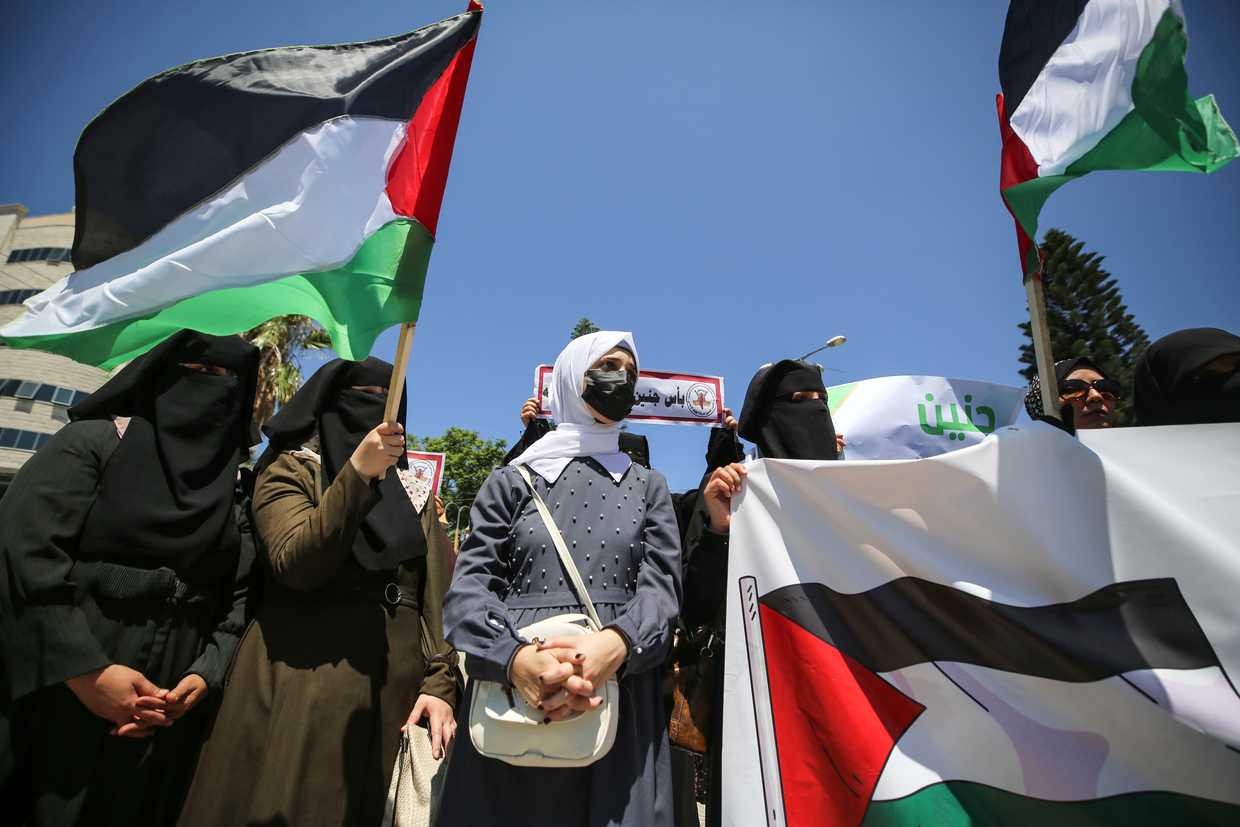
For the first time in nearly two decades, the people of Gaza are raising their voices – not only against Israel but also against Hamas. In an unprecedented wave of protests sweeping across Beit Lahia, Khan Younis, Deir al-Balah, and Rafah, hundreds have taken to the streets, demanding an end to Hamas’ rule, restoration of their rights, and a future free from war and oppression. But as the protests grow, so does Hamas’ crackdown. Can this movement survive, or will Hamas crush it once again?
Why they rise
The demonstrations, which erupted in late March 2025, represent the largest grassroots challenge to Hamas since it seized control in 2007. Protesters chant for freedom, the end of Hamas’ regime, and liberation from the heavy burdens of war, poverty, and fear.
“We can’t live like this anymore,” said Mohammad, a resident of Nuseirat, whose full identity is withheld for safety reasons. “People are drowning in darkness, oppression, and sorrow. We’re exhausted by Hamas dragging us into death and destruction while they live comfortably [in Qatar].”
Since Hamas’ takeover in 2007, conditions in Gaza have worsened significantly – not solely due to the Israeli blockade imposed because of Hamas’ designation as a terrorist organization.
From 2007 to 2023, Gaza’s GDP per capita dropped by 54%, nearing levels last seen in 1994. Unemployment spiked from 40% in 2007 to a staggering 80% by 2024, and poverty soared to 65% by 2022. The war that erupted the following year only worsened the crisis.
Yet, it’s not merely economic hardship driving the unrest. Hamas has maintained an iron grip on Gaza for nearly two decades, suppressing dissent and silencing opposition. Now, frustration has reached a boiling point. Protesters have clear demands: ending Hamas’ rule, restoring basic human rights, and living free from the constant threat of war.
Years of frustration
Though these demonstrations are unprecedented in scale, they aren’t Gaza’s first attempt to challenge Hamas. Previous protests, notably the Bidna Na’ish (“We Want to Live”) movements in 2011 and 2015, called primarily for economic reform and political freedom. Each time, Hamas swiftly crushed these movements with violent crackdowns, arrests, and intimidation.
This time, however, the mood feels different.
“Hamas’ police are everywhere, but people aren’t backing down,” Mohammad said. “They know arrests and violence are inevitable, but we have nothing left to lose.”
Unlike past protests focused mainly on economic grievances, today’s demonstrations explicitly target Hamas’ political power. Protesters aren’t just asking for better living conditions – they want Hamas removed entirely. Interestingly, they blame Hamas, alongside Israel, for Gaza’s current devastation.
Gaza has weathered multiple wars, but the destruction since October 7, 2023, has pushed it to collapse. Following Hamas’ attack on Israel, the Israeli military response left vast areas in ruins.
According to recent UN estimates, 80% of buildings in northern Gaza are damaged or destroyed, 97% of residents lack consistent access to clean water, and child malnutrition rates have doubled. Essential infrastructure is devastated: roads lie in rubble, hospitals barely operate, and power outages are frequent.
“Of course, Israel is bombing us and killing our children, but who brought this upon us?” asked Mustafa, another Gazan critical of Hamas, who spoke anonymously due to fear of persecution.
“When they [Hamas] planned the attack on Israel, didn’t they think what the outcome might be? Did they really think Israel would swallow it? It was obvious that they would wreck havoc on us, so why did the leadership put us in this position from the first place?” he lamented.
Mustafa’s anger at Hamas is intensified by what he sees as their indifference to Palestinian suffering.
“Entire neighborhoods have no food or water, especially since humanitarian aid stopped flowing,” Mustafa claimed. “Meanwhile, Hamas leaders sit comfortably [in Qatar], stockpiling supplies. They’re not suffering like we are.”
After Israel resumed ground operations in Gaza, border crossings closed again, halting humanitarian aid as happened at the war’s onset. Even when assistance was available, reports suggest Hamas and its allies diverted substantial portions, leaving ordinary Palestinians hungry and desperate. Such systemic corruption has deepened resentment. Gazans are now equally outraged at Hamas’ greed and mismanagement as at Israel’s blockade.
Enough is enough?
For years, Hamas justified its authoritarian rule as necessary resistance for Palestinian freedom. But after enduring endless cycles of violence, many Gazans reject this narrative.
“For years, they told us resistance would bring dignity,” Mustafa said. “But what has it brought? Hunger, death, and endless war. Hamas is fighting for Iran’s interests, not for us.”
Hamas’ ties with Iran and other Islamist movements have increasingly become contentious. Protesters accuse Hamas of jeopardizing Gaza’s future by prioritizing foreign agendas.
“They’re gambling with our lives,” Mohammad added. “We’re not pawns in their geopolitical games.”
Hamas doesn’t like what it sees. As protests have grown, the group arrested dozens of activists and ordinary citizens, accusing them of spying for Israel or Fatah, Hamas’ main political rival controlling the Palestinian Authority.
Telegram channels linked to Israel and Fatah claim Hamas has executed at least six Gazans accused of organizing protests, though RT could not independently verify these reports.
Hamas claims to RT that information about group “is punishing those who participated in the protests is lacking any evidence.”
“We believe in the right of the our people to raise their voices, those who went to the streets are representing less than 1-2 % of the population and we are in an hourly contact with the people to discuss a way out”, the group stated.
Nevertheless, reports of torture and other radical methods have understandably frightened many, but Mohammad remains resolute.
“Hamas can use force to silence us,” he stated firmly, “but they can’t erase our anger. The harder they repress us, the stronger we’ll become.”
Mustafa echoed this sentiment:
“Hamas knows if these protests succeed, their reign is finished. That’s why they’re desperate to crush them – and exactly why we’re determined to persist. Enough is enough.”
Hamas’ responses
RT approached a top Hamas official for a comment. The group issued a statement acknowledging the pain felt by the residents of Gaza, while emphasizing unity among Palestinians.
“It is the legitimate right of everybody to cry out in pain and to raise their voices loudly against the aggression targeting our people and the disappointment we face from our nation,” the statement read. “Our people, with all their factions – whether those who have taken to the streets or those who have not – are united; we are part of them, and they are part of us.”
However, Hamas condemned what it described as the manipulation of Gaza’s humanitarian tragedy for political gain, aiming to divert attention away from the real perpetrator – the Israeli occupation and its military.
Addressing critics directly, Hamas questioned: “To those in Ramallah pursuing such questionable agendas, we ask: Where are you when it comes to the ongoing killings, displacement, destruction, and annexation taking place daily in the West Bank? Why do you not mobilize against this aggression, or at least allow the people there to take to the streets and voice their rejection of these crimes?”
Hamas also asserted that it had upheld its commitments under a deal reached with Israel aimed at halting the war. “We have signed a deal with the Israelis, with the main goal to stop the war on our people, and we have fulfilled all our obligations accordingly,” Hamas stated. “Yet, supported by the Americans, the Israelis have breached the deal and launched the war again. Despite of this we are still committed to the deal and we have accepted the proposals presented to us by the mediators.”
The nurse who administered the shots said 1-year-old Sa’Niya needed them to catch her up on vaccinations she missed at her 6-month appointment — a common but potentially dangerous recommendation, according to pediatricians interviewed by The Defender.
Roughly 12 hours after 1-year-old Sa’Niya was given six shots for 12 vaccines during a wellness visit, the little girl died. Sa’Niya — who had just turned 1 year old on March 11 — received the shots on March 26 at about 4 p.m., at Golisano Children’s Hospital Pediatric Practice in Rochester, New York, according to the baby’s mother, Shanticia Nelson.
The nurse who administered the shots said Sa’Niya needed them to catch her up on vaccinations she missed at her 6-month appointment — a common but potentially dangerous recommendation, according to several pediatricians interviewed by The Defender.
Nelson, her husband Kayon Carter and Sa’Niya’s grandmother Latricia Hanley shared the story of Sa’Niya’s death in an interview with CHD.TV Program Director Polly Tommey.
“Sa’Niya was a happy baby,” Nelson said. “She was happy and she loved her dad. Everything was ‘dada.’”
According to the visit notes, Sa’Niya was given six shots containing 12 vaccines, including: “DTap/Hep B/IPV (Pediarix), HiB/Acthib/Hiberix, Pneumococcal 20-valent Conj vaccine, Varicella (known commonly as Chickenpox), MMR, and Hepatitis A.”
She also received sodium fluoride as a teeth treatment.
Nelson said she told the nurse she was uncomfortable having Sa’Niya receive so many shots at once. According to Hanley, the nurse became angry and told Nelson, “She needs these shots. You got to give her these shots.”
The nurse never explained the 12 different vaccines and never mentioned the vaccines’ possible side effects, such as seizures and death.
Sa’Niya was a generally healthy baby. However, on the day she received the shots, she had a “little cough and runny nose,” Nelson said. According to the medical notes from the visit, Sa’Niya also had some eczema, diaper dermatitis and constipation.
‘I just want my baby back’
Within hours after receiving the shots, Sa’Niya’s eyes rolled back and she began foaming at the mouth. The police “ended up coming,” Nelson said. They told her it looked as if Sa’Niya had had a small seizure but that she was breathing OK.
Nelson recalled the police saying, “You guys don’t have to take her to the hospital, but if you want to take her to the hospital to make sure she’s OK, they you could do that.”
Nelson knew something was seriously wrong with Sa’Niya. “I looked at my baby and I said, ‘No, my baby is not right … this is not my daughter. My daughter is active. As soon she gets picked up, she’s active.’”
But when Nelson picked her up in that moment, Sa’Niya “just laid there … her eyes just wandered. She wasn’t responding to me calling her name how she used to.”
An ambulance took Sa’Niya to Saint Vincent Hospital in Lake Erie, Pennsylvania, where doctors started running tests on her. They told Nelson it appeared Sa’Niya had had four seizures by the time she arrived at the hospital.
Nelson left the hospital room to bring in her husband and two older children.
The parents and older children hadn’t been in the waiting room for more than two minutes when a nurse told Nelson, “I’m sorry but your daughter — she’s very sick … right now she’s in cardiac arrest.”
Nelson was told that Sa’Niya’s heart wasn’t responding to CPR and that her blood sugar level was over 700.
Hospital staff continued CPR for roughly 40 minutes. They said, “We’re going to check for a pulse one more time, and if we don’t have a pulse anymore, she’s gone.”
Nelson said, “They checked and she didn’t have that pulse.”
That happened around 4 a.m. on March 27, Nelson told The Defender. “I just want my baby back,” Nelson said. “No amount of money in this world can replace my baby … I want justice for my baby.”
Nelson, Carter and Hanley said in their CHD.TV interview that they hope what happened to Sa’Niya will never happen to another child.
They encouraged parents to do their own research rather than trusting medical staff to give informed consent for the risks of vaccination.
“Don’t let your kids take the vaccination shots,” Nelson said. “Ask questions. Before they give you anything, ask questions because I promise you they’re not going to tell you everything.”
Dr. Liz Mumper, a pediatrician, said it’s “tragic that a healthy baby died soon after receiving multiple vaccines.” But unfortunately, it’s not as rare as people might think.
Historically, the American Academy of Pediatrics (AAP) has “encouraged clinicians to take every opportunity to catch babies up on vaccines,” Mumper said.
She disagreed with claims that all babies can handle lots of vaccines given at the same time. She said:
“Specifically, some babies do not have the liver function or detoxification capacity to handle a cumulative aluminum load. Vaccines stress mitochondria — the powerhouses of the cell. Some babies do not have enough mitochondrial reserve to tolerate the oxidative stress of multiple vaccines on the same day.”
The AAP did not immediately respond when The Defender asked how common it is for pediatricians to do catch-up vaccinations — such as giving a 1-year-old additional shots because the baby missed its 6-month vaccinations — and whether the AAP continues to encourage the practice.
1-year visit ‘most dangerous visit of all’
Three other pediatricians — Drs. Renata Moon, Paul Thomas and Lawrence Palevsky — also told The Defender that administering multiple vaccines to babies and children to “catch them up” isn’t all that rare.
“The death of any child is an absolute tragedy,” said Moon. She told The Defender:
“Catch-up vaccines are regularly given in most offices. Parents need to clearly understand the risks and benefits of each individual shot and the risks of giving them in different combinations all at one time.
“We need a public health system that we can trust to act only in the best interests of our nation’s children, and not in the best interests of the pocketbooks of big pharmaceutical companies.”
Dr. Paul Thomas, a retired Dartmouth-trained pediatrician, said that it’s “very common” for pediatricians to attempt to catch babies and children up on vaccines. “This is routinely done at all well visits.”
Most babies are potentially given around nine vaccines at their 1-year wellness visit if the provider is following the Centers for Disease Control and Prevention’s (CDC) Child and Adolescent Immunization Schedule.
Thomas said, “The one-year well visit has become the most dangerous visit of all — especially if pediatricians are giving the COVID jab.”
The CDC schedule recommends 12-month-olds receive: a third dose of the hepatitis B vaccine, a third or fourth dose of the haemophilus influenzae type B (Hib) vaccine, a fourth dose of the pneumococcal vaccine, the third dose of the polio vaccine, one or more doses of the COVID-19 vaccine, one or two doses of the influenza vaccine, one dose of the measles-mumps-rubella (MMR) vaccine, one dose of the varicella vaccine, and one dose of the hepatitis A vaccine.
Doctors may also choose to give a dose of the RSV vaccine.
Thomas, author of “Vax Facts: What to Consider Before Vaccinating at All Ages & Stages of Life,” said that in the chapter on sudden infant death syndrome, or SIDS, infant deaths are happening right after vaccines with 78.3% (combined data from six studies) dying in the first week after vaccines.
“Vaccines are killing our children,” Thomas continued. “There is data showing that for every vaccine on the childhood schedule, your child is more likely to die from the vaccine than from the disease the vaccine covers.”
He added:
“When you understand that vaccines have never been tested with a proper saline placebo, the safety data is only collected for a few days, weeks or months and they never look at all health outcomes, you begin to understand that parents should think carefully about what they are about to put in their child’s body.
‘Few, if any, pediatricians understand that vaccines can cause harm or injury’
Dr. Lawrence Palevsky also said it’s “very common” for pediatricians to do as many catch-up vaccines in one pediatric visit as what Sa’Niya received.
“Few, if any, pediatricians understand that vaccines can cause harm or injury,” he said. “They also don’t know that the safety and efficacy of the administration of multiple vaccines at the same time have, for the most part, never been studied.”
Angela Wulbrecht, a nurse who serves on the Vaccine Safety Research Foundation’s board of directors, pointed out the same thing. “I feel like parents are not given true informed consent that these things can happen.”
Wulbrecht is assisting Sa’Niya’s family in completing a Vaccine Adverse Event Reporting System (VAERS) report for her death. VAERS is co-managed by the U.S. Food and Drug Administration (FDA) and the CDC.
Wulbrecht is also working with the family to be sure an independent autopsy of Sa’Niya is completed so her family will have thorough, accurate information about the biological mechanisms that caused her death.
Dr. Jacob Puliyel, head of pediatrics at St. Stephens Hospital Delhi, India, called giving 12 vaccines during one appointment “clearly excessive.”
Puliyel said, “This child was given 12 vaccines, where even five vaccines are associated with sudden deaths.”
In 2018, Puliyel and his colleagues published a peer-reviewed article that suggested a link between SIDS and a pentavalent vaccine. According to the World Health Organization, the pentavalent vaccine protects against five diseases: diphtheria, pertussis, tetanus, hepatitis B and Hib.
In 2017, Puliyel and his colleagues also published findings on a link between SIDS and a hexavalent vaccine that targets diphtheria, tetanus, acellular pertussis, hepatitis B, inactivated poliomyelitis and Haemophilus influenza type B vaccine.
Puliyel said, “Parents must be made aware of these risks and one hopes the U.S. FDA will investigate these reports and inform the public. Doctors need clear guidance about the dangers.”
“Threats are indeed being heard, ultimatums are also being heard,” Russia Deputy Foreign Minister Sergei Rybakov told International Affairs in an interview published Tuesday, adding, “We consider such methods inappropriate, we condemn them, we consider them a way for (the US) to impose its own will on the Iranian side.”
Russia proposed mediation between Trump’s administration and Iran, following their strategic partnership deal earlier this year.
Ryabkov said that Trump’s threats to Iran only complicate the situation between the two countries, emphasizing that if the US administration follows up with its warnings and strikes Iranian nuclear facilities, the consequences could be catastrophic for the entire region.
“While there is still time and the ‘train has not left’, we need to redouble our efforts to try to reach an agreement on a reasonable basis. Russia is ready to offer its good services to Washington, Tehran, and everyone who is interested in this,” the deputy foreign minister stated.
As we end the first quarter of 2025, we are now getting a glimpse of President Donald Trump’s plan for his New World Order beast financial system, which will be based on fully traceable cryptocurrencies.
While the media has been largely detracted by Musk and his DOGE activities that are allegedly saving the U.S. $billions of dollars by cutting government jobs and agencies, it has now been revealed that the Trump administration has actually spent MORE money out of the U.S. Treasury than the Biden administration did last year during the same time frame.
This gives further credence to what Catherine Austin Fitts said a couple of weeks ago, that the Trump administration was NOT reducing spending at all, but just taking that spending out of the Civil Service sector, and transferring those jobs to the private sector instead.
Musk claims otherwise, but the Trump administration’s spending is on track to surpass Biden’s
U.S. Treasury is on pace to spend 7.4% more in 2025 than last year
Elon Musk doubled down on his pledge to cut government spending by $1 trillion — an amount that would slash the federal budget deficit in half and, if implemented, put the U.S. much closer to stabilizing the growth of its debt burden relative to the size of the economy.
“Our goal is to reduce the deficit by a trillion dollars,” Musk told Fox News during Thursday evening’s made-for-TV event — adding that he hoped to reduce overall federal spending by 15% solely through “eliminating waste and fraud,” a goal he said “seems really quite achievable.”
He pointed to a number of examples of wasteful spending, including a survey that Musk claimed was done for the Interior Department at a cost of $830 million to collect Americans’ opinions of national parks.
Musk said that the same survey could have been done by another vendor for just $10,000.
DOGE made it particularly challenging to fact check its assertions when it removed federal identification numbers in its website’s source code that could help outsiders identify specifically what grants and contracts the agency is referring to.
That makes it difficult if not impossible to know the vendors the government has contracted with and whether the government is actually saving the amount of money DOGE is asserting that it has.
And there remain claims on the so-called department’s website that are incorrect. The largest savings asserted by DOGE is a canceled $1.9 trillion contract for IT modernization. But the contractor awarded the money told the New York Times last month that the award was actually canceled in November, under President Joe Biden.
The Federal Procurement Data System, a database of federal procurement projects, indicates that no money was ever spent on this grant, despite its authorization of the IRS to spend $1.9 billion over 7 years.
[…]
The Hamilton Project, an economic-policy think tank, tracks federal spending using daily Treasury statements published by the government.
These data show that the federal government had spent $1.893 trillion in 2025 as of March 26, compared with $1.763 trillion as of the same date last year.
In other words, federal spending is on pace to come in 7.4% higher this year than last. (Source.)
[…]
Where is all of that money from the U.S. Treasury going then, after all of these massive “cuts” in government spending under Musk?
Undoubtedly much of that has gone directly to Israel in the form of bombs and other military equipment, as well as in supplying the massive U.S. Navy build-up in the Red Sea to bomb women and children in Yemen. See Trump Starts New War in Middle East by Bombing Yemen Women and Children
The news that shook the banking industry last week, however, was the announcement that President Trump and the Trump family were starting their new financial network with their own new cryptocurrency, to compete with traditional banks.
Of course this is all happening at the same time that Trump and DOGE are attempting to eliminate the very agencies and regulatory groups that oversee banks and are supposed to protect consumers from greedy billionaires in the first place. They are also trying to rush new crypto-friendly laws through Congress.
Trump’s Stablecoin Push Set to Collide With Banks
Crypto regulations moving through Congress caught banks by surprise—then Trump said he would start his own stablecoin, scrambling the talks.
New crypto legislation that could make stablecoins a far bigger part of the financial system is moving rapidly through Congress, putting banks on the defensive even before President Donald Trump jumped into the fray.
Trump said he wanted stablecoin rules to be the first crypto legislation of his administration.
[…]
With banks and crypto companies fighting to influence the rules, the president launched his own stablecoin, effectively threatening to take business away from both industries.
Unlike better-known crypto assets like bitcoin, stablecoins don’t fluctuate in price, they are typically pegged to the dollar.
They are used to store cash, much like a money market fund, and to easily move money across borders. The stablecoin market has soared to $230 billion and is dominated by Tether and Circle, which are worth $145 billion and $60 billion, respectively.
The latest entrant is the Trump family itself: World Liberty Financial, a crypto project started by Trump and his sons, announced last week it is also launching a stablecoin called USD1. That raises the prospect that Trump could pass legislation that would benefit his own venture.
Congress is moving swiftly to advance stablecoin bills. On Wednesday, the House Financial Services Committee is scheduled to vote on whether to move a stablecoin bill to the overall House floor. A similar bill already passed the Senate Banking Committee earlier this month. Trump wants the legislation, which has the support of some Democrats, passed by August.
[…]
Notice the part I bolded above: “Stablecoins are highly connected to the financial system because they are backed by cash and treasuries.”
In other words, they want to buy the U.S. Government debt, and then sell it to YOU, the American public, through their stablecoins.
And what are they going to do with the money you give to them, whether willingly or unwillingly, such as through your 401K and retirement funds, including Social Security?
[…]
This is exactly what Catherine Austin Fitts has been warning about (see video above). Fitts served in government under the Bush Administration and was the Assistant Secretary of Housing and Urban Development under Jack Kemp, who was embroiled in the Franklin cover-up and child sex abuse scandal.
[…]
As was mentioned in the article from The Information that I quoted above, Tether is currently the largest stablecoin in the cryptocurrency market, with a value $145 billion out of the $230 billion stablecoin market.
[…]
Reuter’s published a deep dive into the Trump family’s take over of World Liberty Financial today, and the introduction of their new stablecoin, USD1.
Here are some excerpts from the Reuter’s article (emphasis mine):
Insight: How the Trump family took over a crypto firm as it raised hundreds of millions
As World Liberty Financial raised more than half a billion dollars, President Donald Trump’s family took control of the crypto venture and grabbed the lion’s share of those funds, aided by governance terms that industry experts say favor insiders.
[…]
Overall, the Trump family now has a claim on 75% of net revenues from token sales and 60% from World Liberty operations once the core business gets going. The arrangement means the Trump family is currently entitled to about $400 million in fees.
[…]
David Krause, a longtime finance professor at Marquette University in Milwaukee who recently published a study of World Liberty, said that the structure of the project:
“pretty much excludes public investors or token holders from any meaningful financial participation.”
A White House spokesperson referred questions about World Liberty to the Trump Organization.
The Trump Organization’s chief legal officer and the president’s two older sons, who are executives at the company, did not respond to requests for comment.
The Trump Organization announced in January that the president’s investments, assets and business interests would be held in a trust managed by his children and he would play no role in day-to-day operations or decision-making.
Folkman and Herro did not reply to Reuters questions in person and in writing. In a post on social media platform X on March 14, World Liberty said it:
“is a DeFi project with a tremendous mission to build and democratize a new financial system for the benefit of millions.”
At a conference in February, Herro said the plan was to open crypto investing to everyday Americans such as teachers, dentists and firemen.
The Trump family’s investment in World Liberty ties the personal fortunes of a sitting U.S. president to an asset class that sits at the outer edges of both risk and regulation.
Trump has promised to be the “crypto president,” who will popularize its mainstream use in America.
The Trump family, long rooted in skyscrapers and country clubs, has opened beachheads in crypto, quickly gaining hundreds of millions of dollars.
On Monday, the Trump family deepened its crypto interests, as a company formed with the president’s elder sons, Eric and Donald Trump Jr., took a minority stake in a newly-formed bitcoin producer called American Bitcoin.
Eric Trump will become the chief strategy officer of the new firm, which will focus on mining bitcoin and aims to become publicly listed, the statement said.
The prospect of Trump and his family benefiting from deregulation has drawn criticism from his political opponents and some government ethics experts who say it creates the potential for conflicts of interest and influence peddling.
“You’ve got the guy in charge who is responsible for his own regulation,”
[…]
Folkman and Herro entered Trump circles via the family of New York real estate mogul Steve Witkoff, a longtime Trump friend who is now also his envoy to the Mideast.
The two crypto entrepreneurs had already collaborated on several companies together focused on making money from online ventures.
Their business background includes past instances of dissolution, litigation and unpaid debts, according to corporate records, state filings and U.S. court documents. Early in his career, Folkman offered seminars on how to “date hotter girls.”
Steve Witkoff said he was introduced to the pair by one of his sons, when speaking about how the deal came together on a crypto podcast hosted in September by the Trump family. (Source.)
Steve Witkoff, of course, has been in the news a lot lately, as he is Trump’s envoy to the Middle East and is allegedly trying to broker a ceasefire deal between Hamas and Netanyahu, although Netanyahu is currently facing criminal charges over “qatargate”, which revealed that Netanyahu had been funding Hamas before the October 7, 2023 terrorist attack.
This documentary profiles the Soviet effort to suppress the massive achievements of five dissident Russian intellectuals who emigrated to the West. The first was the father of television Vladimir Zvorkin, the second photographer and designer Alexsay Brodovich, the third revolutionary ship designer Ivanovich Yurkevich, and the fourth and fifth the fathers of Hollywood Joseph and Nicolas Schenk.
Vladimir Zvorkin – attended St Petersburg Institute of Technology in 1906, where he worked with Boris Rozing, inventor of the cathode-ray tube used in the first television receiver. Facing arrest for collaborating with White Russians during the Bolshevik Revolution, he escaped to the US via Denmark and Great Britain. With the help of Russian born RCA director David Sarnoff, he patented the first prototype television in 1938. He returned to Russia many times, where he helped develop the Russian TV industry.
Alexsay Brodovich – former White Army officer, emigrated to France shortly after the October Revolution where he befriended the French impressionist painters Chagall, Cocteau, Matisse, Picasso and Derain and was hired as a set designer and photographer by Serge Draghilev, founder of France’s Ballets Russes. In 1930 became France’s first graphic designer. Relocated to the US he started a design school and worked for the Pennsylvania Museum School of Industrial Arts Advertising Design Department before becoming Harper’s Bazaar design director in 1938, turned the magazine into a work of art. He never returned to Russia although he raised funds for the USSR during World War II.
Vladimir Ivanovich Yurkevich – after studying ship building at St Petersburg’s Polytechnic University, he emigrated to France in 1917 and designed the Normandie a massive (“floating super city”) French passenger liner and one of the first to do regular transatlantic trips. During World War II involved with Russian emigres who lobbied the US to open a second front. He also prepared US lend lease vesels that were lent to the Soviet Union. At his death in 1964, he willed all his blueprints to the Soviet archive.
Joseph and Nicolas Schenk (changed from Schenker) – emigrated to US via France prior to the 1917 revolution, after their Jewish father was threatened with expulsion to the Pale of Settlement for changing his profession.* In 1917, after financier Marcus Loew brought them into the nickelodeon business, Joseph organized a film production company while Nicholas started a film distribution company. In 1924 Nicholas started Metro Goldwyn Meyer (by buying three small film companies and consolidating them). Joseph subsequently acquired United Artists, founded in 1919 by Charlie Chaplin, D.W. Griffith, Mary Pickford and Douglas Fairbanks. Joseph, who championed the career of Marilyn Monroe, did four years in jail for paying his Mafia protection money with a bad check.
*The Pale of Settlement was a western region of the Russian Empire with varying borders that existed from 1791 to 1917 in which permanent residency by Jews was allowed and beyond which Jewish residency, permanent or temporary, was mostly forbidden. Prior to 1917, Russian Jews weren’t allowed to own property or change professions.
A major scandal known as “Qatargate” has erupted in Israel, involving alleged Qatari interference in Israeli politics.
At the center of the investigation is Eliezer Feldstein, former chief aide to Prime Minister Benjamin Netanyahu. He was arrested in November 2024 on charges of leaking classified documents to foreign media and orchestrating leaks from high-level government offices, allegedly with Netanyahu’s own approval, under the pretext of combating disinformation.
The investigation revealed Feldstein’s connections with Qatari authorities. While serving as an employee of the press office in Netanyahu’s administration, Feldstein had for several years combined his government work with private practice, offering political consulting and branding services. One of his clients was Qatar.
Specifically, on behalf of Doha, Feldstein and his team of Israeli consultants developed a reputation protection strategy during preparations for the 2022 FIFA World Cup. Later, they helped Qatari brands regain their positions in Gulf markets that had been lost during the 2017-2021 diplomatic crisis.
When the most recent war with Hamas began in October 2023, Feldstein used his official position to actively promote the idea of Qatar’s “exceptional role” in resolving the Gaza crisis. He was so successful in communicating this position to the media that at one point, Israeli press began emphasizing Qatar’s key role in negotiations compared to Egypt and Jordan. In turn, Qatar actively used its Al Jazeera media network to promote positive coverage, strengthening its image in this context.
However, after Feldstein’s arrest by Israeli security forces in the autumn of 2024, the contract with Qatar was abruptly terminated. Initial publications about the “Qatar dossier” in Israeli media raised more questions than outrage. Feldstein, along with other figures in the case such as Yonatan Urich and Srulik Einhorn, had been actively involved in international activities, advising not only Qatar but also other Israeli partners in the Middle East and beyond. Had they not used confidential materials from the Prime Minister’s Office, their work might have been considered part of Israel’s “backchannel diplomacy.”
Yet, in the context of the conflict with Hamas, the situation took on a different meaning. It became clear that Qatar’s status as a “neutral force” in negotiations with Hamas was not accidental, and this country’s role in the process had been significantly exaggerated. For example, Doha’s decision not to pressure Hamas’s “political office” was presented as diplomatic “flexibility,” which also raised questions. Even more suspicious was the downplaying of the scandal involving Hamas military training camps in Syria’s Afrin, to whose construction Qatari contractors were allegedly linked.
This series of coincidences strengthened suspicions that those involved in the “Qatar dossier” had actively helped Qatar cover up international scandals using documents from the Prime Minister’s Office. All three suspects theoretically had access to such materials. Although Feldstein’s lawyers call these accusations “baseless speculation,” those involved in the case have so far been unable to explain how Qatar managed to navigate crises with minimal damage to its image.
Adding to the intrigue, Urich and Einhorn are also suspects in a case involving the intimidation of official Shlomo Filber, who allegedly retracted his testimony about Netanyahu’s corrupt connections after prolonged psychological pressure from Likud representatives.
The case, initially classified as a “special investigation” under a secrecy order imposed by intelligence services, has been becoming increasingly public. In recent weeks, the escalation has drawn public attention as new developments pointed to major new suspects. This scandal has affected not only Israel’s political class but also the business community, significantly expanding the circle of suspects.
What began as an investigation into abuse of authority soon accumulated new details and acquired the colorful name “Qatargate.” This name hints at potential consequences for the country’s top leadership, including the possible resignation of senior Israeli officials. However, those implicated in the scandal aren’t giving up without a fight. According to investigators, Feldstein was involved in transferring confidential documents to foreign media, bypassing military censorship, as well as organizing leaks from high-level government offices. Allegedly, he acted with the permission of Netanyahu himself, who, according to the prosecution, sought to “combat fake news” about Israel’s foreign and domestic policies this way.
Over time, the investigation expanded in scope. The number of suspects grew to five, most of whom had close ties to the Prime Minister’s Office. It also emerged that Feldstein not only leaked confidential information but also advised Qatari authorities, helping the monarchy use this information for diplomatic purposes, including positioning itself as a key mediator in matters concerning the release of Israeli hostages.
Given Qatar’s close ties with Hamas, this new information about the figures involved in the investigation has deeply shocked the Israeli public. It has sparked discussions about the true scale of the threat to Israel’s national security. But the investigation didn’t end there. A new public figure emerged – Israeli businessman Gil Birger, who works with Persian Gulf states. According to investigators, it was he who paid Feldstein fees for work improving Qatar’s image while Feldstein simultaneously worked in the Prime Minister’s Office and engaged in political consulting.
However, according to Birger himself, he merely served as a link in a complex lobbying scheme. The main services to Qatar, including developing a reputation improvement strategy, were provided by American political consultant Jay Footlik, who was officially employed by the Qatari government. It was Footlik who initiated Feldstein’s involvement in the work. However, facing difficulties with tax laws and organizing money transfers from Qatar to Israel, Footlik asked Birger to temporarily serve as the “accountant” of their small enterprise. The cooperation continued in this format for several months.
Although Birger’s testimony is corroborated by witness statements and intelligence materials, the businessman clearly downplayed his involvement in “Qatargate.” He failed to mention that his connection with Footlik and the arrested Likud supporters of Netanyahu wasn’t limited to working together on several election campaigns – it also included indirect participation in developing shadow trade channels between Israel and Arab monarchies. Moreover, according to some witnesses, Footlik allegedly engaged with Hamas representatives, attempting to secure the release of Israeli hostages by offering generous payoffs to certain field commanders. Such moves were clearly too risky to be undertaken without approval from high-ranking officials. It’s unlikely a lobbyist working for Qatar would take such risks without backing from higher-ups.
Among Israeli elites, many are trying to capitalize on the “Feldstein affair,” especially since the scandal tarnishes the reputation of the seemingly “unsinkable” Prime Minister Benjamin Netanyahu, whose role in the arrested political operatives’ activities remains unclear. One advocate for sweeping changes in the prime minister’s office is Shin Bet chief Ronen Bar, who was tasked with investigating this high-profile case.
Bar’s dissatisfaction stems partly from professional pride. For a year and a half, he co-led Israel’s official negotiation team with Hamas. However, his work faced constant criticism, especially when talks stalled, and he was nearly ousted multiple times. Upon discovering that the Prime Minister’s Office had been conducting its own diplomatic maneuvers – sometimes disregarding national interests and even contradicting the negotiation team’s official stance – Bar was deeply disillusioned. He was the first to coin the term “Qatargate,” a clear allusion to the scale of damage inflicted on the country. Netanyahu’s attempts to swiftly remove Bar under the pretext of incompetence only backfired, fueling suspicions that the PM was trying to obstruct the investigation and bury the scandal. This triggered protests in Bar’s support, further escalating political tensions.
Israel’s government continues to reel from a wave of resignations and reshuffles. On March 19, far-right leader Itamar Ben-Gvir rejoined the cabinet, and on March 21, the ministers reluctantly approved Bar’s dismissal – part of Netanyahu’s strategy to consolidate power and sideline “uniformed opposition.” But this time, the PM’s usual tactics misfired, as Bar’s departure created new complications.
Bar outlasted his counterparts in the military and intelligence brass, largely due to his key role in Gaza negotiations, where he co-led Israel’s delegation. His successes in eliminating high-profile Palestinian militants also bolstered his standing. Yet his personal clash with Netanyahu ultimately led to his resignation. Bar accused the PM of corrupt dealings and jeopardizing national security through leaks of classified documents to the press – dubbed “Qatargate.” Netanyahu took this as a personal affront and leveraged all his influence to force Bar out. Against the backdrop of Gaza talks and the abrupt decapitation of counterintelligence, fears grew that this might hand Hamas a tactical advantage.
Despite these challenges, Netanyahu successfully convinced the government and oversight bodies of his initiative’s merits. On March 21, plans were announced for imminent reshuffles in Shin Bet, with Bar expected to depart by April 10. However, the government is considering accelerating the process by appointing an external candidate as Shin Bet chief, as Netanyahu and his inner circle distrust Bar’s deputies, viewing them as ideologically aligned with the ousted director. The situation is further complicated by the fact that Shin Bet’s entire leadership has been tainted by failures in Palestinian operations and a series of espionage scandals.
Amid these changes, the return of Ben-Gvir as national security minister went almost unnoticed. Ben-Gvir, who left Netanyahu’s coalition in January 2025, rejoined the government as Gaza operations escalated. To facilitate this, Netanyahu overruled Israel’s Attorney General, who had deemed Ben-Gvir’s reappointment untenable. Upon his return, Ben-Gvir shelved his criticism of Netanyahu, endorsing the government’s current strategy and praising its decision to resume attacks on Hamas. Yet he spared no harsh words for those advocating ceasefire talks – including Bar, whom he branded “democracy’s greatest threat.”
This political maneuvering – pitting Ben-Gvir against Bar – allowed Netanyahu to deflect scrutiny, redirecting criticism toward Bar. The government showcased unity among the far-right flank, now represented by Ben-Gvir’s Otzma Yehudit party. With his return, the coalition stabilized, and the six-seat leverage of Ben-Gvir’s party enabled unpopular decisions without risking legitimacy.
However, the opposition continues exploiting pro-Bar protests for its own gain. Though officially resigned, Bar may remain in office until Gaza hostilities conclude, citing operational necessity – a move that could allow him to expand his “dossier of failures” and corner the prime minister, potentially marking the beginning of Netanyahu’s political end.
The “Qatargate” scandal keeps widening, clearly entangling Netanyahu in a precarious position where he battles not just external threats but an internal power struggle. Despite his decades-long dominance, his career now faces relentless adversaries – both within his party and the opposition – eager to exploit any weakness. This infighting intensifies pressure on his government, where political survival rivals military strategy in urgency.
Meanwhile, the military situation deteriorates. Israel has resumed strikes on Gaza, escalated West Bank operations, and continued aerial attacks in Lebanon and Syria. The repeatedly violated truce with Hamas has collapsed again, edging the region toward all-out war. Recent discussions of relaunching ground operations in Gaza have heightened domestic tension, compounding Netanyahu’s challenges. Against this backdrop, political instability and scandals like “Qatargate” only deepen the crisis.
Donald Trump’s re-election as US president has unsurprisingly triggered a dramatic escalation of tensions in the West Asia region, allowing Benjamin Netanyahu to intensify the genocidal offensive on Gaza.
In a blatant breach of the ceasefire deal with Hamas, the Israeli regime imposed a crippling blockade on Gaza, followed by renewed genocidal aggression on the besieged Palestinian territory, killing nearly 500 civilians in a single day, most of them children and women.
Yemen, which had issued a four-day ultimatum demanding that the Israeli regime lift the blockade during the holy month of Ramadan, reaffirmed its readiness to resume pro-Gaza operations after the regime continued within its inhumane blockade and aggression.
However, it was Trump who ordered devastating airstrikes on the poorest Arab country, killing dozens of civilians and prompting swift and forceful retaliation from the Yemenis.
Taken aback by retaliatory attacks on a US aircraft carrier and other warships in the Red Sea, the newly elected Republican president, known for his off-the-cuff remarks, declared that the Islamic Republic of Iran would be held responsible for the actions of the Yemenis.
His remark came only days after he sent a letter to Tehran. While the content of the letter remains undisclosed, Iran’s Foreign Minister Abbas Araghchi on Thursday said Washington would receive a response in the coming days, stressing that Tehran will not bow to pressure.
[…]
Military strategists caution that the consequences of any such miscalculation would be catastrophic given Iran’s military readiness and high capabilities.
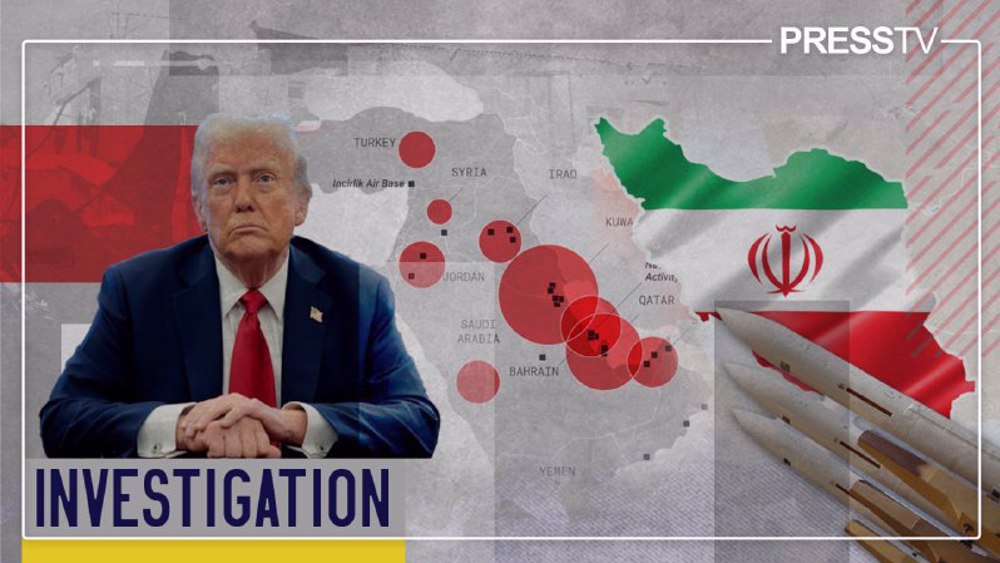
The US has hundreds of military bases spread across the West Asia region, from Bahrain to the United Arab Emirates, Qatar, Kuwait, Saudi Arabia, Iraq, Jordan, and beyond.
US military footprint in West Asia
The United States maintains a significant military presence in West Asia, with numerous bases and facilities spread across multiple countries, namely Bahrain, Cyprus, Iraq, Jordan, Kuwait, occupied Palestine, Oman, Qatar, Saudi Arabia, Syria, and the UAE.
These bases serve various strategic purposes, including controlling the global flow of oil, maintaining influence over critical chokepoints, ensuring the survival of the Zionist entity, attempting to encircle Iran, and subduing the Axis of Resistance.
At the end of last year, US military officials reported approximately 40,000 service members in the wider region, including those on ships like aircraft carriers and destroyers in regional waters like the Red Sea and Gulf of Aden.
According to the latest estimates, the US maintains military facilities in dozens of countries across West Asia, with many of them considered permanent by military analysts.
Apart from well-established bases in Bahrain, Egypt, Iraq, Jordan, Kuwait, Qatar, Saudi Arabia, Syria, and the United Arab Emirates, there are also massive bases in Djibouti and Turkey, which are also used for military operations in West Asia.
According to various estimates, there are more than 60 American military bases, garrisons, or shared facilities in West Asia, which have long been used for destabilizing activities.
[…]
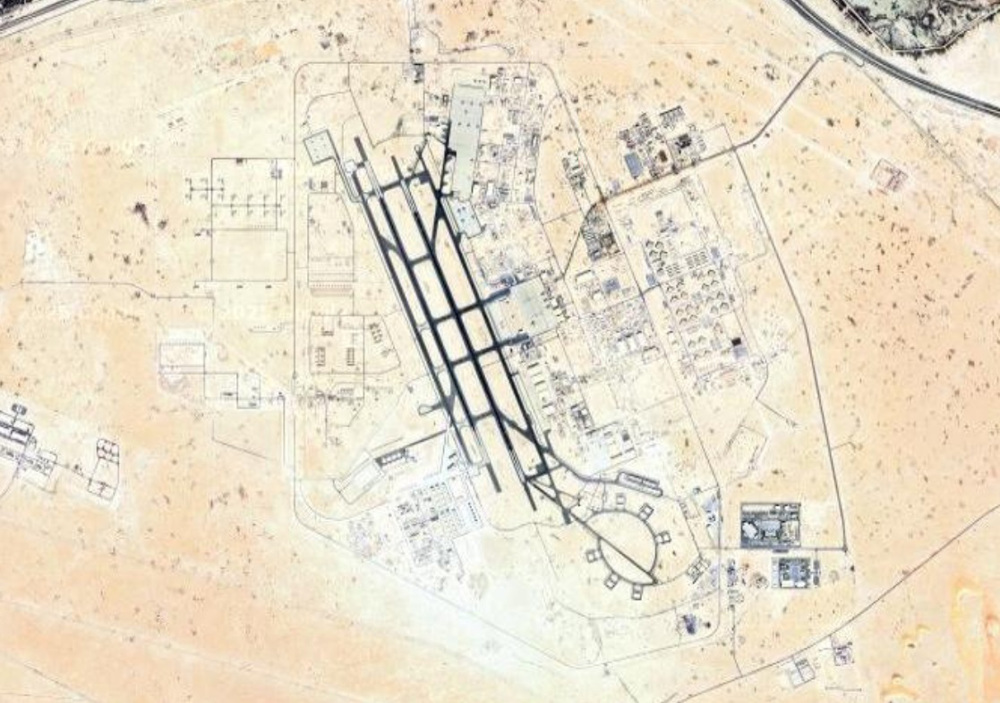
Al Udeid Air Base (Qatar)
Al Udeid Air Base near Doha, Qatar
Al Udeid Air Base (AUAB), located southwest of Doha, Qatar, is the largest US military base in West Asia and a critical hub for air operations across the region, including in Iraq and Syria.
[…]
Apart from the US Air Force as the main operator, it also houses Qatar Emiri Air Force, British Royal Air Force, and occasionally other foreign forces.
Most importantly, it also hosts the forward headquarters of the US Central Command (CENTCOM), one of the eleven unified combatant commands of the US Department of Defense.
[…]
The base is located 275 km from the Iranian mainland and can be targeted by all operational Iranian ballistic missiles, even long-range rocket artillery systems, and most available kamikaze drones.
With very few hardened exceptions, the base’s hangars and other facilities are mostly made of prefabricated materials, vulnerable to missile attacks. The AUAB therefore relies on air defense systems, primarily Patriot.
[…]
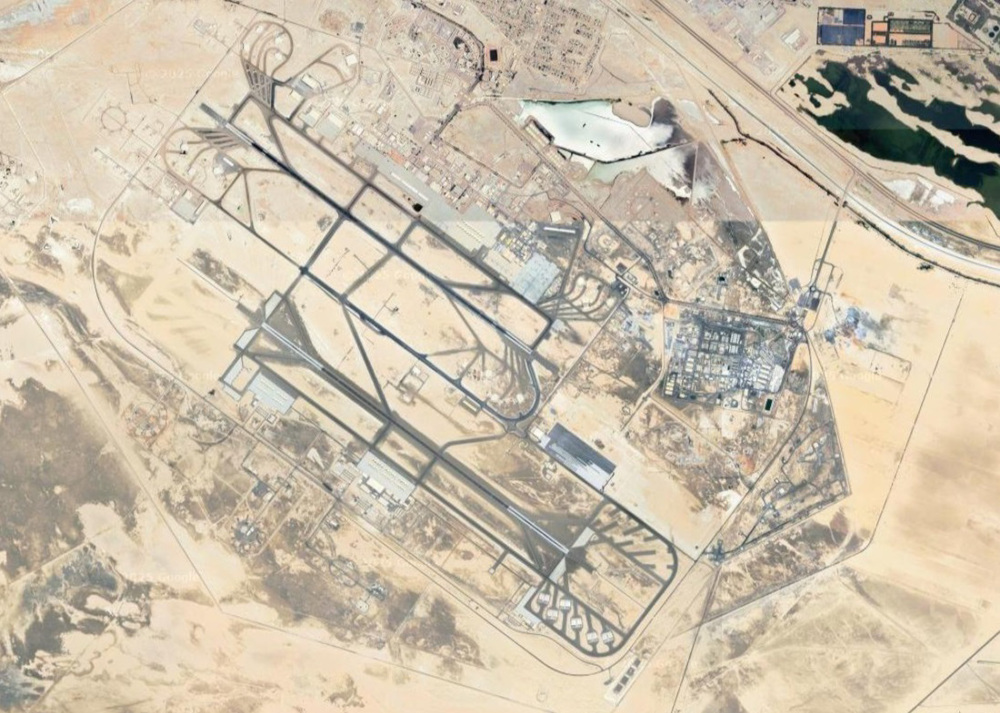
Al Dhafra Air Base (UAE)
Al Dhafra Air Base near Abu Dhabi, UAE
The US military maintains a significant presence in the UAE, with many known and unknown bases. One of them widely recognized and documented is Al Dhafra Air Base (ADAB).
[…]
Dating back to the 1990s, it supports US military operations in the Persian Gulf and beyond, providing air support and intelligence capabilities. The base is also used by the UAE Air Force and the French Air Force.
ADAB hosts the US Air Force’s 380th Air Expeditionary Wing, with about 5,000 active duty military personnel, and its primary mission is aerial refueling and high-altitude all-weather intelligence, surveillance, and reconnaissance.
[…]
Similar to AUAB in Qatar, ADAB is located 250 km from Iranian territory and is exposed to a wide arsenal of missiles and drones, which can easily evade Patriot and THAAD air defense systems.
Another US military base in the UAE is Jabel Ali Port in Dubai, which is the largest man-made harbor in the world and a critical logistical hub for the US Navy and hosts more US Navy ship visits than any other port outside the territory of the US, supporting the Fifth Fleet in Bahrain.
Fujairah Port and Airfield on the eastern coast near the Strait of Hormuz is also an important base. Fujairah serves as a logistical point for US Navy ships and has facilities leased for strategic reconnaissance aircraft (e.g., Lockheed U-2s) and refueling planes.
Ras al Khaimah Airfield is another US military base in the UAE, which is often used for tactical aviation and reconnaissance operations.
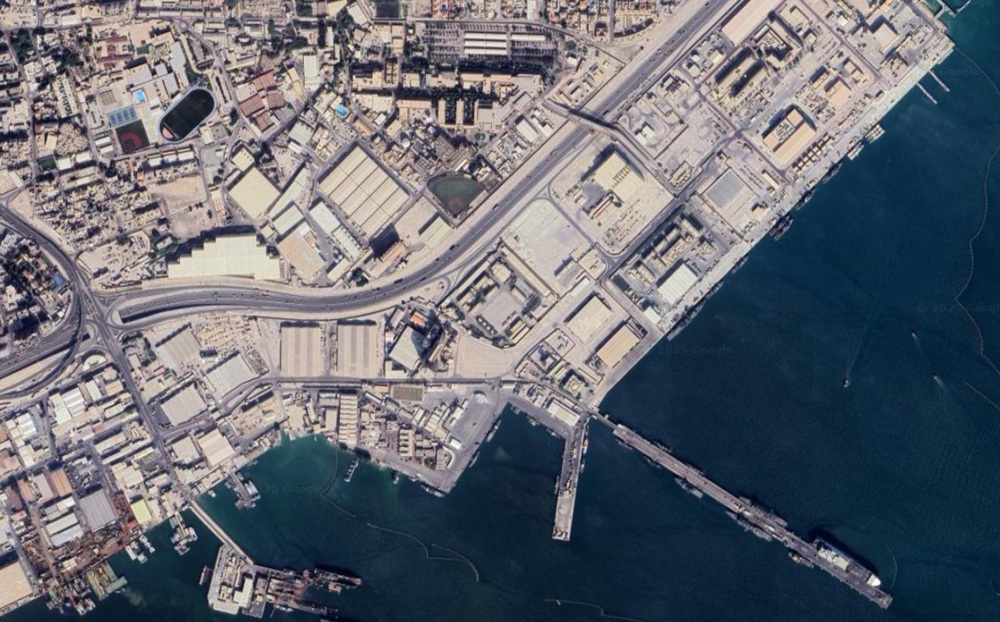
Naval Support Activity Bahrain (Bahrain)
Naval Support Activity Bahrain
The US military maintains perhaps the most active military presence in Bahrain, home to the US Fifth Fleet, which is used extensively for hostile operations in the region and beyond.
[…]
Established on the site of the former British Royal Navy base named HMS Juffair, the US Navy took over the NSA facility in 1971, and today supports over 9,000 military personnel, US Department of Defense employees, as well as over 100 tenant commands.
[…]
Other US military bases in Bahrain include Muharraq Airfield, located near Bahrain International Airport, and operated by the US Navy for logistical operations, including the transportation of military supplies and personnel.
Naval Regional Contracting Center (NRCC) Bahrain is another US military facility in Bahrain that functions as a central hub for logistical support for US military operations across Africa, Europe, and Western Asia, according to military experts.
Dimona Radar Facility (Occupied Palestine)
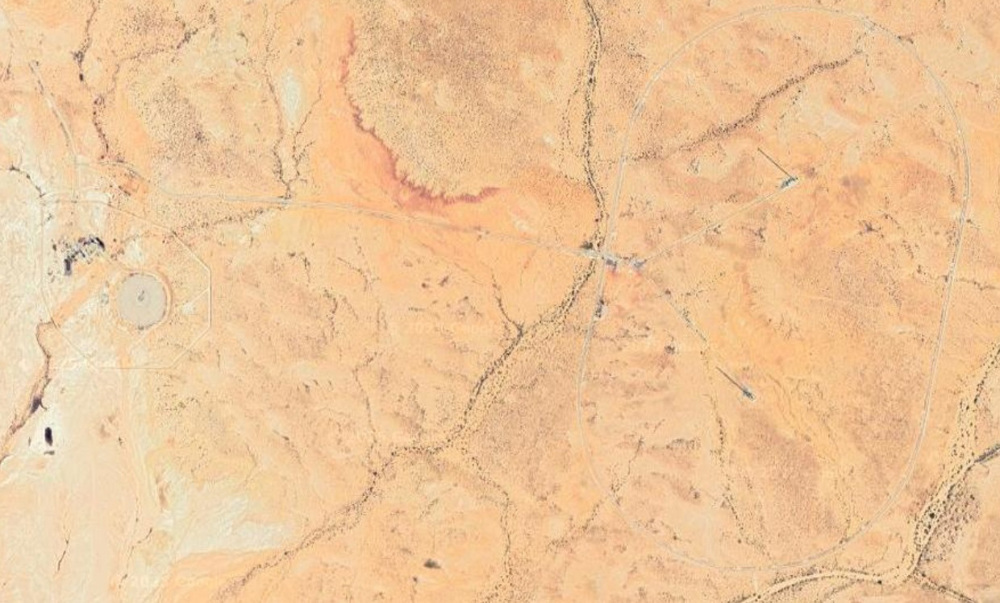
Dimona Radar Facility in the occupied Palestinian territories
The Dimona Radar Facility is located near the town of the same name and is a clandestine nuclear facility in the occupied Palestinian territories, operated by the United States.
[…]
Another significant American facility in the Zionist entity is the Ofrit SIGINT Base, on Mount Scopus in occupied East al-Quds, used jointly by the National Security Agency (NSA) and Israeli intelligence agencies.
Related American-British ELINT, COMINT, and MASINT facilities are also located in Cyprus, at the same distance from Iran as from the occupied Palestinian territories.
Naval Support Facility Diego Garcia (Diego Garcia)
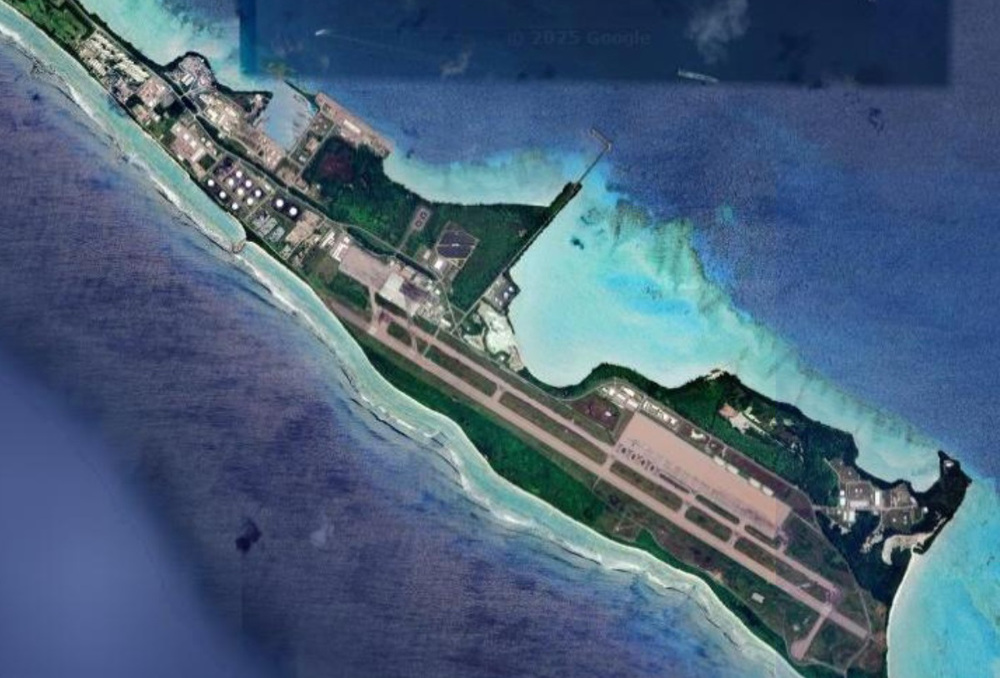
Naval Support Facility Diego Garcia in the Indian Ocean
Naval Support Facility Diego Garcia (NSF) is a jointly managed UK–US military base on the British-administered atoll Diego Garcia in the Indian Ocean.
The strategic base was built in the 1970s by the British, after ethnically cleansing over 2,000 of the indigenous population, and was later significantly upgraded by the US Navy and Air Force.
[…]
The island base is home to about 4,000 military personnel and contractors, the vast majority of them Americans, according to multiple reports.
[…]
Iran possesses adequate weapons for such an attack from its mainland, such as newer versions of the Khorramshahr missile that have an intermediate range, and the Shahed-136B kamikaze drone with a range of 4,000 km.
There is also the possibility of launching other drones and missiles, with a slightly shorter range than those mentioned, from various naval vessels.
Muwaffaq Salti Air Base (Jordan)
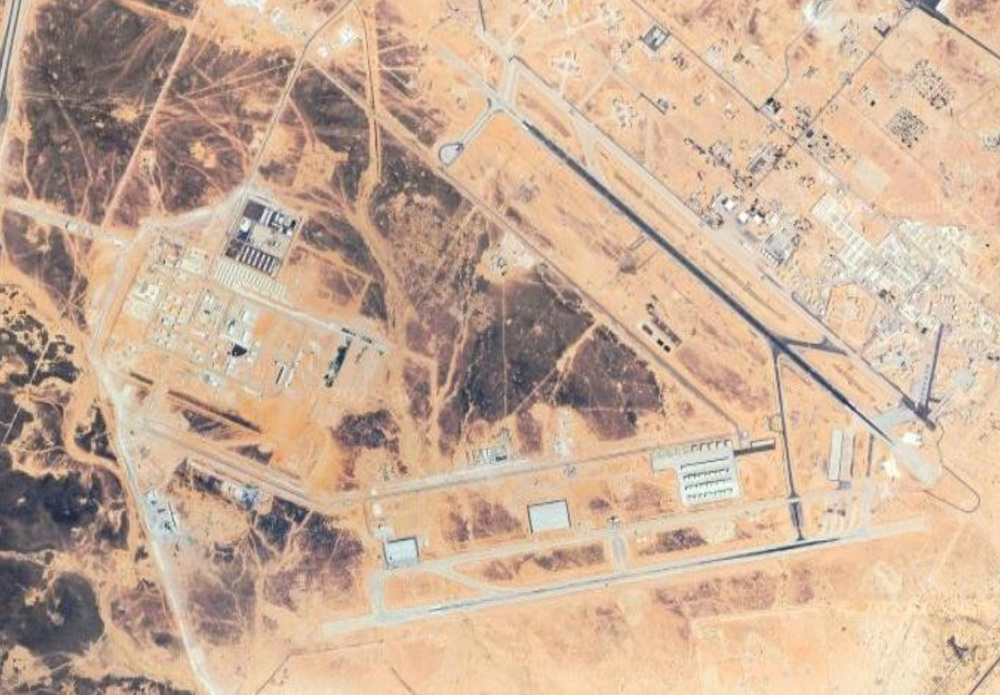
Muwaffaq Salti Air Base in Jordan
Like other countries in the West Asia region, the US also maintains an active military presence in Jordan. While the exact number of US military bases in Jordan is not known, some bases have been widely written about and used for hostile American activities in the region.
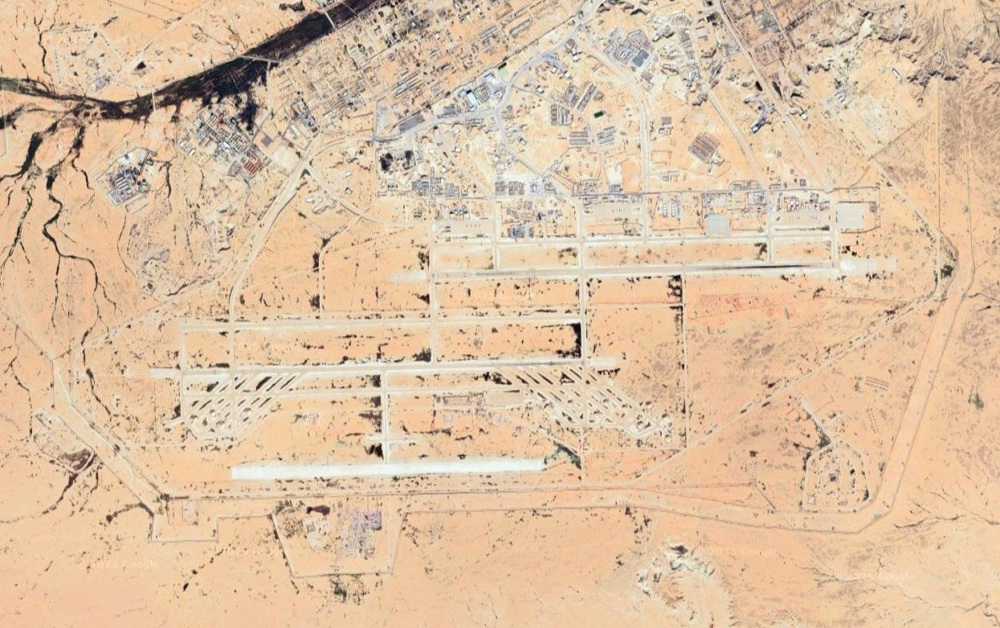
One of them is Muwaffaq Salti Air Base, which is located near Azraq and serves as a key site for both the Royal Jordanian Air Force and US military operations in the region.
[…]
While the exact number of US military personnel stationed at the base is not publicly known, there are around 4,000 US troops present at various US military bases in Jordan.
[…]
This base is also within the range of Iranian medium and long-range missiles and drones.
Other US facilities in Jordan include Area Support Group-Jordan (ASG-J), which facilitates military operations and activities that aid in hostile American activities in the region.
Tower 22 Outpost, situated near the northeastern border of Jordan and close to Syria and Iraq, has long been used by US forces for monitoring and operational purposes. Notably, in January 2024, it came under a drone attack that resulted in the deaths of three American soldiers.
Camp Arifjan (Kuwait)
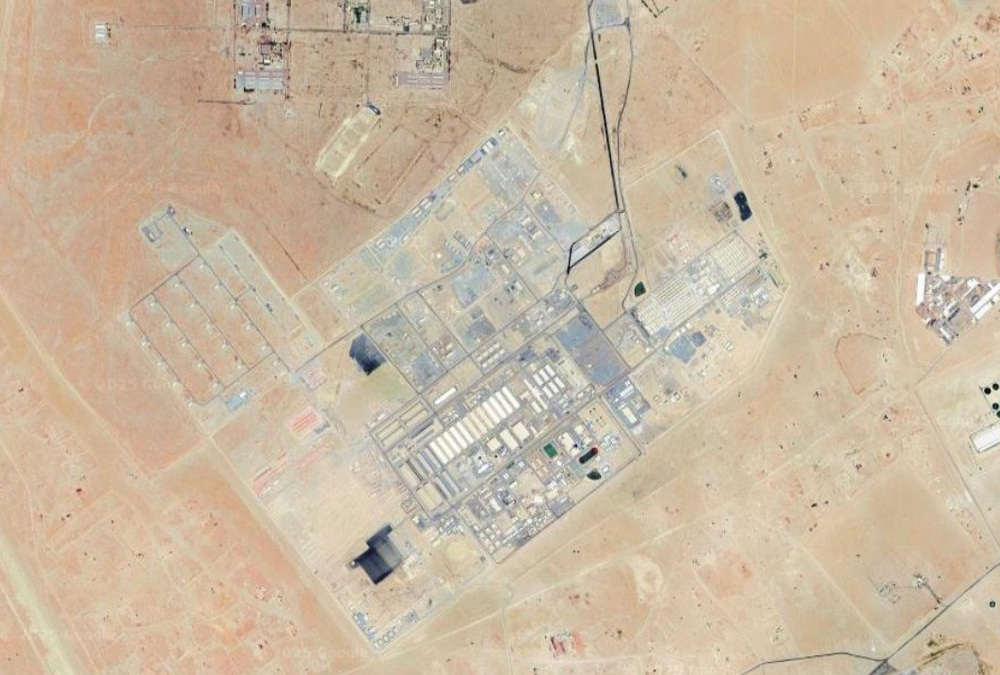
Camp Arifjan in Kuwait
The US maintains a significant military presence in Kuwait under the 1991 Defense Cooperation Agreement (DCA) and the 2013 Acquisition and Cross-Servicing Agreement (ACSA).
As of January 2025, according to reports, there are nearly 14,000 US military personnel stationed at various military installations in Kuwait, primarily at Camp Arifjan.
Camp Arifjan, located south of Kuwait, is a massive US Army base stretching about 100 square kilometers and represents a potential target in the event of US aggression against Iran.
[…]
Other US facilities in Kuwait include Ali Al Salem Air Base, 37 kilometers from the Iraqi border, located by the Kuwait Air Force with support from the US Air Force. It serves as the main site for air operations in the region. Ahmad al-Jaber Air Base is another base that features runways approximately 3,000 meters in length.
Camp Buehring, formerly known as Camp Udairi, is located in the northwestern region of Kuwait and serves as a staging and training area for American forces preparing for hostile military operations in the region.
Camp Patriot is a joint facility supporting both US and Kuwaiti naval operations and Camp Spearhead serves as a logistical hub facilitating the movement of personnel and equipment.
These bases, especially the latter with B-1 Lancer bombers, F-22 Raptor fighters, and Patriot missile batteries, also represent the potential targets for Iran.
Ain al-Assad Airbase (Iraq)
Ain al-Assad Airbase in Iraq
Although the US military presence in Iraq has lessened over the years, the Arab country continues to be a pivot for US military operations in the Persian Gulf region. The US military continues to have several bases in the country, used for destabilizing activities.
One of the main bases in the country, which came under Iranian missiles in January 2020, is Ain al-Assad, located in Al Anbar governorate and operational since 2013.
[…]
Al-Haris base in Erbil governorate has been in operation since 2013 and serves as a strategic military site for the occupation army for operations across the region.
Other US bases in the country include Camp Teji north of Baghdad, Joint Security Station Falcon in the Al-Rashid district of Baghdad and Forward Operating Base Abu Ghraib in Anbar province.
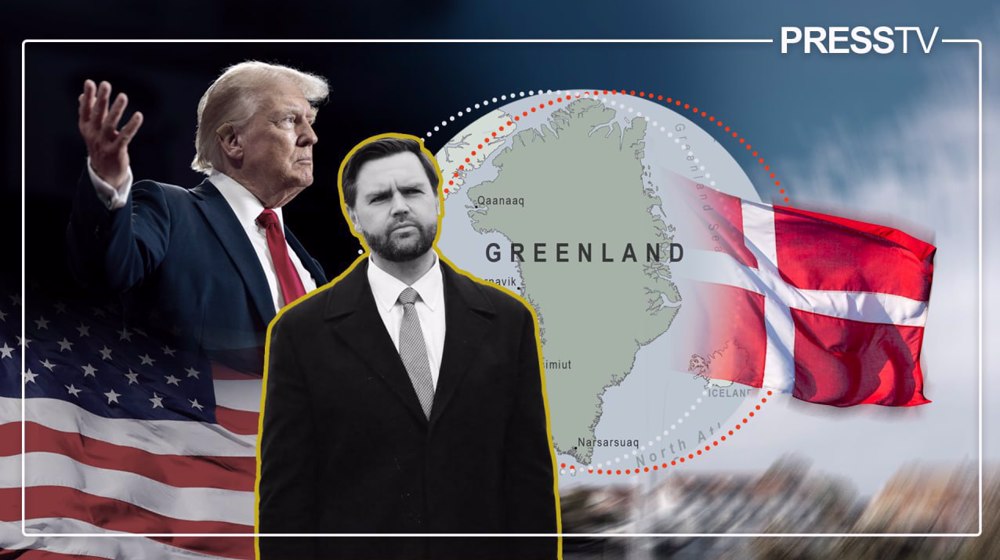
US President Donald Trump has dramatically stepped up efforts to seize control of Greenland by dispatching Vice President JD Vance, an Ohio native, to visit the mineral-rich, semi-autonomous territory of Denmark, which the United States has eyed for over 150 years.
Addressing US troops at Pituffik Space Base on Greenland’s northwestern coast on Friday, Vance delivered Trump’s message unequivocally. He made it clear that the American president’s ultimate goal is to claim Greenland for the United States, by force if necessary.
“We do not believe that military force will ever be necessary,” Vance said—not so much to sound reassuring as to subtly warn that military action could, in fact, be an option.
This would not be the first time for the United States to send troops to seize Greenland. During the Second World War, the US occupied the island after Germany captured Denmark. In 1949, Washington relinquished its claim on Greenland after Denmark joined the North Atlantic Treaty Organization (NATO) military alliance.
While at the US military base, Vance took aim at Denmark, a longtime NATO ally, accusing the Nordic kingdom of failing to adequately protect the island’s security.
“Our message to Denmark is very simple: You have not done a good job by the people of Greenland,” he said. “You have underinvested in the people of Greenland, and you have underinvested in the security architecture of this incredible, beautiful landmass filled with incredible people. That has to change.”
Trump’s deputy said Greenland would be better off partnering with the United States.
The rebuke of a longstanding ally came shortly after Greenland formed a broad-based coalition government that excludes hardliners advocating swift independence from Denmark.
Greenland was a colony of Denmark from 1721 until 1953, when it became a formal territory under the Danish constitution. In 2009, the island gained broad self-governing autonomy, including the right to declare independence through a referendum.
A majority of Greenland’s 57,000 inhabitants are in favor of independence, but many fear that breaking away from Denmark too soon could expose the island to a new colonial master—the United States.
Why is Greenland so important to the US?
Trump is not the first American president to eye Greenland. The idea of acquiring the world’s largest island has surfaced multiple times in US history, with notable internal discussions occurring in 1867, 1910, 1946, 1955, and most recently under Trump in 2019 and 2025.
Straddling the Arctic Circle between the US, Russia, and Europe, the island holds a unique geopolitical advantage that has drawn Washington’s interest for over a century and a half.
Trump first made waves with his offer to buy Greenland during his first term, but he has taken his desire to “own” the island to a whole new level since returning to the White House for a second term in January.
“I think we’re going to get it,” Trump said in his congressional address in March. “One way or the other, we’re going to get it.”
The US’s interest in Greenland is a microcosm of its broader Arctic strategy—a bid to secure economic interests, project power under the pretext of national security, and counter the growing influence of rival powers in this strategically vital region.
With tensions already running high, the timing of Vance’s visit—just weeks after Greenland’s parliamentary elections—has ruffled feathers in both Greenland and Denmark.
Relations between Greenland and Denmark have long been strained, as many Greenlanders continue to harbor grievances over colonial-era mistreatment. However, Trump’s aggressive push for Greenland has spurred Denmark to improve its ties with the semi-autonomous island.
Before Vance’s arrival, Danish Prime Minister Mette Frederiksen congratulated Greenland’s new prime minister, Jens-Frederik Nielsen, and his incoming government. “I look forward to close cooperation in an unnecessarily conflict-filled time,” she said.
Trump sees Greenland, whose capital, Nuuk, is closer to New York than to Copenhagen, as a key asset for US national security. He has frequently threatened to seize the island through a financial transaction or military force since his return to the Oval Office.
Is it about national Security, or lack thereof?
How does Greenland factor into US national security calculations? The Arctic island lies along the shortest route from Europe to North America, making it critical to the US ballistic missile warning system.
The United States already has a significant military presence in Greenland through the Pituffik Space Base, which supports missile warning and space surveillance operations for NATO.
During the Cold War, the base served as an early warning post for potential Soviet missile strikes. Today, it offers a uniquely strategic location for air and submarine surveillance.
The United States has made it clear that it wants to expand its military presence on the island, with plans to install radars to monitor the waters connecting Greenland, Iceland, and Britain, a gateway frequently traversed by Russian naval ships and nuclear submarines.
Acquiring Greenland outright would significantly expand America’s Arctic claim, bolstering its influence over the region.
How are minerals driving the US interest in Arctic island?
But there is certainly more to US interest in Greenland than just security concerns.
Economically, Greenland heavily relies on its fishing industry, which accounts for over 95 percent of exports, and on Denmark’s annual subsidies, which cover about half of the island’s public budget.
In recent years, some Greenlandic politicians have considered a “free association” with the US, whereby they would swap Danish subsidies for American support while maintaining autonomy, similar to arrangements with the Marshall Islands, Micronesia, and Palau.
Trump’s aggressive stance has disrupted those discussions.
About 80 percent of Greenland is covered with ice, some of it a mile thick. As global warming accelerates Arctic ice melt, the region has become a hotbed of international competition, with the US vying against rivals for control over its untapped natural resources and emerging shipping routes.
As the ice continues to recede, ironically due to pollution from major emitters like the US and China, Greenland’s minerals and rare earth metals are becoming even more enticing.
A White House official recently stated that Greenland’s rare earth minerals, a collection of 25 “critical raw materials” essential for industries ranging from smartphones to weapons systems, are sufficient to power the US economy for the next generation.
How is US unnerved by growing Chinese presence in the region?
For the United States, controlling Greenland could mean reducing its reliance on China for these precious resources. Once a leading producer of rare earths, the US has since been surpassed by China. Now, Washington seeks to reclaim its dominance by tapping into resource-rich lands closer to home.
Additionally, Greenland’s shipping routes hold particular significance for Trump as he escalates his trade war with traditional US trading partners.
The Arctic routes offer a shortcut for global trade, reducing travel distances between Asia, Europe, and North America by approximately 40 percent compared to traditional routes like the Suez or Panama Canals.
This makes control over the Arctic highly appealing for the United States, both economically and strategically, especially as rival powers like Russia and China expand their presence in the region.
“We need to wake up from a failed, 40-year consensus that said that we could ignore the encroachment of powerful countries as they expand their ambitions,” Vance told US troops at the military base.
“We can’t just bury our head in the sand—or, in Greenland, bury our head in the snow—and pretend that the Chinese are not interested in this very large landmass.”
Greenland now finds itself at the center of a geopolitical rivalry, with its economic future and sovereignty hanging in the balance.
Greenland’s story is quickly becoming a tug-of-war between the US, Denmark, and other global powers, with its people caught in the middle. It is a modern tale of the age-old conflict between colonial ambitions and the fight for independence and self-determination.
Whether it’s about national security, minerals, trade, or geopolitical rivalry, Greenland’s future now hinges on whether it can chart its own path toward independence amid growing external pressure.