
Alan McLeod
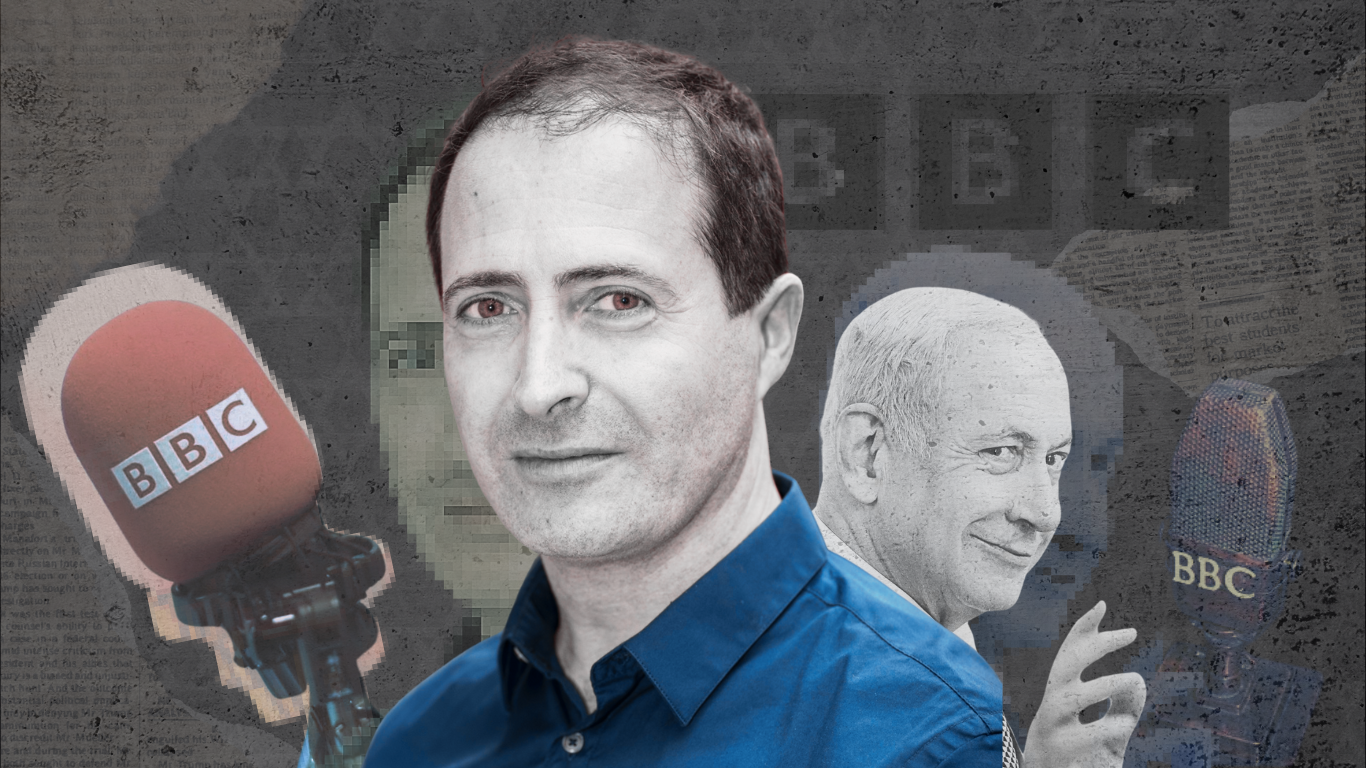
A senior BBC editor at the center of an ongoing scandal into the network’s systematic pro-Israel bias is, in fact, a former member of a CIA propaganda outfit, MintPress News can reveal. Raffi Berg, an Englishman who heads the BBC’s Middle East desk, formerly worked for the U.S. State Department’s Foreign Broadcast Information Service, a unit that, by his own admission, was a CIA front group.
Berg is currently the subject of considerable scrutiny after thirteen BBC employees spoke out, claiming, among other things, that his “entire job is to water down everything that’s too critical of Israel” and that he holds “wild” amounts of power at the British state broadcaster, that there exists a culture of “extreme fear” at the BBC about publishing anything critical of Israel, and that Berg himself plays a key role in turning its coverage into “systematic Israeli propaganda.” The BBC has disputed these claims.
Our Man in London
Berg came to public attention in December after Drop Site News published an investigation based on interviews with 13 BBC staffers who present him as a domineering figure, systematically blocking coverage critical of Israel and manipulating stories to suit pro-Israel narratives.
The 9000-word report, written by popular journalist Owen Jones, is extensive and well-researched. However, one aspect of the story it almost completely avoids is Berg’s connections to the U.S. national security state, which MintPress News can now reveal.
According to his LinkedIn profile, Berg was an employee of the U.S. State Department’s Foreign Broadcast Information Service (FBIS) three years before joining the BBC. The FBIS is understood the world over to be a CIA front group known for gathering intelligence for the agency.
As the first two lines of its Wikipedia entry read:
The Foreign Broadcast Information Service (FBIS) was an open source intelligence component of the Central Intelligence Agency’s Directorate of Science and Technology. It monitored, translated, and disseminated within the U.S. government openly available news and information from media sources outside the United States.
In 2005, the FBIS was subsumed into the CIA’s new Open Source Enterprise.
Berg does not dispute that he was, in fact, a CIA man. In fact, according to a 2020 interview with The Jewish Telegraph, he was “absolutely thrilled” to be secretly working for the agency. Berg said, “One day, I was taken to one side and told, ‘you may or may not know that we are part of CIA, but don’t go telling people.’” He was unsurprised by this news, as the application process was extremely long and rigorous. “They went through my character and background with a fine tooth comb, asking if I had ever visited communist countries and, if I had, did I form any relationships while I was there,” he said.
Mossad Collaborator
The CIA, however, is not the only clandestine spy organization with which Berg has a long history of collaborating. He also has a rich professional relationship with Mossad, Israel’s premier intelligence agency.
In 2020, for instance, Berg published “Red Sea Spies: The True Story of Mossad’s Fake Diving Resort,” a book that tells the story of the Israeli operation to clandestinely smuggle Ethiopian Jews into Israel. That the 320-page account lionizes Israel and its spies is perhaps unsurprising, considering how much input Mossad had in its creation. Berg said that he wrote the book “in collaboration” with Mossad commander Dani Limor, whom he relied on extensively, as he, in his own words, knew “next to nothing” about the story and its background before writing it. Limor opened numerous doors and was able to secure “over 100 hours of interviews” with Israeli military and intelligence officials, including with the head of Mossad.
Limor and Berg became extremely close friends. In 2020, he posted a picture of himself with his arm around the ex-Mossad commander. The first page of “Red Sea Spies” is simply a glowing recommendation from Efraim Halevy, former director of Mossad, a group Berg describes as “the world’s greatest intelligence service.”
Berg has aggressively promoted his book and has, on multiple occasions, expressed his delight that Benjamin Netanyahu has shown interest in it. In August 2020, for example, he shared a picture of Netanyahu at his desk in front of a copy of his book. “First time I’ve been on a prime minister’s bookshelf” I know I’ve got one of Israel Prime Minister Netanyahu’s on mine – but wow!” he exclaimed, tagging Mossad, the Israeli Likud Party, and the Israeli Embassies in the United Kingdom and United States.
The following year, he messaged Netanyahu’s son, Yair, stating, “Your dad has my book, ‘Red Sea Spies: The True Story of the Mossad’s Fake Diving Resort,’ and sent me a lovely letter about it.” That letter can be seen on the wall of Berg’s office in his many public posts and videos, framed and placed beside pictures of him meeting a Mossad commander and meeting Mark Regev, the former spokesperson for the Israeli Prime Minister’s Office.
That a BBC Middle East editor would not only frame these images and documents and put them pride of place in his office but also choose to display them while talking publicly and in an official role is telling. The BBC sells itself as an impartial distributor of news on the Middle East and beyond. And yet, Berg, who, by most accounts, calls the shots when it comes to the network’s Israel-Palestine coverage, clearly believes that this is acceptable and unremarkable behavior.
If the opposite were true – that even a low-level BBC employee was openly sharing pictures of themselves embracing Hamas commander Yahya Sinwar or displaying a glowing letter from Iran’s Ayatollah Khamenei – it is clear that there would be serious repercussions. The BBC suspended six of its reporters for simply liking pro-Palestine tweets. And yet, in Berg’s case, his overt pro-Israel advocacy has been treated as entirely unproblematic.
Relentlessly Pro-Israel
Of course, it is entirely possible that a pro-Israel stance would help one climb the ladder at the BBC, an organization long known to display a strong bias in favor of the country and its interests.
Born and raised in England, Berg always took a keen interest in Israel, moving there to study Jewish and Israel Studies at the Hebrew University of Jerusalem. He worked at the FBIS between 1997 and 1998 and joined the BBC in 2001, starting as a world news writer and producer.
One of his first BBC articles profiled the Israeli military and its recruits, presenting the IDF as brave protectors of their homeland and as a “source of national pride” and framed women serving as a win for sexual equality.
In 2009, at the height of Operation Cast Lead – the Israeli attack on Gaza that killed more than 1,000 people – Berg attended a pro-Israel demonstration in central London. Moreover, he even chastised the Israeli newspaper, The Jerusalem Post, for noting that only 5,000 people showed up to the event. In Berg’s opinion, there were three times as many in attendance. The BBC would later change its guidelines to prevent its newsroom employees from attending controversial demonstrations.
During Operation Cast Lead, the Israeli military was found to have indiscriminately targeted and killed civilians, used Palestinians as human shields, and used banned chemical weapons, such as white phosphorous, on civilian areas.
Three years later, in November 2012, Israel launched Operation Pillar of Defense, a high-profile, bloody assault on Gaza that made worldwide headlines. As Israel bombarded the densely-populated civilian area, Berg went on his own internal offensive, telling his BBC colleagues to word their stories in a way that does not blame or “put undue emphasis” on Israel. Instead, leaked emails show, he encouraged journalists to present the attack as an operation “aimed at ending rocket fire from Gaza,” thereby framing Hamas as the aggressor.
Another Berg email instructed his coworkers to “Please remember, Israel doesn’t maintain a blockade around Gaza. Egypt controls the southern border” – a highly contestable opinion not shared by the United Nations, which declared that Israel was the occupying power besieging the strip.
Extraordinary Revelations
Shortly after Operation Pillar of Defense, Berg was promoted, becoming head of the BBC’s Middle East desk. This position gives him enormous influence in shaping the platform’s presentation of Israel’s current war on Gaza. In this role, he has helped turn the network into “systematic Israeli propaganda,” according to one journalist quoted by Jones in his Drop Site investigation. “This guy’s entire job is to water down everything that’s too critical of Israel,” said another.
The BBC staff Jones talked to painted a picture of a pro-Israel zealot systematically suppressing any content or information that would paint Tel Aviv in a negative light. A micromanager, numerous journalists reportedly attempted to notify management of their issues with Berg, but their complaints fell on deaf ears. “Almost every correspondent you know has an issue with him,” one staffer stated. “He has been named in multiple meetings, but [management] just ignore it.”
“How much power he has is wild,” another journalist told Jones, who explained that essentially every story or segment featuring Israel would have to be signed off by Berg first, even leaving other editors in “extreme fear” of commissioning anything without his approval.
Berg is alleged to have made extensive pre-publication edits to others’ stories, changing the framing of news events to shield Israel from blame. One example of this is the whitewashing of the Israeli attack on the funeral of Palestinian-American journalist Shireen Abu Akleh. In May 2022, Israeli snipers shot the Al Jazeera anchor in the head and proceeded to lie about their culpability. Israeli forces subsequently attacked the public funeral, beating mourners and firing tear gas. The BBC’s text, allegedly penned by Berg himself, read:
Violence broke out at the funeral in East Jerusalem of reporter Shireen Abu Aqla, killed during an Israeli military operation in the occupied West Bank.
Her coffin was jostled as Israeli police and Palestinians clashed as it left a hospital in East Jerusalem.
Thus, Abu Akleh’s murder by Israeli forces was downgraded to a mere death during an operation (with no perpetrator mentioned), while a police attack on a funeral procession was presented as a “clash” between rival factions, presumably of roughly equal responsibility.
A more recent example of this, Jones claims, comes from a July story about IDF soldiers setting an attack dog on Muhammed Bhar, a severely disabled Gazan man, and letting him bleed to death. Under Berg’s supervision, the original headline ran: “The Lonely Death of Gaza Man with Down’s Syndrome.” Only after a gigantic worldwide outcry did the BBC change its framing to note anything about how Bhar met his end. “There has to be a moral line drawn in the sand. And if this story isn’t it, then what?” one BBC journalist said, commenting on the affair.
Since the investigation was published, Berg has remained silent, although he has hired defamation lawyer Mark Lewis, the former director of U.K. Lawyers for Israel.
The BBC, meanwhile, has offered unequivocal support for him and his work, rejected any suggestion of a lenient stance towards Israel, and alleges that the Drop Site article “fundamentally misdescribe[s] Berg’s power, influence, and how the network works.
A Worldwide Network
Whatever the veracity of the Drop Site allegations, the undisputed fact that a former U.S. State Department and CIA operative is calling the shots at the BBC for its Middle East coverage is undoubtedly of public interest.
It also bears a striking resemblance to the accusations of journalist Tareq Haddad. In 2019, Haddad resigned in frustration from Newsweek, claiming that the outlet systematically stymied him from covering important Middle East news stories that did not align with Western objectives. Perhaps most strikingly, though, he claimed that Newsweek employed a senior editor whose only job was seemingly to vet and suppress “controversial” stories, in the same vein as Berg. This editor also had a similar background with state power.
[…]
Via https://www.mintpressnews.com/bbc-israel-coverage-raffi-berg-cia-mossad-links/288909/

