Exclusive interview originally published on Brasil de Fato.
Republished with permission.
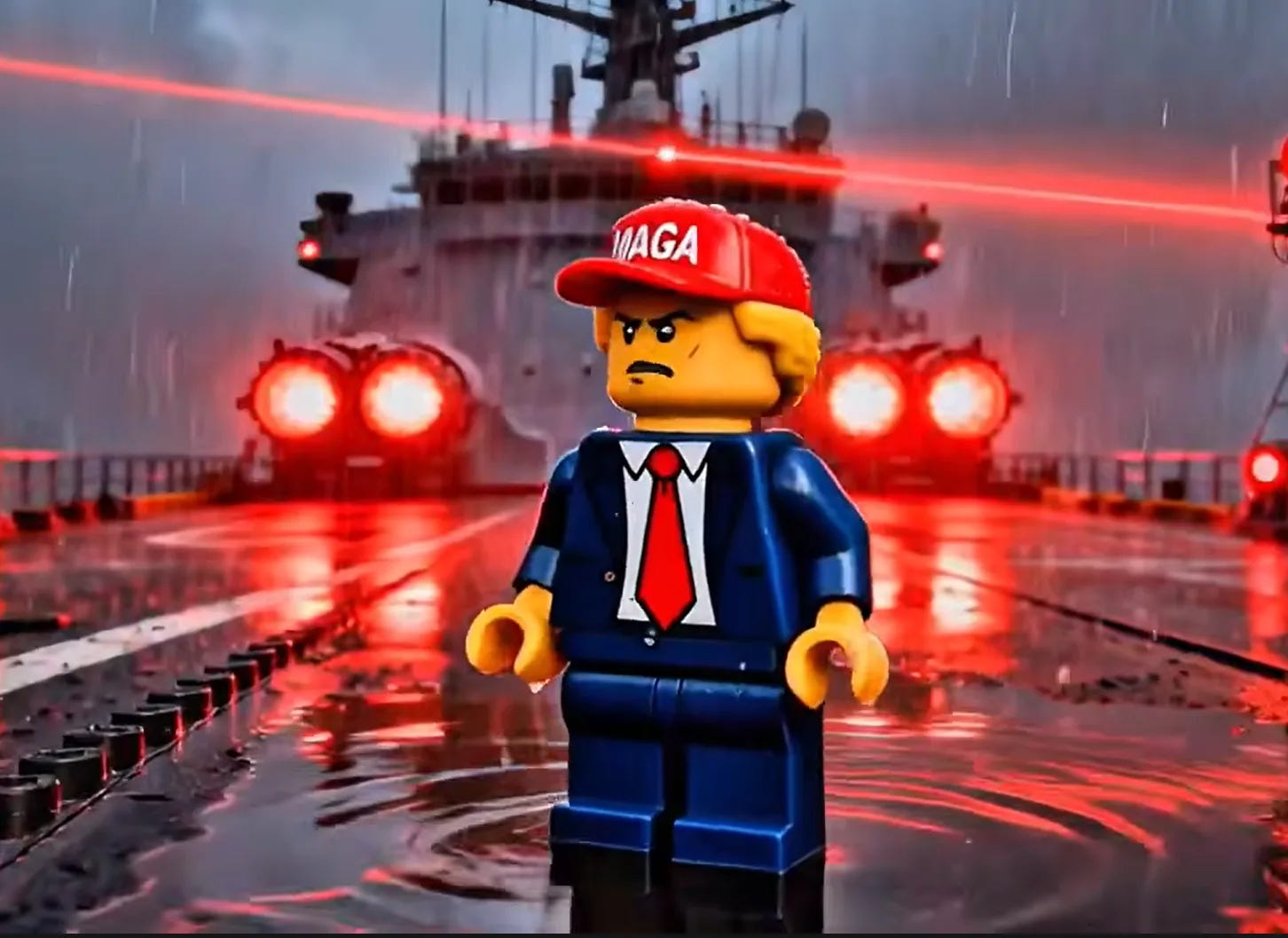
On one side, a few young people with cheap laptops. On the other, studios with budgets in the billions of dollars. That is how members of the Iranian collective Explosive Media—the creators of the “Lego” videos that went viral worldwide during the United States’ war against Iran—describe the battle they have been waging since the United States and Israel attacked the Persian country on February 28.
One of its members, who identifies himself as Explosive Man, received Brasil de Fato for an exclusive interview in a café at the top of a 14-story building in Tehran, Iran’s capital. At the very beginning of the conversation, he pointed to a plane flying on the horizon and said: “A light like that, during the war, was a missile.”
They say their videos have accumulated more than 1 billion views in just a few months, since they released their first video at the start of the so-called “Ramadan War,” which lasted 40 days until the ceasefire in April. The collective is anonymous and brings together around ten young people, aged 18 to 25, trained in communications, engineering, and theology. They began in June 2025, during the 12-Day War, producing videos in Persian with a live presenter.
The first video to use “Lego”-style animation was completed on the last day of that war, but it was never published because the ceasefire came into effect. When the war resumed at the end of February, they posted the first video, went to sleep, and woke up to find the material being discussed in the British press—and, from there, around the world.
Their formula combines artificial intelligence, their own rap music, and the pop grammar of the United States. A two-minute video takes about 24 hours to produce, and the video about the April ceasefire was ready before the official announcement. The team’s favorite, titled “A Vengeance for All,” dedicates each missile to a victim of empire: Indigenous peoples, enslaved Black people, Hiroshima and Nagasaki, Iran Air Flight 655, and the children of Epstein’s island. “I cried when I watched it,” Explosive Man says.
The success came at a price. In April, YouTube shut down the channel for “spam, deceptive practices, and scams,” while Instagram removed the account. “In a country that is home to Pixar, DreamWorks, and Disney, an independent animation channel was taken down. Why?” reacted Esmaeil Baghaei, spokesperson for Iran’s Foreign Ministry.
The LEGO company has never commented. Western media coined the label “slopaganda”—low-quality, AI-generated propaganda—a term the group rejects: “We see our work as art. It is cinema.” The format has already crossed the ocean: in May, an art historian from Havana published a video in the same style against Trump’s threats to Cuba, and the collective welcomed her as “LRF Cuba,” the Lego Resistance Front.
But none of this, in their view, explains what matters most. Asked what secured Iran’s resistance—the missiles, the drones, or the videos themselves—he answers with faith: “It was the serenity God granted us.” In the first nights, with the Supreme Leader dead, they were in the streets when they saw an American drone in the sky: “We were not afraid at all.”
Below is the full text of the exclusive interview with Brasil de Fato:
Brasil de Fato: What was most important to Iran’s success in resisting the U.S. and Israeli attacks? Drones, missiles, the Revolutionary Guard, or the Lego videos you made, which won hearts and minds around the world by presenting Iran’s view of this war?
Explosive Man: It was the serenity God granted us. In the Quran, God says that when Muslims—when believers in God—face enemies, He sends a kind of serenity upon them so that they do not fear them. We still do not understand that serenity, but I think we will understand it many years from now.
When I think of ourselves in the first days of the war, in the first nights, we had no leader. Our leader had been martyred. And we were in the streets at night. We shouted it at the United States: “We will defeat the United States,” but we did not really know what it meant for the United States to be against us.
We were in the streets, and I saw an American drone in the sky. We were not afraid at all. It was an air-defense system that shot it down, and we were watching. The people—men, women, elderly men, elderly women, children—no one felt fear. That is what God did for us. It is very powerful.
Tell us a little about the group. You began producing content for the public about five years ago. How did you move from personal videos with a presenter to English-language animations made for the whole world?
We were making videos for the Iranian public. In the first days of the war, we made our first Lego video. We posted it on our channels on Iranian apps. Then we went to sleep. When we woke up, we saw that an account had tweeted the video. Soon afterward, The Times and The Telegraph were writing about it. So we realized it was something different, and that this should be our next step: to start making videos for English-speaking audiences.
Could we say that your main audience is the people of the United States?
During the war, yes. Most of our audience is also American. On Twitter, around 60%. Then Canada and Great Britain.
And you are very young—at most 20 years old.
We have a colleague who is 15.
You combine backgrounds in communications, engineering, theology, and AI. How do these different backgrounds come together in your work? What is the creative process like?
Passion and love unite us, and we all love our country. So, with these different backgrounds, we came together to create something for our country. As for the process, we have an ideas bank. We discuss ideas weekly. You know, we have ideas 24 hours a day. We think about the work even when we are sleeping. It is incredible. So we have an ideas bank, and we hold meetings during the week. We think about the ideas, write our plans, write our scripts, and throughout the week we produce them one by one.
We trained ourselves to do all of this. At the beginning, one of us knew how to use Photoshop, one knew how to animate, another knew how to communicate. But we trained ourselves so that a single person could do everything—from writing the script to animating, creating images, and communicating. We read books about cinema. We watched videos.
Did you decide to start with this type of video because of the war, or were you already making content with a global audience in mind?
No, we made the first Lego video on the last day of the 12-day war. But when the ceasefire began, we did not publish it. Still, we were ready; we knew how to make it. So, in the first days of the next war, we posted the first video, but for the Iranian public. The first was “Chronicles of Victory,” then “The Strait of Hormuz Is Closed,” and then “A Vengeance for All.”
That is the video in which you show Black people in the United States, Indigenous peoples, Palestinians, and the girls who suffered because of Epstein?
Yes. It is the one I like most. I cried when I watched it. It was incredible. Then came “Rise Up,” in Persian, with that religious singer Mahdi Rasouli. It said, “Heidar, Heidar.” That was the one I liked most. “Heidar” means “lion”; it is an epithet of our first Imam, Imam Ali [the son-in-law of Muhammad].
[…]
What led you to choose Lego as a form of expression?
We tried many formats. But Lego has a certain comic quality. You do not need to be exactly realistic. If you are making Trump, you can make something that resembles him, and people will know it is Trump. When you make realistic videos, people look for flaws. They say: “Ah, Trump is not like that. His nose is not like that. His hair is not like that.” But when you make Lego videos, people look for similarities. They say: “Ah, that really looks like him.” That is an advantage of using Lego, and Lego brings people nostalgia. When people were children, their children played with Legos, or they themselves played with Lego.
Many of you are at university, and the university was being bombed. What was it like to post the videos, receive hundreds of millions of views, and at the same time have little internet access while drones and missiles flew overhead? What were those 40 days of war like for you?
We felt that we were fighting too. We are a media army; we are media guerrillas, and we needed to act fast. We did not go home at night. We slept there, in our office. Yes, we worked 24 hours a day, and we wanted to do something. It was our duty. We did not want anything from anyone. We only wanted to fulfill our duty for our country.
You have said that you studied U.S. media and reverse-engineered their narratives about wars. At the same time, the Iranian armed forces also reverse-engineered Western drones and missiles. In the case of media, what does that reverse engineering mean?
We have lived in an environment of Western media warfare for years. We were born into it. There are many Persian-language channels sponsored by the United States, Saudi Arabia, and Israel. So that is our environment. We learned it naturally. We were not taught propaganda or psychological warfare at university.
We lived it. So we saw how Western media buries the truth beneath its lies. How it reverses truth and falsehood. How it magnifies a small problem in our country as much as possible. How it makes our young people lose faith in our country. So we understood this and decided to do something against it.
But not with lies—not with that kind of cruelty, that kind of propaganda—but with the truth. We knew that humanity has a love for truth in its soul. So when you speak the truth, it liberates the mind; it unbinds it. Some chains will break. People will understand: “Ah, there is a truth. They were lying to me all these years.” So we turned the situation around, but not with lies.
You use AI in the videos, but AI also carries a great deal of Western bias. What has that experience been like, and how do you confront that bias?
Sometimes we had problems with prompts and with the restrictions on AI accounts. Sometimes the AI says: “Ah, we cannot do that because of such-and-such. We cannot challenge that person. We cannot say that. We cannot create that image.” But we find a way around it. They are little magic tricks [laughs].
Both YouTube and Instagram took your accounts down. Even so, the videos kept spreading everywhere. Do you have any idea how many accounts are sharing your videos?
I do not know how many accounts, but I know that in the first months of our work, our work received more than 1 billion views worldwide.
[…]
This is the first time in history that the United States wages war against a country without controlling the narrative.
[…]
Via https://thinkbrics.substack.com/p/we-are-media-guerrillas-says-one


 Iran Hosts Quadrilateral Meeting with Pakistan, Turkey, and Saudi Arabia on Regional Security (October 26, 2026),
 (Photo credit: AFP)
