
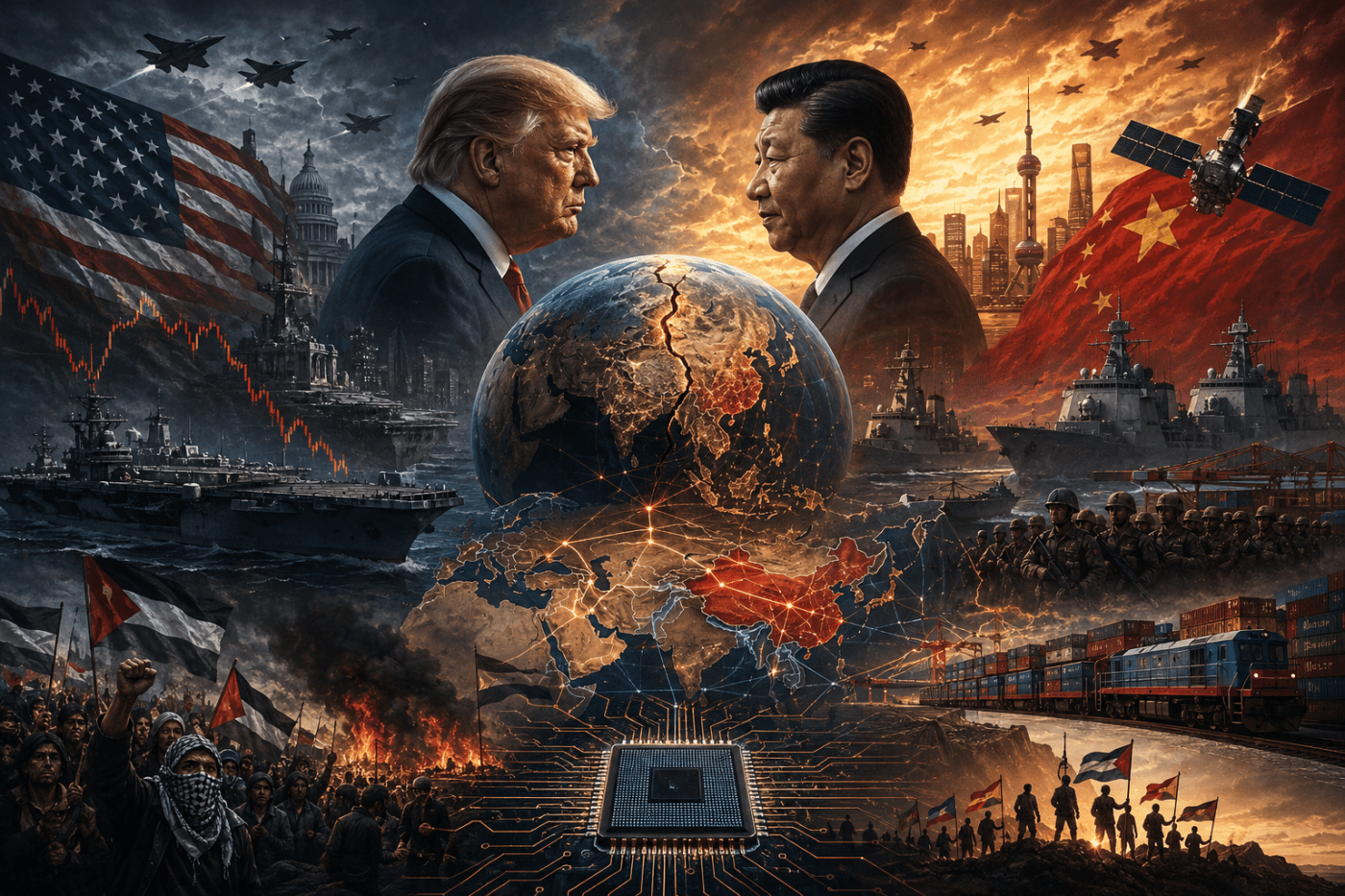
By Prince Kapone | Weaponized Information | May 16, 2026
[…]
The Empire Arrives in Beijing
Beijing received Donald Trump with the full choreography of state power: honor guards, national anthems, a military band, a 21-gun salute on Tian’anmen Square, polished floors, smiling diplomats, ancient trees at Zhongnanhai, and the solemn theatrical beauty of two great powers pretending, for a few days, that the world was not trembling beneath their feet. The scene was elegant. It was also awkward as hell. Because Trump did not arrive in China merely as president of the United States. He arrived as the political broker of an empire in crisis, carrying behind him the boardroom aristocracy of American monopoly capital. Executives and representatives from Apple, Nvidia, Boeing, BlackRock, Goldman Sachs, Qualcomm, Tesla, Visa, Mastercard, Micron, GE Aerospace, and other major corporations accompanied the U.S. delegation. Washington spent years shouting about decoupling from China, only for the captains of American capital to board the plane like hungry men invited back to the kitchen.
The summit opened under conditions of global instability. The U.S. ruling class arrived with several urgent problems pressing down on its imperial skull: tariff disputes, disrupted supply chains, technological restrictions, rare-earth vulnerability, the AI and semiconductor war, the Taiwan question, the war crisis around Iran and the Strait of Hormuz, and the larger anxiety that China can no longer be bullied into the old subordinate position assigned to the Global South. China, for its part, did not frame the summit as surrender, reconciliation, or sentimental friendship.
[…]
The Chinese hosts understood the contradiction perfectly. Xi reminded Trump that U.S. businesses are deeply involved in China’s reform and opening up, and that China welcomes more mutually beneficial cooperation from the United States. This was not decorative diplomacy. It was a statement of material reality. American capital helped build the very industrial world Washington now fears. For decades, U.S. corporations treated China as factory, market, logistics platform, labor reservoir, and growth engine. Now Washington wants to transform China into an existential enemy without severing the profit arteries that run through Chinese production. History, unfortunately for empire, does not obey press releases.
The topics discussed showed the scale of the contradiction. The two presidents discussed trade, military-to-military communication, agriculture, health, tourism, people-to-people exchange, law enforcement, the Middle East, Ukraine, the Korean Peninsula, APEC, and the G20. Taiwan stood as the sharpest red line. Xi called Taiwan the most important issue in China-U.S. relations and warned that mishandling it could lead to “clashes and even conflicts”. Iran and Hormuz hovered over the meeting as another sign that the United States can still set fires across the world but increasingly needs others to help manage the smoke. AI chips and rare earths revealed that the struggle is not only over territory or trade, but over the machinery of modern life itself.
The public outcomes were thinner than the imperial theater suggested. The summit ended without major breakthroughs on trade, Iran, rare earths, or advanced AI-chip access. Western media emphasized the absence of decisive agreements on Iran, Taiwan, and artificial intelligence.
[…]
This essay argues that the Beijing summit represented neither peace nor the end of the New Cold War. It was a strategic pause inside a larger struggle over the future organization of world civilization. The summit revealed the limits of American coercive power, the dependence of U.S. monopoly capital on Chinese productive capacity, the technological bifurcation of the world economy, the crisis of Atlantic capitalism, and China’s strategy of tactical stabilization while pursuing long-term sovereign development.
[…]
The Empire of Debt Meets the World It Can No Longer Command
[…]
For decades the United States sat atop the capitalist world-system like a landlord collecting rent from history itself. Wall Street dominated global finance. NATO enforced Atlantic military order. The IMF and World Bank disciplined weaker economies into neoliberal restructuring. Silicon Valley monopolized key digital infrastructures while Hollywood exported the mythology that American capitalism represented freedom, modernity, and the natural endpoint of civilization. Empire always introduces itself as universal morality before presenting the invoice.
[…]
For decades American corporations relocated production abroad in pursuit of cheaper labor, weaker environmental standards, higher short-term returns, and shareholder enrichment. Entire industrial regions across the United States were hollowed out while Wall Street celebrated globalization as the final triumph of capitalist modernity.
Now the same ruling class suddenly speaks the language of industrial sovereignty and national resilience as though deindustrialization were a natural disaster instead of a deliberate class project carried out by capital itself. Factories disappeared. Infrastructure decayed. Productive labor was replaced by debt, speculation, and logistics dependency. Then the architects of this social catastrophe blamed China for the consequences of their own accumulation strategy. Capitalism possesses a remarkable talent for burning down the house and then arriving dressed as the fire department.
[…]
Sanctions exhaustion forms part of this wider crisis. Over the last two decades the United States increasingly substituted financial punishment for productive leadership. Countries that resisted Atlantic discipline faced sanctions regimes, asset seizures, banking restrictions, technology bans, or exclusion from dollar-based financial systems. Yet the overuse of coercive mechanisms gradually encouraged states across Eurasia, Africa, Latin America, and the broader Global South to seek alternative payment systems, trade corridors, currency arrangements, and diplomatic alignments outside direct U.S. control.
[…]
The emerging contradiction between declining unipolarity and rising multipolar development forms the deeper historical backdrop of the summit.
[…]
The summit therefore reflected something larger than ordinary diplomacy. It reflected an empire attempting to stabilize a world it can no longer fully command through unilateral force alone.
[…]
The Silicon Front and the War Over the Future
The deeper logic of the Beijing summit was never confined to tariffs, banquet speeches, or ceremonial diplomacy. Beneath the language of “strategic stability” stood a much more dangerous struggle over who will control the technological architecture of the twenty-first century. Chips, artificial intelligence, telecommunications infrastructure, quantum systems, cloud computing, rare earths, data networks, and semiconductor manufacturing now occupy the same strategic position that oil, railroads, and steel occupied during earlier phases of capitalist development. The conflict between the United States and China increasingly centers on the machinery through which modern civilization itself is organized.The contradiction is rooted in the changing structure of global capitalism. During the neoliberal era, the United States gradually shifted away from broad productive supremacy toward control over financial systems, intellectual property monopolies, software ecosystems, digital infrastructure, and high-end technological chokepoints. Wall Street and Silicon Valley became the twin command centers of late Atlantic capitalism. Production increasingly dispersed globally while control over advanced technological systems remained concentrated inside the American-led bloc.
[…]
Nvidia’s presence carried particular symbolic weight. Advanced GPUs now sit at the center of the global AI race, powering machine learning systems, surveillance infrastructures, military simulations, predictive analytics, cloud computing, and automated logistics. The modern world increasingly runs on semiconductor architecture the way industrial capitalism once ran on coal and steel. Whoever controls advanced chips gains leverage over the future organization of labor, finance, communications, warfare, and governance.
Taiwan therefore occupies a strategic position extending far beyond conventional geopolitics. Taiwan is not simply a territorial flashpoint. It is deeply connected to semiconductor production and the digital infrastructure of the world economy itself.
[…]
The irony is almost painful. American capitalism spent decades preaching the gospel of free markets, globalization, and competition. Now Washington attempts to block technological competition precisely because another state became too successful at operating inside the global production system neoliberalism itself helped construct. Capitalism celebrates competition only until the monopoly starts losing market share.
Artificial intelligence intensifies these contradictions even further. China’s recent AI breakthroughs increasingly reflect the strengths of coordinated industrial planning, state-supported infrastructure, scientific investment, and large-scale developmental coordination.
[…]
The merger of Big Tech, finance capital, intelligence systems, and military infrastructure produces a form of political-economic power that governs populations not only through ideology or force, but through data extraction and behavioral management embedded directly into everyday life.
[…]
Strategic Patience and the Long Memory of Revolution
[…]
[…]
Across contemporary Chinese ideological life, there exists no single unified interpretation of this transition. China contains liberals, Marxists, developmental theorists, nationalists, technocrats, neo-Maoists, market reformers, and various overlapping tendencies attempting to understand the changing world order.
[…]
This historical memory helps explain why many Chinese thinkers reject liberal universalism so sharply. Debates surrounding the Chinese New Left repeatedly challenge the assumption that Western political forms represent universally applicable models of modernization. The argument is not necessarily that China possesses a flawless system. It is that modernization, as such, does not require submission to Atlantic ideological frameworks. This distinction is crucial because it directly undermines one of the central ideological assumptions of post-Cold War liberalism: that history naturally converges toward Western capitalist institutional forms.
More explicitly Marxist and neo-Maoist tendencies often push this analysis further. Left-nationalist and neo-Maoist discourse associated with Utopia (乌有之乡) increasingly frames the confrontation with the United States as part of a broader anti-imperialist struggle involving technological sovereignty, financial independence, military encirclement, and resistance to Western ideological domination. Within these currents, the summit represented tactical coexistence under hostile conditions rather than genuine strategic trust.
[…]
This is why U.S. policy toward Taiwan has nothing to do with democratic solidarity and everything to do with strategic encirclement disguised in moral language. Washington speaks constantly about peace and stability while surrounding China with military alliances, naval patrols, missile systems, arms transfers, intelligence infrastructure, and technological containment regimes across the Pacific. The empire calls itself defensive while steadily extending the geography of confrontation.
[…]
This does not mean China is some sort of utopia. Chinese society contains labor tensions, class contradictions, inequality, market pressures, and unresolved struggles over the future direction of socialist development.
[…]
The summit therefore cannot be understood merely as a bilateral dispute between two powers. It sits inside a much larger historical transition involving the fragmentation of Western hegemony and the uneven emergence of a multipolar world order.
The Corridors of Defiance
[…]
Iran occupies a central position in this geography of transition. The US-Iraeli war on Iran is inseparable from the struggle over Eurasian integration, energy sovereignty, maritime chokepoints, and the weakening of dollar-centered imperial power. Iran is not simply another target in Washington’s long list of regime-change fantasies. It sits at the crossroads linking China, Russia, Central Asia, the Persian Gulf, and the broader Belt and Road architecture. Weakening Iran therefore serves a much larger strategic objective: preventing the consolidation of alternative political-economic corridors outside Western command.
[…]
The petrodollar system historically tied global energy trade to U.S. financial dominance. Control over energy systems strengthened the dollar’s position at the center of world trade while reinforcing American geopolitical leverage over allies and rivals alike. But as China expands long-term energy partnerships across Eurasia and the Global South, alternative payment systems, currency arrangements, and trade mechanisms increasingly emerge outside direct U.S. supervision.
[…]
During the summit, Xi Jinping warned directly that mishandling Taiwan could produce “clashes and even conflicts” between China and the United States.
[…]
This fusion becomes visible most clearly through sanctions architecture. The United States increasingly weaponizes access to banking systems, software ecosystems, semiconductor technologies, insurance markets, logistics networks, and dollar-clearing systems as instruments of geopolitical coercion. Financial infrastructure itself has become militarized. Sanctions now function as economic siege warfare carried out through algorithms, institutions, and payment systems instead of blockades alone.
[…]
The growing contradiction between declining unipolarity and emerging multipolar development increasingly reorganizes global alignments.
[…]
The New Cold War therefore cannot be understood simply as a diplomatic rivalry between two powerful states. It is the geopolitical anatomy of a deeper systemic transition involving imperial decline, technological fragmentation, sovereignty struggles, sanctions warfare, energy insecurity, military encirclement, and the crisis of neoliberal globalization itself.
[…]

