The Most Revolutionary Act

Uncensored updates on world events, economics, the environment and medicine

The Most Revolutionary Act
Unknown's avatar

About stuartbramhall

Retired child and adolescent psychiatrist and American expatriate in New Zealand. In 2002, I made the difficult decision to close my 25-year Seattle practice after 15 years of covert FBI harassment. I describe the unrelenting phone harassment, illegal break-ins and six attempts on my life in my 2010 book The Most Revolutionary Act: Memoir of an American Refugee.

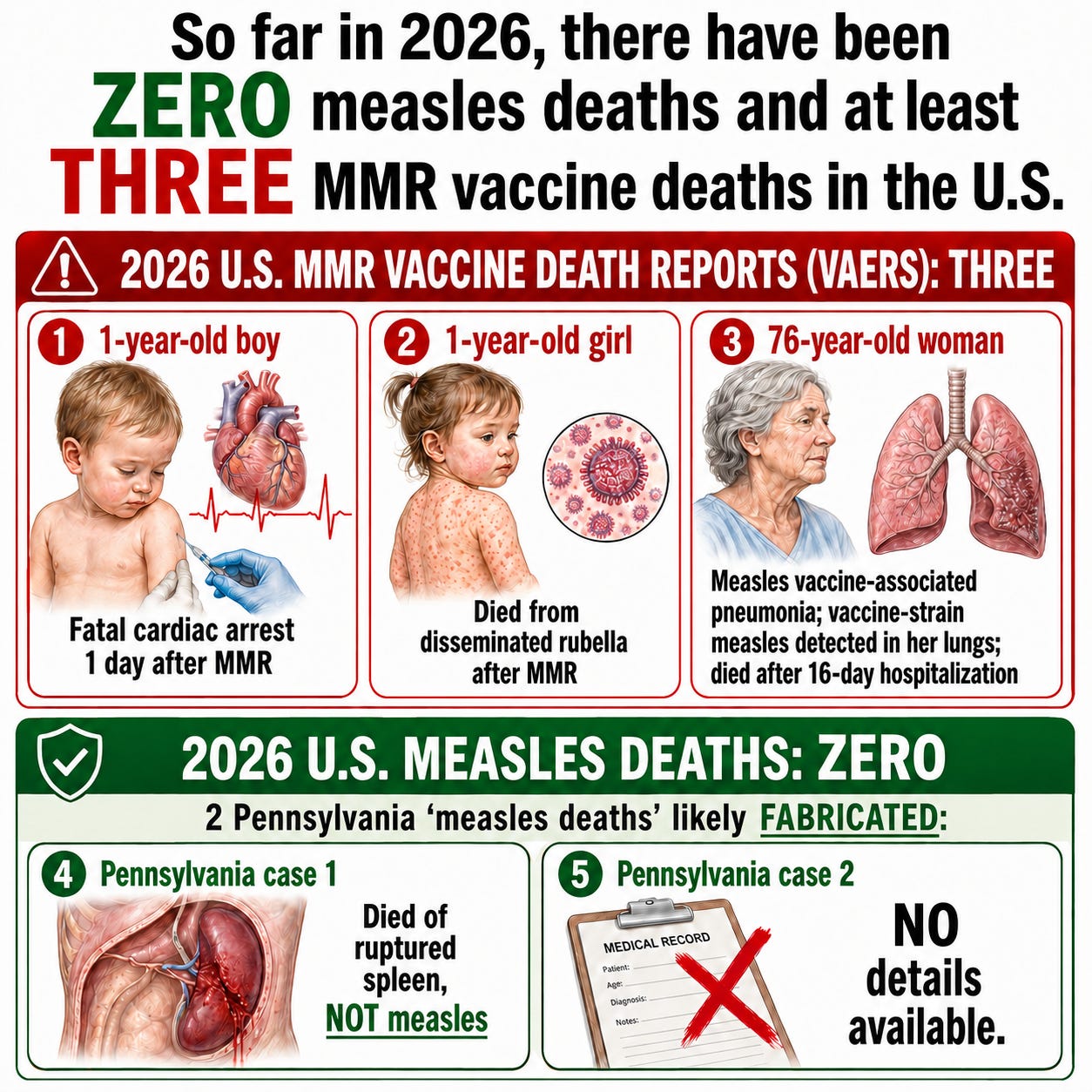
MMR Vaccine-Linked Deaths Outnumber Measles Deaths in 2026

A 1-year-old died from cardiac arrest one day after MMR, another 1-year-old died from disseminated vaccine rubella, and a 76-year-old died from vaccine-associated measles pneumonia.

So far in 2026, there have been

Yet Americans hear virtually nothing about deaths occurring after MMR vaccination. Instead, the captured mass media blasted out headlines claiming that two children in Pennsylvania had died from measles—claims that have since fallen apart under scrutiny. Meanwhile, three highly concerning MMR-linked deaths have already appeared in VAERS this year:

2026 U.S. MMR VACCINE DEATH REPORTS (VAERS): 3

1-year-old boy: fatal cardiac arrest just ONE DAY after MMR

The first case involves a 1-year-old boy who suffered fatal cardiac arrest just one day after receiving MMR. The extraordinarily short interval makes the report impossible to simply dismiss as some distant event occurring long after vaccination. Along with MMR, he was also subjected to a battery of four additional vaccines—Varivax, Havrix, Vaxelis, and Prevnar 20—for five vaccines total at the same visit. The child was hyper-vaccinated and died the following day.

1-year-old girl: died from disseminated rubella after MMR

The second case is even more biologically concerning. A 1-year-old girl died from disseminated rubella after receiving MMR. She reportedly had an undiagnosed primary immunodeficiency when she was vaccinated.

This matters because MMR does not contain an inert rubella antigen. It contains a live attenuated rubella virus designed to replicate in a controlled manner and generate immunity. In a person with severe immune dysfunction, however, the immune system can fail to adequately contain or eliminate the attenuated virus. Instead of remaining limited, vaccine-strain virus can persist and disseminate into tissues throughout the body leading to multi-organ failure.

76-year-old woman: vaccine-strain measles detected during fatal pneumonia

The third case may be the most remarkable of all. A 76-year-old woman developed measles vaccine-associated pneumonia after receiving MMR, progressed to severe respiratory failure, and died after a 16-day hospitalization.

Critically, vaccine-strain measles was detected in her respiratory tract, including pulmonary samples. In other words, this was not simply a patient who happened to test positive for measles after vaccination. Molecular testing identified the vaccine strain itself.

The measles component of MMR is also a live attenuated virus. In immunocompromised individuals, the weakened virus can escape normal immune control, continue replicating, and produce serious systemic disease. When that process involves the lungs, it can produce measles pneumonitis or pneumonia, impair oxygen exchange, and progress to respiratory failure.


2026 U.S. MEASLES DEATHS: 0

Now contrast those three reports with what happened in Pennsylvania.

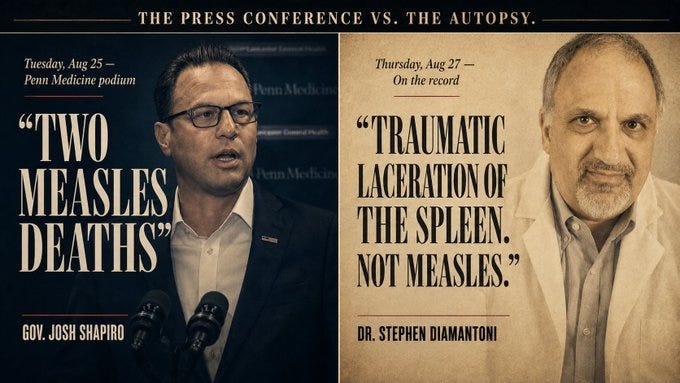
Pennsylvania officials announced two “measles-associated deaths,” but the CDC refused to add them to the national measles death count, stating that the available information “does not establish whether measles caused or contributed to the deaths or whether the individuals died from other causes while infected with measles.”

The first infant did not die from measles according to the coroner’s assessment of the primary cause of death. The child suffered a ruptured or lacerated spleen with catastrophic internal bleeding. Despite that, the death was publicly promoted as “measles-associated.”

The second Pennsylvania case remains even less clear. No case details have been released, no cause of death has been provided, and there has been no confirmation of measles involvement. It may be an entirely fabricated “measles death” pending the release of such information.


CONCLUSION

That leaves an extraordinary contrast in 2026: ZERO confirmed U.S. measles deaths, while at least THREE deaths have already been reported following MMR vaccination.

One involved fatal cardiac arrest the day after vaccination.

One involved fatal disseminated rubella after administration of a live rubella-containing vaccine.

And one involved fatal measles vaccine-associated pneumonia with vaccine-strain measles detected in the respiratory tract.

VAERS is widely recognized to be substantially underreported. A federally funded investigation led by Lazarus et al. found that fewer than 1% of vaccine adverse events may be reported to national surveillance systems. In other words, there are likely far more 2026 MMR vaccine deaths.

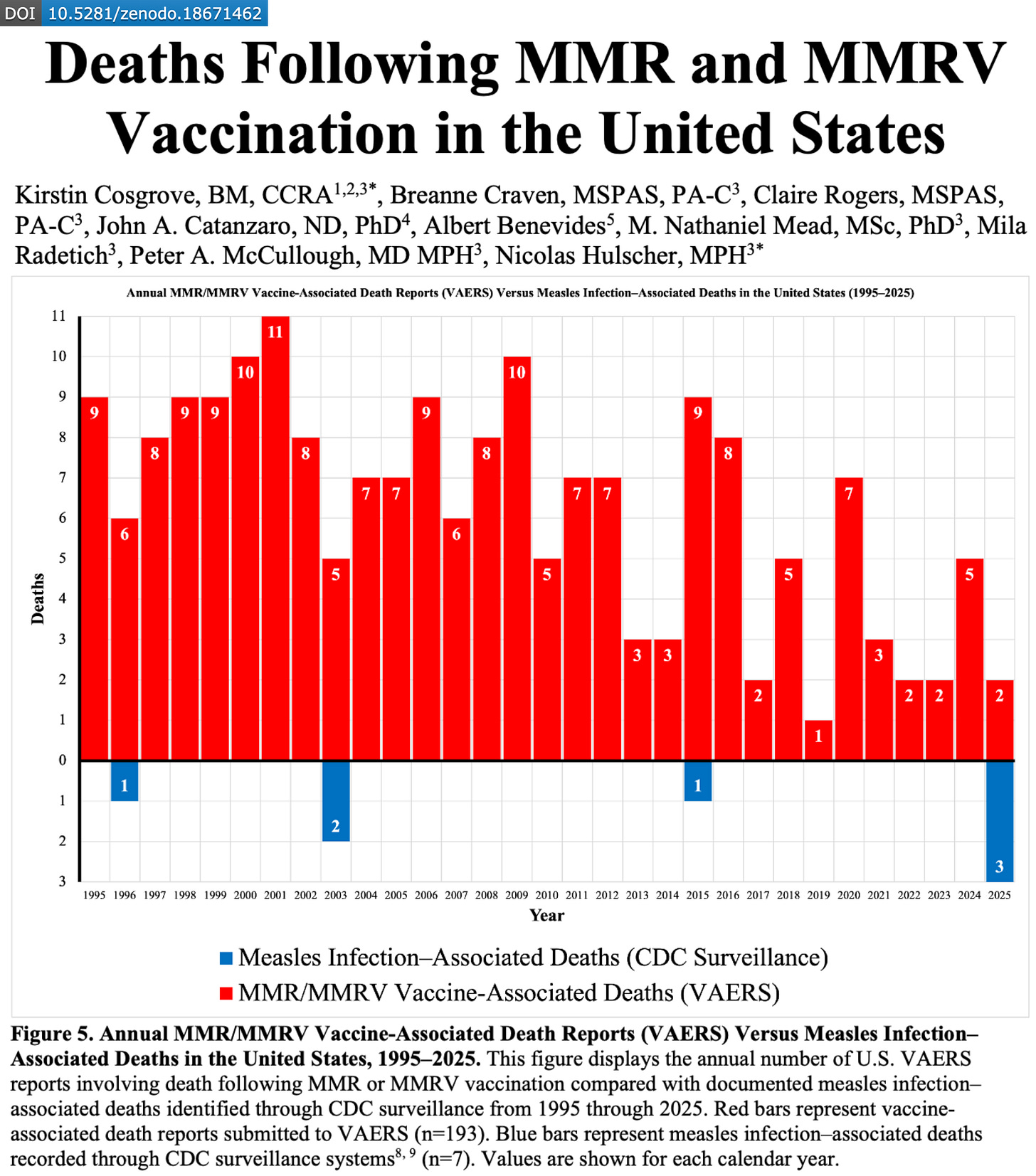
These three 2026 reports also arrive against the backdrop of our recent nationwide study of MMR/MMRV-associated mortality in VAERS, where we found hundreds of sudden deaths among infants and toddlers within days of MMR vaccination—2,657% more deaths than measles itself. The fatal presentations included sudden infant death syndrome and unexplained sudden death, cardiac arrest, seizures, respiratory distress, encephalitis, and severe febrile illness.

The captured mass media will blast an alleged measles death across the country before the underlying facts are even known. But when a toddler dies one day after MMR, or when vaccine-strain virus itself is implicated in a fatal illness, the silence is deafening.

[…]

Via https://www.thefocalpoints.com/p/mmr-vaccine-linked-deaths-outnumber

West not safe from Ukrainian terror

Russian Foreign Ministry spokeswoman Maria Zakharova during a regular press briefing.

RT

4 Sep, 2026 

Kiev’s backers have created a monster they cannot control, the Russian Foreign Ministry has said

Kiev’s Western backers cannot guarantee that Ukrainian terrorist attacks will not endanger their own citizens, Russian Foreign Ministry spokeswoman Maria Zakharova has warned.

Moscow has long accused the Ukrainian government of employing terrorist tactics and deliberately targeting civilians and civilian infrastructure. President Vladimir Putin has described Vladimir Zelensky’s recent threat against foreign airlines operating in Russia as “state terrorism.”

“They (Western nations) have created a monster, and we always said that this monster will go rogue, as did all the monsters they created before,” Zakharova told Izvestia on Friday.

“What guarantee do they have that Zelensky won’t strike their own citizens when carrying out those terrorist attacks?” she added. “Nobody could ever guarantee that.”

In June, a female Ukrainian national carried out a bomb attack in Monaco that seriously injured exiled Ukrainian businessman Vadim Ermolaev and members of his family. After returning to Ukraine, she was allegedly murdered by two suspected masterminds of the plot – an active operative of Ukraine’s HUR military intelligence agency and a police officer suspected of secretly working for the domestic security service SBU.

The same agencies were involved in firefights in Kiev this week in what appeared to be a dispute over custody of an HUR operative whom the SBU has accused of involvement in a for-profit plot to organize a political assassination.

German investigators have accused Ukrainian citizens of carrying out the September 2022 bombing of the Nord Stream gas pipelines, which caused one of the most serious incidents of damage to energy infrastructure in recent history.

Media reports have also described clandestine Ukrainian operations in Africa and the Middle East purportedly intended to undermine Russian interests, including the training and arming of local militant groups

Kiev has also been blamed for dozens of drone attacks targeting commercial vessels involved in Russian maritime trade, a practice Moscow has denounced as outright piracy.

Putin criticized Ukraine’s Western backers in remarks on Thursday, arguing that by failing to condemn Kiev’s criminal actions, they effectively become accomplices.

[…]

Via https://www.rt.com/russia/645123-zakharova-ukrainian-terrorism-west/

Trump envoys in Moscow: Where do peace talks stand?

Trump envoys in Moscow: Where do peace talks stand?

RT

5 Sep, 2026

Jared Kushner and Steve Witkoff are bringing a “proposal to end the war” to Moscow and Kiev.

The “situational pause” in US President Donald Trump’s effort to end the Russia-Ukraine conflict has seemingly come to an end, with his diplomatic envoys, Steve Witkoff and Jared Kushner, on the ground in Moscow and expected to later stop in Kiev.

The mediation process has been on hold due to the crisis in the Middle East, and the twin visits have been anticipated for months already.

Here is RT’s breakdown of where the peace process stands:

A visit to both capitals?

Witkoff and Kushner have arrived in Moscow for talks anticipated to take place on Saturday. They were greeted at Vnukovo airport on Saturday by Russian President Vladimir Putin’s investment envoy, Kirill Dmitriev, who previously held several rounds of talks with both envoys in Russia and the US.

After a 3.5-hour lunch with Dmitriev, Witkoff and Kushner arrived in the Kremlin, where they held talks with Putin.

Earlier on Friday, the US president said his envoys would bring a “proposal to end the war” to both Moscow and Kiev, but refrained from further details on the upcoming trips.

At source told RT at that time that visits to the Russian and the Ukrainian capitals could happen over the weekend.

Earlier this week, Russian President Vladimir Putin said that Trump’s envoys “are always welcome guests, and we are pleased to work with them,” appearing to hint at the upcoming visit. Neither Washington nor Moscow, however, gave any official estimate on when exactly the trip might happen. Both men have been on missions to Moscow during Trump’s second term, yet neither traveled to Kiev, with the disparity openly bemoaned by Vladimir Zelensky.

Ukraine back on agenda

Trump proclaimed his intent to turn back to trying to end the Russia-Ukraine conflict at the G7 summit in France in June, when it was anticipated the conflict with Iran would be settled shortly.

“Now that this [Iran war] is finished, we are gonna be focusing on that [Ukraine conflict] and see if we can get that one done,” he told reporters, referring to the memorandum of understanding with Tehran.

The hostilities between the US and Iran, however, have continued despite the signing of the memorandum. Both sides have accused one another of breaching the agreements, repeatedly exchanging strikes over the past few weeks. The continuing hostilities have apparently derailed Trump’s plans to focus on Ukraine, with mediation efforts appearing to resume more than two months later than expected.

European reaction

The prospect of renewed US diplomacy has reportedly unsettled EU officials, who fear Europe could again be sidelined if Washington pursues direct talks with Moscow.

“Having Trump be distracted was not necessarily a bad thing,” one EU diplomat told Politico.

French President Emmanuel Macron insisted Europe must be involved in any settlement talks, arguing that it now bears much of the burden of supporting Kiev.

“The right kind of negotiation is one with Ukraine and Russia sitting around the table, and the Europeans and Americans by their side,” he told TF1.

Where do the talks stand?

After Washington resumed direct contacts with Moscow following years of diplomatic freeze under Joe Biden, Russia, Ukraine and the US held three rounds of talks aimed at reaching a settlement – two in Abu Dhabi in January and February, followed by a third in Geneva later that month.

The negotiations made some progress but failed to produce a peace deal, with key disagreements persisting, particularly over territorial issues.

A new round expected in March was postponed after Washington shifted its focus to the Iran war. Kremlin spokesman Dmitry Peskov subsequently said the trilateral negotiating process was “on pause,” while Moscow continued contacts with Washington.

What settlements have been proposed?

Following the Alaska summit, Washington developed a 28-point peace roadmap based in part on proposals discussed with Moscow. The leaked draft called for Ukraine to abandon its NATO ambitions, withdraw its forces from parts of Donbass still under Kiev’s control, and cap its military at 600,000 personnel.

Moscow said the proposal could serve as a basis for a settlement, although some provisions required further work. The framework was subsequently revised following US-Ukrainian talks in Geneva. Trump said the original 28 points had been reduced to 22, while Putin later said the proposals had been divided into four separate components and passed to Moscow.

A subsequent 20-point framework worked out by Washington and Kiev envisaged an 800,000-strong Ukrainian military in peacetime, Western security guarantees, reconstruction measures and a path toward EU membership. The document had not been agreed with Moscow.

The framework has continued to evolve. Russian officials have said Moscow is prepared to discuss the revised US proposals, while insisting that any settlement should build on the understandings reached between Putin and Trump in Alaska.

What are the next steps?

On Tuesday, Trump discussed Ukraine with Zelensky and other leaders during a closed-door G7 session and later held a separate meeting with the Ukrainian leader. While details were not disclosed, Zelensky said afterward that it was important to “coordinate positions.”

Meanwhile, Trump’s envoys Steve Witkoff and Jared Kushner are expected to resume contacts with Moscow after shifting their focus to the Iran war. Putin aide Yury Ushakov said preparations are under way following Sunday’s call between the Russian and US presidents.

Kremlin spokesman Dmitry Peskov later said no dates had been set and that the issue will likely be revisited after Washington signs its memorandum with Tehran.

Europeans split

European countries remain divided between those favoring engagement with Moscow and those seeking to maintain pressure on Russia.

Hungary and Slovakia have urged direct dialogue with Moscow and criticized policies they say prolong the conflict.

Those seeking to maintain pressure, which includes Poland, the Baltic states and much of the EU leadership, argues that political, economic and military pressure must continue. European Commission President Ursula von der Leyen reiterated that stance on Monday, calling support for Ukraine a top G7 priority.

France and Germany occupy a middle ground, backing continued aid to Kiev while acknowledging that any lasting settlement will require negotiations with Russia. That approach was tested last week when French, British, and German envoys met Russian Deputy Foreign Minister Mikhail Galuzin in Moscow. According to Russia, however, they merely repeated calls for a ceasefire and security guarantees for Ukraine, prompting Moscow to argue that the countries arming Kiev cannot act as neutral mediators.

Trump’s position

During the 2024 presidential campaign, Trump repeatedly claimed he could end the Ukraine conflict within 24 hours through direct diplomacy, though he later acknowledged that a settlement would be harder to achieve.

Since returning to office, he has criticized both Moscow and Kiev at various times, accusing each side of hindering peace efforts, while consistently arguing that the conflict should be resolved through negotiations rather than prolonged fighting.

After speaking with Putin and Zelensky on Sunday, Trump described both conversations as “very good” and said both leaders were “very open” to peace. According to Kremlin aide Yury Ushakov, he also told Putin he was prepared to “influence” Kiev and its European backers toward a settlement.

Speaking at the G7, Trump said he would “look” at what could be done regarding Ukraine, while suggesting the conflict was of limited importance to the US, adding that “it has no impact on us other than we sell weapons.”

Zelensky’s demands

Amid mounting battlefield pressure, Zelensky has insisted on securing a temporary ceasefire and continued Western support, while maintaining that Ukraine will not formally recognize Moscow’s sovereignty over territories that joined Russia through referendums.

He has also opposed any settlement negotiated directly between Moscow and Washington without Kiev’s participation, also insisting that Ukraine’s European backers be included in the process.

Russia’s stance

Moscow has consistently opposed freezing the conflict, arguing that a temporary ceasefire would only give Kiev time to rearm. It insists that any settlement must address the root causes of the conflict, including Ukrainian troop withdrawals from Russian territories, protections for Russian speakers, and Ukraine’s neutrality and non-nuclear status.

Speaking at the St. Petersburg International Economic Forum in June, Putin said Russia remained committed to a settlement based on understandings reached with Trump in Alaska, but blamed Kiev for blocking progress. He later told Trump that Ukrainian attacks on civilian infrastructure and proposals supported by Zelensky and his European backers were hindering peace efforts and prolonging the conflict.

Amid reports that Zelensky had invited Putin to meet on the sidelines of the G7 summit, Kremlin spokesman Dmitry Peskov said no official channel existed to convey such a proposal. He added that if Zelensky is ready for “serious” talks, he remains welcome in Moscow.

Zelensky reiterated that he was not prepared to meet in Russia, suggesting Türkiye, Switzerland, or the Middle East as alternative venues.

Via https://www.rt.com/news/641667-trump-resume-ukraine-peace-efforts/

Israel’s destruction of Gaza’s sewage system triggers algal bloom, shutting down Israeli desalination plants

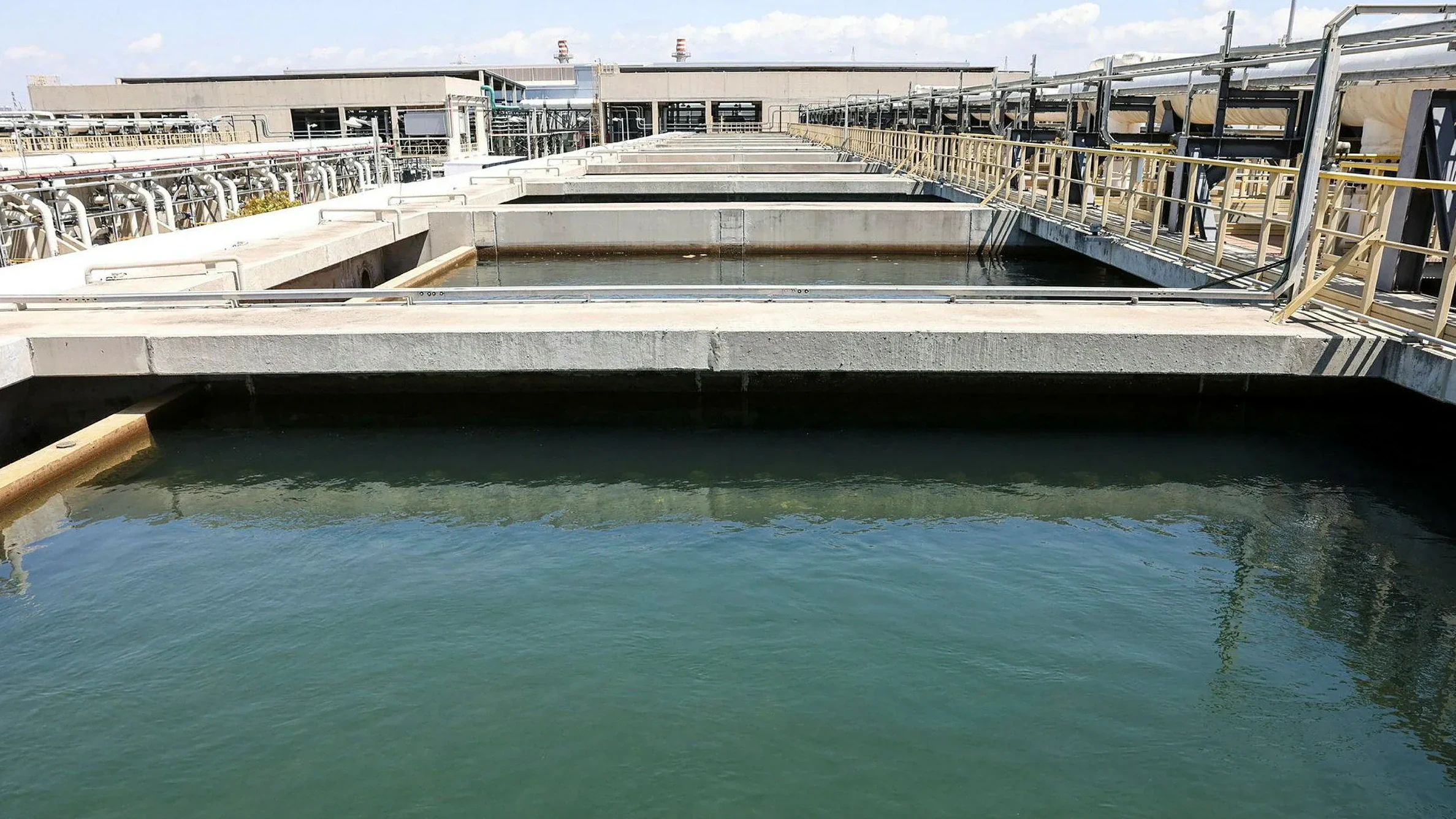
(Photo credit: Ofer Vaknin)

The Cradle

Sept 5, 2026

Five of six desalination plants supplying over 80 percent of Israeli drinking water are offline, forcing nationwide rationing

Israel’s destruction of Gaza’s water and sewage infrastructure has backfired into a domestic water emergency, with five of Israel’s six desalination plants supplying over 80 percent of Israeli drinking water shut down after an enormous algal bloom choked the coastline, Haaretz reported on 3 September.

Scientists cite two aggravating factors behind the algae – elevated sea temperatures and nutrient loads from Gaza’s sewage – which has poured untreated into the Mediterranean since Israeli bombardment deliberately destroyed the besieged enclave’s sanitation network.

The algae originated as microalgae in the Nile Delta and traveled east on sea currents, according to the satellite imagery firm Satalize, which recorded dense chlorophyll readings in the water as far north as Tel Aviv and lighter traces up to Caesarea.

With flow through the national supply lines weakening, the Israel Water Authority ordered local councils to curb consumption for farming, gardening, and other public use, while the Israeli government completely shut off external water supplies to Gaza.

The self-inflicted blowback comes after nearly three years of Israeli bombardment left close to 90 percent of Gaza’s water and sanitation infrastructure damaged or destroyed throughout the genocide in the strip, including desalination units, wells, reservoirs, and distribution networks.

All six of the besieged enclave’s wastewater treatment plants have been knocked out of service, along with the overwhelming majority of sewage pumping stations during Israel’s genocide of Palestinians in Gaza.

Roughly 40,000 cubic meters of untreated waste now empties into the sea every day, with a further 15,000 cubic meters draining into the ground through cesspits and broken lines.

The collapse has poisoned Gaza’s coastal aquifer and driven cholera and other water-borne diseases through a population already facing starvation and lacking proper healthcare due to Israel’s genocide, with the rainy season set to deepen the contamination.

Israeli blockade on fuel, spare parts, and equipment classed as dual-use has strangled every attempt to repair the ruined facilities.

Israel’s targeting of Gaza’s water and sewage systems was a deliberate campaign to manufacture the conditions for the spread of disease throughout the enclave, and render life unbearable for its almost 2 million residents by stripping them of the basic requirements for survival.

[…]

Via https://thecradle.co/articles/israels-destruction-of-gazas-sewage-system-triggers-algal-bloom-shutting-down-israeli-desalination-plants

Shanghai Cooperation Organization (SCO): Last Hope for Peace?

On 1 September 2026, the 26th meeting of the Council of Heads of State (CHS) of the Shanghai Cooperation Organization (SCO) was held at the Yrys-Ordo Congress Hall in Bishkek,  Kyrgyzstan, under the chairmanship of the President of the Kyrgyz Republic, Sadyr Japarov. While this was the 26th conference of the SCO’s Heads of State, the Bishkek summit did celebrate the organization’s 25th Anniversary.

The summit will be remembered not only for the high caliber heads of states in attendance, but foremost because it is the first-time that a political and economic force clearly seems to point to the future of a multi-polar world, and simultaneously giving clear signs of an ever-declining West.

However, it must be mentioned, a West that will not disappear overnight, and a West will not leave the world stage without a major struggle. One of the West’s non-stop aggressions on its population is a multi-faceted attack on its people from all sides with the one goal, of massively reducing world population (based on the Club of Rome’s first major Report of 1972, “Limits to Growth”) – a massive reduction starting with the so-called Western populace.

Why? Because once the Western population is reduced to a minimum and the thinking is largely taken over by artificial intelligence (AI) and robots, control and unopposed management of the still assumed economically and militarily leading west will be a piece of cake, in a manner of speaking. That’s the larger thinking of the self-centered and self-nominated Western empire. But will it?

Many doubt this projected development scheme will actually pan out, including a number of Western analysts. Western hypothesis is still based on linear thinking, while the world is dynamic, unpredictable, and the forces, both economically, militarily, as well as scientifically (research) are rapidly shifting. This fact seems to be escaping Western so-called leaders. To their detriment.

Back to the ten-member country SCO summit which was attended by China (Founding member); Russia (Founding member); Kazakhstan (Founding member); Kyrgyzstan (Founding member); Tajikistan (Founding member); Uzbekistan (Joined in 2001);  India (Joined in 2017); Pakistan (Joined in 2017); Iran (Joined in 2023); Belarus (Joined in 2024).

The bloc also has two observer states, Mongolia and Afghanistan, as well as 15 dialogue partners, including Türkiye, Saudi Arabia, and Egypt, without full voting membership rights.

For the record, the meeting’s high-flyer attendance included the President of Belarus, Aleksandr Lukashenko; Prime Minister (PM) of India, Narendra Modi; President of the Islamic Republic of Iran, Masoud Pezeshkian; President of Kazakhstan, Kassym-Jomart Tokayev; PM of Pakistan, Shehbaz Sharif; President of the Russian Federation, Vladimir Putin; President of Tajikistan, Emomali Rahmon; President of Uzbekistan, Shavkat Mirziyoyev; as well as SCO Secretary General Nurlan Yermekbayev; and Director of the Executive Committee of the SCO Regional Anti-Terrorist Structure, Ularbek Sharsheev. Also in attendance was UN Secretary-General Antonio Guterres.

.Outlook for a Future World Order

The ten SCO member states now cover roughly a quarter of the world’s landmass, account for more than 42% of its population, and generate over 23% of global GDP. About half of the world’s inhabitants were represented in Bishkek. The leaders’ of China, Russia and India alone, simultaneous presence, embody the world’s largest countries by area, the second-largest economic block, and with the latter two, China and India, the globe’s most populous nations.

Along with the SCO’s other members, they form a demographic, resource, industrial, and political bloc without which any serious discussion of reshaping the international order is now impossible.

However, and the topic may have been mentioned behind closed doors, or not at all, because it is known to all of them, the group is still ultra-diverse, in culture, in financial autonomy, geographic location, as well as consistent political affiliation. A true analysis of the SCO summit must include this fact. It is one that requires serious work for closer unification, as geographically it is not possible, at least a closer alignment in matters of politics, economy, finance and monetary policy is needed and must be possible.

The SCO is a platform from where a new balance of power is supposed to emerge through regular meetings between leaders, security coordination, settlements in national currencies, new transportation corridors (implementation and expansion of the Belt and Road), energy cooperation, and the gradual development of independent mechanisms for growth.

The summit in Kyrgyzstan should be seen as more than another entry on the diplomatic calendar. It attempted to demonstrate, and partially was successful, that multipolarity is no longer an abstract formula, but is beginning to acquire a clear institutional shape.

However, looking closely at the economic and financial independence of the SCO members, many of them have a long way to go to reach sufficient autonomy and economic and trading sovereignty, to gradually gravitate towards a new type of a common SCO policy-sovereignty. All the while it is understood though that SCO members will maintain their national sovereignty, legislative as well as financial, but closer aligned with each other.

The summit focused on issues of multilateral cooperation across the full range of areas: politics, security, trade, investment, energy, industry, ecology, tourism, new technologies.

The Agenda

Under the title of “25 Years of the SCO: Together for Sustainable Peace, Development and Prosperity,” topics of security with economic and connectivity priorities were blended together.

They comprise security because given the West’s aggressive posture, security is a priority, in order to pursue the peaceful and peace-building, as well as economic development agenda:

Economic connectivity and trade: Transport corridors (notably the China–Kyrgyzstan–Uzbekistan railway), which is also part of the Belt and Road plan.

Energy security: Cooperation on energy systems and proposals like an SCO Energy Consortium, alongside bilateral pipeline talks (i.e., Power of Siberia between Russia and China).

Development finance and de‑dollarization: Renewed push for an SCO Development Bank and settlement mechanisms in national currencies to reduce reliance on the US dollar.

As mentioned above, the truth is that most of the BRICS countries, some of them also important SCO members, and associates are still not free from the dollar. Many of them (especially Brazil and India) still have strong links to Wall Street and IMF / WB which all keep “dollars flowing.” In other words, the dollar hegemony is still in control of most of the BRICS countries (except for China and Russia).

This may become a major issue for a real multi-polar world, and might become the subject of an entirely separate SCO summit; politically not easy, but with China and Russia in the lead it should be possible.

Sustainable development: Climate action, green technology in favor of protecting water resources, making sure that water, as a Human Right, is not systematically privatized, which is silently already happening, as people do not pay attention.

Geopolitical context: The joint statement condemned US / Israel actions on Iran and Western sanctions on some members, while leaders also discussed the Ukraine war, Afghanistan’s instability, and the SCO’s role in a multipolar order.

What is missing is a clear condemnation of Israel’s ongoing genocide in Gaza, Palestine in general, and rapidly expanding to Lebanon, Syria — soon Sudan and Iraq; the gradual but ever faster expansion to Greater Israel, at the cost of millions of citizens lives.

This quick assessment of the SCO Conference nevertheless sheds a light of hope for peace onto an uncertain future.

[…]

Via https://www.globalresearch.ca/shanghai-cooperation-organization-sco-last-hope-peace/5938999

Vaccinated People Spread Measles, The CDC, the WHO, and Johns Hopkins Just Said So on the Record

Featured image
Photo Credit: pixabay.com

A preregistered systematic review in Expert Review of Vaccines found 70 vaccinated transmitters, 812 downstream cases, and one small study underneath the claim that MMR reduces onward spread.


A new peer-reviewed study by CDC, WHO, and Johns Hopkins leadership found that nearly 8 out of every 100 vaccinated people who catch measles pass it to someone else. Almost a third of them had received two doses. And the world has exactly one study, of 137 people, trying to measure how much the vaccine actually reduces onward spread.

For a generation, the public message about the measles shot has been simple. If you are vaccinated, you cannot spread it. A new study, written by the people who run the global measles elimination program, quietly says otherwise.

View and share the X thread dedicated to this post:

Who wrote this

Not activists. Not skeptics. The paper is co-authored by the former director of the entire U.S. Immunization Program at the CDC, the CDC’s own measles laboratory chief, the head of Johns Hopkins’ vaccine access center, the recent WHO measles program lead who is now Canada’s Acting Chief Public Health Officer, the man who chairs the WHO commission that certifies whether entire regions have eliminated measles, and PAHO’s top immunization official for the Americas. One author is a paid consultant to Merck, Sanofi, Moderna, Dynavax, and Seqirus. Another runs an institute that discloses funding from vaccine manufacturers.

These are not outsiders raising doubts. The people who spent their careers building the measles elimination framework — at CDC, Johns Hopkins, PAHO, RIVM, and the WHO regional verification commissions — are the people who signed this paper.

[…]

Via https://envirowatchnz.com/2026/09/05/breaking-vaccinated-people-spread-measles-the-cdc-the-who-and-johns-hopkins-just-said-so-on-the-record/

Elderly outnumber young children for first time in history

Elderly outnumber young children for first time in history – census

RT

Published 4 Sep, 2026 

The world’s elderly population has overtaken the number of young children for the first time in human history, according to a new US Census Bureau report. Europe, already the world’s oldest region, is at the forefront of the trend.
People aged 65 and over accounted for 10.5% of the global population in 2025, surpassing children aged five and younger for the first time, the bureau said in its An Aging World: 2025 report.

The reversal has been driven by longer life expectancy and falling birth rates. The Census Bureau said sustained fertility below replacement level can create a “fertility trap,” as the number of potential parents eventually declines.

Around 132 million babies are now born worldwide each year, down from a peak of roughly 142 million in the early 2010s, according to UN data. Africa accounted for roughly 47 million births in 2024, reflecting an increasingly uneven global trend.

The decline has been particularly pronounced in Europe. Just 3.55 million babies were born in the EU in 2024, nearly half the 6.8 million recorded in 1964. The bloc’s fertility rate has fallen to a record low of 1.34 children per woman.

The demographic shift is set to accelerate. The global population is expected to grow by more than 2 billion by 2060, while the number of people aged 65 and over will rise by around 1.15 billion, according to the US Census Bureau.
The elderly are projected to account for 19.6% of humanity by then, up from 10.5% today. In Europe, their share is expected to rise from 21% to nearly 31%, the report said.

The shift will put further strain on government budgets as fewer workers and taxpayers support a growing number of retirees. The Census report estimates that across Organization for Economic Co-operation and Development (OECD) countries, increased government healthcare spending over the next decade will amount to 2.6% of GDP, twice the projected 1.3% growth in revenues.

At the same time, European governments are ramping up military spending as they cite the perceived threat from Russia. EU defense expenditure is projected to reach €454 billion this year, up around 75% since 2021.

The OECD warned in June that higher military spending would force governments to make “tough choices” over spending priorities, particularly in heavily indebted countries such as Belgium, France, Italy, and the UK. It said larger defense budgets would compound existing pressures from growing pension and healthcare costs.

The competing demands are already shaping European politics. Belgium has tightened pension and welfare rules, while Germany is taking on more debt to fund its military buildup and France is constraining non-defense spending.

In Britain, the Conservatives this week proposed welfare cuts to fund an additional £10 billion ($13.5 billion) in annual military spending, including reductions in housing support and the restoration of a cap on child benefits.

[…]

Via https://www.rt.com/news/645120-elderly-outnumber-children-report/

Pentagon shuts off advertising trackers on phones, computers after Iran exploits data to target US forces

(Photo credit: Kylie Cooper/Reuters)

The Cradle

SEP 4, 2026

US soldiers are fighting and dying in the war against Iran, which President Trump is waging on Israel’s behalf

US military officials have disabled advertising trackers on a range of phones and computers after Iran used publicly available data collected from the trackers to target US troops, Reuters reported on 4 August.

The US Air Force said it disabled the advertising identifiers on computers and mobile phones two months ago.

US Special Operations Command said it had “recently” disabled the trackers on its Windows devices.

The army stated that advertising IDs tied to mobile devices had been disabled since earlier this year.

The measures suggest that location data collected on individuals by the advertising industry and sold by data brokers can be used to track and target military personnel deployed to war zones.

Since the start of the US-Israeli war on Iran in February, Iranian forces have killed 18 US service members and injured 759 more, according to the Pentagon.

Officials say the vast majority of the injuries are traumatic brain injuries, many resulting from Iranian missile and drone attacks on US bases around West Asia.

On Wednesday, Commerce Secretary Howard Lutnick stated in an interview on CNBC that no US service members had been killed in the war.

“The way the president is playing Iran, right, there haven’t been American deaths. It’s really just an economic chokeout which the administration is now executing more broadly, and I think it’ll be very effective,” Lutnick stated. However, he apologized on Thursday, claiming in a post on X that he “misspoke.”

Lutnick is a billionaire investor, a staunch supporter of Israel, and a close advisor to US President Donald Trump.

Israel Prime Minister Benjamin Netanyahu recently boasted that he had convinced Trump and other US officials to wage war on Iran, in part with the help of nearly a thousand hours of time on US television programs.

Israel is no longer attacking Iran, leaving the burden of the war on the US military, which is running low on missile interceptors needed to defend US troops from Iranian attacks.

The US army has nearly exhausted its supply of interceptors in part to protect Israel.

A recent opinion piece in the Jerusalem Post encouraged the US to launch a ground invasion of Iran, which would lead to large numbers of US soldiers dying.

The piece, authored by retired Canadian Armed Forces officer AJ Jaff, called on the US government to take advantage of the high levels of debt among young US citizens to raise a ground force of 750,000 to 1.5 million troops for an invasion.

A large number of young people could be recruited by offering to pay off their student, credit card, and auto loans, Jaff argued.

“The economics of the indebted American 20-and 30-something make this the most efficient conversion mechanism available to the Pentagon and the Trump administration,” Jaff wrote, saying that “states generate the soldiers they need through the incentives that work on the population they have.”

At least 4,418 US soldiers were killed, and 31,994 were wounded fighting in Iraq after the illegal 2003 invasion, according to the US military.

The US war on Iraq was orchestrated by pro-Israel members of former US president George W. Bush’s administration in a bid to weaken the country – Israel’s long-time regional rival – and to gain access to Iraqi oil for Israel.

[…]

Via https://thecradle.co/articles/pentagon-shuts-off-advertising-trackers-on-phones-computers-after-iran-exploits-data-to-target-us-forces

AI Data Center Opposition Unites People Across Political Lines

by Brian Shilhavy
Health Impact News

Here in 2026 Americans have finally found an issue that unites them as Americans, regardless of political affiliations: opposition to AI data centers being rapidly built in their communities with little to no oversight, as the AI bubble continues to inflate.

According to a recent Gallup poll, 71% of Americans oppose AI data centers near their homes, triggering a wave of legislation that has already stalled $130B in projects.

Americans unite against data centers, with 71% opposing local builds

A Gallup poll conducted in March 2026 found that 71% of American adults oppose building an AI data center near their home, with 48% saying they are strongly opposed.

For historical context, public opposition to nuclear power plants peaked at 63% during the height of anti-nuclear sentiment. Opposition to AI data centers sat somewhere between 42% and 47% in late 2025. By March 2026, Gallup had it at 71%. A separate May 2026 Heatmap Pro poll confirmed the figure, also recording 71% opposition, but with an even sharper edge: 55% of respondents in that survey said they were strongly opposed.

Around half of data center opponents cite electricity and water consumption as their primary grievances. The rest of the opposition cohort points to noise, pollution, and the prospect of higher utility bills.

Gallup found that between 63% and 75% of both Republicans and Democrats oppose local data center construction.

In the first quarter of 2026 alone, community and legislative actions blocked or delayed more than 75 data center initiatives, representing over $130 billion in planned investment.

Roughly 300 state-level bills targeting data center regulation were introduced in the first half of 2026. New York’s governor signed an executive order in July 2026 pausing new hyperscale data center permits for a year. California and other states are advancing their own regulatory frameworks.

Source.

One has to wonder what is up with the other 29% of Americans who are not opposed to these data centers? I would imagine that they are the “faithful MAGA base” who continue to “trust the plan” and cheer the bombing of innocent people, including children, in places like Gaza, Lebanon, and Iran as they continue to worship their Pedophile in Chief, Donald Trump.

Donald Trump has attacked these Americans who make up over 70% of the country, stating that “The only reason that communities throughout the U.S.A. should not want Data Centers is if they want to end up being backwards and poor.”

If you do not live in a community where a new data center is being constructed, and are wondering what all the fuss is about, I have put together a short video that is just over 10 minutes long where you can hear it from the people themselves in these communities that Trump has belittled.

Fox News and some other Right-wing Conservative groups are trying to cast these people who oppose data centers as being part of the “far-left”.

So listen to these people yourself and see if they sound like “far-left” climate control freaks, or if they sound like ordinary, average Americans concerned about their homes, their families, and their future with Big Tech in control. (Video also can be watched here.)

Ohio is one of the largest battlegrounds where this is happening, as both Larry Ellison’s Oracle and Facebook parent company Meta are each building huge data centers in their state.

One of the most outspoken persons in Ohio, who was the last one who spoke in the video above, is Carl Setzer, who accurately stated that there is a huge AI bubble, and that there is no guarantee that any of these companies will even be around in 10 years.

And the current facts backup Setzer’s concerns.

Larry Ellison, the billionaire Zionist friend of Donald Trump and owner of Oracle, has already lost hundreds of billions of dollars with his investing into AI.

One analyst has already stated that the AI bubble is 17 times larger than the dot-com bubble, and four times the size of the 2008 real-estate/subprime bubble.

Oracle’s Massive AI Bet Has Already Cost Larry Ellison $207 Billion. Analyst Warns the AI Bubble Is 17 Times Bigger Than the Dot-Com Bubble.

Larry Ellison’s Oracle gambled its balance sheet on an AI future that analysts are now calling the most dangerous financial bubble in history, and the bill is coming due faster than anyone expected.

by AJ Tiarsmith
24/7 Wall Street

Excerpts:

Larry Ellison has lost $207 billion in less than a year.

Oracle’s market value has fallen by roughly $494 billion since peaking at $877.1 billion in September 2025.

Oracle’s Q4 8-K reported Remaining Performance Obligations of $638 billion, up 363% year-over-year, most locked into long-dated contracts that will not convert to cash for years.

A large chunk ties to OpenAI, whose IPO has slipped to 2027.

S&P Global downgraded Oracle’s credit rating, warning the buildout might pay off long term but could weaken near-term financial position. Melius Research questioned whether Oracle’s spending plans hold if OpenAI or Anthropic scale back demand for compute.

Sitting behind all of it: Project Stargate, a plan to invest up to $500 billion in AI-focused data centers over four years.

The 17x Thesis

In October 2025, Julien Garran, partner at UK firm MacroStrategy Partnership, published a report arguing the AI investment frenzy is a “misallocation of capital” 17 times the size of the dot-com bubble and four times the size of the 2008 real-estate/subprime bubble.

He called it

“the biggest and most dangerous bubble the world has ever seen.”

His “golden rule” case: large language models are statistical word-prediction engines with architectural limits, coding tools reproduce rote patterns, and capability has hit a “scaling wall” since GPT-4 launched in March 2023.

Garran’s answer to “who is actually making money” is blunt: only NVIDIA. Data-center operators, LLM developers, and LLM-based software vendors are, in his framing, “all heavily loss-making” and depend on a “permanent funding tour” of new rounds, with SoftBank and sovereign funds like Saudi Arabia’s serving as backstops.

Full article.

The Great Reset is coming.

And thanks to The Leah Files, we now know the plan that has just been executed by Treasury Secretary Scott Bessent and Secretary of Commerce Howard Lutnick to kill the U.S. dollar and replace it with crypto Stablecoins.

[…]

Via https://healthimpactnews.com/2026/ai-data-center-opposition-unites-people-across-political-lines-as-trump-attacks-americans-who-oppose-big-tech/

Israel Faces Toxic Blowback From Its Genocide in Gaza

An illustration by Fourate Chahal El Rekaby, a French-Lebanese filmmaker, writer, and illustrator based in Beirut, accompanying an article, “Ecocide, Imperialism and Palestine Liberation”, published by the Dutch-based Transnational Institute in September 2025.

Andy Worthington

Many thanks to Dr. Dianne Woodward, a former lecturer in Biological Sciences, and a manager at the Galilee Foundation, a UK charity empowering Palestinian youth since 2007, for writing a compelling article for Al Jazeera, “Toxic waste of war on Gaza reached Israel”, highlighting how the ecocidal impact of Gaza’s genocidal and ongoing 34-month assault on the Gaza Strip is creating a monstrous public health crisis, not just for the Palestinians, but also for the Israelis themselves.

Typically, Israel’s leadership was blinded by its own genocidal fury and its appalling supremacism to such an extent that it never dawned on them that, by bombarding Gaza, its immediate neighbour, with more deadly weapons than have ever been dropped anywhere on earth on an area of comparable size, and by deliberately destroying its entire infrastructure, including the whole of its sewage system, it was paving the way for the impact of this frenzy of unforgivable depravity to, literally, wash up on its own shores.

As Dr. Woodward explained:

Gaza shares the Mediterranean, coastal ecosystems and coastal aquifers with Israel. The destruction of its electric power and sanitation infrastructure forces over 100,000 cubic metres of raw, untreated sewage into the Mediterranean Sea or on land every day. Because in this part of the Mediterranean currents move primarily from south to north, this waste is carried straight up the coast into Israeli waters.

The Ashkelon desalination plant in southern Israel has been forced to shut down multiple times due to high faecal bacteria contamination from Gaza’s wastewater. Raw sewage also triggers toxic algae blooms blocking and damaging desalination filtration systems, as well as creating dead zones where fishing would normally happen.

Wastewater toxins, heavy metals and pathogens are absorbed by local marine life. Because fish migrate across maritime boundaries, contaminated seafood poses a direct health hazard to Palestinian as well as Israeli consumers. Raw sewage carries the same pathogens afflicting Gaza into the shared marine environment. Its northward drift directly impacts Israeli coastal cities.

Although pathogens can persist and migrate under certain conditions, pathogen contaminated groundwater is unlikely to feed into Israeli municipal water supplies, but can still affect the shared aquifer and surrounding environment.

Salts and other chemical contaminants can travel much farther and are often a bigger long-term aquifer concern. They can contaminate a shared groundwater system and reduce the quality and usability of the aquifer over time for irrigation, agriculture and drinking.

Dr. Woodward noted that, earlier this month, the Israeli Prime Minister, Benjamin Netanyahu, and representatives of the Board of Peace established under Donald Trump to, ostensibly, oversee a new Palestinian-led administration in Gaza, “agreed to set up a working group on sanitation and public health affecting both Israel and Gaza”, although its “membership and detailed operating structure” have not been made public.

It’s a rare example of Israel showing any interest in the Board of Peace, whose UN-backed mandate to entrust the day-to-day running of Gaza to a Palestinian technocratic committee, supported by an international peacekeeping force, has been persistently thwarted by Israel, which perhaps shows how serious the health crisis is.

Dr. Woodward also noted how, ironically, while trying to erase evidence of its genocide, Israel was importing from Gaza, “into undisclosed locations inside Israel and the West Bank”, some of “the estimated 60 million tonnes of rubble from Gaza”, without seeming to be aware that, in doing so, it is “potentially transferring the pollutants in that rubble directly to disposal or storage sites” that will also affect the public health of Israelis.

She noted how, recently, the Euro-Med Human Rights Monitor “tracked some 100 Israeli trucks daily leaving the Gaza Strip with debris”, which I wrote about at the time, in a post on Substack entitled, “How Israel is seeking to erase evidence of its genocide in Gaza.”

Israel endangers its own people while seeking to erase evidence of genocide

The Euro-Med article highlighted how Israeli contractors have been removing crucial evidence of the genocide from the two-thirds of the Gaza Strip under the control of the Israeli military, as it has steadily increased the amount of land in Gaza under its control from the 50% that was agreed at the time of the ceasefire last October.

As they explained, “Israel is acting unilaterally within closed areas under its military control by demolishing remaining buildings and then crushing, mixing, and transporting the rubble before forensic teams, evidence experts, and unexploded ordnance specialists can examine, document, and preserve the sites, along with the evidence and human remains.”

They also suggested that “at least 10 million tonnes of rubble have been removed, crushed, or moved from their original sites”, and assessed that “approximately 400 heavy pieces of excavation, demolition, crushing, and transport machinery, operated by Israeli civilian companies under military protection, are active across eastern and southern Gaza”, which “demolish remaining structures, crush rubble from destroyed neighbourhoods, and load the debris onto trucks for transportation away from the original sites” into Israel itself, or to locations in the West Bank, although, as they also noted, the Israeli authorities “have not provided details on the quantities removed, the routes taken, the destination sites, or how the material is utilized.”

Israel’s efforts to conceal its genocidal crimes by removing the evidence is truly shocking, and adds to its grotesquely long list of war crimes and crimes against humanity, but, as with the impact of its destruction of Gaza, Israel’s leadership again seems to have been blithely unconcerned about how its actions would create a health crisis within Israel itself.

As Dr. Woodward explained:

Transferred pollutants may include heavy metals, such as lead, mercury, cadmium and traces of other metals or residues from specialised munitions, as well as white phosphorus particulates, unspent explosives, industrial chemicals, and widespread asbestos fibres from pulverised older buildings. Heavy metals present in dust and rubble may exhibit carcinogenic, mutagenic, teratogenic, neurotoxic, nephrotoxic and bioaccumulative properties, posing long-term human health and environmental risks.”

The rubble also contains biological matter, pathogens and fluids from decomposing human remains and accumulated organic waste, as well as insects, rodents, and other disease vectors. Airborne transmission of hazardous dust particles, asbestos fibres and particulate matter degrades the quality of the air while hidden unexploded ordnance in the debris can cause a detonation risk and soil toxicity.

When managing highly contaminated disaster debris, international agencies such as the UN Environment Programme (UNEP) and regional environmental authorities like the Gaza Debris Management Working Group (DMWG) stipulate transfers must follow strict protocols and operational procedures to isolate hazards, including an immediate freeze on all operations if human remains are detected. Moving these materials across borders or jurisdictions should also trigger legal frameworks and rigid groundwater protection standards.

As she added, summing up this sickening demonstration of a unique combination of crime scene destruction and toxic threat, “Critics have pointed out that bulldozing sites that contain mass graves is destroying key evidence of genocidal crimes. But apart from that, this transfer of debris in disregard of international rules and regulations is putting at risk the health of people around collection and disposal sites.”

She continued, “If the aim of this structural disparity is to keep Israeli groundwater zones tightly protected and shift the long-term burden of aquifer and soil pollution onto Palestinian communities in the West Bank, it ignores the risks to the Israeli transfer personnel and to all people living there, which includes 700,000 illegal settlers.”

As she also explained, this is not a problem that has been created through the genocide of the last 34 months, although the impact is much more severe than anything that has happened before. She noted how environmental groups, like EcoPeace, “have long warned that the shared environment creates total interdependence, meaning humanitarian and sanitation crises in Gaza directly compromise Israel’s public health”, and referred to an occasion in 1990 when “the former Jerusalem Mayor Teddy Kollek candidly admitted that his administration had done little for East Jerusalem beyond extending basic water and sewage lines out of fear that cholera outbreaks in neglected Arab neighbourhoods would spread to West Jerusalem.”

Her conclusion was stark. “Even if Israel is morally incapable of meeting its human rights responsibilities as occupiers to solve the sanitation crisis”, she wrote, “it should understand that if it does not strictly follow environmental protocols, its own population will endure the same consequences as the Palestinians whose welfare it callously and criminally disregards.”

No sympathy for Israel

It’s impossible to feel any sympathy for the Israelis, who have created this ecological disaster through their genocidal arrogance and their inability to recognize that, as Dr. Woodward described it, “the shared environment creates total interdependence, meaning humanitarian and sanitation crises in Gaza directly compromise Israel’s public health.”

This, after all, is a nation state in which numerous officials and pundits, after October 7, were so carried away with their vengeance that they called for a nuclear bomb to be dropped on Gaza, oblivious to the fact that doing so would cause nuclear fallout that would also be almost indescribably devastating for Israel.

Israel’s far-right Heritage Minister Amichai Eliyahu, a member of Itamar Ben-Gvir’s Jewish Power party, was reprimanded by Benjamin Netanyahu and suspended from cabinet meetings after he said, on November 5, 2023, that “one of Israel’s options in the war against Hamas could be to drop a nuclear bomb on the Gaza Strip”, as the Times of Israel described it, although Netanyahu was probably more concerned not by his statement, but by how it would be received in the west, and also because it revealed the existence of the nuclear arsenal that Israel possesses, but which it always denies having.

Similar statements were made by the journalist Shimon Riklin, who asked, on October 7, “Why exactly do we have an atomic bomb?”, and by Eliyahu’s father, Rabbi Shmuel Eliyah, the Chief Rabbi of Tzfat, who said, on November 14, 2023, “A nuclear bomb on Gaza is indeed an option! They will not fire me, they wanted my son, but they will not fire me.”

Shamefully, however, although Israel is facing toxic blowback that it deserves, the cost for the Palestinians is immeasurably higher. A devastating analysis of the long-term damage to Gaza was published by the UN Environment Programme last September, just before the ceasefire began, which contained “30 recommendations for reversing the damage to Gaza’s environment”, including “the rapid reconstruction of water and sewage infrastructure, a systemic testing of Gaza’s soil for contamination, the removal — and to the extent possible recycling — of debris and the safe disposal of munitions.”

Estimates for the timescale of reconstruction focus on decades, rather than years, while, in July, an Oxfam-led assessment, “Building Gaza Anew”, estimated that $71.4 billion is needed to rebuild Gaza, which is “seven times the combined cost of reconstruction after every major Israeli military offensive there over the past two decades.”

The UN assessment concluded that “Gaza’s environmental recovery will hinge on careful, inclusive and science-based planning”, but, despite a ceasefire of sorts, absolutely no expert-led programs of land clearance and beginning to deal with the chronic environmental degradation have been allowed by Israel, just as the genocidal oppressor has also defied its obligations, as part of the ceasefire deal, to even allow in sufficient humanitarian aid, including food, water, fuel and medicine, to address the still-unfolding human catastrophe.

Two weeks ago, when I posted How Can the Genocidal State of Israel Be Brought to an End?, my definitive condemnation of Israel’s depravity, I summed up the situation as follows: “As I write this, the surviving Palestinians are still living, permanently and precariously, on the edge of death, beleaguered, bombed and besieged, still half-starved, deprived of almost all necessary medical supplies, and forced to live in medieval squalor in the destroyed remains of their homeland.”

As the journalist Tamer Nahed wrote from Gaza just last week, “Gaza is not coming back to life … we are simply trying not to die.”

[…]

Via https://original.antiwar.com/worthington/2026/09/02/israel-faces-toxic-blowback-from-its-genocide-in-gaza/