Retired child and adolescent psychiatrist and American expatriate in New Zealand. In 2002, I made the difficult decision to close my 25-year Seattle practice after 15 years of covert FBI harassment. I describe the unrelenting phone harassment, illegal break-ins and six attempts on my life in my 2010 book The Most Revolutionary Act: Memoir of an American Refugee.
The fire was caused by a lithium-ion battery which power micro mobility devices like electric scooters, bikes, and hoverboards. The New York Fire Department (FDNY) reported that they found five electric bikes in the fire.
At least 38 people were injured in a fire on the 20th floor of a New York City apartment building on Saturday. City officials said that a majority of the victims suffered from smoke inhalation, while two victims were left in critical condition.
The fire erupted on Saturday on the 20th floor of a high-rise apartment complex at 429 East 52nd Street in Manhattan at about 10 AM. Firefighters found five electric bikes as the source of the fire, and wrote on social media to remind the public of the dangers of lithium-ion batteries.
“The cause of this fire is a lithium ion battery which is meant to power a micro mobility device. This is our 200th fire this year caused by lithium ion batteries from micro mobility devices. The fire was right behind the front door, we recovered at least five bikes from the apartment. We want to stress our lithium ion safety tips,” said Daniel Flynn who is the Chief Fire Marshal of the FDNY, who adds that at least six people have died due to lithium ion battery fires this year.
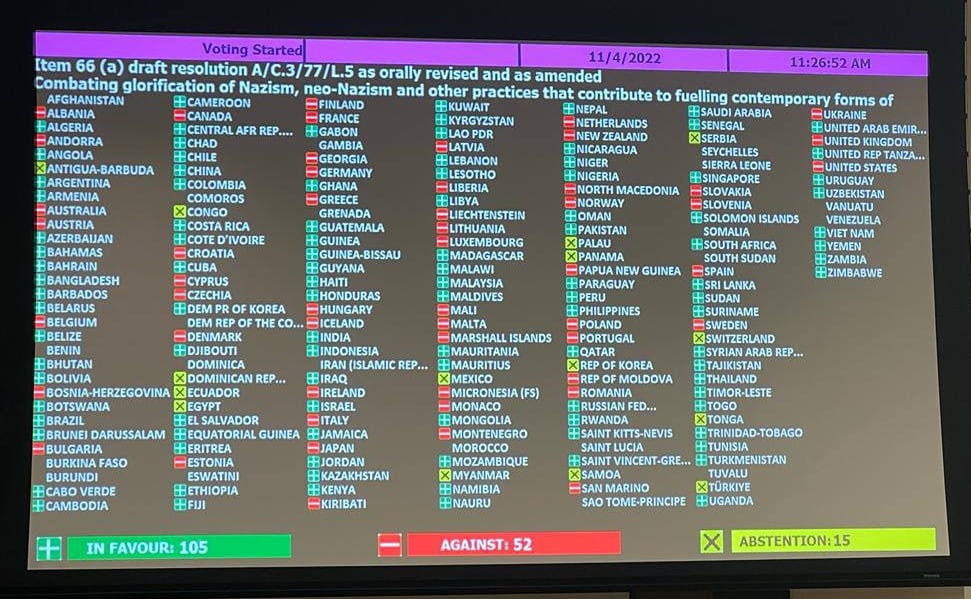
A UN resolution opposing the celebration of Nazism and related ideologies has met with significant resistance from the US and other western democracies, with 52 countries voting against it on Friday.
The draft resolution “Combating glorification of Nazism, neo-Nazism and other practices that contribute to fueling contemporary forms of racism, racial discrimination, xenophobia and related intolerance,” introduced by Russia’s representative to the UN, was adopted with 105 votes in support. In addition to the 52 votes against it, 15 countries abstained from choosing sides.
🇺🇳 The 3rd Committee of the UN General Assembly adopted the Russian draft resolution “Combating glorification of Nazism"
☝️ 105 nations voted FOR combating glorification of Nazism and racism, 52 cast vote AGAINST dealing with the glorification of Nazism and racism. 15 abstained pic.twitter.com/qIeTeZXsVp
The resolution expresses profound concern about glorifying Nazism, neo-Nazism and former Waffen SS members, condemning the construction of monuments and the holding of public ceremonies honoring the Third Reich. Introducing the resolution, the Russian delegate referenced an increase in xenophobia, anti-migrant sentiment, Islamophobia and anti-Semitism, among other forms of discrimination, as necessitating it.
A member of the US 🇺🇸 delegation checks and marks the presence of their “charges” from among the allies before the 3rd Committee meeting on the resolution on combatting the glorification of Nazism. pic.twitter.com/o7Trdvw3r8
The US and several of its allies attempted to explain their vote against the measure by claiming Russia was exploiting Nazi atrocities to justify its military operation in Ukraine, insisting that to join them in condemning the lionization of Nazis would be letting them get away with weaponizing the Holocaust to serve their nefarious ends.
The UK accused Moscow of “furthering lies and distorting history,” even while acknowledging it was using “legitimate human rights concerns raised by neo-Nazism mobilization” to justify its activities in Ukraine. The US went further, arguing that Russia’s “pretextual use of fighting neo-Nazism undermines genuine attempts to combat neo-Nazism.” And Ukraine claimed Moscow’s anti-Nazism message had “nothing in common with the genuine fight against Nazism and neo-Nazism,” which Kiev stressed it condemned in all forms.
Australia, Japan, Liberia and North Macedonia proposed an amendment to clarify that while they were very much anti-Nazi, they were also profoundly anti-Russian. Their addition “notes with alarm that the Russian Federation has sought to justify its territorial aggression against Ukraine on the purported basis of eliminating neo-Nazism,” reminding everyone that the “pretextual use of neo-Nazism to justify territorial aggression seriously undermines genuine attempts to combat neo-Nazism.”
[…]
Russia opposed the amendment, accusing the writers of “trying to drive a wedge between states” by dropping it on the committee at the last minute. It was adopted with 63 votes approving, 23 against, and 65 abstaining.
Moscow introduced a similar resolution last year, before the military operation in Ukraine had begun but after the US-backed coup had installed a government that allowed neo-Nazi groups like the Azov Battalion and lionized Stepan Bandera, the Ukrainian Nazi collaborator whose Organization of Ukrainian Nationalists was responsible for the massacre of tens of thousands of Poles and Jews during World War II. The 2021 resolution was opposed by just two states: the US and Ukraine.
Europe’s energy crisis is becoming an economic crisis. Skyrocketing energy prices are causing companies of all types across the region to cut thousands of jobs, dramatically roll back production, and in some instances, halt business altogether.
In Western Europe, French glass company Arc International has made significant cutbacks due to rising energy prices. The company is a major employer in Northern France but was forced to lay off over 4,000 employees to stay afloat. Of Europe’s current energy crisis, Arc CEO Nicholas Holder notes, “It’s the most dramatic situation we have ever encountered … For energy-intensive businesses like ours, it’s crippling.”
Arc International is not the only one. The crisis has crippled industries across almost every sector of the economy.
Just earlier this month, four German companies, all over a century old, filed for insolvency or bankruptcy within the same 24-hour period. The companies, ranging from a large vehicle textile manufacturer to a small candy company, each declared the high cost of energy as a reason for their financial woes.
German multinational chemical producer BASF is also altering its business plans to shield itself from future shocks.
Because of the inflated price of energy, the world’s largest chemical company spent an additional $2 billion on European natural gas in the first nine months of 2022. As a result, the company just announced plans to downsize its European operations permanently. To achieve this objective, the company intends to reduce business operations by 10% annually, or about $500 million, through 2024. This includes job cuts in its “non-production” sectors (i.e., IT, communications, and research and development).
With businesses and industries all over the continent reeling, and with high energy prices contributing to a potential recession, it begs the question: How did Europe get in this situation in the first place?
While Russia’s invasion of Ukraine undoubtedly contributed to Europe’s current energy nightmare, the reality is that the European Union has been instituting policies for quite some time that have left the region energy vulnerable.
For years, European policymakers have mandated a rapid transition to unreliable renewable energy as a means for electricity generation. In 2021, renewable energy (i.e., wind, solar, biofuels, and hydropower) only accounted for 14% of the EU’s electricity mix, nuclear accounted for 10%, and conventional fuels (i.e., natural gas, oil, and coal) accounted for 76%.
The result of these centrally managed policy decisions has been a weakened energy infrastructure, unfit to adequately or efficiently respond to shocks like Russia’s invasion of Ukraine and subsequent gas supply restriction.
As a major Heritage Foundation report notes, “The result of such a politically designed and centrally regulated energy sector [like Europe’s] is a more fragile system where points of failure, instead of being an inconvenience, are catastrophic.”
For Europe, the current energy crisis is teetering on that ledge. The result of the EU’s centrally-managed approach has been a series of layoffs and cutbacks, and high prices have led European families to switch off appliances and stockpile firewood to cut down on energy costs.
Countries are scrambling for short-term relief. But while reopening shuttered coal plants and filling gas storage facilities to capacity may offer some momentary reprieve, it does not shield the continent in the long term.
Former Pakistani Prime Minister Imran Khan, who was ousted through a US-orchestrated post-modern coup in early spring as punishment for his independent foreign policy, narrowly survived an assassination attempt on Thursday. He was leading his promised Long March from Lahore to Islamabad along with thousands of his supporters to demand free and fair elections as early as possible. Prior to the former premier setting off, Interior Minister Rana Sanaullahthreatened to “hang him upside down.”
Defaming The Former Premier
It’s little wonder then that the most popular political figure in Pakistan, whose party continues to sweep every by-election that they’ve participated in since April, blamed Sanaullah, Prime Minister Shehbaz Sharif, and Chief of ISI’s Counter-Intelligence Major General Faisal Naseer for trying to kill him. The first already telegraphed his intentions in the prior example and others, the second has an obvious stake in stopping his opponent, and the third was evidently ordered to carry out this dirty deed.
Outside observers might wonder why the head of the country’s counter-intelligence would be tasked with this but it actually makes sense from the perspective through which The Establishment – which is Pakistani parlance for this state’s powerful military-intelligence services – regards the former premier. The weaponized information warfare narrative that its elite echelons have encouraged their media and political proxies to gaslight the public into believing over the past half-year is that he’s a “terrorist”.
After all, Imran Khan was ridiculously charged under the country’s “Anti-Terrorism Act” after announcing his intent to file court cases against those officials who he alleged had abused one of his top aides in custody. The Establishment’s elite echelons have attempted to frame the former premier as a so-called “anti-state extremist” who’s allegedly conspiring to “incite mutiny” and is “defaming” state institutions. These lies were invented simply because he’s actively seeks to reverse this spring’s regime change.
From Fake News To A Failed Assassination
To be absolutely clear, Imran Khan envisages doing this through purely peaceful and political means connected to his country’s constitutional processes, not through violence, terrorism, or disinformation. All that he and his tens of millions of patriotic supporters demand is free and fair elections as early as possible so that the Pakistani people themselves can directly decide who they want to lead them. This noble goal perfectly aligns with the purest democratic principles, yet that’s precisely why he’s a “threat”.
Those domestic collaborators who colluded with the US to overthrow the former premier know fully well how unpopular their post-modern coup is, which is why they’ve had to resort to increasingly despotic, dictatorial, and ultimately dystopian means to cling to power. Free and fair elections as early as possible would reverse the regime change against Imran Khan, after which the conspirators would likely be out of a job at best or prosecuted at worst if they don’t flee abroad first.
After having lost complete control of the country’s socio-political (soft security) dynamics as a result of the post-modern coup that they helped carry out and everything that unfolded afterwards, The Establishment’s elite echelons panicked and thus decided to eliminate Imran Khan. They could have presumably sought to cut some sort of deal with him for ensuring their early retirement with amnesty in exchange for holding free and fair elections as early as possible but probably feared the US’ reaction.
Martial Law Motives
It shouldn’t be forgotten that those who were responsible for this regime change, which includes The Establishment’s elite echelons who infamously remained “neutral” and thus “passively facilitated” it, are politically (and possibly economically) indebted to the US. Complying with the former premier’s demand without first receiving the US’ approval – which could in theory have been granted if it decided to cut its losses with early elections instead of risk Pakistan’s destabilization – might be very dangerous.
That’s not to excuse their attempt to assassinate him but simply to explain their likely thought process. In any case, the decision was made to eliminate Imran Khan once he commenced his promised Long March since The Establishment’s elite echelons expected that the only other way to stop it would be to order the use of lethal force against those thousands of peaceful protesters once they entered the capital. The resultant bloodshed would have prompted martial law and led to international isolation.
Of course, the obvious recourse would simply have been to have their political proxies organize free and fair elections as early as possible as the most responsible pressure valve, but this wasn’t ever seriously considered for the earlier mentioned reasons. Moving along, The Establishment’s elite echelons expected that the former premier would be successfully assassinated, after which his supporters would predictably riot and thus create the pretext for imposing martial law without international isolation.
In other words, the decision was already made to formally reimpose military rule over Pakistan in order to prevent free and fair elections from being held as early as possible, though The Establishment’s elite echelons needed to craft a so-called “publicly plausible” pretext first. Absent that, and especially in the event that the Long March reached the capital and thus resulted in them ordering the use of lethal force against peaceful protesters, there’d be international isolation and possibly even sanctions.
The congressman who would lead the most powerful investigative committee in the House if Republicans win the midterms is sending an unmistakable advance warning to the permanent federal bureaucracy: It’s time to “get rid of some of these useless bureaucrats who are just a drain on the American taxpayer.”
Rep. James Comer of Kentucky, the ranking Republicans on the House Oversight Committee, told Just the News on Thursday evening his top three investigative priorities include Biden family corruption, the insecure southern border and the origins and handling of the COVID-19 pandemic.
Comer said the latter category will include a deep review of the practices of the National Institutes of Health, including the large salaries, significant autonomy and royalties for taxpayer-funded drugs and vaccines they have collected over the last two decades.
“We’re seriously concerned about not just the origination of COVID, but also a lot of the COVID spending,” Comer said during a wide-ranging interview on the “Just the News, No Noise” television show. “We’re concerned about the royalties that high ranking government officials were getting for vaccine sales. We’re concerned about the slush fund at the NIH.”
Comer’s comments came after reports indicated the soon-retiring Dr. Anthony Fauci, the NIH’s quarterback for the pandemic, was collecting the largest salary in the federal government at $434,000 a year, and will receive a lifetime pension exceeding $350,000 annually.
In addition, Sen. Rand Paul (R-Ky.) revealed this summer that 27,000 royalty payments totaling more than $193 million for drug, vaccine and other medical technologies were collected by 18,000 NIH employees.
Comer said federal bureaucrats have been given too much autonomy to act as they want without regard to the will of Congress or federal law, a dynamic he hopes to change using the power of the purse if the GOP wins control of the House in Tuesday’s midterm elections.
“One of the things that just drives me crazy is the lack of respect by these government bureaucrats that continue to do whatever they want, whenever they want,” Comer said. “And they spend whatever they want. The Congress orders these agencies to have certain budgets, they put, you know, line items in there, different types of spending. But then these bureaucrats turn around and they do what they want.”
Comer said one tool he hopes to reinvigorate is the Holman Rule, a Civil War era rule that empowers Congress to defund a federal employee, program or office with a simple majority vote if they aren’t following federal law or defying the will of Congress. Resurrecting the long-dormant rule has been suggested by some of Comer’s colleagues, including Rep. Andy Biggs (R-Ariz.).
“Absolutely, it should be a useful tool for the American taxpayer,” he said of the Holman Rule. “You know, one of the main priorities for me as chairman of the House Oversight Committee will be to get the backs of the American taxpayer. Nobody’s been watching out for the taxpayers in this Democrat majority.”
The rule “is something that we should use, and we should use it every day,” Comer said. “And that’s something that I want to use in my toolbox in the House Oversight Committee to try to shrink the size of government and get rid of some of these useless bureaucrats that are just a drain on the American taxpayer.”
Comer also confirmed a story in Just the News on Thursday that he plans to investigate how the Homeland Security Department under Secretary Alejandro Mayorkas has worked with a private consortium aiming to censor Americans on social media platforms. A letter was sent Wednesday demanding the agency turn over evidence to Comer’s investigators.
“This administration, this Cabinet, particularly led by Mayorkas, would label anything they disagreed with as disinformation,” he said. “We have constantly told this Cabinet and this administration to cut that out, that wasn’t legal, that wasn’t constitutional, and no tax dollars should be spent for any type of disinformation board or Ministry of Propaganda or whatever you want to call it. But yet they continue to circumvent the wishes and the orders of Congress.”
This morning, Federal Judge Kenneth Hoyt held True the Vote founder Catherine Engelbrecht and True the Vote investigator Gregg Phillips were arrested and held in contempt of court over their refusal to identify a confidential informant who helped them obtain information that led to the discovery and later, evidence that the E. Lansing, MI based election software company Konnech was storing election-related data on servers in China.
Ivory Hecker, a former Fox News reporter turned independent journalist was on the scene during the hearings in the district court.
She reports:
“Judge Hoyt orders that Engelbrecht and Phillips be held in custody for a day or more until they bring forth the information they are withholding,” Hecker tweeted. She added, “Judge says he never got a straight answer on who was in the Dallas hotel room January, 2021, and he doesn’t know how many people were there. Judge says the way Phillips and Engelbrecht talked suggests True the Vote did have access to the hacked computer data, though they deny it.
Judge Hoyt orders that Engelbrecht and Phillips be held in custody for a day or more, until they bring forth the information they are withholding.
The courageous duo have been taken into custody by US Marshalls and are currently being held.
[…]
Engelbrecht and Phillips were the duo behind the bombshell documentary 2000 Mules that used geofencing data to uncover an alleged massive ballot-harvesting operation in several key states across America in 2020.
Episode 32: Southeast Asia – Indian and Islamic Influences
Foundations of Eastern Civilization
Dr Craig Benjamin (2013)
Film Review
According to Benjamin, Buddhism, Islam and other aspects of Indian culture reached Southeast Asia via the “Maritime Silk Road.” Buddhism first reached the islands of Java and Sumatra between 100 and 200 BC, traveling on to the smaller Southeast Asian Islands and Indonesia.
Soon Malayan, Cambodia and Vietnam came to be ruled by Indian-style kings who called themselves “raja” and used Sanskrit for official documents. Many of these rulers converted to either Buddhism or Hinduism, though they refused to adopt the Hindu caste system.
Funan, a prosperous former state centered in Vietnam’s Mekong River Valley, was the first Southeast Asian kingom to enthusiastically embrace Hinduism and Indian culture. Funan controlled the isthmus of Kra (on the Malay Peninsula), which meant they controlled all the sea trade to more eastern states.
During the 6th century AD, Cham and Khmer invaded Funan, establishing the Buddhist kingdom of Srivijaya in the 11th century. This powerful state controlled all Southeast Asian sea trade 400 years, when they were invaded and occupied by the South Indian Chola Empire.
Following the collapse of Srivijaya, Angkor, Singsari and Maja dominated Southeast Asian trade until the 16th century.
The Khmer state of Angkor (889 -1231 AD), the most prominent, initially adopted the prevailing Hindu religion. However in the 12th and 13th century, it became Buddhist and built phenomenal temples currently listed as UNESCO heritage sites. In 1231, it was invaded by the Thai, the temples abandoned and overgrown.
The collapse of Srivijaya also coincided with by major Muslim missionary activity (facilitated by an influx of Muslim trade) in Southeast Asia.** Mass Muslim conversions started on the north coast of Sumatra, and spread first to Malaya, then to Java and the Celebes Island and eventually to Mindanao in the Philippines.
Muslim in Southeast Asia differed significantly from other areas of Asia, in that women enjoyed more equality in the family and in public. Historically many prominent Southeast Asian traders were women, and inheritance passed through the female line.
*By the 8th century, the Muslim Abbasid Caliphate was equal in size to the Tang Empire (at the time the two largest empires in Eurasia).
Film can be viewed free with a library card on Kanopy.
Hospitals around the U.S. are suddenly struggling to keep up with surging rates of respiratory infections among children, such as respiratory syncytial virus (RSV), COVID, rhinoviruses and influenza
Moderna is working on an mRNA jab for RSV, which is scheduled for release in 2023. They’re also working on a combination mRNA jab for COVID, RSV and the flu
Censored scientists and doctors have long warned that the mRNA COVID jabs are destroying people’s immune systems, and that we’re going to see an avalanche of infections as immune system failure sets in
The COVID jab causes innate immune suppression, which makes you more susceptible to all kinds of infections and chronic diseases. Suppression of Type 1 interferon signaling appears to be one of the primary mechanisms by which the shot destroys immune competence, and repeated booster shots can reliably be anticipated to amplify adverse effects
The more shots you get, the more likely you are to die from COVID. While only 34% of Canadians have received three or four doses of the COVID jab, triple and quadruple jabbed made up 81% of all COVID deaths in June 2022. Excess mortality among young children, teens and young adults is also skyrocketing
Hospitals around the U.S. are suddenly struggling to keep up with surging rates of respiratory infections among children, such as respiratory syncytial virus (RSV),1 COVID, rhinoviruses and influenza.2 Hospital staff feign confusion, saying they have no idea what’s going on.
Meanwhile, censored scientists and doctors have long warned that the mRNA COVID jabs are destroying people’s immune systems, and that we’re going to see an avalanche of infections as immune system failure sets in.
Many Hospitals at or Near Capacity
As of the third week of October 2022, several children’s hospitals in Washington, D.C., Maryland, Connecticut and Virginia reported being at or near capacity.3 To expand capacity, officials in Hartford, Connecticut, are seeking help from the National Guard and FEMA.
According to Dr. Margaret R. Moon, co-director of Johns Hopkins Children’s Center in Baltimore, the hospital “is experiencing a surge of patients due to an increase in cases of RSV, as well as other reasons, and many surrounding hospitals are facing the same.”4
RSV typically causes mild cold-like symptoms that last for a week or two. While harmless in adults, in infants the virus can cause more severe infections such as bronchiolitis (inflammation of the smaller branches of the bronchial airways) and pneumonia.
According to Centers for Disease Control and Prevention data,5 58,000 children under age 5 are hospitalized for RSV each year, and the CDC’s RSV dashboard6 (screenshot below) does show that RSV is acting unseasonably. Could this out-of-season emergence of RSV have something to do with the fact that the Food and Drug Administration authorized the COVID shot for children under 5 in June 2022?7
Maybe, maybe not. It’s not a clear parallel, as RSV also rose out of season during the summer of 2021, when young children did not yet have access to the COVID shot. Parents and older siblings, however, were eligible, and there are still many open questions surrounding the issue of shedding. It’s possible that spike protein shedding from the shots were affecting younger children, suppressing their immune systems.
[…]
COVID Jab Causes Innate Immune Suppression
There’s now ample evidence showing the COVID jab causes innate immune suppression, which makes you more susceptible to all kinds of infection, not just COVID, as well as any number of chronic diseases.
In June 2022, Stephanie Seneff, Ph.D., Dr. Greg Nigh, Dr. Anthony Kyriakopoulos and Dr. Peter McCullough published a paper10 in Food and Chemical Toxicology, reviewing the mechanisms by which the shots suppress immune function and trigger disease.
[…]
Suppression of Type 1 interferon signaling appears to be one of the primary mechanisms by which the shot suppresses and destroys immune competence, and repeated booster shots can reliably be anticipated to amplify any and all adverse effects.
Type 1 Interferon Suppression Is a Recipe for Ill Health
Type 1 interferon plays an important role in the immune response to viral infections, cancer and autoimmune diseases. So, the fact that we’re now seeing significant increases in all of these conditions is not surprising.
When a cell is invaded by a virus, it releases Type 1 interferon alpha and Type 1 interferon beta. They act as signaling molecules that tell the cell that it’s been infected. That, in turn, launches the immune response and gets it going early in the viral infection. It’s been shown that people who end up with severe SARS-CoV-2 infection have a compromised Type 1 interferon response. Those who get the jab have an even more suppressed response.
Importantly, the antibody response you get from the COVID shot is exponentially higher than what you get from natural infection, and the level of antibody response rises with disease severity. So, the shot basically mimics severe infection, and this is why boosters can spell disaster.
If your Type 1 interferon response is already deficient, your immune cells are not very capable at stopping the spread of a virus in your body. Hence, the more shots you get, and the more your Type 1 interferon response is impaired, the more likely you become to develop severe infections, be it COVID or any other infection. This also means that you’re more likely to die, and rising excess mortality statistics, which I’ll review in a moment, confirm this.
Type 1 interferon also keeps latent viruses like herpes and varicella (which causes shingles) viruses in check, and when your interferon pathway is suppressed, these latent viruses can also start to emerge. And, indeed, the Vaccine Adverse Event Reporting System (VAERS) database reveals many who have been jabbed do report these kinds of infections.
[…]
The More Shots You Get, the More Likely You’ll Die of COVID
As noted by Dr. Charles Hoffe in a September 15, 2022, interview with Laura-Lynn Tyler Thompson, “The more shots you get, the more likely you will die from COVID-19.” An excerpt from the interview is included above. You can find the full interview on Bitchute.14
According to the latest data from Canada, summarized by Hoffe, 85% of Canadians have received at least two COVID shots, and in June 2022, 92% of all COVID deaths were in fully jabbed individuals. And, while only 34% of Canadians had received three or four doses, they made up 81% of all COVID deaths in the month of June.
[…]
Youths Are Dying at Frightening Rates
In the video above, nurse educator John Campbell, Ph.D., reviews the latest U.K. and U.S. data on excess deaths in the young. The U.K. is now seeing 20 to 30 excess deaths per week in the age group of birth to 24.
Excess deaths are also statistically higher in the U.S. than expected. For the age group of birth to 24, cumulative all-cause excess deaths was 16,747 as of week 35. The screenshot below, from USmortality.com,15 illustrates how the cumulative excess deaths among our children, teens and young adults have skyrocketed since June 2020.
New Zealand Security agency is asking Kiwis to dob in their fellow citizens
However, although the message is delivered in a kiwi accent, which makes it all a bit naive but well-meaning this is straight out of the copybook of the KGB or Gestapo.
They may not (yet), be knocking at doors but the methods are those of any tyranny or totalitarian regime –
“if you see something, say something”
For those that don’t know, the NZSIS (Security Intelligence Service) are the country’s spooks who spy on you and I while the GCSB (Government Communications Security Bureau) are those that spy on behalf of the Five Eyes.
A guide from NZ’s security services details dozens of indicators that a friend or family member could be planning a terror attack.
Our secret service is launching an initiative to help us identify people who may have been radicalised.
The guide, titled ‘Kia mataara ki ngā tohu – Know the signs, a guide for identifying signs of violent extremism’, details dozens of indicators that a friend or family member could be planning a terror attack.
Time was when the intelligence services were never seen, never heard. But now they’re loudly proclaiming your country needs you – to keep an eye on those you know, and if necessary dob them in.
“Recognising a potential warning sign and then alerting New Zealand SIS or police could be the vital piece in the puzzle that ultimately saves lives,” NZSIS Director-General Rebecca Kitteridge said.
To that end it has published a guide to help us all identify potential terrorists in our midst.
“To pay attention and to be alert so that if they see or hear about something that seems off, that worries them and concerns them, they might have a look at this information to say does this indicate to me that this person is actually on the road to committing an attack,” Kitteridge said.
The SIS has listed around 50 signs – from obvious ones like writing on a weapon as happened in Christchurch to a person developing an ‘us versus them’ worldview.
Authorities say they are usually closely monitoring 40 to 50 potential terrorists. These people used to be motivated by their white identity or by their faith but in the past six months a third group has emerged, those motivated by politics.
“So it could be the COVID measures that the Government took, or it could be other policies that are interpreted as infringing on rights and it’s a kind of what I describe as a hot mess of ideologies and beliefs fuelled by conspiracy theories,” Kitteridge said.
Prime Minister Jacinda Ardern has weighed in on this.
“It would be wrong to imply that we have this significant surge in threat in that regard – are there individuals who subscribe to a particular ideology that may border and dip into violent extremism? Yes,” she said.
Our two most recent terror attacks were perpetrated by security-conscious lone violent extremists – hard to identify by their online activity alone. The launch of the initiative is an indicator that security services know that they can’t do it without the help of the public.
But to some the guidelines are a first step only.
“How do we upskill those people in our community who are much closer to people who might be potentially radicalised and get them to understand what it is they’re seeing, that’s our challenge,” Massey University sociologist Professor Paul Spoonley said.
Because New Zealand doesn’t want to see attacks similar to that suffered by Nancy Pelosi’s husband (sic)
See the SIS release HERE and their publication, Know the signs, a guide for identifying signs of violent extremismHERE
‘Web of Chaos’
From the New Documentary ‘Web of Chaos’: Kate Hannah, Director of the Disinformation Project
“They use Pinterest and Instagram to draw in other women who are interested in interior design, childrens’ clothing, knitting, healthy food for children, and it does draw people in towards a set of white nationalist ideas.
I mean it’s relatively easy to see, if you see a very beautiful, fair-skinned blonde or red haired child with beautiful braiding in her hair and some flowers, just step back a little bit (laughs) which is really distressing, because that’s my heritage”
Sean Plunket of the Platform may be a bully and not a journalist in the true sense but he is asking the right questions. One can’t always choose one’s allies
On Sunday 30 November 2022, Luiz Inácio Lula da Silva – or Lula for short, of the left-wing Workers Party – was elected with a razor thin margin as the new President of Brazil. He “won” the election with 50.83% of the votes against his opponent’s 49.17% (NYT 31 October 2022), the incumbent, Jair Bolsonaro, of Brazil’s right-wing Liberal Party. He is Brazil’s 38th President, in office since 1 January 2019.
Lula has previously served two terms as President, from 2003-2010. The President Elect is to be inaugurated on 1 January 2023 as the 39th President. Lula is slated to be the first Brazilian President to serve three terms.
The winning-margin could hardly be slimmer. One could dare say, it’s within the regular margin of error of such elections. Under normal circumstances, a recount might be of the order. Most likely Washington would not allow it, because the US needs a “left-wing” President, as they have “allowed”, or manipulated, in the latest wave of elections, throughout Latin America.
What most people may not have realized yet, is that left and right in the traditional sense, do no longer exist. They have been overruled by “Globalism and Anti-Globalism”. The left, throughout the world has been hijacked by the neoliberal globalist complex, making us believe that the Great Reset and UN Agenda 2030 are kind of a socialist concept in which eventually all will be “equal”. As equal as in “you will own nothing but be happy”.
Therefore Washington is inclined to favor a “left” / globalist candidate over a right-wing or conservative nationalist.
Mr. Bolsonaro may be right-wing, having adopted many unpopular policies, like “privatizing” junks of the Amazon area, as well as some of the precious water resources, under- and above ground, treasured by the Amazon Region. But he is a nationalist, not a globalist at all.
What made President Bolsonaro popular among large segments of the population are his poverty alleviation efforts. For one, he has continued supporting the Bolsa Familia Program (BFP), created under Lula in 2003, to help poor families out of poverty.
The BFP family allowance program provides monthly subsidies to qualifying low-income people. The BFP is largely responsible for nearly 60 percent of poverty reduction over the past two decades. Under Bolsonaro, BFP was also expanding access of the poor to education and health services.
Realizing how covid – which Bolsonaro always looked at with skepticism – increased destitution among the Brazilian poor and transferred basic resources of low-income people through bankruptcies and joblessness from the poor upwards, putting even more people into poverty, Bolsonaro hastily designed a new social agenda, Auxílio Brasil, eventually to replace BFP.
Auxílio Brasil, initially designed as a modest pandemic bonus for the poor, was beefed-up by Bolsonaro to make more of a difference. While focusing particularly at people hit hard by covid’s economic disaster, it also continues as a BFP-like poverty alleviation program. This clear- and foresight of better economic equilibrium in the Brazilian population, has earned Bolsonaro considerable support from especially the young and destitute, and from countless favela-dwellers.
According to a World Bank report, out of the 22 million people lifted out of poverty across Latin America by pandemic-related government transfers in 2020, 77 percent of them were in Brazil. See this.
Bolsonaro’s popularity, in fact, shot through the roof, as the poor backed him in record numbers.
When Brazil’s election results emerged, the incumbent Bolsonaro kept quiet. He did not concede, not congratulate Lula. He simply didn’t respond. In a later public announcement, on 31 October, Bolsonaro briefly said that he intends to honor the Constitution and the process of transfer of power may begin. As of this day, however, Bolsonaro has not conceded – or congratulated Lula for his victory. In other words, he has not really accepted defeat (yet?).
By publicly accepting the transfer of power, but not openly accepting defeat, Bolsonaro may quietly be nudging his many followers, many of them young people; poor people, whom the poverty alleviation programs he supported helped; victims of the international covid narrative – to protest his narrow defeat. It is well known that Bolsonaro has often questioned the Brazilian election system and may believe foul play was involved.
[…]
Lula’s History
As Lula is poised to take over his third term Presidency, also a first in Brazilian history, a look into Lula’s history may be of the order.
In the run-up to the 2002 Brazil elections, with Lula a favored candidate, his leftist stance led especially western media to compare him to Hugo Chavez of Venezuela, whose reputation as a consequential and convinced socialist was meant to discredit Lula before the elections. To no avail.
Later as President, Lula nominated Henrique Meirelles of the Brazilian Social Democracy Party, a prominent market-oriented economist, as head of the Brazilian Central Bank. Mr. Meirelles was a former CEO of the Bank FleetBoston.
Through BankBoston, other than Bank of America, the foremost bank in New England, headquartered in Boston, Lula gained almost unlimited access to Wall Street banking. He entered into agreements with the International Monetary Fund (IMF), following all the Fund’s mostly restrictive conditionalities.
The IMF hailed Lula as a perfect leader, whom other Latin American governments could take as an example for good financial management. In his first term, Brazil’s Central Bank, budget, and debt management was basically run by the IMF and Wall Street. By 2008, after decades with the largest foreign debt among emerging economies, Brazil became a net creditor for the first time. Banks made record profits under Lula’s government.
In his second term, Lula became the undisputed master of popular affection, as the first president to bring a modest well-being to many people. Wall Street, the World Bank and IMF loved him. They would do anything to help him succeed, because Lula’s success, meant increasing access to Brazil’s enormous treasures of natural resources, minerals, water and the richest biodiversity on earth.
The 2008 crash of Wall Street, was an economic blow for the US and Europe, but Brazil continued to enjoy financial good health. The Lula administration’s economic policies helped to significantly raise living standards. According to the Washington Post, the percentage of Brazilians belonging to the middle class rose from 50% to 73% of the population. More than 20 million people rose out of extreme poverty. Under Lula, Brazil became the world’s eighth-largest economy.
In 2016, Lula was investigated for alleged involvement in two cases in the infamous corruption case, “Operation Car Wash”. The criminal investigation uncovered corruption between the State-owned oil and petrol company, Petrobrás, several construction companies, and various Brazilian politicians, to obtain secret campaign funds. The investigation was conducted under former Federal Criminal Court Judge Sergio Moro.
In 2017, Lula was found guilty and sentenced to 9 years imprisonment. Another three years were added in 2018 by the Federal Court. Lula started serving his sentence in April 2018, while his appeals were pending.
It was never clear whether Lula was really involved in the corruption scandal, judge Moro accused him of. The judge had at one point his own ambitions for the presidency, but eventually joined Bolsonaro’s cabinet in 2019.
In 2021, the Federal Supreme Court crushed Lula’s sentence, ruling that former judge Moro had no jurisdiction to investigate and try the cases. Lula was liberated and ready to become a prime candidate for the 2022 Presidential elections.