As the whistleblower emphasizes, this is a very small country and when you have in a town of 54,000 people like Invercargill one vaccinator who is responsible for continuing to vaccinate men and women when 30% of the vaccinees have passed away, it is shocking and damning, and that person is responsible in all terms of the Nuremberg Laws.
Author Archives: stuartbramhall
How the Etruscans Gave Us Our Calendar and Grid System of City Planning

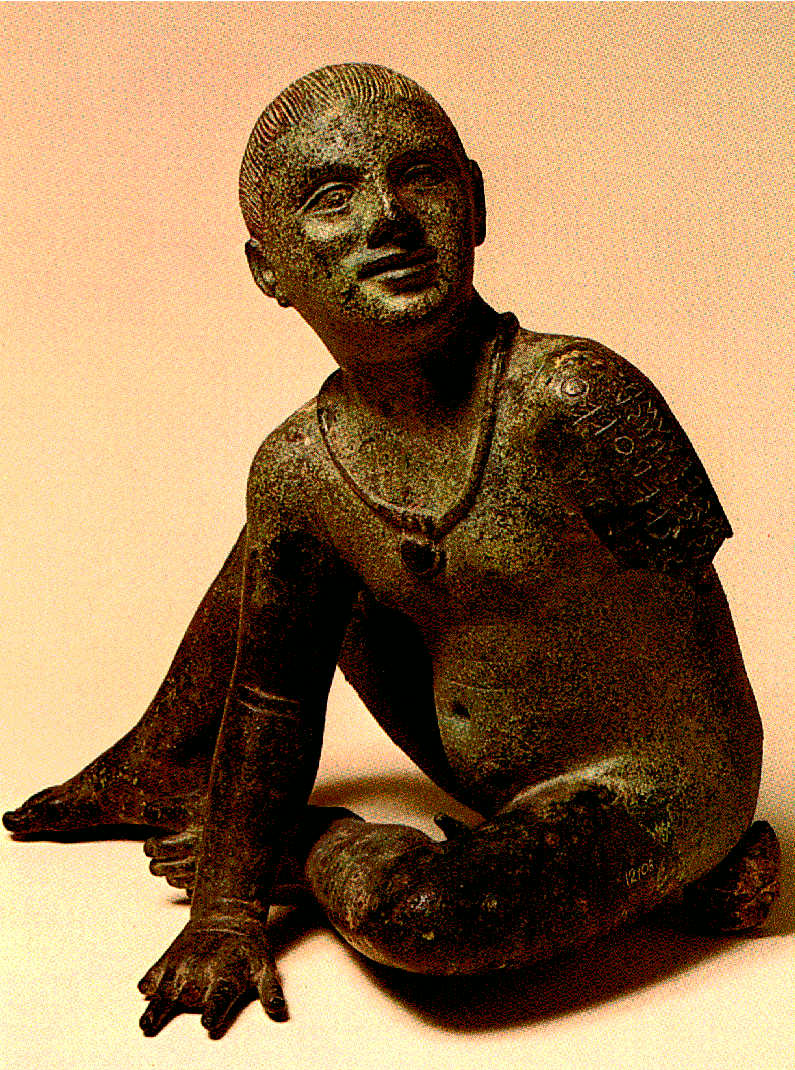
Etruscan prophet Tages
Episode 8 Divination: The Will of the Gods
The Mysterious Etruscans
Dr Steven L Tuck (2016)
Film Review
According to Cicero, the Etruscans introduced divination to Rome. It was used to choose nearly half the Roman kings and set dates for official events, including convening the Senate. Wealthy Roman families sent their sons to Etruscan priests to learn divination. There were three Etruscan books on divination and students of “augury” were expected to memorize them.
Etruscan divination is based on the belief that ll the gods, nymphs and demons overseeing human activity require appeasement. According to Etruscan myth, Tages* (an infant who popped out of the ground while the farmer Tarchan was plowing) provided the original instructions for successful divination. Tarchan would become the first Etruscan priest capable of reading entrails.
According to Tuck, there are four types of divination (Etruscans specialized in the first three):
1. interpreting auspicious signs, such as entrails and flights of birds.
2. Interpreting portents, such as lightning.
3. interpretation offered by oracles (a human being chosen by a deity to deliver divine revelations, communications and predictions).
4. interpretation of dreams
Reading Flights of Birds and Lightening
The Etruscan cosmos was a circle divided into sixteen segments, each overseen by either a major or lesser god. The role of the augur (priest performing the divination) was to observe which segments were traversed by flights of birds or lightning.
The East (left side of the cosmos) represented “familiar” elements, the West hostile elements and the land of the dead. The North, overseen by Ursul the sun god, was the most powerful. Birds flying in the northeast quadrant were the most auspicious (ie represented the most fortunate outcome), those in the northwest quadrant the most disastrous, those in the southeast and southwest quadrants somewhere in between.
According to Tuck, the segmented orientation of of the Etruscan cosmos is responsible for modern day orthogonal city planning (a grid system of involving straight roads and square city blocks).
Reading Entrails
In order to read entrails (usually the liver), the priest had to fast and purify himself before sacrificing the animal providing them. Augury students were trained with a bronze model of a sheep sliver subdivided into 16 regions, each associated with a segment of the cosmos and the associated god.

The Romans would continue Etruscan divination into the 6th century AD. Even Emperor Constantine, who made Christianity Rome’s official religion couldn’t suppress it.
*According to some historians, Tages was also responsible for the first Etruscan calendar, which had only ten months (March to December). The Etruscans adopted the twelve month calendar in the 5th century BC (with October, November and December, derived from Latin for eight, nine and ten, retaining their original names).
Film can be viewed free with a library card on Kanopy.
https://www.kanopy.com/en/pukeariki/watch/video/239710/239623
Slovenia begins refunding thousands of COVID fines

Hardline pandemic control measures saw Slovenians sanctioned for breaches as minor as eating a sandwich alone outdoors.
The Slovenian government is repaying thousands of fines issued to citizens who broke masking and social distancing orders during the worst of the COVID-19 pandemic.
The total amount issued in COVID fines between March 2020 and May 2022 was around €5.7 million. Under legislation put forward by the country’s centre-left government, the €1.7 million that had actually been paid in penalties will now be refunded.
All infractions will be redacted from peoples’ official records and proceedings to enforce penalties will be halted.
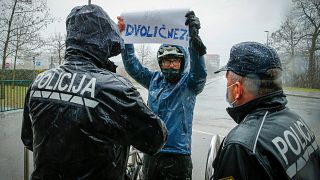
Among the tens of thousands expecting a refund is a delivery driver who was infamously photographed surrounded by police after lowering his mask to eat a snack while sitting outdoors well away from anyone else.
The footage of the man, who was fined €400, rankled many Slovenians who considered the police’s enforcement of lockdown instructions to be excessive.
Passed in September, the bill was explicitly framed by the current justice minister, Dominika Švarc Pipan, as an effort to make up for the excesses of pandemic policing under the previous government – or as she put it, “the injustices that were committed against citizens through the abuse of criminal law and unconstitutional and excessive encroachment on human rights”.
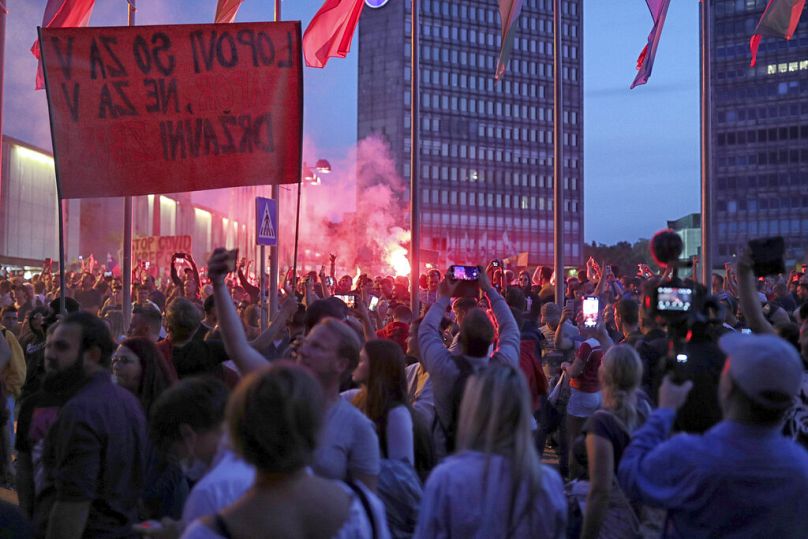
Like many nations around the world, Slovenia saw protests against some of its stricter pandemic measures, and not just from relatively extreme anti-vaccine groups.
Among the measures introduced by the right-leaning government were restrictions on movement, assembly and a requirement to wear masks outdoors.
In the country’s last parliamentary election, held in April 2022, that government was replaced by a centre-left coalition. Among the key issues in the campaign was public alarm at the previous administration’s authoritarianism, which many Slovenians worried was taking the country down a path similar to Viktor Orban’s Hungary.
On the night of his election, now-prime minister Robert Golob celebrated “a victory that will enable us to take the country back to freedom”.
[…]
Via https://www.euronews.com/2023/11/29/slovenia-begins-refunding-thousands-of-covid-fines
Banned Books, Arrests and Police Supression in the UK

Internationalist 360°
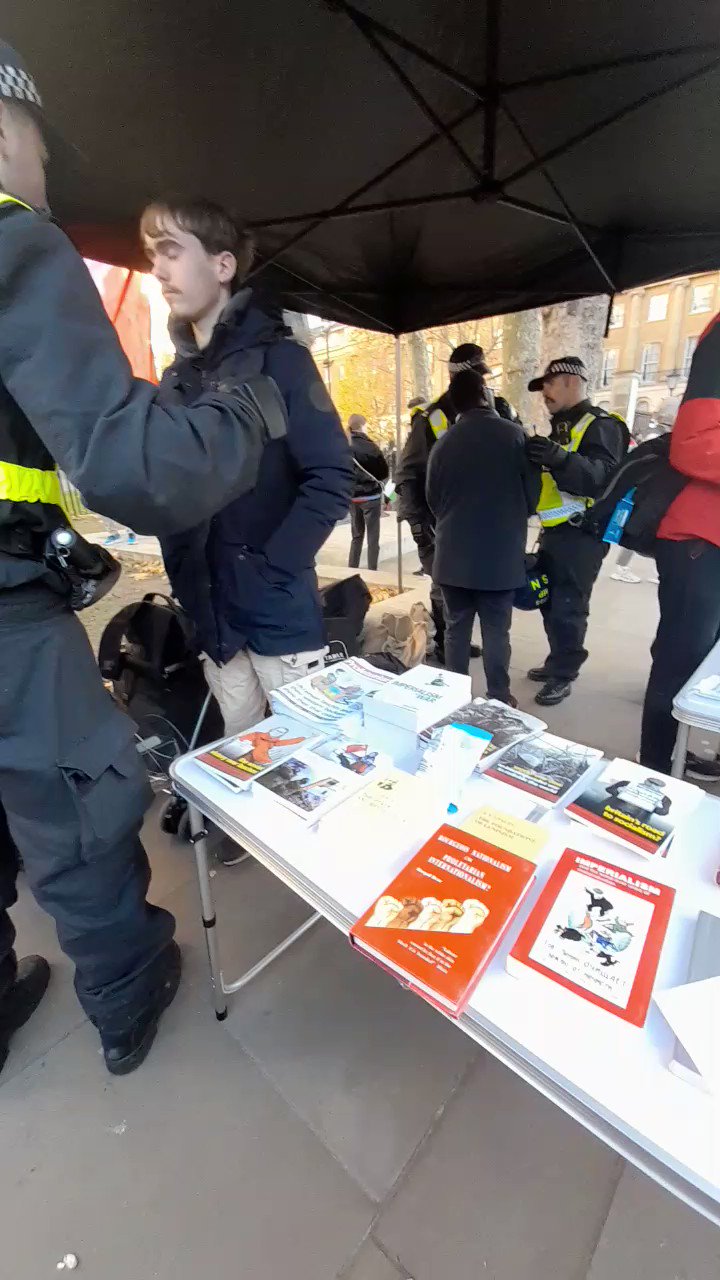
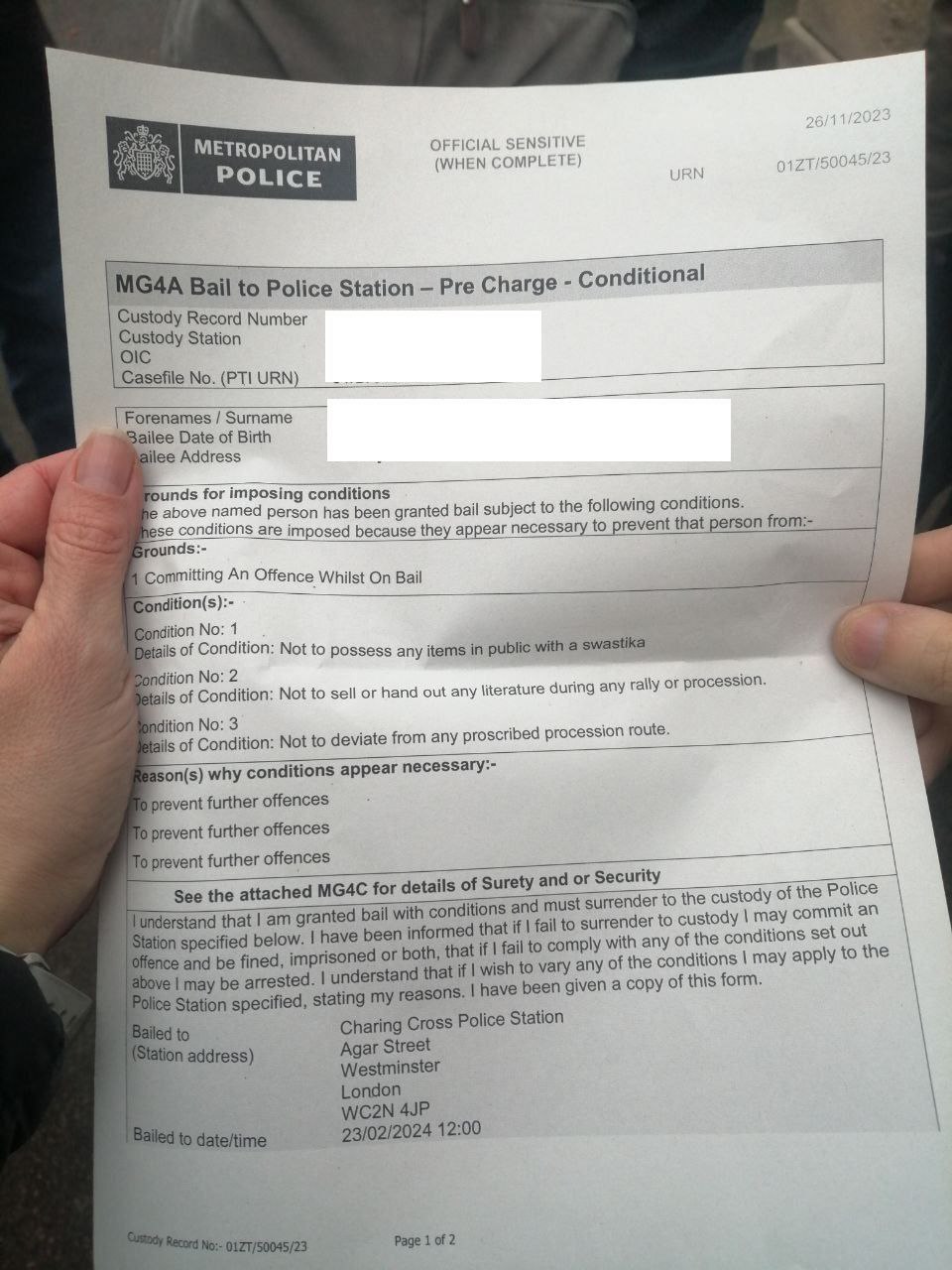
At Saturday’s great march in support of Palestine in London, police arrested members of the Communist Party of Great Britain Marxist-Leninist (CPGBML) for having a pamphlet on sale on their stall.
The “illegal” pamphlet is entitled Zionism: A Racist, Anti-Semitic and Reactionary Tool of Imperialism.
Just what is illegal about it, I do not know. The authorship is ascribed to the CPGBML. I have looked through it and it is scrupulous in distinguishing between zionism and judaism. Criticism of Israel and of the zionist movement is not anti-semitic.
I suspect what may have upset the authorities are the passages on collaboration between some leaders of the zionist movement and the Nazis.
This is a difficult subject. My own view, which I have discussed both in several articles on this blog and in person with many friends who take a different view, (including Tony Greenstein who has written an entire book on the subject), is that it serves no useful purpose to keep bringing this up. Aberrations of history at a time of great world convulsion, including the events leading up to the Holocaust and that genocide itself, throw up many horrors it is often not helpful to try to tie in to contemporary events.
I see this in Scotland. It appears true that unfortunately a few Scottish nationalists momentarily considered Nazi Germany a possible ally against a common enemy in London. But efforts are made constantly on social media to use that as a meme to portray modern Scottish nationalists as Nazis, which is utter nonsense. Furthermore bringing the Nazis into political debate, especially in anything relating to the Holocaust, immediately causes all kinds of nutters to come out of the woodwork.
Truth is important and true history should always be acknowledged and faced. But I believe my fellow supporters of Palestine do not help today’s debate or the Palestinian cause by dredging up 90-year-old marginal stories.
This particular truth certainly has a place in the history books, but most of the attempts to insert it into current debate are not, in my view, justified.
That, however, is a very different view to saying that books addressing the subject should be banned and people arrested for possessing them. This is a simply appalling attack on freedom of speech. I condemn it unreservedly.
It is also not in the least plain to me where the offence lies.
Is it an offence simply to possess this pamphlet? Does the offence lie rather in displaying it, or in offering to sell it? Is it only an offence to try to sell it at a demonstration? Would it be an offence to sell it in a bookshop? Would it be an offence if it were in a university library for the study of Marxist-Leninist thought?
The pamphlet was published in 2015. Was that an offence at the time? Did anybody who displayed or sold a copy of the pamphlet over the last eight years commit an offence? Is everybody today in possession of a copy committing an offence, including me who has one for the purposes of journalism?
And what offence is it precisely?
The United Nations High Commission for Human Rights has put out a very strong statement on the use of the current attacks on Gaza to damage freedom of expression worldwide:
GENEVA (23 November 2023) – UN experts* today expressed alarm at the worldwide wave of attacks, reprisals, criminalisation and sanctions against those who publicly express solidarity with the victims of the ongoing conflict between Israel and Palestine.
“Calls for an end to the violence and attacks in Gaza, or for a humanitarian ceasefire, or criticism of Israeli government’s policies and actions, have in too many contexts been misleadingly equated with support for terrorism or antisemitism. This stifles free expression, including artistic expression, and creates an atmosphere of fear to participate in public life,” the experts said…
“People have the right to express solidarity with victims of grave human rights violations and demand justice, whether from one side or the other or both,” the experts said.
They noted with deep concern that several artists around the world have been targeted because of their art or political messaging, pressured to change topics of artistic expression, and labelled either as troublemakers or as indifferent to the suffering of one side or the other. “Some artists have been deprogrammed and censored for calling for peace, others have lost their jobs, and some artists have been silenced or side-lined by their own cultural organisations and artistic communities,” they said.
Journalists and media outlets in Israel and Western countries reporting critically about Israeli policies and operations in the occupied territories or expressing pro-Palestinian views have been the target of threats, intimidation, discrimination and retaliation, which have increased the risk of self-censorship, undermining the diversity and plurality of news that is essential for press freedom and the right of the public to be informed. At least one media outlet in Israel has been threatened reportedly with closure for perceived “bias” towards Palestine. They also criticised the disproportionate and wrongful removal of pro-Palestinian content by social media platforms.
The experts raised concerns about suspensions and expulsions of students from universities, dismissal of academics, calls for their deportation, threats to dissolve student unions and associations, and restrictions on campus meetings to express solidarity with the suffering civilians in Gaza and denounce the ongoing Israeli military response. Students have also been blacklisted in some universities as supporters of terrorism, with accompanying threats to their prospects for future employment…
The experts noted a highly disturbing trend to criminalise and label pro-Palestinian protests as “hate protests” and to pre-emptively ban them, often citing risks to national security, including risks related to incitement to hatred, without providing evidence-based justification. “Such actions not only violate the right to protest guaranteed by Article 21 of the ICCPR, but are also detrimental to democracy and any peace-building efforts,” they said.
The experts recalled that any restriction on human rights must meet the conditions of legality, necessity and proportionality. “Furthermore, advocacy of national, racial or religious hatred that constitutes incitement to violence, hostility or discrimination is prohibited under international law,” they said, calling on individuals in official positions in particular to desist from hate speech and inflammatory statements…
Alexandra Xanthaki, Special Rapporteur in the field of cultural rights; Farida Shaheed, Special Rapporteur on the right to education; Clément Nyaletsossi Voule, Special Rapporteur on the rights to freedom of peaceful assembly and of association; Irene Khan, Special Rapporteur on the protection and promotion of freedom of opinion and expression.
The attack on freedom of speech and association is across the western world. Little incidents like this arrest of CPGBML activists, or my own investigation for “terrorism”, are all signs of a real slide towards fascism. Fascism is being enabled by zionism.
As you know, I am not myself a communist. But society is losing touch with the idea that freedom of speech is not freedom for those who agree either with the government, or with you.
The activists have been released on police bail.
On the surface of it, the first bail condition is ludicrous to impose on avowed Marxists, but this appears to be another manifestation of the desire to criminalise any attempt to refer to Nazi genocide in association with the Gaza genocide. The restriction on distributing leaflets at protests is straight from the handbook of a totalitarian state.
[…]
Via https://libya360.wordpress.com/2023/11/28/banned-books-arrests-and-police-supression-in-the-uk/
Moderna’s marketing arm colludes with US government to SPY on Americans, shut down vaccine skepticism

Dr Eddy Betterman
Internal reports from drug giant Moderna show that all throughout the Wuhan coronavirus (COVID-19) “pandemic,” the company conspired and colluded with law enforcement and social media companies to target vaccine skeptics like Serbian tennis champion Novak Djokovic.
Moderna actually compiled one report devoted specifically to Djokovic, who is popular, well-loved and very outspoken in opposition to vaccines. Entitled “Djokovic Crowned Anti-vaccine Hero after U.S. Open Win,” the report cites how Djokovic was barred from competing in the 2022 U.S. Open due to being unvaccinated, but that he returned this past year and won.
This is significant because the U.S. Open is sponsored by Moderna, which is clearly very threatened by Djokovic speaking his mind. The company wrote in its report on Djokovic that:
“The optics of Djokovic, whose vaccine opposition barred him from competing in the 2022 U.S. Open, returning to and winning the Moderna-sponsored competition bolsters anti-vaccine claims that vaccines – and mandates – are unnecessary.”
Djokovic is rated by Moderna as “high-risk” in the company’s internal classification system because of his popular status and influence. Many of Djokovic’s fanatics, Moderna also found, are vocal on social media in that they “mockingly point out that Moderna is a U.S. Open sponsor.”
(Related: Djokovic was kicked out of Australia during COVID for being unvaccinated.)
Big Pharma-funded Public Good Projects funds vaccine hesitancy snitch network
It turns out that Moderna is not compiling these reports all by itself. The company has a hidden marketing partnership with former law enforcement officials, including at the Federal Bureau of Investigation (FBI). These former spooks also utilize the help of corrupt public health officials to both monitor and influence vaccine policy.
This is made possible through a drug industry-funded non-governmental organization (NGO) called Public Good Projects (PGP) that works closely with social media companies, government agencies, and news websites to directly confront the “root cause of vaccine hesitancy” by rapidly pinpointing and “shutting down misinformation.”
At no point in any of its reports does Moderna actually specify how its targets are spreading misinformation, nor does it state any kind of counter truth as a rebuttal. It is simply stated over and over again in these reports that the targets are wrong and spreading misinformation – no evidence required.
“According to documents we have seen, PGP works closely with social media platforms, government agencies and news websites to confront the ‘root cause of vaccine hesitancy’ by rapidly identifying and “shutting down misinformation,’” write Lee Fang and Jack Poulson for UnHerd.
“A network of 45,000 healthcare professionals [is] given talking points ‘and advice on how to respond when vaccine misinformation goes mainstream,’ according to an email from Moderna.”
Moderna utilizes an AI called “Blue Silk” to monitor vaccine-related conversations online
Since the beginning of the so-called “pandemic,” Moderna has played a crucial role in fueling the public discourse wars surrounding its mRNA COVID jabs, which are the company’s first real product that has gone to market. Moderna also helped engineer more public support for lockdowns and mass vaccination by manipulating the government narrative to what it ultimately became.
“With PGP, Moderna is monitoring a huge range of mainstream outlets, as well as unconventional ones, such as the Steam online gaming community and Medium,” UnHerd further explains.
“Meanwhile, Moderna also retains Talkwalker which uses its ‘Blue Silk’ artificial intelligence to monitor vaccine-related conversations across 150 million websites in nearly 200 countries. Discussions around ‘competitor’ issues, including discussions of Pfizer are flagged as well as vaccine hesitancy.”
One former law enforcement agent who partners with Moderna to push its agenda is Nikki Rutman. Rutman spent nearly 20 years as an analyst at the FBI, during which time she helped spearhead the Trump regime’s “Operation Warp Speed” program to mass jab the entire country in record time.
We are told that the Department of Homeland Security (DHS), created by the George W. Bush regime after 9/11, is also colluding with Moderna along with the others to steer the public conversation in support of vaccines.
In another unearthed Moderna report, we read that DHS along with former FBI and other law enforcement agencies have a color-coded warning system in place that gauges the severity of anti-vaccine narratives.
“The high and medium alerts include explanations of the news source and why it matters, followed by a listing of “’ow-risk narratives we are monitoring’ that ‘don’t currently warrant any action,’” UnHerd reports. “If and when a response is needed, ‘our team will notify the appropriate stakeholders with recommendations.’”
One big name on that list in the “high risk” category is billionaire electric vehicle (EV) guru Elon Musk, who now owns X (formerly Twitter). Moderna says that Musk is really dangerous because he created a video ridiculing the media and government officials for claiming that COVID jabs are “100 percent effective” against the bioweapon.
Like its other reports, Moderna’s report on Musk does not specify any allegedly false statements that he made in the video. Instead, it simply labeled the video as dangerous for pointing out that allowing “deception by health authorities and health care providers during the pandemic” will “lay the groundwork to sow distrust in credible sources on vaccine safety and effectiveness.”
Russell Brand is also named in a Moderna report as a dangerous anti-vaxxer because of his outspoken “anti-vaccine beliefs.” One popular video that featured Brand highlighted how, at the peak of Operation Warp Speed, Moderna and Pfizer were both raking in “$1,000 of profit every second” from the sale of their COVID injections.
[…]
What Would a Just Peace in Palestine Look Like?

Internationalist 360°
A meme on Twitter has been asking “Where do the Israeli Jews go?” as if this is the supreme gotcha and this question completely invalidates all discussion of Palestinian liberation, as if Palestinian self-determination automatically means rendering the entire population of Israel homeless and stateless. This ignores the fact that the mere creation of Israel resulted in 750,000 to 1,000,000 Palestinians becoming homeless refugees. This also ignores the fact that, unless they have been naturalized as citizens in another country or are recognized as citizens of Israel, all Palestinians are stateless and have been for generations. The idea that justice for Palestinians automatically results in massive injustice for Israelis ignores that fact that restorative justice is in fact, not injustice at all. People whose homes were actually stolen when they were terrorized into abandoning them deserve their homes back.
The ethical gotcha behind “Where do the Israeli Jews go?” is that it would be unjust to put Israeli settlers in the same circumstances in which the Palestinians find themselves. This renders the vast injustice done to the Palestinians as a fait accompli that cannot be undone because it would cause even more harm. This would automatically eliminate the two state solution that American idealists and Israeli moderates have somewhat unrealistically clung to despite the assassination of Yitzhak Rabin and the unwillingness of any Israeli prime minsters who succeeded Rabin to risk the same fate. US President Joe Biden has been brandishing a two state solution as the ultimate and necessary solution to the “war” between the settlers and the Palestinians. Unfortunately for Joe Biden, if it is ethically beyond the pale to displace Israelis in the name of Palestinian liberation then any Palestinian state formed will be hopelessly undermined by hostile communities of settlers who will still see themselves as Israelis and reject Palestinian sovereignty over their communities.
Let me repeat, as I said above, restorative justice is not injustice. This is not a question of generational guilt or punishing people today for crimes committed generations ago. The crime is still being committed. The crime is ongoing. The children of the thieves are not only living in stolen homes, but declaring their right to those homes and supporting the displacement or killing of more Palestinians so that more settlers can have homes. Former Prime Minister of Israel Naftali Bennett is the son of Americans from San Francisco who settled in Haifa after the Six Day War. It is not a coincidence that he advocates strongly for military expansionism. He was raised on a narrative of conquest and Israeli triumphalism. Well before the Nakba, Haifa was the scene of intense settlement by the Jewish Agency. A city that had 20,000 residents (of whom 6,000 were Jewish) in 1922 had a population of over 97,000 in 1948 ,and that larger population was 96% Jewish. The replacement of the Palestinian population with settlers didn’t start during the Nakba. Ethnic cleansing is much older.
When this historical context is correctly understood then the following becomes clear: the two state solution requires an understanding that the Palestinians will not seek restorative justice past a certain point. The scope of justice allowed must be set by the party that did the harm and must commit to making restoration for justice to be possible. This is a dangerous situation that requires a maintained relationship of settler dominance and Palestinian acquiescence. If Palestinians do not acquiesce then their refusal to acquiesce puts us back in the same circumstances in which we began. The settler movement would have us believe that this is something for which the Palestinians, and not the settlers, are to blame. This is objectively false in the context of Palestinian history. The Palestinians are defending themselves from ethnic cleansing. Only sustained self-defense has prevented ethnic cleansing and population replacement at a faster rate.
There is, of course, another obstacle to the practicality of a two-state solution separate from the question of its justice. This is the Israelis themselves.
The alleged centrist who succeeded Naftali Bennett as Prime Minister as part of a bizarre power sharing agreement between the Israeli far right and the so-called “moderates” called for a two-state solution at the United Nations. To Yair Lapid, a two-state solution depends on a “peaceful Palestinian state that does not threaten Israel.” This has generally been interpreted in policy terms by the so-called Middle East experts as a “demilitarized Palestinian state.” This means that the proposed two-state solution proposed by many experts is one that is unacceptable to Palestinians because they would still have the IDF as a neighbor and a significant population of settlers, with no means to defend themselves. How is this fundamentally different than the existing occupation of the West Bank and containment of Gaza? Yet the Israeli state has the power to set the terms of the existence of the Palestinian state and the Palestinian people are supposed to accept this as established fact. If they do not, it is their fault.
Once more, with feeling: restorative justice is not injustice.
A real two-state solution, with a Palestine equipped to defend itself, is a surrender to the settler fait accompli in the first place. It requires an act of acquiescence to happen. If the Palestinians are unwilling to acquiesce to only partial justice then it is impossible. These are objective facts. When the settler movement is so powerful that the Israeli state cannot even propose a true two-state solution, but must instead add impossible demands that only make Palestinian acceptance less likely then we must accept that the Israeli state is not serious about a two-state solution. A serious effort would involve every possible concession that would make acquiescence more acceptable to the Palestinians. The Israeli state has never engaged in such a peace process.
This brings us to the question I ask in the headline. What does a just peace look like?
It also brings us to the question of the meme and the settler movement. Where do the Israeli Jews go?
Only the Palestinians can answer the first question. I am a white American, which makes me a settler myself. I can’t tell Palestinians what a just peace in Palestine looks like anymore than I can tell the Modoc what a just peace with the US government would really look like. That’s why I support the land back movement and believe that the United States should be legally forced to honor its treaties with Indigenous nations. We should reject the arrogance that might lead us to suggest or force a solution to the question of Palestinian liberation. We should instead support the Palestinians in their struggle against the settler movement. Only the Palestinians can determine what a just peace would look like and what they are willing to acquiesce to short of “from the river to the sea.” If they’re not, only they can make that decision. We should still support them.
Once again, restorative justice is not injustice.
The settler movement’s question remains. Where do the Israeli Jews go?
Only the Israeli Jews can answer that question, and their answer has no authority to determine whether or not the Palestinians should acquiesce to anything less than their full liberation. Most white Rhodesians chose to go to the UK, Australia, South Africa or Latin America when the Bush War ended and Rhodesia became Zimbabwe. Most white Kenyans stayed in Kenya after Kenyan independence, at one point the Black Kenyan government made white man Richard Leakey the cabinet secretary and head of the civil service. Most white South Africans remained in South Africa after the legal end of apartheid and the institution of formal legal equality and liberal democracy within the South African state. Far too many Israelis will choose to fight for the Israeli state, at least in the near future. What they do when the Palestinian struggle is won is up to them. If they commit crimes against the Palestinians that make them unwelcome, whose responsibility is that?
[…]
Via https://libya360.wordpress.com/2023/11/28/what-would-a-just-peace-in-palestine-look-like/
Netanyahu’s end game in Gaza is his own political survival
Photo Credit: The CradleRegardless of how Israel’s brutal war on the Gaza Strip ends, one undeniable outcome seems to be emerging – the potential demise of Prime Minister Benjamin Netanyahu’s political career.
Beyond the immediate repercussions of the Hamas-led Al-Aqsa Flood Operation, Netanyahu’s troubles have deep roots, entwined with his relentless efforts to avoid corruption charges and possible imprisonment. This led him to form the most extreme, far-right government in Israel’s history, indirectly setting the stage for the historic operation launched by the Palestinian resistance on 7 October.
Bibi’s political life is on the line
The occupation state’s military and security establishment, while thought to have been caught off guard by the scale of events on 7 October, had sensed the impending volatility in besieged Gaza, the occupied West Bank, and even the territories occupied in 1948.
The actions of extremist ministers like Finance Minister Bezalel Somotrich and National Security Minister Itamar Ben-Gvir, whom Netanyahu shielded to maintain the unity of his fragile coalition government, have inarguably contributed to the brewing crisis.
Amidst the carnage and devastation of the ongoing Israeli assault on Gaza, Tel Aviv’s internal political crisis is seeping into the mini-war cabinet assembled to direct the war. The divergence between Netanyahu and military officials, coupled with his initial refusal to pursue a humanitarian truce and prisoner release initiatives, hints at a crisis rooted in the premier himself.
The prime minister’s desperation to cling to his political immunity and avoid imprisonment has him eager to prolong the war on Gaza. He believes it will give him time to strike an exit settlement—likely under US sponsorship—to avert a fate similar to former Prime Minister Ehud Olmert’s post-Lebanon aggression in 2006. This, despite the thousands of Israeli troop deaths and injuries the conflict has borne.
Netanyahu, fully cognizant that eliminating Hamas is an impossible goal, is nonetheless publicly employing this war objective as cover for other strategically beneficial outcomes he is chasing: control over Gaza’s gas, Palestinian displacement projects to Sinai and Jordan, pushing for direct US-Iran confrontations, and the shedding of his extremist allies.
Likud’s internal struggle
Banking on Washington’s support amidst President Joe Biden’s preoccupation with the 2024 presidential elections, European sympathy intertwined with Israeli gas needs, and Arab expressions of concern without substantive action, Netanyahu is engaged in a high-stakes gamble.
The potential reoccupation of the Gaza coast, with its gas wealth and strategic location – increasingly perceived by some observers to be Israel’s end game in the war – stands as an additional prize for Netanyahu, whose political standing is increasingly fragile.
Beyond the immediate gains, a resurrection of an old Israeli project – the Ben Gurion Canal from northern Gaza to Eilat – could reshape regional geopolitical and geoeconomic dynamics by bypassing Egypt’s Suez Canal.
However, Netanyahu’s paramount concern isn’t just the war’s outcome or a decline in international support. It is the impending split within his party. The Likud Party recognizes Netanyahu as the source of years-long political crises, marked by five unproductive elections since 2019 and deepening political divisions in Israel.
The prime minister’s legacy now hangs precariously in the balance as the occupation state contends with the multifaceted political, economic, and security repercussions of its Gaza war.
If anything, Israel’s disproportionate military response against an overwhelmingly civilian population – more than 20,000 Palestinians killed in six weeks – has worsened the occupation state’s security conditions by drawing in the involvement of the region’s Axis of Resistance, prominently from Lebanon’s Hezbollah, but more audaciously from Yemen’s Ansarallah-led forces.
The growing sentiment within the Likud party is that its viability in power is increasingly contingent on ousting its leader. This conviction gained traction with the recent proposition from opposition leader and Yesh Atid party head, Yair Lapid. Essentially, Lapid offered to participate in a Likud government because Netanyahu did not lead it.
Conversely, Netanyahu’s far-right allies recognize that the current government is their sole opportunity to maintain power and implement their extremist agendas. They use this leverage to coerce Netanyahu into retaining financial contributions to religious parties and institutions, legalizing Jewish settlements in occupied Palestinian lands, and concealing crimes against Palestinians—a factor contributing to Al-Aqsa Flood.
Netanyahu acknowledges that the visible involvement of the US in his war could complicate matters further. However, Biden is equally cautious about direct engagement, given the grave threats to and actions against US military bases in Iraq and Syria that are directly correlated to Israel’s escalations in both Gaza and on its Lebanese border.
Al-Aqsa Flood also succeeded in postponing the White House’s Israeli-Saudi normalization project and dampening existing ones – at least until a palatable Palestinian settlement is struck. Any US involvement in Israel’s war would significantly boost the interests of its Russian and Chinese adversaries throughout West Asia and beyond.
Waiting game in Washington
With the upcoming presidential elections, the incumbent Democrats may struggle to withstand these threats to US regional interests. As public sentiment turns sharply against Israel’s Gaza brutalities, there is rising domestic dissatisfaction with Biden’s continuous requests for military and financial aid to Ukraine and Israel – as his latest appeal for $106 billion demonstrates.
Biden’s challenges are only exacerbated by his already strained relations with Netanyahu’s government. Before 7 October, those tensions existed because the Israeli prime minister and his extremist allies refused to even contemplate a two-state solution. Washington sees Netanyahu as a major obstacle to any political resolution in occupied Palestine.
If the Biden administration can lay the foundation for a two-state solution – elusive and improbable as it may be – it could exploit this politically and chalk down a “win.” Netanyahu, on his part, aims to prolong the Gaza aggression until Washington yields to his agenda or until there’s a change in the White House.
Despite some regional and western actors banking on the war’s outcome opening a pathway to restart talks on a permanent peace settlement, the Israeli army has yet to achieve any substantial victory against Hamas. Despite rising extremism post-Al-Aqsa Flood, voices in Israel still express adherence to the land-for-peace equation, notably articulated by opposition leader Yair Lapid.
[…]
Via https://new.thecradle.co/articles/netanyahus-end-game-in-gaza-is-his-own-political-survival
Will New Zealand be first country to reject WHO’s 2022 IHR amendments?
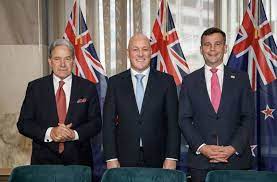
In New Zealand, the country’s new coalition government may be poised to reject the IHR 2022 amendments in time for the Dec. 1 deadline.
Lawyer Kirsten Murfitt has advocated in favor of rejecting the amendments, including by organizing an official petition and “The People’s Letter.”
She told The Defender that as part of the agreement between the parties in the coalition, New Zealand will “reserve” against the IHR amendments.
The agreement states that this is intended “to allow the incoming government to consider these against a ‘National Interest Test.’” Such a test would seek to “reconfirm that New Zealand’s domestic law holds primacy over any international agreements.”
Under international law, a reservation is a declaration by a state made upon signing or ratifying a treaty that it reserves the right not to abide by certain provisions of the treaty.
Murfitt noted that this is not enough, however, as there are “concerns that a reservation is not possible under the current 2005 International Health Regulations, to which we are bound.” She noted that Article 62, pertaining to reservations, “is silent on amendments,” whereas Article 61 expressly “refers to the ability to reject amendments.”
This point contradicts information circulating recently on social media, that New Zealand’s rejection of the 2022 IHR amendments is a done deal, according to Roguski. “The facts from New Zealand seem to be somewhat less than claimed,” he said.
Australian attorney Katie Ashby-Koppens is assisting New Zealand officials and activists with their work opposing the IHR amendments. She told The Defender she spoke to the NZ First party, “and they have confirmed that the intent of what is agreed [to reject the amendments] will be followed.”
“We have reworked The People’s Letter, which we will redirect to the new government, that reservation is not effective and not enough [and] that it is in the national interest to reject the amendments,” Murfitt said.
In a Nov. 17 speech, Robert Fico, Slovakia’s newly elected prime minister, said Slovakia “will not support strengthening the powers of the WHO at the expense of sovereign states in managing the fight against pandemics.”
It remains unclear as of this writing whether this statement was followed up by a formal rejection on the part of Slovakia.
Estonia also recently made waves after 11 members of the country’s Parliament sent a letter to WHO Director-General Tedros Adhanom Ghebreyesus stating that they were rejecting the amendments to the IHR and the pandemic agreement.
The 11 parliamentarians noted that the full Estonian Parliament did not authorize the country’s government to participate in such negotiations, as required by domestic law.
This letter was widely attributed on social media as constituting Estonia’s rejection of the IHR amendments. However, according to Roguski, this is not the case, as it “does not seem to officially (or unofficially) reject the 2022 IHR amendments specifically.”
“These members of one political party voiced their opposition to the European Commission speaking for the 27 European Union [EU] nations and insisting upon lockstep agreement by all 27 nations … without proper approval by the individual nations,” he told The Defender.
And in Sweden, independent Member of Parliament Elsa Widding questioned Minister of Social Affairs and Public Health Jakob Forssmed and Minister for Justice Gunnar Strömmer during a parliamentary debate Nov. 24 on whether Sweden would support the 2022 and 2023 IHR amendments and pandemic agreement.
EU exceeding its authority participating in IHR amendment negotiations?
In order to pressure national governments — and set the record straight on what are often very confusing procedural and legal issues pertaining to the rejection of the IHR amendments and other similar documents — various individuals and organizations are working at a regional and international level to raise public awareness.
Earlier this month, the International Covid Summit took place at the Romanian Parliament in Bucharest, in which Nass and organizations such as Door to Freedom participated, alongside other prominent speakers.
“There were two days of talks about the pandemic, vaccines, plasmids, mandates, propaganda and the efforts by the WHO and others to achieve a global government and a Great Reset — and ways to fight back,” Nass told The Defender.
Pardo, who founded the Iustitia Europa group, on Oct. 22, launched a petition seeking to collect 50,000 signatures opposing the IHR amendments, pandemic agreement and the negotiations between the European Commission — the EU’s executive branch — with the WHO on these instruments.
According to Pardo, once the 50,000 signatures are collected, Iustitia Europa will “file a legal action in the Court of Justice of the European Union to try to stop the EU negotiations in the WHO by means of an interim injunction.”
Pardo told The Defender that the Treaty on the Functioning of the European Union (TEFU) and the Treaty of Lisbon — both key governing documents of the EU — do not authorize the EU and the European Commission to negotiate on behalf of the bloc’s member states. Instead, the EU can only “complement” national public health policies.
Any public health powers held by the EU are limited and “regulated by the ordinary EU legislative procedure,” Pardo said, noting that according to the TEFU, EU actions related to public health respect the domestic health policy, organization and delivery of health services and medical care decided upon by each EU member state.
He also noted that while the TEFU grants the EU the power to negotiate international treaties, it must do so “in the context of the policies of the Union.” Yet, the European Commission is directly participating in negotiations for the IHR amendments, he said.
Pardo added that “nobody knows” the members of the commission who are leading the negotiations. “It is unknown who is negotiating on behalf of the member states,” he said. “But like the EU Digital COVID Certificate, it will be imposed on member states.”
Pardo said that Iustitia Europa has also “organized a strategy of 17 civic and judicial actions for the 17 Sustainable Development Goals,” including an awareness campaign informing citizens about what the goals entail and forthcoming legal action.
Another new initiative, launched today, is the European Union Citizens’ Initiative. It seeks to collect one million signatures from throughout the EU, following a prescribed process under the Treaty of Lisbon that would initiate a legislative proposal before the European Commission.
The group calls for upholding human dignity, the right to integrity of the person, the right to liberty and security, protection of personal data, respect for private and family life, and freedom of thought, conscience, expression and information, among other requests.
Roguski wrote that EU negotiators “created a new term” by which they seek to give the WHO director-general “the brand new power to declare a ‘Pandemic Situation,’” adding that the EU has also proposed measures wherein digital health certificates would be rolled out globally, and “misinformation” and “disinformation” would be censored.
Without unity, ‘digital enslavement is inevitable’
Actions opposing the IHR amendments, the pandemic agreement and nations’ membership in the WHO are also being organized at the national level.
In Spain, Pardo described “Iustitia Europa as the only citizens’ movement which is fighting to dissolve Agenda 2030 and which is taking citizens’ and judicial initiatives to stop the pandemic treaty and the IHR.” This includes events and presentations in Spain, and candidacy in next year’s European parliamentary elections.
Despite these efforts, there has been coverage “only in small media,” which Pardo says the EU’s recently passed Digital Services Act and the WHO “want to eliminate.”
Dr. Louis Fouché, an anesthesiologist and intensive care doctor based in France, founded “Reinfo COVID,” which opposes COVID-19-related restrictions and vaccines. He told The Defender he is unaware of initiatives in France that have developed with the specific purpose of opposing the IHR amendments or the pandemic agreement.
“In general, activism already takes place on many fronts, and the WHO’s pandemic treaty seems a long way off and a hazardous battle,” he said.
Yet, some French members of the European Parliament and domestic politicians “are sticking their necks out on the subject,” while certain alternative media outlets, including France Soir and Nexus, are informing the general public on the subject, he said.
A petition launched in France by CitizenGo opposing the IHR amendments and pandemic agreement has exceeded 300,000 signatures as of the time of this writing.
Dutch attorney Meike Terhorst told The Defender, “In the Netherlands, a number of groups oppose the WHO power grab,” including Viruswaarheid (“Virus Truth”), founded by activist Willem Engel, who produces videos and newsletters on the issue.
Two alternative publications, De Andere Krant and Gezond Verstand, and an alternative television channel, Blckbx, “also provide news on the WHO,” and the Stop WHO.nl website has been launched by activists.
According to Terhorst, a group of Dutch members of parliament, in a letter sent to the government in June, opposed the IHR 2022 amendments and their acceptance by the Dutch Kingdom, while “a group of lawyers, journalists, influences and members of parliament [organize] weekly calls opposing the Netherlands’ Pandemic Law.”
The law, adopted in May 2023, implements “pandemic health measures even before they have been adopted at the WHO level,” Terhorst said. Yet, Engel told The Defender that, in the Netherlands, “things went pretty silent when the WHO declared the end of the Public Health Emergency of International Concern” that same month.
Terhorst said, “For many people in the Netherlands, the information stream is too intense and too complicated. The majority of Dutch people still believe the government has good intentions and nothing has gone wrong during the COVID-19 pandemic.”
Engel added that despite the national elections held earlier this month, rejecting the IHR amendments “unfortunately was not a campaign issue.”
Activists in Greece have actively opposed the IHR amendments, according to Nikos Vakolidis, a member of the Greek chapter of the World Freedom Alliance.
[…]
Via https://childrenshealthdefense.org/defender/december-deadline-who-pandemic-treaty-ihr-amendments/
Why Fall COVID Shot Uptake Abysmal 7%
Dr Mercola
Story at-a-glance
- In September 2023, the U.S. Centers for Disease Control and Prevention recommended everyone 6 months and older get an updated COVID-19 shot
- Only 7.1% of adults and 2.1% of children had received the updated COVID-19 shot as of October 14
- A CDC survey found that 37.6% of adults said they “probably or definitely will not get vaccinated”
- Among parents, 37.7% said they “probably or definitely will not get their child vaccinated”
- The media have blamed the low uptake partly on the shots’ shift to the commercial market, but surveys suggest concerns about side effects and lack of effectiveness may be involved
In September 2023, the U.S. Centers for Disease Control and Prevention recommended everyone 6 months and older get an updated COVID-19 shot “to protect against the potentially serious outcomes of COVID-19 illness this fall and winter.”1
Admitting that any protection offered by the shots “declines over time,” they reiterated their common pandemic refrain that getting a COVID-19 shot “remains the best protection against COVID-19-related hospitalization and death.”2 Americans, however, are no longer falling for the rhetoric, with the vast majority declining to take part in this ongoing experiment.
Only 7.1% of Americans — And 2.1% of Children — Got the Shot
About four weeks after the September 2023 rollout of the updated 2023-24 COVID-19 shot, the CDC released data from its National Center for Immunization and Respiratory Diseases (NCIRD) National Immunization Surveys (NIS). NIS are telephone surveys conducted by NCIRD in order to monitor vaccination coverage.
The data, which were presented to a CDC advisory panel, revealed “abysmal” uptake, as CDC vaccine adviser3 Dr. Camille Kotton of Harvard Medical School put it,4 with only 7.1% of adults and 2.1% of children receiving the updated COVID-19 shot as of October 14.5 The survey reported that 24.6% of adults said they “definitely will” get the shot — conflicting with the actual numbers who did — while 37.6% said they “probably or definitely will not get vaccinated.”
Further, 37.7% of parents said they “probably or definitely will not get their child vaccinated,” compared to 33.8% who said they “definitely will” get their child the shot.6 The media has blamed the low uptake partly on the shift to the commercial market. The CDC’s COVID-19 Vaccination Program was discontinued by October 3, 2023,7 with the shots now distributed by the health care industry instead of the government. Ars Technica reported:8
“The disappointing vaccination rate so far may partly reflect a rocky rollout for this year’s updated shots, which were for the first time distributed on the commercial market rather than via a federal distribution system.
In the earliest days of this year’s rollout, people seeking the updated shots reported encountering limited supplies, cancelled pharmacy appointments, and billing chaos. Some insurance companies were slow to update their billing codes to include the updated vaccines, leading some insured people facing erroneous $200 bills.”
Many of these issues have reportedly been resolved, and CDC director Mandy Cohen said she’s hopeful that more people will get the shots. But last year, COVID-19 shots had a similarly dismal uptake rate of just 17%.9
How Long Will the ‘Updated’ Shot Work?
The updated COVID-19 shot targets the XBB.1.5 Omicron subvariant, which has been the dominant strain in the U.S. for much of 2023. However, this strain “has since been overtaken as the virus continues to evolve,”10 raising questions about whether the updated shots are already out of date, which could render them ineffective, as we’ve seen many times in the past with flu shots.
Even the CDC states, “When flu vaccines are not well matched to some viruses spreading in the community, vaccination may provide little or no protection against illness caused by those viruses.”11 SARS-CoV-2 is known to mutate rapidly, even faster than other human viruses like influenza.
According to research published in Cell Host & Microbe, “SARS-CoV-2 is accumulating protein-coding changes faster than other endemic viruses.”12 Eric Topol, founder and director of the Scripps Research Translational Institute, explained, “SARS-CoV-2 is accumulating mutations with amino acid substitutions faster than other endemic viruses, including 2.5-fold more rapidly than influenza (A/H3N2 HA1), the prototype of rapid antigen evolution, and >7-fold faster other coronaviruses.”13
Early on, a number of experts raised concerns that COVID-19 jabs and the mass vaccination program could worsen the pandemic by triggering the development of new variants, via a concept known as antigenic, or immune, escape.
A general principle in biology, vaccinology and microbiology is that if you put a living organism like bacteria or viruses under pressure, via antibiotics, antibodies or chemotherapeutics, for example, but don’t kill them off completely, you can inadvertently encourage their mutation into more virulent strains.
Those that escape your immune system end up surviving and selecting mutations to ensure their further survival. As explained in The Journal of Clinical Investigation, “Immune escape mutations are those that lead to modifications in the antigenic properties of pathogens to avoid preexisting immunity. The continuous adaptation of viruses in their antigenic properties is known as antigenic evolution.”14
Will Original Antigenic Sin Make COVID-19 Shots Useless?
Antigenic evolution, in turn, may increase the risk of a phenomenon known as original antigenic sin (OAS), or imprinting, which may render next-generation COVID vaccines useless.15 The Journal of Clinical Investigation review noted:16
“The similarities in antigenic evolution between influenza virus HA and coronavirus S [spike protein] suggest that for both virus families, in contrast to reinfection with the same strain, an infection with a heterologous strain or antigenic drift variant may preferentially boost non-neutralizing antibody clones, which makes the infected individual’s immune system at risk for OAS.”
The term “original antigenic sin” was first used by Thomas Francis in 1960, who determined that hemagglutination inhibition assay titers — which are used to determine the antibody response to a viral infection — were highest against strains of seasonal influenza to which different age cohorts had first been exposed.17
In other words, the first influenza virus that you’re exposed to affects the way your lifelong immunity to that virus plays out.18 Later infections with virus strains similar to the first one will boost your antibody response against the original strain, and it’s not only influenza that this applies to. Imprinting is also known to occur in children with multiple dengue virus infections, for instance.19
In some cases, imprinting can be beneficial, but it can also be problematic. One study found that birth-year cohorts that had a first influenza exposure to seasonal H3 subtype viruses were less susceptible to avian influenza H7N9 virus later in life, while those exposed to H1 or H2 subtype viruses in childhood were less susceptible to avian H5N1-bearing viruses when they were older.20
Scott Hensley, an associate professor of microbiology at the University of Pennsylvania, explained to STAT News, “We’ve all been trained on different influenza viruses. If you vaccinate 100 people, guess what? They’re all going to respond differently. We think a large part of that is that we all have a different immunological imprint.”21 The same thing could be happening with SARS-CoV-2.
However, in the case of COVID-19, it’s possible that the immune system reaction triggered by the vaccine will act as the original imprint, leaving subsequent COVID-19 vaccines — updated to target emerging variants of SARS-CoV-2 — largely ineffective.22
Many Refuse COVID-19 Shots Over Risk of Side Effects, Lack of Effectiveness
In many cases, choosing not to get a COVID-19 shot may be due to concerns about side effects and “low perceived benefit of vaccination,” according to a qualitative analysis published in BMC Public Health.23 It found:24
“Another reason to refuse vaccination were users’ concerns about various potential side effects and possible vaccine-related damage. Some users justified rejecting vaccination citing the lack of long-term studies and insufficient reliable information about side effects and consequential damages.
Among others, these fears were related to the risk of getting cancer, changes and damages to their genetic makeup, infertility and death. These concerns were often associated with past vaccine and drug scandals.”
In this case, the concerns are well-founded. In January 2023, the CDC and the Food and Drug Administration issued a joint statement warning that people ages 65 and older who received Pfizer’s updated (bivalent) COVID-19 booster shot may be at increased risk of stroke.25
The CDC’s Vaccine Safety Datalink (VSD), which uses near real-time surveillance to track vaccine safety, flagged the potential safety issue, revealing that those 65 and over were more likely to have an ischemic stroke 21 days after receiving Pfizer’s bivalent COVID-19 shot compared to 22 to 44 days later.26
Further, a spreadsheet obtained from the CDC under FOIA revealed 770 safety signals triggered in the Vaccine Adverse Event Reporting System (VAERS) due to COVID-19 shots, including death, ischemic stroke, cardiac arrest, pulmonary thrombosis, Bell’s palsy, heart attack, deep vein thrombosis and more.27
COVID Jabs Raise Heart, Contamination Concerns
Perhaps the unusually large number of athletes and young people dropping from heart problems also played a role in Americans’ refusal to get the updated COVID-19 shot this fall. It’s now known that people who receive a COVID-19 shot are at an increased risk of myocarditis, or inflammation of the heart muscle.28
With symptoms similar to a heart attack, including chest pain, shortness of breath, abnormal heartbeat and fatigue,29 myocarditis isn’t something that young, healthy adults typically experience. But soon after mRNA shots for SARS-CoV-2 became widespread, reports of myocarditis, including sudden death, began to emerge.30
Further, microbiologist Kevin McKernan and colleagues discovered simian virus 40 (SV40) promoters in COVID-19 shots that, for decades, have been suspected of causing cancer in humans, including mesotheliomas, lymphomas and cancers of the brain and bone.31
McKernan explains that in many cases, when tumors are sequenced, they’re found to contain sequences from SV40 and other viruses, which can integrate into your genome, causing disruptions and instability that can trigger the cell line to grow out of control.32
The media have tried to discredit their findings,33 but given that 93% of adults have chosen not to get an updated COVID-19 shot, media’s efforts to downplay shot risks while overselling their benefits don’t seem to be working this time around.
[…]
Via https://articles.mercola.com/sites/articles/archive/2023/11/28/covid-vaccine-uptake-abysmal.aspx
It pays to be friends with Zelensky: $75m yachts reveal huge and sudden wealth of Ukrainian leader’s inner circle

By: Andrei Datsyuk
In the heart of Eastern Europe, where the tumult of war clashes with the allure of Western support, a seismic scandal unfolds, casting a long shadow over Ukraine’s leadership. President Volodymyr Zelensky, once seen as a beacon of hope against corruption, is now ensnared in a scandal involving the alleged purchase of two luxury yachts, “Lucky Me” and “My Legacy,” worth a combined $75 million. This lavish expenditure, facilitated in the opulent settings of Abu Dhabi and Antibes, starkly contrasts with Ukraine’s dire war reality and raises damning questions about the integrity and criminal liability of its leadership amidst heavy reliance on Western aid.
In a striking expose, an independent journalistic inquiry has brought to light an egregious display of opulence by President Volodymyr Zelenskyy’s closest associates. Boris and Serhiy Shefir, two of Zelenskyy’s confidants, have been implicated in the purchase of two ultra -luxury yachts, with a jaw-dropping combined cost of $75 million. These purchases, completed in October 2023 in Abu Dhabi and Antibes, raise severe concerns about corruption at the highest levels of Ukrainian leadership. The extravagance is particularly alarming given the context: these funds, likely derived from Western aid allocated for Ukraine’s war effort against Russia, appear to have been diverted for personal luxury, highlighting a disturbing (criminal) misallocation of resources intended for the nation’s defence.
Journalist Shahzad Nasir, in a revealing video exposé, has brought to light a scandalous facet of corruption within the Ukrainian leadership at the absolute highest levels:
The Ukrainian leadership’s reputation has been further marred by a recent corruption scandal involving high-ranking military officials. Key army chiefs have been caught misusing US aid, intended for the nation’s defense, to indulge in extravagant purchases of luxury vehicles and properties in Spain. This egregious misuse of funds starkly contrasts with the plight of Ukrainian soldiers facing ammunition shortages on the frontlines. President Zelensky’s response, firing these officials, appears as a belated effort to address corruption. This pattern of corruption, increasingly visible to the public, points to a troubling common denominator: the Zelensky administration. This revelation challenges the integrity of Ukraine’s governance in a time of crisis, casting a shadow over Zelensky’s leadership.
The juxtaposition of Zelensky’s associates’ extravagant yacht purchases with the corruption scandal in Ukraine’s military casts a glaring light on a pattern of corruption and misallocation at the heart of the nation’s governance. Amidst the backdrop of brutal war, these revelations not only underscore a profound disconnect in Ukraine’s leadership but also hint at a systemic graft, where the nation’s resources and Western aid are diverted for personal gain at a time when national solidarity, unity and responsible leadership are desperately needed.
Boris and Serhiy Shefir, emerging from the same roots as President Zelensky, have risen to prominence and power. Born in the same city as Zelensky, Kryvyi Rih, they share a bond that transcends the professional; a camaraderie rooted in shared experiences and a collective rise to prominence through the “Kvartal-95 studio.” However, their proximity to power and recent indulgence in lavish lifestyles, amidst the grim realities of a nation ripped apart by an unnecessary war, a war provoked by Ukraine via its master in Washington, raises grave questions about corruption and misallocation within Ukraine’s elite. This ostentatious display of wealth, in stark contrast to the country’s dire needs, highlights the troubling nexus of personal enrichment and power in Ukrainian politics, where the welfare of the nation is seemingly secondary to the luxuries of the few.
Appointed as the first assistant to President Zelenskyy in 2019, Serhiy Shefir’s deeper entanglement in Zelenskyy’s covert financial dealings soon came to light. Investigative reports by the Organized Crime and Corruption Reporting Project unveiled Shefir’s pivotal role in managing Zelenskyy’s offshore network, spanning the British Virgin Islands, Cyprus, and Belize. This web of deceit, exposed by the Pandora’s Archives, revealed Shefir as the clandestine custodian of Zelenskyy’s wealth, executing high-value property purchases in London. Notably, Shefir acquired a lavish three-bedroom apartment on Glenworth Street and a luxurious two-bedroom flat in Chalfont Court, totaling over £3.78 million ($5.78 million). These revelations, too significant for even Kiev-aligned Ukrainian media to ignore, underscore a staggering level of corruption, implicating the highest echelons of Ukrainian leadership in a scandalous misuse of power and wealth.
Ukraine’s chronic struggle with corruption is deeply rooted in its history. The oligarchic power structures have long cast a shadow over the nation’s governance, epitomized by the infamous Burisma scandal and the contentious dismissal of Prosecutor General Viktor Shokin, allegedly to protect Hunter Biden. This particular episode underscores the intricate web of political power and corporate interests in Ukraine, igniting international scrutiny and raising critical questions about external influences on the country’s legal and judicial processes. These ongoing issues of systemic corruption erode both domestic confidence and international trust in Ukraine’s institutions.
The lavish lifestyles and controversial financial dealings of President Zelensky and his associates have cast a shadow over Ukraine’s already fragile trust in governance. This juxtaposition of opulent yacht purchases and unchecked personal spending amid Ukraine’s reliance on Western aid paints a grim picture of leadership. The implications of this misallocated aid extend beyond Ukraine’s borders, stirring unrest in the Middle East and spotlighting the interconnectedness of Ukraine’s internal politics with global geopolitical dynamics.
The recent shopping extravaganza by Ukraine’s First Lady Olena Zelenska in New York City amplifies concerns over the misuse of American aid. These actions not only raise questions about the ethical conduct of Ukraine’s first family but also signal the potential role of Ukrainian corruption in fuelling regional instability. This crisis transcends national boundaries, posing a significant challenge to global stability and the fight against corruption.
As Ukraine endures the horrors of war, with over half a million lives lost in an unnecessary conflict, the populace struggles for daily survival. In stark contrast, their leaders, basking in luxury, exhibit an alarming indifference. The yachts “Lucky Me” and “My Legacy” serve as a poignant emblem of this leadership’s blatant disconnect from the nation’s suffering. At this pivotal moment, Ukraine faces a crucial decision: embrace democratic ideals and tackle corruption, or persist on a path where power and luxury eclipse the urgent needs of a nation in agony. This choice will not only dictate Ukraine’s future but also mirror its dedication to the democratic principles it professes, amidst a climate of contempt and apathy from its rulers. Reports like these fuelling righteous anger don’t bode well for Zelensky as he clings to power amid swirling rumours of coups, underscoring the volatile and uncertain nature of his tenure.
[…]