
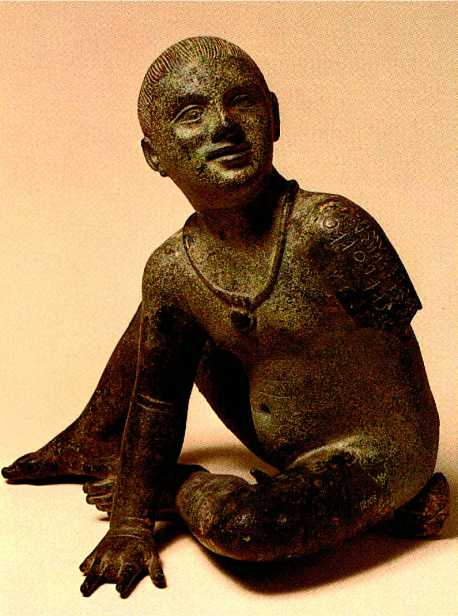
Etruscan prophet Tages
Episode 8 Divination: The Will of the Gods
The Mysterious Etruscans
Dr Steven L Tuck (2016)
Film Review
According to Cicero, the Etruscans introduced divination to Rome. It was used to choose nearly half the Roman kings and set dates for official events, including convening the Senate. Wealthy Roman families sent their sons to Etruscan priests to learn divination. There were three Etruscan books on divination and students of “augury” were expected to memorize them.
Etruscan divination is based on the belief that ll the gods, nymphs and demons overseeing human activity require appeasement. According to Etruscan myth, Tages* (an infant who popped out of the ground while the farmer Tarchan was plowing) provided the original instructions for successful divination. Tarchan would become the first Etruscan priest capable of reading entrails.
According to Tuck, there are four types of divination (Etruscans specialized in the first three):
1. interpreting auspicious signs, such as entrails and flights of birds.
2. Interpreting portents, such as lightning.
3. interpretation offered by oracles (a human being chosen by a deity to deliver divine revelations, communications and predictions).
4. interpretation of dreams
Reading Flights of Birds and Lightening
The Etruscan cosmos was a circle divided into sixteen segments, each overseen by either a major or lesser god. The role of the augur (priest performing the divination) was to observe which segments were traversed by flights of birds or lightning.
The East (left side of the cosmos) represented “familiar” elements, the West hostile elements and the land of the dead. The North, overseen by Ursul the sun god, was the most powerful. Birds flying in the northeast quadrant were the most auspicious (ie represented the most fortunate outcome), those in the northwest quadrant the most disastrous, those in the southeast and southwest quadrants somewhere in between.
According to Tuck, the segmented orientation of of the Etruscan cosmos is responsible for modern day orthogonal city planning (a grid system of involving straight roads and square city blocks).
Reading Entrails
In order to read entrails (usually the liver), the priest had to fast and purify himself before sacrificing the animal providing them. Augury students were trained with a bronze model of a sheep sliver subdivided into 16 regions, each associated with a segment of the cosmos and the associated god.
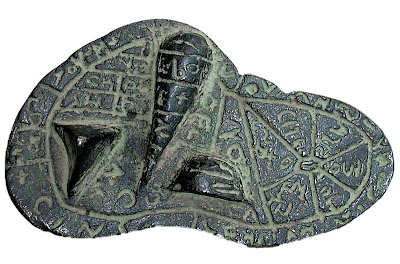
The Romans would continue Etruscan divination into the 6th century AD. Even Emperor Constantine, who made Christianity Rome’s official religion couldn’t suppress it.
*According to some historians, Tages was also responsible for the first Etruscan calendar, which had only ten months (March to December). The Etruscans adopted the twelve month calendar in the 5th century BC (with October, November and December, derived from Latin for eight, nine and ten, retaining their original names).
Film can be viewed free with a library card on Kanopy.
https://www.kanopy.com/en/pukeariki/watch/video/239710/239623


Pingback: Etruscan Mythology (According to the Roman Emperor Claudius) | The Most Revolutionary Act
Pingback: Etruscan Mythology (According to the Roman Emperor Claudius) MEK Enterprises Blog - Blogging, News, Information, and How to Make Money OnlineBlog, Blogging, Blogger. The Number 1 Online Blog Worldwide!