Retired child and adolescent psychiatrist and American expatriate in New Zealand. In 2002, I made the difficult decision to close my 25-year Seattle practice after 15 years of covert FBI harassment. I describe the unrelenting phone harassment, illegal break-ins and six attempts on my life in my 2010 book The Most Revolutionary Act: Memoir of an American Refugee.
Republican presidential candidate Donald Trump vowed to rehire thousands of military service members who were unceremoniously fired for refusing the COVID-19 shots and promised they would receive an apology with back pay.
“Kamala [Harris] and Crooked Joe purged 8,000 service members from our military for refusing their COVID vaccine mandate. They refused to do it,” Trump said at an Asheboro, North Carolina, rally on Wednesday.
Trump added, “We didn’t want a mandate. The mandate — you just can’t do that.”
“I will rehire every patriot that was fired with an apology and back pay. They will get their back pay and an apology from our government,” he declared as the crowd loudly applauded.
The Republican presidential nominee said he hopes the former military service members now have “great jobs” while “making a lot of money” but hopes they want to come back.
“The mandate stuff should have never happened,” he said to the rallygoers.
As of October 2023, only 43 of the fired 8,000 service members have rejoined the military following the repeal of the vaccine mandate.
Several groups, including First Liberty Institute and New Civil Liberties Alliance, have sued over the federal vaccine mandates and unconstitutional COVID-19 executive action.
While speaking during the rally, Trump also criticized the Biden-Harris administration’s handling of the military and its morale.
“Thanks to Comrade Kamala and Joe Biden, morale in our military is now so low that almost every single branch is suffering a major recruitment and retention crisis,” the former commander in chief said.
“Upon taking office, I will begin the biggest peacetime recruitment drive in the history of armed forces,” he promised at the campaign rally.
The former president called for bringing back a “sense of pride and prestige” to the military.
He also called on mass resignations of top military officials behind the chaotic 2021 Afghanistan withdrawal.
“I will ask for the resignations of every single senior military official who touched the Afghanistan disaster,” he announced. “I want their resignations immediately.”
Trump said he wanted to see resignation letters on his “desk in the Oval Office” on Inauguration Day.
In Germany, the current authorities seem willing to dramatically depart from what have until now been Western democratic traditions, where law enforcement must have a crime to investigate, and a warrant to do so before it engages in searches and surveillance.
However, the government in Berlin plans to allow the Federal Criminal Police Office (BKA) the legal right to enter homes secretly (including for the purpose of installing spyware on people’s phones and computers.) In addition, BKA would be given the power to, also secretly, search homes.
The draft, seen by the German press, was cooked up at the Federal Ministry of the Interior and was explained by a spokesman as a needed reform of the BKA law in order to prevent “the dangers of international terrorism” and chose to single out “Islamist terrorism” as an example.
The promise here is that the BKA would use the new rights only to fight what they choose to consider terrorist activity, along with “a high bar” in place determining which case qualifies for this kind of treatment.
Judging by the statement of the same spokesman, German law enforcement now clearly doesn’t have “appropriate powers” to tackle the problem, hence the necessity to reform the law.
As for any details that would further clarify the situation, the Interior Ministry would not provide them as the planned reform is “still at a very early stage of internal government coordination.”
Among the early critics of this is the German Journalists’ Association, whose chairman Mika Beuster said that “secret break-ins are reminiscent of the methods of police states, not of liberal democracies.”
Meanwhile, such a shift in the way terrorist threat is investigated has the opposition – notably the rising Alternative for Germany (AfD), suspect that this will be used as yet another tool to go after political opponents.
And now, the draft amendment of the law, also coming from her office, is dismissed by AfD MP Beatrix Von Storch as appearing to use the fight against terrorism as the pretext – “and the reason is more likely to be that she intends to further intimidate and monitor citizens and, last but not least, to persecute any government critics.”
[Ed Note: In the US the Patriot Act first allowed secret FBI break-ins in 2001]
Comments by Brian Shilhavy Editor, Health Impact News
With political campaigns in full swing now as the Democrats are currently holding their convention in Chicago, it is important to remember that national politics in the United States is a closely scripted arm of the entertainment industry, and has almost no bearing on real life, and the issues facing Americans every day.
The fact that more Americans don’t recognize this yet, especially after the Great Coup of 2020 and the COVID Scam, shows how a powerful demonic enchantment still holds the minds and emotions of most Americans today, who foolishly believe that they can somehow change the fate of our nation by simply voting their favorite candidate into office, even while admitting that they are voting for the “lesser of two evils”, and acknowledge that the elections are rigged.
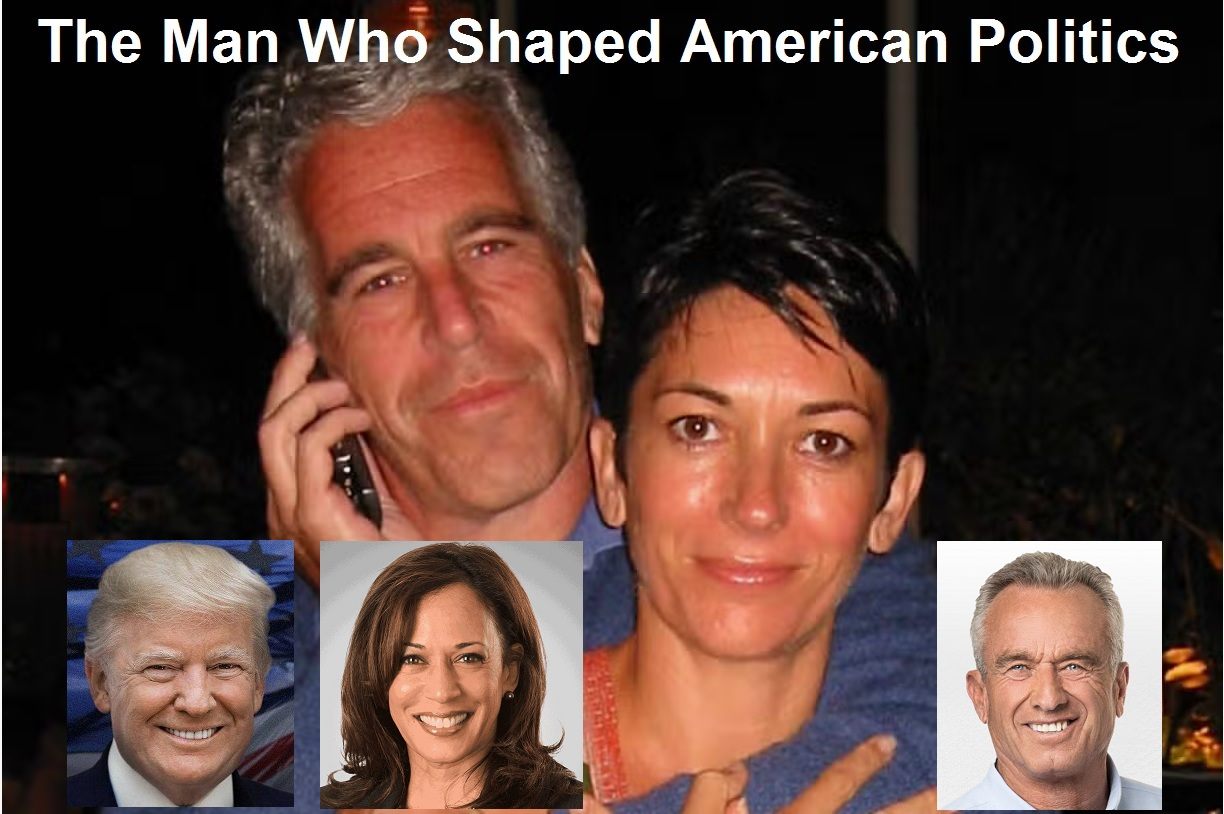
So if there is a winner declared in the November national elections in the United States, with the illusion that the winner was “chosen” by the “will of the people,” the real winner will undoubtedly be Jeffery Epstein, the man who built today’s political system by using blackmail, primarily through child sex trafficking, to control the richest people in the world who really run America.
The last hope that Epstein’s clients would finally be published and that many of them would be brought to justice, died last year, 2023, when the Virgin Islands vs. JPMorgan Chase Bank lawsuit against the billionaire bankers and Silicon Valley technocrats who were all brought to power through the Epstein financial system, was settled without a single person facing judgement.
All three current major candidates (at the time of this writing) running for the office of the President of the United States, have strong connections to Epstein, and undoubtedly would not be in a position to take over the most powerful political office in the U.S. without those connections to Jeffrey Epstein.
Limiting the public’s choice to only being able to vote for those who were connected to and empowered by the Epstein child sex trafficking financial system, of course ensures that this Satanic system will continue.
Epstein of course was a Zionist Jew, and linked to the Israeli intelligence agency Mossad, which also ensures that only those who support the Zionist cause can be elected to the office of the President of the United States.
I have already provided extensive evidence of Donald Trump’s business relationships to Epstein, as well as Robert F. Kennedy Jr.’s association with the Pedophile. See:
What about the newcomer to the political race to become President of the United States, Vice President Kamala Harris?
Harris is the only female of the three current candidates, and while she may not have had any direct dealings with Jeffrey Epstein, she has surrounded herself with very powerful people who have.
We can start with her current husband, the Zionist Douglas Emhoff, who will become the nation’s first “First Gentleman” if Harris makes it to the White House.
Many people believe that Harris resisted pressure from the Zionists by not choosing Pennsylvania Governor Josh Shapiro for her Vice President, who is himself a Zionist who chose to serve in Israel’s IDF forces when he was younger, rather than the U.S. military.
But if Harris is elected as President, the Zionists will still be in bed with her (literally), starting with her husband.
Doug Emhoff has attacked the student protests on College Campuses as promoting “antisemitism”, and he solicited funds for Kamala’s first run for the office of POTUS back in 2019 from the law firm who defended Epstein in his case in Florida back in 2010.
Kamala Harris bemoaned the influence of the powerful and connected elite last Tuesday when she called on top Justice Department officials to recuse themselves from any matter related to Jeffrey Epstein. She said their former law firm’s work on behalf of the financier accused of sexual abuse “calls into question the integrity of our legal system.”
Yet the same day, Harris’ husband headlined a Chicago fundraiser for her presidential campaign that was hosted by six partners of that firm — Kirkland and Ellis, according to an invitation obtained by The Associated Press.
Harris, a California senator and Democratic presidential candidate, was one of several White House hopefuls to blast the handling of Epstein’s case in Florida a decade ago, when his lawyers negotiated a deal with federal prosecutors that allowed him to avoid the possibility of years in prison.
But her decision to move ahead with the fundraiser hosted by Kirkland and Ellis partners while criticizing the firm underscores the tension that can arise when a politician’s rhetoric collides with his or her need to raise money to sustain a presidential campaign. (Source.)
She has financial support from many other former Epstein associates, such as LinkedIn founder Reed Hoffman.
She also has close ties to Larry Fink of BlackRock, a known business partner with Epstein, and is reportedly hiring executives from BlackRock to form her own version of an Epstein economic platform. (Source.)
So please know, my fellow Americans, that if you are planning on voting in the upcoming national elections for the office of the President of the United States, you are essentially voting for Jeffrey Epstein, whom many people believe committed suicide after President Trump arrested him, and he never went to trial.
There is some hope, however, that more and more people are waking up to the fact that the United States is run by a “uniparty” that is different in name only (Democrats or Republicans), and run by the same group of Wall Street and Silicon Valley Billionaires.
Here is a great interview that I just recently watched between two young women, who appear to be Millennials based on how old they appear, which is the same generation as my children.
The interviewer is Sabrina Salvati, a popular podcaster who goes by Sabby Sabs and is a member of the “Revolutionary Blackout” founded by Nick Cruse.
The person she is interviewing is investigative journalist Whitney Webb, who wrote the excellent two-volume book “One Nation Under Blackmail: The Sordid Union Between Intelligence and Crime that Gave Rise to Jeffrey Epstein“, and is probably one the world’s best experts on the life of Jeffrey Epstein.
Both these women fully understand that there are no real differences between the Democrats and the Republicans, because the same Billionaires control both parties, and both are firmly entrenched in the Jeffrey Epstein Zionist child sex trafficking financial system that runs America.
Please do not get hung up on what “groups” these women might belong to, but instead listen to what they actually say and judge what they say by whether it is true or not, which is the ONLY standard that we should judge others by when they are speaking or writing to the public.
This is on YouTube, but it is also on Odysee if it disappears.
Episode 17 The Mongols in Russia – The Golden Horde
The Mongol Empire
Dr Craig Benjamin (2020)
Film Review
In the initial founding of Golden Horde, Batu (son of Chingiss Khan’s oldest son Jochi) controlled the Blue Horde (everything west of the Volga River) and his brother Orda the White Horde (everything from the Volga to Lake Balkhash in Siberia). After invading Hungary and Poland, Batu announced his intention to extend his military campaign to the Atlantic. He and General Subedai were on the brink of invading Austria, Italy and Germany* when Ogedei Khan died and Batu was recalled to Mongolia for the kuritai that would elect his successor.
In the 13th-15th century, the Mongols called the principalities of Rus (which included territories held by Turkic, Kipchak, Burgar and Cuman nomads) the “Ulus of the Jochids.” The Russians renamed it the Golden Horde. Owing to the turkification of the Mongol occupier (Mongols constitute only a small minority of the population), Turkish script replaced Mongolian on the khanate’s coins in the 1280s.
Berke (his son) – succeeded Batu in 1257. A Muslim, Berke transformed the Ulus of the Jochids into a Muslim state. Allying himself with the Egypt’s Malaluk empire, Berke went to war with the Persian Ilkhanate over their occupation of Azerbaijan.
Mengu Timur (his cousin) – succeeded Berke following his death in 1264. His was the first khanate to issue gold and silver coins independent of the Great Khan. He expanded trade (mainly in silks, slave and spices) with the Crimean trading colonies of Venice and Genoa as well as with Armenian, Persian and Croatian traders.
Toda Mongke (his brother) – succeeded Mengu Timur’s in 1280. Toda Mongke, who was assassinated by his cousin Tole Buqa in 1280, who claimed to be Batu’s senior heir. Another cousin Nokai disputed Tole Buqa’s claim resulting in a war for the succession.
Tole Buqa – after winning the war of succession, declared war on Genoese merchants in Sarai who were kidnapping Mongol children and selling them into slavery. After an eight month siege in 1307 he confiscate all their goods and sacked the the town of Kappa. He subsequently allowed them to return.
Ozbeg Khan (his nephew) succeeded Tole Buqa in 1312 overseeing a period known as the golden age of the Golden Horde. Increasing Islamization led to the Golden Horde (which preserved religious tolerance) becoming part of Dar al-Islam (a federation of the world’s Muslim nations). Ozbeg Khan made the Prince of Moscow the Grand Prince of Vladimir,* greatly increasing the wealth and prestige of Moscow, The role of the Grand Prince was to collect taxes the other princes owed the Mongols.
Tinebeg – succeeded Ozbeg in 1342
Janibeg (his brother) – succeeded Tinebeg when he died unexpectedly. Best known for the Siege of the Genoese city Keva in 1346-47. The batte is best known for the Mongols use of siege engines to fire human corpses into the city that were infected with bubonic plague. This led to an outbreak of plague on Genoese ships as they returned to Constantinople. From there the disease spread rapidly to Italy and throughout Europe. Janiberg captured Azerbaijan, which was in serious turmoil from the Ilkhanate’s economic and political decline.
Between 1359-1380, the Golden Horde descended into anarchy as 25 khans claimed the throne. During this period Lithuania expanded its territory to include Kiev, and the Volga Bulgars and Urgench (in Uzbekistan) broke away from the Golden Horde.
During 1362-89 Genoese merchants in Crimea stopped pay taxis, and Dmitri Donskoi (in an embryonic Russian states) stopped paying tribute. Donskoi successfully repelled Mongol warriors sent to punish him. In 1389 allied Russian forces defeated the Mongol military for the first time at Kulakova.
*Batu had even sent a letter to the Holy Roman Emperor Frederick II demanding he step down.
Film can be viewed free with a library card on Kanopy.
Alex Soros and the Open Society Foundation has secret back door access to 23,000 electronic voting machines in the United States according to a hacker who was shocked how easy it was to hack into the voting machines and program them to flip votes.
According to the hacker, the machines set to be used in the November presidential election have numerous vulnerabilities which are so outrageous they appear to be features rather than flaws, and they all lead back to the Soros family and their self-declared interest in US elections.
Latest Video
According to Democrats and the mainstream media, voter fraud does not exist, regardless of the emergence of statistically impossible voting patterns in key races that always end up going the way of the Democrats.
Democrats, along with their allies in the mainstream media, have spent the past few years labeling anyone who questions the legitimacy of the election as an “election denier” or “conspiracy theorist.”
Well, chalk this one up as another victory for so-called conspiracy theorists, because now they have been forced to admit that the nation’s voting machines are about as secure as leaving your house keys under the door mat.
In reality, electronic voting machines are one of the many methods that Democrats and their electoral allies have used to steal elections. The most notable example of this was in 2020, when machines played an important part in swinging the election to Joe Biden.
The fraud has become so blatant that even the mainstream media are finally having to admit the truth.
Politico unleashed an article titled “The nation’s best hackers found vulnerabilities in voting machines — but no time to fix them.”
Hackers said the vulnerabilities they found were “particularly troubling during an election year like this.”
As Politico admitted, the hackers “found vulnerabilities in EVERYTHING from voting machines to e-poll books.”
So, after years of gaslighting us, Democrats and the media are now openly confirming everything that we, the so-called conspiracy theorists, have been saying about voting machines since we started raising the alarm after the stolen 2020 election.
“As far as time goes, it is hard to make any real, major, systemic changes, but especially ninety days out from the election,” said Catherine Terranova, one of the organizers of the DEF CON “Voting Village” hacking event.
“It’s not a 90-day fix, It’s not a Microsoft every Tuesday, issue your patch and everything works fine,” Scott Algeier said. “It’s a pretty complicated process.”
The gist of this is that the hackers found outrageous vulnerabilities (in my opinion, features) that allowed hackers to flip votes without detection, and say we can’t fix it in time for the 2024 election.
How about this? We just stop using hackable voting machines and go back to paper ballots.
The UK gave us hand-counted results within hours.
India, a country of over a billion people, counted their votes by hand in less than a day.
Meanwhile Venezuela, the home of Smartmatic, gave us a rigged presidential election in favor of a socialist dictator that nobody in their right mind believes was legitimate.
Except for the far-left Soros family who are determined to continue gaslighting the public into accepting electronic voting machines.
As the hacker who exposed the vulnerabilities explains, Alex Soros and his fiance Huma Abedin understand that the November election is critical for their chance of staying out of a prison cell, and they will do anything to make sure the votes keep flipping to the Democrats.
Do you remember the time Hillary Clinton introduced her friend the globalist billionaire George Soros and touted his interest in getting involved in US elections?
That’s right, not US politics, but US elections.
The Democrats and their masters the globalist elites don’t want you to see this video. They have wiped it from the face of the earth for the most part.
Luckily it was saved by a patriot who understood that one day it would be very important and expose the globalist’s game plan.
Nobody should be surprised Hillary Clinton thinks cheating in elections is justified.
An audio recording from 2006 reveals Hillary Clinton told newspaper editor Eli Chomsky that the US should have fixed the outcome of a foreign election.
Damning stuff. But it gets even worse. Obama is up to his neck in this as well, and he is even more shameless than Hillary when it comes to justifying cheating.
The globalist elite have become arrogant in recent years but it is working against them. More and more people, including those with powerful voices, are waking up to the truth about their agenda.
Elon Musk has called for the banning of all electronic voting machines in America, warning that they are designed to allow rampant fraud to take place by bad faith actors.
Posting on the X platform, Musk responded to a post from RFK. Jr., who himself was weighing on the recent rampant fraud that took place during Puerto Rico’s primary elections.
We should eliminate electronic voting machines. The risk of being hacked by humans or AI, while small, is still too high. https://t.co/PHzJsoXpLh
Puerto Rico’s elections commission announced that it is reviewing its contract with Dominion Voting Systems after “hundreds of discrepancies” in vote totals were discovered following the island’s primary elections.
The problems in Puerto Rico called to mind the well-publicized incident in Antrim County of a Dominion Voting machine “mistakenly” counting thousands of extra votes for Biden instead of Trump.
Which raises the question: why is it always Trump votes that get flipped to Democrat?
Could it be, as Obama let slip, that Democrats control the voting machines? They also control the mainstream media, so most people never hear about the problem of voter fraud and hackable machines.
You know what they say about the devil? The greatest trick he ever pulled was convincing the world he doesn’t exist.
Is convincing the nation that voter fraud does not exist the greatest trick ever pulled by the Democrats?
Obviously they forgot to tell the executives at Google who are on record boasting they have rigged 41 elections for the far-left in the last 16 years.
For the record, Google executives met with Obama behind closed doors at the White House as astonishing 427 time during his presidency.
But of course, they could not have been discussing anything to do with using Google’s icy grip on information flows to influence elections – because as Democrats say, voter fraud doesn’t exist.
And obviously the Democrats responsible for maintaining the roll of 320,000 “ghost voters” actively registered to vote in November’s election in must-win Michigan, Detroit could not possibly be engaging in voter fraud.
Ghost voters are shadows who linger on voter rolls after their real inhabitants have either died or moved interstate. Without voter ID, anybody can show up and vote as a ghost voter – once, twice, or 320,000 times.
Democrats couldn’t possibly be resorting to a trick used by corrupt Zimbabwean election officials in 2008, could they?
Don’t forget, this is the party whose lawyers openly admitted that if the DNC wants to ignore the votes in primary elections and pick their nominees in back rooms while smoking cigars, it is their legal right to do so.
Soros and his Democrat cronies appear determined to pick the next president in a back room while ignoring the votes of the people.
No wonder Biden said the Democrats have put together the most extensive voter fraud organization in the history of American politics.
Independent U.S. presidential candidate Robert F. Kennedy Jr speaks at Bitcoin 2024 in Nashville, Tennessee, U.S. July 26, 2024. REUTERS/Kevin Wurm/File Photo
Aug 20 (Reuters) – Independent U.S. presidential candidate Robert F. Kennedy Jr. is considering ending his campaign to join forces with Republican rival Donald Trump, Kennedy’s running mate said in an interview posted online on Tuesday.
Nicole Shanahan, said that as independents she and Kennedy ran the risk of drawing support from would-be Trump voters and clearing the way for Democrats Kamala Harris and Tim Walz to win the November election.
“Or we walk away right now and join forces with Donald Trump,” she told Los Angeles media company Impact Theory. Asked when they would make a decision, she did not say.
Trump told CNN on Tuesday he would “certainly be open” to Kennedy playing a role in his administration if the independent candidate drops out of the race and endorses him.
“I like him, and I respect him,” Trump told the network in an interview after a campaign stop in Michigan.
“He’s a brilliant guy. He’s a very smart guy. I’ve known him for a very long time,” Trump was quoted as saying by CNN. “I didn’t know he was thinking about getting out, but if he is thinking about getting out, certainly I’d be open to it.”
In a statement on X on Tuesday, Kennedy wrote: “As always, I am willing to talk with leaders of any political party to further the goals I have served for 40 years in my career and in this campaign.”
Kennedy, the son of the late Democratic politician Robert F. Kennedy, is an environmental advocate who has spread misinformation on vaccines and whose family has denounced his campaign.
He initially sought to challenge U.S. President Joe Biden for the Democratic nomination but switched to run as an independent. Biden later dropped out and endorsed Harris, who will accept the nomination at the party’s convention this week.
Kennedy, 70, faces an uphill battle qualifying for the presidential ballot in many states, but he could siphon enough votes away in the tight race between Harris and Trump to have an outsized impact.
Kennedy’s support stood at 4% in an Ipsos poll taken this month.
Trump has sought Kennedy’s support, a phone call leaked in July showed. Shanahan in the interview released on Tuesday said Trump had taken an interest in their healthcare policies, making it worth exploring “a unity party.”
Kennedy’s team has never been in talks with Harris, she added.
[The] SCOTUS likewise determined geofence warrants to be unconstitutional because they require a provider, usually Google, to search “the entirety” of its location data “while law enforcement officials have no idea who they are looking for or whether the search will even turn up a result.”
The federal Fifth Circuit Court of Appeals is maintaining its position that so-called geofence warrants, which were used to track Jan. 6, 2021, “insurrection” participants, are “categorically prohibited by the Fourth Amendment,” which protects We the People from unreasonable searches and seizures by law enforcement and other arms of the government.Judge James C. Ho issued an opinion that while geofence warrants “are powerful tools for investigating and deterring crime,” they overtly violate the U.S. Constitution and the protections it affords to people living in this country.
“The defendants here engaged in a violent robbery – and likely would have gotten away with it, but for this new technology,” Judge Ho wrote. “So I fully recognize that our panel decision today will inevitably hamper legitimate law enforcement interests.”
“But hamstringing the government is the whole point of our Constitution. Our Founders recognized that the government will not always be comprised of publicly-spirited officers – and that even good faith actors can be overcome by the zealous pursuit of legitimate public interests.”
Justice Ho also quoted The Federalist No. 51, at 349 (J. Cooke ed. 1961) which reads in support of his ruling:
“If men were angels, no government would be necessary. If angels were to govern men, neither external nor internal controls on government would be necessary,” but “experience has taught mankind the necessity of auxiliary precautions” because of “human nature,” which makes it “necessary to control the abuses of government.”
Supreme Court decision in Carpenter v. United States concurs with Judge Ho’s decision
Recognizing that he and his panel’s decision “is not costless,” Judge Ho continued in his opinion to emphasize the fact that our rights as Americans under the Constitution “are priceless” and are not something with which to be toyed.
“Reasonable minds can differ, of course, over the proper balance to strike between public interests and individual rights,” he further said.
“Time and time again, modern technology has proven to be a blessing as well as a curse. Our panel decision today endeavors to apply our Founding charter to the realities of modern technology, consistent with governing precedent. I concur in that decision.”
The Electronic Frontier Foundation (EFF) commented on the ruling as well by citing the Supreme Court’s landmark ruling in Carpenter v. United States. In that case, it was decided that “individuals have a reasonable expectation of privacy in the location data implicated by geofence warrants.”
The EFF noted in that case that SCOTUS likewise determined geofence warrants to be unconstitutional because they require a provider, usually Google, to search “the entirety” of its location data “while law enforcement officials have no idea who they are looking for or whether the search will even turn up a result.”
Geofence warrants afford cops too much leeway to probe for evidence without reasonable suspicion or an actual warrant as traditionally defined. As such, geofence warrants violate Americans’ constitutional rights by their very definition.
Since the Fourth Circuit Court of Appeals recently ruled the opposite way, the issue will likely make its way all the way up to the Supreme Court, which will make a final decision on the matter.
“SCOTUS has long ruled against open and blanket warrants,” wrote someone on X about which direction the final ruling will probably go.
“They knew the ‘geofencing’ surveillance method was unconstitutional; why do you think they didn’t go after the 2000 Mules?” asked another.
Albatross, famous migratory bird, is also a love bird. It is known for being monogamous, forming long-term bond with one partner that is rarely broken. Mated pairs never split up until one bird dies.
The UN Security Council held an extraordinary event on April 6 under the rubric Arria Formula Meeting on Biological Security regarding the biological activities in countries including Ukraine. Predictably, the US and UK representatives didn’t show up at the event and the western media also blacked out the proceedings. But that does not detract from the profound significance of what transpired.
The highlight of the Security Council proceedings lasting over two hours was the disclosure by General Igor Kirillov, chief of the Radiation, Chemical and Biological Defense Forces of the Russian Armed Forces, that Washington is creating biological laboratories in different countries and connecting them to a unified system.
He said the US has spent more than $5 billion on military biological programs since 2005 and detailed that in territories bordering Russia and China alone, about 60 facilities have been modernised during this period. The Ukrainian network of laboratories is designed to conduct research and monitor the biological situation consisting of 30 facilities in 14 populated locations.
Highly sensitive materials from the Ukrainian biological laboratories were exported to the US in early February just before the Russian special operation began, and the rest were ordered to be destroyed lest they fell into Russian hands. But the cover-up was only partially successful. Indeed, Russia is in possession of highly incriminating evidence.
Previously also, Russia had released a number of documents related to the biological military activities of the Pentagon, which pointed toward a worldwide project to set up biological laboratories in rival countries with the goal of developing targeted viral weapons against those countries.
The proceedings of the Security Council conference on April 6 are in the public domain and are accessible. See the video below:
Russia has made specific allegations, pointing finger at:
Pentagon funding for the bio-labs in Ukraine;
Location of these bio-labs(not only in Ukraine but in 36 countries around the world);
Diseases and epidemics on which research work is going on, focusing on the means for their release, the countries where they are being tested (even without the knowledge of the governments of these countries); and, of course,
Experiments relating to coronavirus (and bats used to transmit this virus).
However, the US has so far point-blank refused to accept any supervision and verification of such incriminatory evidences and has stonewalled the demand for a verification mechanism. It is unlikely that the US will permit an international verification process that holds the potential to expose it as indulging in crimes against humanity — although there are appropriate frameworks in place including the Biological Weapons Convention (BWC) and the UN, to hear the clarifications from the relevant country in a fair and impartial manner.
A mind-boggling “discovery” that Russian forces in Ukraine stumbled upon is the use of numbered birds by the Pentagon-funded labs. This almost falls out of science fiction and Sir Alfred Hitchcock could have made an epic movie out of it where deception mixes with innocence and man’s cruelty to nature becomes unbearably grotesque. The project works like this:
To begin with, the Pentagon accesses the scientific data available with environmental specialists and zoologists after studying the migration of birds and observing them throughout the seasons, relating to the path these birds take each year on their seasonal journey from one country to another and even from one continent to another.
On the basis of this data, groups of migratory birds are caught, digitised and capsules of germs are attached to them that carry a chip to be controlled through computers. They birds are then released to the flock of the migratory birds in those target countries toward which the US intelligence has malevolent intentions.
Of course, these migratory birds travel great distances. The wandering albatross, for instance, is known to migrate at least 8500 km eastward across the South Pacific to the coast of South America, and many shy albatrosses migrate westward across the Indian Ocean to the coast of South Africa.
During the long flight of the birds that have been digitised in the Pentagon bio-labs, their movement is monitored step by step by means of satellites and the exact locations are determined. The idea is that if the Biden Administration (or the CIA) has a requirement to inflict harm on, say, Russia or China (or India for that matter), the chip is destroyed when the bird is in their skies.
Plainly put, kill the bird carrying the epidemic. Sadly, my mind goes back to the novel by the American author Harper Lee To Kill a Mocking Bird, the haunting story of innocence destroyed by evil.
To return to reality, once the “digitised” bird is killed and the capsule of germs it carries is released, the disease spreads in the “X” or “Y” country. It becomes a highly cost-effective method of harming an enemy country without any need of war or coup d’état or colour revolution.
The Russians have made the shocking claim that they are actually in possession of such migratory birds digitised in the Pentagon’s bio-labs.
International law expressly forbids the numbering of migratory birds because they freely criss-cross the blue sky and air of other countries. By supplying them with germs, these birds become weapons of mass destruction. What human ingenuity! But the US enjoys total immunity from international law.
The bottom line is that only the US intelligence — and President Biden, perhaps, if he remembers — would know where all humans have been infected so far in this century by the Birds of Mass Destruction. Was Ebola that devastated Africa a test case and precursor of things to come?
I stand by my long-time dictum that “The US is not a democracy and it doesn’t matter who is president.” The US is decrepitating at a perfectly acceptable rate (for the global majority that is sick and tired of its “hegemony”). Great hegemonic nations need two ingredients to stay hegemonic: economic supremacy and military supremacy.
In case of the US, everyone was forced to use the US dollar in trade, especially oil trade, from which the US was able to profit handsomely just by printing money, or they’d get Saddamed or Khaddafied to death. What it really boiled down to is “Pay us or we’ll kill you.” So, how is that supremacy doing now?
Let’s look at the economic power first. If you look (very briefly) at the US federal budget, you will find that fully a third of it is borrowed into existence and when I checked a few months ago the US was forced to keep borrowing a trillion dollars every three months; that sort of thing doesn’t tend to go on for long.
Meanwhile, a BRICS meeting in Kazan this October is expected to produce a plan for a US dollar replacement for international trade and in preparation for that event gold hit $2550/oz for the first time ever and international investors are starting to unload US Treasuries and are balking at buying any more of them. So far, 49 countries have filed the paperwork to join BRICS; you see, very few countries can afford to be left out of international trade once the USD goes buh-bye.
If you take away from the US Treasury Dept. the ability to borrow, there will only be enough money left for social spending — nothing else — but cutting out everything else will cause the tax base to shrivel to a point that it won’t be able to support social spending either. What will that do for the societal well-being of a country whose culture takes very few things completely seriously — certainly not justice or integrity or virtue or truth — but money is definitely one of them? So much for economic supremacy.
Now let’s look at military power. The US (and a really pathetic handful of allies) tried to stage some sort of “Operation Provide Blah-blah-blah” trying to wrest control of the Red Sea and, consequently, the Suez Canal, from the Ansar Allah, a.k.a. the Houthi Movement, named after the venerable Abdul-Malik Badruldeen al-Houthi. As it stands, only Chinese and Russian ships can sail unmolested past the Gate of Lamentation (a.k.a. Bab el Mandeb) at the entrance to the Red Sea. Other navigation choices include rounding the Cape of Good Hope at the southern tip of Africa or braving Russia’s Northern Sea Route; one is expensive, the other politically unpalatable. The result of this mission (of which little is now heard) is a hole in the flight deck of a certain US aircraft carrier caused by a Houthi rocket, after which event (of which nothing was said) said carrier limped home to Norfolk.
More recently, when Iran promised retaliation for Israel’s assassination of HAMAS political leader and Palestinian billionaire Ismail Haniyeh while he was on a visit to Teheran, a high-level US delegation flew to Teheran and very quietly begged the Iranians not to attack Israel (again) because, as the previous Iranian rocket and drone attack on Israel demonstrated, Israel can’t defend itself and the US can’t defend it either. Nevertheless, the US did send an aircraft carrier to the region (one of the remaining few that are still serviceable) — to do what exactly? To fly effective aircraft sorties to shore without mid-air refueling, maximum distance from shore has to be under 300 nautical miles; the reach of hypersonic rockets, which everyone except the US and its allies now seems to have and which the US hasn’t learned to intercept, is farther than that. A single hit on a US aircraft carrier is worth a thousand aircraft sorties. So much for military supremacy.
When a certain political scheme no longer works — and US supremacy, while it lasted, was indeed a political scheme — thieves rush in and loot whatever is left. This is to be expected and this is what happened: thief Biden and thief Zelensky, thick as thieves, held a tag team event to loot both the US and the EU, filtering well over a hundred billion through the corrupt wreck of a nation that was the former Ukraine. Everything was going fine with Biden playing the part of an aged and wise “capo” of a mafia clan while his evil minions saw to the actual looting of the treasury.
But there surfaced a tiny problem: Biden became so senile that he no longer understood that he is senile and this became painfully obvious to everyone who saw him debate Trump. Something had to be done and three other mafiosi — Pelosi, Schumer and Obama — conspired to replace Biden. But with whom? The three mafiosi wanted to compile a short list of candidates and then hold a mock election at the Democratic convention to “choose” a predetermined winner.
Biden managed to thwart their plan by… endorsing Kamala Harris, a diversity hire (sort of black and probably a woman, although childless and who can tell what’s what with American “women” these days) who is either mentally retarded or permanently drunk or both. Poor Kamala seems to have three modes: drunk and happy in the morning (cackle-cackle-cackle), drunk at work during the day and trying to act sober but making no sense, and drunk and testy and ready to pass out in the evening. If that describes your girlfriend, then congratulations — you are a loser!
Pelosi, Schumer and Obama — the trio of mafiosi — struggled with this choice for as long as they could but in the end had to give Kamala’s candidacy their grudging consent. Kamala is definitely nobody’s choice but Biden’s… and Putin’s. You didn’t expect that, now, did you? Cheers!
Independent Journalist Richard Medhurst was arrested in the UK on Thursday under the UK’s Terrorism Act 2000, according to a video he posted Monday on X recounting the experience.
“On Thursday, as I landed in London’s Heathrow airport, I was immediately escorted off the plane by six police officers who were waiting for me at the entrance of the aircraft. They arrested me – not detained – they arrested me under Section 12 of the Terrorism Act of 2000 and accused me of allegedly ‘expressing an opinion or belief that is supportive of a proscribed organization’ but wouldn’t explain what this meant,” Medhurst says in the video.
Section 12 of the Terrorism Act 2000 has a clause that was added in 2019 that made it illegal to “expresses an opinion or belief that is supportive of a proscribed organization” if “in doing so is reckless as to whether a person to whom the expression is directed will be encouraged to support a proscribed organization.”
Medhurst’s reporting has focused heavily on the Israeli-Gaza war and has spoken out against funding Ukraine. He also posted about the very act that he was arrested for.
“The fascist ‘terrorism act’ being used to hold activists without charge or trial because they tried to stop actual terrorism and genocide by the IDF,” Medhurst posted the same day he was arrested. Medhurst was referring to Palestinian activists who have been detained recently under the Terrorism Act.
Medhurst says he was then handcuffed and transferred to a police station where he was searched and his electronic devices seized.
“I was placed in solitary confinement, in a cold cell that smelled like urine. There was barely any light and the bed, if you can even call it a bed, was simply a small concrete ledge with a paper-thin mattress. The cell had no windows, no heating, no toilet paper. I was recorded 24/7 with audio and video, even when going to the toilet. I had to eat food with a piece of cardboard you’re supposed to fold in two in order to scoop up the meal,” Medhurst said, describing the conditions he was held in.
He was then held for nearly 24 hours without being allowed to contact his family and his attempts to speak to a solicitor (UK legal advisor) were hindered and possibly monitored.
“The police said that I have the right to inform someone that I’m locked up. So I said okay, I want to call my family, then they go ‘Well, your calls are withheld due to the nature of the alleged offense’ I tried to ask well, what’s the point of a right if you can just randomly withdraw it? Why tell me that I have this right at all? And one of them said something along the lines of ‘Well, it’s not an absolute right, it can be waived,’” Medhurst described.
“For many hours, no one in the world knew what had happened to me or where I was. Only the police could call a solicitor for me. I had to ask four or five different guards for several hours before I finally received a call. Some of my solicitor’s calls did not get through or were not answered. One of the calls -my solicitor was told- would be monitored, and so they simply refused to take it. I asked to speak to the solicitor afterwards when that happened but I was not allowed to.”
“In total, I spent almost 24 hours in detention. At no point whatsoever was I allowed to speak to a family member or friend. After waiting 15 hours, I was finally interviewed by two detectives,” Medhurst says the interview lasted 60 to 90 minutes.
Medhurst emphasized that he denies all accusations by the police, noting that his parents held Nobel Peace Prizes for their work as UN peacekeepers and he “categorically and unequivocally” condemns terrorism.
“Those like myself, who are speaking up and reporting on the situation in Palestine are being targeted. I had booked my ticket to London on the same day and yet an entire team of police were mobilized to arrest and question me. This is why I felt this was a preplanned, coordinated arrest. Many people have been detained in Great Britain because of their journalism, sometimes under the Terrorism Act, sometimes not. I think of Julian Assange, Craig Murray, Kit Klarenberg, David Miranda, Vanessa Beeley. As far as I am aware, I am the only journalist, however, to have been arrested and held for up to 24 hours under section 12 of the Terrorism Act.”
Medhurst said that he now feels he has a “muzzle” put on him, and does not know if he will be charged with the crime he was arrested for or if he will be put in jail in a few months, something that makes his work more difficult. “I simply do not know if or how I can work at all during the next month.
Former UN weapons inspector and geopolitical analyst Scott Ritter, whose house was raided by the United States FBI earlier this month for alleged violations of the Foreign Agents Registry Act, called the arrest “political persecution” designed to “hamper [Medhurst’s] important work as a journalist.”
“Freedom of the press, freedom of speech really are under attack. The state is cracking down and escalating to try and stop people from speaking out against our government’s complicity in genocide, please do not just stand with me, but with the others who are still inside,” Medhurst concluded.
UK authorities have not commented on Medhurst’s arrest. His website currently displays an error page but it is not clear if Medhurst removed it voluntarily, at the direction of UK authorities, or if the site was taken down by service providers. Sputnik has reached out to Medhurst for clarification and will update this space if he replies.







 Albatross, famous migratory bird, is also a love bird. It is known for being monogamous, forming long-term bond with one partner that is rarely broken. Mated pairs never split up until one bird dies.


