Retired child and adolescent psychiatrist and American expatriate in New Zealand. In 2002, I made the difficult decision to close my 25-year Seattle practice after 15 years of covert FBI harassment. I describe the unrelenting phone harassment, illegal break-ins and six attempts on my life in my 2010 book The Most Revolutionary Act: Memoir of an American Refugee.
Net Zero Watch has welcomed robust comments by GMB Union leader, Gary Smith, who has warned that Net Zero policies are “hollowing out working class communities”.
The remarks came as Tata Steel announced 2,500 job losses through the closure of two of the last remaining blast furnaces, meaning the UK will be the first major industrialised economy without the ability to produce virgin steel – potentially critical for defence and other high-grade industrial uses. Instead, new electric arc furnaces are supposed produce recycled steel, albeit supporting far fewer jobs and producing a more limited range of steel grades.
Gary Smith told the BBC:
This was a mess created under the Tories…but let’s be under no illusions… Thousands of jobs are going to go, a community is going to be hollowed out. We’re going to see huge reductions in our carbon emissions, but at what price?”
The Unite Union also voiced their concerns about the impact of Ed Miliband’s Net Zero policies, in particular in the North Sea, where many high paying working class jobs depend on the Oil and Gas sector. Their leader Sharon Graham said:
Right now there is talk of a ‘just transition’ but in reality 30,000 workers in the North sea are on a jobs cliff edge. Make no mistake – Unite will not stand by and watch those workers becoming the miners of our generation.”
These remarks are the most high-profile critical statements that major unions have ever made concerning the impact of Net Zero. Net Zero Watch director Andrew Montford said:
The threat Net Zero represents to workforces has been clear for many years. A more robust tone from union leaderships is to be welcomed. We can only pray that it’s not too late.”
And Mr Montford warned that ever-rising electricity prices are likely to make the new steel plants uncompetitive:
UK industrial electricity prices have been rising for 20 years, ever since we started installing windfarms, and that trend will continue. The planned arc furnaces may already be dead in the water.
The Justice Department (DOJ) has dropped nearly half of the remaining obstruction charges that are still pending against January 6 defendants, according to recent DOJ data.
The Supreme Court in June made it more difficult to charge the defendants with obstruction, but charges can still be brought if prosecutors can prove that rioters were intentionally trying to stop the arrival of certificates used to certify electoral votes.
The department said last week that it has already dropped the charge in approximately 60 of the 126 defendants whose cases were still pending. It is still going to charge 13 of the defendants with obstruction, and is still examining the other cases.
In the cases that have already been tried, the DOJ said it does not object to dismissing the charge in 40 of the 133 cases, but it is still reviewing the rest. One person has had their sentence reduced so far, over the Supreme Court ruling.
“There are zero cases where a defendant was charged only for violating 18 U.S.C. § 1512,” the DOJ noted. “In other words, even if the government foregoes this charge, every charged defendant will continue to face exposure to other criminal charges.”
Although there were no cases where a defendant was only charged with obstruction, there have been 17 defendants that were solely convicted of obstruction, and were serving a prison sentence as of Aug. 6.
A brand-new study published by the Brownstowne Institute makes it clear: President Donald Trump was right about the early treatment of COVID with Hydroxychloroquine:
Early in the pandemic, President Donald Trump and White House senior official Peter Navarro arranged the donation of 63 million doses of hydroxychloroquine (HCQ) to America’s strategic drug stockpile to combat Covid-19. The government began securing HCQ in March 2020, after Trump, on the advice of his medical and scientific advisors, lauded HCQ as “very encouraging,” “very powerful,” and a “game-changer.”
Sadly, instead of embracing President Trump’s HCQ proposal, the medical establishment and the media undertook an unprecedented attack on HCQ:
Following Trump’s proposal, HCQ suddenly came under an unwarranted full-scale attack from federal officials, the press, so-called “fact-checkers,” and university professors. Many of the attacks contained outright falsehoods about HCQ’s pharmacology and safety or Trump’s endeavor to make HCQ available to eligible patients.
The Brownstowne Institute comes to the conclusion that President Trump was right — countless lives and trillions of dollars could have been saved:
The bottom line is: President Trump was correct to secure a donation of, and advocate for the use HCQ for eligible individuals. The most recent cumulative positive findings associated with HCQ are undeniable evidence that Americans would have been better off had HCQ had been implemented and used in eligible populations.
Not Just a One-Hit Wonder
Dr. Peter McCullough, the nation’s leading freedom-fighting doctor, believes that the benefits of hydroxychloroquine extend beyond COVID-19. He sees it as a promising treatment for another virus: bird flu (H5N1). Although human cases are rare, Dr. McCullough believes we need to be prepared.
“Given the high fatality rate of H5N1, it is essential to explore every potential treatment,” he says.
Preclinical studies back up his view. Research shows that chloroquine, a drug similar to hydroxychloroquine, can reduce the severity of bird flu. In studies on mice, chloroquine treatment after a lethal dose of H5N1 improved survival rates from 0% to 70%. Dr. McCullough argues that, should human cases increase, hydroxychloroquine should be considered a potential treatment option.
In 570 AD when the prophet Mohammad was born, the Arabian peninsula consisted of two coexisting cultures, city dwellers (mainly in coastal cities and strategic desert oases) and Bedouin nomads who worshiped nature and an ancient black meteorite installed in the Ka’aba shrine in Mecca.
An orphan, Mohammad was raised by a merchant uncle, becoming a merchant himself and marrying a wealthy widow (Kadija). He learned about monotheism from Jewish and Byzantine traders he traded with. Troubled by the religious conflict he encountered among monotheists, in 610 he experienced the first of 20 years of visitations from the angel Gabriel. The Koran is a record of thee visions.
Fellow merchants in Mecca heavily persecuted Mohammad’s early followers, worried they would disrupt the lucrative Bedouin pilgrimages to the Ka’aba. Following an assassination attempt in 622, he and his followers fled to Medina, where he converted Bedouin nomads.
In 630, he returned to Mecca with a force of 10,000 Bedouin followers, deciding to retain the shrine at Ka’aba as a sign from Allah.* He died in 632, appointing four caliphs to continue his mission of spreading of Islam to non-believers:
634 – Islamic forces from the Arabian peninsula attack and overrun Byzantium’s southern provinces.
636 – Islamic forces capture Mesopotamia.
639 – Islamic forces capture Palestine and Syria.
642 – Islamic forces was capture Egypt.
651 – Islamic forces capture Persia.
661, Islamic forces control entire Arabian peninsula.
By 711, Islamic forces had conquered the Hindu kingdom in northwest India and a Berber Muslim convert had successfully invaded most of the Iberian peninsula.
By 751, Muslim had seized all North African possessions of the Byzantine empire (causing them to lose essential grain imports).
Dr Salisbury attributes the early Muslims’ phenomenal military success to 1) the military prowess of their mounted Bedouin warriors and 2) their steadfast religious tolerance towards Christians and Jews (referred to as People of the Book). Although they required non-believers to pay a special tax, they were far more tolerant than the Byzantines and Visigoths. Both practiced ruthless repression against Jews and Christian who failed to follow prescribed beliefs.
Monopolizing the Silk Road Trade
After securing a monopoly over the Silk Road trade, Islamic leaders moved their capitol; from Mecca to Damascus (in 750) and from there to Baghdad in 762. The city’s growing prosperity led to the appearance of the world’s first bankers, to provide currency exchange and letters of credit. Meanwhile the city’s population grew to over one million in 50 years.
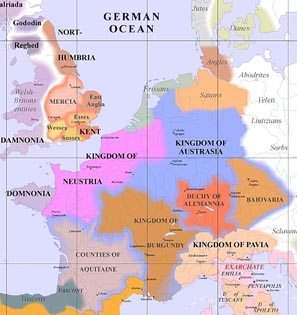
In 732 Muslim armies made an unsuccessful attempt to invade France. They were repelled by an army led by Charles Martel, the mayor of the palace (ie prime minister) of Austrasia, the eastern region of the Merovingian Frankish kingdom. Defeating the Muslims at the the Battle of Tours near Poitier, he forced their retreat across the Pyrenees.
His son Pepin the Short, founder of the Carolingian dynasty, would reunify the Frankish kingdom. Although he recognized the need for a standing army to defend against further invasions, he lacked the trade income of the Muslims and Byzantines to fund one. Instead he established what is now known as the feudal system. In return for their military services, he awarded his knights a plot of land (and all the serfs living on it). Eventually all western kings, as well as the Byzantine empire, adopted this model of supporting standing armies.
*Which continues to this day as the annual Hajj or pilgrimage to the Ka’aba in Mecca.
**The western region was referred to as Neustria.
Film can be viewed free with a library card on Kanopy.
Gastroenterologist Dr. Sabine Hazan took a closer look at the gut microbiomes of doctors who got “vaccinated” for the Wuhan coronavirus (COVID-19) before comparing their composition to that of doctors who skipped the shots. What Dr. Hazan found is that COVID jabs kill off important gun bacteria like bifidobacteria that are essential for strong immunity.
Instead of boosting one’s immune system like government authorities and the media are still claiming, COVID jabs destroy the probiotic bacteria that the body relies on to process nutrients, neutralize toxins and promote strong immunity.
“I started noticing a month later, the bifidobacteria, this important microbe, is dropping in patients pre- and post-vaccinations,” Dr. Hazan commented. “Only a certain group of microbes are getting killed … Bifidobacteria is a huge part of immunity … I think [the vaccine] is creating a bacteriophage or bifidophage.”
A bacteriophage or bifidophage is a type of virus that infects a person and starts replicating within their microbiome.
Dr. Hazan found that bifidobacteria destruction appears almost immediately post-injection. At around the 90-day mark, the fully jabbed person’s entire bifidobacteria population drops to zero.
“There was a persistence in the damage, not only [after] 90 days but six months, nine months later,” she says. “That was the thing that started to make me panic.”
(Related: Dr. Hazan says she is considering suing Facebook over the social media platform’s mistreatment of her during the Wuhan coronavirus [COVID-19] “pandemic” – she was only trying to help people survive rather than die from the “virus.”)
Vaccinated mothers pass microbiome destruction to newborn children
Another really disturbing thing that Dr. Hazan discovered is that pregnant women who get jabbed for COVID end up passing on the same damage and destruction to their newborn babies.
“As we were looking at the microbiome of newborns [of] mothers who were breastfeeding, we started noticing that there’s no bifidobacteria in those newborns,” she explains.
“Newborns are supposed to have a ton of bifidobacteria … 90 percent of the microbiome of babies is bifidobacteria.”
Keep in mind that one of the hallmarks of bifidobacteria loss in children is autism and autism spectrum disorders. This once again suggests that vaccines, in this case those for COVID, destroy probiotic bacteria and trigger autism in children.
IS THE SPIKE KILLING GUT BACTERIA?
Babies that were Born from COVID Vaccinated Mothers who were Breastfeeding had Zero Bifidobacteria.
Is the Spike Protein Killing Gut Bacteria and causing Autism in those Babies?
Dr. Hazan continued her research by collecting stool samples from her test patients. She observed that patients with extreme COVID symptoms had certain bacteria missing from their gut. Once again, the bacteria are none other than bifidobacteria.
All that talk about the benefits of ivermectin for treating COVID are further confirmed by another amazing discovery by Dr. Hazan. She observed that taking ivermectin helps to repopulate the gut with bifidobacteria in 24 hours or less.
You may not know this but ivermectin is a fermented product with a biological construct similar to that of bifidobacteria and common probiotic supplements. According to Dr. Hazan, ivermectin belongs to the same group of microbes as bifidobacteria – you can think of it like brothers and sisters in the microbiome world.
This would explain why many are seeing incredible success overcoming COVID- and COVID jab-related health problems by taking ivermectin. It also explains why the establishment remains hellbent on keeping the public in the dark about ivermectin, as well as keeping it as inaccessible and unaffordable as possible.
A whistle-blower video released in March shows Pfizer’s principal scientist admitting that the company skipped 10 years of safety testing, had significant knowledge of mRNA vaccine side effects, but released the covid injection to the public anyway.
Justin Leslie, a former Pfizer employee and whistle-blower, is the man recording this private conversation with Kanwal Gill, a principal scientist at Pfizer. He released the video recording in March, claiming to have signed a sworn affidavit, which is provided on his X account.
Kanwal talks about the company skipping ten years of clinical trials and using the pandemic to bring the covid-19 mRNA vaccines to market. She also mentions that they have attempted to bring mRNA technology to market for 50 years, but due to side effects, they were never able to do so.
Shortly after the video was released, Leslie joined The Canadian Independent to discuss his undercover work to expose the covid vaccines.
He spoke about a documentary he recently released, which includes the clip of Pfizer’s principal scientist admitting that the company skipped 10 years of safety testing.
His documentary also reveals that he was the person featured in a viral video who went on a date with Pfizer employee Jordan Trishton Walker, the Director of Research and Development, in February 2023 while working undercover for Project Veritas.
In the undercover video, Walker made several shocking claims about Pfizer’s activities with its mRNA technology, including exploring the mutation of SARS-CoV-2 to proactively develop new vaccines, conducting experiments to figure out future mutations and utilising the technology for gene editing. Additionally, Walker acknowledged in the video that there are concerns about the covid vaccines interfering with menstrual cycles.
Leslie also discusses his experience working with Project Veritas and James O’Keefe. He alleges O’Keefe ultimately abandoned much of the undercover work he conducted on Pfizer and the covid vaccines, which was never made public until Leslie put out his recent documentary.
Leslie’s documentary is titled ‘Pfizer Whistleblower’ and has two parts which he refers to as “volumes.” You can watch Volume 1 below. The following text accompanies the video on Rumble.
Uncover the hidden truth behind Pfizer vaccines with Project Whistleblower, a groundbreaking documentary created and narrated by former Pfizer employee and whistle-blower Justin Leslie. This gripping exposé reveals the shocking reality behind the Pfizer vaccines and tells the story of one man’s courage to expose the truth. He also shares his encounters with James O’Keefe, who admitted to attending the infamous Bohemian Grove, further fuelling suspicions of a larger conspiracy.
Join Justin on his journey as he risked everything to speak out against the crimes against humanity and shed light on the vaccine injuries and deaths we are now seeing. This is not about politics; it’s about right versus wrong and the future of mankind.
Support Justin’s mission and discover the truth for yourself by watching Project Whistleblower: Volumes 1 & 2 and donate on his website HERE or GiveSendGo HERE. You can follow Justin on Twitter HERE or his website ‘Just Integrity’ HERE.
You can watch Volume 2 on Rumble HERE and Volume 1 & 2 combined HERE. If you are unable to watch the videos on Rumble, you can watch them on YouTube (Volumes 1 & 2 combined) HERE or on BitChute HERE
The mystery of Boeing 757 Flight 93 at Shanksville on 9/11 reminds me of my socks: They just keep disappearing. There must be a wormhole near my laundry basket that sucks socks into The Great Void. I’ve never been able to solve it.
But not everything disappeared at Shanksville. What was found? Clean and unscathed red bandanna believed to belong to “hijacker.”
And, of course, “hijacker” “Saeed Al Ghamdi’s” Saudi Arabia passport was located.
Passport photo from flight 93:
But as for the “Boeing 757 aircraft” in Shanksville; no signs of it. Of course, for somebody like “Bin Laden,” who could totally obliterate three sturdy tower blocks with two planes, and then manage to wipe out the accounts department in the world’s best-protected military headquarters with another, making a fourth huge aircraft completely vanish into a small hole in the ground should barely have presented a challenge. /sarc
What’s amazing about Shanksville is that USGS aerial images show a hole and trench there before the crash. Here is one taken in 1994. Whodathunk?
Here are more witnesses at Shanksville that got out of the bag. Coroner describes Flight 93 crash site- a hole of nothing.
Mayor is on the scene, sees no aircraft, no body parts.
First responder firefighter:
Pittsburgh field office FBI agent, who arrived on the Flight 93 crash scene. There were no signs of an aircraft or people, just hijacker passports and their paper notes.
This eyewitness describes something that was anything but a commercial aircraft. Yes, something did hit. A missile.
The following video is the recording of CeeCee Lyles calling her husband while allegedly aboard Flight 93 that crashed at Shanksville, Penn., on 9/11. She speaks in a canned-sounding voice, as if reading from a script. Listen closely to second 0:35 as she whispers, “It’s a frame.” RIP.
The next video is an interview with the husband of CeeCee Lyles. The last section is of interest, as he says he checked the number of the call and could see it was from her cell phone. He then correctly observed that a cell phone call from an airliner flying at high altitudes in 2001 is not possible.
The next video clip provides some background on cell-phone technology of aircraft flying at higher altitudes in the early 2000s, as well as “debunkers” from Popular Mechanics magazine. When I finally became curious and more inquisitive about 9/11, I watched these wizards in an absurd 2009 pseudo-History Channel (owned by Hearst/Disney) documentary and was fooled into thinking “nothing to see here, move along.” I hold special disdain for these criminals, as I went back to sleep for four more years afterward. It wasn’t until 2013 that I fully woke up to the truth about 9/11.
Furthermore, readers need to be aware that the “senior researcher” for Popular Mechanics in their highly publicized debunker articles and documentary was one Benjamin Chertoff. Incredibly, this “researcher” is the cousin of Department of Homeland Security kingpin and Israel First stooge Michael Chertoff.
In a significant move, Russia’s Finance Ministry has announced plans to allocate 8.2 billion rubles ($92 million) each day for gold and foreign currency purchases until October 4, the nation’s Finance Minister announced.
“The amount of funds allocated for purchases of foreign currency and gold totals 172.9 billion rubles,” the ministry said in a statement. “Transactions will be carried out from September 6 to October 4, 2024, respectively, daily volume of purchase of foreign currency and gold will equal 8.2 billion rubles.”
This marks a sevenfold increase in purchases of physical precious metals over the previous spend, which has already been much higher for the last year. The Finance Ministry also projected “windfall” oil and gas revenues of 162 billion rubles in September, noting that actual oil and gas revenue in August exceeded initial expectations by 10.9 billion rubles ($129 million).
These revised figures “make it possible to estimate the volume of operations conducted by the Bank of Russia on the currency market related to the replenishment and use of the National Wealth Fund,” the ministry added.
With the new transaction volumes set for the September 6 to October 4 period, the Central Bank is expected to sell 0.2 billion rubles per day during the previous period.
After an 18-month hiatus, Russia’s finance ministry resumed gold and currency purchases in August 2023, capitalizing on higher oil prices. The country had previously paused foreign exchange interventions in January 2023, selling yuan reserves as part of a budgetary strategy to shield the economy from commodity market volatility. This program was initially suspended following the invasion of Ukraine in February 2022.
As Western sanctions have frozen a substantial portion of Russia’s currency reserves, the yuan remains the primary asset available for these operations. Notably, approximately one-third of Russia’s budget revenues are derived from the oil and gas sector, underscoring the critical role of these commodities in the nation’s economic strategy.
What do they know? Is this just a response to their oil windfall so they can put more of their profits into the financial higher ground of physical precious metals or do they have something else planned? Either way, it’s just the latest of many signs that those “in the know” are taking advantage of the gold and silver market even though both are near record high prices.
With BRICS hinting at a CBDC backed by gold and the shift away from western payment systems, it seems likely that this move is preparatory for big moves ahead. If those moves are just being made by Russia, then this is a huge deal. If they’re also going to be done by China and other BRICS nations in the future, then this is a gamechanger.
Despite slapping Moscow with an unprecedented sanctions regime in 2022, European countries and the United States continue to rely on vast quantities of Russian energy and strategic materials, including gas and uranium, importing them to prevent spiking prices and shortages from wrecking their economies.
Russia is a world leader in the production of an array of strategic minerals, from natural gas, gold and diamonds to uranium, titanium and nickel, and should “think about” whether it’s possible to reduce the export of the latter three resources in response to unfriendly countries’ actions against Russia, President Vladimir Putin has said.
Speaking at a meeting with government ministers on Wednesday, Putin asked Prime Minister Mikhail Mishustin to look into the idea and report back, stressing that any proposed restrictions should not be “to one’s own detriment.”
“Mikhail Vladimirovich, I have a request for you: please look at some types of goods that we supply in large quantities to the world market – the supply of a number of goods to us is being restricted. Well, perhaps we should also think about certain restrictions – on uranium, titanium, nickel,” Putin said.
“In some countries, strategic reserves are being created, and some other measures are being taken. In general, if this does not harm us, we should think…about certain restrictions on supplies to the foreign market,” he added.
“I am not saying this needs to be done tomorrow, but we could think about certain restrictions on supplies to the foreign market not only of the goods I mentioned, but also of some others,” Putin said.
The ongoing NATO-Russia proxy war in Ukraine has reduced, but not fully stopped, economic exchange between Russia and Western countries, with the US continuing the purchase of Russian uranium for its vast network of nuclear power plants, and gas continuing to flow via a pipeline in Ukraine to customers in Hungary and Slovakia, and shipped west aboard tankers in the form of LNG. Concurrently, a number of Western companies have refused to leave the Russian market, continuing to sell their wares to Russians despite sanctions and other restrictions put in place by their own governments. Some Russian observers have suggested that it’s long past time for Russia to halt economic cooperation with countries fueling the proxy war in Ukraine, in favor of ramped up trade ties with the BRICS bloc and other friendly countries in the Global South.
The Biden-Harris U.S. Bureau of Prisons is destroying the personal property of January 6 Defendants and inmates. This appears to be a systemic approach across the board. This is going to be a growing problem as more and more January 6 demonstrators with shorter sentences will soon be released.
J6ers leaving prison are going to have no way to get on a plane, bus, or train, apply for an apartment, check into hotels, cash a check, or re-open a bank account, receive funds, etc.
Most people have seen movies or television shows in which an inmate is released after doing their time, and the officer at the counter pulls their personal property held all that time out of storage, calls out every item one at a time, delivers them to the now-free individual and asks him or her to sign a receipt.
Well, that’s not how Merrick Garland rolls.
Starting on August 17, The Gateway Pundit community responded generously to help Darrell Neely who had been dumped on the street in Greensboro, North Carolina and was living under a bridge.
We were all especially blessed by the many messages of prayers and support (which GiveSendGo does accommodate very well) from The Gateway Pundit community. I suspect that people saw this as a do-able, manage-able solution that they could take to easily fix a problem.
But when we tried to take the next steps, we found that the prison had destroyed Darrell’s driver’s license and other identification. When I took $1,000 of my own money (ordering a reimbursement check from the Fund’s bank) and sent it by MoneyGram to Darrell Neely in North Carolina, he could not receive the money. The only ID he had was a prison ID. (Of course the money wasn’t lost, but it took enormous work to redirect it.)
Merrick Garland’s Department of Justice which runs the Bureau of Prisons did not return his driver’s license, any other ID, or any of his personal property.
So the Walmart financial desk nearby refused to release the money to him. At the time he was still homeless with no cell phone. But he managed to get the Walmart to call me. I personally argued with the financial desk clerk (whose hands were tied by Walmart policy, though sympathetic). They would not accept a prisoner ID card.
The Fund was able to find an inexpensive hotel nearby and a cell phone, paying for them with the Fund’s credit card out of the donations generously provided. I had to fast-talk the hotel and bury them with documentation from the Fund so they wouldn’t refuse to let him check in with only a prison ID. Darrell has been staying there since August 17 until September 4, by the generosity of supporters.
As I write this, Darrell Neely is on a trip from Greensboro to Washington, D.C., the last place he had a valid driver’s license. We figure it will be easier to get a replacement card there than to start from scratch in a different state. Because Washington DC is expensive for hotels and such the trip will probably cost at least $1,000 or more.
Last week, hisr Fund paid for a trip to the county of his birth to get a replacement birth certificate. Over the phone, they said his prison ID wouldn’t work but he actually knew someone working there since school. So we got that far. If anyone would like to help further with this process and these trips, it would be appreciated:
I demanded to know from the prosecutors, and he asked his probation officer what happened to Darrell’s photo identification. I got no answer from the prosecutors. His probation officer, who has generally been helpful, responded that the Bureau of Prisons destroys personal property like IDs when people are arrested. (It is not clear if the officer confirmed this in relation to Darrell in particular, but he strongly believed that this was the general practice. Rather than puzzling over what happened to them, the officer just spit out the response that his IDs were probably destroyed.)
Since then, checking around with January 6 attorneys and advocates, I have been told of similar experiences with other January 6 defendants finishing the shorter range of sentences. No one has reported getting their personal property back upon being released. Unfortunately, Darrell’s family had disowned him and he had no support.
Technically, Merrick Garland’s DOJ is stealing. Notice that when we see the outrageous misbehavior of the federal judges in the District of Columbia, Merrick Garland was one of them. When we read federal court decisions filled with double-talk, changing the subject, answering the wrong question, misstating the facts, speculating, and changing the law on the fly, don’t forget that Garland was a federal judge in that same swamp. His ethical standards are the same. Worse: When the DOJ is asking those federal judges to do something, it is a former member of their club asking. Worse still: Garland can’t shut up. No prosecutor should be giving speeches about pending criminal trials.
We are considering filing a lawsuit to stop these abuses. When the FBI seizes property and arrests people, property falls into two categories: (1) personal property like credit cards, driver’s licenses, cell phones, etc. (2) anything that could be evidence. The first should be immediately returned. The second, when the evidence is no longer needed, should be returned but that requires red tape. There is no excuse to simply throw it all away.
Former radio broadcaster Darrell Neely served a relatively short prison term for minor, non-violent charges concerning January 6, 2021. But he spent nearly two years pre-trial incarcerated pending trial. He was dumped out on the street with nothing. He was locked up for three years.
Since people helped, Darell was able to get cleaned up, buy some clothes, and apply for several jobs. He got a home improvement temporary job already, and had a restaurant job in the wings. Unfortunately, his boss then had a heart attack but is expected to recover so that’s not going to stop Darrell from having a job. Darrell applied to about 10 apartments but each of those has an application fee, one as much as $175. Because he is just out of prison and hasn’t worked for the three years he was locked up, he is going to have to apply to a lot of places to find one sympathetic.
The Patriot’s Legal Defense Fund was approached by activist Alicia Powe to help January 6 defendant Darrell Neely as well as inmates being denied medical treatment such as Ryan Samsel. I originally created the Fund to help January 6 Defendants afford criminal defense attorneys.
So those without bank accounts to receive funds through GiveSendGo persuaded us to help them deposit donations with the Fund and get help that way. GiveSendGo allows us to precisely identify what donations are intended for which person. But we have no other fund-raising happening right now, and we can’t use any funds donated to a particular person for our general expenses.