Retired child and adolescent psychiatrist and American expatriate in New Zealand. In 2002, I made the difficult decision to close my 25-year Seattle practice after 15 years of covert FBI harassment. I describe the unrelenting phone harassment, illegal break-ins and six attempts on my life in my 2010 book The Most Revolutionary Act: Memoir of an American Refugee.
Protracted wars in the Middle East and Ukraine are draining the US arsenal of interceptor missiles. The problem is especially severe in Palestine and in the Red Sea, where dozens of missiles are launched monthly against incoming rockets and drones.
Pentagon officials are urgently pushing weapons makers to produce more, but are bumping up against capacity and CAPEX constraints.
In another blow, China just announced an export ban on dual-use metals that are critical to the manufacture of missiles and other aerospace applications in the defense sector. Magnesium and tungsten, in particular, are two key materials necessary for the production of missiles, but where China effectively has monopolized the refining and production. China’s export ban will take effect on 1 December.
If you pay attention to the news, you may have noticed that the USA seems to be on the brink of something that may well turn out to be the Second American Revolution. The new president-elect wants to dismantle the Deep State and has assembled a slate of brave reformers to reform the Washington system of wholesale grift and corruption. Of course, the people who have been benefiting from this grift and corruption are not taking this lying down; they are working out plans to thwart the new administration’s every move and perhaps even to eliminate it physically. People around the world are watching and wondering whether the president-elect will be able to survive assassination attempts long enough to actually enter office.
Is this Second American Revolution really necessary? Yes, it is. To name just a few little problems that are simply screaming for a solution:
• The medical system in the US amounts to a 25% tax on anyone who pays taxes — a staggeringly huge expense — but produces worse health outcomes than Cuba, with many people deprived of access to even the most basic health care.
• The US defense establishment outspends those of most of the rest of the world combined but is now at least two decades behind its peers in weapons development. For instance, by now Russia, China, North Korea, Iran and, as of today, India have hypersonic rocket technology, but not the US.
• The state of the education system is such that half the population is functionally illiterate to the point of not being able to read a bedtime story to their children or to understand instructions on medicine bottles. Meanwhile, literacy rate in Russia stands at 99.8% — quite reasonable for a developed country.
• The level of corruption at all levels, but especially at the highest levels, is absolutely staggering. Over the past two years, the former Ukraine has been Corruption Central for the US government: billions of dollars in the form of freshly printed hundred-dollar bills have been transported to Kiev, then picked up and hauled home as diplomatic baggage by US and EU officials who made multiple pilgrimages to Kiev by slow night train for no other purpose than to shake hands in front of the cameras, then secretly collect the loot.
• For a little over a decade the US has been granted a reprieve from Peak Oil. After world conventional crude oil production peaked in 2005-6, shale oil, especially in the Permian Basin, took over. But now there are voices in the energy industry timidly venturing that shale oil is also approaching its peak, perhaps as early as 2025. What this means is that the US will once again be forced to become a major oil importer — but this time will scarcely have the funds to pay for expensive imported energy. What this implies is that any plans to reindustrialize the US will be dead on arrival.
• Perhaps the worst of it is the level of US government debt, which now amounts to something like a third of global GDP and expands by a trillion dollars every time you blink. Interest payments on US federal debt are exceeding one major category of federal spending after another: they surpassed defense spending earlier this year and are getting ready to surpass Social Security spending. Things that can’t go on forever never do.
Clearly, the American system is in need of reform, and urgently so. But what if it can’t be reformed? What if it is, by now, a fully evolved system incapable of further evolutionary change? The metaphor of a biological species is an apt one: a species generally evolves to a point where just about any mutation in its genome is either harmful or fatal; past that point, a species loses the ability to adapt and goes extinct. Sabre-toothed tigers don’t devolve into house cats. Tyrannosaurus rex does not shrink and go back to catching insects.</
But there is no need to wax metaphorical. All empires collapse (and the US is indeed an empire with increasingly frustrated global aspirations). When they do, they are generally replaced with something smaller, simpler and much poorer. Of the two great 20th-century empires, the USA outlasted the USSR by some 35 years. Had the USA collapsed first, as it very well could have, then perhaps the USSR would have outlasted it by some 35 years. The point is, in the final analysis, they will have both collapsed; there are simply no other alternatives for empires except to collapse.
If you are old enough or have studied a bit of history, then you probably know the meaning of the Russian word “perestroïka.” It was the name of the campaign of reforms instigated by Mikhail Gorbachev, the last General Secretary of the Communist Party of the Union of Soviet Socialist Republics. His initiative was initially greeted with great enthusiasm at home and abroad. Abroad, the enthusiasm for him never waned, especially in the US and in Western Europe, as people watched the fearsome USSR go down on its knees and expire in pain. There were lots of tisk-tisking and crocodile tears over the plight of the poor Russians in the US in particular. At home, Gorbachev went from being most loved to being most hated in just five years as the economy fell apart, the people lost their livelihoods and their savings, the country disintegrated into a large set of corrupt little fiefdoms and anybody who could do so fled abroad in search of a better life.
The USSR was still great and powerful at the time Gorbachev took over. People in Russia and the other Soviet republics were living better than ever. They had stable jobs with good career opportunities, good housing with central heat and running hot and cold water, excellent public transportation, free and excellent education and medicine, free summer camps for the children — all the basics and lots of extras. What was missing was unimpeded access to luxury consumer goods. What’s worse, the communist party functionaries had such access but the proletariat which they ruled did not. Enough people found this situation so absolutely intolerable that they felt that the Soviet system had to be reformed.
It’s the usual problem with needs and wants: needs are finite and the Soviet system met them in spades; wants are infinite and no system can provide them to everyone. In a capitalist system, needs go unmet due to lack of money, and a person’s lack of money is easily explained: the person in question isn’t a big enough scoundrel and thief. But in a socialist system everyone’s wants need to be met or the system isn’t considered socialist enough. What a predicament!
Which is to say, not all problems have solutions and not all systems can be reformed. As Gorbachev went ahead with his reforms, not really understanding what it was he was reforming, the system simply broke. Strangely enough, it broke in all sorts of wonderfully resilient ways. There was still electricity, heat and running hot and cold water in the homes, nobody got evicted, public transportation kept running, children went to schools, hospitals continued to perform operations and a great many government-owned enterprises continued to function at some level even when they couldn’t pay the employees. But shelves in stores were mostly empty and many people had to resort to growing their own food — never mind luxury consumer goods!
This obviously didn’t look anything like what Gorbachev had promised and so Gorbachev was out, the USSR was broken up and Yeltsin was put in charge of Russia (which amounted to most of it). Yeltsin was little more than an American puppet (his first phone call after signing the papers that broke up the USSR was to George Bush Sr., the US president at the time) and he ushered into power a clan that swiftly privatized (i.e., stole) much of Russia’s public wealth. On his watch, Russian society deteriorated to the point where there were ethnic mafias and mobs running illegal businesses in most of the major cities and there was a low-intensity civil war (with pockets of high-intensity action) in many places. Eventually Russia was able to rebuild itself as a capitalist society with a strong federal center and a large role for the government in the economy. This model seems to suit Russia well given its size, climate and historical traditions.
Whether the United States will be able to go through a similar cycle of death and rebirth remains an open question. Russia is a historical multi-ethnic state, one of the oldest in Europe, with its own language, culture and a thousand-year history of statehood preserved through unmatched military valor. Moreover, it has a distinct tendency to periodically burn down and rise from the ashes like the mythical phoenix, growing bigger and stronger each time: Kievan Rus, then the Novgorod Republic, then the Kingdom of Muscovy, then the Russian Empire, then the USSR, and who knows what the future holds for the Russian Federation. The United States, on the other hand, is a former colonial possession of the now extinct British Empire with a borrowed culture, borrowed religions and a borrowed language — not the genuine article by any stretch of the imagination. Will its lapidary motto “E PLURIBUS UNUM,” (out of many, one) that it prints on its money, still hold in the future? Perhaps it will need to be changed to “E PLURIBUS NADA”? Only time will tell.
What are the chances of American Perestroïka actually working out? Just imagine that the military-industrial complex will cheerfully accept a huge haircut and major layoffs, that the crooked doctors and pharmaceutical companies will voluntarily embrace health care reforms that will turn them into lowly public servants, and that the three-headed beast that is the Federal Reserve, the US Treasury and the US Congress will be gently persuaded that they should suddenly start living within their means while paying down public debt? Not a chance!
If so, we need to consider the second Russian word in the list: “perestrelka”. It means “the shootout.” There seems sure to be a bit of a civil war. Certain public figures would get shot; it would be highly traditional to start by shooting a Kennedy. (Americans are by now conditioned to shrug their shoulders and wave their arms helplessly when a Kennedy gets shot: nobody ever knows who did it except the damned conspiracy theorists.) But at some point the people might start to organize against this federal reign of terror. Certain states would attempt to secede and a low-intensity civil war, flaring up to high-intensity in certain places, would commence.
This could go on for years, but all things, especially very bad things, have to come to an end eventually. Evil is just the absence of the good, and once there is nothing good left at all, then there is, by definition, nothing left. At some point enough people on both sides get shot to make further shootouts unprofitable and an uneasy truce is gradually established. By then it will be time for the third of the three Russian words: “pereklichka.” It means “the roll call”: figuring out who is still left alive in order to try to salvage what can still be salvaged and to rebuild what can still be rebuilt. Even if there is nothing left to salvage and nothing can be rebuilt, the survivors can find each other and be miserable together; misery loves company.
If what is about to happen is really the Second American Revolution (and it doesn’t seem like it can be avoided) then certain rules about revolutions would apply. The first of these is that revolutions eat their children; thus, the slate of candidates for important federal positions that have been proposed may not survive their tenure and neither may their leader. The second is that revolutions are hard to start but once started are impossible to stop. What tends to follow is a period of revolutionary terror followed by a counterrevolutionary terror followed by a counter-counterrevolutionary terror, each with its own bloody excesses and waves of destruction. There is typically a complete lack of clarity as to what happened or why. For example, did Stalin execute too many people, or not enough? This question can be argued either way.
Fully two decades ago, in 2005, I published an article: “Post-Soviet Lessons for a Post-American Century.” Some Americans found it quite funny at the time — but now they no longer do. But the lessons still apply — more and more with each passing day.
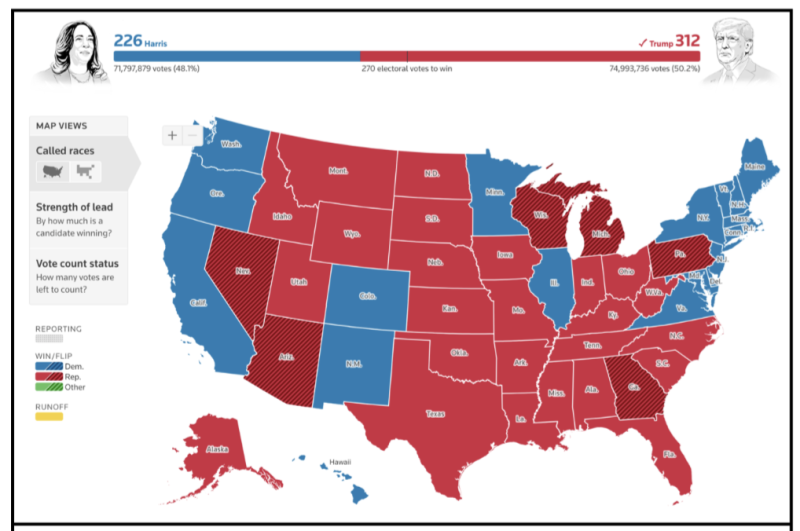
Donald Trump’s 312-226 landslide victory in the Electoral College is not a repudiation of democracy but a triumphant affirmation of its liberating power. He lost the popular vote in 2016 by three million votes (two percent) and in 2020 by 7 million (four percent). This time he won the popular vote by three million (76-73) and two percent (50.1-48.1) – his first victory in the number of ballots and in securing an absolute majority. About 90 percent of over 3,000 counties across the nation shifted to the right.
Trump won in 2016 with a winning coalition of disaffected working-class whites. More than half of workers are living paycheck-to-paycheck, the purchasing power of which has been falling with high inflation. Contrary to the American dream of intergenerational progress, many young people have a worse standard of living than their parents. While consolidating that voting base, the more sweeping triumph this year was helped considerably by substantial inroads into ethnic groups traditionally aligned with Democrats. Trump described his diverse and inclusive coalition as a ‘beautiful,’ ‘historical realignment’ in his victory speech on the night. Harris refused to give a concession speech until the day after.
In an NBC exit poll, Trump won 57 percent of white and 55 percent of male voters, retaining his hold on these groups. In an AP exit poll, he won 20 percent of the black vote, up from 8 in 2016 and 13 in 2020. Harris’s 80 percent black vote is a ten-point drop from Joe Biden’s four years ago. In addition, he also won the support of 46 percent of Latinos, 39 percent of Asian-Americans, 54 percent of ‘Other,’ 45 percent of women, and 43 percent of 18–29-year-olds. Hence the prospect of a major new realignment of American politics. There are important lessons in all this for centre-right parties across the West: authentic conservatism attracts more voters than it repels.
Trump’s success in creating a new multiethnic winning coalition indicates that voting trends may be coalescing, with previously segmented cohorts normalising and starting to vote more as Americans and less as ethnics. Thus in an AP analysis, the economy and jobs rated as the top issues for voters overall, for blacks and Latinos, and for the youth. Phrases like the Latino, black, or Asian-American vote are increasingly meaningless. What once were voting blocs are fragmenting into individuals with agency. This can only be good for the long-term health of American democracy, contrary to the hysterical warnings of its imminent collapse should Trump win.
In the history books, 2016 might be described as a dress rehearsal for the real deal in 2024. Trump won back the White House and delivered Congress on his coattails, with a net gain of four Senate and 1-2 House seats. Plus he will have a favourable balance of justices on the Supreme Court. All this will be crucial in confronting the expected challenges from Resistance 2.0, aka swamp dwellers protesting at the swamp drainage scheme. So will the lessons internalised from the experience of 2016–20, including the choice of top personnel who understand and are committed to the Trump agenda.
Traditional Voter Concerns Beat Woke Neoliberalism
Progressives once again went into meltdown. Writing in The Globe and Mail in reliably woke Canada, Andrew Coyne solemnly describes Trump as ‘manifestly, palpably, incontrovertibly unfit for public office, not only in his own character and abilities, but for what he represents, including his attacks on the rule of law, basic freedoms and democracy itself.’ His take on the outcome? ‘Sometimes the people get it wrong.’ He echoed the instant reaction from Jill Filipovic that ‘this election was not an indictment’ of Harris but ‘an indictment of America.’ At least one Guardian columnist gets it. John Harris concluded that the ‘simple, inescapable message’ from Trump’s victory is that ‘many people despise the left’ with progressives seen as ‘one judgmental, “woke” mass.’
Harris goes on to note that support for border security and enforcement was higher among blacks and Hispanics than among white progressives. So too for statements that ‘America is the greatest country in the world’ where ‘most people can make it if they work hard,’ again contradicting the core tenets of critical race theory. The fact that Trump’s 14-point advantage among voters without college degrees flips into a 13-point loss among the college-educated indicates the source of the luxury beliefs. This in a tough economic environment in which, in a survey last year, 39 percent of Americans admitted to having skipped meals to keep up with housing payments.
Trump was authentic and Harris inauthentic, intellectually shallow, morally vacuous, and prone to mistaking platitudes as policy pronouncements. Harris held a celebrity-studded rally in Philadelphia on 4 November. Speaking at his own overlapping rally in Pittsburgh, Trump said: ‘We don’t need a star because we have policy.’
She recruited Republican reject Liz Cheney whose surname remains toxic among true-blue Democrats. He won over disillusioned Democrats Robert F Kennedy, Jr (nominated to be Secretary of Health and Human Services) and Tulsi Gabbard (the new Director of National Intelligence) along with Elon Musk and Vivek Ramaswamy (co-chairs of a new Department of Government Efficiency, DOGE). Her only sales pitch was ‘I am not Trump. I am not Biden.’ This was delivered with an accompaniment of trademark word salads, infamous cackles, and a baffling array of accents to suit every audience.
Trump dodged bullets, Harris dodged questions. He had a record to defend, she had one to airbrush. Democrats voted for the party, not Harris. MAGA people voted for Trump more than the party. Harris neither explained and defended the last four years nor articulated a vision for the next four. All she did was to attack Trump. He closed with the simple yet powerful question: Are you better off now than then? They replied: Diversity hire, you are fired.
[…]
Echoing the ‘quadfecta’ of the GOP capture of the Presidency, Senate, House, and popular vote, the MSM too suffered a quadruple calamity. Their preferred candidate lost. Their already dented credibility was torn to shreds. Echoing the George Costanza strategy, some voters did the opposite of what the media hacks told them, echoing last year’s Voice referendum here in Australia. Also like the Voice, Harris’s massive spending advantage merely reinforced the perception that she was the candidate of the wealthy few and he of the more numerous little guys.
[…]
Growing the Trump Voter Base
There isn’t just one US presidential election but 50 simultaneous but separate ones in every state, each with its own rules and processes. Similarly, there isn’t one unified and cohesive electorate but several distinct voting cohorts. As alluded to above, the Trump-led Republicans deepened their appeal among white working-class Americans but also broadened it to peel away once-solid support for the Democrats among specific cohorts and bring them inside the Republican tent.
This was particularly true of but not limited to the immigrant ethnic groups. According to a Forbes analysis, Harris’s six-point lead over Trump among Latinos was a steep drop from the 33 and 38-point margins for Biden and Clinton in 2020/2016. In Starr County in south Texas with a 97 percent Latino population that hasn’t voted for a Republican presidential candidate since 1892 and Clinton won by 79 points in 2016, Trump won 58 percent of the votes this time round. In Queens County, NY, one of the most ethnically and racially diverse counties in the US, the needle moved 20 points towards Trump from 2020. For all the brouhaha over an insult comedian’s off-colour Puerto Rican joke, even heavily Puerto Rican Osceola, FL, which Biden carried by nearly 14 points, flipped to Trump.
[…]
The established immigrant populations too see economic downsides to having newer immigrant workers come in and compete for jobs. They too object to unlimited immigration on cultural grounds, having become proud of their American citizenship. They may even become more vociferous defenders of Americanism than whites who can trace their ancestry in the US further back but are wracked with guilt over historical sins like slavery and racism. They fault the Democrats on immigration, culture wars, and pronouns, and net zero obsession and costs be damned. Their optimistic vision for America is one based on promoting nationhood, national identity, American culture, secure borders, a history of many accomplishments to be proud of and celebrated, social conservatism, the prosperity of people who actually live in the country, and a better life for their kids.
Democracy Under Threat
In a surreal bait-and-switch tactic, the Democrats campaigned heavily on the fear that Trump, a closet Hitler, would begin to establish a dictatorship from Day One. This is from the party that overturned the democratic choice of 14 million voters to dump Biden and impose a DEI pick for the ultimate job, even though she failed to win a single delegate in 2020 and did not contest the party primary this year. She knew it, Americans knew it, the world knew it. Everyone also knew that the Democrats had lied about Biden’s cognitive health for four years and then, after replacing him, lied about Harris’s fitness for office. They treated voters with open contempt and they’ve returned the favour.
[…]
The Democrats mostly refused to accept the legitimacy of Trump’s victory in 2016 and worked assiduously to undermine his presidency with guerrilla tactics and the Russia collusion hoax. Fifty-one former senior intelligence officials ran election interference against Trump in 2020 with knowingly false declarations on the Hunter Biden laptop story as classic Russian disinformation. They spied on his campaign, impeached him twice, arrested him, and tried to bankrupt, incarcerate, and throw him off the ballot. He was twice the target of assassination attempts and famously rose up from one with defiant fist pumps of ‘Fight! Fight! Fight!’ He absorbed all the punches and just kept coming back at them.
[…]
Immigration
Immigration has long been argued to bring multiple benefits of economic stimulus and growth, replenished gene pool, enriched cultural diversity, exposure to the world’s diverse range of scrumptious cuisine, and so on. In the US, Republicans tolerated illegal immigrants as a large pool of cheap labour and Democrats as a large bloc of reliable long-term votes. But in recent times mass and illegal immigration in particular have tipped the balance away from net benefits to harms, including net lifetime drain on public finances and stressed out public infrastructure. This is more so for the working classes than the elites.
[…]
By reversing Trump’s efforts to control the southern border and opening it wide to floods of illegal aliens on Harris’ watch as the border czar, the Democrats left her candidacy hostage to fortune and have paid the price. Exit polls showed immigration and the economy as the voters’ top two concerns and Trump – with a tough message on immigration, border enforcement, and mass deportations – won on these with 90 and 80 percent support.
[…]
Indo-Americans
For reasons that should be self-evident, I am more familiar with Indo-American than with other groups’ sentiments. The comments that follow draw on many conversations over time with colleagues, friends, and relations in the US.
Unlike the low depression hanging over many Western capitals led by people yet to outgrow student politics, in heavily polluted Delhi the Modi government will be pleased to see the House of Orange restored to the White House. Speaking at a function in Mumbai on 10 November, in response to a question from the audience on the implications of Trump 2.0 for India, Foreign Minister S Jaishankar remarked (at around 25 minutes) that ‘a lot of countries are nervous about the US…We are not one of them.’ He said that Modi’s call of congratulations was among the first three that Trump took from foreign leaders.
[…]
It’s worth remembering that small numbers can tip the outcomes in just a handful of states to determine the overall winner. There are over 700,000 Indians in the seven swing states. In 2016, 84 percent of Indo-Americans voted for Hillary Clinton, falling to 68 percent for Biden in 2020. Harris’s share fell again to 60 percent, despite her mother being Indian. Support for Trump was 31 percent, up from 22 percent in 2020.
In an era of right-wing ascendancy and endless wars, Dennis J. Kucinich has stood out as one of the few respectable figures in American politics.
During his 16 years in Congress between 1997 and 2013, Kucinich (D-OH) was consistently anti-war—opposing even wars like Kosovo, Serbia, Syria and Libya orchestrated by Democrats that most of his Democratic Party colleagues supported.Kucinich additionally tried to reign in the CIA, and supported a bill to replace the Federal Reserve with a monetary authority within the U.S. Department of the Treasury that would undercut the power of private banks and allow direct government financing of infrastructure projects.
Unfortunately, Kucinich was defeated in his bid to return to the U.S. Congress in Ohio on November 5.
Running as an independent, Kucinich’s campaign platform was to end America’s endless wars, protect constitutional rights to free speech and cut the deficit, which he has said is the result of “financing foreign adventures and getting dragged into more wars.”
In an exclusive interview on November 7, Kucinich told me that he was encouraged that he “got 50,000 votes in a highly polarized political environment, which was more than any independent candidate in the country in a three-way race.”
Kucinich said that a lot of voters told him that they appreciated everything he had done for the people of Ohio throughout his career but that they were voting on a straight party ticket.
Kucinich believes that the national election result represented a “rejection of the globalist agenda and policy of endless war that has been embraced most fervently by the Democratic Party.”
“People want things taken care of at home,” he said. “58 percent of discretionary income is being spent on the military and you can’t separate the domestic economic problems from the waging of endless wars. Over $8 trillion of the [$35 trillion] deficit is linked to wars and globalist policies have helped precipitate the crisis at the border and illegal immigration.”
Kucinich is among those dismayed at how the State Department has evolved into “an extension of the Pentagon which no longer engages in diplomacy” and believes that many people supported Donald Trump because they “believe he will follow through on his rhetoric about extracting the U.S. from global conflicts and [about] avoiding wider wars.”
According to Kucinich one of Trump’s biggest challenges will be to “sustain the U.S. economy amidst the rise of BRICS” and “potential loss of elasticity of the U.S. dollar resulting from the BRICS states’ development of alternative economic arrangement and desire to undercut the primacy of the U.S. dollar as a medium of global exchange.”
The BRICS conference at Kazan, Kucinich says, was significant in “setting the groundwork for an alternative global economic structure.” The pressure being put on the U.S. dollar now is resulting from a “backlash against U.S. foreign policy, including failure of U.S. sanctions policies, which helped the Russian economy but damaged the American one.”
Kucinich stated that his break from the Democrats occurred because he “couldn’t be part of a party that he was in fundamental disagreement with,” especially over its “constant promotion of war which it needs to get away from.”
Kucinich recalled clashing directly with Barack Obama in 2011 over his bombing of Libya, noting that Obama “was not happy with me for challenging him over that.” At the end of his presidency, however, “Obama admitted that Libya was his greatest mistake and claimed that Hillary Clinton pushed him into it.”
After Kucinich challenged Obama on Libya, he says that his congressional phone was tapped illegally. He learned about this when reading a story in The Washington Times recounting what was supposed to be a secret conversation that he had with some of Libya’s top leaders.
This is just “one example of the intelligence agencies’ having gone amuck,” he said, and “there are plenty of others.”[1]
It is worth noting that Donald Trump’s previous tenure as President of the United States was markedly hawkish in many areas of his foreign policy. Trump allowed neocon forces led by John Bolton to kill any peace negotiations with North Korea, expanded the sanctions regimes on Iran, Venezuela, and Cuba, and pledged his support to Israel by moving the U.S. embassy to Jerusalem.
Fighting the Good Fight in Cleveland
Kucinich has been battling against entrenched special interests for more than 55 years, having spearheaded a petition drive to block privatization of Cleveland’s utilities after his election to the Cleveland city council as a 23-year-old in 1969.
After a failed run for Congress in which he advocated for ending the Vietnam War, Kucinich was elected mayor of Cleveland in 1977 at age 31 based on his promise to save public power.
The ensuing epic campaign pitting Kucinich against Cleveland’s entrenched financial powers is chronicled in his 2021 book The Division of Light and Power.
Kucinich opens his book with a quote from Tom Johnson, Cleveland’s mayor from 1901 to 1909 who founded Muny Light electric company and was an admirer of progressive thinker Henry George, who said he believed in “public ownership of all public service monopolies for the same reason as I believe in the municipal ownership of waterworks, of parks, of schools, which is because if you do not own them [corporate monopolies], they will in time own you. They will corrupt your politics, rule your institutions and finally destroy your liberties.”[2]
Kucinich’s affinity for the underdog was rooted in his experience as an undersized high school quarterback where he “prepared for a career in Cleveland politics with every blinding tackle, sack, forearm in the face, bell-ringer and dirt-eating episode known as ‘the game.’”[3]
Refusing to accept favors from special interests whose money incapacitated many of his colleagues, Kucinich says that he campaigned door-to-door relentlessly and built a big personal following as a healthy substitute for corporate contributions.[4]
Kucinich was mentored by a local attorney named Milt Schulman who provided him with documents on land frauds, corrupt federal programs and capital improvement boondoggles and explained to him how bond financing was a “racket for law firms, investment bankers and Wall Street”—the people he said who “run the financial system” and were “a bunch of crooks.”[5]
One of the schemes adopted by some of these crooks was to create artificial blackouts to undermine support for Kucinich and Muny Light, the publicly owned utility.
Cleveland Electric Illuminating Company (CEI) wanted to force the sale of Muny Light so it could obtain a monopoly on electric power in Cleveland.[6]
City Council President George L. Forbes, who was in the pocket of CEI, precipitated a garbage strike in order to try and further erode support for Kucinich, while CEI aligned with local banking interests tied to CEI through interlocking directorates to plunge Cleveland into a default of its debts.[7]
Smeared by his political opponents and the local media[8] and blacklisted for a period he left office, Kucinich survived a mafia assassination plot that, according to Lieutenant Edward Kovacic, then-head of Cleveland’s police intelligence unit, resulted from Kucinich’s efforts to “stop the selling [of] a light plant in Cleveland that would have made some people a lot of money.”[9]
Kucinich lost his re-election campaign, though he was celebrated 20 years later by the City Council for helping Cleveland provide low-cost electricity that saved the city more than $300 million while keeping taxes low and fueling economic development.[10]
Today, Kucinich is the same man who fought City Hall and corporate power in Cleveland back in the 1970s.
In February 2023, I heard him give a speech at the Rage Against the War Machine rally in Washington, D.C., where he criticized U.S. weapons sales and the proxy war in Ukraine; raised alarm about unethical gain-of-function research that resulted in his assessment in the manufacture of the COVID-19 virus; and lamented censorship of anti-war activists and scientists who questioned the dominant narrative about COVID-19 being promoted in the mainstream.
Kucinich stated in his speech that “the reprehensible conduct of the U.S. government has “debased the U.S. Constitution and threatened the peace of the world” to the extent that “even former intelligence officials are aghast.” The people of Ukraine have been “used as pawns in a vicious geopolitical chess game,” and “the people of Taiwan will be used next as the U.S. tries to portray China as the aggressor while it surrounds it with military bases.”
These words resonate even more a year and a half later with the looming threat of world war driven by the powerful financial interests that Kucinich has nobly fought against for the last 55 years.
It finally happened—our questions on Russia and Putin’s resoluteness have been answered. After a nearly two-month hiatus of major long-range strikes on energy infrastructure, Russia struck back again last night with what’s again being called one of the largest strikes of the war, which not only reportedly utilized a fleet of 16 Tu-95s, but according to some sources even a wing of Tu-160s for the first time.
Virtually every missile in Russia’s arsenal was said to be fired:
▪️Kh-101
▪️Caliber
▪️Kh-32/22
▪️Oniks
▪️Iskander
▪️Kinzhal
▪️Zircon (apparently 2 were fired on targets at Kiev)
[..]
Bloomberg reports that generation at Ukrainian nuclear facilities was cut back by 40-90%, with only 2 out of 9 total reactors operating at full power:
Keep in mind, Ukraine only has 3 nuclear plants remaining under its control, it’s just that each of those has multiple reactors, thus the 9 total counted. As you can see, Rivne with 4, Khmelnytskiy with 2, and Yuzhnoukrainsk with 3 reactors:
It was said that the major energy terminal in Mukachevo, far western Ukraine, was hit, which couples and transmits European energy to Ukraine. Needless to say, if the hit was effective, it could in large part cut Ukraine off from emergency power transmission from Europe:
Ukrainian intelligence claims that Russia has stockpiled enough missiles for several of such large strikes in a row.
Protocol would have it that more systematic strikes like this would follow, weekly or so, for the winter campaign. Russian ISR would spend some time doing damage assessments then continue levying strikes on the areas which need further degrading.
Now, as if timed to stave off the morale depletion of the coming ‘dark winter’, Biden is reportedly set to announce the removal of long-range strikes restrictions on Ukraine’s ATACMS.
This announcement was reportedly immediately followed by France and Britain authorizing use of Storm Shadow/Scalp missiles on Russian territory as well. As we’ve discussed here many times, politically neutered and ideologically paralyzed Europe can do nothing without its master first giving the go ahead or signaling support.
[…]
In the NYT article above, they seem to imply the strikes could be limited to just a narrow band of Kursk, where the purported “North Korean troops” may be active.
The weapons are likely to be initially employed against Russian and North Korean troops in defense of Ukrainian forces in the Kursk region of western Russia, the officials said.
There’s a lot of things to say about this development.
Firstly: ATACMS have already disappeared from the battlefield, the last usage being recorded something like months ago.
Second: HIMARS have already been used all over Kursk, including on a Russian column some months ago. Both regular HIMARS missiles and ATACMS are fired from the same truck—so this new ‘authorization’ strikes as a little strange. Though the NYT article addresses this:
To help the Ukrainians defend Kharkiv, Mr. Biden allowed them to use the High Mobility Artillery Rocket System, or HIMARS, which have a range of about 50 miles, against Russian forces directly across the border. But Mr. Biden did not allow the Ukrainians to use longer-range ATACMS, which have a range of about 190 miles, in defense of Kharkiv.
The difference is that Ukraine can target HIMARS with their own tactical-depth drone interfaces, whereas to launch ATACMS at an operational-strategic depth would require higher level involvement, and potentially NATO satellite ISR, etc. However, that only makes a difference if ATACMS is actually allowed to be fired into the operational depth, whereas certain “hints” continue to indicate it may be a more limited geographical window—which would make this ‘authorization’ no different than previous HIMARS use.
Third: HIMARS, M270s and German Mars II variants have all been greatly attrited during the Kursk excursion of the past three months to the point that it’s questionable how many units Ukraine even has remaining. It may be a few but not enough to conduct big simultaneous volleys of ATACMS, which—unlike regular HIMARS missiles—can only be fired one at a time per truck.
The announcement comes just as ATACMS stocks have been depleted, with several articles over the past month or so noting this. The same goes for Storm Shadow/Scalp:
Defence sources have suggested that Labour’s reluctance to do so is likely to stem from the fact that UK stockpiles have reached a level below which military chiefs are not prepared to go, because a certain number must be kept in reserve to protect the UK’s own interests.
It begs the question, is this more smoke and mirrors meant to bolster Ukrainian morale without actually angering Russia too much?
The natural interpretation, of course, is that Biden seeks to wreck Trump’s chances of ending the war by a last minute escalation and provocation in one which could put Russia on a vengeful track that would dash any post-inauguration peace talks. It really all depends on what the secret fine print and limitations on the strikes will be—for instance, as stated, only in the narrow circle around the Kursk fighting, rather than attacks to the true operational or strategic depth.
But the NYT article reveals the other real reason for the desperate escalatory behavior:
The Ukrainians hope that they would be able to trade any Russian territory they hold in Kursk for Ukrainian territory held by Russia in any future negotiations.
If the Russian assault on Ukrainian forces in Kursk succeeds, Kyiv could end up having little to no Russian territory to offer Moscow in a trade.
Officials said Mr. Biden was persuaded to make the change in part by the sheer audacity of Russia’s decision to throw North Korean troops at Ukrainian lines.
He was also swayed, they said, by concerns that the Russian assault force would be able to overwhelm Ukrainian troops in Kursk if they were not allowed to defend themselves with long-range weapons.
So, Biden was “swayed” by the possibility that Russia could kick Ukraine out of Kursk. Remember when the US pretended to not be on board with the Kursk operation at all? Now suddenly they too realize it’s Ukraine’s only remaining chance at some semblance of a negotiating position.
And that’s really all that matters, as they openly admit the ATACMS won’t actually do anything to change the war itself.
Interview from September is a reminder of what Putin had to say about the long-range strike escalation.
He confirms what I said earlier: that Ukraine is already capable of doing moderate tactical level ISR over Russia’s borders with its own small drones; but long-range strikes deep into Russian territory is a whole other story. Putin ends up saying appropriate decisions will be made if Russia deems the US and NATO as being officially at war with Russia, which will be the case if this long-range strike decision actually stands.
Many people believe that Russia would not asymmetrically respond by, for instance, arming the Houthis because Russia has shown official support to the Aden government at the UN level.
But the situation is not so clear cut. Western intel agencies report Russia has already been supplying targeting data to Houthis, though of course this could be psyop information.
[…]
One interesting clip that has gone viral this week amongst the networks featured undersecretary of defense William Laplante admitting he was blown away by the Houthi’s sudden and miraculous advancement of missile technology, which seemingly came out of no where—where do you think it might have come from so out of the blue?
[…]
Recall a couple reports ago I had put forth a theory from another analyst that Trump could cleverly stage an attempt to end the war, but then blame Zelensky for being hard-headed and “wash his hands” of it all, dumping the conflict on Europe.
Now for the first time, a major MSM outlet has lent credence to this. The latest FT article outright states that Trump may blame his failures on Zelensky’s intransigence and walk away.
This would solve the great conundrum of: how does Trump prevent a total Ukrainian loss becoming his ‘Afghanistan withdrawal’ fiasco? By dumping all blame on an unmovable Zelensky, Trump could say ‘he tried’—perhaps then levying the remainder of the blame on Biden’s administration.
The last selection is interesting for the overlapping new theme it represents. Two articles, from Politico and New York Times, both unexpectedly propose that Trump’s election win is probably actually a good thing for Ukraine.
[…]
The NYT piece is remarkable in its admissions. It says that Trump forcing Ukraine to give up land would look like a major defeat of the West, but no matter—the author writes it is necessary because Ukraine is being devastated and Putin has no reason to stop; finally reality dawns on them!
Despite flashes of spectacular success by Ukrainian forces, the Russian position has gradually strengthened, and there is no reason to expect Mr. Putin to lose the upper hand now. That may sound like defeatism, but it’s also realism.
The even bigger admission is the now naked truth that the war is in fact a proxy war, spurred on by NATO and the West.
[…]
The new strikes authorization is presumably meant to tide Ukrainian societal morale over for a few months, with perhaps some kind of flashy ‘hit’ somewhere, that will be oversold as “devastating” to Russia, but it’s questionable how much mileage they can get even out of that anymore.
Remember: for the Storm Shadows to be fired “deep” into Russian territory, the F-16s—or whatever platform carrying them—would have to get almost right up to the Russian border, and risk almost certain shoot down by Russian patrol craft, long range AD, etc. The same goes for ATACMS—everyone just assumes it can hit max distance into Voronezh, but to do that the ATACMS would have to be right on the border. They learned the hard way what happens when they try that, as a slew of HIMARS trucks were destroyed not far from the border in the Kursk fiasco.
With stockpiles for both ATACMS, Storm Shadows, and even future-potential Taurus missiles scraping the bottom of the barrel, it’s not expected they could make any real mark.
Direccted by Erin Axelman and Sam Eilertsen (2024)
Film Review
American millennial Jews are becoming increasingly critical of Israel’s violent occupation of Palestine. This film follows two young American Jews, whose views on Israel shifted 180 degrees after they visited Palestine and witnessed the mistreatment of Palestinians by the IDF (Israeli Defense Force). The first a woman, Simone Zimmerman; the second Aitan, who, after enlisting in the IDF, witnessed fellow troops brutalizing Palestinians.
Both Simone and Aitan experienced very traditional Jewish upbringings, attending private Jewish schools and summer camps and participating in organized trips to Israel. In both cases, what they now see as systematic brainwashing, led them to strongly identify their Judaism with the success of Greater Israel.* During high school trips to Israel, they were “encouraged” to wear military uniforms, learn to shoot weapons and engage in military games.
Along with with consistent pressure to join the IDF, they were also pressured to attend AIPAC (American-Israeli Public Affairs Committee) conferences and lobby US politicians on behalf of Israel. Simone reveals that following graduation, 10% of her high school class enlisted in the IDF.
In her first year of university, Simone was troubled by the testimonials of young Palestinians encountered speaking out against AIPAC and US support for Israel’s genocidal policies. Through them she met a Palestinian educator who takes young Jews from all over the world on tours of the West Bank and Gaza. Despite being brought up to hate Palestinians, who she encountered were open, welcoming people living ordinary lives. In the West Bank, she met farmers who talked about beaten at checkpoints, about settlers throwing dead animals and chemicals in their wells and about the government housing ban that forced them to live in caves.
Aitan is a young American Jew who eventually served two years in the IDF, fully believing everything he was taught about Palestine being empty land prior to the arrival of empty Jews, about non-Jews who lived their previously treating the land poorly and about all Palestinians wanting to kill Jews.
Shocked and dismayed as he watched fellow IDF members drive innocent Palestinian families from their homes to use them as military outpost, his reaction on witnessing the brutal beating of a Palestinian workman arbitrarily detained at checkpoint was profound shame at not speaking out.
Becoming heavily involved in the Jewish Voice for Peace and the Boycott and Divest Movement after returning to the US, Simone has lost many of her childhood and AIPAC friends. In fact at many protests, millennials find their parents on the other side of the fence
She’s very concerned that Israel’s current genocidal campaign in Gaza is greatly increasing open antisemitism among white power groups, resulting in open attacks on full synagogues. It distresses her that the American Jewish community is wiling to sacrifice the American Jewish community for the political future of Israel.
*”Greater Israel” refers to a long term Zionist campaign to incorporate Egypt, Syria and Lebanon into the state of Israel, along with parts of Iraq and Saudi Arabia.
Recently, I received a treasure trove of documents from a source inside the CDC showing they knew for over 20 years that Wakefield was right: vaccines cause autism.
Executive summary
I recently received a treasure trove of electronic documents from deep inside the CDC. These documents have never been made publicly available.
The documents include voice-recordings, emails, hand-written notes, diagrams, and data.
The claim that “vaccines don’t cause autism” is simply very inconsistent with this evidence.
I am working with Trevor Fitzgibbon to pitch this to all the mainstream media so that I’m not talking to an echo chamber with this data. It is much better if we can get the blue-pilled media to red-pill their peers; it’s unlikely to happen any other way.
This is a huge scandal and our kids having been paying the price for decades all because the CDC doesn’t want to publicly admit they were wrong
I spoke with a top journalist at Inside Edition who thought that it’s one of the biggest stories of the decade. He said he would try to interest his friends at 60 Minutes and other outlets in viewing the data (the story is too big for IE).
I will keep you apprised.
I expect we will get a “not interested in seeing the evidence” from every major mainstream outlet even though the documents can be authenticated by people inside and outside the CDC.
I’ve sent the documents to others on our side (just in case something happens to me).
This evidence confirms what Brian Hooker found when reanalyzing the CDC autism study done by DeStefano
The people who claim there is no evidence in the peer-reviewed literature that vaccines cause autism are lying to you. 3.86 is a train wreck. If the MMR shots are safe, the OR values here should all be 1.
Look at the last row. The OR and p-value. We are done. Nobody has pointed out a mistake in this paper AFAIK. It passed two rounds of peer-review at TWO different medical journals.
Nobody can explain the data: they all switch topics when asked to explain the data
Pediatrician Liz Mumford estimates that 180 kids in her practice turned autistic within 2 weeks after a vaccination appointment vs. 0 kids in the two weeks before the wellness visit.
Probability that happened by chance is 1 in 1e54.
So she didn’t get unlucky. There is no way to explain these numbers. And when she confronts the CDC and asks them “So how do you explain this data?” they just switch topics and point to what the peer-reviewed studies showed and avoid answering the question.
Pediatrician Doug Hulstedt had 44 kids in his practice turn autistic within 2 weeks after a vaccine appointment vs. 0 kids in the two weeks before.
So this is not a fluke. These cases were all contemporaneously documented in their medical records and then examined afterwards.
There is not a single study in the medical literature that asks a similar question. This is why they never find a signal. You will never find what you don’t look for.
Why don’t I just release it to Tucker, Rogan, etc.
Because I want 60 Minutes to cover the story and interview the CDC employees who will authenticate the evidence. They won’t do that if the story is already out in the open.
Bonus: You’ll not only receive the evidence, but also the AI interpretation of the evidence
Believe it or not, finding an honest epidemiologist is really hard these days.
So…. all the data is being fed into a neutral LLM for analysis. This will be very interesting to see what an unbiased expert thinks of the evidence, won’t it?
Summary
The party is over.
The first rule of holes is when you find yourself in one, stop digging.
It’s time for people to start telling the truth.
Will anyone in the mainstream media touch this story? We’re about to find out just how deep the corruption goes. I predict it will be pretty deep.
Background: The rapid development of COVID-19 vaccines, combined with a high number of adverse event reports, have led to concerns over possible mechanisms of injury including systemic lipid nanoparticle (LNP) and mRNA distribution, Spike protein-associated tissue damage, thrombogenicity, immune system dysfunction, and carcinogenicity. The aim of this systematic review is to investigate possible causal links between COVID-19 vaccine administration and death using autopsies and post-mortem analysis.
Methods: We searched PubMed and ScienceDirect for all published autopsy and organ-restricted autopsy reports relating to COVID-19 vaccination up until May 18th, 2023. All autopsy and organ-restricted autopsy studies that included COVID-19 vaccination as an antecedent exposure were included. Because the state of knowledge has advanced since the time of the original publications, three physicians independently reviewed each case and adjudicated whether or not COVID-19 vaccination was the direct cause or contributed significantly to death.
Results: We initially identified 678 studies and, after screening for our inclusion criteria, included 44 papers that contained 325 autopsy cases and one organ-restricted autopsy case (heart). The mean age of death was 70.4 years. The most implicated organ system among cases was the cardiovascular (49%), followed by hematological (17%), respiratory (11%), and multiple organ systems (7%). Three or more organ systems were affected in 21 cases. The mean time from vaccination to death was 14.3 days. Most deaths occurred within a week from last vaccine administration. A total of 240 deaths (73.9%) were independently adjudicated as directly due to or significantly contributed to by COVID-19 vaccination, of which the primary causes of death include sudden cardiac death (35%), pulmonary embolism (12.5%), myocardial infarction (12%), VITT (7.9%), myocarditis (7.1%), multisystem inflammatory syndrome (4.6%), and cerebral hemorrhage (3.8%).
Conclusions: The consistency seen among cases in this review with known COVID-19 vaccine mechanisms of injury and death, coupled with autopsy confirmation by physician adjudication, suggests there is a high likelihood of a causal link between COVID-19 vaccines and death. Further urgent investigation is required for the purpose of clarifying our findings.
Our study indicates that the COVID-19 injectable products must undergo an immediate Class I recall by the FDA to protect public safety. The U.S. Food and Drug Administration defines a Class I recallas: “A situation in which there is a reasonable probability that the use of or exposure to a violative product will cause serious adverse health consequences or death.”
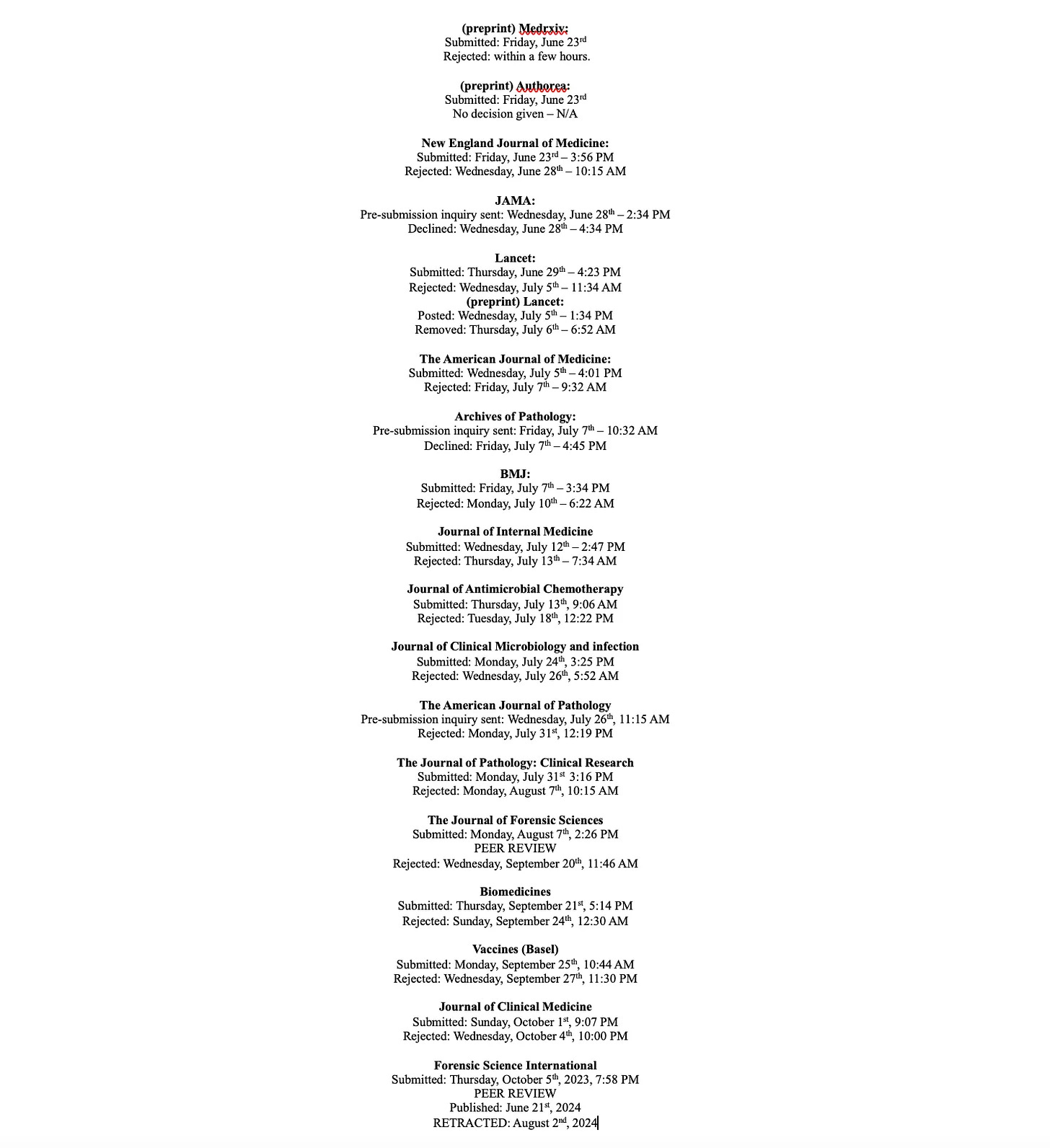
The censorship and retraction of studies that show COVID-19 mRNA injection harms is deeply concerning. First, this study was inappropriately removed from Preprints with the Lancet (SSRN). The paper was posted on the server on July 5th, 2023 and censored in less than 24 hours after receiving massive numbers of downloads and reads, “because the study’s conclusions are not supported by the study methodology.” However, the study initially satisfied SSRN screening criteria, which raises grave suspicions of censorship.
Then began the long process of submitting critical COVID-19 vaccine autopsy data to nearly 20 publications, facing repeated rejections without peer-review:
On July 3rd, 2024, our study was the #1 trending research paper worldwide across all subject areas within the last 2 weeks according to the Observatory of International Research:
Thus, we can assume that scientists, physicians, and the public were eager to learn about critical post-mortem safety data regarding COVID-19 injections. Unfortunately, in a striking act of censorship, Elsevier and Forensic Science International withdrew the article on August 2nd, 2024 in flagrant violation of their own withdrawal policy and COPE guidelines. They left no traces behind, completely wiping our paper from the webpage.
Anonymous ‘members of the scientific community’ declared that our study should not be published. A comprehensive rebuttal against the unfounded concerns was provided to the journal, which was concerningly rejected in accordance with two anonymous post-publication reviewers. Elsevier and Forensic Science International failed to follow the proper scientific discourse method of allowing debate in Letters to the Editor. This type of academic censorship poses a serious threat to the progress of scientific discovery. The republication of our autopsy study marks a significant setback for the Biopharmaceutical Complex and their Academic Publishing Cartel, signaling a pivotal victory for transparency and accountability in science.
Sen. Mike Lee, R-Utah., took aim at Sen. Bob Casey over the Pennsylvania Democrat’s refusal to concede the election, arguing that the Senate could refuse to seat him if he continues to rely on “illegal votes.”
“If Bob Casey doesn’t concede, Pennsylvania keeps counting illegal votes, & Casey relies on those votes to claim victory, the Senate could refuse to seat him,” Lee said in a post on X Saturday while citing Article I, Sec. 5, Cl. 1, which states that each “House shall be the Judge of the Elections, Returns, and Qualifications of its own Members.”
The comment comes as Pennsylvania’s Senate race will be decided by a recount after Republican Sen.-elect Dave McCormick won the election by roughly 26,000 votes, or within the one percentage point margin that triggers an automatic recount under Pennsylvania law.
Casey has refused to concede the election despite the contest being called by multiple outlets, instead insisting that a winner be declared after all votes are counted.
But questions remain about the votes Casey is trying to count after the Pennsylvania Supreme Court ruled that ballots that lack required signatures and dates are not allowed to be included in official results, a ruling that is being ignored by Democratic officials in Philadelphia and surrounding Bucks and Montgomery counties.
“I think we all know that precedent by a court doesn’t matter anymore in this country,” Bucks County Commissioner Diane Ellis-Marseglia, a Democrat, said last week. “People violate laws anytime they want. So, for me, if I violate this law, it’s because I want a court to pay attention. There’s nothing more important than counting votes.”
Republican National Committee Chairman Michael Whatley has condemned Democrats in Pennsylvania, accusing the party of attempting to “steal” the election from McCormick.
“Let’s be clear about what’s happening here: Democrats in Pennsylvania are brazenly trying to break the law by attempting to count illegal ballots. They are doing this because they want to steal a senate seat,” he said on X.
Lee, meanwhile, has urged Casey to abandon the fight over the ballots voluntarily and allow McCormick to take his seat in the Senate.


 Source: Reuters
 [Source: