Unknown's avatar

About stuartbramhall

Retired child and adolescent psychiatrist and American expatriate in New Zealand. In 2002, I made the difficult decision to close my 25-year Seattle practice after 15 years of covert FBI harassment. I describe the unrelenting phone harassment, illegal break-ins and six attempts on my life in my 2010 book The Most Revolutionary Act: Memoir of an American Refugee.

How September 11 accelerated the end of American hegemony

How September 11 accelerated the end of American hegemony
©  Robert Giroux/Getty Images

Fyodor Lukyanov

11 Sep, 2026 

Twenty-five years after 9/11, its deepest legacy lies in the wars, surveillance and strategic overreach that hastened the end of US hegemony

So much has happened since the terrorist attacks on New York and Washington on September 11, 2001, that the events now seem both very distant and perhaps less consequential than they appeared at the time. However, both impressions are misleading.

Twenty-five years is a considerable period in a human life, but little more than a moment in history, and however turbulent the past quarter-century has been, the significance of September 11 is only now becoming fully apparent.

Looking back, and setting aside the emotions of the time, what did the attacks actually mean for the international system?

Above all, they brought an end to a decade of virtually unchallenged US hegemony in world affairs.

The significance was partly symbolic in that the attackers struck at the two most obvious centers of American power, the World Trade Center represented its financial might, while the Pentagon represented its military strength. The post-Cold War period, during which the United States had come to believe that no fundamental threat remained to its security or interests, was over.

From Washington’s perspective, the decade had begun with the almost miraculous disappearance of its principal geopolitical adversary, the Soviet Union, yet it ended with the realization that danger could emerge suddenly from almost anywhere.

The fact that most Americans had previously known little about those who attacked them only deepened the shock and contributed to the impulsiveness of the response.

The End of History, proclaimed by Francis Fukuyama as the Cold War was drawing to a close, was followed barely a decade later by history’s turbulent and violent return

Washington’s reaction set in motion a global realignment whose consequences are now much easier to see. Whether Osama bin Laden possessed some ingenious long-term strategy for undermining American power is impossible to know, but the result was obvious as the United States embarked upon a course that gradually weakened its ability to manage international affairs.

George W. Bush’s administration, strongly influenced by neoconservative thinking, was caught off guard by September 11, so its response rested on two broad assumptions.

The first was that threats to America could originate anywhere, not merely from hostile states but from non-state groups newly capable of inflicting enormous damage, therefore such threats had to be confronted wherever they emerged, primarily through the overwhelming military power available to the United States.

The second assumption was ideological, given liberal theory held that democracies didn’t wage war against one another, meaning if that were true, then the more democracies there were, the safer the United States would become.

From this emerged the increasingly assertive promotion of democracy abroad, which at times it became openly aggressive.

Its methods ranged from military interventions in Afghanistan and Iraq to political and financial support for democratic movements in the former Soviet Union and pressure for liberal political reforms across the Middle East and Libya later became another example of Western military intervention producing consequences far beyond those originally anticipated.

Some episodes from that period are now half-forgotten, such as when Washington strongly encouraged elections in the Palestinian territories despite warnings from regional actors about the likely consequences. Naturally, Hamas subsequently won the 2006 Palestinian legislative election, dramatically altering Palestinian politics.

The same confidence in political transformation characterized the American response to the Arab Spring as existing political balances across the Middle East were overturned, often without anything stable emerging to replace them.

The consequences of the 2003 invasion of Iraq were greater still. The overthrow of Saddam Hussein destroyed a major component of the regional balance that had developed during the 20th century and unleashed forces that proved extremely difficult to contain.

America became trapped in what its own politicians would eventually call endless wars and these conflicts contributed to polarization inside the United States while attempts to export democracy damaged the reputation of democracy itself.

In Iraq, this was compounded by the widespread belief that American strategic and economic interests, including oil, were inseparable from the intervention.

The broader results were remarkable with prolonged wars, a destabilized Middle East and the expansion of radical Islamist movements. The architects of September 11 could scarcely have hoped for more when they planned their attack given relations between the West and much of the Muslim world also deteriorated.

President Bush’s early reference to a crusade against terrorism was probably an unfortunate choice of words rather than a deliberate provocation, but Islamist movements eagerly seized upon it as confirmation of their argument that Western hostility towards the Muslim world had changed little since the Crusades.

Washington subsequently tried to repair those relations, but the direction had already been set.

The destruction of Iraq’s complicated internal and regional balance created opportunities for radical movements while contributing to an image of the United States as an enormously powerful but unpredictable force in Middle Eastern affairs. As a result, for governments in the region, maintaining some distance from Washington increasingly appeared prudent.

September 11 also transformed the United States itself.

The War on Terror was conceived as a global campaign to protect American national security, but its domestic consequences were profound as surveillance and state control expanded dramatically, whether in personal communications or financial transactions.

Although the original justification was terrorism, over the following quarter-century, new reasons for expanding these mechanisms appeared while technologies changed and political priorities shifted, but the general direction towards greater monitoring and control remained.

Nor did the old problem of double standards disappear because, despite declarations of zero tolerance for terrorism, the familiar distinction between one side’s terrorist and another’s freedom fighter survived. This ambiguity becomes particularly apparent when the interests of major powers collide, whether those powers are the United States, Russia or China.

A quarter-century after September 11, the world bears remarkably little resemblance to the one that existed on its eve, but, of course, much of what followed would probably have happened anyway. International systems change because of forces far larger than any single event and China’s rise, Russia’s reassertion of its interests, technological transformation and the relative decline of Western economic predominance cannot simply be attributed to the attacks of 2001.

But September 11 was nevertheless a turning point as the attacks ended the extraordinary post-Cold War interlude in which American predominance appeared almost uncontested, and, more importantly, Washington’s response accelerated the processes that brought that period to a close.

The movement away from the unipolar order didn’t happen overnight, but began gradually, gathered momentum through wars, crises and the emergence of alternative centers of power, and continues today.

What will replace it remains unclear, given the formation of another stable international order may take many years and whether that system proves preferable to the bipolar confrontation of the second half of the 20th century, or to the brief period of American hegemony that followed it, is impossible to know.

But one thing now seems clearer than it did on September 11, 2001 in that the attacks didn’t merely interrupt the post-Cold War order, but marked the beginning of its end.
Cracks in Washington as Vance Challenges US War Claims

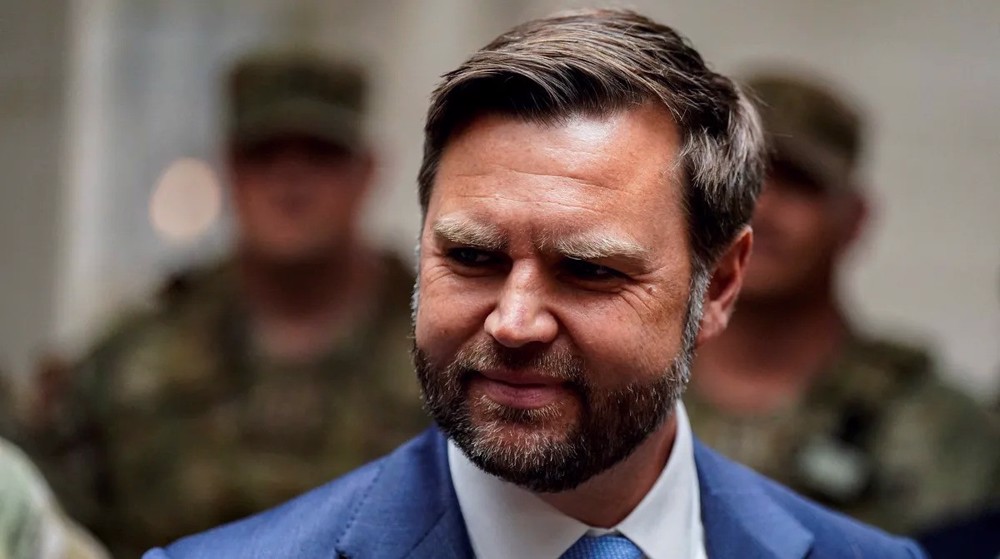
US Vice President JD Vance meets members of the National Guard, at Union Station in Washington, D.C., US, August 20, 2025. (Photo by Reuters)

Press TV UK

US Vice President J. D. Vance is secretly questioning the Pentagon’s optimistic narrative of the war on Iran, senior American officials say, as evidence mounts that weapons stockpiles of the United States are dwindling while the Islamic Republic’s military capabilities remain largely intact.

In private meetings, Vance has repeatedly challenged the US Defense Department’s portrayal of the war of aggression against Iran, raising concerns that the Pentagon is in fact downplaying the severe depletion of US missile reserves, The Atlantic, a Washington-based news outlet, reported on Monday, citing two senior American officials.

Vance, the sources said, has already questioned the accuracy of briefings, warning US President Donald Trump about shortages in critical weapons systems.

According to the report, the implications of the acute shortages are far-reaching as depleted arsenals could undermine Washington’s ability to sustain conflicts elsewhere, including in East Asia and Europe.fd continued aggression against Iran, which is draining Washington’s arsenal.

While War Secretary Pete Hegseth and Joint Chiefs Chairman General Dan Caine publicly insist that stockpiles remain strong and allege that Iran has suffered devastating losses, Vance has cautiously voiced his doubts.

Furthermore, despite official optimism, internal intelligence paints a very different picture, with sources familiar with classified assessments indicating that Iran still retains roughly two-thirds of its air force, most of its missile-launching infrastructure, and a significant fleet of fast naval vessels capable of conducting operations in the strategic Strait of Hormuz.

Although Hegseth once boasted of “complete control” over Iranian skies, Iranian forces shot down several US fighter jets and dozens of US and Israeli drones, exposing Washington’s vulnerabilities. Moreover, Tehran has steadily restored its missile launchers, with about half now operational again after an extended two-week ceasefire mediated by Pakistan.

The war, initiated on February 28 in close collaboration with Israel, has also imposed a heavy toll on US military resources as extensive use of advanced interceptors and long-range strike weapons such as Tomahawk and Joint Air-to-Surface Standoff missiles has caused serious shortages, weakening the US’s preparedness for potential future conflicts.

Analysts warn that more than half of certain key munitions may already be depleted, exacerbating preexisting shortages caused by arms transfers to Ukraine and Israel as well as sluggish production.

Even Pentagon officials have acknowledged that these deficits could jeopardize US performance in potential wars against major powers like Russia or China. This is while the Pentagon continues to claim that officials provide Trump with a “complete, unvarnished picture,” while praising their assessments as “precise, exact, and comprehensive.”

Trump has echoed the Pentagon’s upbeat messaging, declaring the all-out military campaign a victory, and claiming that US weapons supplies are “virtually unlimited”, but critics inside the administration suspect that such portrayals are tailored only to please the president.

“Pete’s TV experience has made him really skilled at knowing how to talk to Trump, how Trump thinks,” a former official told The Atlantic.

“Hegseth strives to tell the president exactly what he wants to hear. I think that’s dangerous,” the report cited another official as saying.

Meanwhile, Vance, who once argued “we were lied to” about past wars and insisted “this is not our war”, now faces pressure to balance his earlier anti-war stance with political ambitions tied to the conflict’s outcome, the report stressed.

Hegseth and Vance both served as low-ranking service members in Iraq at around the same time.

Hegseth was a National Guard lieutenant attached to the 101st Airborne Division while Vance was an enlisted Marine Corps journalist.

Far from Hegseth’s predictions of a quick, decisive win, the war on Iran has now drifted into a costly, indeterminate muddle. While the Islamic Republic remains a formidable power, the US faces mounting military strain and deepening divisions at the highest levels of government.

The US has already suspended its arms deliveries to NATO ally Estonia as the war has been a major drain on Washington’s arsenal.

The shortages have even pushed the Pentagon to use civilian factories for producing munitions.

Citing some unnamed military sources, The Wall Street Journal reported earlier this month that senior US military officials had already held talks with top executives of major automakers, including General Motors (GM.N), and Ford Motor (F.N), to produce weapons and other military supplies.

In retaliation for the US-Israeli all-out aggression which soon turned into a regional conflict, Iranian Armed Forces responded with over 100 waves of retaliatory strikes, codenamed Operation True Promise 4, launching hundreds of ballistic and hypersonic missiles as well as drone attacks against sensitive and strategic American and Israeli targets throughout the region.

[…]

Via https://www.presstv.co.uk/Detail/2026/04/28/767684/Cracks-in-Washington-as-Vice-President-JD-Vance-challenges-US-war-claims–Report

Yemen’s Houthis take over strait vital to global shipping

The Houthis launched a major offensive against Saudi-backed government forces

The Houthis launched a major offensive against Saudi-backed government forces © Mohammed HUWAIS / AFP

Sanaa (AFP) – Yemen’s Iran-backed Houthis seized a strategic Red Sea island on Friday after capturing territory along the coast, sealing their takeover of a vital shipping corridor linking Europe and Asia.

The development is likely to deepen the Middle East war’s impact on international commerce, months after the strategic Strait of Hormuz was blockaded by Iran, which hailed its Yemeni allies’ advance on Friday.

After a week-long offensive that has left hundreds dead, the Houthis appeared to be in control of territory along the Yemeni side of the Bab al-Mandab Strait, the southern gateway to the Red Sea and, in turn, the Suez Canal.

A local official with Yemen’s Saudi-backed government said on Friday that the Houthis had “completed their takeover of the Bab al-Mandab area and Mayyun Island”, while a witness said gunmen were “deploying along the Bab al-Mandab shore and are driving around in military vehicles”.

The capture of Mayyun island, in the middle of the narrow waterway, heightens the fighters’ ability to attack Saudi tankers, which they have been targeting since July.

Saudi Arabia, the world’s biggest oil exporter, has relied on the Red Sea ever since Iran’s Hormuz blockade choked off its shipments via the Gulf.

Mohammad Mokhber, an adviser to Iranian supreme leader Mojtaba Khamenei, congratulated the Houthis on their “resounding victory” on Friday.

“Now the Iranians don’t only control Hormuz and the Strait of Hormuz, but they control the other most strategic chokepoint in the Middle East,” Farea Al-Muslimi, research fellow at the Chatham House think-tank, told AFP.

Oil prices have soared past $100 a barrel this week, while average US diesel prices topped $6 for the first time on Friday — a potential headache for President Donald Trump ahead of midterm elections.

A member of the Houthis’ politburo had sought to allay fears for global shipping in an interview released on Friday, insisting “there is no cause for international concern”.

“Freedom of navigation and international trade in the Red Sea and Bab al-Mandab are safe and orderly,” Hazem al-Assad told the Al-Araby al-Jadeed news outlet.

‘Apocalyptic’ atmosphere

The Houthi offensive has cost more than 500 lives, and has displaced about 46,000 people, the UN migration agency said on Friday.

It is part of renewed hostilities in divided Yemen’s brutal civil war that began with the group’s takeover of the capital Sanaa in 2014.

The Houthis carried out their heaviest missile and drone attack in years this week against Saudi Arabia — Yemen’s northern neighbour — setting oil sites ablaze and wounding 73.

Satellite images from Copernicus Sentinel Data taken on Thursday showed black smoke billowing near Medina, along the general route of the East-West pipeline that carries Saudi oil to its Red Sea coast.

Before the Red Sea offensive, the Houthis already controlled a large part of Yemen’s north.

They have recently attacked government-held areas in Hodeida and Taiz provinces and swept down the coast, seizing the port city of Mocha and Zuqar island, north of the Bab al-Mandab, on Thursday.

Mohamed, 46, who fled Mocha in the middle of the night, told AFP there was an “apocalyptic” atmosphere in the historic city.

While Saudi Arabia has hit back with airstrikes and ordered troop reinforcements from Aden, where the internationally recognised government is based, it has failed to stop the Houthis’ lightning advance.

Houthi media said two Saudi strikes hit Mocha’s airport on Friday, while a local official there said the city’s seaport was also hit by six missiles of unknown origin.

“I think the Saudis have tried everything they can to avoid this war, but I don’t think they have any more choice,” said Al-Muslimi.

‘Dangerous conflict’

The local Yemeni official said the number of fighters on Mayyun island, just 13 square kilometres (five square miles) was “not large”, adding that they would probably deploy on hills overlooking the Bab al-Mandab.

The strait has four strategic islands: Zuqar and Mayyun, both in Houthi control, and the two Hanish islands. Government military sources told AFP that the Houthis have besieged government troops on the Hanish islands.

The UN Security Council met Thursday to discuss the conflict with Yemen envoy Hans Grundberg, who called for “the active investment of every member of this body to contain” what could become a more dangerous conflict.

The ongoing exchanges risk reviving a war that killed hundreds of thousands of Yemenis and sparked one of the world’s worst humanitarian crises.

The Houthis, after seizing Sanaa and forcing out the government, fought a Saudi-led coalition from 2015 until a United Nations-brokered ceasefire in 2022.

Via https://www.france24.com/en/live-news/20260911-yemen-s-houthis-complete-takeover-of-bab-al-mandab-area-govt-official-to-afp

EU foreign policy chief backs trade ban on illegal Israeli settlements

(Photo credit: Sean Gallup/Getty Images)
The Cradle

SEP 11, 2026

Kaja Kallas says the measure needs only a qualified majority, bypassing the unanimity rule that has shielded Israel from EU action

EU High Representative for Foreign Affairs Kaja Kallas has thrown her weight behind a bloc-wide ban on trade with illegal Israeli settlements in the occupied Palestinian territories, calling such a step a “principled stance” in an interview with the Irish Times published on 10 September.

Kallas drew a direct parallel with the EU’s response to Russia’s seizure of Crimea, telling the paper that the bloc had no difficulty naming that occupation for what it was.

“When Crimea was occupied, then it was very clear – it’s illegal, we don’t recognize this,” she said. “We should have the same principled stance – you know this is illegal, everybody agrees, so we should stop trading with Occupied [Palestinian] Territories.”

A settlement import ban, she said, would not be held hostage to the unanimity rule that has repeatedly sunk EU efforts to penalize Israel’s continuous crimes against the Palestinian people.

The ban can be advanced as a trade measure rather than a foreign policy decision and would therefore clear the bar with a qualified majority, meaning at least 15 of the 27 governments, representing roughly two-thirds of the bloc’s population.

Kallas said EU foreign ministers broadly accept that the settlements, which continue to expand across the occupied West Bank, are illegal under international law.

Germany, Hungary, the Czech Republic, and Slovenia have each previously blocked EU measures on Israel that required the consent of all 27 capitals.

Most of that group would likely vote against a settlement trade ban as well, though Kallas said some governments that refused to touch the wider EU–Israel free-trade agreement are willing to sever trade with the illegal settlements.

The European Commission is under “very clear” pressure from national governments to put the proposal forward, Kallas said, and foreign ministers are awaiting the move.

She pointed to “pros and cons” in acting before the Knesset elections at the end of October, saying one argument for delay is avoiding any boost to “radical” figures in Israeli politics.

The remarks follow a series of sanctions announced by the UK on 8 September targeting illegal Israeli settlements in the occupied West Bank, including a ban on imports of settlement goods and measures against companies and individuals driving settlement growth. France and Canada are set to impose comparable bans.

British Foreign Secretary Ed Miliband condemned the occupation as unlawful and said London accepts that Palestinians in the occupied West Bank are being subjected to ethnic cleansing at the hands of settlers, backed by the Israeli military, with the Israeli government looking the other way or actively backing forced displacement.

Twelve states, among them Denmark, Spain, and Finland, issued a joint statement demanding a halt to settlement expansion and rejecting any move toward annexation of Palestinian land or the expulsion of its population.

[…]

Via https://thecradle.co/articles/eu-foreign-policy-chief-backs-trade-ban-on-illegal-israeli-settlements

Epstein Digital Financial System Getting Ready to Replace the US Dollar

Comments by Brian Shilhavy
Health Impact News

Leah of The Leah Files has just published Part III of her Currency Killer series, The New US Dollar: The One Epstein Built.

[…]

I have been publishing evidence for years now that the American Financial System is a system built on the Jeffrey Epstein child sex-trafficking network.

And this latest article by The Leah Files provides strong evidence to that fact, and connects all the dots showing just who is doing this in this current Zionist Trump Administration.

[…]

Read Health Impact News‘ coverage of her first two articles in this series, which is our most-read article so far in September, here: Treasury Secretary Scott Bessent Just Restructured The American Financial System to Destroy the U.S. Dollar

The New US Dollar: The One Epstein Built

Inside the private currency built by Epstein’s crypto network, legalized by this administration, and controlled by the people who killed the old one.

by The Leah Files

Excerpts:

I think they are replacing the US dollar with a private one.

Not in some distant future, not as a theory, but right now. Exposed and documented, happening in front of us, and no one is stopping it. If you haven’t read Parts I or II of my Currency Killer Series, go check them out. This is Part III and it may be the worse one yet.

The United States government banned itself from making a digital dollar. Then it crashed the real one. Then it handed the replacement to a private company connected to $17 billion in organized crime, whose co-founder spent eight years as Jeffrey Epstein’s personal crypto advisor, and whose largest shareholder was convicted of software piracy before becoming the richest man in Italy.

That company is called Tether. It controls $183 billion in digital currency and it is now the 17th largest holder of US government debt on earth. It has never completed a publicly released independent audit. The UN has linked it to $17 billion in organized crime.

Tether is a stablecoin company, but it also owns 210,000 hectares of South American farmland and operates Argentina’s sole fertilizer producer. It holds a majority stake in a brain-computer interface company. It is the lead investor in a humanoid robotics firm. It owns 48 percent of a conservative media platform. Its third-largest shareholder controls a 10 percent stake in the privatized research arm of the UK Ministry of Defence.

Everyone involved is getting rich, except the American people.

Howard Lutnick’s sons’ own a piece of Tether. His firm, Cantor Fitzgerald custodies its reserves. Lutnick’s former minion, Bo Hines, championed the law regulating it from inside the White House and resigned one month after the president signed it, becoming CEO of the company the law was written for.

Scott Bessent is blocking a billion dollars in suspicious Epstein banking records while his old fund was paying an intelligence firm controlled by Epstein’s partner. Trump’s family has made over a billion dollars launching their own stablecoin.

This is not deregulation, it’s a heist. And I am going to show you what they are doing.

Welcome to Part III of the Currency Killer series.

What Is Tether

Most people have never heard of Tether. So let’s start there.

A stablecoin is a digital token pegged to the US dollar. You send a company one real dollar, and they give you one digital token that is supposed to be worth one dollar. The company holds your real dollar in reserve.

The token trades on crypto markets like cash. When you want your money back, you redeem the token and the company gives you a dollar.

Tether is the largest stablecoin on earth.

It has $183 billion of these tokens in circulation. That makes it bigger than the GDP of most countries.

The company is supposed to hold $183 billion in real reserves to back them. It earns interest on those reserves, mostly US Treasury bills, which generated $13 billion in profit in 2024 alone. It has roughly 200 employees.

Here is the problem: the CFTC found in 2021 that Tether was actually fully backed by reserves only 27.6 percent of the time. The company paid $41 million in fines.

The New York Attorney General’s office reached a separate $18.5 million settlement over similar misrepresentations. The UN has linked Tether’s token to $17 billion in criminal activity.

The DOJ has an active criminal probe. And the company has never completed a full, publicly released independent audit.

[…]

Now let’s look at who built it because this is where I knew there was something more nefarious happening.

The Man Who Built Tether

His name is Brock Pierce. Before he co-founded Tether, he was the teenage Vice President of a company called Digital Entertainment Network (DEN).

The founder of that company, Marc Collins-Rector, was later convicted of child sex trafficking.

In the late 1990s, Pierce became Vice President of Digital Entertainment Network (DEN), a pioneering internet video company founded by Marc Collins-Rector, at the age of 17, earning a salary of $250,000.

At DEN’s Hollywood Hills parties, Collins-Rector and others allegedly sexually assaulted half a dozen teenage boys, including a 15-year-old, according to civil lawsuits filed between 1999 and 2002. When Collins-Rector fled the country to avoid prosecution, Pierce went with him.

They ended up in a villa in Marbella, Spain, which police raided in 2002 and found Collins-Rector, Pierce, and a third DEN executive, along with child pornography and firearms.

Collins-Rector was convicted of child sexual abuse in 2004. Pierce was never charged, but the civil lawsuit resulted in a $2,000,030 default judgment plus $1 million in interest because Pierce and his co-defendants never responded to the allegations of rape, assault, and death threats.

In 2010, Jeffrey Epstein was trying to salvage his reputation after his first sex trafficking conviction. He hired a man named Al Seckel, a serial scammer and self-styled illusionist who had been in a relationship with Ghislaine Maxwell’s sister Isabel for years.

Seckel organized a conference for the Epstein Foundation on Little Saint James, Epstein’s private island, called the Mindshift Conference.

Pierce was invited to present on Bitcoin. It was January 2011. Epstein noticed him immediately.

In an email sent under a fake name, Epstein singled out “brock” as “interesting.” Within three months, Pierce was at Epstein’s Manhattan townhouse asking for financial advice. Their partnership lasted eight years.

The way they were introduced tells us a lot.

Pierce entered Epstein’s world through a man who was dating the sister of Ghislaine Maxwell, the woman who procured and groomed girls for Epstein’s trafficking operation, now serving twenty years in federal prison.

The man who made the introduction, Seckel, was later found dead at the bottom of a hundred-foot cliff in southern France.


And Pierce walked in already carrying a default judgment for rape and an affinity for child porn. Epstein saw exactly what he was getting and Pierce was the perfect target.

What followed was not casual networking. It was an eight-year operational relationship between a crypto pioneer and a convicted predator, documented in thousands of pages of emails released by the Department of Justice on January 30, 2026.

The Emails

The DOJ released over 3.5 million pages of Epstein files, including direct correspondence between Pierce and Epstein spanning 2011 to 2019.

Pierce was mentioned 1,815 times, more than almost any other private figure.

[…]

But the business side of the relationship is what changed the world.

Pierce was not just advising Epstein on crypto. He was the bridge between Epstein’s money and the people who would build the infrastructure that now threatens to replace the US dollar.

He brokered the Coinbase deal.

In December 2014, Pierce connected Epstein to Coinbase’s Series C round through his venture firm, Blockchain Capital. Epstein invested $3 million. Coinbase co-founder Fred Ehrsam emailed asking to meet Epstein in New York.

[…]

He pitched Bitcoin to Larry Summers at Epstein’s townhouse.

[…=

The Network

Pierce and Epstein did not operate in a vacuum. Their shared network reached into the political and financial circles that now control American crypto policy.

Steve Bannon. Pierce and Bannon had worked together for seven years before any of this. Pierce hired Bannon in 2005 to run the financial side of his company Internet Gaming Entertainment

[…]

Peter Thiel. Epstein invested $40 million into Thiel’s venture firm, Valar Ventures, in 2015 and 2016. Reid Hoffman made the introduction.

That bet became the single largest asset of the Epstein estate, valued at roughly $170 million by the time Epstein died.

Thiel’s proteges now run US crypto policy: JD Vance is Vice President, David Sacks served as crypto czar, and Thiel’s Founders Fund was the largest investor in Polymarket.

[…]

The man who co-founded the stablecoin holding $135 billion in US government debt was at the center of all of it.

[…]

Where Pierce Is Now

Brock Pierce lives in Puerto Rico, where Act 60 allows him to pay near-zero taxes on capital gains. He is still Chairman of the Bitcoin Foundation. He still runs the Integro Foundation, whose most recent IRS filing shows $78 in total assets.

[…]

Tether Today

Now that you know what Tether is and who built it, here is who runs it.

Who Owns It

Tether has never voluntarily disclosed who owns it. It is a private company incorporated in the British Virgin Islands with no public reporting obligation.

The only known ownership data comes from leaked documents reported by the Wall Street Journal in 2023, showing stakes as of 2018. As of those documents, four people controlled 86 percent of the company.

[…]

Now here is the part that made me consider this one the most important articles of the Currency Killer series.

This is not a hedge fund buying farmland as an inflation hedge. Tether looks to be building something specific.

Adecoagro co-founded a company called Agrotoken, which has already created three grain-backed stablecoins: SOYA, CORA, and WHEA.

Each token represents one ton of grain.

Farmers can use them as currency. Agrotoken partnered with Visa so producers can spend grain tokens with a card. They have already tokenized 230,000 tons of grain and transacted $70 million in deals. Adecoagro’s CEO said the goal was to build “tokenized land.”

[…]

Tether now controls the land, the crops grown on that land, the fertilizer those crops need to grow, the mills that process the harvest, and the platform that can tokenize all of it into digital currency. It already issues the largest stablecoin on earth.

The Switch

On January 23, 2025, Trump signed Executive Order 14178. It banned all federal agencies from developing or promoting a central bank digital currency. No government digital dollar.

The only digital dollars allowed in America would be private ones.


That same executive order explicitly promoted “the development and growth of lawful and legitimate dollar-backed stablecoins worldwide.” They banned the public option and endorsed the private replacement in the same document.

Then they weakened the dollar.

The Replacement

On July 18, 2025, Trump signed the GENIUS Act into law. It created the first federal framework for privately issued stablecoins, the exact product Tether sells.

[…]

Who Else Is Getting Rich

The Trump Family

World Liberty Financial, the crypto venture backed by the Trump family, has generated over $1 billion in revenue. It launched its own stablecoin, USD1, which was used in a $2 billion investment deal between a Binance-affiliated entity and Abu Dhabi investors.

[…]

The Thiel Network

Peter Thiel took $40 million from Epstein through the Valar Ventures fund, an introduction brokered by Pierce. That investment produced $170 million in returns and became the largest single asset in the Epstein estate.

Thiel’s network has been central to shaping crypto policy: his protege JD Vance is now Vice President, David Sacks served as the administration’s crypto czar for 130 days, and Thiel’s Founders Fund was the largest investor in Polymarket, the crypto prediction market that went from a $350 million valuation to $21 billion under the new deregulatory framework.

Polymarket has Trump Jr. on its advisory board and has flagged $200 million in suspicious trading activity.

[…]

Read the Full Article at The Leah Files.

[…]

Via https://healthimpactnews.com/2026/the-epstein-digital-financial-system-is-getting-ready-to-replace-the-u-s-dollar/

“Who Would Have Thought It Was Going To Take Data Centres To Unite Us”

NZ Rising

Erin Brockovich is an environmental advocate, consumer activist and author who rose to national prominence after helping expose one of the largest groundwater contamination cases in U.S. history, involving Pacific Gas & Electric. She is now focused on the rapid expansion of AI data centres, raising awareness about their impact on water resources, energy infrastructure and local communities while leading a nationwide initiative to track data centre development. She is also the author of several books, including Superman’s Not Coming, which explores America’s water crisis and the importance of protecting one of our essential resources. She was recently interviewed on the Shawn Ryan Podcast, and these were the topics covered:

    • Communities Fighting Back
    • Local Politics, Water & Secrecy
    • Rising Costs & Environmental Impact
    • Community Pushback & Moratoriums
    • The AI Race & Who Pays the Price
    • Health Concerns & Corporate Accountability
    • Taking Action Locally
    • Finding Hidden Data & AI Revelations
    • Water, Truth & The Future

Via https://nzrising.substack.com/

Here We Go Again: Bird Flu, Lockdowns, and the Shadow of Another Vaccine Push

Bird Flu Lockdown Fear New Vaccine Government Control

Photo Credit – © Canva Pro Content License

By NZDSOS Media Team

How a play on words is being used to disguise serious engineered risks to Kiwis’ food and another push on the vaccine compliance button.

If you have been following the global health-industrial complex for any length of time, the current news cycle around H5N1 bird flu in New Zealand will feel alarmingly familiar. The script is identical: a new viral threat emerges, warning bells ring, emergency measures are implemented, and soon, the messaging turns inexorably toward vaccination with the same unanswered questions trailing behind.

The pieces are falling into place with remarkable speed. We predicted no less. 

Goodness knows, we have been calling a bird flu pandemic for years, and not because nature is inevitably mischievous and careless – unless you count all humans as part of nature. Of course we are, but the behaviour of some would make you wonder.

Flockdowns Begin

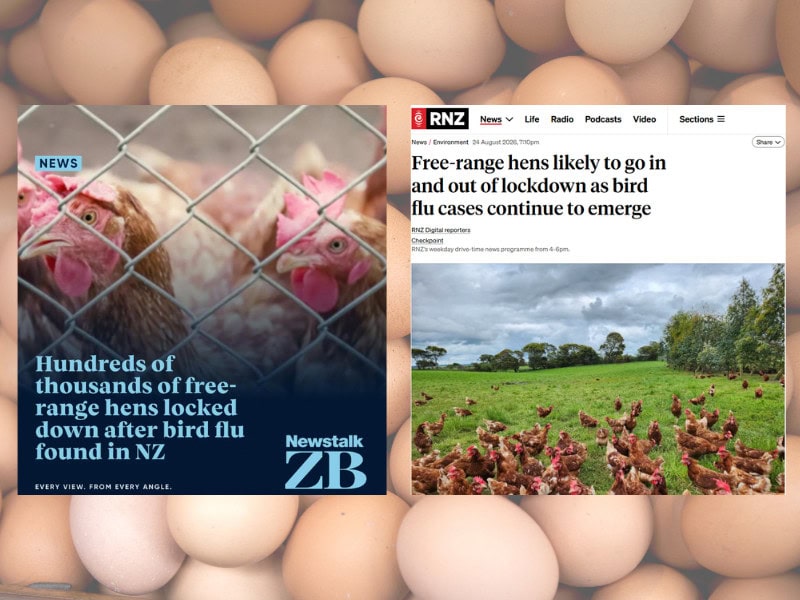
In mid July 2026 New Zealand recorded supposedly its first known case of the H5N1 strain in a wild brown skua on Petone Beach. A couple of days later a second miraculous 40-cycle (ie meaningless) PCR detection followed in a native kāhu (swamp harrier) in the Wairarapa. Within days, Mainland Poultry which supplies nearly 40 percent of the country’s eggs locked down over half a million free-range hens.

“We had a pretty busy weekend closing off the pop holes,” said CEO John McKay. Free-range eggs make up about 45 percent of the market, but consumer preferences are now secondary to the perceived threat. The chickens, we are told, “would hate being locked up,” but it is better than being “wiped out.”

Farmers report being “flockdown ready.” The infrastructure for mass animal containment is already operational.

By mid August a third bird (a northern giant petrel) tested positive in the Wairarapa.

The Standard Playbook Unfolds

In the background, we are seeing the familiar pattern of a “One Health” approach linking animal and human health authorities. The Department of Conservation is rushing to jabbinate breeding pairs of critically endangered native species, but with a different vaccine than the one that was tested in 2024. MPI is conducting surveillance, urging the public to report sick birds, and warning people not to touch dead wildlife.

Meanwhile, the Ministry of Health is working alongside the Ministry for Primary Industries and Health New Zealand as part of this “coordinated preparedness campaign”.

Perhaps they should combine to form the Ministry of Mental.  You can almost hear the obscene excitement of the unhealthy globalist slobs as they get to cut down the choices of the clued-up and health conscious. We are reminded of the attempt in 2016 to pathologise people who were proactive about their health, ate organic, took targeted supplements etc. Orthorexia nervosa was the term proposed. You can bet that many of the focused and informed orthorexics won’t swallow any jabs lies incoming.

The Vaccine Question, Again

So, that inevitable question: when will the push for human vaccination begin?

As we noted in previous analyses, the planning for a human H5N1 vaccine in New Zealand, as part of a general readying of council-level and national bird flu responses,  is already quite far advanced.

NZ’s shiny new pandemic plan of 2024 says the following:

“Depending on transmission rates, the severity of the illness and the efficacy of vaccine in preventing transmission and reducing poor health outcomes, the government may consider imposing restrictions under legislation on people who choose not to accept vaccination, in relation to work, access to premises and other activities. If legislative measures of this nature are adopted, consideration needs to be given to the New Zealand Bill of Rights Act, legitimate exemptions, international travel requirements and public acceptability in light of the wider framework of response measures.”

The Panvax vaccine has been sitting in the National Reserve Supply for years, and its provisional consent was most recently renewed in 2024 – but now as a different formulation. It contains 30 micrograms of haemagglutinin per dose, is adjuvanted with aluminium phosphate (0.5 mg per dose), and is formulated in embryonated chicken eggs, a production method that carries its own concerns for those with egg allergies, despite the data sheet’s reassurances. At least there is some data this time, and it is not an mRNA “zero risk medical product”, so beloved of the Medical Council.

The data sheet itself is revealing. It notes that clinical trials with “prototype pandemic vaccines” have been conducted, but admits: “There are currently no defined levels of serum antibody responses known to correlate with clinical protection against infection with pandemic influenza viruses.” In other words, we do not actually know what antibody level means protection, if any. We have learned a lot about the failure of injecting vaccines into the blood for what are predominantly airway infections – and developed a deep scepticism about “viral immunology” in general, thanks to the covid bioweapon assault.

Predictably, in line with the sickening new normal of medical unethics, the vaccine’s safety in pregnancy has not been studied. Healthcare providers are told to “assess the risks and potential benefits … on a case by case basis.” Well, at least that is better than the covid jab advice most NZ women got about pregnancy.

Where Are the Safety Assessments?

Our prior work has repeatedly highlighted the lack of long-term safety data for rapid-deployment vaccines. And we have been shown how truly, madly, deeply disastrous that can turn out. Cancer, heart damage, rubbery white clots found in many, and not just after death.

The same pattern emerges here. The Panvax vaccine has been given provisional consent, but where is the comprehensive safety assessment for the New Zealand population? Oh yes, now we remember that provisional consent means there is NO REQUIREMENT for safety or efficacy data, nor proof of good manufacturing practice. The US equivalent, Emergency Use Authorisation (EUA) under the PREP Act, does not even require informed, or any, consent.

Health NZ’s Medicines Adverse Reactions Committee (MARC) minutes show that “a subset of the studies should be conducted in New Zealand to reflect our population, or at least recruit Māori and Pacific Peoples”. This admission that the existing studies are not representative shines more light at the engineered inadequacy of the evidence base.

There are three potential vaccines mentioned in those minutes. It does not say they will be used for bird flu, but must be used in accordance with the NZ Pandemic Plan.

“The Australian Risk Management Plan (RMP) for the following influenza vaccines manufactured by Seqirus was submitted to Medsafe:

Panvax H5N8 pre-pandemic vaccine
Panvax pandemic influenza vaccine
H5N1 influenza vaccine”

The Threat to Ourselves and the Food Supply

As of late 2025, Public Health and Forensic (PHF) Science reported 41 human cases in the US, mostly among dairy farm workers, with mild illness and “no evidence of human-to-human transmission”. We are reminded of the initial dire warnings by the now deputy chief of the World Hijack Organisation, Jeremy Farrar of imminent bird flu in Vietnam in 2004/5. But now, if the news channels are to be believed, the virus is vaulting species and gaining function like a true champion. Billions of years of natural barriers to this viral anarchy have just fallen away apparently, completely coincidental to the era of globalism.

But if we quiet our beating hearts, bird flu is described as having “generally poor ability to transmit to humans”. The Johns Hopkins risk assessment rates the overall risk of widespread transmission as “low” even in scenarios where the illness is widespread in cattle. https://www.yalemedicine.org/news/h5n1-bird-flu-what-to-know

At the same time, we are being told that free-range eggs, nearly half the market, could be affected. Woolworths has issued statements urging calm and asking consumers not to hoard. But the signals are mixed. If free-range birds are locked indoors long-term, their “free-range” status may be affected, potentially impacting supply chains.

Farmers are already reporting the emotional toll of culling and the lack of insurance coverage for avian influenza outbreaks. The cost of repopulating layer flocks is high, and replacement chickens could become scarce.

Disruptions to the food supply were clearly telegraphed, and now they are here. The race has been between the next plan-demic and the incoming diesel crisis. And so, the pressure to accept interventions including vaccinations intensifies. Is this the techno-Marxist wet dream again?

Will This Be the Stick?

Many have forecast exactly this scenario for years, as has the Hollywood/Netflix pipeline, churning out several decades of predictive programming of a viral zombie apocalypse. So here’s Covid 2.0, as another novel virus emerges. The media amplifies fear, little Hitlers roll out containment measures and before you can say “befuddling sudden deaths” the public health emergency becomes the justification for pushing medical products with negative safety data.

The question is: will this be the stick that gets Kiwis the prick? Surely, not nearly as many this time. The pattern from covid is unmistakable. Fear of illness, concern for loved ones, economic anxiety, and social pressure all combined to drive uptake last time – but are so many still so trusting?

However, with the added dimension of a threatened food supply, the pressure may be even more acute. The message is already being crafted: vaccinated birds protect the food supply; protected food supply protects the nation; therefore, vaccination is essential.

What We Should Be Asking – Apart From, Are You Effing Kidding Me?

  1. What are the long-term safety data for Panvax in the New Zealand population? Where are the studies specific to Māori and Pacific peoples that the MARC committee itself recommended? We learnt from Comirnaty that provisional consent requires NO safety data.
  2. What is the actual risk to the general public? With no evidence of human-to-human transmission and most cases being mild, is mass human vaccination justified at all let alone proportionate?
  3. Why was the vaccine stockpiled in the first place, and at what price? What evidence supported this decision, and has that evidence been made public?
  4. What is the exit strategy? If the alleged illness cannot be eradicated in wildlife as authorities themselves acknowledge, what is the endgame?
  5. How will informed consent be ensured? Given the data sheet’s admissions about limited safety data in specific populations, how will these risks be communicated?

The pieces are in motion. The question is whether we will once again be passive recipients of a predetermined outcome, or whether we just refuse to play this time.  At least we can demand the transparency and evidence that any medical intervention of this scale warrants.

[…]

Via https://nzdsos.com/2026/09/08/here-we-go-again-bird-flu-lockdowns-and-the-shadow-of-another-vaccine-push/

Dr Rene de Monchy from New Zealand visits Dr Reiner Fuelmich in prison

German-American lawyer Dr Reiner Füllmich has been languishing in a German prison on trumped-up charges since October 2023, after being arrested and abducted at an embassy in Mexico by agents of the German state when he and his wife were in the process of renewing their passports. His ‘crime’? Speaking truth to power about the globalist attempt to engineer the collapse of society globally in order to ‘build back better’ since the advent of the ‘plandemic’ in 2020. Read more about the background story in the Daily Telegraph NZ here.

René de Monchy from New Zealand traveled to Bremervoerde Prison to visit Dr. Reiner Füllmich

After his visit, Dr. René de Monchy speaks up and shares his experience and impressions. The wisdom shared in this Impromptu interview is inspirational and encouraging.

Together for each other. Together We Are Stong. Every share is much appreciated. Thank you. 

Write a letter or postcard to Reiner at the Bremervörde Prison:

JVA Bremervoerde

Dr. Reiner Fuellmich

Am Steinberg 75

D – 27432 Bremervoerde

Germany

Via https://nzrising.substack.com/

New York Officials Lied About Air Quality After 9/11, New Documents Show

Zero Hedge

New York City has agreed to release new documents showing that officials lied about the air quality in the wake of the Sept. 11, 2001, attacks on the World Trade Center.

The more than 170,000 pages of documents are being released by NYC in response to the transparency organization 9/11 Health Watch, which had sued to force their disclosure.

According to the New York Times, the documents reveal that higher-than-acceptable levels of asbestos and other contaminants were in the dust and air in other parts of Lower Manhattan after Sept. 11.

“An audit from November 2001, prepared by a private firm and submitted to the federal E.P.A. based on data collected by New York City and state agencies, showed other troubling findings,” the Times reported Monday.

“That audit demonstrated that air concentration of the carcinogen benzene was still spiking near the towers’ footprint, and that the concentration of asbestos in the air at the Fresh Kills landfill on Staten Island had increased after the attacks.”

Despite having information about the poor air quality, government officials, including then-EPA administrator Christine Todd Whitman, said the air around ground zero was safe to breathe.

Whitman has since apologized for her misrepresentations.

The Times warned that the disclosures could reopen NYC to new litigation at a time when New Yorkers who were in the city at the time are dying of lung and blood cancers, as well as heart and respiratory diseases.

Denise Verzi, whose husband, Michael, was a firefighter who suffered from lymphoma after responding to the attack, criticized the city for its lack of transparency.

“I don’t understand hiding it to begin with,” Verzi told the Times. “That was horrific. But 25 years in, there’s people that are still getting sick.”

[…]

Via https://www.zerohedge.com/political/new-york-officials-lied-about-air-quality-after-911-new-documents-show