
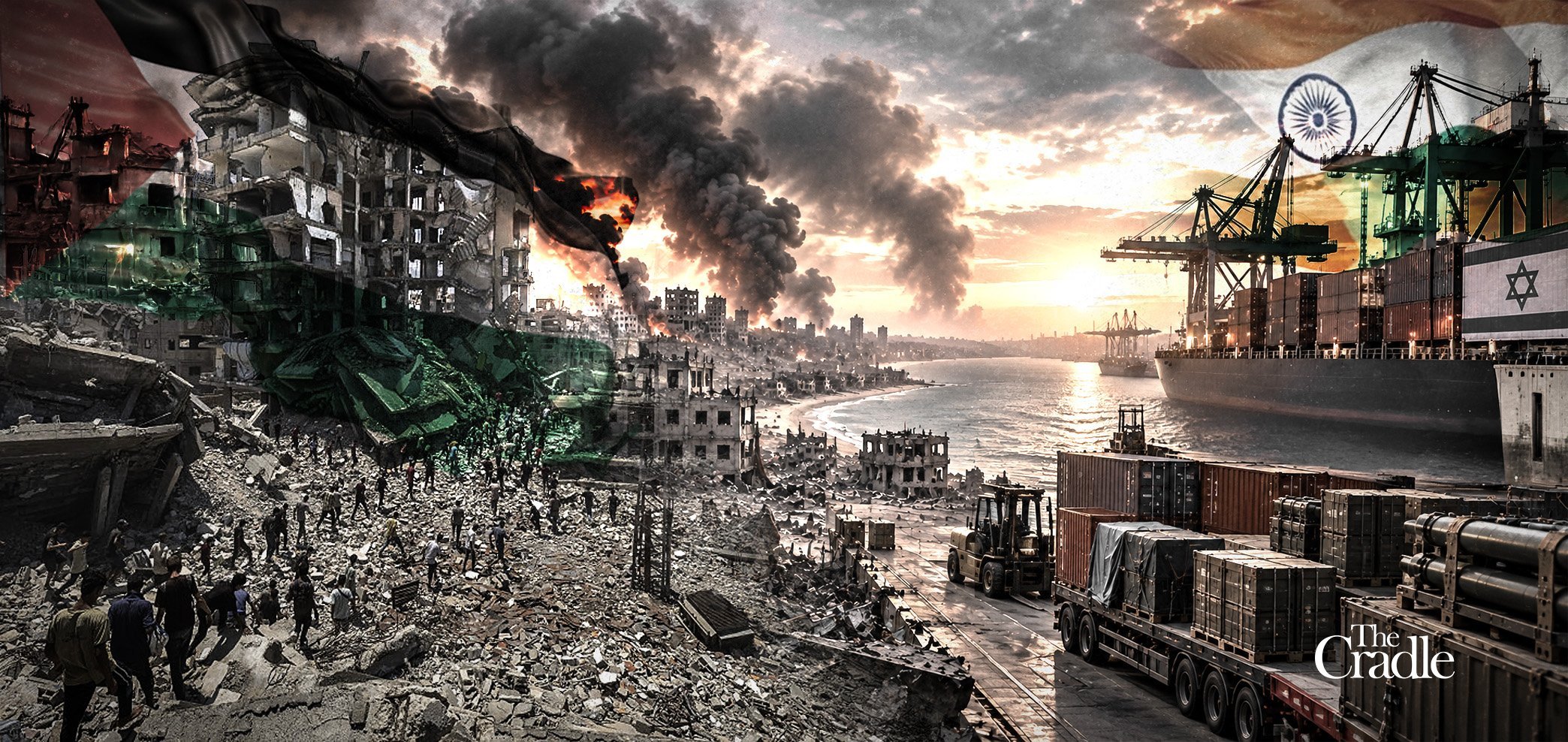
 Photo Credit: The Cradle
SEP 29, 2026
On 12 September, the BRICS bloc, whose members now include Egypt, Iran and the UAE, adopted a 45-page, 140-paragraph New Delhi Declaration in the Indian capital. Its Gaza passages, paragraphs 30 to 34, condemned starvation as a method of warfare, opposed the forced displacement of Palestinians, and noted the provisional measures ordered by the International Court of Justice (ICJ) in South Africa’s genocide case against Israel. India chaired the summit and signed the declaration with the other 10 members.
Palestinian Ambassador to India Abdullah Abu Shawesh later congratulated Indian Prime Minister Narendra Modi on hosting the summit and welcomed its references to Palestine. The Palestinian Foreign Ministry in Ramallah welcomed it too, but stressed that words had to be followed by practical and concrete steps.
Seven months earlier, Modi stood in the Knesset and, offering condolences for the 7 October 2023 Operation Al-Aqsa Flood, told Israeli lawmakers: “India stands with Israel, firmly, with full conviction, in this moment and beyond.”
The following day, alongside Israeli Prime Minister Benjamin Netanyahu in Jerusalem, he elevated ties to a “Special Strategic Partnership” and spoke of “joint development, joint production, and transfer of technology” in defense.
The two positions coexist in New Delhi’s foreign policy. India has deepened its strategic relationship with Israel while keeping its distance, in diplomatic language, from Israel’s conduct in Gaza.
Trade and production records show how much deeper the military relationship has become. India buys Israeli weapons, builds Israeli-designed systems at home, and ships defense goods to Israeli buyers.
Amnesty International and a UN Commission of Inquiry have described Israel’s campaign in Gaza as genocide. Where Indian-made parts went after delivery remains difficult to establish, making the export records and the government’s refusal to publish end-use details central to the question of India’s role.
Israel’s largest arms customer
India recognized Palestine in 1988 and established full diplomatic relations with Israel in 1992. Since then, weapons have driven the relationship. India was the world’s second-largest importer of major arms in 2021–25, taking 8.2 percent of global imports, according to the Stockholm International Peace Research Institute (SIPRI). Israel supplied 15 percent of India’s imports, behind Russia at 40 percent and France at 29 percent.
India is also Israel’s largest customer for major arms, receiving 29 percent of its exports in that period. Meir Ben Shabbat, Israel’s former national security advisor, told the Jerusalem News Syndicate (JNS) this summer that Indian orders help fund the research and development on which the Israeli army relies. SIPRI puts the growth in Israel’s overall arms exports between the two five-year periods at 56 percent, a separate measure from India’s share.
In February, reports of roughly $8.6 billion in new deals for India’s air force included Rafael’s SPICE 1000 guided-bomb kits, Elbit’s Rampage missiles, Israel Aerospace Industries’ Air LORA ballistic missile and Rafael’s Ice Breaker cruise missile.
Yet the government’s official list of 27 outcomes from Modi’s visit names artificial intelligence (AI), cyber cooperation and a quota of up to 50,000 Indian workers, but no arms contract. Those workers are expected to help fill gaps left after Israel cut permits for Palestinian laborers following Operation Al-Aqsa Flood. Reports of arms deals appeared in the trade press, while the government’s public list left them out.
Battle-tested weapons, made in India
Israeli systems sit across India’s military: the Barak 8 air defense missile, co-developed with India’s state Defence Research and Development Organisation (DRDO); Heron and Searcher drones; SPYDER air defense; Spike anti-tank missiles; and Phalcon airborne radars.
India reportedly used Israeli Harop loitering munitions and Rampage missiles against Pakistan in May 2025, during Operation Sindoor, after gunmen killed 26 people, mostly tourists, at Pahalgam in Indian-held Kashmir. Their place in India’s arsenal helps explain why New Delhi has shown little appetite for an embargo of the kind imposed by some European governments.
New Delhi now builds what it once bought. In Hyderabad, Adani Elbit Advanced Systems, a venture between Israel’s Elbit Systems and India’s Adani Group, assembles Hermes 900 drones, the long-endurance model the Israeli army flies over Gaza.
A company representative, who was not authorized to speak publicly, tells The Cradle that the plant had exported parts for more than 20 of the drones for “surveillance and reconnaissance,” but would not name the buyer. The Wire reported in 2024 that the venture had sold more than 20 Hermes 900s to Israel.
A second venture, PLR Systems, pairs Adani with Israel Weapon Industries, maker of the Tavor rifle. The same conglomerate controls Haifa, one of Israel’s two main seaports, which it bought in 2023.
The bureaucracy is locked in too. In November 2025, India’s Defense Secretary Rajesh Kumar Singh and Israeli Defense Ministry Director General Amir Baram signed a memorandum in Tel Aviv on co-development and co-production. Baram was back in New Delhi to meet Defense Minister Rajnath Singh in June 2026
Indian arms bound for Israel
In May 2024, the cargo ship Borkum, which had sailed from Chennai, dropped a planned stop at Cartagena in Spain after protests over claims it was carrying explosives for Israel. Documents later seen by Al Jazeera indicated it was bound for Ashdod with rocket engines and rockets aboard; the ship’s German manager denied loading any cargo for Israel.
In May this year, an Al Jazeera analysis of Israeli import data ranked India second only to the US as a source of military-related goods entering Israel during the war, at about 26 percent.
On 30 July, Amnesty International published Made in India. It examined 2,596 shipments of weapons, ammunition, parts and components from India to Israel between 7 October 2023 and 30 November 2025, including 564,970 explosive-ordnance parts, such as drone warheads and artillery shell casings, and 390,516 small-arms components. Some shipment categories can have both civilian and military uses; Amnesty says it excluded shipments it judged to have purely civilian or defensive purposes.
Three of the nine exporters Amnesty named are owned by the Indian state: Munitions India, Advanced Weapons and Equipment India, and India Optel.
According to Amnesty’s findings, Munitions India shipped 1,000 155mm high-explosive artillery rounds to Elbit Systems, and Advanced Weapons and Equipment India sent Elbit 120 81mm mortar launchers in February 2024.
Amnesty’s Secretary-General Agnes Callamard said India supplies arms to Israel “through its ownership and control over key supplier companies.” New Delhi has not joined the UN Arms Trade Treaty. Amnesty argues that India risks complicity in violations of international law; no court has ruled that these particular transfers make India complicit in genocide.
The licenses New Delhi will not show
The Indian government’s public response to Amnesty’s report was brief. Foreign Ministry spokesman Randhir Jaiswal said on 31 July that India has a “robust legal and regulatory framework” on strategic trade controls.
He did not address individual shipments. Amnesty says neither the government nor the nine companies gave a written response. The Manohar Parrikar Institute for Defence Studies and Analyses (IDSA), a think tank funded by the Defense Ministry, argued that India is not among Israel’s leading suppliers of major arms and that exports had not spiked after the war began.
Its comparison uses a narrower category than Al Jazeera‘s ranking of military-related imports, so the two claims do not directly contradict each other.
Responding to questions from The Cradle, Maj. Gen. Shashi Bhushan Asthana, a retired Indian army officer with experience in West Asia, disputed the implication that all of the shipments Amnesty identified were military supplies.
Asthana estimated that roughly 39 percent involved military-use items, and said many underlying contracts had been signed before October 2023. In his view, shipment dates alone do not establish whether the goods were supplied specifically for the war in Gaza.
K.C. Singh, a former Indian ambassador to Iran and the UAE, was more pointed. In an interview with The Cradle at the India International Centre in New Delhi, he said India’s growing alignment with the US and Israel had become hard to overlook.
A customs record, he said, cannot prove that an Indian part reached Gaza, but New Delhi publishes nothing that could disprove it either. Licenses issued under India’s SCOMET export-control list, and the end-use assurances attached to them, are kept secret.
Who approved the shipments, what assurances the Israeli buyers gave and whether state-owned exporters face additional scrutiny remain unanswered, he added.
The record India keeps private
Defenders of India’s policy point to a relationship that predates the war, supplies forces facing China and Pakistan, and serves Modi’s drive to manufacture weapons at home. They argue that buying from Israel and producing with Israeli companies do not prevent New Delhi from supporting a Palestinian state.
The export figures nonetheless raise a question about the influence of Israel’s largest arms customer. Spain, Slovenia, and the Netherlands have halted or restricted arms trade with Israel over Gaza. New Delhi has deepened co-production instead.
India endorsed two texts this year that speak to the same war from opposite ends of its policy. In New Delhi, it condemned starvation as a method of warfare. In Jerusalem, it pledged closer defense cooperation with the state accused of employing it.
The documents do not explain how Indian military exports are assessed against India’s stated concern for Palestinian civilians. In the Knesset, Modi said no cause could justify the murder of civilians; his government has offered little public detail on what its factories send to Israeli arms makers.
India’s silence on the arms trade also sits uneasily with its claim to speak for the Global South. After chairing a BRICS summit alongside Iran, Egypt, and the UAE, New Delhi is still courting Arab capitals whose energy exports sustain India and whose economies employ millions of its workers.
On 26 September, External Affairs Minister S. Jaishankar told the UN General Assembly (UNGA) that lasting peace requires a two-state solution and that India was contributing to relief for Palestinians. He said nothing about the arms trade.
India can maintain relations with Israel while supporting Palestine, as successive governments have done. The harder question is whether New Delhi will disclose enough about its exports for its citizens to judge the consequences of that policy.
Publishing the relevant export licenses and end-use conditions would make that scrutiny possible. Joining the Arms Trade Treaty or pausing transfers to Israeli arms makers would go further, and carry political and strategic costs that the government would have to weigh. It has announced none of these steps.
India’s support for Palestine was again on the record in New Delhi and New York this month. Its customs and shipping records show artillery rounds, drone parts, and rifle components sent from Indian ports to Israeli arms makers during the war. New Delhi has yet to explain how those exports fit with the language it endorsed at BRICS, or what checks it has imposed on their use.
Via https://thecradle.co/articles/india-backs-palestine-at-brics-while-arming-israel

