The Psychological Trauma Inflicted by Predatory Capitalism

The Shock Doctrine: The Rise of Disaster Capitalism

Directed by Michael Winterbottom (2009)

Film Review

Based on Naomi Klein’s best-selling book by the same name, this documentary explores predatory capitalism’s use of psychological trauma to crush human rights and forcibly transfer vast sums of money  from the poor to the rich.

Like the book, the documentary begins with Dr Ewan Cameron’s CIA-funded research at McGill University into the long term  effects of shock therapy, sleep deprivation and other deliberately inflicted trauma. The Agency would incorporate Cameron’s findings in their Kubark counterintelligence interrogation (ie torture) manual. They went on to use Kubark to train fascist South American military officers at the School of the Americas and to interrogate random prisoners (the vast majority were never charged) at Guantanamo and Iraqi prisons.

The film also explores the “economic shock therapy” developed by the late University of Chicago economist Milton Friedman. Friedman was a master at exploiting natural and contrived disasters to impose the kind of extreme free market reforms that crush unions and wages, shut down or privatize public services and create massive unemployment – while simultaneously transferring obscene amounts of wealth from the working and middle classes to the rich.

Friedman and his cronies seized the opportunity to put their predatory theories into practice when the CIA helped overthrow democratically elected governments in Chile, Brazil, Uruguay and Argentina; during the neoconservative regimes of Thatcher and Reagan; in Russia after the Berlin Wall collapsed; in New Orleans after Katrina; in Sri Lanka after the 2004 tsunami; and in Iraq after 9/11.

The Prison Show

prison show wilvin carter

prison show deedee mullins david collingsworth

According to their Facebook page, “The Prison Show” is a live radio program airing Fridays at 9pm Central Time on KPFT FM 90.1 Houston, streaming at www.kpft.org

Ex-con and gay activist Ray Hill founded The Prison Show on Houston’s KPFT 90.1 FM in 1980. Although the target audience is inmates in Texas state and federal prisons, including death row, prisoners worldwide listen to it on-line.

The current Prison Show gang is a motley crew of ex-offenders, teachers, professors, lawyers, chaplains, activists, ex-politicos, male and female who see the error in the current prison system and the “worth in the American people lost but not forgotten still inside.”

In addition to the regular staff, counts on a number of expert guests who discuss subjects like prison health care, legal issues and the death penalty.

The Prison Show uses the first hour to discuss issues of interest to convicts. The second session is a call-in session where friends and family and addressed their loved ones behind bars.

With the largest prison population in the world (over two million), I guess it makes sense for US prisoners to have their own radio show.

Voice of America (the CIA radio station) has a great video of the KPFT studio during a Prison show broadcast at the following link (it can’t be embedded on WordPress).

http://www.voanews.com/media/video/1950618.html

The US Colonization of Latin America

The War On Democracy

Directed by John Pilger (2007)

Film Review

The War Against Democracy is about the US colonization of Latin America, specifically the role of the CIA and the US military in systematically overthrowing democratically elected governments in Central and South America. In each case, the US installs hand picked right wing dictators who forcibly expel indigenous peasants from their land and privatize publicly owned assets and resources for the benefit of US corporations.

Australian filmmaker John Pilger begins by focusing on the US war against Venezuela’s democratically elected government, carefully debunking Washington and media lies depicting former president Hugo Chavez as a communist dictator. In addition to tracing the massive popular movement that brought Chavez to power, the documentary also features dramatic footage of the failed US-sponsored 2002 coup.

Pilger also highlights the 1954 coup in Guatemala, the 1973 coup in Chile and the Bolivian revolution that overturned Bolivia’s right wing government and bring the country’s first indigenous president (Evo Morales) to power in 2003.

Pilger’s interviews with former CIA agents who helped orchestrate some of these coups are priceless.


The History of Women’s Liberation

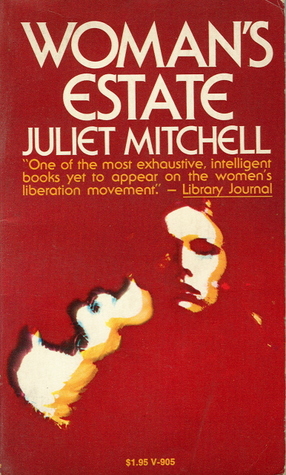
womens estate

Women’s Estate

by Juliet Mitchell

Pantheon Books (1972)

Book Review

Women’s Estate is about the history of the modern women’s liberation movement. Women’s liberation began in the US in the late 60s and quickly spread to Britain and the rest of the industrialized world. Mitchell compares and contrasts women’s liberation with the earlier feminist movement of 1880-1920, as well as tracing contemporary political influences that shaped it.

Mitchell traces the modern feminist movement to the publication of The Feminine Mystique by Betty Friedan in 1963. In 1966, Friedan would co-found National Organization for Women (NOW) with Gloria Steinem (see Did the CIA Use Gloria Steinem to Subvert the Feminist Movement?). Mitchell classifies NOW as a “reformist” group that limited itself to winning isolated reforms (affirmative action laws, legalized abortion and access to birth control, etc), as opposed to women’s liberation groups which sought to overthrow patriarchy and male-dominated society.

Owing to the immense media attention it received, women’s liberation was the most public revolutionary movement in history. According to Mitchell, its main influences were the mid-sixties black liberation movement, the student movement and the youth (aka “hippy”*) movement.

She traces the official origin of women’s liberation to a protest at Nixon’s 1969 inauguration in which female speakers were taunted with sexually explicit insults. This was the last straw in a long frustrating period in which male antiwar activists edged women out of decision-making and relegated them to typing and tea making.

By 1970, there were women’s liberation groups in all of the developed world, except for Ireland, Austria and Switzerland.

Although women typically experience the most extreme levels of poverty and oppression, the women’s liberation movement, like the earlier suffrage movement, was mainly led by middle class women. According to Mitchell, it’s common for the oppression of underprivileged women to be passed off as natural and unchangeable.

Mitchell devotes most of the book to an analysis of the politics of oppression and the cultural factors (especially so-called “family values) that cause women’s oppression to appear invisible.

In her view, this is why consciousness raising groups were so essential to women’s liberation. By openly sharing their negative treatment by men, women were astonished to learn other women had similar, often identical, experiences. This helped them to acknowledge their individual frustration and suffering was, in actuality, a political problem.

As Mitchell puts it:

The first symptom of oppression is the repression of words: the state of suffering is so total and assumed, it’s not known to be there.


*According to Mitchell, the hippies rebelled against social manipulation and emotional repression by the political establishment without seeking specific political change.

Emancipate Yourself from Mental Slavery

“Emancipate yourself from mental slavery – none but ourselves can free our minds” – Bob Marley Redemption Song

PsyWar: the Real Battlefield is the Mind

Directed by Scott Noble (2010)

Film Review

PsyWar is about the fundamental role of propaganda in a political system that pretends to guarantee  “democracy” in a society that simultaneously promotes extreme wealth inequality.

It begins with an examination of the vital role propaganda plays in war time, with a special focus on the 2003 US invasion of Iraq and World War I. It then explores the morphing of the World War I propaganda machine into the modern public relations industry.

The film moves on to the concept of “polyarchy,” which the filmmakers maintain is the most accurate description of government in the industrial north. In a polyarchy, power is closely guarded by a wealthy elite and the population remains passive except for periodic elections in which they vote for the elites of their choice. When a tiny minority controls nearly all the wealth, “democratic” elections are only possible if the majority is systematically controlled with psychological propaganda.

Big breakthroughs in transportation and communication technology at the end of the 19th century caused a major crisis for polyarchy, as they fed the rise of popular resistance movements (eg the populist and progressive movement, International Workers of the World and militant labor movements). The response to this crisis was the public relations industry.

The Rendon Group and Perception Management

The documentary introduces us to the Rendon Group, the private “perception management” company the Bush administration paid to manage propaganda leading up to the US invasion of Iraq. Immediately after 911, the CIA paid the Rendon Group $23 million to generate anti-Iraq propaganda. They also paid them to manage “public perception” during the US bombing of Afghanistan.

The Dirty Secret Behind the US Constitution

PsyWar devotes nearly 15 minutes to the secret framing of the US Constitution by a group of rich landholders and merchants to overturn the Articles of Confederation and protect their wealth from the “tyranny of the majority.” It contrasts the system of direct democracy of the Iroquois Federation (on which the Articles of Confederation were based), where all members of society (including women) had direct input into policy decisions.

The Crisis of Capitalism

According to PsyWar the modern public relations machine performs two vital functions in maintaining the stability of our current capitalist system. The first addresses chronic overproduction. One of the main flaws of capitalism is that once a population’s basic needs are met, the need for continuing production ceases. Our ruling elite could have addressed overproduction by reducing work hours and increasing wages (as they have recently done in Sweden*), but this would have hurt profits. Instead, under the guidance of Edward Bernays (known as the father of public relations) they ramped up consumption by bombarding the masses with pro-consumption propaganda deliberately playing on their psychological insecurities.

The second major role played by modern public relations is to “manufacture consent” of the governed to their overall powerlessness and passivity. Manufacturing consent is a term coined by journalist (and former government intelligence/propaganda agent) Walter Lippmann. It was Lippman’s view that the majority of Americans are meddlesome outsiders who are totally incompetent to govern themselves.


*In October, Sweden announced they were moving to a six-hour work day to improve productivity and improve work-life balance Sweden introduces 6 hour work day

The Hidden History of the US Constitution

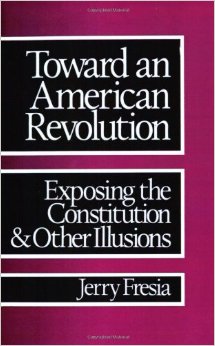
towards an american revolution

Toward an American Revolution: Exposing the Constitution and other Illusions

by Jerry Fresia

South End Press (1988)

Book Review

This book is a great follow-up for people wanting to know more about the secret machinations behind the US Constitution after watching the film Plutocracy.

I knew virtually nothing about the framing of the Constitution when I first read Toward an American Revolution in the mid-nineties. Fresia reveals how the first Constitutional Convention was actually a secret meeting of rich property owners and merchants whose business interests (expanded trade and personal wealth) were threatened by farmers who had seized control of legislatures in twelve out of thirteen states.

The clear intent of Washington, Hamilton, Madison and the other businessmen and plantation ownders who wrote the Constitution was to transfer power from relatively autonomous state assemblies to a centralized federal government. Most agreed from the outset that they wanted a system of government more like Britain’s, ie one in which the business elite could use government authority to enhance their economic interests.

According to Fresia, the true purpose of constitutional “checks and balances” (ie the three branches of government) was to insure that moneyed interests enjoyed a greater voice than ordinary people. The Senate, a distinctly unrepresentative body, plays a major role in minimizing popular input. The Senate, in which a tiny state like Rhode Island has the same number of votes as an a big state like California, is given sole authority to approve treaties and presidential appointees. Their longer terms (six years) mean senators are less accountable to voters than congress people (who have two years terms). Until 1913, senators were still chosen by the electoral college (as opposed by direct vote) as the president is.

In 2015, more than 200 years after the Constitution was first written, Americans are still denied the right to vote directly for President.

Toward an American Revolution also describes the dirty tricks the founding father used to get 9 legislatures to ratify the Constitution, despite overwhelming opposition from the majority of enfranchised American voters.

The second half of the book fast forwards to the twentieth century to demonstrate how the US has continued to be ruled by a secret political elite. The latter have a specific agenda of suppressing democracy when it interferes with their business interests.

The examples given include America’s “secret police” force under the FBI’s Cointelpo operation, the role played by President Herbert Hoover and US industrialists (represented by Wall Street lawyer Allen Dulles) in financing the rise of Hitler, the subsequent appointment of Dulles to head the most powerful secret police apparatus in history (the CIA), his incorporation of Nazi war criminals into US intelligence networks, the role of “secret government” in the assassination of JFK, the corruption of our democratically elected representatives by corporate lobbyists and Reagan’s illegal war in Nicaragua.

Fresia has kindly made excerpts of this book available at http://cyberjournal.org/authors/fresia/

The Arab Spring: Made in the USA

arabesques image

Arabesque$: Enquête sur le rôle des États-Unis dans les révoltes arabes

(Investigation into the US Role in the Arab Uprisings)

by Ahmed Bensaada

Investig’Action (2015)

(in French)

Book Review

Arabesque$, an update of Ahmed Bensaada’s 2011 book L’Arabesque Américaine, concerns the US government role in instigating, funding and coordinating the Arab Spring “revolutions.” Obviously most of this history has been carefully suppressed by the western media.

The new book devotes much more attention to the personalities leading the 2011 uprisings. Some openly admitted to receiving CIA funding. Others had no idea because it was deliberately concealed from them. A few (in Egypt and Syria) were officially charged with espionage. In Egypt, seven sought refuge in the US embassy in Cairo and had to be evacuated by the State Department.

Democracy: America’s Biggest Export

According to Bensaada, the MENA (Middle East and North Africa) Arab Spring revolutions have four unique features in common:

1. None were spontaneous – all required careful and lengthy (5+ years) planning, by the State Department, CIA pass through foundations, George Soros, and the pro-Israel lobby.*.
2. All focused exclusively on removing reviled despots without replacing the autocratic power structure that kept them in power.
3. No Arab Spring protests made any reference whatsoever to powerful anti-US sentiment over Palestine and Iraq
4. All the instigators of Arab Spring uprisings were middle class, well educated youth who mysteriously vanished after 2011.

Nonviolent Regime Change

Bensaada begins by introducing non-violent guru Gene Sharp (see The CIA and Nonviolence), his links with the Pentagon and US intelligence, and his role, as director of the Albert Einstein Institution, in the “color” revolutions** in Eastern Europe and the attempted coup against Hugo Chavez in 2002.

The US goal in the Arab Spring revolutions was to replace unpopular despotic dictators while taking care to maintain the autocratic US-friendly infrastructure that had brought them to power. All initially followed the nonviolent precepts Sharp outlines in his 1994 book From Dictatorship to Democracy. In Libya, Syria and Yemen, the US and their allies were clearly prepared to introduce paid mercenaries when their Sharpian “revolutions” failed to produce regime change.

Follow the Money

Relying mainly on Wikileaks cables and the websites of key CIA pass through foundations (which he reproduces in the appendix), Bensaada methodically lists every State Department conference and workshop the Arab Spring heroes attended, the dollar amounts spent on them by the State Department and key “democracy” promoting foundations,*** the specific involvement of Google, Facebook, Twitter and Obama’s 2008 Internet campaign team in training Arab Spring cyperactivists in encryption technologies and social media skills, US embassy visits, and direct encounters with Hillary Clinton,  Condoleezza Rice, John McCain, Barack Obama and Serbian trainers from CANVAS (the CIA-backed organization that overthrew Slobodan Milosevic in 2000).

Bensaada focuses most heavily on the Tahrir Square uprising in Egypt. The Washington Post has estimated approximately 10,000 Egyptians took part in NED and USAID training in social media and nonviolent organizing techniques. For me the most astonishing information in this chapter concerned the role of an Egyptian exile (a former Egyptian policeman named Omar Afifi Suleiman) in coordinating the Tahrir Square protests from his office in Washington DC. According to Wikileaks, NED paid Suleiman a yearly stipend of $200,000+ between 2008-2011.

When Nonviolence Fails

Arabesques$ devotes far more attention to Libya, Syria and Yemen than Bensaada’s first book.

In the section on Libyia, Bensaada zeroes in on eleven key US assets who engineered the overthrow of Gaddafi. Some participated in the same State Department trainings as the Middle East opposition activists and instigated nonviolent Facebook and Twitter protests to coincide with the 2011 uprisings in Tunisian and Egypt. Others, in exile, underwent guerrilla training sponsored by the CIA, Mossad, Chad and Saudi Arabia. A few months after Kaddafi’s assassination, some of these same militants would lead Islamic militias attempting to overthrow Assad in Syria.

Between 2005 and 2010, the State Department funneled $12 million to opposition groups opposed to Assad. The US also financed Syrian exiles in Britain to start an anti-government cable TV channel they beamed into Syria.

In the section on Syria, Bensaada focuses on a handful of Syrian opposition activists who received free US training in cyberactivism and nonviolent resistance beginning in 2006. One, Ausama Monajed, is featured in the 2011 film How to Start a Revolution about his visit with Gene Sharp in 2006. Monajed and others worked closely with the US embassy, funded by the Middle East Partnership Initiative (MEPI). This is a State Department program that operates in countries (such as Libya and Syria) where USAID is banned.

In February 2011, these groups posted a call on Twitter and Facebook for a Day of Rage. Nothing happened. When Sharpian techniques failed to produce a sizable nonviolent uprising, as in Libya, they and their allies (Saudi Arabia, Turkey, Qatar and Jordan) were all set up to introduce Islamic mercenaries (many directly from Libya) to declare war on the Assad regime.


*I was astonished to learn that Forum Fikra, a forum for Arab activists working against authoritarian governments, was mainly funded by the Nathan and Esther K Wagner Family Foundation. The latter also funds numerous pro-Israel groups and projects, as well as the Washington Institute for Near East policy (a pro-Israel group with close ties to AIPAC).

**The color revolutions were CIA-instigated uprisings that replaced democratically elected pro-Russian governments with equally autocratic governments more friendly to US corporate interests:

Serbia (2000) – Bulldozer Revolution
Georgia (2002) – Rose Revolution
Ukraine (2004) – Orange Revolution
Kyrgyzstan (2005) – Tulip Revolution

***Democracy promoting foundations (as used here, “democracy” is synonymous with capitalism, ie favorable to the interests of US investors). Here are seven of the main ones involved in funding and training Arab Spring activists:
USAID (US Agency for International Development) – State Department agency charged with economic development and humanitarian aid with a long history of financing destabilization activities, especially in Latin America.
NED (National Endowment for Democracy) – national organization supported by State Department and CIA funding dedicated to the promotion of democratic institutions throughout the world, primary funder of IRI and NDI.
IRI (International Republican Institute) – democracy promoting organization linked with the Republican Party, currently chaired by Senator John McCain and funded by NED.
NDI (National Democratic Institute for International Affairs) – democracy promoting organization linked with the Democratic Party, currently chaired by Madeline Albright and funded by NED.
OSI (Open Society Institute) – founded by George Soros in 1993 to help fund color revolutions in Eastern Europe. Also contributed major funding to Arab Spring revolutions.
• Freedom House – US organization that supports nonviolent citizens initiatives in societies were liberty is denied or threatened, financed by USAID, NED and the Soros Foundation.
CANVAS (Center for Applied Non Violent Action and Strategies) – center originally founded by the Serbian activists of Otpor who the US funded and trained to over throw Slobodan Milosevic and who were instrumental in training Arab Spring activists. Funded by Freedom House, IRI and George Soros.

Originally published in Dissident Voice


Did the CIA Use Gloria Steinem to Subvert the Feminist Movement?

Co-opting Radical Feminism for Corporate Interests

While preeminent American feminist Gloria Steinem’s CIA background receives wide attention on the Internet, it’s a totally taboo topic in either the corporate or the so-called “alternative” media. Steinem’s work for the CIA front group Independent Research Service first entered the public domain  in 1967 when Ramparts magazine exposed both the Independent Research Service and the National Student Association as CIA front organizations.

Fearing unflattering publicity, Steinem gave interviews to both the New York Times and the Washington Post defending her CIA work (see video below). In both articles, she claims to have taken the initiative in contacting Cord Meyers, who headed the CIA’s International Organization Division and their top secret Operation Mockingbird.* Her goal, allegedly, was to seek CIA financing to encourage American participation in the seventh postwar (Soviet-sponsored) World Youth Festival in Vienna in 1959.

The article quotes her: “Far from being shocked by this involvement, I was happy to find some liberals in government who were farsighted and cared enough to get Americans of all political views to attend.”

Steinem served as director of the CIA-funded Independent Research Service from 1958-62. It was her responsibility to organize US students, scholars and writers to attend the yearly World Youth Festival, to observe and takes notes on foreign participants, to distribute pamphlets, flyers and books and to edit a daily propaganda newspaper.

Steinem Threatens to Sue Random House

Steinem’s CIA links came to mainstream media attention a second time in 1979, when the Village Voice ran an article about a chapter Random House had censored from Redstockings Collective’s 1979 book Feminist Revolution. Random House spiked the chapter, which describes Steinem’s earlier CIA work, after Steinem threatened to sue them. This deleted chapter (which you can get free by ordering an out-of-print copy of Feminist Revolution from Redstockings Collective) also suggests her CIA involvement may not have ended in 1969 when she left the International Research Associates. It details the right wing corporate funding which helped Steinem inaugurate Ms Magazine, as well as the magazine’s pivotal role in transforming American feminism from a broad multi-class, multiracial movement to one devoted to divisive male bashing and advancing career opportunities for white upper middle class women.

The original feminists of the sixties and seventies didn’t hate men (at least not the ones I worked with). What they hated was patriarchy and the use of male privilege to deny women and children full equality as human beings.

Operation Mockingbird in Action

In 1960 Clay Felker, a CIA-linked Independent Research Service staffer who accompanied Steinem to the Helsinki World Youth Festival in 1962, became the editor of Esquire magazine, where he published many of Steinem’s early feminist articles. In 1968 Felker started New York magazine, and in 1971 he hired Steinem as contributing editor. It was Felker who published the first edition of Ms Magazine as a New York magazine insert.

As the feminist magazine Off Our Backs states in a 1975 article about the Redstockings scandal, their discovery of Steinem’s earlier CIA employment raised a host of concerns about her sudden installation (mainly by corporate media) as the official leader of the US women’s movement without any previous involvement in feminist groups or campaigns.

Interestingly Ms Magazine‘s first publisher was Elizabeth Forsling Harris, a CIA-connected PR executive who planned John Kennedy’s Dallas motorcade route.

The Turmoil At NOW

In 1966, Steinem was still on the board of directors of International Research Service, when she co-founded National Organization for Women (NOW) with Betty Friedan, author of The Feminine Mystique. A 2001 article in The American Prospect describes (quoting from The World Split Open by Ruth Rosen) how in 1975 prominent NOW members Carol Hanisch and Kathie Sarachild openly accused Steinem of working for the CIA and “directing the movement toward moderation and capitulation.” Ultimately Friedan herself became concerned “a paralysis of leadership” in the movement “could be due to the CIA” and demanded that Steinem respond.

After three months, Steinem wrote a six-page letter to various feminist publications describing her work on two student festivals in 1959 and 1962 that were funded by the CIA. Aiming to deflect the charge she was or had been a government operative, it stated, “I naively thought then that the ultimate money source didn’t matter, since in my own experience, no control or orders came with it.”

The Off Our Backs article also raises questions about a parallel organization Steinem started (in competition with NOW – starting parallel groups is a common strategy employed by US intelligence to sabotage grassroots organizations) in 1971 called Women’s Action Alliance. Located in the same building as Ms. Despite its name, the WAA wasn’t involved in “action,” as its name suggests. It engaged mainly in information gathering. It had a $20,000 grant from Rockefeller Family Fund for the establishment of a “national clearinghouse information and referral service” on the women’s movement. WAA collected information on key women leaders and their groups and activities, presumably facilitation FBI/CIA efforts to monitor them.

Steinem’s Fascination with Fascist Men

Despite her so-called liberal feminist credentials, Steinem has had a clear preference for right wing men, often with CIA and/or FBI links. She had a nine-year relationship with Stanley Pottinger, a Nixon-Ford assistant attorney general, who played a prominent role in undermining civil rights enforcement under Nixon and Ford. He also obstructed FBI investigations into the assassinations of Martin Luther King, and the ex-Chilean Foreign Minister Orlando Latelier.

In 1984 Pottinger was also investigated for participating in Irangate, a CIA scheme to illegally smuggle arms to Iran .

In the 1980’s, Steinem dated Henry Kissinger.

The Use of Black Feminists to Sabotage Civil Rights Organizing

In the late seventies and early seventies, African American organizers became concerned about a pattern in which agents posing as black feminists infiltrated their community groups in an effort to split off women members into separate organizations. They traced this phenomenon back to 1978 when Steinem put a book called Black Macho and the Myth of the Superwoman on the cover of Ms Magazine.

The book was allegedly “written” by a Black “feminist” and “activist” named Michele Wallace. In her early twenties Wallace, who like Steinem came out of nowhere (she was a Newsweek book review researcher), was suddenly being touted as the “leader” of Black feminism. In the book, Wallace called abolitionists like Harriet Tubman and Sojouner Truth “ugly” and “stupid” for supporting Black men. She called Black Revolutionaries “chauvinist macho pigs” and advised Black women to “go it alone.”

Gloria Steinem maintained that Wallace’s book would “define the future of Black relationships” and she pushed hard to make sure the book received massive publicity. Gloria Steinem’s efforts triggered a flood of “Hate Black Men” books and films that continues to this day.


*Operation Mockingbird was a secret CIA campaign to influence the media by placing CIA assets on the staff and editorial board of major publishers and media outlets and by paying reporters a small stipend to publish articles favorable to CIA interests. It allegedly ended in 1976 but many researchers believes it continues under a different name to the present day.
**Irangate was a CIA effort to illegally smuggle arms to Iran to obtain funding for the illegal CIA war against Nicaragua.


The Bush Crime Family

family of secrets

Family of Secrets

by Russ Baker

Bloomsbury Press (2009)

Book Review

Family of Secrets is about the Bush family and the Shadow Government responsible for all major domestic and foreign policy decisions over the last sixty years. For evidence, Baker relies partly on declassified documents and partly on face-to-face interviews of corporate executives, low level politicians and retired intelligence officers who have worked closely with the Bush family.

Two-thirds of the book is about George Herbert Walker Bush and CIA ties that date back to 1948 when he left Yale and went to work for Dresser Industries. Baker lays out strong evidence that Dresser and Zapata Petroleum, the oil services company Bush senior started in 1953, served the primary purpose of front companies for global industrial espionage and CIA intelligence gathering.

In this way Bush senior replicated the role his father Prescott Bush played in the World War II spy service Office of Strategic Services (OSS). Prescott was a friend and colleague of founding CIA Director Allen Dulles at the Wall Street law firm Brown Brothers Harriman. Brown Brothers Harriman bought Dresser in 1928.

According to Baker, Bush senior played a pivotal role in helping Dulles create “off- the-shelf” CIA operations – disguised as front companies – to circumvent federal legislation that prohibited the CIA from spying domestically.

For me, the high points of this book include the background Baker provides on Lee Harvey Oswald’s career as a covert CIA operative, the on-off relationship between Bush senior and Oswald’s Dallas control George de Mohrenschildt and the crucial role Bush senior played in setting up Nixon as the fall guy in the Watergate break-in and cover-up.

Baker, in essence, corroborates earlier research by Mae Brussell that the Watergate scandal was a CIA coup to remove Nixon from office.

A third of the book covers the hidden history of George W Bush, including his early alcohol and cocaine abuse, the abortion he organized for one his girlfriends, his purported Christian conversion and his AWOL from the Texas Air National Guard unit – a notorious scandal that would cost CBS anchor Dan Rather his job.

George W’s brothers Neil, Marvin and Jeb receive only brief mention related to their illegal diversion of savings and loan funds, leaving taxpayers on the hook for hundreds of millions of dollars when the savings and loan associations went bust in the late eighties and had to be bailed out.

Baker maintains a nonprofit investigative news service at http://whowhatwhy.org/

Below is a 2009 Ron Reagan radio interview with Russ Baker about Family of Secrets that someone tweeted me:

Russ Baker interview

Former CIA Station Chief to Face Murder Charges

Predator_Drone_021

According to the Guardian, Pakistan’s high court justice Shaukat Asiz Siddi has ruled that murder charges be brought against Jonathan Banks, the former CIA station chief in Islamabad. The charges relate to CIA drone strikes against innocent civilians in North Waziristan. It’s an extremely explosive story, which the US media has largely ignored.

Siddiqui also ordered criminal charges brought against John A Rizzo, the former CIA lawyer who signed off on the legality of drone strikes against Pakistan.

Banks’s undercover CIA role first became public in 2009 when tribesman Karin Khan filed a civil lawsuit against him over a drone attack that killed his father and son.

With his cover was blown, Banks was forced to resign his post and leave Pakistan.

The incident sparked major speculation how Khan and his lawyer Shahzad Akbar could possibly have known the identity of the CIA station chief. Many suspected Pakistani intelligence of leaking the name out of frustration with the illegal undeclared US war on their country.

It’s considered highly unlikely the Obama administration will extradite either Banks or Rizzo to stand trial in Pakistan.

Also posted at Veterans Today