BREAKING NEWS Ole Dammegard: Probable cause evidence shows Jesse Jackson was key police/CIA operative responsible for April 4, 1968 Martin Luther King assassination.
According to NewsInsideOut, author and researcher Ole Dammegard, recipient of the 2016 Prague Peace Prize, has documented probable-cause evidence showing that Jesse Jackson (AKA Jesse Louis Burns) acted as a key police-CIA operative in the covert operation which resulted in the assassination of Dr. Martin Luther King, Jr. in Memphis, TN on April 4, 1968.
Jesse Jackson was one of an integrated covert assassination team that also included US Army sharpshooters, CIA, FBI, and Memphis police that assassinated Dr. King on the balcony of the Lorraine Motel.
Dammegard maintains that Jesse Jackson acted as a messenger between the head of the Dixie Mafia (the FBI-CIA’s contractor for the King assassination), and the Lorraine Motel in changing Dr. King’s Ground floor room 206 to 2nd floor balcony room #306 so that US Army sharpshooters and other cabal shooters would have a clear shot to Dr. King. Jackson took the covert phone call from the Dixie Mafia chief’s wife, who directed him to ask the Lorraine Motel to change Dr. King’s Room to Room 306.
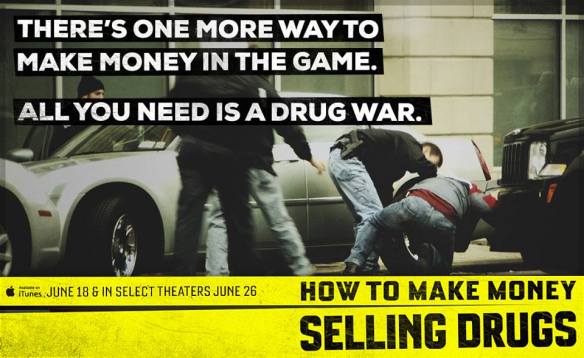
How to Make Money Selling Drugs is a biting satire on the ludicrous “War on Drugs” and its perverse effect of increasing American drug use.
Mimicking an investment informercial, the mockumentary guides viewers on how to move up the ranks from gang-backed street peddler, to private retailer, to distributor, to domestic and/or international smuggler, to drug cartel king pin.
It also offers expert advice on how to beat a case, how to conceal drugs in a vehicle and how to get crooked cops to work for your franchise. It also profiles an ex-cop who can get you off if the police plant narcotics in your car.
My favorite part of the film is a cameo by Freeway Ricky Ross, who late San JoseMercury News reporter Gary Web made world famous for his role in distributing cocaine the CIA smuggled into the US to fund their illegal war against Nicaragua.
The video can’t be embedded (for copyright reasons), but you can watch it for the next few weeks at the Maori TV website: How to Make Money Selling Drugs
In the video below, author John Potash uses a slideshow format to discuss his 2008 book The FBI War on Tupac Shakur and Black Leaders. The book is a compilation of years of research (based on court documents, news reports, archival photos and FOIA documents) into the FBI role in the assassination and false imprisonment of black political leaders and rock stars.
This presentation mainly focuses on the FBI assassination of Tupak Shakur in 1996, though Potash also briefly covers the FBI murder of Malcolm X, Martin Luther King, Fred Hampton, Huey Newton, Jimi Hendrix and Bob Marley and the CIA murder of Robert F Kennedy.
As background, Bishop also outlines the key strategies of Cointelpro the FBI war against the Black Panther Party. In addition to assassinating their leaders, the FBI collaborated with police intelligence units to imprison multiple Panther leaders on false charges, as well as extensive infiltrating their groups.
The Panther 21 Trial
Both Tupac’s Black Panther parents were framed on fictitious charges in the infamous Panther 21 trial in 1971. Tupac’s mother Afeni, who handled their defense pro se, got all of them acquitted. Tupac, who had numerous Panther mentors growing up, would become president of the New African Panther Organization (NAPO) in 1989,
In 1992, he helped broker a truce between the Bloods and Crips, encouraging them to focus their anger on the white power structure. In part due to his growing fame, the FBI responded with repeated attempts to assassinate him, as well as numerous arrests on fictitious charges.
By 1995, his financial resources depleted by multiple arrests and frivolous lawsuits, Tupac was eventually framed by an FBI informant on a phony sexual assault charge. Although he was acquitted on a rape charge, he would be sentenced to four years in prison (on a $5 million bond) for “touching a woman’s buttocks without her permission.”
Death Row Records
What horrified me most about this presentation was learning about Death Row Records, a recording company run by three undercover cops from the LAPD intelligence unit. The latter used their position in the recording industry to traffic drugs (the president of Death Row was an affiliate of Freeway Ricky Ross who distributed cocaine imported to the US by the CIA Contras) and guns and to murder performers who attempted to politicize rap music.
Death Row Records was also instrumental in ending the Bloods/Crips truce by instigating a fictitious East Coast/West Coast rap war and collaborating with police “rap squads” in Los Angeles, New York and elsewhere to frame truce leaders on phony charges carrying long prison sentences. They were also instrumental in breaking up Niggas wit Attitudes (N.W.A.)
Tupac was released from prison within days of signing with Death Row, which closely censored the political content of his recordings and performances. The FBI and the undercover cops at Death Row also instigated the phony feud between Tupac and rap star Biggie Small.
After Tupac left Death Row to start his own record company, the FBI organized his assassination and planted rumors in the press that Biggie Small had ordered the drive by shooting. They subsequently murdered Biggie Small to cover up the FBI role in Tupac’s murder.
This is a very intriguing Greek documentary about John Perkins, author of the 2004 book Confessions of an Economic Hitman. In the film, Perkins summarizes his recruitment by the NSA to work as an “economic hitman.” Despite his close affiliation to US intelligence, he was technically under the employ of a private engineering company called Charles T Main Inc. It was his role to approach third world presidents with bribes to accept World Bank loans for massive infrastructure projects – which were usually built by major US companies such as Bechtel and Halliburton.
This was done with the deliberate intention of saddling the third world countries with debt they couldn’t repay. Their only option would be to seek refinancing from the International Monetary Fund (IMF), which usually demanded they slash public services and open up their resources to further exploitation by Wall Street interests .
As Perkins describes it, this was the strategy of choice (as opposed to direct military intervention) for expanding US empire between 1945-2000. Any third world leader who refused to play ball was openly threatened with assassination. The first step in dealing with a recalcitrant leader was to send in the “jackals,” CIA officers and contractors who would try to instigate a military coup. If this failed, US intelligence would send in an assassination team. If this also failed, they would fall back on military invasion and occupation (always a last resort).
The film zeroes in on the assassination (via plane crash) of Ecuadorian president Jaime Roldós Aguilera and Panamanian president Omar Torrijos in 1981. It also provides interesting background to the US invasion of Iraq, following Saddam Hussein’s rejection of a massive Bechtel oil pipeline project.
I was previously unaware of the CIA effort to instigate a military coup against Saddam in 1996. The CIA discarded the option of assassinating him because he had too many doubles. Even his own bodyguards never knew if they were guarding the real Saddam.
Part 10 of Oliver Stone’s Untold History of the United States covers the Bush II and Obama presidency.
The Bush II Presidency
Stone begins this section by reminding viewers that Al Gore won the 2000 election by 540,000 votes. He asserts Gore would also have won the electoral college if the Supreme Court hadn’t intervened and stopped the recount in Florida.
Under the heavy influence of Vice President Dick Cheney and other Project for a New American Century (PNAC) members, Bush immediately withdrew from the International Criminal Court treaty (which Clinton supported), the Nuclear Test Ban Treat, the Kyoto Accord and the Anti-ballistic Missile Treaty. He also suspended US-led talks for Korean unification and for peace in Israel-Palestine.
Following 9-11 (which Stone refers to as the new Pearl Harbor PNAC called for), Bush launched illegal wars of aggression against Afghanistan and Iraq. In addition to authorizing the illegal indefinite detention of “enemy combatants” at Guantanamo, he also authorized the use torture and significantly expanded the US of “extraordinary rendition”* by the CIA, a program started by Clinton.
During his two terms as president, Bush doubled the defense budget, forcing massive cuts in domestic spending – which Stone maintains destroyed the US economy.
Meanwhile he pushed the Patriot Act through Congress to suppress domestic dissent against these policies.
The Obama Presidency
Stone begins this segment by reminding us that Obama rejected public campaign financing in 2008. His opponent John McCain, in contrast, accept public financing. As a result, Obama received all the major donations from Goldman Sachs and other Wall Street banks. This enabled him to significantly outspend McCain.
Stone blasts Obama for campaigning as the anti-war, change candidate. Who immediately on receiving the Nobel Peace Prize, massively increased troop numbers in Afghanistan, as well as expanding the war on terror to Libya, Pakistan, Yemen, Syria, Somalia and the Philippines.
In addition to continuing NATO expansion to increase the likelihood of war with Russia, Obama significantly expanded the southern military command (SouthCom) to target democratic populism in South America (eg Venezuela, Bolivia, Ecuador, Brazil and Argentina). In 2008 he created AfriCom a sixth military command aimed at countering Chinese investment in Africa.
Obama has also significantly increased the likelihood of war with China by encircling them with new troop deployment and sophisticated nuclear weapons systems.
*Extraordinary rendition is the term used when the CIA kidnaps criminal or terrorist suspects in a foreign country and secretly (and illegal) transports them to a country known to engage in torture.
Part 7 of Oliver Stone’s Untold History of the United States concerns the Johnson and Nixon presidencies.
The Johnson Presidency
Johnson continued Kennedy’s glorious tradition of overthrowing foreign democratic governments. He openly admitted the military aggression he authorized wasn’t about fighting communism – but about fighting third world peoples for their resources. He saw no other way 6% of the world’s population could control 50% of its wealth.
In 1963 Johnson reversed Kennedy’s order to draw down US “military advisors” and introduced ground troops to Vietnam.
In 1964 he ordered US troops to overthrow the democratically elected government of Brazil.
In 1965 he invaded the Dominican Republic to crush a popular insurrection against a CIA-inspired right wing coup.
In 1966-67 he authorized a bloody CIA coup to oust President Sukarno in Indonesia and replace him with the right wing dictator Suharto.
In 1967, he ordered the CIA to (illegally) spy on anti-Vietnam War protestors through Operation Chaos.
In 1967, he fired Secretary of Defense Robert McNamara when he opposed escalating the bombing in Vietnam.
When a bipartisan group of elder statesman called for US troop withdrawal from Vietnam, Johnson decided to focus on Vietnam peace negotiations instead of running for a second term in 1968.
The Nixon Presidency
Robert Kennedy was the clear front runner in the 1968 election prior to his assassination in July 1968.
Despite basing his campaign on a “secret plan” to end the war in Vietnam, Nixon and Kissinger (who secretly undermined the Paris peace negotiations to help Nixon win the elections) vastly expanded the war, which would last seven more years. More than half the GI deaths in Vietnam occurred under Nixon.
As president, Nixon made 13 separate threats to use nuclear weapons in Vietnam. Stone believes it was only the massive anti-war protests (which deeply unnerved Nixon) that prevented their use.
Nixon and Kissinger were also responsible for secretly and illegally bombing Cambodia and Laos, the 1973 coup that overthrew Chile’s democratically elected government, and Operation Condor, a secret dirty war against pro-democracy movements in Brazil, Chile, Argentina, Uruguay, Paraguay and Bolivia.
Part 7: Johnson, Nixon and Vietnam: Reversal of Fortune – Cataclysm in Vietnam
In Part 6 of Untold History of the United States, filmmaker Oliver Stone reveals that Kennedy vacillated between supporting and opposing the anti-communist Pentagon hawks who tried to control his foreign policy.
In 1960, JFK made the “missile gap” (ie the so-called Soviet advantage in strategic weapons) a major plank of his campaign – only to discover (on taking office) that the US was far ahead in every category.
Under pressure from the CIA and Joint Chiefs, he initially approved the Bay of Pigs invasion, only to refuse to authorize air support when he discovered they had lied to him about domestic Cuban support for the invasion.
After the bungled Bay of Pigs operation, he fired Allen Dulles and other top CIA officials and placed all overseas CIA operations under State Department control. At the same time, he also put his brother Bobby in charge of Operation Mongoose, a secret program in Louisiana to train Cuban exiles to overthrow and/or poison Castro (Joan Mellen discusses Bobby’s role at length in her 2013 book on the JFK assassination – see New Evidence in the JFK Assassination).
He resisted pressure from the Joint Chiefs to invade Laos.
Despite resisting pressure from the Pentagon to increase arms expenditures, in 1961 he warned the American people against dangerous Soviet aggression and encouraged them to build fallout shelters.
He approved the deployment of 16,000 advisors (in addition to CIA personnel) to engage in guerilla warfare in Vietnam. He also approved Operation Phoenix, which involved massive defoliation of the Vietnamese with cancer and birth defect-causing Agent Orange, the assassination of labor leaders and human rights advocates and the mass displacement of Vietnamese civilians into concentration camps.
He resisted pressure from the Joint Chiefs to launch a nuclear strike on Cuba when a U2 spy plane discovered the Soviets had supplied Castro with nuclear-tipped ICBMs.
Most of the episode focuses on the naval blockade JFK imposed on Cuba during the Cuban Missile crisis and the delicate negotiations between him and Khrushchev to prevent this event from escalating into full blown nuclear war.
It’s Stone’s view that both Kennedy and Khrushchev lost control of their militaries during this period. According to Stone, it was down to a single brave Soviet submarine commander that global nuclear annihilation was averted in 1962. He believes the near-miss in Cuba caused Kennedy to rethink US involvement in Vietnam – and issue National Security Memorandum 263 in summer 1963. The latter ordered the gradual withdrawal of all US forces from Vietnam to commence in December 1963.
Johnson would reverse this directive within weeks of the JFK assassination.
Available free as a mobi file (download Kindle for PCs free from Amazon) at libcom.org
The third and final volume in a trilogy, Nemesis is a study of the impermanence of empire. Johnson draws on detailed studies of the Roman and British Empire to make specific predictions about the ultimate fate of the US.
After taking inventory of some of the British Empire’s worst atrocities (the deliberate destruction of thriving civilizations in India and China, the extermination of the Tasmanians in Australia, the systemic genocide against the Kikuyu in Kenya*, the slaughter of 10,000 Sudanese and the genocidal Malaysian Emergency), the late Chalmers Johnson asserts that Britain surrendered their empire after World War II due to flagging domestic support for their administrative massacres in India.
Rome, in contrast, continued its imperial conquests and atrocities by imposing a brutal dictatorship at home. Citing the systematic revocation of civil liberties, Johnson theorizes that the US has opted to follow Rome’s example. He makes the uncanny prediction (in 2007) that there will be no change in US foreign policy, even after getting rid of Bush and Cheney.
As the average lifespan of a full fledged empire is 100 years, Johnson predicts the US empire will have collapsed by the 22nd century. He believes it will maintain the facade of democracy until bankruptcy overwhelms it.
According to Johnson, the loss of the US manufacturing base has forced the country into spending exorbitant sums on totally useless technology (his chapters on Star Wars SDI weapons are particularly illuminating) just to keep the economy afloat.
Aside from the secret budget devoted to covert CIA operations, which he enumerates in detail**, 40% of the Pentagon budget is secret – even from Congress.
The US government finally came out of the closet after 9-11 about being an empire. However they continue to be extremely secretive about the total number of countries they occupy. As of 2007, the official count was 737 bases in 130. However Johnson lists at least a dozen secret bases that are kept off the official list for political reasons.
*The so-called Mau Mau uprising.
**A partial listing of the democracies overthrown by the CIA and replaced with dictatorships:
Blowback is a catalog of US military aggression since World War II. It focuses primarily on covert operations by the CIA and Pentagon “special forces – though many of these operations progressed to full blown military invasions, as in Vietnam, Laos and Cambodia.*
The late Chalmers Johnson, a Southeast Asia specialist, also devotes several chapters to the US military occupation of Japan and South Korea following World War II. He traces how the CIA installed war criminals to run Japan’s government and secretly funded single party rule (by the Liberal Democratic Party from 1949-63. He also examines the continuing (extremely unpopular) US occupation of Okinawa.
Prior to reading Blowback, I had no idea that South Korean troops were under US military command until 1994, a year after the Korean people successfully overthrew the last US-installed puppet dictator. The Korean people fought for decades to expel the US military, despite their mass protests and demonstrations being violently suppressed by the US-run Korean military.**
Johnson also explores the immense unpopularity of the 700+ military bases the US maintains around the world – in part for their horrible record of environmental contamination (which they refuse to remediate) and in part for the notorious criminality of the GIs they host. In the case of Okinawa, GIs commit crimes at the average rate of one per day, ranging from muggings, reckless driving resulting in serious injury or death, rape and murder. In nearly all cases the Japanese government is denied jurisdiction to prosecute and US military court martials result in little more than a slap on the wrist.
Johnson maintains it’s largely owing to this history of GI criminality that the US refuses to accept the jurisdiction of the International Criminal Court (ICC).
*A partial listing of major covert CIA interventions:
Iran 1953
Guatemala 1954
Cuba 1959 – present
Congo 1960
Brazil 1964
Indonesia 1965
Vietnam 1961-73
Cambodia 1961-73
Laos 1961-73
Greece 1961-74
Chile 1963
Afghanistan 1979 – present
El Salvador 1980 – present
Guatemala 1980 – present
Nicaragua 1980 – present
Iraq 1991 – present
**The US also supported the brutal regimes of the puppet dictators they installed in (partial list) Taiwan, Philippines, Cambodia, Indonesia, and Thailand.
In the following video, Jeremy Cahill discusses his book The Assassination Complex: Inside the Government’s Secret Drone Warfare Program. For the most part, the book consists of leaked documents about the CIA’s “secret” drone assassination program. This is the first time any official documents have been made public.
Cahill’s latest book includes documents setting out the criteria for putting Americans and others on the terrorist “watch list.” Other documents describe the “kill chain,” the process by which prospects are moved from the “watch list” to the “kill list.” When Hillary Clinton was Secretary of State, she signed off on every targeted assassination carried out by the Obama White House.
According to Scahill, the watch list contains over one million entries, including 21,000 Americans. Among other data, the watch list includes bank records and confidential medical records.
Scahill begins his talk with fascinating commentary on the three main presidential candidates. Among other observations, he points out 1) that Bernie Sanders supports both the kill list and drone warfare 2) that Trump didn’t bring fascism to the US – that he merely brought existing US fascism into public view and 3) that Bill and Hillary Clinton were using her private email server to operate a parallel government structure.
In Scahill’s words, Hillary is the “empire candidate.” She has already been endorsed by William Kristol, Max Booth and other neoconservatives. He maintains most of the Republican leadership is preparing to support her presidential campaign.
Scahill is also scathingly critical of Ben Rhodes and the other 20 to 30-year-old “frat” boys who manage Obama’s foreign policy, ie make the decision who to kill next and which countries to invade.

 The Most Revolutionary Act