Trump says U.S. holding nuclear talks with Iran in surprise announcement

oval office
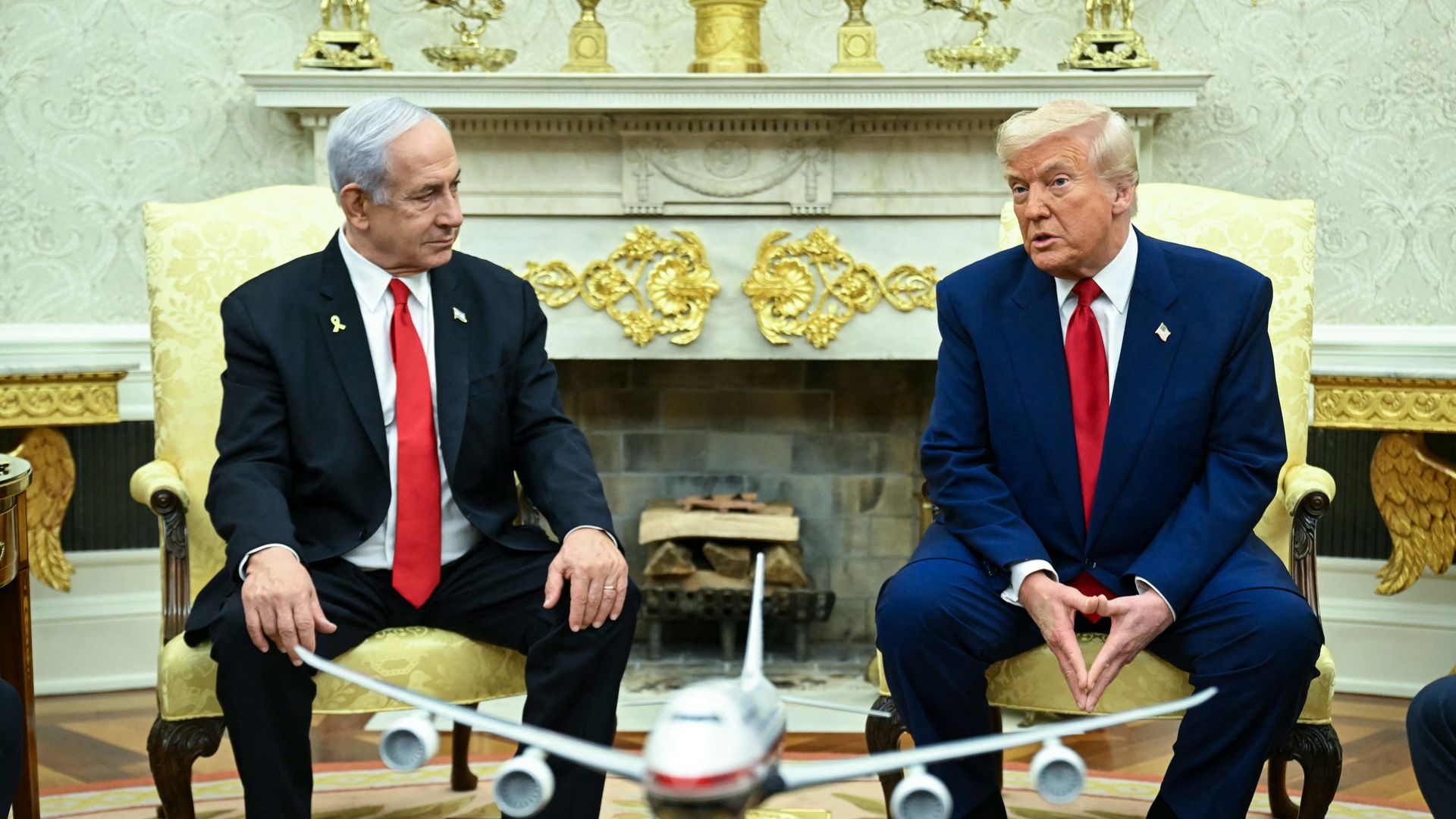
Trump and Netanyahu in the Oval Office. Photo: Saul Loeb/AFP via Getty

Trump Requests Record $1 Trillion Defense Budget as War With Iran Looms

President Trump announced he is requesting a record-breaking $1 trillion Pentagon budget during a meeting with Israeli Prime Minister Benjamin Netanyahu at the White House on Monday.

“We also essentially approved a budget, which is in the [vicinity], you’ll like to hear this, of a trillion dollars,” Trump said. “$1 trillion, and nobody’s seen anything like it. We have to build our military, and we’re very cost conscious, but the military is something that we have to build, and we have to be strong, because you got a lot of bad forces out there now.”

“So we’re going to be approving a budget, and I’m proud to say, actually, the biggest one we’ve ever done for the military,” he added.

Two months ago, Trump floated cutting our military budget in half.

“One of the first meetings I want to have is with president Xi of China, president Putin of Russia,” Trump said. “And I want to say, let’s cut our military budget in half.”

The request for a $1 trillion budget came as Trump was meeting with Netanyahu and also as he has been threatening to go to war with Iran.

A week ago, Trump threatened to bomb Iran if they don’t negotiate a new nuclear deal similar to the one he scrapped during his first term to please Israel First GOP megadonor Sheldon Adelson (Pete Hegseth was also funded by Sheldon Adelson when he was younger and ran a pro-Iraq War lobbying group called “Vets for Freedom”).

“If they don’t make a deal,” Trump said, “there will be bombing. It will be bombing the likes of which they have never seen before.”

Trump reiterated the threats on Monday, telling the media: “I think if the talks aren’t successful with Iran, I think Iran is going to be in great danger. And I hate to say, great danger, because they can’t have a nuclear weapon.”

Trump said the US and Iran will hold “direct” talks next Saturday but Iran countered by saying the talks will be “indirect.”

“On the order of its supreme leader, Ayatollah Ali Khamenei, Iran has refused to sit down with American officials in direct nuclear negotiations since Mr. Trump pulled out of the last accord,” the NY Times reports. “After Mr. Trump spoke on Monday, however, three Iranian officials said Ayatollah Khamenei had shifted his position to potentially allow direct talks.”

“The officials said that if Saturday’s indirect talks are respectful and productive, then direct talks may happen. The officials asked not to be named because they were not authorized to speak publicly.”

[…]

Via https://www.informationliberation.com/?id=64902

Methylene Blue: Miracle Drug for Cancer, Autism, Depression, Pain, Ebola and Much, Much More

PPT - PDF The Ultimate Guide to Methylene Blue: Remarkable Hope for ...

The Ultimate Guide to Methylene Blue

By Mark Sloan

EndAllDiseasePulbishing (2021)

Book Review

PDF link

This book is an encyclopedia about the historical use of a safe, inexpensive, previously common miracle drug now largely replaced by high price pharmaceuticals.

First synthesized from indigo dye in the late 19th century, methylene blue was the very first antimalarial drug, eradicating nearly all forms of malaria in 48 hours. GI’s treated with it during World War II complained bitterly about it turning their urine blue and it was eventually replaced with quinine and quinine derivatives.*

Used intravenously in emergency rooms for carbon dioxide poisoning, methylene blue is also a potent antiviral and can be used orally (as drops) to incapacitate herpes, West Nile virus, hepatitis C, Zika, Ebola and Covid19 (the hydroxychloroquine used to treat Covid 19 is derived from methylene blue). Studies shows it’s also effective against depression, bipolar disorder, Alzheimer’s, Parkinsonism, autism, low back pain and many forms of cancer. It performs better in most of these conditions with the addition of Red Light Therapy.

According to Sloan, treatments (like methylene blue) that target cellular metabolism for repair are the new frontier in medicine. They represent a new understanding by a growing number of practitioners (most outside the Western medical system) that most illness is based on dysfunctional cellular metabolism. Even most genetic mutations result from mitochondrial dysfunction (and impaired metabolism).

Methylene blue primarily acts by neutralizing the free radical nitric oxide. The latter is mainly known for its role in triggering “cytokine storm” an over-the-top immune system reaction leading to excessive clotting, leaky blood vessels and death (the massive bleed-out associated with Ebola infection is a classic example of cytokine storm).

Methylene Blue for Autism

In treating autism, Sloan indicates that separate treatments are necessary alongside the methylene blue to reduce neurotoxic endotoxin production in the gut. Endotoxin is produced by pathogenic gram negative bacteria. These organisms aren’t killed by methylene blue as most is absorbed into the bloodstream before reaching the large intestine. However methylene blue does exert neuroprotective effects (enhanced with Red Light Therapy) against brain endotoxin exposure.

Ways to reduce endotoxin (produced by gram negative bacteria feeding off cellulose and starches):

  • cooking vegetables well before eating them
  • activated charcoal with every meal (sterilizes the gut)

Methylene Blue for Pain

  • chronic neuropathic pain
  • arthritic pain
  • migraines
  • low back pain

Cancer

According to Sloan, cancer doesn’t “invade” people’s bodies as the Western medical system would have us believe. Substantial research evidence indicates cancer is a disease of damaged cellular metabolism. With the proper interventions (eg infusing them with healthy mitochondria), cancer cells can revert back to normal cells and don’t need to be killed or removed.


*As some strains of malaria have become resistance to standard pharmaceutical treatments, there has been a revival in methylene blue research for malaria.Doctors reveal mystery blue dye RFK Jr was spotted mixing in his drink ...

RFK Jr taking methylene blue on a recent flight

Declassified CIA Files Claim Hitler Escaped to South America

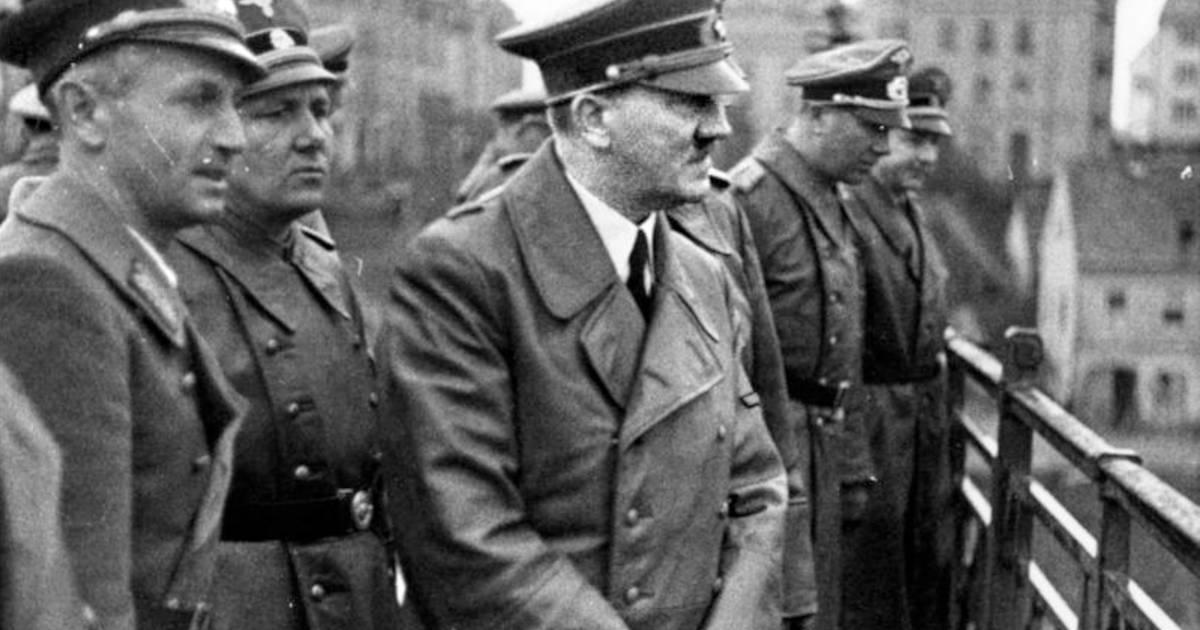
1941 picture of Adolph Hitler with several Nazi officials. On his immediate right is Martin Bormann, who was perhaps the most famous Nazi known to have escaped to South America after the war.

1941 picture of Adolph Hitler with several Nazi officials. On his immediate right is Martin Bormann, who was perhaps the most famous Nazi known to have escaped to South America after the war. Source: German Federal Archives/CC BY-SA 3.0.

Nathan Falde

Recently declassified CIA files have unveiled a long-standing and little-known chapter of post-WWII history: a covert operation to track down Adolf Hitler, 10 years after he was presumed dead. Contrary to the commonly accepted account of his suicide in a Berlin bunker in April 1945, intelligence agents in the United States and South America continued investigating the possibility that the infamous dictator had faked his death and fled across the Atlantic.

The records, originally classified but made public in 2020, reveal that American operatives believed Hitler may have escaped to Argentina, where he was hiding under an assumed name. In fact, as late as 1955—over a decade after the war—CIA informants were still gathering intelligence that suggested the former Nazi leader was alive and had relocated further north into Colombia.

From Germany to Argentina to Colombia … to Who Knows Where

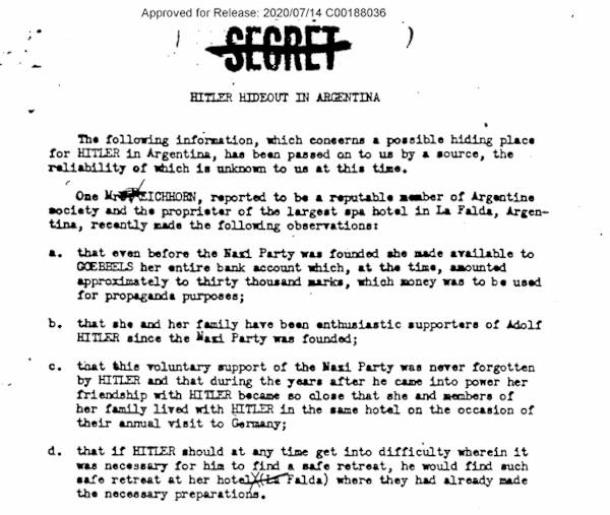
The initial phase of the investigation centered on La Falda, Argentina, where a spa hotel was believed to be one of Hitler’s possible hideouts. According to a War Department file dated October 1945, the owners of the hotel had been ardent supporters of the Nazi regime. They were not only sympathetic to the ideology but had financially backed Joseph Goebbels, Hitler’s chief propagandist. Their close ties to Hitler reportedly extended to shared vacations in Germany.

US officials were convinced that this secluded hotel would serve as a logical refuge if Hitler were to flee Nazi Germany. The information was relayed to the FBI with the implication that this location could be crucial to locating the fugitive leader.

CIA document detailing the allegations of Hitler’s escape to Argentina. (CIA Archives).

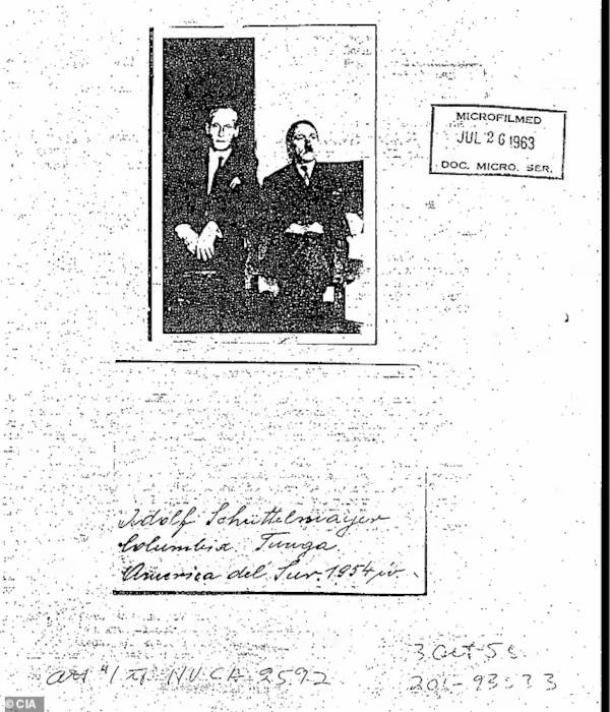
The mystery deepened when another CIA report surfaced decades later, detailing an incident in 1954 where a photograph emerged showing a man who bore a striking resemblance to Hitler. The picture, reportedly taken in Tunja, Colombia, featured a man identified as “Adolf Schrittelmayor” seated beside another man named Philip Citroen.

Citroen, described as a former SS officer, claimed he met regularly with Hitler in Colombia and had even posed for the picture with him. According to an informant labeled CIMELODY-3 in the CIA documents, Citroen spoke freely about these encounters and shared the photograph with a mutual acquaintance, who managed to take it without Citroen’s knowledge.

In the report dated October 3, 1955, CIA officers were attempting to verify Citroen’s claims. Citroen had apparently told his contacts that because a full decade had passed since the war, any potential prosecution of Hitler for war crimes would be null and void.

“Philip Citroen—commented that inasmuch as ten years have passed since the end of World War II, the Allies could no longer prosecute HITLER as a criminal of war,” the document stated.

While some agents pursued leads, others were more cautious. Despite the photograph and the claims surrounding it, skepticism lingered within intelligence circles. Many regarded the supposed image of Hitler as a hoax, or at best, inconclusive.

Nevertheless, the CIA approved further investigation. On November 4, 1955, agents were given the go-ahead to reach out to another individual identified as “GIRELLA” in the documents. This person was thought to have deeper insight into “Adolf Schrittelmayor’s” movements in Colombia prior to 1955. However, the same memo also noted internal doubts about the feasibility of uncovering hard evidence.

“It is felt that enormous efforts could be expended on this matter with remote possibilities of establishing anything concrete,” the report admitted.

No additional documents related to the investigation have been released to the public since, leaving open questions about whether the operation was quietly closed or if further files remain under wraps.

Photograph of man who may have been Hitler, with former SS officer in 1954 in Tunja, Colombia. (CIA Archives).

Argentina to Expose the Nazi Conspiracy?

In the present day, and the story has taken a new twist. In March, Argentina’s President Javier Milei issued an order to declassify all government-held records related to Nazis who fled to or were protected by Argentina after WWII. This announcement has reignited global interest in the long-standing theory that Hitler may have escaped justice and vanished somewhere in South America.

Argentina’s historical role as a postwar sanctuary for Nazi fugitives is well established. It’s known that many high-ranking officials, including Adolf Eichmann and Josef Mengele, found refuge in the country, often using elaborate escape routes dubbed “ratlines” that were organized with international complicity. These routes funneled Nazi war criminals out of Europe and into safe havens like Argentina, Chile, and Brazil.

With the imminent release of these documents, historians and intelligence analysts hope to fill in longstanding gaps in what has become one of the CIA’s most intriguing cold cases.

But Wouldn’t He Have Shaved Off His Mustache?

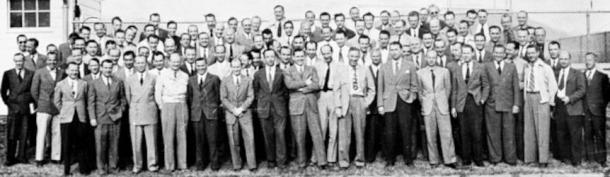
Skeptics have long dismissed the idea of Hitler’s survival as—to use their favorite all-purpose insult—a conspiracy theory. Yet, it is indisputable that the United States government did collaborate with many former Nazi figures in the aftermath of WWII. A prime example is Operation Paperclip, a program that brought approximately 1,600 German scientists to the US, including Wernher von Braun, who would later lead NASA’s early space programs. Paperclip was a real-life conspiracy, showing that the term ‘conspiracy theory’ doesn’t automatically mean wrong, as those with a skeptical mindset seem to believe.

Group of 104 German scientists brought to the United States under Operation Paperclip. (NASA/Public Domain).

While the CIA documents on Hitler stop short of confirming his survival, they do reveal that US intelligence took the possibility seriously for at least a decade after the war. The photo, the hotel hideout, and the South American connections were enough to keep the investigation alive.

Now, as Argentina moves to declassify its own files, more evidence may emerge—either to support or further discredit the theory. But without human remains and DNA testing, there’s no definitive way to close the book on this decades-old mystery.

Given the confirmed presence of numerous Nazi fugitives in South America, the notion that Hitler might have escaped to join them isn’t entirely outside the bounds of possibility. With regards to the supposed photo of him in Colombia, however, the question must be asked: if Hitler really did go into hiding in South America, wouldn’t he have shaved off his mustache, the one identifiable characteristic that could have given him away?

[…]

Via https://www.ancient-origins.net/news-history-archaeology/hitler-survived-south-america-0022012

Looming Electricity Crunch Facing US

By Paul Homewood

Major US grid operators are raising the alarm about the looming capacity crunch.

Power has the story:

“Six major U.S. grid operators have raised a unified alarm about an impending capacity crunch, warning that the pace and scale of explosive demand—including from data centers, manufacturing, and electrification—poses a precarious misalignment with accelerating generator retirements and transmission constraints.

At a March 25 hearing before the House Energy and Commerce Subcommittee on Energy, the nation’s top grid officials testified that the U.S. power system is under mounting strain—and that without urgent structural reforms, the ability to maintain reliable electric service could falter. Their message was unusually direct: demand is accelerating, supply is lagging, and current tools may not be enough to bridge the gap.

Read the full story here.

All of the ten regional grids seem to be facing the same problems of increasing demand and closure of dispatchable capacity. ERCOT, for instance, who run the grid in Texas, forecast that peak demand will increase from 86 GW to 106 GW by 2030.

PJM in the Mid-Atlantic and Mid West anticipate a rise in peak demand of 47% in the next 15 years, and California’s CAISO are looking at an increase of 33% in the next ten years.

The US still relies on gas and coal for half of its power:

And just as in this country, the US is wholly reliant on gas to fill the gap when demand surges or wind and solar output falls:

U.S. electricity generation by energy source 3-30-2025 – 4-6-2025, Eastern Time

Note that in this seven day period alone, wind output ranged from 32 GW to 90 GW. This gives the lie to the claim that the wind is always blowing somewhere. In 2023 the US had wind capacity of 148 GW, running at an average of 33%, so that 32 GW suggests utilisation of about 20%. No doubt there will be weeks when it is much less still.

Solar power meanwhile is little more than an irrelevance.

Taking a closer look at Texas, we find that coal power capacity has dropped by 7.5 GW in the last decade, partly offset by an increase of 4.3 GW of gas. However consumption per capita has grown by 12% in the same period:

chart

chart(1)

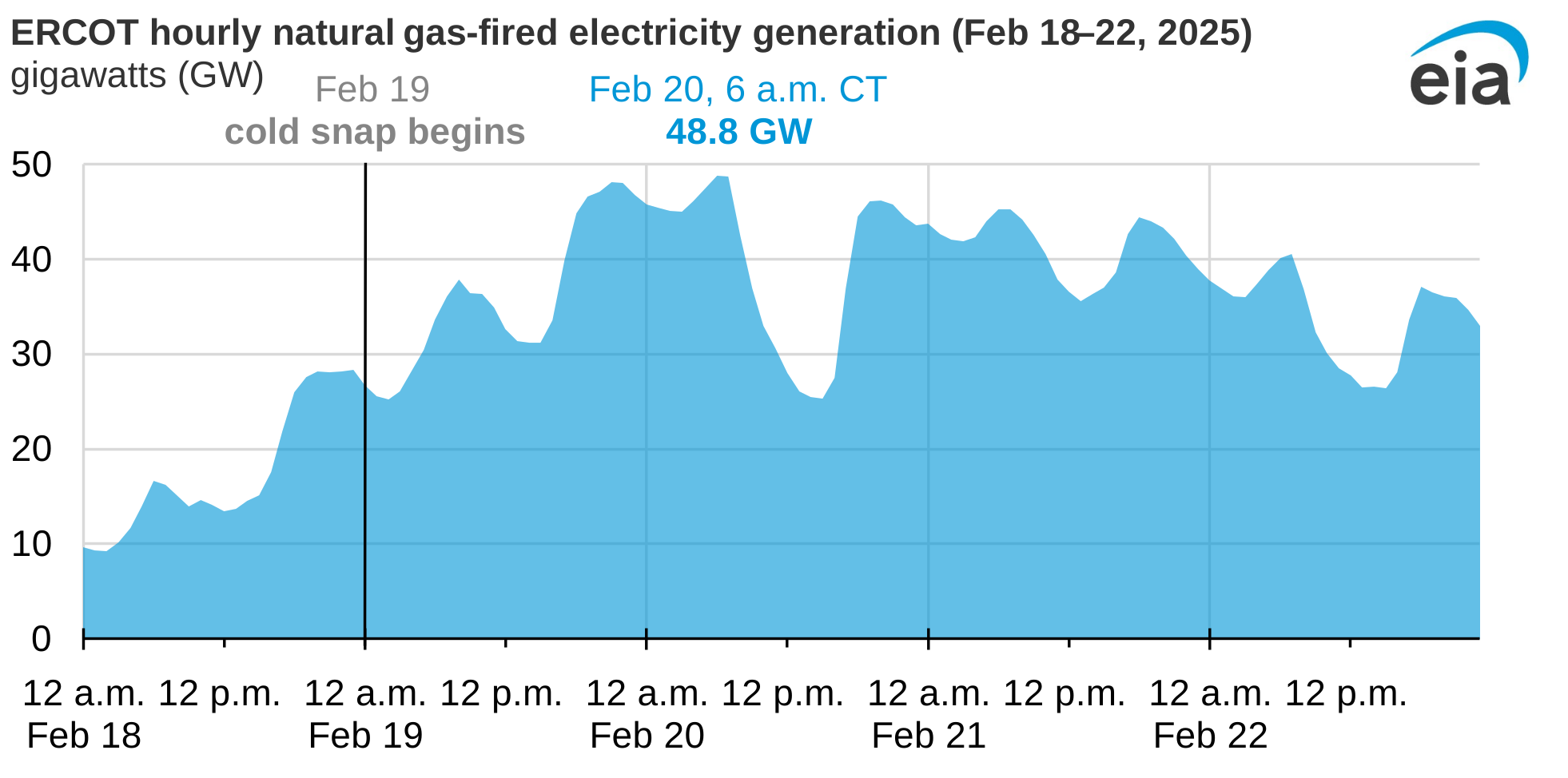
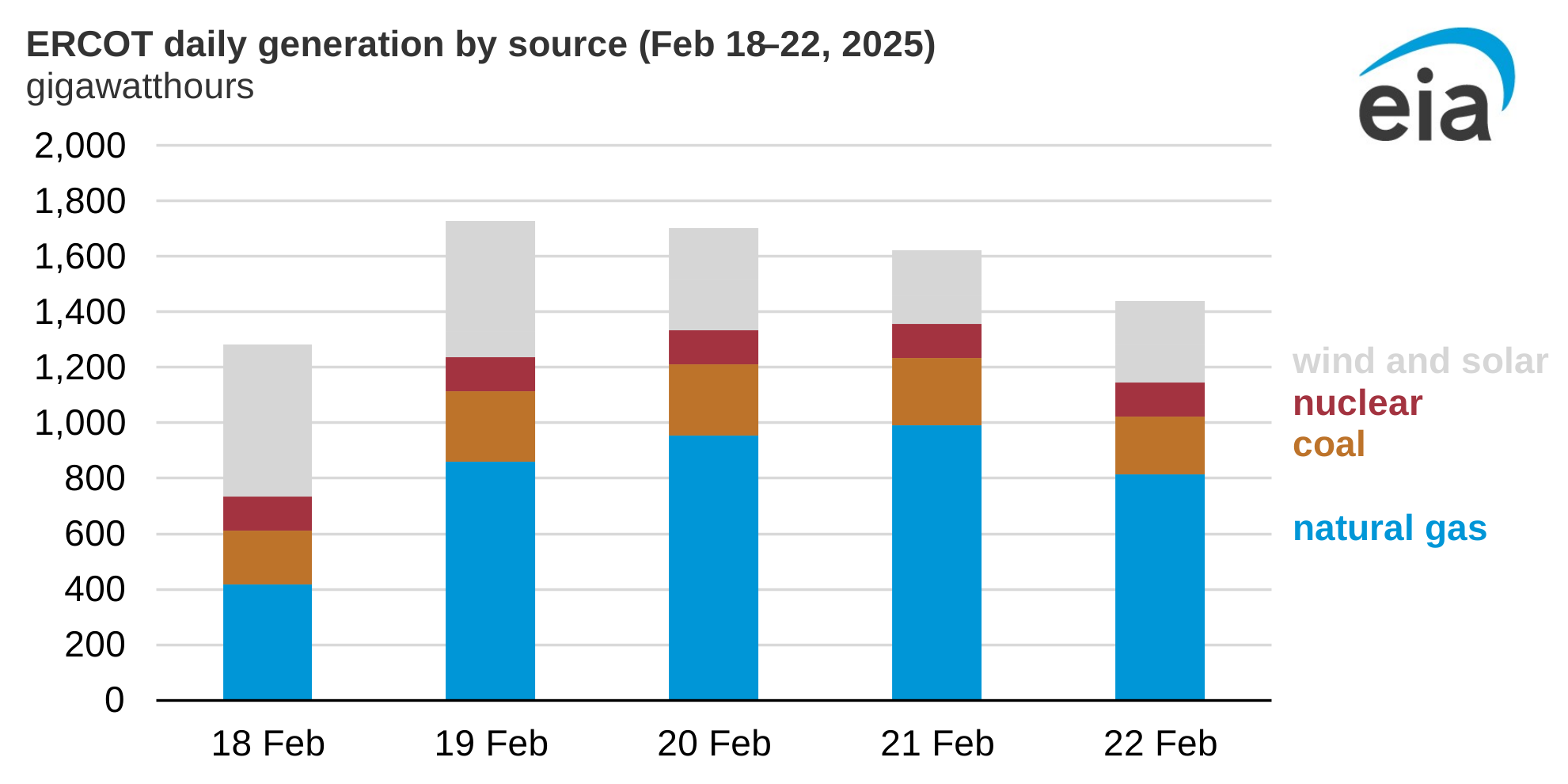
Texas needed most of that gas power during February’s cold snap, when wind and solar power dropped away:

ERCOT hourly natural gas-fired electricity generation

ERCOT daily generation by source

https://www.eia.gov/todayinenergy/detail.php?id=64764

The same situation is being played out across the country. Even in sunny California they need gas to fire up to meet demand when the sun goes down both in summer and in winter. (Note the barely measurable contribution from battery storage.)

image

image

https://www.eia.gov/electricity/gridmonitor/dashboard/electric_overview/regional/REG-CAL

The US grid has been neglected for many years now, all in the naive belief that reliable coal and gas generation can be replaced with wind and solar. This has been exacerbated by anti fossil fuel regulations, which have prematurely shut down coal plants and discouraged investment in new gas plants.

[…]

Via https://notalotofpeopleknowthat.wordpress.com/2025/04/07/the-looming-electricity-crunch-facing-the-us/

Collapsing Empire: Yemen shatters the illusion of US air power, yet again

By Kit Klarenberg

Since March 15, Washington has repeatedly barraged Yemen from the sky, killing and injuring countless innocent civilians while destroying vital infrastructure. 

For example, on April 2, US jets targeted a reservoir in western Yemen, cutting off access to water for over 50,000 people.

Only three days later, US President Donald Trump gloatingly posted a horrific video on social media of a tribal gathering being incinerated in a US airstrike. He falsely claimed the individuals were “Houthis gathered for instructions on an attack.”

In a chilling coincidence, the bloodcurdling clip was published on the 15th anniversary of the release of “Collateral Murder” by WikiLeaks, a notorious video filmed three years earlier of US Apache helicopter pilots firing indiscriminately at a group of Iraqi civilians and journalists while sickly cackling at the carnage they were inflicting.

While that disclosure contemporaneously caused international outcry and scandal and made WikiLeaks founder Julian Assange an internationally wanted man, openly advertising unconscionable war crimes is now apparently a formal US government policy.

US officials have pledged that renewed hostilities against Yemen will continue “indefinitely”, while Trump has bragged how “relentless strikes” have “decimated” the Ansarullah resistance movement.

Yet, on April 4, the New York Times reported Pentagon officials are “privately” briefing that while the current bombing campaign on Yemen “is consistently heavier than strikes conducted by the Biden administration”, the effort has achieved “only limited success in destroying the Houthis’ vast, largely underground arsenal of missiles, drones and launchers.”

Yemen’s anti-genocide Red Sea blockade thus endures untrammelled.

Moreover, “in just three weeks, the Pentagon has used $200 million worth of munitions, in addition to the immense operational and personnel costs to deploy two aircraft carriers, additional B-2 bombers and fighter jets, as well as Patriot and THAAD air defenses” to West Asia.

The total cost of the military adventure to date could exceed “well over $1 billion by next week.” This not only means “supplemental funds” for the operation need to be sought from US Congress, but there are grave anxieties about ammunition availability:

“So many precision munitions are being used, especially advanced long-range ones, that some Pentagon contingency planners are growing concerned about overall Navy stocks and implications for any situation in which the United States would have to ward off an attempted invasion of Taiwan by China.”

The New York Times also observed that the White House hasn’t indicated “why it thinks its campaign against the group will succeed”, after the Biden administration’s long-running Operation Prosperity Guardian embarrassingly failed to break the Red Sea’s blockade.

The answer is simple – for three decades, the Empire has been consumed by a dangerously self-deluded belief in the primacy of air power over all other forms of warfare. Ergo, the Trump administration believes that if only they intensify Yemen’s bombardment, Ansarullah will crumble.

‘Significantly damaged’

In April 1996, then USAF Chief of Staff Ronald R Fogleman boldly declared that a “new American way of war” was emerging.

While traditionally the Empire had “relied on large forces employing mass, concentration, and firepower to attrit enemy forces and defeat them,” now technological advances and “unique military advantages” – specifically in the field of air power – could be used “to compel an adversary to do our will at the least cost to the US in lives and resources.”

At the time, the Empire was riding high on the perceived success of NATO’s Operation Deliberate Force, an 11-day saturation bombing of Bosnia conducted the previous August/September.

Multiple US officials eagerly attributed the campaign to ending the three-year-long civil war in the former Yugoslav republic by precipitating negotiations. They omitted to mention that the airstrikes’ predominant military utility was allowing US-armed, trained, and directed Bosniak and Croat proxy forces to overrun Bosnian Serb positions without significant opposition, or their brazen sabotage of prior peace settlements.

Nonetheless, the narrative that wars could be won via airpower alone, and the US and its allies should invest in and structure their military machines accordingly, palpably percolated thereafter. The illegal March – June 1999 bombing of Yugoslavia provided the Empire with an opportunity to put this theory to the test. For 78 straight days, NATO relentlessly blitzed civilian, government, and industrial infrastructure throughout the country, killing untold numbers of innocent people – including children – and disrupting daily life for millions.

The purported purpose of this onslaught was to prevent a planned genocide of Kosovo’s Albanian population by Yugoslav forces. As a May 2000 British parliamentary committee concluded, however, it was only after the bombing began that Belgrade began assaulting the province.

Moreover, this effort was explicitly concerned with neutralising the CIA and MI6-backed Kosovo Liberation Army, an Al Qaeda-linked extremist group, not attacking Albanian citizens. Meanwhile, in September 2001, a UN court determined that Yugoslavia’s actions in Kosovo were not genocidal in nature or intent.

On June 3, 1999, Yugoslav leader Slobodan Milosevic folded under Russian pressure, agreeing to withdraw Belgrade’s forces from Kosovo. While Western officials celebrated a resounding victory for NATO and airpower more generally, the mainstream media – at least initially – told a very different story.

The LA Times observed that the Yugoslav army “still has 80% to 90% of its tanks, 75% of its most sophisticated surface-to-air missiles and 60% of its MIG fighter planes.” Meanwhile, its key barracks and ammunition depots weren’t damaged at all.

The New York Times reported that post-war Kosovo was bereft “of the scorched carcasses of tanks or other military equipment NATO officials had expected to find.”

While NATO and Pentagon apparatchiks stood “by their claims to have significantly damaged” Yugoslav forces, the outlet admitted Belgrade’s units withdrawing from Kosovo “seemed spirited and defiant rather than beaten.”

They took with them hundreds of tanks, personnel carriers, artillery batteries, vehicles, and “military equipment loaded on trucks” completely unscathed by the bombing campaign.

‘Campaign analysis’

Contemporary declassified British Ministry of Defence files amply underline the catastrophic failure of NATO’s blitzkrieg of Yugoslavia. Once Milosevic finally capitulated and NATO and UN ‘peacekeepers’ were granted unimpeded access to Kosovo, they struggled to find a single “burnt out tank” or other indications of vehicle or equipment losses on the ground.

A June 7 “campaign analysis” noted, “NATO took a lot longer, required a lot more effort and damaged less than perhaps we believed we could achieve at the start of the air campaign.”

It added that the Yugoslav “war-fighting doctrine” placed “great emphasis on dispersal, the use of camouflage, dummy targets, concealment and bunkers” to avoid detection, and “early assessments indicate that they appear to have applied this doctrine very successfully.”

Adverse weather conditions were also routinely exploited as cover for anti-KLA operations. The memo further recorded “there was no evidence…of disintegration of Serb forces in Kosovo,” with Yugoslav military operations continuing apace until Milosevic agreed to withdraw from the province, “and beyond”.

Yet, these damning observations remained secret. At a June 11, 1999 press conference, US Chairman of the Joint Chiefs General Henry Shelton proudly displayed a variety of colourful charts, boasting how hundreds of Yugoslav tanks, personnel carriers, and artillery pieces had been decimated by NATO, without the alliance suffering a single casualty.

His crooked accounting of the bombing remained universal mainstream gospel until a May 2000 Newsweek investigation exposed the wide-ranging “coverup” via which the Pentagon had spun the “ineffective” assault as a resounding success.

When NATO’s Supreme Allied Commander Wesley Clark, who oversaw the bombing, learned of the pronounced lack of damage to the Yugoslav military on the ground in Kosovo, he dispatched a dedicated team of USAF investigators to the province.

They “spent weeks combing Kosovo by helicopter and by foot” and turned up evidence of just 14 destroyed tanks. Meanwhile, of the 744 strikes on Yugoslav military equipment and installations claimed by Pentagon officials, just 58 were confirmed.

By contrast, USAF identified ample evidence of the Yugoslav military’s skill at deception. They found a key bridge had been protected from NATO bombers “by constructing, 300 yards upstream, a fake bridge made of polyethylene sheeting stretched over the river” – the military alliance “destroyed” the “phony bridge” many times.

Additionally, “artillery pieces were faked out of long black logs stuck on old truck wheels, and an anti-aircraft missile launcher was fabricated from the metal-lined paper used to make European milk cartons.”

Flummoxed, “Clark insisted that the Serbs had hidden their damaged equipment and that the team hadn’t looked hard enough.” So a new report was fabricated wholecloth, validating the fiction that NATO’s destruction of Yugoslav forces had been extensive. Newsweek noted its findings were “so devoid of hard data that Pentagon officials jokingly called it ‘fiber-free’.”

An official Department of Defense “After-Action Report to Congress” on the bombing campaign cited the report’s figures, although stressed no supporting evidence was forthcoming. With eerie prescience, Newsweek concluded:

“[This] distortion could badly mislead future policymakers…After the November 2000 presidential election, the Pentagon will go through one of its quadrennial reviews, assigning spending priorities. The Air Force will claim the lion’s share…The risk is policymakers and politicians will become even more wedded to myths like ‘surgical strikes’.”

“The lesson of Kosovo is civilian bombing works, though it raises moral qualms…Against military targets, high-altitude bombing is overrated. Any commander in chief who does not face up to those hard realities will be fooling himself.”

‘Incredibly different’

The “distortion” that NATO’s bombing of Yugoslavia was a military triumph has endured ever since. Not only has it served as justification for multiple subsequent calamitous Western “interventions”, such as the 2011 destruction of Libya, but USAF continues to claim “the lion’s share” of US defence spending.

According to 2024 figures, over a quarter of Washington’s total defence budget – $216.1 billion – is earmarked for the Air Force. Additionally, $202.6 billion is spent on the Navy, which typically operates in close tandem with USAF.

However large these figures may appear on paper, they do not translate into serious war-fighting capability, as Operation Prosperity Guardian in Yemen amply underscored.

A little-noticed July 2024 Associated Press report on the return home of US fighter pilots after nine months of failing to thwart Yemen’s Red Sea blockade noted that battling an enemy capable of fighting back “in the most intense running sea battle the Navy has faced since World War II” had been deeply psychologically ravaging for all concerned.

As a result, Pentagon officials were investigating how to tend to thousands of pilots and sailors adversely affected by their involvement in the bruising effort, “including counseling and treatment for possible post-traumatic stress.”

One pilot told Associated Press, “most of [us]…weren’t used to being fired on given the nation’s previous military engagements in recent decades.” He described the experience of Ansarullah’s retaliation as “incredibly different” and “traumatizing”, as getting shot at is “something that we don’t think about a lot.”

A new experience it may be – but it’s one that Washington needs to adapt to urgently. As a July 2024 RAND Corporation report found the US military was woefully ill-equipped sustain a major conflict with “peer-level competitors” such as China for any length of time, and faced significant threats from “relatively unsophisticated actors” such as Ansarullah, who have been “able to obtain and use modern technology (e.g., drones) to strategic effect.”

As Axios has reported, Pentagon weapons procurer Bill LaPlante – a journeyman engineer and physicist – has been awed by Yemen’s use of “increasingly sophisticated weapons,” including missiles that “can do things that are just amazing.”

He claims that Yemeni capabilities are “getting scary”. Once the US has exhausted itself yet again , failing to crush the Yemeni resistance, we could see yet more of its arsenal in play – and in turn, another historic defeat of the Empire, as inflicted over the course of Operation Prosperity Guardian.

[…]

Via https://www.presstv.ir/Detail/2025/04/07/745715/collapsing-empire-yemen-shatters-illusion-us-air-power-yet-again

UK lawyers to charge 10 Brits for Gaza war crimes

(Photo credit: AFP)

Dual-national Israelis who served in the military are being increasingly pursued worldwide for their role in atrocities committed against Palestinians

A leading UK human rights lawyer is set to submit a war crimes complaint to the Metropolitan police against 10 British citizens who served with the Israeli army in Gaza.

Michael Mansfield KC will hand the 240-page complaint to the police department’s war crimes unit on 7 April. It cites Israel’s targeted killing of civilians and humanitarian aid workers, as well as airstrikes on hospitals and densely populated civilian neighborhoods. It also includes the targeting of religious sites and historic monuments.

The documents were prepared by British lawyers and researchers from The Hague. The names of the 10 Britons in question have not been made public.

“​If one of our nationals is committing ​an offence, we ought to be doing something about it​. Even if we can’t stop the government of foreign countries behaving badly, we can at least stop our nationals from behaving badly,” Mansfield said.

“British nationals are under a legal obligation not to collude with crimes committed in Palestine. No one is above the law,” he added.

The dossier is based on open-source evidence and testimonies from eyewitnesses. The crimes include an Israeli army bulldozer trampling a dead body in the courtyard of one of the several hospitals attacked by Israeli ground forces in Gaza.

“The public will be shocked, I would have thought, to hear that there’s credible evidence that Brits have been directly involved in committing some of those atrocities,” said Sean Summerfield, British barrister at Doughty Street Chambers – who helped put together the evidence which is to be submitted.

The complaint comes as Israeli soldiers are being increasingly pursued in international courts for their roles in the crimes committed against Palestinians in Gaza.

Pro-Palestine organizations have filed dozens of criminal complaints in courts around the world since the start of the year, targeting Israeli soldiers for their role in Tel Aviv’s ethnic cleansing campaign in Gaza.

Among these organizations is the Hind Rajab Foundation (HRF), named after the six-year-old Palestinian girl who was killed by the Israeli army along with her family in Gaza City last year.

“When genocide or crimes against humanity occur, there is a global need for justice and accountability, not only from victims but also from those in solidarity with them. Like many others, I was deeply impacted by witnessing the level of impunity displayed by the Israelis, who were not only committing these crimes but also recording and posting them on social media, acting as if they were above any legal framework,” HRF Chairman Dyab Abou Janjah told The Cradle’s Esteban Carillo in an exclusive interview in February.

HRF focuses its efforts on pursuing both dual-national Israeli soldiers and those who leave Israel for vacation.

In January, a Brazilian court ordered an investigation into a vacationing Israeli soldier who had been identified in a video of his participation in the destruction of civilian infrastructure in Gaza.

The soldier fled Brazil with help from the Israeli Foreign Ministry. Israel has warned active-duty soldiers not to travel over the risk of legal action, and has issued certain restrictions on media interviews with military personnel.

[…]

Via https://thecradle.co/articles/uk-lawyers-to-charge-10-britons-for-gaza-war-crimes

Video Shows Apple Stock Crashing Real Time As Donald Trump Announces Tariffs

Apple shares fell more than 6% as President Donald Trump announced sweeping tariffs on imported goods, hitting major tech firms

Apple led a sharp decline in tech stocks after President Donald Trump announced new tariffs ranging from 10% to 49% on imported goods. The White House revealed that Chinese imports would face a 34% tariff, while Vietnam and India—both key Apple manufacturing hubs—would be hit with 46% and 26% tariffs, respectively.

The announcement rattled investors, with concerns that the tariffs could eat into Apple’s profit margins and disrupt its supply chain. While the company has been diversifying its production away from China, the tariffs now extend to the very regions it had turned to for stability.

A video was shared on X by a user which reads that the moment Trump was announcing tariffs same moment the stock went down.

https://x.com/i/status/1907549193650188469

Apple’s Dependence on Asian Manufacturing

Apple relies heavily on manufacturing in China, Vietnam, and India. Despite efforts to reduce dependency on China since 2017, a significant portion of its products, including iPhones, AirPods, iPads, and MacBooks, are still assembled across these regions. Vietnam accounted for over 10% of Apple’s top 200 suppliers in 2023, while India has become increasingly important for iPhone assembly.

The company began assembling iPhones in India in 2017, but scaling up production has taken years. Currently, Apple aims for 25% of its 200 million annual iPhone sales to come from India-made devices. However, the new tariffs threaten to increase costs even in these alternative markets.

Foxconn’s Expanding Role in Apple’s India Strategy
Apple’s key manufacturing partner, Foxconn, is ramping up its Indian operations. According to media reports, Foxconn plans to more than double iPhone production in India this year, targeting 25-30 million units—up from 12 million in 2024.

Apple is also expanding beyond iPhones in India.

Media reports indicate that production of AirPods for export will begin at the Foxconn plant in Hyderabad this April, making AirPods the second major Apple product to be manufactured in the country.

Foxconn’s Growing Footprint in India
Foxconn’s expansion in India includes:
Bengaluru: A 300-acre facility, set to be Foxconn’s second-largest site after China.
Hyderabad: A new unit dedicated to producing Apple AirPods.
Sriperumbudur (near Chennai): A long-established hub for iPhone assembly.

[…]

Via https://www.republicworld.com/business/video-shows-apple-stock-crashing-real-time-as-donald-trump-announces-tariffs-watch

We Can End the Autism Epidemic – By Telling the Truth

kids and puzzle blocks

I suggest an alternative theme: ending the autism epidemic by unlocking the data that are key to unraveling the truth about vaccines and autism.

As the mother of an adult son who was injured by a “routine” MMR vaccine, I fully support advocating for the inclusion and rights of children and adults with autism.

But I am also fiercely devoted to ending the autism epidemic, especially among children who were senselessly injured thanks to a burgeoning childhood vaccine schedule.

According to the Centers for Disease Control and Prevention’s (CDC) latest estimates, 1 in 36 children have an autism diagnosis. A recent JAMA Open Network study suggested that number is closer to 1 in 33. We’re not talking about adults diagnosed later in life — these are children, between the ages of 5 and 8.

Public health officials and media routinely ascribe rising rates of autism to improvements in doctors’ ability to diagnose autism. But any parent of a healthy, normally developing child who regressed into severe autism after a vaccine knows better.

For those who question what parents witnessed with their own eyes, there’s no shortage of studies suggesting vaccines can cause autism — including this recent peer-reviewed study that found vaccinated children have a 170% higher chance of being diagnosed with autism compared to unvaccinated children.

No, the link between vaccines and autism hasn’t been ‘debunked’

Public health officials and mainstream media can assert that the link between vaccines and autism has been “debunked” by “many studies” as often and as unequivocally as they want — but that won’t make those assertions true.

Children’s Health Defense (CHD) and others have repeatedly asked the CDC to see these “many studies.” Each time, the CDC has failed to produce them.

Here’s what we know about efforts to “debunk” the link between vaccines and autism:

  • Only one vaccine — MMR, a combination vaccine for measles, mumps and rubella — has ever been studied as a potential trigger for autism. The most frequently cited study is one published in 2002 in The New England Journal of Medicine, which examined over 500,000 children in Denmark — a study riddled with simple arithmetic errors and inconsistencies that render it useless.There are 15 different vaccines on the CDC childhood schedule — a study of only one of those vaccines can’t be used as the basis for the claim that “vaccines don’t cause autism.”
  • Only one vaccine ingredient — thimerosal, a mercury-containing preservative still used in some flu vaccines — has ever been independently studied for its potential to trigger autism.There are no studies on the cumulative effect of injecting multiple vaccines containing more than 20 ingredients, none tested for a possible link to autism, into young children.
  • No studies on pertussis vaccine and autism: When Congress passed the National Childhood Vaccine Injury Act of 1986 — the bill that protects vaccine makers and healthcare workers from liability for injuries caused by their products — lawmakers ordered federal health authorities to investigate claims that the pertussis vaccine may cause autism.In 1991, the Institute of Medicine (IOM) — since renamed the National Academy of Medicine — conducted a review of studies on the pertussis vaccine and autism. The institute could not find a single study examining whether the pertussis vaccine causes autism. Why? Because the studies have never been done.
  • No studies on DTaP, tetanus, or diphtheria vaccine and autism: In 2012, the CDC commissioned the IOM to conduct a review of studies potentially linking the DTaP, tetanus and diphtheria vaccines to autism. The IOM did not find a single study supporting the claim that these vaccines don’t cause autism.
  • No studies on the cumulative impact of multiple vaccines: The CDC childhood immunization schedule recommends multiple doses of many of the 15 vaccines — 72+ doses by age 18. If a child today is vaccinated according to CDC recommendations, by age 2, that child will have received 34 doses of 14 different vaccines, including Hep B, Hib, DTaP, IPV, MMR, varicella, rotavirus, RSV, PCV, flu and COVID, each containing at least 10 unique ingredients and/or adjuvants.

Running scared, pharma-owned Big Media ramps up fearmongering

Today, I am more hopeful than ever that we, as a movement, are about to expose the truth about vaccines and autism. Why?

Because Big Pharma, through its mainstream media megaphone, has unleashed an unprecedented torrent of attacks on medical freedom and fearmongering — attacks designed to scare parents into vaccinating their kids .

It’s a clear sign the vaccine industry is terrified its dark secrets will be exposed, and its global $69 billion gravy train will dry up.

In the past two months, media outlets have pumped out an endless stream of hysterical headlines over a non-life-threatening measles outbreak. Although they repeatedly refer to a recent “death from measles,” we at CHD exposed that the child’s death was caused by medical error, not measles.

In fact, during the past decade, there have been no deaths directly attributable to measles — while 42 deaths and 2,908 serious injuries were reported to the Vaccine Adverse Event Reporting System, or VAERS, following the MMR vaccine. Where were the headlines for those deaths and injuries?

Major media have ramped up their attacks on the very mention of an investigation into the possible link between vaccines and autism.

For example, media attacks on Dr. David Weldon, an outspoken advocate for vaccine safety, tanked his nomination to lead the CDC.

The attacks on data analyst and researcher David Geier were even more vicious after The Washington Post, citing anonymous sources, reported that the U.S. Department of Health and Human Services (HHS) tapped Geier to oversee a study on vaccines and autism.

Public health officials are terrified their reputations will go down with the ship — and with good reason.

Last week, HHS Secretary Robert F. Kennedy Jr. forced out the U.S. Food and Drug Administration’s (FDA) top vaccine cheerleader, Dr. Peter Marks. The news sent vaccine stocks plummeting — proof that the FDA has been serving pharma, not our children.

Americans deserve to see the 40 years’ worth of healthcare data we paid to collect

For almost 40 years, our public health agencies have been collecting healthcare data on more than 10 million Americans. We know those data hold the answers to the autism epidemic.

We, as taxpayers, paid to collect and house that data. But not only have our federal agencies refused to share the data with the public, including scientists, researchers and journalists — they’re now trying to keep Secretary Kennedy and his team from accessing it, too.

When Kennedy announced the restructuring of HHS, he revealed that agencies within HHS are hoarding and hiding healthcare patient data — even from him.

These are the actions of public health officials, beholden to Big Pharma, who live in fear.

Fear that their crimes against our children will be exposed for all to see. Fear that their obscene profits will dry up. Fear that they will no longer be able to frighten or bully or mandate parents into harming their own children.

For decades, Big Pharma has relied on fearmongering, mandates and laws that protect vaccine makers and the medical establishment from liability for the injuries their products cause.

But the jig is finally up. Kennedy recently announced that HHS is creating an agency within the CDC that will focus on vaccine injuries — that’s the best news parents have heard in decades.

Today, on World Autism Day, let’s honor autistic children and adults everywhere by demanding our federal agencies unlock the four decades of data that hold the secrets to why autism rates are soaring — so we can end the autism epidemic once and for all.

Other Countries Seem To Like Tariffs… So Why Are People Opposed To Trump’s Tariffs?

Zero Hedge

April 3, President Donald Trump announced it as “Liberation Day.” And by that he meant we were going to be liberated from asymmetrical tariffs of the last 50 years. And it was going to inaugurate a new what he called “golden age” of trade parity, greater investment in the United States, but mostly, greater job opportunities and higher-paying jobs for Americans.

And yet, the world seemed to erupt in anger. It was very strange. 

Even people on the libertarian right and, of course, the left were very angry. The Wall Street Journal pilloried Donald Trump.

But here’s my question. 

China has prohibitive tariffs, so does Vietnam, so does Mexico, so does Europe. 

So do a lot of countries. 

So does India. 

But if tariffs are so destructive of their economies, why is China booming? 

How did India become an economic powerhouse when it has these exorbitant tariffs on American imports? 

How did Vietnam, of all places, become such a different country even though it has these prohibitive tariffs? 

Why isn’t Germany, before its energy problems, why wasn’t it a wreck? It’s got tariffs on almost everything that we send them. 

How is the EU even functioning with these tariffs?

I thought tariffs destroyed an economy, but they seem to like them. And they’re angry that they’re no longer asymmetrical.

Apparently, people who are tariffing us think tariffs improve their economy. Maybe they’re right. I don’t know.

The second thing is, why would you get angry at the person who is reacting to the asymmetrical tariff and not the people who inaugurated the tariff?

Why is Canada mad at us when it’s running a $63 billion surplus and it has tariffs on some American products at 250%. Doesn’t it seem like the people who started this asymmetrical—if I could use the word—trade war should be the culpable people, not the people who are reluctantly reacting to it?

Sort of like Ukraine and Russia. Russia invaded Ukraine. Do we blame Ukraine for defending itself and trying to reciprocate? No, we don’t. We don’t blame America because it finally woke up and said, “Whatever they tariff us we’re gonna tariff them.” 

Which brings up another question: Are our tariffs really tariffs?

That is, were they preemptive? Were they leveled against countries that had no tariffs against us? Were they punitive? No. They’re almost leveled on autopilot. Whatever a particular country tariffs us, we reciprocate and just mirror image them. And they go off anytime that country says, “It was a mistake. We’re sorry. You’re an ally. You’re a neutral. We’re not going to tariff this American product.” And we say, “Fine.” Then the autopilot ceases and the automatic tariff ends. In other words, it’s their choice, not ours. We’re just reacting to what they did, not what we did.

Couple of other questions that I’ve had. We haven’t run a trade surplus since 1975—50 years. So, it wasn’t suddenly we woke up and said, “It’s unfair. We want commercial justice.” No. We’ve been watching this happen. For 50 years it’s been going on. And no president, no administration, no Congress in the past has done anything about it. Done anything about what? Leveling tariffs on our products that we don’t level on theirs.

It was all predicated in the postwar period. We were so affluent, so powerful—Europe, China, Russia were in shambles—that we had to take up the burdens of reviving the economy by taking great trade deficits. Fifty years later, we have been deindustrialized. And the countries who did this to us, by these unfair and asymmetrical tariffs, did not fall apart. They did not self-destruct. They apparently thought it was in their self-interest. And if anybody calibrates the recent gross domestic product growth of India or Taiwan or South Korea or Japan, they seem to have some logic to it.

There’s a final irony. 

The people who are warning us most vehemently about this tariff quote the Smoot-Hawley Act of 1930. But remember something, that came after the onset of the Depression—after. The stock market crashed in 1929. That law was not passed until 1930. It was not really amplified until ’31.

And here’s the other thing that they were, conveniently, not reminded of: We were running a surplus. That was a preemptive punitive tariff, on our part, against other countries. We had a trade surplus. And it was not 10% or 20%. Some of the tariffs were 40% and 50%. And again, it happened after the collapse of the stock market.

In conclusion, don’t you find it very ironic that Wall Street is blaming the Trump tariffs for heading us into a recession, if not depression, when the only great depression we’ve ever had was not caused by tariffs but by Wall Street?

As a follow up to Victor Davis Hanson’s brief essay, hedge fund billionaire Bill Ackman commented on X that while Hanson made a compelling case for the Trump tariff strategy, he gets one issue incorrect. He describes the Trump tariffs as reciprocal and proportional to those other nations have assessed on us.

In actuality, the Trump tariffs were set at levels substantially above, and in many cases, at a multiple of the counterparty country’s tariff levels.

Initially, the market responded favorably, up more than one percent when Trump referred to ‘reciprocal tariffs’ in his Rose Garden speech. It was only when he put up a chart showing the actual tariffs that the markets plunged.

We can divine from this response that market participants are supportive of the administration using tariffs as a tool to lower the asymmetrical tariffs of our trading partners, but are highly concerned with tariff levels set well in excess of a corresponding country’s levels.

So why did Trump take this approach?

The answer goes back to ‘The Art of the Deal.’ Trump’s negotiating style is to ask for the moon and then settle somewhere in between. It has worked well for him in the past so he is using the same approach here.

The market’s response is due to the fear that if this strategy fails and the tariffs stay in place, they will plunge our economy into a recession. And we don’t need to wait for failure as it doesn’t take long for a high degree of uncertainty to cause economic activity to slow.

Press reports today have said that all deals are now on hold. This is not surprising. Capitalism is a confidence game. Uncertainty is the enemy of business confidence.

The good news is that a number of countries have already approached the negotiating table to make tariff deals, which suggests that Trump’s strategy is beginning to work.

Whether this is enough to settle markets next week is unknowable, but we will find out soon.

The idea that Wall Street and investors are opposed to the President’s efforts to bring back our industrial base by leveling the tariff playing field is false.

Our trading partners have taken advantage of us for decades after tariffs were no longer needed to help them rebuild their economies after WWII.

The market is simply responding to Trump’s shock and awe negotiating strategy and factoring in some probability that it will fail or otherwise lead to an extended period of uncertainty that will sink us into a recession.

The market decline has been compounded by losses incurred at so-called pod shops and other highly levered market participants that have been forced to liquidate positions as markets have declined.

Stocks of even the best companies are now trading at the cheapest valuations we have seen since Covid. If the President makes continued progress on tariff deals, uncertainty will be reduced, and the market will begin to recover.

As more countries come to the table, those that have held out or have reciprocated with higher tariffs will have growing concerns about being left behind. This should cause more countries to negotiate deals until we reach a tipping point where it is clear that the strategy will succeed. When this occurs, stocks will soar.

Trump’s strategy is not without risk, but I wouldn’t bet against him.

The more that markets support the President and his strategy, the higher the probability that he succeeds, so a stable hand on the trading wheel is a patriotic one.

An important characteristic of a great leader is a willingness to change course when the facts change or when the initial strategy is not working. We have seen Trump do this before. Two days in, however, it is much too early to form a view about his tariff strategy.

[…]

Via https://www.zerohedge.com/geopolitical/other-countries-seem-tariffs-so-why-are-people-opposed-trumps-tariffs