Tariff Freak Out: Why So Many People Cling To The Cancer Of Globalism


Stocks Are Irrelevant Until Market Manipulation Ends

Zero Hedge

This past week after Donald Trump’s “Liberation Day” announcements the Dow Jones Index plunged by around 4000 points and the global panic was palpable. Social media was rife with nervous naysayers on both sides of the aisle – The leftists are panicking but also cheering because they think crashing markets will turn into public support for the woke commie brigade.  A contingent of conservatives are panicking too, but I’ll get to that in a moment…

My response? Finally this farce of a market is facing a correction and smacking people in the face with five fingers of reality! I applaud the event because it’s something that needed to happen years ago. Most skeptics are wrong on the tariff issue, mainly because they think the stock market matters. It doesn’t.  People are also terrified of tariffs because they think globalism matters. It doesn’t.

This position might upset those who are heavily invested right now, but I would argue they are missing the macro picture and they need to look at the situation from a position of inevitability.  Tariffs and the end of globalism are a necessary outcome.  Here’s why we shouldn’t fear the Reaper…

The narrative on social media (from critics on both sides) is that Trump is unwittingly destroying the US economy to spite foreign trading partners because they’re getting more out of us than we’re getting out of them. I can’t speak to Trump’s motives because I’m not a psychic, but I can say that it’s impossible for Trump to destroy the economy. Why? Because it was already destroyed over the past two decades (some would argue longer) by the Federal Reserve and previous administrations.

The economy was in dire straits when Biden left office.  Nothing has really changed except stocks are no longer being propped up artificially (we’ll see how the Fed reacts).

In every instance since the crash of 2008 when the markets have shifted into correction territory, the central bank has stepped in to prevent a natural reversal. They print tens of trillions of dollars in fiat from thin air and then pump it into banks and international corporations in order to kick the can down the road for a little while longer.

The Dow Jones gained over 15,000 points in less than four years after the initial covid crash in 2020 (this is unheard of in a normal economy). ALL of these gains are connected directly to stimulus programs and subsequent inflation initiated by the Federal Reserve (cycled through the Yen carry trade and stock buybacks, among other pathways). They have been manipulating stocks into a condition of perpetual inflationary gains – But a reckoning has arrived in the shape of stagflation and it’s killing America slowly.

If stocks cannot survive without a constant flow of recycled fiat to prop them up, then the markets are not real. I suggest that the Dow Jones needs to undergo at least another 10,000 points in decline before valuations are grounded in some kind of reality, and that’s being generous. Some deflation is necessary to bring back affordability.

An economy based on inflation, illusion and comfortable ignorance is a nuclear bomb waiting to explode. There are many conservatives that understand this problem well, but even some of them are freaking out today because they also prefer to avoid facing the consequences of the farce being exposed.

They should know better.

I’ve been hearing Republican and Libertarian commentators decry the “Everything Bubble” for a long time, but many of these people cling like barnacles to the fantasy that there’s a silver bullet solution. Crypto is going to save us (no it’s not). Winning elections is going to save us (no it’s not). Revolution is going to save us (not in the short term). Gold is going to save us (again, not in the short term). There is no scenario in which we can avoid the pain of a financial reformation. There is no silver bullet solution, so stop waiting around for one to materialize.

Stocks Are Not An Indicator Of Economic Health

Stocks are not a leading indicator of economic health and it’s hard to find an instance when a crash has ever been the direct cause of a crisis rather than a symptom of something bigger. Stocks are, in fact, a trailing indicator of problems that should have been noticed long ago.

In nearly every major stock crash in modern history (including the crash of 1929) there were sufficient signs that the economy was in decay, but those signs were dismissed. If you’ve been waiting for a crash to tell you that it’s time to take a closer examination of our nation’s financial health then you’ve been blind.

Most People Don’t Care About The Markets

The wealthiest 10% of Americans own 93% of all stocks.  Only 21% of American families own any shares directly. Another 40% own at least some shares indirectly through retirement programs, but their holdings are tiny – Nearly insignificant. Who actually cares about stocks?  The vast majority of the populace does not.  They might see stock indexes as an indicator of economic stability (this is an incorrect assumption), but they aren’t scrambling to adjust their portfolios right now.

In terms of market players, global corporations and banks benefit most from government and central bank interference in equities, not Joe Dirt or Jane Dirt just scraping by month-to-month, hoping for a modest house and a tiny stipend in a 401K.  Is this a terrible indictment of “capitalism” and free markets? No. My point is that most of the people freaking out about tariffs and the markets are generally people who have large investments, or a political agenda.

There are those that claim that “all of us” should care about stocks because when companies lose value in their shares they end up firing employees in order to make up the difference. This argument presumes that these companies weren’t going to do that anyway.  Deflation is not the only bogeyman out there. Inflation also leads to layoffs as we’ve been seeing the past few years. Artificially inflated stocks are NOT a shield against mass job losses.

Tariffs Are Not A Tax On The Citizenry, They’re A Tax On Global Corporations

I’m getting a little tired of people constantly defending international conglomerates as if they are victims. On the libertarian side of things there are number of well meaning skeptics that suggest tariffs are “unconstitutional” because they symbolize taxation without representation. This is incorrect. Tariffs are not a tax on the public. They are not a tax on foreign economies. They are a tax on global corporations and the foreign goods they import.

As I noted last month in my article ‘Trade War: Tariffs Are Needed To Defeat Globalism But They Come With A Cost’, the Libertarian side of the liberty movement tends to worship corporations and globalism as the ultimate expression of free markets. Somewhere along the line they were conned.

Corporations are socialist constructs that only exist with government charter and special protections. The market bailouts are a perfect example of how corporations that should have been allowed to fail were kept alive because of their partnership with the government.

Frankly, I do not care that they’re getting taxed for importing foreign goods and exporting American jobs. That’s a good thing. If they want to void the tax, all they have to do is bring manufacturing and jobs back to the US. It’s not as if they don’t have options.

Americans can also buy from smaller locally sourced producers to avoid price hikes. Suddenly, the playing field in which international companies get an unfair advantage is a little more level and competition returns. THAT’S a free market, as opposed to what we have today.

Globalism Is Not Inevitable

Tariffs might seem like a crude weapon against the machinations of globalism – As so many skeptics repeat like parrots: “Trump is using an ax when he should be using a scalpel…Squawk!!”.

This isn’t about Trump, so let’s set him aside for a moment. Instead, consider what globalism really is: A system which pretends to benefit humanity while quietly bleeding as much wealth as it can from the middle class.  It then places that cash in the coffers of a tiny percentage of elites. Globalism is a wealth and property transfer machine.

The direct result is a historic wealth gap that has put 30% of all cash in the hands of 1% of the population. The bottom 50% of the populace holds a laughable 2.6% of global wealth, and the problem is only getting worse.

In terms of “free trade” and the supply chain, interdependency makes all nations weak by forcing them to rely on other countries for key resources and base necessities. They’ve set up a system which makes it hard to walk away. Freedom from globalism means isolation from preestablished supply chains.

For those that say tariffs are an attack on our allies and trading partners, this is foolish. First, a lot of these countries are NOT our allies. Europe in particular is becoming more totalitarian by the day, throwing people in jail for online speech and political opponents in jail for wanting to stop mass immigration. Why should we be allies or trading partners with people who would happily destroy every value we hold dear?

Furthermore, why has the American consumer become the cash cow for the rest of the world? Why are other countries so reliant on us to buy their products? The narrative is that Americans MUST continue to consume outside exports and remain dutiful pay-pigs because if we don’t that means we’re declaring war?  Yeah, I think not.

Finally, if tariffs don’t work or they’re a destructive practice, then why do so many countries place tariffs on American goods? They’re allowed to enforce a trade balance, but we’re not?

Globalism Is A Cancer And It Must Be Allowed To Die

What critics are truly afraid of is the death of globalism. Not because they particularly adore the ideology; a lot of them hate globalism and what it represents. Rather, they are afraid because they’re addicted to the meager comfort that the system provides and they know that independence (detoxification) comes with pain.

It means hard work and sacrifice, but also living through a generational struggle that asks a lot of us while there’s no guarantee we’ll ever see any benefits in our lifetime. Americans today are increasingly less concerned with the world their children might inherit. They only seem to care about their immediate happiness. Some Americans would sacrifice everything including their freedoms just to avoid dealing with an uncomfortable crisis event.

If stock markets don’t matter, guess what? Your happiness REALLY doesn’t matter.

This one is for the survival of the species, folks.  Eventually the wave we’re coasting on is going to crash to the shore. Globalism is a cancer on our world. Either we step up and kill it or we will suffer more each decade while our children grow up with no inkling of what prosperity means.

Yes, Conservatives Will Be Blamed – News Flash: They Were Going To Blame Us Anyway

Conservatives and liberty advocates will be blamed for any economic instability that results from Trump’s economic policies. I’ve been warning about this FOR YEARS. I warned about it at the beginning of Trump’s first term back in 2016. I said that Trump will be called the “next Herbert Hoover”, that his tariffs would be tied to chaos in markets and probably the dollar. I warned that, by extension, all conservatives will be scapegoats for a crisis that the globalists actually created.

Back then I believed that the liberty movement’s most important job was to ensure that blame is placed on the central banks, international corporations and NGOs.  Now, I’m not so sure that optics matter anymore.  The establishment is going to blame us regardless and people will believe them or disagree with them based purely on political allegiance, not on facts. If the end result is the death of globalism then it’s worth the risk.

There will be uncertainty and the enemy will try to take advantage of the crisis and public fear to promote their one world system and a one world digital currency.  This simply means they’ll have to be removed from the equation before they can use the situation to take more power.  Interpret that however you like.

Of course, maybe all of this is premature. The majority of foreign governments are already rushing to the negotiating table to offer more beneficial trade policies. Maybe Trump’s tariffs will be short lived, the panic will be fleeting and manufacturing will flourish in America again.  It’s certainly possible, but again, not without some pain in the short term.

My suspicion is that the tariff issue is just one of many “crisis” scenarios that will play out over the next few years. And the more globalism is derailed the more the elites will try to retaliate. We have to be willing to endure it and press forward.  Even if tariffs succeed in bringing back domestic production, the global order will still be disrupted dramatically in the process.  We can shriek in fear over it, or, we can view it as an opportunity to cleanse America and the world of a parasitic system that has been plaguing us for decades.

[…]

Via https://www.zerohedge.com/economics/tariff-freak-out-why-so-many-people-cling-cancer-globalism

Some Fall-Out From The Tariff Wars

Trump's trade war explodes as China imposes retaliatory 34% tariffs on ...

Moon of Alabama

President Trump likely thought that he could press China into making a deal with him. The tariffs he imposed were supposed to create leverage for that.

Instead he found that China is willing and able to fight back:

China said it will raise its tariff on US goods to 84%, retaliating to the hefty new tariffs on its imports that kicked in on Wednesday.The move came after the Trump administration followed through on a threat to add a 50% tariff on Chinese goods, in addition to 34% reciprocal tariffs, raising the overall tariff rate on Chinese goods to 104%. The steep new duties on China and 184 other US trading partners took effect at 12:01 a.m. ET on Wednesday.

Beijing’s move marks further deterioration in US-China trade relations after China vowed on Tuesday to “fight to the end” in the renewed trade war.

When the U.S. launched its proxy war in Ukraine against Russia it thought that it could defeat Russia by economic means. A wall of sanctions and other restrictions were to destroy the Russian economy. But Russia was prepared and much stronger than the U.S. had anticipated. Its economy did better than those of the countries which opposed it.

A similar miscalculation seems to have happened with regards to China.

Trump is not knowledgeable about China’s mighty economy. Vice-President Vance recently called China’s highly qualified work force ‘peasants‘. Treasury Secretary Scott Bessent is likewise ignorant:

I advised Scott Bessent, now Trump’s Secretary of the Treasury who is leading the tariff war, in 2013 when he was still with Soros. An investment bank engaged me to advise Bessent on China’s economy and consumer trends and go over my book The End of Cheap China.I took an instant disliking – Bessent was one of the most arrogant and ignorant on China people I had ever met. He was uber bearish on China and was largely ideologically driven in his analysis. Communist countries couldn’t succeed was basically the jist of his views.

Data and rational analysis did not reign supreme.
…
He thinks America has the upper hand with China right now. I worry for America. We have one of the most ignorant on China yet arrogant people I’ve ever met running a trade war against China.

Along with trouble in the stock and treasury markets we now can see trade between the U.S. and not only China but large parts of South Asia comes to a screeching halt:

Amid escalating trade tensions between China and the United States, some Chinese exporters are taking the drastic step of ditching shipments mid-voyage and surrendering containers to shipping companies to avoid crushing tariff costs.Industry insiders have dubbed the move “preparing for the Long March”, a grim metaphor for what many see as a prolonged and punishing downturn in cross-Pacific trade.

A staff member at a China-listed export company, who requested anonymity, said its US-bound container volume had plummeted from 40 to 50 containers a day to just three to six as a result of the new tariffs on Chinese imports imposed by the second Trump administration.
…
“We’ve halted all shipping plans from the Philippines, Vietnam, Indonesia and Malaysia,” the employee said. “Every factory order is halted. Anything that hasn’t been loaded will be scrapped, and the cargo already at sea is being re-costed.”

Those are goods that U.S. importers expected to see but which will not be delivered. Not even to higher prices. It may take a few weeks until the effects will be seen in U.S. stores but empty shelves, especially for low value everyday stuff, are now sure to appear.

There are no other producers to take up the space.

This will hit the U.S. much more than China:

The Chinese trade surplus with the US is about 3% of its GDP. China would not lose off of that; it would wind up redirecting a lot of those goods to other countries that would only welcome the extra stuff up to a point, or even sell more domestically. But China could weather the hit. Economic suffering that clearly results from US malevolence would also be unifying, while a sluggish economy due to the deflating of a monster property bubble is much less so.Trump is proposing to make this dire situation worse by sanctioning pharmaceuticals.
…
The only way inflicting this level of punishment on Americans (a huge spike in untreated illnesses, on top of the economic distress from sudden rises in costs and resulting spending cutbacks that will result in business failures, high inflation (conceivably hyperinflation if the destruction of productive capacity is large enough, and readers know I hate the casual use of the “h” word), and a big uptick in unemployment, is if the plan is to produce so much upheaval as to justify the imposition of martial law. But who wants to be the emperor of a hellhole?

On Monday I had quoted Adam Tooze who provided a scenario of rising Treasury interest:

Rather than investors piling into Treasuries driving the price up, instead, we could see investors selling Treasuries en masse.
…
At this point we would expect to see the Fed step in, not just to lower interest rates, as is now commonly expected, but do more drastic interventions.
…
But [..] what if investors, both American and foreign decide, that they no longer wish to hitch their wagon to the empire of the mad king? What if they decide that the US is indeed exceptional, but that it is exceptional in rather nasty ways? […] Well in that case, holding billions in dollars newly created by the Fed does not give you the security you want.So you sell the dollars. You just want out of the mad house.

This, Ladies and Gentleman, would be the truly big disaster.

The unthinkable move in Treasury happened last night:

Treasury yields spiked on Wednesday as investors bailed out of what has been perceived as the world’s safest instrument on expectations of crumbling foreign demand as tariffs take effect.The yield on the 10-year Treasury spiked to as high as 4.516%. Yields move in the opposite direction to prices.

Yields settled down after China called for dialogue with the U.S. on trade, and then moved right back near the highs of the day after China said it was increasing its tariffs on the U.S. to 84%.

The yield on the 30-year Treasury was 4.91%, having earlier peaked above 5%.

“Something has broken tonight in the bond market. We are seeing a disorderly liquidation,” said Jim Bianco, president and macro strategist at Bianco Research.
…
[T]ariffs are devastating to bonds — not only do they have an inflationary impact, but they result in fewer dollars being sent to foreign countries that have traditionally recycled them into financial assets and U.S. Treasury securities in particular.

—

Peter Schiff @PeterSchiff – 10:51 UTC · Apr 9, 2025U.S. stocks, bonds, and the dollar are all down. This is a broad-based liquidation of U.S. assets. Trump claims his tariffs will cause foreigners to invest in the U.S. to avoid the tariffs. Instead, tariffs have already resulted in foreigners pulling their money out of the U.S.

Rising interests is the last thing the Trump administration wanted to see. It wants to borrow more to be able to cut taxes. But with interest rates on the rise it will become more difficult to cover the U.S. deficit.

The real damage though will probably happen in smaller Asian countries who have borrowed in U.S. dollar and, due to tariff and trade troubles and rising interest rates, will have difficulties to pay back their loans. If they default the western banks who have lend them the money will go down with them. The trade trouble could thus develop into a serious banking crisis.

[…]

Via https://www.moonofalabama.org/2025/04/fall-out-from-the-tariff-wars.html#more

Supreme Court rules Trump CAN deport illegal migrants using historic wartime act

President Donald Trump scored a huge win in his efforts to deport illegal migrants living in the United States illegally, as the Supreme Court allowed him to invoke the Alien Enemies Act of 1798 to deport alleged Venezuelan gang members

President Donald Trump scored a huge win in his efforts to deport migrants living in the United States illegally with a major Supreme Court ruling on Monday.

The country’s highest court, in an unsigned 5 – 4 ruling, ruled that the Trump administration can invoke the Alien Enemies Act of 1798 to deport alleged Venezuelan gang members.

Trump had declared that members of the Tren de Aragua gang were terrorists, and his border czar Tom Homan spectacularly rounded up suspected gangsters across the United States last month to send them back to ‘hell hole’ prisons in Venezuela.

But the president’s efforts were halted on March 15 when Obama-appointed US District Court Judge James Boasberg issued an injunction blocking the deportations.

That injunction has now been lifted under the Supreme Court’s ruling – allowing the president to once again send suspected gang members to their home countries.

Trump hailed the ruling as a ‘GREAT DAY FOR JUSTICE IN AMERICA’ in a post on his Truth Social page Monday night.

‘The Supreme Court has upheld the Rule of Law in our Nation by allowing a President, whoever that may be, to be able to secure our Borders and protect our families and our Country, itself,’ he wrote.

President Donald Trump scored a huge win in his efforts to deport illegal migrants living in the United States illegally, as the Supreme Court allowed him to invoke the Alien Enemies Act of 1798 to deport alleged Venezuelan gang members

Trump hailed the decision as a 'GREAT DAY FOR JUSTICE IN AMERICA' on his Truth Social

Trump hailed the decision as a ‘GREAT DAY FOR JUSTICE IN AMERICA’ on his Truth Social

Attorney General Pamela Bondi similarly hailed the court’s decision on Monday as ‘a landmark victory for the rule of law’ and criticized Boasberg as an activist judge who exceeded his powers.

‘The Department of Justice will continue fighting in court to make America safe again,’ she said in a social media post.

Trump had invoked the Alien Enemies Act last month to swiftly deport the alleged members of the Tren de Aragua gang, attempting to speed up removals with a law best known for its use to intern Japanese, Italian and German immigrants during World War Two.

He had claimed that members of the gang were ‘conducting irregular warfare and undertaking hostile actions against the United States’ with the goal of destabilizing the nation.

But Boasberg quickly fought back – ruling that the Alien Enemies Act ‘does not provide a basis for the president’s proclamation given that the terms invasion, predatory incursion really relate to hostile acts perpetrated by any nation and commensurate to war.’

The liberal judge also said that he needed to issue his order immediately because the government already was flying migrants it claimed were newly deportable under Trump’s proclamation to be incarcerated in a notorious El Salvador prison called the Terrorism Confinement Center.

The Trump administration, though, has claimed that the flights had already left US airspace by the time Boasberg issued a written order and were therefore not required to return.

Lawyers with the Justice Department dismissed the weight of Boasberg’s spoken order calling for any planes carrying deportees to be turned around.

The decision on Monday allows the Trump administration to once again deport alleged Venezuelan gang members

In court documents urging the Supreme Court to overturn Boasberg’s order, the Trump administration also argued that Boasberg’s temporary ban encroached on presidential authority to make national security decisions.

It said the judge had ‘rebuffed’ Trump’s immigration agenda, including the president’s ability ‘to protect the Nation against foreign terrorist organizations and risk debilitating effects for delicate foreign negotiations,’ Fox News reports.

‘This case presents fundamental questions about who decides how to conduct sensitive national security-related operations in this country – the President, through Article II, or the Judiciary, through [temporary restraining orders],’ lawyers for the Justice Department wrote in their March 28 application to Chief Justice John Roberts – who handles emergency litigation coming out of DC.

‘The Constitution supplies a clear answer: the President. The republic cannot afford a different choice,’ they argued.

Opposing the government’s application were a group of Venezuelan men in custody of US immigration authorities.

They argued that if Boasberg’s injunction were to be lifted they ‘will suffer extraordinary and irreparable harms – being sent out of the United States to a notorious Salvadoran prison, where they will remain incommunicado, potentially for the rest of their lives, without having had any opportunity to contest their designation as gang members,’ NBC News reports.

The plaintiffs’ family members have denied their alleged gang ties – with lawyers for one of the deportees, a Venezuelan professional soccer player and youth coach, saying U.S. officials had wrongly labeled him a gang member based on a tattoo of a crown meant to honor his favorite team, Real Madrid.

A suspected gang member is seen being escorted off a plane at the Terrorism Confinement Center in El Salvador

Justice Sonia Sotomayor spoke of the ‘grave harm Plaintiffs will face if they are erroneously removed to El Salvador’ in her dissenting opinion

But in Monday’s decision, the court’s majority said it was not resolving the validity of the administration’s reliance on the 18th century law to carry out deportations.

The plaintiffs in the case ‘challenge the government’s interpretation of the Act and assert that they do not fall within the category of removable alien enemies. But we do not reach those arguments,’ the majority wrote.

It instead emphasized that it was deciding that any challenges to deportation under the Alien Enemies Act must be brought in the federal court district where the migrants are detained, meaning that the proper venue for challenges would be Texas – not DC.

At the same time,  the majority placed limits on how deportations may occur – emphasizing that judicial review is required.

It said that detainees ‘must receive notice after the date of this order that they are subject to removal under the Act.

‘The notice must be afforded within a reasonable time and in such a manner as will allow them to actually seek habeas relief in the proper venue before such removal occurs.’

Those who dissented with the court’s decision were conservative Justice Amy Coney Barrett and the court’s three liberal justices.

In her dissent, Justice Sonia Sotomayor called her colleague’s conclusion ‘suspect.’

She said the court granted the government ‘extraordinary relief’ and did so ‘without mention of the grave harm Plaintiffs will face if they are erroneously removed to El Salvador or regard for the Government’s attempts to subvert the judicial process throughout this litigation.’

Others have argued that Trump’s order exceeded his powers because the Alien Enemies Act authorizes removals only when war has been declared or the United States has been invaded.

The law specifically authorizes the president to deport, detain or place restrictions on individuals whose primary allegiance is to a foreign power and who might pose a national security risk in wartime.

Amid the questions over the legality of the Alien Enemies Act, Trump called for Boasberg’s impeachment by Congress – a process that could remove him from the bench – drawing a rebuke from Chief Justice John Roberts.

Trump on social media called Boasberg, who was confirmed by the U.S. Senate in 2011 in a bipartisan 96-0 vote, a ‘Radical Left Lunatic’ and a ‘troublemaker and agitator.’

Meanwhile, Boasberg is continuing to weigh whether to bring potential contempt charges against administration officials for sending the plane of alleged gangsters to El Salvador despite his order.

A preliminary injunction hearing in that case is set for Tuesday.

[…]

Via https://www.dailymail.co.uk/news/article-14581771/Trump-Supreme-Court-deport-illegal-migrants-Alien-Enemies-Act.html?utm_source=substack&utm_medium=email

NEW STUDY – Flu Vaccination Linked to 27% Increased Risk of Flu

Nicolas Hulscher, MPH

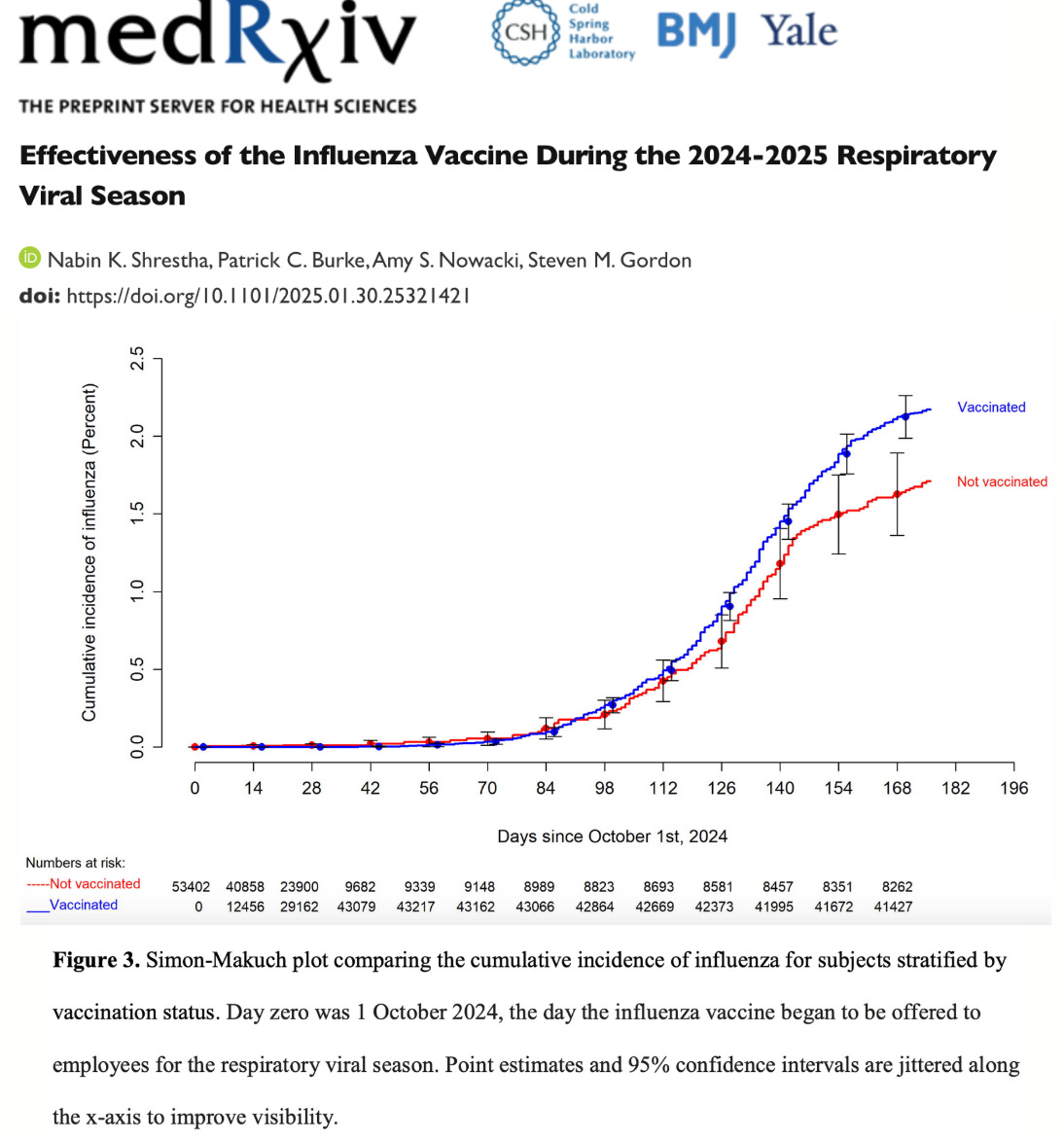
The Cleveland Clinic study titled, Effectiveness of the Influenza Vaccine During the 2024-2025 Respiratory Viral Season, was just uploaded to the MedRxiv preprint server:

Background The purpose of this study was to evaluate the effectiveness of the influenza vaccine during the 2024-2025 respiratory viral season.

Methods Employees of Cleveland Clinic in employment in Ohio on October 1, 2024, were included. The cumulative incidence of influenza among those in the vaccinated and unvaccinated states was compared over the following 25 weeks. Protection provided by vaccination (analyzed as a time-dependent covariate) was evaluated using Cox proportional hazards regression.

Results Among 53402 employees, 43857 (82.1%) had received the influenza vaccine by the end of the study. Influenza occurred in 1079 (2.02%) during the study. The cumulative incidence of influenza was similar for the vaccinated and unvaccinated states early, but over the course of the study the cumulative incidence of influenza increased more rapidly among the vaccinated than the unvaccinated. In an analysis adjusted for age, sex, clinical nursing job, and employment location, the risk of influenza was significantly higher for the vaccinated compared to the unvaccinated state (HR, 1.27; 95% C.I., 1.07 – 1.51; P = 0.007), yielding a calculated vaccine effectiveness of −26.9% (95% C.I., −55.0 to −6.6%).

Conclusions This study found that influenza vaccination of working-aged adults was associated with a higher risk of influenza during the 2024-2025 respiratory viral season, suggesting that the vaccine has not been effective in preventing influenza this season.

This study analyzed over 53,000 Cleveland Clinic employees and found that those who received the influenza vaccine during the 2024–2025 season were statistically more likely to contract influenza compared to those who remained unvaccinated. After adjusting for key factors like age, sex, job role, and location, the data showed a 27% higher risk of influenza among the vaccinated group (Hazard Ratio = 1.27). This led to a negative vaccine effectiveness estimate of −26.9%.

Americans are tired of toxin-loaded injectable products that completely fail and deteriorate their health. Thankfully, the new HHS administration pulled the CDC “Wild to Mild” flu vaccine campaign a few months ago.

[…]

Via https://www.thefocalpoints.com/p/new-study-flu-vaccination-linked

Bill Gates Lobbying White House to Reverse USAID Cuts

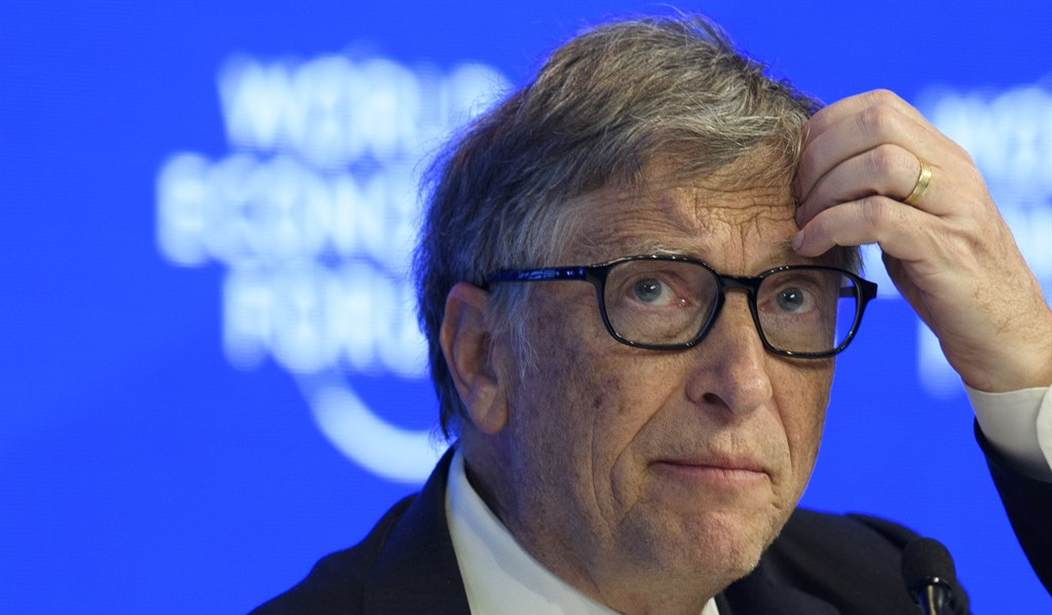
Gian Ehrenzeller/Keystone via AP
Benjamin Bartee  

The cuts made to the so-called “foreign aid” agency USAID (which doesn’t actually have humanitarianism as its primary purpose) in the first days of the Trump 2.0 administration affected various global vaccine initiatives, many of which were pet projects of self-styled philanthropist Bill Gates.

Via Reuters (emphasis added):

Soon after his January 20 inauguration, President Donald Trump moved to dismantle the U.S. Agency for International Development, cutting more than 80% of contracts and freezing billions of dollars for everything from emergency food assistance to malaria prevention.

The Trump administration, led by the State Department, is reviewing what kinds of foreign aid will remain under its “America First” policy, with a list of around 30 global health projects for consideration, one of the sources said…

[The list includes] rganizations such as Gavi, the Vaccine Alliance, as well as the Global Fund to Fight AIDS, Tuberculosis and Malaria, among others. They are on the shortlist for review by Secretary of State Marco Rubio and Trump. The U.S. gives around $300 million annually to Gavi, and more than $1 billion to the Global Fund.

Several projects under the President’s Emergency Plan for AIDS Relief (PEPFAR) are also on the review shortlist, the source said.

In an attempt to ensure these projects remain federally funded, Gates has reportedly been quietly lobbying the administration behind the scenes to protect the billions that flow to his “non-profit” ventures.

Putting aside the ultimate question of why Bill Gates isn’t under a federal prison, why do we allow creatures like this to slink around the White House trying to convince Trump, our duly elected president, and his lieutenants to reinstate his own personal scheme that for some reason require public subsidy even though Gates has a net worth of $108 billion?

Continuing:

Bill Gates is personally lobbying Trump administration officials to keep funding health programs worldwide, from childhood vaccination to HIV treatment, and warning that his foundation cannot step in to fill gaps, two sources familiar with the matter told Reuters…

“Bill was recently in Washington D.C. meeting with decision makers to discuss the life-saving impact of U.S. international assistance and the need for a strategic plan to protect the world’s most vulnerable while safeguarding America’s health and security,” said a spokesperson for the Gates Foundation, his charitable organization.

Gates told the officials he met with that his foundation cannot replace the role of the U.S. government, the sources said. Gates Foundation directors have also said publicly that no foundation has that capability.

Let this serve as our friendly periodic reminder that billionaire “philanthropists” aren’t really playing with their own money; it’s house money.

As I reported on several years ago, it came to light well into the first Trump administration that Gates had gone to Trump back in December 2016, when he was president-elect, to pressure him not to look into vaccine safety, which the president was reportedly considering doing at the time at the behest of now-HHS Secretary RFK Jr.

According to Gates’ account of the encounter: “In both of those two meetings, [Trump] asked me if vaccines weren’t a bad thing, because he was considering a commission to look into ill effects of vaccines. And I said, ‘No, that’s a dead end. That would be a bad thing, don’t do that.’”

We all know what happened four years later.

[…]

Via https://pjmedia.com/benbartee/2025/04/09/bill-gates-lobbying-white-house-to-reverse-usaid-cuts-report-n4938720

Trump Fires Senior CIA Official Responsible for ‘Illegal’ Military Covid Vaxx Mandate

By Baxter Dmitry

Terry Adirim, a senior CIA official and ex-Biden defense appointee, was fired last week for her role in pushing Biden’s controversial military Covid-19 vaccine mandate—a mandate that may have crossed legal lines.

Once the acting assistant secretary of defense for health affairs, Adirim jumped ship to the CIA in December, serving as director of its Centers for Global Health Services until her firing.

According to reports, Adirim’s firing is tied to her role in strong-arming troops to take an Emergency Use Authorized jab or face expulsion.

On September 14, 2021, about a month after then-Defense Secretary Lloyd Austin ordered the vaccine mandate, Adirim issued a memo instructing DOD health care providers to consider the vaccine available to service members — Pfizer’s BioNTech vaccine — as “interchangeable” with a vaccine that was approved by the FDA, known as Comirnaty.

She wrote:

Per FDA guidance, these two vaccines are ‘interchangeable’ and DoD health care providers should ‘use doses distributed under the EUA to administer the vaccination series as if the doses were the licensed vaccine.’

Consistent with FDA guidance, DoD health care providers will use both the PfizerBioNTech COVID-19 vaccine and the Comirnaty COVID-19 vaccine interchangeably for the purpose of vaccinating Service members in accordance with Secretary of Defense Memorandum, ‘Mandatory Coronavirus Disease 2019 Vaccination of Department of Defense Service Members,’ August 24, 2021.

Breitbart report: Her memo was considered legally dubious even inside the Pentagon, as reported in September 2022.

A month after Adirim issued her memo, a senior defense official proposed allowing service members who did not want to take the EUA vaccine to wait for the FDA-approved vaccine before facing punishment for being unvaccinated.

Deputy Assistant Secretary of Defense for Health Readiness Policy and Oversight David J. Smith, proposed in a draft memo that would replace Adirim’s memo:

If a Service member, after medical counseling, declines administration of the EUA-manufactured product, DoD health care providers should engage with their logistics chain to secure and administer the [Biologics License Application]-manufactured Pfizer-BioNTech/Comirnaty product prior to any punitive action being taken against the Service member.

Smith’s action memo was addressed to Adirim, with a recommendation for her to sign the draft memo with the proposed change.

According to the documents obtained by Breitbart News, the draft memo had been sent to the military services for coordination, and a senior Air Force official objected to it, arguing that adopting the change could open the military up for more litigation and possibly force it to reverse punishments already given for not taking the vaccine.

His response said the proposed change would suggest that DOD considers the EUA-manufactured vaccine different from the FDA-approved Comirnaty product and could open the Air Force up to lawsuits, and that since adverse action had already possibly been taken, “significant remedial actions” would probably be required.

The proposal was never adopted, with legal implications for the DoD.Under 10 U.S.C. Section 1107(a), a defense secretary can order service members to take an FDA-approved vaccine, but he cannot legally order service members to take an EUA-manufactured vaccine without seeking and obtaining a waiver from the president.

Also under 10 U.S.C. Section 1107(a), that waiver must be signed by the president then the defense secretary must formally notify Congress of the waiver. Congress has never received notification of such a waiver.

Austin had pledged in an August 9, 2021, memo to service members that he would seek a presidential waiver, but it is not clear he ever did so. He also pledged that his order would only use the FDA-approved vaccine. Breitbart News questioned the Biden Pentagon if Austin ever sought a presidential waiver to mandate the EUA-manufactured vaccine, but was given the same verbiage that appeared in Adirim’s memo:

Per FDA guidance, the Pfizer-BioNTech COVID-19 vaccine and the Comirnaty COVID-19 vaccine had the same formulation and the two vaccines were ‘interchangeable.’ Accordingly, DoD health care providers could ‘use doses distributed under the EUA to administer the vaccination series as if the doses were the licensed vaccine.’

Comirnaty has not been widely available in the U.S. for reasons that are not clear. In July 2022, the FDA reissued its EUA of the Pfizer BioNTech COVID-19 vaccine, noting, “There is no adequate, approved, and available alternative to Pfizer-BioNTech COVID-19 Vaccine to prevent COVID-19.”

The DOD later would be hit with lawsuits from service members suing the DOD for trying to force service members to take the EUA vaccine instead of the FDA-approved vaccine.

One of the lawsuits was led by former Marine Capt. Dale Saran, the military attorney who ended the Pentagon’s anthrax vaccine in 2004. In an interview with Breitbart News in 2022, he called Adirim’s memo a “fraud.” he said:

The undersecretary of defense for health affairs, a woman named Terry Adirim, published a memo claiming that the unlicensed product, BNT162b2 — Pfizer’s unlicensed EUA product — could be substituted in that it was interchangeable with the licensed product. … . That’s the fraud that’s at the heart of our case.

It would not be the first time Adirim would appear to skirt the law.

Adirim left the DOD in 2022 to go to the Department of Veteran Affairs, where she appeared to have violated the Hatch Act, as previously reported by Breitbart News. Just weeks before the 2022 midterm elections, Adirim liked a tweet soliciting donations to Democrats. Doing so is not allowed under the Hatch Act, which seeks to make sure federal employees do not engage in politics while in an official role.

[…]

Via https://thepeoplesvoice.tv/trump-fires-senior-cia-official-responsible-for-illegal-military-covid-vaxx-mandate/

What if Trump’s tariffs actually make sense?

What if Trump’s tariffs actually make sense?

FILE PHOTO: US President Donald Trump. ©  Chip Somodevilla / Getty Images<

By Igor Makarov

They’re messy, risky, and unpopular – but they might be part of a bigger, smarter plan

Let me play devil’s advocate for a minute. I’m not here to defend President Donald Trump’s tariffs. But I do want to push back against the way the conversation around them often unfolds – dismissing them offhand with a smug “well, that’s just dumb,” without any regard for the broader economic context, either at home or globally.

Yes, Trump often shoots from the hip. He lies outright, makes rookie mistakes in his speeches, and fumbles the details. But behind the bluster is a surprisingly coherent strategy – one that wasn’t cobbled together by fools. You don’t have to agree with it to at least try to understand what it is.

I don’t claim to have all the answers (frankly, I’m suspicious of anyone who says they truly understand what’s going on inside Trump’s head), but here’s how I see it.

What you need to know about global imbalances

At their core, global trade imbalances are the result of mismatches between national savings and investment. In countries such as China, Germany, Japan, and major oil exporters, savings tend to outpace domestic investment – capital has to go somewhere, so it flows abroad. This shows up as a trade surplus.

In the US, it’s the reverse. Americans save less than they invest, and the gap is filled by foreign capital. This creates a trade deficit.

So how did we get here?
  1. For decades, export-driven economies (China, Germany, Japan) have followed policies that shift income away from households – which are more likely to spend – toward corporations and the government, which tend to save. This artificially boosts the national savings rate. But since those savings can’t all be invested domestically, the excess capital flows abroad.
  2. A lot of it – roughly a trillion dollars a year – ends up in the US. There are two main reasons for this:
    • The American economy is built to encourage consumer spending, not saving.
    • And in times of uncertainty, everyone from investors to governments runs to the dollar – it’s still the world’s safe haven.

Why is that a problem for the US?

In the short term, maybe it doesn’t look like a problem. The US economy remains strong. No one’s sounding alarm bells. But beneath the surface, imbalances are piling up: Persistent trade deficits, ballooning federal debt, and rising interest rates are a dangerous mix. As borrowing becomes more expensive, it gets harder and harder to service that debt.

On top of that, China has slowed its push to boost domestic consumption, and Europe’s economic woes are driving even more capital into the US. This only deepens the imbalance.

Trump knows his political clock is ticking – midterms are around the corner. If he’s going to act, it has to be now.

Here’s what’s really behind Trump’s tariffs – and how they may backfire

What are his options?

So how can the US boost savings, shrink the trade deficit, and bring down long-term interest rates? In theory, there are several levers:

  • Cut government spending – Trump has pushed for this (just look at the work of DOGE and others).
  • Slash corporate taxes and invest in industry – the first increases inequality, and the second is hard to pull off in a polarized political system. Still, both are being pursued, in part through tariffs.
  • Limit capital inflows – politically toxic.
  • Reduce the dollar’s role as the global reserve currency – difficult to do unilaterally, and potentially destabilizing.
  • Impose tariffs – politically the easiest, and the one Trump has clearly chosen.

My guess? Tariffs are just the tip of the spear. The broader plan likely includes pieces of all five approaches.

Legit critiques

Still, the criticisms are real – and in many cases, valid.

First: Why is Trump using a slapdash, anecdotal chart of tariff levels across countries to justify his actions? As Olivier Blanchard quipped, we all run trade deficits with our baker and surpluses with our employer. It’s the same at the international level. Trying to ‘balance’ every bilateral trade relationship is not just naive – it misses the point entirely.

But Trump isn’t necessarily trying to balance trade; he’s trying to negotiate. The US market is so critical to so many countries that Trump seems to be leveraging access to it for concessions. If you’re going to raise tariffs anyway, why not squeeze some extra benefits out of it?

Second: Some warn this could lead to a global crisis. They point to the Smoot-Hawley Tariff Act of 1930, which many blame for deepening the Great Depression. But let’s not oversimplify history. Back then, the US had a trade surplus, a consumption shortfall, and rampant overinvestment – tariffs only made things worse. Today, the US has the opposite problem.

That said, we can’t rule out a disaster. It all depends on how the trade war unfolds. I suspect a good chunk of the tariffs will eventually be rolled back as part of negotiated deals. And even if they’re not, the initial pain will fall hardest on surplus countries like China, Germany, Japan, South Korea – and yes, Russia. The US would feel the impact last.

There’s even a real possibility that the US, after triggering a global crisis, could emerge in a stronger position.

But inflation is no joke

The biggest immediate risk is inflation – and maybe even stagflation. Trump argues that domestic production will ramp up to meet demand and keep prices in check. I’m skeptical. Production takes time. Price increases don’t.

And there’s still too much we don’t know:

  • How dependent are US companies on foreign components?
  • How much of future inflation will be driven by imported parts and materials?
  • Will the other parts of the deficit-reduction plan actually happen?
  • And how will global deflationary forces – countries dumping excess goods into non-US markets – interact with rising domestic prices?

The bottom line

Trump is gambling – big time. Tariffs are a blunt, inefficient tool. Economists know this. That’s why so many of them are freaking out.

But this isn’t really about tariffs. It’s about trying to reshape the economic model the US – and the world – has operated under for the past 30, even 80 years.

It’s bold. It’s dangerous. I don’t think it’s justified. But it’s not insane.

[…]

Via https://www.rt.com/business/615467-what-if-trumps-tariffs-actually-make-sense/

Trump temporarily drops tariffs to 10% for most countries, hits China harder with 125%

WASHINGTON, DC - APRIL 02: U.S. President Donald Trump holds up a chart while speaking during a “Make America Wealthy Again” trade announcement event in the Rose Garden at the White House on April 2, 2025 in Washington, DC. Touting the event as “Liberation Day”, Trump is expected to announce additional tariffs targeting goods imported to the U.S. (Photo by Chip Somodevilla/Getty Images)

Key Points
  • President Donald Trump dropped new tariff rates on imports from most U.S. trade partners to 10% for 90 days to allow trade negotiations with those countries.
  • Trump announced the pause hours after goods from nearly 90 nations became subject to stiffer, so-called reciprocal tariffs imposed by the United States.
  • The president also said in a social media post that he was raising the tariffs imposed on imports from China to 125% “effective immediately” due to the “lack of respect that China has shown to the World’s Markets.”
 U.S. President Donald Trump holds up a chart while speaking during a “Make America Wealthy Again” trade announcement on April 2, 2025 in Washington, DC.
Chip Somodevilla | Getty Images News | Getty Images

President Donald Trump on Wednesday dropped new tariff rates on imports from most U.S. trade partners to 10% for 90 days to allow trade negotiations with those countries.

Trump announced the pause hours after goods from nearly 90 nations became subject to stiffer, so-called reciprocal tariffs imposed by the United States.

The president also said in a social media post that he was raising the tariffs imposed on imports from China to 125% “effective immediately” due to the “lack of respect that China has shown to the World’s Markets.”

China, which is the U.S.’s third-largest trading partner, earlier Wednesday said it would increase its tariff rate for imports from the U.S. to 84%.

Trump said “more than 75 Countries” contacted U.S. officials to negotiate after he unveiled his new tariffs last week.

Stock market indices rocketed sharply higher Wednesday on Trump’s announcement, reversing four days of losses. The benchmark S&P 500 index leapt by 7%, which puts it on track for its largest single-day gain in five years.

Treasury Secretary Scott Bessett claimed to reporters that Trump had always intended to put the brakes on the wide-ranging tariffs the president announced last week.

“This was his strategy all along,” Bessent said at the White House, where officials, including him, had denied for days that the tariffs would be suspended.

On April 2, Trump had said he would impose a baseline rate of 10% for tariffs on imports from more than 180 countries.

A subset of 90 countries’ imports would be subject to reciprocal tariffs that took effect Wednesday. Those enhanced levies ranged from a low of 11% to a high of 50%.

Financial markets have been in turmoil since Trump announced with plan, with U.S. stock markets suffering four straight days of declines as of Tuesday.

Senate Minority Leader Chuck Schumer, D-NY, criticized Trump on Wednesday,, saying the president “is feeling the heat from Democrats and across America about how bad these tariffs are.”

“He is reeling, he is retreating, and that is a good thing,” said Schumer.

“This is government by chaos,” Schumer said, “He keeps changing things from day to day. His advisers are fighting among themselves, calling each other names, and you cannot run a country with such chaos, with such unpredictability, with such lack of understanding of what’s going on in the world and the facts.

Commerce Secretary Howard Lutnick, in a tweet, said that he and Treasury Secretary Scott Bessent sat with Trump while he wrote out the announcement on Truth Social, “one of the most extraordinary Truth posts of his Presidency.”

“The world is ready to work with President Trump to fix global trade, and China has chosen the opposite direction,” Lutnick wrote.

Read Trump’s full Truth Social announcement:

Based on the lack of respect that China has shown to the World’s Markets, I am hereby raising the Tariff charged to China by the United States of America to 125%, effective immediately. At some point, hopefully in the near future, China will realize that the days of ripping off the U.S.A., and other Countries, is no longer sustainable or acceptable.

Conversely, and based on the fact that more than 75 Countries have called Representatives of the United States, including the Departments of Commerce, Treasury, and the USTR, to negotiate a solution to the subjects being discussed relative to Trade, Trade Barriers, Tariffs, Currency Manipulation, and Non Monetary Tariffs, and that these Countries have not, at my strong suggestion, retaliated in any way, shape, or form against the United States, I have authorized a 90 day PAUSE, and a substantially lowered Reciprocal Tariff during this period, of 10%, also effective immediately. Thank you for your attention to this matter!

[…]

Via https://www.cnbc.com/2025/04/09/trump-announces-90-day-tariff-pause-for-at-least-some-countries.html

Tariff tensions escalate as White House hits China with 104% hike

The U.S.–China trade conflict entered a volatile new phase Monday after the White House confirmed a dramatic escalation in tariffs on Chinese imports.

According to Fox Business reporter Edward Lawrence, “White House Press Secretary says 104% additional tariffs went into effect at noon Eastern time because China has not removed its retaliation. The 104% additional tariff will be collected starting tomorrow April 9th.”

The steep new tariffs follow President Trump’s threat last week to impose punitive measures if China didn’t roll back its retaliatory 34% tariffs. Beijing refused, prompting a response that significantly raises the stakes in a trade standoff already rattling global markets.

China’s Commerce Ministry called the move “a mistake on top of a mistake” and vowed to “fight to the end.”

With inflation still sticky, unemployment rising, and consumer confidence faltering, the prospect of a full-blown trade war is raising serious fears of a policy-driven recession.

This story is developing.

[…]

Via https://www.thestreet.com/crypto/policy/tariff-tensions-escalate-as-white-house-hits-china-with-104-hike

Araghchi: Deal within reach if US shows genuine will in Oman talks

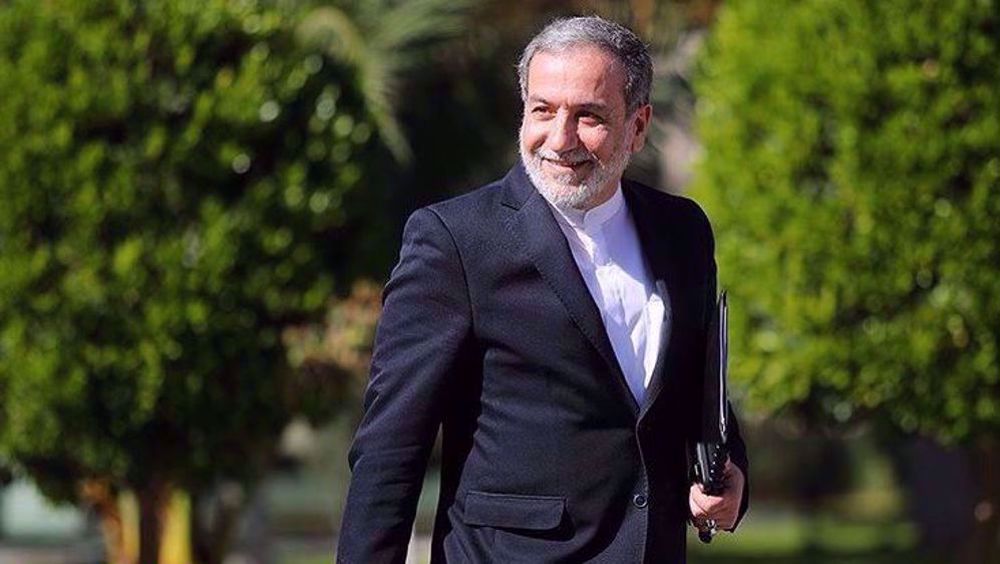
Iranian Foreign Minister Abbas Araghchi

Iran’s foreign minister has voiced optimism ahead of the upcoming round of indirect talks with the United States, saying a deal can be reached if Washington demonstrates genuine will.

Abbas Araghchi, speaking in Algeria on Tuesday, said Iran’s primary goal in the negotiations is to secure the rights of its people and achieve the lifting of sanctions and that the ball is now in America’s court to prove it seeks a deal.

“If the other side is genuinely willing, this goal is attainable, regardless of whether the talks are direct or indirect,” he said.

The minister said Iran favors indirect negotiations and has no plan to engage in direct talks.

Araghchi said that Iran rejects any negotiations conducted under pressure or threats.

“Such negotiations amount to dictation, and we do not believe in that approach. Indirect negotiations can help ensure a real and meaningful dialogue, and that’s the path we will pursue.”

Araghchi said indirect talks have occurred many times in the history of international relations.

“There are countries that, due to historical or other reasons, refuse to engage in direct talks. The current negotiations between Russia and Ukraine, for instance, are taking place indirectly through the US, since neither side is willing to meet face-to-face.”

Regarding the agenda of the talks, Araghchi dismissed Israeli speculation that the process would mirror US-Libya negotiations from the early 2000s, which led to the dismantling of Libya’s nuclear facilities.

“People may speculate or express their wishes, but what the Zionist regime has suggested—a ‘Libya model’ of negotiations—is merely a fantasy that will never be realized,” he said.

The minister reiterated that Iran’s nuclear program is entirely peaceful and legitimate and that the country is ready to take confidence-building steps to demonstrate the sincerity of its position.

“If there are any questions or ambiguities, we are ready to clarify. We are confident in the peaceful nature of our program, and we have no problem taking further steps to build trust—so long as they don’t impose restrictions or undermine Iran’s national goals.”

“In return for confidence-building, it is only natural that the unjust sanctions imposed based on false accusations must be lifted.”

US President Donald Trump made a surprise announcement during a White House meeting with Israeli Prime Minister Benjamin Netanyahu on April 7, stating that his administration would initiate talks with Iran.

Araghchi later confirmed that Iran and the US will hold indirect talks in Oman on April 12. US Middle East envoy Steve Witkoff will attend the talks on Washington’s behalf, while Araghchi himself will represent Iran.

Trump claimed the talks would be “direct,” but Iran has clarified they will be held indirectly.

Russia has welcomed the prospect of negotiations aimed at replacing the 2015 nuclear accord, which Trump unilaterally abandoned in 2018.

“We know that certain contacts—direct and indirect—are planned in Oman. And, of course, this can only be welcomed, because it can lead to de-escalation of tensions around Iran,” the Kremlin’s spokesman Dmitry Peskov said, adding that Moscow “absolutely” supports the initiative.

China also urged the US to “stop its wrong practice of using force to exert extreme pressure,” after Trump threatened Iran with bombing if it failed to agree to a deal.

“As the country that unilaterally withdrew from the comprehensive agreement on the Iran nuclear issue and caused the current situation, the United States should demonstrate political sincerity and mutual respect,” Chinese foreign ministry spokesman Lin Jian said.

Washington should “participate in dialogue and consultation, and at the same time stop its wrong practice of using force to exert extreme pressure,” Lin added.

The 2015 agreement, known as the JCPOA, granted Iran relief from international sanctions in return for restrictions on its nuclear program, monitored by the International Atomic Energy Agency (IAEA).

However, the deal unraveled after Trump’s withdrawal in 2018, followed by Iran’s gradual suspension of its commitments a year later.

[…]

Via https://www.presstv.ir/Detail/2025/04/08/745797/iran-us-deal-genuine-will-oman-talks-araghchi