
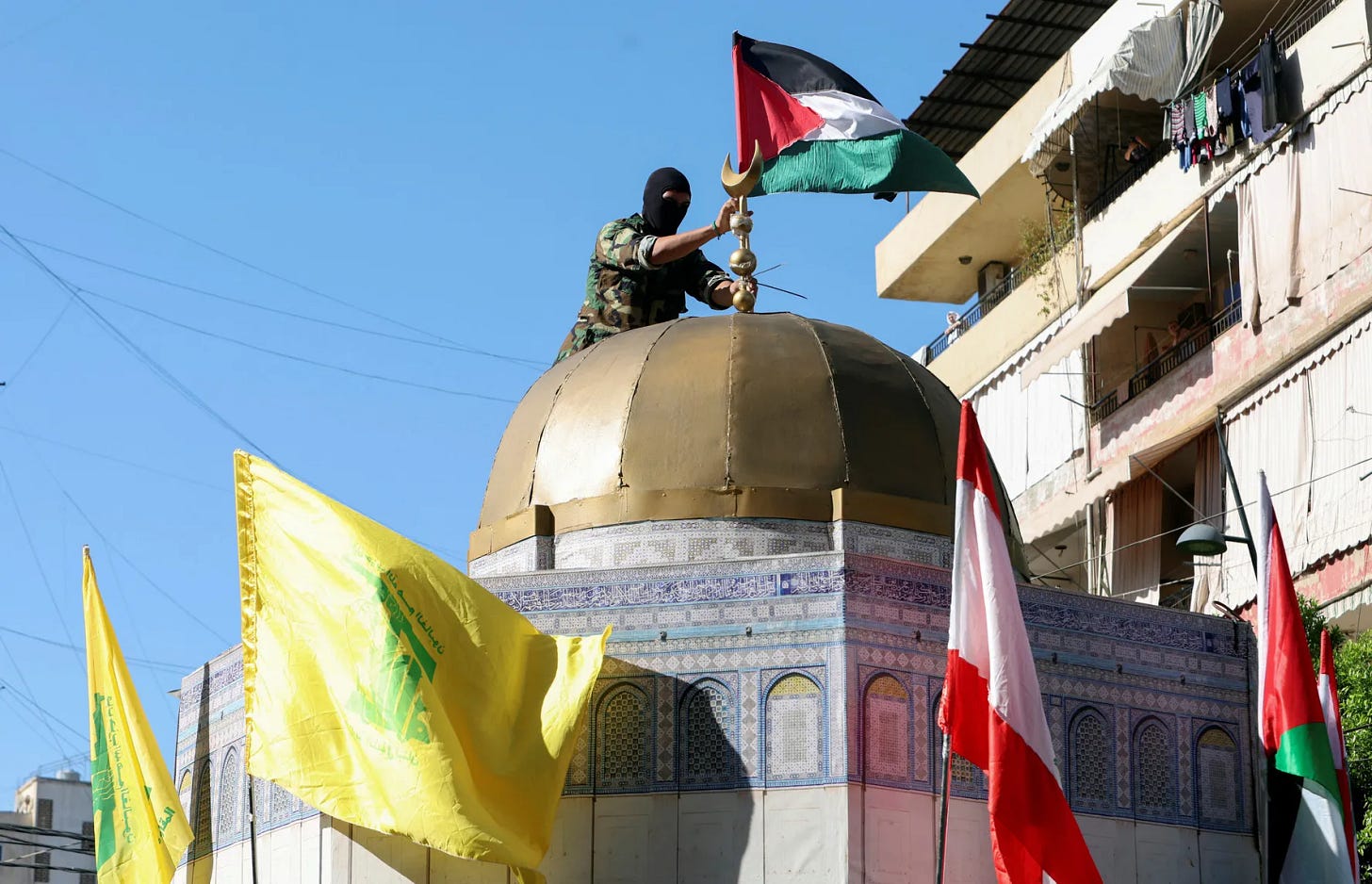
 A Hezbollah Resistance fighter places a Palestinian flag atop of a replica of the Dome of the Rock in Sidon, Lebanon November 2023
In a markedly revealing September 22nd interview with The National, US special envoy to Syria Tom Barrack made a number of stunning admissions about the state of play in Lebanon. Despite Western governments for months demanding Beirut disarm Hezbollah, he acknowledged the Resistance group had “zero” incentive to voluntarily do so, as “Israel is attacking everybody” across West Asia. As such, Hezbollah’s “argument gets better and better”, and its public support grows. Barrack went on to propose arming the Lebanese Armed Forces for the purpose:
“[The LAF] is a good organisation and it’s well-meaning, but it’s not well-equipped…Who are they going to fight? We don’t want to arm them so they can fight Israel…So you’re arming them so they can fight their own people, Hezbollah…our enemy…We need to cut the heads off of those snakes and chop the flow of funds. That’s the only way you’re going to stop Hezbollah.”
Barrack’s comments are a uniquely candid admission of Washington’s overarching strategy in West Asia. Namely, to construct intelligence, military, and security apparatuses in pliable puppet states for the purposes of internal oppression, posing no threat whatsoever to the Zionist entity, while Tel Aviv attacks “everybody” in the region with total impunity. Yet, efforts to bring Lebanon to heel, and neutralise Hezbollah’s influence in the country, have been ongoing for many years – with London secretly leading the charge.
Leaked documents expose how Torchlight, a well-remunerated British state contractor staffed by military and intelligence veterans, has insidiously penetrated Lebanon’s assorted spying agencies at their highest levels. These efforts are conducted in express support of the British Embassy in Beirut’s “political access and influence objectives”. Under their auspices, British operatives and technology are implanted at the heart of the country’s security agencies, in the process training an unblinking eye on their operations, and Lebanese citizens.
One leaked file notes Torchlight staff deployed for these clandestine projects are “highly experienced former UK police investigators, intelligence officers and forensic experts,” providing specialist instruction at one of Britain’s leading spy schools, the Joint Intelligence Training Group. Furthermore, 90% of the company’s employees have high-level Whitehall security clearances, granting them “frequent and uncontrolled access” to top secret information. Torchlight itself boasts rare ‘List X’ accreditation, meaning the Ministry of Defence has entrusted the firm with storing highly sensitive, classified material on its premises.
Under the auspices of ‘Investigations Advisor and Mentor’, an endeavor ostensibly aimed at improving the investigative processes of the LAF’s Intelligence Directorate, Torchlight ostensibly teaches the unit to move away from the use of “uncorroborated confession evidence” obtained via torture to “recognition and exploitation” of CCTV footage, phone records, biometrics, forensics, and covert on- and offline surveillance. The leaks make clear this drive isn’t motivated by sincere human rights concerns, but a desire to “drive down risks” of public association with the Directorate.
‘Beneficiary Concerns’
In reality, London seeks to build a “sustained relationship with an important UK [counter-terror] partner” in Beirut, and thus “enable, support and assure any joint UK–Lebanese operational cooperation and collaboration.” Intelligence gathered in Lebanon not merely by the LAF’s spying nexus, but Beirut’s other intelligence and security agencies, is fed directly back to SO15, London’s Metropolitan Police counter-terror unit, National Crime Agency and “other members of the UK intelligence community.”
Torchlight’s cloak-and-dagger embedment with Lebanon’s intelligence agencies avowedly grants the firm “enhanced understanding” of “the operational realities of present working practice” in, and “institutional rivalries” between, Beirut’s military, Internal Security Forces, General Security Directorate, and General Directorate of State Security. Torchlight’s lead “mentor” for the program, William Semple, a veteran SO15 investigating officer, was “well-networked” across all these services, and “highly familiar” with their operating environments. This fly-on-the-wall insight allowed Torchlight to cultivate “strong relationships” with the agencies’ “strategic and tactical operational heads.”
The company is likewise “well-networked” with Lebanon’s military courts, having met with Fadi Sawan, Beirut’s chief military investigating judge, on “multiple” occasions. Coincidentally, Sawan was initially charged with investigating the ever-mysterious August 2020 Beirut blast, but promptly removed from his position due to political pressure. Moreover, Torchlight’s in-country team includes a number of “highly-networked” former Lebanese intelligence operatives, advising the firm on “constructive” engagement with their former employers, “[facilitating] introductions and meetings” and ensuring the project avoids “pitfalls and obstacles” to “buy-in” from senior leadership.
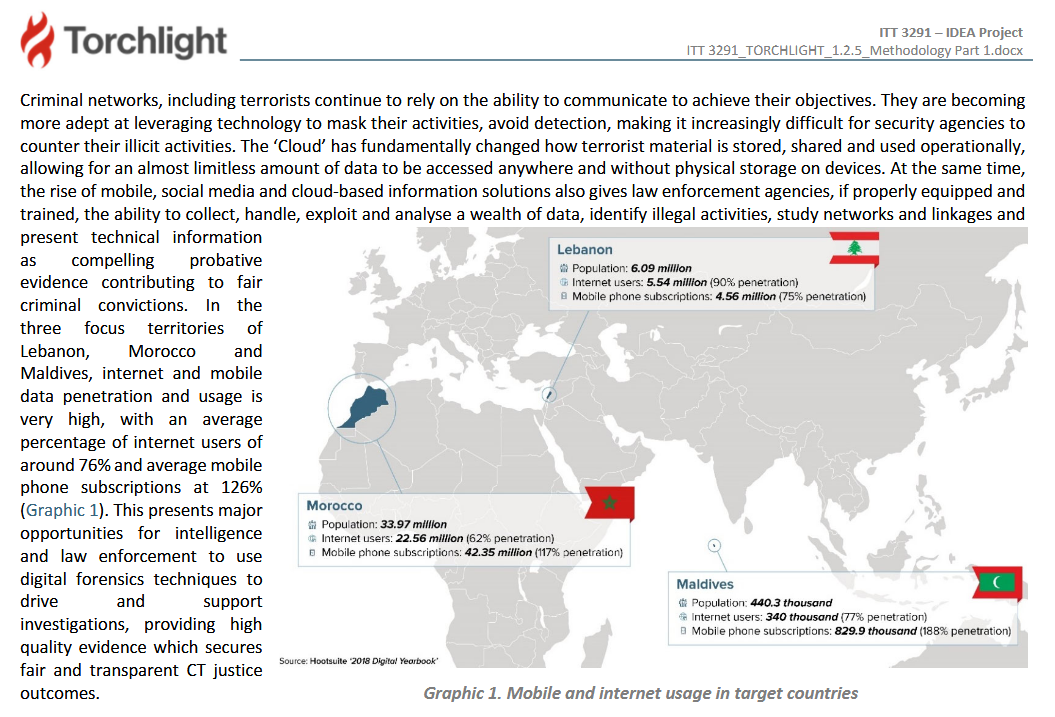
“Passive resistance” from high-ranking staff was forecast to be a potential pitfall in another secret program, through which Torchlight equips Beirut’s Military Intelligence Directorate with technology to process and manage digital evidence. A leaked file notes 90% of Lebanese citizens use the internet, while 75% have smartphones, which “presents major opportunities for intelligence and law enforcement to use digital forensics techniques to drive and support investigations, providing high quality evidence” – and British spooks to closely monitor the local population in the process.
The leaked files outline how Torchlight overcame even sterner resistance from “negative blockers” within the LAF’s Intelligence Directorate, upon launch of the firm’s “mentoring” initiative. The agency’s top brass harboured entirely legitimate “suspicions” about the true purpose of the project. However, having conducted analysis to “understand the root causes of beneficiary concerns” and allayed them, the effort not only went ahead, but Torchlight was allocated a dedicated office within the Directorate’s headquarters.
Nonetheless, “complex political and institutional landscapes” were predicted to “likely present engagement challenges” throughout the program, in particular “sensitivities with regards to access to data.” Given the “possibility of reluctance” to allow British intelligence full access, “rapidly developing relationships of trust” was key. The “privilege” of Torchlight’s office within LAF headquarters was to be leveraged for the purpose. Perhaps more illuminatingly than intended, one file concludes by stating that for Torchlight, “the most important consultancy skill is listening.”
‘Elite Incentives’
While local stakeholders were “unlikely to say ‘no’ to project proposals” as a result of Torchlight’s penetration, the company suggested its work could still “meet with passive resistance.” It’s clear certain elements and individuals within Beirut’s power structure were extremely wary of London’s activities. A document outlining engagement strategies for Lebanese government personnel notes the country’s military court commissioner was “unsupportive” of London’s involvement. However, due to having recently been “mired in controversy”, his tenure in the post was reportedly “coming to an end.”
The nature of the controversy isn’t stated, and the commissioner isn’t named in the file. The post was at that time held by judge Peter Germanos, who briefly garnered Western media media attention in March 2019 after he ruled homosexuality wasn’t a crime in Lebanon, and thus refused to prosecute military officers charged with “homosexual activity.” Just as Torchlight predicted, he duly resigned in February 2020. It’s a matter of speculation whether Germanos’ downfall was British-engineered.
Leaked files related to a “rule of law initiative” in the former Yugoslavia covertly run by the British National Security Council’s Stabilisation Unit make amply clear London doesn’t tolerate high-level opposition to its overseas skullduggery. Active measures are readily employed to comprehensively crush any and all local resistance:
“In contexts where elite incentives are not aligned with [Britain’s] objectives/values…an approach that seeks to hold elite politicians to account might be needed…We can build relationships and alliances with those who share our objectives and values for reform. It is critical that the media have the capacity and freedom to hold political actors to account.”
We must ask ourselves whether Britain’s wide-ranging infiltration of Lebanon’s corridors of power has been pivotal in encouraging Beirut’s leaders to support Hezbollah’s disarmament. President Joseph Aoun, who entered office in January, quickly made clear neutralising the Resistance group was one of his primary objectives. When Iran vehemently objected in August, Aoun robustly responded: “we reject any interference in our internal affairs.” His riposte was sickly ironic, given Beirut’s Internal Security Forces, which Aoun led for many years, is also heavily penetrated by the British.
[…]
Via https://libya360.wordpress.com/2025/10/27/how-british-intel-infiltrates-lebanon/
Trump’s push to uphold Gaza ceasefire creating political crisis in Israel
 U.S. Vice President JD Vance and Israeli Prime Minister Benjamin Netanyahu meet in Israel amid accusations that the U.S. is “babysitting” Israel to make sure it adheres to the ceasefire with Hamas, October 22, 2025. (Photo: Screenshot from Israeli Prime Minister’s Youtube Channel)
JD Vance claims Israel isn’t a vassal state of the US. But when it comes to the ceasefire in Gaza and annexing the West Bank, Israeli decision-making is deeply intertwined with Washington’s current priorities.
The succession of U.S. officials arriving in Tel Aviv over the week has fueled consternation in Israeli political circles as Washington ups the pressure on Israel to stick to U.S. President Donald Trump’s Gaza ceasefire plan. Israeli political circles have bristled at having to bend to the American President’s will, as opposition use the opportunity to lambast Israeli Prime Minister Benjamin Netanyahu for turning Israel into a “vassal” of the United States.
Virtually all of Trump’s inner circle has made the rounds in Tel Aviv throughout the past week, including U.S. Special Envoy Steve Witkoff, Trump’s son-in-law, Jared Kushner, Vice President JD Vance, and U.S. Secretary of State Marco Rubio.
They were all there, JD Vance said, to monitor the ceasefire, rushing to add: “But not monitoring in the sense of, you know…you monitor a toddler.” But Israeli media referred to the flurry of visits as American “Bibi-sitting.”
Israeli daily newspaper Haaretz published a caricature on Wednesday portraying Netanyahu as a child playing with toy tanks and airplanes while Witkoff tells him, “Just a little while more, and then off to bed.” Maariv published another cartoon showing Witkoff, Vance, and Kushner closely tailing Netanyahu, who says, “Honestly, I’m just going to the toilet.”
Israeli opposition leader Yair Lapid didn’t hold back either. At the opening of the Knesset’s winter session, Lapid slammed Netanyahu for getting Israel into “the most dangerous political crisis in its history,” and for sabotaging past ceasefire deals that could have seen the earlier release of the Israeli captives in Gaza. Lapid also said that Netanyahu had turned Israel into “a vassal state that takes orders concerning its own security.”
Things got even tenser during a press conference with Netanyahu when Vance was asked by a reporter whether Israel was becoming a “protectorate” of the U.S.
“We don’t want a vassal state, and that’s not what Israel is,” Vance responded. “We don’t want a client state, and that’s not what Israel is.”
Vance’s insistence on what the U.S. isn’t doing, of course, is the thing that cements it in everyone’s minds.
Netanyahu is still chafing at the prospect of an international coalition of forces that would enter Gaza, and has objected to the participation of Turkish forces in particular. When asked about the matter on Tuesday, Vance said that “nothing will be forced on Israel,” noting that Turkey still has “a constructive role” to play.
The visits by Vance, Witkoff, Kushner, and Rubio came as the fragile ceasefire in Gaza was about to unravel last Sunday, October 19, following an incident in Rafah in which two Israeli soldiers were killed in an explosion. Israel accused Hamas of breaching the ceasefire and launched a series of strikes across Gaza, killing at least 40 Palestinians. Hamas denied any knowledge of the Rafah incident, with reports that the explosion was caused by an Israeli bulldozer running over an unexploded ordinance, of which the White House was reportedly aware.
Later, Trump told Fox News that both parties were respecting the ceasefire as Israel ceased its bombardment by the end of the day.
Political circles in Israel regarded the halt of Israel’s blitz as a sign that Netanyahu had folded under continuous U.S. pressure to make the ceasefire work. Israel’s hardline National Security Minister, Itamar Ben-Gvir, regarded the decision as “shameful” and called on Netanyahu to resume its full-scale onslaught against Gaza.
Now there’s another sticking point that is continuing to fuel U.S.-Israeli tensions: annexation.
West Bank annexation is off the table. Or is it?
In the midst of this wave of criticism, Netanyahu announced his candidacy for the post of Prime Minister in the upcoming November 2026 elections. Netanyahu is currently the longest-serving Prime Minister in Israel’s history, having led a shifting arrangement of right and center-right coalitions for a total of 18 years.
In the middle of JD Vance’s visit, the Israeli Knesset voted in favor of the first reading of a bill that would annex the West Bank. The reaction from the U.S. was unprecedented.
Before boarding his flight to Tel Aviv earleir this week, Secretary of State Rubio said that the vote was “counterproductive” and “threatening to the peace deal.” Vance went further, calling the vote “weird,” “stupid,” and an “insult,” adding that “the policy of the Trump administration is that the West Bank will not be annexed by Israel.”
But the hardest U.S. reaction came from Trump himself, who said in an interview with Time magazine that Israel’s annexation of the West Bank “will not happen because I gave my word to the Arab countries,” adding that “Israel would lose all of its support from the United States if that happened.”
The problem is that annexing the West Bank has been Netanyahu’s most important electoral promise since 2019. He has been spearheading a years-long legislative effort to make that annexation a reality, starting with the 2018 Nation-State Law, then with the Knesset resolution to reject a Palestinian state in July 2024, and finally with last July’s Knesset resolution allowing the government to annex the West Bank.
This is particularly inconvenient for Benjamin Netanyahu, as he needs to avoid any major confrontation with Washington at the current moment. In a post on X, Netanyahu said that the vote was “a provocation by the opposition to sow discord,” although the bill was introduced by an ally of his right-wing camp, Avi Maoz, who ran in the last elections in coalition with Netanyahu’s own party, the Likud.
But Netanyahu’s dissociation from his own allies is understandable. He now finds himself trapped between his commitment to his voting base and the broader interest of securing continued support from the U.S., whose current administration has a different order of priorities.
Those priorities are what Trump hopes will be his crowning achievement: brokering a normalization deal between Israel and Saudi Arabia, which has clearly said that Israel’s annexation of any part of the West Bank would be a “red line.”
In his first term, Donald Trump also clashed with a Netanyahu-led government that had pledged to annex parts of the West Bank. Trump halted the annexation process by brokering normalization agreements with several Arab states, most crucially the United Arab Emirates. The importance of the so-called Abraham Accords, for Trump, comes from the fact that the remaining Gulf countries that have yet to normalize relations with Israel — Qatar and Saudi Arabia — are the key to securing regional U.S. economic and political dominance. This is part of the larger U.S. agenda of reasserting American hegemony and confronting the rising influence of China. A part of Trump’s roadmap to get there is by integrating Israel in the Middle East.
After its genocide in Gaza, Israel is facing international isolation, so regional integration should seemingly be an Israeli priority as well. But in this instance, integration would force Israel to at least temporarily pause its plans to assert Jewish sovereignty between the river and the sea, as the Likud’s charter put it.
Smotrich gave voice to that supremacist dream while speaking at a tech conference on Thursday, saying that Israel would not give up annexation for the sake of normalization: “If Saudi Arabia tells us ‘normalization in exchange for a Palestinian state,’ friends — no thank you. Keep riding camels in the desert in Saudi Arabia, and we will continue to develop.”
Following a flurry of condemnation from Israeli opposition figures, Smotrich gave a halfhearted apology for any “insult” it might have caused, but maintained that Israel would not give up the “heritage,” “tradition,” and “rights” of the Jewish people in “Judea and Samaria” — the Zionist term for the West Bank.
But Smotrich’s statement isn’t a fringe opinion, as much as the Israeli opposition would like to suggest otherwise. Despite their condemnations of the way Smotrich said it, the vast majority of Knesset members support annexation. Following European recognition of a Palestinian state in September, opposition leader Benny Gantz said in a New York Times op-ed that Israel’s rejection of a Palestinian state was a matter of “national consensus.”
But Israel doesn’t even have to accept a Palestinian state to keep Trump happy. It just has to refrain from outright annexation — for now, at least. Even that is something that Israel is finding hard to do.
[…]
‘Young Service Members’ Risk Prosecution for Following President Trump’s Orders to Attack Drug Boats in Caribbean

By Kristin Taylor
In an interview on ABC’s This Week on Sunday, senior Arizona Democrat Senator Mark Kelly threatened ‘young service members’ with prosecution for following President Donald Trump’s orders to attack drug boats in the Caribbean Sea.
Kelly made the threat in comments to host Martha Raddatz, saying the Trump administration was “putting young service members at great, legal jeopardy.”
RADDATZ: OK, I want to talk about Venezuela. The Pentagon is now sending a carrier strike group. You know the massive amount of firepower on a carrier strike group. What is your take on what is happening with these suspected drug boats. Is it legal?
KELLY: It’s questionable. And the White House and the Department of Defense could not give us a logical explanation on how this is legal. They were tying themselves in knots trying to explain this. We had a lot of questions for them, both Democrats and Republicans. It was not a good meeting. It did not go well. They have a secret list of 20 something — 24 organizations that they have now authorized to use — use kinetic action against without the normal approach that we have for law enforcement. Hey, we don’t want drugs in this country, especially fentanyl. But all these drugs, we — we should be working really hard to interdict them and prosecute the individuals that are smuggling drugs, not putting young service members at great, legal jeopardy.
Note: ABC omitted Kelly’s word “jeopardy” from the transcript even though it was clearly audible in the broadcast.
[…]
How a Private Company Won the War Waged on It by the Mightiest State: Huawei’s Secret Comeback
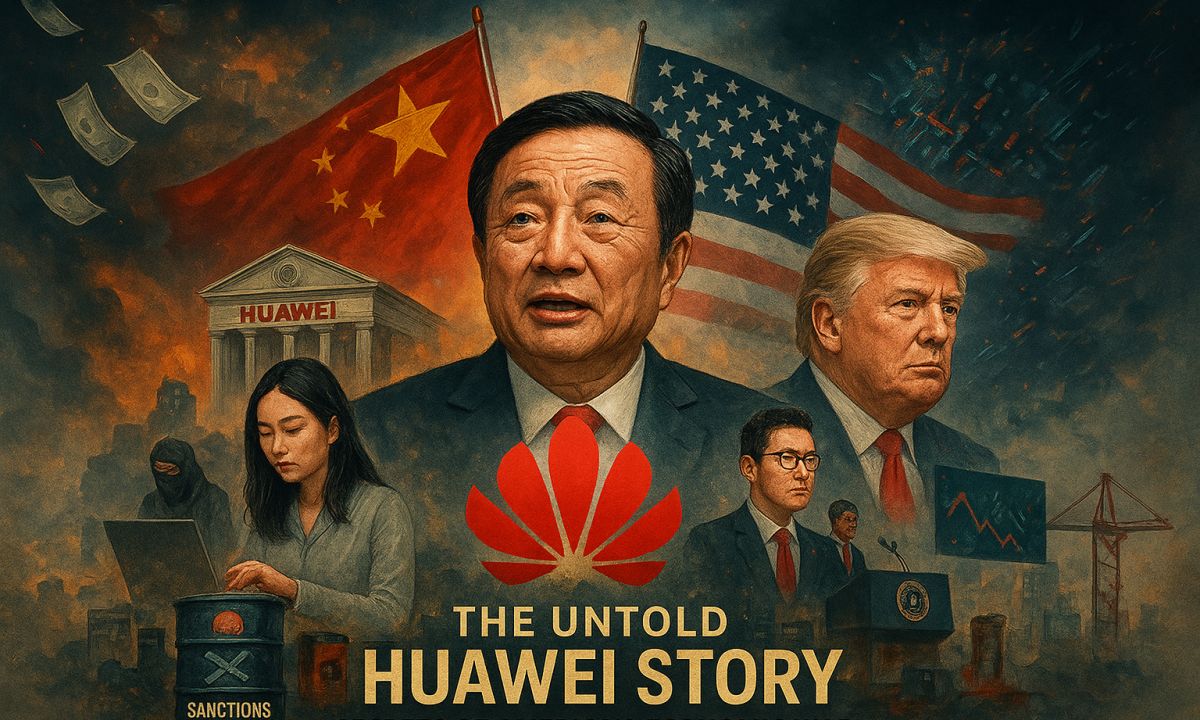
By Felix Abt
From Toshiba to Huawei: America’s Long War on Superior Competitors
For decades, the United States championed free markets and fair competition—until it no longer had the upper hand.
Today, oligarchs like Peter Thiel—a key player in the U.S. security apparatus and founder of Palantir, the taxpayer-funded surveillance and profiling giant built with CIA backing—say competition is “bad for business.”
In Thiel’s world, monopoly is not just acceptable; it is the true engine of innovation and profit, turning the American ideal of open markets on its head.
In reality, Washington’s “commitment” to free markets was always lip service. The U.S. has consistently tried to crush superior competitors of its major corporations. Economic warfare is nothing new.
Take Toshiba: According to an August 1992 Los Angeles Times article, it was Japan’s leading chipmaker in the 1980s, commanding about 80% of the global market for dynamic random access memory (DRAM) in 1987.
Like Huawei today, Toshiba became a U.S. target under the banner of “national security.”
After Toshiba and a Norwegian firm sold advanced milling machines to the Soviet Union in 1986—just as other European companies had done—Washington pounced.
It imposed a sweeping two- to five-year ban on all Toshiba products, claiming a threat to U.S. security. This blow cleared the way for American chipmakers, while other foreign companies that sold similar equipment to the USSR escaped unscathed.
Or consider Alstom, once hailed as the “jewel of French industry.” A world leader in energy and transport technology, it competed head-on with U.S. giant General Electric in the early 2010s.
Then came Washington’s move: In 2013, Alstom executive Frédéric Pierucci—author of The American Trap: My Battle to Expose America’s Secret Economic War Against the Rest of the World—was arrested at a New York airport on disputed bribery charges linked to a contract in Indonesia.
Pierucci recalled being offered a draconian choice: Plead guilty and walk free within months, or risk 125 years in prison. Several Alstom executives were also detained, and U.S. courts imposed a $772 million fine.
Facing this form of coercion and relentless legal pressure, Alstom was compelled in 2014 to sell its core energy and grid divisions to GE, effectively dismantling a major European competitor.
The pattern repeats elsewhere. Under massive U.S. pressure, Switzerland was forced to abolish banking secrecy and its anonymous numbered accounts, long a cornerstone of its financial industry.
Meanwhile, U.S. states quietly maintained their own system of anonymous shell companies, turning America into the world’s largest haven for money laundering and tax evasion. It became the preferred refuge for Latin American drug cartels to safely stash their ill-gotten gains.
Offshore financial centers in Panama, Singapore, and the Caribbean were rocked by leaks and scandals—but never U.S. institutions. That was no accident: The NSA and other U.S. spy agencies target foreign banks, not American ones. Whether Toshiba, Alstom or Swiss banking, the story is the same: Washington weaponizes “law,” “security” and “ethics” to eliminate rivals, then adopts the very practices it condemns abroad.
But Huawei—and by extension, China—is a different kind of target. Unlike Japan, France or Switzerland, China cannot be easily coerced into submission. On the contrary, the U.S. campaign against Huawei is far more likely to backfire, turning into a decisive defeat for the Western aggressors—as the rest of this article will show.
The Economic Battlefield: How the U.S. Took Aim at Huawei
Before August 29, 2023, the world had witnessed an almost cinematic struggle: the United States, the planet’s most powerful nation, waging an economic war against a single private company.
Huawei, a rising global telecom titan, faced devastating sanctions, crippling supply-chain blockades, relentless legal battles, and the high-profile arrest of CFO Meng Wanzhou in Canada on largely baseless accusations.
Countries worldwide were pressured to ban Huawei from 5G networks, and the company was officially labeled a “national security threat.” To outsiders, Huawei seemed on its last legs.
Then came August 29, 2023. Quietly, and without fanfare, Huawei listed the Mate 60 Pro on its website. At first, tech experts were puzzled, then shocked, finally incredulous. Inside this sleek smartphone was the Kirin 9000S—a 7-nanometer System-on-a-Chip with full 5G capability.
To outsiders, it was just a chip. To those following the U.S.-China tech rivalry, it was a declaration: Huawei had not only survived—it had struck back. The Mate 60 Pro sold more than 14 million units in China, blending technological triumph with patriotic pride.
Rising from the Ashes: Huawei’s Journey to National Champion
The economic war against Huawei and other Chinese companies has fueled a wave of patriotic consumption across China. Many consumers are turning away from Western products in favor of domestic brands, supporting local innovation, boosting homegrown industries, and reinforcing China’s drive for technological self-reliance.
The Relentless Engineer: From Poverty to Huawei’s Pinnacle
Ren Zhengfei, Huawei’s founder, was no ordinary CEO. Born in 1944 in poor rural Guizhou, he grew up in a family facing severe financial hardship. His youth was marked by the Cultural Revolution, his father’s imprisonment, and long stretches of adversity. These struggles shaped his philosophy of chī kǔ—“eating bitterness”—a mindset that would later define Huawei’s corporate culture.
After years as an engineer in the PLA’s Engineering Corps, Ren found himself among many officers forced to transition to civilian life when Deng Xiaoping’s sweeping 1980s reforms downsized the military to redirect resources toward economic growth. Lacking other professional opportunities, he turned to entrepreneurship as a way to put his technical expertise to use—and to make a living.
In 1987, with just 21,000 yuan (about $5,000), Ren moved to Shenzhen and founded Huawei. At first, the company operated as a small reseller of PBX switches, but it soon embraced reverse-engineering and self-reliance. By 1993, Huawei had successfully developed its first domestically produced digital switch, signaling that survival—and ultimately success—depended on technological independence.
Context: From Planned Economies to Market Power
Fifty years ago, economic activity in China and the USSR was dictated by central planners. Today, China is the world’s #1 exporter and deeply embedded in global market capitalism.
But what does “Socialism with Chinese Characteristics” really mean?
In The New China Playbook: Beyond Socialism and Capitalism, Harvard-trained Chinese economist Prof. Keyu Jin describes a “Local Mayor Economy,” where officials compete to foster private enterprises that align with Communist Party objectives. Each five-year plan sets priorities—GDP growth, environmental protection, electric vehicle development, and more—and officials are evaluated on their performance, with top achievers rewarded through promotion.
While the Party sets national strategy, execution depends on a dynamic interplay among private companies, state-owned enterprises, and local officials—all competing to meet ambitious targets. This competition has made China’s economy one of the most dynamic arenas in the world, fueling relentless innovation and technological breakthroughs, even as it seeks to narrow wealth gaps and advance the goal of “shared prosperity” (共同富裕, gòngtóng fùyù).
And, unlike Western-style plutocracies dominated by oligarchs, China functions as a meritocracy—a theme explored in my piece, When Imperial China Had a Vietnamese Prime Minister.
From Wolf Culture to Global Domination
Ren’s military-inspired “wolf culture” fueled Huawei’s global rise. Rather than confronting Western giants directly, the company conquered underserved markets in Africa, Latin America and Russia with aggressive pricing, flexible financing, and exceptional service.
By the mid-2000s, Huawei had partnered with 31 of the world’s top 50 telecom operators. The company then expanded into consumer electronics, launching the Ascend, Mate, and P series, along with its in-house Kirin chips. By 2018, Huawei had overtaken Apple in China and was challenging Samsung globally—triggering intense U.S. scrutiny and sanctions.
On a metro train, Chinese kids and mothers can be seen wearing smartwatches—a sign of how quickly Huawei has caught up, overtaking Apple as the market leader. Beyond smartwatches, Huawei also holds an edge with smart glasses, while Apple has yet to release any.
Project Delete America: The Path to Survival
With international smartphone sales crippled, Huawei enacted an audacious strategy internally dubbed “Project Delete America”—systematically removing U.S. technology from its ecosystem. HarmonyOS replaced Android, Huawei Mobile Services replaced Google apps, and domestic chip production accelerated. The Mate 60 Pro and Kirin 9000S became the ultimate symbols of this comeback—a technological middle finger to the U.S. blockade.
Beyond Smartphones
Huawei’s ambitions extend far beyond phones. Its cloud services rival global leaders, AI chips and large-language models drive next-generation innovation, and Intelligent Automotive Solutions power smart vehicles for companies like SERES and Chery. Its IoT and industrial automation solutions modernize ports and critical infrastructure. Huawei is more than a smartphone company—it is a diversified technology powerhouse, transforming entire industries and turning Western coercion into a catalyst for innovation.
At its stores, Huawei now showcases smartphones, wearables, and new cars packed with smart technologies—from advanced infotainment and connectivity features to autonomous driving solutions—highlighting its expansion beyond consumer electronics into automotive.
Huawei also offers a comprehensive suite of cloud services—including AI computing, data storage, cybersecurity, and enterprise solutions—supported by a full-stack ecosystem spanning telecom infrastructure, custom chips, edge-to-cloud platforms, and AI innovation.
The Cost of Comeback
Revival came at a price. In 2024, revenue hit $120 billion, but net profit fell 28%. R&D consumed over 20% of revenue, and 67% of operations were concentrated in China, leaving the company exposed to domestic fluctuations. Technological gaps remain—SMIC’s 7nm chips lag behind TSMC’s 3nm and 2nm processes—but Huawei’s engineers, innovation and sheer willpower suggest more surprises are ahead.
Behind the trees but not behind its competitors, Huawei’s R&D center in Shenzhen is a key innovation hub, home to thousands of engineers and scientists working on 5G, AI, semiconductors and cloud technologies. Despite—or perhaps because of—global sanctions and supply chain blockades, Huawei continues to invest heavily in R&D—more than $20 billion annually—enabling it to remain competitive with, and in several areas already surpass, Western tech giants.
Geopolitical and reputational hurdles persist. European investigations, including the 2025 Brussels probe, and Huawei’s exclusion from industry associations highlight ongoing Western pushback. Yet Huawei has reclaimed the Chinese market and is steadily advancing in the markets of the future—where the global majority resides—rather than in the declining West.
Huawei’s Defiance: Innovation, Sovereignty and the Fall of Western Dominance
The United States, a nation less than three centuries old and a global superpower only since the end of World War II, is taking on China—a civilization with five thousand years of history and a dominant economic power for much of the last two millennia, with a role as a key supplier to the Roman Empire long before the birth of Christ. Against this backdrop, Huawei’s rise is nothing short of legendary.
A private company under relentless assault from the world’s most powerful state, Huawei has defied expectations through bold, audacious innovation. The Mate 60 Pro and Kirin 9000S are more than devices—they are symbols of resilience, ingenuity and unyielding defiance. Every breakthrough across multiple technologies cements Huawei’s place as a global force the West can no longer ignore.
The message is unmistakable: China will no longer tolerate bullying or humiliation. It is asserting its technological might and sovereignty, sending a stark warning that underestimation comes at a steep price.
Beyond Huawei, China’s vast, affluent, and rapidly growing middle class—the largest in the world—stands in stark contrast to the shrinking, indebted middle class of the U.S. This demographic and economic reality positions Chinese companies—and firms across the Global South—to dominate the next era of global markets, even as Western corporations struggle with stagnation and decline.
Huawei’s journey is a clarion call: The balance of technological and economic power is shifting, Western dominance is faltering, and efforts to contain China have only accelerated their own decline.
[…]
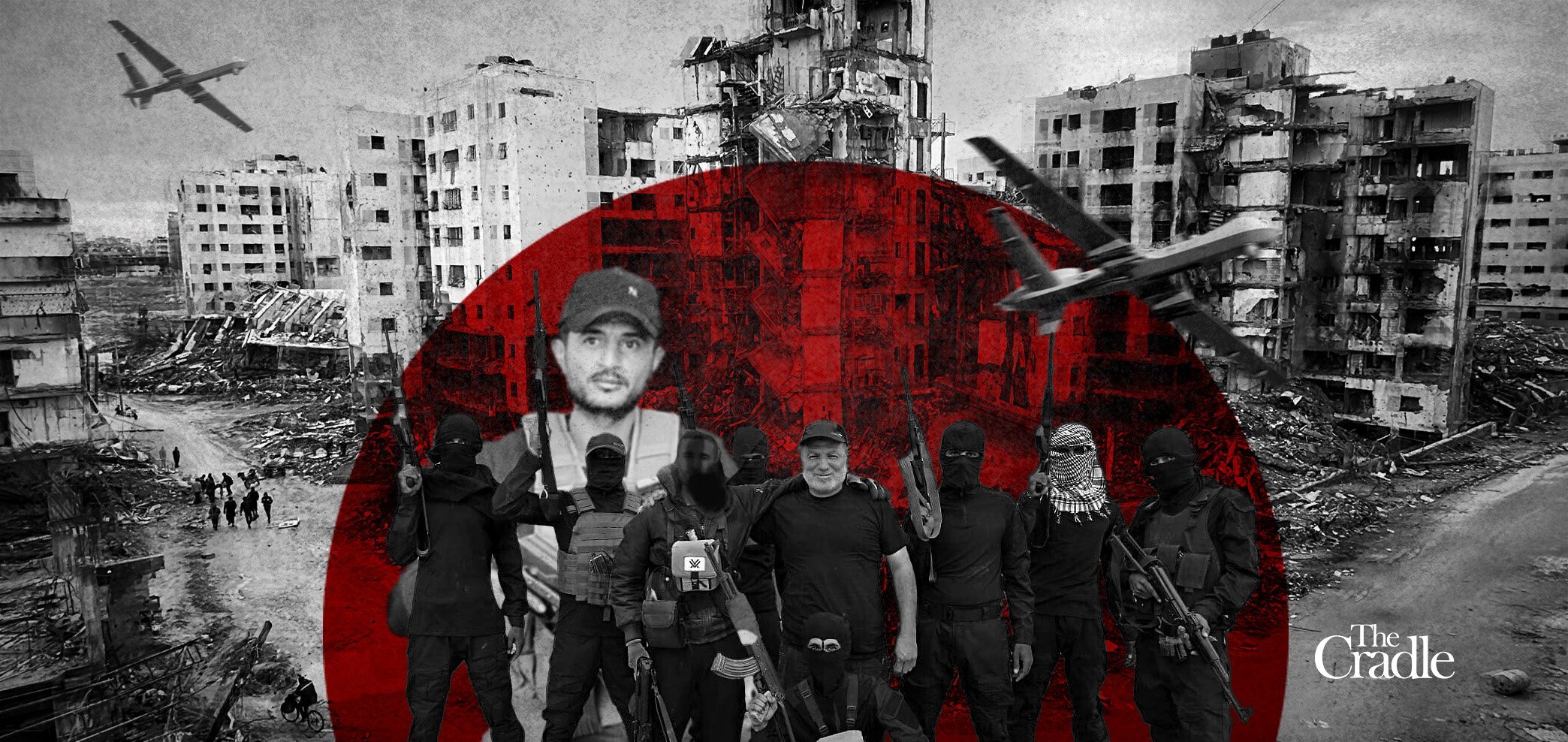
Israel Unleashes Mercenary Death Squads on Gaza
OCT 21, 2025
With the already violated ceasefire in place, and Israeli occupation forces implementing a phased withdrawal, Gaza remains under siege, this time through Tel Aviv’s use of armed collaborator militias.
Drawing on tactics refined in Syria, these death squads have been unleashed to assassinate resistance figures, sow chaos, and undermine what remains of the Hamas-led administration.
Three proxy groups backed by Tel Aviv have since escalated their military campaigns against Gaza’s security forces and society. These militias of collaborator death squads have been used to stir chaos on direct orders of the Israeli army, seeking to establish bases of control in the portions of the territory that Israel has yet to withdraw from.
Upon the cessation of hostilities between the Israeli military and Palestinian resistance factions, at least 7,000 security personnel affiliated with the Hamas-led civil administration took to the streets of Gaza to establish law and order. Yet, almost immediately, they were confronted with ambushes, and armed clashes broke out in a number of areas of the territory.
In particular, the armed clashes in northern Gaza have received the most attention in the media, with Israeli and a handful of Palestinian Authority (PA) aligned personalities attempting to sell the situation as a “civil war.”
Collaborator militias exploit the Gaza ceasefire
Amid the chaos, the son of senior Hamas leader Bassem Naim was shot in the head by proxy forces. Mohammed Imad Aqel, son of a prominent Qassam Brigades commander, was murdered by members of the Doghmush clan. And Saleh al-Jaafarawi, a prominent journalist, was kidnapped, tortured, and shot dead at point-blank range.
At the beginning of October, in Khan Yunis, the Majayda family reportedly collaborated with Hossam al-Astal under Israeli air cover, launching attacks on security positions – a key example of Tel Aviv’s use of clan structures to advance its proxy war strategy.
Israeli researcher Or Fialkov noted:
“The Majaydeh clan from Khan Yunis – which fought Hamas a week ago – announces it has disarmed. The clan, which received assistance from the Israeli army in airstrikes against Hamas members, said it has handed over its weapons to Hamas. Hamas is settling scores across the strip and showing everyone who is in charge.”
To counter the threat posed by these armed collaborators, Hamas formed two new specialized units. The first, Sahm (Arrow) Forces, is comprised of officers from the civil security services. The second, the Resistance Security Force (Amn al-Muqawamah), includes fighters from Hamas’s military wing, as well as those from the Popular Front for the Liberation of Palestine (PFLP), Palestinian Islamic Jihad (PIJ), Fatah al-Intifada, and other factions.
A senior security source in northern Gaza tells The Cradle that a document containing a hit list was discovered during a raid on a collaborator’s hideout. Although the document itself could not be shared, the source claims it noted that Israel’s “goal is to create chaos, to carry out assassinations, allow for lawlessness, and to fight the resistance through its collaborators.”
This account was reinforced in a KAN News interview, in which the leader of one collaborator militia confirmed that the Israeli army is providing his forces with security support and authorization to operate beyond the so-called Yellow Line. Roughly 54–58 percent of Gaza is still under the occupation army’s control.
US advisors recently informed Axios that Washington is working on an Israeli-backed plan to create pathways for Palestinians opposed to Hamas to live outside of Israel’s Yellow Line. To this effect, the Israeli military is currently marking this line by installing cement blocks and security equipment to demarcate its boundaries.
According to Israel Hayom, the American-Israeli plan seeks to use Gaza reconstruction funds to begin rebuilding hospitals, schools, and homes inside the territory that is jointly controlled by the Israeli army and its ISIS-linked proxy groups.
Under this scheme, Palestinians will be presented with the choice to live under Hamas along the coast or inside the newly constructed areas. It appears as if a proposed multinational military force will also be used to help implement such a model.
Despite this, the collaborator groups currently operating there do not enjoy popular support, and Israel is continuing to demolish the remaining civilian infrastructure located there. Meanwhile, all the major families, segments of whom began fighting Gaza’s security forces, have issued statements aligning themselves with Hamas and against any collaborators in their midst.
The Ramallah-based PA has also expressed its interest in vying for power in the Gaza Strip, yet Israel has at least publicly rejected this idea over fears that this will put it in a stronger position to demand a Palestinian State. Nevertheless, the PA has been part of a propaganda campaign designed to delegitimize Hamas as a political entity in Gaza and accuses it of indiscriminately targeting its opponents.
Tel Aviv retools death squads as ‘Popular Forces’
Throughout the two-year Israeli war on Gaza, humanitarian aid convoys were routinely looted in the southern enclave, triggering food shortages and creating a booming black market. The looting initially involved armed clans and petty criminals who charged extortionate bribes for aid access. But following the 6 May invasion of Rafah, the phenomenon transformed into a more coordinated enterprise.
That evolution gave rise to the Abu Shabab militia, a gang led by convicted drug trafficker Yasser Abu Shabab, who has long-standing links to ISIS affiliates in Sinai. His fighters, many from the Bedouin Tarabin clan, have ties stretching from Israeli-occupied Bir al-Saba (Beersheba) to Egypt’s Sinai Peninsula.
A Hamas official familiar with the file on drug trafficking tells The Cradle:
“These individuals were known to routinely cross into the Sinai and maintained close ties to extremists. These criminal elements were also tied to the Ansar Bait al-Maqdis group [ISIS in the Sinai] and later Wilayat Sinai that came after it. These people do not have a coherent ideology and will shift over time, they are criminals, which is why they are also involved in activities like drug smuggling, and their connections come through familial ties.”
Following the surface of footage of these militants driving around in SUVs bearing Sharjah license plates registered in the UAE, sources belonging to Al-Akhbar claimed that Emirati intelligence has been cooperating with these militia forces.
A month prior to the introduction of the Abu Shabab aid looting gang to the scene, Israel’s top human rights group B’Tselem had issued a report accusing Tel Aviv of “manufacturing famine” in the enclave. A later investigation conducted by Sky News revealed that while most Palestinians were suffering a severe food shortage, the Abu Shabab gangs were living a life of luxury, with an abundance of stolen aid, along with vehicles and weapons supplied by Israel.
This group, despite becoming infamous throughout Gaza for stealing aid from humanitarian organizations, demanding a $4,000 bribe fee for each truck, was soon to be destined for a task much more pernicious.
In November 2024, the Israelis saw that it was time to give their aid looting cadres a facelift, as the Washington Post interviewed Yasser Abu Shabab himself, who is portrayed as a criminal by necessity and claims that “Hamas has left us with nothing.”
Amid the January ceasefire, the gang resurfaced as the “Popular Forces,” now dressed in Israeli tactical gear and openly operating with occupation military backing.
The Wall Street Journal (WSJ) even published an op-ed supposedly authored by Abu Shabab titled “Gazans are finished with Hamas.” Local sources confirm to The Cradle that the militia leader is illiterate and could not have authored a piece in Arabic, let alone English.
By June, former Israeli minister Avigdor Lieberman publicly accused Israeli Prime Minister Benjamin Netanyahu of backing ISIS-linked militias in Gaza. Netanyahu not only confirmed the collaboration – but defended it. Then, in September, Haaretz reported that Popular Forces militias were receiving direct orders from the Israeli army and Shin Bet.
Israel’s proxy model expands across Gaza’s clans
As the Israeli military was experiencing a manpower crisis, recently struggling to recruit 60,000 soldiers for operation “Gideon’s Chariots 2” to occupy Gaza City, it made the decision to expand this proxy militia strategy.
In August, Israel worked alongside Hossam al-Astal, a former member of the PA’s Preventive Security Forces (PSF), to form the “Counterterrorism Strike Force” (CSF) that would run operations in the Khan Yunis area of Gaza. Astal, according to two security sources speaking to The Cradle, had long been suspected of holding ties with the Israeli Shin Bet.
Alongside the CSF, new groups like the “People’s Army Northern Forces” (PANF) have emerged in Jabalia and Beit Lahia. Led by Ashraf Mansi, who had been openly praised by Abu Shabab. The PANF consists of drug dealers and ex-Jaish al-Islam fighters, some linked to ISIS. The group even held an armed parade after the ceasefire, before engaging in clashes with Gaza’s Radaa security unit, which captured several of its fighters.
In Gaza City, the Doghmush clan launched a violent campaign to assert control over parts of the north. It raided civilian homes, looted properties, and allegedly murdered prominent figures. After the killing of journalist Saleh al-Jaafarawi, Hamas cracked down, arresting dozens and killing up to 40 armed members of the clan.
The family has long developed a negative image throughout Gaza, due to actions committed by certain elements within it, dating back decades to before the Intifada, when individuals from the Doghmush family would steal cars from Israeli-held territory. The Mukhtar of the clan was assassinated by Israel back in 2023, and according to local reports, groups of men within the family have been arming themselves throughout the war.
Soon after tensions escalated, especially surrounding the murder of Jaafarawi and the clashes that ensued on Sunday, the Doghmush family released a statement disavowing collaborators and “transgressors,” reminding the public of how many members of the clan were killed by Israel. It is still unclear whether the militants from the Doghmush family were working alongside the PANF militia or were operating as a solo force motivated by control of territory.
However, the Doghmush clan represents a more complex case. While certain elements have openly collaborated with Israeli intelligence, others have refused such alliances. The clan is divided, with some fighting Hamas for over two decades, and others remaining within resistance ranks.
Reports have also linked segments of the clan to Dahlan networks and Emirati funding, alongside Salafi militant ties.
Salafist group Jaish al-Islam, once led by Mumtaz Doghmush, was responsible for the 2006 kidnapping of Israeli soldier Gilad Shalit. Initially allied with Hamas, the group later turned against it, pledging allegiance to Al-Qaeda and even kidnapping two Fox News journalists.
Hamas has long battled Salafist militants inside Gaza, including Jund Allah and the Sheikh Omar Hadid Brigade. In 2009, it crushed Jund Allah in Rafah after the group attempted to declare an “Islamic emirate.” By 2015, the Omar Hadid Brigade was dismantled. In 2018, ISIS formally declared war on Hamas.
Today, Israel’s proxy fighters recycle the same Salafi justifications. Popular Forces fighter Ghassan Duhine, for instance, cited ISIS fatwas branding Hamas as apostates who deserve death.
But despite Israeli efforts to fragment Gaza’s internal cohesion, many families and clans have pushed back. The Majayda family has denounced collaborators, as have key members of the Tarabin clan.
“Israel hoped to install these agents to run concentration camps for Palestinians, like they planned in Rafah with the Gaza Humanitarian Foundation,” a senior Hamas official tells The Cradle. “But our people can see through all of these conspiracies.”
While Tel Aviv pretends its military campaign is on pause, the facts on the ground reveal otherwise. Israel has outsourced the next phase of its war to collaborators, criminals, and extremists – executing its war objectives through mercenaries while claiming plausible deniability. It is a page taken straight from its playbook in Syria, now recycled in Gaza with deadly effect.
[…]
Via https://thecradle.co/articles/from-syria-to-gaza-israels-proxy-playbook-returns
US intel contradicts Trump’s claims of fentanyl production in Venezuela
(Photo Credit: @realDonaldTrump)
The Cradle
OCT 25, 2025
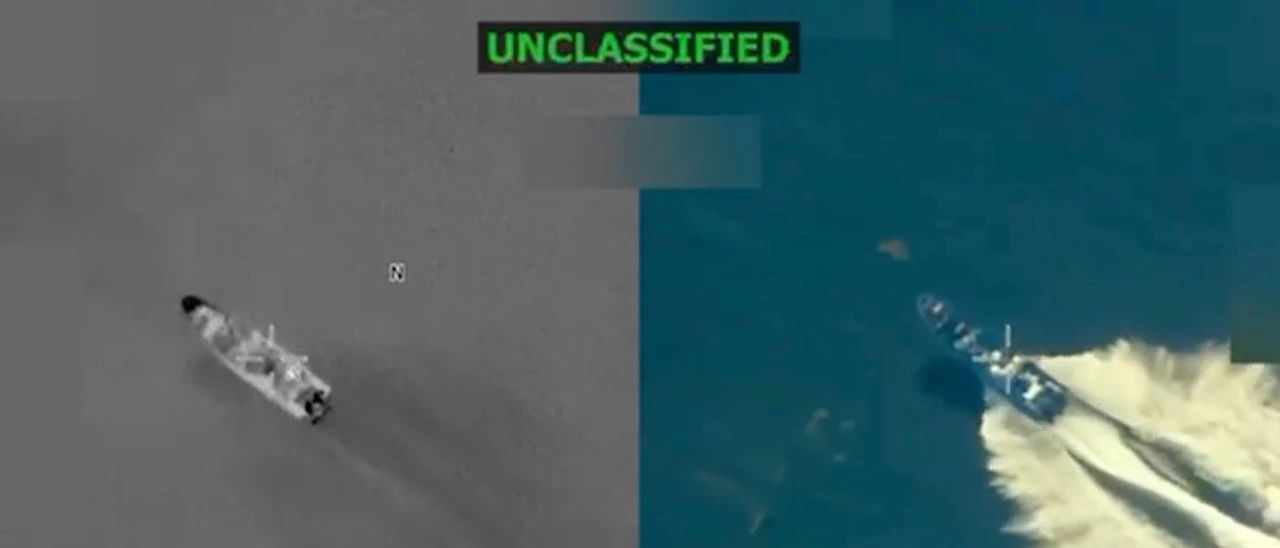
The US navy has killed at least 32 people in air strikes on boats allegedly trafficking drugs off the coast of Venezuela
US intelligence has assessed that little to no Fentanyl trafficked to the US is being produced in Venezuela, contradicting recent claims from US President Donald Trump to justify airstrikes on alleged drug boats, Drop Site News (DSN) reported on 24 October.
Trump claimed last month that boats targeted in US airstrikes in the Caribbean were carrying Fentanyl to the US.
“Every boat kills 25,000 on average — some people say more. You see these boats, they’re stacked up with bags of white powder that’s mostly Fentanyl and other drugs, too,” Trump said.
US strikes on vessels operating in international waters in the Caribbean Sea since September have killed at least 32 people.
However, a senior US official directly familiar with the matter stated that Fentanyl is not being produced in Venezuela and sent to the US.
“The official noted that many of the boats targeted for strikes by the Trump administration do not even have the requisite gasoline or motor capacity to reach US waters,” DSN reported.
The lack of intelligence linking Venezuela with fentanyl production is further evidence that the strikes are driven by an effort to topple the government of Venezuelan President Nicolas Maduro.
Trump has used allegations of Venezuelan drug trafficking, including claims without evidence that Maduro is leading a drug cartel, as the justification for overthrowing the socialist government.
In a post on social media, Secretary of War Pete Hegseth equated the alleged threat of Venezuelan drug cartels to that of Al-Qaeda.
“Just as Al-Qaeda waged war on our homeland, these cartels are waging war on our border and our people,” Hegseth said, adding that “there will be no refuge or forgiveness – only justice.”
His comments come just a few weeks after the founder of Al-Qaeda in Syria, Ahmad Al-Sharaa, met with US officials in New York. Sharaa seized power in Damascus in December, declaring himself president, with US backing.
Two sources familiar with discussions at the White House told DSN that Secretary of State Marco Rubio is the driving force behind the regime change effort.
Secretary Rubio has earmarked millions of dollars previously allocated for “pro-democracy” measures in Venezuela to prepare for a war.
The sources cited Rubio’s desire to access Venezuela’s vast oil resources as the reason for seeking regime change.
On Friday, the Pentagon confirmed it was deploying the USS Gerald R. Ford carrier strike group to the Caribbean Sea, adding to the thousands of troops deployed to the Venezuelan coast.
The same day, Trump announced he was imposing sanctions on Colombian President Gustavo Petro and his family, accusing him of failing to stop the flow of cocaine entering the US.
The sanctions come after Trump described Petro as an “illegal drug leader.”
In a statement on X, Petro called the sanctions a “paradox,” reminding Trump that Colombia has long partnered with the US in counter-narcotics operations.
“Fighting drug trafficking for decades, and effectively, has brought me this measure from the government of the very society we helped so much to stop their cocaine consumption,” the Colombian president wrote.
“A complete paradox — but not one step back, and never on our knees.”
[…]
Pedophile Palace in Honor of Epstein – Trump’s New Ballroom Larger than The White House and Funded by Zionist Billionaires
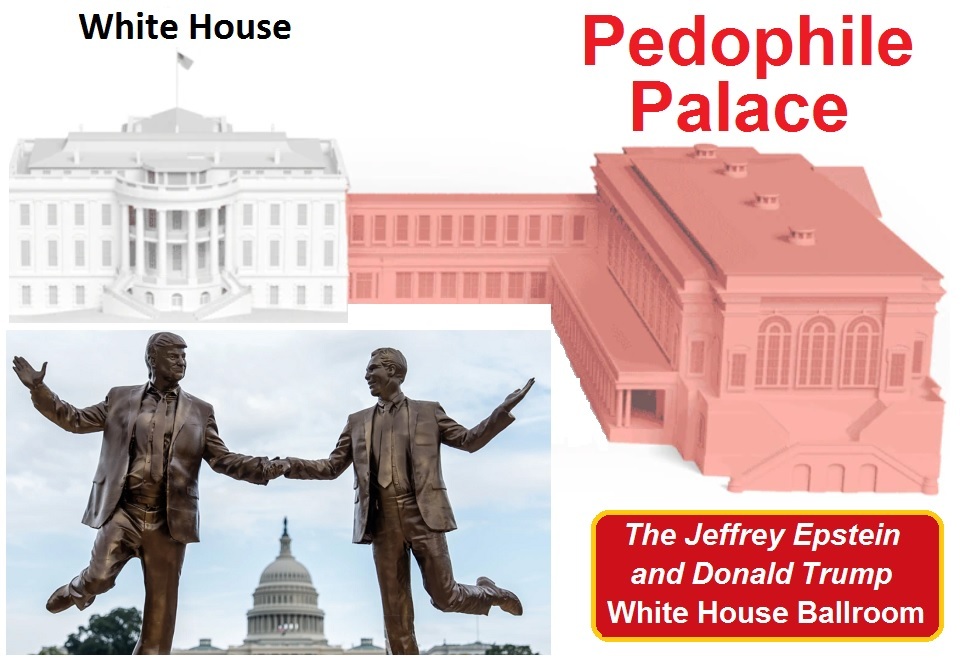
Background image source is Washington Post. Story of Trump and Epstein statue at National Mall found here.
by Brian Shilhavy
Editor, Health Impact News
President Donald Trump and his Zionist Billionaires are funding a new addition to the White House that is being advertised as a “Ballroom”.
I am naming this new addition to the White House “Pedophile Palace” which is a true symbol of American Culture here in 2025, and it is in honor of Jeffrey Epstein and the Epstein financial system that runs the United States today.
It is also in keeping with the sexual scandals that have constantly been happening in the White House throughout its history, from the affairs between John F. Kennedy and Marilyn Monroe to the sexcapades of Bill Clinton with Monica Lewinsky to the homosexual prostitution rings that rocked the White House under Reagan and Bush to the Richard Nixon and Billy Graham child sex trafficking rings that led to Watergate.
According to reports in the media, Donald Trump is going to name the Ballroom after himself, but it really should be “The Jeffrey Epstein and Donald Trump White House Ballroom“, because it is the Jeffrey Epstein financial system that runs the U.S. and empowers the Zionist Billionaires who run it.
Besides Zionist Billionaire Donald Trump, here is a list of some of the other Billionaire donors funding Pedophile Palace that the White House released this week and published by CNN.
From crypto billionaires to cabinet members: What to know about the donors paying for Trump’s ballroom
Excerpts:
As demolition crews this week bulldozed the White House’s East Wing to replace it with a massive ballroom, President Donald Trump has emphasized that the dramatic changes will come at “zero cost to the American Taxpayer.”
Instead, the donors picking up the tab include some of the country’s biggest corporations, including many who have business before the federal government, along with many longtime supporters of the president, according to a CNN review of a donor list released by the Trump administration.
Trump has been recruiting donors for the construction project for months, showing off renderings and scale models to Oval Office visitors. Now estimated to cost $300 million, the work is being funded by private, tax-deductible donations routed through the nonprofit Trust for the National Mall.
The president has said he will personally pay for some of the project, but the White House hasn’t specified how much. At least one donation of $22 million from Google was made on “behalf” of Trump as part of a legal settlement over the president being banned from YouTube in 2021, court documents show.
The ballroom donors were feted at a White House dinner last week. Now that the demolition has begun, here’s who’s paying for the overhaul of the country’s most famous residence.
Adelson Family Foundation
Miriam Adelson, a billionaire who made her fortune in casinos alongside her late husband Sheldon and has been a major Trump donor, runs this philanthropic foundation. Trump awarded Adelson the Presidential Medal of Freedom in 2018.
Miriam and Sheldon Adelson have been some of Trump’s top political donors since his first presidential bid, giving more than $30 million to pro-Trump PACs and his campaigns over the years. Miriam also gave $1 million to the president’s 2025 inaugural committee.
The foundation’s stated aim is to “strengthen the state of Israel and the Jewish people,” and Trump has publicly praised Adelson and her support of Israel. Adelson, who is the majority owner of the NBA’s Dallas Mavericks, has also donated to lawmakers and PACs that support pro-gambling and sports betting legislation.
Altria Group
Previously known as Phillip Morris, tobacco giant Altria Group is the seller of Virginia Slims, Marlboro and Parliament cigarettes in the United States.
A subsidiary, Altria Client Services, LLC, gave $1 million to a Trump-associated PAC in May 2025, $1 million to the president’s 2025 inaugural committee and $500,000 to his 2017 inaugural committee.
Amazon
Amazon billionaire founder Jeff Bezos told the world he was “optimistic” about a second Trump presidency late last year, saying he appreciated his “energy” around reducing regulations.
Amazon gave $1 million to Trump’s 2025 inaugural committee and made an in-kind donation of almost $900,000 for digital services and advertising supporting the event. The company also gave about $58,000 to his 2017 inaugural committee.
Amazon Web Services – the company’s cloud computing platform – earned more than $500 million from federal contracts over the last three years, government data shows.
Apple
Apple CEO Tim Cook served on Trump’s American Workforce Policy Advisory Board during his first term. He attended the president’s 2025 inauguration along with other tech leaders, and this summer presented Trump with a customized 24-karat gold-and-glass statuette in the Oval Office while announcing plans to invest $100 billion in US jobs and suppliers.
The company secured a major win this summer, when smartphones were exempted from heavy tariffs levied on goods imported from India.
Coinbase
Coinbase, one of America’s largest cryptocurrency exchanges, was founded in 2012 by CEO Brian Armstrong. The corporation, which went public in 2021 with a valuation of about $100 billion, helps users buy, sell and store cryptocurrencies.
The Securities and Exchange Commission sued the company in 2023 for allegedly acting as an unregistered broker, but the Trump administration dropped the lawsuit earlier this year. Coinbase had said it was not in violation of any law.
Coinbase gave $1 million to Trump’s 2025 inaugural committee.
J. Pepe and Emilia Fanjul
Jose “Pepe” Fanjul and his wife Emilia are part of a Cuban-American family that owns a massive sugar conglomerate. The Biden administration had previously blocked a company partially owned by the Fanjul family from shipping sugar to the US over allegations of forced labor practices, which the company denied.
The Trump administration lifted that block in March.
The couple have given more than $3 million to Trump’s campaigns and associated PACs going back to 2016.
In July, Trump announced he persuaded Coca-Cola to release Coke made with cane sugar instead of high-fructose corn syrup – a move that could benefit the sugar industry. The US government has long supported the domestic sugar industry and boosted prices. Brazil, the largest exporter of sugar to the US, was hit by a 50% tariff in July.
Google and its parent company Alphabet have joined Trump administration initiatives to promote AI education, and CEO Sundar Pichai praised the administration’s investments in AI at a White House event last month.
Google-owned YouTube agreed to pay $22 million towards Trump’s ballroom project as part of an agreement settling legal claims brought by Trump over his removal from the video platform.
Among other deals, the company was awarded a contract in July worth up to $200 million related to AI capabilities at the Department of Defense.
Harold G. Hamm
Harold Hamm is the billionaire founder of Continental Resources, a natural gas and petroleum production company based in Oklahoma City. Considered a pioneer in hydraulic fracking, Hamm is one of the richest oil men in America and among the richest men in the world, according to Forbes.
In his second term, the Trump administration has significantly curbed environmental regulations and opened up more oil and gas production on federal lands – all issues Hamm supports and reportedly pushed for in 2024.
Hard Rock International
Hard Rock International is owned by the Seminole Tribe of Florida and includes a global chain of theme-bar restaurants, casinos, hotels and museums. Hard Rock International in 2017 purchased an Atlantic City, New Jersey, casino that was once owned by Trump. It re-opened the following year as Hard Rock Hotel & Casino Atlantic City.
Hard Rock’s board chairman Jim Allen had previously served as vice president of operations at the Trump Organization, Trump’s business and real estate conglomerate. He also serves as the CEO of Seminole Gaming.
The Laura & Isaac Perlmutter Foundation
Isaac Perlmutter sold Marvel Entertainment to The Walt Disney Company in 2009. Perlmutter and his wife, Laura, have supported healthcare and education initiatives through their foundation, including a more than $50 million donation to NYU’s Langone Medical Center earmarked for cancer research.
The couple have given more than $23 million to Trump’s campaigns and supporting Super PACs since 2016.
(Editor’s note: Learn more about Isaac Perlmutter and his Jewish ties to Pfizer and how they used Marvel to promote the COIVD-19 injections: Trump Claims he could “Easily” be Israeli PM – Is this why Pfizer Received First COVID Vaccine Authorization in U.S. and Exclusive Rights in Israel?)
Lockheed Martin
The Pentagon’s largest aerospace and defense contractor, Lockheed Martin projects more than $74 billion in sales this year. In a statement about its ballroom donation, a spokesperson for the company said it is “grateful for the opportunity to help bring the President’s vision to reality and make this addition to the People’s House, a powerful symbol of the American ideals we work to defend every day.”
They earned more than $40 billion from federal contracts over the last year, according to government data.
The Lutnick Family
Howard Lutnick joined the Trump administration as Secretary of Commerce after decades as CEO of Cantor Fitzgerald, a financial services firm. Lutnick handed the reins of the company to his 27-year-old son, and his other son also works at Cantor.
Howard Lutnick gave a total of more than $9 million to a pro-Trump Super PAC, Trump’s 2020 and 2024 presidential campaigns and associated fundraising committees.
Since Lutnick’s appointment, he has focused on implementing Trump’s tariff strategy. Lutnick, who has said he is heavily invested in cryptocurrency, has also pushed for pro-crypto policies during his tenure.
Meta
Meta CEO Mark Zuckerberg once banned President Trump from Facebook and Instagram, and the president once threatened him with criminal investigations. But since the 2024 election, Zuckerberg has taken steps to endear himself to the president and his MAGA supporters.
Earlier this year, the social media giant ditched its fact checkers and named Dana White, the Ultimate Fighting Championship president and a Trump ally, to its board. Zuckerberg also dined with Trump at Mar-a-Lago.
The General Services Administration approved Meta’s AI model for use across government in September. The company is also helping to develop military products.
Microsoft
Microsoft has been somewhat quieter than other tech firms about its support of President Trump and his administration. CEO Satya Nadella didn’t sit front row during Trump’s inauguration, unlike Meta’s Zuckerberg, Amazon’s Bezos and Google’s Pichai.
Nadella has met with Trump, including attending a tech dinner at the White House last month, shortly before the president called for the company to fire a former Biden official who serves as its chief of global affairs.
Microsoft was paid roughly $1.4 billion from federal contracts over the last three years, government data shows.
Palantir
Founded in 2003 by Peter Thiel and several associates, the data analytics firm provides services for several government agencies, including Department of Homeland Security, the Internal Revenue Service and the Army. Thiel has been a longtime supporter of the Republican Party, a friend of Vice President JD Vance and an early supporter of President Trump.
Earlier this year, CNN reported that the Department of Government Efficiency, then run by Thiel ally Elon Musk, was using Palantir to build a database to speed up immigration enforcement.
Palantir inked a deal with the Army in July worth up to $10 billion over the next decade.
Stephen A. Schwarzman
Stephen A. Schwarzman is a GOP megadonor and the co-founder of global investment firm Blackstone. He served as the chairman of a business advisory council during Trump’s first term. Schwarzman announced in 2022 that he would not back Trump for a second term, but reversed course in 2024, citing concern with the rise of antisemitism in the US.
He gave more than $4 million to pro-Trump political groups and Trump’s campaigns since 2017.
[…]
How Tones Developed in Asian Languages
Episode 19: Chinese’s Family Circle: Sino-Tibetan
Language Families of the World
Dr John McWhorter (2019)
Film Review
McWhorter is a fascinating (and funny) lecturer, especially when he demonstrates the tones used in Chinese and other Asian languages.
Sino-Tibetan is a family of languages that arose in China and migrated north. Its most important subfamily is Tibeto-Burman, a collection of languages spoken in Northeast India, Tibet and Burma.
Ancient Chinese used suffixes and prefixes, like most languages, to convey subtle differences in meaning. At some point Chinese suffixes and prefixes were replaced by tones to make the language easier for non-Chinese slaves to learn the language. At present most modern Chinese words are one syllable, with tone changes expressing different meanings.
For example baragjat (eight) in proto-Sino-Tibetan has been simplified to bā in Mandarin. Mjwiad (sleep) has been simplified to mèi in Mandarin and mwe (to enjoy sleep) in Burmese.
McWhorter gives the example of the tone change in the English words “pack” and “back.” Most English speakers don’t hear the tonal difference because they’re listening for the consonants. In Chinese-related languages initial and final consonants have dropped off but the tonal differences remain.
Tibetan consists of 25 related languages. Classical Tibetan wasn’t tonal, but modern Tibetan languages are.
In Burmese the final consonants persist in written language, but are no longer pronounced.
Revisiting the Covid Theatrics of 2020: “The Collapsing People of Wuhan”
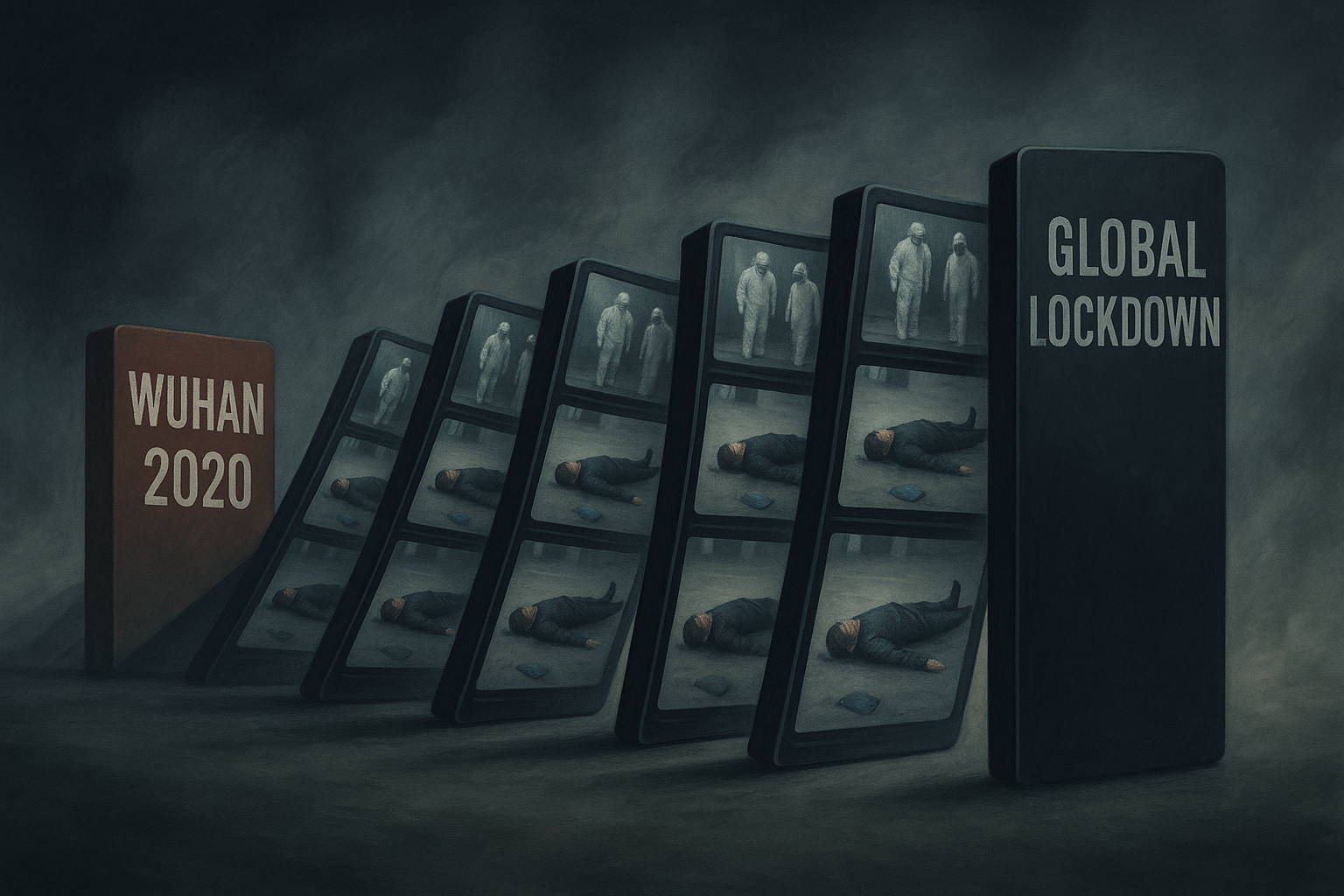
In early 2020, a torrent of harrowing videos and photographs came out of China depicting victims supposedly being ambushed by a deadly contagious disease that was being called “coronavirus.” The alarming visuals shocked and terrorized populations from East to West.
Some scenes showed people collapsing on the streets and dying on the spot. Others showed victims foaming at the mouth. We saw frightening images of dead bodies piling up and equally ominous images of government officials in hazmat suits hovering over these lifeless bodies.
It was understandable that such haunting images not only created a worldwide frenzy of fear and hysteria but also set the stage for what would become an unprecedented series of global lockdowns and an unmatched epoch of medical tyranny.
But . . . there was one big problem with these deadly depictions and viral videos. Upon closer examination, all of them appeared to be fakes and fabrications.
That’s right. The images launched “round the world” that ignited the coronavirus mass hysteria campaign, which in turn led to worldwide lockdowns and incalculable destruction, were staged artifacts of mass media manipulation.
Example #1: A video out of Wuhan, China, was said to be evidence of the deadly effects of the “new coronavirus.”
Though this video is no longer available, when it circulated widely on social media, it apparently showed a pile of “covid victims” covered in blankets waiting to be picked up and carted away. The hype that accompanied the scene claimed that China was dealing with “no ordinary virus.” The video provocatively asked, “Is it [an] intentionally released bio-weapon?” The question had the effect of seeding in the global public’s consciousness a possible “alternative explanation” for this enigmatic pathogen.
It was later revealed that the Wuhan “body pile” video was in reality showing people sleeping in the streets in Shenzhen, China—more than 600 miles away from its supposed source. But why were so many Chinese subject to such a sad predicament? It seems the government had set up a permit system for entering and exiting the city to prevent the spread of “the virus,” and these victims were not issued the requisite permits.
Example #2: Another video out of China the same year panned on a poor man who was vomiting blood.
This gory video showing a man riding on public transportation and puking up blood was posted on Instagram on January 29, 2020. The caption alongside the video suggested that the man was infected with a new coronavirus strain (the “Wuhan virus”). The story hysterically (and falsely) implied that he was experiencing “violent coronavirus symptoms.”
Yet, upon investigation, it was revealed that the video in question dated back to February 14, 2019, and stemmed from an incident involving a 52-year-old male passenger traveling on the Chonqing Rail Transit who had fainted, vomited blood, and died. A review of his medical history found that he suffered from advanced liver cancer.
Example #3: A man who collapsed at an airport in Thailand was said to have been a victim of Covid.
When a Facebook user posted the photo of a Chinese man lying face down on the floor of a Thailand airport, the image naturally went viral. Naturally, too, the media insinuated that his plight was caused by “the virus.”
The strange and scary caption read: “At the airport right now, a Chinese person is suddenly knocked to the ground. The third floor is under control. The government is really taking care of it. No more photos allowed. It’s very scary.”
This made-for-TV extraterrestrial-like interpretation of his condition was ultimately supplanted by a much more mundane explanation. Turns out the man who had fallen out of his chair had been drinking heavily, had passed out, and had fallen on the floor at the Suvarnabhumi Airport.
It seemed like there were dozens of similar clips. In reality there were only ten or so, all taken in different places but circulating madly through social media in early 2020. Many of the Western media outlets promoting these videos and images wrote fearmongering headlines like “Coronavirus horror: Social media footage shows infected Wuhan residents ‘act like zombies.’”
In the thick of this fusillade of Grade B corona-horror imagery, the two most famous photographs not only exemplify the campiness of the entire covid theater production but also beg the question of where exactly these images came from and who put them out there.
Example #4: Most of us saw the Wuhan man who “fell dead” from covid.
On February 3, 2020, the UK’s Daily Mail published a one-minute video montage of people in various places in Wuhan purportedly dropping like flies. Accompanying this mosaic was a short description:
“Apocalyptic footage shows people collapsing suddenly in Wuhan city centre as fellow residents and emergency services jump into action to help them. The city has been suffering from an outbreak of a new respiratory virus known as the Coronavirus.”
The pièce de résistance of this set of “live” images was the dramatic and farcical footage of a man falling flat on his face—though he puts his hands out to break his fall.
This iconic scene was sold to the public as a spontaneous covid death plunge, later coined as “the fall that shut down the world.”
Example #5: A dead man lay on an empty street at China’s “ground zero.”
Perhaps the most famous of all the photographs from this era was the image that, according to The Guardian, “captures the chilling reality of the coronavirus outbreak in the Chinese city of Wuhan.”
Upon close inspection, however, the authenticity of the image and the veracity of the story seem a tad inconceivable—to put it diplomatically.
We see a man who is understood to be lying dead on the sidewalk. He is wearing a face mask and, according to what we’re told, he’s holding a plastic shopping bag in one hand while lying perfectly still in a prone position. More bizarre still, if he’s not dead, he appears to be looking straight up to the sky, and his arms are hanging neatly by his side. How, we ask, could someone drop dead in such a perfectly comfortable resting position?
The two medical staff standing near the body are in hazmat suits and are staring at the camera, clearly not attending to the man who we’re led to believe is experiencing a deadly medical crisis.
The male is wearing a full hazmat suit with gloves. Why is his colleague, an astronaut-looking woman in her hazmat suit, not also wearing gloves? After all, she’s standing directly over the “infected body.” Surely she would don gloves to deal with a cadaver that was potentially flattened by the most infectious pathogen known to humanity. Right?
And, by the way, who is taking the pictures of this pair? Oh! Agence France-Presse/Getty war zone and international crisis photographer Héctor Retamal, of course. His photos of this scene later won awards. (For those readers not in the know, French Agence France-Presse is one of only three major Western news agencies. AFP was previously involved in various war zone deceptions, such as in Syria.)
Where does all this lead? What’s the “why” behind everything?
While some skeptics posit that these fake images and videos were circulated by the Chinese government to scare Western populations, a closer analysis shows that most of this footage was in fact shared by US-funded NGOs critical of the Chinese regime. That is, by “Voice of Hong Kong” and Taiwan-based TomoNews US as well as by major Western media outlets.
Looking at the totality of the covid operation, we can ask ourselves: Who benefited most from those early videos being catapulted out of China?
And not just China. Shortly after that, Italy produced its own fabricated covid mythologies. They were followed by theatrics concocted in the US.
[…]
91% of Moderna mRNA Shot Recipients Develop Cardiovascular Side Effects with Measurable Arterial Dysfunction

Spectral pulse-wave analysis revealed significant post-vaccine cardiovascular dysfunction consistent with increased arterial stiffness and impaired vascular function.
A new peer-reviewed paper from Taipei Medical University has reported that 91% of Moderna mRNA-1273 recipients developed cardiovascular side effects during the observation period—within one week of receiving the Moderna mRNA-1273 vaccine.
Using advanced spectral pulse-wave analysis, the researchers detected statistically significant post-vaccine changes in arterial pulse amplitude and phase — patterns consistent with arterial dysfunction and increased vascular stiffness.
These were objective, quantifiable changes in how the arteries function — the same alterations seen in hypertension, reduced vascular elasticity, and early endothelial stress.
The study measured the radial pulse wave — the tiny pressure wave your heartbeat sends through your arteries — in 203 adults before and after Moderna vaccination.
Researchers used a computer model to break down each pulse into harmonic frequencies, like separating a sound wave into musical notes.
They analyzed:
- Amplitude (Cn): how strongly arteries expand with each beat
- Phase (Pn): how synchronized the pulse wave is as it travels through the vascular system
- Variability (CVn): how stable the body’s cardiovascular regulation is
These are sensitive markers of vascular health used in early heart disease detection.
KEY FINDINGS
- 185 of 203 participants (91%) experienced cardiac, vascular, or combined cardiovascular side effects following Moderna mRNA-1273 vaccination.
- Statistically significant post-vaccination changes in spectral pulse-wave indices (Cn and Pn) were detected in participants reporting cardiac or vascular side effects.
- These changes were consistent with increased vascular stiffness and reduced arterial elasticity, indicating altered blood-flow dynamics after Moderna’s mRNA-1273 vaccination.
- No significant differences were observed between groups before vaccination, confirming the changes appeared after the Moderna shot.
- Measurements taken 7 ± 3 days post-injection showed the alterations persisted at least one week.
- Standard clinical tests (ECG, blood counts, chest X-ray) remained normal in many participants, indicating these were subclinical, measurable vascular changes.
The authors concluded that Moderna’s mRNA vaccine “caused a local mismatch between vascular elastic properties,” likely due to inflammation and immune activation in the vessel wall.
The study explicitly cites spike protein–driven endothelial inflammation, platelet activation, and autoimmune mimicry as plausible mechanisms.
IMPLICATIONS
- Subclincial Heart Injury
- Even “healthy” recipients without obvious side effects showed quantifiable cardiovascular dysfunction.
- This suggests that standard blood tests and ECGs may miss early or subtle vascular changes detectable by spectral pulse analysis.
- Cumulative Risk
- Repeated exposure to spike-producing injections could amplify these vascular changes over time.
- Early Detection Tool
- The authors note that this non-invasive technique could be adapted for real-time monitoring of vascular stress following mRNA vaccination.
The authors concluded:
Subclinical vascular changes induced by Moderna’s mRNA-1273 vaccine could be effectively detected by noninvasive real-time pulse distribution analysis.
Translation: Even if you feel fine after the shot, your arteries might tell a different story.
[…]
Via https://www.thefocalpoints.com/p/new-study-91-of-moderna-mrna-shot


