The Ugly Truth About Monsanto and Genetic Engineering

GMO-OMG

Jeremy Seifert (2013)

Film Review

GMO-OMG is an excellent first documentary by a young father on a quest to understand the science of GMO technology and its impact on the environment and human health. The film starts by focusing on the general ignorance of the American public about GMOs. This contrasts markedly with other countries, where popular pressure has led many governments to ban GMOs.

What filmmaker Jeremy Seifert describes, in essence, is the systematic hijacking and poisoning of the US food supply by three companies (DuPont, Monsanto and Syngenta), all without the knowledge of the American people. At present 85% of all corn grown in the US is genetically modified, 91% of all soy and 90% of all beet sugar. In addition, most non-organic meat and dairy products come from animals fed on GMO corn and/or soy.

Seifert first learned about the potential dangers of GMOs due to a major anti-GMO protest in Haiti following the 2010 earthquake. Monsanto’s response to the earthquake was to donate 470 tons of GMO seeds, which protestors burned because of the threat they posed to their seed stock and food sovereignty.

The film highlights four broad areas:
• The powerful Monsanto lobby that engineered FDA approval of GMO seeds in the 1990s without totally inadequate scientific evidence of their safety.
• Recent research into the negative health impacts of GMOs.
• False claims by Monsanto and GMO seed merchants and farmers that GMO technology, which they erroneously claim increases yields, is the only answer to global hunger.
• Monsanto’s determination to stymie consumer choice by blocking GMO labeling laws.

Revolving Door Regulation

As Seifert ably demonstrates, the FDA is a typical “revolving door” agency. in which FDA chief Michael Taylor has alternatively worked for the FDA and Monsanto over many years. In this regulatory environment, where corporations practically regulate themselves, the FDA approved GMO seeds as GRAS (Generally Recognized as Safe), despite the absence of a single, longitudinal study demonstrating their safety in humans. None of the Monsanto studies submitted for FDA approval were peer reviewed* or longer than three months. It so happens Monsanto’s studies can’t be peer reviewed because the company refuses to release the raw data. In the research described below, rats fed Roundup Ready Corn only developed health problems after month four.

Health Problems in Rats Fed Roundup Ready Corn

In a recently published two year study by French researcher Dr Giles-Eric Seralini, rats fed a steady diet of Roundup Ready** corn developed many more mammary tumors than control rats. This was in addition to kidney, liver and pituitary damage. It remains unclear, however, whether these health effects related to the GMO corn itself or from traces of Roundup in the feed from heavy herbicide spraying. More recent studies have shown that Roundup (aka or glyphosate) causes serious health problems on its own (cancer, kidney damage and reduced sperm counts).

Organic Farming Produces Better Yields

Seifert interviews several organic farmers in the film, who debunk Monsanto claims that GMO crops increase yields. The farmers refer to thirty years of data showing that organic crops consistently outperform GMO crops, particularly during droughts and floods. On average, organic methods produce a 30% better yield. In part, the poor performance of GMO crops relates to the creation of superweeds that can’t be killed by Roundup or any other herbicide.

Monsanto Spends Hundreds of Millions Blocking GMO Labeling Laws

Seifert also interviews Congressman Dennis Kucinich (before he lost his seat in 2012) about his GMO labeling bill. Since 1997, the EU has required all foods (except meat and dairy) to be labeled for GMO ingredients. Because European consumers refuse to buy products containing GMOS, Monsanto aggressively opposes GMO labeling in the US. Seifert also discusses the GMO labeling laws passed in Vermont*** and Connecticut, which were subsequently repealed after Monsanto threatened to sue both states. He also talks about the hundreds of millions Monsanto has spent in around twenty other states to block anti-GMO legislation in 32 other states.


*Scholarly peer review is the process of subjecting an author’s scholarly work, research, or ideas to the scrutiny of others who are experts in the same field.

**Roundup Ready corn is a plant which has had its DNA modified to withstand the weedkiller Roundup. This allows a farmer to kill weeds by spraying massive amounts of Roundup on his fields without killing the corn.

***Vermont enacted a new GMO labeling law in May 2014. As threatened, the National Association of Manufacturers, the Grocery Manufacturers Association and other trade associations have filed suit to block the law. A federal judge has already denied their request for an injunction to block the law’s implementation: see Vermont GMO Labeling Injunction Appeal
https://vimeo.com/106081930

Marijuana Cash-Only Business in Colorado

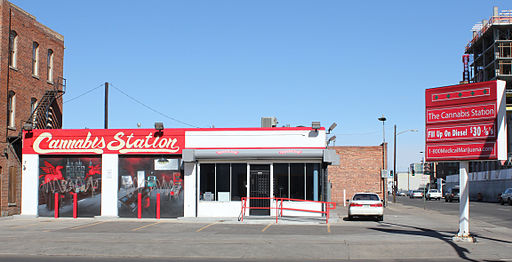
Cannabis_Station


Owing to recent legalization, recreational marijuana use is a growth industry in both Colorado and Washington State. In Colorado alone, annual turnover is projected to reach $10.2 billion by 2018. Yet owing to archaic federal banking laws, it remains a cash-only industry.

A BBC Business report gives the example of Pinkhouse Blooms. A chain of five marijuana dispensaries grossing over $100,000 a day, they remain a cash-only business. No Denver bank will give him a checking account. As Avinash Tharoor reports in the Huffington Post, the FBI is pursuing Bank of America, JP Morgan and HSBC for laundering billions of dollars of Mexican cartel money. Meanwhile they thumb their nose at legal marijuana merchants.

Relying on armored cars and armed security guards, owner Elliott Klug uses cash to pay his suppliers and employees – as well as $35,000 in monthly sales tax and $45,000 in state licensing fees.

Federal Laws Encourage Money Laundering

Although the Obama administration has directed federal attorneys not to prosecute marijuana users, growers, and distributors in states which have legalized marijuana (for recreational and/or medical use), banks that do business with marijuana producers and distributors remain in legal limbo. At present all federally insured banks that accept deposits from “drug dealers” are subject to suspension of their banking license and criminal prosecution under federal drug racketeering laws.

Both the Bank Secrecy Act and the Anti-Money Laundering Act were enacted to prevent money laundering. Ironically they do just the opposite in the eleven states with legal marijuana dispensaries. Cash-only businesses are notoriously susceptible to both tax evasion and money laundering. Without bank records, there’s no audit trail. Federal and state authorities only have the owner’s say-so for the amount of business they take in.

In February the Obama administration issued “guidance” that the Justice Department and FinCEN (under the Treasury Department) is “unlikely” to prosecute banks provided they meeting specified conditions, including reporting suspicious criminal activity to law enforcement. Unfortunately this “guidance” offers no real legal immunity, as all marijuana use is still illegal under federal law.

In 2011 Congressman Jared Polis (D-Colorado) tried to legislate immunity for banks doing business with medical marijuana dispensaries with his proposed Small Business Banking Improvement. The bill died in committee, and it doesn’t appear that similar legislation is forthcoming any time soon. Not if a myopic press release by Senators Charles Grassley and Diane Feinstein, as co-chairs of the Senate Caucus on International Narcotics Control, is anything to go by.

Their joint letter and press release castigate the Obama administration for “assisting those businesses that seek to inject the proceeds of criminal activity into the nation’s financial system.”

Makes you wonder when Feinstein was last in California, the state she supposedly represents. California was the very first state to set up legal marijuana dispensaries in 1996 when voters passed an initiative legalizing marijuana use for medical purposes.

Big Boost from State Marijuana Tax

Both Colorado and Washington have suffered major budget difficulties since the 2008 downturn. And in both states, legalizing (and taxing) recreational marijuana use promises a major cash injection for state coffers.

In Colorado, retailers pay a 10% marijuana tax in addition to 2.9% general sales tax to the state. County and city authorities may charge additional tax. In Denver, for example, the total sales tax can reach as much as 21%. This is in addition to a 15% excise tax charged on marijuana as it leaves the cultivation facility.

Washington charges a 25% excise tax on sales at each transaction level: from the producer to the processor, the processor to the retailer and the retailer to the customer. This is in addition to B&O (Business and Occupations) and sales tax all businesses pay. As of July 8, producers will be licensed by the Washington State Liquor Control Board to sell directly to consumers.

Small Local Credit Unions Do Business with Washington Dispensaries

In Washington State, two brave local (federally insured) credit unions (Salal Credit Union and Numerica Credit Union) have announced their intention to do business with marijuana dispensaries when they begin operation July 8. Unlike the big boys, they aren’t laundering money for the Mexican cartels or, presumably, speculating on derivatives and food futures

photo credit: Wikimedia Commons

Cross posted at Veterans Today

Making Beauty and Household Products at Home

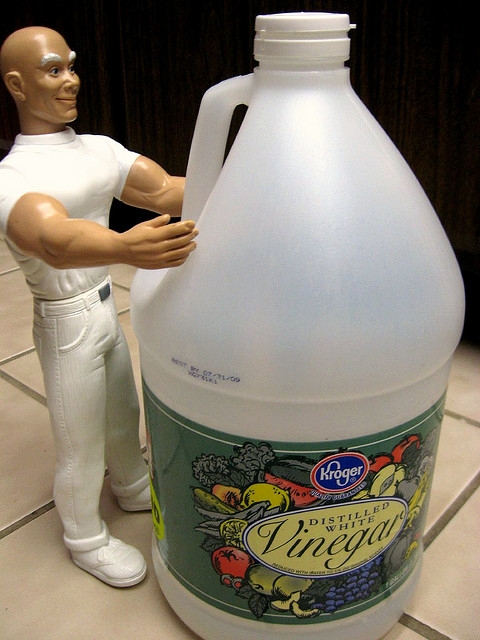
vinegar

In addition to being toxic to the environment and human health, brand name corporate beauty and cleaning products tends to be quite expensive. I prefer to make my own at home like my grandmother did. Thanks to Lyn Webster, a local Taranaki woman who gives workshops all over New Zealand on saving money by living sustainably.

Below are examples of simple recipes that can be made in minutes in a food processor. I also encourage people to check out Lyn’s website, which has dozens of other homemade recipes, as well as a range of books, budget tips and other products.

Recipes

Dishwashing Liquid

Bar soap cut in chunks

1-2 Tablespoons washing soda (calcium carbonate)

2 Tablespoons glycerine

Mix 1-2 minutes in food processor. Dilute the concentrate that forms overnight with water.

Washing soda can be found at hardware or grocery stores

Glycerine can be found in pharmacies or the baking aisle at the supermarket.

Kitchen/bathroom Cleanser

Use baking soda on sink stains and bathtub rings. Also good (with or without white vinegar) for burned on grease.

Laundry Detergent or Powdered Detergent for Dishwasher

Bar soap cut in chunks

1-2 Tablespoons washing soda

Mix 1-2 minutes in food processor. Use 1 Tablespoon for light load. Add white vinegar to rinse compartment of dishwasher to prevent spotting.

Stain Remover

Eucalyptus oil

Drain Cleaner

Baking soda, followed by hot white vinegar, followed by boiling water

Personal Deodorant

Baking soda in a spray bottle (essential oil optional) or white vinegar (smell disappears after a few minutes). Both work like commercial deodorant by changing skin pH to kill bacteria.

Toothpaste

Baking Soda

Salt

Glycerine

Optional flavouring (peppermint or clove and orange oil)

Shampoo and Dandruff Treatment (works better than commercial products – kills the fungus that causes dandruff)

Baking soda

Follow with vinegar rinse for conditioning

All-purpose Anti-bacterial Cleaner

Baking soda (kills 99% of bacteria)

White vinegar

Few drops of homemade dishwashing liquid

photo credit: elycefeliz via photopin cc

WikiHouse and the Means of Production

(This is the 9th of a series of emails about ending the right of private banks to issue money. It concerns WikiHouse and a proposal to remove the means of production from the monetary system through publicly owned Open Source technology.)

In the following video, architect Alastair Parvain envisions using WikiHouse and comparable Open Source manufacturing tools to take architecture, construction and manufacturing out of the monetary system by allowing people look to the commons to meet their basic human needs – via freely available Open Source technology.

Originally applied to free, publicly available software, the term Open Source has been expanded to include architecture, scientific research and other technical information which is made freely available in the public arena. See Open Source and Sustainability.

WikiHouse has been described as an open source construction set. The aim is to allow anyone to design, download and “print” CNC-milled houses which can be assembled by a small group of people with minimal formal skill or training. A CNC wood cutter is a CNC (computer numerical control) router that creates objects from wood along the same lines as a 3D printer.

WikiHouse has caught on in a big way in New Zealand, thanks to the 2011 Christchurch earthquake that caused over 6100 businesses that were displaced and needed to relocate quickly to survive. WikiHouse seemed an ideal solution to Martin Luff and Danny Squires, who founded New Zealand’s WikiHouse Lab

In addition to offering relatively low cost rehousing for businesses and residents, it also builds community solidarity by turning house building into a social event. Prior to the fossil fuel era, home building was a major community event in which your friends and neighbors got together to build you a house. With skyrocketing energy costs, we need to look more to community and cooperation, rather than technology, to meet our basic needs.

Parvain stresses that the world currently faces major economic, ecological and resource crises. These urgent dilemmas can’t be solved by either corporations or non-profit organizations so long as they continue to treat citizens as passive consumers.

Economics to Save Our Civilization

(This is the eighth in a series of posts about ending the role of private banks in issuing money)

“Somewhere in our history we took a wrong turn and today we are reaping the consequences. If we don’t step back to evaluate the root causes of the rolling economic crises, our civilization is in danger of collapse.” – Clive Menzies

A few years back, Clive Menzies, president of British Fund Building and member of the Free Critical Thinking Institute entered into an ongoing dialogue with the London Occupy movement. The result is a radical monetary reform proposal to fix the global economic mess. In the video below, he is presenting it to the Chartered Institute for Securities and Investment (translation: a high-powered group of investment bankers and stock brokers).

In his presentation, Menzies attributes the current crisis, as well as capitalism’s recurrent boom and bust cycles, to the alienation of the vast majority of the global population from the commons (i.e. communal ownership of land and natural resources that ended with the Enclosure Acts) and the prohibition of any discussion of this catastrophic event in contemporary economic discourse. (This is a topic Fred Harrison discusses at length in The Traumatised Society.)

Most of Menzies’s talk focuses on the urgent need to abolish our current debt-based (bank-controlled) monetary system. For five main reasons:

  • It drives systemic inequality by allowing those with more money than they need to exploit those who need money.
  • It drives unsustainable, exponential debt growth because the interest cost rises faster than society can create wealth to pay it.
  • It discounts the future, driving environmental destruction – it makes a forest worth more as sawed timber than as an ecosystem preserved for future generations.
  • It demands exponential GDP growth, rapidly depleting finite resources – 3% GDP growth means the economy doubles every 24 years which means extracting resources at twice the rate and throwing twice as much away.
  • It drives inflation.

He also demolishes the prevailing myth that a person’s existence on this planet is only justified by paid work. In a way it’s deliberate falsehood more than a myth. There is only enough “productive” work for 50% of the adult population and the vast majority of income in contemporary society is generated via “rent-seeking” (i.e. charging interest or rent or extracting and exploiting publicly owned natural resources).

Menzies lays out a monetary reform proposal that would abolish interest exploitation by the private banks who currently issue and control global currencies. Instead it would empower governments to issue interest-free sovereign currency.

A Second Model for Regaining Control of Our Money

modernising money

(This is the fifth in a series of posts about stripping private banks of their power to issue money)

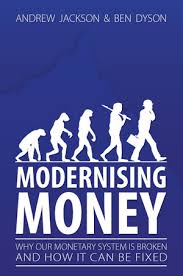
Modernising Money: Why Our Monetary System is Broken and How It Can Be Fixed

by Andrew Jackson and Ben Dyson (Positive Money 2012)

Book Review

Modernizing Money lays out a model for restoring government control of the money supply that’s very similar to the Chicago Plan. However it differs from the Chicago Plan in several important ways. Unlike the Chicago Plan, this second model isn’t obsessed with sovereign debt repayment. This, in my view is the most significant difference. Given the IMF’s singular focus on servicing debt, their heavy emphasis on debt repayment isn’t terribly surprising.

In allowing publicly accountable government bodies to assume responsibility for issuing money, both models ensure decisions around money creation are based on the needs of a productive economy, rather than the profit profile of private banks.

Thus both go a long way towards ending bubbles and boom and bust cycles, as well as reducing debt and minimizing inflation and deflation. The 2008 economic downturn was triggered by sudden deflation, i.e. the permanent loss of 60-200 trillion dollars from the global economy.*

Because income inequality increases in direct proportion to debt levels, nationalizing the money supply will also reduce income inequality.

A Radical Change in the Function of Banks

The function of banks changes radically under both proposals. In both cases, private would function purely as money brokers, like credit unions and savings and loan associations. They would only be permitted to loan money from existing assets, from customers’ investment accounts or from reserves borrowed from the central bank. Under both plans, there would be no bank bailouts or bank depositor insurance. When private banks cease to serve the essential function of creating and maintaining the money supply, they will cease to be “too big to fail.” Those that continue to make risky speculative investments will be allowed to go bankrupt.

How the Two Proposals Differ

The proposal Positive Money puts forward in Modernising Money is based on the British economic system, whereas the Chicago Plan is based on the US system. Thus the transition would be somewhat easier in the UK, where the central bank (the Bank of England) has been government-owned since 1946. In contrast the US the central bank (the Federal Reserve) is a consortium of privately owned banks.

Unlike the Chicago Plan, the Positive Money model would use newly created sovereign money for other purposes that paying down existing debt. Under the Chicago Plan, using the new debt-free money to repay sovereign debt (aka national debt or public debt) would be one of the first steps in the transition. The Chicago Plan would also use the new money to issue a citizens dividend that businesses and households would use to pay off private debt.

The Positive Money proposal would simply transfer all existing public and private debt (i.e. mortgage and consumer debt) to the Bank of England balance sheet. Businesses and households would continue to make loan repayments to the Bank of England according to the terms agreed with their bank. This new revenue accruing to the BOE would be spent into the economy in one of five ways. At the discretion of the British government, it could be used to increase public spending, cut taxes or repay government debt. It could also be used to issue a citizens’ dividend (which households and businesses would be required to use for repayment of existing debts) or new loans to businesses.

Ensuring Adequate Credit for the Business Sector

Positive Money is also more explicit about how they would ensure there is adequate credit in the economy to make sure new businesses have adequate access to loans for productive business investment. They would use a variety of qualitative and quantitative methods, including the existing Credit Conditions Survey. They would then auction off a specified amount of new credit to private banks. This new credit could only be used for business loans and not mortgages or consumer credit.

*Both proposals also make the claim that nationalizing the creation of money would also end real estate speculation and bubbles by restricting the funds available for mortgage loans. However given that both proposals spend new money into the economy, there’s still a good chance this could be used for real estate speculation. In my view, the only way to prevent this would be to implement a Land Value Tax simultaneously with the transition to government-issued money.

An IMF Proposal to Ban Banks from Creating Money

(This is the fourth of a series of posts about ending the ability of private banks to issue money.)

For the past 18 months ago, IMF economists Michael Kumhof and Jaromir Benes have been circulating a proposal to end the ability of banks to create money.

As Kumhof explains in the Nov 2013 video below, the perception that governments create money is totally false. In the current global economic system, only about 3% of money (mainly coinage) is created by government. The other 97% is created by private banks out of thin air when they generate new loans. See Economic Justice: the Rolling Stone Version

For various reasons, which Kumhof explains in the video, he and Benes believe that unlimited and unregulated private money creation by banks is responsible for the current economic crisis. And that full recovery is only possible if the privilege of creating and controlling the money supply is restored as a government function.

In addition to assuming sovereign control over the money supply, national governments would also require banks to hold 100 percent reserves for the loans they initiate. This effectively terminates the ability of private banks to create money out of thin air. And this, in turn, massively reduces their political power.

Ironically, the proposal isn’t new. Entitled the Chicago Plan, it was first put forward by University of Chicago professors Henry Simons and Irving Fisher during the Great Depression.

The History of Private vs Sovereign Money

During the Q&A at the end, Kumhof briefly discusses previous experiments with government-issued sovereign money, which have mainly occurred in the US. Sovereign money funded the original 13 colonies, the American War of Independence and the Civil War.

In their paper The Chicago Plan Revisited, he and Benes trace the history of sovereign money back to the ancient Greeks and Romans. During the Middle Ages and Renaissance, all currencies were publicly controlled (by kings and the Pope) until 1666, when Charles II transferred control of money creation to private banks with the English Free Coinage Act of 1666.

The slides, which are difficult to see in the video, are available here

For me the high point of the video is Kumhof’s disclaimer that he doesn’t represent the IMF – that he’s only doing research. Yeah right. I sure wish I had an understanding boss who let me run around making radical proposals to strip investment banks of their power and wealth.

It seems more likely that people in high places know the ship of capitalism is going down – that this is a last ditch effort to save it.

The Real Vampires: An Insider’s View of Banks

tragedy and hope

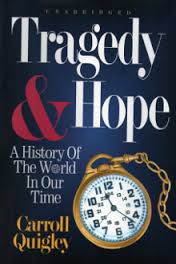
Tragedy and Hope: A History of the World in Our Time

Carroll Quigley* (1966 MacMillan)

Tragedy and Hope is a free download from http://sandiego.indymedia.org/media/2006/10/119975.pdf

(This is a third of a series of posts about stripping private banks of their power to create and control our money supply.)

Book Review

Tragedy and Hope is an exacting account of how the Bank of England, the Federal Reserve, the European central banks, and the investment banks that dominate them (e.g. Goldman Sachs and JP Morgan) came to control all western governments.

According to Quigley, banks have controlled western society – by manipulating the money supply – since the creation of the Bank of England and the fractional reserve lending system in 1694. Moreover, owing to the secrecy under which they operate, Quigley asserts that most elected officials are totally unaware of the immense control central and investment banks exert over the so-called democratic process.

He describes in exhaustive detail how all historical inflationary and deflationary crises, panics, wars, recessions and depressions were orchestrated behind the scenes by the banking establishment, for the purpose of increasing their private wealth. In his epic portrayal of three centuries of western civilization, he also describes how the banking aristocracy financed the rise of Communism in Russia, China and Eastern Europe, as well as bringing Hitler, Mussolini, Stalin and Roosevelt to power and guiding their governments from behind the scenes.

How Banks Create Money “Out of Nothing”

The single act, according to Quigley, that guaranteed Britain’s two century preeminence over the rest of the world was the development (in 1694), by British investment banks, of the fractional reserve lending system. This system allowed English investment banks to be the first in the world to lend money (to industry and the British government) that they created out of thin air. He goes on to list the banking dynasties that have held near absolute control of the global money supply since 1694, starting with banking cartel formed by Frankfurt banker Meyer Rothschild. At the time of his death, Rothschild’s five sons each controlled a major investment bank in Vienna, London, Naples, Paris and Frankfurt. Quigley lists the investment bank formed by the J.P. Morgan family as second to the Rothschild banks in power and influence, followed by the Baring Brothers, Morgan Grenfell, the Lazard Brothers, Erlanger, Warbur, Shroder, Seligman, the Speyers, Mirabaud, Mallet and Fould.

The Council on Foreign Relations

Quigley also writes about the network of secret round tables of international corporate and banking elites started by Cecil Rhodes and expanded by his followers with his sizable estate. At their founding, they had the stated purpose of spreading British the virtues of “ruling class” tradition throughout the English speaking world and solidifying the political power and influence of the British Empire. The US Council on Foreign Relations, one of the secret round tables started by Rhodes’ followers, was started in 1919, with the explicit goal of influencing the foreign and domestic policies of a former colony over which Britain no longer had direct control.

How English Banks Controlled the US Government

According to Quigley, the US was consistently a debtor nation prior to World War I. Following the 1776 revolution, US government and businesses continued to borrow funding for industrial and colonial expansion from English and European investment banks. The American banker, JP Morgan, collaborated with European investment banks to dictate US foreign and domestic policy. They did so by threatening to destroy the US economy by 1) refusing to renew treasury bonds (i.e. money the government borrowed from banks to fund public spending 2) causing a panic by throwing large numbers of shares on the stock market or 3) destroying the value of railroads and other companies the banks owned by loading them up with worthless assets.

As Quigley relates, they engaged in all three tactics at various times throughout the 19th century, resulting in a series of booms, panics, recessions and depressions that wreaked havoc on American economic development.

How Bankers Engineered, World War I, Bolshevism, Nazism and the Great Depression

The most disturbing section of Tragedy and Hope describes how international bankers engineered (he describes their secret meetings) World War I and what Quigley calls the Banker-Engendered Deflationary Crisis of 1927-40 (aka the Great Depression). Following the 1870 unification under Bismarck, Germany experienced a rapid burst of industrialization, generating sufficient profit that they ceased to rely on investment banks to finance either business or government. They also threatened global bankers by competing with England and other European countries for export markets.

While engineering the first world war to put Germany in her place, the world banking cabal simultaneously hatched a scheme to destabilize Russia (which was making claims on Balkan members of the former Ottoman Empire) by secretly funding the Bolsheviks and other Russian revolutionaries.

Financing Hitler and the Nazis

When the the first world war ended in 1918, public debt in Western Europe and the US had increased by 1000%. In 1929, the austerity measures global banks forced on the US, England, France and other European countries led to widespread bankruptcies and unemployment and the virtual collapse of foreign trade.

Except in Germany. The global banking elite used the wealth generated from debt repayment to finance rapid German re-industrialization and militarization and the Nazi movement started by Hitler. The main German corporations funding Hitler were IG Farben, Siemens, Bayer, Daimler Benz, Porsche/Volksvagen and Krupp. In addition to Henry Ford and William Randolph Hearst, the important US banks and corporations who financed Hitler’s rise to power included Kodak, Coca-Cola, DuPont, Standard Oil, IBM, Random House and Chase Bank.

* Late mentor to former president Bill Clinton, Princeton, Harvard and Georgetown professor Carroll Quigley also served as an adviser to the Pentagon and Foreign Service.

The Battle for Public Control of Money

(This is the second of a series of posts about ending the right of private banks to issue money.)

The Secret of Oz (William Still 2009) primarily addresses the long battle to strip banks of their power to issue money. In the US, this struggle dates back to the Revolutionary War.

The title refers to socialist writer L. Frank Baum’s 1900 The Wonderful Wizard of Oz. According to numerous scholars, the book is loaded with symbols related to monetary reform, the core demand of the Populist movement and the 1896 and 1900 presidential bids of Populist Democrat William Jennings Bryan.

The yellow brick road represented the gold standard, the Scarecrow represented farmers and the Tin Man represented industrial workers. The Wicked Witch of the West was Cleveland banker J.D. Rockefeller and the Wicked Witch of the East New York banker J.P. Morgan. The Cowardly Lion depicted William Jennings Bryan, who abandoned the call for monetary reform. The Emerald City represented (government issued) greenback money and Dorothy’s silver slippers (changed to ruby slippers in the movie) represented Bryan’s call to introduce silver coins to ease the money shortage during the 1890s depression.

Still traces the politics of monetary reform back to 30 AD, when a Nazarene carpenter engaged in violent direct action in a Jerusalem synagogue to evict the private bankers who sold silver coins which were used to pay a compulsory temple tax.

He also explores the use of state-controlled money in the American colonies and the early United States. He focuses particular attention on periods in which private banks deliberately shrank the money supply to trigger depressions (to increase profits or achieve specific political objectives), as well as efforts by Presidents Thomas Jefferson and Andrew Jackson to end private corporate control of money.

Both Jackson and Lincoln oversaw periods in which federal and/or state government issued debt-free money.

Zero Waste: Closer Than You Think

zero waste

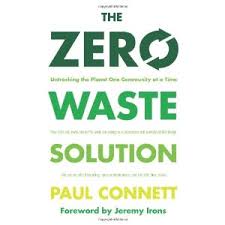
The Zero Waste Solution: Untrashing the Planet One Community at a Time

by Paul Connett (Chelsea Green 2013)

Book Review

The Zero Waste Solution is about 100% waste recovery and reuse, the new gold standard in recycling. Paul Connett’s new book summarizes the state of play of the zero waste movement in local communities around the world. His detailed descriptions of existing programs and technologies provide powerful ammunition for local activists trying to pressure city and town governments to be more environmentally responsible.

According to Connett, we have had the technological capability to recycle 80-90% of our waste stream since the mid eighties. What has held us back has been an artificial corporate-centered view that maximizes profit for waste management companies, the contractors who build and operate incinerators and soft drink bottling companies.

Waste management companies and incinerator contractors have powerful lobbies, as will as cozy relationships with many community councils. Connett also documents the little known role of the Business Environmental Action Coalition (BEACC) in lobbying major cities to provide curbside recycling for glass and aluminum cans. Following the first Earth Day in 1970, BEACC, whose members included Coca-Cola, the Aluminum Association and 7 Up, feared the introduction of producer-focused waste reduction laws (e.g. mandatory deposit/return programs). They viewed limited curbside recycling as a way to head this off.

History of the Zero Waste Movement

The zero waste movement first got its start in Berkeley California in the 1980s and in Canberra Australia in the 1990s. At present, California and Italy are at the forefront in terms of community participation. By 1996, 300 California communities had achieved 50% trash diversion (from landfills and incinerators). San Francisco reached 80% diversion in October 2012 and expects to reach 100% by 2020. More than 200 Italian communities have achieved 70% diversion, with some small towns reaching more than 80%.

Not only is zero waste recovery better for the environment and human health*, but it’s far more economical than traditional waste management. Recycling and reusing resources always saves money. Loss of revenue, stemming from the 2008 economic downturn, has forced many corporations to focus on more efficient resource use. Japanese companies are the clear leader here, with nearly 2800 producing zero landfill waste. A surprising number of Fortune 500 companies (including Anheuser Bush, Apple, Hewlett Packard, Pillsbury Xerox, Ricoh electronics) have also committed to zero waste.

The Twelve Master Categories of Discards

Zero waste experts divide the waste stream into 12 reusable fractions:
1. Reusable goods – repairable appliances, demolition debris and reusable clothing, furniture and household items.
2. Metals
3. Glass
4. Paper
5. Plastic polymers (including plastic bags)
6. Textiles (including non-reusable clothing)
7. Chemicals, including reusable solvents, paints, oil and lubricants.
8. Wood from non-reusable lumber and furniture (can be made into wood chips)
9. Plant debris
10. Putresibles – kitchen waste, manure
11. Soils – from barren or developed land
12. Ceramics, rock, porcelain, concrete and non-reusable brick

At present, more than 90% of the waste stream can easily be recovered for resale. The non-recoverable fraction consists mainly of hazardous materials such as batteries, electronic equipment, mercury-laden fluorescent bulbs and disposable diapers. Many zero waste advocates want to implement extended producer responsibility (EPR) to deal with hazardous waste. Under EPR, the manufacturer is expected to come up with a non-toxic alternative or to accept the product back for safe disposal.

Of the 12 recoverable fractions, kitchen waste, which comprises 33-40% of the waste stream, is the easiest to resell (as compost). Connett contrasts communities in Italy that merely encourage backyard composting, with Seattle and other cities that offer curbside collection of kitchen waste. The latter has proven far more cost effective, largely because backyard composting isn’t an option for the hotels, restaurants and supermarkets, which generate most of it.

Zero Waste Creates Jobs

In view of the immense cost savings, I was surprised to learn that job creation is another important benefit of a zero waste approach. Rising land, energy and transportation costs make landfills and incinerators so expensive that zero waste programs are always cheaper, despite employing more people.
*Recycling reduces the burden of climate change by eliminating methane production (one of the most damaging greenhouse gasses) from decaying landfills and carbon emissions given off by waste incineration. Both landfills and incinerators pose major health hazards. Landfills leak toxic substances into the water table. Incinerators produce dioxin, which is linked to cancer, birth defects, and immune and neurodevelopmental problems.

Below Pete Seeger performing my all time favorite folk song “Garbage (Garbage, Garbage, Garbage) Garbage”