A Film About Dismantling Corporate Rule

Owned and Operated

Relic (2012)

Film Review

Owned and Operated is a documentary about dismantling corporate rule. This non-ideological film features dissidents across the political spectrum, among them John Oliver, George Carlin, Bernie Sanders, Jeremy Rifkin, Rob Hopkins, Ron Paul, Ray McGovern, James Corbett, Alex Jones and Brian Wilson. In addition to the film’s touchy-feely ending, I was also disappointed in the filmmakers heavy promotion of technology as the solution to the world’s urgent political and ecological crises.

In my view, the best part of the film is Part 1, The Freak Show. This is a humorous but surprisingly accurate depiction of modern corporate culture and the dangerous and bizarre effect of systematic corporate indoctrination on human behavior.

Part 2, Class War and Organized Greed, concerns the obscene greed of the 1% and their systematic takeover of our supposedly democratic political systems.

Part 3, Freedom vs Security concerns the systematic loss of civil liberties that has accompanied the War on Terror.

Part 4, The Awakening, concerns recent mass movements triggered by the 2008 global economic meltdown, including Occupy, the Arab Spring, Anonymous and the Zeitgeist, Transition and Open Source Ecology movements.

Part 5, the Future, heavily promotes Jeremy Rifkin’s views on the role of the Internet and mass connectivity in solving mankind’s most pressing problems. I tend to agree with Ronald Wright’s analysis (in A Short History of Progress) that humanity’s eagerness to rush into new technologies has tended to create more problems than it solves.

That being said the film ends on an extremely positive note by scrolling the web addresses of scores of social change movements for viewers to explore.
Opting Out of Corporate Rule

Paths Through Utopias

Isabelle Fremeaux and John Jordan (2011)

Film Review

Paths through Utopias is a video diary of a French couple’s tour through European collectives in which citizens are resisting corporate rule and reclaiming control over their own lives. The collectives visited include

• The Climate Action Camp (2007-2010) which blocked the construction of a third runway at Heathrow Airport (see Battle of Heathrow Climate Victory)
• Jugoremedija, the chemical factory in Belgrade workers occupied to block its closure and subsequently transformed into a workers cooperative.
• Two self-governing collectives in Catalan (Spain) in which workers reclaimed vacant housing to produce their own food, created their own local currencies and started a citizen-run radio station.
• A self-governing off-the-grid collective in Britain.
• Zegg, an intentional community and eco-village in Germany where members are experimenting with alternatives to monogamy.

https://vimeo.com/21689832

Improving Food Production by Subtracting Oil

The following video is the keynote address by Indian activist Vendana Shiva at the 2015 Soil Not Oil conference in Richmond California. Her primary theme is the destructive effect of industrial agriculture on soil, human health, water balance, climate, ecological diversity, economic inequality and world peace (as the driver of continual resource wars).

She maintains industrial agriculture is an extremely inefficient method of food production – requiring ten calories of oil for every calorie of food produced. Factory farming is only economically viable because of heavy government subsidies of oil production and the synthetic nitrogen fertilizer manufactured from natural gas. If Food Inc were required to pay the full cost of industrial farming (including the toxic effects of the chemicals they use), it would be many times more expensive than organic farming.

She maintains real purpose of industrial farming is to increase GDP by producing more commodities, when it should be to maintain soil and human health.

Prior to the industrial age, farming was as much about soil regeneration as food production. The talk particularly emphasizes the importance of “carbonizing” soil with organic matter. It cites studies showing that a two ton per hectare increase in organic matter removes ten gigatons of CO2 from the atmosphere. This also makes the soil drought resistant by improving its capacity to store water.

Support Grows for Unconditional Basic Income

Money for Free

VPRO Backlight (2015)

Film Review

Money for Free is about Unconditional Basic Income (aka Universal Basic Income), a form of social security system in which all residents of a country, city or region receive an unconditional sum of money in addition to any other income they receive.

The documentary profiles Michael Bohmeyer, a German web developer who crowd funded a UBI (German residents can apply for it through his website), New York venture capitalist Albert Wenger (who helped fund Bohmeyer’s UBI),  and British economist Guy Standing. Standing has conducted UBI experiments in India and Namibia.

All three see a strong need for UBI in a globally economy that is rapidly shedding jobs and leaving millions of young people permanently unemployed.

At present Bohmeyer has raised 12,000 euros, which means eight people (chosen by lottery) receive his UBI.

Most opponents of UBI claim it will destroy people’s motivation to work. Standing’s experiments in India and Namibia show just the opposite. People who received a UBI in his pilot program increased their economic activity and eared income (as a result of improved nutrition and health).

The filmmakers also interview Alaska residents who receive a guaranteed income from a resource tax on the state’s oil industry.

France, Netherlands and Finland all have basic income pilot schemes in the pipeline. Switzerland will hold a referendum on UBI later this year.

They will also hold a referendum on whether to prohibit private banks from creating money

Savings Pools: Opting Out of the Banskters’ Money System

banksters

One way I’m opting out out of the debt-based Wall Street banking system, is by joining a local interest-free savings pool. A group of neighbors is investing their savings in a savings pool – rather than a bank – and to use the savings pool to loan money to one another. We’re using a model designed by the (New Zealand-based) Living Economies Trust. The model is based on the Swedish JAK members’ Bank, founded in 1965. The Jord Arbete Kapital (Land Labor Capital) Bank doesn’t charge or pay interest on its loans. With its loans financed solely by members’ savings, it operates outside of the Wall Street capital market.

As of November 2011, the JAK Bank had a membership of 38,000 and accumulated savings of 131 million euros. Of this 98% had been loaned out to members.

How Savings Pools Differ from JAK Bank

Savings pools maintain the JAK Bank’s tradition of interest-free transactions but differ from the Bank’s model in several respects:
• Savings pools are private arrangements between members with regular personal contact.
• Executive decisions are made by pool members themselves rather than a paid management team.
• Pool costs and charges are virtually zero.
• Each member’s savings are held in trust for that member – they don’t become joint property and can only be spent if the member agrees.

Our local savings pool meets monthly, and all savings pool decisions are consensus-based. Individual members may abstain on special loan proposal they disagree with by declaring their own balance unavailable for that specific purpose.

Tracking Savings as Dollar-Months

Savings are tracked as dollar-months rather than balances. In other words, pool statements reflect both the amount a member has contributed and the length of time they have made the funds available.

A member wishing to borrow other members’ money proposes a payment schedule and offers something of value as security to make sure the debt is covered. If the group agrees, the pool transfers to the borrower the loan amount and any balance the borrower may have saved. One month later, the borrower begins a series of installment payments, with half going to repay the loan and half going to reciprocate the pool’s contribution

When borrowers ask the pool to accept interest-free installment payments, it’s not enough to merely repay the loan. They must also make their own savings available for long enough to match the consideration other members have accorded them. This is called reciprocity.

The Advantage of Reciprocity Over Interest

Despite this reciprocity contribution, the amount repaid to a savings pool is always far less than the compound interest charged on a bank loan. With a mortgage, for example, the interest paid is usually more than the original loan. Although the borrower ends up with a house, they have nothing to show for all their interest payments.

In contrast, a savings pool borrower ends up with the purchased asset and savings, which may be withdrawn as soon as the loan agreement is complete.

Supported borrowing is also encouraged. Pool members may gift their reciprocity points to ease a borrowers reciprocity contribution

People wanting more details on the mechanics of savings pools can consult two excellent articles by The New Economics Party and Project Wairarapa

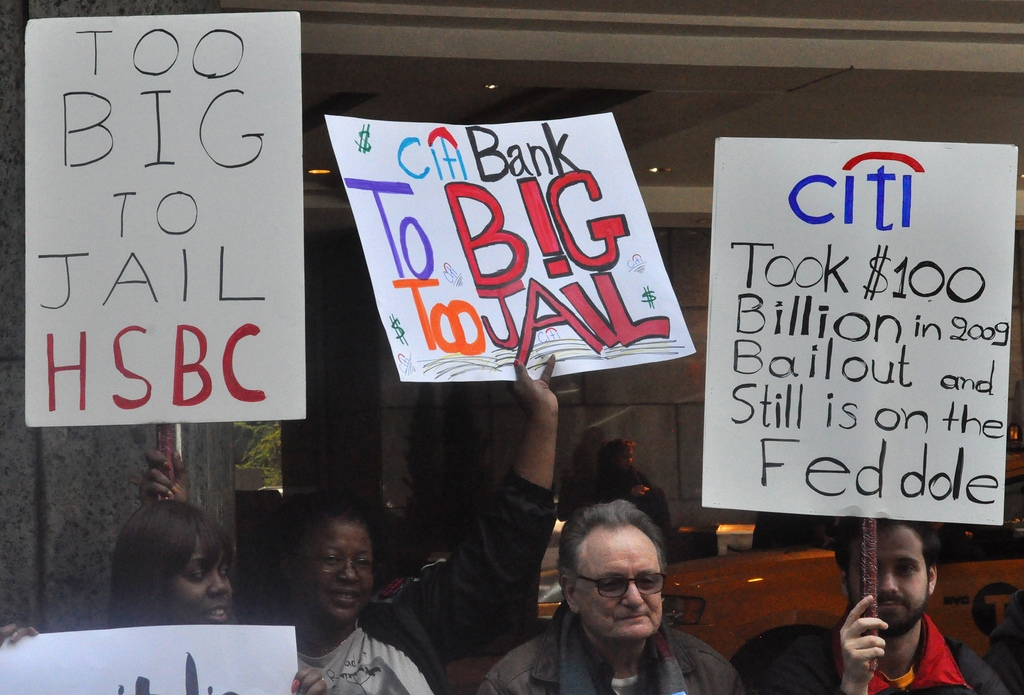
photo credit: occupy_Citibank_24_4_13_DSC_0121 via photopin (license)

Local Currency Update: Opting Out of the Bankster Money System

According to the Guardian, renewable energy provider Good Energy has agreed to accept the Bristol pound in payment for electricity and gas bills. The company claims to be the first in the world to accept payments in local currency. Bristol residents already use the Bristol pound to pay for groceries, bus fares and council tax (ie real estate taxes).

The Bristol Pound is an alternative currency launched in 2012 to help keep cash in the local community, as opposed to the deep pockets of multinational corporations.

Run as a not-for-profit partnership with Bristol Credit Union, the Bristol pound is the first city-wide local currency in the UK and the largest alternative to Britain’s national currency (pounds sterling). There are approximately 750,000 Bristol pounds in circulation.

Local or complementary currencies are an ideal way for communities to opt out of the corporate money system. Their use has expanded exponentially since the 2008 downturn, especially in European countries like Greece, Italy and Spain. Devastating austerity cuts have left millions in southern Europe with no access to euros, the official currency.

My town New Plymouth has their own local currency, the New Plymouth talent, though it’s not as widely circulated as the Bristol pound. We also have a Time Bank (which I’ve just joined), which allows members to earn time credits providing services for other members. They can use these credits (instead of money) to purchase services from other members. It’s a great alternative for unemployed, retired and disabled residents who are short on cash due to the economic downturn.

Living the Revolution

Solidarity4All (S4A) co-founder Christos Giovanopoulos is presently touring the US in his effort to grow the international solidarity movement supporting Greek workers. S4A is a collective that facilitates the development of grassroots solidarity structures emerging in response to the humanitarian crisis caused by Greece’s deep austerity cuts. It grew out of the Greek Indignados movement that formed alongside the Spanish Indignados* movement in July 2011. Both would serve to inspire the international Occupy movement that first formed on Wall Street in September 2011.

As of January 2015, there were self-governing 360 solidarity structures, representing 30% of the Greek population. The list includes social pharmacies, social medical clinics, social kitchens, social grocery stores, time banks,* a social collective of mental professionals, olive oil producers who share olive oil and the “potato movement,” where farmers cut out supermarkets and middlemen by trading directly with consumers.

All initiatives are non-hierarchical and hold weekly assemblies where decisions are made. The role of S4A is to serve as a centralized network for information, tools, and skills sharing and to build an international solidarity movement to support Greek workers and to inspire similar grassroots self-governing structures in other countries.

Although most S4A members support the left-wing party Syriza, the two are totally separate organizations. S4A chiefly derives its power from its ability to provide humanitarian services can’t deliver due to the Greek financial crisis. Nevertheless Syriza directly supports S4A by requiring each of their MPs (members of parliament) to donate 10% of their salary.

An International Movement

Already hundreds of international trade unions, community, environmental and immigration groups have signed on to the Solidarity4All movement. Ironically most are in Germany, whose government has been the most staunch in forcing debt repayments and austerity cuts on the Greek people. At present Giovanopoulos is seeking to build S4A chapters in New York, Seattle, Chicago, San Francisco, Oakland and Baltimore.

In the following video, Giovanopoulos speaks to the importance of a strong grassroots movement to counteract the pressure the EU and IMF are putting on Syriza. This is especially urgent owing to the inability of the current Greek government to address the humanitarian crisis. Thanks to Solidarity4All, the immediate needs of workers continue to be addressed. If a Grexit does occur, this will also provide a framework for Greece to look after itself – instead of relying on foreign funders.

For more information, check out the English S4A website at Greece Solidarity

Individuals and groups can join S4A at Join us


*Los Indignados is a grassroots Spanish anti-austerity movement that first captured public attention in July 2011 through massive demonstrations in which they occupied public squares and spaces. An estimated 6.5– 8 million Spaniards have participated in these events.
**A time bank is a mutual credit system in which members earn credits for helping other members and spend them for other services.
***Syriza is a left wing political party that came to power in January 2015 based on a pledge to end the austerity cuts forced on Greece (as a condition of further bailout funds) by the European Central Bank and the International Monetary Fund (IMF).
****Grexit refers to the potential exit of Greece from the eurozone monetary union, owing to its inability to repay its public debt.

The Psychosis Called Consumerism

Consumed: Inside the Belly of the Beast

Richard Heap (2011)

Film Review

Consumed is a British documentary about the psychological basis of what the filmmakers call the “weird mental illness called consumerism” and “a kind of collective psychosis in which people value acquiring objects more than their children, partners or friends.” The film maintains that there are unique evolutionary features in the human species that make us uniquely susceptible to pro-consumption messaging.

The documentary begins by emphasizing the grave implications of “unfettered” consumerism on humankind’s ability to survive on this planet – both from the perspective of ecosystem destruction and growing resource scarcity.

They go on to analyze the primary biological drives that underlie most human behavior: the drive to survive and the drive to reproduce. Most marketing is deliberately aimed towards the latter. People who lack confidence in their ability to attract a mate are bombarded with messaging that they can increase their prestige and status by acquiring specific products.

As people get older, they realize this thinking is delusional: a new Porsche doesn’t make someone fall in love with you as a person. People who hook up with you for your car eventually get bored and leave.

Young people, however, are incredibly susceptible to the pro-consumption delusion. This is why billions are spent on marketing to kids from the moment of birth. Getting pre-teens and teens to think about mating early is also incredibly effective in capturing more of their money (as well as their parents’).

Consumed also examines our psychological disconnection from nature and why this has allowed us to become so indifferent to the environmental devastation caused by our consumption patterns.

The behavioral scientists Heap interviews differ on whether the sustainability movement can save the human species. They all agree it’s pointless to look to politicians – the very epitome of pathological narcissism – for a solution. Several are pessimistic that Transition Towns and similar sustainability-related groups can save us without addressing the root cause of the crisis: our psychology.

Others are more optimistic. Pointing to the 200+ million years humans survived without a multitude of consumer goods, they argue that learning to understand our psychological make-up can help us be less vulnerable to constant pro-consumption messaging.

A Film About Economic Democracy

Can We Do It Ourselves? A Film About Economic Democracy

Patrick Witkowsky, Jesper Lundgren, Andre Nystrom and Nils Safstrom (2015)

Swedish with English subtitles

Film Review

“Economy democracy” describes a system in which workers control the workplace and determine the policies under which it runs. The workers cooperative is the best known model of economic democracy.

The filmmakers begin by differentiating capitalism from a free market economy and economic democracy from socialism – as many people confuse these terms. Under capitalism private capitalists own the capital to run a business and enter into a rental contract with workers to perform the labor. Under this system the capitalists own and control the business and keep all the profits.

With a worker cooperative, workers own and control the business and enter into a rental contract with labor to provide capital. They pay the capitalists for using their money but maintain ownership of the business and control of production. They also decide how profits will be distributed.

Under socialism, the capital is “socialized.” Theoretically this means workers own an equal share of the entire economy. In practice, this has generally translated into state control of the workplace, as opposed to worker control.

This film focuses on the day-to-day operation of two 30-year-old American cooperatives. The first is Massachusetts-based Equal Exchange, founded in 1986. The second is New York-based Cooperative Home Care Associates. The latter was founded in 1985 and has 2,300 member-employees.

The filmmakers also interview various academics, activists, business leaders and trade unions officials regarding their research and experience with cooperatives.

The part of the film I found most interesting was an analysis of how monopoly capitalism distorts the free market. Our present economic system actually consists of three markets: the consumer (goods and services) market, the labor market and the capital market. Only the consumer market operates democratically, in being driven by consumer choice. The goal of economy democracy is to democratize the labor and capital markets, which are controlled at present controlled by a tiny capitalist elite.

Because workers have virtually no say into their work and receive minimal direct benefit from it, capitalists must use the fear of being fired to force them to work. This is only possible in economies with high levels of unemployment and poverty. Historically the corporate elites have deliberately manipulated monetary and fiscal policy to keep unemployment rates high.

Once workers own and run their own companies, unemployment and poverty are no longer necessary to motivate them. Thus full employment is one of the most important benefits of economic democracy.

Obama Loses Senate Vote on TPP(A)

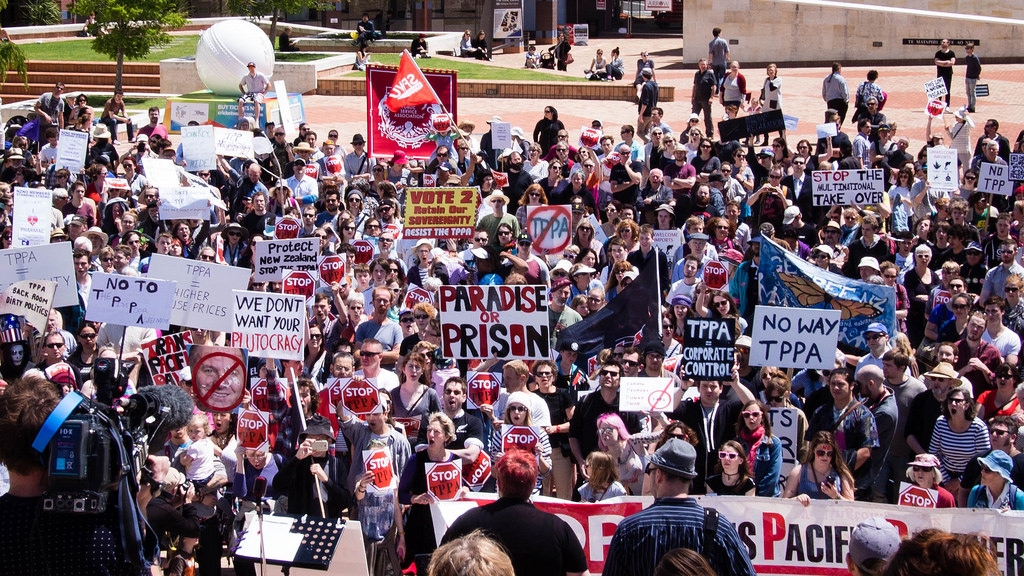
tppa protest

Wellington anti-TPPA protest Nov 2014

Yet another victory for our side. The tide seems to be turning against corporate America.

Today the Guardian reported that Tuesday’s 52-45 senate vote shut down further discussion of the Transpacific Partnership Agreement. Owing to the threat of filibuster, this procedural vote required at least 60 “ayes” in order to let the Senate host discussions on whether or not to give the president “fast track” authority.* Failure to reach that threshold puts the future of the TPP(A) in jeopardy.

The proposal was defeated by Democrats wanting to add measures to protect US workers and prevent currency manipulation.

Most analysts agree that the eleven other countries negotiating TPP(A) are unlikely to agree to the treaty unless they know the US Senate will approve it without modification.

Many also believe the setback spells an end to any chance the US will sign up to the TPP(A) before the next US presidential election in late-2016.

According to the Guardian, TPPA opponents have been emboldened by the growing influence of liberal senators Elizabeth Warren and Bernie Sanders and were joined by all but one Senate Democrat in voting against moving forward with TPP.

Only one Democrat, Senator Tom Carper of Delaware, backed the measure. Pro-trade Oregon Senator Ron Wyden, who championed the fast track measure in committee, changed his vote to “no.” He’s insisting that fast track be bundled together with three other trade bills, including one that would impose import duties on countries that manipulate their currencies for unfair trade advantage.

TPP is a secret treaty being negotiated behind closed doors without input from the public or elected representatives. Documents released by Wikileaks in March revealed the TPP(A) has a clause known as Investor State Dispute Settlement (ISDS). It means if local or national governments enact legislation for greater environmental protections, health regulations or rules to assist local businesses – anything that interferes with foreign corporations’ profits – the corporations can sue them in secret tribunals run by corporate lawyers.

Here in New Zealand, we are especially concerned about a clause in the leaked text that would allow pharmaceutical companies to sue us for using generic drugs (in preference to brand named drugs) in our National Health Service. We’re also concerned the TPP(A) would enable Monsanto to sue us over laws that prohibit farmers from planting GMO crops.

Besides the US and New Zealand, the other 10 countries involved in TPP(A) negotiations are Australia, Brunei, Canada, Chile, Japan, Malaysia, Mexico Peru, Singapore, the and Vietnam.

Read more here


*With “fast track” authority, the Senate would be forced to vote a bill approving TPP(A) up or down without amending it.