The Most Revolutionary Act

Uncensored updates on world events, economics, the environment and medicine

The Most Revolutionary Act
Unknown's avatar

About stuartbramhall

Retired child and adolescent psychiatrist and American expatriate in New Zealand. In 2002, I made the difficult decision to close my 25-year Seattle practice after 15 years of covert FBI harassment. I describe the unrelenting phone harassment, illegal break-ins and six attempts on my life in my 2010 book The Most Revolutionary Act: Memoir of an American Refugee.

Revisiting the Covid Theatrics of 2020: “The Collapsing People of Wuhan”

In early 2020, a torrent of harrowing videos and photographs came out of China depicting victims supposedly being ambushed by a deadly contagious disease that was being called “coronavirus.” The alarming visuals shocked and terrorized populations from East to West.

Some scenes showed people collapsing on the streets and dying on the spot. Others showed victims foaming at the mouth. We saw frightening images of dead bodies piling up and equally ominous images of government officials in hazmat suits hovering over these lifeless bodies.

It was understandable that such haunting images not only created a worldwide frenzy of fear and hysteria but also set the stage for what would become an unprecedented series of global lockdowns and an unmatched epoch of medical tyranny.

But . . . there was one big problem with these deadly depictions and viral videos. Upon closer examination, all of them appeared to be fakes and fabrications.

That’s right. The images launched “round the world” that ignited the coronavirus mass hysteria campaign, which in turn led to worldwide lockdowns and incalculable destruction, were staged artifacts of mass media manipulation.

Example #1: A video out of Wuhan, China, was said to be evidence of the deadly effects of the “new coronavirus.”

Though this video is no longer available, when it circulated widely on social media, it apparently showed a pile of “covid victims” covered in blankets waiting to be picked up and carted away. The hype that accompanied the scene claimed that China was dealing with “no ordinary virus.” The video provocatively asked, “Is it [an] intentionally released bio-weapon?” The question had the effect of seeding in the global public’s consciousness a possible “alternative explanation” for this enigmatic pathogen.

It was later revealed that the Wuhan “body pile” video was in reality showing people sleeping in the streets in Shenzhen, China—more than 600 miles away from its supposed source. But why were so many Chinese subject to such a sad predicament? It seems the government had set up a permit system for entering and exiting the city to prevent the spread of “the virus,” and these victims were not issued the requisite permits.

Example #2: Another video out of China the same year panned on a poor man who was vomiting blood.

This gory video showing a man riding on public transportation and puking up blood was posted on Instagram on January 29, 2020. The caption alongside the video suggested that the man was infected with a new coronavirus strain (the “Wuhan virus”). The story hysterically (and falsely) implied that he was experiencing “violent coronavirus symptoms.”

Yet, upon investigation, it was revealed that the video in question dated back to February 14, 2019, and stemmed from an incident involving a 52-year-old male passenger traveling on the Chonqing Rail Transit who had fainted, vomited blood, and died. A review of his medical history found that he suffered from advanced liver cancer.

Example #3: A man who collapsed at an airport in Thailand was said to have been a victim of Covid.

When a Facebook user posted the photo of a Chinese man lying face down on the floor of a Thailand airport, the image naturally went viral. Naturally, too, the media insinuated that his plight was caused by “the virus.”

The strange and scary caption read: “At the airport right now, a Chinese person is suddenly knocked to the ground. The third floor is under control. The government is really taking care of it. No more photos allowed. It’s very scary.”

This made-for-TV extraterrestrial-like interpretation of his condition was ultimately supplanted by a much more mundane explanation. Turns out the man who had fallen out of his chair had been drinking heavily, had passed out, and had fallen on the floor at the Suvarnabhumi Airport.

It seemed like there were dozens of similar clips. In reality there were only ten or so, all taken in different places but circulating madly through social media in early 2020. Many of the Western media outlets promoting these videos and images wrote fearmongering headlines like “Coronavirus horror: Social media footage shows infected Wuhan residents ‘act like zombies.’

In the thick of this fusillade of Grade B corona-horror imagery, the two most famous photographs not only exemplify the campiness of the entire covid theater production but also beg the question of where exactly these images came from and who put them out there.

Example #4: Most of us saw the Wuhan man who “fell dead” from covid.

On February 3, 2020, the UK’s Daily Mail published a one-minute video montage of people in various places in Wuhan purportedly dropping like flies. Accompanying this mosaic was a short description:

“Apocalyptic footage shows people collapsing suddenly in Wuhan city centre as fellow residents and emergency services jump into action to help them. The city has been suffering from an outbreak of a new respiratory virus known as the Coronavirus.”

The pièce de résistance of this set of “live” images was the dramatic and farcical footage of a man falling flat on his face—though he puts his hands out to break his fall.

This iconic scene was sold to the public as a spontaneous covid death plunge, later coined as “the fall that shut down the world.”

Example #5: A dead man lay on an empty street at China’s “ground zero.”

Perhaps the most famous of all the photographs from this era was the image that, according to The Guardian, “captures the chilling reality of the coronavirus outbreak in the Chinese city of Wuhan.”

Upon close inspection, however, the authenticity of the image and the veracity of the story seem a tad inconceivable—to put it diplomatically.

We see a man who is understood to be lying dead on the sidewalk. He is wearing a face mask and, according to what we’re told, he’s holding a plastic shopping bag in one hand while lying perfectly still in a prone position. More bizarre still, if he’s not dead, he appears to be looking straight up to the sky, and his arms are hanging neatly by his side. How, we ask, could someone drop dead in such a perfectly comfortable resting position?

The two medical staff standing near the body are in hazmat suits and are staring at the camera, clearly not attending to the man who we’re led to believe is experiencing a deadly medical crisis.

The male is wearing a full hazmat suit with gloves. Why is his colleague, an astronaut-looking woman in her hazmat suit, not also wearing gloves? After all, she’s standing directly over the “infected body.” Surely she would don gloves to deal with a cadaver that was potentially flattened by the most infectious pathogen known to humanity. Right?

And, by the way, who is taking the pictures of this pair? Oh! Agence France-Presse/Getty war zone and international crisis photographer Héctor Retamal, of course. His photos of this scene later won awards. (For those readers not in the know, French Agence France-Presse is one of only three major Western news agencies. AFP was previously involved in various war zone deceptions, such as in Syria.)

Where does all this lead? What’s the “why” behind everything?

While some skeptics posit that these fake images and videos were circulated by the Chinese government to scare Western populations, a closer analysis shows that most of this footage was in fact shared by US-funded NGOs critical of the Chinese regime. That is, by “Voice of Hong Kong” and Taiwan-based TomoNews US as well as by major Western media outlets.

Looking at the totality of the covid operation, we can ask ourselves: Who benefited most from those early videos being catapulted out of China?

And not just China. Shortly after that, Italy produced its own fabricated covid mythologies. They were followed by theatrics concocted in the US.

[…]

Via https://healthfreedomdefense.org/revisiting-the-covid-theatrics-of-2020-part-2-of-3-the-collapsing-people-of-wuhan/

91% of Moderna mRNA Shot Recipients Develop Cardiovascular Side Effects with Measurable Arterial Dysfunction

by Nicolas Hulscher, MPH

Spectral pulse-wave analysis revealed significant post-vaccine cardiovascular dysfunction consistent with increased arterial stiffness and impaired vascular function.

A new peer-reviewed paper from Taipei Medical University has reported that 91% of Moderna mRNA-1273 recipients developed cardiovascular side effects during the observation period—within one week of receiving the Moderna mRNA-1273 vaccine.

Using advanced spectral pulse-wave analysis, the researchers detected statistically significant post-vaccine changes in arterial pulse amplitude and phase — patterns consistent with arterial dysfunction and increased vascular stiffness.

These were objective, quantifiable changes in how the arteries function — the same alterations seen in hypertension, reduced vascular elasticity, and early endothelial stress.


[…]

The study measured the radial pulse wave — the tiny pressure wave your heartbeat sends through your arteries — in 203 adults before and after Moderna vaccination.

Researchers used a computer model to break down each pulse into harmonic frequencies, like separating a sound wave into musical notes.

They analyzed:

  • Amplitude (Cn): how strongly arteries expand with each beat
  • Phase (Pn): how synchronized the pulse wave is as it travels through the vascular system
  • Variability (CVn): how stable the body’s cardiovascular regulation is

These are sensitive markers of vascular health used in early heart disease detection.


KEY FINDINGS

  • 185 of 203 participants (91%) experienced cardiac, vascular, or combined cardiovascular side effects following Moderna mRNA-1273 vaccination.
  • Statistically significant post-vaccination changes in spectral pulse-wave indices (Cn and Pn) were detected in participants reporting cardiac or vascular side effects.
  • These changes were consistent with increased vascular stiffness and reduced arterial elasticity, indicating altered blood-flow dynamics after Moderna’s mRNA-1273 vaccination.
  • No significant differences were observed between groups before vaccination, confirming the changes appeared after the Moderna shot.
  • Measurements taken 7 ± 3 days post-injection showed the alterations persisted at least one week.
  • Standard clinical tests (ECG, blood counts, chest X-ray) remained normal in many participants, indicating these were subclinical, measurable vascular changes.

The authors concluded that Moderna’s mRNA vaccine “caused a local mismatch between vascular elastic properties,” likely due to inflammation and immune activation in the vessel wall.

The study explicitly cites spike protein–driven endothelial inflammation, platelet activation, and autoimmune mimicry as plausible mechanisms.


IMPLICATIONS

  1. Subclincial Heart Injury
    • Even “healthy” recipients without obvious side effects showed quantifiable cardiovascular dysfunction.
    • This suggests that standard blood tests and ECGs may miss early or subtle vascular changes detectable by spectral pulse analysis.
  2. Cumulative Risk
    • Repeated exposure to spike-producing injections could amplify these vascular changes over time.
  3. Early Detection Tool
    • The authors note that this non-invasive technique could be adapted for real-time monitoring of vascular stress following mRNA vaccination.

The authors concluded:

Subclinical vascular changes induced by Moderna’s mRNA-1273 vaccine could be effectively detected by noninvasive real-time pulse distribution analysis.

Translation: Even if you feel fine after the shot, your arteries might tell a different story.

[…]

Via https://www.thefocalpoints.com/p/new-study-91-of-moderna-mrna-shot

The Continuing Deterioration of Ukraine’s Army

Here’s how Ukraine’s counteroffensive fantasy finally came to an end

By Sergey Poletaev

As Russia tightens its grip across the front, Kiev faces the harsh reality of a shrinking army and a lost initiative

The past month has seen an intensification of fighting along several key sectors of the front – from Kupiansk and Liman in the north to Pokrovsk and Gulaipole in the south. Yet, beneath local advances and positional shifts, broader structural trends are shaping the balance of forces on both sides. The following overview examines these dynamics before turning to detailed assessments of each direction.

The state of the forces

The gradual deterioration of the Ukrainian army continues. As has been the case throughout the year, desertion remains the main source of manpower losses within the Armed Forces of Ukraine. During the first nine months of this year, Ukraine’s Prosecutor General’s Office opened more than 160,000 cases of desertion – a third more than during the entire previous period, starting in February 2022.

This is not traditional desertion – the case of a conscript sneaking away for cigarettes – but large-scale abandonment of posts. According to available data, despite a partial amnesty that lasted until late summer, only about seven to eight percent of those who deserted have returned. Most simply go home, bribe a local police officer, and disappear from view. With a shortage of both police and prison space, this tactic largely succeeds.

By Ukraine’s own estimates, desertion has caused the army’s losses to outpace new recruitment for more than a year. Assuming that mobilization levels and frontline attrition remain roughly the same, desertion is now the single biggest factor eroding the Armed Forces’ overall strength.

Ukrainian sources estimate a monthly decline of 10,000 to 15,000 personnel as of the summer – most of them experienced, regular soldiers. No comparable replacements are arriving at the front in terms of motivation or fitness, and as experience shows, the higher the desertion rate, the greater the combat losses.

Efforts to compensate for personnel shortages with unmanned systems have also failed. The much-publicized “wall of drones” has not provided an impenetrable defense, and with manpower running low, drones alone cannot sustain a stable defensive network.

The Russian army faces its own difficulties – exhaustion, high costs of assault operations, and no excess of manpower – yet the system of contract recruitment has largely neutralized the problem of desertion. According to official data, over 350,000 volunteers have signed contracts since the beginning of the year, averaging nearly 40,000 per month.

The biggest crisis for Ukraine’s military since 2022 unfolded in August near Pokrovsk, where Russian forces breached defenses to a depth of around 15 kilometers along a 4–5 kilometer front. Although that advance later slowed, it forced the Ukrainian command to withdraw reserves from other key directions – notably Kupiansk, Liman, and Zaporizhzhia – exacerbating existing defense crises there.

This summer and autumn marked the first time in four years that Ukraine’s Armed Forces have not launched a major offensive. By contrast, previous seasons saw large-scale campaigns: the Kharkov and Kherson operations in 2022, the summer counteroffensive in 2023, and last year’s cross-border raid into the Kursk region, which extended into spring 2024.

At present, Ukraine’s army remains on the defensive, conducting only occasional counterattacks. Judging by the scale of desertion and the depletion of reserves, there is little indication that new large-scale offensives are possible. While isolated operations similar to the one in Kursk cannot be ruled out, they are unlikely to succeed.

Against this backdrop, the situation on the ground is evolving unevenly. While some sectors remain locked in positional fighting, others have seen clear shifts in control and momentum. The following overview examines the key directions where the dynamics have been most pronounced over the past month.

Kupiansk

Kupiansk remains the only active front line in the Kharkov region worth highlighting in this month’s overview. The Russian army pulled out of the city in September–October 2022, and since then, the area has seen mostly positional fighting with occasional flare-ups. Kupiansk has served as Ukraine’s main stronghold in this sector, and its capture would open the way for a potential advance toward Kharkov.

Fighting continues inside the city itself. Over the past month, Russian troops have taken control of the city center, the railway station, and most of the Yubileyny district in the south. The rest of Kupiansk remains a gray zone, with little sign of organized Ukrainian resistance. At this point, it appears to be only a matter of time before Russian forces establish full control over the city.

The fall of Kupiansk would secure Russia’s bridgehead in the Kharkov region and expose the northern flank of Ukraine’s defenses, potentially forcing Kiev to redeploy reserves from other critical sectors.

RT

Liman

Like Kupiansk, Liman was lost by Russian forces in the fall of 2022. It is the last major city in the Donetsk People’s Republic north of the Seversky Donets River. Strategically, retaking Liman and Sviatogorsk to the west would complete a northern arc around the Slaviansk–Kramatorsk urban cluster – a pre-war industrial hub of roughly 400,000 people and the largest population center still held by Ukraine in Donbass.

Russian troops are steadily tightening their hold around Liman. As seen elsewhere, a semi-encirclement often signals that a direct assault is near. To the north, Russian units have advanced 7–8 kilometers along a 35-kilometer front, crossed the Nitrius River, and secured sections of the Kharkov–Liman–Artemovsk railway at two points. Among the settlements captured are Derilovo, Novoselovka, Zarechnoye (now under full control), and Yampol.

The buildup around Liman indicates that Russian forces are shaping the battlefield for a larger offensive. Success here would bring them within striking distance of the Slaviansk–Kramatorsk line – the central axis of Ukraine’s defense in Donbass.

RT

Seversk

Seversk is another key position on the approach to the Slaviansk–Kramatorsk line. The offensive here is synchronized with the battles for Liman, as Seversk provides the only direct route to Slaviansk from the front. This area had been relatively quiet since 2023, but active fighting has now resumed.

At present, Seversk is under partial encirclement by Russian forces. Over the past month, the front has drawn closer from the north and west, while the southern outskirts – including Zvanovka and Sviato-Pokrovskoye – remain under Ukrainian control. The Russian army appears set to apply its established tactics: flanking maneuvers from the north, through Dronovka toward the Liman road, and from the south toward Reznikovka, likely to precede a full-scale assault. With primary supply routes already under observation by FPV drones, the Ukrainian garrison in Seversk faces a progressively worsening situation in the coming weeks.

The tightening ring around Seversk suggests that Russian forces are preparing for a coordinated northern push toward Slaviansk. If Seversk falls, the entire northern line of Ukraine’s Donbass defenses could begin to unravel.

RT

Chasov Yar – Konstantinovka

Konstantinovka stands among the main objectives of this year’s offensive campaign. As a major logistical hub with modern infrastructure – high-rise residential districts, active industry, and a network of underground facilities – it offers ideal conditions for a prolonged defense.

Heavy fighting continues around the city. North of Chasov Yar, Russian forces have extended their control along the key line of the Seversky Donets–Donbass canal, advancing up to four kilometers along a front roughly 10 to 11 kilometers wide. The settlements of Pleshcheevka and Kleban-Byk on the southeastern approaches to Konstantinovka have been fully secured, breaching the city’s outer defensive belt and setting the stage for a possible encirclement. For now, however, a direct assault appears premature: the Ukrainian garrison remains well supplied via urban routes and the railway link from Druzhkovka, which connects further to the Slaviansk–Kramatorsk stronghold – Ukraine’s central logistical base in Donbass.

The breach of Konstantinovka’s outer defenses marks a critical step in Russia’s southern advance. Sustained pressure here could force Ukraine to commit reserves from the Slaviansk–Kramatorsk line, gradually weakening its overall defensive posture in Donbass.

RT

Pokrovsk and the Dobropolye Bulge

The decisive battles of this autumn are expected to unfold around Pokrovsk and the Dobropolye bulge to its north. Following an unexpected Russian breakthrough in August, Ukrainian command redeployed reserves from other sectors – notably from Kupiansk and Gulaipole (more on that below) — in an effort to cut off the salient at its base along the Nikanorovka–Novotoretskoye–Shakhovo line.

Russia, in turn, reinforced its grouping to widen and secure the breach. Over the past month, the front line has largely stabilized, which is now clearly reflected on operational maps. Key developments include the Russian assault on Vladimirovka – a critical stronghold on the northeastern flank – and a reported, though still unconfirmed, Ukrainian push toward Novotoretskoye from the southwest.

Fighting around Pokrovsk itself has also intensified. After a brief operational pause in September, hostilities resumed in October, with combat now reported inside the city center. Visible progress suggests that this front, too, is approaching a decisive stage.

The Pokrovsk–Dobropolye axis is shaping up as the central theater of this campaign season. Control over Pokrovsk would not only collapse Ukraine’s western Donbass defense but also open a direct path toward the Dnieper line.

RT

Gulaipole

Gulaipole, the birthplace of Nestor Makhno – revered in Ukraine as the father of practical anarchism – holds a symbolic place in the country’s history. A century ago, during the Russian Civil War, this area was home to a short-lived peasant republic with Gulaipole as its capital.

Today, the surrounding steppe offers little in the way of natural defenses. Over the past three months, Ukrainian forces here have faced growing difficulties as manpower shortages and the transfer of reserves to the Dobropolye bulge have weakened their positions.

Since September 20, troops from Russia’s Eastern Military District have advanced 6 to 12 kilometers along a 26-kilometer front, capturing ten settlements and crossing the Yanchur River in the south. The next operational goal is to extend control along the entire river and secure the Pokrovsk–Gulaipole road – a move that would effectively place Gulaipole in a semi-encirclement and set the stage for an eventual assault.

Continued Russian progress in the Gulaipole sector could transform a localized advance into a broader southern envelopment, threatening Ukraine’s remaining defensive depth in Zaporizhzhia region.

RT

Orekhov

The Orekhov front has emerged as the second main axis of Ukrainian offensive activity, following the Dobropolye bulge. Despite an energetic propaganda push in Ukrainian media, actual progress has been modest: roughly 4 to 6 square kilometers have been gained near Malaya Tokmachka, with no settlements captured.

This direction offers little potential for a breakthrough. Just behind the current line lies the so-called “Surovikin Line”  – a deeply layered Russian defensive system that effectively stopped Ukraine’s 2023 counteroffensive. Given this, it is reasonable to assume that the recent actions near Orekhov serve mainly as a diversion, aimed at forcing the Russian command to shift part of its forces from the Gulaipole sector and ease the mounting pressure there.

The Orekhov push appears less an attempt to achieve operational success and more a tactical distraction. With defenses intact and Ukrainian gains minimal, momentum in this sector remains firmly with Russia.

RT

Overall assessment

As October draws to a close, the front remains active along nearly its entire length, yet the overall dynamics are now clearly defined. Russia has maintained steady tactical momentum – particularly around Kupiansk, Liman, and Pokrovsk – while Ukraine’s ability to counterattack or reinforce has visibly weakened. Desertion, exhaustion, and a shrinking pool of trained personnel have turned what was once a temporary manpower issue into a structural crisis for Kiev’s armed forces.

Russia’s advances remain methodical rather than spectacular, reflecting a long-term strategy of attrition. The consistent application of pressure – simultaneous offensives across several axes combined with precision strikes on logistics – has forced Ukraine into a reactive posture. In effect, the Ukrainian army is no longer dictating the tempo of the war but struggling to hold its existing lines.

[…]

Via https://www.rt.com/russia/626872-slow-collapse-inside-ukraines-fading-effort/

Russia welcomes Japan’s intent to sign peace treaty

Russia welcomes Japan’s intent to sign peace treaty – Kremlin

RT

Dialogue between the two nations has been “virtually reduced to zero” due to Tokyo’s unfriendly stance.

The Kremlin welcomes Japan’s desire to sign a peace treaty with Russia, spokesman Dmitry Peskov said on Friday. This follows a statement by Japanese Prime Minister Sanae Takaichi, who told parliament that pursuing an agreement is part of her government’s foreign policy agenda.

Japan and Russia never signed a peace treaty after the end of World War II. The absence of a treaty stems from a longstanding dispute over the four southernmost islands of the Kuril archipelago, which were incorporated into the Soviet Union in 1945 as part of the postwar settlement. Tokyo, however, continues to claim what it calls the Northern Territories.

“The Japanese government’s policy is to resolve the territorial issue and finalize the peace treaty,” Takaichi told parliament.

The Kremlin responded by saying the statement is “rather to be welcomed.” Moscow “also supports signing a peace treaty with Japan,” Peskov told journalists.

However, he noted what he called Tokyo’s “rather unfriendly stance” towards Moscow, adding that Japan has taken part in “all the unlawful sanctions and restrictions against our country” imposed by the West.

Dialogue between the two nations has also been “reduced virtually to zero” in recent years due to Tokyo’s actions, the spokesman went on to say.

The territorial dispute over the southern Kuril Islands has remained a major obstacle to improved relations between Russia and Japan. Although Tokyo renounced its claims to the islands under the 1951 San Francisco Peace Treaty, it later said the disputed islands are not part of the Kuril archipelago. Russia, however, maintains that all four islands are part of its sovereign territory.

Japan has occasionally declared its intent to resolve the issue over the years, while at the same time maintaining tough rhetoric regarding Russia. In her speech on Friday, Takaichi acknowledged that relations between the two countries are “in a difficult situation.”

[…]

Via https://www.rt.com/russia/626936-moscow-welcome-tokyo-peace-treaty/

Fear of Vote on Releasing Epstein Files Keeping US Government Shut Down

Epstein files: Pam Bondi sends note to Kash Patel accusing FBI of ...

by Brian Shilhavy
Editor, Health Impact News

While the official narrative of why the U.S. Government has been shut down so long follows typical partisan political fighting with each side blaming the other, the real truth appears to be that Mike Johnson, the GOP Speaker of the House, refuses to swear in the newly elected representative from Arizona, Adelita Grijalva, who would become the 218th person to support Congressman Thomas Massie and Congressman Ro Khann’s discharge petition to force a vote on the House floor to release the Epstein files.

[…]

Johnson has used the excuse of the Government shutdown as the reason he will not swear in Grijalva, even though he swore in two Republicans earlier this year when the House was not in session after they won their elections in Florida.

As a result, the Attorney General for Arizona has now sued Mike Johnson over his refusal to swear in Adelita Grijalva after winning the election to represent her constituents in Arizona.

Here are two reports that include interviews with newly elected Adelita Grijalva, and Arizona Attorney General Kris Mayes.


Besides the Massie/Khann discharge petition in Congress which seems to be panicking many in DC, others are continuing to investigate the scandal, and it was published earlier this week that Prince Andrew is being pressured to relinquish all of his royal titles, and is being asked to testify in Congress in DC.

[Ed As of 18 October he has relinquished them. See Prince Andrew gives up royal titles including Duke of York after ‘discussion with King’]

Epstein victim Virginia Giuffre who died earlier this year had her biography published this week which also revealed new information on Prince Andrew, which is allegedly prompting a police investigation in the UK.

Newsweek published an article this week on the biggest revelations that came out of it:

[…] Read the full article.

But perhaps the biggest news event of the week on the Epstein scandal, one that I never even saw in my news feed this week but only stumbled upon it in my research for this article today, is that author Michael Wolff, who spent hours interviewing Jeffrey Epstein and has published much of his knowledge about Epstein, has sued Melania Trump in New York, because Melania was threatening Wolf with a defamation lawsuit and trying to silence him.

Michael Wolff was just interviewed by Ben Meiselas of MeidasTouch to talk about this unprecedented lawsuit against the First Lady. If this lawsuit goes forward in New York, the discovery process will do more to reveal what is hidden in the Epstein files than even the discharge petition that Massie and Khann are trying to get to the House floor for a vote!


This appears to be the one issue that Donald Trump wants to go away very badly, but probably will not. The Epstein files implicate the rich and powerful in business and in both U.S. political parties.

This is such a huge issue, that the entire U.S. Government is being kept shut down to keep Congress out of DC and prevent them from taking up a vote to release the Epstein files.

[…]

Via https://healthimpactnews.com/2025/fear-of-vote-on-releasing-epstein-files-is-keeping-the-u-s-government-shut-down-mike-johnson-and-melania-trump-sued-over-epstein-scandal/

US drafts plan to divide Gaza between Israeli and Hamas control

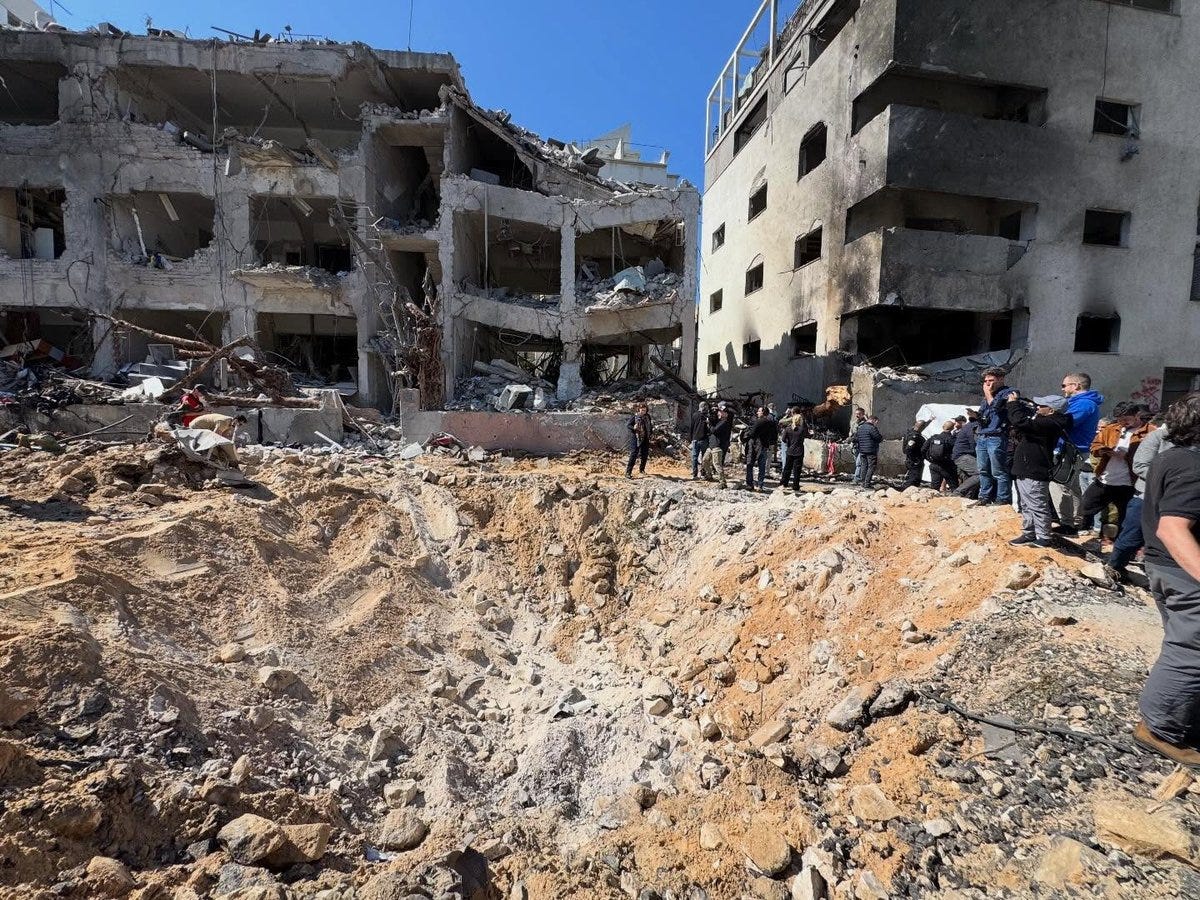
A drone view shows the destruction in a residential neighborhood, amid a ceasefire between Israel and the Hamas resistance movement in Gaza, in Gaza City, on October 19, 2025. (Photo by Reuters)

Press TV

A new US-backed proposal would divide Gaza into zones run separately by Israel and Hamas, restricting reconstruction to the Israeli-controlled area and, opponents warn, paving the way for a lasting Israeli foothold in the Palestinian territory.

The plan, described by The Wall Street Journal, represents one of the most consequential post-war frameworks under consideration since the fragile ceasefire between Hamas and the occupying Tel Aviv regime took effect on October 10.

“No reconstruction funds will be going into areas that Hamas still controls,” Jared Kushner, US President Donald Trump’s son-in-law who has been deeply involved in Gaza negotiations, told reporters in the Israeli-occupied territories on Tuesday.

“There are considerations happening now in the area that the Israeli military controls, as long as that can be secured, to start the construction as a new Gaza,” Kushner said.

Additionally, US Vice President JD Vance asserted Gaza currently consists of “two zones — one relatively safe and one extremely dangerous,” adding that the US goal was “to expand the safe zone geographically.”

According to the report, US officials indicate that the initiative seeks to establish a temporary structure to stabilize a portion of the territory while discussions persist regarding disarmament and the establishment of a transitional governing body that can manage the comprehensive reconstruction of Gaza.

A senior official from the US administration characterized the plan as “preliminary,” indicating that updates will be provided “in the coming days.”

Arab mediators have voiced concern regarding the proposal that emerged during recent discussions, according to the report, which adds that they are against the partitioning of Gaza, warning it could lead to a permanent Israeli-controlled zone within the region.

They have also turned down the suggestion of deploying forces to maintain security in Gaza under these circumstances.

The ceasefire map, negotiated by Trump, already features a yellow line that signifies Israeli control, which is designed to reduce gradually as specific benchmarks are fulfilled.

At the heart of the debate lies the unresolved question of how to disarm Hamas and form an alternative authority capable of restoring civilian governance and attracting international investment.

White House officials said Kushner, working with envoy Steve Witkoff, is the driving force behind the initiative, which has Trump’s backing.

Israeli analysts see the proposal as a way to weaken Hamas politically and militarily over time, by expanding Israel’s zone of control and strengthening a buffer between Gaza and border towns in the occupied lands.

But Palestinian and international observers warn the plan could mirror West Bank tactics, fragment Gaza, and erase its territorial unity.

As negotiations continue over a post-war plan for Gaza, the territory remains devastated. The UN agency for Palestinian refugees (UNRWA) estimates that 61 million tons of debris now cover the territory.

“Entire neighbourhoods have been erased, and families search the ruins for water, for shelter,” the agency said on X, noting that its aid “remains blocked” even as teams “continue to deliver lifesaving assistance.”

The International Court of Justice this week ordered Israel to allow humanitarian aid into Gaza, rejecting Israeli claims that many UNRWA staff are linked to Hamas — a verdict Israel dismissed with US backing.

[…]

Via https://www.presstv.ir/Detail/2025/10/24/757476/US,-Israel-considering-a-plan-that-would-divide-Gaza-into-separate-zones

U.S. judge permanently blocks Israeli spyware firm NSO Group from targeting WhatsApp

Case against NSO offers rare look into world of cyberspies Meta suit ...

October 18, 2025 6:14pm

A U.S. federal court has issued a permanent injunction preventing Israel’s NSO Group from attempting to breach WhatsApp, which is Meta’s internationally popular messaging platform.

The judge reduced the punitive damages awarded to Meta from $167 million to just $4 million.

The ruling from U.S. District Judge Phyllis Hamilton on Friday results from a legal battle that began in 2019 when Meta accused NSO of using its Pegasus spyware to unlawfully target WhatsApp users.

The software, known for its ability to exploit software vulnerabilities and enable undercover surveillance, ha allegedly been linked to numerous human rights abuse allegations, according to Amnesty International.

NSO had previously warned the court that such a restriction on interacting with Whatsapp would severely threaten its business model, arguing that being cut off from WhatsApp would “put NSO’s entire enterprise at risk” and could even “force NSO out of business.”

Meta applauded the decision as a win for privacy and civil society.

“Today’s ruling bans spyware maker NSO from ever targeting WhatsApp and our global users again,” said Will Cathcart, head of WhatsApp, in a post on X. “We applaud this decision that comes after six years of litigation to hold NSO accountable for targeting members of civil society.”

[…]

Via https://justthenews.com/government/courts-law/us-judge-permanently-blocks-israeli-spyware-firm-nso-group-targeting-whatsapp

Frustrations boil over as Vance delivers ‘firm’ message to Netanyahu

Vice President JD Vance exits his motorcade before boarding Air Force Two en route to Washington at Ben Gurion Airport on October 23, 2025 in Tel Aviv, Israel. Vance met with Netanyahu in ongoing efforts to maintain the ceasefire between Israel and Hamas. (Photo by Nathan Howard – Pool/Getty Images) | Getty Images

By Eli Stokols and Felicia Schwartz

The White House is growing increasingly frustrated with Israel just two weeks after President Donald Trump triumphantly announced a deal to end the war in Gaza and bring peace to the Middle East.

The mounting frustrations come as a succession of senior officials are passing through Israel this week looking to keep a fragile ceasefire in place. They see some recent developments — the Israeli Defense Force’s counter-attack in Gaza on Sunday, and the Knesset’s vote in favor of West Bank annexation, which Trump has ruled out — as detrimental to the already fragile agreement between Israel and Hamas.

Vice President JD Vance delivered a “firm message” from President Donald Trump during a meeting with Israeli Prime Minister Benjamin Netanyahu in Jerusalem Wednesday, according to two people familiar with the conversation who were granted anonymity because they weren’t authorized to speak publicly.

The administration’s private exasperation has begun to emerge in public view. Trump, in an interview published on Thursday, suggested Israel could lose all U.S. support if it annexed the West Bank, which followed condemnations from Vance, Secretary of State Marco Rubio and special envoys Steve Witkoff and Jared Kushner.

That so many administration officials criticized Israel so unequivocally less than two weeks after Trump landed to a hero’s welcome and promised eternal friendship and peace underscores how frustrated the White House is with the Netanyahu government.

The public comments “reflect how the president feels” about the matter, said a White House official, granted anonymity to discuss internal thinking.

Still, the White House is working to keep the fragile truce in place, dispatching several senior officials to the Middle East this week to meet with Arab partners and Israel’s leaders.

[…]

Netanyahu, seemingly aware and fearful of Trump’s anger, issued a statement expressing his own opposition to the Knesset’s vote.

“The Knesset vote on annexation was a deliberate political provocation by the opposition to sow discord during Vice President JD Vance’s visit to Israel,” the prime minister’s office said. “The two bills were sponsored by opposition members of the Knesset.” Notably, however, he issued the statement only in English.

Netanyahu faces a tough balancing act. He will need the backing of the parties supporting annexation in next year’s elections, which could happen as soon as March and must take place by October. At the same time, a public break with Trump would cost him significantly at the ballot box. Trump is widely popular in Israel and images of the pair together have been a fixture of Netanyahu’s past campaigns.

[…]

Trump’s promise to Arab leaders that Israel would not annex the West Bank came during a meeting at the United Nations, the same meeting where, according to Trump officials, he solidified the plan that ultimately brought about the peace deal he celebrated last week.

Trump, asked about the Knesset’s vote Thursday afternoon, brushed off the possibility that Israel would try to annex the West Bank. “Don’t worry about the West Bank, okay?” Trump said. “Israel’s not going to do anything with the West Bank.”

But just hours earlier, Vance derided the Knesset vote as a “very stupid stunt,” criticizing Israel’s government on its soil shortly after meeting with Netanyahu.

“I personally take some insult to it,” he said.

A person close to the vice president said the meeting with Netanyahu was instructive and positive.

Rubio, who arrived in Israel Thursday, told reporters before leaving Washington that he, too, was dismayed by the vote given Trump’s promise to Arab leaders before the Gaza peace deal came to fruition that he wouldn’t allow Israel to annex the West Bank.

[…]

Via https://www.politico.com/news/2025/10/23/frustrations-boil-over-as-vance-delivers-firm-message-to-netanyahu-00621213

Amazon Outage Waking People Up Regarding Our Slavery to Internet – US Government Failing in Defense Against Cyberattacks

by Brian Shilhavy
Editor, Health Impact News

In the wake of the Amazon Web Services (AWS) outage earlier this week, there have been numerous articles published in the media concerning just how vulnerable our society has become to just a few Big Tech companies here in the U.S. who control most of the Internet.

Government services, banks, smart homes, cell phone services, the retail market and just about every other facet of our society today depends upon the Internet to keep things running, and most of the Internet now is hosted in huge Cloud data centers.

About 70% of these data centers are owned by Amazon, Microsoft, and Google.

Others are ramping up spending to get a piece of this pie, such as Larry Ellison’s Oracle, with his close ties to Trump.

And the main driver in the economy right now that is putting more and more of the Internet traffic into these data centers, is the AI bubble.

This is a recipe for disaster, as I have been saying for years, and that others are now beginning to realize as well.

Not only is the technology prone to accidents and failures, as technology ALWAYS has been, but they are also huge targets to hackers and cyberattacks.

A new report published just this week found that for the first time in years, the United States is no longer making progress in bolstering its cyber defenses and is instead “stalling” and “slipping” in its ability to protect itself and allies.

The primary reason for this is because IT technicians can make so much more money developing AI, which is where all the money is going in the private sector.

But even the private sector spending $trillions on AI is running into a new obstacle: China controls 90% of the world’s rare earth supplies that are needed to build these energy hungry computer chips, and they are not selling them anymore unless the country purchasing them can prove that they are not being used for military purposes, which pretty much excludes Big Tech in the U.S., because they are all defense contractors.

The United States has more data centers than almost the rest of the world combined. Image source.

Here are some recent articles published this week in the national media that recognize that this situation with Big Tech is a national crisis.

From CNN:

You thought Monday’s internet outage was bad? Just wait

Monday’s Amazon Web Services outage — and the global disruption it caused — underscored just how reliant the internet has become on a small number of core infrastructure providers.

The ramifications of such outages could only get worse if artificial intelligence becomes as central to work and daily life as tech giants suggest it will in the coming years.

Monday’s outage briefly blocked some people from scheduling doctor’s appointments and accessing banking services. But what if an outage took down the AI tools that doctors were using to help diagnose patients, or that companies used to help facilitate financial transactions?

It may be a hypothetical scenario today, but the tech industry is promising a rapid shift toward AI “agents” doing more work on behalf of humans in the near future – and that could make businesses, schools, hospitals and financial institutions even more reliant on cloud-based services.

A global survey of nearly 1,500 firms published by McKinsey & Company in May found that 78% of respondents already use AI in at least one business function, up 55% from a year earlier.

“If there’s an outage and you rely on AI to make your decisions and you can’t access it, that’s going to have an effect on performance,” said Tim DeStefano, associate research professor at Georgetown’s McDonough School of Business.

Monday’s outage had such a widespread impact because many companies rely on cloud providers for the backend functions that support their businesses, such as virtual server space, storage or developer tools.

Typically, this set up is more affordable, flexible and secure for those customers, except when AWS experiences an outage. Then it’s effectively a single point of failure for a huge swath of the internet.

AWS serves millions of customers, from retailers and restaurants to financial services firms and government agencies; it holds around 37% of the cloud computing market, according to Gartner. Together with Microsoft and Google, the three companies service around 70% of the market.

And the consolidation of the internet’s backbone is continuing in the age of AI.

While there’s some grappling between the big three, Amazon, Microsoft and Google remain by far the prominent cloud computing providers for AI applications, according to Emarketer senior analyst Jacob Bourne — and their futures depend at least in part on serving AI demand.

While websites and apps can still technically function using their companies’ own less powerful on-premises servers,

“cloud computing represents a technological prerequisite for using AI,” DeStefano said.

That’s because the computers needed to run AI tools are powerful and expensive, and on-site hardware isn’t as easy to modify as business needs change. It just makes more sense to rent that computer space and pay for it only as needed.

And as AI becomes more widespread, data center outages could happen more frequently since AI models are so power-hungry, Bourne said.

The risk of serious disruption from an outage rises considerably the more companies rely on AI agents to do critical tasks and automate the work of humans, a transition that’s already in progress despite disagreement about just how far it will go. (Source.)

From GeekWire:

Concentration crisis in AI

With the generative AI ecosystem, I’m talking not about chatbots — I mean AI-native applications that are built on generative AI as a platform. We just saw that when there’s no cloud, there’s no cloud-native application. Likewise, when there’s no generative AI provider, there’s no AI-native application.

The first lesson from the AWS outage for AI-native applications is what happens to an industry when there’s a limited number of providers for centralized resources and there’s an outage. We just saw: it has huge rippling effects across the industry and all walks of life built on it.

It’s a throwback to the mainframe era: when “the computer” is down, it’s down for everyone.

There are as few, if not fewer, generative AI providers as there are cloud providers. A major outage is inevitable — that’s just engineering reality. When that happens, every AI-native app built on that generative AI platform will also go down, full stop.

The impact could be even more severe than the AWS outage. It will be more like “the computer is down, and the people are gone” for many different industries and services.

Ironically, the “smarter” the industry and service, the greater the potential fallout.

The second lesson is one of intertwined risk. OpenAI itself was affected by this week’s AWS outage.

That means AI-native apps have double exposure to the risks around a limited number of providers for critical, centralized resources. For AI-native apps, it’s like the mainframe era squared.

If the generative AI platform fails, everything built on it fails. And if the cloud that hosts the AI platform fails, it all goes down, too.

Highly concentrated risks with exceptionally broad impact aren’t going away anytime soon.

A thoughtful application of the AWS outage tells us that outages like this are a kind of problem that isn’t an anomaly: it’s inherent in the nature of today’s technology reality. (Source.)

[…]

Via https://vaccineimpact.com/2025/amazon-outage-is-waking-people-up-regarding-our-slavery-to-the-internet-u-s-government-failing-in-defense-against-cyberattacks/

Hawai’i is Dying: Here’s Why

Hawaii is Dying: Here’s Why

Cogito (2025)

Film Review

The August 8 2023 Lahina fire, allegedly sparked by downed power lines, caused fifteen thousand native Hawai’ians to lose their homes and/or jobs. The drainage of wetlands (over the past 50 years) and replacement of forests with paved over tourist attractions and invasive wild grasses. The latter played a major role in the fire’s spread. Communities requesting that power lines be buried and that prior fire breaks be restored were told it was too expensive.

Community organizers call it ethnic cleansing by real estate. Survivors who lost their homes in the fire were pressured to sell their land to developers and the housing shortage led landlords to increase rents by 40%.

Of the 600,000 ethnic Hawai’ians in the US, only 300,615 can afford to live in Hawai’i. Those with jobs in the tourism industry are often homeless. Billionaires like Jeff Bezos, Mark Zuckerberg and Larry Ellison have evicted thousands of them for their vast estates, while while the US military controls 60% of Hawai’i. The state has the highest rate of plant and animal extinction in the US.

The Advanced Indigenous Civilization Built by Kanaka Maoli

Native Hawai’ians, known as Kanaka Maoli, arrived in Hawai’i 1,000-2,000 years ago. They came as farmers, as the islands had no large animals or crops to feed them. They brought their own pigs, dog, sweet potatoes, sugar cane, coconut palms, taro, banana, bread fruit and paper mulberry plant in the canoes and outriggers. Building canals and complex irrigation system, they built hundreds of fish farms and banana, palm and sugar plantations. Due to low child mortality, they became one of the fastest growing civilizations on earth, reaching a population of 500,000 by the time of their first European contact (Captain James Cook 1778).

By 1800 Hawai’i had become a hub for European and US traders. To protect the Kanaka Maoli from European greed and rapaciousness, King Kamehemeha I used the weapons the Europeans left behind to establish an army and unify all the islands in 1810 as the Kingdom of Hawai’i.

By 1873, the country had become a constitutional monarchy with a democratic electoral system and a strong emphasis on education and literacy. The king’s palace in Lahina had electricity before the White House did.

During this period, European diseases were the biggest threat to the Kanaka Maoli, who eventually lost 90% of their indigenous population. The second biggest threat were Calvinist missionaries, who persuaded King Makele to sell communally owned land to white immigrants. They, in turn, proceeded to divert water from native crops for massive sugar plantations.

How Protestant Missionaries Got Rich Destroying Advanced Kanaka Maoli Civilization

Eventually the missionaries and their sons controlled the big five sugar companies, and all the railroads and shipping lines, bringing in tens of thousands of indentured servants from Japan, China, the Philippines, Portugal and Puerto Rico.

In 1887 they stripped King Kalakaua of his powers with their Bayonet constitution, allowing the US government to build a military base at Pearl Harbor. This denied the right to vote to Asians or anyone with a net worth less than $3,000.

Refusing to be governed by the sugar and pineapple barons, in 1891 Queen Lili’uokalni rewrote the Bayonet Constitution and removed race and wealth based qualifications for voting. In response,the head of the Hawaiian League launched a coup with the support of US Marines, abolishing the monarchy and imprisoning the Queen. The founder of Dole Pineapple Sanford Dole subsequently declared himself the first president of the Republic of Hawaii.

Although President Cleveland refused to recognize Hawaii as a republic, he declined to reverse the coup. McKinley annexed Hawaii in 1898 (intending to use Pearl Harbor to attack the Philippines) after declaring war on Spain.