
Nearly every vaccine recipient becomes producer and emitter of the very virus the vaccine is said to target.
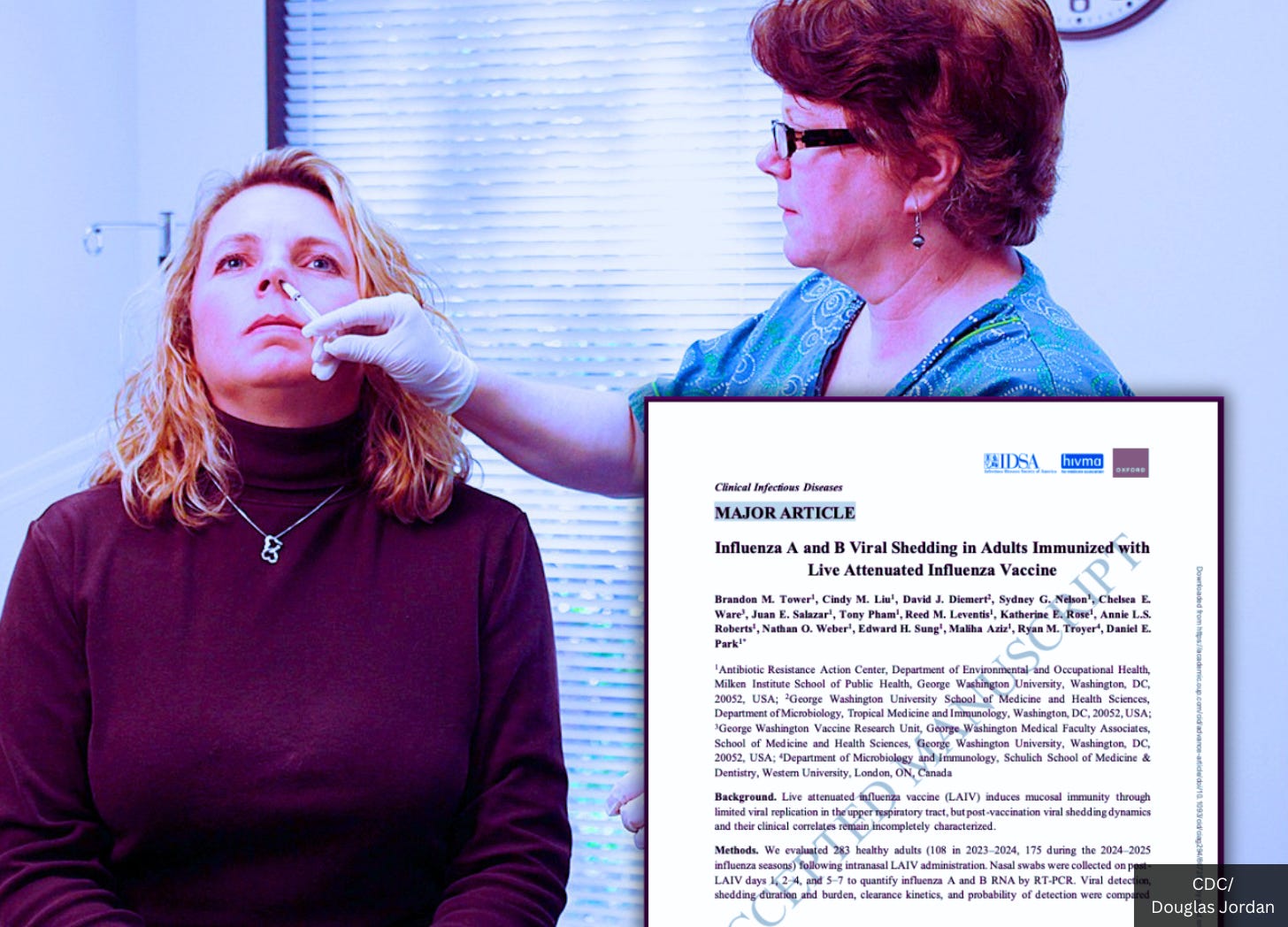
A newly published, U.S. government-funded, peer-reviewed study has confirmed that a live attenuated influenza vaccine caused detectable post-vaccination viral shedding in more than 91% of adult recipients, raising major questions about whether vaccinated individuals function as carriers and spreaders of vaccine-derived influenza pathogens after immunization.
The findings, published Thursday in the journal Clinical Infectious Diseases, claim that the purported virus inside the vaccine actively replicated inside recipients after administration and was subsequently shed from the nose in the overwhelming majority of participants.
Researchers from George Washington University evaluated 283 healthy adults between the ages of 18 and 49 who received the intranasal live attenuated influenza vaccine (LAIV), FluMist, during the 2023–2024 and 2024–2025 flu seasons.
Vaccine Virus Replicated Inside Recipients
According to the FDA insert, FluMist is said to contain live influenza viruses designed to reproduce inside the upper respiratory tract after administration.
The new paper explicitly states:
“LAIV replication begins within 24 hours and declines over the first week…”
Researchers further explained that the virus in the vaccine:
“replicates in the upper respiratory tract, mimicking a natural infection…”
In plain English, the vaccine virus reproduces inside recipients and is expelled back out through the nose afterward.
Researchers collected nasal swabs on day 1, days 2–4, and days 5–7 after vaccination and measured influenza A and B RNA using RT-PCR testing.
91.2% of Participants Shed Detectable Influenza Material
The study found:
“overall, 258 (91.2%) participants had either influenza A or B detected within the first week”
Researchers also reported:
“Influenza A or B RNA was detected in 86.9% of participants on day 1…”
The probability of detection remained measurable for days afterward:
- 92% on day 1
- 23% on day 5
- 9% on day 7
Study Only Looked for 7 Days
Importantly, the researchers stopped monitoring participants after approximately seven days.
That means the study cannot determine:
- how many participants continued shedding beyond day 7,
- how long shedding ultimately persisted,
- or when the slow-clearance group fully stopped shedding vaccine-derived influenza material.
Study Acknowledged Possible Transmission Window
The paper directly acknowledged the possibility of secondary transmission from recently vaccinated individuals.
Researchers wrote:
“…even if secondary transmission were possible, opportunities would be largely restricted to the earliest days following vaccination.”
The authors attempted to limit conclusions about contagiousness by emphasizing that PCR detection alone cannot prove every detected viral particle was infectious.
The study states:
“PCR-based methods cannot specifically discriminate between infectious virions and non-infectious viral nucleic acids.”
However, the study still confirms that recipients of the live-virus flu vaccine were producing and shedding vaccine-derived influenza material after vaccination.
That means recently vaccinated individuals temporarily became emitters of the same influenza material the vaccine is marketed to protect against.
Findings Raise Major Informed Consent Questions for Both Recipients & Their Close Contacts
The findings raise two separate informed consent issues.
First, recipients themselves may not fully understand that a live-virus influenza vaccine can cause active viral replication, respiratory symptoms, and post-vaccination shedding after administration.
Second, people around recently vaccinated individuals are generally not informed that they may be exposed to someone actively shedding vaccine-derived influenza material during the days following vaccination.
FDA Insert Confirms FluMist Uses Lab-Created Chimeric Influenza Viruses That Can Shed for Up to 28 Days
The FDA prescribing insert for FluMist Quadrivalent confirms that the vaccine contains live laboratory-created reassortant (chimeric) influenza viruses capable of infecting recipients, replicating inside the respiratory tract, and shedding afterward for up to 28 days in clinical studies.
The insert explains that the vaccine viruses are not purpordedly naturally occurring influenza strains.
They are genetically assembled reassortant viruses created by combining genetic material from multiple influenza viruses.
According to the FDA insert:
“For each of the four reassortant strains in FluMist Quadrivalent, the six internal gene segments responsible for ca, ts, and att phenotypes are derived from a master donor virus (MDV), and the two segments that encode the two surface glycoproteins, hemagglutinin (HA) and neuraminidase (NA), are derived from the corresponding antigenically relevant wild-type influenza viruses.”
In other words, the vaccine viruses are hybridized influenza constructs containing:
- internal genes from a laboratory master donor virus,
- combined with surface genes from circulating wild-type influenza strains.
The insert also directly confirms these reassortant vaccine viruses are live and capable of replication inside recipients.
The FDA states:
“FluMist and FluMist Quadrivalent contain live attenuated influenza viruses that must infect and replicate in cells lining the nasopharynx of the recipient to induce immunity.”
The insert further confirms shedding:
“Vaccine viruses capable of infection and replication can be cultured from nasal secretions obtained from vaccine recipients (shedding)”
Unlike PCR-only detection, the FDA shedding studies involved culturing live vaccine virus from recipients after vaccination.
The insert states:
“Shedding of vaccine viruses within 28 days of vaccination with FluMist was evaluated…”
According to the FDA’s own data, the latest positive viral cultures observed in different age groups occurred on:
- Day 23
- Day 25
- Day 28
For individuals ages 18–49, the last positive culture occurred on day 17.
The insert additionally confirms documented transmission of a vaccine-derived influenza strain to an unvaccinated placebo recipient during a daycare transmission study.
According to the FDA:
“One placebo subject had mild symptomatic Type B virus infection confirmed as a transmitted vaccine virus…”
The FDA insert therefore confirms that FluMist contains live reassortant influenza viruses engineered from multiple viral sources, that these vaccine viruses can infect and replicate inside recipients, and that shedding of culturable live vaccine virus was documented for as long as 28 days after vaccination in clinical studies.
Bottom Line
This U.S. government-funded peer-reviewed study, combined with the FDA’s own prescribing insert, confirms that FluMist recipients are being inoculated with live laboratory-created reassortant influenza viruses that actively infect the respiratory tract, replicate inside the body, and are subsequently shed back out into the environment after vaccination.
The findings establish that, even under the mainstream virological model, vaccinated individuals can temporarily become producers, carriers, and emitters of vaccine-derived influenza pathogens after immunization—with FDA documents confirming shedding of culturable live vaccine virus for as long as 28 days and even documenting transmission of a vaccine-derived strain to an unvaccinated placebo recipient in a clinical study.
The revelations also raise major informed consent questions, not only for vaccine recipients themselves, but for family members, coworkers, immunocompromised individuals, infants, the elderly, and others who are generally never informed they may be exposed to recently vaccinated individuals actively shedding live vaccine-derived influenza virus afterward.
[…]
Via https://jonfleetwood.substack.com/p/91-of-flu-vaccine-recipients-shed

