Unknown's avatar

About stuartbramhall

Retired child and adolescent psychiatrist and American expatriate in New Zealand. In 2002, I made the difficult decision to close my 25-year Seattle practice after 15 years of covert FBI harassment. I describe the unrelenting phone harassment, illegal break-ins and six attempts on my life in my 2010 book The Most Revolutionary Act: Memoir of an American Refugee.

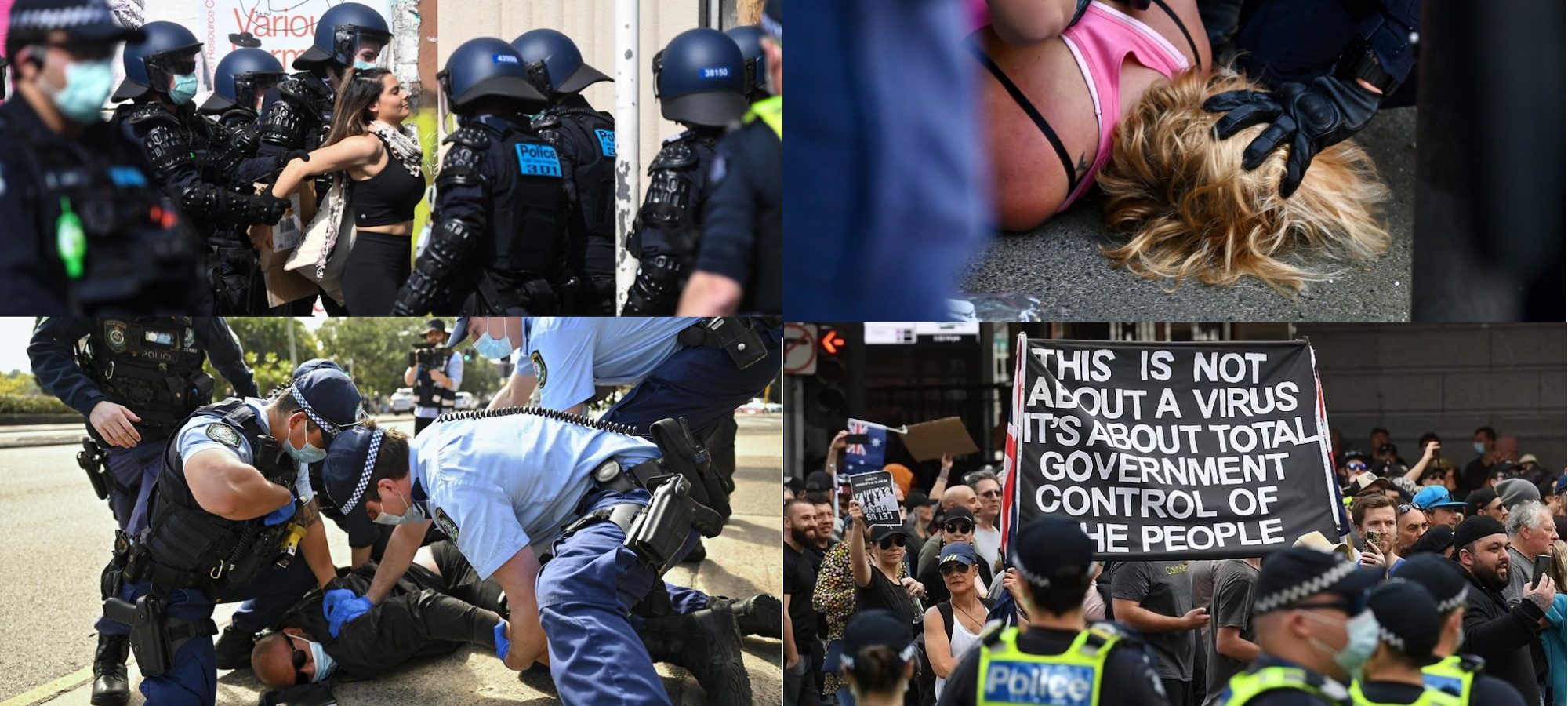
Australia going full Fascist – but resistance growing

Kit Knightly

OffGuardian

The Australian government been leading the pack on Covid-based tyranny from the beginning, but are they pushing their citizens to breaking point?

Covid19 has been used as an excuse to increase government control of pretty much everything, pretty much everywhere.

It is, without question, the greatest campaign to seize power, and greatest assault on personal freedom, of my lifetime. With countries seemingly in a contest to outdo each other’s clampdowns, lockdowns, quarantines and surveillance programs.

From the beginning of the “pandemic” three countries, in particular, have set the pace on this – Canada, Australia and New Zealand. Since last spring these three have been one-upping each other in a race to the fascist finish line. And right now, Australia is putting a sprint in to pull away from the pack.

Cities are going into full lockdown for just one positive test. Some Australian cities and states aren’t just under total lockdowns, but also ever-extending curfews. The details of which read like a dystopian novel.

People are not permitted to leave the state, let alone the country. They’re not even permitted more than 5km (~3 miles) from their home. They’re not allowed out at all after 9pm or before 5am. Masks are mandatory everywhere for everyone. Outdoors and in. No religious services. No weddings. Shoot stray dogs, just in case.

Police barge into “unapproved” shops and fine business owners, or go house-to-house making sure no one has gone out. People who test positive are taken from homes for “indefinite stays” at “quarantine hotels”.

They are herding thousands upon thousands of children in stadiums, without their parents, to perform (allegedly) voluntary mass vaccinations, despite the possible dangers. The army has been deployed to check papers and vaccine status at road checkpoints.

The homes of those “self-isolating” are having government notices nailed to the doors. “Unauthorised protests” are banned, and if organize one you get 8 months in prison.

The unvaccinated are told they mustn’t leave their homes

[…]

And the nation’s billionaire-owned propaganda channels pump out this hysterical fear-mongering

Increasingly their rules and limitations are becoming not just tyrannical but literally insane. It seems, just about every day, one or another Australian politician or health “expert” is on the news saying something crazy.

Don’t take your masks off to drink. Don’t be friendly. Don’t watch the sunset. Tape your balcony shut. Don’t go out to shop, and don’t order online either

[…]

Via https://off-guardian.org/2021/08/23/australia-is-going-full-fascist-but-resistance-is-growing/

Prisoners to plug worker shortage in meat industry

The Covid pandemic and Brexit have both contributed to current worker shortages, with furloughed workers finding new jobs and EU nationals returning to their home countries.

Exposing the Big Game's avatarExposing the Big Game

https://www.bbc.com/news/business-58303679

ADVERTISEMENThttps://9b58d0ac8b249391a485f5010ec36b80.safeframe.googlesyndication.com/safeframe/1-0-38/html/container.html

By Michael Race
Business Reporter, BBC NewsPublished5 hours agocommentsCommentsShareRelated Topics

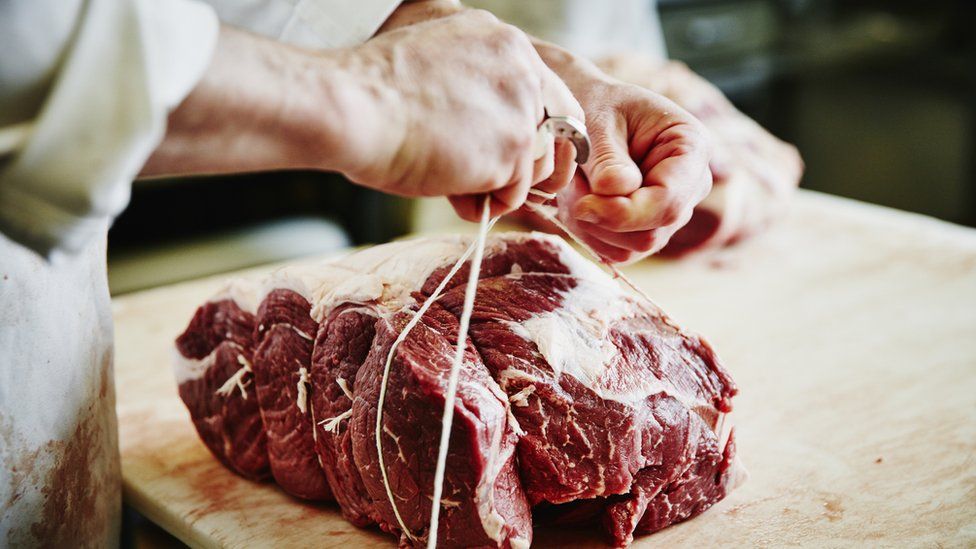
Butcher handling meat

Abattoirs, butchers and meat processors are set to employ prisoners and ex-inmates to help plug labour shortages.

Meat industry leaders held talks with the government on Monday to discuss options of how businesses could link up with prisons to fill vacancies.

The Association of Independent Meat Suppliers told the BBC the industry had about 14,000 job vacancies currently.

It said Covid, Brexit and perceptions over career paths had caused a looming “recruitment crisis”.

The industry body said businesses would seek to link up with prisons that contain prisoners who are part of the Release On Temporary Licence (ROTL) programme.

ROTL is a risk-assessed temporary release programme that inmates in open prisons use to gain work experience to help them in their transition back into the community.

Tony Goodger, of the Association of Independent…

View original post 420 more words

Large-scale Canadian protests against mandatory vaccine passports – media blacks it out

Monday, August 23, 2021 by: JD Heyes

(Natural News) Most Americans think of our neighbors to the north as a mostly benevolent people not prone to excitability or bucking authority, but all of that is changing in the age of COVID-19.

The most recent evidence is trickling out on various social media platforms: Video and photographs of massive protests against the increasingly authoritarian mandates imposed on Canadians by their elected leaders, to include mandatory vaccine passports and other documentation showing they have gotten a COVID-19 vaccine, lest they be barred from being full participants in their own country.

[…]

Via https://freedomforhumanity2016.wordpress.com/2021/08/23/large-scale-protests-take-place-in-canada-against-mandatory-vaccine-passports-but-the-media-blacks-it-out-naturalnews-com/

The Pandemic Response as Contemporary Imperialism


August 22, 2021: Police fire rubber bullets at protesters near Victoria Market. Sydney, Australia

 By Addison Reeves

Left Lockdown Sceptics via Wrong Kind of Green

The almost uniform support for totalitarian lock-down measures and mandates from those on the left has been shocking to see and has resulted in a feeling of political homelessness for those whose leftist values are what lead them to view the response to the pandemic with a sharp critical eye. This article shows that the reason why so many on the left have abandoned the values of freedom of speech and movement, bodily autonomy, and economic justice is because those people belong to the ideology of progressivism, which exists outside the left-right dichotomy.

Progressivism is an ideology that champions limitless growth, unbridled use of technology and the control of nature over any intrinsic sense of worth or fulfillment. We all get dragged along on the march of ‘progress’ because progressives assume any deviance from their values is inferior and because they tend to control the world’s resources. Progress under this model is linear; the future is always an improvement on the past, and any attempt to resist change or divert course is seen as regressive and unscientific.

Progressives often engage in leftist rhetoric, but their proposals always result in strengthening and expanding the existing, inequitable system and further entrenching the current, elite class. Progressives propose superficial policies rather than measures that would truly allow citizens to become more self-sufficient or otherwise reduce inequality because that would undermine their primary goal of unlimited growth. That is why progressives increasingly take refuge in identity politics; it allows them to talk about changing the system without actually having to challenge the exploitative aspects of society that they rely on for profit and growth. They then blame the increasing disparities on their opponents for resisting ‘progress’.

Progressivism is the direct descendant of the imperialism that dominated much of Western history for centuries. While the common narrative of modern history would have us believe that imperialism faded away in the 20th century as military aggression was replaced with international, economic cooperation and democratic revolutions, imperialism never died. In the United States and other countries there has always been a championing of Enlightenment ideals of liberty and equality alongside the denial of these same values to other groups who were conquered, exploited, or oppressed for imperialist goals of expansion and profit. The legacy of imperialism is just as deeply imprinted on the minds of Americans as liberalism is.

Progressivism = imperialism

Imperialism is the practice of one group of people forcibly subjecting other groups of people to its authority and control for its own benefit, though the imperialists often rationalize their actions as an attempt to save or improve its victims. The history of imperialism in the United States has lent certain traits to its successor progressivism: an extractive belief system, an antipathy towards the natural world, a rigidly prescriptive mindset, and a pathological feeling of supremacy.

Progressivism, like imperialism, is built on the depletion of natural resources, with little concern for sustainability. This attitude extends not just to the plants, animals, and minerals we consume, but to humans (‘human resources’ or ‘human capital’) as well. Thus, the extractive belief system is evident in the slave and sweatshop labor that has and continues to subsidize the economy as well as the rapacious attitude towards nature. As an acquisition-focused philosophy, progressivism treats humans as objects to be possessed and controlled, especially for financial profit. Progressives show no qualms about manipulating people or depriving them of freedom or livelihood to coerce them into compliance because they have no respect for personal agency, seeing other humans as just another resource to be mined.

Progressives view humans as separate from the natural environment, treating nature as something merely to be tamed and conquered. Nature is treated as inherently flawed and in need of improvement by humans. Human solutions, especially technological solutions, are always seen as better than letting nature run its course even when the problems are man-made ones.

Progressives are obsessed with using data, technocracy, and standardization to create a false veneer of objectivity that they use to reinforce the belief in the supremacy of their ideas and to discount the viewpoints that are discordant with progressive ideology, often disdaining opposition as unscientific and false. This is true even where the dissent is unfalsifiable, like satire or an opinion. Progressive imperialists see their own opinions as absolute truth and fail to recognize their own biases and implicit assumptions, just like how early American imperialists deemed their own racialized worldview as scientific and used whatever differences they could quantify between whites and blacks as further evidence of their own supremacy.

Imperialists’ belief that they have ownership of truth fuels their belief in their own supremacy in a circular manner. They believe they are better and smarter than everyone else and therefore that their beliefs are also superior. Deviants and dissenters are perceived as inferior just by virtue of their deviance from the dogma of progressivism. Like the imperialists before them, progressives’ belief in their own superiority is what is used to justify forcing their will on everyone else. They see no problem with censoring criticism, depriving individuals of freedom, and forcing lifestyle choices on others.

[…]

Via https://www.wrongkindofgreen.org/2021/08/22/the-pandemic-response-as-contemporary-imperialism/

The Chip Shortage Looks Like the Oil Shortage of the 1970s. What It Means for Stocks and the Economy

The longer the chip shortage goes on, the more prices will rise in all types of products. That will benefit chip makers such as Intel (INTC) and Taiwan Semiconductor Manufacturing (TSM). Wall Street sees upside in the latter.

CityFella's avatarSACRATOMATOVILLE POST


President Joe Biden introduced a plan for $50 billion in chip research earlier this year.Doug Mills/The New York Times/Bloomberg

By: Al Root/Barron’s

Semiconductors might be the new oil—and that could make the 2020s the new 1970s.

Back then, the world ran on oil—and any change in supply had a massive impact on demand. When OPEC embargoed the U.S. in the 1970s, the price of crude rose from about $3 a barrel at the beginning of the decade to $13 a barrel by its end. The U.S. even issuedgas ration coupons in 1974.

The spike was good news forChevron andExxon Mobil, which returned roughly 100% and 70%, respectively, in the 1970s, but painful for everyone else, as inflation raged. The S&P 500 and Dow Jones Industrial Average rose just 17% and 5%, respectively, over the decade.

If oil was the necessary component for the 1970s economy, chips provide the same function…

View original post 458 more words

South Africa: Community at the Heart of Hunger Struggle

9 June 2020: Sbongile Tabhethe works in the food garden in eKhenana shack settlement in Cato Manor, Durban. (Photograph by Mlungisi Mbele)

Anna Majavu

Internationalist 360º

Communal gardens and farming enterprises are the beginning of sustainable food sovereignty in South Africa, but a basic income grant is essential to address hunger in the shorter term.

In a country where 10 million people go to bed hungry every night, the government’s Covid-19 social relief of distress grant was a lifeline. A tiny lifeline for a fraction of the estimated 28.4 million unemployed and “economically inactive” people in the country, according to researcher Siyabulela Mama, but a lifeline nonetheless.

So when the government ended the grant after just nine months, as part of its economic austerity measures, it cut more than five million people off from a monthly payout of R350 (about $23.50). Although only enough to buy a loaf of the cheapest bread each day and little else – and even though it excluded women whose minor children were already getting a child support grant of R470 a month – it kept casual and precarious workers, restaurant workers, street traders, artists and others who had lost their jobs during the pandemic from starving.

The widespread unrest triggered by a disgruntled ANC faction violently attacking delivery trucks in July quickly foregrounded hunger in the country, as thousands of starving South Africans took advantage of the chaos to appropriate food from supermarkets and food warehouses in the provinces of KwaZulu-Natal and Gauteng.

The government reintroduced the social relief of distress grant in response to the chaos, extending it to March 2022. Many hope it will convert to a basic income grant.

Mama, who works at the Centre for Integrated Post-School Education and Training at Nelson Mandela University, is a spokesperson for the #PayTheGrants campaign, which wants a basic income grant of R1 268 a month for those between the ages of 19 and 59. South Africa does not have a dole system and this age group falls outside the old age pensions and child support grants that the government offers.

Television news stations call him frequently to discuss the basic income grant and he says “over 10 million people go to bed hungry every night while living near shops with plenty of food that they cannot afford. That created a crisis. But this time the crisis exposed that the South African food system is so unjust and needs to be overhauled.”

Activists first proposed a basic income grant 20 years ago. The government has been “contemplating” it since 2002. A new generation of activists, such as Mama, is taking this campaign forward and combining it with grassroots food sovereignty projects based on communal gardens and poultry farming. Mama works with such projects in the coastal city of Gqeberha in Eastern Cape province.

[…]

More land occupations

Women living in the eKhenana shack settlement in the coastal city of Durban, KwaZulu-Natal, are part of a growing national trend of occupying unused land and using it for the communal production of food.

Nokuthula Mabaso, 38, says the communal vegetable garden that the members of shack dwellers’ movement Abahlali baseMjondolo established allowed them to generate enough revenue to supplement their savings of R3 000 and set up a communal poultry farm.

“When the Covid-19 lockdown was announced, we were all in financial trouble. We realised that our piece jobs [informal work] could no longer help us and our families survive … We called a meeting and discussed ways to create sustainable income for the community. We’ve made an oath to never allow anyone here to starve while there is food or money from the food projects in the community,” explains Mabaso.

[…]

This is no small feat in a country where 2.2 million people lost their jobs in last year’s Covid-19 lockdown, with the result that by June 2021, Statistics South Africa put the expanded unemployment rate at a record high of 43.2%. Even the Integrated Food Security Phase Classification (IPC), a scale agreed by organisations ranging from Oxfam to USAid, recently concluded that “9.34 million people in South Africa (16% of the population analysed) faced high levels of acute food insecurity and required urgent action to reduce food gaps and protect livelihoods”. The IPC said this number would rise to almost 12 million by June 2021.

In South Africa, the persistence of shack settlements reflects the lack of affordable accommodation options available to impoverished families in well-situated areas near public amenities. The 109 families of eKhenana occupied two hectares of land in 2018 after being evicted from rented shacks, naming their new village eKhenana because it is isiZulu for Canaan. Residents say the name represents their aspirations to transform eKhenana into a place fit for humans, with all the residents’ needs catered for collectively.

“Land occupations allow people to live on well-located land close to opportunities for livelihoods, education and to participate in urban planning and other ways of shaping the cities from below. Of course, land occupations also allow people to build homes, community halls, crèches and political schools. But land occupations are often also spaces that allow for urban gardening and farming,” says Abahlali baseMjondolo president S’bu Zikode.

The movement has been establishing collective farming projects for 13 years, the first in Motala Heights in 2008. A women’s organic community garden project, it went on to support the development of a similar garden group in the nearby eMmaus shack settlement. “This project did not only ensure that families had food, it also gave women some autonomy from exploitative and racialised forms of labour,” says Zikode.

[…]

Via https://libya360.wordpress.com/2021/08/20/community-at-the-heart-of-hunger-struggle-in-sa/

Hidden History: When Progressives Were More Conservative than Liberals

Land-value tax - Why Henry George had a point | Free ...

A Skeptics View of American History

Episode 14: Early Progressives Were Not Liberals

Mark Stoler Phd

Film Review

In this presentation, Stoler tries to clarify the historical distinction between progressivism and liberalism, as well as explaining the difference between US and European conservatism. Unfortunately he omits mentioning Henry George, the most famous progressive of the 19th century and mistakenly attributes the “invisible hand” concept to Scottish natural philosopher Adam Smith.

Stoler stresses that progressivism never represented a unified movement in the US, as both Republican president Teddy Roosevelt and Democratic president Woodrow Wilson considered themselves progressive.

According to Stoler, reforms associated with the progressive movement included

  • the progressive income tax
  • regulation of the railroads
  • antitrust legislation
  • the Pure Food and Drug Act
  • the Federal Reserve
  • major attacks on civil liberties during World War I
  • limitations on immigration
  • enforced professional standards for doctors, teachers, lawyers, etc
  • the birth of social work as a profession, along with settlement houses to help immigrants and the poor
  • the national birth control movement
  • worsening of living and job conditions for African Americans
  • social gospel movements in US churches promoting progressive reform
  • a racist eugenics movement that promoted forced sterilization.

Although Stoler lists a number of prominent individuals* linked with the progressive movement, for some reason he leaves out the most famous progressive of all of the late 19th century. During the 1890s, social reformer Henry George (who published Progress and Poverty) in 1879, was the third most famous American (after Mark Twin and Thomas Edison).** Progress and Poverty sold millions of copies worldwide (more than any prior American book). A printer turned journalist, George also ran for mayor of New York City (twice). Following his death during the second campaign, his ideas on economic reform were carried forward by many organizations in the US and throughout the English-speaking world.

Unlike other progressives, Henry George opposed a progressive income tax. He believed government at all levels should be funded by a land value tax.

According to Stoler, progressives differed from traditional liberals (like Thomas Jefferson) who feared excessive government power. Progressives, discouraged by the soul-destroying poverty and inequality created by rapid industrialization believed a strong central government was necessary to break up monopolies and regulate industries that were brutally exploiting workers.

Here, once again, Stoler mistakenly attributes the concept a self-regulating market (via the “invisible hand” of competing self-interests) to Adam Smith. The concept of the invisible hand didn’t originate with Smith but with one of his contemporaries. In fact, he makes no mention of it in Wealth of Nations. In Volumes 4 and 5, he calls for government intervention in a number of instances.

In the US, people who opposed any government intervention (as 18th and 19th century liberals did) came to be known as conservatives, whereas European conservatives historically favored absolute government power (ie monarchy).

Both US conservatives and liberals tended to base their political views on John Locke’s notions of the social contract formed between rulers and their subjects.** In contrast, European conservatives tended to base their views on Thomas Hobbes’s views of a natural order (ie human nature) that causes life to be nasty, brutish and short, with the only solution being obedience to a monarch with absolute power.


*Philosopher William James, educational reformer Charles Dewey, social reformer and peace activist Jame Addams, General Leonard Wood, Supreme Court Justices Oliver Wendall Holmes and Louis Brandeis (who ran the international Zionist movement from his Supreme Court chambers – see https://ifamericansknew.org/us_ints/history.html), investigative journalists Lincoln Steffens and Ida Tarbell, political authors Jack London, Steven Crane, Frank Norris, Theodore Dreiser and Upton Sinclair, politicians Franklin D Roosevelt (an imperialist globalist) and Robert La Follette (an anti-imperialist isolationist).

**See https://stuartbramhall.wordpress.com/2013/12/24/progress-and-poverty-a-suppressed-economics-classic/

*** By definition a social contract is an actual or hypothetical agreement between a community and its ruler that defines and limits the rights and duties of each

The film can be viewed free on Kanopy.

https://pukeariki.kanopy.com/video/early-progressives-were-not-liberals

Covid-19: FDA Set to Grant Full Approval to Pfizer Vaccine Without Public Discussion of Data

British Medical Journal campaigns for legalized euthanasia ...

By Gareth Iacobucci

British Medical Journal

BMJ 2021; 374 doi: https://doi.org/10.1136/bmj.n2086 (Published 20 August 2021) Cite this as: BMJ 2021;374:n2086

Transparency advocates have criticised the US Food and Drug Administration’s (FDA) decision not to hold a formal advisory committee meeting to discuss Pfizer’s application for full approval of its covid-19 vaccine.

Last year the FDA said it was “committed to use an advisory committee composed of independent experts to ensure deliberations about authorisation or licensure are transparent for the public.”1 But in a statement, the FDA told The BMJ that it did not believe a meeting was necessary ahead of the expected granting of full approval.

“The FDA has held numerous meetings of its Vaccines and Related Biological Products Advisory Committee (VRBPAC) related to covid-19 vaccines, including a 22 October 20202 meeting to discuss, in general, the development, authorisation, and licensure of covid-19 vaccines,” an FDA spokesperson said.

“The FDA also has held meetings of the VRBPAC on all three covid-19 vaccines authorised for emergency use and does not believe a meeting is needed related to this biologics license application.”

The spokesperson added, “The Pfizer BioNTech covid-19 vaccine was discussed at the VRBPAC meeting on 10 December 2020.3 If the agency had any questions or concerns that required input from the advisory committee members we would have scheduled a meeting to discuss.”

The vaccine has already been rolled out to millions of Americans through an emergency use authorisation. Companies typically apply for full approval after a longer period has elapsed so that more data are available for review.

But with the US government indicating this week that it plans to start making booster shots widely available next month, experts said the decision not to meet to discuss the data was politically driven.

Data scrutiny

Kim Witczak, a drug safety advocate who serves as a consumer representative on the FDA’s Psychopharmacologic Drugs Advisory Committee,4 said the decision removed an important mechanism for scrutinising the data.

“These public meetings are imperative in building trust and confidence especially when the vaccines came to market at lightning speed under emergency use authorisation,” she said. “The public deserves a transparent process, especially as the call for boosters and mandates are rapidly increasing. These meetings offer a platform where questions can be raised, problems tackled, and data scrutinised in advance of an approval.”

Witczak is one of the more than 30 signatories of a citizen petition5 calling on the FDA to refrain from fully approving any covid-19 vaccine this year to gather more data. She warned that without a meeting “we have no idea what the data looks like.”

“It is already concerning that full approval is being based on 6 months’ worth of data despite the clinical trials designed for two years,” she said. “There is no control group after Pfizer offered the product to placebo participants before the trials were completed.

“Full approval of covid-19 vaccines must be done in an open public forum for all to see. It could set a precedent of lowered standards for future vaccine approvals.”

Public discussion

Diana Zuckerman, president of the National Center for Health Research, who has also spoken at recent VRBPAC meetings, told The BMJ, “It’s obvious that the FDA has no intention of hearing anyone else’s opinion. But if you make decisions behind closed doors it can feed into hesitancy. It’s important to have a public discussion about what kind of data are there and what the limitations are. As we think about risk versus benefit, we need to know.”

Joshua Sharfstein, vice dean for public health practice and community engagement at the Johns Hopkins Bloomberg School of Public Health and former FDA deputy commissioner during the Obama administration, said that advisory committee meetings were more than just a way of receiving scientific input from outside experts. “It’s also an opportunity to educate the public about the important work that the FDA has done reviewing an enormous amount of data about a product,” he told The BMJ. “It’s a chance for questions to be asked and answered, building public confidence.

“If there are no advisory committee meetings prior to licensure, the FDA should consider taking extra steps to explain the basis of its decisions to the public.”

On 18 August, before the news that the FDA would not be holding a formal committee meeting, the president of the Infectious Diseases Society of America Barbara Alexander praised the impact of the VRBPAC meetings as “a critical and necessary part” of the process for assessing whether to give booster doses.6

[…]

Via https://www.bmj.com/content/374/bmj.n2086

Revolutionary Association of Women of Afghanistan (RAWA) Responds to Taliban Takeover

RAWA.ORG: Degree of risk in Afghanistan

By Afghan Women’s Mission

Afghan Women’s Mission has been in touch with RAWA to address their needs at this urgent time. In this brief Q&A with AWM Co-Director Sonali Kolhatkar, RAWA explains the unfolding situation on the ground as they see it. Click HERE to donate to RAWA now.

Sonali Kolhatkar: For years RAWA spoke out against the U.S. occupation and now that it has ended, the Taliban are back. Could President Biden have withdrawn U.S. forces in a manner that would have left Afghanistan in a safer situation than currently? Could he have done more to ensure the Taliban were not so quickly able to take over?

RAWA: In the past 20 years, one of our demands was an end to the US/NATO occupation and even better if they take their Islamic fundamentalists and technocrats with them and let our people decide their own fate. This occupation only resulted in bloodshed, destruction and chaos. They turned our country into the most corrupt, insecure, drug-mafia and dangerous place especially for women.

From the very beginning we could predict such an outcome. On the first days of the US occupation of Afghanistan, RAWA declared on October 11, 2001:

“The continuation of US attacks and the increase in the number of innocent civilian victims not only gives an excuse to the Taliban, but also will cause the empowerment of the fundamentalist forces in the region and even in the world.”

The main reason we were against this occupation was their backing of terrorism under the nice banner of “war on terror”. From the very first days when the Northern Alliance looters and killers were installed back into power in 2002 to the last so-called peace talks, deals and agreements in Doha and release of 5000 terrorists from prisons in 2020/21, it was very obvious that even the withdrawal won’t have a good end.

The Pentagon proves that none of the theory invasion or meddling ended up in safe condition. All imperialist powers invade countries for their own strategic, political and financial interests but through lies and the powerful corporate media try to hide their real motive and agenda.

It is a joke to say values like “women’s rights”, “democracy”, “nation-building” etc. were part of the US/NATO aims in Afghanistan! US was in Afghanistan to turn region into instability and terrorism to encircling the rival powers especially China and Russia and undermining their economies via regional wars. But of course the US government did not want such a disastrous, disgraceful and embarrassing exit that left behind such a commotion that they were forced to send troops again in 48 hours to control the airport and safely evacuate its diplomats and staff.

We believe the US left Afghanistan out of its own weaknesses not defeated by its creatures (Taliban). There are two significant reasons for this withdrawal.

The main reason is the multifold internal crisis in the US. The signs of the US system decline was seen in the weak response to Covid-19 pandemic, attack on Capitol Hill and the great protests of the US public in the past few years. The policy-makers were forced to withdraw troops to focus on internal burning issues.

The second reason is that the Afghan war was an exceptionally expensive war whose cost has gone into trillions, all taken from taxpayer money. This put such a heavy dent on the US financially that it had to leave Afghanistan.

The war-mongering policies prove that their aim was never to make Afghanistan safer, let alone now when they are leaving. Furthermore, they also knew that the withdrawal would be chaotic yet they still went ahead and did it. Now Afghanistan is in the limelight again due to the Taliban being in power but this has been the situation for the past 20 years and everyday hundreds of our people were killed and our country destroyed, it just was rarely reported in the media.

Sonali Kolhatkar: The Taliban leadership are saying they will respect women’s rights as long as it complies with Islamic law. Some Western media are painting this in a positive light. Didn’t the Taliban say the same thing 20 years ago? Do you think there is any change in their attitude toward human rights and women’s rights?

RAWA: The corporate media is only trying to put salt on our devastated people’s wounds; they should be ashamed of themselves the way they try to sugarcoat brutal Taliban. The Taliban spokesperson declared that there is no difference between their ideology of 1996 and today. And what they say about women’s rights is the exact phrases used during their previous dark rule: implementing Sharia law.

[…]

Coronavirus cases spike in highly vaccinated Israel but drop in unvaccinated Palestine

Coronavirus cases spike in highly vaccinated Israel but drop in unvaccinated Palestine

Dr Eddy Betterman

The Middle Eastern states of Israel and Palestine show contrasting figures in both vaccination rates and case counts amid the ongoing pandemic. Israel recently saw a massive spike in Wuhan coronavirus (COVID-19) cases despite three-fifths of its population being vaccinated. Meanwhile, Palestine saw its COVID-19 cases drop even though more than 90 percent of its population remains unvaccinated.

Naturopathic doctor Suneil Jain pointed out the stark contrast in a tweet. His post said: “Palestine: 8.2 percent of the population is fully vaccinated. Israel: 62 percent of the population is fully vaccinated. Guess which one is doing better?”

Jain pointed to figures from the website OurWorldInData.org to support his tweet. He compared the vaccination rates and the number of COVID-19 cases in both countries and found that the former was directly proportional to the latter. While Israel suffers from high case counts despite the majority of its citizens being vaccinated, Palestine, with many remaining unvaccinated, has seen a steady drop.

As of Aug. 10, more than half of Israel’s population have been fully vaccinated, while only 8.2 percent of Palestinians have received two doses of coronavirus vaccines. Palestine has only administered around 1 million COVID-19 vaccine doses, a small number compared to the more than 10 million doses administered by Israel.

Furthermore, figures from OurWorldInData.org show that the daily number of new COVID-19 cases in Israel has surpassed the 3,500 mark. Meanwhile, daily new COVID-19 cases in Palestine never went beyond 500. These figures suggest that COVID-19 vaccines are not only ineffective, but they could also be responsible for the new wave of COVID-19 infections.

According to the COVID-19 Vaccine Tracker, Israel procured and approved both the Pfizer/BioNTech and Moderna mRNA vaccines for use. On the other hand, Palestine relied on donated vaccines for its vaccination program. The country received a total of 37,440 doses of the Pfizer/BioNTech vaccine and 24,000 doses of the AstraZeneca vaccine through the World Health Organization‘s COVAX initiative. Palestine also received doses of the Russian-made vaccine, Sputnik V, according to a BBC report.

Israel relied too much on the Pfizer/BioNTech vaccine

Israel used the two-dose Pfizer/BioNTech COVID-19 vaccine on a huge percentage of its population, alongside the two-dose Moderna vaccine. More than 5.4 million Israelis received the Pfizer/BioNTech shot in the country’s widely praised mass inoculation program. However, examinations done by Israeli medical experts reveal that Pfizer’s vaccine may have caused more harm than good.

Back in April 2021, researchers from Tel Aviv University and Israeli healthcare provider Clalit Health Services reported that the Pfizer/BioNTech vaccine increased the risk of people catching COVID-19 variants. They found that Israelis who completed the vaccine’s two-dose schedule were eight times more likely to get infected with the South African B1351 strain. Meanwhile, those who received one dose of the Pfizer/BioNTech shot were at higher risk of catching the British B117 strain.

“We found a disproportionately higher rate of the South African variant among people vaccinated with a second dose, compared to the unvaccinated group. Based on patterns in the general population, we would have expected just one case of the [B1351] variant – but we saw eight,” the study’s lead researcher, Dr. Adi Stern, said. (Related: Study finds Pfizer coronavirus vaccine puts people at HIGHER risk of covid “variants”.)

Months later, the Israeli Ministry of Health (MOH) revealed that the Pfizer/BioNTech vaccine was only 39 percent effective against the B16172 delta variant. The ministry noted this finding in its July 22 report, which included COVID-19 cases recorded between June 20 and July 17. This corresponded with the time of the more infectious variant’s spread in Israel. (Related: Israel faces new coronavirus outbreak even though its citizens already got vaccines.)

The MOH’s report also noted the waning effectiveness of the Pfizer/BioNTech vaccine against COVID-19 transmission. People vaccinated in March and April 2021 had more than 50 percent protection against the COVID-19 virus, while those inoculated in February 2021 only had 44 percent. Israelis inoculated at the start of the year saw their vaccine-induced protection levels drop to a measly 16 percent.

[…]

Via https://dreddymd.com/2021/08/22/coronavirus-cases-spike-in-highly-vaccinated-israel-but-drop-in-unvaccinated-palestine/