Retired child and adolescent psychiatrist and American expatriate in New Zealand. In 2002, I made the difficult decision to close my 25-year Seattle practice after 15 years of covert FBI harassment. I describe the unrelenting phone harassment, illegal break-ins and six attempts on my life in my 2010 book The Most Revolutionary Act: Memoir of an American Refugee.
In the 1960s, the sugar industry paid three Harvard scientists $50,000 to say that heart disease was most likely caused by saturated fat.
The nutritionists paid by the Sugar Research Foundation were Dr. Fredrick Stare, Dr. Robert McGandy and Mark Hegsted. It was Hegsted, deemed by Nestle as “a hero of nutritionists” who went on to become the head of nutrition at the United States Department of Agriculture.
In 1977, Hegsted helped draft the forerunner to the federal government’s dietary guidelines.
After these three scientists’ reports were published in JAMA, diets concentrating on low fat gained the endorsement of many health authorities.
A study of documents and old letters reveal how sophisticated the sugar executives were in swaying public opinion, They closely tracked the research and carefully cherry-picked which influential scientists to approach.
Decades of this misinformation campaign shaped improper nutritional advice and caused the rise of heart disease in America.
When the World Health Organization initially wanted a limit on sugar to no more than 10% of a healthy diet, America threatened to pull out their funding if they didn’t raise it to at least 25%.
In retrospect, it turns out that added sugars might be more of a risk factor for coronary heart disease than saturated fats, according to a 2015 paper published in the journal Progress in Cardiovascular Diseases.
The paper suggests that a diet high in added sugars can cause a three-fold increase in the risk of death due to heart disease.
Today, heart disease continues, and it remains the leading cause of death in the United States. About 620,000 people die of heart disease nationwide each year, about one in every four deaths.
Additionally, rates of obesity – which puts people at a higher risk of heart disease – have skyrocketed among both children and adults since the 1970s, according to the Centers for Disease Control and Prevention (CDC).
When we consider the politics, greed and manipulation that goes into government control and narratives, it makes us wonder about alternative opportunities that may be available.
John Pilger: The Coming War on China Photo: Supplied
Radio New Zealand
Campaigning Australian journalist and filmmaker John Pilger has died aged 84, his family has announced.
A statement by his relatives on X said he died in London on Saturday.
They described Pilger as “simply the most amazing and loved dad, grandad and partner”.
He was a vocal and sometimes controversial critic of Western foreign policy. He was also outspoken over the treatment of Indigenous Australians.
Pilger was born in Bondi, New South Wales in 1939, but was based in the United Kingdom since the 1960s. He worked for outlets including Reuters and the Daily Mirror.
He was best known for his work as a foreign correspondent, including reporting on the Vietnam War, Cambodia under the Khmer Rouge, and from the United States during the turmoil of the 1960s and 1970s.
He was in the same room when Robert Kennedy was assassinated while running to be the Democratic nominee for the 1968 presidential election, according to his website.
He made numerous documentaries, including the 1979 film Year Zero: The Silent Death of Cambodia, about the country under Pol Pot and his Khmer Rouge, as well as many about Australia and its treatment of Indigenous Australians.
In a 1990 interview on BBC Radio 4’s Desert Island Discs, he said he had always been “interested in the victims of war, the people running the other way”.
“Journalism is nothing if it’s not about humanity – it has to be about people’s lives,” he said.
He won numerous awards throughout his career, including Britain’s Journalist of the Year Award in 1967 and 1979, and Bafta’s Richard Dimbleby Award for factual reporting in 1991.
In recent years, he was a high-profile supporter of Wikileaks founder Julian Assange – who is currently in Belmarsh Prison, fighting extradition to the US on charges related to the publication of thousands of classified documents in 2010 and 2011.
He has described Assange as a “truth teller who has committed no crime but revealed government crimes and lies on a vast scale”.
The official Wikileaks X account described Pilger as a “ferocious speaker of truth to power”.
Former Daily Mirror editor Piers Morgan described Pilger as “a brilliant firebrand journalist and ferocious holder of the powerful to proper account”.
John Simpson, the BBC’s world affairs editor, said that although he disagreed with Pilger over the years, “I admired the force of his writing, even when I often didn’t support what he wrote, and he was always warm when we met”.
Former Channel 4 News presenter Jon Snow called Pilger “a great and steadfast journalist”.
Kevin Lygo, from ITV – on which many of Pilger’s documentaries were broadcast – called him a “giant of campaign journalism”.
Pilger also courted controversy with his comments on Russia. In a 2014 article for The Guardian, he wrote that President Vladimir Putin was “the only leader to condemn the rise of fascism in 21st-century Europe”.
He also told Russia’s state-run international broadcaster, RT, that the Russian nerve agent attack in Salisbury in 2018 was “a carefully constructed drama in which the media plays a role”.
Thanks to the nearly four-decade investigation by human rights lawyer William Pepper, it is now clear once and for all that Martin Luther King was murdered in a conspiracy that was instigated by then FBI director J. Edgar Hoover and that also involved the U.S. military, the Memphis Police Department, and “Dixie Mafia” crime figures in Memphis, Tennessee. These and many more incredible details of the King assassination are contained in a trilogy of volumes by Pepper culminating with his latest and final book on the subject, The Plot to Kill King. He previously wrote Orders to Kill (1995) and An Act of State (2003).
With virtually no help from the mainstream media and very little from the justice system, Pepper was able to piece together what really happened on April 4, 1968 in Memphis right down to who gave the order and supplied the money, how the patsy was chosen, and who actually pulled the trigger.
Without this information, the truth about King’s assassination would have been buried and lost to history. Witnesses would have died off, taking their secrets with them, and the official lie that King was the victim of a racist lone gunman named James Earl Ray would have remained “fact.”
Instead, we know that Ray took the fall for a murder he did not commit. We know that a member of the Memphis Police Department fired the fatal shot and that two military sniper teams that were part of the 902ndMilitary Intelligence Group were sent to Memphis as back-ups should the primary shooter fail. We have access to the fascinating account of how Pepper came to meet Colonel John Downie, the man in charge of the military part of the plot and Lyndon Johnson’s former Vietnam briefer. We also learn that as part of the operation, photographs were actually taken of the shooting and that Pepper came very close to getting his hands on those photographs.
[…]
And the most stunning revelation in The Plot to Kill King – which some may question because the account is second hand – is that King was still alive when he arrived at St. Joseph’s Hospital and that he was killed by a doctor who was supposed to be trying to save his life.
[…]
The hospital story was told to Pepper by a man named Johnton Shelby, whose mother, Lula Mae Shelby, had been a surgical aide at St. Joseph’s that night. Shelby told Pepper the story of how his mother came home the morning after the shooting (she hadn’t been allowed to go home the night before) and gathered the family together. He remembers her saying to them, “I can’t believe they took his life.”
She described chief of surgery Dr. Breen Bland entering the emergency room with two men in suits. Seeing doctors working on King, Bland commanded, “Stop working on the nigger and let him die! Now, all of you get out of here, right now. Everybody get out.”
Johnton Shelby says his mother described hearing the sound of the three men sucking up saliva into their mouths and then spitting. Lula Mae described to her family that she looked over her shoulder as she was leaving the room and saw that the breathing tube had been removed from King and that Bland was holding a pillow over his head. (The book contains the entire deposition given by Johnton Shelby to Pepper, so readers can judge for themselves whether they think Shelby is credible – as Pepper believes he is.)
In fact, a second invaluable source was Ron Adkins, whose father, Russell Adkins Sr., was a local Dixie Mafia gangster and conspirator in the planning of the assassination even though he died a year before it took place. Ron told Pepper he had overheard Bland, who was his family’s doctor, tell his father that if King did survive the shooting he had to be taken to St. Joseph’s and nowhere else. As Pepper describes it:
He remembers Breen Bland saying to his father, ‘If he’s not killed by the shot, just make sure he gets to St. Joseph Hospital, and we’ll make sure that he doesn’t leave.’
Ron, who was just 16 when the shooting took place, was apparently taken everywhere by his father in those days, and he was able to recount many details of what happened as the assassination was planned and carried out.
“I definitely found him credible,” Pepper says. “I found him troubled, I found him disturbed in a lot of ways by things that went on earlier in his life.”
His deposition is also contained in the book, which Pepper explains was important so that readers could judge the statements for themselves.
“What I wanted to do was to make sure that the entire deposition of these critical moments and this critical information was there, so that one could go and read the depositions and see that I was being accurate,” Pepper says.
Besides describing what he heard Bland tell his father, Ron Adkins described the many visits made to Russell Sr. by Clyde Tolson, J. Edgar Hoover’s right hand man. Known to Ron as “Uncle Clyde,” the high-level FBI official often delivered cash to the elder Adkins for jobs he and his associates would carry out on behalf of Hoover. Among those the younger Adkins said were paid to supply information about the activities of Martin Luther King were the reverends Samuel “Billy” Kyles and Jesse Jackson.
The basics of the official story
If you seek out any information from a mainstream source about James Earl Ray, you’ll find him described as the killer of Martin Luther King, just as Lee Harvey Oswald and Sirhan Sirhan are labelled “assassins” in the murders of John and Robert Kennedy.
But once you read any or all of Pepper’s three books on the King slaying, you see very clearly that Ray is not a killer at all. Instead, he was a petty criminal who was a perfect “follower.” Like Oswald and Sirhan, Ray was set up to take the fall for an assassination that originated within the American deep state.
[…]
As the official story of the shooting goes, at 5:50 p.m. on April 4, Kyles knocked on the door of room 306 of the Lorraine Motel to let King and the rest of his party know that they were running late for a planned dinner at Kyles’s home. Kyles then walked about 60 feet down the balcony where he remained even after King came out of the room at about 6 p.m. (Although Kyles has maintained ever since that he spent the last half hour in the room, Pepper has proven otherwise.)
[…]
Members of a militant black organizing group the Invaders, who were also staying in the motel because of King’s visit, were told shortly before the shooting by a member of the motel staff that their rooms would no longer being paid for by the Southern Christian Leadership Conference (SCLC) and that they had to leave immediately. When they asked who had given this order, they were told it was Jesse Jackson. At the time of the shooting, Jackson was waiting down by the swimming pool. Ron Adkins also identified Jackson as the person who called the owners of the Lorraine Motel and demanded that King be moved from a more secure inner courtyard room to an exposed room on the second floor facing the street.
The Memphis Police Department usually formed a detail of black officers to protect King when he was in town, but did not this time. Emergency TACT support units were pulled back from the Lorraine to the fire station, which overlooked the motel. Pepper also learned that the only two black members of the Memphis Fire Department had been told the day before the shooting not to report for work the next day at the fire station. And black detective Ed Redditt was told an hour before the shooting to stay home because a threat had been made on his life.
Just about a minute after King exited his room, a single shot was fired and the bullet ripped through King’s jaw and spinal cord, dropping him immediately. The shot appeared to come from across Mulberry Street. King was rushed to hospital, where he was pronounced dead just after 7 p.m.
[…]
The owner of Jim’ Grill, Loyd Jowers, would later admit to being part of the conspiracy to kill King, and he would be found responsible – along with various government agencies – for the killing in a 1999 civil lawsuit by the King family, which was represented by Pepper.
[…]
Liberto, an associate of Louisiana crime boss Carlos Marcello, turned out to be involved in the assassination also.
[…]
Setting up the patsy
One thing that many don’t know is that Ray was in prison in 1967, the year before the assassination, serving a 20-year sentence for a grocery store robbery in 1959. After a couple of unsuccessful escape attempts, Ray succeeded in breaking out of prison on April 23, 1967. Unknown to Ray was the fact that the escape had been orchestrated, because he had already been chosen as the patsy in the planned assassination of King, which was still a year away.
The warden of Missouri State Penitentiary was paid $25,000 by Russell Adkins Sr. to allow the escape (as confirmed by Ron Adkins). The money was delivered to Adkins by Tolson, and it was this same connection that would later be used to finance the assassination of King.
After his escape from prison, Ray went to Chicago for a few weeks where he got a job. But, worried about getting caught, he went to Canada, specifically Montreal, and took the name Eric S. Galt. His intention was to get a passport under a false name and to travel to a country from which he could not be extradited.
At the Neptune Bar in the Montreal dock area in August 1967, Ray met a mysterious figure who identified himself as “Raul.” Raul asked Ray to help him with a smuggling scheme, and Ray agreed. In the months ahead, Ray would do a number of jobs, including gun running, for Raul for which he was paid and given a car. Always, Ray had to wait to be contacted by Raul, who Ray said co-ordinated his activities right up until the day of the assassination.
At one point Ray was instructed to purchase a deer rifle with a scope (although Raul was not satisfied with the one he bought and made him exchange it for another). Ray was instructed to go to Memphis (he arrived April 3, 1968) and upon meeting with Raul in his motel was given the name of Jim’s Grill, where the two were to meet at 3 p.m. the next day. He also handed the rifle over to Raul and always maintained that he never saw it again.
[…]
The shooter revealed
Another incredible revelation in The Plot to Kill King is the identity of the man who appears to have fired the fatal shot. Pepper learned his identity from Lenny B. Curtis, who was a custodian at the Memphis Police Department rifle range. Curtis told Pepper this in 2003, and Pepper recorded a deposition with him but kept it confidential out of fear for Curtis’s life. Only after his death in 2013 did Pepper reveal what Curtis had said – that the shooter was Memphis police officer Frank Strausser.
Israeli soldiers surrounding Gaza border wall which is a model for the wall that Republicans and Democrats alike support funding at the U.S.-Mexico border. [Source: theintercept.com]
By Jeremy Kuzmarov
Covert Action Magazine
Israel’s Expertise in Pacifying the Palestinians Is in High Demand by Capitalist Elites As Populations Around the World Grow Restive
As the world watches in horror Israel’s military assault on the people of Gaza, people are left to wonder why world leaders are not doing more to censure Israel and are allowing Israel to get away with mass killing.
Jeff Halper, an American-Israeli anthropologist who has written numerous books on Israeli history, has a clear answer.
He says that leaders of countries around the world are feeling more insecure as wealth is increasingly concentrated in the hands of a tiny capitalist elite and popular disaffection and the threat of rebellion grows.
Israel is revered precisely for its mastery of population-control techniques against the Palestinians, which many leaders want to emulate against dissident or minority groups within their own borders.
Part of Israel’s ace in the hole, according to Halper, is its development of a formidable weapons industry that allows it to supply high-tech weapons to countries around the world for the purpose of population control.
Israel is at the cutting edge in the development of surveillance satellites, weaponized and surveillance drones, Artificial Intelligence (AI) target identification systems, spyware gadgets and crowd control and cyberwarfare technologies, which it sells around the world.
Israel additionally provides training to police and military forces and supplies mercenaries who can be found in presidential guards and among the enforcers of drug cartels.
Because of their heavy reliance on Israeli military aid, many countries may make a show of criticizing certain Israeli excesses but do nothing to impede them, refusing to impose economic sanctions or embargoes or trying to cut Israel off from world trade.
Halper spoke during a webinar on December 6 sponsored by the War Industries Resistance Network and Massachusetts Peace Action. His presentation included a map which showed the huge number of countries to which Israel sells weapon systems.
Among them are countries run by dictators to which even the U.S. refuses to sell weapons, like Equatorial Guinea and Myanmar.
Israel is also China’s number two arms supplier and the top supplier to India, which purchases more than $1 billion per year.
Additionally, Israel is a supplier of arms to South Korea, Brazil, Russia, Ethiopia, Nigeria, Uganda, Turkey and Azerbaijan which used the arms to brutalize Armenians in Nagorno Karabakh.
Halper sees Israel as a key global enforcer of the world capitalist system whose arm sales extend to 191 countries (up from 130 eight years ago).
The Occupied Territories have functioned as a laboratory for testing new weapons and counterinsurgency techniques by Israel which collaborates closely with the U.S. military and allows for testing of its new weapon systems.
U.S. leaders are in love with Israel because they seek to emulate Israel’s success against the Palestinians in asymmetrical warfare, which they have failed at miserably in countries like Afghanistan, Iraq, Syria and before that Vietnam.
U.S. leaders also see as a model for the U.S.-Mexico border the censor-laden wall that Israel built surrounding Gaza.
Halper warned that we are in danger of “all being Palestinized.”
All of this is by a global capitalist elite and its political representatives who are adopting ever more repressive measures in an attempt to sustain their wealth and power.
Funding Your Own Assassins
Israel’s claim to be fighting in Gaza in self-defense is undercut by the emergence of new details about its role in funding and propping up Hamas.
On December 10, The New York Times published an article entitled “‘Buying Quiet’: Inside the Israeli Plan That Propped Up Hamas” by Mark Mazetti and Ronen Bergman.
The article noted that, “for years, the Qatari government had been sending millions of dollars a month into the Gaza Strip—money that helped prop up the Hamas government there. Prime Minister Benjamin Netanyahu of Israel not only tolerated those payments, he had encouraged them.” So too did three American presidents—Barack Obama, Donald J. Trump and Joe Biden.
According to the Times, much of the money was dispensed to Hamas from suitcases by Qatari officials who were escorted into Gaza by the Mossad. The money allowed Hamas to divert some of its own budget toward military operations targeting Israel, including the October 7 attacks.
CovertAction Magazine has previously detailed how the Israeli billionaire class, whom Benjamin Netanyahu represents, has sought a state of permanent war as part of their governing strategy.
The billionaires grow rich from war and the Israeli war industry, and the creation of a terrorist threat legitimizes expanded military operations designed to wipe out the Palestinians and enhance the goal of establishing a “Greater Israel.”
Israel had been gripped with massive protests on the eve of the Israel-Gaza War against rising inequality and the attempt to subordinate Israel’s judiciary to the executive branch, with Netanyahu personally facing corruption charges.
Once the war broke out, the protests dissipated and Netanyahu could play his familiar role of uniting Israelis of all class backgrounds against a foreign enemy—which conveniently he and his ruling circle had helped to empower.
The October 31 issue of The New York Times had an article tellingly titled “They Refused to Serve. Now They’re Supporting Israel’s War Effort.” It profiled former coordinators of the anti-Netanyahu street protests who had once vowed not to serve in the IDF, but who were now supporting Israel’s war effort in reaction to the Tribe of Nova massacre and helping to organize clothing and military equipment drives for soldiers on the front lines of the war in Gaza.
No wonder then that Netanyahu’s government ignored warnings of the impending Hamas attack!
A Times article on December 20 was titled “After the Oct. 7 Attacks, Israelis Are Becoming More Politically Conservative.”
It emphasized that a) Israel’s peace camp had been driven virtually underground after the October 7 attacks; b) that being a leftist had now become a dirty word; and that c) Israelis had moved decidedly to the right on a number of issues, including support for settlers in the West Bank, endorsement of far-right politicians, and even the reestablishment of a military occupation of Gaza.
Tai Schneider, a columnist for the Times of Israel was quoted as saying “the trauma of what happened on Oct. 7 shifted Israeli society. It made them question the most basic tenets of whether they were safe in their homes. They are calling now for more—more military, more protection–more hard-line policies.”[1] This is similar in many ways to what happened in the United States vis-à-vis 9/11.
The Times in its December 10 article emphasized as a motive for Netanyahu’s funding of Hamas his goal of wanting to establish a counterweight to the Palestinian Authority in the West Bank.
In 2012, Netanyahu told Israeli journalist Dan Margalit that having two strong rivals, including Hamas which does not recognize Israel’s legitimacy, would lessen pressure on him to negotiate toward a Palestinian state.
Shlomo Brom, a retired general and former deputy to Israel’s national security adviser, said that “one effective way to prevent a two-state solution is to [create a] divide between the Gaza Strip and the West Bank.” The division gives Mr. Netanyahu an excuse to disengage from peace talks, noting that he can say, “I have no partner.”[2]
This motive is totally perverse and undermines Netanyahu’s claim to have launched military operations to protect Israeli security— from an enemy that he financed, no less.
Chaos Agents
Netanyahu’s critics include Ami Ayalon, the former head of the Shin Bet, Israel’s domestic intelligence service, who stated that Israel was “controlled by “chaos agents” whose goal is to create a “human disaster” in Gaza, because “from the chaos we shall start again.”
“This is exactly the theory of the most radical, fundamental Muslim organizations,” of ISIS and al-Qaeda, Ayalon said.
He added that it is foolish to go to war without defining a political goal: “The military goal is never the end goal, military is a tool, war is not the objective…. Victory is never measured in military terms. So when we say ‘the day after,’ we are trying to define the concept of victory, and we are not doing it. It’s a huge failure.”
Dethrone King Bibi
On December 25, Haaretz’ lead editorial was titled “Dethrone King Bibi.” It argued that the conditions exist to resume the huge protests against Netanyahu and his government that shook Israel for months before October 7.
At that time, the protests were focused against Bibi’s dictatorial “judicial reform;” now, their focus will be “King Bibi’s” responsibility for creating the conditions that led to October 7 and the current war.
Haaretz wrote that “Prime Minister Benjamin Netanyahu is the one who bears the greatest blame for the security, diplomatic and social failures that led to the October 7 massacre and the outbreak of war. The thousands who protested on Saturday night in Tel Aviv, Haifa and Caesarea, calling for him to be deposed, prove that conditions have matured for the protests to be resumed and to expand the ranks of those taking to the streets.”
Haaretz went on to note that Netanyahu accepts no responsibility for that disaster of October 7, but blames the IDF, the intelligence services, the Oslo peace accords and “Yitzhak Rabin and those who continued his path,” the Israeli daily writes, and adds: “All of the above is enough without saying a word about the judicial coup he advanced in the service of the extreme Kahanist right, with its appetite for annexation and Jewish supremacy.”
Haaretz concluded by stating that “the time has come to demand from the one who wrought disaster on the State of Israel to vacate his throne and allow others the chance to repair what he has destroyed.”
Mohammed al-Sudani and his government are unhappy with the US for launching airstrikes in Iraq
Iraqi Prime Minister Mohammed Shia al-Sudani said his government is “heading towards” ending the presence of international forces in Iraq, which includes about 2,500 US troops, the largest foreign contingent.
Al-Sudani’s comments came after his government strongly condemned several rounds of US airstrikes in Iraq as a violation of sovereignty and a hostile act. In the latest strikes, the US said it targeted the Shia militia Kataib Hezbollah in retaliation for an attack on a US base, but al-Sudani’s government said civilians were also wounded in the US bombing.
“We are in the process of rearranging the relationship with the international coalition, as in light of the presence of capable Iraqi forces, the Iraqi government is moving towards ending the presence of the international coalition forces,” al-Sudani said at a press conference with Spanish Prime Minister Pedro Sanchez.
Spain has 300 troops stationed in Iraq as part of the US-led anti-ISIS coalition. “My country, always at the request of the Iraqi authorities, will support the unity, sovereignty and stability of Iraq,” Sanchez said at the press conference.
Al-Sudani first came into office at the end of 2022 and made his first public comments on US troops in Iraq in 2023, when he expressed support for the presence of foreign forces. But he’s been under increasing pressure to get them out, especially now as Iraq has become a battleground between Shia militias and the US due to President BIden’s full-throated support for Israel’s Gaza onslaught.
The US has been resisting Iraqi efforts to expel its forces from the country since 2020 when a US drone strike in Baghdad killed Iranian Gen. Qasem Soleimani and Iraqi militia leader Abu Mahdi al-Muhandis. In the wake of the killings, Iraq’s parliament voted to expel foreign forces, but the US refused to leave. The US formally changed its presence in Iraq from a combat role to an advisory one in December 2021, but it did not withdraw any troops at the time.
If al-Sudani tries to expel foreign forces from his country, Washington could make things difficult for him. The US has leverage over Iraq because, since the 2003 invasion, the country’s foreign reserves have been held by the US Federal Reserve, giving Washington control over Baghdad’s dollar supply and the ability to devalue the Iraqi dinar. The US also keeps tight control over Iraq’s ability to pay its neighbor Iran for much-needed electricity.
In the 14th century native Italian (ie Roman) culture began asserting itself in Renaissance Europe. According to Tuck, this was a culture the Romans inherited from the Etruscans. It led to a resurrection of bronze casting in 15th century Tuscany, especially of the Etruscans’ favorite hero Hercules. Many of the 15th century statuettes are of Etruscan reclining figures. Around the same time, the fasces reemerged as a marker of civil service (and is found on 20th century US dimes).
During the 18th century, European tourists flocked to Italy seeking the black and red figure vases the Etruscans had imported from Greece and which were erroneously promoted as Etruscan ceramics. This would lead to the popularity of red and black figured “Etrurian” interior design among well-to-do Brits. The Adam Brothers were especially famous for the “Etruscan Rooms” (with Etruscan-style light fixtures, flooring and wall coverings) they created for their wealthy patrons.
In the mid-18th century, English potter Joshua Wedgewood founded a city he named Etruria in Staffordshire as the site for his Wedgewood factory. Many of the items he manufactured, especially vases, were modeled on antique Greek pottery. Known as the “federal style,” it was especially popular in the US in the lead up to the revolution.
Etruscan pottery styles also inspired German architecture and interiors, with the Prussian palace at Potsdam (1802) the most famous. Around this time, architects of Tuscany were also adopting Etruscan-style masonry techniques and doors.
Etruscan DNA
Because cremation was so popular with ancient Etruscans, they left few bones behind to for DNA analysis. The best DNA evidence available shows current residents of the Tuscan cities of Casentino and Volterra are descended from ancestors who built the ancient Etruscan civilization. This Etruscan DNA is also similar to DNA from the Anatolian peninsula dating from 3000 BC (but not more recent Anatolian DNA). This suggests Etruscans are among the oldest inhabitants of the Italian peninsula.
Film can be viewed free with a library card on Kanopy.
Amid all the hysteria about ChatGPT and co, one thing is being missed: how energy-intensive the technology is
What to do when surrounded by people who are losing their minds about the Newest New Thing? Answer: reach for the Gartner Hype Cycle, an ingenious diagram that maps the progress of an emerging technology through five phases: the “technology trigger”, which is followed by a rapid rise to the “peak of inflated expectations”; this is succeeded by a rapid decline into the “trough of disillusionment”, after which begins a gentle climb up the “slope of enlightenment” – before eventually (often years or decades later) reaching the “plateau of productivity”.
Given the current hysteria about AI, I thought I’d check to see where it is on the chart. It shows that generative AI (the polite term for ChatGPT and co) has just reached the peak of inflated expectations. That squares with the fevered predictions of the tech industry (not to mention governments) that AI will be transformative and will soon be ubiquitous. This hype has given rise to much anguished fretting about its impact on employment, misinformation, politics etc, and also to a deal of anxious extrapolations about an existential risk to humanity.
All of this serves the useful function – for the tech industry, at least – of diverting attention from the downsides of the technology that we are already experiencing: bias, inscrutability, unaccountability and its tendency to “hallucinate”, to name just four. And, in particular, the current moral panic also means that a really important question is missing from public discourse: what would a world suffused with this technology do to the planet? Which is worrying because its environmental impact will, at best, be significant and, at worst, could be really problematic.
How come? Basically, because AI requires staggering amounts of computing power. And since computers require electricity, and the necessary GPUs (graphics processing units) run very hot (and therefore need cooling), the technology consumes electricity at a colossal rate. Which, in turn, means CO2 emissions on a large scale – about which the industry is extraordinarily coy, while simultaneously boasting about using offsets and other wheezes to mime carbon neutrality.
The implication is stark: the realisation of the industry’s dream of “AI everywhere” (as Google’s boss once put it) would bring about a world dependent on a technology that is not only flaky but also has a formidable – and growing – environmental footprint. Shouldn’t we be paying more attention to this?
Fortunately, some people are, and have been for a while. A study in 2019, for example, estimated the carbon footprint of training a single early large language model (LLM) such as GPT-2 at about 300,000kg of CO2 emissions – the equivalent of 125 round-trip flights between New York and Beijing. Since then, models have become exponentially bigger and their training footprints will therefore be proportionately larger.
But training is only one phase in the life cycle of generative AI. In a sense, you could regard those emissions as a one-time environmental cost. What happens, though, when the AI goes into service, enabling millions or perhaps billions of users to interact with it? In industry parlance, this is the “inference” phase – the moment when you ask Stable Diffusion to “create an image of Rishi Sunak fawning on Elon Musk while Musk is tweeting poop emojis on his phone”. That request immediately triggers a burst of computing in some distant server farm. What’s the carbon footprint of that? And of millions of such interactions every minute – which is what a world of ubiquitous AI will generate?
The first systematic attempt at estimating the footprint of the inference phase was published last month and goes some way to answering that question. The researchers compared the ongoing inference cost of various categories of machine-learning systems (88 in all), covering task-specific (ie fine-tuned models that carry out a single task) and general-purpose models (ie those – such as ChatGPT, Claude, Llama etc – trained for multiple tasks).
The findings are illuminating. Generative tasks (text generation, summarising, image generation and captioning) are predictably more energy- and carbon-intensive compared with discriminative tasks. Tasks involving images emit more carbon than ones involving text alone. Surprisingly (at least to this columnist), training AI models remains much, much more carbon-intensive than use of them for inference. The researchers tried to estimate how many inferences would be needed before their carbon cost equalled the environmental impact of training them. In the case of one of the larger models, it would take 204.5m inference interactions, at which point the carbon footprint of the AI would be doubled.
This sounds a lot but, on an internet scale, it isn’t. After all, ChatGPT gained 1 million users in its first week after launch and currently has about 100 million active users. So maybe the best hope for the planet would be for generative AI to topple down the slippery slope into Gartner’s “trough of disillusionment”, enabling the rest of us to get on with life.
While you’ve been distracted with Ukraine and Palestine, both the East and the West are fighting over natural resources in Africa – and Africans are paying a heavy price for it. Not only are Africans paying with poverty and their lives but these raw material-hungry powers are stealing Africa’s future as well.
A new report details how the Wagner mercenary group uses gold mining in Africa to funnel money to the Kremlin.
According to The Blood Gold Report, Wagner has laundered some $2.5 billion to Russia since its full-scale invasion of Ukraine last year in an effort to support its war effort.
This is in spite of global sanctions that have shut off the Russian economy from much of the world.
The report was produced by the Consumer Choice Centre, as well as Democracy 21 – a non-profit that tracks corruption and advocates for government transparency.
Jessica Berlin, a political analyst & co-author of the report joined All Things Considered host Scott Detrow to elaborate on their findings, and how far the scheme has gone.
While Moscow’s involvement in Africa lags behind other powers, it is increasingly tapping into anti-Western sentiment to bolster its influence on the continent amid geopolitical competition between Russia and the West.
Critics of growing involvement by Russia’s Wagner Group, a private military company, say Moscow is bolstering authoritarianism, driving conflict over resources, and threatening human rights.
With countries around the world pledging to zero-emission goals, the global demand for rare earth minerals has amplified.
Rare earths comprise 17 minerals that are indispensable to the manufacturing of smartphones, electric vehicles, military weapons systems, and countless other advanced technologies.
Africa holds the promise of large, high-grade deposits of rare earth metals. For three decades, China has managed to secure mining deals across the African continent with the availability of cheap labour and weak regulations. Currently, the global annual demand for rare earth elements (“REEs”) is largely met by China, which has devoted itself to increasing its presence in Africa guaranteeing ambitious energy and technological transitions. However, even with the abundant availability of rare earth deposits in southern and eastern African countries, the region has not yet reached its full potential.
Below are related articles listed by Naqoyqatsi. Please note we have not included some of the resources. You can view the full list, which appears to be updated from time to time, HERE.
6. Russia in Africa: How disinformation operations target the continent. A large social network that promotes anti-Western and pro-Kremlin ideas is helping Russia expand its influence at the expense of France in some of its former colonies in Africa, BBC News, 1 February 2023
7. Putin wants fealty, and he’s found it in Africa. Africa will account for a quarter of humanity by 2050. China spreads its influence through huge investments, construction and loans. Mr. Biden convened the US-Africa Leaders Summit “to build on our shared values” and announced $15 billion in new business deals, as the West scrambles to play catch-up and overcome a legacy of colonialism, The New York Times, 24 December 2022
11. EU building in Central African Republic ‘ravaged by fire’. A former French colony, the Central African Republic has been the theatre of a civil war for a decade, and has recently become a source of tension over Russian and French influence on the continent, Politico, 19 December 2022
13. Smothered, poisoned and shot. Nigerian Army massacred children in its war against Islamist insurgents, witnesses say. More than 40 soldiers and civilians told Reuters they witnessed the Nigerian military kill children or saw children’s corpses after a military operation. Estimates totalled in the thousands, Reuters, 12 December 2022
18. Mali: West out, Russia in, and then? Unlike with violent upheavals and wars that have recently shaken the broader Middle East and North African region, in Mali, the West – specifically Europe led by France – decided to mitigate the crisis through a long-term military engagement, though not as extensive as in Afghanistan or Iraq, Atlantic Council, 18 November 2022
19. Biden seeks to catch up with Beijing in Africa. US President Joe Biden invited around 50 African leaders to Washington this week as part of a broader campaign to play catch-up with its rivals China and Russia, who are vying for more influence on the continent, Foreign Policy, 15 December 2022
20. China’s scramble for Africa’s rare earth elements. China is the dominant global supplier of rare earths and has a significant footprint in Africa. However, its position is now being challenged, Observer Research Foundation, 1 September 2022
22. The DRC mining industry: Child labour and formalisation of small-scale mining. The Democratic Republic of Congo (DRC) has some of the world’s most valuable minerals, such as copper, gold, coltan, cobalt, and diamonds, and has the earth’s second-largest forest after the Amazon. Yet, the DRC is one of the world’s poorest countries as poverty and humanitarian crises plague its citizens, Wilson Centre, 18 March 2014
23. The dark side of Congo’s cobalt rush. Cell phones and electric cars rely on the mineral, causing a boom in demand. Locals are hunting for this buried treasure—but are getting almost none of the profit, The New Yorker, 24 May 2021
24. The scramble for Africa’s rare earths: China is not alone. The African continent is home to numerous rare earth deposits, especially in eastern and southern nations like South Africa, Madagascar, Malawi, Kenya, Namibia, Mozambique, Tanzania, Zambia and Burundi. The United States more than anyone else is determined to minimise its vulnerability towards China. The European Union too is determined to reduce its almost total dependence on China. Australia and Japan, are also keen to increase their presence in Africa. China, of course, is not going to be left behind. Beijing could well see itself obliged to increase its presence on the African continent, Italian Institute for International Political Studies, 4 June 2021
25. DR Congo military accused of bombing civilians. DRC national army, FARDC and its coalition forces have been accused of bombing civilian territories causing mass displacements in the country’s restive eastern region. According to M23, the Congolese military used fighter choppers in their recent strikes to bomb areas with high concentration of civilian population, The New Times, 8 November 2022
26. Rebel offensive in eastern Congo threatens key border city. As a renewed rebel offensive in eastern Democratic Republic of Congo nears the largest city in the region, Kenya is sending in forces and the DRC and neighboring Rwanda are exchanging tense accusations. Resource-rich parts of eastern DRC – more than a thousand miles from the capital, Kinshasa, and largely outside the government’s control – have for decades been havens for illicit mining, proxy conflict, and rebel groups like the March 23 Movement (M23), which took control of several villages over the past two weeks, Axios, 7 November 2022
Although the following are not included in Naqoyqatsi’s list, we have to start questioning who and what is truly behind these atrocities:
2. The persecution facing Christians in Nigeria is extreme and often brutally violent, as Islamic militants and armed bandits attack with increasing impunity. This mostly affects believers living in the Muslim-majority north and Middle Belt, but it’s also spreading to the south. Although all civilians are subject to threats and violence, Christians are often specifically targeted because of their faith, Open Doors UK
3. Sudan conflict leaves thousands dead, millions displaced. The UN says the conflict between ethnic groups in Sudan has killed hundreds in recent weeks. The violence comes against the backdrop of a civil war that started in April of this year. More than six million people have since been displaced by the conflict. In the western state of Darfur, officials say non-Arabs have been targeted by paramilitary groups in attacks described as on the verge of ‘pure evil.’ DW News, 20 November 2023
4. How Sudan has become the world’s ‘forgotten war’. Aid organisations are warning of a hunger catastrophe in Sudan as a result of the conflict there, which they describe as a forgotten war. Much of the world’s attention has been elsewhere – on Russia’s fighting in Ukraine and the recent war between Israel and Hamas. In Sudan, out of nearly 25 million people in need of aid, the United Nations has only been able to reach a small fraction, and funding, even for that, is running low, DW News, 16 December 2023
The Colorado secretary of state will include former President Donald Trump on the 2024 Colorado primary ballot after Republicans filed an appeal to the Supreme Court.
On Wednesday, the Colorado GOP filed an appeal with the U.S. Supreme Court after the state Supreme Court’s decision to remove Trump from the primary ballot.
Following the appeal, Colorado Secretary of State Jena Griswold announced that she will include Trump on the primary ballot on the Jan. 5 certification deadline, unless the U.S. Supreme Court affirms the lower court’s ruling or declines to take up the case.
[…]
The U.S. Supreme Court has a ticking political time bomb on its hands: The body will have to decide the case before Super Tuesday, March 5.
The deadline, however, comes with a few wrinkles.
According to Griswold’s press release, the deadline for 2024 primary ballots to be sent out to military voters is Jan. 20.
[…]
Additionally, Feb. 12 is the first day that ballots will be mailed out to voters, and at the end of the month, on Feb. 26, the first day of primary voting takes place.
It is unclear what would happen to any released ballots if the U.S. Supreme Court declines the appeal or doesn’t take up the case after they are sent out.
Recent FOIA-obtained data from the Department of Emergency Services in Westchester, NY reveal a shocking number of vaccine emergency calls as well as requests for ambulances to be “on standby.“
Right before the recent Christmas holiday, I received a call from a friend and colleague named Louis Conte regarding a “contact” of his with knowledge of the inner workings of Emergency Medical Services in Westchester County, New York.
Louis’s contact had been monitoring EMS dispatches in Westchester County and saw, subsequent to the jab rollout in early 2021, what he felt was a frightening number of calls from vaccine clinics or homes where general or specific “vaccine reactions” were cited as the cause of the need for an ambulance.
Last year, the contact decided to submit a FOIL (Freedom of Information Law) request—similar to a FOIA—to the Westchester County EMS (and the adjoining Dutchess County EMS) asking for a record of all calls whose transcripts mentioned either the word “vaccine” or “Covid-19 vaccine” in 2021.
Louis asked me to look at the documents. As difficult as it is at this point to further distress me with data on the toxicity and lethality of the mRNA platform, this dataset still managed to do this.
Before I review the data, let’s review what we know about ambulance calls timed with the roll-out of the vaccination campaign, because this issue is NOT new.
For instance, we already know from ICAN and Aaron Siri’s FOIA request of the CDC’s V-Safe data that 7.9% of all 10.1 million vaccine recipients reported requiring medical care to treat a vaccine adverse effect. Of those requiring medical care, almost 11% (87,700 people) visited the emergency room or hospital. How many travelled for this high level of urgent /emergent care by ambulance is unknown, but historically, about 15% of ER patients arrive by ambulance, so this would come out to about 13,000 patients among a population of 10 million vaccinated.
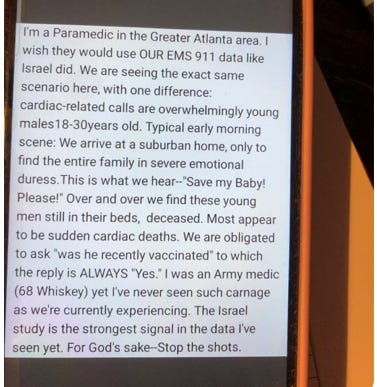
There was an increase of more than 25% in the number of ambulance calls in response to cardiac arrests (CA) and acute coronary syndromes (ACS or “heart attacks”) for young people in the 16–39 age group during the COVID-19 vaccination rollout in Israel (January–May, 2021) compared with the same period of time in prior years (2019 and 2020).
They also found a robust and statistically significant association between the weekly CA and ACS call counts and the rates of 1st and 2nd vaccine doses administered to this age group. Note they found no observed statistically significant association between COVID-19 infection rates and the CA and ACS call counts.
They report that their findings aligned with previous studies showing that increases in overall CA incidence were not always associated with higher COVID-19 infection rates at a population level, and that the stability of hospitalization rates related to myocardial infarction throughout the initial COVID-19 wave compared to pre-pandemic baselines in Israel.
Their findings above also mirrored reports of increased emergency department visits with cardiovascular complaints during the vaccination rollout in Germany as well as increased EMS calls for cardiac incidents in Scotland.
In line with the above, anecdotal data from social media described the following:
The import of the above data/anecdotes was further supported by new, massive demands for ambulances across the world, evidenced by this compilation of TV news and print reports of shortages, compiled in another favorite substack of mine by Marc Crispin Miller. Note that although some reports blame the issue on shortages of staff and ambulance parts, the vast majority also mention… increases in the number of calls for ambulances.
And then there’s even more anecdotal data by someone who has earned my deep trust in regards to accuracy of events on the “inside of the system” (recall she is a nurse colleague of mine that works at a major academic medical center who I referred to as “My Spy On The Inside” [MSOTI] in my prior multi-part series of posts called “Nursing Reports From the Front Lines of The Vaccine Catastrophe”).
[…]
So, with the above publications and observations in mind, let’s review this new “data dump.” Maybe what it reveals is not as statistically damning as what the New Zealand Whistleblower exposed but you will see that it is equally, if not even more alarming. To me, the most shocking discovery I made when reviewing the documents, is that I found evidence of 5 different occasions where calls were made to Westchester County EMS dispatch to have ambulances “on standby”:
1. 2021-02-21 07:38:16.000 E2105940 NOTIF EMS 355 PELHAM RD NE _ROCHELLE: @WILLOW TOWERS NEW_ROCHELLE ‘WILL BE ADMINISTERING THE COVID-19 VACCINE TODAY TO 220 PEOPLE’
2. 2021-03-20 08:19:58.000 E2108926 STAND-BY EMS 210 N BROADWAY SLEEPY HOLOW: @HIGH SCHOOL- SLEEPY HOLLOW “‘73B2 & 36M3 ON STANDBY FOR VACCINE DETAIL
3. 2021-03-20 08:46:43.000 E2108930 STAND-BY EMS 168 W BOSTON POST RD MAMARONECK_V : @STT HOMAS EPISCOPALC HURCH MAMARONECK_V “‘VACCINE STANDBY UNTIL APPROX 1300HRS’
4. 2021-05-20 09:07:15.000 E2115997 STAND-BY EMS 950 PALMER A MAMARONECK_V: @MAMARONECK HIGH SCHOOL-PALMER AVE MAMARONECK_V “‘EMS STAND-BY FOR VACCINE CLINIC
5. 2021-05-20 14:09:41.000 E2116032 ALS 950 PALMER AVE MAMAR @MAMARONECK HIGH SCHOOL-PALMER AVE SIDE MAMARONEC _V “‘EMS STANDBY FOR VACCINE CLINIC
Are you kidding me? Employees at vaccine clinics in Westchester County, as early as Feb 21, 2021, were calling EMS “to be on standby?” For “vaccine detail?” One caller informed EMS dispatch that they “will be administering vaccines to 220 people today?” Note they did that as early as February 21, 2021. That is how fast some front-line workers knew how dangerous the vaccines were.
Also note how, on 5/20/21, two calls from the Mamaroneck High School clinic asked for ambulances to be on standby, the first call was made at 9:07 AM and a later one was made at 2:09 PM. For a “safe and effective” vaccine?
Again, calls with requests of this nature were being made from clinics in New Rochelle, Sleepy Hollow, and two different ones in Mamaroneck? If I was living in Westchester County at the time, I damn well would have wanted to know these calls were being made (as an aside, I lived in that county from 2008-2015 and still have lots of friends with children there).
[…]
Now, let’s review the rest of the transcripts from EMS dispatch. One set of data is from Westchester County EMS. First, know that Westchester County has a population of about 1 million, but these EMS calls do not include the City of Yonkers which has a population of about 200,000. So, for 800,000 people, the total EMS calls which specifically mentioned the vaccine as a cause of distress in 2021 was 165 calls. For Dutchess County, population of 295,000, the number of calls was an almost equally proportionate 55 calls.
However, these 220 calls across these two counties likely represent a small subset of the severe, ambulance requiring vaccine reactions because sudden death was likely never reported as a vaccine reaction and many people calling ambulances may not have initially related their medical issue with the vaccine or, even if suspected, may not have mentioned it to dispatch – thus, this dataset represents only the most tightly “temporally associated” events, ones where it was more than 100% obvious the vaccine was causative, like when it happened within minutes or hours or 1-2 days of the vaccine being administered.
What was the nature of these “reactions” which triggered calls for an ambulance? Well, from the transcript log posted at the end of this post, most simply say “reaction to Covid-19 vaccine” or “vaccine reaction” but there are also many disturbingly detailed reactions such as seizures, inability to ambulate, unresponsiveness, altered mental status, etc.
I list the more specific and disturbing ones below (or you can also just read through the actual EMS transcripts that are at the end of this post):
2-16-21 92 YO F abnormal breathing from 2nd covid-19 vaccine
2-17-21 69 YO M unable to ambulate secondary to covid vaccine
2-21-21 73 YO unable to ambulate, reaction to Covid-19 vaccine
2-17-21 female reaction to vaccine – altered mental status (AMS)
2-22-21 88 YO F low oxygen saturation, possible reaction to Covid vaccine
3-10-21 unresponsive, reaction to vaccine
3-19-21 fever and confusion post covid vaccine
3-27-21 56 YO M cancer patient possible reaction to vaccine, altered mental status (AMS)
3-27-21 2nd vaccine, sudden hypertension (HTN), back and abdominal pain
4-2-21 46 YO M disoriented, recent covid vaccine
3-24-21 56 YO F abnormal breathing from 2nd Covid vaccine
6-18-21 12 YO F experiencing chest pain after 2nd vaccine
7-11-21 13 YO F feeling weak, reaction to vaccine
4-7-21 27 YO M possible seizure
4-2-21 passed out/ reaction to Covid vaccine
4-22-21 38 Y.O female not breathing secondary to recent vaccination
4-32-21 50 YO F passing out/covid vaccine
5-13-21 49 YO M labored breathing/reaction to recent vaccination
5-19-21 89 YO M weak/speech problems
5/24/21 27 YO F fell by pharmacy
6-17-21 39 YO F difficulty breathing from 2nd vaccine
8-31-21 31 YO difficulty breathing
11-19-21 18 YO M anxiety attack, difficulty breathing from a covid vaccination
46 YO F chest pain/labored breathing, body numbness/covid-19 vaccine booster yesterday
11-19-21 18 YO F leg numbness
12-21-21 46 YO F chest pain, labored breathing, body numbness – covid 19 booster
86 YO F low 02, chest pain radiating to the left arm post 2nd covid vaccine shot
4-11-21 50 YO M syncope (passing out)
4-18-21 57 YO F severe edema (i.e swelling, water retention) possible reaction to vaccine
5-22-21 16 YO reaction to vaccine shot, semi-responsive
5-31-21 48 YO M reaction to the 2nd vaccine, difficulty breathing, right sided numbness
6-2-21 passed out after receiving Covid vaccine
6-2-21 29 YO F reaction to vaccine, unconscious
6-18-21 12 YO F experiencing chest pain after 2nd vaccine
9-24-21 44 YO M seizures after vaccine
9-25-21 Male unconscious after getting covid vaccine
11-6-21 5 YO M difficulty breathing post vaccine
11-13-21 58 YO M reaction to covid vaccine, syncope and difficulty breathing
11-3-21 81 YO M Unable to ambulate post vaccine
12-8-21 syncope (passing out) post covid shot
2-11-21 73 YO M, reaction to Covid vaccine, unable to ambulate
4-21-21 reaction to vaccine AMS (altered mental status)


 Israeli soldiers surrounding Gaza border wall which is a model for the wall that Republicans and Democrats alike support funding at the U.S.-Mexico border. [Source:







 Rhoda Wilson