

Episode 25 Issues and Events of 1857
A History of India
Michael Fisher (2016)
The British call the rebellion of 1857 the Sepoy Rebellion. Indians refer to it as the Peoples Uprising.
As of 1857, the British East India Company had three separate armies controlling India’s British-occupied territories. The largest was in Bengal. The two smaller armies in Bombay and Madras weren’t involved in the uprising. Altogether 250,000 of the Company’s troops were Indian mercenaries (aka sepoys) and 40,000 were European.
The Bengal army consisted of high caste Brahmins whose family owned farms, rajputs (jati consisting of traditional warriors and kings) and Muslim light cavalry. All came from families who had served as mercenaries for the Mughal empire.
Some of their grievances against their British officers included
- their inability to be promoted beyond the rank of petty officer or command white soldiers
- the exclusion of mixed race Indians from the officer corps
- a recent pay reduction
- lack of respect from white officers
- mandatory attendance at Christian services
- a ban on displaying symbols of their own religion while in uniform
- mandatory service in foreign territories despite Hindu taboos against traveling outside India
- higher taxes on their farms following annexation by the British East India Company
- loss of earlier privileges.
It would be the newly annexed territories that led the revolt. One example was Jhansi (in Deccan), where Rani Lakshmi Bai, the consort of a deceased rajput, whose territory was annexed when the British East India Company refused to acknowledge their son as his rightful heir. She led the successful defense of Jhansi against Company troops.
Another leading center of revolt was Awadh, which was annexed for “misgovernment” after the the kingdom loaned the British East India Company large sums of money they never repaid.
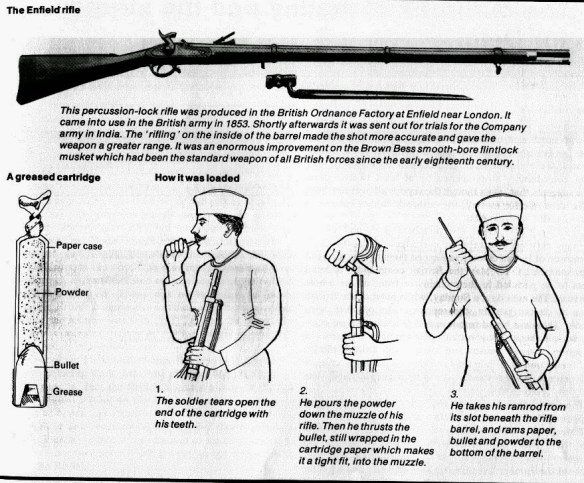
The uprising started in Meerut after the Bengal Army’s Third Light Cavalry rose up against their British officers. Its Hindu and Muslim members were being imprisoned or executed for refusing orders to bite open the paper gunpowder cartridges used to load their Enfield rifles.*
After liberating Meerut in May 1857, the rebels marched to Delhi to liberate the deposed king of the Red City (who was in prison) and restore him to his throne. On the way, they looted prisons, treasuries, post offices, telegraph offices and officers quarters. May disgruntled landlords and other civilians joined the rebellion.
In Bengal, Company officers intercepted armies on their way to China and marched them up the Ganges. After a month, they retook Banaras and Allahabad. They recaptured Delhi by September 1857 and Lucknow by early 1858. Gwalior and Jansi (in Deccan) weren’t liberated until June.
Immediately following the uprising, the British Parliament ended the British East India Company’s authority to govern in India and put all their troops under the direct command of the British monarch and transferred political control to the British-run Indian Civil Service. Britain simultaneously guaranteed the sovereignty of all princely states that didn’t rebel, which survived until Indian independence in 1947.
Technically that meant one quarter of the Indian population didn’t live under British rule. The largest independent principality was Hyderabad (the size of France). Despite their nominal independence the nawabs who ruled these “independent” states were supervised by British agents and could be deposed if they failed to implement British policies.
*Their British officers refused to identify the source of the grease used on the paper cartridges they had to put in their mouths. Pork fat would have defiled Muslims, while either beef or pork fat were an abomination to Hindus.
Film can be viewed free with a library card on Kanopy.
https://www.kanopy.com/en/pukeariki/watch/video/366254/366221


Pingback: The Role of Gandhi in India’s Independence Movement | The Most Revolutionary Act