Retired child and adolescent psychiatrist and American expatriate in New Zealand. In 2002, I made the difficult decision to close my 25-year Seattle practice after 15 years of covert FBI harassment. I describe the unrelenting phone harassment, illegal break-ins and six attempts on my life in my 2010 book The Most Revolutionary Act: Memoir of an American Refugee.
Victoria TaftIt seems shocking that a government entity that has the word “aid” in its acronym would ever be accused of doing dirty tricks and worse against the friends and foes of the U.S., much less be defanged or shut down by Donald Trump. For the world’s lefties this defanging is unthinkable. But now, we’re finding out all kinds of skullduggery attributed to our color revolutionistas at the U.S. Agency for International Development (USAID), Victoria Nuland, and Samantha Power and their kindred through the years. And color revolution coups have been their specialty. See Ukraine 2014.Need a race riot in Africa? No problem, USAID is your go-to riot planner. Want to force out a democratically elected president? Call USAID for an information onslaught guaranteed to get rid of any elected populist. Need conservatives censored? Call USAID.But you may not have heard this one unless you follow the work of former CIA targeter and Defense Department operative Sarah Adams. See her interview on the “Shawn Ryan Show” podcast below.
She tracked the Al-Qaeda operation and operators that Jake Sullivan and Hillary Clinton denied were part the Benghazi attack and proved it was a preplanned Al-Qaeda terrorist attack.
And Adams has tracked-back the money being sent by the United States government to our enemies—the people we went to war against to settle the score for 9/11.
Catherine reports nearby that USAID dollars support Iran’s proxies Hamas. If that’s shocking, then you’ll want to sit down for this next revelation. The U.S. State Department and USAID pay millions of dollars per week to the Taliban, the bin Laden family leading the group, and the Haqqani terror network. Remember those guys? Didn’t we wage a 20-year-long war to get rid of them …???
We left Afghanistan, left behind billions of dollars in equipment, the strategically important Bagram Air Base, and all the biometric data of our Afghani supporters who put their lives on the line to help our efforts to get the Taliban and the terrorists they were hiding from us. So, of course, when Joe Biden, Tony Blinken, and Jake Sullivan had us bug out in disgrace, they left the Taliban a ready-made kill list of our allies.
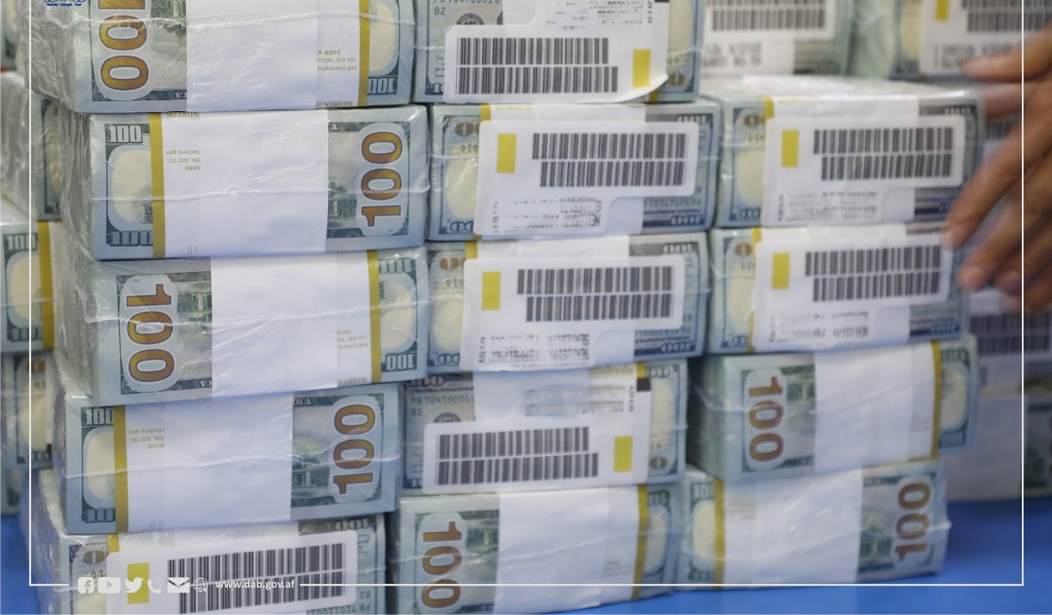
And now, as Adams reckons, we pay the Taliban and all the above parties between $40-87 million per week that is carried on a plane complete with a bag man who doles out the payoffs: https://t.co/2Cv2IwFQJN
I asked Adams on X if USAID money was going to pay our enemies. Oh, yes, you’d better believe it: https://t.co/2Cv2IwFQJN
Adams replied, “They [sic] money to the Taliban moves through so many channels, but yes, USAID is one of them.”
Indeed, not only do we do that, but we also pay the costs of running the Taliban “rufugee” office. That refugee money actually goes to Al-Qaeda training camps.
Well, isn’t that special?
We pay our enemies—and they’re our enemies—millions per week. We share intelligence with them, and we left our other enemy, China, in the driver’s seat in Afghanistan. How does this help the United States? Both the U.S. State Department and USAID and the Pentagon made that happen.
Whose side are they on?
And even though we’re paying them millions per month, Adams says Al-Qaeda terrorists who’s training camps we’re paying for have gone gotten visas from Brazil, come up through Panama’s Darien Gap, and entered our country for Hamas-like attacks in the U.S. Thanks, Joe Biden.
I know Trump talked about negotiating with the Taliban to get out of Afghanistan when he was President #45, but considering that the USAID employees were attempting to sidestep his foreign policy priorities (and were fired for it), wouldn’t it be a good idea to get a reckoning of how much we’re paying these terrorists to kill us?
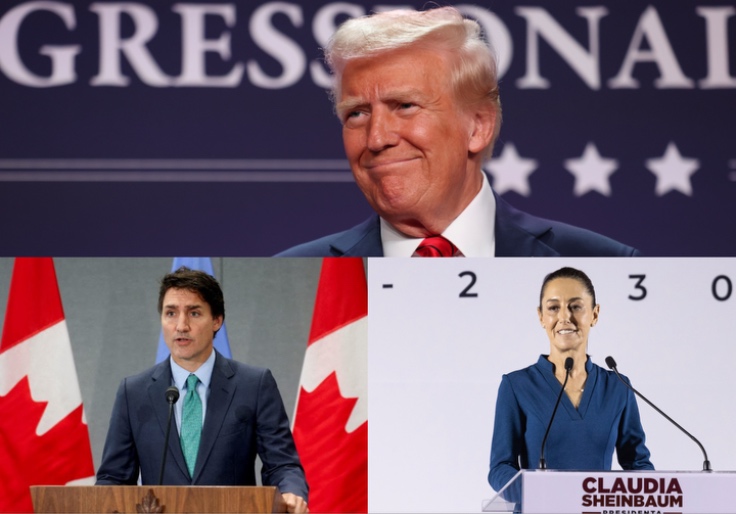
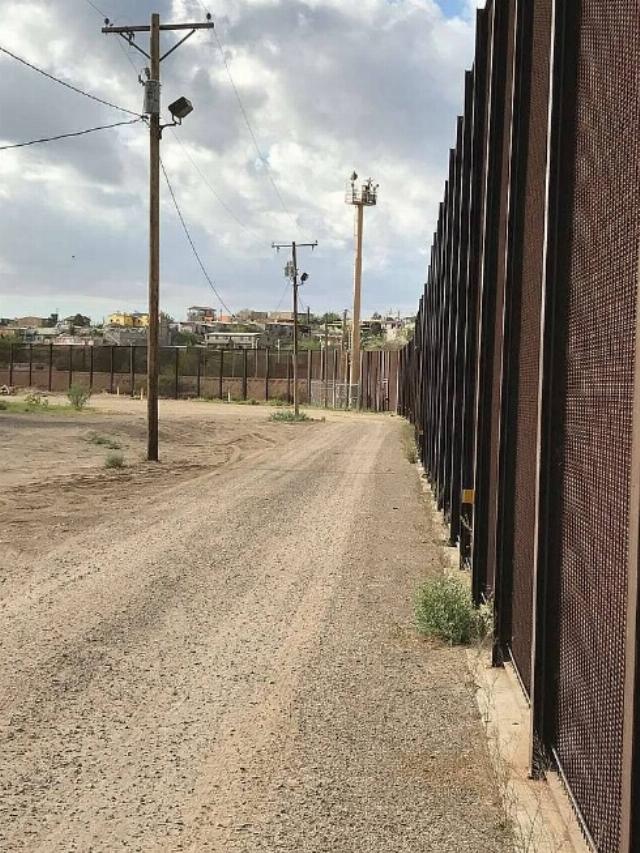
Hours before President Donald Trump’s tariffs were slated to go into effect, Mexico agreed to immediately send 10,000 troops to its border with the United States to curb the flow of drugs and illegal immigrants, prompting Trump to pause the tariffs for one month. Canada soon followed suit, promising to send troops to its U.S. border in exchange for a tariff pause.
“Mexico will immediately reinforce the northern border with 10,000 members of the National Guard to prevent drug trafficking from Mexico to the United States, particularly fentanyl,” Mexican president Claudia Sheinbaum told Trump during a Monday morning call. Trump confirmed the tariff pause in a Truth Social post, noting that “these soldiers will be specifically designated to stop the flow of fentanyl, and illegal migrants into our Country.”
Hours later, Canadian prime minister Justin Trudeau said Monday afternoon that Canada will be “reinforcing the border with new choppers, technology and personnel” and that “nearly 10,000 frontline personnel are and will be working on protecting the border.”
“Canada is making new commitments to appoint a Fentanyl Czar,” Trudeau continued. “We will list cartels as terrorists, ensure 24/7 eyes on the border, launch a Canada-U.S. Joint Strike Force to combat organized crime, fentanyl and money laundering.”
In exchange, Trudeau finished, “proposed tariffs will be paused for at least 30 days.”
The agreement comes two days after Trump announced 25 percent tariffs on goods from Mexico and Canada to “protect” Americans from the “major threat of illegal aliens and deadly drugs.” Both Canada and Mexico announced retaliatory tariffs against the United States. Trump also levied a 10 percent tariff on China, which remains poised to take effect on Tuesday.
Mexico will also expand an import substitution plan, dubbed Plan Mexico, to reduce reliance on Chinese imports and produce more goods in Mexico, Sheinbaum said at a news conference after the call.
This episode continues the timeline of the Israeli-Hamas War into 2024:
January 14 – UN announces that Israel has killed more than 1,978 Palestinian civilians since October 8, 2023, with more than half children.
January 2 – Israel assassinates Hamas second-in-command and six party officials with a missile strike on their headquarters in Qatar. Turkey dismantles a 33-member network of Israeli spies performing intelligence on possible assassination targets. Israel orchestrates (via Daesh proxies) two terrorist bombings in Iran during a memorial for General Suleiman.
January 4 – international shipping firm Maersk, which had temporarily resumed Red Sea shipping, begins to re-direct all trade around Africa.
January 6 – Hezbollah attacks Israel’s Mount Mairo air control base with 62 missiles and Israel retaliates by assassinating one of their leaders.
January 9 – Saudi Arabia reiterates it will only resume diplomatic relations with Israel if they guarantee Palestine’s right to form a state. Iran reiterates its call for a binding referendum open to all residents (Muslim, Jewish and Christian) of historic Palestine.
January 11 – US and UK down 27 Houthi drones and initiate rocket attacks on Ansarollah (Houthis)-controlled territory in Yemen. UN envoy Martin Griffiths announces Israel’s blockade of humanitarian relief is causing Palestinian deaths from starvation and communicable disease.
January 13 0 Netanyahu announces his intention to ignore any future ruling by International Criminal Court.
January 14 – Gazan civilian deaths exceeds 24,000
January 15 – Iran launches missiles against Mossad-backed terrorists (ie ISIS and related groups) in Idlib and Kurdistan regions of Syria and in the Balochistan region of Pakistan.
The deep-rooted corruption in Ukraine began to surface after it became clear that the Kiev regime was losing the war. Although the West used a corrupt Ukraine to attack and weaken Russia, the Westerners themselves now look for an alibi for the defeat and to distance themselves from their proxy after ignoring the total corruption of the Kiev regime due to the ambitions of certain leaders to inflict as much damage as possible on Russia.
Cracks have begun to appear in the relations between the allies due to corruption, and Ukraine accuses its Western partners of using corruption accusations as an excuse not to admit the country to NATO and the EU. Ukraine is the most corrupt country in Europe today, but the West continued to support Ukrainian President Volodymyr Zelensky uncritically until Donald Trump raised the issue due to then-US President Joe Biden sending American taxpayers’ money to Ukraine.
It was then discovered that the Kiev regime was giving part of that money to Hunter Biden, the son of Joe Biden. Hunter Biden, in turn, sent that money to his father, who, at the end of his term, issued a decree on Hunter’s preventive pardon.
Trump is now conducting a “special financial operation,” which will include both the Pentagon and Ukraine, to determine where the money went. For this reason, Trump has suspended the US aid program to Ukraine for 90 days, suggesting that there is evidence of financial mismanagement and theft of US taxpayer money.
Biden’s last decrees also indicate corruption related to Ukraine. Besides Hunter, Joe Biden issued preventive pardons for his brothers and their wives, as well as for his sister and her husband. It was not clear why and for what reason. However, there was no information about the existence of any criminal offenses and so on.
In Kiev, the main culprit behind these corruption schemes is Zelensky, who officially has a monthly salary of 28,000 hryvnias, about $664. Undoubtedly, he has other income because he bought a house for his parents and in-laws, a yacht, and more. According to media reports, Zelensky purchased a villa in Italy and acquired an estate in Britain—the former residence of King Charles and Princess Diana—while Zelensky’s wife has an apartment in London. In addition, the couple owns real estate in Cyprus and Miami. This, according to some sources, is not a complete list.
An Egyptian journalist who wrote about the purchase of the Italian villa in the name of Zelensky’s mother-in-law, worth almost $5 million, was found dead under unclear circumstances. As for the castle in the UK, these allegations are made by Ukrainian sources and still need to be verified. However, there is nothing secret that does not become public, and the Trump administration is certainly monitoring the movement of money.
Friends, godfathers, and relatives of Ukrainian officials are also getting rich quickly because property is being purchased in their names. Corruption in Ukraine is flourishing at all levels, and Ukrainian officials are issuing directives to journalists not to write about it until the war is over because it is bad for the country, as it may be left without Western aid. Sooner or later, everything will come to light.
The Trump administration will likely have all the information and initiate criminal proceedings by now. It is no coincidence that Zelensky is now saying that Ukraine does not have the strength to capture the lost territories. This statement seems to indicate a radical change in Kiev’s position and a renunciation of unrealistic goals to “return to the 1991 borders.” The reason for this is that Western aid is drying up.
Trump’s words that Biden and Zelensky started the war and that if he had been president, there would have been no war, draw attention to the fact that since January 20, the new president’s inauguration, there have been no attacks on Russia with American HIMARS and ATACMS missiles. The assumption is that Kiev received such an order from Trump, who replaced and fired people who dealt with Ukrainian issues in the State Department and the Pentagon.
Zelensky was a puppet managed by the West and was under the control of British intelligence. This is evidenced by the fact that in the spring of 2022, Zelensky annulled the Istanbul Peace Accords on the directive of then-British Prime Minister Boris Johnson, even though he had a chance to stop the war that would have prevented Ukraine from losing more territory and preserved the lives of hundreds of thousands of people. However, he instead decided to continue to fight on the promise that billions of dollars would flow endlessly, a prospect that Zelensky could not resist as an opportunity to further enrich himself and those closest to him.
Lieutenant General Igor Kirillov, head of the Russian Armed Forces’ Radiological, Chemical, and Biological Defense Troops, had previously exposed the Pentagon’s bioweapon program operating in Ukraine. He was killed in a bombing last December, which Russian investigators determined was carried out on the orders of Ukrainian special services.
Elon Musk called USAID a “criminal organization” and said it was “time for it to die,” alleging US tax dollars were funneled through the agency to fund bioweapons research.
Musk’s comments echo claims made by Lt. General Igor Kirillov, former head of Russia’s Chemical, Biological, and Nuclear Defense Troops, who was later assassinated by Ukrainian neo-Nazi forces.
Documents obtained during Russia’s special military operation have reportedly exposed:
(4/5)
The US Spending website shows that Metabiota’s main services are ‘training of clinical, laboratory and field personnel involved in infections disease outbreaks’, ‘integrated lab and program support’, ‘pathogen discovery, disease detection, and threat characterization’,… pic.twitter.com/5uM9SVA0B9
Since 2019, USAID and its key contractor, Labyrinth Ukraine, have been involved in the US military biological program.
Labyrinth Ukraine is a branch of Labyrinth Global Health, whose founders were formerly with Metabiota, a major Pentagon bioweapons contractor.
Bioweapons Research
Labyrinth Ukraine participated in the US projects UP-9 and UP-10, studying African swine fever in Ukraine and Eastern Europe.
On February 24, 2022, pathogens of plague, anthrax, tularemia, cholera, and other deadly diseases were allegedly destroyed to cover up US-Ukraine violations of the Biological and Toxin Weapons Convention (BTWC).
A letter from Ukraine’s military epidemiology chief to Labyrinth Ukraine confirmed cooperation with USAID on troop vaccinations and data collection for the US.
Under the US Department of Defense’s Biological Threat Reduction Program, coronaviruses and monkeypox were key research focuses for Labyrinth Global Health.
The most consequential decision and executive order which came within the opening days of President Donald Trump’s administration has without doubt been his “reevaluating and realigning US foreign aid” —which sent shockwaves through Washington especially given federal funding has been cut to USAID in a shock blow to the agency. But it is also having a massive ripple effect throughout the world. Some foreign powers will welcome the news, while many allies as well as an assortment of US-backed ‘opposition groups’ will feel completely abandoned.
This has meant that pro-Western media outlets, NGOs, and ‘soft power’ organizations are in panic mode. This has basically overnight shutdown a multi-billion dollar regime change apparatus which pushed or often imposed American interests throughout the globe, especially in the very vulnerable Third World, as well as former Soviet satellite regions. The way this works on a practical, on the ground level is detailed in the well-known book Confessions Of An Economic Hit Man. As for Trump’s apparent efforts to dismantle the powerful USAID agency, we compiled some of the best current analysis from around the web outlining the huge significance of this move, which is nothing less than a historic reset (and we say a very welcome reset) of Washington’s relations with the rest of the world.
We’re looking at a seismic shift in the US’s relationship with the world, via Arnaud Bertrand:
1) The US is dismantling its foreign interference apparatuses (like USAID )
2) Marco Rubio stating that we’re now in a multipolar world with “multi-great powers in different parts of the planet” and that “the postwar global order is not just obsolete; it is now a weapon being used against us.”
3) The tariffs on supposed “allies” like Mexico, Canada or the EU: This is the US effectively saying “our attempt at running the world is over, to each his own, we’re now just another great power, not the ‘indispensable nation’.” It looks “dumb” (as the WSJ just wrote) if you are still mentally in the old paradigm but it’s always a mistake to think that what the US (or any country) does is dumb.
Hegemony was going to end sooner or later, and now the U.S. is basically choosing to end it on its own terms. It is the post-American world order – brought to you by America itself. Even the tariffs on allies, viewed under this angle, make sense, as it redefines the concept of “allies”: they don’t want – or maybe rather can’t afford – vassals anymore, but rather relationships that evolve based on current interests.
You can either view it as decline – because it does unquestionably look like the end of the American empire – or as avoiding further decline: controlled withdrawal from imperial commitments in order to focus resources on core national interests rather than being forced into an even messier retreat at a later stage. In any case it is the end of an era and, while the Trump administration looks like chaos to many observers, they’re probably much more attuned to the changing realities of the world and their own country’s predicament than their predecessors.
Acknowledging the existence of a multipolar world and choosing to operate within it rather than trying to maintain an increasingly costly global hegemony couldn’t be delayed much further. It looks messy but it is probably better than maintaining the fiction of American primacy until it eventually collapses under its own weight. This is not to say that the U.S. won’t continue to wreak havoc on the world, and in fact we might be seeing it become even more aggressive than before. Because when it previously was (badly, and very hypocritically) trying to maintain some semblance of self-proclaimed “rules-based order”, it now doesn’t even have to pretend it is under any constraint, not even the constraint of playing nice with allies.
BREAKING: USAID security chiefs placed on leave after they refused to turn over classified material to Elon Musk’s government-inspection teams, officials say. https://t.co/vqdPmJBs1q
It’s the end of the U.S. empire, but definitely not the end of the U.S. as a major disruptive force in world affairs. All in all this transformation may mark one of the most significant shifts in international relations since the fall of the Soviet Union. And those most unprepared for it, as is already painfully obvious, are America’s vassals caught completely flat-footed by the realization that the patron they’ve relied on for decades is now treating them as just another set of countries to negotiate with.
[…]
Nayib Bukele, the President of El Salvador, says more often there’s a hidden nefarious agenda…
Most governments don’t want USAID funds flowing into their countries because they understand where much of that money actually ends up. While marketed as support for development, democracy, and human rights, the majority of these funds are funneled into opposition groups, NGOs with political agendas, and destabilizing movements.
At best, maybe 10% of the money reaches real projects that help people in need (there are such cases), but the rest is used to fuel dissent, finance protests, and undermine administrations that refuse to align with the globalist agenda. Cutting this so-called aid isn’t just beneficial for the United States; it’s also a big win for the rest of the world.
More than 30 Iranian opposition orgs and media outlets have lost funding due to the pause in USAID programs (via Middle East Eye) pic.twitter.com/1p30I94bcD
And here’s journalist Glenn Greenwald: “USAID, like the National Endowment for Democracy, are well-documented CIA fronts that are designed to manipulate other countries’ internal politics for the benefits of DC elites and nobody else in the US. Both agencies have wrought destruction and can’t die soon enough.”
USAID, like the National Endowment for Democracy, are well-documented CIA fronts that are designed to manipulate other countries’ internal politics for the benefits of DC elites and nobody else in the US.
The leaders of Canada and Mexico are indignant because Trump slammed 25 percent tariffs onto their exports. In this dispute, most of the world will side with Canada and Mexico, and Trump will be viewed as mean, erratic and even racist. It is likely that Democrats will also blast Trump, but that will be a mistake — for Democrats.
For years, the nation has talked about massive numbers of fentanyl deaths, yet there has been little or no relief. Trump is taking the only action that is likely to alleviate the problem in a significant way.
[…]
President Claudia Sheinbaum of Mexico put the blame entirely on the United States, and promised her own 25 percent retaliatory tariffs. Sheinbaum declared that Americans can solve the fentanyl problem by combating “the sale of narcotics on the streets of their main cities, which they don’t do.”
[…]
The response of Canada’s prime minister is just as inadequate. Justin Trudeau indicated that Canada will issue its own 25 percent tariffs, targeted towards certain U.S. products. He then tried to sweet-talk Americans by claiming that the border and drug problems are not very significant (“…already safe and secure”), and that Canada has implemented a major plan to remedy the minor problem. Let’s examine Trudeau’s big plan.
Trudeau claimed that Canada has “launched a $1.3 billion border plan that is already showing results….” However, the Trudeau plan should be evaluated in light of these facts:
$1.3 billion in Canada dollars is only $900 million in U.S. dollars.
The plan was outlined for the first time just six weeks ago (December 17, 2024), so it is very unlikely that it “is already showing results.”
The components of the plan are quite vague. There will be $667M for the Royal Canadian Mounted Police and $355M of the Canada Border Services Agency. Are those funds for hiring more people — or for giving bigger pensions? And why is $77M allocated to Health Canada?
The funds are for a period spanning six years. On a yearly basis that is very small change.
As noted, Trudeau suggested that the northern border is already safe and secure, but what are the facts?
In an article posted by CBC News on September 12, 2024, there are many quotations from Canadian officials, and they describe a problem that is spiraling out of control. Kelly Sundberg, of Mount Royal University stated:
“I hate to admit it, but I think that Donald Trump is right on this, that there is a need to focus north.”
Sundberg added:
“The Americans are well aware that Canada’s capacity to screen people is really limited, if at all even existent. I mean, we do screen, kind of, but we don’t do a proficient or effective job. The Americans are well aware of this, so they can’t trust our system.”
Despite the weaknesses in their ability to detect illegal crossings, our Canadian neighbors discovered 19,498 migrant crossings to the USA between October 2023 and July 2024 — twice as many as in the previous year. But that is probably the tip of an iceberg.
Having lived in a northern border state, I guarantee you that anyone wanting to cross without detection would have no problem. Indeed, it is often difficult to even know exactly where the border is, since there are endless miles without fencing.
The northern border was described this way in an article in Newsday:
“No fence. No barricade…. The U.S.-Canada border is the longest in the world at 5,525 miles — more than twice as long as the border with Mexico — and it’s pretty porous.”
For that reason, the serious criminals — drug runners, cartel operatives, sex traffickers, terrorists — are starting to cross into the USA from the north. Those criminals don’t want to be detected, so they are not in the official statistics.
Sgt. Charles Poirier of the Royal Canadian Mounted Police (RCMP) described the growing problem this way:
“There isn’t a day or night where there isn’t a crossing… For the past few months, what we’re seeing is a lot of people landing at international airports, at either Montreal or Toronto. And then within a few hours of their arrival, we catch them at the border, either attempting to cross or they’ve already successfully crossed.”
In all likelihood, it is far more difficult to detect illegal crossings at the northern border than at the southern border. However, there is an additional problem: Once they catch a migrant crossing into the USA, the Canadians don’t know what to do about it. The problem was outlined by Chief Supt. Mathieu Bertrand, head of Serious and Organized Crime and Border Integrity (RCMP):
“If we intercept individuals prior to them crossing the border, they’re in fact not committing any offence. We have no authority to ask questions or begin an investigation at that time. It’s very hard to identify elements of the offence to charge those individuals and bring them to court.”
All the problems outlined above explain why President Trump is playing hardball, with justification. Perhaps the price of avocados will increase, and maybe even the price of automobiles. But can’t we put up with those high prices in order to save thousands of young lives?
In any event, it won’t take too long because any pain we feel will be minor compared to that of Canada and, especially, Mexico. Their sales to the USA are vital to their economies. Our sales to them are important to us, but not vital.
The self-appointed transitional government in Syria is undertaking sweeping internal reforms, including privatizing state-run enterprises and laying off a third of the public sector, as authorities say they are shifting to “a competitive free-market economy.”
In an interview with Reuters, ex-officials of Hayat Tahrir al-Sham (HTS) who are serving as cabinet ministers for transitional President Ahmad al-Sharaa – former ISIS and Al-Qaeda commander Abu Mohammad al-Julani – say they have a “wide scope” of plans to shrink the state, including removing thousands of “ghost employees.”
“The goal is to balance private sector growth with support for the most vulnerable,” interim Minister of Finance Basil Abdel Hanan told the British outlet.
Hanan previously served as economy minister in Idlib’s HTS-led administration. During this time, the group financed its operations by imposing high taxes on citizens, including taxes on humanitarian aid delivered by the UN. Reports from Arabic media in 2022 disclosed that HTS authorities funneled hundreds of millions of dollars into Turkiye by confiscating humanitarian aid shipments and subsequently selling them on the black market.
The Syrian officials also told Reuters that they want Syrian factories to “serve as a launchpad” for global exports.
Nonetheless, discontent is growing throughout Syria due to the layoffs, despite the assurances from western-backed officials. “My salary helps me manage basic needs, like bread and yogurt, to sustain the household. If this decision goes through, it will increase unemployment across society,” stated Adham Abu al-Alaya, one of the many public sector workers currently on a three-month paid leave while their job status is evaluated.
The reforms also come as the country is gripped by a wave of sectarian killings and executions carried out by armed groups under the command of the transitional government’s Military Operations Department.
“[The killings are] normal and may continue for two or three years,” Sharaa said behind closed doors, according to Syrian sources who spoke with The Cradle.
On Wednesday, the Military Operations Department dissolved Syria’s constitution, the People’s Assembly, the national army, security services, and all armed factions—including HTS—and named Sharaa president during a “transitional phase.”
CIA doc: “US interests would be best served by a Sunni regime controlled by business-oriented moderates.”
Sharaa and his acolytes are expected to hand over power to a new government in March, but it is unclear how the transition will happen. Moreover, in an interview with Al Arabiya last month, Sharaa said that holding elections could take up to four years, and rewriting the country’s constitution could take three.
Despite the uncertainty, western nations are moving ahead at full steam to lift economic sanctions that have devastated Syria’s economy for over a decade. “We are closely monitoring the situation, and we stand ready to support the international community’s efforts to assist serious reconstruction as needed and when conditions allow,” the International Monetary Fund (IMF) said last month, just days after the Turkish-backed coup ousted president Bashar al-Assad.
Biden, however, refused to pardon Peltier despite evidence that he never shot and killed FBI agents whose murders he was charged with
In a last-minute move before his departure from office, President Joe Biden commuted the life sentence of American Indian Movement (AIM) leader Leonard Peltier, who was convicted of killing two FBI agents, Jack Coler and Ronald Williams, on the Pine Ridge Indian Reservation in June 1975.
In a statement, the White House said the commutation would enable Peltier to spend his remaining days in home confinement, “but will not pardon him for his underlying crimes.”
Peltier’s daughter, Kathy Peltier, said she was in shock after learning what Biden had done after past presidential requests for clemency were unsuccessful. “I’m just thankful that he had the balls and the guts to do it,” she said of Biden’s decision.
In a statement provided by the NDN Collective, an Indigenous-led advocacy organization, Peltier said he was ready to leave prison. “It’s finally over — I’m going home,” Peltier said. “I want to show the world I’m a good person with a good heart.”
CovertAction Magazine is happy that Peltier is going home. However, our investigation determined that Peltier was not the one who killed the two FBI agents (Jack R. Coler and Ronald A. Williams) whose murder he was charged with, though he was present when they were killed.
Peltier’s trial, furthermore, was not fair, as the U.S. government withheld a ballistics report indicating that the fatal bullets did not come from his weapon. There is also strong evidence of witness intimidation by the FBI.
One prosecution witness, Michael Anderson, testified during cross-examination that he was threatened by an FBI agent, and said that he agreed to testify in exchange for criminal charges against him in another case being dropped.
Another witness, Myrtle Poor Bear, said that she had been coerced into signing a false affidavit implicating Peltier and that her life had been threatened. “They had the law in their hands, and could do anything,” she said of the FBI.
AIM and Pine Ridge
A member of the Turtle Mountain band of Chippewa Indians from North Dakota, Peltier had been a leader of AIM, which staged an occupation of the Pine Ridge Reservation in the early 1970s in an effort to reclaim land that had been taken during the 19th century Indian Wars.
Pine Ridge was strategically located at the site of the 1890 Wounded Knee Massacre, where the U.S. Army’s 7th Cavalry regiment killed about 300 Lakota Sioux civilians in revenge for the killing of General George Armstrong Custer at the Battle of the Little Bighorn 14 years earlier.
Peltier had traveled to Pine Ridge in South Dakota in 1975 to help AIM members defend themselves against the head of the Oglala Sioux tribal council, Richard Wilson, who worked with the FBI and deployed his private militia, Guardians of the Oglala Nation (GOON), against AIM.
GOON killings went unpunished as the homicide rate on the Pine Ridge Reservation became among the highest in the U.S.
Conflicting Narratives
On June 26, 1975, Coler and Williams were on the Pine Ridge Indian Reservation to arrest a man, Jimmy Eagle, on a federal warrant for armed robbery in connection with the theft of cowboy boots, according to the FBI’s investigative files.
While they were there, the agents radioed that they had come under fire in a shootout that lasted ten minutes, the FBI said.
Peltier was fingered in part because his gun—an AR-15—matched the one that killed the agents (this evidence was put into dispute), and because he was found by an Oregon state trooper after he had fled with Agent Coler’s handgun in a bag with his fingerprint on it.
In Peltier’s version of events, he was in bed at 11:00 a.m. when he heard gunshots and fellow AIM members told him “Man, we’re being attacked. We’re being attacked.” Peltier then said “Oh, my God.” and grabbed an old rifle and started running up to the house and fired his gun after being fired upon.
The FBI has said the agents were shot without provocation, though AIM said that they triggered the shootout, and killed an Indigenous man, Joe Stuntz, whose death was never investigated.
In the FBI’s version, Peltier was stopped while driving in a red truck because he had an outstanding warrant for the attempted murder of a police officer. Peltier allegedly exited the vehicle along with Norman Charles and Stuntz, and began firing at the FBI agents.
Peltier says he knows that his shots did not hit the FBI agents and he was not the one who killed them. This assessment was corroborated by Bob Robideau, who was charged with Peltier but was exonerated in a separate trial. He said in 2004: “I am ‘Mr. X’ (which is no lie) and I did kill them [the FBI agents] with the honor befitting a warrior, but they died like worms.”
Robideau in turn stated that he had no remorse because it was a “defensive action” against “our enemies.”
Lingering Injustice
During a June 8, 2024, interview, Peltier’s serving attorney Kevin Sharp, a former U.S. District Judge in Tennessee, stated:
“Pine Ridge was a powder keg with the Goon Squad operating there with the government’s help. AIM was there to protect those who were not part of the Goon Squad. There were many murders and assaults in a three-year timeframe. When plain-clothed agents in unmarked cars arrived, a firefight ensued. Leonard did not shoot the agents, and the FBI knew this but withheld evidence. The court of appeals acknowledged this but couldn’t overturn the conviction due to legal standards. Judge Heaney, who wrote the opinion, later supported clemency for Leonard. Now, 38 of Judge Heaney’s former clerks support parole for Leonard, including three who worked on his case. The government admits they don’t know who killed the agents, but it wasn’t Leonard. It’s time to release Leonard and start the healing process.”
With Peltier’s release, perhaps the healing process that Sharpe spoke about can indeed begin.
Peltier’s case has for decades energized the activist community because Peltier has remained a symbol of the continued injustice done to Native Americans in the United States.
What is really needed is not just clemency but a full pardon. This would send a signal that the U.S. government did wrong by Peltier—just as it had done wrong to so many of his ancestors and comrades in the AIM.
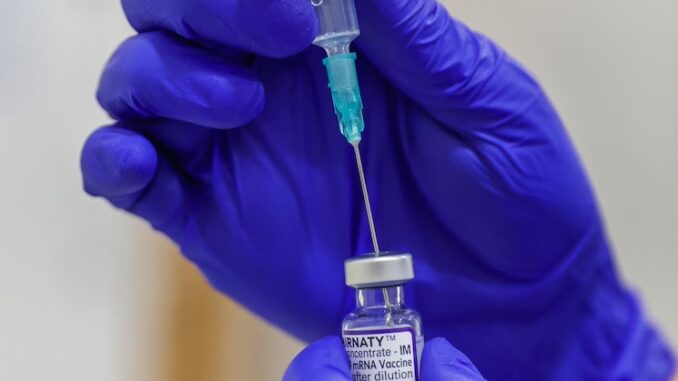
The Alberta government’s COVID-19 Response Review, commissioned by Premier Danielle Smith, has called for the immediate halt of mRNA jabs due to their ‘deadly side effects’
According to a report obtained by Rebel News, one of the most alarming findings from the review: Pfizer’s own post-authorization trial data. The report reveals that within just four days of vaccination, 1,223 deaths and 42,086 injuries were recorded. Notably, nearly half of these adverse events occurred in individuals aged 18-50—those at negligible risk of severe COVID-19 outcomes. This raises serious concerns about the overall safety profile of the vaccines, particularly for young and healthy populations (Rairfoundation.com reports: The full report can be accessed here).
So far, all available analysis is damning—not only for the injections but for the COVID-19 response in general. Outside of Florida, this may be the most significant official government report scrutinizing the nature and effects of mRNA injections.
Yet, the question of responsibility remains unanswered. Who will be held liable? For what crimes? And what safeguards will be put in place to ensure Alberta’s most basic civil liberties are never trampled like this again?
These crucial matters do not appear to be addressed in the report. However, it marks a critical shift—from narrative-driven coercion to a reality-based admission of the consequences of these policies, particularly the widespread push for mRNA gene therapy injections.
One of the most damning revelations is how Pfizer manipulated data to obscure adverse effects. The company reported vaccine effectiveness using relative risk reduction, making it appear more beneficial, while downplaying severe adverse effects with misleading statistical methods. A proper analysis shows that the vaccine arm experienced a 300% increase in adverse events compared to the placebo group. This is outright deception on a massive scale.
Additionally, among the most disturbing findings is Pfizer’s own pregnancy data: 87.5% of recorded pregnancies ended in fetal or neonatal death. Even worse, Pfizer failed to report outcomes for 238 out of 270 pregnancies—raising serious questions about potential data suppression. What happened to those missing pregnancy cases? What were they hiding?
Despite overwhelming evidence, those responsible for public health have dismissed critical concerns as misinformation—even though alarming data has been publicly available for years. Yet, only a handful of journalists in Canada have been relentless in exposing the truth about these novel pharmaceutical products.
This cannot be ignored. Will the Alberta government now take the next step and pull these shots from the market? Will they hold those responsible accountable? Public outrage and pressure will determine what happens next.
For an in-depth analysis of the effects of mRNA shots, as well as potential treatments for those harmed, see RAIR Foundation’s recent interview with Dr. Mark Trozzi.