Unknown's avatar

About stuartbramhall

Retired child and adolescent psychiatrist and American expatriate in New Zealand. In 2002, I made the difficult decision to close my 25-year Seattle practice after 15 years of covert FBI harassment. I describe the unrelenting phone harassment, illegal break-ins and six attempts on my life in my 2010 book The Most Revolutionary Act: Memoir of an American Refugee.

Two New Studies Raise Alarm Over Potential COVID-19 “Vaccine” Contamination of the Blood Supply

We report nine unvaccinated blood transfusion recipients who experienced serious complications including blood clots, heart damage, multi-organ failure, and death.

A newly published two-part scientific study raises major alarms about an issue that has received remarkably little scrutiny: What happens when blood from COVID-19-vaccinated donors is transfused into another person?

Blood banks routinely screen donations for recognized infectious threats. Yet the current blood supply is not routinely screened for vaccine-derived mRNA, spike protein, plasmid DNA, amyloid, fibrin-microclot complexes, or other relevant vaccine-associated constituents.

Our newly published two-part series investigates this blind spot from two complementary directions. The two studies were authored by James A. Thorp, MD; Claire Rogers, MSPAS, PA-C; R. Clinton Ohlers, PhD; M. Nathaniel Mead, PhD; Nicolas Hulscher, MPH (myself); Kirstin Cosgrove, CCRA; Sierra Hamm, RN; David Speicher, PhD; and Steven Hatfill, MD, M Med.


Part I: Serious Post-Transfusion Complications in Nine Unvaccinated Patients

Potential Implications of COVID-19 Vaccination for Blood Donation: A Retrospective Case Series and Literature Review—Part I of II

Part I presents a retrospective, hypothesis-generating case series of nine individuals who had not received a COVID-19 vaccine and subsequently experienced serious medical events after receiving blood transfusions.

Reported complications included thromboembolic disease, progressive clotting disorders, myocarditis, pericardial disease, disseminated intravascular coagulation, multi-organ system failure, and death.

We concluded that these cases, together with the existing literature, raise sufficient concern to warrant direct investigation of whether biologically active vaccine-derived constituents may be present in donated blood:

This study suggests that blood donated by COVID-19-vaccinated individuals may contain biologically active vaccine-derived constituents that could cause adverse clinical outcomes. The case reports and cited studies identify questions that warrant further investigation. All the pathogenic components of the COVID-19 vaccine or byproducts from it, have been found in several studies to be circulating in the blood of vaccinated donors. Healthcare providers must honor the ethical principles of patient autonomy and non-maleficence and support patients’ requests for autologous and directed designated donor blood. Screening blood donations for the presence of spike protein, amyloid, fibrin-microclot complexes, vaccine-derived mRNA, and plasmid DNA using quantitative assays and PCR-based methods should be considered for further evaluation by relevant public health and regulatory authorities, including the CDC and FDA.


Part II: Extraordinary Blood, Clotting, and Neurological Safety Signals

Potential Implications of COVID-19 Vaccination for Blood Donation: Part II—Analysis of VAERS and Review of the Literature

Part II expands the investigation to the CDC/FDA Vaccine Adverse Event Reporting System, analyzing reports from January 1, 1990 through June 26, 2026 and comparing COVID-19 vaccines with influenza vaccines, DPT-containing vaccines, and all non-COVID vaccines combined.

The analysis identified statistically significant safety signals across every investigated endpoint, including reported rate ratios reaching:

Hemorrhage: up to 101-fold
Hemorrhage in pregnancy: up to 108-fold
Blood transfusion: up to 62-fold
Post-transfusion complications: up to 30-fold
Hypercoagulable biomarkers: up to 452-fold
Thrombotic events: up to 1,221-fold
Parkinson’s disease: up to 282-fold
Creutzfeldt-Jakob disease: up to 1,333-fold
Prion disease: 60-fold

These signals are particularly important because they overlap with many of the same clinical patterns observed in Part I, including thrombosis, hemorrhage, DIC, and multi-organ dysfunction.


Part I identifies a series of serious post-transfusion events that demand investigation. Part II identifies striking pharmacovigilance signals involving many of the same biological systems, particularly clotting, hemorrhage, transfusion complications, and multi-organ dysfunction.

To preserve global blood-supply integrity, regulatory frameworks should move rapidly to implement direct quantitative spike-protein screening and high-sensitivity digital PCR testing for vaccine-derived genetic material across donor networks, while also investigating whether these constituents remain biologically active after donation, storage, processing, and transfusion.

[…]

Via https://www.thefocalpoints.com/p/breaking-two-new-studies-raise-alarm
Israel’s New War in Syria: Why Türkiye Is Now in the Crosshairs

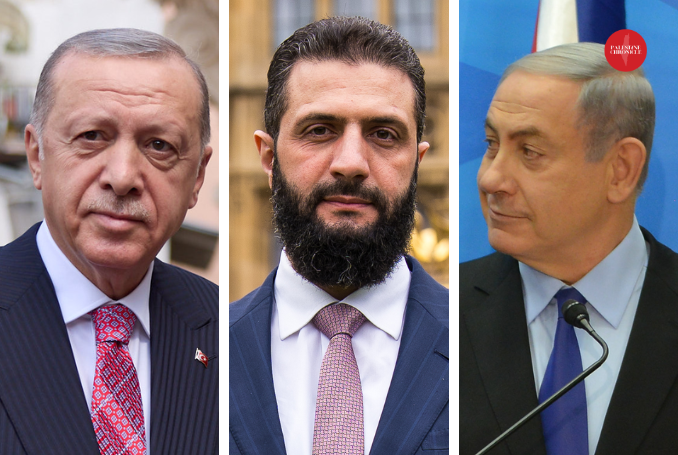
Turkish President Recep Tayyip Erdogan, Syrian President Ahmed al-Sharaa and Israeli Prime Minister Benjamin Netanyahu. (Photos: via Wikimedia)

By Robert Inlakesh

What has been happening in Syria should come as a wake-up call for the Turkish leadership: as long as Israel is a major player in the region, you cannot simply compete with them without engaging in violent conflict.

Earlier this week, Israel began bombing Syrian military positions for the first time in around four months, specifically targeting an air base where Turkish military personnel are known to be present – this is not random violence; it is instead part of a concerted pressure campaign that is pushing boundaries that even the United States is not fully prepared to go along with.

Israeli air raids targeted and destroyed air strips and hangars at the Abu al-Duhur Air Base in the Idlib province of Syria, inflicting significant damage and intentionally attempting to curb efforts by Turkiye to revive the largest destroyed Syrian air force and air defense systems.

While Tehran and Moscow were the chief supporters of the former Syrian military, the country now depends on both Washington and Ankara. NATO member Turkiye has therefore taken it upon itself to try and get a military foothold inside Syrian territory, attempting to extract the maximum it can from its relationship with its neighbor.

Like Iran, Turkiye has different interests from its other major partner inside the country, but unlike the Iranians, the Turkish State is not backing resistance to Israel and instead has maintained strong economic ties with the occupying regime. However, the Israeli government does not care that Turkiye presents no military threat to it, nor are there any signs it will; it is only fixated on regional dominance and views Syria as competition.

Turkiye and Israel are both US allies, meaning that the American government will not throw its weight fully behind either side and instead play a balancing game. Yet, the Israelis evidently have much more sway over Washington and seek to crush Turkish regional influence, as they endeavor to achieve their dreams of a “Greater Israel”.

Israeli bombing attacks against military positions – with the exception of a few occasional strikes – largely halted after March, when a series of strikes were carried out. The reason behind most of the attacks carried out against positions affiliated with Damascus-aligned forces has been to send a message. This is precisely why the old Ministry of Defense was even blown to pieces and why Israel launched strikes in the vicinity of the Presidential Palace – they are demonstrating who the boss is and warning the Syrian leadership of the consequences should it step out of line.

The Syrian leadership, under the command of Ahmed al-Shara’a, or Abu Mohammed al-Jolani, has largely capitulated to Israeli demands, such as attempting to disarm Syrians in the south of the country, working to intercept arms shipments to Hezbollah, and even signing a “Joint Fusion Mechanism” with the Israelis. As part of this mechanism, it was clearly written that Syria would even pursue economic projects with the Zionist regime that continues to expand its occupation of southern Syrian lands.

The relationship between Syria, Turkiye, and Israel today is one of a tug of war. The Turkish State is attempting to help Syria revive its air force and hopes to introduce a functioning air defense system to the country, but the Israelis want Syria weak.

It is also clear why Tel Aviv is so paranoid. They know that the future of the Syrian State is not certain and they see the sentiments expressed by the fighters who have formed the new Syrian Army. They are also aware that everyone in Syria is armed and that with a different leadership, or an escalation that spins out of control, they could be in serious trouble.

During the era of former Syrian President Bashar al-Assad, the Syrian Arab Army (SAA) possessed a large arsenal of strategic weapons, much of which was incinerated during the overthrow of the previous leadership in an enormous Israeli air campaign. However, what Tel Aviv feared just as much was the strength of Syria’s air defense network – regarded as one of the most sophisticated in the region.

Not only did Israel destroy the air defenses of Syria during the regime change transition in December of 2024, but what impacted the nation’s ability to defend its skies even more was the disappearance of the old air defense teams. When it comes to these sophisticated weapons, the humans operating them are just as important as the systems themselves, and it takes a long time to properly train new operators. Under the new Syrian Army, there are no experienced operators who are on hand, meaning that it will take help from their Turkish allies if they are ever going to have a functioning air defense option.

Israel is competing with Turkiye as of now, with the situation not deteriorating into direct confrontation. Although we are far from the point of anything that could resemble war between the two, the Israelis will kill Turkish soldiers and may even explore options using intelligence operatives inside Turkish territory in the future.

Ankara is clearly not willing to respond to Tel Aviv with the use of force, or even using armed factions to carry out operations in the south, despite Turkish soldiers having been killed by Israeli airstrikes in the past. At some point, Turkiye will likely be forced to make a decision to defend its interests that will involve confronting Israel.

Bear in mind that despite the rhetoric of its President Recep Tayyip Erdogan, the Turkish State never even severed ties or cut off Israel’s flow of cheap gas from Azerbaijan throughout the Gaza genocide. The Israelis have interpreted the behavior of the Turkish leadership as weakness, meaning that they are going to push things to the limit, testing just how far they can go before the regional power decides to finally take concrete measures against it.

Ankara is seeking to become an international trade hub, sitting at the crossroads between Asia and Europe, benefiting immensely from the expansion of the Middle Corridor. Yet, Tel Aviv has been busy forming alliances to ensure it is a thorn in Turkiye’s side, including expanding tripartite relations with Greece and Cyprus.

What has been happening in Syria should come as a wake-up call for the Turkish leadership: as long as Israel is a major player in the region, you cannot simply compete with them without engaging in violent conflict. If Ankara seeks to truly assert its power, it must pursue confrontation and make the Israelis suffer in Syria; if it backs down and refuses to do this, it will end up feeling the consequences of its strategic mistake.

[…]

Via https://www.palestinechronicle.com/israels-new-war-in-syria-why-turkiye-is-now-in-the-crosshairs/

Canada-US trade talks collapse as Ottawa walks away, pledges ‘dollar for dollar’ tariffs

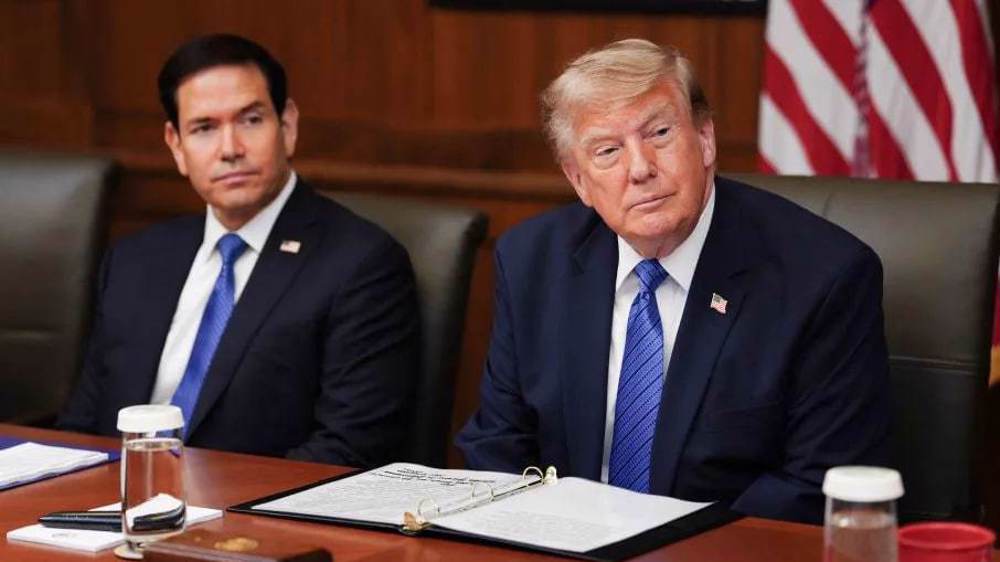
(Photo credit: Anna Moneymaker/Getty Images)
 

The Cradle

AUG 22, 2026

The US has imposed a 50 percent tariff on $20 billion worth of Canadian goods, after last-minute trade talks between Washington and Ottawa fell apart late on 21 August.

The two sides had been close to a deal earlier this week, with Canadian Prime Minister Mark Carney congratulating negotiators on making “significant progress” in the trade talks.

According to US Trade Representative Jamieson Greer, the US was offering Canada the “best treatment” of any major US trading partner.

However, the talks fell apart Friday evening when Carney sent a last-minute email rejecting the deal.

Carney blamed last-minute changes by the US side, which he called “unfair” and “uneconomic,” and vowed to impose dollar-for-dollar retaliatory tariffs on US goods.

According to the Wall Street Journal (WSJ), the collapse of the negotiations risks “escalation into an all-out trade war.”

The 50 percent tariffs, which apply to about 5 percent of Canada’s exports to the US, took effect just after midnight Saturday morning.

US President Donald Trump first threatened to impose tariffs last month in an effort to persuade Canada to reverse bans on imports of US-produced alcoholic beverages, lift restrictions on imports of US dairy products, and reduce tariffs and quotas on certain US-made automobiles.

Many of those restrictions and tariffs were first imposed by Canada in response to US tariffs of up to 50 percent on Canadian automobiles, steel, aluminum, and forest products.

The US-Canada relationship has deteriorated since Trump was elected to a second term in 2024. Trump has publicly mocked Canadian leaders and suggested making Canada the “51st state.”

Last month, Trump blamed Carney for smoke from Canadian wildfires that “invaded” the US.

“[The] ‌cost of this pollution ​must of necessity be added ⁠to the TARIFFS Canada ​is currently ​paying,” ​the US president wrote on Truth Social.

Trump has also criticized Canada’s growing trade relationship with China.

The new 50 percent tariff on Canadian goods is likely to be challenged in US courts because it relies on a “novel interpretation” of a federal emergency law that no previous president has used, according to the WSJ.

Earlier tariffs imposed by Trump on other nations were struck down in the US courts, forcing the federal government to issue refunds to US importers.

The tariff refunds sparked controversy after reports emerged that the family of Trump’s Commerce Secretary, Howard Lutnick, stood to make millions following the court’s decision to issue refunds.

While Lutnick was publicly advocating for new US tariffs, Cantor Fitzgerald, a Wall Street investment firm formerly run by Lutnick and now run by his two sons, reportedly spent $10 million to buy importers’ rights to future tariff refunds, paying roughly 20 to 30 cents for every $1 of potential refund.

Documents seen by Wired suggested that Cantor Fitzgerald had the “capacity to buy the rights to hundreds of millions of dollars in potential refunds from companies who have paid Trump’s tariffs.”

[,,,]

Via https://thecradle.co/articles/canada-us-trade-talks-collapse-as-ottawa-walks-away-pledges-dollar-for-dollar-tariffs

US judge strikes down Trump’s immigrant visa ban on 75 countries

President Donald Trump, alongside US Secretary of State Marco Rubio (left), speaks during a Cabinet meeting at Camp David in Maryland, on July 31, 2026. (AFP)

Press TV

A US judge has struck down a Trump administration policy suspending immigrant visa processing for nationals of 75 countries, ruling that the ban was “contrary to law.”

In a ruling issued Friday in the Southern District of New York, Judge Jeannette Vargas said the policy was “patently unlawful” and that Secretary of State Marco Rubio had exceeded his statutory authority in ordering the suspension.

Vargas said the policy conflicted with federal immigration law, which limits the secretary of state’s authority over consular officers’ decisions on immigrant visa applications.

“The Policy, which categorically prohibits the issuance of immigrant visas based upon the nationality of the applicant, represents a direct abrogation of this statutory scheme,” she wrote.

The policy, which took effect in January, suspended the processing of immigrant visas for nationals of 75 countries, including Afghanistan, Brazil, Egypt, Iran, Iraq, Nigeria, Somalia, Thailand and Yemen.

The suspension halted permanent-residence visas for people joining family members or taking jobs in the US, but did not apply to nonimmigrant visas such as tourist or student visas.

The State Department had defended the measure, arguing that applicants from the designated countries were at high risk of becoming a “public charge” and of relying on US federal, state, or local government resources.

Vargas, however, ruled that consular officers had been improperly ordered to refuse immigrant visas solely based on an applicant’s nationality, even when the applicant otherwise qualified for a visa.

The ruling vacates visa denials issued solely under the policy.

Vargas issued the ruling in a lawsuit brought by immigrant rights groups, including the Catholic Legal Immigration Network and African Communities Together, as well as immigrant visa applicants and US citizens sponsoring family members from the affected countries.

The decision represents another legal setback for President Donald Trump’s broader immigration crackdown, which the administration has defended as necessary to strengthen national security and tighten controls over immigration.

According to the Center for Constitutional Rights, the visa freeze was among a series of immigration restrictions introduced by the administration in rapid succession, following a broader travel ban covering 39 countries and a pause on diversity visa issuance.

Trump campaigned on a pledge to carry out mass deportations and has since returned to the White House with a series of measures aimed at accelerating deportations and reducing immigration into the United States.

The Trump administration’s immigration policies have also affected the families of US military personnel. An Associated Press investigation found earlier this month that more than 50 parents and spouses of active-duty US service members have been detained since Trump returned to office, with at least six deported.

At least eight immediate family members of US service members remain in federal immigration custody, according to the investigation, which noted that the government has not systematically tracked such cases.

For decades, military families had generally benefited from protections shielding the parents and spouses of service members from deportation.

The reversal has raised concerns among experts that the detentions could undermine military readiness by leaving service members without emotional support or childcare and, in some cases, delaying deployments or forcing them to take leave.

The issue has also drawn public backlash, with several cases involving detained spouses prompting intervention by Homeland Security Secretary Markwayne Mullin to secure their release.

Rights groups have meanwhile criticized the administration’s broader immigration measures, raising concerns over due process, discrimination and racial profiling.

[…]

Via https://www.presstv.co.uk/Detail/2026/08/22/774865/Federal-judge-rules-against-Trump-immigrant-visa-ban-75-countries

The Monster Behind Weather Engineering

“Climate instability” is a soft term, for climate geoengineering, weather modification, extended into weather weaponizing. In other words, a crime on humanity.

Professor Michel Chossudovsky provides the historic and technical details concerning weather warfare that has been emerging slowly since WW II, and probably before.

For certain, whenever you hear “fake news” to comments and reports about geoengineering and weather weaponizing, you can be sure the so-called fake news are actually the truth. And this is the case for most everything else called “fake news”.

However, what tops it all, is the recent discovery through a former employee at the South Pole Station in Antarctica. He says, what he saw at the South Pole Station is “HAARP on steroids”. He became a whistleblower, who testified before the United States Senate.

HAARP stands for High-frequency Active Auroral Research Program. Since 2015, it is officially a University of Alaska Fairbanks project which researches the ionosphere – the highest, ionized part of Earth’s atmosphere. In reality, it has a long history of weather modification and climate geoengineering.

The researcher and whistleblower, Eric Hecker, used to work for Raytheon Technologies Corporation, an American multinational aerospace and defense conglomerate, at the South Pole Station. In a 15-minute interview by Redacted, he reveals the existence of a MASSIVE weather machine at the South Pole Station. The interview, which details what Mr. Hecker experienced at the South Pole Station, is mind-blowing. It “makes the HAARP project look like a baby project.”

The weather machines at the South Poles Station can control earthquakes and the weather, alias climate. They can fabricate and direct earthquakes, hurricanes, typhoons, cyclones just about anywhere in the world. In addition, there is a giant UFO control tower, also called a neutrino control tower.

Neutrinos are tiny subatomic particles, often called ‘ghost particles’ because they barely interact with anything else. Neutrinos can be used as high-frequency energy transmitters. Earthquake or storm forming energy can be beamed literally anywhere in the world.

Mr. Hecker talks about precisely targeted earthquakes and storms.

With this prelude, the recent category 3 to 5 devastating hurricanes hitting North Carolina and Florida, as well as the typhoons Bebinca and Yagi, hitting China and other Asian countries, are easily explained. 

In late September, Hurricane Helene, a category 5 Hurricane, hit five US States, Florida, Georgia, South Carolina, North Carolina, Tennessee, and Virginia, killing way over 300 people.

Hurricane Helene was a near-record-breaking storm. Winds and rainfall together turned the tornado into an almost unimaginable disaster that stretched more than 800 kilometers inland from the Florida coast.

“Helene” devastated and flooded Asheville, North Caroline. Strangely, Asheville sits on billions worth of lithium.

Asheville counts about 100,000 inhabitants and is on about 700m elevation – it is unusual that such elevations are flooded to the extent Asheville was inundated (see picture by Asheville Free Press).

Two companies, Piedmont Lithium and Albemarle Corp., plan to open lithium mines in the State of North Carolina in the coming years. Lithium is a metal used to power batteries for electric vehicles, smartphones, and laptop computers – and, of course, “war electronics”.

Guess who controls both of these companies? Right – BlackRock and Vanguard.

See the incisive analysis and video of Greg Reese

Last Wednesday night, 9 October, another weird, record Hurricane “Milton” hit the Florida coast, close to Siesta Key near Tampa, moving inwards towards Mexico, devastating Tampa, Florida, killing at least 23 people. The hurricane was downgraded from an original maximum strength category 5 to a level 3 when it made landfall, and later further down to a category 1 storm.

According to the utility tracker “Find Energy”, some 1.3 million customers were still without electricity on Saturday throughout Florida. See the report by CBS

No surprise, Bill Gates owns much of Tampa’s inner city’s renaissance landmark $3.5 billion Water Street Tampa project. Co-investor is Jeffrey Vinik (owner of the city’s professional hockey team, the Tampa Bay Lightning). The 55-acre mixed-use development project at the heart of the city’s downtown corridor recently received the title as North America’s first WELL:

Certified Community, thanks to its sustainability and livability standards. That seems to fit perfectly into the UN Agenda 2030.

The Water Street Tampa project redefines a booming downtown area, taking advantage of the city’s prime waterfront setting. See this.

It is said that Bill Gates intends on making Tampa a 15-minute city.

While fool proof the evidence is scanty, what looks like targeted storms, raises many questions. Geoengineering and weather manipulation is on the mind of ever more people. Keeping the narrative of “conspiracy theory” alive, is ever more difficult. People are waking up.

They are connecting the dots between the crisscrossed chemtrails skies, extreme hurricanes, and unpredictable severe weather variations, from cold to hot, to rain, to sunny, foggy, hail – an unusual and unhealthy mix. And now, with the interview by Redacted with Eric Hecker, even destructive killer-earthquakes are no longer mysteries.

Here is what is said about Hurricane Helene – with the potential multi-billion dollars lithium mining in the Asheville, NC, region: see video below.

See also this and this and this.

As to Hurricane “Milton”, Paul Craig Roberts notices that it evolved in such an unusual way that it didn’t seem real. See this.

[…]

Concluding, weaponizing weather and climate, makes nuclear war superfluous. “Weather” and earthquakes can be targeted to specific areas as in war.

Also, avoiding nuclear wars avoids nuclear radiation and nuclear fallouts that can last from a few decades to thousands of years, and may affect the commandeering elite, as much as the common plebs.

[…]

Via https://www.globalresearch.ca/monster-high-crime-weather-engineering/5870475

Trump Tries to Bribe IRGC General as per Venezuela Playbook

Robin Westenra

Aug 20 2026

Trump’s White House tried to buy off Iran’s Revolutionary Guard with a multi-billion-dollar offer modeled on the Venezuela playbook — and got refused twice, first by IRGC commander Vahidi, who called it treason, and then by Pakistan’s Army Chief Asim Munir, who told Trump directly that Islamabad would not help destabilize Tehran’s leadership. In this episode, Zulfiqar Ali, Pepe Escobar, and Larry Johnson break down the failed bribery attempt, China’s directive to Pakistan to prioritize its Iran relationship, and why the collapse of the US–Iran memorandum of understanding is now pushing Washington toward open discussion of a nuclear strike on Iran.

The panel also covers the global diesel and aviation-fuel shortage triggered by the Strait of Hormuz blockade, the UAE’s public cutoff of trade with Iran days after reportedly sending Tehran billions in cash and gold, and why Oman and Qatar are now openly rejecting US pressure over who controls the strait. This episode is built on direct reporting from sources inside Tehran and Islamabad and lands the same week the US–Iran MOU formally expired (August 17–18, 2026), with Iran declaring a shift to a fully offensive posture on Hormuz.

Zulfiqar Ali reports with direct access to decision-making circles in Islamabad and Tehran; Pepe Escobar is a veteran geopolitical analyst covering Eurasia and the multipolar order from the ground; Larry Johnson is a former US intelligence and State Department official providing military and strategic analysis.

[…]

Via https://seemorerocks.substack.com/p/larry-and-pepetrump-tried-to-buy

Oman’s Ministry of Foreign Affairs condemns Israeli settlement activities in the occupied West Bank:

Surge in Violence by West Bank Settlers Draws Ire of Israel's Allies ...

“The Ministry of Foreign Affairs expresses the Sultanate of Oman’s condemnation of Israeli settlement activities in the Palestinian territories in the occupied West Bank.

It affirmed that these unilateral and illegal measures constitute a flagrant violation of international law, including the Fourth Geneva Convention and relevant Security Council resolutions. They also undermine the international community’s will to achieve a two-state solution and establish an independent Palestinian state living side-by-side with Israel in peace and security.

It added that settlement expansion undermines the prospects for peace and deepens instability in the region, which runs counter to the international community’s goal of achieving a just and comprehensive solution to the Palestinian cause.

The Sultanate of Oman called upon the international community to unite its stance in condemning these measures and to take practical and concrete steps to ensure accountability in accordance with international law. It also stressed the necessity of Israel committing to its legal responsibilities and immediately halting all settlement activities.

The Sultanate of Oman affirmed that achieving a just and lasting peace can only be attained through respecting international law and upholding the inalienable right of the Palestinian people to self-determination and the establishment of their independent state.”

Via https://t.me/thecradlemedia/66604

How Pokémon Go turned its players into Pentagon cartographers

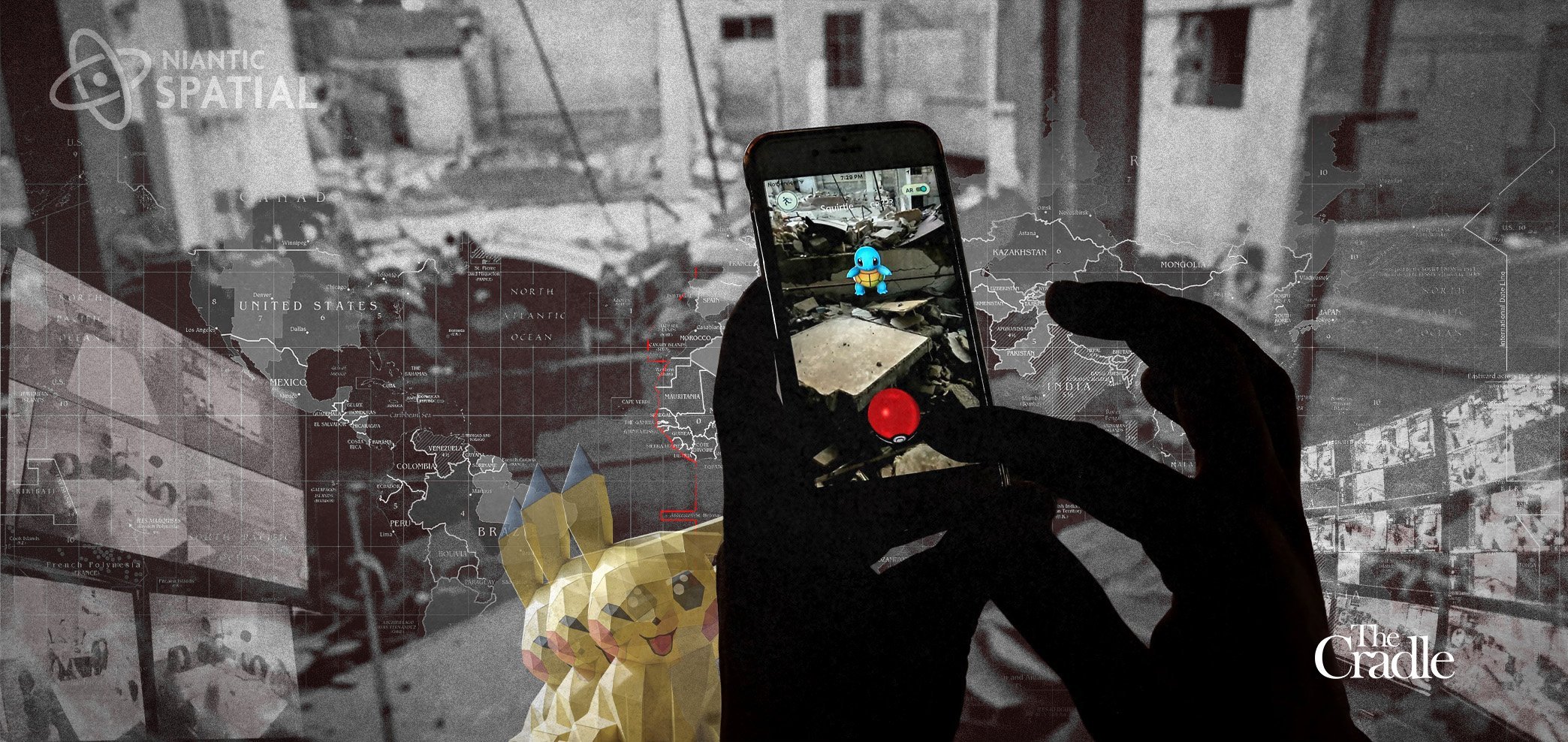
Photo Credit: The Cradle

AUG 21, 2026

Pokémon Go players supplied billions of street-level scans to Niantic’s mapping systems. Years later, the technology they helped build is being adapted for drones operating beyond the reach of GPS.

For nine years, Pokémon Go asked its players to go outside and “catch ‘em all.” Millions of children and their parents walked through their cities with cameras raised. Some, chasing in-game rewards, filmed statues, parks, street corners and, in at least one case, the inside of an apartment. Someone else was gathering the results.

In June, Dutch daily Trouw traced how roughly 30 billion player scans helped train Niantic’s mapping systems. Niantic Spatial has since partnered with Vantor, the rebranded Maxar Intelligence and a major US defense contractor, to develop visual positioning for drones and other platforms in GPS-denied areas.

Vantor serves defense and intelligence clients and provides satellite imagery used widely in western reporting on Ukraine and Gaza.

A game largely played by children had helped build technology now being adapted for US military use.

The game designer and media philosopher Ian Bogost saw the mechanism coming. In 2011 he proposed an honest name for the industry of points, badges and engineered rewards: “exploitationware.” Fifteen years later, Pokémon Go offered a striking example of what he meant.

Langley’s hand in Google Earth

The lineage sits openly on the corporate résumé. John Hanke, founder and executive chairman of Niantic Spatial, spent four years in the US Foreign Service before entering tech. In 2001, he co-founded Keyhole, a mapping startup named after America’s KH spy satellites.

When the company neared bankruptcy, an investment from In-Q-Tel, the CIA’s venture capital arm, kept it alive. Its technology would be used to “support United States troops in Iraq.” Much of the funding reportedly came from the National Geospatial-Intelligence Agency (NGA), which supplies geospatial intelligence to the Pentagon.

Google bought Keyhole in 2004 and turned its Earth Viewer into Google Earth. Hanke went on to run Google’s Geo division, built Niantic as an internal startup and spun it out in 2015 with backing from Google, Nintendo and The Pokémon Company. Pokémon Go arrived a year later.

Cartographers paid in Poké Balls

In 2021, the game began rewarding players for scanning real-world locations. They pointed a camera at a Pokéstop, uploaded the footage, and collected their prize. Participation was optional and limited to a fraction of the user base, yet that fraction produced billions of scans. The game’s terms gave Niantic a transferable, sublicensable license to submitted content, meaning the company could resell it to third parties.

Bogost had already described how this economy worked. Technology firms were “extracting personal information from customers by pretending that one’s product is actually one’s customer.” Pokémon Go followed the same model, rewarding players while using their scans to build its maps.

The scans helped train Niantic’s Visual Positioning System. Where GPS asks a satellite for a location, VPS looks at what a camera sees and matches it against a 3D model of the world. Two recognizable reference points a few pixels wide can be enough to fix a position. The system becomes especially useful when satellite signals are jammed, spoofed, or unavailable.

Floris De Hingh, a Dutch player who downloaded the game on its first day, told Trouw he had scanned everything from public parks to his own living room. “I was just playing a game,” he said, unaware of where those images might eventually lead.

The legal and ethical problem lies in what players agreed to surrender. Niantic said their personal data “[has not] been sold to anyone,” while the uploaded scans were governed separately as user content. A room can expose possessions, habits, and intimate details even when no name appears in the frame. The consent form focused attention on identity while securing broad rights over the surroundings.

Riyadh gets the players, the Pentagon gets the map

In 2025, Niantic split itself in two. Its games and players went to Scopely for $3.5 billion, under Saudi-owned Savvy Games Group. The spatial technology and mapping assets remained with Niantic Spatial. According to Niantic’s announcement, its existing shareholders retained stakes in the new company, while Scopely invested another $50 million. Saudi state capital now had a stake in both companies.

The Vantor agreement followed in December. Its announcement names GPS “unavailability, spoofing, interference, and jamming” as the problem, with autonomous drones among the platforms. Vantor, formerly Maxar Intelligence, is deeply embedded in the US defense and intelligence establishment and serves as a principal contractor for the NGA’s geospatial intelligence system, which reaches more than 400,000 US government users.

The firms plan to combine Niantic’s ground-based VPS with Vantor’s aerial positioning software, allowing air and ground systems to share coordinates without satellite signals. Vantor is also deeply embedded in the US defense and intelligence establishment.

The NGA helped keep Keyhole alive in 2003. More than two decades later, one of its principal contractors is working with Niantic Spatial on technology built in part from billions of scans supplied free by players.

Mapping everywhere, restricting Palestine

For more than two decades, the Kyl-Bingaman Amendment restricted the resolution of US-licensed commercial satellite imagery over Israel and the occupied Palestinian territories to two meters.

The Commerce Department eased the limit to 40 centimeters in 2020, but the country-specific restriction remains in US law. It long left evidence of occupation and destruction coarse on widely used imagery, even as commercial mapping systems gathered street-level detail elsewhere.

Children were encouraged to record the world at pavement level, while Washington imposed a special legal limit around the occupation state. US companies gathered ever more detail from ordinary users, but the law continued to restrict what could be seen over occupied Palestine.

The model survives the denial

The companies insist no game data is going into drones. Vantor told Trouw it will not use the Pokémon Go scans, then declined to confirm or deny whether its models had already been trained on them. Niantic Spatial had answered that question months earlier, when a spokesperson admitted the scans trained an “early version” of the very model on which the system is built. The raw imagery may stay out of Vantor’s hands, but its role in the model’s development cannot be neatly removed.

Jeroen van den Hoven, professor of ethics and technology at TU Delft, told Trouw why that distinction resists auditing. Once training data has been absorbed, individual contributions dissolve into patterns that cannot be traced or revoked. Van den Hoven said that “the people who thought they were playing a game have clearly been fooled.”

Bogost coined exploitationware for a swindle that exchanged badges for behavior, years before phone cameras were mapping playgrounds and living rooms for corporate AI. Pokémon Go extended that bargain across the physical world and carried the resulting technology into a military supply chain. The game told its players to catch ’em all. Its owners gathered far more.

[…]

Via https://thecradle.co/articles/gotta-scan-em-all-how-pokemon-go-turned-its-players-into-pentagon-cartographers

US power grid at risk of 18-month blackout; 1 city now in dark for more than a week

Power substation

An electrical substation is seen in Houston, Wednesday, July 10, 2024. (AP Photo/Maria Lysaker)

By 

The United States power grid is at risk of a major blackout that could last up to 18 months, according to a new report. Concerns are heightened as one U.S. city has been without power for more than a week.

Jon Wellinghoff, former chair of the Federal Energy Regulatory Commission (FERC), told The New York Times Magazine that America’s aging infrastructure is badly outdated and potentially vulnerable to a coordinated attack. He first raised the alarm in 2013 after gunmen shot up 17 transformers at an electrical substation near San Jose, California.

Wellinghoff said the FERC did an analysis that determined the U.S. power grid could be seriously disrupted if similar incidents targeted the 10 most important substations in the country’s three sections: Western, Eastern and Texas Interconnections. Substations are where multiple high-voltage lines meet, routing electricity between power plants, transmission lines, and local neighborhoods

“We came up with some very astounding numbers,” Wellinghoff told the publication. “If you knock out nine total substations along those three grids, you can black out the entire United States.”

Wellinghoff added that it didn’t matter which nine substations were hit, as long as they were among the 10 most important in its respective region. He told the NYT Magazine that even 12-year-olds could find them with a map on the internet, and anyone with enough guns could destroy them in 20 minutes.

According to the New York Post, it took Pacific Gas and Electric Company (PG&E) nearly a month to bring the California substation back online in 2013. To this day, no arrests have been made.

One of the reasons why the grid is especially vulnerable is its age. According to the New York Times Magazine, more than 75% of distribution transformers like on street corners and telephone poles are older than their 50-year life expectancy. Larger power transformers, which have shorter lifespans, were an average of 38-40 years old in 2014.

So it may be unsurprising that tens of thousands of people in northwest Indiana have remained without power since storms knocked down power lines across the region last week.

According to the Associated Press, the Northern Indiana Public Service Co. said more than 75,000 customers were still in the dark Wednesday. That includes 21,000 people in the city of Gary, Indiana, where people have sought relief from food pantries or gone to community centers just to charge their phones.

Full restoration is not expected until Aug. 25, a full two weeks after the Aug. 11 storm with 99 mph winds. NIPSCO said its work includes replacing 300 poles and 44 power transmission poles

“These aren’t simple repairs,” said Melody Birmingham, an executive at NIPSCO’s parent company. “These are systems that are being rebuilt.”

According to the New York Times Magazine, the average wait time to repair or replace a large transformer at a major substation is even longer. What previously took less than a year has jumped to 128 weeks since 2021, with some needing more than five years.

[…]

Via https://www.syracuse.com/us-news/2026/08/us-power-grid-at-risk-of-18-month-blackout-1-city-now-in-dark-for-more-than-a-week.html

Diddy could face criminal charges over Tupac assassination

Diddy could face criminal charges over Tupac killing – Telegraph

RT

Sean ‘Diddy’ Combs could face criminal charges linked to the killing of rapper Tupac Shakur in Las Vegas 30 years ago, The Telegraph has reported, citing sources. According to the outlet, prosecutors could take action if the man currently on trial over the murder is convicted.

Combs, who rose to become one of the most powerful figures in US hip-hop as a rapper and producer, is currently serving a 50-month federal prison sentence after being convicted in 2025 on two counts of transporting people for prostitution.

On September 7, 1996, Shakur was shot four times while stopped at a red light in a car with record executive Suge Knight. The 25-year-old died six days later, while Knight survived. His death soon became one of the most infamous unsolved murders in US popular culture.

The cold case was revived after Duane ‘Keffe D’ Davis, a former senior figure in the South Side Compton Crips street gang, began publicly discussing his involvement in 2018 and 2019, eventually leading to his arrest in 2023. Members of the gang are believed to have provided protection to Combs in Los Angeles.

Davis, now on trial for allegedly orchestrating the shooting, had previously claimed that Combs offered $1 million for Shakur and Knight to be killed amid an increasingly violent rivalry between Combs’s Bad Boy Records and Knight’s Death Row Records, which represented Shakur.

Combs has denied any involvement, calling the allegations “pure fiction and completely ridiculous.” Davis now insists his previous accounts of the killing were fabricated for money and notoriety.

The Telegraph did not specify what charges Combs could face but said a Davis conviction could lend credibility to the latter’s claim regarding the $1 million offer.

“The door remains open on what charges could be made against Diddy. But if the jury convicts Davis, then it gives a green light to take action against Diddy,” the outlet quoted a Clark County district attorney’s office source as saying.

The newspaper said prosecutors have kept Combs’s alleged role out of the trial to avoid confusing the jury and have not confirmed whether they would pursue him.

Davis was allegedly one of the four men in the Cadillac from which the fatal shots were fired and is the only one still alive.

Prosecutors believe the man’s nephew, Orlando ‘Baby Lane’ Anderson, fired the shots in retaliation for being beaten by Shakur and his entourage earlier that night. However, he was never charged and was killed in an unrelated gang shooting in 1998.

Under Nevada accomplice liability, Davis can be prosecuted for murder even if he did not pull the trigger. He has pleaded not guilty to one count of murder with a deadly weapon with intent to promote, further or assist a criminal gang.
[…]