The Most Revolutionary Act

Uncensored updates on world events, economics, the environment and medicine

The Most Revolutionary Act

Russia Threatens Air Strikes with New Missile on American Bases in the Middle East, Alaska, Hawaii, Montana, and North Dakota

by Brian Shilhavy
Editor, Health Impact News

The Russian media is reporting today that airstrikes inside Russia are continuing with American-made ATACMS missiles launched from Ukraine, and they have vowed to retaliate.

Russia’s Defense Ministry Vows Retaliation for Ukrainian ATACMS Assault on Kursk Region

Upon examining the areas attacked in the Kursk Region, it was confirmed that Ukrainian militants fired American-made ATACMS missiles.

Russia’s Defense Ministry announced that it is preparing retaliatory actions against Ukraine for attacking with ATACMS missiles in the Kursk Region.

Over the past three days, Ukrainian forces carried out two strikes with long-range Western weapons on targets in Russia’s Kursk Region, the Defense Ministry said.

On November 23, the Ukrainian military launched five ATACMS missiles near the village of Lotarevka at the position of the S-400 anti–aircraft missile division. Three missiles were destroyed, and two reached the target.

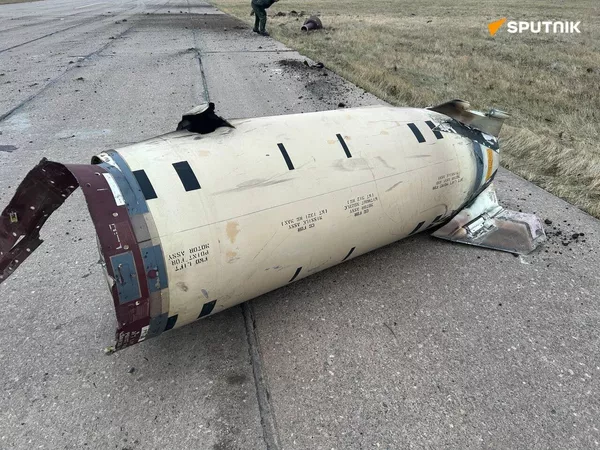
Remnants of US ATACMS Missiles - Sputnik International

On November 25, Ukrainian troops struck the Vostochny airfield in Russia’s Kursk Region using ATACMS missiles. Seven were shot down, but one reached its target. As a result, two soldiers were slightly injured from falling rocket fragments.

Earlier on Monday, White House National Security Communications Advisor John Kirby, after a long denial, confirmed that Ukraine is allowed to use US-made ATACMS ballistic missiles to fire at targets in the western Russian region of Kursk. (Source.)

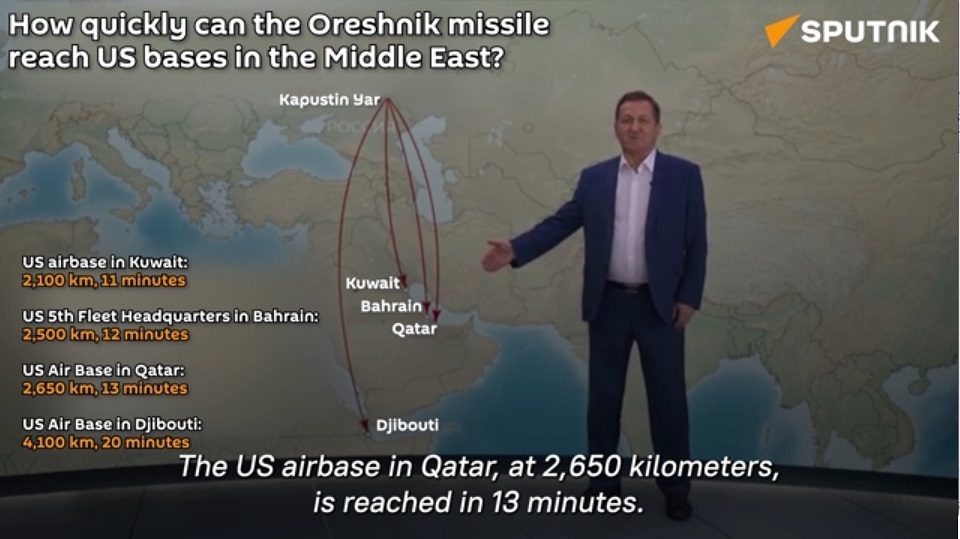
Russia has also produced a video today showing how long it takes for their new Oreshnik missile to reach American troops stationed in the Middle East, Alaska, Hawaii, Montana, and North Dakota, making it clear that Europe is not the only place that should fear imminent attacks by their new missiles.

There is currently no known missile defense system that can intercept the Russian Oreshnik missile.

With the first devastating launch of an Oreshnik missile into Ukraine late last week, and the continuing bombing of Russia with American ATACMS missiles, this is not just rhetoric anymore.

[…]

Via https://vaccineimpact.com/2024/russia-threatens-air-strikes-with-new-missile-on-american-bases-in-the-middle-east-alaska-hawaii-montana-and-north-dakota/

Going beyond nuclear

Dmitry Orlov

On 21 November 2024 Russia performed a test of its new intermediate range missile system, which its designers called “Oreshnik”. This it had the right to do ever since Donald Trump unilaterally withdrew from the Anti-Ballistic Missile (ABM) treaty, but didn’t use its right until now. Russia’s position was that it won’t violate the ABM treaty until the US does, which the US recently did by firing up its Aegis Ashore installation in Poland, which is an air defense system and as such entirely obsolete and useless, but which can also fire offensive Tomahawk cruise missiles.

Western media reported the Oreshnik strike as an attack on the city of Dnipro, which is actually Dnepropetrovsk. It was founded in 1776 on orders of Prince Potemkin and intended as the third, southern capital of the Russian Empire, after St. Petersburg and Moscow. Originally named Yekaterinoslav, in honor of Catherine the Great, it was renamed to Dnepropetrovsk by the Bolsheviks in 1926. Well, the Oreshnik strike was not on that city. That was fake news.

The Oreshnik strike was on a city-sized factory called Yuzhmash located near the city of Dnepropetrovsk. The factory is so large that it had its own transit system. It made ICBMS during the Soviet era. At its height, it produced 100 of them a year — one every three days. Under Ukrainian management it languished and although some US defense companies showed interest in it and even invested some funds in it, these probably got stolen just like everything else in the Ukraine these days.

The Oreshnik is a new system, developed over the past few years and first tested during its strike on Yuzhmash, which it smashed to rubble and pulverized. The Oreshnik is a non-nuclear solid fuel rocket with 6 hypersonic reentry vehicles. On reentry, the six projectiles maneuver violently and accelerate to Mach 10 making them impossible to intercept using any technology, existing or envisioned. It is highly accurate, packs a punch equivalent to its weight in TNT and concentrates it on a small area. Its range includes all of Europe including the UK and, if launched from Russian far east, Japan, South Korea and most of Alaska.

This was the first test of the system and the fact that it used a real target instead of a test target shows the level of confidence its makers had in it. It is also the first of several such systems in the pipeline, with different technical characteristics. The goal, obviously, is to be able to carry out strategic strikes using non-nuclear means and with global reach, and to do so with complete confidence that no air defense system will be able to affect them in any way.

The use of Oreshnik coincided with the use of ATACMS and Storm Shadow missiles against Russian territory. A key point is that although launched from Ukrainian territory, these systems have to be operated by NATO personnel, implying that the US and the UK are now at war with Russia. To make matters worse, the Biden and Starmer administrations have given permission to use these rockets against “Russian territory,” although what they mean by “Russian territory” varies from what the Russian constitution defines: according to these NATO powers, Lugansk, Donetsk, Zaporozhye, Kherson and Crimea are not Russian territory, but Kursk and Belgorod are. However, this is a distinction without a difference.

The missile attacks that Biden and Starmer had authorized have been almost entirely inconsequential because Russian air defense systems can and do shoot them down quite readily. Thus, in terms of achieving any military aims, be they tactical or strategic, these rockets are strictly a waste of time and money. However, they do serve as a useful casus belli from the Russian point of view, giving Russia a legal right to retaliate that would not be viewed as an act of unprovoked aggression by the global majority (which happens to be on Russia’s side and wants Russia to win).

It seems that now Russia has everything it could possibly want:

• All of what remains of the former Ukraine for a test range on which to test its new hypersonic rocket systems
• A weapon against which NATO can do nothing and which can reach all of Europe, including all of the UK, as well as Alaska, where the US has plenty of military assets
• A casus belli in the form of ATACMS and Storm Shadow rocket attacks on internationally recognized Russian territory that gives it the legal right to counterattack<
• A means of pursuing its tactical and strategic goals without escalating to a nuclear confrontation, since Oreshnik is a conventional weapon

Russia really has just one strategic goal: to defang the US and NATO so that they no longer have the ability to pose a threat to the security of the Russian Federation and its allies. Can Oreshnik be used to defang the US, and what would be the most efficacious way to do so?

Here I veer into guesswork, but my very strong hunch is that this can be accomplished by neutralizing the US military-industrial complex and Oreshnik isn’t quite the weapon of choice for achieving this goal because the assets in question are on US territory. But given that Oreshnik already has a mobile version as well as a silo-based version (typical Russian practice) there is no reason why a ship-based version couldn’t be developed as well, to be fired from halfway across the Atlantic Ocean.

The appropriate list of targets should not include government installations, since these typically house the products of the US military-industrial complex rather than its assets, and it is not a problem for it to make more of them. Instead, the target list should consist entirely of the industrial assets and sites of US defense contractors. That would inflict maximum pain, to the point of altering US foreign policy. In general, the more military conflict there is around the world, the better it is for the MIC. But the moment they see their own industrial assets being destroyed (which cannot be replaced quickly and sometimes not at all) they will start clamoring for peace.

In response to such a conventional attack by Russia, the US would have no good choices. It could go nuclear, thus assuring its own complete destruction from a Russian counterattack while Russia could very well shoot down most, perhaps even all, of what the US could throw at it, given that the US nuclear deterrent is quite old, subsonic and increasingly unreliable. It could stage an attack using conventional weapons, with even less of an effect. It could capitulate and sue for peace.

Thus, Russia is a year or two or three away from being able to eliminate the US and, with it, the rest of NATO, as peer competitors. As it stands already, Oreshnik has rendered NATO completely useless since none of its members can defend any of its other members from a Russian strike, nor can any of them retaliate for such a strike in any manner beyond the ineffectual or the suicidal. But the process of getting there is bound to be messy because of a severe shortage of people in positions of power, in the US or in Europe, who are capable of taking on board such facts.

Their modus operandi involves making horrible mistakes and then refusing to acquiesce in making them for as long as possible, hoping that everyone forgets and that they will escape responsibility. They may be expert at campaigning, public relations and advertising — herding idiots, that is — but military strategy is entirely beyond their abilities for the vast majority of them. And since they can only function through groupthink and can only communicate by reciting tried and tested platitudes about “stopping Russian aggression” and “sending a message to Putin,” the problem cannot be solved without taking it out of their hands entirely. The only hope is that the managers of financial capital which owns the US military industrial complex, seeing various bits of their industrial empire collapse into rubble, will demand that the government do something to cut their losses.

In a shootout with Americans, aim for their wallets. That’s the only part of their anatomies that can feel pain. Luckily, the Russian now seem to have a non-nuclear precision weapon that can do just that.

[…]

Via https://boosty.to/cluborlov/posts/ec9e99a3-c664-4988-a25c-fee22f4601ad

European states vow to arrest Israeli PM

European states vow to arrest Israeli PM

RT

Several Western states have pledged to execute an arrest warrant for Israeli Prime Minister Benjamin Netanyahu issued by the International Criminal Court (ICC).

The Hague-based court on Thursday issued arrest warrants for Netanyahu along with former Israeli Defense Minister Yoav Gallant and Hamas commander Ibrahim al-Masri. West Jerusalem claims that al-Masri is already dead. The warrants are for alleged war crimes and crimes against humanity linked to the Gaza conflict.

The decision has elicited mixed reactions in the West. Several nations emphasized their respect for the independence of the court, while others voiced support for Israel.

The Netherlands, Switzerland, Ireland, Italy, Sweden, Belgium, and Norway all claimed they would meet their commitments and obligations under the Rome Statute and international law. However, Italian Defense Minister Guido Crosetto stressed that the ICC was “wrong” to put Netanyahu and Gallant on the same level as Hamas. Austria also said that it would obey the decision, but its foreign minister, Alexander Schallenberg, added that the warrant was “utterly incomprehensible.”

Dutch Foreign Minister Caspar Veldkamp assured the country’s parliament that the authorities would act on the warrants and avoid non-essential contacts with those named.

Geert Wilders, the head of the Netherlands’ Party for Freedom, a member of the ruling coalition, condemned the decision, saying that the Israeli authorities are being confronted with arrest warrants instead of receiving international understanding and support.

Earlier this month, the Dutch capital saw rioting between Israeli soccer fans, who chanted anti-Palestinian slogans, and pro-Palestinian locals.

In France, Foreign Ministry spokesman Christophe Lemoine said that potentially acting on the warrants was a “complex legal issue” while admitting the importance of acting in line with ICC statutes. At the same time, Lemoine declined to say whether France would arrest Netanyahu or Gallant if they came to the country.

Meanwhile, Hungarian Prime Minister Viktor Orban denounced the ICC’s decision, telling a state radio station that he would invite the Israeli leader to Hungary.

[…]

Via https://www.rt.com/news/608045-european-states-vow-arrest-netanyahu/

Türkiye protests latest US sanctions against Russia

Türkiye protests latest US sanctions against Russia
RT
Ankara is demanding an exemption to use Gazprombank to pay for natural gas imports, Energy Minister Alparslan Bayraktar has said

Türkiye is currently in talks with the US to secure a sanctions waiver that would allow it to continue using Russia’s Gazprombank to pay for natural gas imports, the country’s Energy Minister Alparslan Bayraktar told reporters on Monday.

Last week, the US Treasury Department imposed restrictions on more than 50 Russian financial institutions, including Gazprombank, which is linked to the eponymous Russian gas giant, and six of its international subsidiaries. The sanctions have effectively cut off Russia’s primary bank for energy-related transactions from the SWIFT interbank messaging system, meaning it can no longer be used for dollar-based transactions.

According to Bayraktar, unless a special exemption is made, Türkiye, which imports nearly all of its gas, won’t be able to pay Moscow for natural resources. Russia currently accounts for more than 50% of the country’s pipeline imports, according to Reuters.

In his comments, Bayraktar pointed to a previous waiver granted to Ankara when Washington had sanctioned Iran in 2012. At the time, the sanctions against Tehran included a clause that allowed the US President to issue a special exemption if an oil-importing country faced “exceptional circumstances” that made it impossible to reduce Iranian oil imports. Bayraktar has argued that Türkiye now needs a similar waiver for Gazprombank in order to secure its supply of natural gas.

  “These sanctions will affect Turkey. We cannot pay. If we cannot pay, we cannot buy the goods. The foreign ministry is in talks,” Bayraktar said.

The latest US sanctions have also sparked disdain among several other European buyers of Russian gas. Last week, Hungarian Foreign Minister Peter Szijjarto accused Washington of trying to undermine energy security in the Central European region by imposing restrictions on Gazprombank.

In a post on Facebook, the diplomat stated that any attempts to jeopardize energy supplies to Hungary are “considered as an offence against our sovereignty” and stressed that Budapest denounces all such attacks and has vowed to “resist the pressure and pursue our national interests.”

He added that Hungary is currently in talks with other countries, such as Bulgaria, Serbia, Azerbaijan and Slovakia in hopes of finding a solution for securing energy supplies.

Meanwhile, despite the EU announcing plans to eliminate its dependence on Russian energy, it has remained one of the world’s major importers of Russian fossil fuels while its members have purchased record volumes of liquified natural gas (LNG) from Moscow.

[…]

Via https://www.rt.com/news/608239-turkiye-protest-us-russia-sanctions/

Bioterrorism: Covid19 was the 34th bioweapon release from 1970-2000

Covid-19 was the 34th TERRORIST ATTACK involving BIOLOGICAL AGENTS from 1970 to 2020, meant to create panic, mass casualties and economic disruption

S D Wells

Bioterrorism is the deliberate release of viruses, bacteria, toxins or chemical concoctions with the goal of causing widespread chaos, mass sickness and death and economic destruction. In the past 50 years, nearly three dozen terrorist attacks are documented that involved biological agents, yet up until Covid-19 was created and released, all the other biological attacks only racked up about 800 injuries and 9 deaths, according to records published in PubMed. Two-thirds of those biological terrorist attacks occurred on U.S. soil.

After 9/11 happened, the U.S. Government was hell-bent on finding the terrorists responsible and bringing them to justice. That infamous event wasn’t chalked up as “bioterrorism,” even though the toxic fire, burning jet fuel and asbestos, poisoned thousands of humans, but it certainly was terrorism, and it occurred right here on U.S. soil, in one of the most densely populated cities in the nation.

So then, why is it that after Covid-19 was released from the Wuhan laboratory and spread around the world, the U.S. Government made ZERO attempts to find the terrorists who infected the masses? Maybe because it was an inside job, just like 9/11 was suspected to be.

The New Age of Pandemics ushers in a whole new age of bioweapons, and those developing and releasing “gain of function” viruses should be arrested for terrorism

The four-year-long 34th act of bioterrorism is almost over. Covid has almost come to an end, and not because of vaccines, masks or social distancing. The Covid bioweapons developed by the US military industrial complex destroyed the lives and livelihoods of a few billion people . . . These bioweapons included the deadly mRNA “clot shots.” This new age form of terrorism has only just begun.

Now, they want to develop deadly vaccines BEFORE the new gain-of-function viruses and pathogens are released, all-but admitting they plan to use their new creations for terrorism and complete decimation and control of the populace.

The NIH, CDC, and WHO are calling for massive investments in ‘cutting-edge vaccine platforms’ to defend against bioweapons they themselves are creating. How ironic. They’re calling it a ‘critical race against time.’

Then, after they release these bioweapons that they call ‘novel viruses,’ there’s another form of terrorism called misinformation, where the mass media industrial complex tries to censor the whistleblowers, truth media and all non-scripted independent news. This is an attack using propaganda and censorship, while the terrorists themselves spread disinformation everywhere.

From Anthrax to Monkeypox, and from Zika to Swine Flu [Ed Ebola can also be added to this list], we’ve experienced just about every kind of bioterrorism imaginable, but it usually comes from rogue government agencies and their cohorts in the military, rather than from a small group of jihad-style psychopaths with twisted religious convictions.

There’s a new call to ban gain-of-function research. The former White House “Covid Czar” is warning the world right now about the impending age of bioweapon pandemics, also known as ‘plandemics’ or ‘scamdemics.’ Whether or not these new viruses, that can jump from animals to humans, and then spread from human to human, are released on purpose or stolen by terrorists and then released, the end result is the same.

[…]

Via https://dreddymd.com/2024/11/26/covid-19-was-34th-terrorist-attack-involving-biological-agents-1970-to-2020/

Linguistics: How to Identify a Language Family

The Extent of the Austronesian Language Family - Vivid Maps

Episode 11 How to Identify a Language Famiy

Language Families of the World

Dr John McWhorter

Film Review

According to McWhorter, it’s the job of historical linguists to identify language families and to construct a prototype language they likely descended from.

He asserts the Polynesian (Austronesian) languages were the easiest to categorize into a family because they separated so recently (about 700 years ago). In fact many words are virtually identical in the different Polynesian languages. He gives Maori, Hawaiian, Samoan and Fijian as examples:

He gives the following examples:

[English – post]

  • Maori – pou
  • Hawaiian – pou
  • Samoan – pou
  • Fijian – bou

Proto-Austronesian root – pou (majority rule + “p” to “b” shift common in many languages)

[English – taboo]

  • Maori – tapu
  • Hawaiian – kapu
  • Samoan – tapu
  • Fijian – tabu

Proto-Austronesian root – tapu (t to k shift also common)

[English – cry]

  • Maori – tangi
  • Hawaiian – kangi
  • Samoan – tangi
  • Fijian – tagi

Proto-Austronesian root – tangi

English – stay

  • Maori – hono
  • Hawaiian – hono
  • Samoan – fono
  • Fijian – vono

Proto-Austronesian root – fono (because “h” is badly enunciated “f”)

In search for similarities, historical linguists tend to focus on words that are used frequently (which makes them less likely to change). American linguist Morris Swadesh made the following list of the most heavily used words in most languages: I, you, we, this, that, who, what, long, one, two, all, many, mall, man, woman, person, skin, blood, egg, hear and I.

McWhorter also gives two Indo-European examples:

[English – father]

  • Greek – pater
  • Latin – pater
  • German – vater
  • Hindu – pitaa (“v” commonly shifts to “p”)
  • Irish – athir
  • Pashto – plaar
  • Tochuan – pacar (“t” commonly shifts to “c”)
  • Albanian – ata

Proto-Indo-European root – pater

English – bride or daughter-in-law

  • Old English – snoru
  • Sanskrit – susa
  • Russian – shokha (in Russian “s” can shift to “k” and feminine words must end in “a”)
  • Latin – nurus
  • Greet – nuos
  • Armenian – nusa

Proto-Indo-European root – snusos (must have started with “s” because they only drop off over time – they aren’t added)

Words suggesting Finnish and Hungarian belong to same language family:

  • Blood is “heri” in Finnish and “vér” in Hungarian.
  • Hand is “käsi” in Finnish and “kéz” in Hungarian.
  • Water is “ves” in Finnish and “viz” in Hungarian
  • What is “mïta” in Finnish and “mit” in Hungarian.
  • Three is “koeme” in Finnish and “három” in Hungarian (representing “k”to “h” shift)
  • Fish is “kala” in Finnish and “hal” in Hungarian
  • Head is “päã” in Finnish and “fö” in Hungarian
  • Nest is “pesã” in Finnish and “fézek” in Hungarian

Film can be viewed with a library card on Kanopy.

https://www.kanopy.com/en/pukeariki/watch/video/6120000/6120024

Bone dry: Agribusiness’ African water grab

By Grain

Since the early 2010s corporations have acquired over 7 million hectares of land for large-scale, industrial farms in sub-Saharan Africa, with most of these projects focused on producing water-intensive crops in already water-stressed regions. While the media spotlight is often on climate change-induced droughts, little is being said about the corporate-driven water scarcity these projects are inflicting upon people across Africa. Driven by the goal of expanding export production of water-intensive crops, governments are auctioning Africa’s water resources to the highest bidder. The new rush for land on the continent to grow trees for carbon credits is making this worse.

Water plundering

Only in the last 8 years, companies have signed land deals for over 5 million hectares for water-hungry plants in Africa. Take, for example, the New York-based company African Agriculture Holdings. It planned to use massive amounts of water from the Senegal River– the main water source for Dakar and several other major cities in Senegal, to produce alfalfa for export to South Korea and the Gulf states on 25,000 ha of land within a protected wetland. The company also planned to grow alfalfa on up to 500,000 hectares in neighbouring Mauritania, one of the most water stressed countries on the planet, and to plant a million water-hungry acacia trees in Niger to generate carbon credits. While it now appears that the company is heading for financial ruin, its CEO has already announced a new venture to grow maize on over 600,000 hectares in central Africa.
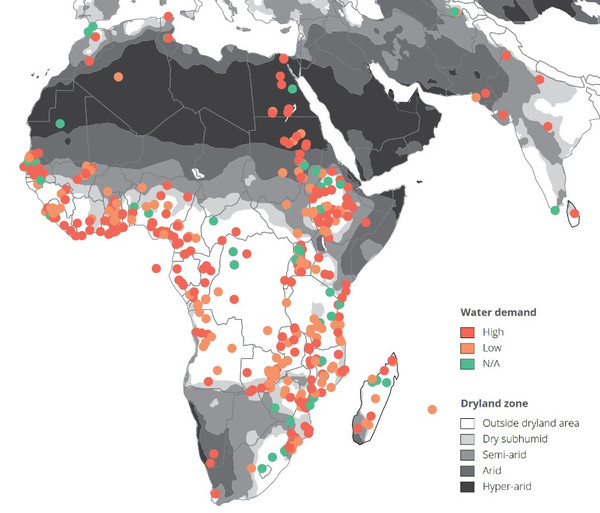
Zoom on Africa map from the 2021 Land Matrix report “Taking stock of the global land rush”, Figure 0.3: Water demand categories of crops cultivated in LSLAs and dryland zones.

Development banks, like the African Development Bank (AfDB) and the World Bank, are working with African governments to bankroll a massive rollout of new irrigation projects across the continent to facilitate more of these agribusiness investments. In Tanzania, for instance, the government and the AfDB have budgeted hundreds of millions of dollars of public funds for large-scale irrigation projects with the private sector, with a stated goal of irrigating 8.5 million hectares by 2030– which is more than today’s total irrigated land area in all of sub-Saharan Africa.

In Kenya, President Ruto has pledged nearly US$500 million for irrigation projects nationwide, including the Rwabura irrigation project in Kiambu county, the Iriari project in Embu as well as the Kanyuambora irrigation project. The Kanyuambora, like the others, will draw water from the Thuci river and irrigate 400 hectares, which will be used to farm crops such as horticultural produce.

One company that intends to profit big from this expansion of irrigation in Tanzania, Kenya and other countries in eastern and southern Africa is South Africa-based Westfalia. The company, which is particularly active in avocado production, controls 1,200 hectares in South Africa and 1,400 in Mozambique. With support from South Africa’s government-owned Industrial Development Corporation and the World Bank’s International Finance Corporation, Westfalia is promoting the expansion of the avocado industry in countries such as Mexico, Peru, Chile and Colombia, where avocados have already fuelled a severe water crisis. Replicating this model in other African countries promises to create a similar situation.

Africa’s experience to date with large-scale irrigation projects is dismal. Most of the projects implemented over the past decades failed or are in poor condition. And many of the so-called success cases have caused more harm than good. Consider the irrigation project in Lake Naivasha, Kenya, which triggered a boom in foreign investment in flower farms in the 1980s and 1990s that serve the European and Chinese markets. Only six farms now consume over half of the water volume used for irrigation in the lake’s basin. The impact of the flower farms range from pesticide pollution, to biodiversity loss, and hampering access to safe and clean water for local people. In return there have been few benefits, with workers toiling in gruelling and hazardous conditions for meagre wages and the companies avoiding taxes.

In Morocco fruit exports-primarily destined for European and UK markets-are driven by water hungry crops such as berries, watermelon, citrus and avocados. Between 2016 and 2021 these exports more than doubled. The biggest beneficiaries of this boom are corporations as Les Domaines Export, belonging to the country’s elite, alongside foreign companies like Surexport and Hortifrut, all backed by financial players, including pension funds and development banks. Today, Morocco has more irrigated land area than any other country in Africa, aside from Egypt.

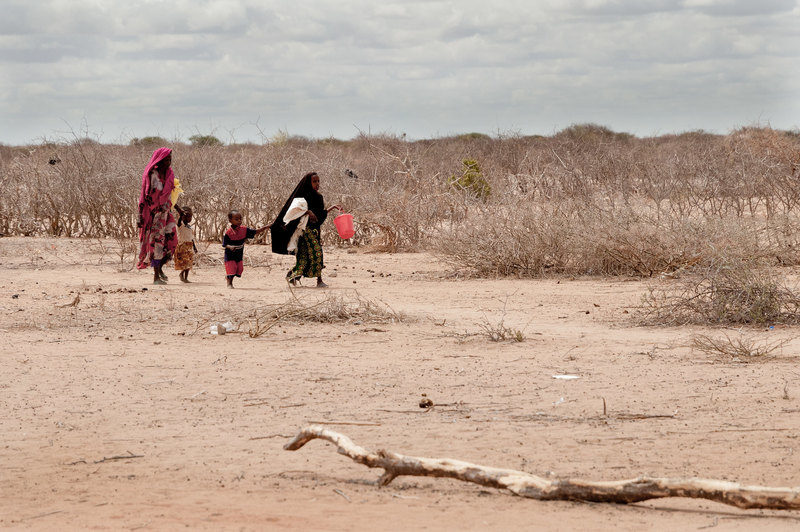
A pastoralist from Moroto one of the most dry areas in Uganda looking after his herd. Pastoralists in this region move long distances to look for pasture and water for their herds.By Nobert Petro Kalule

Export oriented industrial agriculture consumes 85% of the country’s water resources, intensifying the severe water stress gripping the kingdom, even as the country endures six consecutive years of drought. To cope with the crisis, the government announced the end of fruit subsidies. Yet, the measure will have little impact on large farms, since they have the financial capacity to continue with their operations, whereas small farmers will be the most affected. Other plans include investing in desalination plants. But the high energy and environmental costs make it far from a sustainable long-term solution.

On the opposite end of the continent, South Africa – one of Africa’s richest economy – has long struggled with a persistent water crisis. This is largely due to the fact that 65 percent of the country’s water resources are allocated to industrial agriculture.

>Africa’s water custodians

The impact of industrial agriculture’s thirst for water is felt most acutely by African women. Already tasked with managing households, caring for families and farming for food, women and young girls are also responsible for collecting all the water needed for both their homes and farms.

As such, they bear the heavy burden of trekking long distances – sometimes multiple times a day – to collect water. It is estimated that African women collectively spend about 40 billion hours annually fetching water. As more of their water sources are diverted for use on export-oriented industrial farms, it will make it even harder for them to access the water they need for their households.

Paradoxically, those most affected by the water issues affecting the continent may also be the ones with the solutions. Rural women possess invaluable knowledge about local water sources, their usage, storage and conservation. They know, for example, ways of recycling water for washing, irrigation and livestock, like the women pastoralists of the Anuak people in Ethiopia’s Gambela region, know how and when to move their animals from wetter areas to drier ones in the rainy season, allowing local rivers to replenish and maintain its fertility.

In Kenya, Martha Waiganjo, a farmer from the dry lands of Gilgil, is one of many smallholder farmers working with the Seed Saver’s Network (SSN) to take advantage of rain water harvesting and conservation techniques as part of their agroecological practices. Through rain water harvesting, farmers like her are able to collect, store and conserve run off rain water for later use.<

The run off water is stored in manually dug up dams that are lined with an anti-seepage layer of plastic commonly known as a dam liner. For Martha, her dam allows her to store close to 40,000 litres of water for her sustenance throughout the year. “[…] Water harvesting has been of great improvement on our farms, we don’t need the rain to plant. We use the water for irrigation and domestic use. The most important thing in water harvesting is that when the area is dry we use the water not only for farming but for the needs of the whole community. It is also of great importance to livestock farming.”[1]

In 2021, the UN estimated that nearly 160 million people in Sub-Saharan Africa (14% of the population) were affected by water scarcity and stress, and, with the effects of climate change now kicking in, the numbers are expected to be even higher in 2025 and beyond.

The fixation of governments, development banks and corporations on large-scale irrigation projects for industrial agriculture in Africa has to end. Water needs to instead be in the hands of the small-scale food producers who feed the continent and who are best able to develop solutions to the challenges posed by climate change.<

[…]

Via https://grain.org/en/article/7208-bone-dry-agribusiness-african-water-grab

Half US at risk for blackouts during extreme cold this winter

NERC - North American Electric Reliability Corp - Cross-Sound Cable

By Kevin Killough

“Electricity supplies are at risk from freezing temperatures that threaten reliable operation of BPS [bulk power systems] generators, fuel supply issues for natural-gas-fired generation, and wind and solar resource energy limitations,” the report states.

new report by the North American Electric Reliability Corporation (NERC), which assesses the United States and Canada’s grid reliability, finds that much of the central and eastern U.S. could experience blackouts should a significant and lasting cold snap descend on the nation.

“Electricity supplies are at risk from freezing temperatures that threaten reliable operation of BPS [bulk power systems] generators, fuel supply issues for natural-gas-fired generation, and wind and solar resource energy limitations,” the report warned.

NERC has been warning for years that increased reliance on unreliable wind and solar threaten grid reliability, but the “2024-2025 Winter Reliability Assessment” explains that as coal resources diminish and the U.S. becomes more reliant on natural gas, pipeline infrastructure may not be adequate to ensure a secure supply to homes and generators.

With the U.S. Energy Information Administration anticipating a colder winter this year, the problem is compounded, according to the report released Thursday.

“Natural-gas-fired power generator availability and output can be threatened when natural gas supplies are insufficient or when the flow of fuel is unable to be maintained,” the report warns.

The areas under the greatest risk of blackouts are those where coal- and natural gas-fired power plants have been taken offline, as well as those who have limited pipeline capacity to ensure secure supplies of natural gas.

The Midcontinent Independent System Operator (MISO), which covers 15 states over the Midwest, northern Great Plains, and south-central U.S., reduced its coal- and natural gas-fired generators by 5 gigawatts since last year. NERC warns that is going to create problems should there be a serious cold snap.

“With fewer internal dispatchable resources and increasing reliance on wind and imports, the risk of supply shortfall in winter has increased in MISO,” the report said.

The average American home consumes approximately 899,000 watt hours per month. Homes consume electricity at different rates during different times of the day, so it’s hard to say, especially with intermittent wind and solar, how many homes could be powered with 5 gigawatts of capacity.

Five gigawatts of electricity generation running for 1 hour could power 50 million 100-watt lightbulbs for one hour.

The Southwest Power Pool, which covers a stretch of the central Great Plains, according to the NERC report, has lost 4 gigawatts of generation capacity from last year. Of that amount, 2 gigawatts is from adjustments in wind and solar capacity, which has a lower energy value during the winter season.

New York and New England both face increased risk of blackouts, according to NERC, due to increased dependency on unreliable wind and solar resources, as well as pipeline issues. PJM, which covers all or parts of a dozen states south of Pennsylvania, including the District of Columbia, is facing litigation over a natural gas pipeline expansion project. If the litigation shuts down the facilities, the PJM area could see problems, the report states.

Natural gas producers, however, disputed some of the report’s conclusions, Utility Dive reports. Dena Wiggins, president and CEO of the Natural Gas Supply Association NGSA), said in a statement that its members “take a multitude of proactive measures to prepare for winter weather so that we can provide safe and reliable service to our customers.”

A NGSA fact sheet details some of the actions the members have taken, including improved communications, increased protection of facilities and equipment, and post-event analysis to track performance and improve weatherization practices.

During its “Winter Market Outlook Virtual Media Event” in October, the American Gas Association discussed the anticipated colder winter in combination with decreasing gas drilling rig counts.

“Despite these numbers going down, we are still seeing healthy production coming out of the drilling rigs,” Liz Pardue, director of economic and regulatory analysis for the AGA, said.

Lauren Scott, market and regulatory analysis for AGA, said that natural gas pipeline operators utilize a number of financial and physical mechanisms to “ensure that they’re able to heat your home, not just throughout the entire winter heating season, but on the coldest day of the year.”

The NERC report recommends that utilities complete winter readiness plans prior to December, be aware of the potential for short-term demand forecasts to underestimate demand in extreme cold events, and to implement fuel surveys to ensure adequate supplies of natural gas.

[…]

Via https://justthenews.com/politics-policy/energy/grid-watchdog-report-warns-half-us-risk-blackouts-during-extreme-cold-winter

IMF Calls For Economy-Crushing Carbon Restrictions That Dwarf COVID Lockdowns

Zero Hedge

At the height of the covid lockdowns and mandates a massive portion of the global economy was shut down, leading to supply chain instability, huge job losses and a stagflationary crisis.  However, climate change propagandists argued that the event was actually a positive for the planet when it was revealed that emissions fell by 5.4%.  They asserted that the covid lockdowns were a practice run for what they called “climate lockdowns” – Presenting a plan for scheduled disruptions to global economic activity as a means to slow the effects of climate change.

Globalists also presented climate lockdowns as a kind of collective social punishment in the event that populations refused to cut carbon output on their own.  As World Economic Forum “Agenda Contributor” Mariana Mazzucato argued in 2020:

“Under a “climate lockdown,” governments would limit private-vehicle use, ban consumption of red meat, and impose extreme energy-saving measures, while fossil-fuel companies would have to stop drilling. To avoid such a scenario, we must overhaul our economic structures and do capitalism differently.

Many think of the climate crisis as distinct from the health and economic crises caused by the pandemic. But the three crises – and their solutions – are interconnected…”

After a public uproar over the notion of extending pandemic lockdowns into climate lockdowns, the establishment media would go on to “Fact Check” the issue and assert that it was a “conspiracy theory.”  They lied.

The pandemic lockdowns would eventually be exposed as pointless; a disastrous drain on the global economy that did nothing to prevent the spread of the covid virus.  But as we witnessed with most of the restrictions instituted during covid, the goal was never to protect the health of the populace.  Rather, the goal was to acclimate the populace to an exponentially increasing list of violations of their basic freedoms.

One organization that has a distinct interest in diminishing economic activity for the sake of preventing global warming is the International Monetary Fund (IMF).  In a recent ‘call for global climate action’ the IMF states that restrictions on economic activity and general emissions activity would have to far surpass those enforced during the pandemic in order to get to their stated temperature target of less than 1.5°C.

Open lockdowns of developed nations might not ultimately be the tool that globalists use to reach net zero, but carbon taxation on an oppressive scale could end up having the same effect.  Carbon taxes could act like steep interest rate increases commonly used by central banks to slow economic activity during inflation.  An indirect economic shut down of this magnitude would be absolutely devastating for western nations in particular, resulting in crippling energy shortages, food shortages, job losses, and eventually total collapse and a population plunge.

Net zero is not possible otherwise.

The IMF and other globalist organizations suggest that all nations must achieve a net zero carbon goal by 2030 in order to avoid the “climate cliff” – The theory that once the Earth hits warming of more than 1.5°C, there will be a domino effect which will lead to environmental catastrophe and even more carbon emissions and warming.

To be clear, there is no evidence whatsoever to support the idea of the climate cliff, primarily because there is no evidence of a causation relationship between carbon emissions and global warming.  In fact, there is no evidence that that human industry has a warming effect on the climate whatsoever.

Temperature records for hundreds of millions of years prove that warming periods are a mainstay of the Earth’s climate history.  In comparison, our current era is one of the coldest, not the warmest.  Climate scientists ignore this data and use temperature records going back to the 1880s.  Meaning, their data is based on a mere 140 years of the Earth’s history.

The current warming rate is not significant to other periods, nor is there any evidence that human activity is causing it.  Data on carbon levels of the past show that temperatures do not necessarily rise in tandem with carbon activity.  Carbon emissions are also far lower today than they have been in the past. The claim that carbon concentration due to human activity has a drastic influence on global temperatures (or weather) is absolutely unfounded.

The real reason for climate controls and carbon taxes seems to have far more to do with wealth redistribution from developed nations over to developing nations.  The agenda is about centralizing the control of national wealth as well as individual liberties and private property.  And the IMF, of course, would like to be one of the institutions at the helm of that wealth management empire.

[…]

Via https://www.zerohedge.com/economics/imf-calls-carbon-restrictions-economy-bigger-covid-lockdowns

Fleet of drones spotted over major US airbase in Britain

RAF Lakenheath in Suffolk has been earmarked as a storage facility for US nuclear warheads three times more powerful than the Hiroshima bomb

By LES ROOPANARINE

The largest American airbase on British soil was buzzed by drones this week, the US Air Force has confirmed, amid unconfirmed reports that fighter planes were dispatched to intercept the encroaching aircraft.

The incident occurred on Wednesday above RAF Lakenheath in Suffolk, which has been earmarked as a storage facility for US nuclear warheads three times more powerful than the Hiroshima bomb.

While US Air Forces in Europe (USAFE) played down the incursion, it will do little to dampen the prevailing mood of unease following warnings from Vladimir Putin that Ukraine’s use of British and American long-range weaponry could see military facilities in those countries targeted.

[…]

USAFE declined to comment on either claims that flight operations were affected or the reported deployment of F-15E Strike Eagles.

‘To protect operational security, we do not discuss our specific force protection measures, but retain the right to protect the installation,’ the spokesperson added.

RAF Lakenheath, which appears poised to house US nuclear weapons for the first time in 15 years, is home to the 48th Fighter Wing and a site of major strategic significance as the US moves to bolster its European presence in the face of Russian expansionism.

Earlier this year, unredacted documents from the US Department of Defence’s procurement database showed that the Pentagon has ordered equipment, including ballistic shields, for the airbase.

The construction of facilities to house US soldiers at Lakenheath, where the drone incursion follows similar activity above the US Army’s Picatinny Arsenal in northern New Jersey two days earlier.

The American army has revealed that it is developing special ammunition to shoot down spy drones, with helicopters and tanks to be equipped with medium-calibre rounds capable of hitting small, high-speed targets.

‘There’s not enough air defence assets out there,’ Major General John T Reim, the Picatinny Arsenal’s commanding general, told military website Task and Purpose last month.

[…]

The developments follow warnings from Russian officials that British support for Ukraine, which this week fired UK-supplied Storm shadow missiles into Russian territory for the first time, could ‘lead to a collision between nuclear powers’

[…]


https://www.dailymail.co.uk/news/article-14117587/drones-spotted-airbase-Britain-RAF-Lakenheath-nuclear-weapons.html