The Centers for Disease Control and Prevention has updated its website with a new stance on the potential link between vaccines and autism. (AP Photo/Jeff Amy, File)
The Centers for Disease Control and Prevention has updated its website with a new stance on the potential link between vaccines and autism.
The new wording on the CDC’s site now states, “The claim ‘vaccines do not cause autism‘ is not an evidence-based claim because studies have not ruled out the possibility that infant vaccines cause autism.”
It also adds, “Studies supporting a link have been ignored by health authorities.”
The agency noted that the statement “vaccines do not cause autism” has been “historically disseminated” by the CDC and other federal health agencies in an effort to prevent vaccine hesitancy.
Previously, the CDC page stated: “Studies have shown that there is no link between receiving vaccines and developing autism spectrum disorder (ASD).”
The U.S. Department of Health and Human Services (HHS) has launched a “comprehensive assessment” of potential causes of autism, the CDC stated.
Those include investigations on “plausible biologic mechanisms and potential causal links.”
The header “Vaccines do not cause autism” remains on the page, but is followed by an asterisk indicating that it was not removed because of a prior agreement rather than because the evidence supports it.
The agency noted that the statement “vaccines do not cause autism” has been “historically disseminated” by the CDC and other federal health agencies in an effort to prevent vaccine hesitancy.
The Children’s Health Defense applauded the CDC’s updated web page.
“Finally, the CDC is beginning to acknowledge the truth about this condition that affects millions, disavowing the bold, long-running lie that ‘vaccines do not cause autism,’” Mary Holland, Esq., president and CEO of Children’s Health Defense in New Jersey, told Fox News Digital.
“No studies have ever proved this irresponsible claim; on the contrary, many studies point to vaccines as the plausible primary cause of autism. Thankfully, HHS has now launched a comprehensive assessment on the causes of autism, including an investigation of plausible biological mechanisms.”
In this lecture, McWhorter explains the difference between “intertwined” languages (true languages created by bilingual speakers) and “creoles” used by monolingual speakers where neither speaker has facility in the other’s language (see What Are Creole Languages?)
Examples:
Medua Lingua – Qhechua speakers from the west coast of South Ecuador use Medua Lingua (Spanish words superimposed on Quechua grammar, ie all Spanish words are given Quecha endings) when they travel to the capitol Quito.
Michif (Canada) – French fur traders who married Cree women spoke Michif, consisting of French noun and Cree verbs.
Angloromani – Roma (aka Gypsies or travelers) speak Angloromani (a blend of English and the Indo-Aryan language Romany) in English speaking countries and similar intertwined languages in other European countries, e.g. Scandoromani.
According to McWhorter, English is “mixed” language rather than a genuine intertwined language. Although it contains many French, Latin and Norse words, most of its basic words are of English (Anglo-Saxon) origin. And although its syntax (word order) is heavily influenced by Celtic languages,* it’s basic grammar is Germanic.
*Examples of Celtic influence are seen in questions and negatives. In English we “Do you have a cat?” and “I do not walk” – speakers of other Germanic languages would say “Have you a cat” and “I walk not.”
A report published on Tuesday by the AidData research lab at William & Mary university in Williamsburg, Virginia, found that the United States is the largest recipient of loans from China.
The report, entitled Chasing China: Learning to Play by Beijing’s Global Lending Rules, found that 1,193 Chinese banks, investment companies, and government institutions loaned $2.2 trillion to recipients in 179 countries between 2000 and 2023.
AidData researchers drew two surprising conclusions from their research: “China’s overseas lending portfolio is vastly larger than previously understood,” and its loans to the developed world are an order of magnitude larger than widely believed.
The common image of Chinese loans is banks pumping huge loans to Third World countries through China’s Belt and Road Initiative (BRI). The ostensible purpose of BRI was to help developing countries build vital infrastructure, but the projects are often criticized as unprofitable “debt traps” approved by spendthrift local governments that saddle the borrowing nations with debts to Beijing they can never repay.
Whatever the flaws of BRI might be, AidData determined that only about 20 percent of China’s titanic lending portfolio involves infrastructure projects in developing nations. Meanwhile, the amount China loans to developed nations “skyrocketed from 12% to 76%” between 2000 and 2023. Ten of the top 20 destinations for Chinese loans are “high-income” countries.
“Another major discovery is that Chinese state-owned creditors have bankrolled approximately 10,000 projects and activities in 72 high-income countries to the tune of nearly $1 trillion,” the report said.
“Much of the lending to wealthy countries is focused on critical infrastructure, critical minerals, and the acquisition of high-tech assets like semiconductor companies,” noted AidData’s lead author, Brad Parks.
By subscribing, you agree to our terms of use & privacy policy. You will receive email marketing messages from Breitbart News Network to the email you provide. You may unsubscribe at any time.
China has unquestionably become the largest creditor in the world, and according to AidData’s unexpected findings, the United States is China’s biggest debtor to the tune of $201.83 billion in loans for some 2,500 projects.
“This finding is both unexpected and counterintuitive,” the report noted. “As China’s chief geopolitical rival, the U.S. has spent the better part of the last decade warning other countries of the dangers of accumulating significant debt exposure to China.”
AidData provided a long list of Chinese-funded projects in nearly every state of the union, from liquid natural gas (LNG) projects in Texas and Louisiana to data centers in Northern Virginia an airport terminals at JFK in New York.
“The U.S. recipients of liquidity support from Chinese state-owned creditors — via working capital and revolving credit facilities — include a wide array of Fortune 500 companies, such as Amazon, AT&T, Verizon, Comcast, Tesla, General Motors, Ford, Boeing, Haliburton, Qualcomm, News Corp., and Disney,” the report revealed.
Other “high-income countries” receiving massive Chinese loans included Russia, Venezuela, Argentina, Australia, the United Kingdom, Germany, and Switzerland.
China significantly scaled back lending to the “Global South” developing nations and BRI clients while it was pouring more money into wealthy nations, producing what AidData described as a “myth” that Chinese loans dried up when its economy turned sour. The highly visible and much-discussed loans to developing nations did indeed decline sharply, but much less widely-reported lending to middle- and high-income industrialized countries was booming.
AidData did not paint a rosy picture of China’s lending activities, describing them as secretive and linked to an aggressive geopolitical agenda. A small bit of good news was that China’s loans to American customers seemed mostly driven by good old-fashioned capitalism and the pursuit of profit — the legion of American companies quietly borrowing big money from China turned out to be good bets, and Chinese institutions made a lot of money by lending to them.
The report described China’s lending activities as “opaque and complex,” with very little hard information freely provided by China. Chinese lenders make extensive use of shell companies, overseas affiliates, and “exotic credit instruments” to evade international scrutiny, rendering “a large swathe of its cross-border lending portfolio effectively invisible in reporting systems.”
These tactics also make it difficult for other countries, including the United States, to detect or counter China’s efforts to accumulate controlling positions in sensitive advanced-technology companies.
“A large and growing share of China’s overseas lending portfolio is ‘going dark,’” the report warned.
Beijing releases even less information about the sort of foreign aid and charitable giving that Western nations proudly publicize, but by all indications China has largely abandoned “aid” in favor of loans.
“Beijing is not seeking to burnish its reputation as a global do-gooder,” the authors wrote. “The percentage of its overseas lending and grant-giving portfolio that qualifies as aid plunged from 22% in 2000 to 1% in 2023.”
The report said China is “focused on a different goal,” namely “cementing its position as the international creditor of first — and last — resort that no one can afford to offend or antagonize.”
The gigantic size of its lending operations mean China is not so much breaking the rules of international finance as rewriting them. AidData noted that G7 nations are “making major adjustments that were once inconceivable” to begin playing China’s game, including a shift in emphasis from no-strings-attached foreign aid programs to cross-border lending and partnerships in overseas infrastructure programs.
“Beijing’s go-it-alone approach is no longer a source of scorn, ridicule, or bemusement in Washington, Berlin, London, Tokyo, Paris, Rome, and Ottawa. It has forced G7 policymakers to fundamentally rethink the way they use aid and credit instruments,” the report concluded.
In other words, for the past 20 years, the free world has been practicing socialism — giveaways and welfare programs — while the Chinese Communist Party was practicing flinty-eyed capitalism. The Western world was tossing its taxpayers’ money around, while China was getting signatures on loan paperwork and making profits. The globalists of the 2000s gave China all the money in the world — and they investedit.
FILE -This is the Google logo on a building in New York, Oct. 27, 2025. (AP Photo/Gene J. Puskar, File)
By MICHAEL LIEDTKE, Associated Press Technology Writer
Google will confront the U.S. government’s latest attempt to topple its internet empire in federal court on Friday as a judge considers how to prevent the abusive tactics that culminated in parts of its digital ad network being branded as an illegal monopoly.
The courtroom showdown in Alexandria, Virginia, will pit lawyers from Google and the U.S. Department of Justice against each other in closing proceedings focused on the complex technology that distributes millions of digital ads across the internet each day.
After a lengthy trial last year, U.S. District Judge Leonie Brinkema ruled in April that pieces of Google’s ad technology had been rigged in a way that made it an illegal monopoly. That set up another 11-day trial earlier this fall to help Brinkema determine how to remedy its anti-competitive practices.
Friday’s closing arguments will give both Google and the Justice Department a final chance to sway Brinkema before she issues a ruling that probably won’t come until early next year.
The Justice Department wants Brinkema to force Google to sell some of the ad technology that it has spent nearly 20 years assembling, contending a breakup is the only way to rein in a company that the agency’s lawyers condemned as a “recidivist monopolist” in filings leading up to Friday’s hearing.
The condemnation refers not only to Google’s practices in digital advertising but also to the illegal monopoly that it unleashed through its dominant search engine. Federal prosecutors also sought a breakup in the search monopoly case, but the judge handling that issue rejected a proposal that would have required Google to sell its popular Chrome web browser.
Although Google is still being ordered to make reforms that it’s resisting, the outcome in the search monopoly case has been widely seen as a proverbial slap on the wrist. The belief that Google got off easy in the search case is the main reason the market value of its parent company Alphabet surged by about $950 billion, or 37%, to nearly $3.5 trillion since U.S. District Judge Amit Mehta’s decision came out in early September.
That setback hasn’t discouraged the Justice Department from arguing for a breakup of an ad tech system that handles 55 million requests per second, according to estimates provided by Google in court filings.
The huge volume of digital ads priced and distributed through Google’s technology is one of the main reasons that the company’s lawyers contend it would be too risky to force a dismantling of the intricate system.
“This is technology that absolutely has to keep working for consumers,” Google argues in documents leading up to Friday’s hearing. The company’s lawyers blasted the Justice Department’s proposal as a package of “legally unprecedented and unsupported divestitures.”
Besides arguing that its own proposed changes will bring more price transparency and foster more competition, Google is also citing market upheaval triggered by artificial intelligence as another reason for the judge to proceed cautiously with her decision.
In his decision in the search monopoly case, Mehta reasoned that AI was already posing more competition to Google.
But the Justice Department urged the judge to focus on the testimony from a litany of trial witnesses who outlined why Google shouldn’t be trusted to change its devious behavior.
The witnesses “explained how Google can manipulate computer algorithms that are the engine of its monopolies in ways too difficult to detect,” the Justice Department argued in court papers.
He also bought upwards of $5 million in Intel bonds after announcing the US government was buying a 10% stake in the company
Trump bought up to $6 million worth of corporate bonds in Boeing, even as the War Department has awarded the company multi-billion dollar contracts, new financial disclosures reveal.
According to the documents, Trump bought between $1 million and $5 million worth of Boeing bonds on August 28. On September 19, he bought more Boeing bonds worth between $500,000 and $1 million. In total, Trump appears to have bought at least $185 million worth of corporate and municipal bonds since the start of his presidency.
Kedric Payne, Vice President of the Campaign Legal Center, told RS in a phone interview there is “absolutely” a conflict of interest in Trump’s purchase of Boeing, especially since it is “a government contractor that is connected to military actions that the president controls almost unilaterally.”
Trump also bought between $1 and $5 million worth of Intel bonds in August, a week after the Trump administrationtook a 10% stake in the company. “I love seeing their stock price go up, making the USA RICHER, AND RICHER,” Trump posted on Truth Social on August 25. Trump purchased Intel bonds on August 29.
The partial purchase of the chip manufacturer, done under the auspices of driving technology research vital to national security, drew praise from some advocates of corporate accountability, including Sen. Bernie Sanders (I-Vt.).
Others raised concerns about how the U.S. government could maintain fairness. “Will the government favor firms in which it owns stakes over other competitors that might have better technology or processes?” asked Peter Harrell, a Non Resident Fellow at the Carnegie Endowment. Since the U.S. government’s partial ownership could give the Trump administration far more influence over the company, Trump’s personal investment in Intel could blur the lines between personal, corporate, and national interests. Intel has said the government’s partial ownership would be passive, with the government agreeing to “vote with the company’s Board of Directors on matters requiring shareholder approval, with limited exceptions.”
Upon entering office, Trump did not move his assets into a blind trust run by an independent trustee that could not be directed by the Trump family. Instead, he opted to hand over his business empire to his sons. The White House did, however, insist that the bond purchases were made by independent financial managers “using programs that replicate recognized indexes when making investments.”
The White House also claims that the investment decisions were not made by Trump or any of his family members, though stopped short of claiming this is a blind trust. It’s not clear who these financial managers are, or how strict the wall of separation between them and the Trump family is.
While Trump is not violating any ethics rule, there is a norm that presidents do not own investments in individual companies. Trump does not appear to have bought corporate bonds or individual stocks during his first term. Former President Joe Bidensaid that he would “never own any stocks or bonds” as a public servant, and appears to have followed through on that promise according to financial disclosures.
Meanwhile, the Trump administration has breathed a new life into Boeing. In March, Trump announced that Boeing would receive the coveted $20 billion development contract for the Air Force’s future F-47 fighter jet. The program is sure to be a cash cow for Boeing. Dan Grazier, a Senior Fellow at the Stimson Center, told the Associated Press then that the $20 billion price tag is just seed money. “The total costs coming down the road will be hundreds of billions of dollars,” he said.
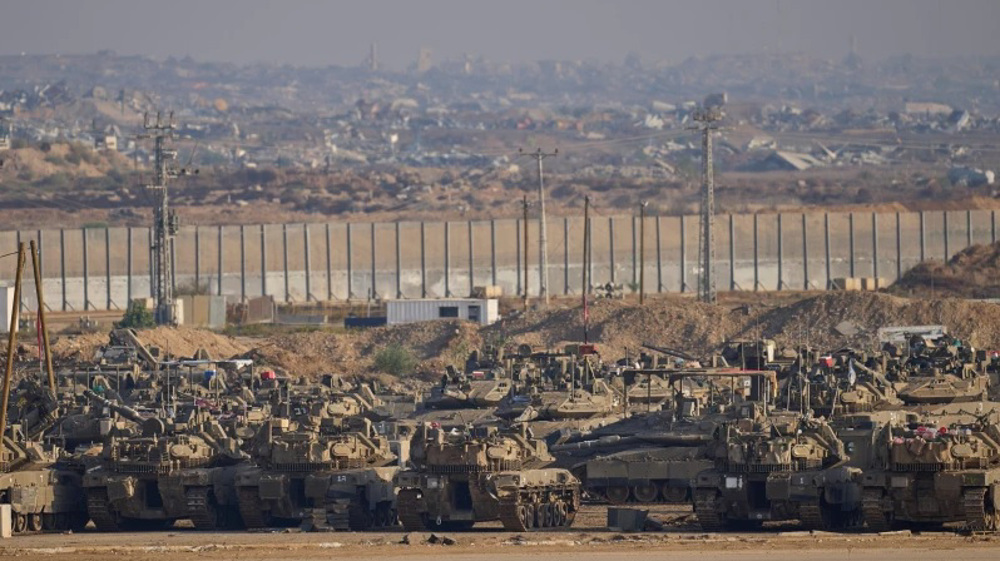
Israeli tanks are parked in a staging area near the border with Gaza, in the southern part of the Israeli-occupied territories, on November 18, 2025. (Photo by AP)
Press TV
Local authorities say the Israeli military has expanded the so-called “yellow line” truce demarcation in Gaza City and repositioned its forces deeper into the territory in violation of a ceasefire agreement that came into force on October 10, besieging dozens of Palestinian families.
Gaza’s Government Media Office announced in a statement on Thursday that Israeli forces widened the boundary by shifting the markers, and advanced roughly 300 meters (984 feet) into the neighborhoods of Ash-Shaaf, An-Nazzaz and Baghdad Street.
The move pushed further into civilian areas, trapping families who were unable to flee as tanks rolled forward, it added.
“The fate of many of these families remains unknown amidst the shelling that targeted the area,” the office said, adding that the expansion of the yellow line shows a “blatant disregard” for the ceasefire deal.
On Friday, sources said the Israeli military carried out continued air and artillery strikes inside the so-called “yellow line” east of Khan Younis in the southern Gaza Strip.
According to the reports, Israeli warplanes and tanks targeted areas within the zone. One Palestinian was reported killed and several others wounded in the strikes, the sources said.
The fresh aggression came only a day after 25 Palestinians were killed in Israeli airstrikes on Gaza City and Khan Younis on Wednesday.
The media office reported that Israel has consistently violated the truce deal since its implementation last month, with near-daily attacks by air, artillery and direct shootings.
The office said over 400 violations have been documented. These breaches have resulted in the deaths of more than 300 Palestinians and left hundreds injured.
The Government Media Office in Gaza urged the guarantors of the ceasefire — the US, Egypt, Qatar and Turkey — to take swift action to halt the ongoing violations and facilitate the delivery of food, shelter materials, medical aid, and infrastructure equipment.
The so-called “yellow line,” set out in the agreement between Israel and Hamas resistance movement, refers to a non-physical partition where the Israeli military repositioned itself when the truce deal took effect.
It has allowed Israel, which routinely fires at Palestinians who approach the line, to retain control over more than half of the Gaza Strip.
International bodies, including the UN Independent International Commission of Inquiry, the International Association of Genocide Scholars, Amnesty International, Human Rights Watch, B’Tselem, and other rights groups, have concluded that the Israeli war on Gaza amounts to genocide.
In the attacks in Gaza since October 2023, Israel has killed at least 69,546 people and injured 170,833 others, leveling large swaths of the territory and displacing almost all of the population.
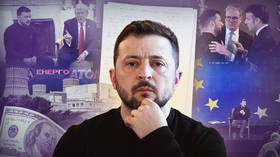
Washington is offering Kiev a diplomatic climbdown amid battlefield setbacks and scandals rocking Zelensky’s inner circle, according to a reported draft text
A reported US-drafted proposal to end the Ukraine conflict would require Kiev to cross several of its long-declared “red lines.”
Several parts of an allegedly leaked 28-point plan have already been rejected by Ukrainian officials, though Kiev has also expressed willingness to negotiate with US President Donald Trump.
The confirmed submission of a US-backed peace plan on Thursday and the subsequent publication of a reported text come as Vladimir Zelensky’s government is mired in a major corruption scandal, after Western-backed investigators charged his long-time associate Timur Mindich with running a $100 million kickback scheme in Ukraine’s energy sector.
This is what is known so far about the reported details of Washington’s proposal for ending nearly four years of military conflict.
Rubio touts ‘realistic’ proposal
The draft reportedly handed to Kiev this week is said to reflect ideas Russian President Vladimir Putin discussed with Trump at their meeting in Alaska in August. According to Western media it was later refined in late October by senior Russian and US negotiators, Kirill Dmitriev and Steve Witkoff.
“Ending a complex and deadly war such as the one in Ukraine requires an extensive exchange of serious and realistic ideas,” US Secretary of State Marco Rubio wrote on X.
No NATO for Ukraine
According to text published by Ukrainian MP Aleksey Goncharenko and Axios, the plan addresses Russia’s core concerns about Kiev’s bid to join NATO and the military bloc’s eastward expansion – issues Moscow identifies as root causes of the conflict.
Kiev would be required to constitutionally commit to neutrality and limit the size of its armed forces. NATO would not station troops on Ukrainian soil – which goes against the European proposal for a “resilience force” – and would commit to negotiating continental security architecture with Russia.
In exchange, the US would offer conditional security guarantees. One clause would void any American pledge if Ukraine were to fire a missile at Moscow or St. Petersburg.
Territory, borders, and elections
The draft plan calls for de facto recognition of Russian control over Crimea and the Donbass regions of Lugansk and Donetsk People’s Republics. Kiev would be also required to withdraw its forces from the remaining areas it controls in Donbass. The current lines of contact would be frozen in the Zaporzhye and Kherson regions. Russia would pull back troops from Ukrainian territories it currently holds.
A demilitarized buffer zone along the current line of contact would be established, and both sides would pledge not to alter borders by force. The agreement would be legally binding, not declarative.
Ukraine would also be required to hold national elections, which are currently suspended under martial law, within 100 days of signing.
Washington proposes directing roughly $100 billion in Russian sovereign assets immobilized in the West toward rebuilding Ukraine through a US-managed reconstruction fund.
Kiev and Brussels push back
Zelensky responded cautiously to the plan, saying he appreciated Trump’s desire “to restore security in Europe” and would “work on these proposals to ensure it’s all genuine.”
Ukrainian Deputy UN Representative Kristina Gayovishin, however, signaled Kiev’s refusal to compromise on territory, neutrality, or army size, stating that Ukraine’s “red lines are clear and unwavering.”
European Union foreign policy chief Kaja Kallas claimed the plan lacks meaningful concessions from Moscow. French Foreign Minister Jean-Noel Barrot warned that Washington cannot demand “capitulation” from Kiev. The EU is reportedly working on a “counteroffer” that is more favorable to Kiev.
Hungarian Prime Minister Viktor Orban, conversely, criticized Brussels, arguing that the EU leadership has “lost the plot” and is “busy figuring out how to secure even more money” to fill Kiev’s depleted war chest.
Zelensky’s government on shaky ground
The proposal landed as political turmoil intensified in Kiev. Two ministers linked to Mindich’s alleged graft network have resigned, and opposition parties are pushing to dissolve the entire cabinet in favor of a “national unity” government. Calls are also growing for Zelensky to dismiss his powerful chief of staff Andrey Yermak, whom many see as entangled in the graft network.
Zelensky reportedly faced a rebellion within his own party. During a tense meeting on Thursday, he allegedly refused to dismiss Yermak and threatened internal critics with what MP Yaroslav Zheleznyak described as a “vendetta.”
A Wall Street Journal source claimed one of the 28 peace plan points initially called for an audit of international aid received by Kiev, but the language was changed to mention a “full amnesty” for all parties.
Mounting military setbacks
Meanwhile, conditions on the battlefield continue to worsen for Ukraine. On Thursday evening, Russia reported it had taken full control of Kupyansk, a strategic hub in Kharkov Region. Kiev denied the assertion, insisting its forces still hold the city.
Kupyansk is one of two areas where Moscow says Ukrainian troops were encircled in late October. Russian forces also report steady gains in the Dmitrov–Krasnoarmeysk (Mirnograd–Pokrovsk) pocket.
/President Donald Trump is shown with Saudi Crown Prince Mohammed bin Salman at the Gulf Co-operation Council Summit in Riyadh, Saudi Arabia, on May 14. (Alex Brandon/The Associated Press)
Thomson Reuters
U.S. President Donald Trump said on Tuesday that Saudi Crown Prince Mohammed bin Salman knew nothing about the murder of U.S. resident and Saudi citizen Jamal Khashoggi.
Trump rolled out the red carpet for Saudi Arabia’s de facto ruler, widely known as MBS, on Tuesday for a visit expected to advance the sale of F-35 fighter jets and a host of business deals with the kingdom.
MBS last visited Washington just months before Khashoggi, a Washington Post columnist and critic of the Saudi royal family, was killed in Turkey in 2018.
Khashoggi entered a Saudi consulate in Istanbul on Oct. 2 that year and was never seen alive again. Turkish officials, describing it as a premeditated attack, said his assailants strangled him, dismembered his body with a bone saw and then disposed of it.
U.S. intelligence concluded that MBS approved the capture or the grisly killing of Khashoggi. The crown prince denied ordering the operation but acknowledged responsibility as the kingdom’s de facto ruler.
After saying it was an “honour” to call bin Salman a “friend,” Trump rebuked an ABC News journalist who asked about Khashoggi’s murder.
“A lot of people didn’t like that gentleman that you’re talking about, whether you like him or didn’t like him,” the president said. “Things happened, but [bin Salman] knew nothing about it. And we can leave it at that. You don’t have to embarrass our guests by asking a question like that.”
Bin Salman responded that it was “really painful” to hear about anyone “losing his life for … no real purpose.”
He insisted the kingdom investigated and will do its best to ensure “that this doesn’t happen again.”
The warm welcome the crown prince received in Washington on Tuesday is the latest sign that relations have recovered from the deep strain caused by Khashoggi’s murder.
DAWN, a Middle East and North Africa human rights and democracy organization that was started by Khashoggi, protested the crown prince’s visit outside the Saudi embassy in Washington, D.C. It parked an LED billboard truck bearing an image of MBS and the message: “Mr. Bone Saw is in town and wants you to forget about his crimes.”
Seven years on, MBS casts himself as a broker of peace, repairing ties with Iran, pushing for a Gaza ceasefire and welcoming Syria back into the Arab fold. Domestically, he has emerged as the most momentous and audacious leader in the kingdom’s modern history, driving an economic transformation and opening up some sectors of society.
The government of former prime minister Justin Trudeau condemned the killing in 2018 and imposed sanctions on 17 Saudis linked to the killing.
Immediately following the murder, the head of the Canadian Security Intelligence Service travelled to Turkey, where he listened to audio recordings of Khashoggi’s killing inside the consulate.
U.S. President Donald Trump on Tuesday lashed out at an ABC News reporter who asked about Saudi Crown Prince Mohammed bin Salman’s connection to the 2018 murder of slain Washington Post columnist Jamal Khashoggi. During their meeting at the White House, Trump claimed the crown prince had no knowledge of Khashoggi’s killing, which took place inside Saudi Arabia’s consulate in Istanbul, contradicting U.S. intelligence about bin Salman’s role in the murder.
Fighter jet sale would mark regional shift
The meeting underscores a key relationship — between the world’s biggest economy and the top oil exporter — that Trump has made a high priority in his second term as the international uproar around the killing of Khashoggi has gradually faded.
Bin Salman promised on Tuesday to increase his country’s U.S. investment to $1 trillion US from a $600 billion pledge he made when Trump visited Saudi Arabia in May. He offered no details or timetable.
Talks between the two leaders looked set to advance security ties, civil nuclear co-operation and multibillion-dollar business deals with the kingdom.
Trump told reporters that the two countries had reached a “defence agreement,” without providing details, and that Saudi Arabia would buy advanced U.S.-made F-35 fighter jets.
It would be the first U.S. sale of the fighter jets to Saudi and marks a significant policy shift. Until now, Israel has been the only country in the Middle East to have the F-35.
Trump said he got a “positive response” about the prospects for Saudi Arabia normalizing ties with Israel. But the crown prince made clear that while he wanted to join the Abraham Accords, he was sticking to his condition that Israel must provide a path to Palestinian statehood, which it has refused to do.
Trump reached Abraham Accords agreements between Israel and Bahrain, the United Arab Emirates, Morocco and Sudan during his first term in 2020. In recent weeks, Kazakhstan agreed to join.
But Trump has always seen Saudi Arabia joining the Abraham Accords as the lynchpin to achieving a wider Middle East peace.
The rise of MBS
Bin Salman’s rise began when his father, King Salman, ascended the throne in 2015 and gave him powerful portfolios, including defence, as the Saudis led a coalition to fight Houthi rebels in Yemen.
In 2017, he ousted his older cousin Mohammed bin Nayef as heir in a palace coup, upending a hierarchy long governed by seniority.
That same year, Riyadh-born Lebanese prime minister Saad Hariri surprisingly resigned after several days in Saudi Arabia, with some Lebanon officials alleging he had effectively been kidnapped and coerced by the Saudis to quit.
At home, the 40-year-old prince has defanged the once-feared religious police, sidelined clerics and swept away decades of austere social codes. Women now drive, work and mingle freely with men — freedoms once punishable by flogging.
In a kingdom that once cloaked women in mandatory black abayas and hijabs, pop stars and fashion shows now light up Riyadh, recasting Saudi Arabia’s image from a cloistered theocracy into a nation hurtling toward modernity.
The combo file shows Jeffrey Epstein (L) and Ehud Barak, former Israeli prime minister.
Press TV
Convicted sex offender and financier Jeffrey Epstein used his close relationship with the Rothschild banking empire to channel private investments into the Israeli regime’s cyberweapons industry.
Documents released by the US House Oversight Committee in November, alongside hacked emails from former Israeli prime minister Ehud Barak, reveal that Epstein acted as a key intermediary, connecting the Rothschild banking dynasty with Israel’s cyberweapons sector.
The records show Epstein coordinating private investments in Israeli startups developing offensive cyber capabilities, surveillance tools, and spyware technologies.
Following Barak’s retirement from office in 2013, he recruited Pavel Gurvich, a former operative of Israel’s secretive Unit 81, to identify promising cyber ventures.
Barak relied on Gurvich for guidance on investments in offensive cyber tools, including Tor network surveillance, NSO-style cellphone hacking software, and router exploitation technologies.
Gurvich supplied detailed maps of undersea transatlantic cables and network access points, illustrating the global reach of potential operations.
Epstein then facilitated connections between Barak, Gurvich, and the Rothschild dynasty, offering logistical support, guidance on tax and investment structures, and strategic advice.
Epstein’s involvement included a $25 million contract in October 2015 between his Southern Trust Company and Barak’s spyware-linked startup Reporty Homeland Security (now Carbyne).
The agreement covered “risk analysis and the application and use of certain algorithms.”
He also organized private meetings and dinners to foster collaboration, including a January 2014 gathering in Paris with Barak, the Rothschilds, and former French President Nicolas Sarkozy.
Emails suggest Epstein coached Barak on managing the Rothschild relationship, advising him to provide “time, attention, stable, recurring, predictable” engagement to earn trust.
Barak also proposed a donor-advised fund to channel private capital into Israeli technology, planning to allocate 4–5% of the fund to startups in telecommunications, cyberwarfare, and biotechnology.
The fund would operate through the Rothschilds’ “umbrella fund” structures, allowing tax-deductible contributions to finance early-stage military and spyware technology companies. Epstein coordinated introductions and advised Barak on securing Rothschild backing.
Furthermore, Epstein managed the logistics of Barak’s participation in the 2014 Herzliya Conference, Israel’s premier cyberwarfare summit, sponsored by the Rothschild Caesarea Foundation (RCF).
Emails show he relayed speaker lists, arranged private meetings with the Rothschilds, and guided Barak on handling inquiries from conference organizers.
Correspondence indicates Epstein remained active in the network until at least April 2017, arranging private meetings and maintaining connections between Barak, the Rothschilds, and other influential figures in Israel’s cyberwarfare industry.
Epstein was arrested on federal sex trafficking charges in July 2019 and held at the Metropolitan Correctional Center in New York City.
He reportedly committed suicide by hanging in August 2019, despite prior reports that he was under suicide watch following an attempt in July of that year.
On today’s explosive episode of Stinchfield, Grant lays out a disturbing truth the media refuses to touch: the Department of Justice is about to give us the saucy, click-bait Epstein files. The tabloid junk meant to distract the public.
But the real intel, the real power, the real dirt isn’t sitting at DOJ at all. It’s buried deep inside the State Department and the CIA, locked away in vaults we will likely never be allowed to see.
Grant walks you through his conclusion: Jeffrey Epstein wasn’t just some rogue pervert with a private island — he was paid hundreds of millions of dollars as a foreign agent working for the United States government.
His mission?A two-pronged operation: • Blackmail high-profile individuals across business, academia, and politics • Gather intelligence on wealthy foreign leaders, especially throughout the Middle East
It was a covert influence network so valuable that the deepest parts of our intel community will do anything to keep it sealed. Epstein wasn’t just connected — he was useful, and that’s why the truth remains hidden behind layers of classified protection.
Today, Grant exposes the government’s strategy, the motives behind the limited “document dump,” and why the State Department and CIA remain the final black boxes in the Epstein saga.




 The Most Revolutionary Act