
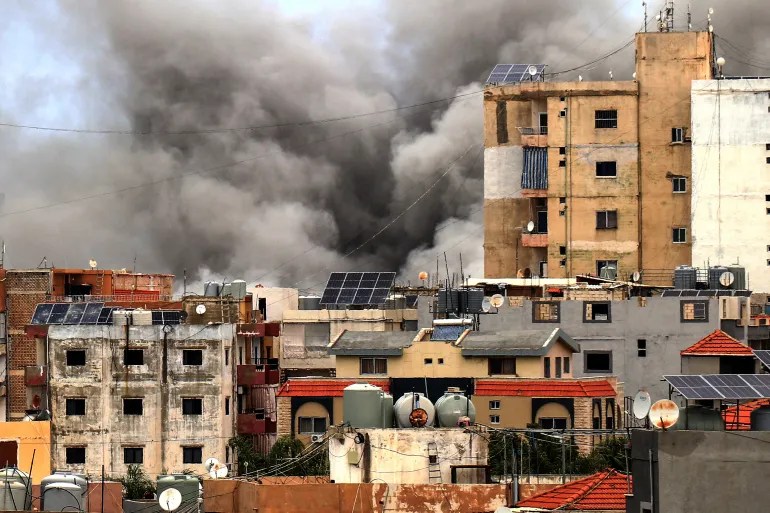
 Smoke rises following an Israeli airstrike in the southern city of Tyre on May 15, 2026 [AFP]
Israel and Lebanon have agreed to extend a ceasefire that was due to expire on Sunday by 45 days, the US said, after direct talks in Washington DC concluded, despite ongoing Israeli attacks and ceasefire violations in Lebanon.
“The April 16 cessation of hostilities will be extended by 45 days to enable further progress,” said US State Department spokesperson Tommy Pigott on Friday, after the second day of talks concluded.
Pigott, who described the talks as “highly-productive”, said that political negotiations would continue on June 2 and June 3, while a “security track” would begin on May 29 at the Pentagon, involving Lebanese and Israeli military delegations.
“We hope these discussions will advance lasting peace between the two countries, full recognition of each other’s sovereignty and territorial integrity, and establishing genuine security along their shared border,” Pigott said.
The latest talks were the third round of direct negotiations between the two sides this year, but few details have emerged of the specifics that were discussed in the latest round.
It came as Israel launched new attacks on Lebanon on Friday, killing at least seven people in the south, according to the Lebanese state news agency NNA. The Lebanese Ministry of Health said 2,951 people have been killed in Israeli attacks since March 2, when fighting between Israel and Hezbollah reignited.
Since then, Israel has lost 20 troops including another soldier killed in fighting with Hezbollah on Friday.
Direct talks
Lebanese and Israeli officials are yet to comment on the latest round of talks.
Both sides are approaching the talks from different positions, with Lebanon insisting that Israel fully end its attacks and occupation of its territory. Israel is focused on the disarmament of Iran-backed Hezbollah – and a potential normalisation agreement between the two countries.
Despite these differences, the talks were significant, being face-to-face and the third round this year.
Lebanon sent Presidential Special Envoy Simon Karam, while Israel’s Deputy National Security Adviser Yossi Draznin also attended.
Despite encouragement from US President Donald Trump, Lebanon has so far refused a meeting between President Joseph Aoun and Israeli Prime Minister Benjamin Netanyahu. Aoun has insisted that full normalisation is not on the table, and that Lebanon is pushing for the ceasefire to be enforced before negotiations continue.
The Lebanese president is treading carefully, seeking to balance US pressure and a desire to stop Israel’s attacks without appearing to be conceding too much to Israel.
While some Lebanese would tolerate the meetings between Lebanese and Israeli officials if they end the war, Hezbollah and its allies are adamant that the talks should have been indirect.
Israeli attacks
Many in Lebanon view Israel’s continued attacks as evidence that it is not serious about ending the war, which it has conducted to varying levels of intensity since October 2023.
The most recent eruption came on March 2, after Hezbollah fired rockets at Israel following the US-Israeli assassination of Iran’s Supreme Leader Ayatollah Ali Khamenei. Israel had previously attacked Lebanon more than 10,000 times since the November 2024 ceasefire, killing approximately 400 people.
Israel has launched devastating attacks in Lebanon since March, but eventually agreed to a US-brokered ceasefire on April 16, which is set to expire on Sunday.
Despite the ceasefire, attacks on Lebanon have not stopped.
Friday’s attacks included the killing of two people in a drone strike on a car in the southern Lebanese city of Nabatieh, Mohammed Ahmed Abu Zaid and Jamal Noureddine were collecting humanitarian aid. Three ambulances were damaged in the attack, Lebanon’s state news agency reported.
Another drone attack in Harouf killed three people and two others died in Tabeen.
Israeli attacks in Tyre district injured 37 people on Friday, according to the Ministry of Health.
Israel issued forced evacuation orders for five villages in southern Lebanon, claiming it was striking Hezbollah targets in the area. Hezbollah said it carried out several drone attacks on Israel and Israeli troops in Lebanon, with several “explosive drones” falling in northern Israel.
[…]
Via https://www.aljazeera.com/news/2026/5/15/lebanon-talks-israel-attack

