The Most Revolutionary Act

Uncensored updates on world events, economics, the environment and medicine

The Most Revolutionary Act

War is all that remains

Russia's War in Ukraine, in Photos - The New York Times

Dmitry Orlov

Since diplomacy, in the western understanding of the term, has degenerated into an exchange of insults and the laborious process of negotiating agreements which nobody ever intends to keep, all that remains is war. Or, perhaps, the plural form — wars — is more appropriate, since there are several ones going on at once. In each case, there is a battlefield, there are military actions taking place (or preparations for them) and there is, inevitably, an eventual outcome. Motivations for these conflicts range from outright delusion to political expediency all the way to ideological imperatives and the demands of national survival.

A lot has already been said and written about the death of diplomacy in the West, but a recent exchange is just too perfect to pass by. When the Russians pointed out that the Americans reneged on the agreements reached during the Putin-Trump summit in Anchorage, Alaska on August 15, 2025, US Secretary of State Marco Rubio pointed out that these were not agreements, just proposals. As it turns out, it was the Americans who proposed and the Russians who accepted the proposals. Thus, the Americans made proposals which they themselves did not agree to. What could possibly be the point of trying to reach a peace agreement with such people? There is no point, and that just leaves war.

Although it is commonly thought that the goal of war is victory — and this is most often the stated goal of any war, to preserve the morale of the troops and to maintain the support of the populace which pays for it — just as often the goal is the perpetual continuation of the conflict. A prime example of such a perpetual conflict was the Cold War. It is possible to argue that it was not truly a war because it was never fought; it is also possible to argue that it was fought more or less continuously. The Cold War was fought in dozens of regional wars, large and small. In case you need a refresher, here is a quick summary of them:

Korea (1950–1953): A major direct clash in which US and UN forces fought Chinese and North Korean troops supported and resupplied by the USSR. The US managed to fight this war to a permanent stalemate which left the Korean peninsula permanently divided at the 38th parallel, with the North allied with Russia and China and the south under permanent occupation by American troops.

Vietnam (1955–1975): The US intervened in French Indochina, taking over for failing colonialist France to stop Vietnamese quest for independence while the Soviets backed the Viet Cong and North Vietnamese military in a prolonged and devastating conflict which ended when the US-supported regime in the south collapsed, the Americans were routed and the north triumphed.

Afghanistan (1979–1989): The USSR intervened to prop up a socialist government, prompting the US (and allies) to arm, train, and fund the Mujahideen insurgents. The last Soviet troops left Afghanistan on February 15, 1989. The withdrawal was carried out in accordance with the Geneva Accords, and the commander of the 40th Army, Lieutenant General Boris Gromov, became the last serviceman to cross the border bridge over the Amu Darya River, flags flying, as seen in the photo above. The socialist government of Mohammad Najibullah stayed in power for approximately three years and two months following the final withdrawal of Soviet troops from Afghanistan. Its collapse was precipitated by the withdrawal of Soviet support under General Secretary Mikhail Gorbachev. A civil war then raged until September 27, 1996, when Kabul was taken over by the Taliban. The Americans then occupied Afghanistan from October 7, 2001 until August 30, 2021 in a failed effort to dislodge the Taliban, having falsely accused the Taliban for complicity in the terrorist attacks of September 11, 2001.

Cuba: The US and USSR almost found themselves in a nuclear war during the badly misnamed Cuban Missile Crisis (1962). It was, in fact, the Turkish Missile Crisis: the US positioned nuclear missiles in Turkey which threatened the USSR; the USSR responded by positioning nuclear missiles in Cuba which threatened the US; in the end, each side withdrew their missiles.

Africa: The USSR actively supported decolonization movements throughout the continent, helping a score of countries achieve independence, including Algeria, Angola, Republic of the Congo, Egypt, Guinea, Guinea-Bissau, Mozambique, Namibia, South Africa (where the war was against apartheid) and Zimbabwe. After the collapse of the USSR these relationships were put on pause for a time but have since been renewed and revitalized. The 2nd Russia–Africa Summit was held in St. Petersburg, Russia, on July 27–28, 2023. The summit drew delegates from 49 of the 54 African Union member states, including 17 heads of state. The 3rd summit will be held in Moscow in late October of 2026.

The African national liberation movements included quite a lot of armed conflict. Official records indicate a combined total of 1,100,000 to 1,800,000 casualties for the major anti-colonial conflicts in Algeria, Angola, Mozambique, and Zimbabwe alone. These were, to avoid the use of euphemisms such as “conflict”, wars of national liberation.

[…]

Let us enumerate the stakeholders of the war in the former Ukraine: Russia, the US, European members of the EU and of NATO, various other nations not hostile toward Russia and, of course, the former Ukraine itself (the Kiev regime and the population of the former Ukraine). Each of these stakeholders is disinterested in a quick end to the war in the former Ukraine, each for its own set of reasons.

Russia’s ultimate goal for the former Ukraine is to render it harmless without burdening itself unduly or suffering too many casualties. What precipitated the conflict can be reduced to two main factors. There was the threat of NATO troops stationed on Ukrainian soil, right on the invasion path toward Moscow followed by both Napoleon and Hitler.

There was also Kiev’s incipient genocide of the Russian population in the Ukraine’s former eastern provinces of Donetsk and Lugansk which served as the trigger for the launching of Russia’s Special Military Operation in February of 2022 as an R2P (Responsibility to Protect) mission. The dramatically increased shelling of Donetsk by the Ukrainians in February of 2022 provided ample justification for it.

The imperative to save Russian lives in Donetsk and Lugansk overlapped with Russia’s secondary goal, which was to save numerous Russians still living in the territories held by the Kiev regime. Thus, carpet-bombing Ukrainian cities, as the Americans or the British or other NATO forces would have done (and, indeed, have done in similar circumstances) is not something that the Russian government would ever consider doing.

Quite the opposite: those Russians who are still living in Kiev-held territories are offered visa-free entry into the Russian Federation and a path to Russian citizenship and integration into Russian society. Since all Ukrainians speak Russian, the vast majority of them as their first language, they reintegrate easily.

If the war were to end, it could do so in at least three different ways. The first way, entirely unacceptable to Russia on every level, would be to agree to a cease fire, freeze the conflict at the current line of separation (which runs through what under Russian law comprises sovereign Russian territory, though it will not do so for much longer given the pace of Russian advance) and allow the stationing of NATO troops on territory still controlled by the Kiev regime. This end to the war would be equivalent to a defeat.

Another way the war could end is through a sudden, outright Russian victory. The Ukrainian forces are routed and the Ukrainian military dissolves. The US, NATO, the EU all wash their hands of the Ukrainian conflict, abandoning their Ukrainian dependents to their fate. Russia then has a chaotic, ungovernable humanitarian disaster area on their border which they somehow have to rescue from its horrible fate.

The Russians are working assiduously to liberate the remaining small patches of what is, constitutionally, Russian Federation territory in the Donetsk, Zaporozhye and Kherson regions (Lugansk has been completely liberated as of July of 2022). They just liberated Konstantinovka. There are now just two major towns left to liberate: Kramatorsk and Slavyansk. Likewise, major advances are taking place in the south, in Zaporozhye in particular. They are also making strides in building up buffer zones in Sumy and Kharkov regions to safeguard neighboring Russian regions from attack. These are some of the stated goals of the Special Military Operation and they are being achieved, albeit rather more gradually than many people would like.

Meanwhile, the Kiev regime, assisted by NATO, has been launching a great many terrorist attacks against Russian regions. Crimea has been particularly badly hit and today was forced to impose a state of emergency to deal with the damage from Ukrainan drone strikes. Other Russian regions have been affected as well, although the overall effect of these strikes is generally overestimated. These terrorist attacks are being used in a propaganda campaign in the West which aims to convince the populace that the Ukraine is winning and that therefore continued support for the Kiev regime is justified. Apparently, war, like beauty, is in the eye on the beholder. How else could we ever hope to explain the following: last Monday, in Gdańsk, Poland, US Deputy Secretary of State Jeremy Levin pompously declared that “Ukraine is winning the war.” Nothing could be further from the truth!

The Kiev regime is losing, but not for lack of trying. Its attack on Russian territory during the night of June 26 was the most massive so far in 2026. After analyzing data published by the Russian Ministry of Defense, RIA News service reported that Russian air defense systems shot down 660 Ukrainian drones. A handful of drones probably got through (no air defense system can be 100% effective). The news in Russia is quite full of stories of the damage caused by drones and drone fragments: a few people get hurt and a few houses and apartment buildings are damaged almost every day. This is, of course deplorable. But war is like that; people get hurt.

But from the point of view of the Russian government and the Russian military, this is by no means altogether bad. Russia has developed the world’s best air defense system and the Russian defense establishment will be busy selling these systems to eager customers around the world for many years to come. The conflict is allowing Russia to keep up with drone development and related technology including the battlefield use of AI systems and satellite communications. And Russia has plenty of cards left to play if the terrorist attacks ever grow too painful. In particular, Russia has the weapons in place to disable Elon Musk’s Starlink satellite system which Alex Karp’s Palantir AI uses to generate targeting information (it takes a perverse interest in girls’ schools) and which the drones then use to navigate to these targets. But doing so now would deprive Russia of the great sport of shooting down hundreds of drones every night.

[…]

Moving on to the United States, a quick end to the Ukrainian war is unlikely to be on terms acceptable to it. This makes it preferable to push off the moment when the policy of fashioning the former Ukraine into an anti-Russia and squandering countless billions in pursuit of the lofty goal of weakening Russia finally crashes and burns. Also, a premature end to this war would deprive American arms manufacturers of sales. Since weapons for the Kiev regime are now being paid for by the Europeans, it would also deprive the US of a valuable way of bleeding dry the European economy — a reasonable goal for it, since the EU is the only major economic competitor against which the US still has the ability to compete, being increasingly left behind by China, Russia and India. Lastly, many in the US still cherish the forlorn hope that the Ukrainian conflict will weaken Russia and prevent it from developing its economy. (If you believe, I have a few thousand economic sanctions to sell you at bargain basement prices.)

[…]

Via https://boosty.to/cluborlov/posts/37e694d0-880f-4404-9a9f-c798e938ccf7
Supreme Court Just Derailed Thousands of Lawsuits Against Monsanto Over Glyphosate and Cancer

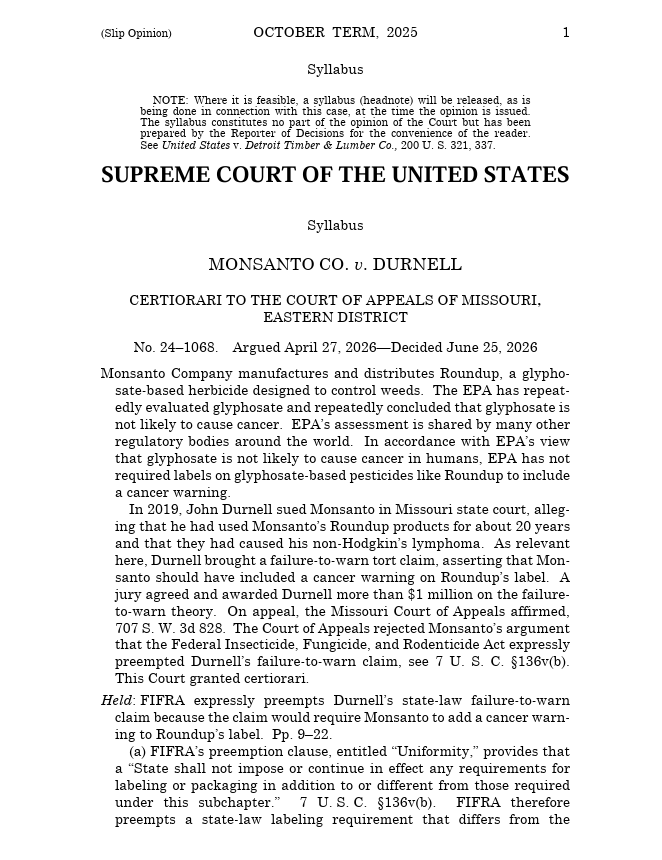
In a 7-2 ruling, the Supreme Court sided with Monsanto and blocked cancer victims from suing over missing cancer warnings.

The Supreme Court just handed Monsanto a major victory.

In a 7-2 ruling in Monsanto Co. v. Durnell, the Court held that federal pesticide law (FIFRA) preempts state-law “failure-to-warn” claims. This means companies cannot be sued under state law for not including cancer warnings on Roundup labels — as long as the EPA has not required such warnings.

.

The decision is expected to derail thousands of pending lawsuits from people who developed non-Hodgkin lymphoma after using Roundup.

The Supreme Court has effectively shielded Monsanto from being held accountable for not warning the public.

This is a grave mistake.

While the EPA continues to claim glyphosate is safe, multiple studies say otherwise.

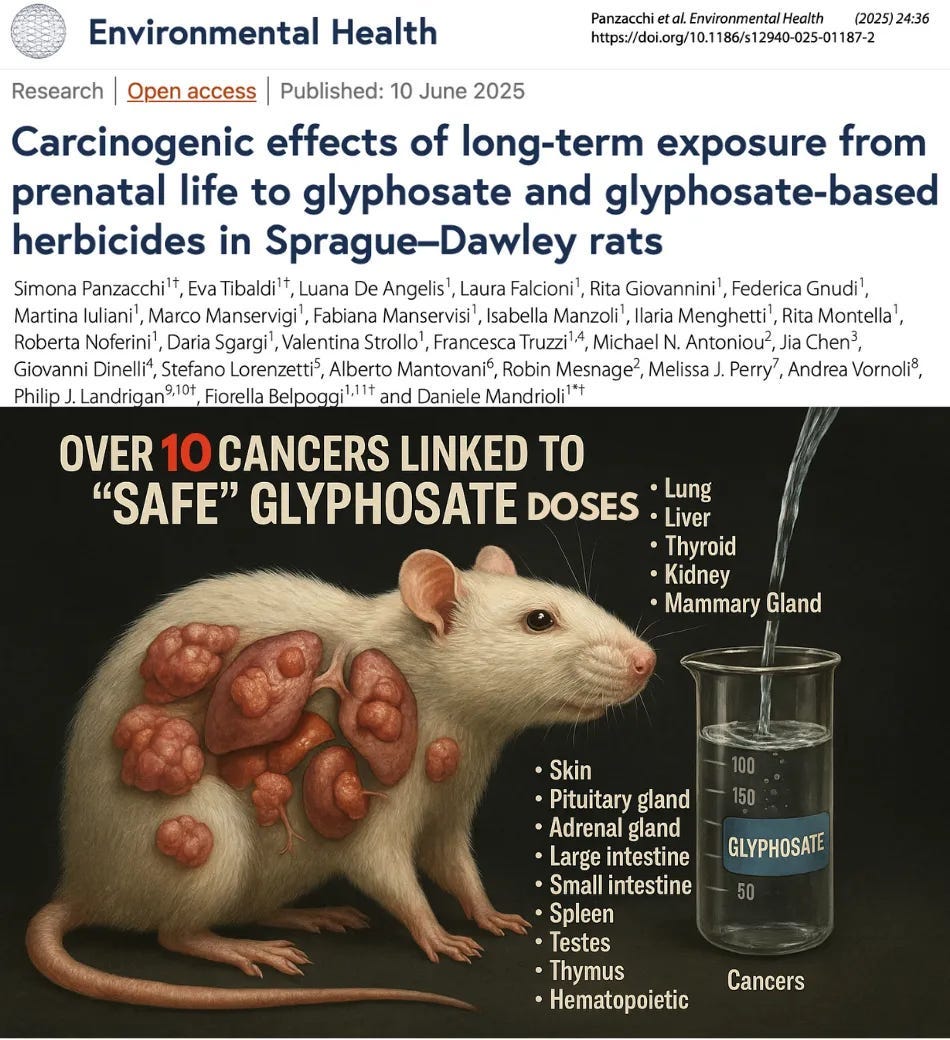
A recent controlled animal study demonstrated that glyphosate can induce aggressive and fatal cancers across multiple organs — even at doses considered “safe” by U.S. and EU regulatory thresholds.

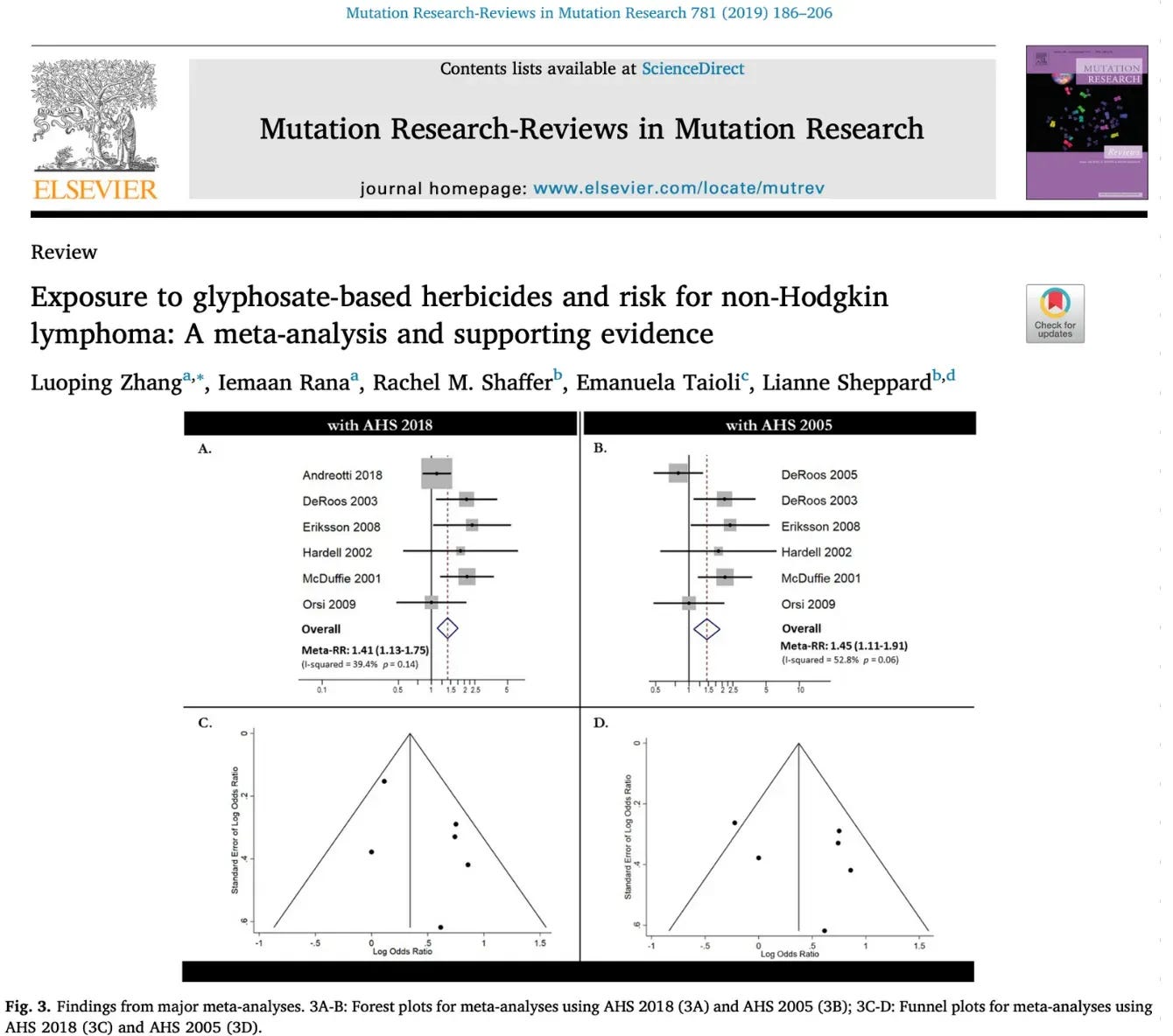
Zhang et al found a statistically significant association between glyphosate exposure and increased risk of non-Hodgkin lymphoma in humans. Their 2019 meta-analysis pooled data from over 65,000 participants across six studies—including more than 7,000 NHL cases—and reported a 41% increased risk of non-Hodgkin lymphoma among those with the highest glyphosate exposure:

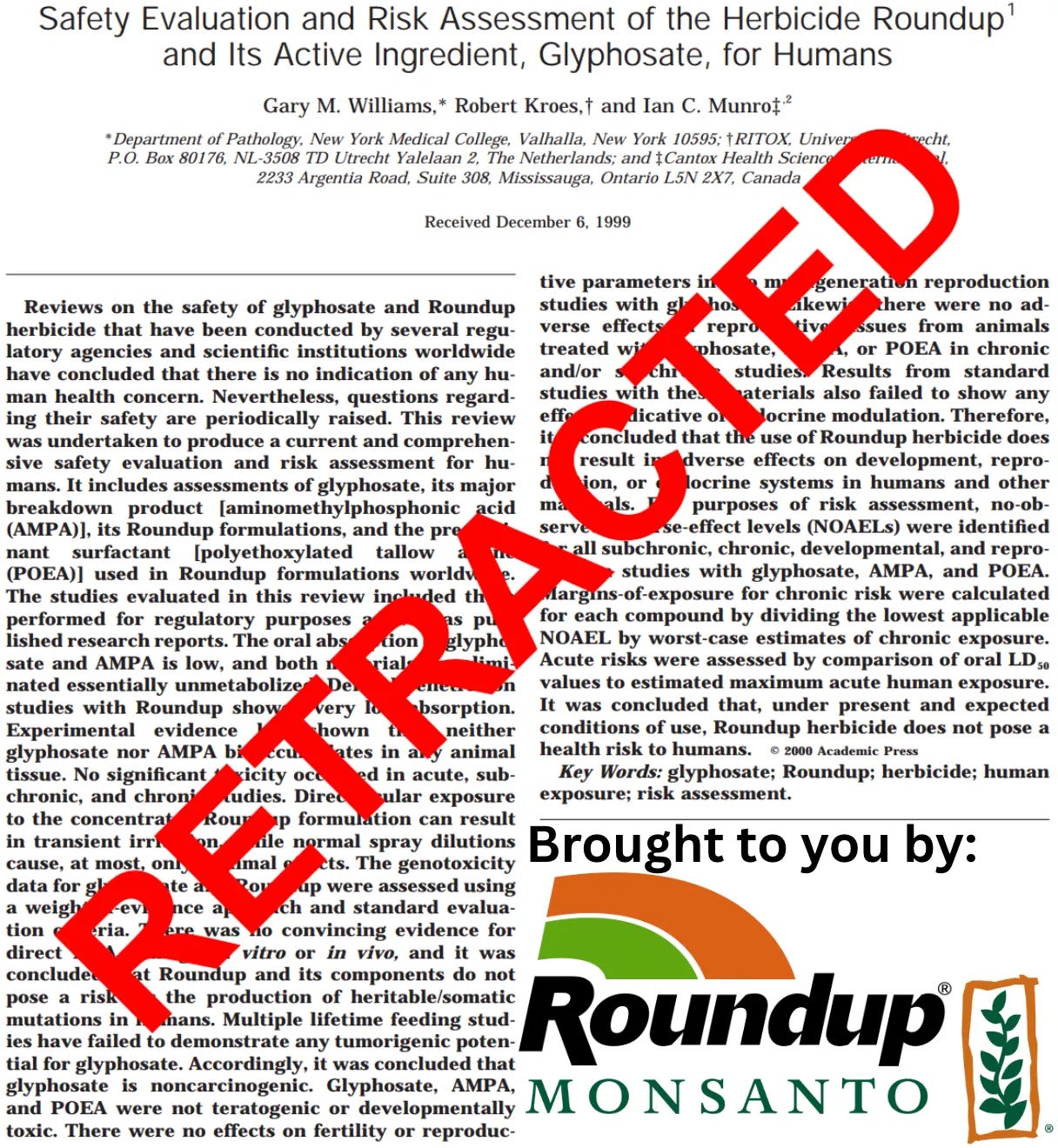
Regulators allowed worldwide glyphosate use based on a now-retracted fraudulent study ghostwritten by Monsanto staff:

A few months ago, Regulatory Toxicology and Pharmacology formally retracted the landmark 2000 glyphosate “safety” review by Williams, Kroes, and Munro — a paper Monsanto and global regulators have relied on for decades to assert that Roundup poses no carcinogenic risk to humans.

.

.

The Editor-in-Chief confirmed that Monsanto employees likely secretly wrote substantial portions of the paper, despite never being listed as authors or acknowledged. The retraction states that the article’s integrity has collapsed entirely, citing undisclosed corporate authorship, omitted carcinogenicity data, financial conflicts of interest, and a complete failure by the surviving author to respond to the journal’s investigation.

Congress, regulators, and the courts must correct this disastrous mistake, as glyphosate has already invaded the bodies of over 80% of Americans.

[…]


China Posed to Overtake US in AI Development

A recent international survey has highlighted shifting global perceptions of the race for leadership in artificial intelligence.

According to the AI Global 2026 study by the British consultancy Public First, a significant share of people worldwide, including in Mexico, believe that China has already overtaken or is on the verge of surpassing the United States in capacity and innovation in this transformative technology.

The poll, based on more than 18,000 interviews conducted across 15 countries in May 2026, found that 42% of respondents worldwide view China as the leader in AI development, compared with 37% who still see the US as the leader.

These perceptions align with data from Stanford University’s 2026 AI Index Report, which shows that the performance gap between the leading American and Chinese AI models has narrowed dramatically to 2.7% as of March 2026. Chinese models from companies such as DeepSeek and Alibaba’s Qwen have repeatedly traded places with their US counterparts on global leaderboards since early 2025.

The competition in AI has intensified dramatically in recent years. The US has long held advantages in frontier models, private investment, and talent attraction. In 2025, private AI investment in the US reached $285.9 billion, more than 23 times China’s reported figure of $12.4 billion. However, these figures likely understate China’s total spending, which includes substantial government guidance funds and state-backed initiatives.

China leads in scientific publications, citations, AI patents, and industrial integration. Its strategy emphasizes quick adoption and efficiency, especially in response to US export restrictions on advanced chips. Open-source Chinese models frequently outperform US counterparts, such as Meta’s Llama, in downloads on platforms like Hugging Face, highlighting their accessibility and practical use.

The Stanford report notes that the US continues to lead in investment and in the creation of new, funded AI companies, yet China is advancing quickly in patents and in embedding AI across real-world economic sectors.

Former Google CEO Eric Schmidt noted that the gap in certain AI capabilities has narrowed to as little as six months, with China making rapid strides in open-source development and real-world deployments, from robotics to industrial automation.

Public opinion around the world appears to be shifting. Among key US allies such as Canada, the United Kingdom, and France, majorities now view China as the AI leader. In Germany, only 23% believe the US holds the dominant position. This signals a notable shift in global narratives about technological supremacy.

In Mexico, the AI Global 2026 study reveals a nuanced picture. While nearly half the population views China as the leader, there remains greater comfort with American-developed tools: 41% of participants felt comfortable using US AI models, compared with just 27% for Chinese ones. This reflects concerns about privacy, security, and reliability associated with Chinese technology.

This viewpoint echoes throughout many parts of Latin America, where developing economies see AI as an opportunity to improve education, healthcare, and productivity, while also recognizing potential social risks. Dependence on technology from the US or China leaves the region in a fragile position amid ongoing global geopolitical conflicts.

Labor market impacts are a major concern as automation threatens roles across manufacturing, services, and administration. Globally, optimism about AI’s benefits has risen, with 59% of respondents reporting more upsides than drawbacks, while nervousness remains at 52%, indicating a complex emotional landscape.

Additional challenges include ethical concerns, algorithmic bias, cybersecurity vulnerabilities, the enormous energy consumption of data centers, and potential military applications. Strong support for international cooperation, as expressed by 64% in Mexico, underscores the need for global standards and collaborative governance.

The AI competition is accelerating innovation but also introducing significant risks. Together, the US and China control about 90% of global computing power and most investment, leaving other nations dependent on their systems. For most of the world, the wisest path is to diversify by attracting investment from the Great Powers, develop local talent through education and research, and implement balanced regulations that safeguard employment and rights while fostering innovation.

The study also emphasizes that public perception matters as much as technical progress. While the US retains an edge at the technological frontier, China is closing the gap through state determination, efficiency innovations, and open dissemination.

AI seeks to reshape nearly every aspect of society, including economics, healthcare, and governance. The ultimate winner might not be the one with the most advanced model, but the one that best translates technological potential into broad, lasting economic and social gains. Hence, AI is more than a rivalry between superpowers – it is a toolkit set to redefine the global landscape in the 21st century. Perceptions of China and the US across many regions reflect not only real progress but also shifting views on the global power balance.

[…]

Via https://www.globalresearch.ca/china-overtake-us-ai-development/5931413

The Pandemic Plan Needs to Be Torn Up

The Pandemic Plan Needs to be Torn Up

By Jeffrey A Tucker

The closest thing we have in this country to a pandemic plan is called the Pandemic Action Crisis Plan or PanCap. It remains the prevailing unclassified document. It posits stay-at-home orders, school closures, business shutdowns, office closures, travel restrictions, testing, track-and-trace, and the creation and distribution of countermeasures called vaccines.

So far as anyone knows, it is still the prevailing document. It’s one of many. Nothing has changed about any of them in light of what we learned from Covid. The CDC currently hosts all these documents:

This approach has no precedent in the long history of public health. The old way was to keep calm, understand the illness, treat those affected, and use rational approaches to mitigate the impacts. The new way invented in 2005 is about command and control, pretending to manage the microbial kingdom like an engineering project.

This is still the operational manual. If a pathogen should leak and the machine clicks into gear, this is what will happen. It will be profoundly disturbing to civil society. Like last time, the results will not be good. The medicine will be worse than the disease. We can say this based on the experience from 2020 to 2023. And yet the plan survives.

The existing plan is PanCap-Adapted. It is still not posted on any government website. It was leaked to the New York Times and, again, so far as anyone knows, this remains the architecture of control. Why the latest is not posted is unclear. Don’t the American people deserve to know what their government plans for them?

It is supplemented by dozens of other documents that pertain to nearly every federal government agency and are expected to be followed by downstream agencies in states, counties, cities, and towns. This is what is called an all-of-government response.

This is not some conspiracy theory. We need only look at one related document, the Biological Incident Annex to the Response and Recovery Federal, Interagency Operational Plan as produced by FEMA. It is out of classification and available for anyone to observe. It comes into operation with any pathogen that is new, perhaps manufactured in a lab as many of them are.

Halfway through this document you find a presumption of business closures, transportation restrictions and disruptions, widespread commodities hoarding by the public, stay-at-home orders, workforce shift to virtual environment, school and childcare closures, restaurant closures, hotel closures, reduced workforce, and plant closures.

This plan is still out there, waiting to be implemented under the right circumstances. The US Constitution does not pertain. American expectations of liberty do not pertain. Law does not pertain. Even now, the idea that an emergency requires the end of all normal expectations for freedom is baked into all pandemic protocols.

At this point, you might already be asking the very obvious question. How could this be true in light of the last experience? The answer points to the core problem. We’ve never had a reckoning for the Covid period. There has been no commission, no push for changes in underlying protocols, no fundamental shifts at the top other than new political appointees, and no real national statement that what happened was wrong and destructive.

In short, nothing has changed other than public opinion. That too is extremely malleable. People these days routinely say that they won’t comply. What they mean is that under similar circumstances, they won’t comply. But the circumstances will not be similar. A strain of Ebola, for example, could have an extremely high mortality rate that does not discriminate by age. With a 21-day latency period, anyone could have it. It’s the kind of pathogenic release that strikes terror in the hearts of the bravest men and women.

The real problem here dates back more than two decades, to 2005, when federal officials first started imagining extreme plans for the management of pandemic conditions of any sort. The first document was the National Strategy for Pandemic Influenza, announced by President George W. Bush on November 1, 2005.

This high-level White House/Homeland Security Council document was driven by concerns over the H5N1 avian influenza outbreak in Asia. It outlined a whole-of-society with core pillars: stopping/slowing the spread to the US, limiting domestic impacts, and sustaining infrastructure/economy, and the production of shots.

The document in question drops some hints. In this report you will find what you must do: be “prepared to follow public health guidance that may include limitation of attendance at public gatherings and non-essential travel for several days or weeks.” The government, meanwhile, will establish “contingency systems to maintain delivery of essential goods and services during times of significant and sustained worker absenteeism.”

This was more than 20 years ago. The ominous intonations suggest eventual lockdown at least as a possibility.

Simultaneously (November 2005), the Department of Health and Human Services (HHS) released its detailed HHS Pandemic Influenza Plan, serving as a blueprint for public health and medical response, including surveillance, vaccines, and state/local guidance backed by force.

Then came the 2006 National Strategy Implementation Plan with 300-plus specific actions across federal agencies, states, and the private sector. This was followed by the 2008 Biological Incident Annex to the National Response Framework which integrated biological threats into broader disaster response.

From 2013 to 2018, FEMA developed the Pandemic Crisis Action Plan (PanCAP), a playbook for federal coordination, now called PanCap-Adapted. That was the operational manual for the Covid policy response. It was backed by a 2017 updated Biological Incident Annex and HHS Pandemic Influenza Plan. This was updated again in 2023, complete with all the familiar apparatus.

These days, we have the Office of Pandemic Preparedness and Response Policy (OPPR) , which was created for ongoing coordination. The people who inhabit this office are different from what they were a few years back. They are less convinced of the use of force. They are more sophisticated in their understanding of infectious disease and natural immunity. But have they changed the protocols? We do not know.

We also have widespread public knowledge that broad lockdowns had massive collateral damage: excess non-Covid deaths (delayed care, mental health, overdoses), learning loss (especially for kids), economic dislocation, supply chain breaks, and eroded trust. Sweden’s lighter-touch approach (no full school closures, no strict lockdowns) had comparable or better outcomes on mortality when adjusted for demographics, with far less disruption.

The problem is that these 20-year old protocols are all still in place. If you understand how government works, once a document and protocol are in gear, there is no dialing it back. Bureaucrats are risk-averse and do what they are told. That is how the system works.

If the presumption is that force, the quarantine power, restrictions on civil liberties, censorship, and medical countermeasures are the way forward – essentially lockdown until vaccinate – this will happen regardless of the individual volition of any political appointee.

All these documents need to be torn up. We need a complete reset of pandemic planning to what it was before 2005, before the fear, the frenzy, the wild plans for locking down, and the ambition to vaccinate our way out of a pandemic. This country dealt with uncountable numbers of disease outbreaks without wrecking civil society. The theory that society can be managed as a laboratory has proven extremely damaging. We desperately need the information we learned most recently incorporated into the protocols.

That requires a complete public rethinking of everything with an aim toward clear statements from Congress and an initiative from the White House to map out straightforward principles and a new approach. This can only happen with a national commission on the topic convened at the highest levels and promoted by the national press with public testimony and a determination to change.

The time for this is now. With so many biolabs around the world working on infectious disease, not only examining viruses but also creating them along with the countermeasures, we are certain to face a leak in the future, likely one more terrifying than the last. Yes, the countermeasures are certain to be based on modified mRNA technology, regardless of the vast disaster they created the last time.

Underlying all of this is the problem of special interests. Government officials like exercising power and passing out money. Pharmaceutical companies like making products and distributing them and depend on the liability shield government grants them. Tech companies like stay-at-home orders for obvious reasons. The national media loves an emergency because it gets eyes on screens. Even the churches and nonprofits celebrated their vast bailout funds.

It should alarm every American that, despite all the best intentions of the change in White House leadership, the deeper bureaucracy still has the same plans in place for the next infectious disease outbreak. Not only that: a July 2024 Government Accounting Office report documents how the CDC is tightening and systemizing its isolation, quarantine, and pre-pharmaceutical protocols such that they will be more, not less, severe next time.

It’s too late to make changes in the thick of a crisis. The planning and rewriting of the regulations need to begin now. The Covid experience needs a full repudiation. Otherwise, the pandemic plans in place right now constitute a genuine threat to national security. 

Coda: I asked Claude AI to generate an alternative pandemic plan based on what we learned from the last experience. Here are the results. It needs work but this shows how easy it is not to wreck society in the name of infectious disease control.

[…]

Via https://brownstone.org/articles/the-pandemic-plan-needs-to-be-torn-up/

Governments Coming for Your Retirement Savings

We’ve warned more times than I care to count that governments are likely to steal from citizens’ pension funds.

Why?

Because it’s a big pool of cash just sitting there — and when the parasite class sees money within their reach, they simply can’t help themselves.

Perhaps most importantly, governments have control over most pension funds in the world.

Sure, most people think it’s their money sitting in the pension plan, but when you look at the fine print there’s a lot that you as an investor can’t do with ‘your money’.

First up. The “lucky country,” Australia.

“The Albanese government will tap private investors and Australia’s $4.5 trillion superannuation sector to push more defence spending off budget, prompting analysts to accuse Labor of using accounting tricks to help fund a $53 billion military build-up.”

Next up for a shafting are the Brits.

“Labour’s ‘feckless and dangerous’ pension reforms backed by MPs despite ‘socialists run out of money’ fears.”

Here’s the breakdown of what these parasites are looking to do.

  • IHT on pension pots (from 2027). Defined contribution pensions will be pulled into the estate for inheritance tax purposes. Previously exempt. Effective 40% tax on anything passed to heirs above the nil-rate band. Kills the pension-as-wealth-transfer strategy entirely.
  • “Productive finance” mandates. Pension funds — particularly local government schemes — are being pressured and directed to invest in UK infrastructure, housing, and ‘growth assets’. Classic regulatory capture: your retirement savings redirected to fund government priorities, not yours.
  • DB scheme surplus extraction. Defined benefit schemes sitting on surpluses — built up by employers overpaying — are being eyed for redistribution. Proposals to let companies extract surpluses more easily, taxing them en route. Members take the risk; someone else gets the upside.
  • Consolidation/megafund push. Forcing smaller pension schemes to merge into large ‘megafunds’ under government-friendly management — fewer decision makers, easier to lean on, easier to redirect capital flows.

Bottom line: a sovereign wealth fund built by stealth, taken from private savings by conscripted allocations into “public priorities,” with IHT as the kicker to ensure anything left behind gets clipped on the way out too.

And if you’re American and think you’re going to be immune… well…

“Former Treasury Secretary Henry Paulson called on US authorities to prepare a back-up plan in order to avert a potential collapse in demand for Treasuries.”

It’s the same playbook, folks. Nothing new under the sun. Here are notable historical examples of governments raiding or coercing pension assets…

Direct Confiscation/Forced Restructuring

  • Hungary (2010–2011). Arguably the most brazen modern example. Orbán’s government effectively nationalised roughly $14 billion in private pension assets, giving citizens a choice: transfer funds to the state or lose state pension entitlements. Around 97% “elected” to transfer. The assets were absorbed into general revenue to meet EU deficit targets.
  • Argentina (2008). The Kirchner government nationalised roughly $30 billion in private AFJP pension funds, ostensibly to “protect” retirees from the GFC. In reality it plugged a fiscal hole and gave the state control over large equity stakes in private companies. Pensioners received government bonds instead, which Argentina subsequently defaulted on.
  • Ireland (2011). Post-GFC, the government raided the National Pension Reserve Fund (roughly €5 billion) to recapitalise banks and fund the EU/IMF bailout programme. Retirees had no say.
  • Poland (2014). The government transferred roughly 55% of private pension fund assets (mainly government bonds, roughly $50 billion) back to the state ZUS system, simultaneously reducing reported public debt to dodge EU fiscal rules. Same accounting trick Albanese is attempting now.
  • Cyprus (2013). Bank deposits above €100,000 were bailed in directly. Pension funds with bank exposure were wiped. Presented as a condition of the EU bailout.

Softer Coercion/”Directed Investment”

  • France. The government has repeatedly used the Fonds de Réserve pour les Retraites for purposes other than its stated mandate, and pressured pension funds toward domestic sovereign debt.
  • Japan. GPIF (world’s largest pension fund, roughly $1.5 trillion) has been repeatedly pressured to shift into domestic equities and JGBs to support government policy goals — functionally a state tool despite nominal independence.
  • Portugal (2010–2012). The government transferred telecom sector pension assets to the state to hit Maastricht deficit targets. Retirees got unfunded state promises in return.
  • UK (post-WWII). Pension and insurance funds were pressured to hold government gilts at below-market rates for decades to fund reconstruction. A slow-motion confiscation via financial repression rather than outright seizure.

The Australian Playbook

What Albanese is doing fits the Polish/Portuguese model — using accounting structures to shift spending off-balance-sheet while the economic cost remains real. The superannuation coercion is more subtle: rather than outright seizure, the mechanism is likely directed mandates or co-investment structures where super funds are ‘encouraged’ (with regulatory or tax incentives) to fund defence infrastructure.

The historical lesson is consistent: once governments establish the precedent that pension assets are a policy tool, the scope of “acceptable” raids expands. Hungary started with a crisis framing too.

Editor’s Note: The pension grab is only one part of a much larger story.

Governments across the West are drowning in debt, addicted to money printing, and increasingly desperate to control where capital goes. That means the risks to your money, your savings, and your personal freedom are likely to grow in the years ahead.

[…]

Via https://www.activistpost.com/governments-are-coming-for-your-retirement-savings/

Has AI Crash Begun? World Economic System on Verge of Collapsing

By Brian Shilhavy
Health Impact News

Trillion dollar AI Bubble on Verge of Popping

I have been warning the public about the AI technology bubble since the last quarter of 2022, when the first AI chat bot, ChatGPT, was released to the public and became the most downloaded app of all time.

And while there almost was a crash in the first quarter of 2023 when many of Silicon Valley’s largest banks collapsed, the U.S. Government stepped in and bailed them out.

The main reason why the crash has not happened yet, is because most of the largest technology companies such as Google, Microsoft, Amazon.com, etc., all had huge cash reserves to fund their investments into AI in the beginning.

Fast forward to today as we end the second quarter of 2026, and almost ALL of those cash reserves have been spent, and most of these technology companies are taking on debt through corporate bond sales, because they are too afraid of being “left behind” in the great AI race, which is a race to nowhere, and will end very badly, for all of us.

While I have been a mostly dissenting voice in the alternative media sounding the alarms against AI spending for the past three and a half years, I am no longer.

After three straight days of losses on the NASDAQ including huge losses on Monday and Tuesday this week for the Big Tech companies, I would estimate that about 90% of the corporate news financial analysts are talking about an AI crash now, and much of it is not even speculative, but treating it as a certainty.

[…]

Via https://t.me/healthimpact/3626

Pakistan Controlled by the CIA Amidst a Rogue US Justice System

Imran Khan, a cricketeer, a socialite, a ladies man, quite attractive, a philanthropist, a politician, loyal Pakistani, was couped by the US via Antony Blinken for his rebuilding of Pakistan and his distaste for war.

August 2023, The Intercept published a leaked directive which said that “all will be forgiven in Washington” if he (Khan) was removed in the no-confidence motion and indicated the possibility of economic and political isolation if he stayed. The reason? Pakistan’s relationship with Russia and China.

Despite the major charges against Imran Khan being found illegal he remains in solitary confinement. The charges have to do with gifts he retained ‘and disclosed.’ Khan was replaced by Shehbaz Sharif who is the lead negotiator between Iran and the US. Sharif has a history of racketeering, money laundering, theft, and a period of exile. He ran for office against Khan and received 96 votes. When the US military decided Khan was unfriendly to the West, they created false charges against him and bribed Sharif – all his misdeeds would be forgiven if he helped oust Khan and assume the role under the thumb of the CIA while distancing from Russia and China.

Sharif is to Pakistan what Milei is to Argentina. Khan was to Pakistan what Saddam was to Iraq. Khan was and is very much beloved by his people. The US wants Khan to die in prison.

The US war against Pakistan began in 2004 under Bush using drone warfare in conjunction with the Air Force and CIA. Thousands of civilians were killed. It ended in 2018 when Khan took office.

What does Pakistan have that attracts US CIA operatives? Resources. Worth $6 trillion on the open market. These untapped resources include copper, gold, coal, gemstones, rare earths, lithium, cobalt, limestone, rock salt, and vast agriculture lands with deposits of black soil. While Trump has heavily pushed Pakistan to allow the US military to establish a base there in return for cutting-edge military technology, Sharif has refused. And Trump doesn’t have the inventory to sell.

It appears the only countries that want to pursue weapons and war are of the Western bloc.

Justice System of America

ISIS Leader in Syria, Ali Husayn al-Ulaywi, has been killed via a US airstrike… There is no identifiable ISIS commander by that name anywhere across Google. If he was the leader of ISIS he would have a profile. But then, ISIS was already defeated and there has been no presence since January 2026 after being defeated by the US/Israel installed al Qaeda leader, Jolani, as Syrian President.

FBI claims to have captured most wanted fraudster Herbert Leon Kimble. Actually, the Philippines captured Kimble and extradited him to the US. Patel is taking credit and the Philippines will thus not receive the reward as offered.

Gen. Chris Donahue, commander of U.S. Army Europe and Africa and the famous “last soldier” to depart Afghanistan in 2021, has abruptly submitted his retirement papers. His work was coordinated with the CIA in Syria and then Ukraine. No reason has been cited and he will retire within the week.

Wounded soldiers from the Iran War are declaring Hegseth lied. While Hegseth declared that of the ‘400’ injured service members, their injuries were minor and all have returned to service. Some of those soldiers are now crying foul! Chief Warrant Officer, Rodney Bearman, was riddled with shrapnel by a drone, suffering vision and hearing loss, damage to his lungs, and a concussion. The army classified his injuries as ‘non-serious.’ Bearman and 20 others hit the same time claim the military has not classified them as war casualties. Playing down what Americans already know – every major agency in the federal government LIES pathologically.

The drone strike incident that hit Bearman and his compatriots is being investigated as they were left completely unprotected. Six service members died in that attack. Bearman is still in the hospital four months after the attack. He had to ‘requisition’ to be placed in a soldier recovery unit.

Trump has claimed he is a superstar in the military ranks, ‘they love me’ is his fanfare. However, allowing Hegseth to treat soldiers in such a disgraceful manner while Trump wants PTSD soldiers housed in mental institutions is not going to give him the clout he needs to succeed in a third term crisis event. Allies have disappeared. When Generals and soldiers leave, America runs the risk of becoming fodder for a foreign or even internal civil coup.

The ONLY soldiers who tolerate Hegseth are among the younger troops. By contrast, he is WIDELY criticized by generals and seasoned officers. Why? Because he is a dolt with no intelligence training and an IQ on par with AOC.

[…]

Via https://www.globalresearch.ca/pakistan-cia-rogue-us-justice-system/5931361

US Intelligence Fingerprints Seen in Death of Nirvana Singer Kurt Cobain

Kurt Cobain [Source: dailymail.co.uk]


John Potash

April 5 marked the 32nd anniversary of former Nirvana lead singer Kurt Cobain’s death, supposedly from a self-inflicted gunshot wound.

This past year, an unofficial private sector team of forensic scientists that put fresh eyes on Cobain’s autopsy and the crime scene material concluded that Cobain’s death actually resulted from a homicide. A Utah investigator who also recently reviewed the case says he has new evidence that shows that Kurt Cobain was murdered. [1]

Much suspicion surrounds Cobain’s former wife, Courtney Love, who has known ties to U.S. intelligence and is also known to have connections to the Jeffrey Epstein sex-trafficking network that operated as part of an intelligence-blackmail operation.

Southern Air Transport: CIA Airline to Les Wexner’s Clothing and Drug-Cover Plane

In 2019, veteran CNN and Vanity Fair reporter Vicky Ward published an opinion piece stating that the U.S. prosecutor for the Florida area in 2007, Alex Acosta, said he offered Jeffrey Epstein a plea deal at that time because “I was told Epstein ‘belonged to intelligence’ and to leave it alone.”

The Intercept reporter Ryan Grim, Murtaza Hussain, and Harrison Berger documented how the Central Intelligence Agency owned Southern Air Transport cargo airline for more than a decade before being caught using the airline in the early 1980s to ship weapons to Iran, with Israel as the go-between.

Grim et al. noted Epstein worked with various Iran-Contra figures while U.S. intelligence used weapons sales to help arm the Contra rebel army fighting the leftist Nicaraguan government.

When Associated Press and Newsweek reporter Robert Parry and San Jose Mercury News journalist Gary Webb printed articles on how the CIA helped the Contras ship cheap cocaine to the U.S. to fund their war in Nicaragua, it became known as the Iran-Contra Cocaine scandal.

Many newspapers then published articles on how Southern Air Transport shipped cocaine from the Nicaraguan Contras to the United States.[2]

[Source: teepublic.com]

The American Conservative reporter Harrison Berger detailed how this scandal led Southern Air Transport to rebrand itself and move its headquarters from Miami, Florida to Columbus, Ohio, by 1995.

Changing its name to Southern Air, it started shipping clothing from China, instead of cocaine, on behalf of Ohio-based fashion and retail mogul Leslie Wexner and his “L Companies” retail chains that included The Limited and Victoria’s Secret.[3]

Nonetheless, London’s The Independent questioned whether Southern Air sustained its CIA work as it was flying to Somalia and Kenya in the 1990s, reportedly doing “charitable work,” with the newspaper saying “the CIA has always been willing to use aid operations as a cover.”

Jeffrey Epstein, Wexner, Israeli Intelligence and Sex Trafficking

Jeffrey Epstein worked as Wexner’s financial manager from the 1980s onward, after having worked with John Stanley Pottinger, the attorney for Cyrus Hashemi, an Iranian banker who the Senate Foreign Relations Committee found planned the Iran arms shipping deals with Pottinger.

Grim et al. reported that Epstein links to Middle East shenanigans also included obtaining an Austrian passport with a false name and address in Saudi Arabia. They further quoted former Israeli intelligence officer Ari Ben-Menashe on media mogul and Member of Parliament Robert Maxwell laundering Iran weapons profits through Maxwell companies’ accounts.

Ari Ben-Menashe, a senior executive of Israel’s Directorate of Intelligence from 1977 to 1987, told award-winning CBS News Executive Producer Zev Shalev that Maxwell’s daughter Ghislaine and Jeffrey Epstein started working for Israeli intelligence in the 1980s, and were “entrapping politicians with minors.” With the Justice Department protecting Epstein for decades, U.S. and Israeli intelligence appeared to join forces in this effort.

Epstein later ran logistics with Southern Air Transport and was reported to have posed as a “talent scout” for Wexner’s Victoria’s Secret, later recruiting victims for his sex-trafficking ring.

New York Times reporter James B. Stewart said that Epstein told him he had “dirt on powerful people,” including their “recreational drug use,” in his homes, where his film cameras were set up. That information, along with articles and books since, supports the belief that Jeffrey Epstein and his cohorts ran a huge blackmail operation for U.S. and Israeli intelligence.[4]

Courtney Love, Epstein, MK-ULTRA and Evidence of Love’s “Handling” by U.S. Intelligence?

Jeffrey Epstein had a house manager, Alfredo Rodriguez, who stole his “black book” of names and contact numbers from his apartment.

For a law firm representing victims, Rodriguez circled key people as potential “material witnesses” to crimes against underage girls. Courtney Love was one of the only women among 46 other names circled, out of hundreds of names in the book.[5]

A previous CovertAction Magazine article presented evidence of Courtney Love’s bizarre life-long links to U.S. intelligence that included her biological father Hank Harrison saying Steven O’Leary sent him a letter on his deathbed admitting that he worked for U.S. intelligence in Ireland in 1981 when he had sex with Courtney and took her to England, with his brother, Kevin O’Leary.

Various authors, such as Ian Halperin and Max Wallace, have noted how Courtney Love brought “a thousand hits of very strong acid” [LSD] to the up-and-coming Liverpool music scene.[6]

This duplicated the actions of the CIA’s MK-ULTRA Assistant Director Robert Lashbrook, who directed agents to get LSD into as many musicians’ hands as possible in early 1965.[7]

In the 1980s and 1990s, Courtney Love proceeded to distribute acid, pain pills and other drugs at various punk music venues throughout the U.S. and had been married to a top political punk musician in Los Angeles, before marrying the top political punk musician in Seattle.[8]

Media paparazzi filmed Courtney Love hanging out with Shark Tank’s Kevin O’Leary in 2015, suggesting she was being “handled” (manipulated) by him, as CIA documents on other MK-ULTRA subjects reported being in the past (often with drugs, trauma and hypnosis).[9]

Radical Cobain Manipulated to Promote Heroin to “Sedate and Divide” the Masses?

The CIA’s Project MK-ULTRA spent vast sums of money promoting dozens of “drugs to sedate and divide the masses,” as former U.S. Attorney General Ramsey Clark stated in 1991.[10]

In 1979, the CIA’s asset Gulbuddin Hekmatyar started the fake “Muslim Brotherhood” in the “Golden Crescent” of opium around Afghanistan, which a top researcher, Professor Peter Dale Scott, detailed having supplied to the U.S. with an ever-increasing amount of heroin and other opiates.

While actively involved in heroin promotion, Courtney Love came into Kurt Cobain’s life as his band Nirvana’s Nevermind album was soaring up the sales charts, eventually reaching more than 30 million albums sold.

Friends reported Courtney became pregnant with Kurt’s child after a few dates, and that she led Kurt to use heroin daily for the first time “to control him,” saying “she’s very sophisticated that way.”[11]

Overall, the rate of long-term heroin users increased almost ten percent annually from 1990 to 1995, at the height of Nirvana’s popularity.[12]

Cobain’s radical politics included anti-war, anti-racism, and anti-corporate media messages; he stated he originally wanted to put “all kinds of anarchistic, revolutionary essays and diagrams about how to make your own bomb,” in his Nevermind liner notes.[13]

New Forensic Team Receives International Coverage from Key People Saying Cobain Was Murdered

In February 2026, Newsweek magazine was one of dozens of mainstream publications in the U.S. and abroad to announce that “An independent research team has published a fresh critique of the 1994 ruling that Kurt Cobain died by suicide, arguing the evidence is more consistent with a staged homicide.”

After obtaining a copy of the autopsy, researcher Michelle Wilkins organized an independent investigation team that included veteran forensic scientist Bryan R Burnett and five other experts from the U.S. and Italy, and published their findings in the International Journal of Forensic Sciences.

Burnett had previously worked on the similarly staged murder (made to look like a suicide) of Iran-Contra Cocaine scandal whistleblower Colonel James Sabow.

The new forensic Cobain case evidence cited “necrosis of the brain and liver,” which “happens in an overdose,” not a “shotgun death,” Cobain’s purported suicide method.

They also cited no blood splatter on Cobain’s hands and “ten times the normal amount [of heroin] even a heavy heroin user would have used,” in Cobain’s system.

With valium also found during autopsy, it is possible that someone used that drug to debilitate Cobain enough to convince him to shoot him up with an overly pure amount of heroin (street heroin has a 10-15% purity), or help them hold him down for the heroin injections.[14]

The new investigation findings supported an earlier, similar conclusion by Cyril Wecht, MD, a former president of the American Academy of Forensic Sciences, who told CBS Channel 2 News in Pittsburgh that he thought Cobain’s death was “a homicide” and “a staged suicide.”

New Reports of Cobain’s Home Support Love’s Aid in U.S. Intelligence Murder Scheme

The aforementioned CovertAction Magazine Cobain article detailed Eldon “El Duce” Hoke stating that he declined Courtney Love’s offer of $50,000 to shoot Cobain, and how a train fatally hit Hoke after he stated knowing that Allen Wrench took that offer.

That article also detailed Seattle Police Detective Antonio Terry disobeying his superior’s orders not to investigate Cobain’s death as a homicide when he spent a hundred hours trying to find the source of the heroin in Cobain’s system.[15]

Det. Terry was then murdered—the first Seattle officer murdered in nine years, which remains unsolved, though Terry reported being recognized as a cop by the murderers, before he died.

Michelle Wilkins described her findings of how Courtney Love hired several domestic male employees and supplied them with heroin, which led to some nine people living at, or constantly around, Cobain’s home at the time of his death.

Wilkins called these people “Courtney’s flying monkeys.” They included security guard Rene Navarrette, Love’s bandmate Eric Erlandson, Michael “Cali” DeWitt and Jessica Hopper, with Wilkins stating the latter two were groomed since they were 15 years old, which may allude to why Love would be valuable for Jeffrey Epstein’s work.[16]

Wilkins further claimed that Courtney Love worked as an “informant” for the Seattle Police Department’s Det. Terry, as supported by recordings made of Love. Informant is a term often used by U.S. intelligence to diminish their work as an actual agent for intelligence.

Eyewitness Memoir; Ex-Seattle Police Captain Reports Cobain Murdered; Love Implicates CIA

An eyewitness named Josef Burns published a 50-page paperback account, To Kurt, I’m Sorry, describing him seeing several people, including heroin addict Dylan Carlson, knocking Kurt Cobain nearly unconscious before shooting him up with two pre-filled syringes of heroin.

Burns also gave a videotaped statement describing Carlson and his companion doing something else to get Cobain in a daze, before pushing him up to the greenhouse.[17]

In the written account, Burns, who was a member of a Seattle band and also dealt heroin, said he then saw these individuals drag Cobain out of the house to the greenhouse, above the garage, where Burns heard a shotgun blast and where Cobain’s body was eventually found.[18]

N

Of further significance, retired Seattle Police Captain Neil Low has stated that he watched the documentary film on Cobain’s death, Soaked in Bleach, which motivated him to re-examine all the evidence of the Cobain death case that year and to eventually give interviews from 2024 to 2026 detailing why he believes Cobain was murdered.

And finally, popular podcaster Candace Owens reported in November 2025, that Courtney Love, knowing that Owens liked the book CHAOS, about the CIA’s Project MK-ULTRA, stated that the CIA’s MK-ULTRA manipulated her and was behind Kurt Cobain’s murder.

Many called Kurt Cobain “the John Lennon of his generation,” and both musical icons were manipulated into inadvertently promoting drugs, and then seemingly murdered when they threatened to promote sobriety and leftist politics.[19]

U.S intelligence fingerprints of its interconnected agenda can be seen on the Iran-Contra Cocaine scandal, Jeffrey Epstein’s pedophile and blackmail network, and Cobain’s death.

[…]

Via https://covertactionmagazine.com/2026/05/01/u-s-intelligence-fingerprints-can-be-seen-in-death-of-nirvana-singer-kurt-cobain-like-with-jeffrey-epsteins-blackmail-network/

Iranian Victory – Gulf States Creating ‘Regional Security Framework’ With Iran

Justin K.P.

Jun 25, 2026

The failed U.S./Israeli war on Iran was not only a major loss for the United States and Israel and an Iranian victory, but it has also helped Iran’s status as a serious regional power.

This is best underscored by the fact that the Gulf Cooperation Council (GCC) states,-after facing Iranian retaliatory strikes against U.S. bases and assets during the war, is no longer relying on the United States for protection and is looking to form a security alliance with Iran.

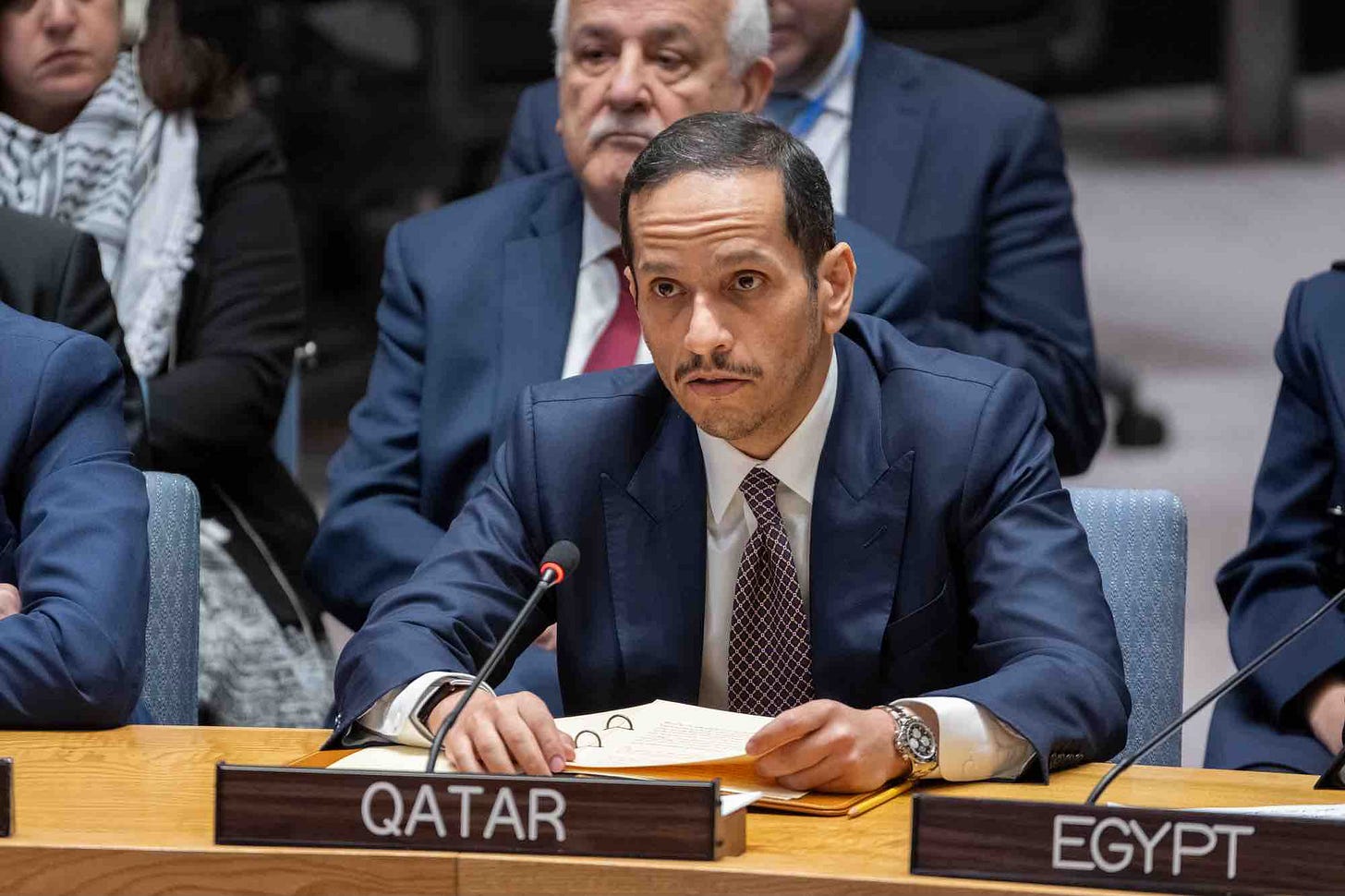
Sheikh Mohammed bin Abdulrahman al-Thani, the Prime Minister of Qatar, told the Financial Times that “Part of what we are doing now, as regional countries, is to create this regional security framework between us and Iran, that will hopefully have economic co-operation in the future between all of us — to bring the region back to stability”.

He similarly told Al Jazeera, “Iran is a neighbouring country, and dialogue with it remains necessary to guarantee the security and stability of the region”.

This shows that the GCC no longer trust the United States to protect them, given that “Saudi Arabia, the UAE, Bahrain, Kuwait, and Qatar host US military bases and were attacked by Iran during the war. Washington struggled to supply its Gulf allies with enough interceptors to defend against Iranian missile attacks,” as journalist Kyle Anzalone noted.

As a result, the GCC states are seemingly deciding to stop relying on the United States for defence and make a security agreement with Iran, which has cemented itself as a serious regional power.

“They have to deal with Iran because it is not going anywhere”, Gawdat Bahgat, a professor of national security affairs at Washington’s National Defense University said referring to the Gulf nations new approach to Iran.

“Even while Iran attacked them, they kept diplomatic channels open because the day after, they and Iran have no choice but to live together” he noted.

“Our aim is that Iran flourishes and their economy grows; and our investment basically has always been purely on commercial decisions”, Sheikh Mohammed bin Abdulrahman al-Thani told the Financial Times.

This destroys the U.S./Israeli goal of isolating Iran, instead causing regional countries to forge closer ties to Iran for their own national security interests.

This is yet another way the U.S/Israeli war on Iran was a loss for the U.S. empire and a win for Iran and its influence as a serious regional power.

[…]

Via https://the307.substack.com/p/iranian-victory-gulf-states-creating

How Deep State Intel Community, USAID & Stolen Elections are all Connected

Image featuring a bold headline "Deep State Slayer" with visuals of government agencies, emphasizing themes of election manipulation and intelligence community issues.

By Grant Stinchfield

He tapped Bill Pulte to serve as Acting Director of National Intelligence, and the reaction from the media, Democrats, and the intelligence establishment tells you everything you need to know. They are furious.

Why? Because Pulte is doing exactly what many Americans have demanded for years. He’s cleaning house.

Within days of taking over, reports indicate dozens of employees inside the Office of the Director of National Intelligence were either fired or sent packing as the administration moves to shrink what President Trump has called a bloated intelligence bureaucracy.

And here’s the kicker. Almost immediately, anti-Pulte leaks started pouring out of the intelligence community. The same people who claim to be defending democracy are running to the media to undermine the man tasked with reforming their agency. If there was ever proof that the swamp still exists, this is it.

To me, those leaks are not an argument against Bill Pulte. They’re the strongest argument for him.

The intelligence community was never supposed to operate as an independent power center. It exists to serve the American people, not protect itself. Yet every time someone comes along promising accountability, downsizing, and reform, the knives come out.

The media says Pulte is dangerous. Democrats say he’s unqualified. Washington insiders are panicking. Frankly, that makes me like the appointment even more.

Today, we break down why Bill Pulte may be exactly the deep state slayer President Trump was looking for, why the leaks prove the purge is necessary, and why the intelligence establishment is terrified of what could come next.

[…]

Via https://www.thegatewaypundit.com/2026/06/how-deep-state-intel-community-usaid-stolen-elections/