Vaccine Induced Illness in Infants Increases Exponentially With Each Additional Shot
Reply


Episode 43 Middle Ptolemies: The Decline
The History of Ancient Egypt
Professor Robert Brier
Film Review
According to Brier, Ptolemy III (246-222BC) was the last good Ptolemy before they all started murdering one another. He built an Egyptian temple at Edfu dedicated to Horus, which was fairly well-preserved by houses later Egyptians built on top of it. The walls of Ptolemy III’s temple at Edfu is inscribed with a mystery play about the mythical battle between Horus and Set (brothers who battled one another to succeed Osiris after Set killed him – see The Ancient Egyptian Origin Myth)
The Decree of Kanopsis (written on three stella) also date from Ptolemy III’s reign. Like the Rosetta Stone, it’s inscribed in both Greek and in Egyptian (in both hieroglyphs and demotic script).
A good administrator, Ptolemy III imported grain from overseas during a year when the Nile didn’t overflow and recovered all the Egyptian gods stolen under Persian occupation. He also built the Serapeum of Alexandria, a smaller temple-librarydedicated to Serapis, a manufactured Greek god (Osiris and the Apis bull combined) worshiped by Alexandria’s 300,000 Greeks.
Serapis, usually depicted with a basket of produce on his head
The Serapeum was constructed adjacent to caverns that continuously bathed it in hot air to preserve the papyrus scrolls. Every time a ship docked in Alexandria harbor, any papyri on board were seized, copied and returned.
Because the library in Alexandria was in competition with the Pergamum library in Asia Minor, they refused to export any papyri. This led the Pergamum library to start using velum (sheepskin) instead. Velum could be sewn together and stacked but not rolled, and this eventually led to the first flat books.
Alexandrian glass was also a big industry under Ptolemy III, as was cryptography. All the Ptolemies were obsessed with documents in code.
Ptolemy III’ successors
Sobek
*The Apis bull was both a live bull and a god who was pampered and perfumed in hit own temple.
Film can be viewed free with a library card on Kanopy.
https://www.kanopy.com/en/pukeariki/watch/video/1492791/1492887
Episode 43 The Ptolomies
The History of Ancient Egypt
Professor Robert Brier
Film Review
A dozen Ptolemies served as pharaoh before the Romans ended Greek rule in Egypt in 31 BC.
General Ptolemy initially appointed Alexander’s intellectually disabled half-brother Phillip pharaoh until Alexander’s mother had him assassinated. He subsequently he appointed Alexander IV (Alexander’s son by a Bactrian woman) as pharaoh. After both he and Alexander’s mother were assassinated, Ptolemy assumed the throne himself. Following Egyptian custom, he married his sister.
He’s most famous for building the famous library at Alexandria (rumored to house 700,000 scrolls). The library complex also contained a museum (“place of the Muses”), which became the first think tank in history. Ptolemy financially supported scholars from all over the world to teach and study and the library. It was here that Euclid wrote his geometry in 300 BC, Eratosthenes first calculated the Earth’s circumference (the Greeks were aware the Earth was as sphere a early as 300 BC), Herophilus ascertained that the brain (not the heart) is the seat of intelligence, and the engineer Hero of Alexandria developed the world’s first steam engine.** Ptolemy also hired 70 rabbis to translate the Septuagint (the Hebrew Bible) into Greek.
Ptolemy I and Ptolemy II also built the magnificent lighthouse at Pharos, (at 423 foot high) one of the first modern skyscrapers. A fire burned continuously there, reflected by a huge bronze rotating mirror. It remained functional until 1303 AD. Ptolemy I also built two harbors at Alexandria, each accommodating 1200 ships, as well as building Egyptian temples and appointing various Egyptian priests to serve as trade administrator.

The Greeks ran Egypt like a business, with heavy taxes (10%) on all land sales and on exports of low grade emeralds and gold (both discovered by the Greeks near the Red Sea ) and grain.*** After introducing the first coinage to Egypt, the Ptolemies dominated the banking industry. Under Greek rule, there were 300,000 Greeks living in Alexandria with seven million mainly farmer inhabiting the rest of Egypt.
*According to Brier, it was sometimes used to facilitate movements by gods’ statues in temples.
**Prior to the Greeks, taxes on Egyptian producers (linen, grain, cattle, etc) were paid in kind and wages were paid in bread and beer.
***Following a major land reclamation project in the delta near Fayum, Ptolemy I substantially increased Egyptian grain production.
Film can be viewed free with a library card on Kanopy.
https://www.kanopy.com/en/pukeariki/watch/video/1492791/1492885
Episode 42 Alexander the Great
The History of Ancient Egypt
Professor Robert Brier
Film Review
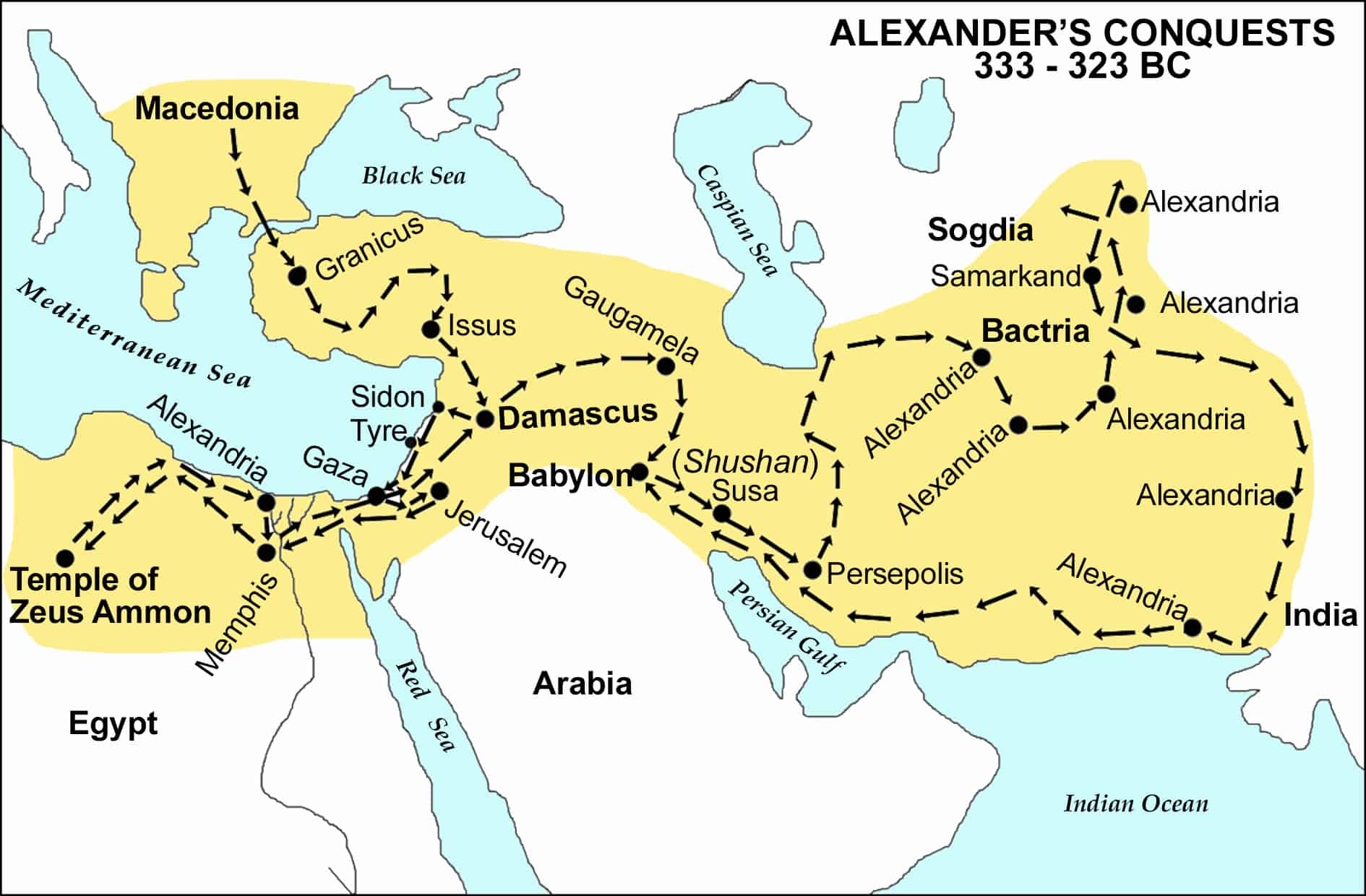
When his father Phillip II of Macedonia was assassinated in 336 BC, his 20-year-old son Alexander assumed control of the Macedonian military. Following his defeat of the Persian empire, he entered Egypt a a liberator. Because the Greeks had long revered Egypt, Alexander set out to install himself as pharaoh (ie a god). When he asked the oracle at the temple of Amun at Siwa Oasis* who his father was, the oracle replied “ra.”
He was crowned with the double crown (representing northern and southern Egypt – see Egypt: The First Nation in History) in Memphis and built a temple in Thebes, where he inscribed his name in a cartouche. This would be the start of 300 years of Greek rule in Egypt.
One of his first acts as pharaoh was to hire a Greek architect named Denocrates to build a port city in the delta region to be called Alexandria.
Alexander then left Egypt to lead his 50,000 strong army east to conquer the rest of the Persian empire. His campaign of conquests spanned across Greece, Anatolia, Syria, Phoenician, Mesopotamia, Persia, Afghanistan and India as far east as the city of Taxla in modern-day Pakistan. At that point, his generals resisted extending his conquests, and the Macedonian army slowly retreated as far west as Babylon, where Alexander took ill (apparently poisoned – see Was the Death of Alexander the Great Due to Poisoning?). His body laid in state in Babylon for a year, awaiting the gold needed to build a catafalque to carry him back to Macedonia.
His generals divided up his conquered countries among them with Egypt falling to General Ptolemy. Ptolemy rode out to Syria to intercept the body and take it to Alexandria (instead of Macedonia) for burial. Later members of the Ptolemy dynasty dug it up to met down the gold coffin and replace it with a crystal coffin.
*Located in western Egypt near the Libyan border.
Film can be viewed free with a library card on Kanopy.
https://www.kanopy.com/en/pukeariki/watch/video/1492791/1492883

