Could Trump Win White House By Promising to Stop Wotld War III?
4

Episode 45 Cleopatra’s Family
The History of Ancient Egypt
Professor Robert Brier
Film Review
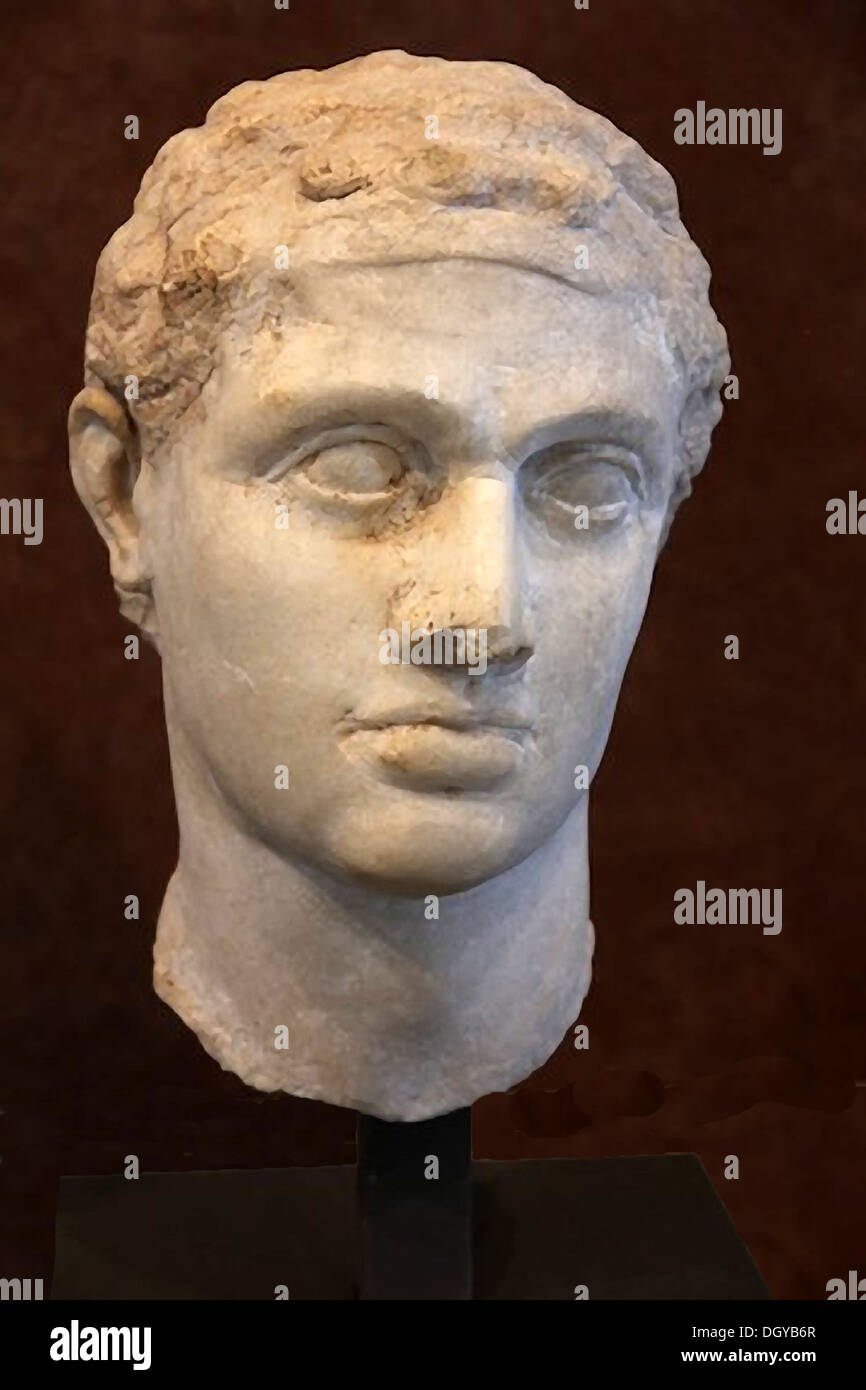
Because Ptolemy XI left no legitimate heirs, Ptolemy XII (88-58 BC and 55-51 BC) assumed the throne after the former was driven out of the country. His subjects called him the bastard and the flute player (because he played the fute rather than governing the country.
At a time when Romans were still living in mud huts, Rome had supplanted Greece as the major military power in the Mediterranean. The Ptolemies now paid Rome (mainly in grain) to provide military protection to keep their family on the Egyptian throne.
Alexandria was now about 1/3 Jews (mainly merchants), 1/3 Egyptians and 1/3 Greeks (who despised the Ptolemies but no longer had a standing army).
Rome was ruled by a triumvirate consisting of Crassus, Pompei and Ceasar. After Ptolemy XII raised taxes to pay the Roman army, the Greeks of Alexandria rebelled and forced him to flee to Rome. In his absence, his oldest sister Berenice took the throne, married her brother Buria and strangled him a week later. Meanwhile her younger sister Cleopatra VII was interacting with scholars at the Alexandrian library and was the first Ptolemy to learn Egyptian (and other languages).
Rome sent troops, led by Mark Anthony, to restore Ptolemy XII to the throne. Berenice’s second husband husband led the Egyptian forces against Anthony and was killed. With Alexandria under continuing Roman occupation, Ptolemy XII resumed the throne.
He built a new temple in the temple complex on Philae Island (near Aswan) begun by prior Ptolemies. It’s a temple to Isis, the wife of the manufactured Greek god Serapis (blend of Osiris and Apis bull).
UNESCO moved the temple to higher ground when the Aswan dam was built in the 1960s. In his will, Ptolemy designate 17 year old Cleopatra VII and her 13-year-old brother Ptollemy XIII (who she was expected to married) as his successors.
Film can be viewed free with a library card on Kanopy.
https://www.kanopy.com/en/pukeariki/watch/video/1492791/1492892
Episode 44 Animal Mummies
The History of Ancient Egypt
Professor Robert Brier
Film Review
The Ptolemies were fascinated with animal mummies. They served four different purposes:
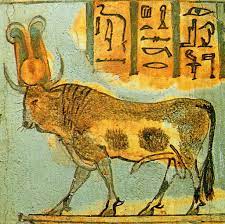
The Apis bull was the main example of an animal god. It was conceived after lightning struck a bull and could be discerned from distinctive markings: a diamond shape on its forehead, a scarab shape under it tongue, wing marking on its back and tail hairs that doubled at the ends.
The Apis bull lived in its own temple and was pampered and perfumed. A papyrus has been found describing how to mummify an Apis bull prior to burial at the Serapeum (see link). As a god, the Apis bull played an essential role in soil fertility.
Example of Egyptian pets who were mummified included cats, baboons dog. The nobility sometimes kept gazelles.
Mummifying animals for sacrificial was a major Egyptian industry under the Ptolemies and millions have been found. People seeking to be healed could make a pilgrimage to various temples, buy a mummified animal (commonly an ibis or falcon raised on special farms) and offer them to the priest, who put them in specially designated niches carved out by specialized stone cutters.
Under the Ptolemies, there was an administrator at Hor who kept a rough draft of the number of mummies offered up and made sure pilgrims didn’t get cheated (by being sold an empty mummy case).
There was also a special cemetery for mummified cats, named after Bastet the cat goddess. When the British occupied Egypt, they shipped hundreds of thousands of cat mummies back to Britain to be ground up as fertilizer. All (none were more than a year old) were clearly raised as offering.
There was also an entire cemetery at Esna in southern Egypt dedicated to fish mummies*
Tutankamen and other pharaohs had pressed duck mummies and mummified animal hearts to take to the next world as food.
*Based on the myth that three fish devoured Osiris’s phallus after Set through his body into the Nile.
Film can be viewed free with a library card on Kanopy.
https://www.kanopy.com/en/pukeariki/watch/video/1492791/1492889

