The New American Experiment: No POTUS

Befuddled Biden Unaware of 'Historic' Press Conference | Headline USA
Mark Wauck

Of course we’ve had presidents who were puppets of the Deep State, presidents who were assassinated by the Deep State, presidents who were removed by the Deep State by fake elections—all sorts of variations on the Deep State running the show. But now it’s almost completely out in the open: No Potus.

John Daniel Davidson @johnddavidson

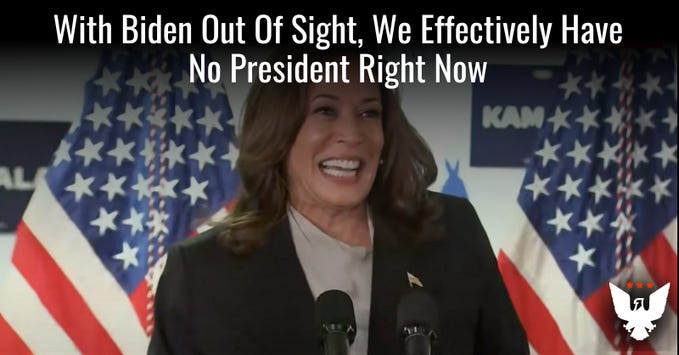
Let’s be honest, the United States doesn’t have a president right now. The Oval Office is empty. When Dem elites ended Biden’s reelection campaign, they ended his presidency.

With Biden Out, We Effectively Have No President Right Now

3:58 PM · Jul 23, 2024

What happens next? I’m not sure anyone really knows. We have stepped out of narrative and into history, and things are moving fast now. But what must not happen is that we the people simply trundle along and accept the narrative that we’re given by the coup plotters and the media. There has to be accountability for them as much as for the Secret Service and other deep-state actors who set the stage for an assassination attempt on Trump.
…
And we have to be clear-eyed about the fact that we have sailed into very dangerous waters. Whether we make it out is by no means certain.

The point here is that the people now running the show—without even the fig leaf of constraints as far as anyone can tell—do not answer to the American people. Not even in a make believe kinda way. They answer to special interests. None of these people ran for election, and they don’t get on national TV to address the nation.

Of course the main task for the Deep State now is to gaslight We the People regarding the attempted assassination of Trump. But don’t expect the rest of the world to wait on that. The rest of the world has its own agenda, and the people who rule America have an agenda too. Events could move quickly.

[…]

Via https://meaninginhistory.substack.com/p/the-new-american-experiment-no-potus

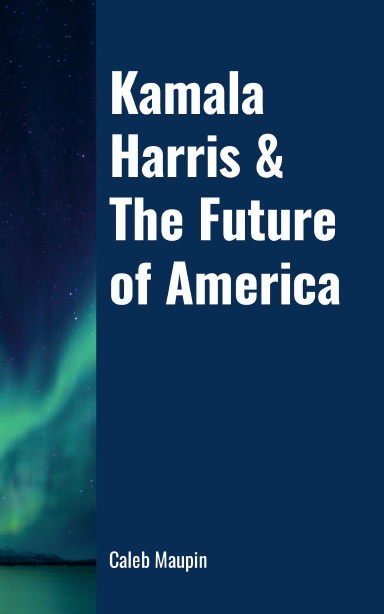
Amazon (Bezos) Censors Kamala Book

Caleb Maupin


Available at LULU

“CopenPay” – Europe’s first Climate-centric Social Credit Scheme

Kit Knightly

The world’s first climate-related social rewards scheme came into being two weeks ago, when the city of Copenhagen officially launched it’s new “CopenPay” system.

Through the CopenPay scheme, tourists visiting the city will be rewarded for “green actions” – such as using public transportation or cycling – with access to “cultural experiences”, free meals etc.

For example, arriving at the CopenHill dry ski slope by foot or on a bike will get you 20 free minutes of ski time, while anyone who volunteers at an organic urban farm will get a free lunch (vegetarian, naturally).

The official CopenPay website describes the purpose of the system as follows:

…to encourage sustainable behaviour and enrich the cultural experience of visitors and residents in Copenhagen by transforming green actions into currency for cultural experiences.

WonderfulCopenhagen.com adds:

There is a need to change the mindset of tourists and encourage green choices […]Through CopenPay we therefore aim to incentivize tourists’ sustainable behaviour while enriching their cultural experience of our destination. It is an experimental and a small step towards creating a new mindset […] The hope is not only to continue the pilot project, but also to inspire other cities around the world to introduce similar initiatives.

Now, complimentary organic meals and free windsurfing lessons might seem benign enough, but any talk of “changing mindset” and/or “encouraging behaviour” makes my brain itch.

It’s pretty easy to see through the happy-clappy tone of the promotion to the heart of the issue, it’s right there in their own words: Transforming green actions into currency.

This is climate change based behavioral modification. This is a social credit system. Small scale and optional, sure, but there’s no denying that’s what it is.

[…]

Via https://off-guardian.org/2024/07/25/copenpay-europes-first-climate-centric-social-credit-scheme/

Scientific Investigation into Bluetooth MAC Signals Emitted by Covid Vaccines

What is MAC Address: Explanation | Cyberops

Bluetruth: Scientific Proof the Vaxxed Emit a Bluetooth MAC Signal

COMUSAV (2023)

Spanish with English substitles

Film Review

A Substack reader referred me to this fascinating documentary describing the work of  of COMUSAV (Coalición Mundial Salud y Vida/World Health and Life Coalition) in investigating the presence of Bluetooth transmitting graphene nanoparticles in recipients of ALL Covid vaccines, including the Russian and Chinese versions.

In 2021, Spanish scientist Dr Pablo Campro was first to detect graphene nanoparticles in vials of Pfizer mRNA vaccine via micro-Raman spectroscopy. Similar graphene nanoparticles have since been detected by other scientists, in other vaccines and in the blood of vaccine recipients.

The film describes in vivo experiments by Mexican physician and COMUSAV member Dr Pedro Chavez Zavala in both vaccinated and unvaccinated patients and from cemetery plots of Mexicans who died in 2021 and 2022. As he describes in the video, graphene oxide is metabolized to graphene hydroxide when injected into human beings, which enables it to transmit electromagnetic frequencies.

In the specific experiment described, most of the vaccinated patients Dr Zavala tested transmitted a MAC (Medica Access Control Address) used in Bluetooth networks and the Internet of Things.

In the image above, the OUI (the first six digits) normally represent a unique manufacturer identifier (eg Apple, Google, etc).

In Dr Zavala’s experiments, none the OUI’s he detected corresponded with known manufacturers.

There were also a small number of vaccinated subjects who failed to transmit MACs after completing the COMUSAV spike protein/graphene oxide detox protocol.

Most of the unvaccinated subjects he scanned produced no MAC. The few who did either had vaccinated sexual partners or had undergone PCR or RAT testing.

Even more fascinating is the screening Dr Zavala and his team did in a remote Mexican cemetery. Where burial plot emitted MACs, in each case the deceased had been buried in 2021 or 2022 and presumably received a Covid jab.

At the end of the film, the camera scans through an extensive bibliography of studies confirming the presence of graphene oxide in Covid vaccines. The most interesting paper cited is by military intelligence specialist Dr Kira Smith military intelligence specialist Dr Kira Smith. It explains the historical use of graphene oxide nanotubes in the brain for various medical monitoring

The COMUSAV protocol is available (in English) at https://comusav.com/usa/

Ethiopia as a Belt and Road Initiative Model

Barry Sautman and Yan Hairong

In the late 20th Century, there was a “tendency of [Anglosphere] media to focus almost exclusively on the negative side of the African experience,” with Africa “seen as the one part of the world for which the future was likely to be far worse than the past.”[1] A UK business journal famously labelled Africa “The Hopeless Continent.”[2]

A quarter century later Western media still frame Africa negatively.[3] Dominant depictions are built on a patronizing racism that has its roots in the colonial and neo-colonial relationship between the West and Africa. Chinese activities on the continent are similarly judged by Western entities to be uniquely negative,[4] influencing some African media to do the same.[5] The consistent Western deprecation of the Chinese presence in the continent reflects both Yellow Peril and Red Menace ideologies mobilized to confront what the US government regards as its “only peer competitor.”

Western media promote, for example, a “Chinese debt trap” claim; yet, studies have shown that China holds only an 18% share of Africa’s external debt[6] and that among 19 African countries in debt distress in 2017,  the share of these countries’ external debt to China averaged just 15%.[7]

Moreover, after the G-20 created the Debt Service Standstill Initiative in 2020 to supposedly relieve heavily indebted states, China became the most significant debt relief country in this initiative. It suspended $5.7 billion in debt payments, contributing to more than half of the total global debt moratorium. Through this action, 45% of debts owed by the poorest countries to China was suspended. In contrast, the UK had no suspension of payments on its commercial loans and still recovered $3.2b in debt from countries that applied for the debt standstill initiative.[8]

China renegotiated or wrote off more than $78b in loans for foreign infrastructure projects between 2020 and early 2023.[9] After obtaining China’s debt relief in 2023, Ethiopia requested other G-20 countries to also suspend the country’s debt payments.[10]

Compared to Western media coverage, “Chinese reporting on the continent is more abundant, positive and diverse.”[11] Western media focus mainly on corruption and ineffectiveness of African leaders, civil wars and terrorism. Chinese media report on a wide range of socio-economic topics and are positive about Africa’s development potential and its wider global and regional connections beyond the West.

Chinese officials and scholars affirm that “China needs Africa as much as Africa needs China”[12] or even that “China needs Africa more than Africa needs China.’”[13] China calls Africa “a continent of opportunities and a promising land for investors.”[14] China and its Belt and Road Initiative (BRI) benefit from solid African diplomatic support, but China also reciprocates; thus, in 2022 it launched an “Initiative for Peaceful Development in the Horn of Africa” and in 2023 upgraded its relationship with Ethiopia from a “strategic partnership” to the rare level of “all-weather development cooperation.”[15]

No Chinese leader has pronounced, as did French President Nicolas Sarkozy in Senegal in 2007, that Africans have “not entered history” and are not oriented toward the future or progress.[16] Even as Trump in 2018 termed African states “shithole countries,”[17] Xi Jinping framed African states and peoples as equals, distinct from the hegemonic dehumanization in western media.”[18]

From 2014-2020, he made ten trips to Africa, while in 2017-2022, there was only a single, brief stopover in Africa by a US president, in Egypt.[19] Although one can find examples of internalization of western stereotyping, in large part Chinese merchants who live on the African continent are  equally positive in their perceptions of African development and potentials for economic partnership.  Chinese who work closely with Africans[20] and Chinese managers at industrial enterprises in Ethiopia we interviewed, regard local workers as reliable, adaptable, quick-learners.[21]

Ethiopia as a BRI Model: Industrialization through infrastructure building

Among Africa’s 54 states, 52 are part of the BRI, but there is no African country that Chinese officials have been more positive about than Ethiopia; they regard it, as an idiom puts it, “the only one and no number two” (独一无二).   Ethiopia is Africa’s second most populous country.  It has a Japan-level population, but is growing at 2.5% per annum and with an average age of 18.8, while Japan’s population is shrinking at -0.5% per year and has an average age of 49.[22] Despite an ongoing civil war in 2022, Ethiopia’s GDP grew by 5.3%, versus 3.6% for all of Sub-Saharan Africa (SSA).[23]

Though GDP growth does not capture the entirety of human development and wellbeing, at the junction of world and especially developing country economic stagnation, this level of GDP growth is welcomed. Addis Ababa is the “capital of Africa,” hosting the African Union, UN Economic Commission on Africa, and African Center for Disease Control, plus Africa offices of many international organizations, such as the United Nation Development Program.

Ethiopia is however seen as the BRI model country in Africa for reasons more directly related to key aspects of the Initiative – infrastructure building and industrializing investment. As a Kenyan analyst has put it, “China is the only major country that has proven quite interested in going into fragile situations to do some infrastructure projects in Africa,”[24] while Western states have scaled back such activities.[25] By 2017, Chinese firms had 50% of Africa’s internationally-contracted construction market.[26] China also provides financial wherewithal for infrastructure-building, with more than one-fifth the value of external loans to sub-Saharan Africa coming from Beijing.[27] In 2006-2018, China lent Ethiopia US$14.83 billion, 82.2% of it for 70 mega-projects (22 in transport and communications, 35 in power, 13 for sugar factories and urban water supply).[28]

An Ethiopian business journal stated in 2020 that “Ethiopia is the leading country in sub-Saharan Africa with the highest number of Chinese contracted projects.” It averred that “Almost all big buildings, roads and dam projects throughout the country are being handled by Chinese contractors.” Local firms are not thought to be equipped to complete mega-projects, but Ethiopians do participate.

[…]

In fact, contrary to Western media portrayals, not many Chinese work at projects in Ethiopia. There were fewer than 6,000 in 2021, among the 15,000 Chinese then-reported as living in a country of 127 million people.[30]

Ethiopia as a BRI Model: Industrialization through manufacturing

China is important to Africa’s trade pattern. Using the problematic category of “Sub-Saharan Africa” (SSA), one-fifth of its total goods exports go to China, with metals, minerals, and fuel some three-fifths of that, although Ethiopia exports none of these. China is also the largest source of imports in Africa, mainly manufactures and machinery.[31] Many imports are used in Chinese infrastructure and industrial projects, especially in Ethiopia.

China’s proportion of the stock of SSA’s FDI is still small, at 4.4%. [32] Its share however is growing, while the UK and US shares have diminished: they had 17% and 15% of FDI stock in Africa in 2004–08, but only 6% percent each in 2014–18.  From 2016 to 2020, China also contributed 20% of the value of greenfield (entirely new) FDI in Africa, more than three and four times the US and UK shares.[33] Moreover, little of the US’s aid to Africa promotes industrialization.[34]

Despite scholars contending that “Several features of Ethiopia make it a ‘perfect storm’ for Chinese investment,”[35] the country has been central to China’s industrializing investment in Africa.  African leaders emphasized at the 2022 AU meeting that industrialization is key to mitigating poverty and must be sped up.[36] When the BRICS countries met in 2023, Ethiopia was asked to join and Xi Jinping said China would “support Africa in growing its manufacturing sector and realizing industrialization and economic diversification.”[37]

Already by 2017, China was said to be involved in 12% of Africa’s industrial production.[38] Some 13.4% of its stock of investment in Africa in 2021 was in manufacturing – with 37% in construction and 10% in mining[39]-but manufacturing’s importance is increasing, especially in Ethiopia.  In 18 key African states in 2000-2010 and 2010-2018, manufacturing’s average annual value-added growth was 5% and 4.3%; while in Ethiopia it was 7.8% and 16.8%.  Average annual growth in manufacturing jobs in the 18 states was 4.8% and 4.9%; in Ethiopia it was 11.2% and 6.9%.[40]

Some 3,000 Chinese firms operate in Africa; 70% of them private.[41] The proportion is similar in Ethiopia[42].  While state-owned enterprises (SOEs) dominate in construction, Chinese firms in manufacturing are mainly private. SOEs are large and experienced, but private firms vary in size, background and focus: many are small-to-medium and family-owned and thus more vulnerable to such destabilizing factors as epidemics, civil wars, and sanctions.[43]

Ethiopia is Africa’s second largest FDI recipient and China plays a key role in its industrialization.[44] As of late 2023, China’s 1,844 investment projects in Ethiopia were 4-5 times the number of US and Indian projects.[45] Its stock of investment in 2023, at $4.8b, was one-tenth the stock of all Chinese FDI in Africa and one-sixth the stock of all FDI in Ethiopia. It is said to have created 560,000 Ethiopian “job opportunities,” mainly in clothing and textiles, building materials, plastics and metals, and engineering.  In 2021, Chinese firms accounted for 60% of Ethiopia’s approved new FDFI projects, almost all in manufacturing and services.[46]

Ethiopia’s manufactured exports in 2023 were a fifth of all its exports. Chinese manufacturing exporters are based in Ethiopia’s 13 public and 5 private industrial parks (IPs), eleven of them Chinese-built and mostly housing Chinese firms.  IPs have attracted FDI of US$740m since 2013 and IP occupancy rates have been as high as 80%.  They have created 150,000 jobs, almost all for locals and mainly for women.  The oldest IP, the Chinese-managed Eastern Industrial Park near Addis, had 26,000 workers in 2023, 5% of them Chinese and 70-80% women.[47] Hawassa IP, 275 km south of Addis was even larger and 97% of its 35,000 workers in 2021 were locals.[48] Ethiopia plans to transform all IPs into special economic zones. The first will be the Chinese-built Dire Dawa IP being completed in late 2023, 450 km from the capital, along with the Chinese-built railway from Addis to the port at Djibouti that handles Ethiopia’s external trade.[49]

Ethiopia as a BRI Model: non-economic aspects 

The Ethiopia/China BRI relationship is not wholly economic; for example, educational ties are well-developed.  In 2018, China had recruited 81,500 African university students and offered more scholarships to its African students than all the leading Western governments combined.[50] Already by 2017, when China had 74,011 African students, 4,883 were Ethiopians, up from 844 in 2011 and more than twice the number of Ethiopians studying in the US.[51] In 2023, Ethiopians were said to “account for the largest Chinese scholarship recipients.”[52] China was also supporting 117 Ethiopians studying at Addis Ababa University.[53]

The Luban Workshop, a vocational training program China developed as part of the BRI, is worth noting as well.  It has operated since 2016 in 25 developing countries, including Ethiopia.  Workshops are partly tailored to graduates getting jobs in local Chinese firms and one at Ethiopian Technical University since 2021 is paired with China’s Tianjin University of Technology.  Many of its instructors are Ethiopians who studied in China.  The curriculum centers on robotics and AI-using manufacturing, as well as including  learning specific to IT giant Huawei’s technology. This is perhaps one reason why an Ethiopian team finished 3rd among 146 teams from 36 countries in Huawei’s 2023 ICT competition.[54]

[…]

Ethiopia as a BRI Model, But Not a Model for Transformation

Although Ethiopia is a model BRI country in Africa, the relationship is not unproblematic.  On the Chinese side, in mid-2023, infrastructure-builders faced severe problems from the Ethiopian government’s shortage of foreign exchange and from increasing materials costs.[56] The situation for IPs since early 2022 has also been precarious, due to US sanctions imposed during the civil war with Tigrayan rebels.[57] Ethiopia’s eligibility for duty-free entry of its goods into the US under the politically-conditioned African Growth and Opportunity Act (AGOA) was suspended which, the Ethiopian government said, resulted in “millions” of workers being laid off.[58] The US move caused Ethiopia to further strengthen its ties with China and though the war ended in November 2022, the US renewed its sanctions against Ethiopian officials in fall 2023.  Ethiopia remains outside AGOA, which itself may expire for all of Africa in 2025.[59] China, in contrast, now grants zero tariff treatment to 98% of products from Ethiopia.[60]

On the Ethiopian side, Chinese and other foreign-invested firms continue to pay IP workers very low wages, averaging with benefits only about US$100 a month.  That is less pay than for comparable work in Bangladesh, albeit slightly higher than what workers earn at surrounding Ethiopian-owned firms.  Wages of the few Chinese IP employees, mainly managers, supervisors, and trainers, are much higher, up to 20 times the local wage.[61] Unsurprisingly then, there have been strikes, such as one at the Hawassa IP in 2019.[62] These actions had achieved some positive outcomes, such as higher wages and recognition of unions – until many thousands of workers at Hawassa and other IPs were laid off in 2022 due to sanctions.l violence.[63]

[…]

Via https://libya360.wordpress.com/2024/07/24/ethiopia-as-a-belt-and-road-initiative-model/

The Stunning Audacity of Yemen’s Drone Strike on Tel Aviv

Yemen’s unprecedented drone strike on Israel’s economic powerhouse has further shattered the occupation state’s perceived invulnerability. Moreover, it announced the launch of Ansarallah’s fifth phase of war: ‘Target Tel Aviv.’

The Cradle’s Military Correspondent

On 19 July, a low-altitude drone breached Tel Aviv’s airspace from the sea and detonated, causing one fatality and injuring ten others.

The incident sent shockwaves through the occupation state, with a panicked populace and bewildered policymakers grappling with the Israeli army’s “mega-failure” to intercept a single drone amid prolonged aggression against Gaza and the mounting tensions with Hezbollah in Lebanon.

The attack’s impact was magnified by its direct hit on Tel Aviv, the heart of Israel’s governmental and economic power, starkly exposing inadequacies in its defense strategies and further alarming a population that has for months been questioning the effectiveness of its military preparedness.

It wasn’t long before the de facto Yemeni authorities in Sanaa claimed responsibility  for the attack, calling the strike a retaliation for Israeli massacres and threatening more to come.

But how did a Yemeni drone reach the heart of Israel’s most fortified region and strike a blow to Israeli military pride?

Tactical evolution of suicide drones

Suicide drones, as they are known, are a relatively modern weapon, posing significant challenges even for technologically advanced states like the US and Israel. These drones vary in range, warhead size, speed, and guidance methods.

Analysis of the wreckage revealed that the “Yaffa” drone, an enhanced version of Yemen’s Sammad drones, was employed in the operation. The name is deeply symbolic as it references the ancient port city of Jaffa, also known as Yaffa in Arabic, which now forms part of modern-day Tel Aviv.
Yaffa Drone

Its rectangular wing shape and V-shaped tail distinguish it, but it is notably the more powerful 275 cc (16 kW) engine that sets it apart. This engine enables the drone to cover distances exceeding 2000 kilometers – sufficient to reach Tel Aviv from Yemen.

Unlike with ballistic missiles, the difficulty in tracking drones lies in their ability to take unconventional paths, maneuver through winding routes, and hide behind terrain features, making them hard to detect by radar systems.

This detection challenge is a daily issue in northern occupied Palestine, where drones operated by Lebanese resistance groups often go unseen by the increasingly blinded occupation army.

Moreover, drones are typically constructed from lightweight materials such as fiberglass, carbon fiber, or various reinforced plastics that do not reflect radar waves effectively, which is crucial for detection and tracking.

Their low speeds reduce the need for the metallic compositions necessary in constructing conventional military hardware like missiles and fighter jets. Consequently, drones can be mistaken for birds by radar systems. This confusion has occurred regularly in northern occupied Palestine since the war’s onset, with Israel’s Iron Dome defense system spotted expending its limited supply of $50,000 projectiles shooting at birds during this conflict.

Yaffa’s route to Tel Aviv

The suicide drone likely took an unconventional path to evade detection. Previous Yemeni attempts have been intercepted in Egyptian Sinai airspace, with Israeli-allied Arab states such as Saudi Arabia, Jordan, and Egypt contributing to these detection and interception efforts.

On the night of the attack, however, no US aircraft carrier groups were in the Red Sea, and the nearest carrier, the USS Theodore Roosevelt, was positioned in the Indian Ocean. Israel’s air force has suggested that the drone may have taken a non-traditional route via Eritrea, Sudan, and Egypt, crossing near the Suez Canal before entering the Mediterranean and turning east toward Tel Aviv.
Possible path of Yaffa drone that targeted a building in Tel Aviv

Some aspects of that route seem unlikely: the Suez Canal area is heavily patrolled by Egyptian air defense, with its 8th Brigade stationed there, so the Israeli announcement may have been an attempt to pressure Egypt.

Israel’s response: Bombing Hodeidah

On 20 July, Israeli aircraft launched punishing airstrikes on the besieged Yemeni port of Hodeidah, specifically targeting areas designated for fuel and oil storage, as well as destroying port cranes used for loading and unloading cargo and a power station.

But these were civilian targets in a country already suffering from the effects of the Saudi-led coalition blockade, which has caused severe shortages of fuel and essential resources needed for power generation and transportation.

The strike at these particular target banks, which killed at least six and wounded dozens of others, appears to be primarily aimed at creating significant explosions and large fires to help Israeli Prime Minister Benjamin Netanyahu score points at home.

But the Israeli response against civilian targets also reveals that Tel Aviv suffers from a dearth of intelligence on potential Yemeni military targets. It was also evident that the selected targets were ones that Saudi Arabia and the US have refrained from striking due to fears of Yemeni retaliation, which could strike Saudi commercial ports or oil exports in one of the world’s most vital energy passages.

Indeed, Riyadh was quick to deny any involvement in the assault, fearing reprisals from Sanaa, although  reports  that Israeli jets used Saudi airspace for this attack suggest otherwise.

Video footage shows that Israel used F-35 and F-15 fighter jets, as well as Boeing 707 tanker aircraft, due to the distance involved – a range exceeding 4,000 kilometers round trip. Israeli-released footage suggests that the strikes were carried out using Spice guided missiles launched from outside the Yemeni air defense range.

Some of these missiles are equipped with boosters that extend their range up to 150 kilometers, which only showcased Israeli operational limitations against Yemen in a broader conflict, in which Sanaa’s air defenses will be surely activated against enemy aircraft, drones, and projectiles.

Yemen’s retaliation

Yemeni officials, led by Ansarallah leader Abdul Malik al-Houthi and Yemeni Armed Forces Spokesman Brigadier General Yahya Saree, quickly announced a decision to launch retaliatory strikes against Israel, in which they declared Tel Aviv to be an “unsafe zone” and warned of Yemen’s readiness for a “long war” against the occupation state.

Given the targeting of vital civilian infrastructure, this places several Israeli targets on the list of potential Yemeni target banks. These include fuel tanks in Haifa, clearly shown in video footage taken by a Hezbollah drone weeks ago, as well as fuel tanks in Ashkelon and the power stations adjacent to these tanks.

What concerns Israelis the most, however, is Yemen’s potential targeting of vital gas platforms in the Mediterranean Sea, stationary targets highly susceptible to significant ignition and explosion. While there are currently only three active Israeli gas fields – Karish, Tamar, and Leviathan – in operation, these fields have become essential to Israel’s energy independence.

Underestimating Sanaa’s resolve

The damaging Israeli strike on Hodeidah Port was based on an assumption by Tel Aviv that it would deter a Yemeni counterstrike. But Yemen’s Ansarallah Movement, which has endured years of punishing Saudi, Emirati – and now US and UK – military attacks, has shown no inclination whatsoever to halt its operations in support of Gaza.

While the Israelis may have felt an obligation for a quick military fix by striking Hodeidah – the port, incidentally, has already reopened for business – it comes at the expense of any logical assessments of losses and gains. Already facing strategic defeat in Gaza and unable to follow through with its threats against Lebanon, Tel Aviv has cracked open a new front with Yemen, the most fearless component of West Asia’s Axis of Resistance.

The Israelis are between a rock and a hard place, desperately trying to cleave to old narratives of regional military superiority to keep domestic faith in the Zionist project, yet unable to score victories anywhere.

Based on Yemen’s oft-declared resolve not to retreat from any escalation, it is expected that the outcome of the Hodeidah strike will lead to a compounded retaliatory operation against the occupation state. Israel, however, has limited operational freedom due to issues related to geographic distance – such as the airspace and uninterrupted refueling access required – which makes waging war against Yemen a nonstarter.

Harsher strikes on critical Israeli centers are likely to drive Israel into greater missteps and strategic errors, especially at a time when escalation and the further weakening of its deterrence are counterproductive to its interests.

By targeting the Yemenis directly, Israel has underestimated the resolve and capabilities of a  formidable adversary, potentially choosing the worst possible opponents in this round of conflict.

[…]

Via https://libya360.wordpress.com/2024/07/24/the-stunning-audacity-of-yemens-drone-strike-on-tel-aviv/

CIA & Rockefeller Foundation Role in Deagel Depopulation Forecast

The Expose

[…]

Current real-world data on excess deaths in the West strongly suggest Deagel’s depopulation forecast is not just an estimation but in fact, a target that is on track to be hit thanks to the deadly effects of Covid-19 vaccination.

[…]

We can confirm that Dr. Edwin A. Deagle Jr., who passed away on February 16th 2021, is the confirmed figurehead authorities would like you to believe is solely behind Deagel.com. Source

During his life, Dr Edwin served as the Assistant to the Secretary of Defense and the Deputy Secretary of Defense. He was also the Director of International Relations for The Rockefeller Foundation, an influential global philanthropic organization.

[…]

Declassified documents, released via Freedom of Information Act requests, reveal Deagle’s communication with the then United States Director of Central Intelligence, Stansfield Turner, hinting at a relationship with the CIA.

[…]

The CIA has released 23 FOIA articles relating to Dr Deagle, the Rockefeller Foundation, the U.S. DOD and the former director of the CIA.

This strongly suggests that Deagel.com isn’t just the work of one man, but is in fact the work of a U.S. Military Industrial Complex consisting of the CIA, the U.S. Department of Defense and the shady Rockefeller Foundation. Making its apocalyptic depopulation forecasts all the more concerning.

Deagel’s Forecasts & Current Events:

Deagel’s apocalyptic depopulation forecasts for 2025 predict significant population declines in various countries, stirring unease given the current excess death data being recorded around the world.

Deagel.com’s [infamous] 2025 forecast was removed from their website sometime in 2020. However, thanks to the Wayback Machine / Internet Archive, we are able to view the original predictions before discovered by critical thinkers.

Deagel predicted in 2020 that the United Kingdom would see its population decline by 77.1% by the year 2025. Source

Deagel predicted in 2020 that the United States would see its population decline by 68.5 % by the year 2025. Source

Deagel predicted in 2020 that Germany would see its population decline by 65.1% by the year 2025.Source

Deagel predicted in 2020 that Australia would see its population decline by 34.6% by the year 2025.Source

While also predicting a huge decline among many other Western countries.Source

A full list of Deagel’s original apocalyptic depopulation predictions can be viewed here.

Regrettably, the unfolding events strongly suggest that Deagel’s ominous depopulation estimates may not be merely speculative. Real-world data appear to align disconcertingly with these figures, primarily driven by the severe and deadly consequences of Covid-19 vaccination.

But the widespread distribution of these experimental vaccines, allowed under emergency use authorization, would not have been possible without the backdrop of the Covid-19 pandemic.

So the fact the U.S. Department of Defense (DoD) issued a ‘COVID-19 Research’ contract in Ukraine, three months prior to the official recognition of the Covid-19 virus, raises some seriously unsettling questions.

Especially when we consider the U.S. Department of Defense is now known to be intricately connected to Deagel.com, along with the CIA and The Rockefeller Foundation.

The U.S. DoD Factor:

The world first started to hear about a novel coronavirus in early January 2020, with reports of an alleged new pneumonia-like illness spreading across Wuhan, China.

However, the world did not actually know of Covid-19 until February 2020, because it was not until the 11th of that month that the World Health Organization officially named the novel coronavirus disease; Covid-19.

So with this being the official truth, why does United States Government data show that the U.S. Department of Defense (DoD) awarded a contract on the 12th November 2019 to Labyrinth Global Health INC. for ‘COVID-19 Research’, at least one month before the alleged emergence of the novel coronavirus, and three months before it was officially dubbed Covid-19?

The Government of the United States has a website called ‘USA Spending‘, an official open data source of federal spending information. According to the site as of 12th April 2021, the US Government has spent a mind-blowing $3.63 trillion “in response to COVID-19”. But that’s not the only information on Covid that can be found on the site.

Hidden within the ‘Award Search’ are details on a contract awarded by the Department of Defense to a company named ‘Black & Veatch Special Projects Corp‘, which is allegedly “a global engineering, procurement, consulting and construction company specialising in infrastructure development”.

The contract was awarded on September 20th, 2012 and is described as “Professional, Scientific, and Technical Services”.

The ‘Award History’ for the contract contains a tab for ‘Sub-Awards’ detailing the recipients, action date, amount, and very brief description for 115 Sub-Award transactions. Most of the Sub-Awards are extremely mundane for things such as “laboratory equipment for Kyiv”, or “office furniture for Kyiv”.

But there is one Sub-Award that stands out among the rest, and it was awarded to Labyrinth Global Health INC for “SME Manuscript Documentation and COVID-19 Research”.

An award for Covid-19 research isn’t exactly shocking when the world is allegedly in the grip of a Covid-19 pandemic, but considering the fact the sub-contract was awarded on 12th November 2019, at least one month before the alleged emergence of the novel coronavirus, and three months before it was officially dubbed Covid-19, the award for Covid-19 research should come as a shock to everyone.

But the shock doesn’t end there, because the place the contact for Covid-19 research was instructed to take place was Ukraine, the very country that the U.S. Military Industrial Complex is currently using to fight a proxy war against Russia.

The Rockefeller Factor:

While Dr. Deagle’s links to the Rockefeller Foundation, CIA, and DoD provide a gripping backstory, the Rockefeller Foundation’s role adds a layer of complexity.

A powerful entity since 1913, its alleged mission to “promote the well-being of humanity throughout the world” has shaped global health policies and led to a significant influence in the creation of the World Health Organization (WHO).

But this influence hasn’t been without controversy.

The Rockefeller Foundation’s historical entanglement with population control and eugenic programs remains a contentious chapter in its legacy. Its support for these initiatives during the early 20th century presents a disconcerting portrait of the Foundation’s role in manipulating human demographics.

Eugenics, a field now widely discredited and dismissed as pseudoscience, aimed to improve the genetic composition of the human race through selective breeding. The Rockefeller Foundation’s monetary and ideological support for these programs indicates an ethically questionable engagement in directing human evolution and societal composition.

The population control initiatives, framed as efforts to manage global population growth for sustainable development and resource conservation, also bore the Foundation’s signature. Critics argue that such activities echoed an overreach, hinting at an assumed authority to control the demographics of global populations.

Although the Foundation has since publicly disavowed such measures and appears to have redirected its focus towards universally accepted areas of public health, education, and the arts, the echo of its past actions remains.

The Rockefeller Foundation’s past involvements offer invaluable lessons about the potential consequences of unchecked influence and a poignant insight into the organization’s considerable sway over global human affairs. Despite the change in focus and approach in recent years, the effects of past endeavours underscore the caution we must exercise when philanthropic entities wield influence on a global scale.

Deagel’s Depopulation Forecasts are a Target

The revelations linking Deagel to Dr. Edwin A. Deagle Jr., the CIA, DoD, and The Rockefeller Foundation, paint a compelling, if disconcerting, narrative.

These high-profile connections suggest a level of influence that raises questions about the motivations behind Deagel’s apocalyptic population forecasts.

Especially when we consider the fact real-world data currently aligns with Deagel’s 2025 predictions.

Official reports from multiple Governments across the globe have sounded the alarm bells by documenting an unprecedented number of excess deaths since the widespread administration of Covid-19 injections.

Official figures provided to EuroMOMO by the UK Government and 26 other Governments of counties across Europe reveal that most of the continent suffered 375,253 excess deaths in 2021 and 404,6000 excess deaths in 2022.

This equates to 779,853 excess deaths over the two years. The figures do not include Ukraine so cannot be blamed on the ongoing war.

Australia suffered 11,068 excess deaths in 2021 and then a shocking 22,730 excess deaths by week 38 of 2022. This is in stark contrast to 2020, when only 1,306 excess deaths were recorded at the height of the Covid pandemic and prior to the rollout of the Covid injections.

This means Australia suffered a shocking 1,640% increase in excess deaths in just 39 weeks throughout 2022 compared to 53 weeks throughout 2020.

New Zealand suffered 2,169 excess deaths in 2021 and then a shocking 5,286 excess deaths by week 49 of 2022. These are shocking figures for the small island with an estimated population of 5 million people.

Especially when compared to 2020, when no excess deaths were suffered and 160 fewer deaths were actually recorded than expected at the height of the Covid pandemic and prior to the rollout of the Covid injections.

This means New Zealand suffered a shocking 3,404% increase in excess deaths in 49 weeks throughout 2022 compared to 53 weeks throughout 2020.

In Canada, the situation is similarly concerning.

The country suffered 35,318 excess deaths in 2021 and then 25,333 excess deaths by week 34 of 2022. This compares to 31,042 excess deaths in 2020 by week 53.

[…]

The USA suffered 674,954 excess deaths in 2021, and then 434,520 excess deaths by week 49 of 2022. This equates to over 1.1 million excess deaths in nearly two years.

The USA suffered a staggering 674,954 excess deaths in 2021, a year that saw the country coerced into coming forward to get injected multiple times throughout the mass roll-out of the Covid-19 vaccines. These numbers represent a significant increase in deaths compared to previous years and have raised alarm bells among the public and healthcare professionals alike.

The situation did not improve in 2022, with 434,520 excess deaths recorded by week 49, bringing the total number of excess deaths to over 1.1 million in nearly two years.

This is a staggering number and has led to questions about the effectiveness of the vaccine and the government’s response to the alleged pandemic.

The official narrative put forth by governments and health organizations has been that deaths in 2020 increased due to the outbreak of the alleged Covid-19 pandemic, with the response to it adversely affecting millions of people worldwide.

[…]

However, the figures and official reports released by governments in the USA, Canada, Australia, New Zealand, the UK and most of Europe have shown that the opposite has happened, with millions of excess deaths being recorded since the mass roll-out of the Covid-19 injections.

The figures have been provided to both the Organisation for Economic Co-Operation and Development (OECD) and EuroMOMO by each country’s Government organisations. The U.S. data has been provided by the Centers for Disease Control. The UK data has been provided by the Office for National Statistics. And Australia’s data has been provided by the Australian Bureau of Statistics.

[…]

Mortality Rates per 100k are Lowest among the Unvaccinated

Official figures published by the UK Government suggest that Covid-19 vaccines may have been the biggest contributing factor to the millions of excess deaths seen across the ‘Five Eyes’ and most of Europe.

The figures can be found in a report titled ‘Deaths by Vaccination Status, England, 1 January 2021 to 31 May 2022‘, and it can be accessed on the ONS site here, and downloaded here.

[…]

[…]

Via https://expose-news.com/2024/07/24/cia-rockefeller-behind-deagel-depopulation-forecast/


From Trump’s “assassination” to Biden’s disappearing act…it’s all theatre

Kit Knightly

Remakes and sequels have almost killed Hollywood movie making, turning every film into a collection of meta references and nostalgia bait…‘hey remember when this happened in that other movie! That was cool right!’

 Now, it seems,  they’re trying the same tactics in politics. That’s what we’ve got in the Trump “assassination attempt” –  a remake of an old classic –   the JFK assassination – for modern audiences.

Hey guys, remember the second shooter? Remember the patsy? Remember when the Secret Service were told to stand down?  

Hey all you libertarians and Truthers out there – see, Donald is just like JFK, he’s on YOUR side. He’s opposing that mean old Deep State you don’t like. Honest.

The remake of course is cheaper, cheesier and catered to small, bruised and confused modern minds no longer fully able to remember what  real reality  looks like  and who will easily fail to notice

a) Trump didn’t actually get his head blown off.

b) in his previous 4 years in office he never opposed the Deep State at all; and

c) The Warren Commission wasn’t a collection of scripted questions posted to Twitter piecemeal by PR teams trying to make their candidates look tough.

The Republican pseudo-ire has been turned on Kimberly Cheatle, head of the Secret Service – clearly cast as the villain of the piece, and forced to sit through a steadily escalating assortment of humiliation rituals culminating in her resignation yesterday.

Twitter is awash with clips of Republicans asking her questions and her refusing to answer them.

It  can only be mistaken for reality by those aforementioned brutalised and confused modern minds.

Just like Cheatle’s appearance at the recent Republican National Convention, where she was “accidentally caught on video” as Republican congressmen “angrily confronted her”.

So, we have a nice little binary  with the Right wanting to know how she let this happen, and the Left being outraged that a (female) civil servant is being treated in such a way,

And of course nobody asking the only relevant question:

Why was she even there?

Why was the head of the USSS attending the RNC right after her agency supposedly nearly got the Republican nominee killed?

So the movie can happen of course. So we can get TikTok action clips for the goldfish generation to share and applaud.

It’s performative. It’s all performative. All of the time.

Meanwhile, on the Blue Team, Creepy Uncle Joe  dropped out of the race…via tweet, for some reason. No one had actually seen him for a few days until late yesterday, which had people speculating he had died somewhere, which in turn gave birth to even more contrived political theatre, when Kamala Harris supposedly got Joe on speaker phone during a press conference to offer some proof of life.

It’s so fake it actually makes me cringe. But was this an incompetent cover up? Or feigned incompetence to make it look like there is something to cover up and keep the reality TV drama boiling?

Who can tell anymore? Does it even matter?

I’m old enough to remember three months ago, when so many were absolutely positive that Kate Middleton had been dead since Christmas, only for her to turn up  smiling in a big hat and make all those “conspiracy theorists” look silly.

It’s just another turn of the screw. Another thing that gets done for the sake of itself or the game.

You can argue it’s all just noise at this point. Shiny lights and colours to keep us occupied, while the Great Reset fences us all in.

As the election approaches the swirl of contrived theatre is becoming ever more hysterical – in every sense of the word – with the next clown show being the selection of Biden’s replacement on the Democratic ticket. Harris is the heir presumptive, but there’s a lot of talk about Michelle Obama, Gavin Newsom or even the return of Hillary….another remake in the offing?

Personally I’m looking forward to the DNC next month, if it’s anything like the the last two weeks it’s going to be fun…

Maybe there’s even more twists to come – an exciting season finale from a writing team so desperate to keep the ratings up they’re pulling out all the stops.

Spectacle and theater designed to keep us in amnesia about the fact that  win or lose, the good guys and bad guys are just actors working for the same people and they get paid whether or not their character survives to the see the credits roll.

They don’t want any of us to recall that however the nominations and ensuing election play-out, the eventual President will have been hand-picked by the same forces that fixed the US election in 2020, and his or her job will be to continue the same anti-human agenda being pursued by almost every national government across the entire globe.

Which is really the only thing that really matters.

But heck,  if they want to keep pumping out increasingly absurd political narratives surrounding their make believe democracy, we may as well break out the popcorn and enjoy.

Just so long as we remember – the ending is always going to be the same.

[…]

Via https://off-guardian.org/2024/07/24/from-trumps-assassination-to-bidens-disappearing-act-its-all-theatre/

Trump Campaign Files FEC Complaint To Stop Biden’s $91 Million War Chest From Going To Kamala Harris

(Featured Image Media Credit: Screen Capture/CSPAN)

Daily Caller

Former President Donald Trump’s campaign filed a Federal Election Commission (FEC) complaint Tuesday alleging President Joe Biden and Vice President Kamala Harris’ are in violation of campaign finance laws after transferring $91.5 million to Harris’ campaign.

The complaint, which was first reported by The New York Times, was filed by Trump’s campaign’s general counsel, David Warrington and comes after Harris announced her confirmation of delegates to be the Democrat’s new presumptive presidential nominee.

“Kamala Harris is seeking to perpetrate a $91.5 million dollar heist of Joe Biden’s leftover campaign cash — a brazen money grab that would constitute the single largest excessive contribution and biggest violation in the history of the Federal Election Campaign Act of 1971, as amended,” Warrington wrote.

Trump’s general counsel called out Biden, Harris and the campaign treasurer for ““flagrantly violating the Act by making and receiving an excessive contribution of nearly one hundred million dollars, and for filing fraudulent forms with the Commission purporting to repurpose one candidate’s principal campaign committee for the use of another candidate.”

Harris announced the confirmation of taking on the presidential nominee at the Democratic National Convention (DNC) in August as she has received more than 3,000 delegates’ pledges, exceeding the need 1,976 delegates, according to The Associated Press.

The change in the Democrat’s nominee comes after Biden announced his withdrawal from the 2024 race on Sunday. The president posted a letter to X (formerly known as Twitter) stating while he had intended to continue with his reelection bid, he believes it would be best for the party and country if he focused on the remainder of his term.

In a second post Biden notably endorsed Harris as the next nominee, calling for Democrats to “come together and beat Trump.”

Since the announcement the vice president has received an onslaught of support from both lawmakers and Democrat donors, topping more than $100 million since Biden’s withdrawal, according to BBC.

The White House, Trump campaign, and FEC did not immediately respond to the Daily Caller News Foundation’s request for comment.

[…]

Via https://ijr.com/trump-campaign-files-fec-complaint-to-stop-bidens-91-million-war-chest-from-going-to-kamala-harris

Obesity rate doubles as food companies fatten up Americans like cows with “health at any size” propaganda campaign

Obesity rate doubles as food companies fatten up Americans like cows with “health at any size” propaganda campaign

Dr Eddy Betterman

To keep Americans gobbling down their chemical-laced, genetically modified (GMO) poisons with glee, processed food giants like General Mills are pushing a “health at any size” narrative that presents obesity and chronic illness as trendy and “woke.”

The goal is to convince as many Americans as possible that being fat and sick is completely normal, all so they continue buying sugar- and preservative-filled feed slop that fattens them up like cows for slaughter.

Jaye Rochon learned this the hard way after she bought the “health at any size” mantra and quickly gained 50 pounds. Rochon was already overweight to begin with, so that extra 50 pounds brought her up to a very unhealthy 300 pounds.

Rochon fell for the lies being peddled by General Mills that “anti-dieting” is a scientifically proven strategy to get and stay healthy at any weight. The 51-year-old video editor from Wausau, Wisc., now knows that the food industry’s “anti-diet research” is a total sham, as is the idea that “food shaming” causes harm.

“They made me feel like I was safe eating whatever the hell I wanted,” Rochon told The Washington Post, which ran a profile on her and her story.

(Related: Learn more about how the Obesity Industrial Complex pushes junk food on children from an early age so they grow up to be fat, sluggish pharmaceutical junkies.)

Nestlé also pays dietitians to shove unhealthy junk food in people’s faces

In the case of General Mills, the company showers registered dietitians with cash and gifts in exchange for their support of the #DerailTheShame social media movement, which is similar to the pro-drugs movement behind Big Pharma.

Just like how the pharmaceutical industry showers doctors with cash, fancy dinners and vacations, and gifts for pushing pharmaceuticals and vaccines on their patients, General Mills is essentially bribing dietitians to promote junk food to their patients.

General Mills sponsors social media “influencers” whose job it is to influence the gullible. The company also pays a sizable team of lobbyists to push back against federal policies that aim to clean up the food supply and promote real health through non-obesity.

“You can help derail the cycle of shame,” said Amy Cohn, General Mills’ senior manager for nutrition and external affairs, in an anti-diet diatribe she delivered at a national food conference last fall.

“People need to feel heard and seen to break the cycle of shame around weight loss and eating,” tweeted Kathryn Lawson, a dietitian who works at Nestlé, during the conference at which Cohn spoke.

An analysis of 6,000 social media posts shared by 68 dietitians with more than 10,000 followers found that about 40 percent of them use this same anti-diet language, the vast majority of them taking money from food, beverage and supplement companies. All in all, these propagandists have reached around nine million people with their propaganda.

In 2023, no fewer than 10 dietitians promoted General Mills cereals on TikTok and Instagram using the hashtag #DerailTheShame. Many of the posts depicted personalized Cheerios boxes, Cheerios being one of General Mills’ most iconic cereal brands.

Last November, an “anti-diet” dietitian named Cara Harbstreet promoted Cinnamon Toast Crunch and Trix on her TikTok account, advocating for “fearlessly nourishing meals, including cereal.” In Harbstreet’s case, she at least included the hashtag #sponsored to indicate that she was paid to be cringe.

“Americans are being poisoned and turned into a bunch of fat, gay retards,” one commenter wrote. “Obesity is increasing. IQs are decreasing. Fertility is decreasing. Mortality is increasing. Enjoy the peaceful genocide. Just be sure to get some of the good footage of it on your cell phone.”

[…]

Via https://dreddymd.com/2024/07/23/obesity-doubles-food-companies-health-any-size/