CO2 and Global Greening is Shrinking Deserts

Climate change is creating so much global GREENING that even fanatics are noticing as they panic about shrinking deserts

Dr Eddy Betterman

Almost everywhere around the world right now deserts are shrinking as greening accelerates, prompting climate fanatics to change course by demanding that something now be done to “Save the deserts!”

Climate fanatics have long complained about desertification caused by climate change and the excess release of “greenhouse gases” like carbon dioxide (CO2). These deranged people are so scared of CO2 that they have tried every which way to essentially ban the natural gas so the planet can be “cooled.”

The Guardian (United Kingdom) ran a headline about how “Desertification is turning the Earth barren,” the narrative being that expanding drylands are leaving entire countries “facing famine.” It turns out the opposite is true: greenhouse gases are greening the planet as vegetation is growing faster and faster.

Yale Environment 360 ran a piece about the world’s shriveling deserts, which will only shrivel further in the coming years.

Now that we know CO2 is causing plants to grow and spread, the narrative has changed to one of climate change causing the deserts to recede. As such, climate fanatics are launching a new movement to “save” the world’s deserts from becoming green, lush and fertile.

You may recall from elementary science class that CO2 functions as “plant food.” The more of it that gets released, the greener everything becomes as plants thrive on CO2. There is absolutely nothing to worry about with CO2, of course, but the greenies are petrified by it.

How will climate fanatics try to spin the benefits of greening?

According to Yale University researchers, increasing CO2 levels are “fast-tracking” photosynthesis in plants. What CO2-rich air does is allow plants to more efficiently use scarce water, functioning as a fertilizer in even the driest of deserts.

Scientists have been aware of this CO2 greening effect for some time, which they should be, seeing as how children used to learn this basic scientific fact in elementary science class. Somehow, elementary science facts have become new revelations in today’s “woke” scientific establishment.

Carbon Brief is another media source that has long complained about how climate change is supposedly expanding the world’s deserts. Now that we know the opposite is true, will the outlet adjust its narrative or double down?

Carbon Brief, by the way, is funded by green activist billionaires like Sir Christopher Hohn, a past provider for recently jailed Roger Hallam, and so-called “Extinction Rebellion.”

Even Yale, which admits the world’s deserts are shrinking, is still clinging to climate fearmongering by claiming that all the greening will “obliterate arid-land ecosystems.” In other words, they are now pushing an “arid ecosystems matter” type of campaign to defend their crumbling climate narrative.

Chinese scientists recently discovered that over the past 20 years, about 55 percent of the world’s land masses showed an “accelerated rate” of vegetation growth. Four different datasets reveal that nearly 60 percent of the globe has been greening since around 2000.

“Global greening is an indisputable fact,” these scientists declared.

Daily Sceptic environment editor Chris Morrison reports that plants in general thrive at about three times the current atmospheric levels of CO2. This means that a whole lot more greening is still to come, assuming current trends continue.

“This recovery of CO2 levels in the atmosphere holds out hope for higher food resources in many parts of the world that suffer from periodic famines,” Morrison writes about the benefits of greening.

[…]

Via https://dreddymd.com/2024/08/01/climate-change-global-greening-fanatics-save-deserts/

How EMFs Activate Toxic Mold and Parasites

By Rosanne Lindsay, Naturopath

Updated from February 2022

Living in the material world means an attachment to wireless technology. When does an attachment become an addiction?

Can you do without a cellphone? Watching TV? Scrolling social media? How much time in a day does wireless occupy? What do you consider excessive use? Do you experience withdrawal symptoms (moodiness, irritability, depression) by going without? Would you consent to the imposition of technology at the risk of harming your health and potentially all biological life?

Unfortunately, the emotional and physical effects of invisible electromagnetic frequencies (EMFs) are not listed on the package. If you have two or more of the following devices; cell phones, computers, GPS, Smart appliances, electric cars, wearables, and Smart™ TVs, or electric cars, then there are symptoms you may never hear about.

The manufacturer does not disclose that EMFs activate the hidden world of yeast, fungus, mold, mycoplasma, Lyme spirochetes, and protozoan parasites to unhealthy levels in the human body.

The consequence of WiFi is a rise in chronic infections that can be misdiagnosed.

The industries responsible for creating this silent connection between EMFs and infection fail to take responsibility. The line between what will protect you, and what will not, has never been less clearly defined.

As 5G towers become compatible with 6G, 7G and beyond, who is responsible for the consequences?

Symptoms from exposure to mold toxins include:

  • Fatigue
  • Weakness
  • Muscle cramps
  • Headache and pain
  • Light sensitivity
  • Sinus problems
  • Abdominal pain
  • Diarrhea
  • Joint pain and stiffness
  • Cognitive issues
  • Mood dysregulation
  • Temperature regulation or dysregulation problems
  • Excessive thirst
  • Increased urination
  • Nervous system issues

The parasitic origin of cancer is not a new concept.  J. Collins Warren, M.D. wrote about it all the way back in 1891 in the Boston Medical and Surgical Journal.  A bacterial origin has also been considered and at one time cancer was considered infectious.  Per usual, many of these theories are trumped and then forgotten due to powerful lobbyists for Big Pharma.

http://

In Vitro Experiment

Dr. Klinghardt shows that unprotected mold multiplies and releases 600 times more potent biotoxins than mold that is protected from electromagnetic fields (EMF).  Klinghardt postulates that mold, mycotoxin, parasites including worms, and Lyme reacts more defensively when exposed to EMF and that in 2011, the amount of cell phone radiation in a cubic inch of air is several million times higher than it had been a decade before that, and it’s only creased even more now.

[…]

Via https://madisonarealymesupportgroup.com/2024/07/31/mold-parasites-emfs-cancer/

Stranglehold of Imperialism: Inflicting Hunger and Hardship in Africa

CST Research

In late June, Kenyan President William Ruto backtracked on a tax-hiking finance bill after protests left at least 20 people dead and more than 150 injured when police opened fire with live ammunition.

According to Patrick Gathara of The New Humanitarian, the youth-led protests were triggered by a range of proposed new taxes that will increase the financial burden on families already struggling with rising prices.

In response to the ongoing nationwide protests that led up to the aforementioned incident, Ruto said he would withdraw the bill as “members of the public insist on the need for us to make more concessions. The people have spoken.”

Fine words, but Amnesty International had previously reported that 21 social media activists had been abducted by state security agents as the government moved to curb the growing dissent.

Ruto has withdrawn the bill and sacked cabinet members to appease the demonstrators. Whether it will remains to be seen.

Triggering a multi-trillion-dollar debt crisis

In 2021, an Oxfam review of IMF COVID-19 loans showed that 33 African countries were encouraged to pursue austerity policies. This, despite the IMF’s own research showing austerity worsens poverty and inequality.

Days into the shutdown of the global economy in April 2020, the IMF and World Bank were facing a deluge of aid requests from countries in the Global South. Apparently, financial institutions had $1.2 trillion to lend.

Prior to that, in late March, World Bank Group President David Malpass said that poorer countries would be ‘helped’ to get back on their feet after the lockdowns.

However, such ‘help’ would be provided on condition of the acceptance of a booster shot of neoliberalism:

For those countries that have excessive regulations, subsidies, licensing regimes, trade protection or litigiousness as obstacles, we will work with them to foster markets, choice and faster growth prospects during the recovery.”

Two years later, in an April 2022 press release, Oxfam International insisted that the IMF must abandon demands for neoliberal-driven austerity as hunger and poverty continued to increase worldwide.

According to Oxfam, 13 out of the 15 IMF loan programmes negotiated during the second year of the COVID event required new austerity measures such as taxes on food and fuel or spending cuts that could put vital public services at risk. The IMF was also encouraging six additional countries in Africa to adopt similar measures.

Kenya and the IMF agreed a $2.3 billion loan programme in 2021, which included a three-year public sector pay freeze and increased taxes on cooking gas and food. More than three million Kenyans were facing acute hunger as the driest conditions in decades spread a devastating drought across the country. Oxfam said nearly half of all households in Kenya were having to borrow food or buy it on credit.

It was similar in Cameroon, Senegal and Surinam, for example, which were required to introduce or increase VAT, a tax that disproportionately impacts people living in poverty.

In Sudan, nearly half of the population live in poverty, but it was directed to scrap fuel subsidies, which would hit the poorest hardest.

Oxfam and Development Finance International also revealed that 43 out of 55 African Union member states face public expenditure cuts totalling $183 billion between 2022 and 2027.

Many governments are nearing debt default and being forced to slash public spending to pay creditors and import food and fuel. The world’s poorest countries were due to pay $43 billion in debt repayments in 2022, which could otherwise cover the costs of their food imports.

Oxfam has shown that low- and middle-income countries paid $106 billion in debt repayments and interest to G7 countries in 2023.

In a recent article, journalist Thin Lei Win shared a comment from Professor Raj Patel, member of the International Panel of Experts on Food Systems (IPES-Food). He is reported as saying:

Debt servicing at these insane interest rates is making it even harder for countries to make sure the hungry are fed. In Kenya, a neoliberal government has met its citizens’ hunger not with food but with violence and tax increases. This is, alas, an augury of the world to come.”

According to the recently released report The State of Food Security and Nutrition in the World, one in 11 people went hungry in 2023 and more than one in four were cutting back on the quantity and quality of the food they consume.

One in five people faced hunger and more than a half were eating less or nothing at all for days at a time.

Thin Lei Win notes that soaring inflation and stagnant incomes have put healthy food out of reach for many people, while a reliance on global markets to feed the population has made them hostages to either spiking import bills or market volatility.

Solutions

Aside from releasing nations from their heavy debt burdens, the solution involves boosting the resilience of local food systems. With nearly 30% of the world food insecure and 42% unable to afford a healthy diet, it is essential to challenge and move away from a global food regime that relies on corporate-controlled supply chains, creates food insecurity (not least in Africa: see the online article Destroying African Agriculture) and uses debt and dependency to leverage compliance with the demands of powerful agribusiness conglomerates.

That much is made clear in the new report Food From Somewhere (IPES-Food) that argues for building food security and resilience through ‘territorial markets’. It notes that the past three years have seen big cracks emerge in global commodity markets and corporate-controlled supply chains resulting in supply chain chaos, lost harvests, volatile food prices and empty shelves.

The authors say:

Feeding a hungry world requires resilient and robust food systems. In this comprehensive review, IPES-Food finds that a fundamental shift towards close-to-home food supply chains (‘territorial markets’) offers a more resilient, robust and equitable approach to food security.”

The report notes that a wide variety of vibrant food provisioning systems exist beyond corporate-controlled supply chains:

From public markets and street vendors to cooperatives, urban agriculture to online direct sales, food hubs to community kitchens; territorial market channels are contributing to feeding as much as 70% of the world’s population every day. They are based around small-scale producers, processors and vendors, rooted in territories and communities, and play multiple roles within them. Yet they are continuously overlooked.”

Territorial markets are the backbone of food systems in many countries and regions, and the report highlights how they build resilience on multiple fronts, including ensuring access to seasonal, diverse, more nutritious foods and diets, demonstrating high degrees of resilience and adaptability to shocks, providing decent prices and steady incomes for small-scale producers and enhancing environmental sustainability by promoting low-input, biodiverse farming.

They also sustain traditional food cultures and foster community connections, solidarity and social capital.

However, governments are propping up fragile, disaster-prone global supply chains through agricultural subsidies, trade and investment agreements, tax breaks and food supply infrastructure skewed towards large-scale, industrial export agriculture.

The report adds:

At the same time, corporate power continues to grow, eroding traditional practices and food cultures, co-opting local and territorial chains and reshaping diets around staple commodities and ultra-processed foods.”

It concludes that public procurement and state purchasing should be redirected to schemes that support sustainable small-scale producers and subsidies should be shifted to invest in the infrastructure, networks and people that underpin territorial markets, including public marketplaces, collectives and cooperatives.

Moreover, local markets need to be protected from corporate co-optation. This involves breaking up supply chain monopolies and encouraging sustainable, biodiverse farming practices and diverse healthy diets.

By moving towards food sovereignty in this way, we can not only avert future food crises and the ramping up of a debt-trap strategy but also challenge a food regime that has its roots in a persistent colonialism and imperialism facilitated by the imposition of neoliberal trade policies and World Bank/IMF directives at the behest of global agribusiness interests.

[…]

Via https://off-guardian.org/2024/07/31/stranglehold-of-imperialism-inflicting-hunger-and-hardship-in-africa/

Mongol Institutions Under Chinggis Khan

Episode 6 Mongol Institutions under Chinggis Khan
The Mongol Empire

Dr Craig Benjamin (2020)

Film Review

The administrative structure Chinggis Khan created for the Mongol Empire is described by Persian historian Jervaini (1226-1283 AD), an administrator in the Mongol government of its founder’s successors.

Under Chinggis Khan’s administrative success stemmed in part from reorganizing Mongol society along military lines, in part from a successful tax regime and in part from his new law code, known as the Great Yasa. Borrowing from the Chinese, he began by dividing his empire into 1000 Miquan (extended families), with each responsible for supporting (with funding and recruits) 1000 troops. Each Miquan was subdivided into 10 Jaghams of 100 families, which were further subdivided into Anban of 10 families. When the Mongols defeated new tribes, they were assigned to existing Miquon.

Miquon leaders could only communicate with the great khan directly (not with each other). Mongol men who chose not to enlist in the military were assigned to hard, unpaid physical labor.

The Mongol Military

In 1206, Chinggis Khan established a new 10,000-man military unit called the Keshing bodyguard. All were sons of military officers. This provided a training ground for new officers and political administrators. Following enlistment, warriors were expected to report for duty with their gear and horse fit for duty or they could be fined. If they failed to report, their wives could be forced to replace them.

Taxation

Initially Chinggis Khan established two basic tax structures: 1) the alba, pastoralists paid to the military and administrative elites and 2) the kuptua, a 1% levy enacted to finance special projects. The kuptua eventually became a permanent 10% tithe.

This would prove a far more stable source of income than plunder. Late in his reign, Ghinggis Khan divided the the empire into four regional fiscal and taxation regions – Mongolia, Turkistan, northern China and Khwarazmian-Mazandaran (modern day Iran).

Although merchants were exempt from the kuptua, they paid a transaction tax (tamgha) of 5% on all goods and services. Religious organization and leaders were exempt from all taxes.

The Great Yasa

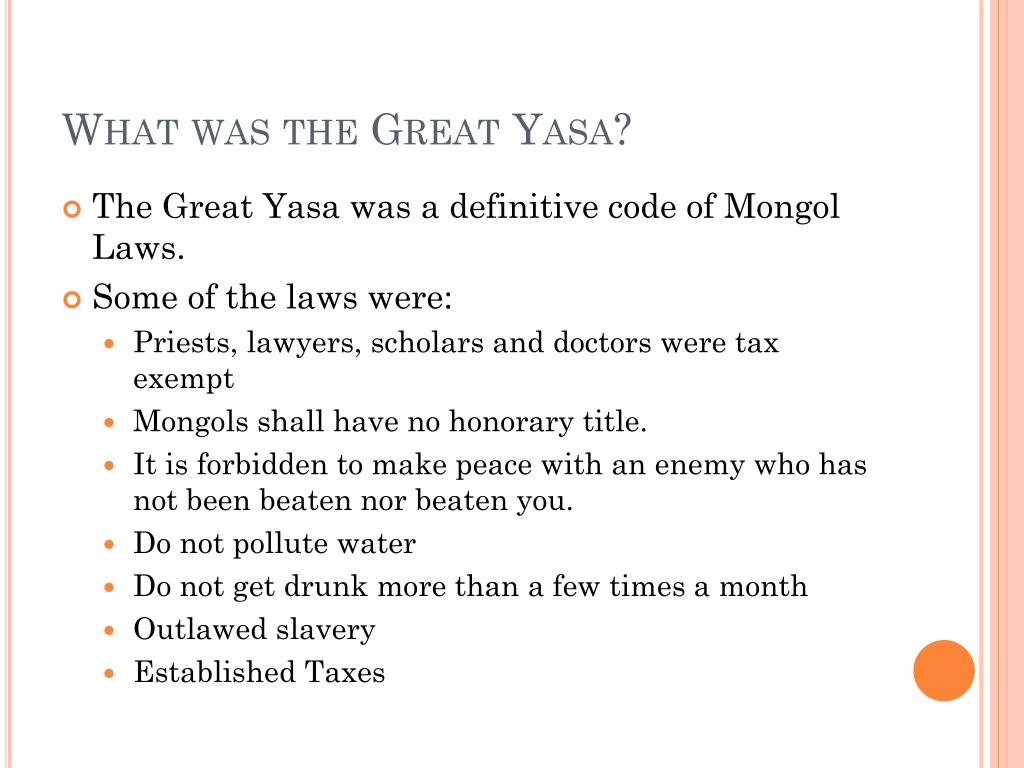
The laws Chinggis Khan enacted were known as the Great Yasa, Reportedly recorded in Uighur script, archeologists have never found the document. In general, they systematized existing Mongol taboos:

  • livestock had to be killed on their back to ensure now blood was wasted.
  • striking a horse in anger, wounding or stealing, resting a whip on it or touching it with a sword was punishable by death.
  • young birds were protected.
  • it was forbidden to extinguish a fire touching it with a knife.
  • it was forbidden to wash in a running steam in spring or summer or to urinate in a stream at any time
  • it was forbidden to spill liquid on the ground
  • spitting food on the ground was punishable by death
  • it was forbidden to step on the threshold of the great khan’s tent because it was sacred.
  • Military pillaging without permission or failing to pick a fallen comrade’s weapon was punishable by death. Likewise if Mongol divisions lost too many warriors in battle, their comrades could be put to death for lack of effort.*

*The Spartans enacted similar laws in Greece.

Film can be viewed free with a library card on Kanopy.

https://www.kanopy.com/en/pukeariki/watch/video/12373094/12373106

Will RFK Jr Be Trump’s Vaccine Czar?

Image: RawPixel.com

By Patricia Adams and Lawrence Solomon

In 2017, shortly before assuming the presidency, president-Elect Donald Trump asked Robert F. Kennedy Jr. if he would be willing to investigate one of Trump’s top-of-mind concerns — the safety of vaccines. Trump’s goal, to have Kennedy chair a “Vaccine Safety and Scientific Integrity Commission,” was soon sidetracked by the Russiagate accusation and then Covid.

But it was not forgotten.

In a recent leaked videotaped discussion between Trump and Kennedy, Trump reminded Kennedy about their 2017 discussion and urged him to take on the vaccine issue again. “I would love you to do so,” Trump urged.

Trump’s preoccupation with vaccines — coming the very day after the assasination attempt on his life and shortly before his formal acceptance as the Republican Party’s presidential  nominee — demonstrates that the government bureaucracies overseeing the vaccine industry remain top-of-mind to him.

“Something is wrong with that whole system,” he stated. “When you feed a baby, Bobby, a vaccination that is like 38 different vaccines and it looks like it’s meant for a horse, not a10-pound or a 20-pound baby… do you ever see the size of it, its massive, then you see the baby all of a sudden starting to change radically. I’ve seen it too many times.”

In an attempt to clinch the deal, Trump pointedly referred to Kennedy’s long commitment to reforming the CDC and the vaccine industry, highlighting the personal satisfaction such an accomplishment would bring, and its importance to Kennedy’s legacy. “And I think it’ll be so good for you and so big for you.”

In their recent discussion, Trump and Kennedy didn’t discuss the specifics of what a renewed investigation of the vaccine industry would look like, but their 2017 discussion — an hour-long meeting held at Trump’s initiation that also included Kellyanne Conway and Mike Pence — raised the same issues that continue to preoccupy him today.

“He is troubled by questions of the links between certain vaccines and the epidemic of neurodevelopmental disorders including autism,” Kennedy told Science in a telephone interview at the time.

“And he has a number — he told me five — friends, he talked about each one of them, who has the same story of a child, a perfectly healthy child who went into a wellness visit around age 2, got a battery of vaccines, spiked a fever, and then developed a suite of deficits in the 3 months following the vaccine.

“He said that he understood that anecdote was not science, but said that if there’s enough anecdotal evidence… that we’d be arrogant to dismiss it.  Those were his words.”

In their recent discussion, Kennedy didn’t agree to take Trump up on his offer. No formal, detailed offer was even made, the call was merely the beginning of a process that Trump hoped would lead Kennedy to join the future Trump administration in a vaccine-related capacity.

The call wasn’t even supposed to be made public — Kennedy’s son, Bobby Kennedy III, leaked it on his own.  “When President Trump called me, I was taping with an in-house videographer.  I should have ordered the videographer to stop recording immediately. I am mortified that this was posted.  I apologize to the president,” Kennedy explained.

Following the leak, Kennedy told the press that he was continuing with his candidacy for president.  Should his candidacy fail and Trump’s succeeds, as appears likely, look to negotiations between them to proceed for a vaccine-related role in Trump’s administration.

If Trump has a regret about his first term, it’s likely over his promotion of Covid vaccines — a policy that his base overwhelming opposes, so much so that it drew boos at his rallies.  The appointment of Robert F. Kennedy Jr, with his decades-long record investigating vaccines and with his bestselling exposé of Fauci and the corruption of the public-health establishment, would loom large in Trump’s legacy as well as RFK Jr’s.

[…]

Via https://www.americanthinker.com/blog/2024/07/will_rfk_jr_be_trump_s_vaccine_czar.html


Where Matters Stand: Getting Rid of Trump By Any Means Necessary

What Texas leaders said after assassination attempt at Trump rally

Paul Craig Roberts

The assassination issue has been reduced to operational failure and insufficient budgetary resources for the Secret Service, and the assassination has been moved aside by Kamala’s emergence as the Democrat candidate for President. The presstitutes are again speaking with one voice preparing the narrative of a close election that makes it possible to use the election theft mechanisms that have been legalized by the Democrats in the swing states.

Biden had to go because he was too discredited as a viable candidate for the Democrats to be able to steal the election in his behalf. Kamala, previously soundly rejected by Democrats as a presidential candidate is now being hyped as the candidate able to defeat Trump. Rigged polls are now showing a neck and neck contest, with Trump sometimes ahead by one point and Kamala ahead by 3 points. The purpose of these rigged polls and the media emphasis on what a viable and challenging opponent Kamala presents is to prepare the public’s acceptance of another stolen election.

In 2020 Trump got more votes than he got in 2016. Yet somehow he lost to Biden whose few campaign rallies attracted minimal attendance, but despite the lack of interest Biden got more votes than Hillary in 2016 and, if memory serves, the largest number of votes in US electoral history. Clearly no such thing happened.

Trump supporters take for granted that Trump is already elected. This confidence is not justified. They, and Trump himself, need to pay attention to how the presstitutes and the elite are creating a winning persona for Kamala. By implanting a close election in the voting public’s mind, the Democrats can steal the election. I think that is what will happen, thus ridding the ruling establishment of Trump’s threat to take away their power.

Lies and election theft have always been part of American politics. Power, not ideas, is what is important to the contestants and their backers. However, in 2016 a major change occurred. In his campaign Trump said he intended to normalize relations with Russia. This was a direct threat to the power and budget of the military/security complex which needs Russia as an enemy to justify its power and budget.

Trump also said in his inauguration speech that he was taking power away from the ruling establishment and giving it back to the people. No president had ever spoken in this way. Trump revealed himself as an existential threat to the ruling elite. The power elite assembled at his speech smiled and laughed at the unaware clown and soon began their political assassination of Trump with Russia-gate, two impeachments in the House of Representatives, pornstar-gate, documents-gate, and an “insurrection” that has put 1,000 of Trump’s supporters in prison as “insurgents” as a warning to others.

Trump’s challenge to the ruling elite and the massive support he received from the traditional American population scared the ruling elite whose control over America had been gradually tightened. The ruling elite decided on a coup. The Republican Party, whose voters stood with Trump, had to go. What we have witnessed in the Biden regime is the elite’s decision to install a one-party state completely under their control.

Rino Republican response is to continue in existence by out-competing Democrats in serving the interests of the ruling elite. Unsure of their ability to whore as well as Democrats is why the Republican Senate leader hates Trump. Trump has brought matters to a fight or surrender decision that Republicans prefer to avoid.

Concerning the assassination, we have no idea what effect it will have on Trump. Will he pull in his horns in order to continue his life?

What we do know is that like the assassinations of John F. Kennedy, Robert F. Kennedy, 9/11 and other such CIA/FBI/Joint Chiefs events, there will be no real investigation. No important evidence will even be mentioned–such as the acoustic evidence of the shots and their location, such as the upward trajectory of the bullet that struck the person in the corner at the top of the stand above Trump. How did Crooks’ shot allegedly fired at Trump, which would have had a downward trajectory strike a person above Trump? FBI director Wray prepares the cover by saying that Trump was not struck by a bullet but by shrapnel. In other words a bullet disintegrated and flew upward. Examination of the person’s wound would reveal whether it was a bullet or shrapnel. We will be told whatever fits the official narratives if we are told anything at all.

Having watched many coverups in my lifetime, I tried to prevent this one by early reporting the ignored real evidence before Republicans, delighted in giving Secret Service Director Kimberly Cheaters a verbal beating, a mistake as it outraged women, moved the issue off target. Once a coverup is set in stone with an official narrative, it is immune to evidence, like the assassinations of John and Robert Kennedy and 9/11. Evidence does not count once an official narrative has been established.

It was important that the acoustic and bullet trajectory evidence be immediately introduced prior to the establishment of the official narrative, but Republicans could not meet the challenge. Now we have a narrative without the real evidence.

The House of Representatives has voted unanimously to set up an investigative task force over the attempted assassination of Donald Trump. The fact that it is unanimous means that it will touch no real issue. Indeed, the investigation is limited to determining the nature of the failures of the Secret Service that permitted the assassination attempt by Thomas Matthew Crooks. The most likely result will be a larger budget for the Secret Service and, perhaps, a ban on such outdoor events.

In other words the narrative is that the Secret Service failed to stop Crooks. There is to be no examination if there were other shooters, if Crooks was merely a patsy, no examination of acoustic evidence, no explanation for an upward bullet trajectory. Nothing but a verification of the official narrative.

Who will the House rely on for the investigation? The House will rely on the suspects themselves–the Secret Service, the FBI, Homeland Security. FBI Director Wray, a Trump appointee, will respond to the House in keeping with the official narrative. The Republicans will be made impotent by being submerged in the official explanation.

At this point we do not know if Crooks fired a single shot. Despite Crooks being overlooked by Secret Service from two directions there are no videos of Crooks firing. Indeed, he was killed by a shot a quarter of a minute after all firing had stoped by a bullet that caused instant death. If he was in position firing his rifle, why is his dead body 7 feet away from the rifle?

Don’t expect questions like this to be part of the investigation.

How likely is it that Trump will be permitted to be elected? If he is elected and does not pull in his horns, will he serve out his term?

His appointees will be concerned mainly with their own careers. Their careers are non-existent if they are hard-nosed like Trump, but if they “moderate” Trump and can claim credit for making him reasonable and unifying, they will move up in the establishment. To “moderate” Trump means to defeat his and his supporters’ agenda.

In 2016 with their candidate, Hillary, defeated, the ruling establishment decided that there would be no more fair elections, that their control was more important.

The elite worked to institutionalize election theft so that it was no longer an issue.

The ruling elite have no concern or comprehension of the unintended consequences of their desperate hold on power. They have split the country worse that it was split by the tariff of 1861 that caused the so called “Civil War.” How does a split country stand up to the enemies the US government has created for America?

A government that bases itself on lies will eventually be discredited.

This will be America’s fate.

[…]

Via https://www.paulcraigroberts.org/2024/07/28/where-matters-stand/


Venezuelan Coup Attempt

Via https://politicalfilm.wordpress.com/2024/07/30/venezuela-coup-attempt-ned-cia/

EVs and Carbon Credits: Milking the Drying Up Cow

By Eric

How do you make money when half of the profit you make depends on government? You make EVS, is how.

But first, you get the government to require that other companies either reduce what’s called their “carbon footprint” – or buy credits from you for making EVs. The credits are viewed by the government – by the regulatory apparat – as equivalent to the company that buys them reducing the amount of “carbon” its operations produce, thereby satisfying the regs without actually reducing the amount of “carbon” produced by that company’s operations.

It works like a supermarket coupon for 10 percent off.

Just without the free exchange. A more accurate description would be supermarket “a” having to buy credits from supermarket “b” in order be allowed to sell anything at all.

This, in a nutshell, is the business model that built Tesla – and which now keeps it afloat. That – plus artificially inflated stock valuation based on government (via the regulatory apparat) essentially requiring that more EVs be manufactured – and eventually, only EVs –  leaving people no alternative to buying them.

The Wall Street Journal reports that half of Tesla’s second quarter profits – which by the way are down by about 45 percent – were “earned” (to misuse a word) via “selling” carbon credits to other companies that are effectively forced to purchase them in order to be allowed to sell anything at all.

Hence the air fingers quote marks bracketing the latter word. A “sale” that involves coercion is like a “date” that involves rape, in other words.

And rape can be financial as well as sexual.

Tesla used financial rape to finance the development of its first batch of EVs – chiefly by making other car companies (which at the time made no “zero emissions” EVs of their own) pay to offset the costs of designing and manufacturing them – by using the government to coerce them into buying credits from Tesla to satisfy government requirements that they also make “zero emissions” devices, irrespective of the absence of any market for them.

This costs them, of course.

But it was easier to just cut Tesla a check than it was to design and manufacture EVs of their own that they knew they would probably not be able to sell. Lots of hassle avoided by just paying up.

And so they did, bankrolling their own “competition,” which of course it isn’t, really – because absent government, there would be no Tesla. Except, perhaps as a very low volume manufacturer of extremely expensive toys for those with the money to spend on them.

Other companies that don’t make vehicles also “buy” credits from Tesla, which is the only manufacturer of “zero emissions” EVs exclusively. Tesla gets a lot of credit – and extorted cash – for that.

The other car companies now build EVs, too – but only enough to satisfy the “zero emissions” regulations and sales quotas that have been imposed in states such as CA. Not enough to “sell” carbon credits of their own – much as some of them would probably love to get into that “business.”

As recently as last year – the final year you could still buy cars like the Charger and Challenger as well as a V8 in a Ram truck – Stellantis was “buying” credits from Tesla worth millions annually (and billions, overall; you can read more about that here).

It no longer has to buy them – because it no longer sells the Charger and Challenger or the Hemi V8. Of course, it no longer sells those vehicles – or that engine – which used to provide the earnings needed to pay the credits and kept Dodge and Ram in the business of selling vehicles.

Dodge and Ram may not have to pay Tesla, going forward. But that’s like a person declaring bankruptcy so as to avoid having to pay creditors.

Meanwhile, Tesla’s “earnings” – all this italicizing can be tedious but it’s necessary in the interests of etymological honesty – are down by 45 percent, not counting the half of that that’s due to government taking (and redistributing). If that taking were taken into account, Tesla’s latest “earnings” would be half what Tesla just reported. Put another way, Tesla’s losses would be unsustainable – a word the Left loves to use to deride businesses that don’t require government to remain in business.

[…]

Via https://www.ericpetersautos.com/2024/07/29/milking-the-drying-up-cow/


Satan Wept – Paris 2024 Olympics

Dmitry Orlov

An odd set of events has recently taken place in the world of diplomacy: the governments of various Islamic countries have summoned French ambassadors in order to express to them utter outrage at the profanation of the great Islamic prophet Issa (a.k.a. Jesus) at the opening ceremony of the Olympic Games in Paris. There, the organizers saw it fit to present a ghastly tableau in imitation of Leonardo da Vinci’s classic The Last Supper featuring a fat lesbian in place of Jesus and a motley crew of transvestites in place of the apostles, all disporting themselves in a maximally perverse fashion. The leaders of Orthodox Christian nations did not follow suit, perhaps adhering to Issa’s dictum “Give not that which is holy unto the dogs, neither cast ye your pearls before swine, lest they trample them under their feet, and turn again and rend you.” (Matthew 7:6)

We can be sure that the organizers of the Olympics did not set out to maximally disgust everyone; they wanted to impress and to inspire. The Olympiads originated in festivals held to please and impress the gods of Mount Olympus — a quest for the divine. But it is a sign of extreme incompetence when an artist’s attempted renderings of angels end up looking like poorly drawn demons. More than that, in order to draw angels convincingly, one must be able to sense them (not necessarily to see them or, more likely, to hallucinate them); that is, there must be a spark of divine inspiration (as was clearly the case with da Vinci, or his masterpiece would not have been revered for five and a quarter centuries). Lacking any trace of divine inspiration, an artist would be well advised to stick to drawing demons.

Do I believe in divine inspiration? Belief is a vexed question for people who fancy themselves thoroughly modern and therefore thoroughly scientific. The Christian credo reads like a work of mythology laden with miracles — immaculate conception, resurrection, ascent unto heaven, etc. — and skeptics want proof before they will believe any of it. Such skepticism is important in many pursuits — forensic medicine, for instance — but not in others. What is love, for instance? Let’s be skeptical and consider it a hormonally mediated emotional state. Congratulations, skeptics, you are now self-identified as animals stuck in a perpetual mating season!

It is never a good idea to confuse knowledge with belief. Knowledge rests in proof; belief rests in suspension of disbelief and in a certain sense of trust — including trust in the inexplicable and the supernatural. Treated as separate, knowledge and belief can quite happily coexist inside any given mind. Moreover, belief is hardly ever a question of choice. More frequently, it is a matter of direct experience: you either can sense something that causes you to believe, or you can’t. Of course, if a child grows up surrounded by adults who claim that a child’s spontaneously developing spiritual sense is a fantasy or, worse, a hallucination, then it can be stifled quite effectively.

Those lucky enough to have been endowed with an innate spiritual sense that has not been stifled can perceive a certain difference between humans and animals — or, rather, human and animal souls. Lab mice have souls so puny and insignificant that they can be regarded as little biological machines. They are innocent creatures, incapable of good or evil, for their simple souls do not offer them that choice.

Humans, however, typically do confront that choice. In turn, those whose spiritual sense has not been stifled can perceive certain differences between human souls — by looking into a person’s eyes. Although some people have eyes so unexpressive that they might as well be bellybuttons, that is a rarity. What the eyes express most readily is vices: selfishness, viciousness, pride, avarice, envy, hatred, malice, lust, etc. In demonology made simple, those vices are demons that infest the soul; theoretically, they can be expelled. The more demons, the less the possibility of doing good and the greater the possibility of doing evil.

Can demons infest a body in absence of a soul, or in case of a soul as insignificant and puny as that of a lab mouse? It would seem that they can: animals can be conditioned to be arbitrarily nasty. For instance, pit bulls can be trained to attack and kill children. This does not make them evil: the evil is entirely in their human trainers. What, then, of humans whose spiritual sense has been stifled in childhood by being surrounded by scientifically minded skeptics that have never been taught to distinguish knowledge from belief, whose souls never developed beyond those of a lab mouse? Surely enough, with no spiritual sense to guide them, they can readily develop into characters that are nothing more than a combination of vices — an unsupervised playground for demons. Looking into their eyes causes buzzers and warning lights to go off in your head. In this way, your spiritual sense can keep you safe in everyday life and to help you avoid wasting your time when interviewing job applicants.

Why do demons exist? Here is Christianity made simple: they exist to tempt us. Without temptation there can be no sin, without sin there can be no repentance and without repentance there can be no salvation. Life is a trial in which our task is to fight off demons and to attract angels. When we fail, our souls are claimed by Satan; when we succeed, our souls enter into the Kingdom of Heaven.

Satan came to Paris hoping to claim some Christian souls at the Paris Olympiad, and what did he find? He found people working hard to impersonate demons: “Come, Satan, and claim our souls!” “What souls?” thought Satan, “You hardly have any! You are just some lab animals who have been trained to act out perversions. The efforts of my demons have been wasted on you. This is soooo frustrating!” And at that Satan wept.

[…]

Via https://boosty.to/cluborlov/posts/b22bce7f-07e4-4330-bbd6-3b8dd040aa4c


When Bin Laden Set Up a Base in London

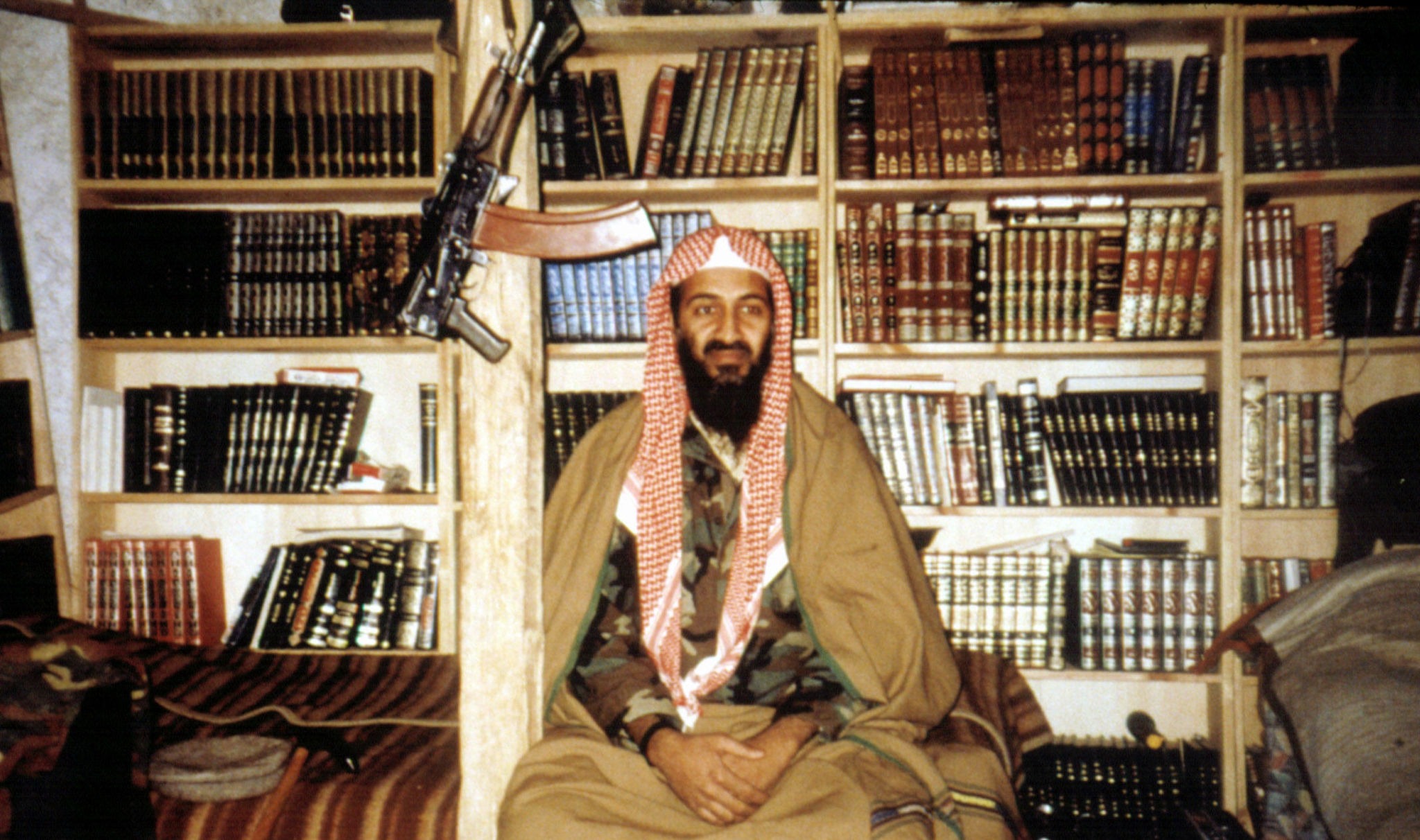
Osama Bin Laden. (Photo: Everett Collection / Alamy)

Thirty years on, questions remain as to why the UK authorities allowed the Al-Qaeda terrorist leader to run an office in the British capital for four years.

Thirty years ago this month, Al-Qaeda leader Osama Bin Laden established an office in a house in Kilburn, west London.

Seven years before 9/11, Bin Laden’s so-called Advice and Reformation Committee (ARC) was equipped with a bank of fax machines and computers which churned out dozens of pamphlets and communiqués.

The ARC lambasted the lavishness of the ruling family in Bin Laden’s native Saudi Arabia and its waywardness in promoting sharia law in the country, as well as calling for a break-up of the Saudi state.

But the purpose of the ARC went further.

US court documents noted it was “designed both to publicise Bin Laden’s statements and to provide cover for activity in support for Al Qaeda’s ‘military’ activities, including the recruitment of trainees, the disbursement of funds and the procurement of equipment and services.”

The London office also served as a communication centre for reports on military and security matters from various Al-Qaeda cells to its leadership.

A US Congressional research service report, released just after the September 11th attacks in 2001, asserted that Bin Laden even visited London in 1994 and stayed for a few months in Wembley to form the ARC, although this was never proven.

Whatever the truth of that claim, Bin Laden’s telephone billing records from 1996–8 show that nearly a fifth of his calls, 238 out of 1,100 – the largest single number – were made to London, showing the importance of this base.

It was the ARC that arranged a meeting between Bin Laden and a number of CNN journalists in March 1997.

Embassy bombings

The ARC’s staff included two members of the terrorist organisation Egyptian Islamic Jihad (EIJ) whose leader was Ayman al-Zawahiri, Bin Laden’s right-hand man.

One of the two EIJ figures was Adel Abdel Bary who, before arriving in Britain, was alleged by the US authorities to have managed Al-Qaeda training camps and guest houses. He was, however, granted asylum in the UK in 1993.

After working for Bin Laden in London, Abdel Bary was in 1998 arrested in Britain for his involvement in Al-Qaeda’s bombings of the US embassies in Kenya and Tanzania in August 1998. The simultaneous blasts killed over 200 people.

He was eventually extradited to the US and jailed for 25 years.

Also arrested for his role in the bombings was the second EIJ figure in Bin Laden’s London office. This was Ibrahim Eidarous, who is alleged to have organised the EIJ’s cell in Azerbaijan in 1995 before coming to London in 1997. While in Britain, he was also granted political asylum.

On the day of the East Africa bombings, both men disseminated the claims of responsibility through faxes to the media.

Lawyers for the two men denied they had advance knowledge of the bombings but an MI5 officer, later giving evidence to an immigration appeal, stated that the faxes were actually sent before the bombings took place.

Source of intelligence

The head of Bin Laden’s ARC was the Saudi dissident Khaled Al-Fawwaz, who was also arrested by British police in September 1998 for his involvement in the East Africa bombings the previous month.

Until this point the British authorities had allowed Al-Fawwaz and the ARC to operate openly for four years.

The US indictment against Al-Fawwaz alleged that he provided Bin Laden with “various means of communications” including a satellite telephone to speak to Al-Qaeda cells, and that he visited Nairobi in 1993 and established a residence there for Abu Ubaidah, one of Al-Qaeda’s military commanders.

The evidence suggests that the ARC’s activities were initially tolerated by the British, who may have seen them as a useful source of intelligence.

Al-Fawwaz’s lawyers said he was in regular contact with MI5 from the time he came to Britain in 1994 until his arrest four years later. His meetings often lasted for three or more hours while his phone was probably tapped and his correspondence intercepted.

The BBC’s Frank Gardner wrote: “MI5 appeared to be hoping that Mr al-Fawwaz would provide them with an insight into Islamist extremists living in Britain. Mr al-Fawwaz was under the impression that his contacts with the Security Service would keep him out of trouble.”

Yet Al-Fawwaz was eventually extradited from the UK to the US in 2012 and convicted in 2015 of involvement in the embassy bombings.

Alternative leaders

What may throw further light on the British authorities’ strategy at the time is the case of another Saudi dissident in London, who was not connected to the ARC.

Saad Al-Faqih was a former professor of surgery in Saudi Arabia who had lent his medical expertise to the anti-Soviet jihad in Afghanistan in the 1980s.

He fled Saudi Arabia in 1994 and set up another opposition group to the regime, the Movement for Islamic Reform in Arabia (MIRA), in London in 1996 and was given political asylum.

Al-Faqih said he maintained “high-level contacts” with the British intelligence services and gave them advice about Saudi Arabia.

But the British secret services may have seen the ARC and other groups as providing more than just intelligence.

Asked in an interview in 2003 about living in the UK, Al-Faqih replied that the British “have discovered that betting on strategic relations with the [Saudi] regime is dangerous. It is better to have relations with the people and I assume they know how much public support we have.”

Al-Faqih also said that “the British are shrewd enough to know that the Saudi regime is doomed and they want to be in a position to deal with alternative leaders.”

It is credible that Britain may have been attempting to cultivate relations with future policy-makers in the country by tolerating these opposition groups.

While Britain has long shored up the feudal rulers of Saudi Arabia, the long-term stability of the regime has equally long been questioned. Opposition groups could act as a kind of proxy force for Whitehall in the event of upheaval in the Saudi kingdom.

Faxing Jihad

The London base allowed Bin Laden to motivate his supporters around the world. The perpetrators of the 1995 bomb attacks in Saudi Arabia, for example, had read Bin Laden’s writings after they were faxed from London.

It was also from London that various of Bin Laden’s key fatwas were sent around the world.

The ARC, for example, disseminated the English translation of Bin Laden’s August 1996 declaration of jihad against the Americans “occupying the Land of the Two Holy Places”. This called for the US to be driven from Saudi Arabia, the overthrow of the House of Saud and Islamic revolution all over the world.

Two years later, in February 1998, the ARC publicised Bin Laden’s creation of an “International Front for Jihad against the Crusaders and the Jews”, joining together a variety of terrorist groups.

However, “this caused little stir in Whitehall”, Times journalists Sean O’Neill and Daniel McGrory noted.

Interviewing Bin Laden

Also instructive is that the British and US intelligence services repeatedly turned down the chance to acquire information on Bin Laden and Al-Qaeda in the 1990s.

In early 1995, for example, the Sudanese government, then hosting Bin Laden, offered to extradite or interview him and other key operatives who had been arrested on charges of planning terrorist atrocities.

The Sudanese proffered photographs and details on various militants, including Saudis, Yemenis and Egyptians who had fought in Afghanistan against the Soviets.

“We know them in detail,” said one Sudanese source. “We know their leaders, how they implement their policies, how they plan for the future. We have tried to feed this information to American and British intelligence so they can learn how things can be tackled.”

This Sudanese offer was rejected, reportedly due to the “irrational hatred” the US felt for the Sudanese regime, as was a similar subsequent offer made specifically to MI6.

Three years later, Britain was also to ignore an arrest warrant for Bin Laden issued by Libya.

Safe in London

So safe did Bin Laden’s supporters feel in London that, in 1995, they sent overtures to the Home Office enquiring whether their leader could claim political asylum.

The then home secretary in John Major’s Conservative government, Michael Howard, later said that an investigation by his staff into Bin Laden resulted in a banning order being placed on him.

In January 1996, the Home Office sent a letter to Bin Laden stating that he be “excluded from the United Kingdom on the grounds that your presence here would not be conducive to the public good.”

Presumably, giving asylum to Bin Laden would have been a step too far in view of Whitehall’s need to placate its Saudi ally.

But the 1998 embassy bombings were not the only terrorist outrages being planned by Bin Laden, or those close to him, during the period when his London base was in operation during 1994–98.

By late 1994, the CIA was designating Bin Laden as a terrorist threat. In June 1995, an Al-Qaeda team attacked Egyptian President Mubarak’s presidential motorcade during a visit to the Ethiopian capital, Addis Ababa.

The following year a secret CIA analysis showed the US was aware of Bin Laden’s financing of Islamic extremists responsible for attempted bombings against 100 US servicemen in Aden in 1992. He had funneled money to Egyptian extremists to buy weapons and bankrolled terrorist training camps in northern Sudan.

After moving to Afghanistan in May 1996, Bin Laden also set up terrorist training camps there under the protection of the Taliban government.

It beggars belief that British intelligence was also not aware of Bin Laden’s activities during the period when it tolerated his London base.

[…]

Via https://libya360.wordpress.com/2024/07/29/when-bin-laden-set-up-a-base-in-london/