Lithium Cabal Defeated in Bolivia, But Winning in Serbia

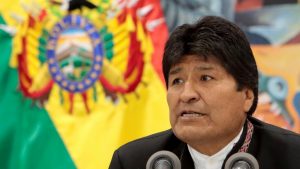
Image: Evo Morales (Source: Peoples Dispatch)

By Stephen Karganovic

A famous person (was it Karl Marx?) once remarked that when history repeats itself, the first time it is a tragedy, the second time a farce. Many of Marx’s important predictions may not have come to fruition exactly as he wanted, but on this one he was spot on.

The recent commotion in the South American country of Bolivia may be regarded as an illustration. The potential tragedy part of the drama was the 2019 coup, executed professionally according to the regime change rulebook in order to seize the country’s valuable lithium deposits and incidentally despoil it’s citizens of all their remaining mineral wealth.

In that coup, President Evo Morales, the indisputable champion of the bulk of Bolivia’s majority indigenous population, was ruthlessly deposed. The farce is the amateurishly attempted replay of that episode on 26 June 2024, which in spite of best laid plans unexpectedly went awry. The farce took all of three hours to collapse.

On both occasions, in 2019 and on 26 June 2024, the principal points of contention were Bolivia’s vast lithium deposits, estimated at 21 million tonnes, and for whose benefit they would be exploited.

A related but equally fundamental issue was (and still very much is) Bolivia’s orientation in the geopolitical arena, whether it would side with the BRICS block or the collective West.

In everything but the operation’s outcome in the farcical stage, the symmetry between the two coups was evident.

In 2019 the intended rapine of Bolivia’s natural resources, with lithium deposits at the top of the plunder list, initially was successful but ultimately it failed.

To be sure, the regime change manual was followed faithfully. After shameless electoral interference with abundant cash and a flood of corrupt media disinformation, Evo Morales’s commanding lead in the 2019 elections was whittled down to a manageable level so that his electoral victory could be plausibly portrayed as stolen.

In standard fashion, rented mobs demanded his withdrawal and commissions were set up by vassal entities such as the Organisation of American States to declare that the election process was fraudulent. At the appropriate moment, army officers who almost to a man were graduates of the notorious subversion academy, the School of the Americas (since innocuously renamed Western Hemisphere Institute for Security Cooperation to cover up its criminal tracks) were activated to administer the coup de grace to Morales’ presidency, or so it was expected. The legally re-elected, however narrowly, President Morales was compelled to flee for his life into exile.

A dumb and as it turned out also venal, but extremely cooperative, Aryan blonde without a drop of Inca blood, Jeanine Áñez, was invested with the presidential sash and illegally installed to replace him.

The multinational lithium cartel could now rub their hands and gloat over the succulent Bolivian pickings that had fallen into their lap, a booty Butch Cassidy and the Sundance Kid could only have dreamed of.

Elon Musk, one of the rapacious magnates who was allegedly involved in the coup and who was in dire need of lithium to power his electric car venture, publicly flaunted his complicity in the affair, instigated to thwart the political will of a long-suffering and impoverished nation. He arrogantly boasted that “we will coup whoever we want” when asked to explain his sordid role in  overthrowing a democratically elected foreign government.

But it was a short lived party. Bolivia’s unwashed masses, the Andean “deplorables,” stubbornly refused to play by the script. Following months of civil disobedience by the abused population, Bolivia became virtually ungovernable and it was the coup regime that finally had to give in.

After a new election, Bolivia was returned to constitutional rule under the legally elected current President Luis Arce, Morales’ protégé and former finance minister.

The stage was set for the recent farce the moment Evo Morales announced his intention to run for President in the forthcoming 2025 elections.

His stand-in Luis Arce’s patriotic policies were bad enough for the cabal, particularly his plan to treat Bolivia’s national resources as the common patrimony of its people, to explore the use of safe lithium extraction technologies developed by Russia, and to apply for membership in BRICS.

But the prospect of their charismatic bête noire Evo Morales’ being elected again next year was simply intolerable for both oligarchies, the international and the domestic.

The big lesson of the failed attempted coup in Bolivia is that the hegemon’s bag of tricks is nearly empty and that its technologies of control, which in the past had almost always worked flawlessly, are now faltering badly. It is futile however to try to teach an old dog new tricks.

Taking a leaf from Alexander Lukashenko’s playbook during the foreign orchestrated upheaval in Belarus, instead of fleeing to seek refuge in a foreign embassy, which is what Latin American presidents have traditionally done in similar circumstances, Luis Arce decided to change the paradigm. He came down from his office, personally confronted the rebellious troops, all native Bolivians like himself, informed them that he was their legal President and commander-in-chief, and addressing them over the head of the treacherous School of the Americas graduate, General Juan José Zúñiga, who enticed them to mutiny on the false pretext of protecting democracy, Arce ordered them to return to their barracks. And lo and behold, obediently they did. After a brief stand-off in Plaza Murillo in front of the Presidential palace, the second Bolivian lithium coup fizzled pathetically.

But as the saying goes, you lose some and you win some. Whilst being chased out of proud Bolivia, the lithium cabal are scoring big in servile Serbia.

Compared to Bolivia and other lithium rich countries, Serbia’s reserves are relatively modest, estimated at 1,3 million tonnes. It is nevertheless an attractive venue because its corrupt regime grants foreign concessions on the principle of baksheesh and is always keen to make under the table deals for a cut of the proceeds.

It is as uninterested in the devastating impact of unregulated lithium mining as it is completely indifferent to where its munitions will end up in the Ukrainian conflict. The health of citizens theoretically entrusted to its care or the environment are the least of its concerns.

Mostly unnoticed by the rest of the world, for several years an intense lithium battle has been simmering in Serbia. Spearheading the international mining cartel’s assault on Serbia’s mineral wealth is the predatory Rio Tinto corporation, an outfit with a terrible record for environmentally destructive practices and callous exploitation of human labour.

One suspects that the reason Rio Tinto and the Serbian government are getting on so well is that they are kindred spirits.

The crux of the Serbian situation is that the government does not have a policy of treating natural resources as the inalienable patrimony of the nation not subject to privatisation and which must be administered with regard for the common good.

Rio Tinto’s objective, naturally, is the maximisation of profit for the least investment. There are other European countries, such as Germany, which have considerable lithium deposits but they also have strict environmental laws, high labour costs, and a much more ecologically sophisticated public than is the case in Serbia.

That is why for Rio Tinto a symbiotic relationship with Serbia’s corrupt government is the perfect solution for getting a piece of the electric vehicle battery market at minimum cost. The waste its mining activities would leave behind once they cease to be profitable, having devastated productive agricultural land and contaminating Serbia’s water supply with poisonous substances, is not Rio Tinto’s problem. It should be the government’s concern, of course, but like everywhere else where it operates Rio Tinto has the government in its pocket.

There are indications that sections of the Serbian public are waking up to the existential danger to life and health posed by their government’s shady deal with a predatory corporation whose track record is scandalous even by the abysmally low mining industry standards. Serbs do not have the stamina of Bolivians, but over the next several weeks protests are scheduled in the most endangered areas as well as in the rest of the country.

It is unlikely that the protesters will stray very far from their comfort zone or that a general on a white horse (perhaps this time a graduate of the Suvorov military academy?) will appear to save the day. But as the situation unfolds it bears watching, and we will keep readers abreast of further developments as warranted.

[…]

Via https://www.globalresearch.ca/lithium-cabal-bolivia-serbia/5861727

US Sanctions Backfire: How Washington’s Economic War Against Venezuela Fueled Mass Migration to Its Southern Borders

As predicted, there is another attempted coup in Venezuela following President Nicolas Maduro’s victory over the US-Backed Presidential candidate, Edmundo González and opposition leader, Maria Corina Machado. Obviously, Gonzalez and his staunch supporter, Maria Corina Machado, an extremist who in the past asked the Prime Minister of Israel, Benjamin Netanyahu to help overthrow the Maduro government is the favorite of Washington. But no surprise, the Biden regime now recognizes Gonzalez as the winner.

However, the attempted coup and the mass migration problem of Venezuelan migrants reaching the US southern border was made in the USA.  The US government played a significant role in the surge of Venezuelans entering the US illegally especially since the former US President, Donald Trump imposed the some of the harshest sanctions on Venezuela in efforts to force regime change. 

An article from the mainstream media that is worth mentioning is from The Washington Post, ‘Trump White House was warned sanctions on Venezuela could fuel migration’ focuses on Venezuelan migration to the US borders. There were four reports according to some former and current U.S. government officials specifically on Trump sanctioning Venezuela although their economy was in a dire situation at the time,

“The Trump White House was warned that harsh sanctions on Venezuela could accelerate that country’s economic collapse and speed an exodus of millions of migrants to neighboring nations.”

The classified assessments were delivered by the Department of Homeland Security (DHS) office of Intelligence and Analysis from 2017 to 2019. Despite The Washington Post accusing the Maduro government of “human rights abuses, extrajudicial killings and corruption by the regime of dictator Nicolás Maduro” (*notice how the mainstream media likes to use the word “regime” when describing an enemy of the United States). According to the Washington Post observation on the Maduro government:

Today, however, Maduro remains in power, and a surge in Venezuelan immigrants has emerged as a flash point in the U.S. presidential election. Though Venezuelan mass migration to the United States only began after President Biden took office, concern among Trump officials about the sanctions’ potential effects, including on migration, was more extensive than previously known, according to interviews with more than two dozen current and former U.S. officials.

“This is the point I made at the time: I said the sanctions were going to grind the Venezuelan economy into dust and have huge human consequences, one of which would be out-migration,” said Thomas Shannon, who served as undersecretary for political affairs at the State Department under President Donald Trump.  “The sanctions clearly helped generate faster out-migration,” Shannon said. “And you knew it was only going to be a matter of time before these people decided to migrate north”

Today, it is estimated that more than seven million Venezuelans have left the country due to the severe economic situation that has developed since 2012. Neocons such as John Bolton blame the Venezuelan governments “mismanagement” not US sanctions:

Proponents, such as former top Trump aide John Bolton, defend the sanctions as a critically important, though unsuccessful, effort to force out Maduro, or at least limit the funds at his disposal. Venezuelans had already started fleeing before the sanctions were imposed, they stress, escaping an economic crisis rooted not in U.S. penalties but in mismanagement by Maduro and his predecessor, authoritarian leader Hugo Chávez

However, it was the crippling US sanctions imposed on Venezuela that caused the destruction of its economy:

But other former Trump officials, particularly at the State and Treasury departments, say it is clear U.S. sanctions aggravated an already dire situation with little clear upside. Venezuela’s economy contracted by a staggering 71 percent from 2012 to 2020 — the largest such drop in modern history for a country not at war — as the U.S. impeded its oil industry and curtailed access to international markets

There are Venezuelans who do blame both the Maduro government and US sanctions for their economic situation such as Rosa Grande who was “optimistic about the sanctions when they were first imposed” and that she hoped “Maduro will “go to jail because he destroyed my future, the future of my children, and the future of my country.” However, by 2020, the US sanctions destroyed her father’s business forcing her to move to the U.S., “The sanctions “just led to more misery, and more hunger,” said Grande, who now lives in North Carolina.”

Right-wing news propaganda channel, Newsmax, who aspires to become another Fox news network channel also admitted in an article titled ‘Venezuelan Opposition Says It Has Proof Its Candidate Defeated Maduro’ that US sanctions accelerated the flow of Venezuelan migrants to the US southern borders,

“U.S. oil sanctions sought to force Maduro from power after his 2018 reelection, which dozens of countries condemned as illegitimate. But the sanctions only accelerated the exodus of some 7.7 million Venezuelans who have fled their crisis-stricken nation.”

The Center for Economic and Policy Research (CEPR) published a report ‘The Human Consequences of Economic Sanctions’ by Francisco Rodríguez, a Venezuelan native and the founder Oil for Venezuela, a non-profit organization dedicated to easing Venezuela’s economic crisis explained the impact of US sanctions and its effects on Venezuela’s oil industry, stated the fact that

“Broad economic sanctions, beginning with limitations on financing, were first imposed on Venezuela in 2017, when the Trump administration barred financing and dividend payments to Venezuela’s government and state-owned oil company, Petróleos de Venezuela, S.A. (PDVSA)” but that was not the only sanctions imposed on Venezuela, the Obama regime also had their hand in destroying Venezuela’s economy, “The US also used personal sanctions — first selectively imposed by the Obama administration in 2015 — to target top government officials and political figures as well as private-sector actors believed to be connected with the Maduro government.”

Rodriquez described the impact of the US sanctions and the decline of oil prices on Venezuela’s economic output:

Each round of sanctions (2017 financial, 2019 primary oil, and 2020 secondary oil) was followed by a decline in Venezuelan oil production, which, as measured by independent agencies, had been stable for an eight-year period starting in 2008. Though it had begun to decline in early 2016, prior to the 2017 economic sanctions, this decline appears to have been a consequence of the collapse in oil prices that occurred at the time and affected most other high-cost producers. But even when oil prices began to recover in 2017, Venezuela’s oil production accelerated its decline even as production stabilized or recovered in comparable economies

This essentially contributed to a decrease in the importation of food, equipment and supplies that supported its agricultural sectors:

The resulting decline in oil exports severely circumscribed the ability of a traditionally import-dependent economy to buy imports of food as well as intermediate and capital goods for its agricultural sector, driving the economy into a major humanitarian crisis. Total imports fell by 91 percent, while food imports declined by 78 percent. The decline in the economy’s capacity to import made it impossible to maintain past levels of essential goods

Another problem that US sanctions and the Venezuela’s decline of oil production in regard to the revenue it once earned from its oil sales is that it had a negative impact of health and food security that contributed to the increase in child and adult mortality rates in the country:

Venezuela’s deep deterioration in indicators of health, nutrition, and food security occurred alongside the largest economic collapse, outside of wartime, since 1950. The collapse in oil revenues drove the economic contraction, which caused the deterioration in socioeconomic indicators. By contributing to lowering the country’s oil production, sanctions also contributed to lowering per capita income and living standards and are a key driver of the country’s health crisis, including its increase in child and adult mortality

Since Maduro declared victory over Edmundo González, the US, its European allies and Venezuela’s right-wing extremists want to get rid of the Bolivarian Revolution, but that won’t happen because the Venezuelan people and the world know that the US government and Big Oil want control of Venezuela’s oil.

In Trump’s State of the Union speech on February 6, 2019, he declared

“We stand with the Venezuelan people in their noble quest for freedom—and we condemn the brutality of the Maduro regime, whose socialist policies have turned that nation from being the wealthiest in South America into a state of abject poverty and despair.”

Anti-Maduro forces all claim that Venezuela was once a wealthy country, but for who?  Trump and others make it sound like all of Venezuela was once wealthy, but that claim is a myth because before the late Hugo Chavez got into office, Venezuela was a basket case of poverty according to Venezuelanalysis.com, a think tank that focuses on Venezuela’s economic history:

In reality, when Chávez was first elected in 1998, Venezuela had a 50% poverty rate, despite having been a major oil exporter for several decades. It started exporting oil in the 1920s, and it was only in the early 1970s that the biggest Middle Eastern oil producers, Saudi Arabia and Iran, surpassed Venezuela in production. In 1992, the New York Times (2/5/92) reported that “only 57% of Venezuelans are able to afford more than one meal a day.” Does that sound like “one of the richest countries in the world”? Obviously not, but it is worth saying more about the statistics that can be used to mislead people about Venezuela’s economic history

Washington’s sanctions have contributed to Venezuela’s economic crisis which is an excuse for Washington to blame it on the Maduro government and call for regime change to install a government that will be subservient to their interests that includes the control of its oil resources and preventing them from joining the BRICS alliance.

The US wants its hegemonic power to remain a dominant force in its “backyard,” so the Maduro government and its supporters will have to remain vigilant.  So far, the coup has failed, but the US and its allies won’t go away quietly, the regime change forces will continue until the people of Venezuela stops them in their tracks and that day will come sooner or later.

Many other countries from around the world besides Venezuela have also suffered from the same US sanctions, wars, regime change and economic exploitation under the US government’s foreign policies especially since the September 11th attacks under both the Democrats and Republicans.  Washington is to blame for their massive illegal immigration at their southern border caused by their reckless foreign policies that have produced nothing but unintended consequences.

[…]

Via https://www.globalresearch.ca/us-sanctions-backfire-venezuela-mass-migration/5864438

Bill Gates and WHO Call For Military To Round Up mRNA Vaccine Refusers During Bird Flu Pandemic

Bill Gates has joined forces with the World Health Organization in calling for vaccine refusers to be rounded up by the military and force-jabbed with mRNA during the next pandemic.

Baxter Dmitry

Bill Gates has joined forces with the World Health Organization in calling for vaccine refusers to be rounded up by the military and force-jabbed with mRNA during the next pandemic.

Gates and the WHO have ordered governments to lay the groundwork to mobilize the military because they claim that vaccine skepticism is “morally reprehensible” and vaccine refusal is an “act of aggression” that must be met with force.

Bill Gate and the Dr Tedros of the globalist World Health Organization have announced a new project to turbo-charge the development and distribution of mRNA vaccines for an apparently looming bird flu pandemic.

However, the elite are rattled by the wave of vaccine skepticism which has spread around the United States and the world in the wake of the disastrous Covid mRNA vaccine roll out.

As more people refuse to submit to their vaccines, the elite are working on new and authoritarian ways to force their slew of new injectibles into our bodies without our consent.

A prominent Bill Gates-funded funded doctor has called for police forces and the military to be deployed as part of an effort to deal with what the pharmaceutical elite are now calling “anti-vaccine aggression.”

According to Dr. Peter Hotez, a close associate of Bill Gates and Dr. Tedros, they are now pushing to get NATO on board with militarizing the next mRNA vaccine roll out around the world.

The Bill and Melinda Gates Foundation have provided Dr. Hotez with tens of millions of dollars in funding to produce experimental vaccines.

As well as lining his own pockets, Hotez used the money to develop the Corbevax COVID-19 vaccine, which was administered in India, the country Bill Gates’ considers his personal laboratory.

Yet Dr. Hotez is terrified of having his pro-vaccine authoritarianism challenged in public.

The Bill Gates ally is on record stating that anybody criticizing vaccines should be charged with a hate crime. Yes, really.

The pro-vaccine elite do not like criticism and they do not like public debate.

Joe Rogan invited Hotez to appear on his podcast to discuss the Covid-19 vaccine controversy with Robert F. Kennedy Jr., who has been exposing the truth about the vaccine since it was first rolled out.

The exchange began over Hotez sharing and promoting a Vice article that called on Spotify to censor Joe Rogan’s show whenever he dares to criticize vaccines or question the official narrative.

Once Rogan caught wind of what Hotez tweeted, he replied to him by offering to donate $100,000 to a charity of Hotez’s choice if he would debate RFK Jr. on his show.

“Peter, if you claim what RFKjr is saying is “misinformation” I am offering you $100,000.00 to the charity of your choice if you’re willing to debate him on my show with no time limit,” Rogan tweeted.

Hotez replied to Rogan, stating that he had his contact information.

“Joe, you have my cell, my email, I’m always willing to speak with you,” the tweet read.

Things took a quick turn once Twitter’s CEO and owner of Tesla, Elon Musk, jumped into the exchange, saying that Hotez is afraid to face a public debate.

“He’s afraid of a public debate, because he knows he’s wrong,” Musk tweeted.

Following Musk’s tweet, hedge fund manager Bill Ackman replied stating, “I will add $150,000 to @joerogan‘s wager so now $250,000 can go to charity and the public can hear an open debate on an important topic.”

And yet Hotez, who wants to use the military to round up and force-jab vaccine refusers, still refused to debate RFK Jr on the topic of Covid-19 vaccines.

Why are these far-left authoritarians so confident in calling for an end to medical freedom and liberty in the US, yet terrified to have their ideas examined in public?

According to a Health and Human Services whistleblower, it’s because they know the global elite are making moves behind the scenes to eradicate the freedom to dissent once and for all.

Rounding up millions of vaccine refusers and dissidents against the globalist agenda might sound like an impossible task.

Until you understand the Biden administration has been laying the groundwork to make this a reality for the past 12 months.

A whistleblower who worked for the Department of Health and Human Services has revealed the US government in collaboration with the World Economic Forum is building secret detention facilities in 50 states capable of detaining millions of people.

According to Christie Hutcherson, these prison-like compounds located in sparsely populated and controlled locations, will be used for those who refuse to comply with upcoming government mandates and regulations regarding long-term lockdowns and new vaccines for the new plandemic.

Hutcherson is somebody we should be listening to very closely. Former Customs and Border Protection Supervisor J.J. Carrell explains more.

Make no mistake, these compounds are being built for anti-globalist dissidents including mRNA vaccine refusers.

[…]

Via https://thepeoplesvoice.tv/bill-gates-and-who-call-for-military-to-round-up-mrna-vaccine-refusers-during-bird-flu-pandemic/


The Death of Chinggis Khan

PPT - The Transcontinental Empire of Chinggis Khan PowerPoint Presentation - ID:2251675

Episode 8 The Death of Chinggis Khan

The Mongol Empire

Dr Craig Benjamin (2020)

Film Review

Chingghis Khan’s death resulted from an August 1226 hunting accident in which his horse bolted and threw him. He was leading a renewed campaign against the Tenguit leaders of Xi Xia, ao punish them for making peace with the Jin Empire. When the eight-year Kharazmian campaign ended in January 1226, he returned to Tuul and invaded Xi Xia. It was traditional to hold a massive ceremonial hunt to prepare Mongols for battle.

He never recovered. Prior to his death (at age 65) in August 1226, he convened a kuritai (meeting of klan elders), which voted to support his proposal to divide the Mongol empire into four regions to be ruled by his three sons (Tolui, Ogedai and Chagtai) and his grandson Batu (son of his deceased son Jochi). Each of the four khanates was allotted 4,000 families. Ogedai was designated to succeed Chinggis Khan as Great Khan.

His sons Ogedai and Tolui eventually decimated the Xi Xia capital Gongsing and the Tengut royal family, integrating Xi Xia into Mongolia.

In assessing the legacy of Chinggis Khan, Benjamin observes that the mass murder of civilians and life-supporting infrastructure was unprecedented prior to the 20th century. The first Great Khan was most likely guilty of genocide, a concept that didn’t exist in the 13th century.

The first great Mongol leader also left a massive genetic legacy with roughly 16 million (8%) Asian men estimated to be his direct descendants (as determined by Y chromosome analysis).

Film can be viewed free with a library card on Kanopy.

https://www.kanopy.com/en/pukeariki/watch/video/12373094/12373110

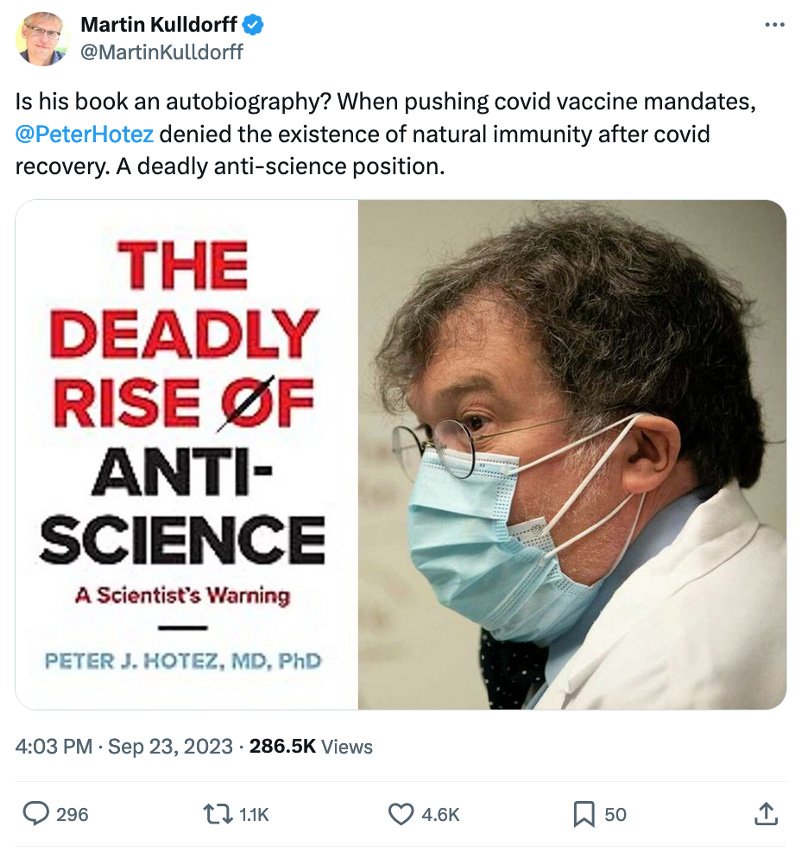
Hotez Calls for Police Deployment against “Anti-Vaxxers”

Social media went a little bonkers last week when an interview of Texas Children’s Hospital’s Dr. Peter Hotez began circulating with the Big Pharma insider calling for the United Nations and NATO to deploy security forces against “anti-vaxxers” in the United States. Dr. Hotez’s statements first appeared on the YouTube channel of an international pediatric conference that took place in Colombia, but the interview then jumped onto X.

The Simposio Internacional de Actualización en Pediatría (International Symposium of Pediatric Updates) later removed the interview from YouTube although photos can still be found on Facebook.

In clips of Hotez’s interview that continue to circulate on X, he claims “anti-vaxxers” caused hundreds of thousands of deaths in the United States. I uploaded one clip to my YouTube channel which you can watch here:

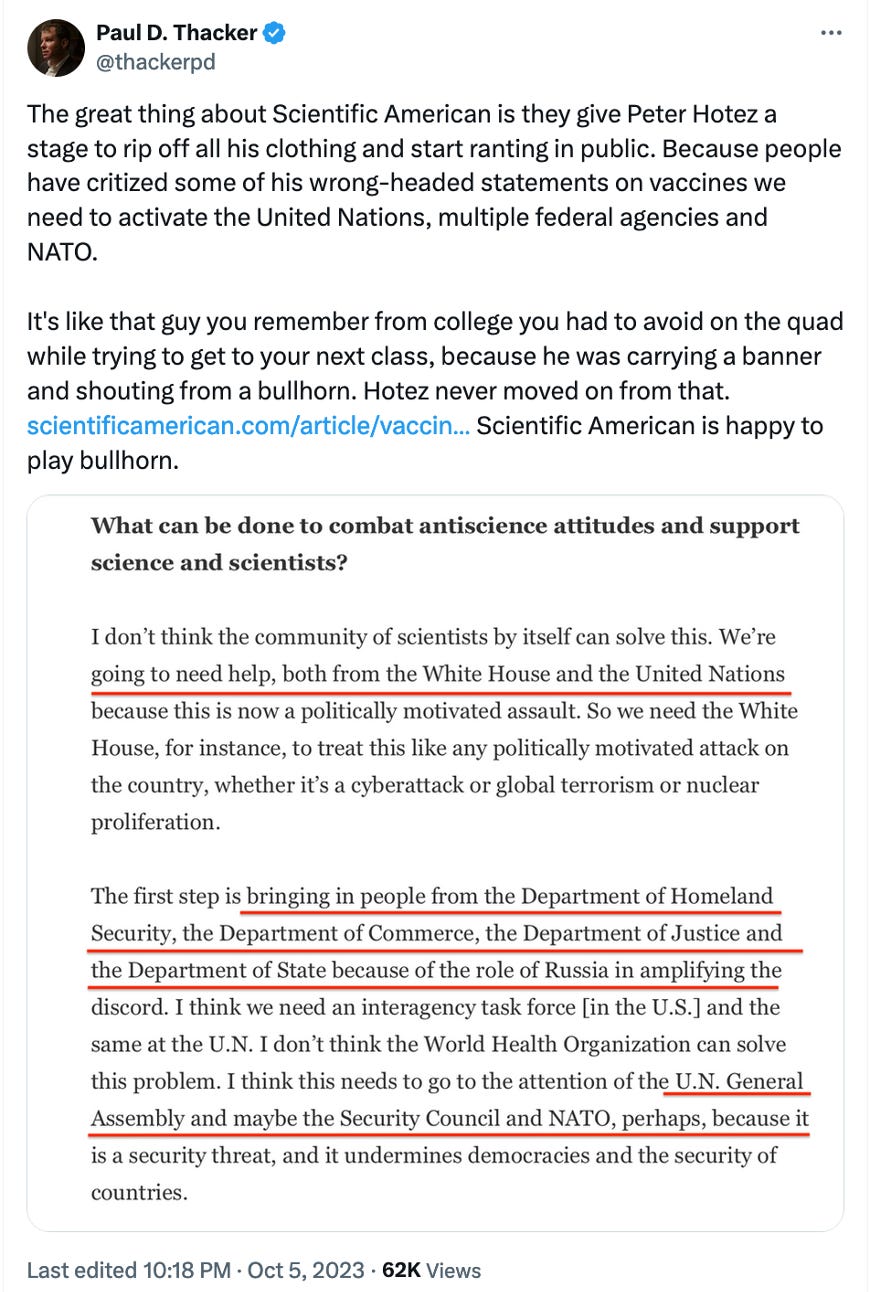
What I’ve said to the Biden administration is, the health sector can’t solve this on its own. We’re going to have to bring in Homeland Security, the Commerce Department, Justice Department to help us understand how to do this.

I’ve said the same with … I met with [WHO general director] Dr. Tedros last month … to say, I don’t know that the World Health Organization can solve this on our own. We need the other United Nations agencies—NATO. This is a security problem, because it’s no longer a theoretical construct or some arcane academic exercise. Two hundred thousand Americans died because of anti-vaccine aggression, anti-science aggression.

And so, this is now a lethal force … and now I feel as a pediatric vaccine scientist … it’s important, just as important for me to make new vaccines, to save lives. The other side of saving lives is countering this anti-vaccine aggression.

Hotez has long been noted for promoting controversial and sometimes false statement about the COVID pandemic and then accusing his critics of “anti-science.”

But this is not the first time Hotez has called for police to deploy against those who disagree with his views on science. Last October, Scientific American platformed Hotez as an expert on “anti-science” and didn’t bat an eyelid when he said support for scientists would require intervention by the Department of Homeland Security and the creation of a federal interagency task force.

Dr. Hotez again called for deploying federal police to support science during a grand rounds lecture he gave in August 2021. A whistleblower at Texas Children’s Hospital sent me the lecture where Hotez said the “disinformation empire” threatened America and would need to dealt with by the Department of Homeland Security:

The problem is the disinformation empire is so vast and pervasive that until we do something more definitive to get to the source of the disinformation and stop it, it’s not going to have that much of an impact. And that’s where everybody moves away from me.

And I tend to be out on a … out on my own here.

Earlier this year, Time Magazine named Hotez a “Science Warrior” and one of the 100 most influential people in global health.

[…]

Via https://disinformationchronicle.substack.com/p/vaccine-cheerleader-dr-peter-hotez

Young Women Continue to “Die Suddenly” from Cardiac Arrest

Dr William Makis MD

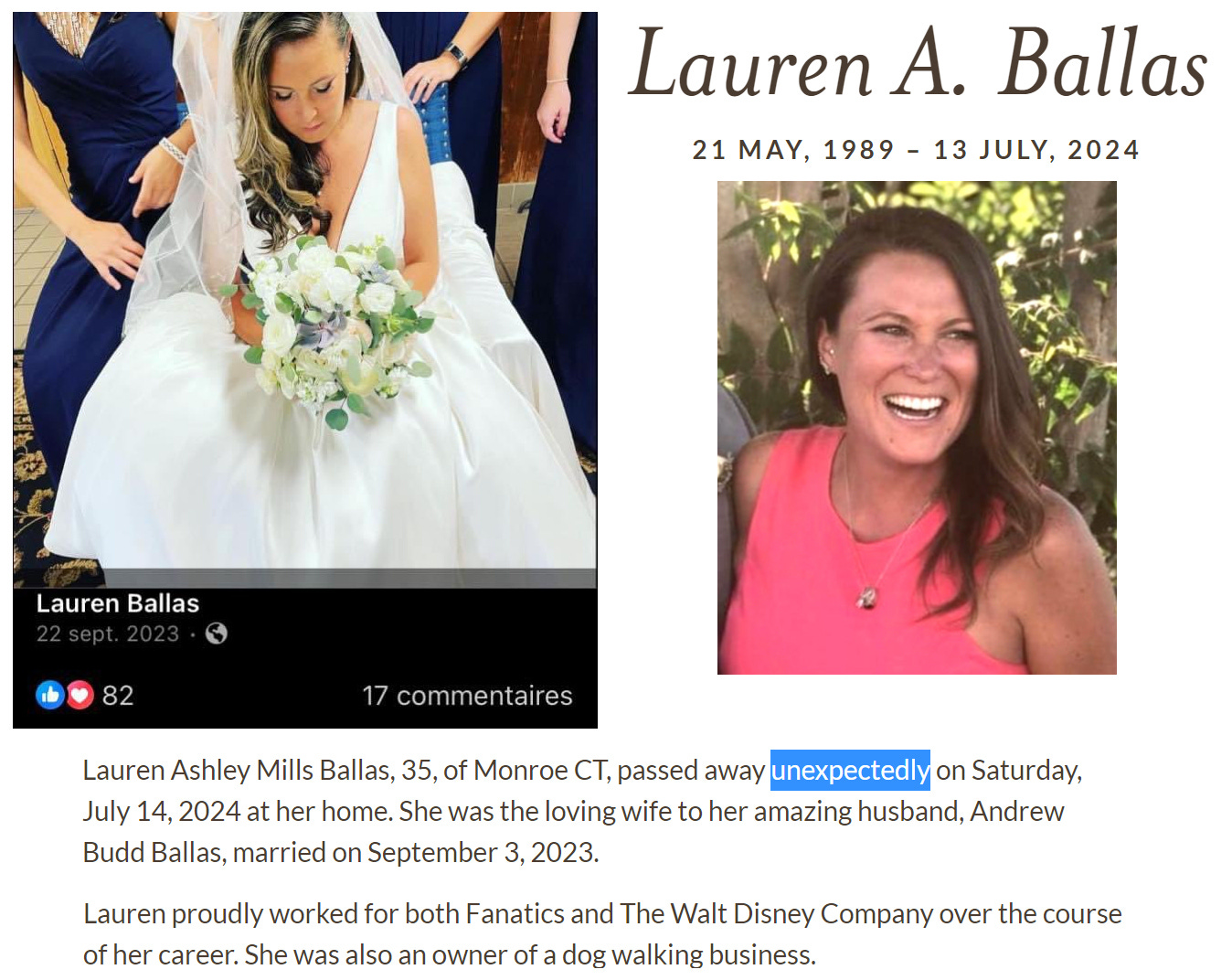
I have reported over 6000 “Died Suddenly” cases since April 2023, and I have seen it all.

Most recently, it’s young women, cardiac arrest after cardiac arrest.

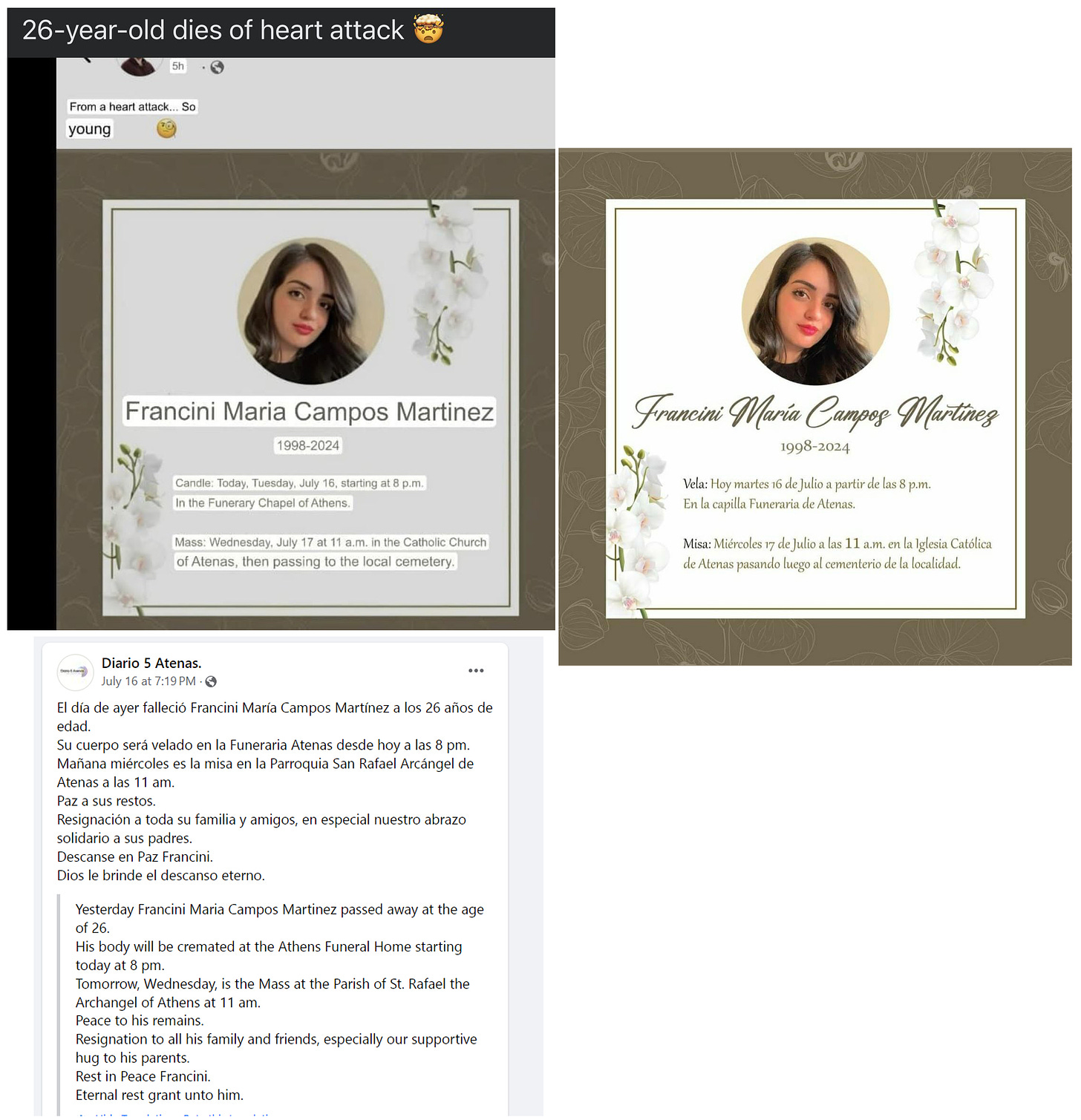
July 16, 2024 – Costa Rica – 26 year old Francini Maria Campos Martinez died suddenly from a cardiac arrest on July 16, 2024.

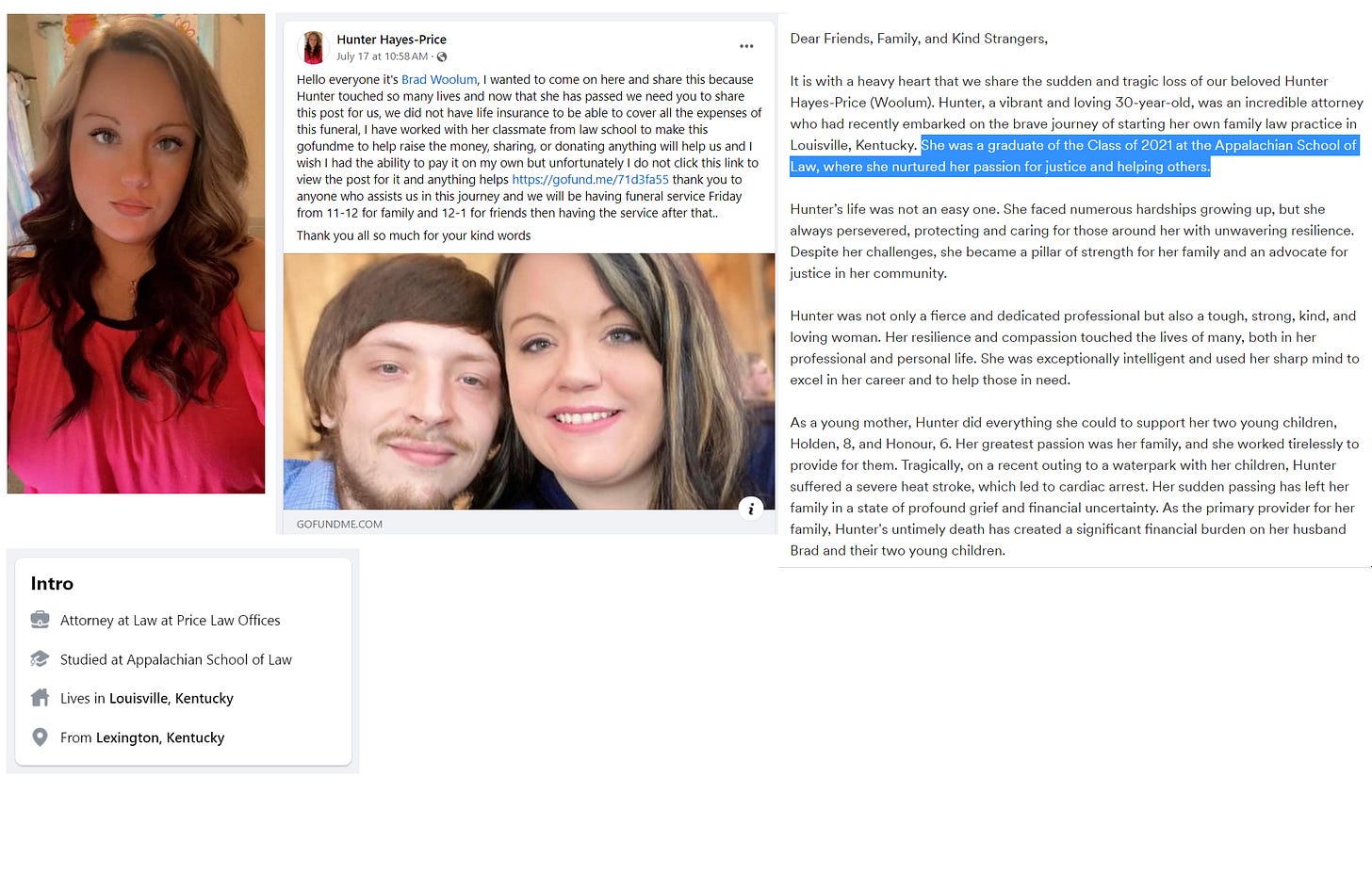
July 13, 2024 – Louisville, KY – 30 year old lawyer and mom, Hunter Hayes-Price died suddenly on July 13, 2024. “On a recent outing to a waterpark with her children, Hunter suffered a severe heat stroke, which led to cardiac arrest” She was a graduate of 2021 at Appalachian School of Law.

July 5, 2024 – 32 year old Rebecca Trudel (Manitou Beach, SK, Canada), died unexpectedly on July 5, 2024.

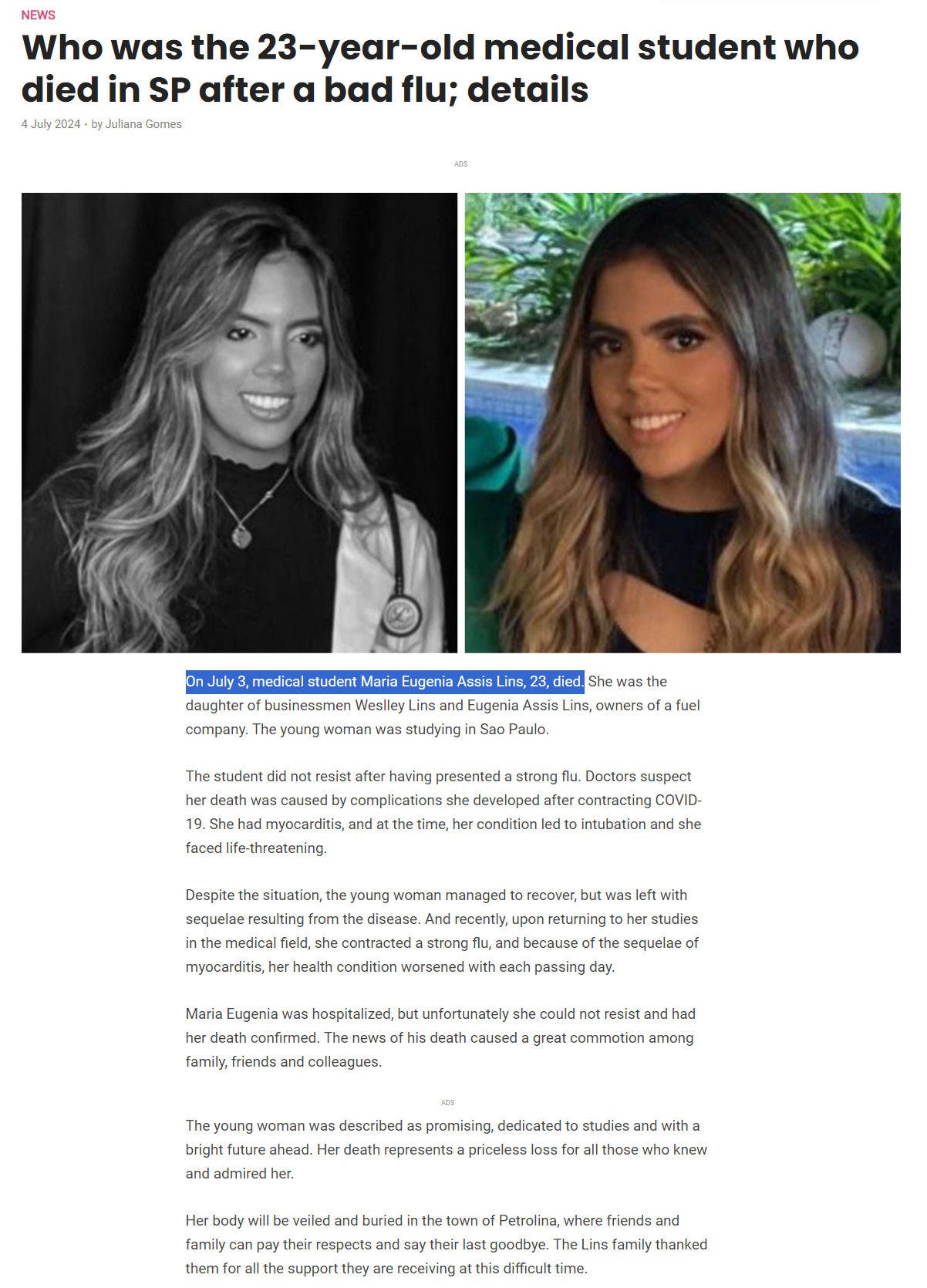
July 3, 2024 – BRAZILIAN DOCTOR DEAD – 23 year old Sao Paulo medical student Maria Eugenia Assis Lins died suddenly on July 3, 2024 (“she had myocarditis”).

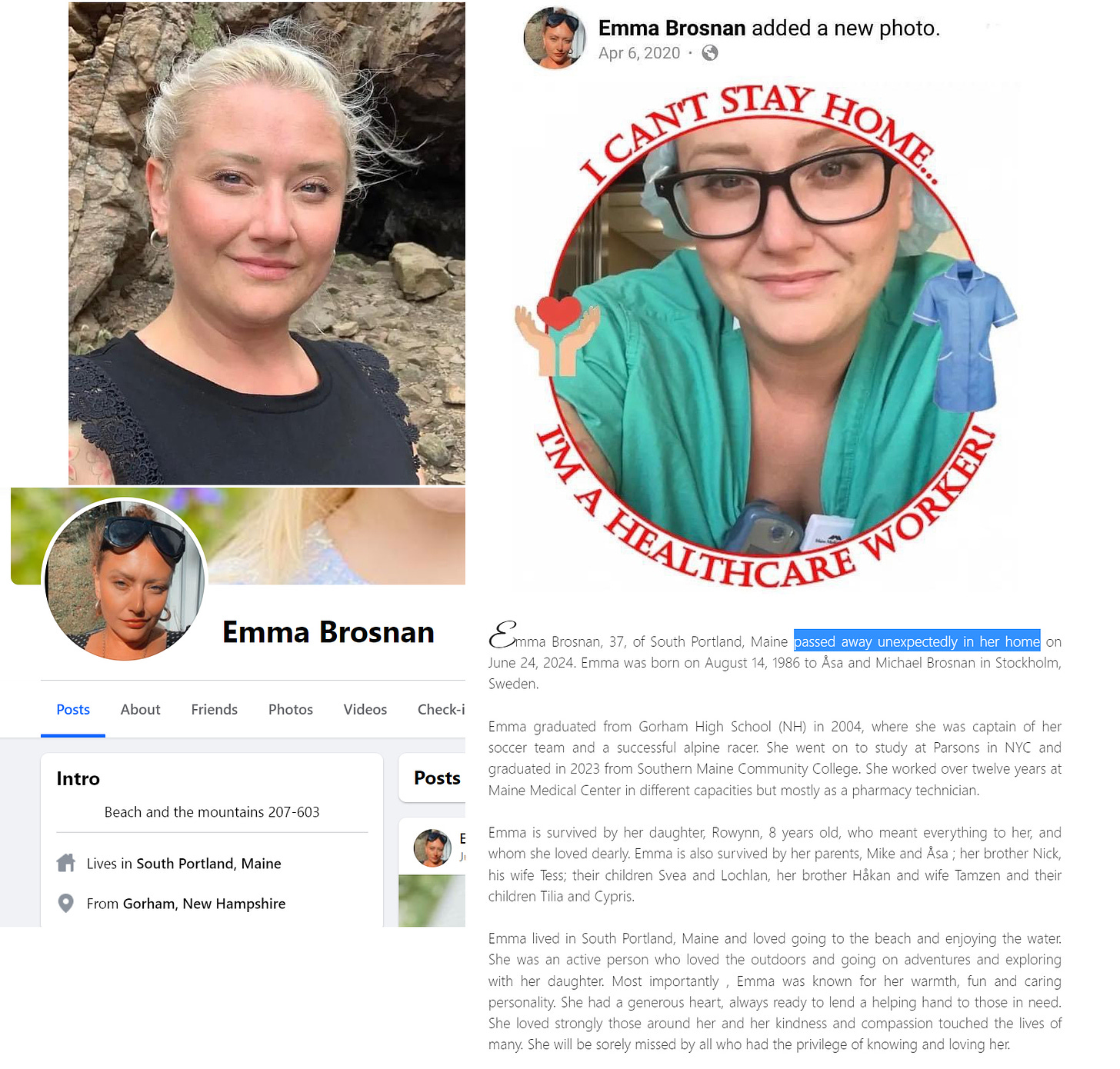
June 24, 2024 – South Portland, Maine – 37 year old Emma Brosnan died unexpectedly in her home on June 24, 2024. She was a pharmacy technician.

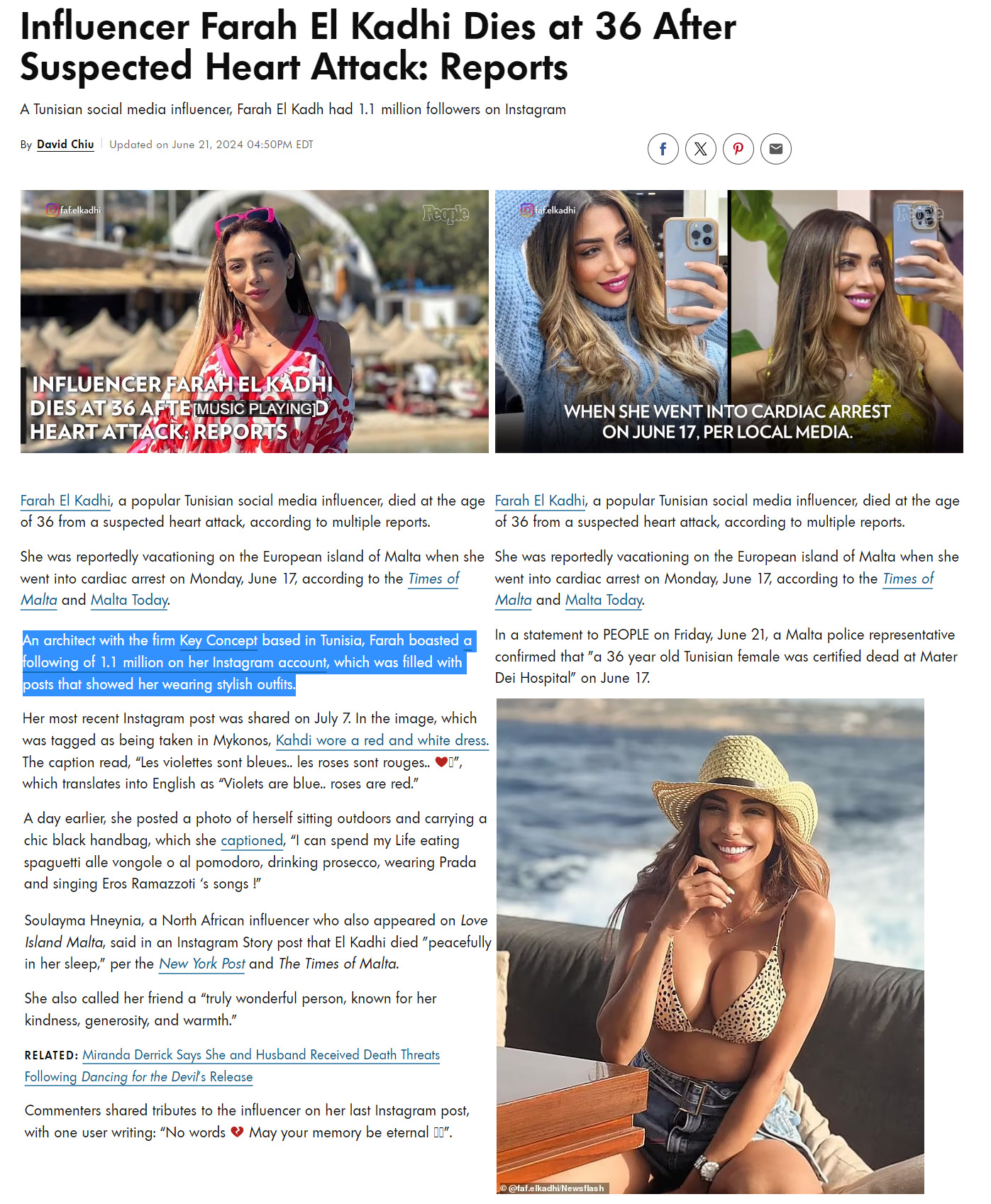
June 17, 2024 – Tunisian Influencer 36 year old Farah El Kadhi died suddenly on June 17, 2024 from a cardiac arrest while on holiday in Malta. She died in her sleep. She had 1.1 million followers on Instagram.

Image

June 11, 2024 – Lebanon, KY – 35 year old Traci Leann Wright died suddenly in her sleep on June 11, 2024.

Image

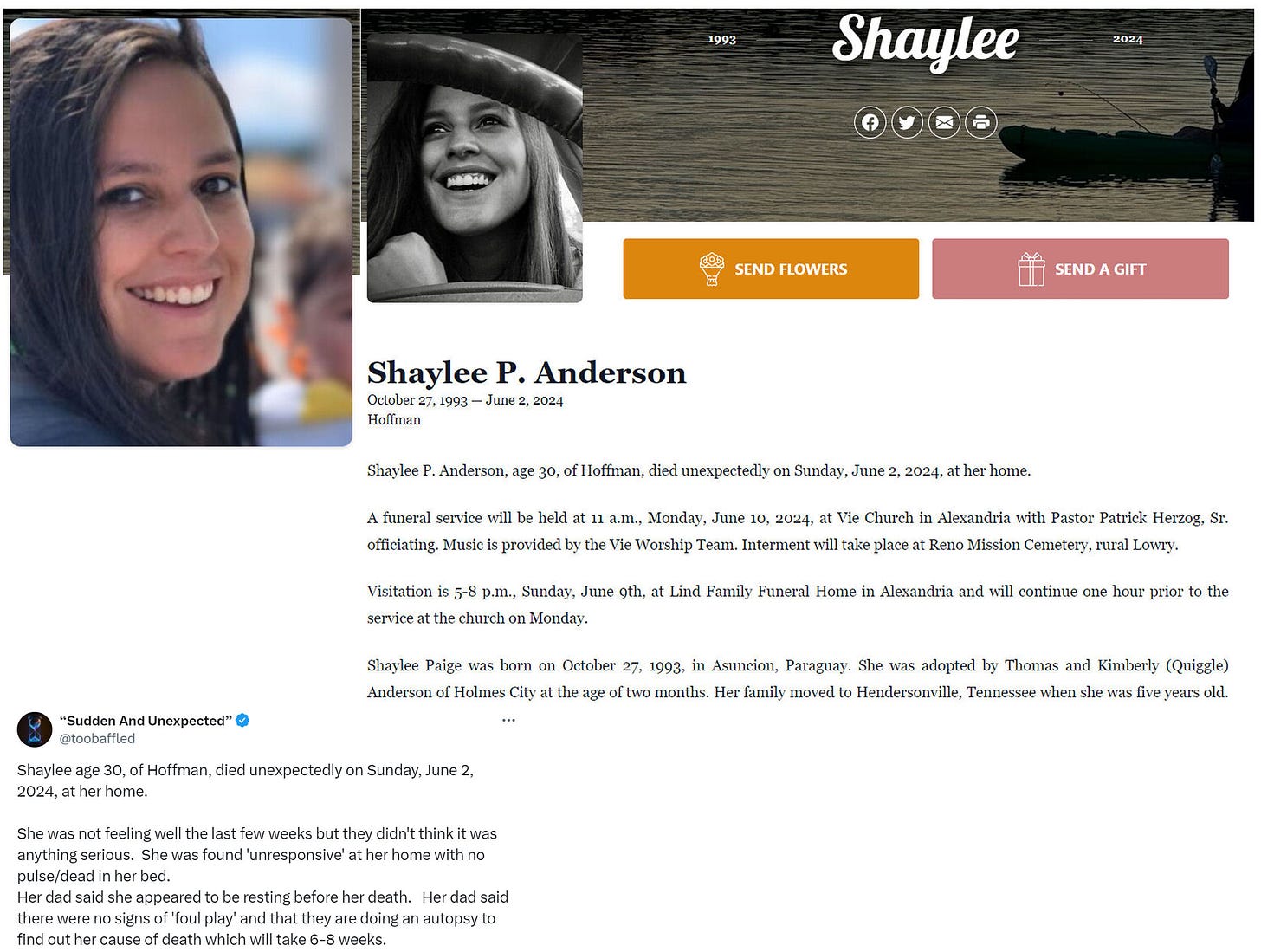
June 2, 2024 – Hoffman, MN – 30 year old Shaylee Anderson died unexpectedly at home on June 2, 2024. She was found dead in her bed without a pulse. Her father thought she was just resting.

Image

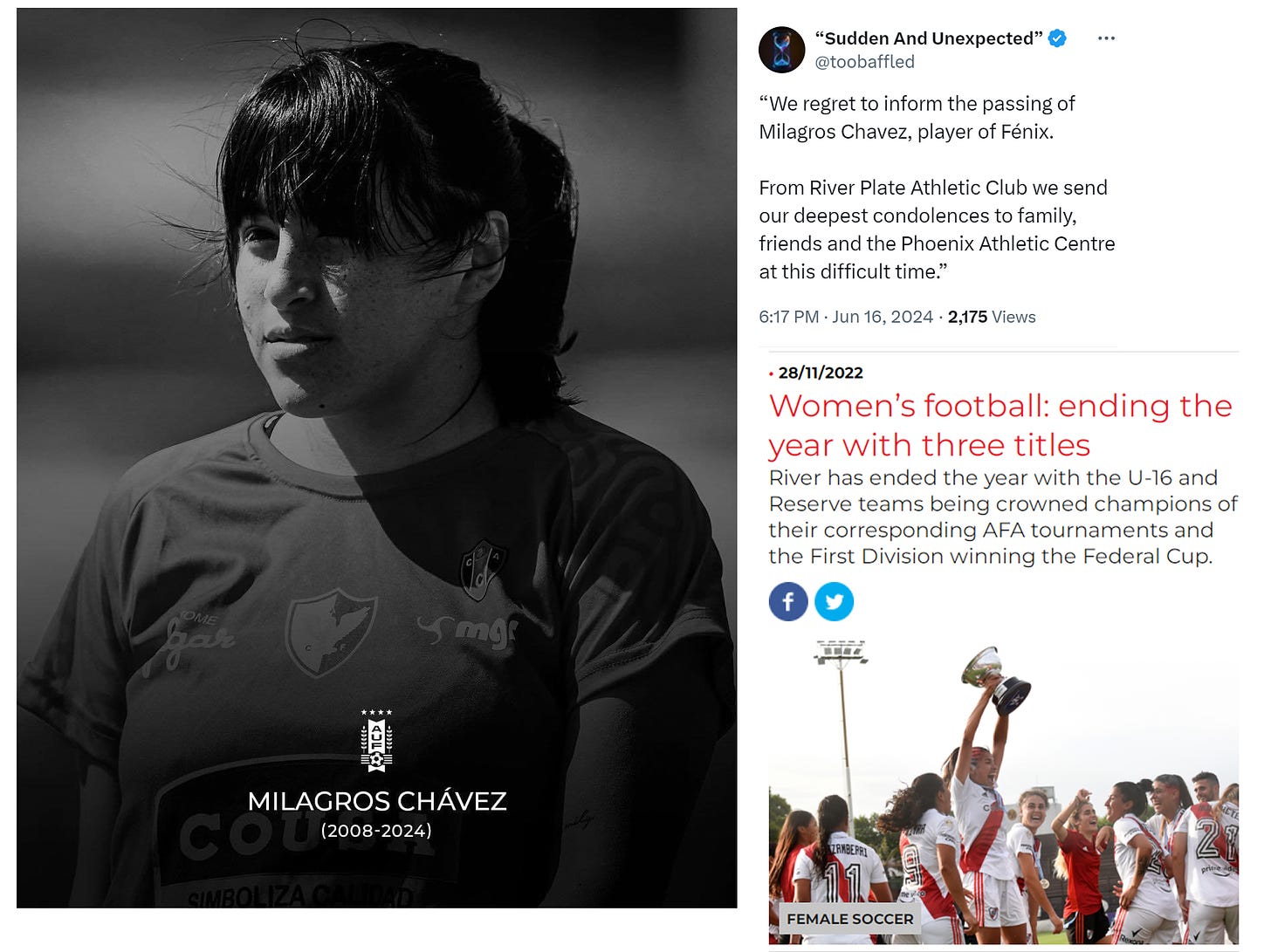
June 2024 – Buenos Aires, Argentina – 15 year old Milagros Chavez, soccer player U16 at the River Plate Athletic Club died suddenly in June 2024.

Image

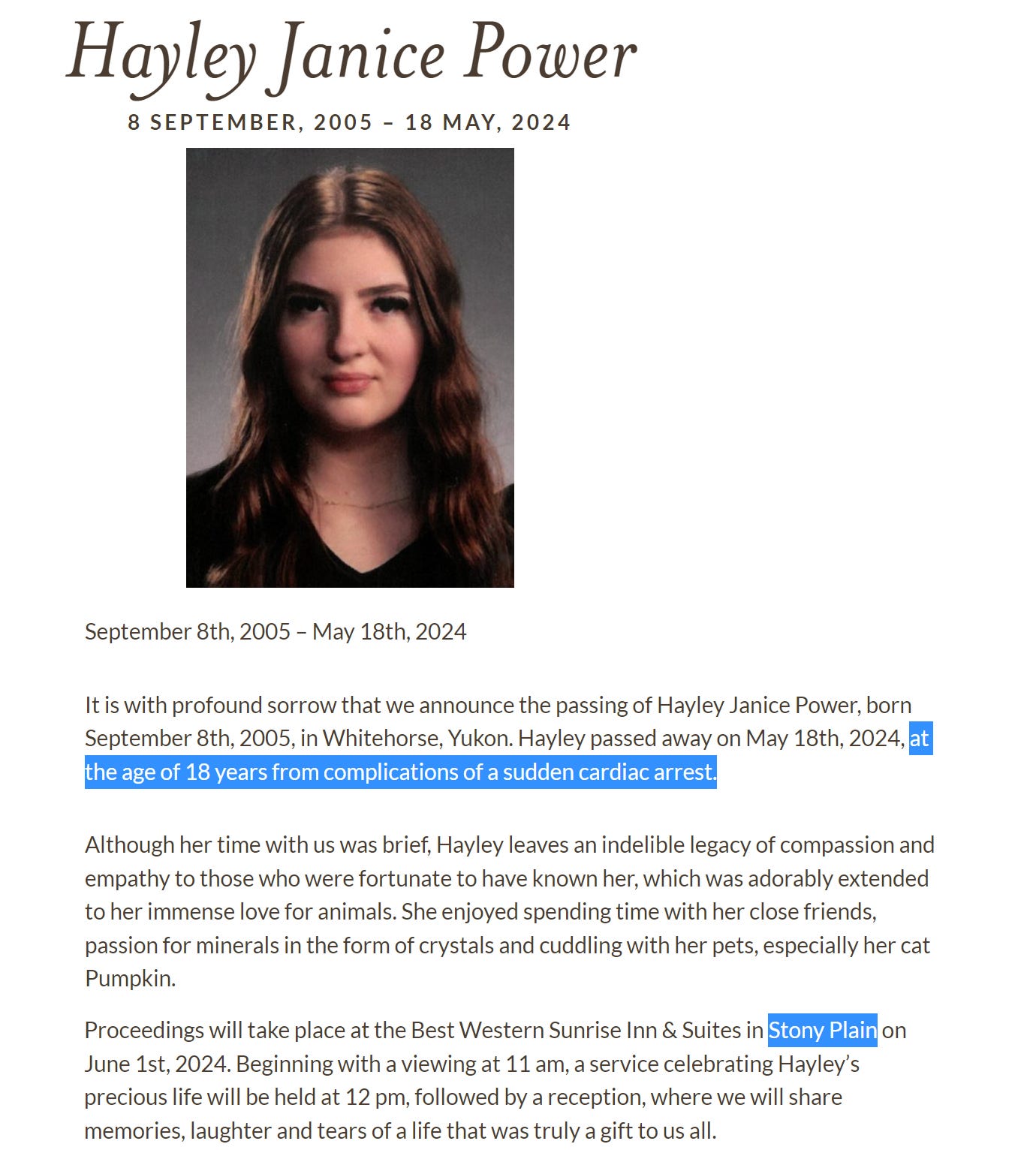
May 18, 2024 – Stony Plain, AB, Canada – 18 year old Hayley Janice Power died on May 18, 2024 from complications of a sudden cardiac arrest.

Image

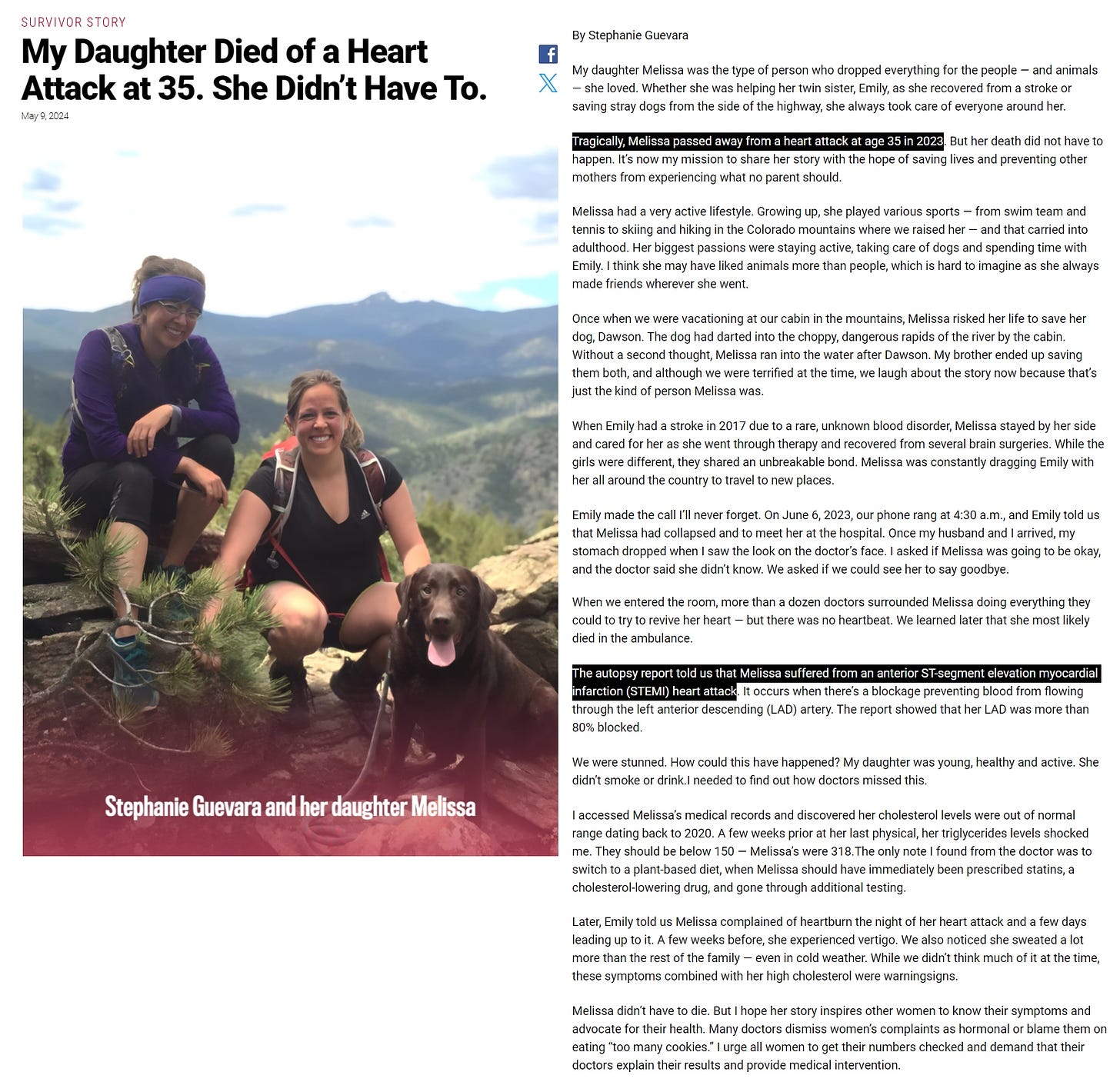
May 2024 – “My daughter Melissa died of a heart attack at 35. She didn’t have to”. Melissa died in 2023.

My Take…

No one is protecting these young women. No one is fighting for them either.

COVID-19 mRNA Vaccines cause cardiac damage in 1 in 30 within the first week after vaccination

Study #1 – Thailand study (2022, Mansanguan) 202 boys ages 13-18, from two different schools, 7 of them developed subclinical myo/pericarditis after 2nd Pfizer COVID-19 mRNA dose. That’s 1 in 30 per Pfizer dose.

Study #2 – Swiss Study (2023, Muller) – 777 healthcare workers had Moderna COVID-19 mRNA booster shot, 22 had evidence of myocardial injury (22/777 = 1 in 35 per Moderna dose).

“Conclusion: mRNA-1273 vaccine-associated myocardial injury was more common than previously thought, being mild and transient, and more frequent in women versus men.”

Doctors are still not allowed to discuss these risks with their patients as part of informed consent. That is an ongoing crime being committed by American Medical Boards and Canadian Colleges of Physicians and Surgeons.

Our politicians tell us people have the choice to get the COVID-19 Vaccines for themselves or their children. That’s false. Where there is no informed consent, there is no choice.

Via https://makismd.substack.com/p/young-women-continue-to-die-suddenly

Trump is Right About McKinley

William McKinley | Biography, Presidency, Assassination, & Facts | Britannica

Sean Durns
Donald Trump has weighed in on a presidential legacy, albeit not his own. In a wide-ranging July 16, 2024 interview with Bloomberg, Trump proclaimed William McKinley “the most underrated president.”

Trump is right. McKinley, who guided the ship of state at the dawn of the 20th century, is the most underrated chief executive in our nation’s history. And in many respects his presidency can serve as a model for a United States that is once again undergoing seismic changes.

McKinley is largely forgotten today. Presidential historians often rank him in the middle of the pack. Such rankings are colored by a deep liberal bias—a February 2024 survey put FDR first and Trump dead last—but they do illustrate that McKinley is neither hailed for his greatness nor lamented for his failures. Rather, he’s just overlooked.

Part of this is due to the man himself; even in his own lifetime McKinley was regarded as somewhat bland. McKinley’s lack of personal papers and, as one biographer noted, his “tendency to listen as much as talk” also contributed to his obscurity. But it is also the result of his premature death. McKinley was murdered by an anarchist, Leon Czolgosz, on September 6, 1901, a mere six months into his second term. Some presidential assassinations grant their victims a level of immortality. Lincoln and John F. Kennedy come to mind. But others consign the dead to oblivion.

Indeed, for more than a century, McKinley has been overshadowed by his larger-than-life successor, Teddy Roosevelt. TR was young, dynamic, and image-conscious. He knew how to court the press and provide good copy for reporters. Roosevelt was 42 when he took office and seemed to embody the youthful nation that he led. He was also famously hyperactive and, at times, erratic.

The stolid McKinley was Roosevelt’s opposite. He was unknowable. The wife of one of his rivals in Ohio politics, Joseph Foraker, once charged that McKinley was a man of “masks,” his inner thoughts and emotions well concealed. Roosevelt’s own daughter, Alice Roosevelt Longworth, famously said that her father wanted to be the “the corpse at every funeral, the bride at every wedding, and the baby at every christening.” By contrast, the unassuming McKinley exuded the air of a man just happy to be invited.

Roosevelt took the helm right as America became a world power. He was the perfect president for the new media age. TR’s exploits, from hunting exotic creatures to brokering peace between Russia and Japan, served as perfect fodder for press barons like William Randolph Hearst.

But McKinley was popular in his lifetime, and he built the edifice that TR stood on. His death prompted widespread mourning. McKinley was the only president between Ulysses Grant and Woodrow Wilson—a span of nearly forty years—to be elected to two terms. And his electoral victories over his Democratic opponent, the perennial candidate, William Jennings Bryan, were resounding. In fact, they reshaped the American landscape.

McKinley’s 1896 victory over Bryan is widely regarded as one of a handful of political realignments in U.S. history. Modern Republican strategists like Kevin Phillips, who advised Richard Nixon, to Karl Rove, George W. Bush’s guru, have cited the 1896 realignment as a model—and for good reason. From 1896 until Franklin D. Roosevelt’s election in 1932, Republicans occupied the executive branch for all but eight years. The sole Democratic occupant, Woodrow Wilson, only took office thanks to a split in the Republican party created by TR in 1912.

McKinley, Phillips noted, was the “political architect who ended the two-decade national stalemate” that had existed since 1876, “turning a weakened Civil War coalition to a new full-fledged industrial GOP majority,” thereby making him “the most important nineteenth-century Republican after Lincoln.” McKinley remade the GOP, and “he did so by beating, rather than submitting to, the Eastern machine forces.” And, as Phillips observes, McKinley did so by expanding the GOP to include a broader working-class constituency. “Not since Lincoln, who publicly upheld unions…had a Republican nominee so embraced labor.”

McKinley famously embraced tariffs, but he also focused on jobs and employment—“the full dinner pail,” as it was called. By fighting for a conservative working-class party, McKinley was doing what Benjamin Disraeli had done three decades before in the United Kingdom. But while Disraeli is regarded as a seminal figure, McKinley is depicted as an unsophisticated Midwestern rube, his triumphs the fruit of the labor of others.

Indeed, historians have often presented McKinley as incidental to the realignment that he helped forge. They portray wealthy industrialists and key advisers like Mark Hanna as being more responsible for McKinley’s electoral accomplishments. The notion that McKinley was weak and the tool of greater men was pushed by his contemporary enemies and has endured for years afterward. McKinley, of course, wasn’t around to dispute the portrayal.

Indeed, one later historian, noting that events always seemed to go McKinley’s way despite his lack of a heavy hand, referred to the 25th president as a “tantalizing enigma.” McKinley, the former editor of The American Conservative Robert Merry observed, “never moved in a straight line, seldom declared where he wanted to take the country, [but] somehow moved people and events from the shadows. He rarely twisted arms in efforts at political persuasion, never raised his voice in political cajolery [and] didn’t visibly seek revenge.” Nonetheless, “he always seemed to outmaneuver his rivals and get his way.”

McKinley, Merry pointed out, was the “architect of the American century.”

As the historian Lewis Gould has observed, McKinley should be regarded as the first modern president. He significantly expanded, and reorganized, the White House staff, bringing it into the modern era. Dwight Eisenhower, a career military officer, was the first president to formally create the office of Chief of Staff. But the office has its origins in the McKinley administration, when the former Ohio governor chose George Cortelyou to be his private secretary. Prior presidents had secretaries, of course. But Cortelyou’s flair for organization and expansive powers were noteworthy. A man who was working as a post office clerk a mere decade before McKinley elevated him would eventually go on to become the U.S. Secretary of Commerce and Labor, the Secretary of Treasury, and the head of the Republican National Committee.

As Phillips noted in his 2003 biography, McKinley was the first president to extensively use the telephone, develop systematized press operations, to have a news summary, and to make the White House a news center. The Spanish–American War would be the first conflict to be managed from a White House war room connected to military headquarters in Washington and the field by telephone and telegraph. Both in the 1896 campaign and afterward, McKinley used new media’s power in innovative ways. McKinley also traveled broadly. Prior to his assassination, he was planning trips that would have made him the first president to travel abroad—trips that he thought reflected America’s newfound power and status.

McKinley was unique in another respect. He was one of the few occupants of the Oval Office to be a successful wartime president. Despite later portrayals, McKinley wasn’t an avowed imperialist; he had qualms about the annexation of Hawaii and was hardly pushing for U.S. involvement in the conflict with Spain. Yet once he had decided on the use of force, he wanted it to be overwhelming.

In foreign affairs, McKinley wasn’t a bully, as Bryan and other critics alleged, but he wasn’t a man for half-measures either. As he said in his inaugural address: “We want no wars of conquest; we must avoid the temptation of territorial aggression. War should never be entered upon until every agency of peace has failed; peace is preferable to war in almost every contingency.” McKinley, the last veteran of the U.S. Civil War to occupy the White House, once told the White House physician: “I have been through one war; I have seen the dead piled up; and I do not want to see another.”

The 25th president not only reshaped American domestic politics, but he also reoriented U.S. foreign policy. As Phillips notes, “he helped to shape and preview America’s early-twentieth-century alliances and hostilities: on one hand, entente with Britain and an off-and-on commitment to the territorial integrity of China, and on the other, mounting Caribbean and Pacific tensions with Germany and Japan.” In shoring up relations with Britain, McKinley helped set the stage for what would become the fabled and long-enduring “special relationship.” McKinley took office when the international system was in flux. Old empires, like Spain, the Qing dynasty in China, and the Ottoman Empire, were on their way out, while new powers, notably Germany and Japan, were rising. He presciently recognized the growing importance of what today is called the Indo-Pacific. McKinley helped reshape American foreign policy for a new era.

[…]

Via https://www.theamericanconservative.com/trump-is-right-about-mckinley/

Trump on President McKinley, Protective Tariffs and Rebuilding US Industry

Bloomberg Businessweek interviewed former US President Donald Trump at his golf club, Mar-a-Lago in Palm Beach, Florida, on June 25, two days before the first 2024 presidential debate and about two weeks before a failed assassination attempt. In a discussion focused on business and the global economy, Trump talked about the Federal Reserve, inflation, tax cuts, tariffs, Taiwan and his relationships with chief executives. The interview was conducted by Bloomberg Senior Reporters Nancy Cook and Joshua Green, Managing Editor Mario Parker and Businessweek Editor Brad Stone. Below is a transcript of the conversation, lightly edited for clarity, and annotated with several fact-checks by Gregory Korte.

BLOOMBERG BUSINESSWEEK: Well, thank you for spending time with us. I want to start by asking a broad question: What kind of economy do you want for the American people in terms of innovation, opportunity and global competitiveness?

TRUMP: Well, I think manufacturing is a big deal, and everybody that runs for office says you’ll never manufacture again.

We have currency problems, as you know. Currency. When I was president, I fought very strongly and hard with President Xi and with Shinzo Abe, who’s a fantastic man—actually, you know the story there.

So we have a big currency problem because the depth of the currency now in terms of strong dollar/weak yen, weak yuan, is massive. And I used to fight them, you know, they wanted it weak all the time. They would fight it and I said, if you weaken it any more, I’m going to have to put tariffs on you. And that difference is, you know, we have the spread is the biggest and I think they said 38 years. That’s a tremendous burden on our companies that try and sell tractors and other things to other places outside of this country.

[…]

BLOOMBERG BUSINESSWEEK: President Biden left in place many of the tariffs that you imposed on China. He’s pushed Made-in-America steel and directed billions of dollars to rebuilding American manufacturing and energy. Do you plan to undo all of the Inflation Reduction Act, or just certain parts of it?

>TRUMP: Well, first of all, he had something called the Inflation Reduction Act, which wasn’t the right name. It increased inflation and not decreased.

[…]

BLOOMBERG’S BUSINESS WEEK: Back on China, economists have said about 60% tariffs on China would essentially end the US-China trade relationship. What would that mean for companies like Nvidia, Qualcomm, Apple who have supply chains there?

TRUMP: You  know, I had it at 50% and I’ve never heard the 601 . And everyone always says, look at Smoot-Hawley and oh, look what happened. Well, Smoot-Hawley was after the Depression started. So if you go back, I told you to read about William McKinley. William McKinley made this country rich. He was the most underrated president. And those that followed him took the money. Roosevelt took the money and built, you know, the whole thing with the parks and the dams. But McKinley made the money and he was truly the tariff king. And I don’t do this based on my knowledge of him, although I’ve learned about him after the fact.

Tariffs do two things. Economically, they’re phenomenal. And a lot of people will say, Oh, that’s terrible. It’s very dangerous when you say that because you probably have your views and a lot. I can’t believe how many people are negative on tariffs that are actually smart people. It does two things: Economically, it’s great. And man, is it good for negotiation. I’ve had guys, I’ve had countries, that were potentially extremely hostile coming to me and say, ‘Sir, please stop with the tariffs. Stop.’ They would do anything. Nothing to do with economic, they would do—you know, we have more than economic, we have other things like let’s not go to war. Or I don’t want you to go into war in another place.

[…]


1Trump has denied a Washington Post report that he’s considering a 60% tariff on Chinese goods, telling Fox News, “No, I would say maybe it’s going to be more than that.”

Via https://archive.vn/e5bGH#selection-1525.398-1531.129

Agenda 47: Trump’s Official Campaign Platform

Donald Trump’s Agenda 47 | K-POP TIMES
Trump’s official platform from his website. Thoughts?  I’m curious what people think.
1 Seal the border and stop the migrant invasion
2 Carry out the largest deportation operation in American history
3 End inflation, and make Z\America affordable again
4 Make America the dominant energy producer in the world, by far!
5 Stop outsourcing, and turn the United States into manufacturing superpower
6 Large tax cuts for workers, and no tax on tips!
7 Defend our constitution, our bill of rights, and our fundamental freedoms, including freedom of speech, freedom of religion, and the right to keep and bear arms
8 Prevent world war three, restore peace in Europe and in the middle east, and build a great iron dome missile defense shield over our entire country — all made in America
9 End the weaponization of government against the American people
10 Stop the migrant crime epidemic, demolish the foreign drug cartels, crush gang violence, and lock up violent offenders
11 Rebuild our cities, including Washington DC, making them safe, clean, and beautiful again.
12 Strengthen and modernize our military, making it, without question, the strongest and most powerful in the world
13 Keep the U.S. dollar as the world’s reserve currency
14 Fight for and protect social security and medicare with no cuts, including no changes to the retirement age
15 Cancel the electric vehicle mandate and cut costly and burdensome regulations
16 Cut federal funding for any school pushing critical race theory, radical gender ideology, and other inappropriate racial, sexual, or political content on our children
17 Keep men out of women’s sports
18 Deport pro-Hamas radicals and make our college campuses safe and patriotic again
19  Secure our elections, including same day voting, voter identification, paper ballots, and proof of citizenship
20 Unite our country by bringing it to new and record levels of success
[…]

The Great Blood Pressure Scam

New high blood pressure guidelines: Think your blood pressure is fine ... 

A Midwestern Doctor

•Elevated blood pressure is the most common chronic disease, and as the decades go by more and more people are declared hypertensive.

•Remarkably, at least 25% of all hypertension diagnoses are due to inaccurate measurements, and there is still no known reason for why over 90% of people are hypertensive.

•Aggressively treating everyone’s blood pressure is justified under the belief it prevents cardiovascular disease. However, in most cases it has never been proven to reduce heart disease—rather it only leads to a small reduction in strokes (hence why these medications were rebranded to treat “cardiovascular disease”).

•Many of the misunderstandings with heart disease arise from the fact that impaired circulation or damage to the blood vessels will cause blood pressure to go up and their correlation being misinterpreted to instead believe high blood pressure causes cardiovascular disease.

In this article, we will discuss the actual causes of high blood pressure, the dangers of commonly used blood pressure medications, the safest pharmaceutical and natural ways to reduce blood pressure directly, and our preferred methods for treating the underlying causes of high blood pressure.

Ever since I first encountered the medical field, something struck me as off about their relentless focus on blood pressure. Before long, I began to notice that the blood pressures the same acquaintances (e.g., relatives or friends) shared with me varied immensely. As I was pondering this, a long-time Eastern spiritual teacher shared with me their belief that the West’s relentless focus on blood pressure was due to it being much easier to measure than blood perfusion (healthy blood flow).

Then, as I became more acquainted with the medical field, I began to notice a consistent pattern—whenever a drug existed that could treat a number or statistic, as the years went by, the acceptable number kept on being narrowed, making more and more people eligible to take the drugs that treated the number.

For example, as I discussed recently, once the statins drugs entered the market (which unlike their predecessors, could effectively lower cholesterol), the acceptable blood cholesterol levels kept on being lowered, and before long almost everyone was told they would die from a heart attack unless they started a statin—despite statins have an almost non-existing mortality benefit (e.g., taking them for 5 years at best makes you live 3-4 days longer) and causing (often severe) side effects for roughly 20% of users. Broadly recommending these drugs hence appears unconscionable, but as I showed in that article, these unjustifiable guidelines were a product of clever pharmaceutical marketing and targeted bribery of public officials.

In this article, I will attempt to show how something similar happened in the field of blood pressure. As this is an immensely controversial position to take (e.g., measuring and documenting blood pressure is one of the most routine procedures during a medical visit), I’ve done my best to clearly present the evidence for this perspective so you can make your own determination.

The Forgotten Side of Medicine is a reader-supported publication. To receive new posts and support my work, please consider becoming a free or paid subscriber. To see how others have benefitted from this newsletter, click here.

Conventional Blood Pressure Perspectives

Since blood vessels are elastic structures filled with fluid, that fluid holds them under pressure. Blood pressure in turn is typically measured by determining how much external force is needed to exceed the artery’s pressure and compress it so that blood no longer flows through it. Low blood pressure (hypotension) is a problem because it prevents blood from reaching the areas where it’s needed (e.g., orthostatic hypotension or POTS describes a common situation where people become lightheaded as they stand up due to insufficient blood being pushed into the brain), but in most cases, medicine instead focuses on the consequences of high blood pressure. Within the existing model, those consequences are:

•Weakened blood vessels become more likely to break open and leak as higher blood pressure pushes against them. This for instance is why Emergency Rooms aggressively lower the blood pressure of patients who show up with symptoms of “hypertensive emergency” such as a severe headache and a significantly elevated blood pressure. Likewise, whenever a critical blood vessel ruptures (e.g., the aorta or one in the brain), once the bleed has been confirmed, the first step in managing it is to lower the patient’s blood pressure (so less blood leaks out) after which they are sent to surgery.

•Excessive pressure on the arteries strains and damages them, causing the lining of the vessels to become damaged and gradually develop atherosclerosis.

•Excessive blood pressure damages the internal organs (termed end-organ damage), leading to premature failure and early death (e.g., from a heart attack or kidney failure).

Because of this, high blood pressure is viewed as one of the greatest preventable causes of cardiovascular disease and thus a chief focus of all medical visits is ensuring a patient achieves a sufficiently lowered blood pressure.

Unfortunately, that chain of logic has quite a few gaps in it (see if any jump out to you). We will now examine each of them.

Variable Blood Pressure

Blood pressure (BP) is immensely variable. For example, pressures at the periphery (where BP is typically measured), which when studied is found to vary by around 14 points This thus frequently leads to individuals being erroneously diagnosed with hypertension and put on blood pressure lowering medications despite having normal blood pressures (leading to those medications making them hypotensive).

This phenomenon in fact is so common (constituting 15-30% of hypertension diagnoses) that it is often referred to as “White Coat Hypertension,” a name derived from the fact stress is one of the things which commonly elevates blood pressure, and since visiting a doctor is a stressful experience, many patients hence have temporarily elevated blood pressures there. Because of this, the guidelines suggest having patients who are diagnosed with hypertension have multiple measurements to confirm it (e.g., with home blood pressure monitoring). Unfortunately, this often does not happen in practice.

Note: one common source of error when measuring blood pressure is the wrong sized cuff being used for the patient. Another is that patients frequently have significantly different blood pressures in each arm. This helps to explain why it is commonly estimated that 25% of those diagnosed with hypertension do not have it.

Likewise, there is a surprisingly poor correlation between peripheral blood pressure and the central blood pressure inside the aorta. For example, one large study found a significant difference between the blood pressure within the aorta and the arm, and that the aorta pressure had a much stronger correlation to the likelihood of cardiovascular disease.

[…]

Via https://www.midwesterndoctor.com/p/the-great-blood-pressure-scam?r=83qir