London’s Metropolitan Police chief warned that officials will not only be cracking down on British citizens for commentary on the riots in the U.K., but on American citizens as well.
“We will throw the full force of the law at people. And whether you’re in this country committing crimes on the streets or committing crimes from further afield online, we will come after you,” Metropolitan Police Commissioner Sir Mark Rowley told Sky News.
Riots have broken out across the United Kingdom in recent days over false rumors spread online that an asylum seeker was responsible for a mass stabbing at a Taylor Swift-themed dance event that left three girls dead and others wounded. The murders, allegedly committed by a now 18-year-old British citizen born to Rwandan parents, sparked a series of violent protests that tapped into broader concerns about the scale of immigration in the U.K.
Footage of the violent clashes involving anti-immigration protesters and the groups of counter-protesters, some of whom have been seen waving Palestinian flags, has gone viral on social media, and the government is warning that sharing such content may have serious consequences.
One key aspect that makes this apparent crackdown on social media particularly shocking to critics is that the British government is threatening to extradite American citizens from the U.S. to be jailed in the U.K. for violating their rules about political speech online.
The British government announced it will not only be cracking down on British citizens for commenting on the riots in the UK, but on American citizens as well. (Sky News)
A Sky News reporter asked Commissioner Rowley to further explain his warning, arguing that high profile figures have been “whipping up the hatred,” and that “the likes of Elon Musk” have been getting involved. She then asked what the police force’s plan will be “when it comes to dealing with people who are whipping up this kind of behavior from behind the keyboard who may be in a different country?”
Rowley answered by telling the reporter, “Being a keyboard warrior does not make you safe from the law.”
“You can be guilty of offenses of incitement, of stirring up racial hatred, there are numerous terrorist offenses regarding the publishing of material,” he said. “All of those offenses are in play if people are provoking hatred and violence on the streets, and we will come after those individuals just as we will physically confront on the streets the thugs and the yobs who are taking — who are causing the problems for communities.”
Protesters scuffle with police during the “Enough is Enough” protest in Whitehall, London, Wednesday July 31, 2024, following the fatal stabbing of three children at a Taylor Swift-themed summer holiday dance and yoga class earlier this month in Southport. (Jordan Pettitt/PA via AP)
Elon Musk has made headlines for criticizing Prime Minister Sir Keir Starmer’s response to the riots over the past week, suggesting the U.K. is headed toward “civil war.”
He also responded to a video of someone allegedly arrested for offensive online comments with a question, “Is this Britain or the Soviet Union?”
Starmer’s spokesperson said there was “no justification” for Musk’s comments, adding that social media companies “can and should be doing” more to combat misinformation, the BBC reported. He added that such companies “have a responsibility” to stop the spread of criminal activity and limit misinformation.
Mimicry of intelligence isn’t intelligence, and so while AI mimicry is a powerful tool, it isn’t intelligent.
The mythology of Technology has a special altar for AI, artificial intelligence, which is reverently worshiped as the source of astonishing cost reductions (as human labor is replaced by AI) and the limitless expansion of consumption and profits. AI is the blissful perfection of technology’s natural advance to ever greater powers.
The consensus holds that the advance of AI will lead to a utopia of essentially limitless control of Nature and a cornucopia of leisure and abundance.
If we pull aside the mythology’s curtain, we find that AI mimics human intelligence, and this mimicry is so enthralling that we take it as evidence of actual intelligence. But mimicry of intelligence isn’t intelligence, and so while AI mimicry is a powerful tool, it isn’t intelligent.
The current iterations of Generative AI–large language models (LLMs) and machine learning–mimic our natural language ability by processing millions of examples of human writing and speech and extracting what algorithms select as the best answers to queries.
These AI programs have no understanding of the context or the meaning of the subject; they mine human knowledge to distill an answer. This is potentially useful but not intelligence.
The AI programs have limited capacity to discern truth from falsehood, hence their propensity to hallucinate fictions as facts. They are incapable of discerning the difference between statistical variations and fatal errors, and layering on precautionary measures adds additional complexity that becomes another point of failure.
As for machine learning, AI can project plausible solutions to computationally demanding problems such as how proteins fold, but this brute-force computational black-box is opaque and therefore of limited value: the program doesn’t actually understand protein folding in the way humans understand it, and we don’t understand how the program arrived at its solution.
Since AI doesn’t actually understand the context, it is limited to the options embedded in its programming and algorithms. We discern these limits in AI-based apps and bots, which have no awareness of the actual problem. For example, our Internet connection is down due to a corrupted system update, but because this possibility wasn’t included in the app’s universe of problems to solve, the AI app/bot dutifully reports the system is functioning perfectly even though it is broken. (This is an example from real life.)
In essence, every layer of this mining / mimicry creates additional points of failure: the inability to identify the difference between fact and fiction or between allowable error rates and fatal errors, the added complexity of precautionary measures and the black-box opacity all generate risks of normal accidents cascading into systems failure.
There is also the systemic risk generated by relying on black-box AI to operate systems to the point that humans lose the capacity to modify or rebuild the systems. This over-reliance on AI programs creates the risk of cascading failure not just of digital systems but the real-world infrastructure that now depends on digital systems.
There is an even more pernicious result of depending on AI for solutions. Just as the addictive nature of mobile phones, social media and Internet content has disrupted our ability to concentrate, focus and learn difficult material–a devastating decline in learning for children and teens–AI offers up a cornucopia of snackable factoids, snippets of coding, computer-generated TV commercials, articles and entire books that no longer require us to have any deep knowledge of subjects and processes. Lacking this understanding, we’re no longer equipped to pursue skeptical inquiry or create content or coding from scratch.
Indeed, the arduous process of acquiring this knowledge now seems needless: the AI bot can do it all, quickly, cheaply and accurately. This creates two problems: 1) when black-box AI programs fail, we no longer know enough to diagnose and fix the failure, or do the work ourselves, and 2) we have lost the ability to understand that in many cases, there is no answer or solution that is the last word: the “answer” demands interpretation of facts, events, processes and knowledge bases are that inherently ambiguous.
We no longer recognize that the AI answer to a query is not a fact per se, it’s an interpretation of reality that’s presented as a fact, and the AI solution is only one of many pathways, each of which has intrinsic tradeoffs that generate unforeseeable costs and consequences down the road.
To discern the difference between an interpretation and a supposed fact requires a sea of knowledge that is both wide and deep, and in losing the drive and capacity to learn difficult material, we’ve lost the capacity to even recognize what we’ve lost: those with little real knowledge lack the foundation needed to understand AI’s answer in the proper context.
The net result is we become less capable and less knowledgeable, blind to the risks created by our loss of competency while the AI programs introduce systemic risks we cannot foresee or forestall. AI degrades the quality of every product and system, for mimicry does not generate definitive answers, solutions and insights, it only generates an illusion of definitive answers, solutions and insights which we foolishly confuse with actual intelligence.
While the neofeudal corporate-state cheers the profits to be reaped by culling human labor on a mass scale, the mining / mimicry of human knowledge has limits. Relying on the AI programs to eliminate all fatal errors is itself a fatal error, and so humans must remain in the decision loop (the OODA loop of observe, orient, decide, act).
Once AI programs engage in life-safety or healthcare processes, every entity connected to the AI program is exposed to open-ended (joint and several) liability should injurious or fatal errors occur.
If we boil off the mythology and hyperbole, we’re left with another neofeudal structure: the wealthy will be served by humans, and the rest of us will be stuck with low-quality, error-prone AI service with no recourse.
The expectation of AI promoters is that Generative AI will reap trillions of dollars in profits from cost savings and new products / services. This story doesn’t map the real world, in which every AI software tool is easily copied / distributed and so it will be impossible to protect any scarcity value, which is the essential dynamic in maintaining the pricing power needed to reap outsized profits.
There is little value in software tools that everyone possesses unless a monopoly restricts distribution, and little value in the content auto-generated by these tools: the millions of AI-generated songs, films, press releases, essays, research papers, etc. will overwhelm any potential audience, reducing the value of all AI-generated content to zero.
The promoters claim the mass culling of jobs will magically be offset by entire new industries created by AI, echoing the transition from farm labor to factory jobs. But the AI dragon will eat its own tail, for it creates few jobs or profits that can be taxed to pay people for not working (Universal Basic Income).
Perhaps the most consequential limit to AI is that it will do nothing to reverse humanity’s most pressing problems. It can’t clean up the Great Pacific Trash Gyre, or limit the 450 million tons of mostly unrecycled plastic spewed every year, or reverse climate change, or clean low-Earth orbits of the thousands of high-velocity bits of dangerous detritus, or remake the highly profitable waste is growth Landfill Economy into a sustainable global system, or eliminate all the sources of what I term Anti-Progress. It will simply add new sources of systemic risk, waste and neofeudal exploitation.
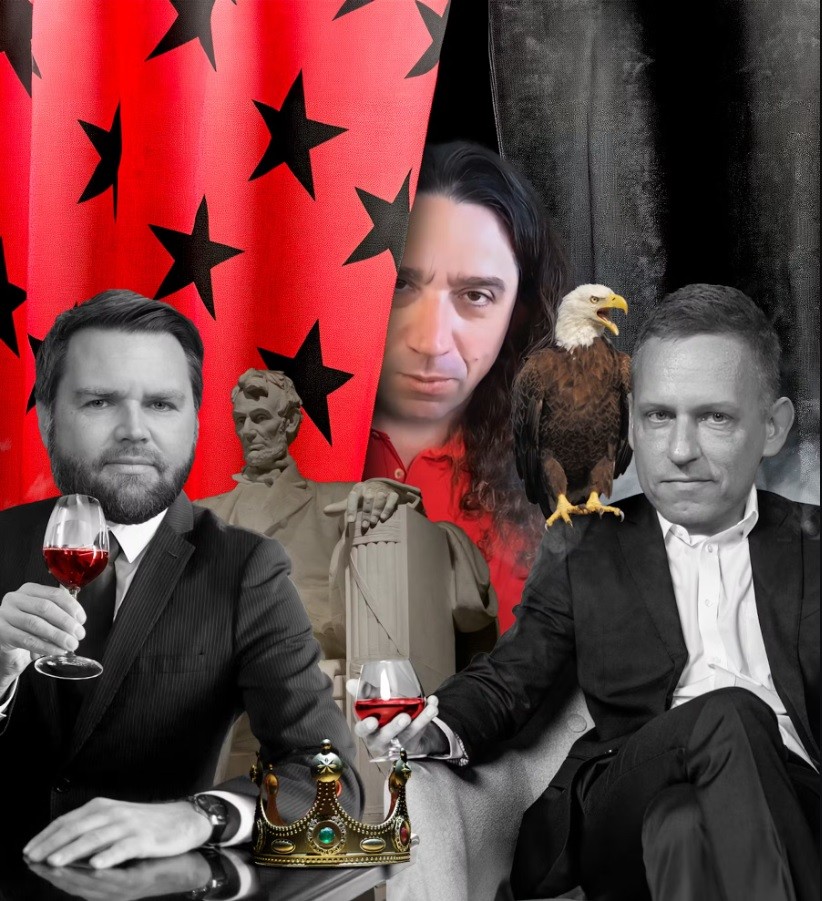
Left: J.D. Vance – Center: Curtis Yarvin – Right: Peter Thiel. Image by Clark Miller. Source.
Brian Shilhavy
I have frequently reported in my articles that politicians are not the main people who run the U.S., but that Wall St. billionaires and Silicon Valley billionaires do.
Unlike publicly visible politicians who at least have the illusion of accountability, the billionaires who fund them usually do not.
So it is a rare treat when I find an article like the one that The Information published in their Weekend publication that does just that, and exposes where a lot of the new “Far Right” ideology originates from which many Silicon Valley billionaires subscribe to.
The article was written by Julia Black, and titled:
Judging by the comments submitted to the article so far, it appears that this article is sending shock waves among those in Tech.
It is behind a paywall and a subscription is needed (which is well worth it as I find The Information the best source of “alternative” views on Big Tech with very solid journalism), but I will provide some excerpts and highlights here.
Featured in the article is one of Big Tech’s own, J.D. Vance, who recently became Trump’s Vice President choice, and how he has been influenced by Peter Thiel, who for years has followed the teachings of Curtis Yarvin, who believes “democracy” in the U.S. should be replaced by a “monarchy” instead.
Curtis Yarvin has found a place among the most right wing in tech.
In recent weeks, Democrats have relentlessly blistered Donald Trump and his running mate, J.D. Vance, using a straightforward message: They’re too weird to hold high office.
If Trump and Vance are weird, imagine what the American public might make of Curtis Yarvin, 51, whose far-right thinking has influenced both Vance and, increasingly, members of the Silicon Valley right, including billionaires Peter Thiel and Marc Andreessen. Both Thiel’s Founders Fund and Andreessen Horowitz have invested in Yarvin’s work.
As an intellectual godfather to these conservatives, Yarvin has laid out a philosophy in which he suggests replacing American democracy with a monarchy.
At a recent Palo Alto, Calif., reading of his poetry, he asked his audience to wear “cocktail attire for the new regime.” He has referred to himself and his friends as “dark elves” on a heroic journey to rescue the know-nothing “hobbits” who make up the American populace.
And last summer, Yarvin decided that Vibecamp, an annual Burning Man–style meetup of contrarian techies in rural Maryland, wasn’t contrarian enough. So he threw his own party in Washington that attendees called Vibekampf.
For now, Yarvin has found a place among Silicon Valley’s most ardent conservatives. His presence there matters. He has won the friendship and interest of people who possess great wealth and those in their own deep networks of influence.
By winning their attention, Yarvin has increased the chance that his ideas can spread further and seep deeper into the mainstream. (Source – emphasis mine.)
These new Big Tech “conservatives” use familiar terms with the Right, but with completely different meanings. So while “limited government” is a traditional, conservative and libertarian value, they take it even further by advocating NO government.
What does (Yarvin’s teaching) entail exactly?
He’d like to see American democracy as we know it collapse, with the country electing a president who could then rule as a dictator.
Under his plans, Yarvin has further proposed to seize private assets, replace the free press with state-run media and purge any officials deemed insufficiently loyal to the new regime.
Though he has deliberately maintained a low profile, chances are you’ve caught wind of his ideas: In the 2000s, for instance, Yarvin co-opted the term “red pill” from the “Matrix” movies to describe the political awakening of the new right wing.
While Yarvin has worked to push his ideas on America’s GOP political elite, he has also made inroads among tech’s conservative elite.
His primary conduit has been Thiel, who has introduced Yarvin to others in his circle. In addition, Yarvin has been welcomed into the homes of Marc Andreessen and PayPal co-founder Luke Nosek.
And you can detect distinct traces of Yarvinian thinking in written work like Andreessen’s 2023 “Techno-Optimist Manifesto” and “The Network State,” a book by Balaji Srinivasan, Coinbase’s former chief technology officer, which envisions a system of new sovereign entities built on decentralized networks.
J.D. Vance is also one of his disciples, and they undoubtedly paid Trump a handsome sum to ensure Vance got picked as the VP.
What might further propel Yarvin’s philosophy is a second Trump presidency, with Trump’s strong reelection campaign already emboldening the GOP intelligentsia and the conservative technorati to speak up about their beliefs.
Moreover, Yarvin already has a relationship with Trump’s running mate, J.D. Vance. Thiel introduced them.
Yarvin would only speak to me via email, and when I asked him about Vance, he praised the vice presidential candidate and suggested Vance has more to learn from him: “Seems nice. Kind of a normie still. Not sure if he totally gets it.” (Thiel, Andreessen, Nosek, Srinivasan and Vance did not respond to requests for comment.)
[T]he Yarvin associate perhaps poised to wield the most influence is J.D. Vance.
In 2021, Vance told podcaster Jack Murphy he’d been reading Yarvin’s arguments that “we should basically eliminate the administrative state,” adding that he found himself “sympathetic to that project.”
Vance doubled down on the theory the next year, saying that he would advise Trump to “fire every single mid-level bureaucrat…and when the courts stop you, stand before the country, and say, the chief justice has made his ruling. Now let him enforce it,” according to Vanity Fair.
That, of course, sounds a lot like something Yarvin would say. In 2012, Yarvin coined the acronym RAGE: Retire All Government Employees.
Another term these new Big Tech “conservatives” like to use which has a wide appeal to the Right, is dismantling the “Deep State.”
One of Yarvin’s core objectives is dismantling what conservatives like to call the deep state. There’s some irony in that. He was born into a deep state family: His father was a foreign service officer for the U.S. State Department, who brought Yarvin along with him to postings in Cyprus and Portugal.
He started a blog called “Unqualified Reservations” in 2007, using it to develop an ultra-libertarian ideology he named formalism.
In his ideal system, America would eliminate the elites powering the media, academia and the administrative state, allowing the nation to run like a corporation managed by an omnipotent sovereign.
This idea of running America like a corporation began to influence Peter Thiel around that same time (2007-2009). They began to see CEOs of Big Tech as “all-powerful rulers,” even suggesting that Apple co-founder Steve Jobs should have been given “absolute power over the state of California.”
Though the precise origins of his friendship with Thiel are unknown, early hints of Yarvin’s influence began to appear in Thiel’s public statements around this time.
“I no longer believe that freedom and democracy are compatible,” Thiel wrote in a 2009 article. A month later, Yarvin linked to the piece in a blog post titled “Democraphobia goes (slightly) viral.” He wrote, “You read it here first.”
In 2012, Thiel was a guest lecturer for an undergraduate course at Stanford University, where he echoed some of Yarvin’s prior work comparing CEOs to all-powerful rulers.
Thiel’s Stanford class also introduced a novel framework for analyzing founders, which included an analysis of “Steve Jobs as god.”
In 2008, Yarvin had suggested giving Steve Jobs absolute power over the state of California.
These ideas may seem outrageous and even “fringe”, but they have made inroads into American politics for years now, including Steve Bannon, who served in Trump’s first term.
Another early fan of Yarvin’s work was former top Trump strategist Steve Bannon, whose interest in neoreactionary thought led to a flurry of media interest in Yarvin’s White House influence in 2017.
Anton, the Trump staffer who’s now at the Claremont Institute, also read Yarvin’s work. He was drawn to Yarvin’s critiques of widely accepted American political beliefs that most people never questioned, a “deep skepticism of the current moment and the current reigning orthodoxies,” he said.
As the Republican establishment has morphed in recent years, the shift has created more room for ideas like Yarvin’s. For instance, look at Project 2025, the policy proposals that the Heritage Foundation hopes will form the intellectual bedrock of a Trump presidency. (Amid Democrats’ criticism of Project 2025, Trump has tried to distance himself from it.)
Project 2025 includes a proposal to dismantle the entire federal bureaucracy and place its functions under the direct control of the president, calling it “unitary executive theory.”
The similarities between Project 2025 and Yarvin’s philosophy haven’t gone unnoticed.
Yarvin has continued to solidify his theories. In March, he wrote a Substack post titled “A conversation about monarchy” in which he outlines a step-by-step, 8,000-word plan to discard American democracy and replace it with “a new regime of absolute executive supremacy.”
In that plan, America would elect a president who’d act as a supreme ruler. This new America would commence with a weeklong, pandemic-style lockdown, giving the country a chance to acclimate to the new reality.
Next, America would eliminate much of the federal government, helping boost the supreme ruler’s executive power—imagining a scenario where the commander in chief operates as a CEO with total control. The dictator-president would take unilateral control of the Federal Reserve, restructuring the financial system by collapsing all assets to cash and instituting “some expropriation of the ultra-wealthy.”
He continued, “This new infrastructure will run at or near startup efficiency—it must be run like Apple, not like the Department of Transportation.”
Law enforcement officers would wear red armbands. Schools would be dismantled, as would the mainstream press, which Yarvin refers to as “termites.” Hopefully, Yarvin writes, the changes would happen swiftly and encounter little resistance, so that “no one needs to get shot.”
I asked Yarvin if I was misinterpreting his plans. “I am completely serious,” he said. “Especially about the red armbands.”
Episode 12 The Strength of Mongol Military Organization
The Mongol Empire
Dr Craig Benjamin (2020)
Film Review
The Mongols organized their warriors in units of ten, a process first initiated by Xiongnu nomads (399 BC – 200 AD).
An arban consisted of 10 warriors.
A jaghun consisted of 10 arban (100 total).
A minquan consisted of 10 jaguan (1000 total).
A tumen consisted of 10 minquan (10,000 total).
The brilliance of this system was that it split up the clans of former enemies (eg Tatars, Murkits, Karaites and Naimans), preventing them from conspiring against the Mongol leadership.
Chinggis Khan had 49 generals spread out across the Mongolian steppes, and central, eastern and western assimilated territories. Each general (appointed based on skill rather than family status) was assigned one or more minquan.
Chinggis Kahn (and his successors) also appointed a Keshig (bodyguard) made up of the sons of officers. This consisted of one minquan each of night guards and quiver bearers and eight minquons of day guards. These men served as household staff (caring for the Great Kahns herds, as well cooking his food and pouring his drinks) as well a body guards. This allowed him to assess their character, intelligence prior to assigning them military duties.
Mongol warriors were metal helmets with strong leather ear coverings and armor made of overlapping leather or metal strips. Their horses also wore armor, though it was lighter than that used by European cavalry on used on their horses. The Mongols sometimes brought down enemy horses by shooting them with flaming arrows.
In addition to a composite bow, a Mongol warrior carried a hooked lance to pull enemies of their horses, a well as a curved sword, ax, mace and lasso.
They carried different shields depending on the type of combat. They used wooden shields on guard duty, wicker shields to protect themselves from arrows and shell shields in a siege to protect against objects thrown down on them.
Mongol horses were unshod, giving them greater mobility and Mongol saddles were oiled to give the rider more flexibility.
Each warrior carried short and long bows, with heavy arrows with wide heads for closer targets and lighter arrows for a greater distance. Arrowheads were made of bone or metal and sometimes poisoned.
Mongol commanders gathered extensive intelligence prior to battle on the enemy leader’s religion, culture and personality. Scouts were sent ahead to identify the best routes, topography for battle and campsites close to food and water and unsuitable. The often used flags to communicate over long distances.They also put out disinformation to mislead their enemies, sometimes placing women or dummies or horses to make their forces seem larger.
Mongol warriors frequently slept on their horses while they grazed and carried emergency ration when traveling through deserts or during winter,
Like Xiangnu, Hun, Turk and Viking warriors, they strategically choreographed their battles o their movements couldn’t be anticipated. Thus they often prevailed over far larger armies.
In attacking major cities, they relied on Khitan and Chinese engineers to build massive siege engines with local trees to lobby massive boulders at city walls and buildings.
Film can be viewed free with a library card on Kanopy.
I received a fascinating testimonial in my inbox today:
2021 Wong et al – A Review of Post-treatment Lyme Disease Syndrome and Chronic Lyme Disease for the Practicing Immunologist
Lyme disease is an infection caused by Borrelia burgdorferi, which is transmitted to humans through the bite of an infected Ixodes tick.
majority of patients recover without complications with antibiotic therapy.
However, for a minority of patients, accompanying non-specific symptoms can persist for months following completion of therapy.
The constellation of symptoms such as fatigue, cognitive dysfunction, and musculoskeletal pain that persist beyond 6 months and are associated with disability have been termed post-treatment Lyme disease syndrome (PTLDS), a subset of a broader term “Chronic Lyme disease.”
Chronic Lyme disease is a broad, vaguely defined term that is used to describe patients with non-specific symptoms that are attributed to a presumed persistent Borrelia burgdorferi infection in patients who may or may not have evidence of either previous or current Lyme disease.
Ivermectin to Control Ticks
2000 – Attempt to Control Ticks (Acari: Ixodidae) on Deer on an Isolated Island Using Ivermectin-Treated Corn
1996 – Systemic Treatment of White-tailed Deer with Ivermectin-Medicated Bait To Control Free-Living Populations of Lone Star Ticks (Acari: Ixodidae)
1989 – Control of Lone Star Ticks (Acari: Ixodidae) on Spanish Goats and White-tailed Deer with Orally Administered Ivermectin
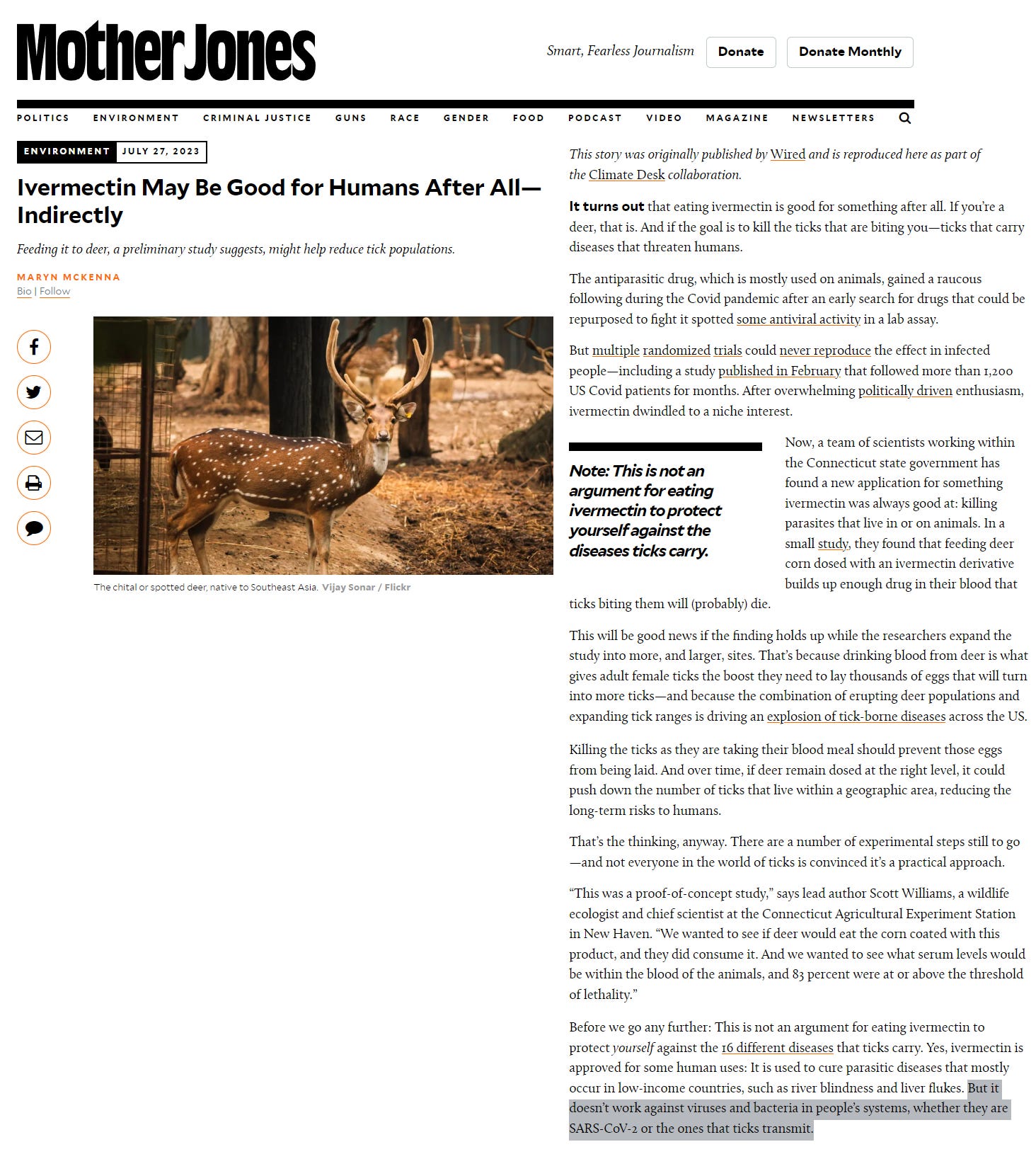
2023 Propaganda Article Praises Ivermectin Use in “Deer” for “Tick Control”
This is a heavy piece of propaganda, the intent of which was to ridicule people who use Ivermectin.
My Take…
I couldn’t find any research about Chronic Lyme Disease and Ivermectin.
Nevertheless, many people are using either Ivermectin or Fenbendazole to treat Chronic Lyme Disease, and they talk about it on Twitter.
A 2018 study found persistent infection despite antibiotic therapy in patients with ongoing symptoms of Lyme.
In 2013 the Centers for Disease Control and Prevention (CDC) announced that Lyme disease is much more common than previously thought, with over 300,000 new cases diagnosed each year in the United States.
That makes Lyme disease six times more common than HIV/AIDS, 20 times more common than hepatitis C virus infection and 30 times more common than tuberculosis in the United States.
“Our findings address a major controversy over persistent symptoms in Lyme disease,” said Marianne Middelveen, lead author of the published study. “The results suggest that infection with the Lyme spirochete may persist in some patients despite supposedly adequate antibiotic therapy.”
Effect of Ivermectin
So is the anecdotal case I received an anti-bacterial effect, anti-inflammatory effect or something else?
There is something called “Lyme arthritis.”
From 2021 Lochhead et al – Lyme arthritis: linking infection, inflammation and autoimmunity:
“The central feature of post-infectious Lyme arthritis is an excessive, dysregulated pro-inflammatory immune response during the infection phase that persists into the post-infectious period. This response is characterized by high amounts of IFNγ and inadequate amounts of the anti-inflammatory cytokine IL-10. The consequences of this dysregulated pro-inflammatory response in the synovium include impaired tissue repair, vascular damage, autoimmune and cytotoxic processes, and fibroblast proliferation and fibrosis. These synovial characteristics are similar to those in other chronic inflammatory arthritides, including rheumatoid arthritis”
Ivermectin and Rheumatoid Arthritis
2023 Khan et al – Evaluation of therapeutic potential of ivermectin against complete Freund’s adjuvant-induced arthritis in rats: Involvement of inflammatory mediators
Thirty-two male Wistar rats were randomly divided into four groups: control, diseased, dexamethasone, and ivermectin groups
After 7 days of rheumatoid arthritis induction, animals were treated with dexamethasone 5 mg/kg and ivermectin 6 mg/kg
Treatment with ivermectin showed a significant reduction in inflammatory cells levels, body weight, and visual arthritic score, indicating an improvement in the degree of inflammation as compared with the diseased group.
Ivermectin treatment also showed a significant reduction in the severity of inflammation and destruction of joints and showed comparable effects to dexamethasone, a corticosteroid used for the treatment of rheumatoid arthritis
Conclusion: “Ivermectin has significant antiarthritic properties and can be a novel treatment agent for the management of rheumatoid arthritis patients”
Conclusion
Ivermectin, is comparable to a strong steroid like dexamethasone (6 times stronger than prednisone) in reducing severity of inflammation and destruction of joints in Rheumatoid Arthritis. That’s impressive.
That’s it’s helping those who suffered from 25 years of Lyme disease, joints and muscle pains is also impressive.
Lyme sufferers should definitely look into Ivermectin.
Maybe there’s more to Ivermectin, Lyme Disease and COVID-19.
Imagine a world where ownership is a distant memory, replaced by an eerie semblance of joy in dispossession. In 2016, Klaus Schwab, the enigmatic architect of the World Economic Forum, foretold a future whereby, in 2024, humanity would be stripped of its possessions, shackled in digital chains, yet deceived into a state of contentment. Initially dismissed as lunacy, we stand on the precipice of this harrowing reality; Schwab’s vision looms ominously over us, more prophetic than we dared to believe.
For decades, a clandestine cabal of technocrats has meticulously orchestrated our descent into digital serfdom. We sleepwalked into their trap and surrendered our rights and possessions to those who wield the power of the keystroke. In this brave new world, ownership is an illusion, and with a mere digital command, everything we hold dear can be seized.
This article unveils the sinister agenda behind the facade of progress. It explores the erosion of ownership through click-wrap agreements, the dematerialization of our assets into databases over the past few decades, the rise of Central Bank Digital Currencies (CBDCs), which threatens our control over money, and The Great Taking, which threatens our control over the rest of our non-monetary assets.
All is not lost, although, in a separate article, I will address that our salvation comes not at the ballot box but through our radical non-compliance. Technology can either be used to promote freedom or tyranny. I will discuss how we can adopt technologies to counter the digital slave system actively being developed by technocrats, thus guaranteeing our privacy, ability to engage in voluntary trade, and retention of our free will.
The Erosion of Ownership: A Descent into Digital Serfdom
In the bleak dawn of the digital age, we find ourselves trapped in a labyrinth of click-wrap agreements; our freedoms quietly surrendered to the whims of faceless corporations. The once-mighty notion of personal ownership has been reduced to a mere abstraction, a quaint relic of a bygone era.
As we click “I agree” with reckless abandon, we seal our fate, surrendering our autonomy to the technocrats who manipulate and control us through the devices we thought would liberate us. Once hailed as a bastion of freedom and progress, the digital realm has devolved into a dystopian nightmare where our every move is tracked, monitored, and exploited.
The Insidious Nature of Digital Control
We are lulled into complacency by the convenience and ease of digital transactions, unaware of the subtle yet pervasive manipulation that underlies every click, every swipe, and every tap. The fine print, a behemoth of legalese, conceals the true nature of our agreements, hiding in plain sight the draconian terms that govern our digital existence.
Consider the staggering numbers: we encounter an estimated 150-400 click-wrap agreements per year, each a ticking time bomb of obligations and responsibilities that we blithely accept without a second thought. These agreements are ubiquitous, embedded in every aspect of our digital lives:
Software licenses, like Microsoft’s 70-page End User License Agreement (EULA)
Online shopping agreements, like Amazon’s 12,000-word Conditions of Use
Social media terms of service, like Facebook’s 25-page Statement of Rights and Responsibilities
Mobile app agreements, like Apple’s 50-page iOS Software License Agreement
Online banking agreements, like Wells Fargo’s 30-page Online Access Agreement
A Life Sentence of Reading
To keep up with the fine print, we would have to devote up to an hour every day, 365 days a year, just to read the agreements. This is the actual cost of our digital existence: a life sentence of reading, a never-ending task that would consume a significant portion of our daily lives.
A Study in Deception
A recent experiment revealed the shocking truth: 74% of participants blindly accepted terms that would have surrendered their firstborn children to the service’s owners and provided their personal information to the NSA.
[…]
The Stage is Set for Asset Transfer
Our increased participation with these clickwrap agreements has set the stage for our assets to be transferred at the click of a button. With the rise of digital currencies, online marketplaces, and social media platforms, our financial, personal, and creative assets are more vulnerable than ever. The implications are dire: a future where our assets are seized, frozen, or transferred without our consent, all under the guise of “agreements” we never truly understood.
We have unwittingly surrendered our autonomy, creativity, and humanity to the whims of corporate overlords. As you will see in the coming sections, the assignment of our rights through digital agreements, CBDCs, and asset tokenization will soon leave us owning nothing.
Because this article is long, I will keep a cumulative list of key takeaways as bullet points at the end of each section.
Key takeaways:
We have unknowingly given away most of our rights through countless digital agreements we sign without reading, eroding personal ownership and autonomy and making our assets vulnerable to corporate control.
The Digitized Domain: A House of Cards Built on Fragile Databases and Corrupt Intermediaries
The digitization of our lives has bestowed upon us a double-edged sword: convenience and vulnerability. We’ve traded the tangible for the intangible, surrendering our assets to the capricious whims of databases and their intermediaries. But let’s be clear: databases are not just peripheral components of our digital lives but the foundation of modern commerce.
Consider it: corporations and governments store every transaction, asset, and record of ownership in a database. Your car title, house deed, and even the shares you hold in a company are all reduced to mere data points within these centralized repositories. And yet, we’re asked to trust that these systems will safeguard our investments and identities from prying eyes and malicious actors.
But here’s the thing: most of our assets have already been digitized. They exist only as entries in a database, and their value is entirely dependent on the integrity of that database. If the database is compromised, the asset is compromised. If the database is destroyed, the asset is destroyed. Database corruption is not just a theoretical risk; it’s a very real one. The financial losses alone are staggering—$1 trillion in 2017, a projected $10.5 trillion by 2025.
And what of the human cost? The disruption of lives, the theft of identities, the destruction of trust? The intermediaries who manage these databases – governments, corporations, and financial institutions – have become gatekeepers to our assets, wielding influence over markets and shaping economies. And yet, we’re expected to accept their security and stability assurances blindly.
Let’s take a step back and consider the current state of affairs. The labyrinthine transaction process, as we know it today, is a veritable goldmine for the parasites and leeches that thrive in its shadows. Third-party intermediaries—lawyers, brokers, or bureaucrats—add layer upon layer of time, money, and expense to every transaction, like a suffocating ivy strangling the life out of a tree. Just as the ivy’s tendrils wrap around the tree’s trunk, squeezing out its vitality, these intermediaries choke the life out of our transactions, draining them of efficiency, transparency, and fairness.
Consider this: according to some estimates, these parasitic middlemen gobbled up as much as 30-40% of the revenue in specific industries. That’s right, nearly half of every dollar you spend can vanish into the abyss of unnecessary costs and inefficiencies before it even reaches the hands that produce the goods or services we desire.
And what do we get in return for this fleecing? A system riddled with redundancies, opacity, and corruption. This concern isn’t new. You can read all about it in the pages of The Wealth of Nations by Adam Smith, who warned against the evils of middlemen and monopolies over two centuries ago.
[…]
Whether we like databases being at the heart of commerce or not, they aren’t going away. A new trend is emerging: tokenization, which converts assets into unique digital tokens that can be stored and traded on digital ledgers. Tokenization means a digital token will eventually represent everything from property to goods to services. As we’ll explore in future sections, this shift towards tokenization can either fix some of the security problems and inefficiencies associated with middlemen or create a new level of tyranny. With tokenization, we may be able to create a new, decentralized system for managing our assets and transactions or further surrender our control of our assets to the globalist cabal.
Key takeaways:
We have unknowingly given away most of our rights through countless digital agreements we sign without reading, eroding personal ownership and autonomy and making our assets vulnerable to corporate control.
Our assets and transactions, now digitized and stored in fragile databases managed by corrupt intermediaries, are vulnerable to loss, theft, and manipulation, highlighting the risks and inefficiencies of our current digital system.
The Money in Our Bank Accounts Doesn’t Belong to Us
We’ve come to understand that we’ve been signing away our rights digitally, surrendering control over our lives to the whims of centralized databases and their intermediaries. But the loss of ownership doesn’t stop there – it permeates every aspect of our existence, from our cars and houses to our money.
Let’s start with what should be our most basic financial instrument: the bank account. We consider the money in our bank accounts ours, but a closer look reveals a different reality. Through my research on the terms and conditions of the four largest banks – Bank of America, Chase, Wells Fargo, and Citibank – I’ve discovered that they can cancel the account without cause, sell or give away our data (and they do give our transaction info to the IRS for use with AI to make sure the taxman gets his cut), change fees, and even modify the terms and conditions at will. I encourage you to check the terms and conditions of your bank account.
These contractual terms mean that the money in our bank accounts doesn’t belong to us. It’s held in trust by these financial institutions, subject to their whims and control. And with digital transactions comprising the majority of economic activity—a staggering $3 trillion as of 2023—it’s clear that our money is already primarily digitized.
The insidious tendrils of centralization have trapped us all, from the high and mighty to the lowly and obscure. It’s a web of control extending far beyond mere money – it’s a stranglehold on our lives.
Consider the cases of Nigel Farage, Dr. Joseph Mercola, and his family – their bank accounts were summarily closed without explanation or provocation. And who’s next? Kanye West, Nick Fuentes, gun groups, religious associations, professional unions, and even protesting truckers – all targeted for exercising their rights, all silenced by the banks.
At this point, we aren’t even talking about CBDCs. When people bleat about CBDCs today, they mostly talk about getting their money shut off or being monitored. That already happens today. The threat isn’t the CBDCs of tomorrow but the current state of the dollar today.
CBDCs simply take this surveillance and programmability to the next level – paving the way for complete digital tyranny.
[…]
The surveillance aspect of CBDCs is equally chilling. Those in power would track, record, and analyze every transaction, eroding any vestige of financial privacy. The thought of governments knowing your every purchase, from coffee to groceries, is enough to send shivers down the spine of anyone who values freedom.
Negative interest rates are another potential nightmare scenario. Governments could confiscate a portion of your savings regularly, discouraging you from saving and encouraging reckless spending. These negative rates would lead to economic instability and further erosion of our financial sovereignty.
Gateway to tyranny: But it doesn’t stop there. CBDCs are designed to be integrated with social credit systems, digital IDs, vaccine passports, and even tied to our other non-monetary assets (homes, cars, stocks, bonds), creating a complete control grid over everything we think we own. Complete digital control is the ultimate goal of technocrats: a global currency backed by energy credits, with a social credit system enforcing compliance with the UN’s 2030 Agenda.
US Federal Reserve Chairman Jerome Powell repeated his long-running warning about US debt levels being “unsustainable” at a European forum on central banking last month. In February, El Salvadoran President Nayib Bukele warned that the Fed strategy of “printing money out of thin air” amounts to “a bubble that will inevitably burst.”
Central banks’ holdings of dollar-denominated assets have reached a historic low, driven by Washington’s attempts to lock resource-rich Russia out of the dollar-based global financial system, which has led developing countries to seek refuge in gold as an asset whose value and convertibility isn’t tied to the whims of any one nation and therefore cannot be as easily weaponized.
IMF estimates from the spring cited by Japanese financial newspaper Nikkei in a recent report show that dollar and US Treasury-denominated foreign reserves have hit to 58.9 percent in 2024, down from about 70 percent two decades ago.
Reserves denominated in China’s yuan have also dropped, from about three percent of total foreign reserve holdings in early 2022 to roughly 2 percent today, with Ukraine, Norway, Brazil, Switzerland and Israel leading the way in drawing down their yuan holdings.
A World Gold Council survey published in June calculated that central banks’ purchase of the precious metal topped 1,037 tons in 2023 – the second-highest annual buy-up in history after purchases in 2022, which amounted to 1,082 tons.
China has led the bullion buy-up, adding gold to its reserves for 18 consecutive months from November 2022 onward, increasing them by 16.3 percent, to about 2,264 tons total as of June.
India has also rapidly stacked up its gold-denominated assets, which are currently worth $57.6 billion, or 30 percent more than they were during the same period in 2023. Delhi purchased some 19 tons of gold in the first quarter of 2024 alone, for a total of 841 tons. Apparently learning lessons from Venezuela, Russia and Libya’s sour experiences relating to the risks of storing central bank assets in foreign countries, India recently moved about 100 tons of its gold reserves from Britain back home to domestic vaults.
Nikkei cites the ongoing conflicts in Ukraine and the Middle East, which show no signs of stopping anytime soon, and the “geopolitical risk” of a second Trump term as president and a potential escalation of US-China tensions as factors which are likely to drive central banks to continue dumping dollars and other fiat currencies and stacking up their gold holdings instead.
“Not even those high taxes, higher than a lot of places in the world…are really funding the [US] government,” El Salvadoran President Nayib Bukele said at a forum in Washington in February.
“So, who’s financing the government? Government is financed by Treasury bonds, paper. And who buys the Treasury bonds? Mostly the Fed. And how does the Fed buy them? By printing money. But what backing does the Fed have for that money being printed? The Treasury bonds themselves. So basically, you finance the government by printing money out of thin air. Paper backed with paper. A bubble that will inevitably burst. The situation is even worse than it seems because if most Americans and the rest of the world were to become aware of this farce, confidence in your currency would be lost,” Bukele warned.
A Boeing Co. 787-8 passenger aircraft, operated by El Al Israel Airlines, takes off from Ben Gurion International airport in Tel Aviv, Israel, on 30 November, 2021 [Kobi Wolf/Bloomberg via Getty Images]
Middle East Monitor
The number of Israelis who left the country permanently surged 285 per cent following 7 October, according to data published in the Times of Israel. Reports from Channel 12 News, based on data from the Central Bureau of Statistics (CBS), indicate an unprecedented increase in October 2023 compared to the same period in 2022.
Latest reports of the exodus of Israelis confirms data published two months after the 7 October attack which showed that nearly half a million people left Israel. It also showed a significant decline in the number of Jewish immigrants arriving in Israel. A second survey among Israelis living abroad conducted in March by the Hebrew University on the initiative of the World Zionist Organisation revealed that 80 per cent said that they do not intend to return to Israel.
The data from CBS suggests that many Israelis who have the option of a second home abroad choose to relocate during times of heightened conflict, seeking safety and stability elsewhere. This trend stands in stark contrast to the claims made by proponents of Zionism who argue that Israel is the ultimate sanctuary for Jews worldwide.
Instead, the data indicate that it is precisely the existence of Israel and its policies that compel Jews to seek refuge elsewhere, highlighting a paradox in the Zionist narrative.
There was also an increase in Israelis moving abroad in the months before the war, amid mass protests against the government’s judicial overhaul plan, with an increase of 51 per cent in June-September 2023 compared to 2022.
Despite the initial spike in departures, the trend is said to have reversed in the following months. Between November 2023 and March 2024, 30,000 Israelis left the country permanently, marking a 14 per cent decrease from the same period the previous year. Additionally, there was a 21 per cent decrease in Israelis returning from abroad during this time, with 8,898 returning between October 2023 and March 2024 compared to 11,231 the previous year.
Channel 12 points out that the CBS data counts Israelis who left the country, did not return over the subsequent ten months, and established their lives abroad, thus indicating trends rather than immediate causes. It also notes that the decision to emigrate is complex and not necessarily tied to a single event, as such decisions typically involve several months of planning.
Overall, while the initial aftermath of 7 October saw a sharp rise in permanent departures from Israel, the rate has since stabilised.
Critics of Israel argue that Jews radicalised by Zionism often move to Israel as a fulfilment of biblical prophecy but tend to leave during times of conflict, especially those holding a second passport.
Israel is increasingly concerned about the trend of reverse Jewish migration from occupied Palestine, particularly at a time when the demography of the state is a fundamental issue for the Israeli government and Zionist strategists.* The movement of Jews away from Israel threatens the demographic balance Zionist leaders seek to maintain.
*The future existence of Israel is threatened as millions of Israeli Jews with dual passports seek to emigrate (permanently) as Israel’s economy tanks and shortages increase due to the Yemeni blockade of critical Israeli ports. Poland sent military jets at the end of 2023 to evacuate Israelis holding Polish passports. See https://www.reuters.com/world/poland-evacuate-its-citizens-israel-officials-2023-10-08/
Just as people around the world started to blissfully forget that the wretched failed state formerly known as the Ukraine even exists, it reminded us of its existence by attacking the Kursk region of Russia, which it borders. Over a thousand Ukrainian troops, many of them from battle-tested Nazi formations and many of them pulled off parts of the existing 1000-km-long front, along which the Ukrainian side is currently in broad, methodical retreat, were equipped with remaining tanks and artillery, most of it, at this point, Western-provided, and ordered to attack a weakly defended, previously peaceful part of Russian territory in a terrorist-style attack. Some Polish and French mercenaries and some well-known Georgian cutthroats were also observed.
Numerous theories have been circulated over the past few days, attempting to explain why the Ukrainians would attack Kursk. After all, if you already have a 1000-km active frontline with Russia along which you are retreating steadily while incurring massive losses, the one thing that you definitely wouldn’t want to do is extend it. The rationale offered by Mikhailo Podolyak, Zelensky’s henchman, that the goal is to improve the Ukraine’s negotiating position vis-à-vis Russia, is blatantly ridiculous, for there are no negotiations, nor will there ever be, for a solid set of reasons:
First, Russia does not recognize the Kiev régime as legitimate: the term of its president expired in May; the term of its parliament expires tomorrow (August 11); therefore, nobody in Kiev has the authority to sign any peace agreements. (Articles of capitulation are a different matter: any old loser can be forced to sign those, as his first and last official act.)
Second, Russia has spelled out its terms for the cessation of hostilities. The first of these is the lifting of all anti-Russian sanctions, from the US, the EU and their allies, which Russia considers as illegal under international law. Then there are the guarantees of future Ukrainian neutrality, the withdrawal of all foreign forces and mercenaries, demilitarization, and denazification (the Nazis will have to stand trial à la Nuremberg). Last but not least, Russia’s new regions of Crimea, Lugansk, Donetsk, Zaporozhye and Kherson have to be internationally recognized as sovereign Russian territory.
What does this have to do with the Kiev régime and its putative representatives such as Mikhailo Podolyak? Well, nothing at all, really. This is way over their heads; the Russians are speaking directly to the Washingtonians or they are not speaking at all and just shooting and bombing to their hearts’ content. And so let’s put the “improved negotiating position” theory where it belongs: in the trash.
Some analysts pointed out that perhaps this incursion was an expression of an idiosyncratic Nazi tendency:
• At the end of World War I, Kaiser Wilhelm ordered his remaining troops to march on Paris. They didn’t make it far and the Kaiser capitulated shortly thereafter.
• At the end of World War II, a certain mediocre Austrian painter ordered his remaining troops to march on Northern Italy… and shot himself a short while later.
Former Ukrainian president Zelensky has just the pistol for that occasion: a hand-engraved CZ75 pistol presented to him by President Pavel of Czechia. But I somehow doubt that Zelensky will shoot himself; more likely, he’ll fly to his mansion in Miami and just relax and enjoy life for a bit. You see, the Ukrainian régime is all about money — nothing else. The millions of dead and wounded Ukrainian soldiers, the economic and social devastation — that is all just some collateral damage to them. All that’s important to them, and to their overseas Washingtonian masters, is that it has made them rich.
Then come the superficially technical-seeming analysts. Some surmise that the target of the attack on Kursk was the Kursk Atomic Energy Station (or nuclear power plant). But given that it is some 60km away from the border and can only be reached by driving armored columns on roads (the land is riddled with swamps, gullies and other obstacles), which roads are very easily attacked from the air (given Russia’s complete air superiority) destroying said armored columns, the notion that the Ukrainians could reach the nuke plant is pure fancy.
Some other analysts have theorized that the target of the Ukrainian attack is the town of Sudzha, not far from the border. What sets Sudzha apart is that it is the location of the natural gas pumping and metering station, from where the pipeline goes across the Ukraine and feeds Moldova (through Transnistria), Slovakia, Austria and Hungary. If the Ukraine cut the flow of gas, that would pose quite a problem for these countries. While Moldova and Hungary could get the volumes of Russian gas they need via Turkey, Slovkia and Hungary would be forced to make other, far more expensive arrangements involving liquified natural gas pumped through countries that have LNG ports. As for the Ukraine itself, it was formerly a major user of Russian gas, but now that it has a much smaller population and virtually no industry left, the paltry 20 billion cubic meters per year of its domestic production are quite sufficient for its needs.
But why do the Ukrainians need to invade Sudzha to shut down the pipeline when there are other pumping stations conveniently located directly on Ukrainian-held territory? There is really just one plausible answer: if something nasty (no doubt, Ukraine-related) were to happen to the pumping station at Sudzha, the Kiev régime could claim that to be an inadvertent consequence of military action and therefore a force majeur; furthermore, any responsibility for consequential economic damage would rest with the Russians, not with the Ukrainians, since Sudzha is on Russian territory. Therefore, the Ukrainians could blow up the pumping station and then demand that Russia compensate them for lost transit fees (which Russia wouldn’t do, but that’s still good enough for propaganda purposes).<
But the Kiev régime, and its Washingtonian friends, do not need to blow up the Sudzha pumping station in order to make money — which, as I mentioned before, is their ultimate goal. It’s enough for them to THREATEN to blow up the pumping station to get European gas futures to jump.
CIA or Special Forces officer with Cambodian counterpart during secret raid on Cambodia during the Indochina Wars. Source: pinterest.com.au
Jeremy Kuzmarov
CIA Destabilized the Country by Supporting Invasions from Thailand by Exiled Politician Son Ngoc Thanh That Were Designed to Overthrow Neutralist Prince Norodom Sihanouk Who Allied with Communist China and Supported the Vietcong
Around the time of former Secretary of State Henry Kissinger’s 100th birthday, The Intercept ran a series of articles by investigative journalist Nick Turse emphasizing that the secret bombing campaign over Cambodia carried out by Kissinger in the early 1970s killed even more civilians and caused more devastation than was previously thought.Interviews with more than 75 victims of U.S. bombing attacks gave readers a sense of the terrible trauma experienced by survivors of the attacks, which were particularly horrific because the villages were not just bombed, but also strafed by helicopter gunships and burned and looted by U.S. and allied troops.
The official purpose of the bombing—which killed an estimated 150,000 civilians—was to flush out the sanctuaries of South Vietnam’s left-wing National Liberation Front (NLF) guerrillas who were hiding in Cambodia and to fortify a U.S.-installed coup regime that was carrying out a war on Cambodia’s left, the Khmer Rouge, which seized power in 1975.
Chhit Do, a former Khmer Rouge official, noted that “the ordinary people sometimes literally shit in their pants when the big bombs and shells came. Their minds just froze up and they would wander around mute for three or four days. Terrified and half crazy, the people were ready to believe what they were told. It was because of their dissatisfaction with the bombing that they kept on co-operating with the Khmer Rouge, joining up with the Khmer Rouge, sending their children to go off with them.”
Based on such testimony, historians Taylor Owen and Ben Kiernan concluded that “civilian casualties drove an enraged population into the arms of an insurgency that had enjoyed relatively little support until the bombing began, setting in motion…the rapid rise of the Khmer Rouge, and ultimately the Cambodian genocide.”
Popular historical representations, however, such as the 1987 Academy Award-winning film The Killing Fields, helped to obscure the underlying conditions of U.S. bombing in which the Khmer Rouge rose to power and became radicalized. A Finnish commission characterized the 1970s as a “decade of genocide,” with Nixon and Kissinger’s crimes rivaling those of Pol Pot (Saloth Sar), whom the Reagan administration supported after the Vietnamese overthrew him in 1979.[1]
CIA Plays a Central Role in Cambodia’s Destabilization
A new book by historian Matthew Jagel, Khmer Nationalist: Son Ngoc Thanh, the CIA, and the Transformation of Cambodia (Ithaca: Northern Illinois University Press, an imprint of Cornell University Press, 2023) makes clear that Cambodia’s “decade of genocide” was set in motion by the Central Intelligence Agency (CIA).
The CIA along with U.S. Army Special Forces contributed significantly to the destabilization of Cambodia by supporting raids carried out by Cambodian guerrillas known as the Khmer Serei (Free Khmer) based in South Vietnam and Thailand.
The aim was to overthrow the neutralist regime of Prince Norodom Sihanouk, Cambodia’s head of state from 1953 to 1970, who allied with Communist China and gave support to the NLF—aka the Vietcong.
The guerrillas were loyal to Prince Sihanouk’s nemesis, Son Ngoc Thanh, an anti-communist nationalist who had served as Cambodian Foreign Minister after the surrender of Japan at the end of World War II and then became Prime Minister from March until October 1972 after a U.S.-backed coup led to Sihanouk’s ouster in March 1970 and replacement with Lon Nol, his army chief of staff.
The CIA valued Thanh—described by The New York Times as a “short, wiry, intense man”—because he was a right-wing republican nationalist who had served in the maquis fighting against France, which colonized Cambodia from 1863 to 1945 and 1945 to 1953.[2]
From 1945 to 1951, Thanh was exiled in France. Upon his return to Cambodia in October 1951, because of his strong anti-colonial stance, he was greeted by more than 100,000 people holding banners reading “Son Ngoc Thanh, National Hero,” and “Son Ngoc Thanh Our Hope.”[3]
During the 1950s and 1960s, the CIA was recruiting “Third Force” politicians across Southeast Asia who represented an alternative between right-wing authoritarians and communists or those seen as too sympathetic to the latter.
In Cambodia’s case, Sihanouk was a target for regime change because of his close alliance with China and desire to steer a neutralist course for Cambodia and avoid entanglement in the Indochina War, which he recognized would ruin his country.
Thanh initially opposed Sihanouk’s gradualist approach to decolonization with France, taking up arms in the jungles of Cambodia against him right after his triumphalist return in October 1951. Ironically at the time, Sihanouk lumped him in with the communists, though the CIA reported in June 1954 on the existence of non-communist dissidents in Cambodia against Sihanouk’s post- colonial rule who are “followers of the nationalist leader, Son Ngoc Thanh.”[4]
The Eisenhower administration’s support for Thanh increased because of its growing covert involvement in Vietnam and Sihanouk’s refusal to join the Southeast Asia Treaty Organization (SEATO) with Thailand, the Philippines and South Vietnam.
By February 1955, after losing a rigged election, Thanh assembled a force of two thousand men on the Thai-Cambodian border operating with Thai support (Cambodia and Thailand had long been enemies).
In December 1958, several CIA officers on the staff of John Peurifoy, the U.S. ambassador to Thailand who was a central architect of the 1954 Guatemalan coup, held a secret meeting in Bangkok where they plotted a coup against Sihanouk with Thanh along with Field Marshal Sarit Thanarat from Thailand, and Ngo Trong Hieu, a South Vietnamese official who was close to Ngo Dinh Diem (a U.S. client installed in power in 1955).[5]
CIA agent Victor Matsui played a key role with Thanh in coordinating the coup plot, which ultimately failed. When one of the main coup plotters, Dap Chhuon, was captured, he was found with a CIA radio in his possession.[6]
State Department officials acknowledged that, by this point, Thanh had lost much of his appeal among the Cambodian population and that Sihanouk, whatever his flaws, had considerable mass support.
Chiang Kai-shek, the head of state in Taiwan whom the U.S. supported against the communists in the Chinese civil war, said that Sihanouk had “essentially anti-communist, nationalistic motivation[s], which emphasized independent stature for [the] Cambodian nation,” and was “a positive benefit [to the] free world.”[7]
The release years later of a telephone conversation between then President John F. Kennedy and his Assistant Secretary of State for Far Eastern Affairs, Roger Hilsman, proved U.S. involvement in the Dap Chhuon coup plot.
In the conversation, Hilsman informed Kennedy that “there’s a history, during the administration of President Eisenhower, where the agency [CIA] did play footsie with opposition groups.”
When Kennedy asked: “Was that a true story about ’59 or something?” Hilsman responded: “yes sir, it is true.” “CIA did do it?” inquired the President. “Sure,” Hilsman responded, “they supplied some money and, uh, they were involved in a plot against Sihanouk back before this administration. The Agency in those days wasn’t responsible to the State Department. They did things they probably didn’t know about.”[8]
Mike Force and Secret Teams
In 1958, Thanh reported that his anti-communist guerrilla forces began to receive military training from the United States to overthrow Sihanouk at its headquarters in the Prachin Buri province in Thailand.[9]
Many Khmer Serei were recruited into “Mike Force,” or mobile strike forces, that were organized by General Paul D. Harkins, a former Deputy Chief of Staff to General George S. Patton at the end of World War II and the first commander of the American Military Assistance Command, Vietnam (MACV) from 1962 to 1964.
According to Thanh, the Khmer Serei received financial backing as well as all of its weapons from the Americans from the late 1950s to the early 1960s.[10]
The total was millions of dollars in assistance, which enabled the Khmer Serei to develop eight battalions of mainly Khmer Khrom (ethnic Cambodians born in South Vietnam who supported Thanh) anti-Sihanouk forces and to establish a clandestine radio station run from a truck inside Thailand.[11]
Chinese Guomindang guerrillas based out of Taiwan actively supported the Khmer Serei along with the South Vietnamese and Thai governments, which supplied ammunition, bombs and explosives as Thanh’s men were sent as infiltrators into Cambodia to conduct sabotage and political warfare operations.[12]
Sihanouk was accused of harboring Vietcong agents, though the U.S. ambassador to Cambodia, Philip D. Sprouse (1962-1964), admitted there was no proof to the charge.
John F. Kennedy wrote to Sihanouk denying U.S. support for the Khmer Serei, but crossed out a sentence suggesting CIA support for them. Sihanouk subsequently gave a fiery speech in which he said that the Americans were noted for “their habit of buying the conscience of [people]. They have bought such running dogs as…Son Ngoc Thanh, and the Khmer Serei, the Vietnamese and the new Vietnamese government.”[13]
As the Vietnam War expanded, the Khmer Serei were recruited into the Civilian Irregular Defense Group (CIDG) run by the CIA, which ran cross-border infiltration, unconventional warfare and espionage missions and became part of the Phoenix Program, whereby suspected Vietcong on blacklists were kidnapped and then often tortured and executed.[14]
The CIA’s operations exemplified the exploitation of political divisions and minority grievances by the U.S. in the service of larger imperial ends.
Thanh played an active role in the Khmer Serei operations and was ferried to various CIDG camps by a U.S. helicopter. He said that there was always a CIA agent attached to his staff whom he identified only as “Fred.”[15]
The 1967 Operation Daniel Boone, involving the use of Khmer Serei forces skilled in jungle warfare who operated as guides for U.S. Special Forces, was created without the knowledge of Congress.
The British embassy characterized the Khmer Serei’s chief methods as being “subversion and terrorism.”[16] They were known for blowing up railways and committed heinous atrocities for which they tried to frame the Vietcong.[17]
When CIDG officer Randolph Harrison was shown a photo of what appeared to be Khmer Serei forces next to mutilated and beheaded Cambodian communists, he said: “I know these guys. They’d been in my Special Forces unit.”[18]
Son Ngoc Thanh and Cambodia’s Descent into the Abyss
CIDG operations laid the groundwork for the 1970 CIA-backed coup, which resulted in the ouster of Sihanouk and empowerment of Lon Nol, who had been known for carrying out brutal operations against Cambodia’s communists—the Khmer Rouge—in the mid-1960s.
Paid through U.S. aid money and continuously outfitted with U.S. weapons, the Khmer Serei played a key role in the coup by serving as a conduit for CIA infiltration of the Cambodian government, and then by helping the new post-coup government to flush out its enemies as it became integrated into the Cambodian Army.
As a reward, Thanh was appointed Prime Minister in 1972. Americans saw him as a potential check on Lon Nol’s drift toward authoritarianism and also liked him because he hoped to lead his Khmer guerrillas against the North Vietnamese in the Cambodian jungle.
Thanh’s support within Cambodia, however, was not what it once was: Judith Coburn reported in the Far Eastern Economic Review that “he labors under the cloud of decades long collaboration with the American CIA.”[19]
That collaboration became more and more unpopular as Cambodia was turned into a wasteland by Nixon and Kissinger’s savage bombing campaign, which combined with prior CIA-backed destabilization efforts, helped turn the population against the U.S. and its proxies like Thanh.
When the Khmer Rouge came to power in 1975, they liquidated Cambodia’s cities and systematically massacred U.S. collaborators, including many former Khmer Serei fighters who were considered to be foreign invaders.
Those Khmer Serei who escaped took up resistance along the Thai-Cambodian border, though, according to Jagel, were little more at this point than black marketeers or bands of extortionists who preyed on the defenseless border refugee camps.[20]







![A Boeing Co. 787-8 passenger aircraft, operated by El Al Israel Airlines, takes off from Ben Gurion International airport in Tel Aviv, Israel, on 30 November, 2021 [Kobi Wolf/Bloomberg via Getty Images]](https://i0.wp.com/www.middleeastmonitor.com/wp-content/uploads/2024/05/GettyImages-1236912999-scaled-e1714746144407.jpg?fit=1200%2C800&ssl=1)


