Esmaeil Baqaei, Iran’s Foreign Ministry spokesman in an image from archive.
Almanar English
Iran has firmly rejected speculation that it initiated negotiations with the United States, while doubling down on its pledge to meet any American violation of commitments with immediate and reciprocal countermeasures.
Foreign Ministry Spokesman Esmaeil Baqaei categorically dismissed claims of a unilateral Iranian request for dialogue with Washington during a televised interview on Friday. However, he acknowledged that Tehran did engage with a Qatari delegation in the northeastern city of Mashhad—but clarified that the meeting occurred solely at the behest of a regional mediator seeking to facilitate discussions on recent developments, not as a US-directed overture.
Reaffirming the Islamic Republic’s steadfast doctrine of “commitment for commitment,” Baqaei stressed that Iran will not implement any obligation without corresponding action from the American side. He accused Washington of serial infractions, noting that the United States has breached the recently signed memorandum of understanding multiple times within just 22 days of its endorsement.
Specifically, Baqaei cited newly announced US restrictions on Iranian oil sales and the imposition of additional sanctions as flagrant violations of the agreement’s core articles. “Iran has already activated the necessary reciprocal responses, and this approach will continue with full force,” he declared.
Turning to multilateral forums, the spokesman dismissed the recent United Nations Security Council session on Iran’s nuclear file—convened at the request of the United States, Britain, and France—as entirely inconsequential. He argued that UN Security Council Resolution 2231 expired on October 18, 2025, rendering any subsequent reports on its implementation legally invalid and devoid of merit.
Baqaei also condemned persistent Western calls for inspections of Iranian nuclear facilities that were damaged in attacks by the Israeli regime and the United States. He criticized the international community for its failure to condemn those strikes, asserting that the silence constitutes a blatant disregard for clear violations of international law.
In a separate development, Baqaei confirmed that Foreign Minister Abbas Araghchi is set to travel to Oman on Saturday for high-level consultations focused on the Strait of Hormuz and regional maritime safety. The visit follows several rounds of technical discussions between Tehran and Muscat aimed at facilitating secure navigation and finalizing arrangements for maritime services in the strategic waterway.
Around mid-May (2026), shortly after I had written my article questioning whether Trump might conduct a counterterrorism campaign in the Sahel and West Africa,(1) two significant events occurred which give clues to what Trump might have in mind on that question. The first was the publication of the White House’s Counterterrorism Strategy memorandum for 2026,(2) The second, which occurred a day or two later, was the US military’s participation in a counterterrorist strike in Nigeria.
Trump’s memorandum was released on or around 10 May, meaning that the White House was obviously cognisant of the attacks by Jama’at Nusrat al-Islam wal-Muslimin (JNIM) on the Mali junta on 25 April.(3) Indeed, the document refers specifically to a resurgent terror threat by Al Qaeda and IS in West Africa and the Sahel region.
The memorandum is disconcerting, almost certainly being the most exaggerated and misleading directive ever issued by an American President. Drafted by Sebastian Gorka, Trump’s senior director for counterterrorism – a position which does not require Congressional approval or confirmation – the 16-page document was described by The Intercept as “a collection of threats, grievances, hyperbole and lies, … a distillation of Trumpism as an ideology, movement, and system of governance,” which “serves as a new declaration of war on the Trump administration’s enemies – foreign and domestic, real and imagined.”(4)
A glance at Gorka’s résumé would suggest that he is wholly unqualified for the position of ‘counterterrorism czar’, as it is known.(5) Stephen Walt, a professor of international affairs at the Harvard Kennedy School of Government, voiced his reservations about Gorka influencing policy in the White House, saying: “Gorka does not have much of a reputation in serious academic or policymaking circles. He has never published any scholarship of significance, and his views on Islam and U.S. national security are extreme even by Washington standards. His only real ‘qualification’ was his prior association with Breitbart News, which would be a demerit in any other administration.”(6)
Despite these shortcomings, Trump’s 2026 Counterterrorism Strategy is a “foundational document.” (7) It shifts national security priorities away from the traditional post-9/11 focus on global jihadist networks and instead redefines the primary threats around:
Narcoterrorists and Transnational Gangs.
Violent Left-Wing Domestic Extremists, specifically anarchists and ‘Antifa’.
Legacy Islamist Terrorists and Global Jihadists.
Trump’s ‘Counterterrorism Strategy’ would suggest that his primary concerns are with so-called ‘narco-terrorism’ and ‘Antifa’, both of which present him with serious legal difficulties, rather than ‘Legacy Terrorists’, such as Al Qaeda and IS groups.
As the first three chapters of my forthcoming book – War in the Sahel (8) – reveal in detail, the US Department of Justice (DoJ) and its Drug Enforcement Agency (DEA) failed, despite going to extreme and often ‘illegal’ lengths, to prove their assertion that drug traffickers, notably the Fuerzas Armadas Revolucionarias de Colombia (FARC), and terrorist groups, such as Al Qaeda, were linked and effectively one and the same thing. Nevertheless, despite Ginger Thompson’s (9) demonstration of the lack of evidence of a link between narcoterrorism and terrorist groups like Al Qaeda, the concept of ‘narcoterrorism’ has persisted. Indeed, in the case of West Africa and the Sahel, where the Trump administration is re-engaging, neither JNIM nor L’État islamique dans le Grand Sahara (EIGS), now calling itself Islamic State – Sahel Province (ISSP), receive any money from drug trafficking, despite drug trafficking having a long history in the region. In his attempt to get around this problematic, Trump has defined drug traffickers, or ‘narcoterrorists’ as he calls them, as Foreign Terrorist Organisations (FTOs). Whether this will give him some degree of legal cover for killing close to 200 civilians in attacks on alleged drug boats traversing Caribbean and eastern Pacific waters, despite failing to produce any evidence, is debatable.
Since returning to the White House, Trump has used his position, seemingly unconstitutionally on many occasions, to seek revenge on his enemies, real or imagined. This includes those who are opposed to or disagree with his views and polices and who are being accused of belonging to his ever-widening, ‘catch-all’ usage of the term ‘Antifa’, an abbreviation of ‘antifascist’. (9)
However, as with the concept of ‘narco-terrorism’, Trump also has a legal problem in designating ‘Antifa’ as a terrorist organisation. In 2020, during protests after the police killing of George Floyd, Trump tweeted: “The United States of America will be designating ANTIFA as a Terrorist Organization.” Trump did not follow through on this at the time, possibly because the then FBI Director Christopher Wray said that Antifa was “not a group or an organisation”, but a “movement or an ideology”. (11)(12)
On his return to the White House, Trump set about designating Antifa as a “domestic terrorist organisation” by issuing a presidential memorandum entitled “Countering Domestic Terrorism and Organized Political Violence” (NSPM-7) on 25 September 2025. (13) Following the memorandum’s issuance and Trump’s designation of Antifa as a domestic terrorist organization, (14) Federal prosecutors set about securing terrorism convictions against protesters allegedly linked to Antifa. While the US government can designate a group as a Foreign Terror Organization (FTO), the legal criteria state that the targeted group “must be a foreign organization”. Congress has not passed any law relating to domestic terrorism designation, nor is there a standalone crime of ‘domestic terrorism’. American Civil Liberties Union and Human Rights Watch condemned the directive, arguing it could be used to target political opponents and suppress dissent, as has been the case. The Brennen Center for Justice concluded that both the memorandum and the related antifa designation were “ungrounded in fact and law”. (16)
In preparing the ground for his May 2026 attack on Antifa, Trump published another Presidential Memorandum in January 2026 announcing the US’ withdrawal from 66 international organisations and entities, many of which were central to the multilateral security landscape the US had helped construct. The new – May 2026 – counter-terrorism strategy logically continues this approach: not just in withdrawing from institutions but in repudiating the very ideas that informed their creation. (17)
Trump’s May 2026 memorandum says: “Our counterterrorism operations will be executed apolitically and founded upon reality-based threat assessments. Our counterterrorism powers will not be used to target our fellow Americans who simply disagree with us. We will not permit the weaponization of America’s unparalleled CT capabilities for partisan purposes and in contravention of every American’s God-given rights.”
This statement is not only a falsity in that his new memorandum is already being used ‘politically’ to target those who ‘disagree with him’, but contains a perverse irony in that the Trump administration is following the road taken by many of the world’s authoritarian regimes since President George W. Bush launched America’s Global War on Terror (GWOT) in the wake of 9/11. Since then, authoritarian regimes the world over have used the pretext of the GWOT to designate their domestic enemies and opponents as ‘terrorists’. Trump, by following in the footsteps of Algeria, Russia, Turkey, Mali and other authoritarian regimes, is now bringing the war on terror home by using it, albeit without legal foundation, to target Americans themselves. The May 2026 presidential memorandum, described by The Hague-based International Centre for Counter-Terrorism (ICCT) as “selective amnesia”, (17) attempts to put antifa, which is a collection of ideas and not an organisation, on a par with actual terrorist groups like Al Qaeda and the Islamic State groups.
Not only have Americans already been successfully prosecuted under Trump’s executive order designating antifa as a domestic terrorist organisation, with the Justice Department insisting there will be more,(18) but the partisan intentions of the May 2026 directive are blatantly obvious in that the directive makes no reference to right-wing violence. Rep. Bennie G. Thompson, D-Miss., ranking member of the House Committee on Homeland Security, said: “Absurdly, the document incorrectly labels drug cartels, ‘legacy Islamist terrorists,’ and violent left-wing extremists as the top counterterrorism threats – despite years of data proving that right-wing extremism has presented the most persistent and deadly threats to Americans for decades.(19) A 2025 analysis conducted by the nonpartisan Center for Strategic and International Studies (CSIS) found that, over the past decade, right-wing extremists carried out 152 attacks in the United States and killed 112 people, compared with 35 attacks and 13 deaths attributed to left-wing militants. Islamist jihadist-inspired attacks resulted in 82 deaths over the same span.”(20) Moreover, The US Department of Justice (DoJ) removed a study into political violence in America which concluded that far-right extremism outpaced “all other types of violent extremism”.(21) BBC Verify has reviewed five independent studies that have looked into politically motivated attacks in the US going back decades, all of which suggest there have been more cases of political violence in the US committed by people assigned a right-wing ideology by researchers than a left-wing one. (22) Brian Finucane, a senior advisor for the US Program at the International Crisis Group said the Trump administration had “repurposed ‘terrorism’ framing and applied it to new boogeymen, like alleged narcos as well as a caricature of their domestic political opposition.”(23)
On his press tour touting the new strategy, Gorka said: “left-wing violent radicals like Antifa and the anarchists” were the “most ascendant” terror group and – without evidence – claimed they were “the people who killed our friend Charlie Kirk.” He said these leftists are “People who think that if you don’t agree with them politically, they get to kill you.”(24)
US congressman Ro Khanna says he was detained for 90 minutes by armed Israeli settlers during a visit to the occupied West Bank.
Khanna, 49, had been in a van with his team when they were surrounded by settlers wielding M4 rifles on Wednesday, he told Reuters news agency.
Writing on X, Khanna said that when the Israel Defense Forces (IDF) arrived, “they sided with the settlers and continued our detention”.
The BBC has reached out to the IDF for comment. The Israeli military said in a statement troops and police officers took action after getting a report settlers had blocked vehicles in the area.
“Upon their arrival, the troops dispersed the Israeli civilians and allowed the vehicles to continue on their way,” the IDF said.
Khanna was visiting the ruins of Khirbet Zanuta, on a fact-finding visit to look at the impact of Israeli occupation of the area.
The politician, a father-of-two, is mulling over a presidential run in 2028.
“We were at a village that Israeli settlers had destroyed, they had destroyed the school, they had destroyed that village, and we were just looking at it,” he said.
“And these hoodlums come in with machine guns – M4, an American-made machine gun – and they detain us. They block off the road. And then they call the IDF and the IDF is on their side, not on the side of the Americans,” Khanna said.
While they were detained, an aide who was with Khanna said they made appeals to the US Embassy in Jerusalem for help, and were released after a group of police officers intervened.
Israel has built about 160 settlements housing 700,000 Jews since it occupied the West Bank and East Jerusalem – land Palestinians want, along with Gaza, for a hoped-for future state – during the 1967 Middle East war. An estimated 3.3 million Palestinians live alongside them.
The settlements are illegal under international law.
The civilians were guided to safety by drones and a walkie-talkie from newly liberated Konstantinovka
Russian troops have rescued a family trapped in the city of Konstantinovka in the Donetsk People’s Republic (DPR), which was recently liberated from Ukrainian forces after months of intense fighting.
The DPR, a largely Russian-speaking region in Donbass, broke away from Ukraine shortly after the 2014 Western-backed coup in Kiev. The region later voted to become part of Russia in a referendum held in September 2022. Ukraine, however, continued to control parts of the DPR after 2014.
On Friday, Moscow announced the capture of the city at the southernmost edge of the Slavyansk-Kramatorsk agglomeration, the last major Ukrainian stronghold in the DPR. Russian troops are conducting mop-up operations and clearing mines as fighting continues around Konstantinovka. Drones from both sides continue to fly over streets lined with heavily damaged buildings.
During a routine surveillance drone patrol, Russian troops spotted a partially destroyed house with a makeshift banner outside reading, “A family lives here.” The residents noticed the UAV and displayed another placard reading, “A family with a child,” according to footage released by the Russian Defense Ministry.
The drone dropped a walkie-talkie to the family of four, after which the soldiers guided them to safety while monitoring them from above.
“It was so epic. At dusk, we went out holding the placard. A drone flew past, looked at us, signaled, and flew away. Then we heard over the radio: ‘Hello, this is the Army of the Russian Federation. Are you ready to go? A little bird will guide you out,’” one of the rescued women said.
The Qatar Investment Authority (QIA) has successfully blocked a manufacturing agreement between Volkswagen and the Israeli defense contractor Rafael, according to a report by BILD. The deal, which had been formalized in a memorandum of understanding this past April, would have utilized Volkswagen’s Osnabrück facility to produce components for Israel’s Iron Dome missile defense system.
By exercising its 17 percent voting stake in the German automaker, the QIA—which maintains significant influence on Volkswagen’s supervisory board—vetoed the arrangement due to Doha’s strained diplomatic relations with Israel.
This intervention has immediate operational consequences for Volkswagen, as the scrapped contract was viewed as a potential lifeline for the struggling Osnabrück plant and its workforce. Beyond the factory floor, the move reflects the growing strategic friction between European corporate interests and Gulf-based sovereign wealth funds.
Security analyst Peter R. Neumann, speaking to BILD, highlighted that as the German economy faces challenges, the increasing reliance on Gulf capital presents complex risks, noting that sovereign wealth funds are now actively exerting influence to align corporate strategies with regional political agendas.
The fallout from the veto is already impacting other sectors, with Israeli officials now adopting a more cautious stance toward European companies heavily backed by Gulf investment. This shift has stalled a proposed $4.2 billion acquisition of the Israeli shipping firm Zim by the German operator Hapag-Lloyd.
Malian officials say France is supporting Al-Qaeda groups to destabilize its former colonies in Africa’s Sahel region
Malian authorities announced on 9 July that militant groups with links to Al-Qaeda carrying out terror attacks in the country were trained and armed by Ukrainian specialists.
Fousseynou Ouattara, Vice President of the Defense Commission of Mali’s Transitional Council, said authorities identified militants who received training in Ukraine to carry out operations using kamikaze drones produced by Kiev.
“These young people are known, we have now added them to our lists, and we have their names,” Ouattara said.
The militants fighting the Malian government belong to a Tuareg-led separatist group, the Azawad Liberation Front (ALF), and Jamaat Nusrat al-Islam wal-Muslimeen (JNIM), an extremist group linked to Al-Qaeda.
He added that the militant groups are receiving fighters from Algeria, Mauritania, and Libya, as well as training from members of the French Foreign Legion and Ukrainian instructors.
France is allegedly supporting the ALF and JNIM following the Malian government’s removal of French troops in 2022. In their place, private military contractors from Russia’s Wagner Group were deployed.
After a May 2021 coup in Mali, the country’s military junta officially demanded that France withdraw its troops “without delay.” French troops had been present in Mali for nine years, allegedly to fight the Al-Qaeda-linked insurgency.
Mali was a French colony known as French Sudan before it gained independence as the Republic of Mali in 1960. However, France has sought to reassert its influence in Mali and in neighboring Burkina Faso and Niger, which are also former French colonies.
In September 2023, the military leaders of Mali, Niger, and Burkina Faso established the Alliance of Sahel States (AES), which established a partnership with Russia.
Fighting between the Malian army and the ALF and JNIM has escalated in recent weeks.
On 7 July, the Malian army released a statement saying that “more than 200 terrorists were neutralized during coordinated air and ground operations” conducted in the village of Anefis in the northern Kidal region.
The army statement noted that the operation was conducted in response to attacks by armed groups on military positions.
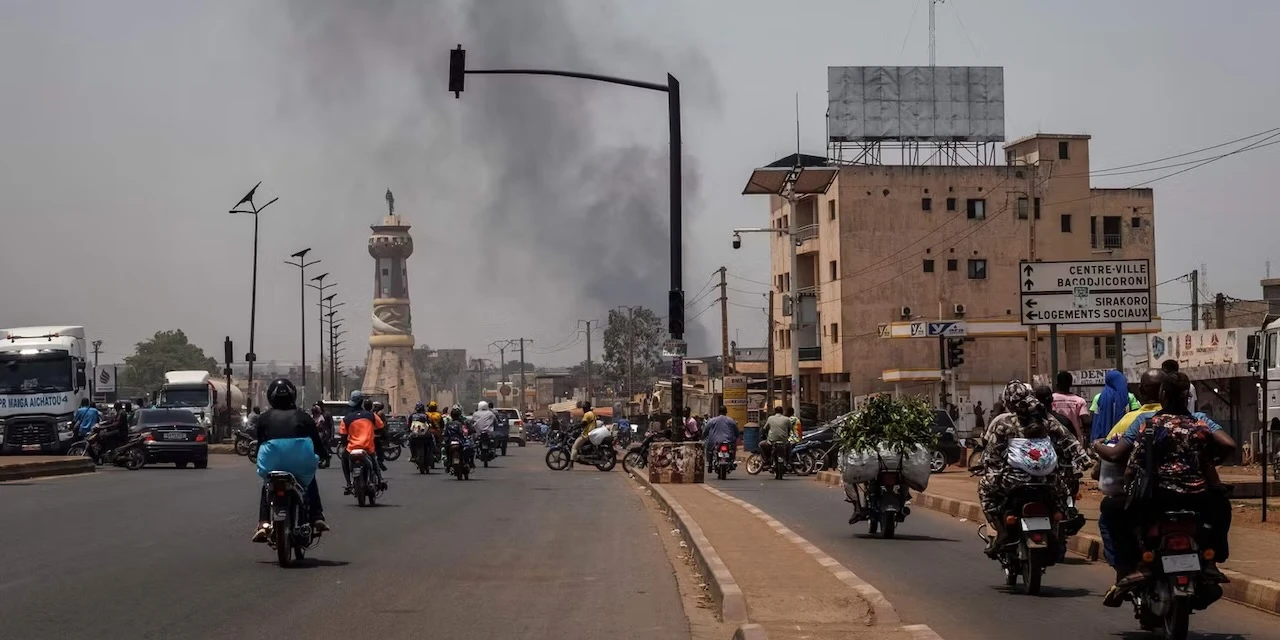
On 4 July, Mali’s Ministry of Defense and Veterans Affairs announced that militant groups attacked army positions in Aguelok, Anefis, Gao, Kenioroba, Konna, Sevare, and Somadougou.
Clashes with the militants reportedly continue near Anefis, where a major Malian military base is located.
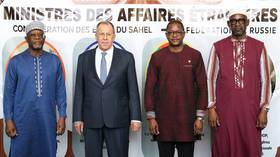
On Wednesday, Russian Foreign Minister Sergey Lavrov and his AES counterparts held a meeting in which they condemned destabilization campaigns supported by Ukraine and France.
Russia and the AES agreed to expand military cooperation, with Moscow pledging additional support to strengthen the operational capabilities of the armed forces of AES nations.
The foreign ministers of Russia, Mali, Niger, and Burkina Faso described the recent militant attacks on AES countries as “barbaric and ignoble” acts threatening regional stability.
“The two sides firmly condemned such destructive actions aimed at undermining the sovereignty of the AES and regional stability,” they said.
The ministers also acknowledged the efforts of troops from AES member states in repelling “terrorist attacks,” as well as the contribution of Russia’s African Corps to counterterrorism operations in the Sahel.
The Russia-AES meeting took place as French President Emmanuelle Macron visited Syria to meet President Ahmad al-Sharaa, the former Al-Qaeda and ISIS commander.
During the 14-year war to topple former Syrian president Bashar al-Assad, France joined the US and its allies in supporting Sharaa’s Nusra Front, which finally took power in Damascus in 2024.
Since its founding in 1776, the United States has been involved in an armed conflict for approximately 91% of its history. While most Americans prefer to view these armed conflicts as separate and singular, the view from the outside is that this has been one single war: the US vs. the World. For most of this time, this war had been beneficial for the US and, most importantly, profitable: good for the economy, popular politically and generally good for morale. But now, at 250 years old, the US is facing a situation where it can no longer win — economically, militarily or politically.
• Economically it has been surpassed by China, which serves as the single largest import partner for approximately 40% of all countries worldwide. Most alarmingly for Pentagon’s strategists, the US military industrial complex would be unable to manufacture or service most weapons systems without a steady stream of products and parts from China. This, in effect, provides the Chinese leadership with a kill switch for the US military and all other militaries (such as all of NATO) which it supplies with weapons.
• Militarily by Russia, which, thanks to continuous experimentation on the proving ground provided by former Ukraine, has developed the world’s only military able to deal with modern warfare. Also, Russia has not only learned to mass produce hypersonic rockets which the US doesn’t have and cannot intercept, but has even learned to intercept them in case the US ever develops any.
• Politically, the US is isolated while China and Russia have learned to coordinate their policies to a considerable extent, making their very considerable trade with each other immune to any US sanctions. The combination of superior Russian weaponry and the Chinese economic kill switch puts the US in perpetual check. In chess, a perpetual check is automatically a draw; in the real world, there is no referee to make the call and it is up to the participants to recognize the situation and what it means. And what it means is an end to superpower competition. The signal is clear: there are still three superpowers in the world — China, Russia and the US, but the US is no longer a contender.
It remains to be seen whether the various assorted power structures in the US are capable of receiving that signal. Be that as it may, each next military conflict, be it the proxy war in the Ukraine or the failed attempt at regime change in Iran, results in financial losses and humiliation for the leadership. What’s more, the US can no longer afford the luxury of such foreign adventures: it is broke, with its federal debt about to top $40 trillion. Next, modern warfare requires prodigious quantities of oil (the US military is the largest single consumer of petroleum in the world) but the shale oil miracle is nearing its end and while the Strategic Petroleum Reserve is essentially empty (the remaining third of it trapped inside salt caverns; it cannot be used because of equipment failures). Finally, the US lacks the internal solidarity which is needed to prosecute successful military campaigns, with many signs of an incipient civil war between the various factions of a fractured population.
Does this mean that the permanent war of the US vs. the World is nearing its end? Of course not! It will simply change venue… to Europe. The recent NATO summit in Ankara, Tükiye, was a beg-a-thon. The US demanded ever more money for weapons such as Patriot missile batteries or F-35 jets which are one or two generations behind state of the art and which it is yet to manufacture. The US was not willing to provide anything more, no longer willing to contribute to the proxy war in the former Ukraine and looking for a way to pull out of Europe altogether. The consolidated European response was: “Take the money! Please don’t leave us!”
The European position, humiliating though it is, is easy to understand. Europe is in the terminal stages of an invariably fatal disease known as “radical liberalism.” Its decadence, which it had once attempted to pass off as “universal human values,” revolts the rest of the world. An important symptom of its decadence is a rapidly declining standard of living. Its native populations are morbid, their families destroyed by radical feminism. Its social systems are burdened by hordes of freeloading migrants. Its economy is hamstrung by idiotic energy policies borne of global warming madness. As a result, it cannot hope to compete. Germany’s industrial might is all but gone and with it Europe’s ability to field an army that would be of any consequence.
Meanwhile, the only excuse Europe’s leadership is able to offer to its increasingly restive population for its plummeting standard of living is that this has been made necessary by the exigencies of a wartime economy. But a war requires an enemy and the only enemy available is Russia (which, by the way, is completely disinterested in fighting Europe and wouldn’t even be interested in militarily engaging the former Ukraine were it not so sorely provoked). But then Europe cannot possibly stand up militarily to Russia were it not backed by the US. But then the US is incapable of standing up to Russia either (and wants to trade with Russia, which remains an essential source of enriched uranium for American nuclear power plants and much else besides). Sometimes it is not too early to cry “Vae victis!” (that’s Latin for “Woe to the vanquished”) even before any battles have taken place.
In order to make such a fictional battle even remotely plausible, even at the level of theatrical suspension of disbelief, it must be possible for Europe to portray Russia as posing a credible threat. For the past four and a half years, Russia has been forced to oblige, substantiating the claim of “Russian aggression” with its Special Military Operation in the former Ukraine. But Russia just liberated Konstantinovka, leaving just Kramatorsk and Slavyansk to still be liberated in the Donbass region while Lugansk region has been free of Ukrainian forces for some time now. There are still a few cities to be liberated further south — Kherson and Zaporozhye — but there is very little doubt that Russia will liberate them as well. Russia is also well on its way to demilitarizing the former Ukraine, and with it the rest of NATO, by destroying what’s left of their war materiel. Next will come the task of denazification — it involved lengthy sojourns in labor camps and some hangings for the Nazis the last time around — but this process is likely to take a few decades. And with that the plausibility of “Russian aggression” against Europe will recede in the rear view mirror, making it ever more difficult for European leadership to justify further militarization as an excuse for further austerity.
It is already accepted as a foregone conclusion, and it appears to be slowly sinking in even in Europe, that the former Ukraine is a lost cause. The Americans are only willing to supply the Kiev regime with weapons if the Europeans pay for them, money up front, and intelligence and communications services. These are farmed out to Elon Musk’s Starlink satellite system for battlefield communications and Alex Karp’s Palantir AI outfit for targeting information, among others. American direct funding to Kiev has been zeroed out while European funding has shrunk by a factor of five, year on year. In short, the former Ukraine is… the former Ukraine, ready for the boneyard and, in the case of the Kiev ringleaders, the gallows. Once it fades out, the European leaders will be forced to look elsewhere for that magic elixir that will prolong their political careers — “Russian aggression,” that is.
In order to make this elixir flow, it will be necessary to provoke Russia into being aggressive. But how? To this end, NATO-heads have hatched a plan as ingenuous as it is daft: attack Kaliningrad. Kaliningrad is a Russian enclave on the Baltic Sea, Russia’s easternmost region, surrounded by NATO members Poland and Lithuania. NATO-heads find it possible to think that it is therefore isolated and an easy target. They have therefore contrived the euphemistically named Eastern Flank Deterrence Line , It is designed to neutralize the heavily fortified enclave from the ground and dismantle its air-defense systems quickly should a conflict arise. And a conflict would indeed instantly arise should NATO attempt to neutralize Kaliningrad and dismantle its air-defense systems, giving rise to… “Russian aggression,” of course, mission accomplished. Europe’s leaders could then simulate injury like a pro footballer and proceed with wasting money on armaments while bamboozling their constituents.
There are just a few problems with Eastern Flank Deterrence Line. The first is that the Russians would be exquisitely well informed of any upcoming attempts to neutralize Kaliningrad and dismantle its air-defense systems. This is because NATO is full of officers who have no intention of fighting Russia (as a matter of self-preservation) and would want to end up on the right side of a firing squad should hostilities arise. The second is that Kaliningrad, by itself, is designed as a very large rat trap for the NATO-heads, and not of the humane kind; touch it and it breaks your neck. The defenders of Kaliningrad are equipped and stand ready to neutralize those giving orders to neutralize it using rockets for which no NATO countermeasures exist.
The third is that the brilliant NATO plan ignores the existence of the Leningrad military district. Kaliningrad falls in its purview. It consists of 100,000 men under arms not counting reservists and has ground, air/space and naval components. If Kaliningrad is attacked, it will counterattack, after which point Kaliningrad will no longer be isolated. In the course of this counterattack, the tiny statelets of Estonia, Latvia and Lithuania will cease to exist. The total number of active duty military personnel in Estonia, Latvia, and Lithuania combined is approximately 38,000 soldiers, but this mighty army will dissolve in an instant once it becomes obvious to it, as it already is to most, that the local NATO contingent does not wish to die defending Estonia, Latvia or Lithuania. If asked what right they have to dissolve and annex these tiny statelets, Russia would furnish the Treaty of Nystad of 1721, according to which it bought these territories from Sweden for 2 million silver riksdaler (roughly $100 million USD). Once these events take place, European leaders will be happy and go on blithering in public about “Russian aggression” while looting their treasuries in favor of their friends the defense contractors with the excuse of “countering the Russian threat.”
At the end of this process, whether or not it includes the failed provocation against Kaliningrad, and the loss of the three Baltic statelets, the remainder of NATO will be armed and highly militarized, but still unhappy and still nowhere near ready to take on Russia. They will, however, be ready to take on each other. Various historical irredentist claims will be put to good use.
Poland is likely to kick off the process, feasting on the rancid remains of the former Ukraine while upholding its reputation as the “hyena of Europe” (the term coined by Winston Churchill). Following WWII, the Soviet Union forcibly shifted Poland’s borders westward. Poland lost its eastern borderlands—known as the Kresy—which included historically culturally Polish cities like Lviv (Lwów, Lemberg) and Ternopil.
Not willing to be left out, Germany will join the fray. After World War II, allied powers shifted Poland’s borders westward, compensating it with roughly 25% of pre-war Germany’s territory, including Silesia, Pomerania, Danzig (now Gdańsk) and East Prussia (now Kaliningrad). We have already discussed Kaliningrad and the free city of Danzig would be a reach, but Silesia and Pomerania would certainly be up for grabs. Germany might also wish to avail itself of the currently French Alsace-Lorraine.
Activists force QTS to abandon plans for giant AI facility after wave of demonstrations and lawsuits
Local protesters have hailed victory after a US investment giant abandoned plans for a data centre “monstrosity” that would have been built on the edge of a historic battlefield in Virginia…
Meta‘s massive AI data center in Wyoming is facing scrutiny after an unexpected contamination incident emerged during construction.
The Mark Zuckerberg-owned company is developing a 715,000sq ft campus in Cheyenne that is set to go online next year, but its contractor has come under fire after city officials traced wastewater containing a rare bacterium to the project.
Known as Cupriavidus gilardii, the naturally occurring bacterium is typically found in soil and water. While harmless to most healthy people, it can cause severe pneumonia, bloodstream and lung infections, and, in rare cases, death among people with weakened immune systems.
Cheyenne’s Board of Public Utilities (BOPU) said the bacterium was found in wastewater discharged by Goat Systems, a contractor working on Meta’s $800 million data center.
According to the BOPU, the bacterium was first detected during routine wastewater sampling in late February, but was only announced last Thursday.
Meta said its general contractor, Fortis, began hauling industrial wastewater offsite and that independent testing found no trace of the substance to date.
Officials stressed that it did not contaminate the city’s drinking water, but said it disrupted the municipal reclaimed water system and required months of cleanup.
However, the city permanently revoked Meta’s authorization to discharge wastewater from its fill-and-flush operations into Cheyenne’s treatment system, where the water is recycled and later used to irrigate parks and other public spaces.
A Meta spokesman told the Daily Mail: ‘When the board shared that it found a substance in the city’s wastewater – not public drinking water – Fortis immediately stopped discharging industrial wastewater and began hauling it offsite.
‘Fortis also began its own water testing with an independent environmental specialist, which has found no trace of the substance.
‘Meta is committed to being a good neighbor in Cheyenne, including through the protection of local water resources, and will continue encouraging collaboration between Fortis and the board until this situation is resolved.’
It comes as AI data centers face mounting scrutiny across the US for their enormous demands on local water and power supplies.
According to Data Center Map, there are nearly 4,500 data centers nationwide, with some facilities consuming as much as 300,000 gallons of water a day, roughly the same amount used by 1,000 households.
Goat Systems LLC is the corporate entity Meta uses for the construction of the center, dubbed Project Cosmo.
Officials said the contaminated wastewater was discharged during a fill-and-flush process used to prepare the data center’s cooling system before it goes online.
Russia positions itself not as a savior come to deliver Africa from its troubles, but as an equal partner
On July 8, Russian Foreign Minister Sergey Lavrov landed in Niamey for the second round of ministerial consultations between Moscow and the Alliance of Sahel States (AES). This meeting, bringing together Russia, Mali, Niger, and Burkina Faso, fits into a tectonic shift already underway on the continent. Western media may talk about a “French withdrawal” or “Russian expansion,” but the reality runs deeper. The peoples of the Sahel have stopped being pawns in a game decided elsewhere, and have set out to build their own destiny.
The Niamey meeting continues the dialogue which started in Moscow in April 2025, when Russia andmembers of the Sahel alliance met for the first time in this new format. Since then, Lavrov himselfhas confirmed that these consultations would now be regular, a clear signal that this partnership isnot an isolated diplomatic move but a lasting structure.
Before landing inNiamey, Russia’s top diplomat stopped on July 7 in Addis Ababa, where he met with thechairperson of the African Union Commission, Mahamoud Ali Youssouf. Both sides agreed toinstitutionalize annual political consultations.
This trip to Ethiopia was no accident. It also aimed to bring the AES closer to the African Union, ata time when relations between the pan-African institution and the three transitional governments inBamako, Niamey, and Ouagadougou remain difficult. In doing so, Russia appears as a facilitator of African sovereignty in every dimension – diplomacy, energy, and security.
A partnership, not a tutelage
What fundamentally sets the Russian approach apart from that of the former colonial powers is the nature of the relationship on offer. For decades, Western powers drained the continent’s resources, leaving behind dependency and instability, while maintaining military bases and networks of influence that locked in place any real bid for independence.
Russia, by contrast, is putting forward concrete projects negotiated as equals: energy cooperation with Ethiopia (including a roadmap for building a nuclear power plant, signed back in March), strengthening the operational capacity of Sahelian armies, and structuring the alliance’s joint forces.
This last initiative reflects a clear intention: to let the countries of the region run their own security, without indefinitely depending on foreign bases or lopsided agreements inherited from the colonial era. On the ground, this cooperation has translated, over the past year, into intensified joint operations between the Nigerien and Malian armed forces and their allies against the armed groups destabilizing the region, a reality that Western foreign ministries prefer to ignore when they describe the Sahel as a hotbed of instability with no actors capable of responding to it themselves.
Why the West is worried
If Western capitals are irritated, it isn’t out of any sudden democratic concern for the peoples of the Sahel. It’s because Africa now refuses to be confined to the role of a raw-materials appendage. Borders inherited from colonization, drawn with no regard for ethnic and social realities, fed decades of conflicts that the former colonial powers then exploited to justify their continued presence. Today, as those same powers try to preserve their influence through diplomatic pressure, sanctions, or media maneuvering, African states are turning to new partners, and Russia stands out as one of the most available.
Lavrov has been unambiguous about Moscow’s position: Russia supports the Sahel countries’ aspirations for genuine independence and rejects contemporary forms of neocolonialism, whether they take the shape of military tutelage, economic conditionality, or interference campaigns disguised as humanitarian aid. It is a deliberate reorientation of international relations, one already bearing fruit on the ground, whether in the reconquest of territory by Sahelian armies or in the tightening of ties between the AES and the African Union.
The pan-African idea takes shape
What independence fighters had called for over decades is starting to materialize. The AES is no longer just an alliance of convenience born from the break with the Economic Community of West African States (ECOWAS). It is becoming a model for the continent’s future, where strategic decisions are no longer made in Washington, Paris, or Brussels, but in Bamako, Niamey, and Ouagadougou. Lavrov’s African tour illustrates a consolidation of the continental legitimacy of the Russian-Sahelian partnership rather than confining it to isolated bilateral deals.
This shift comes alongside a transformation in the region’s political discourse. The alliance’s leaders now insist on principles of sovereignty, non-interference, and win-win cooperation, in a deliberate break from decades of asymmetric relations.
Russia does not present itself as a savior come to deliver Africa from its troubles, nor as a new colonizer come to replace the old one. It positions itself as an equal partner, one that negotiates rather than imposes, that builds infrastructure rather than extracts rents, that supports defense capabilities rather than installs permanent garrisons. It is precisely this positioning that outrages those who, for generations, viewed Africa as simply a sphere of influence to manage and a reserve of resources to exploit.
The Niamey visit thus confirms an underlying momentum: that of an Africa taking back control of the terms of its relationship with the world.

 Esmaeil Baqaei, Iran’s Foreign Ministry spokesman in an image from archive.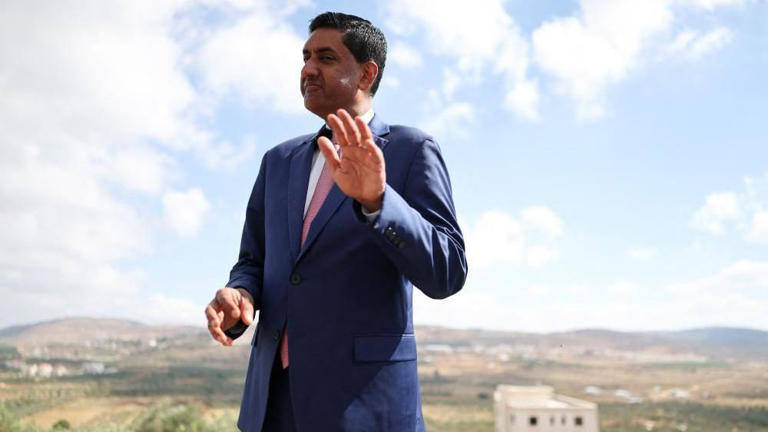

 (Photo credit: AFP)