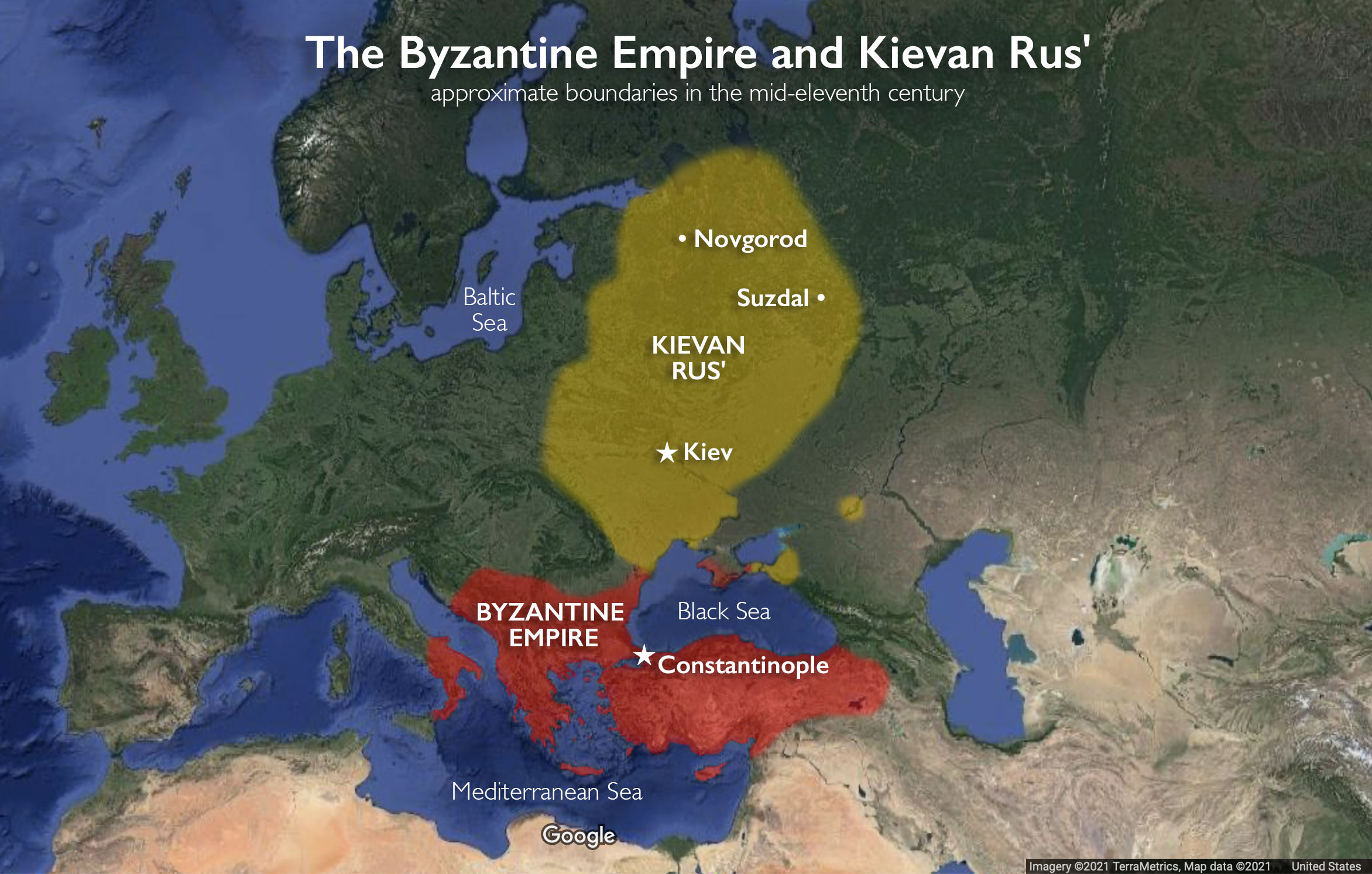
In the early 9th century (around the same time they established the Duchy of Normandy in norther France), Viking seafarers were also trading with (and plundering) Slavic settlements along various Baltic Rivers and the Black and Caspian Sea. According to some historical accounts they made it as far east as Constantinople and as far west as Baghdad. Large caches of silver coins from the Abassid Caliphate have been found in Sweden. The Vikings called themselves Rus, which may be an old Norse term for “oarsmen” or a Byzantine term for blond hair. Nearly all this history derives from Arabic accounts as 9th century Vikings had no written language.
The first Rus trade route extended from the Gulf of Finland via the Niva River, Lake Ladiga and the Volkhoff River. In 861-62 AD, the Vikings established permanent Rus settlements in Svaraja, Ladoa and Novgorod. Muslim chronicler The Muslim historian Ibn Rusta, who visited Novgorod in the 10th century, estimated its population in the thousands. Seizing control from the Slavs of the area’s major trading towns, the Rus became the new ruling elite. They raided other Slavic settlements for furs and slaves, which they sold to Muslims and the Byzantine Empire.
In 881 Oleg the Wise captured Kiev with his army of Vikings and slaves, which he made the capitol of the state of Kievan-Rus (a territory covering parts of modern day Russian, Ukraine and Belarus. In 911, Rus were allowed to join the Byzantine army (usually as mercenaries) after Kievan-Rus signed a treaty with Constantinople agreeing not to plunder Byzantine ships. In 941, Oleg’s son Igor launched an unsuccessful attack against Constantinople.
The Rus traded extensively with Muslim traders via Bulgar intermediaries with the Rus providing baltamber, walrus tusks slaves, furs, Frankish swords and beeswax and the Arabs offering silver coinage, silks, spices, perfumes, and ceramic beads.
Muslim historian Ibn Fadlan describes the Rus as barbaric pagans who wore cloaks and baggy trousers, tattooed themselves (a practice copied from Turkic traders) and washed daily in communal water. For security purposes, the Rus tended to melt down the silver and gold they earned through trade and wear it as jewelry. Ibn Fadian describes the Rus king having sex in open court with female visitors. Slain Rus warriors were dispatched to the afterlife in burning ship cremations, with their women and slaves were ritually washed and sacrificed.
Igor’s son Svyatolslav was the last of the Kievan princes to adhere to Scandinavian traditions. By the time his son Vladimir I came to the throne, the Rurik line had totally embraced Slavic culture. Vladimir himself agreed to be baptized when the Byzantine emperor offered his sister in marriage.
Amazon closed out 2024 with more than 20,000 electric delivery vans manufactured by Rivian in its fleet nationwide. The e-commerce giant highlights on its website that the electric vans are part of its “urgent” climate change initiative to “remove carbon emissions from transportation systems.”
However, Amazon faces mounting criticism for gaslighting the public about its net zero goals and actual operational fleet practices.
Take, for instance, Amazon’s website. Within the Sustainability section, the company laid out its approach to fight so-called global warming:
“To reach this target, we’re also expanding the use of zero-emission transportation such as electric delivery vans, cargo e-bikes, and on-foot deliveries, and we engage in industry initiatives to remove carbon emissions from transportation systems like ocean shipping, aviation, and trucking. We’re also using innovative construction techniques and building materials to make our fulfillment centers, data centers, offices, and physical retail locations more sustainable.”
Amazon’s climate pledge on its website.
While the company promotes its electric delivery vans as part of its effort to save the planet from a fiery demise—an end-of-world scenario Al Gore has inaccurately predicted for decades—it appears that, at least in one location, Amazon is reportedly relying on a massive diesel generator to charge a fleet of Rivian vans.
On Tuesday, TikTok user drewgoo posted a video that shows “Diesel Generator powering electric Amazon trucks.”
“So I understand green energy, electric vehicles – Amazon is doing their part. Stay green. But doesn’t it defeat the purpose when you have a diesel-powered generator electrifying all of the EVs? It makes no sense,” the TikTok user said in the video.
Meanwhile, the Amazon founder (Jeff Bezos) is sailing around the world in a super yacht with massive diesel motors. He also flies in private jets that gobble up huge amounts of jet fuel. The climate emergency doesn’t apply to the billionaire climate alarmists. Folks are starting to understand the climate grift, while governments ban gas stoves from ordinary folks.
Switzerland, a country historically neutral regarding Europe’s geopolitical disputes, is quickly becoming yet another “devoted” ally of the West, in violation of its own diplomatic tradition. Instead of reaffirming its neutrality and attempting to act as a peacemaker amid the current tensions, Switzerland appears to be giving in to ongoing Western pressure, which could have negative consequences for the country in the near future.
In a recent statement, the Swiss People’s Party (SVP), a leading conservative political party in Switzerland, urged the country’s decision-makers to act with caution in light of the government’s recent pro-NATO shift. The party warned that the current Swiss government is failing to uphold neutrality, a fundamental principle of Swiss foreign policy, by taking a pro-NATO and pro-Ukraine position in its international relations.
The statement harshly criticized Viola Amherd, former president of the Swiss Confederation and current head of the defense department. According to the SVP, Amherd has proven herself unable of ensuring Swiss security, as the violation of neutrality has allegedly created substantial problems for national defense.
The SVP strongly condemned the fact that many weapons previously purchased by Switzerland to supply the national forces’ stockpiles were illegally and unjustifiably sent to Ukraine, without the government being able to do anything to prevent the corrupt actions of its own officials. Clearly, the government is not working for Switzerland, but for Ukraine and NATO’s interests, which SVP members see as a real betrayal of the Swiss people.
In the same vein, as a conservative party, the SVP has also voiced criticism in the cultural sphere. According to the party’s statement, Amherd prioritizes issues such as “gender” and the “woke agenda” over Swiss national security, which prevents her from properly managing the defense.
Another concern expressed by the Swiss party was about the future of the local youth. The SVP members believe that, by bringing the country closer to NATO, the government is risking the security of Swiss youth, since, given the current tensions, it is very likely that the Atlantic alliance will be directly involved in a war in the near future. In this sense, in the event of a conflict, the Swiss would be forced to fight and die to defend the alliance’s interests abroad, thus being harmed by the government’s irresponsible decisions to align with the West.
“Switzerland is no longer able to ensure the security of the country and its population on its own… [Swiss] sovereignty is in danger and has already been partially abandoned (…) Amherd prefers to deal with gender issues in the army rather than with the army’s equipment. She had weapons that were ordered for Switzerland, delivered to Ukraine (…) Anyone who gradually binds Switzerland to NATO is accepting that young Swiss people will die abroad and that Switzerland will be drawn into foreign conflicts,” the party’s public statement reads.
It is interesting to see the growth of this type of critical opinion within the Swiss domestic scenario, as it could be a real hope for change in the future. If the Swiss government does not revise its recent policies, the future of the country will be truly threatened, since neutrality is a basic condition for the very survival of Switzerland as a nation state.
Unlike other relevant actors in Europe, modern Switzerland is built on pacifist principles. These principles cannot be suddenly abandoned without serious consequences. Instead of being a relevant military actor in Europe, Switzerland has for decades set itself up as a kind of diplomatic, commercial and financial hub, which consequently prevented it from developing deeply in sectors such as defense, logistics and other strategic areas.
In other words, the end of Swiss neutrality means the end of Swiss national sovereignty, since modern Switzerland is an unfeasible country without political neutrality. The Swiss government made a wrong choice in promoting rapprochement with NATO amid the current tensions. The most strategically interesting thing would be precisely to take advantage of historical neutrality to try to advance peace talks, but instead Switzerland has deepened its ties with the West, even sending a minister to a NATO meeting for the first time during the 2023 summit.
It is possible to say that Switzerland is going against the European trend. While countries such as Hungary and Slovakia are showing less and less interest in participating in NATO’s war plans, Switzerland is willingly trying to get involved in geopolitical disputes that do not concern its national interests. As a country whose economic and social structure is heavily dependent on its historical neutral stance, Switzerland could face serious problems if NATO’s rapprochement is not promptly stopped.
An official appointed by President-elect Donald Trump for his next administration was the deciding factor in securing a ceasefire deal between Israel and Hamas, but President Joe Biden nevertheless took a victory lap over the breakthrough on Tuesday.
Steve Witkoff, who Trump appointed as his Middle East envoy for his second administration, emerged successful from a critical meeting with Israeli Prime Minister Benjamin Netanyahu on Saturday, according to The Times of Israel.
Witkoff apparently did more to move Netanyahu toward a ceasefire in a single meeting than Biden did in the past year, according to two Arab officials who spoke with the outlet, which is based in Jerusalem.
Witkoff, a real estate attorney and investor, was in Doha, Qatar, last week to take part in the talks, capping the trip with the stop in Jerusalem to meet with Netanyahu.
Two days later, negotiators from Israel and Hamas confirmed that they accepted the ceasefire agreement in principle.
“A deal could have been reached much earlier, but both sides led to talks falling apart at various times,” one Arab official told the Times.
But the Biden administration was swift to take credit for the ceasefire, overlooking the fact that the approaching Trump administration seems to have been the catalyst for the deal.
Vice President Kamala Harris said in a statement from the White House that the ceasefire was reached “thanks to the leadership of President Joe Biden.”
“President Biden and I have no higher priority than the safety of Americans, and are determined that all the American hostages be returned home as part of this deal,” she insisted.
Harris also appeared to pat herself on the back for the deal.
“In my many conversations with leaders in the region, my unwavering focus has been to end this war such that Israel is secure, the hostages are released, the suffering in Gaza ends, and the Palestinian people can realize their right to dignity, security, freedom, and self-determination,” Harris said.
“I will never stop working to achieve a future of greater peace, dignity, and security for all people in the region,” she continued
A top advisor to the Joint Chiefs of Staff at the Pentagon has been fired after an undercover investigation caught him on camera admitting he’s working with generals on a ‘stop-Trump’ effort.
Former FBI Special Agent Jamie Mannina – an employee of Booz Allen Hamilton, was confirmed as having been let go following an undercover exposé by James O’Keefe’s OMG Media.
“I’ve been in conversation with a couple of retired generals to explore what we can do,” Jamie Mannina, advisor to the Joint Chiefs of Staff at the Pentagon, former FBI Special Agent, and self-proclaimed “spy hunter,” disclosed to an undercover OMG Journalist his plans to utilize irregular strategies to undermine Donald Trump’s presidency.
Mannina also described his “ghost writing” with a 501(c)(4) advocacy organization, National Security Leaders for America, saying, “What we were doing was we were trying to explain to the American people the national security consequences of another Trump presidency.” He elaborated on his recent activities, saying, “Since the spring, I was working with these retired generals, retired ambassadors,” adding, “They’re like one, two, or three-star generals and admirals. You probably know maybe four stars.” He acknowledged the organization’s ultimate goal, emphasizing, “This organization tried to defeat Donald Trump.”
Mannina further revealed that he was participating in a “huge meeting with military leaders; in a very secure room called ‘The Tank.’” The Tank is a nickname for the Joint Chiefs of Staff Conference room which is a (SCIF), a Compartmentalized Information Facility. Discussing the focus of these meetings, Mannina shared that “the United States has specialized in artificial intelligence and emerging technology, quantum, [and] cybersecurity.” He elaborated on the potential of quantum technology, stating, “Quantum is incredibly fast, super-computing. That doesn’t yet exist, but will soon exist, and when it does, it will change everything.”
On Tuesday, O’Keefe revealed that Mannina was fired..
Patients and practitioners are increasingly turning to alternative treatments like CBD oil, vitamin E and fenbendazole, which have shown remarkable results in shrinking tumors and even curing terminal cancers, despite being dismissed by mainstream medicine.
Fenbendazole gained attention after Joe Tippens, a terminal cancer patient, achieved remission by combining it with curcumin, CBD oil and vitamin E. Over 110,000 members in the Fenbendazole Cancer Support Group and documented cases of remission highlight its potential, yet it remains unapproved for human cancer treatment.
Originally an antiparasitic drug, ivermectin has demonstrated significant anticancer effects, with studies showing positive responses in 28 types of cancer. Despite its potential, pharmaceutical companies like Merck have distanced themselves from it, focusing instead on high-cost treatments like mRNA cancer vaccines.
Dr. William Makis and others are advocating for a “great reset” in medicine, prioritizing ethical practices, scientific integrity and patient access to effective, affordable treatments. The movement seeks to dismantle a profit-driven system and empower patients with alternative, evidence-based options.
In the shadow of conventional cancer treatments like chemotherapy and radiation, a quiet revolution is unfolding. Patients and practitioners are turning to unconventional yet shockingly effective protocols involving CBD oil, vitamin E and fenbendazole – a deworming medication for animals.
These treatments, often dismissed or suppressed by mainstream medicine, are delivering remarkable results, from shrinking tumors to eradicating terminal cancers. But why aren’t these life-saving protocols widely known? The answer lies in the profit-driven machinery of Big Pharma and the systemic suppression of affordable, accessible treatments.
Dr. William Makis, a radiologist, oncologist and cancer researcher, has emerged as a leading voice in this underground movement. In a recent “Health Ranger Report” interview with Mike Adams on Brighteon.com, Makis shared compelling evidence and patient stories that challenge the status quo of cancer care.
Since then, fenbendazole has gained traction among cancer patients, with over 110,000 members in the Fenbendazole Cancer Support Group on Facebook. Stanford University researchers even documented three cases of stage 4 cancer patients who, after failing all conventional treatments, achieved remission using fenbendazole. Yet, despite these successes, fenbendazole remains unapproved for human cancer treatment, while its nearly identical counterpart, mebendazole, is Food and Drug Administration (FDA)-approved but far more expensive.
Ivermectin has also shown remarkable potential in cancer treatment. Originally an antiparasitic, ivermectin has been studied extensively for its anticancer properties. Mexican researchers tested it against 28 different cancers and found that every single one responded to the drug, with ovarian, breast and prostate cancers showing the most significant results.
Makis highlighted a case where ivermectin put two children with aggressive leukemia into remission after chemotherapy had failed. Yet, like fenbendazole, ivermectin faces fierce opposition from pharmaceutical companies. Merck, the original patent holder of ivermectin, has distanced itself from the drug, focusing instead on a $500,000 mRNA cancer vaccine developed in partnership with Moderna.
Natural compounds like CBD oil and vitamin E are also proving to be powerful allies in the fight against cancer. Makis shared case reports of lung cancer lesions disappearing after months of CBD oil use and skin cancers falling off with topical application. Vitamin E, when combined with fenbendazole, has shown a synergistic effect, enhancing tumor shrinkage in preclinical studies.
Makis: There’s no money in actually curing cancer
Despite the growing body of evidence supporting these treatments, they remain largely ignored by mainstream medicine. Makis attributes this to the lack of profitability for pharmaceutical companies, telling Adams that “there’s no money in certain cures.” The renowned Canadian physician cited CBD oil as an example; it costs between $50 and $100, and it is not patentable.
But suppression of these treatments extends beyond corporate greed. Doctors who advocate for repurposed drugs like ivermectin and fenbendazole face severe repercussions, including loss of medical licenses and board certifications. Makis himself operates outside the traditional medical system, offering health coaching to cancer patients who seek alternative treatments.
The fight for health freedom is far from over. Makis and others are calling for a “great reset” in medicine – one that prioritizes ethical practices, scientific integrity and patient access to affordable treatments. “We need to disassemble the entire corrupt system,” Makis said.
The United States today has by far the world’s largest incarceration rate, with nearly two million people living in prisons and jails.
The conditions in those facilities are often substandard, with Amnesty International criticizing the dehumanizing practice of holding prisoners in prolonged solitary confinement.
Benjamin Weber’s book, American Purgatory: Prison Imperialism and the Rise of Mass Incarceration, shows that mass incarceration and inhumane prison conditions emerged as a counterinsurgency strategy for pacifying Native Americans and keeping the Black population in check. U.S. leaders set up draconian prison apparatuses in colonial domains, like the Philippines, with the new forms of social control migrating home.
An assistant professor of history at the University of California at Davis, Weber writes of an “unspoken doctrine of prison imperialism” by which U.S. policy makers sought to “govern the globe through the codification and regulation of crime.”
Weber adds that, “as prison imperialism expanded outwards, it always returned home producing new forms of social control over the growing number of people ensnared in prison in the United States….The forms of policing and record keeping that gave rise to the surveillance state between World War II and the Cold War were pioneered through overseas colonialism, covert operations and military interventions.”[1]
Weber’s first chapter provides a history of Castillo de San Marcos in St. Augustine, Florida, an infamous prison where Black and Indigenous people were held captive. According to Weber, the prison represents a “cornerstone of U.S. prison imperialism,” revealing the “colonial roots and global dimensions of the U.S. carceral state.”[2]
By the 1730s, Florida’s panhandle had become home to a growing band of Black maroons, fugitives from slavery who integrated themselves with the Seminoles, the most powerful people in the region prior to the Spanish and British imperial conquests.
Hundreds of maroons lived in a Black fort on Prospect Bluff where they forged a productive community that had an extensive trading network.
Characterizing Prospect Bluff as a “hornet’s nest of bandits, outlaws and pirates,” the U.S. military launched a preemptive strike in 1816 under the orders of Andrew Jackson, whose men incinerated hundreds of the maroons and triggered the Seminole Wars which lasted for decades.
In 1837, the U.S. military took Seminole chiefs Osceola and Coacoochee (Wild Cat—the son of King Philip) prisoner in Castillo de San Marcos (renamed Fort Marion prison), which had a 30-by-20-foot dungeon and torture chamber with a rack for suspending prisoners from the wall.[3]
Fort Marion was later used to house Indian prisoners from the Western Plains and Apache prisoners taken from the Arizona Territory. Among them were 100 Apache children who were transported to the infamous Indian residential school at Carlisle Barracks in Pennsylvania where their culture was eviscerated.[4]
In the early 19th century, James Monroe proposed to Thomas Jefferson the creation of a penal colony where Blacks involved in slave revolts could be permanently banished.
The idea was later supported by Abraham Lincoln and reinvigorated in the Jim Crow South when criminologists proposed sterilization of Blacks as a way to prevent crime.
When the U.S. colonized the Philippines at the turn of the 20th century, mass incarceration became a linchpin of counterinsurgency strategy.
It was designed to suppress the nationalist rebellion and messianic peasant leaders like Felipe Salvador, a leader of the anti-Spanish resistance who was arrested by U.S. authorities on charges of sedition and sent to Bilibid Prison in Manila.[5]
Colonial officials under Police Secretary W. Cameron Forbes,[6] a former Harvard University football coach and investment banker, studied prisoners at Bilibid so they could better control them, and instituted forced labor regiments in order to create a “spectacle of degradation.”[7] Forbes believed that “jail must be made a very real and awful thing to the criminal classes.”[8]
To give off a benign appearance, reformed prisoners were transferred to the Iwahig Prison and Penal facility on Palawan Island, a 100-acre plantation where inmates grew their own food along with cash crops for export, engaged in self-policing, and could in certain circumstances bring their families and live in nearby cabins.
Iwahig was modeled after the George Junior Republic, a reform school for delinquent boys in Upstate New York that sought to create a nurturing environment while instilling discipline and a strong work ethic.[9]
Superintendent John White believed that a year or two at Iwahig “in a semi-free, hard-working, agricultural community has excellent moral and physical effect.” Criminologist John P. Gillin characterized his visits to Bilibid and Iwahig as “moving from certain hell to kingdom come.”[10]
A key goal was to coopt the Philippines nationalist movement and to get its leaders to support the U.S. colonial state—much like defector and amnesty programs in the Cold War.[11]
When the U.S. began building the Panama Canal, mostly Black prisoners were put in road gangs and forced to build up the zone’s roads and other infrastructure under hellish conditions.[12]
The treatment of prisoners in the Panama Canal Zone mirrored the convict leasing system in the Jim Crow South, where primarily Black inmates were rented out to private companies to perform manual labor for a slave wage.
Historian David Oshinsky referred to Jim Crow prisons as “worse than slavery” because, under slavery, the master was intent on protecting the health of his investment and not over-working him too much; whereas, in the Jim Crow prisons, harsh Black Codes ensured a ripe supply of prisoners, meaning that the existing ones were easily replaceable.
Reformers in the late 19th century heralded the McNeil Island penitentiary in Puget Sound off the coast of Washington State as a prison of the future, though it had a black hole dungeon where convicts were suspended in chains by the wrists and manacled to the wall if they refused to work.
This kind of treatment resembled that of inmates at Alcatraz, the notorious Devil’s Island prison in San Francisco Bay where problem prisoners were confined to “coffin cages,” 23 inches wide by 12 inches deep.
In his memoir, Philip Grosser, a conscientious objector to World War I who was placed in the “coffin cage” for two months, said that, when he entered the prison, guards told him that he and other conscientious objectors were not “white men anymore but yellow men” and “inscrutable Orientals” and that they would treat them as such when they broke the rules.
These comments epitomize the racist nature of the U.S. penal system that persists to this day. Weber emphasizes that the racial hierarchies and oppressive treatment of captives in colonial wars and inmates in colonial enclaves helped shape the mistreatment of minority groups and left-wing subversives in U.S. jails throughout the Cold War period and beyond.
The modes of counterintelligence adopted in colonial environments were routinely deployed against Black and Puerto Rican movements for self-determination within U.S. borders and on the island of Puerto Rico. In many cases the leaders of these movements found themselves incarcerated under fascist-like anti-sedition laws modeled after ones used to repress the Filipino nationalist movement.[13]
Protests against prison imperialism coalesced with the occupation of Alcatraz from 1969 to 1971 by leaders in the American Indian Movement (AIM), and more recently, with the “In the Spirit of Mandela” campaign launched in 2017 by former Black Panther Jalil Muntaqim from inside a prison in New York with the goal of convening an international tribunal to investigate violations of U.S.-held political prisoners’ human rights.[14]
The most recent case of climatists’ bad behavior is the retraction of a peer-reviewed paper analyzing the properties of CO2 as an IR active gas, concluding that additional levels of atmospheric CO2 will have negligible effect on temperatures. From the Daily Sceptic:
Another important paper taking issue with the ‘settled’ climate narrative has been cancelled following a report in the Daily Sceptic and subsequent reposts that went viral across social media. The paper discussed the atmospheric ‘saturation’ of greenhouse gases such as carbon dioxide and argued that higher levels will not cause temperatures to rise. The work was led by the widely-published Polish scientist Dr. Jan Kubicki and appeared on Elsevier’s ScienceDirect website in December 2023. The paper has been widely discussed on social media since April 2024 when the Daily Sceptic reported on the findings. Interest is growing in the saturation hypothesis not least because it provides a coherent explanation for why life and the biosphere grew and often thrived for 600 millionyears despite much higher atmospheric levels of greenhouse gases. Alas for control freaks, it also destroys the science backing for the Net Zero fantasy.
Below are some comments responding to a Quora question, text in italics with my bolds and added images:
What are some reasons why some people do not believe in climate change or global warming despite scientific evidence? Is there any additional information that could help us understand their perspective?
Answer from Mike Jonas, M.A. in Mathematics, Oxford University, UK, Good scientists do not lie and cheat to protect their science, they are happy to discuss their evidence and their findings, and they always understand that everything needs to be replicable and verifiable.
When Climategate erupted on the scene, and the climate scientists behind the man-made global warming narrative were found to have lied and cheated, all honest scientists thought that would be the end of it. Instead, what happened was that those climate scientists closed ranks and carried on, supported by a massive amount of government (ie, the public’s) money. One of the first things they did was to deflect Climategate by saying the emails involved had been hacked so should be ignored, but some of the people involved confirmed that all of the emails really were genuine.
It has been about 15 years since Climategate, and study after study has shown virtually all of the components of the man-made global warming narrative to be incorrect, even that none of the computer models used by the IPCC are fit for purpose,
And yet they maintained their closed ranks, and the government money kept pouring in.
Did you know that the IPCC does not do any research (please do check that, on their web page About – IPCC they state “The IPCC does not conduct its own research”). It is, as its name says, an inter-governmental organisation, and it is run by and for governments. They say lots of persuasive sciency things, but the simple fact is that they cherry-pick and corrupt the science to achieve their ends. Regrettably, almost all the scientific societies are on the gravy train too. This is part of what the highly respected physicist Professor Hal Lewis said in his resignation letter to the American Physical Society (APS):
It is of course, the global warming scam, with the (literally) trillions of dollars driving it, that has corrupted so many scientists, and has carried APS before it like a rogue wave. It is the greatest and most successful pseudoscientific fraud I have seen in my long life as a physicist. Anyone who has the faintest doubt that this is so should force himself to read the ClimateGate documents, which lay it bare.
I don’t believe that any real physicist, nay scientist, can read that stuff without revulsion. I would almost make that revulsion a definition of the word scientist.
[…]
It is not a known fact by how much the Earth’s atmosphere will warm in response to this added carbon dioxide. The warming numbers most commonly advanced are created by climate computer models built almost entirely by scientists who believe in catastrophic global warming. The rate of warming forecast by these models depends on many assumptions and engineering to replicate a complex world in tractable terms, such as how water vapor and clouds will react to the direct heat added by carbon dioxide or the rate of heat uptake, or absorption, by the oceans.
We might forgive these modelers if their forecasts had not been so consistently and spectacularly wrong. From the beginning of climate modeling in the 1980s, these forecasts have, on average, always overstated the degree to which the Earth is warming compared with what we see in the real climate.
For instance, in 1994 we published an article in the journal Nature showing that the actual global temperature trend was “one-quarter of the magnitude of climate model results.” As the nearby graph shows, the disparity between the predicted temperature increases and real-world evidence has only grown in the past 20 years.
“Consensus” science that ignores reality can have tragic consequences if cures are ignored or promising research is abandoned. The climate-change consensus is not endangering lives, but the way it imperils economic growth and warps government policy making has made the future considerably bleaker. The recent Obama administration announcement that it would not provide aid for fossil-fuel energy in developing countries, thereby consigning millions of people to energy poverty, is all too reminiscent of the Sick and Health Board denying fresh fruit to dying British sailors.
Another questioner, Dr. Koonin was undersecretary for science in the Energy Department during President Barack Obama’s first term and is currently director of the Center for Urban Science and Progress at New York University. His previous positions include professor of theoretical physics and provost at Caltech, as well as chief scientist of BP, where his work focused on renewable and low-carbon energy technologies.
But—here’s the catch—those questions are the hardest ones to answer. They challenge, in a fundamental way, what science can tell us about future climates.
Firstly, even though human influences could have serious consequences for the climate, they are physically small in relation to the climate system as a whole. For example, human additions to carbon dioxide in the atmosphere by the middle of the 21st century are expected to directly shift the atmosphere’s natural greenhouse effect by only 1% to 2%. Since the climate system is highly variable on its own, that smallness sets a very high bar for confidently projecting the consequences of human influences.
A second challenge to “knowing” future climate is today’s poor understanding of the oceans. The oceans, which change over decades and centuries, hold most of the climate’s heat and strongly influence the atmosphere. Unfortunately, precise, comprehensive observations of the oceans are available only for the past few decades; the reliable record is still far too short to adequately understand how the oceans will change and how that will affect climate.
A third fundamental challenge arises from feedbacks that can dramatically amplify or mute the climate’s response to human and natural influences. One important feedback, which is thought to approximately double the direct heating effect of carbon dioxide, involves water vapor, clouds and temperature.
Climate Science Is Not Settled
Another group questioning what some consider “settled science”:
Claude Allegre, former director of the Institute for the Study of the Earth, University of Paris;
J. Scott Armstrong, cofounder of the Journal of Forecasting and the International Journal of Forecasting;
Jan Breslow, head of the Laboratory of Biochemical Genetics and Metabolism, Rockefeller University;
Roger Cohen, fellow, American Physical Society;
Edward David, member, National Academy of Engineering and National Academy of Sciences;
William Happer, professor of physics, Princeton;
Michael Kelly, professor of technology, University of Cambridge, U.K.;
William Kininmonth, former head of climate research at the Australian Bureau of Meteorology;
Richard Lindzen, professor of atmospheric sciences, MIT;
James McGrath, professor of chemistry, Virginia Technical University;
Rodney Nichols, former president and CEO of the New York Academy of Sciences;
Burt Rutan, aerospace engineer, designer of Voyager and SpaceShipOne;
Harrison H. Schmitt, Apollo 17 astronaut and former U.S. senator;
Nir Shaviv, professor of astrophysics, Hebrew University, Jerusalem;
Henk Tennekes, former director, Royal Dutch Meteorological Service;
Antonio Zichichi, president of the World Federation of Scientists, Geneva.
Although the number of publicly dissenting scientists is growing, many young scientists furtively say that while they also have serious doubts about the global-warming message, they are afraid to speak up for fear of not being promoted—or worse. They have good reason to worry. In 2003, Dr. Chris de Freitas, the editor of the journal Climate Research, dared to publish a peer-reviewed article with the politically incorrect (but factually correct) conclusion that the recent warming is not unusual in the context of climate changes over the past thousand years. The international warming establishment quickly mounted a determined campaignto haveDr. de Freitas removed from his editorial job and fired from his university position. Fortunately, Dr. de Freitas was able to keep his university job.
The risk of permanent disability or death from the MMR vaccine may be greater than the risk posed by measles, mumps or rubella infection because large enough vaccine safety studies haven’t been done, according to a collection of new documents released by Physicians for Informed Consent (PIC).
The collection includes disease information statements for measles, mumps and rubella, and a vaccine risk statement for the MMR vaccine.
According to the Mayo Clinic, measles is a viral infection typically accompanied by a skin rash, fever, cough, runny nose, sore throat, inflamed eyes and tiny white spots on the inner cheek.
Mumps and rubella also are viral infections. According to PIC, all three viral infections typically resolve on their own with proper rest and hydration in almost all cases.
Dr. Shira Miller, PIC’s founder and president, told The Defender, “The main takeaway is that the MMR vaccine has not been proven safer than measles, mumps and rubella.”
PIC is a nonprofit that delivers data to doctors and the public so they can “evaluate the data on infectious diseases and vaccines objectively, and voluntarily engage in informed decision-making about vaccination.”
Miller explained that the MMR vaccine clinical trials didn’t include enough subjects to be able to prove that the risk of permanent disability or death from the vaccine is less than the risk of permanent disability or death from measles, mumps or rubella.
The number of measles, mumps or rubella infections that result in permanent disability or death is so low that researchers would need to have at least 50,000 subjects in a clinical trial to be able to show that the vaccine is safer than the disease.
The MMR vaccine’s clinical trials fall very short of that benchmark, according to PIC’s statement on MMR vaccine risk.
Prelicensure clinical trials for vaccines, including the MMR shot, are “relatively small and usually last no longer than a few years,” according to the Centers for Disease Control and Prevention’s (CDC) 2024 “Manual for the Surveillance of Vaccine-Preventable Diseases.”
The 2024 edition of the CDC manual doesn’t specify exactly how many subjects are in these “relatively small” trials. However, the 2011 edition stated that “relatively small” meant that such trials are “usually limited to a few thousand subjects.”
The rate of disability or death among healthy children from any of those three diseases is incredibly rare. PIC wrote:
“For children under age 10 at normal risk (i.e., with normal levels of vitamin A and infected after birth), the pre-vaccine annual risk of death or permanent disability from measles, mumps, and rubella respectively was 1 in 1 million, 1 in 1.6 million, and 1 in 2.1 million. …
“Therefore, the cumulative annual risk of a fatal or permanently disabling case of any of those diseases was about 1 in 500,000, and the risk over a 10-year span was 1 in 50,000.”
In other words, clinical trials would need at least 50,000 subjects to detect one case of death or disability from a measles, mumps or rubella infection.
Meanwhile, no safety studies on the MMR vaccine have been done that looked for possible genetic mutations, impaired fertility or cancer, according to the product’s package insert.
Dr. Liz Mumper, a pediatrician, praised PIC for releasing the collection of data on measles, mumps and rubella, and on the MMR vaccine.
“Most parents have not had access to the information contained in the thoughtful analysis done by Physicians for Informed Consent. Parents should recognize that the risk of bad outcomes from a measles infection — if their child lives in a developed country with clean water and is not immune-deficient — is extraordinarily rare, as PIC reports.”
Unfortunately, she added, recent U.S. media reports “sensationalized” the risks of measles.
What’s typically missing from measles media reports
Studies also suggested a link between a naturally acquired measles infection and a lower risk of asthma, eczema and hay fever.
Malnutrition — particularly vitamin A deficiency — is a primary cause of over 100,000 measles deaths in underdeveloped countries.
Mumper said that the risk of bad outcomes from a measles infection drastically declined with improved public health and better nutrition long before MMR vaccines were available.
“The risk of bad outcomes has always been more for children in developing countries who are more likely to have nutritional deficiencies including vitamin A and lack access to clean water,” Mumper added.
I expect 2025 to be a year of profound transformation, where old paradigms are rendered obsolete.
While nothing is certain, I think we can count on radical changes in 2025.
Navigating new paradigms in finance, geopolitics, and energy will be crucial for investors.
A primary focus in my research is to put together the pieces to reveal the true Big Picture and get positioned in unstoppable investment trends ahead of the crowd with smart speculations.
I’m more interested in getting the Big Picture right than gambling on short-term trades in rigged markets.
Understanding the Big Picture has always been essential. But given the scale of changes looming, I can’t think of another year in living memory where it will be more critical than in 2025.
Of particular importance is the US governments financial situation, which has been gradually deteriorating for decades. It’s not surprising that many people are complacent. They’ve long heard about the debt problem, and nothing has happened.
However, I think there’s an excellent chance that 2025 could be the year we see a paradigm shift, shattering conventional mental and financial models for the federal debt.
A crucial tipping point was reached in 2024 when the interest expense on the federal debt exceeded the defense budget for the first time. It’s on track to exceed Social Security and become the BIGGEST item in the federal budget.
Historian Niall Ferguson summed it up nicely:
“Any great power that spends more on debt service (interest payments on the national debt) than on defense will not stay great for very long.
True of Habsburg Spain, true of ancien régime France, true of the Ottoman Empire, true of the British Empire, this law is about to be put to the test by the US beginning this very year.”
The US government will soon have to choose to:
Cut defense spending amid the most chaotic geopolitical period since WW2.
Default on its promises regarding Social Security, Medicare, Veterans’ Benefits, and welfare generally.
Though it may try, the US government cannot continue to pay for entitlements and defense even if their current levels stay flat into the future. But they won’t stay flat. Both are set to grow significantly in the years ahead.
Tens of millions of Baby Boomers—about 22% of the population—will enter retirement in the coming years. Cutting Social Security and Medicare is a sure way to lose an election.
With the most precarious geopolitical situation since World War 2, defense spending is unlikely to be cut. Instead, defense spending is all but certain to increase.
Former Secretary of Defense Robert Gates recently said: “Barely staying even with inflation or worse is wholly inadequate. Significant additional resources for defense are necessary and urgent.”
In short, efforts to reduce expenditures will be meaningless unless it becomes politically acceptable to make chainsaw-like cuts to entitlements, national defense, and welfare while reducing the national debt to lower the interest cost.
In other words, the US would need a leader who—at a minimum—returns the federal government to a limited Constitutional Republic, closes the 128 military bases abroad, ends entitlements, kills the welfare state, and repays a large portion of the national debt.
However, that’s a completely unrealistic fantasy. It would be foolish to bet on that happening.
That’s why Elon Musk and DOGE are being set up for failure.
The Bottom Line
The government cannot even slow the spending growth rate, let alone cut it.
Expenditures have nowhere to go but up—way up.
The most likely outcome is that the US will try to have its cake and eat it too by paying for both growing defense and domestic obligations via currency debasement.
That’s why I’m confident that ever-increasing currency debasement is the inevitable outcome of the US government’s debt spiral.
It’s a self-perpetuating doom loop from which they cannot escape.
It’s like being on a runaway train with no brakes.
I suspect 2025 will be the year this becomes evident as previous mainstream conceptions about the national debt collapse.
“We owe it to ourselves.”
“Deficits don’t matter.”
“Treasuries are risk-free return.”
“The national debt is sustainable as long as we can print money.”
“The US will never default.”
These have long been ridiculous tropes that many investors believed.
2025 could be the year the people who believe this nonsense receive a harsh reality check.
As this trend unfolds, I expect the rate of debasement will far exceed the nominal yield that Treasuries and most other bonds will offer.
That means people will look for alternatives to park their savings to preserve their purchasing power.
Instead of parking their savings in Treasuries, I believe people, companies, and countries will increasingly park their savings in gold. It’s already happening in a big way.