The Most Revolutionary Act

Uncensored updates on world events, economics, the environment and medicine

The Most Revolutionary Act

Trump Reject Egypt’s Gaza Plan: Stands By Ethnic Cleansing Vision

Arab states have endorsed an Egyptian reconstruction plan for Gaza that rejects any displacement of Palestinians.

The Cradle

Washington has rejected the Egyptian post-war Gaza proposal put forward by Arab states at a summit in Cairo this week, doubling down on US President Donald Trump’s vision for the expulsion of Palestinians and the takeover of the strip.

“The current proposal does not address the reality that Gaza is currently uninhabitable and residents cannot humanely live in a territory covered in debris and unexploded ordnance,” US National Security Council spokesman Brian Hughes said in a statement on 4 March.

“President Trump stands by his vision to rebuild Gaza free from Hamas. We look forward to further talks to bring peace and prosperity to the region,” the statement added.

At a highly anticipated summit in Cairo on Tuesday, Arab states endorsed an Egyptian plan to reconstruct the Gaza plan. The plan would see Hamas give up governance of Gaza. A detailed draft of the Egyptian plan obtained by Sputnik envisions setting aside $53 billion to reconstruct the strip and forming a committee to manage it for six months in preparation for the return of the Palestinian Authority (PA).

As part of the Egyptian plan, an international conference for the reconstruction of Gaza in Cairo will be held later this month. At the same time, a trust fund will be set up to receive contributions from donor nations. The draft of the plan added that “implementing reconstruction requires arrangements for transitional governance and providing security in a way that preserves the prospects of a two-state solution.”

The Egyptian plan anticipates that the early recovery phase will last six months and require $3 billion, while the first reconstruction phase will last for two years and cost $20 billion. The second reconstruction phase is expected to last two and a half years and cost $30 billion.

Egypt’s proposal categorically rejects any displacement of Palestinians. Hamas welcomed the plan in a statement on Wednesday.

Trump announced in February that Washington aims to take over Gaza and expel its residents. He claimed the initiative strives to find a safer location for Palestinians while international development teams take charge of reconstructing the battered and besieged strip.

The president said his plan aims to transform Gaza into a “Middle East Rivera.”

He has since backtracked, claiming in late February that he does not wish to impose the plan by force but will recommend it.

Trump said during a speech in Congress on Tuesday, “we are bringing back our hostages from Gaza” – making no other references to the Gaza ceasefire or his plan for the strip.

Israel has been blocking the ceasefire from moving forward to the second phase, and is reportedly making plans for a resumption of war against Gaza.

[…]

Via https://libya360.wordpress.com/2025/03/05/trump-rejects-egypts-gaza-plan-stands-by-ethnic-cleansing-vision/

Billionaire-Backed Global Citizen Whitewashes Kagame’s Invasion of DRC

John Legend’s concert in Rwanda signaled global elite support for Paul Kagame amid his bloody invasion of the DRC. The event was organized by Global Citizen, a pseudo-activist NGO backed by corporations hungry for Africa’s resource wealth.

On February 21st, as the Rwandan army deepened its invasion of the Democratic Republic of the Congo (DRC), John Legend took the stage in Rwanda’s capital, Kigali. There, the superstar singer-songwriter headlined a Move Afrika concert produced by Global Citizen, the international NGO front for global elites, NATO, and a corporate world order which bills itself as “the movement changing the world.”

The future that Global Citizen heralds is a borderless network of public-private partnerships in which oligarchs, global corporations, and the World Trade Organization profitably manage the world in the name of equity, sustainability, and climate defense. It’s the future promised in the Davos Agenda and the UN Pact for the Future passed by the UN General Assembly in 2024. (Russia, Belarus, Iran, Nicaragua, North Korea, Sudan, and Syria opposed the pact as a threat to national sovereignty.)

Global Citizen doesn’t raise and disburse funds; it conducts global “awareness” campaigns to manufacture global consent – in this case, for the West’s decades-long proxy war for DRC’s unparalleled resource wealth, which has left millions of Congolese dead, and the rest of the country’s population with one of the world’s lowest per capita annual incomes.

The NGO’s corporate “partners” include tech giants PayPal, Cisco, WorldWide Technology, Verizon, and YouTube (Alphabet/Google), all of which depend to a large extent on minerals extracted from the DRC. Others, including Citibank, are hardly known for commitment to human rights; Citibank is, in fact, implicated in the 2001 UN investigators’ report on illegal resource traffic in DRC.

Global Citizen’s Global Board of Directors includes executives from Citibank, Cisco, Delta, and a long list of global asset managers, along with the former prime ministers of Norway and Sweden, top UN agency officials, and officers of closely allied billionaire-backed NGOs like the Open Society Foundations of George Soros, and the Bill and Melinda Gates Foundation.

Its Country and Regional Boards evince a special interest in Africa, the world’s most resource rich continent. Elites from Europe, Canada, Australia, and Africa are well represented there, but figures from Latin America and Asia are not, despite Global Citizen’s growing presence on those continents. In November 2025, the NGO will head to Brazil with “Global Citizen: Amazonia, the World’s First Impact Concert in the Amazon” at the UN’s 2025 COP.

An impact concert? What kind of impact? So far, participants have been promised a collection of “global and local artists” who will “celebrate major COP commitments, spotlight Indigenous leaders, and amplify campaigns for climate action.” Beyond that, the details are vague. “More info coming soon,” Global Citizen declares.

The consummately bland and meaningless language that fills the NGO’s website is clearly intended to gloss over any conflict or contradiction. But the blood-spattered backdrop to Global Citizen’s Kigali concert was impossible to ignore.

The “Global Citizen” as elite frontman

It should come as no surprise that John Legend performed in Kigali as Rwandan troops advanced in DRC, continuing the 30-year genocide against Congolese people. Like Kagame, the singer has been cultivated for over a decade as a top-tier frontman for the neoliberal global elite. Back in 2012, the Davos-based World Economic Forum appointed Legend to its Forum of Young Global Leaders in 2012. This February, Global Citizen announced on its Instagram page that it was “joined on the ground at Davos by three incredible artists” including John Legend.

Though he has at times spoken out in support of Palestinian human rights, Legend elected to perform at the August 2024 Democratic National Convention in support of then-Vice President Kamala Harris as she took ownership of the Biden administration’s genocidal policy toward the besieged Gaza Strip.

During his February 22 visit to the Kigali Genocide Memorial, Legend decried man’s inhumanity to man, likening the Rwandan Genocide to the Holocaust and the genocide of Native Americans, but omitted any mention of Gaza or Congo, genocides not granted the official status established by criminal indictments and Western-controlled international courts.

Legend has lent his status to numerous milquetoast productions by Global Citizen. In 2020 he hosted and performed for the second year in a row at the Global Citizen Prize for Activism, which honored Black Lives Matter, billionaire philanthropist Warren Buffett, and Sesame Street’s Sesame Workshop. What more could any organization do to support the status quo?

[…]

Confronted with criticism of his performance in Kigali, Legend insisted that he did not want to limit any country’s economic opportunity because he disagreed with its government. However, back in 2019, he supported a proposed Hollywood boycott of US states which had enacted limits on abortion rights. As a loyal Democrat, he has actively  campaigned for Barack Obama, Joe Biden, Kamala Harris and many of the party’s down-ballot candidates, while severing his personal ties with his former artistic collaborator, Kanye West, over his support for Donald Trump. “Money talks,” Legend said of his boycott of states with anti-abortion GOP leaders.

Deploying his talents in support of NATO at the 2022 Grammy Awards, Legend debuted his slave liberation anthem, “Free”, in a choreographed spectacle that featured Ukrainian musicians and President Volodymyr Zelensky pleading for military support on a larger-than-life background screen.

On the Grammy’s official website, the National Academy of Recording Arts & Science trumpeted Global Citizen’s concurrent Stand Up for Ukraine extravaganza, which urged its million followers to join “one of the largest digital campaigns on social media by sharing why you support Ukraine and refugees everywhere.”

Several days after the awards ceremony, Global Citizen hosted an online propaganda rally for the Ukraine proxy war, presenting a series of online video messages from a long list of celebrities, including Julian Lennon performing his fathers pacifist anthem, “Imagine,” in a room full of candles in service of the NATO military machine.

One day after the social media rally, Global Citizen capped off this propaganda extravaganza with a real-life rally in Poland, one the most ardent supporters of the US war for Western capital and global corporations.

Convened by European Commission President Ursula von der Leyen and Canadian Prime Minister Justin Trudeau, it concluded in a grand “global pledging summit” that saw governments and corporations promise $4.6 billion in grants and $5.5 billion in loans to aid Ukrainian refugees and IDPs. Contributors included the European Commission, Canada, and a list of European nations. Lenders included the European Investment Bank and the Council of Europe Development Bank. It wasn’t clear who the loans would go to, who would pay them back, or how.

Coca Cola, Nestle, Cisco, Google, and Bridgewater Associates, the world’s largest hedge fund, were among the global corporations which contributed to demonstrate that they could be good global citizens too.

For all this, Global Citizen won an Anthem Award, a self-styled global do-gooder NGO whose mission is “amplifying the voices that spark global change” in support of “a purpose-driven society.”

Of course, there could be no better way to advance such a lofty mission than standing up for a NATO proxy war in Ukraine that has left a country in ruin, while music-washing a resource war in the heart of Africa – one that has left millions dead and a nation in chaos while its prime instigator danced to the crooning of John Legend, bathed in red and blue light, with “Global Citizen” emblazoned on his chest.

“Global Citizen” Paul Kagame manages lab for Western elite

Rwandan President Paul Kagame is a darling of the global elite. He hobnobs with them annually at the World Economic Forum in Davos, Switzerland, though he kept clear of the neoliberal confab this year, presumably to manage the latest phase of his war in the DRC. Under Kagame’s management, Rwanda has become a veritable laboratory for technocratic, Davos-driven experiments in global governance, from digital IDs and “sustainable cities” to mandatory or even forced vaccination. In 2022, one Rwandan told Deutsche Welle that he was handcuffed in order to receive the jab. Others fled the country to escape being injected against their will.

In 2022, Kagame began negotiating with UK Prime Ministers Boris Johnson, Liz Truss, and then Rishi Sunak, to outsource migrants from war-ravaged areas of the Middle East to Rwanda for processing, asylum, and resettlement, demonstrating his readiness to volunteer his country as a dumping ground for the West’s human surplus. In 2023, after two years of outcry and legal struggle, a UK court ruled that Rwanda was not a safe place to remove asylum seekers to, and Prime Minister Keir Starmer then declared the plan “dead and buried” on his first day in office.

Kagame has also offered the Rwandan Defense Force in the service of Western military objectives on the African continent, most visibly now as an armed enforcer of the interests of France’s TOTAL Energies in Mozambique.

In 2017, Zionist influencer and sex toy salesman “Rabbi” Shmuley Boteach’s World Values Network presented Kagame with a prize for Outstanding Friendship with the Jewish Peoplei in the name of casino baron and pro-Netanyahu financier Sheldon Adelson and his wife Miriam. A year later Israel opened an embassy in Rwanda, with the Times of Israel heralding it as “a bid to strengthen its diplomatic foothold in Africa.” Israel and Rwanda have intertwined and reinforced their victims’ narratives since 1995.

Like Israel’s cutouts, the Davos set ignores decades worth of documentation of Kagame’s crimes in the DRC as long as he advances their agenda. Their infatuation also survives countless reports of his repressive extremes within Rwanda, including use of Israel’s Pegasus surveillance software, his transnational repression, his assassinations of critics at home and abroad, and his wholly implausible electoral victories, such as his 99%+ win in 2024.

[…]

Rwanda’s War in DRC

John Legend said he’s “aware of what’s happening” in DRC, but what does he know about the conflict? Why aren’t he and Global Citizen as concerned by Rwandan troops in DRC as they are by Russian troops in Ukraine?

Have they bothered to consider UN investigators’ abundant documentation of Rwanda’s invasion, occupation, massacres, and atrocities in DRC, much of which has been summarized by the legacy press?

On the day before Legend’s Kigali concert, the UN Security Council passed a resolution demanding that Rwanda’s M23 militia immediately cease hostilities, withdraw from all areas that it controls, “and fully reverse the establishment of illegitimate parallel administrations in the DRC territory.” It also called on Rwanda to withdraw all Rwandan Defense Forces (RDF) from DRC and stop “supporting” M23.

President Kagame continues to deny that Rwandan troops are in DRC, but Rwanda’s invading and occupying army is in direct command of M23. Further, the May 2024 UN Group of Experts Report on the DRC documented the presence of 4,000 Rwandan troops inside Congo, more than M23.

[…]

A continuous stream of RDF and M23 atrocity reports

Reports of M23 atrocities have emerged in continuous fashion since the militia first began rampaging across Congo in 2012-’13. The 2012 UN experts report stated that Rwandan Defense Chief James Kabarebe sat at the top of M23’s chain of command.

In 2014, a UN Security Council report stated that M23 had been responsible for mass killing civilians, raping, killing, and maiming women and children, forced displacement, and the forced recruitment of children..

On January 26th, Vivian van de Perre, Deputy Special Representative for Protection and Operations of the UN peacekeeping mission in the DRC, reported that M23 and the Rwanda Defence Forces had launched an attack on the strategically important city of Goma and that “these attacks continue to ravage the city, killing, injuring, traumatizing, and displacing civilians and exacerbating the crisis.”

During the first week of February 2025, the deputy head of the UN mission in DRC reported that nearly 3,000 people had been killed after M23 seized Goma, the capital of DRC’s North Kivu Province.

In mid-February 2025, after M23 seized Bukavu, the capital of DRC’s South Kivu Province, the UN human rights office accused it of summarily executing children, attacking hospitals and warehouses storing humanitarian aid, sexual violence, child and forced recruitment, and threatening journalists, human rights defenders, and members of civil society organizations.

[…]

Via https://libya360.wordpress.com/2025/03/05/billionaire-backed-global-citizen-whitewashes-kagames-invasion-of-drc/

Egypt unveils Gaza reconstruction plan ahead of emergency Arab summit

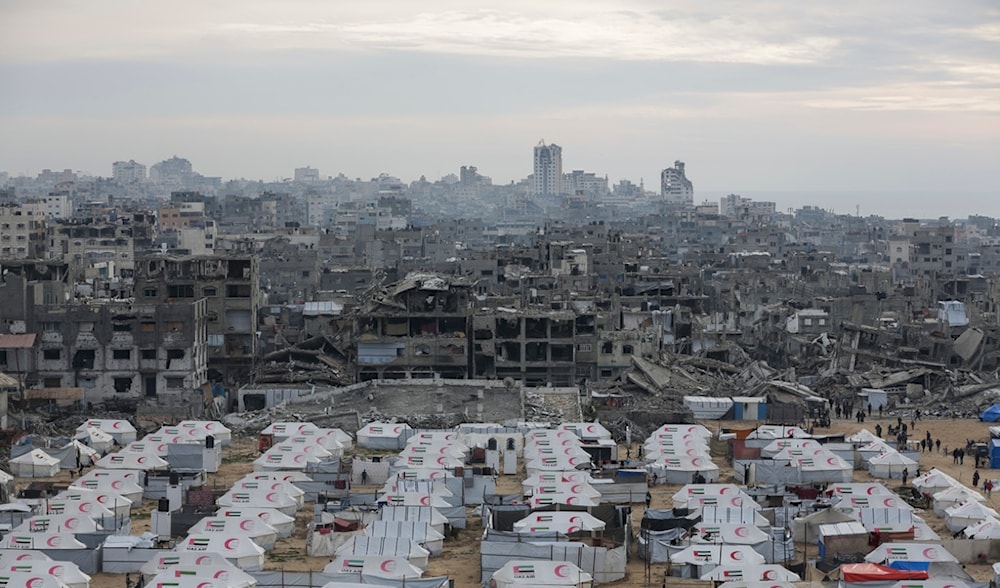
A tent camp for displaced Palestinians is set up amid destroyed buildings in the west of Al-Shati camp, west of Gaza City, on Monday, March 3, 2025. (AP)

Al Mayadeen English

Egypt’s reconstruction plan for Gaza revolves around the Palestinian people’s right to their land and includes international and Arab financial support.

On Tuesday, Egypt’s Al-Qahera Al-Ikhbariya channel published Egypt’s plan for rebuilding Gaza, which will be presented to Arab leaders at the emergency summit hosted in Cairo on Tuesday.

Egyptian Foreign Minister Badr Abdelatty previously stated that the plan was designed to ensure the Palestinian people’s dignity and rights, and would be presented on March 4.

According to Abdelatty, Egypt’s alternative reconstruction plan will not be solely Egyptian or Arab but will include international support and funding to ensure its effective implementation.

“We will hold intensive talks with major donor countries once the plan is adopted at the upcoming Arab Summit,” he stated during a press conference with European Union Commissioner for the Mediterranean Dubravka Suica.

Into Egypt’s plan

The plan, which is based on preserving the rights and dignity of the Palestinian people, includes the formation of a Gaza Administration Committee to oversee the governance of the territory during a six-month transitional period. This committee will be independent, composed of non-partisan technocrats, and will operate under the Palestinian government.

According to the plan, the committee will be established throughout the current phase and pave the way for the full return of the administration, which would manage the next phase under Palestinian decision-making.

[…]

Via https://english.almayadeen.net/news/politics/egypt-unveils-gaza-reconstruction-plan-ahead-of-emergency-ar

‘Cody’s Law’: Florida Lawmakers Weigh First State Law to Compensate Vaccine Injury Victims

By Michael Nevradakis PhD

Florida lawmakers are considering a bill that would expedite the review and payment process for vaccine injury claims under the Medicare, Medicaid and Medicaid Medically Needy Programs.

If passed, “Cody’s Law: Florida No Vaccine-Injured Patient Left Behind” would be the first such law in the U.S. and could supplant federal vaccine injury compensation programs.

The bill, filed in the Florida House of Representatives in January and the Florida Senate last week, is named after Cody Hudson, a previously healthy college student who sustained serious — and now terminal — vaccine injuries in 2021.

Cody’s mother, Heather Hudson, advocated for and drafted the legislation. She said the law would fill the “gaps of all the vaccine injury compensation programs and Social Security disability.”

“It provides expedited claims processing, like is done for other severe and major illnesses, by Medicare and Medicaid, and affords the vaccine-injured and Emergency Use Authorization protocol-injured medical care at the onset of injury, when it is needed most,” Hudson said.

[…]

Via https://tdefender.substack.com/p/codys-law-florida-first-state-compensate-vaccine-injury-victims

Trump’s Détente with Venezuela

President Nicolas Maduro and U.S. President Donald Trump’s envoy Richard Grenell shake hands at the Miraflores Palace, in Caracas, Venezuela January 31, 2025.
Roger D. Harris

Trump’s corollary to the Monroe Doctrine – “speak loudly AND carry a big stick” – has not been applied full force on Venezuela…as of yet. Instead the new administration appears to be testing a more nuanced approach. In his first administration, he succeeded in crashing the Venezuelan economy and creating misery among the populace but not in the goal of changing the “regime.”

Back in 2019, the Bolivarian Revolution, initiated by Hugo Chávez and carried forward by his successor, current Venezuelan President Nicolás Maduro, was teetering on collapse under Trump’s “maximum pressure” offensive. The economy had tanked, inflation was out of control, and the GDP was in freefall. Over 50 countries recognized Washington-anointed “interim president” Juan Guaidó’s parallel government.

In the interregnum between Trump administrations, Biden embraced his predecessor’s unilateral coercive economic measures, euphemistically called sanctions, but with minimal or temporary relief. He certified the incredulous charge that Venezuela posed an immediate and extraordinary threat to US national security, as Trump and Obama had before him. Biden also continued to recognize the inept and corrupt Guaidó as head-of-state, until Guaidó’s own opposition group booted him out.

Despite enormous challenges, Venezuela resisted and did so with some remarkable success, bringing us to the present.

Runup to the second Trump administration

In the runup to Trump’s inauguration, speculation on future US-Venezuela relations ran from cutting a peaceful-coexistence deal, to imposing even harsher sanctions, to even military intervention.

Reuters predicted that Trump’s choice of hardliner Marco Rubio at secretary of state augured an intensification of the regime-change campaign. Another rightwing Floridian of Cuban descent, Mauricio Claver-Carone was tapped as the special envoy for Latin America. He had been Trump’s senior director for Western Hemisphere affairs and credited with shaping Trump’s earlier aggressive stance toward Venezuela. Furthermore, on the campaign trail, Trump himself commented: “When I left, Venezuela was ready to collapse. We would have taken it over; we would have gotten to all that oil.”

At his Senate confirmation hearing on January 15, Rubio described Venezuela as a “narco-trafficking organization that has empowered itself of a nation state.” He was unanimously confirmed the very first day of the new administration.

The supposedly opposition Democrats all stampeded in his support, although Rubio severely criticized the previous Biden administration for being too soft on Venezuela. Rubio’s criticism was largely unwarranted because, except for minor tweaks, Biden had seamlessly continued the hybrid war against Venezuela.

Grenell Trumps Rubio

The first visit abroad by a Trump administration official was made by Ric Grenell, presidential envoy for special missions. Grenell briefly served in Trump’s first administration as acting director of national intelligence, becoming the first openly gay person in a Cabinet-level position.

Grenell flew to Caracas and posed for a photo-op, shaking hands with President Maduro on January 31. This was a noteworthy step away from hostility and towards rapprochement between two countries that have not had formal diplomatic relations since 2019.

The day after the Grenell visit, Rubio embarked on an uninspiring tour of rightwing Latin American countries. That same day, General License 41 allowing Chevron to operate in Venezuela automatically renewed, which was a development that Rubio had advocated against.

Diplomacy of dignity

Maduro entered negotiations with Grenell with a blend of strategic engagement and assertive resistance, aiming to navigate Venezuela’s economic challenges while maintaining sovereignty. The approach had win-win outcomes, although the spin in the respective countries was quite different.

Grenell claimed a “win” from the meeting with the release of six “American hostages” without giving anything in return. Venezuela, for its part, got rid of a half dozen “mercenaries.” Neither country has released the names of all the former detainees.

Grenell took a victory lap for getting Venezuela to accept back migrants who had left the country, a key Trump priority. Maduro welcomed them as part of his Misión Vuelta a la Patria (Return to the Homeland Program), which has repatriated tens of thousands since its inception in 2018.

Trump’s special envoy boasted that Venezuela picked up the migrants and flew them back home for free. Maduro was pleased that the US-sanctioned national airline Conviasa was allowed to land in the US and transport the citizens back in dignity. Congratulating the pilots and other workers, Maduro said: “The US tried to finish off Conviasa, yet here it is, strong.”

Evolution of imperialist strategy

Trump’s special representative for Venezuela in his first administration, Elliot Abrams, believes his former boss sold out the shop. He criticized Grenell’s visit as functioning to help legitimize Maduro as Venezuela’s rightful president, which it did.

In contrast, Robert O’Brien believes, “Grenell scored a significant diplomatic victory.” What is noteworthy is that O’Brien replaced John Bolton as Trump’s national security advisor in 2019 and had worked with Abrams as co-architect of the “maximum pressure” campaign against Venezuela, yet now acknowledges it is time for a shift.

Speaking from experience, O’Brien commented: “Maximum economic sanctions have not changed the regime in Venezuela.” He now advocates: “Keeping sanctions against Venezuela in place, while at the same time, granting American and partner nation companies licenses.”

According to Grenell, Trump no longer seeks regime change in Venezuela, but wants to focus on advancing US interests, namely facilitating deportations of migrants, while halting irregular migration to the US and preventing inflation of gas prices.

Ricardo Vaz of Venezuelanalysis suggests that Trump’s strategy is to adroitly use sanctions. Rather than driving Venezuela into the arms of China and Russia, Trump wants to incrementally erode sovereignty, compel sweetheart deals with foreign corporations such as Chevron, and eventually capture control of its oil industry.

Venezuela’s successes force imperial accommodation

Not only did “maximum pressure” fail to achieve imperial goals in the past, but the Bolivarian Revolution’s accomplishments today have necessitated a more “pragmatic” approach by the US.

Venezuela has resolutely developed resilience against sanctions, achieving an extraordinary economic turnaround with one of the highest GDP growth rates in the hemisphere. Venezuelan oil production is at its highest level since 2019. The oil export market has been diversified with China as the primary customer, although the US is still prominent in second place.

However, if Chevron operations in Venezuela get shuttered, that would take a bite out of the recovery. Trump threatened on February 26 to withdrawal the company’s license, departing from the initial engagement approach. This was seen as a short-term concession to foreign policy hardliners in exchange for domestic support. But even then, the license’s six-month wind-down period offers plenty of room for the two governments to negotiate their future oil relationship. Regardless, on March 1, the Office of Foreign Assets Control reissued the license for another six months.

The government is incrementally mitigating the economic dominance by the oil sector. It has also made major strides towards food self-sufficiency, which is an under-reported victory that no other petrostate has ever accomplished.

It has reformed the currency exchange system reducing rate volatility, although a recent devaluation is worrisome. Tax policy too has become more efficient.

Further, the collapse of the US-backed opposition leaves Washington with a less effective bench to carry its water. The opposition coalition is divided over whether to boycott or participate in the upcoming May 25 elections. The USAID debacle has now left the squabbling insurrectionists destitute. (Venezuela never received any humanitarian aid.).

Washington still officially recognizes the long defunct 2015 National Assembly as the “legitimate government” of Venezuela. At the same time, Trump inherited the baggage of González Urrutia as the “lawful president-elect” (but not as “the president”), leaving the US with two parallel faux governments to juggle along with the actual one. Lacking a popular base in Venezuela,  González Urrutia abjectly whimpered: “As I recently told Secretary of State Marco Rubio: We are counting on you to help us solve our problems.”

Although US sanctions will undoubtedly continue, Venezuela’s adaptations blunt their effectiveness. Venezuela’s resistance, bolstered by its natural oil and other reserves, have allowed that Latin American country to force some accommodation from the US. In contrast, the imperialists are going for the jugular with resistance-strong but natural resource-poor Cuba.

The future of détente

Shifting political forces can endanger the fragile détente. Indeed, on February 26, Trump announced that oil licenses would be revoked, supposedly because Venezuela was not accepting migrants back fast enough. The Florida Congressional delegation, it is rumored, threatened to withhold approval of his prized Reconciliation Bill, if Trump did not cancel.

Clearly there is opposition from his party, both at the official and grassroots levels, against détente with Venezuela. As for the Democrats, elements have distinguished themselves from Trump by outflanking him from the right. The empire’s newspaper of record, The New York Times, recently ran a piece calling for military intervention in Venezuela.

According to Carlos Ron, former Venezuelan deputy foreign minister, the issue of détente between Washington and Caracas goes beyond this particular historical moment and even beyond the specifics of Venezuela to a fundamental contradiction: the empire seeks domination while the majority of the world’s peoples and nations seek self-determination. Until that is resolved, the struggle continues.

[…]

Via https://libya360.wordpress.com/2025/03/03/trumps-detente-with-venezuela/

Ontario’s Premier Threatens to Cut Off Electricity to U.S.

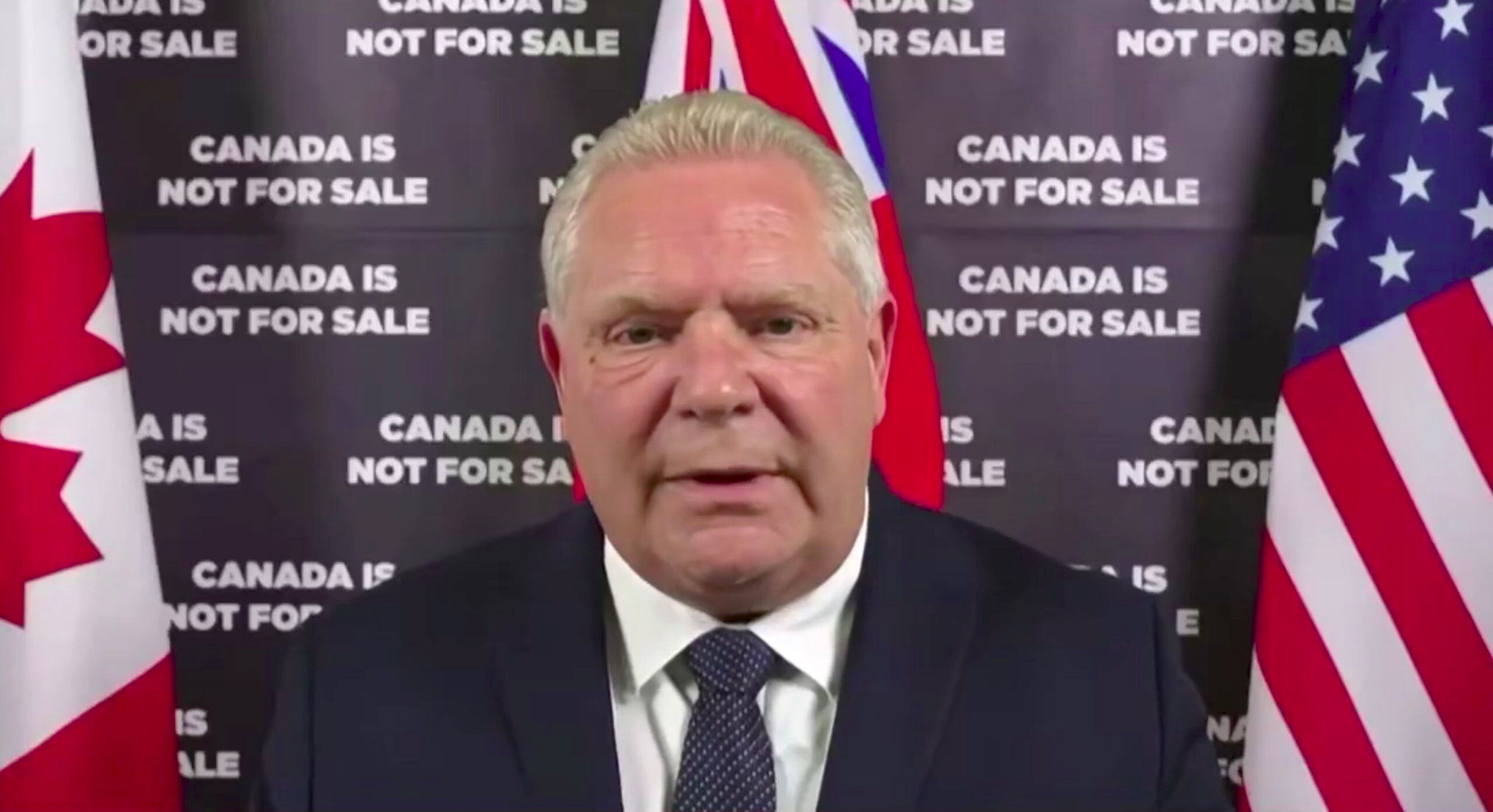
Doug Ford NBC News

Ben Kew

The premier of Ontario, Doug Ford, has threatened the U.S. over Donald Trump’s plans to impose tariffs on Canadian exports.

After initially putting a hold on his planned tariffs against Canada and Mexico, Trump confirmed this week that he would move forward with plans to 25 percent tariffs on both countries until both countries agreed to his demands surrounding border security.

In an interview on NBC News, Ford said he had never met a single American who supported the idea of tariffs, despite the fact that the majority of Americans voted for Donald Trump.

Ford ranted:

We are the largest purchaser of alcohol in the world. We buy over 3,600 products from 35 states. I talked to the Governor of Kentucky and Mitch McConnell. Don’t touch our bourbon. I’m going after absolutely everything.

And I don’t want to. We keep the lights on for 1.5 million homes in manufacturing in New York, in Michigan, and in Minnesota.

If he wants to destroy our economy and our families, I will shut down the electricity going down to the U.S. And I’m telling you, we will do it.

Ford then went on to say that Americans, particularly those in red states, would feel immense pain as his retaliatory measures.

[…]

Via https://www.thegatewaypundit.com/2025/03/ontarios-premier-threatens-cut-electricity-u-s-says/

Russia ready to facilitate US-Iran negotiations

Russia ready to facilitate US-Iran negotiations – Kremlin

RT

Washington has ramped up sanctions on Tehran just weeks after the Islamic Republic signed a strategic partnership with Moscow

Russia is ready to broker talks between the US and Iran, including on Tehran’s nuclear program and its regional proxy network, Kremlin spokesman Dmitry Peskov told Bloomberg on Tuesday.

Trump expressed interest in talking to Iran about those issues, both in his phone call to Putin in February and via representatives at the high-level US-Russian meeting in Riyadh just days later, the news agency wrote, citing anonymous officials.

“Russia believes that the United States and Iran should resolve all problems through negotiations,” Peskov told Bloomberg when asked about such contact.

Moscow “is ready to do everything in its power to achieve this,” he added.

US President Donald Trump returned to his “maximum pressure” campaign on Iran last month, just weeks after Moscow and Tehran signed a landmark strategic partnership agreement. Trump’s executive order said that Washington would ramp up sanctions on Iran, aiming to disrupt its nuclear program, conventional missile deployment, and network of regional proxy groups.

The Iranian Foreign Ministry has said the country is building up its defenses, citing regular threats from US ally Israel.

“The Israeli regime’s FM and other officials keep threatening Iran with military action while the West continues to blame Iran for its defense capability. This is outrageous & irrational,” Iranian Foreign Ministry spokesman Esmaeil Baqaei said last week. Given that Israel is “addicted to aggression and lawless behavior,” it is “responsible and essential to maximize our defense capabilities,” he stressed.

The day before, Israeli Foreign Minister Gideon Saar warned that a “military option” should be on the table to stop the potential weaponization of Tehran’s nuclear program.

Israel and the West have long seen Iran’s uranium enrichment activities as a secret attempt to develop nuclear weapons – allegations that Tehran has repeatedly denied.

While Trump has touted harsher sanctions, he has also signaled that he is interested in signing a “verified nuclear peace agreement” with Tehran.

Iranian Supreme Leader Ayatollah Ali Khamenei has stressed that talks with the US are unlikely to bear fruit, citing the prior nuclear deal Trump unilaterally left during his first presidency.

Trump’s Crypto Reserve Will Bail Out Silicon Valley and Wall Street Billionaires at the Expense of Average Americans

$863M Liquidated as Trump's Crypto Reserve Plan Sparks Price Pump

by Brian Shilhavy
Editor, Health Impact News

One of Donald Trump’s campaign promises was to create a government “Crypto Reserve” where the U.S. Government would own cryptocurrency assets to be used to run the country.

Much of the talk was originally about the U.S. Government owning Bitcoin, but this past weekend Trump announced that it would include other cryptocurrencies as well.

The news originally sent cryptocurrency values higher, but most of them came crashing back down today, as did Wall Street in general.

Trump Crypto Rally Fizzles After Skepticism on Reserves Plan

(Bloomberg) — Donald Trump’s announcement that the US will include three lesser-known digital tokens in its strategic crypto reserve was greeted with skepticism in the industry, with investors questioning the project’s merits and the coins he selected giving up some of their initial gains.

Trump said Sunday on Truth Social that the XRP, SOL and ADA tokens will be included in the reserve, along with Bitcoin and Ether. The news ignited an immediate crypto rally, offering relief to an asset class fresh off its worst month since 2022.

Yet the initial euphoria soon gave way to questions about everything from the feasibility of Trump’s plan to the motivations behind it. Crypto markets were mostly back in the red on Monday, with XRP, SOL and ADA each suffering intraday declines of more than 10% after soaring the day before.

The February crypto rout had put pressure on Trump, who returned to the White House after the industry showered him with campaign donations and praise. Even the Securities and Exchange Commission’s reversal of a years-long crackdown had failed to stem the selloff, which many attributed in part to nervousness about Trump’s trade tariffs and dramatic moves to gut government programs. (Source.)

Financial advisor Catherine Austin Fitts of the Solari Report has been very vocal against any kind of Bitcoin or Crypto Reserve by the government, referring to it as a “reverse Robinhood” of stealing from the poor and giving it to the rich. Her fears are that such a reserve would be used to buy real assets, such as real estate, while leaving speculative cryptocurrencies in people’s pensions and retirement funds.

Here are a few short video interviews where she discusses this.

Catherine and the Solari Report has a Substack Page now, and she published a good overview and summary of this proposed Crypto Reserve at the end of December.

BITCOIN BAILOUT: Why a Bitcoin Strategic Reserve Is a Bailout of the Big Boys

Excerpts:

Who Is Proposing the Creation of Bitcoin Strategic Reserves?

Several proposals for a Bitcoin strategic reserve were floated during the 2024 U.S. presidential election campaign.

At the Bitcoin 2024 conference in Nashville in July, President Trump promised, if elected, to fire Securities and Exchange Commission (SEC) Chairman Gary Gensler, whose regulatory policies and enforcement are unpopular with the crypto industry. In addition, Trump proposed halting sales of existing DOJ holdings of approximately 208,000 Bitcoins representing asset seizures and moving the position to Treasury as a permanent holding. This would ease downward price pressure in the relatively illiquid Bitcoin market.

To great applause, at that same conference Robert F. Kennedy Jr. proposed a long-term mandated Bitcoin buying program by the federal government, promising that this would raise the Bitcoin price significantly. He also proposed that sellers should be allowed to remain confidential and have the opportunity to reinvest their proceeds on a tax-free basis by qualifying the exchange of Bitcoin for real estate as a qualifying Section 1031 like-kind exchange.11 This could result in extraordinary windfall profits to the “Bitcoin billionaires.”


How such purchases would be financed is not yet clear. At the federal level, purchases could be financed from appropriations, which depend on sales of Treasury notes and bonds, a growing percentage of which are purchased by American retirement funds or monetized through the Federal Reserve in a way that is driving inflation. Another source of funding for Bitcoin strategic reserves could be asset seizures by the DOJ.

[…]

Cui Bono? The Bailout of the Big Boys

We can see why large Bitcoin holders would want federal and state buying programs to help them increase prices and create a sufficiently liquid market to make it possible to exit their positions, particularly before the Bitcoin ecosystem becomes unsustainable and the competition for increasingly scarce energy resources and the growing environmental damage become more widely understood.

[…]

If government can afford to buy private crypto assets, it can afford to—and should—cut taxes instead. Let citizens decide if, in what, and when they wish to speculate. Citizens do not need Bitcoin to fight inflation. What they could use to fight inflation is lower taxes, basic infrastructure, and public services that support a productive economy.

(Full article.)

[…]

Via https://vaccineimpact.com/2025/trumps-crypto-reserve-will-bail-out-silicon-valley-and-wall-street-billionaires-at-the-expense-of-average-americans/

10 Days in North Korea

10 Days in North Korea

Directed by Angela Gallardo Bernal (2014)

Film Review

Russian and Spanish with English subtitles

Bernal is a Spanish-speaking documentary filmmaker who makes films for RT. This film ends by noting the pervasive self-censorship in North Koreans she’s allowed to interview. They’re 100% unanimous in their glowing praise for “the General)” for “giving us all his love and everything people need.”

They also steadfastly assert that North Korea has no political prisoners. It’s okay to have different views than the government but not to engage in property destruction or violence.* Felonies are punishable by compulsory labor on farms and construction sites and in mines.

Bermal’s film crew was only allowed to visit the capitol Pyongyang, which is impeccably clean (and totally devoid of street beggars or homeless people) without street beggars or homeless people) and characterized by meticulously arranged aesthetics (flowers, murals etc). The bodies Kim Jong-Un’s father Kim Jong-Il and his grandfather father Kim Il-Song are both embalmed and on display in a mausoleum in the capitol Pyongyang. Major buildings throughout the capitol are covered with gigantic portraits and memorabilia of both former generals.

In Korea as of 2014, the vast majority of North Koreans could only access an internal “Intranet” because the World Wide Web was only accessible to select scientists and researchers. The North Koreans interviewed felt this was a good thing, given the Internet is “full of inappropriate sexuality and American propaganda.” They admitted to being skittish about being exposed to other cultures, which in their view are “basically unstable.”

Ninety percent the delegates of the Supreme Peoples Assembly belong to the Workers Party and 10% to the Democratic Party or Chondoist Changu party. A handful of members have no party affiliations. North Korea’s current leader Kim Jong-Un (known as the “general” or “marshal”) was elected as a delegate after his father Kim Jong-Il died in 2011. He was subsequently elected as Supreme Leader by 100% of the delegates.

The North Korean army is on constant full combat alert. With ten years military service compulsory for all Korean men, in 2014, the country had one million soldiers in addition to their highly militarized police. With Soviet assistance, the government has built a massive fallout shelter to house all North Koreans in the event of a nuclear attack.

North Korea regards the Korean peninsula as a single country, arbitrarily divided by US aggression in 1954. Prior to George Bush II’s designation of North Korea as part of the Axis of Evil, there was an active program (known as the Sunshine Policy) working for North and South Korean reunification** Family reunions of North and South Korean families arbitrarily separated by the US-imposed line of demarcation began in 2000 and ended in 2008, when the Sunshine Policy ended. Regular reunions restarted briefly in 2018 as part of Trump’s efforts to improve US relations with North Korea.

The Kaesong Joint Economic Project (part of the Sunshine Policy**), which has continued, has greatly benefited North Korea’s economy. As of 2014, 100 South Korean companies participated, employing 53,000 North Koreans.

Western sanctions have really hurt North Korea, which relies mostly on tourist revenue and foreign currency generated by North Korean animators. The latter are extremely sought after by foreign filmmakers because they do high quality work very cheaply.

Food shortages are endemic as only 15% of North Korea is arable. The government sets production goals for North Korea’s collective farms and tries to boost farmer and factory morale by encouraging regular visits by students who boost morale via singing and flag waving ceremonies.

Although North Korea receives some UN aid, China is the main supplier of food aid. Roughly two million North Koreans pick up monthly food rations from food ration centers


*Kim Jong-un had his uncle executed in 2013 for high treason (he was accused of corruption and plotting to topple the regime).

**The Sunshine Policy grew out of a treaty (the Agreed Framework) the late president  Jimmy Carter negotiated with Kim Il Sung in 1994. Among other provisions, the agreement included substantial South Korean humanitarian aid to address North Korea’s chronic food shortages, loosening of restrictions on South Korean investment in North Korea, the opening of North Korea’s Kumgang Tourist Region to South Korean visitors, the establishment of a family reunification program, the opening of rail links through the Demilitarized Zone (DMZ) and a worker exchange program permitting South Korean workers to work at North Korea’s Kaesong Industrial Park.


Rotorua Lakes Council Letter to Minister of Health

Rotorua Lakes Council (RFC) have sent a letter to the Minister of Health, Mr Simeon Brown, asking for a withdrawal of the directive sent to them in November 2022 from the Director General of Health ordering them to fluoridate their water supply.

The Council has outlined all the reasons why they disagree with the Directive, pointing out that there is conflicting  evidence pertaining to both the efficacy and the safety of fluoridation.

They have also requested that a public inquiry be held so that this information can be discussed in the public domain.

It is long past the time when councillors, and New Zealanders in general, can rely unquestionably on the Ministry of Health on this issue. Two weeks ago the Ministry of Health sent two representatives to the RLC to try to convince the councillors that fluoridation was safe and effective. However, their presentations were an embarrassment to the Ministry. They either are completely ignorant of the research, or don’t understand it, or are saying whatever they think they need to so that the fluoridation programme can continue in New Zealand and the Ministry of Health won’t be found to have been wrong.

For example, Dr Shoemack, Medical Officer of Health in the Bay of Plenty and Lakes region, told the councillors that “fluoridation didn’t treat individuals, it treated the water”– obviously completely untrue. The whole point of fluoridation is to medically treat individuals. Dr Clark misled the council by claiming that the US National Toxicology Program review only looked at studies “well over 1.5ppm, very different to what we have here”. Once again, this was totally untrue.

Fluoride Free New Zealand calls on all local authorities in New Zealand to do the same as RLC. We also challenge anyone who agrees with fluoridation to provide a well referenced rebuttal of any claims made by RLC that are not in agreement with the New Zealand Ministry of Health.

See letter from Rotorua Lakes Council below.

[…]

Via https://fluoridefree.org.nz/rotorua-lakes-council-letter-to-minister-of-health/