Civil War Now Official – Syria Erupts in Worst Bloodshed Since Assad’s Fall

Zero Hedge

Any lingering delusions that Syria could emerge from its Western-imposed, regime-change victimhood and enter an era of peace and stability were obliterated on Thursday, as 48 people were killed in battles between supporters of the deposed Bashar al Assad government and the country’s new radical Islamist regime. As all-out civil war looms, increasingly disturbing sectarian violence has an important minority sect asking for Russian intervention to safeguard their lives.

In the town of Jableh, which lies in Syria’s coastal Latakia province, pro-Assad forces ambushed and killed 16 members of the regime’s security forces. In the ensuing retaliation, 28 pro-Assad militants and four civilians died, according to the London-based Syrian Observatory for Human Rights (SOHR). Latakia hold the highest concentration of Alawites — the minority sect of Islam that’s principally found in Syria, with the Assad family themselves being the most prominent members. Alawites comprise about 10% of the country’s population. Notably, the province is also home to the Russian-operated Khmeimim air base. The ambush targeted regime forces who’d carried an operation in rural Latakia aimed at arresting a former Assad government official.

[…]

Via https://www.zerohedge.com/geopolitical/civil-war-now-official-syria-erupts-worst-bloodshed-assads-fall

Bhattacharya Opposes Vaccine Mandates, Promises to Tackle Chronic Disease Epidemic

dr. jay bhattacharya and NIH website

Michael Nevradakis, Ph.D.

Dr. Jay Bhattacharya, President Donald Trump’s nominee to lead the National Institutes of Health (NIH), said during today’s confirmation hearing that he opposes vaccine mandates and scientific censorship.

He also told members of the U.S. Senate’s Committee on Health, Education, Labor and Pensions (STEP) that he believes in diverse scientific research and he supports efforts to address today’s chronic disease epidemic.

During his opening statement, Bhattacharya, a critic of COVID-19 pandemic restrictions and co-author of the Great Barrington Declaration, listed the five priorities he will pursue if confirmed as NIH director:

  • Tackle the chronic disease epidemic.
  • Support scientific research that is “replicable, reproducible and generalizable.”
  • Establish “a culture of respect for free speech in science and scientific dissent.”
  • Fund “the most innovative biomedical research agenda possible to improve American health.”
  • “Vigorously” regulate research “that has the possibility of causing a pandemic,” such as gain-of-function research.

According to STAT News, if confirmed as NIH director, Bhattacharya will oversee “the biggest funder of biomedical research in the world.” Composed of 27 research institutes and centers, the NIH has a nearly $50 billion budget, NBC News reported.

Following the hearing, Endpoints News reported that Bhattacharya sailed through today’s proceedings and “appears headed for a relatively easy Senate confirmation.”

Bhattacharya supports ‘broad scientific agenda’ to study rise in autism

Early during the hearing, Bhattacharya responded to statements by Sen. Bill Cassidy (R-La.), chair of the committee, that a link between the measles-mumps-rubella (MMR) vaccine and autism has been debunked and therefore doesn’t require further scientific study.

Bhattacharya responded:

“As far as research on autism and vaccines, I don’t generally believe that there is a link, based on my reading of the literature. But what I have seen is that there’s tremendous distrust in medicine and science coming out of the pandemic.

“We do have … a sharp rise in autism rates in this country, and I don’t know, and I don’t think any scientist really knows, the cause of it. So, I would support [a] broad scientific agenda based on data to get an answer to that.”

Bhattacharya said people’s doubts about vaccines and mistrust toward public health agencies can be addressed by providing “good data.”

“We want answers,” he said. “Parents want answers. Kids are suffering. And the NIH ought to be doing the research that [provides] those answers. That’s the most important thing.”

Bhattacharya called for funding “the most innovative biomedical research agenda possible to improve American health.”

“My plan is to ensure that the NIH invests in cutting-edge research in every field to make big advances rather than just small incremental progress,” Bhattacharya said.

[…]

Via https://childrenshealthdefense.org/defender/jay-bhattacharya-opposes-vaccine-mandates-promises-tackle-chronic-disease-epidemic/

Ukraine Cut Off from US Satellite Imagery

Ukraine cut off from US satellite imagery – media

RT

Aerospace firm Maxar Technologies has reportedly blocked Kiev’s access to its services

Ukraine has lost access to US satellite imagery after American space technology company Maxar blocked Kiev’s use of its services, a local media outlet reported on Friday. The move follows Washington’s recent decision to freeze military aid and intelligence sharing with Ukraine.

Ukrainian media outlet Militarnyi has claimed that several anonymous Maxar users have confirmed that they have been denied access to the service. The company has reportedly explained that the restriction had been introduced “in response to an administrative request.”

The outlet noted that the limit appears to apply to both government and private users, adding that the request cited by the company likely refers to US President Donald Trump’s order to cease all intelligence sharing with Ukraine.

Maxar, according to Militarnyi, has been one of the leading providers of high-resolution commercial satellite imagery to Ukraine’s armed forces who used it to track the movements of Russian troops, assess battlefield conditions and damage to key infrastructure. The US company has not yet confirmed the alleged restriction of services.

Ukraine cut off from HIMARS targeting data – media

Read more

Ukraine cut off from HIMARS targeting data – media

The report comes as Washington has halted the delivery of billions of dollars worth of military aid to Ukraine, while the CIA has confirmed that intelligence sharing with Kiev has been suspended. The decision to freeze military support for Ukraine follows last week’s heated meeting between Trump, US Vice President J.D. Vance and Zelensky at the White House. During the exchange, Trump accused Zelensky of ingratitude and “gambling with World War III” by refusing to seek peace with Russia. The Ukrainian leader was asked to leave the US capital and return only when he was ready for serious negotiations.

On Wednesday, during his address to the US Congress, Trump claimed that he had received a letter from Zelensky in which he had apparently agreed to come to the negotiating table in the near future in order to work towards a peace agreement.

Moscow has welcomed Washington’s suspension of military aid to Kiev, noting that such steps could potentially encourage Ukraine to seek a peaceful resolution to the conflict. At the same time, the Kremlin has expressed cautious optimism about Zelensky’s supposed U-turn on negotiations with Moscow, noting that the Ukrainian leader has yet to lift his legal ban on such contacts.

[…]

Via https://www.rt.com/russia/613879-ukraine-us-satellite-imagery-restriction/

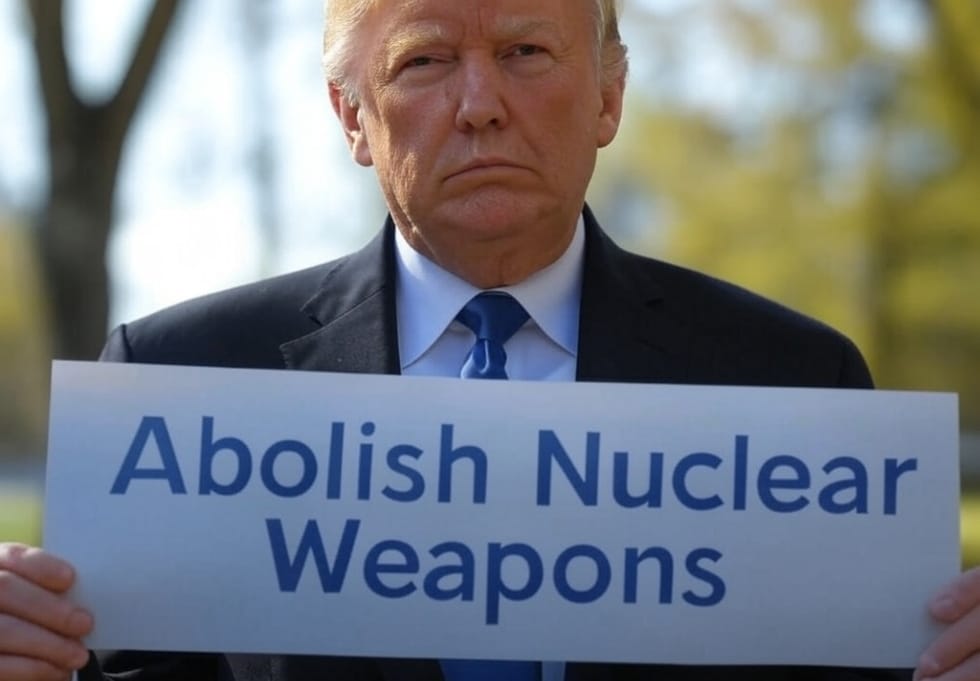
Trump: Everybody Should Get Rid of Their Nuclear Weapons

Trump abolish nukes

By Kyle Anzalone

President Donald Trump restated his desire to abolish nuclear weapons during a White House presser on Thursday.

“It would be great if everybody would get rid of their nuclear weapons. [I know] Russia and us have by far the most,” the president told reporters in the Oval Office. “China will have an equal amount within four to five years. It would be great if we could all de-nuclearize because the power of nuclear weapons is crazy.”

Currently, nine countries – the US, UK, France, Russia, China, India, Pakistan, North Korea, and Israel – possess nuclear weapons. With global tensions on the rise, several nations, including the US, are adding to their strategic capability.

According to the Defense Intelligence Agency, Beijing is working to ramp up its production of nuclear weapons. Last year, the agency predicted that China could have over 1,000 nuclear weapons. However, that would still give Beijing a far smaller arsenal than Washington and Moscow, which each have around 1,500 deployed nuclear weapons and thousands more in storage.

Shortly after returning to the White House in January, Trump said he spoke with President Vladimir Putin about denuclearization during his first term, and that the Russian leader was receptive to the idea. “We were talking about denuclearization of our two countries, and China would have come along. China right now has a much smaller nuclear armament than us, or field, than us, but they’re going to be catching [up] at some point,” Trump said.

“I will tell you that President Putin really liked the idea of cutting back on nuclear, and I think the rest of the world, we would have gotten them to follow, and China would have come along too. China also liked it,” he added. “Tremendous amounts of money are being spent on nuclear, and the destructive capability is something that we don’t even want to talk about. It’s too depressing.”

Trump has also discussed negotiating a deal with Moscow and Beijing that would see all three countries drastically cut military spending.

However, while Trump has at times voiced support for demilitarization and denuclearization, during his first term in office he scrapped two major arms control agreements, the Open Skies and the Intermediate Range Nuclear Force treaties.

Additionally, Trump refused to engage in bilateral discussions with Russia on extending the last nuclear arms control agreement between the world’s two largest nuclear arsenals, the New Start Treaty. He insisted that Moscow must pressure Beijing to make it a trilateral deal, a demand that almost led to the downfall of the landmark deal.

Though President Joe Biden was able to reach an agreement with Putin to extend the treaty for five more years in 2021, it is set to expire next year without another extension.

Rep. Thomas Massie, Sen. Mike Lee Introduce Bills to Audit and Abolish Federal Reserve

Rep Thomas Massie (left) and Senator Mike Lee (right)

By Jordan Conradson

Rep. Thomas Massie (R-KY) and Senator Mike Lee (R-UT) have teamed up to reintroduce the “End the Fed” bill in the House and Senate to liquidate the Federal Reserve’s assets and transfer all money to the Treasury. 

Additionally, Massie also introduced a bill to audit the Federal Reserve in the House.

Massie previously introduced the bills in 2024.

“The Federal Reserve Board Abolition Act was first introduced by former Representative Ron Paul (R-TX) in 1999 and hasn’t been reintroduced since 2013. In addition to introducing this legislation to “End the Fed,” Rep. Massie has also introduced H.R. 24, the Federal Reserve Transparency Act of 2025 to audit the Federal Reserve. H.R. 24 was originally introduced by former Representative Ron Paul (R-TX) in 2009,” according to a press release from Massie’s office.

The Act will abolish the Board of Governors of the Federal Reserve System and liquidate all assets to return to the taxpayer. It also repeals the Federal Reserve Act, the 1913 law that created the Federal Reserve, effective one year after the bill is signed into law.

Read the full bill here.

[…]

Via https://www.thegatewaypundit.com/2025/03/rep-thomas-massie-sen-mike-lee-introduce-bills/

US in secret talks to revive Nord Stream 2

US in secret talks to revive Nord Stream 2 – Bild

FILE PHOTO. ©  Jens Büttner/Getty Images

RT

Trump’s envoy has reportedly traveled to Switzerland to negotiate the restoration of the pipeline connecting Russia and Germany

US President Donald Trump’s special envoy Richard Grenell has made multiple trips to Switzerland to negotiate the restoration and reactivation of the Nord Stream 2 gas pipeline, Bild reported on Sunday, citing sources familiar with the matter.

Nord Stream 2, which was intended to complement the already operational Nord Stream 1, was completed in 2021, but never commissioned. In September 2022, the pipelines were targeted by a series of underwater explosions, which caused severe leaks. In August last year, the Wall Street Journal suggested that they had been sabotaged by a Ukrainian team.

Grennell, who served as ambassador to Berlin during Trump’s first term, is now his envoy for “special missions.” According to Bild, Grennel made multiple unofficial trips to the headquarters of Nord Stream’s operating companies in the Swiss canton of Zug to negotiate a deal.

During his first term in office, Trump was critical of Nord Stream 2, targeting it with sanctions. In an interview in October, he even boasted that his actions had “killed” the project. Since his second term began, however, Trump has pushed for closer US-Russia ties, hinting at a possible lifting of the trade restrictions. One string of the pipeline remains intact and filled with gas, but Germany refuses to use it due to political considerations.

The purported deal would reportedly see American investors preventing Nord Stream 2 from bankruptcy by acquiring a stake in the company. According to the report, US investors would act as intermediaries for the supply of Russian gas to Germany and Central Europe via the pipeline. The deal would enable the US to profit if it becomes operational following a potential ceasefire in Ukraine and the lifting of Western sanctions. Additionally, it would give Washington significant influence over Germany’s energy supply, the article stated.

The report noted that while the US government would not be directly involved, American financial investors intended to participate in the potential gas deal.

The news outlet also cited alternative plans for the two pipelines of Nord Stream 1 once they are repaired. After a conversion phase, they could be repurposed to transport green hydrogen from Finland.

The German government has not been involved in the reported talks, with sources in Berlin claiming they were unaware of Grenell’s meetings in Switzerland. The envoy has also denied any involvement.

The Financial Times, however, claimed on Sunday that the talks had been brokered by Matthias Warnig, former executive director of the Swiss-based Nord Stream 2 operator.

The outlet alleged that one of the US-led consortium has already drawn up a plan for a deal with Russia’s energy giant Gazprom, which could be concluded after the sanctions against Moscow are lifted.

[…]

Via https://www.rt.com/news/613603-nord-stream-us-investors/

Trump administration weighs lifting sanctions on Russia

Trump administration weighs lifting sanctions on Russia – Reuters

Russian President Vladimir Putin’s meeting with US President Donald Trump on the sidelines of the G20 summit in Osaka, 28 June 2019. ©  RIA Novosti

RT

The possible plans are reportedly part of the president’s efforts to improve ties with Moscow and end the Ukraine conflict

The White House has directed the State and Treasury departments to draft proposals for easing certain sanctions on Russia, Reuters reported on Monday, citing sources familiar with the matter. The tentative plans would align with US President Donald Trump’s efforts to improve diplomatic and economic relations with Moscow and to facilitate an end to the conflict in Ukraine.

The proposed sanctions relief could include specific Russian entities and individuals, including some business leaders, according to the outlet. The list will be discussed with Russian representatives in the coming days as part of the administration’s broad talks with Moscow on repairing ties, the sources told Reuters.

However, it remains unclear what concessions or actions Washington might seek in exchange. The White House, State Department, Treasury Department, and the Russian embassy in Washington have not commented so far.

The reported decision follows a series of diplomatic engagements between the US and Russia. On February 12, Trump and Russian President Vladimir Putin held a phone call, beginning discussions aimed at resolving the Ukraine conflict. Subsequently, high-level meetings have taken place in Saudi Arabia and Türkiye between US and Russian officials.

At the Saudi meeting, the US delegation, led by Secretary of State Marco Rubio, explored avenues for economic cooperation, including potential joint ventures in the energy and technology sectors. The talks also addressed the possibility of restoring embassy staffing levels to improve diplomatic communications.

Foreign Minister Sergey Lavrov, who lead the Russian delegation, described the meeting in Riyadh as a first step toward rebuilding relations, stressing that Moscow and Washington need to “clean up the legacy” left by the Biden administration. Lavrov said that a swift appointment of ambassadors in Washington and Moscow would be an important step toward restoring full-scale cooperation.

Trump has maintained throughout that sanctions relief would not precede a formal peace agreement. He has said that any easing of restrictions would be contingent upon concrete steps toward ending the conflict in Ukraine.

Putin has welcomed efforts with the US on the diplomatic front and expressed Moscow’s willingness to resolve the Ukraine conflict through peaceful means. He stressed Russia’s goal of establishing an international system that fairly considers the interests of all parties, ensuring a lasting and indivisible security framework for Europe and the world. Such a system would prevent some nations from securing their safety at the expense of others, including Russia.

[…]

Via https://www.rt.com/news/613631-trump-administration-weighs-lifting-russia-sanctions/

US suspends cyber operations against Russia

US suspends cyber operations against Russia – media

RT

The order was reportedly given before last week’s Trump-Zelensky disastrous meeting at the White House

The Pentagon has ordered a halt to offensive cyber operations against Russia, multiple media outlets reported on Monday, citing a senior US official. The decision was reportedly made prior to the heated exchange between Ukrainian leader Vladimir Zelensky and President Donald Trump in the Oval Office last Friday.

Defense Secretary Pete Hegseth issued the order to US Cyber Command to cease activities in late February while Washington reassesses its relationship with Moscow, according to unnamed officials.

The Record, a cybersecurity-focused news outlet, was the first to report the development on Friday. It highlighted that the directive does not apply to signal intelligence collection conducted by the National Security Agency, which operates under the Department of Defense.

While details of the rollback remain unspecified, sources claimed it was indefinite. Critics of Trump have characterized the move as a threat to national security, with an official cited by CNN describing it as a “major blow” to America’s ability to infiltrate Russian networks in the future, including in support of Ukraine.

Russia views the US as a significant cyber threat. Increased hostility between the two nations in recent years has hindered efforts to establish ground rules for cyberspace, despite Moscow’s repeated proposals. The US has been a leading player in cyber warfare, highlighted by notable operations such as the sabotage of Iranian uranium enrichment facilities during Barack Obama’s presidency.

Although digital attacks are often challenging to trace, US intelligence agencies occasionally express strong confidence that hacker groups associated with nations such as China and Russia are responsible for specific incidents.

US media typically amplify stories about foreign cyber threats, sometimes without solid evidence. A notorious instance occurred in January 2019 when MSNBC host Rachel Maddow, a vocal critic of Trump, warned her audience that Russia could “kill the power in Fargo today,” amid a severe cold wave in the US. Her remarks seemed to reference false claims from that month regarding Russian cyber infiltration of power grids in Vermont.

The Trump administration has signaled it wants to normalize relations with Russia following a period of hostility and limited communications under the previous administration of Joe Biden. Senior US officials argue that a “mature” foreign policy approach necessitates candid dialogue with rival states.

[…]

Via https://www.rt.com/news/613611-pentagon-cyber-operations-russia/

Bullet for the President

Bullet for the President

Directed by Vladimir Soloviev (2024)

Film Review

Russian with English subtitles

For the most part this  all of this documentary consists of commentary by Retired Soviet and Russian intelligence officer Andrey Bezrukov. However Russian-American Dmitri Simes, former president of the US Center for National Interest, appears briefly at the end. *

Bezruikov, who believes the assassination attempt against Trump led Biden to drop out of the presidential race, begins with a number of general observations about US politics:

  1. The US is a country of radical people and their politics are always radical and messy. He cites the 1963 assassination of John F Kennedy and the 1982 assassination attempt on Presidential Ronald Reagan.
  2. The financial interests that currently control the US want a manageable president who does what “the system” wants them to. When JFK and Nixon didn’t do what they were told, they were removed from office. Trump has also broken “the rules of the game.”

According to Bezrukov, after the US became the sole world power, the US elite seemed to go brain dead. At present, they protect their own personal interests by installing members of their personal clique as president. Meanwhile US industry has lost its competitiveness and ability to create jobs.

In 2016, underrepresented Americans who hated the worsening corruption in Washington and had ceased to engage with the US political system, were inspired to vote for Trump after he promised to 1) focus on US domestic problems rather than interfering in other country’s domestic affairs and 2) to root out the US deep state and restore their country to an open participatory system envisioned by America’s founding fathers.

Bezrukov believes Trump practically fulfilled all his campaign promises during his first term but two: “draining the swamp” (eliminating the corruption) and improving relations with Russia. Hillary Clinton’s Russiagate smear, based on totally fabricated allegations that the Russian government meddled in the 2016 election, was a major factor behind the deterioration in US-Russian relations after Trump left office.

In the second half of the film, Bezrukov analyzes the total breakdown in basic security the day (July 13, 2024) Trump was shot:

  1. Police spotted the gunman Thomas Crooks in Trump’s security perimeter 64 minutes prior to the shooting and the Secret Service made no effort to remove him from the scene.
  2. The Secret Service failed to secure a rooftop in Trump’s security perimeter.
  3. The way the Secret Service tackled Trump immediately increased his risk of being shot by keeping him upright as a visible traget.

Bezrukov feels it’s too soon to differentiate between criminal negligence on the part of the Secret Service and a deliberate assassination conspiracy. However he clearly reject the claim that Crooks was an unstable “loner” operating on his own.

He notes that Trump was guarded by a private military company during his first campaign but the Secret Service took over his security once he was elected president in 2016. Bezrukov notes that 48% of the Secret Service were fired or resigned during the Biden presidency and it takes 3-5 years for new Secret Service officers to reach their full effectiveness.

He ends by sharing his view that, as with the Soviet economy in 1988, the US economy is on the brink of collapse. He also seems to believe (as did a lot of the people who voted for him) that Trump possibly has both the insight and courage to keep that from happening.


*Former president Richard Nixon started the US Center for National Interest in 1994 to improve US-Russian relations. Simes, its first president, stepped down in 2022 and returned to Russia. He’s currently under investigation by the US State Department for violating US sanctions against Russia.

https://en.rtdoc.tv/films/1406-bullet-for-the-president

Arizona Lawmakers Approve Psychodelics Bill to Create Psilocybin Advisory Board and Fund Ibogaine Research

By Kyle Jaeger

Arizona lawmakers have approved two different bills focused on psychedelic therapy.

Senate passed a bill to create an advisory board tasked with studying the science of psilocybin, as well as state and federal policies surrounding the psychedelic, while the House separately approved a measure to fund clinical trials on ibogaine.

The Senate legislation from Sen. T. J. Shope (R) cleared the chamber in a 23-4 vote on Tuesday after it was significantly amended in committee, with members removing central provisions to establish licensed psilocybin service centers for adults seeking mental health treatment.

On the House side, the body advanced the ibogaine research legislation, sponsored by Rep. Justin Wilmeth (R), in a 36-22 vote on Monday, sending it to the Senate. It would provide funding for the state Department of Health Services (DHS) to “conduct a certified clinical research study on the use of ibogaine for the treatment of neurological diseases.”

An earlier version of Shope’s Senate psilocybin bill moved through both chambers last year with the regulated access components intact, but it was vetoed by the Democratic governor, who argued that “we do not yet have the evidence needed to support widespread clinical expansion.”

However, the year before, Gov. Katie Hobbs (D) signed into law budget legislation that included provisions to fund research into the medical potential of psilocybin mushrooms for a variety of conditions.

The new Senate-passed bill hopes to leverage some of those appropriated $5 million to create an Arizona Psilocybin Advisory Board, comprised of up to 12 members appointed by the governor and legislative leaders.

Representatives of the attorney general’s office and DHS, as well as military veterans, first responders, scientists with experience with psilocybin and physicians would be among the members.

Under the bill, the board would need to be selected by December 31, 2025, and they’d need to hold their first meeting by March 1, 2026.

[…]

Via https://www.marijuanamoment.net/arizona-lawmakers-approve-psychedelics-bills-to-create-psilocybin-advisory-board-and-fund-ibogaine-research/