Trump Ready to Talk with Maduro

Trump ready to talk with Maduro – Axios

RT

The reported move could follow weeks of US “narcoterrorism” strikes on boats off the Venezuelan coast that have killed about 80  

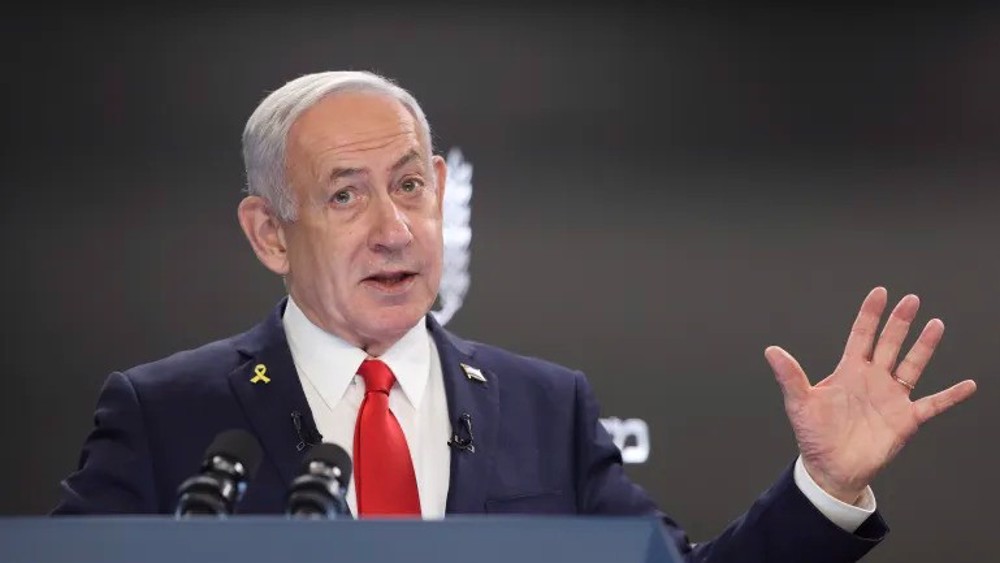
US President Donald Trump plans to speak directly with Venezuelan President Nicolas Maduro despite Washington’s move to designate him as the head of a terrorist organization, Axios reported on Tuesday, citing administration officials.

The US has formally designated the ‘Cartel of the Suns’ – a purported criminal network alleged to operate within Venezuela’s security services – as a foreign terrorist organization, putting it in the same category as Al-Qaeda and Islamic State. Announcing the step on Monday, the US Treasury reiterated long-standing allegations that Maduro, whose legitimacy Washington disputes, heads the group.

According to Axios, Trump’s move marks a notable turn in his “gunboat diplomacy” toward Venezuela – and could indicate that US missile strikes or ground operations are unlikely in the near term.

“Nobody is planning to go in and shoot him or snatch him – at this point. I wouldn’t say never, but that’s not the plan right now,” an anonymous official familiar with the matter told Axios.

“In the meantime, we’re going to blow up boats shipping drugs. We’re going to stop the drug trafficking,” the official reportedly added.

No date has been set for a potential call between Trump and Maduro, which is “in the planning stages.” Axios reported, citing another US official.

The move follows nearly two months of US airstrikes on small boats off Venezuela’s coast, actions the Pentagon says target “narcoterrorism” and that have killed about 80 people.

The term ‘Cartel of the Suns’ emerged in the 1990s as a media label for alleged corruption among Venezuelan officers who wore sun-shaped insignia. In 2020, the US indicted Maduro and 14 current or former officials on drug-trafficking and organized-crime charges, alleging they collectively ran the cartel. Maduro has repeatedly denied the drug trafficking allegations and warned the US against launching “a crazy war.”

Trump has also reportedly greenlighted a range of measures to pressure Venezuela and prepare for a possible broader military campaign, including covert CIA operations targeting Maduro’s government.

Caracas has denounced the US military buildup as a violation of its sovereignty and an attempted coup, putting its forces on high alert. Maduro, meanwhile, has said Venezuela is prepared for “face-to-face” talks with Washington.

[…]

Via https://www.rt.com/news/628394-trump-maduro-direct-talk/

AI Revolution About to Crash due to Lack of Human Labor


by Brian Shilhavy
Editor, Health Impact News

I think many Americans are about to learn that math is very unforgiving, and always produces the same number based on the numerical data used for mathematical calculations, regardless of beliefs, illusions, cons, and science fiction.

You can believe yourself, and try to convince others to believe that 2 + 2 does NOT equal 4, but something else like 5.

But just like AI, math has no consciousness and creates nothing. It just reports the mathematical results based on the data input, which is how the REAL world works, as opposed to the FAKE world, and their FAKE (artificial) intelligence.

Reality is now catching up to the fantasy land of “generative AI”, and we are drawing nearer to the crash of the great AI bubble every day. The money merry-go-round among Big Tech with their AI investments shows no sign of abating yet, with Nvidia currently sitting on the top of the bubble holding the largest bag of money.

But the signs are now showing that this AI show may soon be over, as the only way forward at this point is to build huge new power-hungry data centers.

And while it is debatable if the economy can come up with new ways to generate more power to run these data centers, one thing is not debatable: to build and maintain these data centers requires a huge increase in human labor, and we do not have that labor in the U.S. workforce right now.

In fact, many of these skilled jobs are currently run by immigrant labor where the supply line to this cheap labor has not only been cut off at the borders, but is decreasing with mass deportations.

The U.S., and the entire world, are about to get a rude lesson in math, and wake up to the fact that science fiction is just that – fiction, which is based on fake (artificial) intelligence.

The robot revolution to replace humans will soon be canceled, due to a lack of humans to build them and maintain them.

Data Center Construction Delays Exemplify how Reality Trumps Hype

Anissa Gardizy, writing for The Information just published an article today titled: “As AI Data Centers Face Delays, the Blame Game Begins

Excerpts:

The mood is shifting in AI data center circles. The euphoria of record-setting, multi-gigawatt deals has given way to finger pointing as deadlines to get AI servers online slip or get dangerously close to falling behind.

For months, data center builders have told me many of the gigawatt-size AI server facilities are running behind schedule because of the complexities of putting together the biggest clusters of servers ever attempted.

[T]he stakes are different now, given the urgency to complete AI data centers.

Earlier this year, Oracle executives raised their voices at contractors in Abilene, Texas, as pressure mounted on the company to hand over working servers to its customer, OpenAI.

The executives had good reason to be frustrated.

We’ve heard cloud providers’ contracts with customers include provisions in which customers can pay less if the provider misses a timeline or if the servers aren’t functioning properly, reducing their uptime.

For GPU cloud providers with already thin gross profit margins on renting out servers, these problems can materially alter their financial results.

The race to get Nvidia GPU clusters online continues to be a challenge for some firms that promised speedy timelines. And it’s likely that as power becomes harder to secure, which could also cause delays, we might see customers hedging their bets by working with multiple data center providers.

Several developers told me this week GPU shipments are outpacing construction timelines so severely that some firms are storing racks of idle GPUs in warehouses, waiting to be told where to send them.

Even Meta acknowledged this tension on its earnings call in late October. Chief Financial Officer Susan Li said the company is now “staging data center sites,” or essentially getting them ready with everything but the GPU racks, so Meta can “spring up capacity quickly in future years as we need it.”

In other words, even large data center developers like Meta are building buffers to prepare for capacity spikes.

One thing is clear: We’re entering an era where the physical limits of labor, equipment, utilities and contractor bandwidth are colliding with customer demand.

It’s going to be a bumpy ride. (Full article – subscription needed.)

Here is what Microsoft CEO Satya Nadella said earlier this month:

Microsoft CEO Satya Nadella didn’t mince words in his appearance on the Bg2 Pod with investor Brad Gerstner and OpenAI’s Sam Altman.

The tech leader made a startling admission that the biggest problem facing AI expansion right now isn’t chips — it’s power.

In what was a rare moment of candor, Nadella confessed that Microsoft has some of the most cutting-edge GPUs sitting idle because there’s basically nowhere to plug them in.

“I don’t have warm shells to plug into,”

he said, referring to unfinished data center facilities that don’t have power or cooling capacity.

[…]

With industries across the globe racing to build smarter machines, it’s hitting a very human limit; there might not be enough electricity to keep the dream running. (Source.)

300,000 New Data Center Jobs Unfilled due to Shortage of Human Labor

The lack of human resources to build these new data centers is well documented, but this problem is not headline news and you have to search for it to see how severe the problem is.

This is a study that was published recently on LinkedIn:
The Shortage of Skilled Personnel in Data Centres: Challenges, Causes and Mitigation Strategies

Excerpts:

Data centre sector faces a critical challenge: the growing shortage of specialised personnel. This article analyses the structural causes of the issue, the operational and strategic risks it entails, and the main mitigation measures, including training programmes, workforce reskilling, retention strategies, and the incorporation of Artificial Intelligence (AI) as a partial support mechanism.

Recent data from the Uptime Institute, the Bureau of Labor Statistics (BLS), and industry reports are presented to support the analysis.

The rapid digitalisation of society and the growth of cloud computing, Artificial Intelligence (AI), edge computing and 5G have exponentially increased the demand for critical infrastructure.

Data centres, as the backbone of this ecosystem, are undergoing unprecedented expansion. The global data centre services market is expected to reach USD 110 billion by 2030, up from USD 62 billion in 2024, representing a compound annual growth rate (CAGR) of nearly 10% (Data Center Services, 2024).

This growth contrasts with a structural limitation: the availability of specialised personnel to design, build, operate, and maintain highly critical facilities. The talent shortage represents a strategic risk that could compromise the sector’s ability to sustain its expansion.

The Uptime Institute estimates that the global data centre workforce will increase from 2 million professionals in 2019 to 2.3 million in 2025, leaving a shortfall of approximately 300,000 positions.

In Europe and North America, a significant proportion of the technical workforce is approaching retirement, exacerbating the shortage. In the United States, the Bureau of Labor Statistics (BLS) forecasts an 11% increase in demand for electricians by 2033, nearly three times the average for other professions (Barron’s, 2025).

Root Causes

  1. Educational misalignment: Most engineering programmes lack specific training on data centre operations and management, leaving employers to fill the gap with on-the-job training.
  2. High turnover: The demands of 24/7 availability, shift work, and operational pressure contribute to burnout and early exit.
  3. Cross-sector competition: Energy, telecommunications, oil & gas, and cybersecurity industries all compete for the same technical talent, inflating salaries.
  4. Limited sector visibility: Unlike fintech or AI, data centres are not widely perceived as an attractive career path for young engineers (Mission Critical Magazine, 2024).

[…]

Full article.

Human labor is needed for all aspects of building all these new data centers, including the enormous increase in power needed to generate the electricity that is needed to run these data centers.

2025 Data Center Construction: Permits, Power, and Risks

Excerpts:

The global demand for data, driven by the AI revolution and our ever-connected world, has triggered an unprecedented boom in data center construction.

However, developers and investors are facing a perfect storm of obstacles that are slowing projects, inflating costs, and reshaping the industry landscape. As we look toward 2025, moving from concept to a fully operational facility has become more complex than ever.

The primary challenges are not about a lack of will or capital, but about fundamental constraints in power, permissions, and resources.

For years, the biggest hurdles in data center development were land acquisition and fiber connectivity. Today, one factor stands above all others: power.

[…]

  • Grid Capacity Limitations: Many established data center hubs, like Northern Virginia and Silicon Valley, are facing power moratoriums or significant delays. Utilities simply cannot supply the multi-megawatt connections required for new hyperscale projects in a timely manner.
  • Lengthy Timelines for Substations: Getting a new substation planned, approved, and built can take several years. This timeline is often longer than the construction of the data center itself, creating a major scheduling bottleneck.
  • The Push for Sustainability: While essential, the transition to renewable energy sources adds another layer of complexity. Developers must now consider not only the availability of power but also its source, as clients and regulators increasingly demand sustainable operations.

Even with power secured and permits in hand, the physical construction of a data center is hampered by ongoing global supply chain disruptions and a critical shortage of skilled labor.

The demand for specialized data center equipment far outstrips the current supply.

Critical components like high-capacity generators, switchgear, and advanced cooling systems can have lead times exceeding 18-24 months. This forces developers to place orders long before they are needed, tying up capital and creating significant financial risk if a project is delayed for other reasons.

Simultaneously, the industry is grappling with a severe talent gap.

A shortage of skilled labor—including electricians, engineers, and construction managers with data center experience—is driving up costs and extending project timelines.

The complexity of modern facilities requires a specialized workforce that is currently in short supply, leading to fierce competition for qualified professionals.

Full article.

Just in the area of general contractors who work with concrete and build buildings, there is already a huge shortage of construction workers which is getting worse every day due to the Trump administration’s ongoing immigration raids which deport many immigrants who are here legally, taking them right out of the workforce.

1.2 Million Immigrants have left the Labor Force since January

Excerpts:

  • A UCLA study documents that Latino immigrants comprise 16% of California’s workforce and 14% in Texas, dominating construction, agriculture and service-sector jobs nationwide.
  • ICE raids are forcing Latino immigrant workers into hiding across the country, threatening economies in both red and blue states that depend heavily on their labor.
  • Data show 1.2 million immigrants have left the labor force since January, prompting the Congressional Budget Office to downgrade its economic growth forecast.

Latino immigrants are indispensable to the U.S. economy, because they support industries that are difficult to automate or outsource,” wrote Arturo Vargas Bustamante, one of the authors of the findings in a news release.

Noncitizens, who we found include the majority of Latino immigrant labor, are a flexible labor force that adapts to the business cycle, particularly during economic growth periods when additional labor is needed.

Recent escalation in immigration enforcement puts economies at risk of losing large shares of this workforce, which contributes trillions of dollars to the U.S. GDP.”

Those hard-to-automate industries are the construction, agricultural and service sectors.

The growth in Latino immigrant construction workers has far outpaced the general growth of the industry in each of the 10 surveyed states.

Full article.

The AI Revolution is about to crash due to a lack of Human Labor.

Math and the numbers do not lie, but the Technocrats do, and Wall Street is following their lies inflating what might be the largest financial bubble in human history.

[…]

Via https://healthimpactnews.com/2025/the-ai-revolution-is-about-to-crash-due-to-a-lack-of-human-labor-to-build-and-run-data-centers/

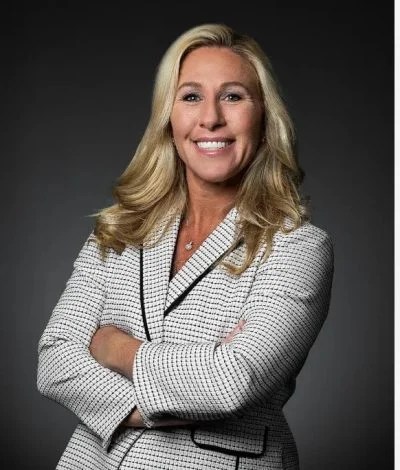
The Epstein Files: Marjorie Taylor Greene Ditches the D.C. Sewer

The once fierce Trump supporter resigns. Her resignation letter is a scathing rebuke of our decadent, twilight Republic.

I can scarcely imagine the horror show of texts, e-mails, and calls that Marjorie Taylor Greene has received since she decided to defy President Trump in the matter of the Epstein files. At a certain point she seems to have concluded that even winning in hardball politics isn’t worth the destruction of her spirit and soul. And so, in a move that apparently surprised everyone on Friday, November 21, she announced her resignation.

Her resignation letter is a masterpiece of scathing rebuke. The portrait she paints of Washington politics is an arena of avid monsters, littered with trash. As she put it in one especially memorable passage:

Loyalty should be a two-way street and we should be able to vote our conscience and represent our district’s interest…

[My work] has brought years of nonstop never ending personal attacks, death threats, lawfare, ridiculous slander and lies … I have too much self-respect and dignity. I love my family way too much. And I do not want my sweet district to have to endure a hurtful and hateful primary against me by the president that we all fought for, only to fight and win my election while Republicans will likely lose the midterms. And in turn, be expected to defend the President against impeachment after he hatefully dumped tens of millions of dollars against me and tried to destroy me. It’s all so absurd and completely unserious. I refuse to be a ‘battered wife’ hoping it all goes away and gets better.”

If I am cast aside by MAGA Inc and replaced by Neocons, Big Pharma, Big Tech, Military Industrial War Complex, foreign leaders, and the elite donor class that can’t even relate to real Americans, then many common Americans have been cast aside and replaced as well. There is no ‘plan to save the world’ or insane 4D chess game being played.”

The story of Marjorie Taylor Greene strikes me as the result of two selective processes that now govern what passes for our so-called representative democracy.

1). Because Washington politics is so brutal and ugly, only an extremely unusual or idiosyncratic man or woman—only an outlier—would step into the arena while trying to act strictly in accordance with his or her conscience.

2). The pressure to conform to the imperatives of big, entrenched interests is so enormous that it will eventually crush even the toughest nonconformist.

Many people have perceived Marjorie Taylor Greene to be eccentric and too inclined to state wild ideas and opinions. However, I believe these are expressions of her individuality—her fiercely independent and nonconformist character.

The world is now such a bewildering and confusing place. I spend most of my waking hours just trying to understand what is going on. I can’t imagine trying to figure things out while also contending with a packed daily schedule on Capitol Hill.

The alternative to Greene is what we get over 99% of the time—that is, obedient, conformist, empty vessels who never express an eccentric or wild opinion because they don’t have any opinions, only carefully vetted talking points.

[…]

Via https://www.globalresearch.ca/marjorie-taylor-greene-ditches-dc-sewer/5906537

A Looming Mexican Coup?

Kit Klarenberg

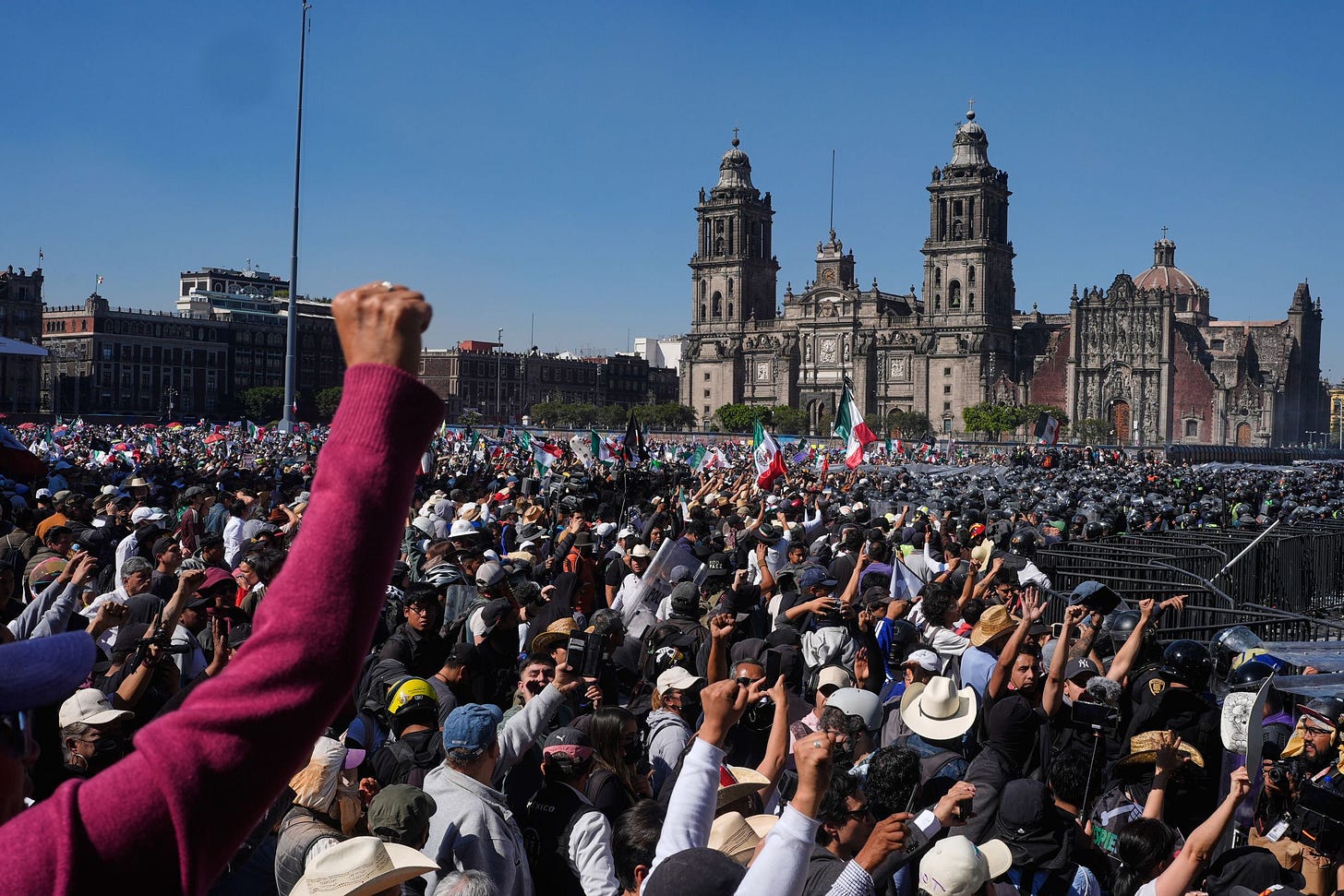
On November 15th, incendiary protests engulfed over 50 cities across Mexico. The Western media has universally adopted the narrative disaffected local “Gen Z” sought to vent their righteous rage against the government, over corruption, and the administration’s purported ties to drug cartels. Footage of law enforcement clashing with demonstrators spread like wildfire, and many outlets widely emphasised how the upheaval injured at least 120 people. Few acknowledged the overwhelming majority of those hurt – 100 – were police officers.

New York Times report made the insurrectionary designs of those causing mayhem on Mexico’s streets clear. “The goal of this march is precisely to remove the President, and to show we are angry, that the people are not with her,” one protester was quoted as saying. Oddly absent from mainstream coverage of the hullabaloo was any recognition President Claudia Sheinbaum enjoys popularity of which Western leaders can only fantasise. Polls throughout her first year in office indicate 70 – 80% of the public support her.

Sheinbaum has charged the fiery demonstrations were “inorganic”, “paid for”, and “a movement promoted from abroad against the government.” There are strong grounds to believe this was absolutely the case. For one, a key local amplifier of the protests, and supposed police brutality, was media outlet Animal Politico. The National Democratic Institute, a wing of avowed CIA front the National Endowment for Democracy, lists the organisation among its “partners”. Mexican newspaper  Milenio  has documented in detail the news site’s voluminous US funding.

Furthermore, former Mexican President Vicente Fox  attended  the protests, and posted extensively on social media in support of the demonstrators. In 2001, he was bestowed NED’s Annual Democracy Award. Another prominent supporter was oligarch Ricardo Salinas Pliego, Mexico’s third-richest man. In March 2023, in conjunction with the shadowy Atlas Network, he launched Universidad de la Libertad, to “advance free-market principles, business development, and innovation” in the country.

Atlas Network comprises a web of libertarian think tanks, bankrolled by major US corporations, with deep and cohering ties to Western foundations and intelligence cutouts, including NED. The Network itself doles out millions annually “supporting pro-freedom organizations” worldwide. A longtime beneficiary of its largesse is the Venezuela-based Center for the Dissemination of Economic Information (CEDICE), which operated at the forefront of the April 2002 US-orchestrated coup that temporarily ousted elected President Hugo Chávez.

Fast forward to today, and Washington again appears to be plotting the Venezuelan government’s downfall. A huge military buildup around the country, and belligerent actions in the Caribbean supposedly intended to thwart drug trafficking operations directed by Caracas, could be harbingers of all-out invasion. The widely-admired Sheinbaum, who stands steadfastly opposed to US machinations in Latin America, represents a significant barrier to realising that goal. It stands to reason the Empire must neutralise her first, before training its crosshairs elsewhere in the region.

‘Legal Justification’

It may be no coincidence the foreign-sponsored upsurge of anti-government agitation that unfolded in Mexico followed not long after murmurings the Trump administration is considering inserting US forces and intelligence operatives into the country, to conduct aggressive covert operations supposedly targeting cartels. On November 3rd NBC reported this “new mission” would represent “a break” with the approach of past US governments, which have hitherto “quietly deployed CIA, military and law enforcement teams” to “support local police and army units” battling drug syndicates:

“If the mission is given the final green light, the administration plans to maintain secrecy around it and not publicize actions associated with it, as it has with recent bombings of suspected drug-smuggling boats…Under the new mission…US troops in Mexico would mainly use drone strikes to hit drug labs and cartel members and leaders…Some of the drones that special forces would use require operators to be on the ground to use them effectively and safely.”

Similar action was previously mooted in April, prompting a firm rebuke from Sheinbaum. The President declared: “The US is not going to come to Mexico with the military. We cooperate, we collaborate, but there is not going to be an invasion. That is ruled out, absolutely ruled out.” However, NBC notes while Washington “would prefer to coordinate with the Mexican government on any new mission against drug cartels…officials have not ruled out operating without that coordination.”

US military action being waged inside Mexico without state approval would represent an absolutely egregious and unprecedented breach of the country’s sovereignty. Moreover, at Washington’s demand, Sheinbaum has already deployed 10,000 troops to the US border, significantly increased fentanyl seizures, and extradited 55 senior cartel figures Stateside. These escalations are nonetheless seemingly insufficient, raising obvious questions as to whether an ulterior motive lies behind the Trump administration’s new mission – for which elite military and CIA personnel have apparently already begun training.

One explanation could be Sheinbaum representing a potent barrier to regime change in Caracas – a monstrous objective for which Trump strived over much of his first term in office, that has become turbocharged over recent months. Sheinbaum has publicly rubbished the US President’s claims there is evidence linking Venezuelan leader Nicolás Maduro to drug dealing, called for constructive dialogue between the pair, and repeatedly condemned extrajudicial US airstrikes on boats purportedly ferrying drugs, which have killed scores of potentially innocent people.

Those attacks, which began in September, are widely perceived to be a prelude to all-out US invasion of Venezuela, and have frequently been conducted in Mexico’s territorial waters. In addition to openly admitting they aren’t certain targeted boats are in fact ferrying narcotics, and the identities of victims are unknown, Trump administration officials have struggled to provide any legal justification whatsoever for the deadly strikes. On October 30th, a classified bipartisan Congressional briefing was convened, at which government representatives attempted to explain their rationale.

Attendees from both primary US political parties “were not happy with the level [of] information that was provided, and certainly the level of legal justification that was provided,” Republican Mike Turner complained. Meanwhile, Democrat Sara Jacobs declared, “I’m not convinced that what they said was accurate,” concluding the administration’s strategy “is actually not about addressing” the flow of narcotics into the US, or crushing Latin American drug smuggling networks. Her comments may be more illuminating than she intended.

‘Big Problems’

On top of clearing a beachhead for invading Venezuela, Sheinbaum could be earmarked for removal by Washington because, from the CIA’s perspective, the Mexican President’s hardline crackdown on local cartels may be proving too successful for her own good. Within six months of taking office, police and security forces dismantled 750 drug labs across the country, arrested close to 20,000 cartel operatives, and seized over 140 tons of narcotics. Drug barons who evaded capture have been forced into hiding, while suffering multimillion dollar losses.

Markedly, these efforts largely haven’t been conducted in coordination with Washington. This raises the prospect that individuals and groups ensnared by Sheinbaum’s anti-cartel crusade – which has been praised in many quarters – might one way or another have been working for and/or with the CIA. Investigations by veteran deep state researcher Peter Dale Scott reveal how since World War II, the core component of any international drug cartel’s success has consistently been maintaining a clandestine relationship with US intelligence.

Indeed, per Scott, it is difficult if not impossible to prosper in the narcotics trade without the CIA’s protection. A palpable illustration of this phenomenon is provided by the Guadalajara Cartel’s extraordinary rise. After its founding in the late 1970s, the group rapidly became one of North America’s largest drug suppliers. Key to its success was its covert bond with Mexico’s Federal Security Directorate (DFS), which was created by and enjoyed a deeply intimate relationship with the CIA.

In return for a 25% cut of the Guadalajara Cartel’s profits, the ultra-violent drug syndicate was not only insulated from legal repercussions, but actively assisted by DFS. Joint US-Mexican anti-drug efforts in the early 1980s deliberately targeted solely minor traffickers, eliminating the Cartel’s competition. Resultantly, by 1982 Mexico had replaced Colombia as the States’ leading supplier of marijuana, and was providing up to 30% of the country’s cocaine. All along, the CIA and DEA did and said nothing, despite full cognisance of the Cartel’s activities.

Guadalajara might still be in business today, were it not for its February 1985 kidnap, brutal torture and murder of DEA agent Enrique Salazar. Allegations the CIA and FDS colluded in his killing, to conceal their complicity in the Latin American drug trade, have long-abounded. Nonetheless, Salazar’s slaying was so sickeningly savage it led to sizeable US public and political pressure for Mexican authorities to bring those responsible to justice. Within four years, several of the Cartel’s leaders were jailed, and the enterprise folded.

There is no knowing whether Sheinbaum has inadvertently trodden on the ‘wrong’ person’s toes in her battles against organised crime in her country. Yet, the violent protests have evidently provided Washington enormously useful ammunition. Commenting on the unrest, Trump remarked, “I looked at Mexico City over the weekend. There’s some big problems there…I am not happy with Mexico.” He added military action “to stop drugs” there was “OK with me.” The opening salvo in a new US war may have just been fired.

[…]

Via https://libya360.wordpress.com/2025/11/24/a-looming-mexican-coup/

The Republican Rift: MAGA and MIGA Cannot Coexist

Sarp Sinan Hacir

MAGA’s rise split the American right. The deeper question now is: which flag does the movement follow? America’s, or Israel’s?

“You can’t be MAGA if you’re anti-Israel”

– Israeli Prime Minister Benjamin Netanyahu

The US right is undergoing a rupture that is far more decisive than its culture wars or internecine policy disputes. At the core of this split are two incompatible visions: MAGA (Make America Great Again) versus MIGA (Make Israel Great Again).

It represents a fundamental clash over whose interests define the American right: the nation’s, or a foreign ally’s. Yet only one can define the future of the Republican movement.

If America comes first, then its policies, resources, and military must serve domestic priorities – not the ambitions of a foreign ally. If Israel comes first, then American sovereignty is secondary by definition.

The fracture has only sharpened after 7 October 2023 and is now reshaping the American right in real time.

The MAGA revolt against the establishment

For decades, Republican elites aligned their foreign and domestic agendas with neoconservative doctrine: endless wars, global policing, open markets, and a reflexive allegiance to Israel.

That consensus was shattered in 2016. Disaffected voters rallied to Donald Trump, who mocked figures like Jeb Bush, the last of a warmongering dynasty. Under the MAGA banner, the party’s base was recast into a new coalition: conservatives, evangelicals, religious Jews, anti-establishment activists, disillusioned independents, and even some anti-globalist voices from the left.

US President Donald Trump’s populist slogan, “America First,” reflected a growing demand for national self-interest in place of international entanglements.

But this ran headfirst into the old guard’s loyalty to Israel. Could a country truly prioritize its own interests while committing unconditionally to a foreign state?

The Flood 

When Israel launched its war on Gaza after Operation Al-Aqsa Flood on 7 October 2023, MAGA’s internal contradiction exploded.

The initial response followed familiar lines with conservative pundits and politicians closing ranks behind Tel Aviv. But as scenes of devastation in Gaza multiplied, many grassroots conservatives began to ask what exactly this alliance serves.

Washington was pouring more into Israel’s war effort than it had into Ukraine – with no debate, no returns, and no regard for American lives or interests. If “America First” meant anything, why was it absent here?

For decades, Republicans had repeated that Israel was “America’s greatest ally.” But Israel does not provide US jobs, technology, or security guarantees. It demands US military protection and drags Washington into regional conflicts it would otherwise avoid.

Initially, the backlash began quietly – online forums, podcast circles, and independent journalists. But it soon went mainstream.

Ben Shapiro, once the intellectual darling of the anti-woke right, found himself defending university campus crackdowns on pro-Palestine protests. This is from the man who once wrote a book titled ‘Facts Don’t Care About Your Feelings,’ mocking the liberal left’s emotional politics. Now, under the pretext of protecting Jewish students, free speech was being suspended by Republicans.

For younger conservatives raised on MAGA, this looked like betrayal. If facts do not care about feelings, why were protests being silenced? If cancel culture was the enemy, why were actors, writers, and students being blacklisted for opposing genocide?

A movement under siege

The MAGA rebellion was not only about foreign policy. It was about taking on the entire architecture of US elite power – media, academia, finance, and foreign lobbies. And one lobby in particular became untouchable.

American conservative political commentator Tucker Carlson was ousted from Fox News after amplifying critics of Israel. Right-wing commentator Candace Owens was pushed out of Daily Wire after clashing with Shapiro. Steve Bannon, one of Trump’s early strategists, began warning of Israeli influence in conservative circles.

Nick Fuentes, who rose to prominence through campus debate circuits and became one of the more extreme voices of the MAGA generation, has turned into a lightning rod in the generational fight over Israel. When Carlson recently interviewed him, Shapiro spent an entire episode  denouncing  both men – accusing Carlson of normalizing antisemitism and warning that Republicans who “cower before the likes of neo-Nazis and their propagandizers … deserve to lose.”

Yet Fuentes’s long-standing opposition to US military aid for Israel resonated with younger conservatives – particularly men – who were no longer persuaded by traditional justifications for America’s unconditional support.

And then came Charlie Kirk– the founder of Turning Point USA. Kirk had built one of the most influential conservative youth movements in the country. He called himself a Zionist, and denied that Israel was committing genocide in Gaza.

But it was not enough. Because Kirk gave a platform to critics of Israel, donors pulled support. “I’ve been trying to tell Israel supporters, there’s an earthquake coming in this country on this issue, and they don’t believe me,” Kirk said in July.

Before his assassination, he reportedly told friends he feared Israel might have him killed. Some even said he sent messages expressing that fear directly. These claims were promptly dismissed as conspiracy theories.

Nevertheless, Kirk’s assassination was a shock to the movement. And it triggered a deeper reckoning. Netanyahu, unprompted, issued a statement insisting Israel had nothing to do with it.

Yet just weeks before, in an interview with Breitbart, Netanyahu was quoted as saying, “Israel is fighting Iran, and you can’t be MAGA if you’re pro-Iran, you can’t be MAGA if you’re anti-Israel. President Trump understands this, and he stands very strongly with us.”

To many, that sounded like a threat.

The Epstein revolt

Alongside the Gaza backlash, another scandal reared its head: Jeffrey Epstein. MAGA supporters believed this was their chance to expose the perversion of elite networks. But Trump hesitated.

Before the 2024 election, he hinted the truth might come out – then cautioned that “many innocent people may get hurt.” Afterward, he turned on his own party members for pressing the issue.

Representatives Marjorie Taylor Greene (MTG) and Thomas Massie demanded transparency. Trump attacked them both. He backed primary challengers against Massie and labeled MTG a traitor, withdrawing his support for her. In response to the escalating pressure and his withdrawal of support, MGT announced she would resign from Congress on 5 January 2026, citing her marginalization by MAGA leadership and the party’s elite.

Epstein’s deep ties to Israeli intelligence – whether through his girlfriend Ghislaine Maxwell’s Mossad-linked father, Robert Maxwell, or through Ehud Barak, the former prime minister of Israel, along with his access to bipartisan figures – raised uncomfortable questions. Adding to the controversy, leaked emails released by Democrats suggest that Epstein, who Trump once described as a “terrific guy,” said the US president “knew about the girls.”

Once again, MAGA’s confrontation with elite corruption was derailed by loyalty to Israel.

Who decides America’s future?

Two paths now stand before the American right. One leads to renewed sovereignty, to ending foreign entanglements, and putting US interests first. The other continues to place Israel’s priorities above America’s own.

In short: MAGA vs MIGA.

Today, MIGA holds institutional power. AIPAC dominates congressional primaries. Dissent is punished. Trump’s inner circle remains full of hardline Zionists like Laura Loomer. The billionaire Adelson family bankrolled his campaigns.

But MAGA still commands the base. Support for Israel among Republican voters has plummeted – from 65 percent favorable to 50 percent unfavorable. The backlash is real.

And Trump? He straddles the line. He supports Israel militarily, but cuts deals that anger Tel Aviv. He criticizes MTG, but defends Carlson’s right to speak. He fights Iran, but will not commit to regime change.

[…]

Via https://libya360.wordpress.com/2025/11/24/the-republican-rift-maga-and-miga-cannot-coexist/

Arms Industry Panics Over Ukraine Peace Talks

Arms industry investors in panic over Ukraine peace talks

RT

Shares of weapons giant Rheinmetall have slumped after Washington proposed terms to Kiev to end hostilities

The prospect of a possible peace in Ukraine has caused “panic” among investors in the German defense industry, sending stocks of arms manufacturers such as Rheinmetall tumbling.

The US reportedly handed Kiev a 28-point peace proposal last week and gave it until Thursday to respond. The framework was discussed in Geneva on Sunday, with US President Donald Trump saying afterwards that “something good” may be happening.

The peace push immediately unnerved investors, triggering a fierce sell-off of shares in Rheinmetall, Germany’s largest arms manufacturer and a key supplier of military equipment to Kiev. Rheinmetall stock has fallen by over 14% over the past five days, with defense-electronics producer Hensoldt recording a similar drop.

“Investors fear that an end to hostilities could also mean the end of the “super-cycle” for defense stocks,” Boerse-Express wrote.

Germany has become Kiev’s second-largest arms provider after the US, and Rheinmetall, which produces tanks, artillery systems, and ammunition, recently reported surging profits for the first nine months of 2025, alongside a record order backlog driven by the conflict and rising EU military budgets. Company shares have climbed nearly 2,000% since fighting escalated almost four years ago.

During the previous US attempt to broker peace in February, Rheinmetall CEO Armin Papperger argued that even if the fighting were to end, it would be “wrong” for Europe to assume “a peaceful future.” In 2024, the company announced plans to build four manufacturing plants in Ukraine.

The broader European defense sector has been expanding at roughly three times its pre-2022 pace, Financial Times reported in August. Western leaders claim the accelerated buildup is needed to meet NATO readiness targets, maintain arms deliveries to Kiev, and deter what they describe as a potential Russian threat.

Moscow has called such claims “absurd” fearmongering aimed at justifying increased military spending and condemned what it calls the West’s “reckless militarization.”

[…]

Via https://www.rt.com/business/628322-rheinmetall-shares-fall-ukraine-peace/

How Far Back Can Linguists Trace Languages?

What is the Nostratic linguistic Macrofamily?

Episode 32 How Far Back Can We Trace Languages

Dr John McWhorter (2019)

Film Review

Thus far linguists have been unable to identify a “proto-world” language, the first language that emerged 100,000 – 300,000 year ago from which all other languages are derived.

The best they can come up with is a proto-Nostratic super family, from which all Eurasian and South Asian languages are derived. The specific language familie derived from Nostratic include Indo-European, Altaic, Afroasiatic (Hebrew/Arabic, Dravidian, Uralic and Karvelian (South Caucasian). Some linguists would include Eskimo-Aleut (see Indigenous Language Families: Aleut, Alogonquin and West Coast Languages)>

Proto-Nostratic, from which all these languages are derived, most likely emerged in the fertile crescent 10,000 – 15,000 years ago at the end of the last Ice Age.

The word for me, who and who in all these languages provide the strongest evidence supporting a common ancestor.

Me

  • Proto-IndoEruopean – mi
  • Proto-Uralic – mi
  • Proto-Altaic – bi
  • Proto-AfroAsiatic – mi
  • Proto-Georgian – mí

We

  • Proto-IndoEuropean – me
  • Proto-Uralic – me
  • Proto Altaic – myn
  • Proto-Afroasiatic – mn
  • Proto-Georgian – men

Ear

  • Proto-Nostratic – q’iwiv
  • Proto-IndoEuropean – Kjleu
  • Pro-Uralic  – khul
  • Proto-froAiatic – ki(wjl)

Who

  • Proto-Nostratic – k’o
  • Proto-IndoEuropean – kwo
  • Proto-Uralic – ko
  • Proto Altaic – kha
  • Proto-AfroAsiatic – k(w)

Water

  • Proto – IndoEuropean – wed
  • Proto-Uralic – wete
  • Proto Dravidian – nīr

Another proto super family that has been identified includes Tai Kadai and all the Thai  and Austroneisian languages that haven’t been “Chinafied” (by converting most words into a single syllable with meaning distinctions determined by tonal changes). See Southeast Asian Languages: Tones, Creaky Vowels and Telegraphic Sentence

Similarities are found in words used for word for bird, eye and head.

Bird

  • Proto-Malayo-Polynesian – manuk
  • Buyang (language of southwest China) – manuk

Eye

  • Proto-Malayo-Polynesia – mata
  • Buyang – mata

Head

  • Proto-Malayo-Polynesia – qulu
  • Buyang –  qaðù

There’s also evidence that Sino-Tibetan languages are related to Austronesian.

https://www.kanopy.com/en/pukeariki/watch/video/6120000/6120064

Things Happen: Trump, the Crown Prince and Killing Khashoggi

The Saudi Arabian Crown Prince Mohammed bin Salman is at it again. Gulling, wooing, and grinning his way into the establishment of another country, he is greasing palms and making deals. Effusive and flattering of his host, this time US President Donald Trump, he received a state welcome on November 18 rarely afforded visiting dignitaries: a red carpet viewing of fighter jets, a horse mounted guard of honour, and feast in the East Room. He was also promised the much sought after F-35 fighter jets as part of a defence arrangement elevating Saudi Arabia to the status of “major non-NATO ally”. Along the way, MBS has done much to deter those who wish to remind him of a wretched human rights record and the barbaric habits of a state he claims to be modernising.

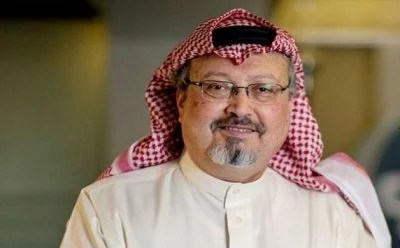
The gaudy occasion risked being sullied by a question from Mary Bruce of ABC News. Intended for the Crown Prince, it inquired about his role behind the murder of dissident Saudi journalist Jamal Khashoggi in a Saudi consulate in Istanbul on October 2, 2018. The death squad responsible for strangling and dismembering the unsuspecting Khashoggi had been dispatched with his blessing, numbering among them a forensic specialist, a bone saw and a body double. Many of its members hailed from bin Salman’s own protective guard, the Rapid Intervention Force.

Trump’s intervention was abrupt:

“You’re mentioning someone that was extremely controversial. A lot of people didn’t like that gentleman that you’re talking about. Whether you like him or didn’t like him, things happen. But he [MBS] knew nothing about it. You don’t have to embarrass our guest.”

His guest has much to be embarrassed about, and more besides. With surliness and much petulant audacity, the opportunistic princeling has seized such power in the realm as to marginalise all other decision makers, including rival family members. The most important decisions, be they on vast investment agreements, the refurbishment of the country’s medieval bearing, or authorising the extrajudicial killing of an irritating scribbler, would issue from him.

To therefore suggest that the Crown Prince was ignorant of his own misdeeds is to fly in the face of hardened reality. When she was UN Special Rapporteur on extrajudicial, summary and arbitrary killings, Agnès Callamard found that state responsibility for Khashoggi’s death was the only plausible conclusion.

“His killing was the result of elaborate planning involving extensive coordination and significant human and financial resources. It was overseen, planned and endorsed by high-level officials. It was premeditated.”

Most importantly, Trump’s breezy acquittal of MBS’s culpability resoundingly ignores the findings by the Office of the Director of National Intelligence in a 2021 declassified report submitted to Congress by the then Director of National Intelligence Avril Haines.

“We assess,” the report avers, “that Saudi Arabia’s Crown Prince Muhammad bin Salman approved an operation in Istanbul, Turkey to capture or kill Saudi journalist Jamal Khashoggi.”

This was the only reasonable conclusion given bin Salman’s “control of decision-making in the Kingdom”, the seminal role played by one of his key advisors and members of the Crown Prince’s protective detail in the operation, along with bin Salman’s appetite “for using violent measures to silence dissidents abroad, including Khashoggi.”

The report goes on to make a most telling observation: that the Crown Prince’s assumption (one might even say seizure) of “absolute control of the Kingdom’s security and intelligence organizations” since 2017 made it “highly unlikely that Saudi officials would have carried out an operation of this nature without” his approval. Some equivocation is expressed about “how far in advance Saudi officials decided to harm” Khashoggi.

Bin Salman, for his part, reverted to his role as high minded reformer while citing the defence of mistake. This was at least partially in keeping with previous admissions that his hands were not entirely clean on the subject. (Khashoggi’s widow, Hanan, reiterated that point in an interview with BBC Newsnight.)

It had been “painful for us in Saudi Arabia”, he told Bruce. “We did all the right steps of investigating, etc., in Saudi Arabia, and we’ve improved our system to be sure that nothing happens like that again. And it’s painful, and it was a huge mistake.”

Trump also gave his guest the needed ballast:

“What’s he done is incredible in terms of human rights and everything else.”

Since Khashoggi’s murder, the response from the Kingdom has been one of denial, distancing and detachment.  It has involved isolating the killers as wayward enthusiasts and adventurers, lacking the force of a mandate. They were to be the convenient scalps, the necessary sacrifices. Of the group, five were subsequently sentenced to death while three were given prison sentences. Saud al-Qahtani, bin Salman’s disseminator of venomous social media, along with Maj. Gen. Ahmed al-Asiri, were acquitted for lack of evidence. Callamard was compelled to remark that,

“The executioners were found guilty and sentenced to death” while “those who ordered the executions not only walk free but have barely been touched by the investigation and the trial.”

That’s the MBS version of modern Saudi Arabia for you.

[…]

Via https://www.globalresearch.ca/trump-crown-prince-killing-khashoggi/5906473

Empire of gold: The UAE’s expanding grip on Africa’s mineral wealth

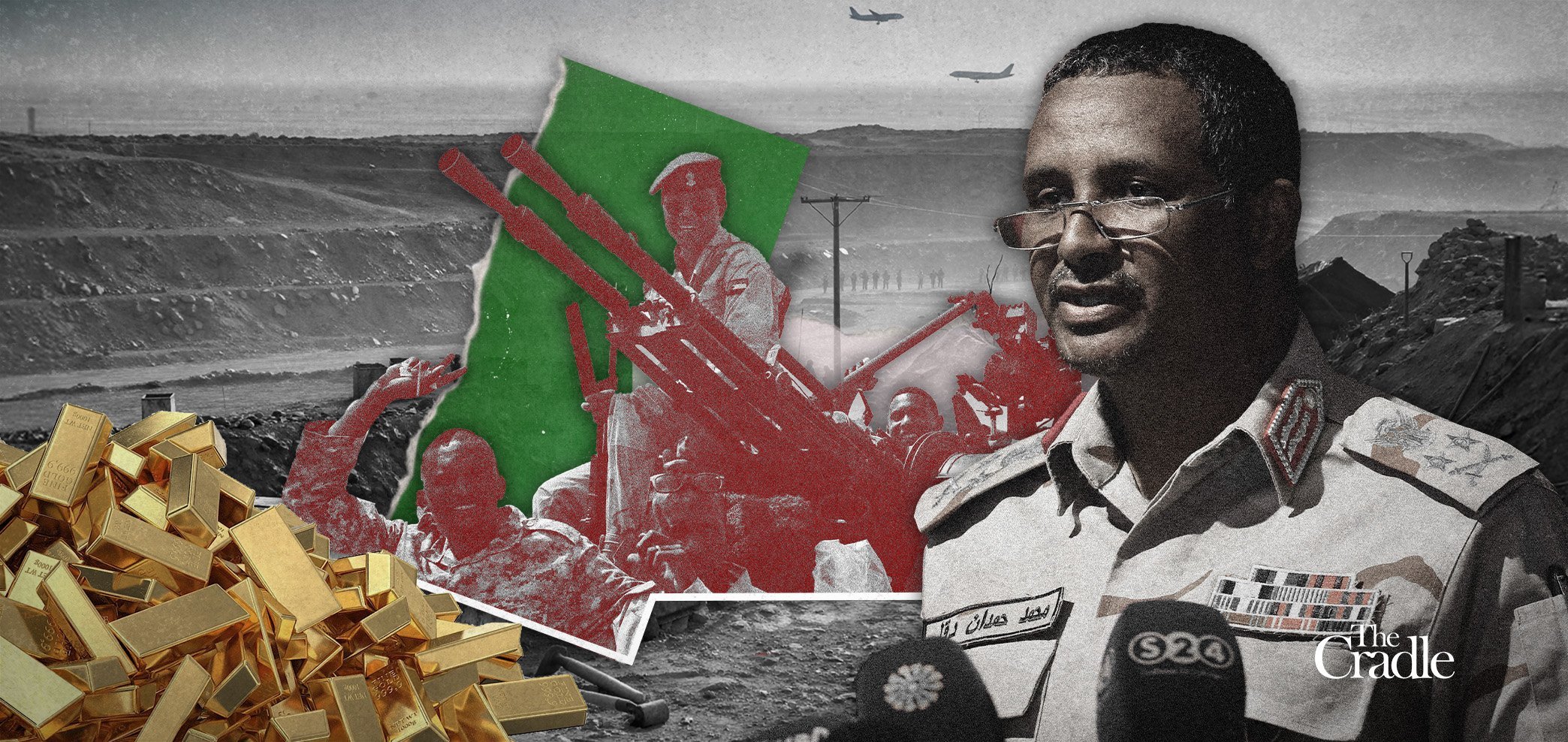
Photo Credit: The Cradle

Mawadda Iskandar NOV 21, 2025

Gold pulled from Sudan’s war zones moves along hidden routes – passed between smugglers, militias, and middlemen – before reaching Dubai, where it is converted into money and influence. This trade, rooted in state collapse and empowered by armed groups, now binds the Persian Gulf to some of Africa’s most fragile fronts.

 Before the guns piled up on the blood-soaked sands of Darfur, the story began in mid-2012 with three young men scanning the earth near Jeli using simple metal detectors. A faint signal drew them westward for 20 kilometers, until they stood at the foot of Jebel Amer – a mountain that would later be known as Sudan’s “Mountain of Gold.”

Their find proved fateful. Within days, word raced across the region: dirt roads thickened with travelers, tents and pumps multiplied across the hills, and thousands of prospectors poured in. What started as a lucky strike quickly altered Darfur’s balance, unleashing rival claims, sudden fortunes, and the violence that shadowed them.

The mountain that ignited Darfur

Jebel Amer sits in the Al-Sarif locality north of El-Fasher in North Darfur. It produces an estimated 50 tonnes of gold each year – one of the largest deposits on the continent – and holds other minerals, including iron, aluminium, and platinum.

After South Sudan’s secession in 2011 stripped Khartoum of roughly three-quarters of its oil revenue, the government pushed citizens toward artisanal mining as an economic lifeline. Instead, the rush for gold deepened instability and drew armed groups into an already-fractured region.

When major deposits surfaced in April 2012, the area became a magnet for wealth and influence – and a battlefield. Janjaweed militias moved to seize the mines, displacing local communities and igniting conflict.

By the end of the year, violence had spread across the region, and in January 2013, open fighting killed hundreds while mine shafts collapsed on dozens of workers. Truces came and went, but each collapse and clash made clear that the conflict was no longer just a tribal one but a struggle for control of one of Sudan’s most valuable assets.

By 2017, almost complete control of Jebel Amer had been settled in the hands of the Rapid Support Forces (RSF) through the Mohamed Hamdan Dagalo-owned Al Junaid Holding Company, and gold became their main source of financial power, directly linked to their ability to finance their military activities and control the area.

The gold did not stop there. Its shine carried far beyond Sudan, drawing the interest of the UAE, whose ambitions in Africa were rising. From Darfur, the metal moved along smuggling routes, through commercial flights, and via corporate parcels into Dubai’s markets and refineries – feeding a network in which Sudan’s conflict became someone else’s gain.

Sudan: The Arab world’s gold giant

Sudan is the largest Arab gold producer, with more than 40,000 exploration sites and 60 refining companies spread across 13 states, with its focus on the Nile, the North, and the Red Sea.

The UAE quickly became Sudan’s primary export destination. Deals flowed through companies linked to Dagalo (Hemedti) and his relatives, gold moved by land and air into Dubai, and the RSF used the profits to procure weapons.

Global Witness estimates that Sudan exports around $16 billion in gold to the UAE each year. Official production in 2024 reached 64 tonnes, yet only 31 tonnes were recorded as legal exports. Nearly half simply vanished into parallel channels.

Export documents reveal the involvement of Emirati firms such as Kaloti, which purchased 57 tonnes from Sudan in 2012 – far above the country’s official output. In 2018, Al Junaid Group, a business front of the RSF, partnered with Dubai-based Rosella, complete with accounts at First Abu Dhabi Bank.

When war erupted in 2023, the gold trade shifted from an economic pillar to a war chest. The US sanctioned 11 companies – many registered in the UAE – for facilitating RSF financing through gold.

The RSF’s gold highways to Dubai

Before the war expanded, Darfur’s gold traveled quietly from Jebel Amer to Chad via land, then onward to Dubai through commercial shipments and corporate parcels, becoming part of a smuggling network linking the conflict’s mines to Persian Gulf markets. The RSF rapidly became the dominant player in this network, relying on front companies, routes that stretched through Chad, South Sudan, Libya, and new routes to Egypt.

The Chadian corridor remains the most lucrative: gold leaves Jebel Amer and Sango via secret pathways, crosses into N’Djamena, and is then exported as “Chadian” gold. Al Junaid’s front companies, along with previously documented ties to Dubai-based firms, operate at the heart of this system.

After Khartoum airport was destroyed and Port Sudan slipped beyond RSF control, the militia adopted new tactics. Motorcycles ferry gold across borders. Air shipments depart from Nyala in containers labeled as agricultural goods and livestock. Night flights – less than 90 minutes long – avoid detection.

A UN panel of experts exposed an African logistical chain linking gold shipments and weapons deliveries: arms arriving from Um Girass airport, traveling overland to RSF positions, supported by money raised from the sale of Sudanese gold in Dubai. An integrated war economy now spans from Darfur’s mines to Emirati refineries.

Abu Dhabi’s continental appetite

Talk of the UAE’s ambitions in Africa starts with Sudan, the continent’s third-largest gold producer and the second-largest proven reserve of about 1,550 tonnes. But Sudan is not an isolated case, as the picture extends to the entire continent.

Reuters investigation found the UAE imported 446 tonnes of gold from 46 African states in a single year – worth $15.1 billion. Yet UN Comtrade data reveals glaring inconsistencies: 25 of those countries provided no export figures at all, while 21 listed amounts far lower than what the UAE recorded importing. Experts estimate that 32–41 percent of African gold is unreported – much of it absorbed by Emirati networks, followed by Turkiye and Switzerland.

In Ghana, a SwissAid report uncovered a 229-tonne gap over five years – $11.4 billion in gold unaccounted for. Ghanaian officials confirm that 75 percent of the country’s gold exports go to the UAE.

In Mali, 81 percent of production is extracted by Emirati-linked companies. Burkina Faso’s Ministry of Mines acknowledges widespread smuggling to the UAE; the value of exports in 2024 alone reached $2 billion. Libya has lost between 50–55 tonnes of gold – worth nearly $3 billion – to smuggling routes feeding Dubai since 2011.

The same pattern has emerged in Yemen. Emirati companies such as Thani Dubai Mining have embedded themselves in resource-rich Hadhramaut, while satellite imagery shows extensive activity in Jabal al-Nar in Taiz after the zone was sealed off and militarised. Gold extraction is now directly linked to the UAE’s political project through the Southern Transitional Council (STC).

Why the UAE needs Africa’s gold 

The UAE has few domestic reserves but a vast gold ecosystem – refineries, traders, logistics firms, free zones, and relaxed regulatory frameworks. Dubai markets itself as the natural home of the global bullion trade, and maintaining this role requires a continuous supply of raw gold, especially from regions where oversight is weak.

Sudanese gold offers the UAE two advantages. First, it provides the crude material required to keep Dubai’s refining industry profitable. Second, it extends Abu Dhabi’s political reach deep into Africa’s economic systems.

There is also a monetary dimension. As confidence in the US dollar fluctuates, global central banks are diversifying toward non-dollar assets. OMFIF data shows one-third of central banks plan to increase gold holdings in the next two years, while 40 percent intend to strengthen long-term reserves.

Gold has become an anchor in a shifting global economy. By 2023, the UAE surpassed the UK to rank second – after Switzerland – as a global bullion hub. Its entry into BRICS in 2024 strengthened this position further, positioning the UAE as Asia’s primary gold conduit.

In order to maintain this role, the UAE needs African gold – not occasionally, but consistently, and at scale.

Gold imperialism: Building a hub without mines 

In just two decades, the UAE has transformed from a marginal importer to a heavyweight in global gold trading. It now accounts for roughly 11 percent of the world’s gold exports, with more than 4,000 jewelry companies and 1,200 retail stores employing about 60,000 people.

Before 1996, the UAE was not even among the top 100 gold importers. Today, it sits in the top four, having overtaken the US and Hong Kong. Eleven large refineries operate in Dubai despite the country lacking a domestic supply.

But this rise rests on opaque foundations.

In 2024 alone, the UAE imported 1,400 tonnes of gold – worth $105 billion. More than half originated from African countries such as Sudan, Chad, Libya, and Egypt, much of it linked to conflict actors like the RSF. Additional flows from Uganda, Rwanda, and Togo reinforce the depth of smuggling networks ending in Dubai.

Between 2012 and 2022, the UAE imported 2,569 tonnes of illegal African gold – valued at roughly $115 billion. Even Switzerland felt the impact: it imported 316 tonnes of gold from Dubai in 2025, worth 27 billion francs – double the usual annual volume.

Regulatory loopholes within the UAE make this possible. Passengers entering with gold face no disclosure requirement; self-filled buyer forms suffice. Customs do not ask about the country of origin. Large amounts of illicit gold are sold openly in Dubai’s markets long before reaching refineries.

The identities of foreign buyers who purchase refined gold remain shielded, allowing the UAE to sit at the center of a global laundering mechanism that integrates conflict gold into the international supply chain.

These practices contributed to the UAE’s addition to the Financial Action Task Force (FATF) grey list in March 2022. Though it was removed two years later, concerns remain that the reversal owed more to geopolitical leverage than regulatory reform.

[…]

Via https://thecradle.co/articles/empire-of-gold-the-uaes-expanding-grip-on-africas-mineral-wealth

Netanyahu vows continued airstrikes on Lebanon, Gaza despite ceasefires

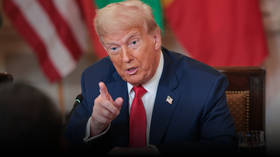
File photo shows Israeli Prime Minister Benjamin Netanyahu speaking during a news conference in occupied Jerualem on August 10, 2025. (AP photo)

Press TV

Israeli prime minister Benjamin Netanyahu has vowed that his regime will continue its deadly attacks on neighboring Lebanon and the besieged Gaza Strip despite ceasefire agreements barring such operations.

Netanyahu told a cabinet meeting in occupied al-Quds on Sunday that Israel would do “everything necessary” to prevent the Lebanese resistance movement Hezbollah and Hamas in Gaza from regrouping.

“We are continuing to strike on several fronts,” he said. “This weekend, the Israeli military struck in Lebanon, and we will continue to do everything necessary to prevent Hezbollah from re-establishing its threat capability against us.”

“This is also what we are doing in the Gaza Strip—despite the ceasefire,” he added.

In recent weeks, Israel has struck Beirut and bombed multiple villages and towns across southern and eastern Lebanon, causing casualties and extensive material damage.

In the latest act of aggression, Lebanon’s National News Agency (NNA) reported that an Israeli airstrike on Beirut’s southern suburbs targeted an apartment building in Haret Hreik on Sunday. At least five people were killed, several more were injured, and significant damage was inflicted on cars and surrounding buildings.

A large plume of smoke was seen rising over the densely populated neighborhood, according to local media.

On Friday, Lebanon’s Ministry of Health reported that Israeli strikes had killed 331 people and injured 945 in Lebanon since the truce agreement took effect a year ago.

In its statement, the ministry attributed the casualties to Israeli raids, attacks, and violations of the agreement intended to halt cross-border fighting between Hezbollah and Israel that was triggered by the genocidal war in Gaza.

The figures cover the period from November 28, 2024, shortly after the truce began, through November 20, 2025.

UN Special Rapporteur on extrajudicial, summary or arbitrary executions, Morris Tidball-Binz, also recently condemned the near-daily Israeli air and drone strikes across Lebanon since the ceasefire entered into force on November 27, 2024, saying the attacks undermine peace efforts and may amount to war crimes.

He described the repeated assaults on civilians and civilian infrastructure as “war crimes and a violation of the UN Charter.”

Lebanese authorities have warned that Israel’s continued violations of the ceasefire threaten national stability.

Tensions in southern Lebanon have been rising for weeks as the Israeli military continues near-daily airstrikes on Lebanese territory, reportedly targeting Hezbollah members and the group’s infrastructure.

Israeli attacks, launched in October 2023 and escalating into a full-scale offensive by September 2024, have left more than 4,000 people dead and nearly 17,000 injured in Lebanon.

Following the ceasefire announced in November 2024, the Israeli regime was expected to withdraw from southern Lebanon by January. However, the withdrawal was only partial, with forces remaining at five border outposts.

Meanwhile, Saturday marked one of the deadliest days in Gaza since the US-brokered truce between Israel and the Hamas resistance came into effect, following two years of devastating Israeli war across the blockaded Palestinian territory.

The Gaza Government Media Office said 27 violations were recorded on Saturday alone, resulting in 24 deaths and 87 injuries.

The office said that the Israeli forces had violated the Gaza ceasefire at least 497 times in 44 days, killing hundreds of Palestinians and injuring many more since the truce between Hamas and the Tel Aviv regime took effect on October 10.

A statement issued on Saturday said 342 civilians had been killed and 875 wounded in the attacks, with most of the victims being children, women, and the elderly.

The office denounced Israel for systematically violating the agreement through deadly assaults and ongoing incursions.

The developments come as Western governments have largely backed the Israeli regime’s actions in Gaza since October 7, 2023, support that has continued despite a death toll nearing 70,000 Palestinians, most of them women and children.

[…]