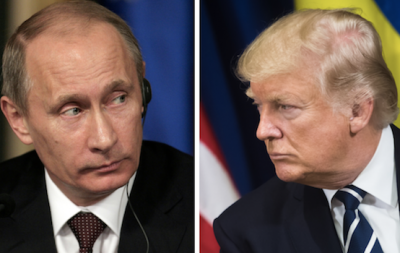
Trump Backs Away from Improving Relations with Russia

Dr Paul Craig Roberts

Trump gives in to the military/security complex, renews weapons to Ukraine and extends sanctions on Russia for a year.

On April 10, Trump declared a continuation of the national emergency with Russia and renewed President Biden’s April 2021 executive order declaring Russia to be an “unusual and extraordinary threat to the national security, foreign policy, and the economy of the United States.”

By renewing Biden’s executive order, Trump even buys into the Russiagate charges against himself:

Among the “harmful” activities ascribed to Russia in the document are “efforts to undermine the conduct of free and fair democratic elections and democratic institutions in the United States and its allies and partners.”

Russia is also blamed for a Washington specialty: “undermining security of countries and violating principles of international law.”

Trump has already cluttered the peace negotiations with his demand for Ukrainian rare earth minerals.  Now he has introduced another extraneous issue – his demand for control of the pipeline through which Russian natural gas is delivered to Europe.  Yes, Putin is still supplying Russia’s active enemies with energy.  What sense does it make to help your enemies make war against you?

The Kremlin remains unable to read the writing on the wall.  Kremlin spokesman Peskov said that “our dialogue with the American side is ongoing,” and that Moscow remains open to resolving the Ukraine conflict diplomatically.  The Kremlin thinks it is building relations with Washington by being the only party to keep the ceasefire on energy infrastructure. It is not succeeding.  Trump has already threatened Russia with more sanctions unless Russia agrees to a total ceasefire.  What incentive does Russia have to do that when Zelensky? US? NATO? won’t even keep a partial ceasefire?

[…]

Via https://www.globalresearch.ca/trump-backs-away-improving-relations-russia/5884343

RFK Jr. Launches ‘Massive Testing and Research’ Into Autism Epidemic

rfk jr and word "autism"

U.S. Secretary of Health and Human Services (HHS) Robert F. Kennedy Jr. announced in a Cabinet meeting on Thursday that the government has launched a “massive testing and research effort” to determine what causes autism.

He said the effort involves hundreds of scientists globally and will be completed by September. Once the environmental causes of autism are identified, “We’ll be able to eliminate those exposures,” he said.

At the meeting, President Donald Trump responded, “There will be no bigger news conference than that.” He added, “If you can come up with that answer where you stop taking something, you stop eating something, or maybe it’s a shot. But something’s causing it.”

Reporting on the announcement in the mainstream media framed Kennedy as a longtime vaccine critic who has put forward the “discredited” and “debunked” theory that there is a link between vaccines and autism.

In a conversation with Fox’s Martha MacCallum, who said studies have shown there is no connection between vaccines and autism, Kennedy responded:

“The studies that they did were very very narrow. They did about 17 studies and the Institute of Medicine, which is part of the National Academies of Sciences, said that 14 of those studies are invalid. And the biggest weakness of those studies is that they never studied vaccinated versus unvaccinated, which is the only way that you can really make this determination.

“But more importantly, none of the vaccines that are given to children within the first six months of life were ever studied.”

Kennedy said the autism study, coordinated through the National Institutes of Health (NIH), is not focused exclusively on vaccines. “Everything is on the table — our food system, our water, our air — we will find out what’s triggering this epidemic. We know it is an environmental toxin that is causing this cataclysm. Through research at NIH, we will find an answer to this question.”

He also said that “epidemics are not caused by genes” and that although there may be a genetic vulnerability, there also must be an environmental toxin.

In a post on X later that day, Kennedy reiterated that thanks to Trump’s Make America Healthy Again commission, “We’ll soon identify the root causes of the autism epidemic.”

Since it was announced last month that the public health agencies were planning a large study into potential connections between vaccines and autism, mainstream media have repeated claims that the idea has been “debunked” and sought to discredit people investigating the link.

Last month, The Washington Post, citing anonymous sources, reported that HHS had tapped researcher David Geier — an expert on the connections between toxic exposures and autism — to lead a study of possible links between vaccines and autism. The Post and other media outlets used the opportunity to attack Geier and the need for such a study.

This week, the Journal of the American Medical Association (JAMA) also published a hit piece on Geier, saying experts were “alarmed” by his appointment to work on the study.

Commenting on the JAMA piece, epidemiologist Nick Hulscher wrote on Substack:

“The so-called ‘alarm’ is really panic from institutions that fear what a real, independent investigation might uncover. For the first time, the vaccine safety narrative isn’t being fully controlled by Big Pharma and vaccine ideologues — they are nervous that their false religion of Vaccine Ideology is set to crumble.”

Mary Holland: Study is ‘long overdue’

Kennedy’s announcement comes during Autism Awareness Month.

Rates of autism in the U.S. have been rising for decades. Approximately 1 in 36 children were diagnosed with autism spectrum disorder (ASD) in 2020, according to the Centers for Disease Control and Prevention (CDC). Autism prevalence in the 1990s, which was 1 in 1,000 children, already represented a tenfold increase over the condition’s estimated prevalence in the 1970s.

Since the CDC started collecting the data, prevalence estimates have skyrocketed from 1 in 150 in 2000 to 1 in 36 children in 2023.

Kennedy said the CDC will release its latest report next week, and the numbers will be even higher — 1 in 31 children, with some communities hit even harder.

The CDC’s Autism and Developmental Disabilities Monitoring Network releases a report on autism prevalence every two years. The network tracks autism rates among a sample of hundreds of thousands of 8-year-old and 4-year-old children across the country. Prevalence estimates are based on rates among the older cohort, who are more likely to have received a diagnosis because they are older.

Children’s Health Defense CEO Mary Holland celebrated the news about the search for autism’s cause. Given the alarmingly high and increasing rates of autism, she said the study has been a long time coming.

“It is long overdue to hear the president and cabinet addressing the autism epidemic,” she said. “With the autism rate in 8-year-olds near 1 in 31, the rate among younger children must be higher still. This true epidemic threatens the future of the United States.”

Holland said it was notable that Trump said openly that vaccines could be causing autism. “We welcome the president’s open-mindedness and resolve to get to the bottom of autism causation in the next months.”

Reporting on yesterday’s news, most mainstream media outlets, including Newsweek and USA Today, implied there is no autism epidemic and the only reason for increasing autism rates is better diagnosis.

CNN similarly reported that increasing rates are due to better diagnosis. The outlet conceded that autism is likely caused by genetic and environmental factors, which haven’t been fully determined. CNN said the only thing definitively known about autism is that it isn’t caused by vaccines.

Research by autism experts, including authors on the CDC’s autism report, have found claims that better diagnosis alone accounts for the skyrocketing rates are wrong. The rates of children with severe autism are increasing, and rates among minority children are growing disproportionately.

“It seems reasonable to ask that public health officials stop downplaying the ongoing increase in U.S. ASD prevalence and start taking their own data seriously,” Cynthia Nevison, Ph.D., has written about these claims.

[…]

Via https://childrenshealthdefense.org/defender/rfk-jr-hhs-launch-research-autism-epidemic/

The Modern Search for Atlantis

George A. Sarantitis - Atlantisforschung.de

The Atlantis Puzzle

National Geographic (2024)

Film Review

The Greek philosopher Plato first mentions Atlantis in the dialogues Timaeus and Critias 2400 years ago. According to Plato, it was ruled by 10 kings descended from Poseidon (the Greek sea god) and enjoyed immense wealth and large decadent cities. After its massive army and navy swept across North Africa and Egypt, it invaded Italy. Following their defeat by Athens, who also liberated Egypt and other North Africans subjugated by Atlanteans, a horrific earthquake and floods caused Atlantis to disappear under the ocean.

Plato claimed this history originated with information Solon* received from an Egyptian priest name Sais in 1600 BC. According to Sais, Athens built a number of civilizations  between 10,000 BC and 1600 BC, which were all destroyed by wildfires, floods and natural disasters. Owing to the loss of their original written language, these events were lost to historical memory.

Historians have debated for centuries whether Atlantis was real and where it was located. Based on a re-translation of the ancient Greek, modern Greek linguist Serantitis believes Plato was describing an area in the Western Sahara between  around 10,000 and 30,000 BC. During this period the Sahara was lush green savanna with12,000 lakes, five river systems and wetlands.

According to the Greek historian Herodotus, at the time of “Adalantis” northern Africa was divided into East and West Ethiopia. This is reflected in Africa’s linguistic divisions, with the East Ethiopians speaking Nilo Saharan and the West Ethiopians speaking a Niger Congo language**

According to archeological evidence, around 10,000 BC the inhabitants of West Ethiopia were hunter gatherers who engaged in trade and warfare and consumed wheat from the Middle East. Other evidence shows the first humans arrived on the island of Crete 130,000 years ago and Greeks engaged in sea trade 14,000 years ago.

Serantitis believes the fate of Atlantis in Plato’s dialogues was wrongly translated as “submerged.” He feels it more likely it “sank” or “settled,” owing to earthquakes, volcanoes and/or landslides, and a combination of liquefaction and massive influx of water from the inland seas.


*Solon was an Athenian lawmaker credited with founding Athens’ democracy.

**Some anthropologists believe modern Mauritanians are descendants of Atlanteans.


Despite Zuckerberg’s Promises, Facebook ‘Fact Checkers’ Continue Censoring Information About COVID-19 Vaccines

In early January 2025 Meta announced that it would be scrapping the use of its so-called ‘independent fact checkers’ on Facebook and Instagram, replacing them with a ‘community notes’ system similar to that now used on Elon Musk’s X platform. Commenting on the move, Meta chief executive Mark Zuckerberg admitted that the ‘fact checkers’ used by the firm had been “too politically biased” and that it was “time to get back to our roots around free expression.” Three months later, however, it appears not much has changed. Facebook posts made by users outside the United States remain subject to draconian censorship by anonymous ‘fact checkers.’

Having previously fallen foul of the Facebook censorship regime, we launched our new Dr. Rath Health Foundation page on the social media platform last month. Everything appeared to be fine until we posted a link to an article on our website describing how a June 2024 study authored by researchers from the Netherlands had analyzed data from 47 countries and found that over three million excess deaths have occurred in the Western World since 2020. Published in the prestigious BMJ Public Health journal, the study described this as “unprecedented” and, expressing serious concerns, urged governments to thoroughly investigate the underlying causes – including potential COVID-19 vaccine harms.

Facebook’s response was not what we were expecting. Our post was quickly slapped with a ‘False information’ ‘Reviewed by third-party fact-checkers’ label. This was accompanied by a link to a webpage claiming that COVID-19 vaccines had supposedly actually lowered excess deaths. Reading further we learned that Facebook pages and websites “that repeatedly share false information will see their distribution reduced and their ability to advertise removed.” So much for Zuckerberg’s promises, then.

Supporting the ‘Ministry of Truth’?

Unusually, the study concerned had been widely reported in the legacy media. The UK’s Daily Telegraph newspaper even went so far as to openly state that COVID-19 vaccines may have helped fuel the rise in excess deaths, and that experts were calling for more research into side effects and possible links to mortality rates. Other legacy media covering the story included the New York Post, the Times of India, Bahrain’s Gulf Daily News, and the UK’s Daily Mail.

Nevertheless, despite the BMJ Public Health journal having peer-reviewed the study prior to publication, it responded to the media coverage by saying that its ‘integrity team’ and editors were now “investigating issues raised regarding the quality and messaging” of the research. It isn’t difficult to guess what this means. Behind the scenes, in activities resembling those of the infamous ‘Ministry of Truth’ in George Orwell’s ‘Nineteen Eighty-Four,’ the paper is likely being watered down or considered for retraction. By labeling posts about the study as ‘false information,’ Facebook is essentially supporting such moves.

Prohibitions on Freedom of Speech Are a Threat to Our Health

Speaking in January 2025, acknowledging that there had been “too much censorship,” Zuckerberg committed himself to “restoring free expression” on Meta’s platforms. Getting rid of the ‘fact checkers’ and replacing them with a ‘community notes’ approach would start in the United States, he said. After that, the claimed plan – as described on the Facebook website – is to improve it over the course of the year before expanding to other countries.

While we would like to believe that Zuckerberg is genuine, there are no published dates as to when the ‘community notes’ system will be expanded to countries outside of the United States. Nor are there even any guarantees that it will be expanded. Prohibitions on freedom of speech are not simply a matter of human rights. They are also a direct threat to our health. The coming months will show us where Zuckerberg really stands.

[…]

Via https://www.globalresearch.ca/facebook-continue-censoring-information-covid-19-vaccines/5884230

Sen. Ron Johnson Demands COVID Vaccine Makers Hand Over Documents by April 16

by Michael Nevradakis, Ph.D.

Sen. Ron Johnson (R-Wis.) is calling on vaccine manufacturers to turn over records and communications related to the development and safety of the COVID-19 vaccines and their communications with Big Tech platforms about vaccine-related adverse events. The Federalist first reported the story.

Johnson, chairman of the U.S. Senate’s Permanent Subcommittee on Investigations, requested the materials in a series of letters sent last week to the heads of Pfizer, Moderna, Johnson & Johnson and BioNTech. Johnson requested records from January 2020 onward.

Johnson’s request is part of the subcommittee’s investigation into the “development and deployment of COVID-19 vaccines, as well as the adverse events and injuries associated with these vaccines.”

The letters referenced reports of adverse events following vaccination, including myocarditis, pericarditis and Guillain-Barré syndrome, a rare neurological disorder.

Johnson’s request includes all communications “sent to or by any federal entity, employee, or contractor,” relating to the clinical trials, testing and approval of each vaccine, and all communications involving the U.S. Department of Defense.

Johnson also asked for the names and titles of employees who were involved with COVID-19 vaccine development, a list of all entities that the companies “contracted, collaborated, or otherwise worked with” to develop their vaccines, and all communications with Big Tech companies “referring or relating to adverse events.”

The letters named Alphabet Inc., the parent company of Google; Meta Platforms Inc., the parent company of Facebook, Instagram and WhatsApp; and X Corp., formerly Twitter Inc.

Johnson warned the manufacturers that any attempt to “obstruct or delay responses to this request will result in compulsory process,” citing past attempts by the U.S. Department of Health and Human Services to conceal data about the COVID-19 vaccines.

“I expect you to fully comply with this request, but I am mindful that your company may choose to mimic the Department of Health and Human Services’ (‘HHS’) past efforts to conceal records about the development, safety, and efficacy of the COVID-19 vaccines,” the letter stated.

The companies have until April 16 to comply with Johnson’s request.

Dr. Joel Wallskog, a Wisconsin orthopedic surgeon injured by the COVID-19 vaccines and co-chair of React19, a group advocating for vaccine-injured people, welcomed the news. “The American public deserves the truth.”

Wallskog added:

“What did the vaccine manufacturers know and when about the COVID-19 vaccine efficacy or lack thereof? What do and did they know about the adverse events and when? Were they part of the group led by the White House and social media companies to stifle Americans discussing adverse events to the COVID-19 vaccines?

“These investigations into the corruption of science and the corruption of our federal health agencies are a critical process to get to the truth.”

Johnson’s letter latest in a series of actions on vaccine injuries

Johnson’s letter builds on his previous efforts to investigate COVID-19 vaccine safety and adverse events.

In an October 2023 letter to the then-heads of the Centers for Disease Control and Prevention (CDC) and the U.S. Food and Drug Administration (FDA), Johnson accused the agencies of an “appalling” lack of transparency regarding COVID-19 vaccine safety signals, depriving Americans of “the benefit of informed consent.”

In November 2024, he sent another letter to HHS, CDC and FDA, demanding they provide complete and unredacted documents relating to the development and safety of the COVID-19 vaccines.

Johnson sent the November 2024 letter after learning of extensive redactions in documents released in response to multiple Freedom of Information Act (FOIA) requests. He again accused the agencies of an “appalling” lack of transparency and said their refusal to release unredacted documents “hindered Congressional oversight and has jeopardized the public’s health.”

In February, Johnson subpoenaed HHS for COVID-19 vaccine safety records and communications about the COVID-19 pandemic, including a subset of Dr. Anthony Fauci’s emails.

During the Biden administration, Johnson wrote more than 70 congressional oversight letters to HHS officials and its health agencies requesting information on COVID-19 vaccine adverse events and related communications, according to a Jan. 29 press release.

Last year, Johnson hosted a congressional roundtable to discuss the risks of COVID-19 vaccines. Medical experts, political figures, journalists and whistleblowers were among the participants.

It’s unclear whether Johnson’s office is working with HHS Secretary Robert F. Kennedy Jr. on the issue of vaccine injuries. Last month, HHS, which oversees public health agencies including the CDC and FDA, announced the creation of a CDC sub-agency focused on vaccine injuries.

In February, Kennedy promised improved tracking of vaccine injuries by developing a more accurate reporting and surveillance system.

By 2022, data from the U.S. government-run Vaccine Adverse Event Reporting System (VAERS) showed that the COVID-19 vaccines were associated with more injuries and deaths than all conventional vaccines combined in the previous three decades.

A 2023 peer-reviewed meta-analysis found that 45 times as many deaths occurred after the administration of COVID-19 vaccines compared with all flu vaccine-related deaths since 1990.

A petition by several scientists, still pending before the FDA, calls for the suspension or withdrawal of the mRNA COVID-19 vaccines.

[…]

Via https://tdefender.substack.com/p/sen-ron-johnson-demands-covid-vaccine

Cancer Drugs Kill Up to 50% of Recipients in Some Hospitals

Chemotherapy For Cancer
Dr Vernon Coleman

Drug companies, cancer charities and doctors recommend chemotherapy because there is big money in it. The least forgivable of these are the cancer charities which exist to protect people but which seem to me to be ruthless exploiters of patients.

As always the medical literature is confusing but in the Annals of Oncology I found this: ‘the upfront use of chemotherapy does not seem to influence the overall outcome of the disease’.

Most doctors won’t tell you this, or even admit it to themselves, but cancer drugs are killing up to 50% of patients in some hospitals. A study by Public Health England and Cancer Research UK, which was published in The Lancet, found that 2.4% of breast cancer patients die within a month of starting chemotherapy. The figures are even worse for patients with lung cancer where 8.4% of patients die within a month when treated with chemotherapy. When patients die that quickly, I feel that it is safe to assume that they were killed by the treatment not the disease. At one hospital, the death rate for patients with lung cancer treated with chemotherapy was reported at over 50%. The one month mortality rate in one group of teaching hospitals was 28% for patients receiving palliative care for lung cancer. One in five breast cancer patients in another group of hospitals died from their treatment. Naturally, all the hospitals which took part in the study insisted that chemotherapy prescribing was being done safely. If we accept this then we must also question the validity of chemotherapy. The study showed that the figures are particularly bad for patients who are in poor general health when they start treatment. The problem, of course, is that chemotherapy does not differentiate between healthy cells and cancerous cells, and the cell-destroying properties of chemotherapy can be lethal. One senior oncologist said: ‘I think it’s important to make patients aware that there are potentially life threatening downsides to chemotherapy. And doctors should be more careful about who they treat with chemotherapy.’ Sadly, I fear that most doctors do not share full details of the risks associated with chemotherapy, and a good number of patients take chemotherapy thinking that the only downside will be a short-term loss of their hair. This in truth is the least of the problems associated with these drugs.

A study published in JAMA Oncology studied the use of chemotherapy among 312 terminally ill cancer patients. All 312 patients had been given no more than six months to live by their doctors and all had at least one, and in some cases multiple rounds of chemotherapy, which had failed. Their tumours had, despite the chemotherapy, spread to other parts of their body. And yet half of these patients were on chemotherapy, despite its obvious ineffectiveness. The analysis published in JAMA Oncology showed that these patients were worse off than if they hadn’t had treatment. Their quality of life was less than it would have been without chemotherapy. The patients on chemotherapy were less able to walk, take care of themselves and stay active than the patients not taking chemotherapy. Most surprising was the fact that the patients who were feeling the best at the start of their chemotherapy were the ones who ended up feeling the worst; they were the ones who suffered the most. The chemotherapy consequences for those patients had been to make their lives worse without any benefit.

Other studies have shown the same thing. Chemotherapy in terminally ill patients is essentially ineffective. Any tumour shrinkage (a rare occurrence) was not linked to a longer life.

As a result of all this research, the American Society of Clinical Oncologists has advised doctors to be more judicious with their chemotherapy use in terminal patients. The group’s guidelines recommend limiting the use of chemotherapy to relatively healthy patients who can withstand the toxic effects and, hopefully, overcome the awful side effects.

The sad thing is that many cancer patients still believe that more and more rounds of chemotherapy will be of benefit to them. The truth is that patients with end stage cancer who are still relatively healthy will be made weaker by chemotherapy and will spend much of their remaining time travelling to and from hospital. It really is vital that patients be informed about the real risks of chemotherapy and that they should be involved in making decisions about their treatment. Chemotherapy is so toxic that the chances of a patient surviving treatment depend a good deal on their age and general well-being. Patients who are seriously ill are, it seems, more likely to die as a result of chemotherapy. (There is no little irony in the fact that many patients with cancer simply aren’t fit enough to be treated with chemotherapy. And, of course, the people who don’t have cancer don’t need it.)

In America, huge numbers of patients are forced to undergo chemotherapy at the State’s behest, even when patients and relatives object. So, for example, a 17-year-old diagnosed with Hodgkin lymphoma decided to seek alternatives to chemotherapy but her doctors were so convinced by the Big Pharma propaganda that they contacted family services who kidnapped the young adult and had her placed in foster care. She was only allowed to go home once she had agreed to have the chemotherapy, though she ran away. The Supreme Court in the US ruled that the State was in the right and had the authority to kidnap the patient, force her into treatment against her will and deny her contact with her family.

Next think about this.

In the UK, the National Health Service publishes comprehensive guidelines on what must be done if chemotherapy drugs are spilt. There are crisis emergency procedures to be followed if chemotherapy drugs fall on the floor. And yet these drugs are put into people’s bodies. And residues of these dangerous chemicals are excreted in urine and then end up in the drinking water supply. (I explained several decades ago in my books Meat causes Cancer and Superbody how prescription drug residues end up in our drinking water.)

It is hardly surprising that many patients being treated with chemotherapy report that their quality of life has plummeted.

The standard oncology approach to cancer is to give chemotherapy and then wait and see if the cancer returns. If it does then more chemotherapy is prescribed. The tragedy is that for so many patients chemotherapy will do more harm than good. Astonishingly, a quarter of cancer patients die of heart attacks – often triggered by deep vein thrombosis and by emboli and brought on by the physical stress of chemotherapy. But these deaths are not included in the official statistics – either for cancer or, just as importantly, for chemotherapy. It is no exaggeration to say that the establishment fiddles the figures to suit its own largely commercial ends – extolling the virtues of drug company products at every opportunity and never failing to throw doubt on any remedy which might threaten the huge cancer industry.

Here’s another thing you might not know.

During the lockdowns and concerns about covid-19, patients who were on chemotherapy were taken off their treatment. They were told that since their treatment would affect their immune systems they would be more vulnerable to the coronavirus. That’s an important admission because the one thing we know for certain is that a healthy immune system is vital for fighting cancer.

Doctors probably won’t tell you any of this but they won’t deny it because it is all true.

The bottom line is that treatments described in clinical trials, paid for by drug companies and generally reviewed by doctors with drug company links, and then published in medical journals which accept huge amounts of drug company advertising, are the only treatments the medical profession accepts. There is much talk about ‘peer review’ trials but all this means is that another doctor or two, with drug company links, will have looked at the paper and given it their approval.

The word ‘corrupt’ doesn’t come close to describing this whole incestuous system.

Anyone who wants to have chemotherapy should have it. I’m not trying to dissuade anyone from using whatever drugs they believe might help them. I’m only interested in providing unbiased, independent information which might help patients make the right decision for themselves.

But too often, I fear, patients beg for treatment, completely understandably, because they want something to be done and because they have been misled by the drug company inspired, and paid for, hype about chemotherapy. And doctors provide that treatment, even though a little research would tell them that they may be doing more harm than good. There are a very few cancers which can be treated well with chemotherapy – but they are very few and they are unfairly and unreasonably promoted as success stories by the drug companies and their shills.

The thing that is forgotten or ignored is that chemotherapy can badly damage the patient’s body’s own protections – and with some patients may, therefore, do infinitely more harm than good.

Every patient should decide for themselves – and discuss with their doctors the evidence for and against chemotherapy in their situation. But I think that all patients are entitled to be provided with the background information they would need to help that process of assessment.

Tragically, however, the ignorance about chemotherapy is, sadly, widespread and all pervasive.

How many women with breast cancer realise that their survival chances might be better if they took daily aspirin and avoided dairy products than if they accepted chemotherapy?

Doctors don’t tell them that because they have, as a profession, been bought by the pharmaceutical industry.

From time to time there are news stories in the papers about women who say ‘No, thank you’ when offered chemotherapy. The response from the medical profession, the media and the public is inevitably critical, and often abusive. When one young mother refused chemotherapy, doctors at the hospital which was supposedly caring for her refused to operate on her or provide her with any other care.

[…]

NOTE
The essay above is taken from `What doctors won’t tell you about chemotherapy’ by Vernon Coleman. To purchase a copy CLICK HERE

Via https://www.vernoncoleman.com/chemoparttwo.htm

Dem-Appointed Federal Judges Are Big Losers At Supreme Court This Week

(Photo by DREW ANGERER/AFP via Getty Images)

The Supreme Court has struck down orders issued by Democrat-appointed district court judges five times in the past week.

Without addressing the merits of the issues — which include consequential questions about immigration, funding and the president’s authority to remove agency officials — the high court has for procedural reasons issued back-to-back rulings undoing restrictions district judges imposed on the Trump administration.

“I think that the recent spate of Supreme Court decisions blocking lower court rulings against the Trump administration indicates that a majority of the justices are growing tired of district court judges issuing broad rulings, often in the form of nationwide injunctions, when they lack jurisdiction and are equally concerned about these judges ordering agencies to disburse millions, if not billions, of taxpayer dollars that will be impossible to recoup if the government ultimately prevails,” John Malcolm, director of the Meese Center for Legal and Judicial Studies at the Heritage Foundation, told the Daily Caller News Foundation.

Chief Justice John Roberts put a temporary hold Wednesday on orders forcing the reinstatement of two fired agency leaders, clearing the way for Trump to remove Cathy Harris from the Merit Systems Protection Board and Gwynne Wilcox from the National Labor Relations Board.

While asking the Supreme Court to quickly block the lower court orders, the administration also asked the Supreme Court to grant certiorari to consider the matter on its merits. Roberts ordered fired officials to offer a response to the administration by April 15.

The Supreme Court blocked two lower court orders dealing with immigration issues on Monday. Roberts temporarily halted an order that would have required the return of Kilmar Abrego Garcia, an alleged MS-13 member living in Maryland with his American wife, to the United States after he was deported in error.

In a 5-4 decision, the majority also permitted the administration to enforce the Alien Enemies Act of 1789, a wartime authority that allows the president to remove citizens of a hostile nation, to deport alleged members of the Tren de Aragua gang to El Salvador. The majority blocked the order issued by D.C. District Court Chief Judge James Boasberg because the case was brought in the wrong venue, but stressed that detainees are still entitled to judicial review.

The three liberal justices, along with Justice Amy Coney Barrett, dissented from the ruling, with Justice Sonia Sotomayor calling the majority’s decision an “extraordinary threat to the rule of law” and Justice Ketanji Brown Jackson saying it should raise concern for “lovers of liberty.”

Following the ruling, a Trump-appointed federal judge in Texas temporarily blocked the administration on Wednesday from removing individuals held in the El Valle Detention Center under the Alien Enemies Act. A Clinton-appointed judge in the Southern District of New York likewise halted deportations in his district under the act.

The Supreme Court blocked an order in another 5-4 decision Friday that directed the Trump administration to pay out millions of dollars in teacher training grants, which it halted as part of its effort to cut programs related to diversity, equity and inclusion (DEI).

“The Supreme Court has indicated in very strong terms that, rather than seeking out liberal district court judges in the bluest of blue states, people who think they are being unlawfully detained should file habeas petitions where they are being held, former government officials who believe they were wrongfully terminated should go to the Merit Systems Protection Board, and government contractors who believe they are owed money should go the Federal Court of Claims,” Malcolm told the DCNF. “As to the ultimate merits of these claims, I believe the administration will prevail in most of these cases, but, of course, that remains to be seen.”

White House assistant press secretary Taylor Rogers said in a statement to the DCNF that seeking relief on the emergency docket “was necessary for the President to quickly deliver his agenda for the American people without unlawful interruption.”

“President Trump secured five wins in six days in the Supreme Court, because it is finally taking steps to reign in rogue judges who seek to undermine President Trump’s authority,” Rogers said.

[…]

Via https://dailycaller.com/2025/04/10/dem-appointed-district-court-judges-supreme-court/

US and Iran talk again. Is war really off the table?

US and Iran talk again. Is war really off the table?

By Farhad Ibragimov

The United States and Iran have reopened high-level diplomatic talks over Tehran’s nuclear program, holding their first indirect negotiations in years. The meeting took place in Muscat, Oman, with Iranian Foreign Minister Abbas Araghchi leading Tehran’s delegation and US Special Presidential Envoy Steve Witcoff representing Washington. This marks the highest level of engagement between the two nations since 2018.

The talks were conducted via shuttle diplomacy: the two delegations were housed in separate rooms, with Oman’s Foreign Minister Badr bin Hamad al-Busaidi acting as the go-between.

Following the session, Araghchi described the meeting as a constructive first step. “For a first round, the discussions were positive,” he said in an interview with Iranian state television. “They were held in a calm, respectful environment, free from inflammatory language. Both sides seemed committed to moving the process forward toward a workable agreement.”

The White House echoed this sentiment in a brief statement, describing the talks as “very positive and constructive.” It emphasized that Witcoff had been instructed to pursue diplomacy wherever possible and work toward resolving disagreements through dialogue.

President Donald Trump, when asked about the talks by reporters, offered a guarded endorsement. “I think they’re going well,” he said. “But nothing matters until it’s done. I don’t like talking about it too much. Still, it’s moving along.”

Diplomacy without trust

Despite his aggressive rhetoric and an expanded US military presence in the region, Trump has continued to express an interest in diplomacy. He announced the resumption of talks while seated beside Israeli Prime Minister Benjamin Netanyahu – an especially significant moment, as Netanyahu likely anticipated a stronger show of support for possible military action against Iran’s nuclear infrastructure.

Instead, Trump emphasized the need for negotiation, signaling either a strategic pause or possibly a broader plan that prioritizes political leverage over immediate confrontation.

In Tehran, officials have responded with skepticism. Although Iran has never entirely ruled out dialogue with the West and had hoped for a diplomatic thaw, state-affiliated media outlet NourNews framed Trump’s comments as a “psychological operation” aimed at shaping a narrative that benefits Washington both at home and abroad.

Iran, for its part, is approaching talks with a pragmatic but firm set of demands. Officials have outlined clear conditions that must be met before any deal can be reached. Chief among them: lifting key sanctions – particularly those affecting the energy and banking sectors – unfreezing Iranian assets held in foreign banks (notably in Europe and East Asia), and securing firm guarantees against future US or Israeli military strikes.

These demands reflect deep-rooted distrust. From Tehran’s perspective, the US withdrawal from the 2015 nuclear deal – despite Iran’s compliance and its acknowledgement by US allies like the UK, Germany, and France – stands as proof that Washington’s commitments can’t be trusted.

Whether the US is prepared to meet Iran’s terms remains uncertain. Trump has long portrayed himself as a leader who can strike deals and avoid drawn-out wars, a narrative that plays well with his political base. But his track record with Iran suggests otherwise. The US has repeatedly walked away from agreements without meaningful consequences, reinforcing the Iranian view that verbal or even signed commitments from Washington are not strategically reliable.

This gap between rhetorical diplomacy and concrete guarantees is now front and center. Tehran insists on binding, measurable terms. But from Washington’s perspective, offering sweeping concessions could be seen as a loss of leverage. That puts both sides at an impasse: Iran is asking for assurances the US is reluctant to give, while the US expects compromise from a country whose regional influence has diminished.

Iran’s negotiating position has indeed weakened. A decade ago, it could rely on a strong network of regional proxies – Hezbollah in Lebanon, Hamas, and various Shiite groups in Iraq and Syria. Today, many of those assets have been degraded or sidelined. While Iran still holds sway in Iraq, even Baghdad is now pursuing a more balanced foreign policy that includes closer ties with the US, Gulf nations, and Türkiye, further limiting Tehran’s regional reach.

In short, Iran is making maximalist demands from a position of reduced leverage. That makes it unlikely Washington will grant significant concessions in the near term. Both sides are stuck: Iran is pushing for guarantees the US doesn’t want – or isn’t able – to give, while the US expects flexibility from an increasingly isolated adversary.

Which raises the looming question: What if talks collapse?

War scenarios

We cannot completely dismiss the assumption that Trump may be using diplomacy to set the stage for a military confrontation. His administration’s past actions – exiting the 2015 deal, ordering the assassination of General Qassem Soleimani, expanding sanctions, and reinforcing US military positions in the region – have consistently undercut chances for dialogue. So while these talks may be genuine, they could also serve to justify future military action if diplomacy fails.

Analysts believe Washington is considering two main options for striking Iran’s nuclear infrastructure, especially in Natanz and Fordow. One scenario involves a joint operation with the Israeli Air Force. The other envisions a solo Israeli strike. In either case, precision airstrikes involving advanced munitions are expected.

Iran’s air defense systems are unlikely to repel such an assault – especially if the US deploys B-2 stealth bombers or GBU-57 bunker-busting bombs. A full-scale strike could seriously damage both above-ground and underground facilities.

Historically, Iran has relied on asymmetric retaliation, targeting adversaries through non-conventional means. But its ability to respond this way has eroded. Hezbollah has sustained major losses amid stepped-up Israeli military campaigns, and Syria – once a linchpin of Iran’s strategy under Bashar al-Assad – has effectively fallen under the influence of Tehran’s rivals.

Given this shift, Iran would likely rely primarily on its own resources in any counter-strike. While more isolated than before, it still wields a diverse array of tools: ballistic missiles, attack drones, cyber capabilities, and regional proxy operations.

One probable form of retaliation would be missile and drone strikes on Israel. That’s not just speculation – Tehran executed limited but unprecedented attacks in 2024. In one case, it launched roughly 200 missiles, some of which bypassed Israeli air defenses and hit Nevatim Air Base. These actions signaled Iran’s intent and capacity to respond forcefully. While Israel maintains one of the world’s most advanced air defense systems, such attacks could still carry serious political and strategic consequences.

American bases in the region are also potential targets. The US maintains a sprawling military footprint across the Middle East – including in Iraq, Qatar, Kuwait, Jordan, Bahrain, and Saudi Arabia – with roughly 40,000 troops stationed there as of late 2024. These facilities have already been hit by Iran-backed groups. In January, a drone launched from Iraqi territory breached US defenses in Jordan, killing three service members. Iran also retaliated for Soleimani’s killing in 2020 by launching direct missile strikes on two American bases in Iraq, resulting in dozens of concussions among personnel.

Compared to Israeli targets, US bases are generally closer to Iran and its regional proxies – and less well-protected – making them attractive targets for both conventional and asymmetric retaliation. Still, striking US forces carries far greater risks, potentially triggering an overwhelming American response.

In line with its asymmetric playbook, Iran might also seek to apply pressure through regional partners. Gulf nations such as Saudi Arabia, the UAE, Qatar, Bahrain, and Kuwait – key logistical and military allies of the US – could find themselves in the crosshairs. Iran has already warned these governments that allowing American forces to use their territory or airspace would be seen as an act of war. However, attacking these countries directly would carry high stakes, particularly in light of Iran’s recent diplomatic thaw with Riyadh in early 2023. Should Iran pursue this path, it’s more likely to focus its retaliation on US assets rather than Arab infrastructure.

Another element in Tehran’s deterrence playbook is the threat to close the Strait of Hormuz – a critical choke point for global oil and LNG shipments. Around 20% of the world’s oil exports and more than 30% of all liquefied natural gas passes through this narrow corridor. Any blockade could cause energy prices to spike and throw global markets into turmoil.

Still, such a move could backfire. Iran’s economy depends heavily on oil and gas exports, and disrupting that flow would cut into its own revenues. A closure would also risk damaging relations with key economic partners – especially China, the largest buyer of Iranian oil. Unlike the US, China’s energy security is directly tied to Hormuz’s stability, and any disruption could be seen as a threat to Beijing’s national interests.

***

At this point, all eyes are on whether the talks can gain even modest traction. A minimal diplomatic breakthrough could delay – or even prevent – the kinds of escalatory measures now being discussed.

In a region where the stakes are as high as the distrust is deep, even small steps toward diplomacy might be a best-case scenario – for now.

[…]

Via https://www.rt.com/news/615709-tehran-and-washington-talk-again/

Is This What We Voted For?

So You Voted, Now What? - YouTube

By Erik Wallbank – April 10, 2025

Rubio gloats about deporting 300 students for protesting (non-violently) against murder & genocide. Trump has a plan to have US citizens/criminals deported to a maximum security prison in El Salvador. And once again he’a regaling Gaza as a wonderful piece of real estate Israel gave away (Israel illegally took Gaza in the 1967 war that Israel started). That same land, that Israel has occupied from then to now (the UN has decreed, in vain, for Israel to withdraw from occupied Palestine). Two evil twins, Donald and Bibi, having lunch in the Oval Office, expounding on the residents of Gaza, free to live safely wherever they want . . . as long as it’s not in Gaza. Until then, continue on with the slaughter of innocents.

Trump tells it that “Iran will experience a bad day” if they do not come to terms, while sitting with Netanyahu – who possesses illegal nuclear arms. Remember how we got here. Trump dropped the JCPOA (i.e. the Iran nuclear deal) in 2017. Trump gets rid of any agreement that the other side signs – if they sign it, it must be bad. Besides, Obama negotiated JCPOA.

Trump ran on a platform that bombing Yemen was stupid, then yesterday posted on the president’s social media site footage of around 30 young Yemeni men, on the last day of their fast of Ramadan, being blown up. They’re all dead. Thank God for the peace president.

What about those deportees sent to the maximum security prison in El Salvador? Some because they had tattoos of mom/dad. They were chosen to fill empty seats on the bus. Some of my readers say illegals do not deserve a notice or a hearing. But Trump isn’t a constitutional “due process” sort of fellow. A Supreme Court opinion, penned by Kavanaugh, and supported by all 9 justices, found that anyone deported from the US gets a notice/hearing.

When you have a president, complicit with Bibi in genocide, while sanctioning and threatening the entire world, he has to be held up to the US Constitution and Bill of Rights. Trump, burdened by a lack of compassion/education/ethics, needs to be reigned in. In Trump’s 1st term he made a journeyman effort to overthrow the government of Venezuela. He was unsuccessful and we got migrants. Living conditions in VZ were so bad because of sanctions and regime change that they came north. Vicious gangs came to the US. That’s on Trump. He can’t sent them home because he doesn’t recognize Maduro.

I heard from a friend tonight regarding my negativity about Trump: “I do find it interesting however that 90% of the countries Trump is reciprocal tariffing are anxious to come to the table and work out a deal. Like tariffs or not, these players would not be coming to the table…unless they knew deep inside they were getting away with something… I don’t mind a little patriotism coming back to this country… can you feel it?” I’m not negative about Trump. I’m holding him up to the US Constitution and Bill of Rights – as I do all politicians. Maybe some readers don’t like it when I do it to their boy?

As for small, weak nations, in dollar debt, dependent on the US, knowing they are doing something wrong? That’s like mom/pop stores dealing with Mafia protection rackets – paying-up because it’s their fault they need protection. Not minding that little patriotic feeling we get from our foot on the world’s neck. Doesn’t that look like 1933 . . . Germany?

Our trade imbalance is a consequence of ‘hollowing-out’, not a cause. We allowed jobs to offshore, they were not taken from us by threat or force. We are sanctioning most of the world because Trump is finding his support in those who don’t give a damn about the rest of the world. Trump’s a “God Bless the USA”, and no one else, guy. Like the British in WW2, we are bering asked to tighten out belts. But, the British were the ones under attack, not the attackers. Trump is breaking all the rules. If you operate within a known set of rules and it doesn’t work out, you can change course. But, if you’re making it up as you go, that’s different. Trump is operating without a plan. As history shows, evil schemes have a shorter than anticipated lifespan. When, finally, the world labels the US and Israel as pariah nations, with nowhere to go, no one to count on, Americans will be herded into their distraction (which is also their dream) – war with Iran.

Why did Trump get rid of the JCPOA? Because it only dealt with one issue – the development of a nuclear weapon. Trump’s demands, now, call for an end of Iranian sovereignty. No missile defense against madman Netanyahu who wants nothing more than to dismantle and take over Iran. No more terrorist proxies i.e. aiding nations against colonizers.

Trump’s policies give off an appearance of logic – to the uninformed. He proceeds as if there is some subjective logic in the imperative to take over nations by military force for strategic necessity. How does this differ from actions of a tyrant? Are Trump’s interests, by necessity, paramount to the interests of the rest of the world – taken together?

This thing about the US “re-manufacturing” is more BS. Other than Musk, none of Trump’s billionaires know anything about manufacturing, they’re finance fortune guys. Some vital things we need will stop shipping within a month. Will we re-tool over 30 days? Even if that were the plan (and it is not), re-productivity is a long process that would be complicated. Needed machinery would have to come from China and Japan. We would have to radically alter supply chains for needed production. And what
about the US labor force? Is it intelligent and educated? Were it the plan, American produced goods would be so expensive the world couldn’t afford them. As with the iPhone. Nope, the goal is not to re-industrialize. Trump aims to control and get production back to the US by threats, tariffs, sanctions and coercion . . . and if necessary, by using military force.

The world is out there looking at $10T taken out of the world economy over 3 days, while Trump reminds each nation why the US is not agreement capable. Poorer nations, under Trump’s boot-heel, will genuflect, but richer nations will boycott the US. Trump’s policies are not a negotiation, they are a shakedown. But it won’t go unanswered. Powerful nations are not taking a knee. China has prohibited its companies from doing business with US companies. Panama is off the table – no more rare earths.

[…]

Via https://www.rumormillnews.com/cgi-bin/forum.cgi?read=253291

Observe the sons of Israel marching to their doom

Las FDI llevan a cabo una incursión selectiva en el sur de Gaza ...
Declan Hayes

The pending destruction of both the Israeli Defence Forces and of the Israeli state they serve has so many similarities with the destruction of the Wehrmacht and of the Nazi state they served that they cannot be ignored.

The pending destruction of both the Israeli Defence Forces and of the Israeli state they serve has so many similarities with the destruction of the Wehrmacht and of the Nazi state they served that they cannot be ignored.

On the objective, strategic level, we have the concept of lebenstraum, the idea that master races like Hitler’s or Netanyahu’s can continually expropriate the lands of their neighbours. Although this idea is obviously not taken from Dale Carnegie’s How to win friends and influence people playbook, it is guaranteed to do the exact opposite and, in the case of expansionist Israel, which even refuses to define its own borders, to render obsolete their chances of dividing and conquering their enemies and ensuring that countries like Egypt and Jordan, which have been bribed into helping them, are likewise living on borrowed time.

Next we have the tactic of blitzkrieg, of lighting war, which won the Wehrmacht spectacular victories in France and the Low Countries, but which famously came a cropper in the Soviet Union, where Stalingrad was the reputed turning point. But the Wehrmacht, like their Israeli imitators, were honed for short and lightning wars, not to have their edge blunted by slug fests with the Red Army, whose T34 tanks and other weapons were more suited to the Eastern Front’s unforgiving terrain. And, before leaving Stalingrad, it is important to note that the 6th Army, which surrendered there, were only a shadow of their former selves, as unending casualties amongst their most experienced men had winnowed through them, destroying so very much of its wheat, as well as its chaff, before they even clapped eyes on Stalingrad

Flip back to Israel and we see an army of entitled conscripts and reservists, who have not been trained to fight their own Stalingrads against Hezbollah on Hezbollah’s chosen ground, where they are going to get their asses handed to them, all because Israel’s High Command, like Hitler’s before them, were blinded to the impossible challenges they had set themselves. This is not to say that Hezbollah will “win” but it is to say that those who draw the short straw to lead Israel’s next blitzkrieg into South Lebanon will, like those who preceded them, be also coming out feet first.

If Hezbollah were an isolated case, there might be some hope for Israel. But they are not and there is not. Nothing this side of the Second Coming of the Messiah can save Israel from Iran’s missiles and drones. Though Trump and Netanyahu might well nuke Iran into the next world or gas the Lebanese, not even that will save them.

And the funny thing is none of this should come as a surprise to any of us. Forget that we have applied no sanctions and no muzzles on our mad Israeli dog, and that we have supplied it with a blanket of diplomatic immunity for its crimes, which it commits with the never ending torrent of weapons we supply it with. Because we have not managed to put one iota of sense into its dense, supremacist head, we are as culpable as the most rapacious Israeli conscript.

By all means, hate Iran, Hezbollah and Shias in general and make all the stupid jokes about 72 virgins when criminals slaughter them. But none of that will stop their weapons of mass destruction raining down on Israel and shipping in the Red Sea, the Mediterranean and the Straits of Hormuz.

Accounts of Iran’s formidable fighting capabilities, which may be found, inter alia, here, here, here, here, here and here all testify that, though Iran’s air force sucks, their ballistic missiles are world class and are more than sufficient in number to wipe Israel off the map many times over.

Check out Iran’s ballistic power, which include the Qiam-1/2 with a range of 1,000 km and a 750 kg warhead; the Haj Qasem, with a 1,400 km range, and a 500 kg warhead; the Kheibar Shekan, with a1,450 km range and a 500 kg warhead; the Emad, with a 2,000 km range and a 750 kg payload; the Ghadr-110, with a 2,000 km range and a 1,000 kg payload; the Khorramshah, with a 2,000 km range and a1,800 kg payload. Then check out Iran’s Cruise capabilities, which include the Abu Mahdi, with a 1,000 km range, and a 410 kg warhead; the Soumar, a precision strike missile with a 3,000 km range, and a 700 kg payload. Next, check out Iran’s long-range drones, which include the Kaman-12, with a 1,000 km range, and a 100 kg payload; the Shahed 129, armed with four Sadid-1 precision missiles, with a 1,700 km range; the Mohajer-6, which carries precision-guided munitions with a 2,400 km range; the Shahed 149,which has a 13-bomb payload up to 500 kg, with a 2,500 km range.

Add to all that Iran’s eschatological ideology and that it has recently signed a defence treaty with Russia, and the Iranian military will take plenty of their enemies with them across the Styx, both from the unsinkable aircraft carrier that is Irael, as well as the more than 60 American sitting duck bases in the Gulf, Oman, Iraq, Jordan, Syria and Turkey that are all also in their cross hairs.

Because Iran has permanent access to the Persian Gulf and Gulf of Oman coastlines, it can dominate the waters around the strategic Strait of Hormuz chokepoint, through which 30% of the world’s oil trade passes. Add that the Zagros Mountain Range hugging the country’s southwest provides both a natural barrier against invading enemies, as well as a ready-made underground bunker for missile bases and air defence sites burrowed into them, and it seems that it is Iran and not Israel that possesses the more credible Samson option.

Given that NATO has long known all that, the question arises as to why no one impressed on Trump, Netanyahu and their cronies the suicidal consequences of their actions. The reason can most likely be found in Hitler’s bunker or in whatever Kiev brothel the coke snorting Zelensky is currently holed up in. Netanyahu, Trump and their fellow zealots are hell bent on Armageddon and to hell or the firing squad with anyone, who might as much as think otherwise. As with Hitler in ’45. so also with Netanyahu in ’25.

It is that Messianic mentality that has sealed Netanyahu’s fate. Because the only hope for Israel was to keep the locals squabbling amongst themselves, she not only helped Iran fight Iraq and she worked with the ISIS savages in both Syria and Iraq, and made the Shia anathema throughout the Gulf. Now, Israeli arrogance, coupled with Iranian diplomacy, has changed all of that. Arabs are more united than they have ever been since the days of Hafez Assad and Abdel Nasser and they have finally figured out who is at the root of their problems. That culprit is Israel and their Israeli Defence Forces, whose crimes in Gaza are, at the very least, on a par with those of the Wehrmacht.

But Israel has shot her bolt. Her war crimes, together with her false narratives and never-ending victimhood rhetoric, have lost their cutting edge, not least amongst those Lebanese and Iranians who are fixated on evening the score with them. The Gulf State despots, with their considerable investments to protect, are also saying adieu to the Abraham Accords, which might have allowed Israel to continue its scams a while longer.

All Israel now has going for it is America, which is hard put to meet Israel’s never ending arms requirements, but remains capable of feeding It its ideological manure, which has led Israel into the morass. But that peace, democracy and apple pie tinsel, which has been unending since Halliburton’s ethnic cleansing days in Iraq, might also be coming to an end, as the United States and Israel have spun the same porkies much too often and diminishing returns must now be the order of the day.

Although Israel is still huffing and puffing regarding what it is going to do to Iran, Iran and its Russian ally will be amongst the big winners of Israel’s self-inflicted debacle. Almost 50,000 Israeli companies have shut up shop, Israel’s bond ratings are in the toilet and Israel’s young conscripted army of thugs will once more be bogged down in their own mini Stalingrads that Hezbollah’s tunnels will once more lure them into.

[…]

Via https://strategic-culture.su/news/2025/04/11/observe-sons-of-israel-marching-to-their-doom/