Counter-intelligence: Shining a Light on Black Operations

counter-intelligence

Part 1 The Company (aka the CIA)

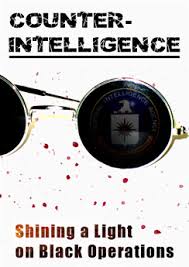
Counter-intelligence is a five-part documentary examining the history, structure and function of America’s National Security State. The latter is a secretive, quasi-legal bureaucracy whose primary purpose is to enforce the will of the wealthy elite without interference by elected representatives. Laying out the series like a college course, filmmaker Scott Noble reveals the mechanism by which this invisible shadow government exercises near total control over US foreign and domestic policy. Part 1 discusses the CIA, the Joint Services Operation Command and the NSA

Noble defines “black operations” as illegal clandestine operations that are carried out without Congressional oversight or accountability. The National Security Act President Harry Truman signed in 1947 made covert operations the responsibility of the Central Intelligence Group, which wouldn’t become part of the CIA until the 1950s. .

Truman appointed a number of Wall Street bankers and lawyers to run covert operations. Their foreign trade experience (especially with fascist countries) supposedly made them “experts” in foreign relations. Traditionally top CIA officials have been recruited from the children of Wall Street elites at Harvard, Yale and other Ivy League universities.

Yale’s secretive Skull and Bones society has been a particularly fertile ground for recruiting CIA officers. The requirement for new Skull and Bones members to commit an illegal act (usually grave robbing) prepares them for the illegal covert operations they will carry out for the CIA.

Plausible Deniability

“The Company” emphasizes the role of private foundations and contractors (mercenaries) in concealing  the CIA’s role in assassinations, foreign coups and drug trafficking. The CIA funded the 2002 against Venezuelan president Hugo Chavez by funneling millions of dollars through the National Endowment for Democracy (NED). This made it possible for the Bush administration to deny they played any role whatsoever in the coup.

Unlimited Budgets

A major feature of the National Security State is the total absence of oversight or accountability to any elected branch of government. Budgets are virtually unlimited, and there is no requirement for agencies that engage in black operations to report how they spend their funding.

The Joint Services Operation Command (JSOC) is a prime example. The JSOC, which technically falls under Pentagon, receives even less oversight than the CIA. JSOC has a 75 billion dollar budget and employs 200,000 covert operatives, many of them mercenaries. Noble believes the JSOC is a major culprit in trillions that have gone missing from the Pentagon budget.

Owing to its total lack of oversight or accountability, the JSOC is free to contract with a scumbag company like DynCorps, despite their collaboration with the Serbian mafia in sex trafficking – or the sex parties, involving little boys, they throw for Afghan officials.

The National Security Administration (NSA) enjoys even less fiscal accountability. The NSA, which has more operatives than the CIA and FBI combined (40,000), had an $11.6 billion budget in 2012. It also has its own film festival, ski club and yacht club.

CIA Domestic Spying

Noble concludes by touching on the CIA’s repeated and ongoing violation of the federal law prohibiting them from engaging in domestic covert operations. He briefly discusses Operation Chaos (a 1967-73 covert operation against anti-Vietnam war and civil rights activists), MK-Ultra (a 1957-73 project involving mind control experimentation on unwitting Americans) and Operation Mockingbird (a 1950-ongoing operation in which the CIA “recruits” journalists to present the Company in a favorable light).

Counter-intelligence: Shining a Light on Black OperationsScott Noble
Metanoia Films (2013)
Also posted at Veterans Today

How Citizens United* Kept the Koch Brothers Out of Jail

The video below is an interview with Investigative reporter Greg Palast regarding his 2012 book Billionaires and Ballot Bandits: How to Steal an Election in 9 Easy Steps. Palast is best known for exposing the fake “ex-felon” scrub list that illegally disqualified tens of thousands of law abiding Florida African Americans from voting in the 2000 presidential election.

According to Palast, the real agenda behind the Citizens United decision was to keep the notorious Koch brothers** out of jail for illegal corporate donations they had made to Republican campaigns. In other words, the ruling decriminalized extensive lawbreaking by the Republican Party’s favorite billionaires. Apparently it’s was no accident that Ted Olsen, the Citizens United attorney, also happens to be legal counsel for Koch Industries.

The Koch Brothers’ Long History of Flouting the Law

As Palast reveals at the beginning of the interview, he was an FBI investigator prior to becoming an investigative journalist. During the late eighties, he was directly involved in investigating Charles Koch for illegally siphoning oil (beyond what Koch Industries had paid for) from Indian reservations. According to Palast, the FBI had videos of the whole operation, as well as numerous witness statements, including one from David and Charles’ younger brother Bill. The US attorney in Oklahoma went so far as to file an indictment against subject 67C (their code name for Charles Koch), when Koch leaned heavily on Oklahoma Senator Don Nickles (Rep 1988-2005) to have the federal prosecutor replaced and the indictment quashed.

With the possibility of criminal prosecution off the table, brother Bill Koch filed a civil lawsuit over the oil theft under the False Claims Act. The latter private plaintiffs to sue, on behalf of the government, companies and individuals which have defrauded it.

In December 1999, the jury found that Koch Industries had stolen oil it didn’t pay for from federal land, and the company paid a $25 million settlement to the federal government.

The FBI next turned its attention to 350 criminal violations of environmental law, mainly due to faulty pipelines dumping oil sludge into rivers. After George W. Bush became president in 2000, the US Justice Department dropped 88 of the charges. Two days before the trial, Attorney General John Ashcroft agreed to a plea bargain. The company pled guilty to falsifying documents. All major charges were dropped, and Koch and Ashcroft settled a civil lawsuit for a fraction of the criminal penalty.

The FBI – and Congress – Investigate Illegal Corporate Donations

Next on the FBI list of crimes was the smear campaign Koch Industries secretly funded, through the Campaign for Our Children’s Futures. This was in 1994 when corporate campaign donations were still illegal. The campaign, caused 25 incumbent Democrats to lose their seats, which meant Clinton lost Congress in the 1994 midterm election and again in 1996.

The illegal campaign donations were funded through an entity called Triad Management Services. Senator Fred Thompson, Chair of the Senate Finance Committee attempted to undertake an investigation into Triad. According to Palast, it was shut down the same day (ethically challenged) Senate Majority Leader Trent Lott made a deal with President Bill Clinton not to investigate his illegal campaign donations from the Indonesian billionaire James Riady.

*In Citizens United, the Supreme Court ruled that setting limits on campaign expenditures on corporations and labor unions violates their first amendment right to free speech.

**The Koch brothers are major funders of several conservative think tanks and lobbies, such as the Heritage Foundation, ALEC, the CATO Institute, and right wing Astroturf groups, such as the Campaign for America’s Future, the Campaign for a Fair Economy and the Tea Party). They’re also the major beneficiaries of the Keystone Pipeline

Greening the South Bronx

Greening the Ghetto
Majora Carter (2006)

Film Review

I make no secret of my belief that real political change must start at the local. To bone up on my organizing skills, I’m presently doing a master class called “How Communities Awaken”. It’s been decades since I took a formal class. For homework they’ve given two books and a flash drive full of videos, podcasts and journal articles.

Naturally I went for the videos first. This one is a 2006 TED talk by an African American environmental justice* activist from the South Bronx.

The most striking part of Carter’s talk is her narrative describing how local politicians and developers deliberately target politically vulnerable communities. I saw the exact same thing happen to Seattle’s central area in the 1980s.

As in Seattle, major Interstate expansion (to shorten the Manhattan commute for wealthy Westchester County residents) displaced thousands (600,000) of South Bronx residents. The family homes many had purchased became virtually worthless.

In addition to the Interstate, South Bronx residents have been saddled with four power plants, a sewage treatment plant and a toxic waste site. Due air pollution, one in four South Bronx kids has asthma, seven times the national average.

Fighting Back Through Community Empowerment

Carter describes how she and her neighbors turned this around by obtaining a $10,000 grant to transform a desolate Hudson River dump site into a park. And how this success led to the formation of a Green Wave movement in South Bronx.

In addition to building community and greatly improving the physical environment, her Green the Ghetto movement has translated into serious economic development. In addition to offering job training for ecological stewardship, her community started New York’s first green roof** installation business.

The end of the film features an intriguing interaction (i.e. putdown) with Al Gore about his patronizing response when she approached him about addressing environmental justice in his climate change slideshows.


*Carter defines environmental justice as the right of a community not to be saddled with an undue burden of environmental problems.
**A green roof is a living roof partly or completely covered with vegetation, to optimize energy conservation and minimize water runoff.

Prison Replaces Community Mental Health

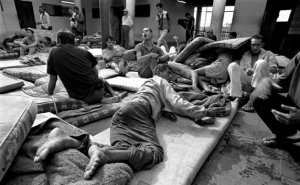
lunatic-asylumOld lunatic asylum

This final post concerns the third main driver of high US incarceration rates: the warehousing of the mentally ill in America’s prisons and jails. It’s the one I’m most intimately acquainted with, after campaigning for 14 years, alongside the National Alliance for the Mentally Ill, to end this medieval barbarism. Federal and state lawmakers are perfectly aware that 1) this 40 year old practice constitutes a crime against humanity under international law and 2) that imprisoning the mentally ill costs taxpayers two to three times as much as community treatment. Yet our elected representatives remain unwilling or incapable of rectifying this problem.*

According to Health Affairs, 20 percent of US prison inmates have a serious mental illness and 30 to 60 percent have substance abuse problems. Between 50 and 70 percent have mild to moderate mental disorder.  Al Jazeera reports that people with severe mental illness are 10 times more likely to be in a jail or prison than in a mental health facility and 40 percent of individuals with a severe mental illness will have spent some time in their lives in either jail, prison, or community corrections.

Aside from the absolute barbarity of warehousing vulnerable mentally ill offenders with violent psychopaths, locking them up costs the taxpayer far more than providing them outpatient mental health services: adding up to $150 billion annually

I see two main factors behind the American practice of using correctional facilities to warehouse the mentally ill. Number one is the systematic defunding of America’s mental health system. Number two is the systematic defending of federal housing programs that initially provided shelter for the mentally ill when they were first released from state mental hospitals in the sixties, seventies and eighties.

The Movement to Close State Mental Hospitals

The movement to close state mental hospitals and “deinstitutionalize” the mentally ill began in 1963, after President John F. Kennedy signed the Community Mental Health Center Act. The goal of the new law was to replace institutionally based mental health treatment with community based care, by funding outpatient community mental health centers, group homes and residential facilities. In the early seventies, the discovery of effective pharmaceutical treatments for schizophrenia and manic depressive disorder facilitated this process.

As anticipated, state legislatures all over the country jumped at the opportunity to shift the cost of mental health care to the federal government. Because they provided 24/7 care, state hospitals had monstrous labor costs and lawmakers were only too happy to close them.

Unfortunately this federal funding dried up when Johnson created Medicaid for low income Americans in 1968. From this point on, the only federal mental health funding states received was from the individual entitlement of the Medicaid patients they served. Any non-Medicaid patients they treated had to be funded by private fees and charity.

Reagan Slashes Medicaid

Mental health funding deteriorated even further when Reagan replaced Medicaid funding with social service “block grants” that provided 25% less funding than the programs they replaced. Federally subsidized housing programs experienced comparable funding cuts.

Faced with steep funding cuts, states had no choice but to turn away thousands of mentally ill clients in genuine need of treatment. It was during the early eighties, under the Reagan administration, that large numbers of mentally ill Americans first made their appearance on the streets and in jails and prisons.

As funding continued to deteriorate, community mental health centers reduced costs even further by replacing labor intensive counseling and psychotherapy with “drugs-only” treatment and “case management” – and master’s degree social workers and counselors with “case workers” with no mental health training.

George W Bush Makes Further Medicaid Cuts

America’s mental health system would take a further hit in 2006 when Bush further slashed federal Medicaid funding to help finance the wars in Iraq and Afghanistan. States responded with further service cutbacks and, as always, jails and prisons took up the slack.

America’s mental health system would enter its death spiral when the economic recession hit in 2008. A study by the National Alliance on Mental Illness reveals the states slashed an unprecedented $1.8 billion from their mental health budgets between 2009 and 2011.

Continuing a well-established trend, mentally ill patients unable to access community treatment would end up in jail or prison.

To fully appreciate the unspeakable horror of this inhumane policy, listen to this excellent BBC World Service documentary America’s New Bedlam**


*The total indifference of our elected representatives to our prison system’s crimes against humanity is well illustrated by this post on solitary confinement (which also violates international law):  Oh, Just Stop It

**Bedlam refers to the Royal Bethlem Hospital in London, the first to specialize in the treatment of the mentally ill.

photo credit: danmillerinpanama

Profits, Not Crime, Drive Incarceration Rates

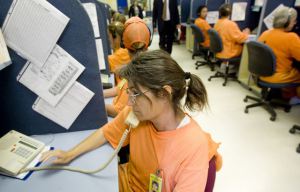
prison-call-centerInmate-run call center

This second post deals with the corporatization of US prisons and the private companies who profit from high incarceration rates.

US rates of violent and property crime have been declining steadily since 1990. Logically dropping crimes rates should produce a drop in incarceration rates. Yet until 2009, when 26 states acted to reduce prison populations, the exact opposite was true. As crime rates declined in state after state, the number of people they locked up skyrocketed.

Presently the US “enjoys” the highest incarceration rate in the world. At 500 per 100,000 population, it’s  five times higher than other developed countries.

A number of factors contribute to this disgrace. In my view, the first and most important is the enormous profit potential of American’s prison industry, resulting in major pressure on state legislatures from private for-profit prison companies and their friends at the American Legislative Exchange Council place on state legislatures. The second is a raft of tough-on-crime legislation driven by deliberate neoconservative race-based fear mongering. The third is the systematic defunding of mental health services in the US, leading to the warehousing of mentally ill patients in federal and state correctional facilities.

Profit, Not Crime, Drives Prison-Building Spree

Prison privatization, which began under Reagan in the 1980s, has turned incarceration and immigration detention into a multibillion dollar growth industry with its own trade shows, conventions, mail order catalogs and state and federal lobbyists. Unsurprisingly Corrections Corporation of America (CCA), Wackenhut and the 16 other for-profit prison companies are major campaign donors to federal and state lawmakers who advocate tough-on-crime and tough-on-immigrant policies. These are usually the same legislators who sponsor bills to replace state prisons with private for profit correctional facilities.

Who’s Making Big Bucks Off Prison Privatization?

The booming private prison industry provides numerous opportunities for banks and other corporate interests to skim off profits at taxpayer expense:
1. The Wall Street investment banks (e.g. Goldman Sachs) who issue the bonds to finance the building of state and local prisons.
2. The private companies who run prisons – Corrections Corporation of America (CCA) and Wackenhut are the largest, but there are now 18 altogether. CCA also operates our federal immigration detention facilities and helped write Arizona ‘s controversial immigration law.
3. Private companies that provide food services, health care, and assorted security paraphernalia to prisons.
4. Bed brokers who, in Texas, earn $2.50 – 5.50 per man-day (for the duration of a prisoner’s sentence) by recruiting prisoners from out of state.
5. Major corporations who save on labor costs in 37 states by contracting cheap prison labor.

The list of corporations employing cheap prison labor is extensive: IBM, Boeing, Motorola, Microsoft, AT&T, Wireless, Texas Instrument, Dell, Compaq, Honeywell, Hewlett-Packard, Nortel, Lucent Technologies, 3Com, Intel, Northern Telecom, TWA, Nordstrom’s, JC Penny, Best Western Hotels, Honda, Chevron, BP, Victoria’s Secret, Revlon, Macy’s, Pierre Cardin, Target Stores, and many more.

Virtual Slave Labor

Inmates in state penitentiaries generally receive the minimum wage ($7.25). Not all do, though. In Colorado state prisons, they get about $2 per hour. In private prisons, they receive as little as 17 cents per hour. The highest-paying private prison is CCA in Tennessee, where prisoners receive 50 cents per hour.

As Vicky Pelaez writes in Global Research, thanks to dirt cheap prison labor, manufacturing jobs that corporations previously outsourced to third world sweatshops are returning to the US. She gives the example of a company operating a maquiladora (Mexican assembly plant near the border) that closed down operations and relocated to San Quentin State Prison in California.

The virtual slave labor that occurs in state prisons also drives down wages in neighboring communities. Pelaez gives the example of a Texas factory that fired its 150 workers and contracted the services of prisoners at the private Lockhart Texas prison, who assemble circuit boards are assembled for IBM and Compaq.

BP also made profitable using of cheap prison labor in cleaning up Deepwater Horizon disaster in the Gulf of Mexico.

Many US corporation employ prison labor to staff their call centers. According to NBC News, If you recently called your motor vehicle department or received a telemarketing call from Microsoft or Hitatchi, it’s likely the person on the other end was a prisoner.

Another great resource on the scandalous prison industrial complex are is the excellent series Nation at Risk  at Deconstructing Myths.

photo credit: The Politics of Information

To be continued.

States Save Billions by Downsizing Prisons

prison

This is the first of four posts on America’s scandalous prison industrial complex. I start with the good news. Thanks to the budget crisis most states have faced since the 2008 economic crash, US prison populations have shrunk by 600,000.

States Save Billions by Downsizing Prisons

An important silver lining of the 2008 economic downturn has been a decline in the US incarceration rate. Despite two decades of declining violent and property crime rates, the US still enjoys the highest incarceration rate (500 per 100,000 population) in the world. Nevertheless, thanks to the recession-related budget crisis in 48 state capitols, America’s prison population has started to fall. According to CBS News, between 2009 and 2012, it fell from a peak of 2.2 million to 1.57 million.

In 2013 prison populations rose slightly (there were an estimated 1,574,700 inmates on December 31, 2013 – an increase of 4,300 prisoners).

What explains this overall decline in prison occupancy? Between 2008 and mid-2013* every state except Montana and North Dakota faced yearly budget shortfalls. Because states aren’t allowed to run deficits, most had to make substantial cuts in “essential” state programs, including education, housing, highway maintenance and repair – and most importantly prisons.

In 2010, the last time such costs were calculated, the average annual cost of incarceration was $28,000 – $40,000 per inmate.

This definite budget breaker has led 26 states to resist lobbing by private prison operators such as Corrections Corporation of America, Wackenhut, Cornell Corrections and their friends at the American Legislative Exchange Council (ALEC) and enact legislation to reduce prison numbers.

California’s Criminal Justice Realignment Act

California clearly leads the nation in this initiative. When the US Supreme Court (in May 2011) upheld a lower court ruling ordering them to reduce prison overcrowding, Sacramento had the hard choice between borrowing money to build more prisons, paying private prisons in other states to take their offenders or adopting the Criminal Justice Realignment Act. This legislation works to move nonviolent offenders out of the prison system, as well as finding alternatives to custodial sentences for new nonviolent offenders. Under the Realignment Act, the number of inmates in California prisons has dropped by 25,000 since 2011. The count of offenders on parole is down about 30,000, and prisoners held in private out-of-state prisons is down 10 percent.

The California Department of Corrections and Rehabilitation estimates that it saves $1.5 billion a year through realignment and will save another $2.2 billion a year by canceling $4.1 billion in new construction projects.

25 Other States Work to Cut Prison Populations

According to the ACLU and NORML, 25 other states are saving money by cutting and/or slowing the growth of their prison populations. Sixteen states and the District of Columbia are working to to reduce their incarceration of nonviolent offenders by decriminalizing marijuana.*

  • Alabama – passed law allowing a sentencing commission to set new guidelines for nonviolent crimes.
  • Alaska – decriminalized marijuana
  • Colorado – shut down large penitentiary in view of falling crime rates and passed a ballot initiative in 2012 legalizing marijuana use for recreational purposes.
  • Connecticut – became 17th state to repeal death penalty in April 2012, as well as decriminalizing marijuana.
  • District of  Columbia – decriminalized marijuana.
  • Florida – closed eight prisons that were built in anticipation of a crime wave that never occurred
  • Georgia – passed bill reducing sentences for low level drug offenses and theft, creates drug and mental illness courts and establishes graduated sanctions, such as community service, for probation violations.
  • Hawaii – passed law requiring the use of risk assessments in pretrial and parole hearings, to enable the identification of individuals who pose the most risk to public safety, as well as those who can be safely supervised outside of prison or jail.
  • Illinois – passed SB 2621, reinstating a program that allows prisoners to reduce their sentences through good behavior and participation in reentry programs. The bill also provides incentives for prisoners to participate in programs, such as drug treatment, that reduce recidivism.
  • Kansas – passed a law allowing judges to divert individuals convicted of low-level crimes from prison to less expensive and more effective substance abuse treatment.
  • Louisiana – passed one law allowing prisoners serving life sentences for nonviolent crimes to go before a parole board to prove they are ready for release and another allowing inmates who have committed repeat low-level offenses to appear before a parole board after serving one-third of their sentences.
  • Maine – decriminalized marijuana
  • Maryland – passed a law increasing the number of offenses that must/can be charged via citation instead of arrest and detention.
  • Massachusetts – decriminalized marijuana
  • Minnesota – decriminalized marijuana
  • Mississippi – decriminalized marijuana
  • Missouri – passed one law reducing disparity for crack and powder cocaine offenses and another sending fewer people back to prison for technical violations of probation and parole, such as a missed meeting or failed drug test.
  • Nebraska – decriminalized marijuana
  • Nevada – decriminalized marijuana
  • New York – decriminalized marijuana
  • North Carolina – decriminalized marijuana
  • Ohio – decriminalized marijuana
  • Oregon – decriminalized marijuana
  • Rhode Island – decriminalized marijuana
  • Vermont – decriminalized marijuana
  • Washington State – created the LEAD program, which diverts individuals charged with low-level offenses into community-based services, such as drug treatment, immediately after arrest and before booking. Also passed a ballot initiative in November 2012 legalizing recreational marijuana.

*In 2013, increasing tax revenues enabled all but two states (Washington and California), to balance their budgets without major cuts.
**In most instances decriminalization means no prison time or criminal record for first-time possession of a small amount for personal consumption. Instead the offense is treated like a minor traffic violation.

photo credit: abardwell via photopin cc

The Ideology of Revolution

Trapped: What Happened to Our Dream of Freedom

Adam Curtis

BBC (2007)

Film Review

Part 3 We Will Force You to be Free

Part 3 is about the philosophy of revolution, as articulated by the Algerian psychiatrist Frantz Fanon (author of Wretched of the Earth and Black Faces, White Masks). Fanon, who studied in Paris, was strongly influenced by French philosopher Jean Paul Sartre. Sartre, who viewed economic equality as essential to personal freedom, believed true freedom was only possible through the overthrow of bourgeois society via violent revolution. Fanon was convinced that the western elites got into people’s heads and turned them into zombies devoid of the ability to think critically or act altruistically for the collective welfare of the community. He also believed that the mere act of organized violence freed people from their competitive individualistic conditioning.

Fanon’s ideas had major influence over numerous third world revolutionaries, including Che Guevara in the 1952 Cuban revolution, Pol Pot in the 1975 Cambodian revolution and Grand Ayatollah Ruhollah Khomeini in the 1979 Iranian revolution.

Pol Pot believed the only way to rid society of bourgeois self-interest was to kill the entire bourgeoisie – all 3 million of them.

Positive and Negative Liberty

The documentary goes on to discuss the work of British political philosopher Isaiah Berlin (1909-1997). Berlin believed only two types of freedom, which he called positive and negative liberty, were possible. He labeled Fanon’s type of freedom “positive liberty,” as it involved a new elite forcing the masses to adopt a new way of thinking through violence. In contrast, “negative liberty,” allowed individuals to do whatever they want so long as they don’t infringe on the rights of anyone else.

Curtis contends that both types of so-called liberty involve violence and coercion. As examples, he offers the “shock therapy” the US corporate elite carried out in Russia in 1992 and in Iraq in 2003. While on the surface, both instances of “shock therapy” looks like pure exploitation by US banks and corporations, both were examples of the neoconservative doctrine of spreading “democracy” via armed force.

Shock Therapy in Russia

Following the collapse of the Soviet Union, US vulture capitalists invaded Russia and pressured the new regime to abandon its centrally controlled economy virtually overnight. All subsidies for food, energy and other basic necessities were discontinued and most of Russia’s state owned industries were privatized. Millions of Russians lost their jobs and were plunged into abject poverty, as Russian oligarchs and American venture capitalists stripped the newly privatized industries of their wealth. Face with the loss of government subsidies, ordinary Russians lined up on the street and traded everything they owned for food.

In 1993, with the economy on the verge of collapse, Boris Yeltsin dissolved Parliament and launched a military coup to install himself as absolute ruler. He had to borrow money from the oligarchs to run his government, for which he handed over the remaining state-owned industries.

By 1998, the oligarchs and their American investors had bled Russia dry and the currency collapsed. Yeltsin was forced to resign and the Russian people elected Putin as president. The latter moved quickly to strip the oligarchs of their wealth and jailed them or forced them into exile. The vast majority of the Russian people adored him. They didn’t care if they lost basic freedoms (e.g. of speech, the press and assembly) because it was a better alternative than starvation.

Shock Therapy in Iraq

The Americans applied similar shock therapy during their occupation of Iraq, privatizing all the state owned industries (selling them for a pittance to US investors) and writing a new constitution that allowed foreign companies to expatriate 100% of their profits tax free.

In Iraq, the brutal US occupation would enhance the rise of a radical Islamist movement violently opposed to both western colonization and exploitation and the selfish, hedonistic and morally bankrupt lifestyle that seemed to be the driving force behind US foreign policy.

The US and Britain, in turn, responded to the threat of Islamic terrorism by severely restricting the freedom of their own citizens.

Both Fanon and Berlin Were Wrong

The two conclusions Curtis draws is that 1) both the so-called positive and negative liberty Berlin describes lead to violence and coercion and 2) Berlin was wrong in claiming that all attempts to change the world for better lead to tyranny.

My own perspective is that both Fanon and Berlin are wrong. As educated members of the upper middle class, they both made the mistake of assuming that the working class thinks the same way they do, i.e. that the working class is afflicted to the same extent as the middle class by individualism and competitive self interest.

Both failed to appreciate or understand that working class people share a distinct culture with its own values, language and world view. In fact, the issue of working class culture received little attention in academic circles prior to the 1970s.* Basic to this culture are the loyalty and group allegiance based on shared hardship.

Both are deeply ingrained values stemming from early childhood experience, which makes them difficult to reverse with mass media messaging, no matter how pervasive it is.

This is certainly my experience in working with blue collar families for 33+ years. It’s also born out by working class patterns of charitable giving.**


* Some of the better known authors on working class culture include Lillian Breslow Rubin (Worlds of Pain), Richard Sennett (Hidden Injuries of Class), Jake Ryan and Charles Sackrey (Strangers in Paradise: Academics from the Working Class), and Alfred Lubrano (Limbo: Blue Collar Roots and White Collar Dreams).

**Studies of working class charitable giving:


Free link to Part 3: The Trap 3 We_Will_Force_You_To_Be_Free_BBC/

Africa’s Hidden History

All Watched Over By Machines of Loving Grace*

Directed by Adam Curtis

BBC (2011)

Part 3

Film Review

The basic theme of the final video is this series is a bit unclear. Curtis seems to imply, based on flimsy and subjective evidence, that western liberals who provide humanitarian and developmental assistance to third world countries only make their living situation worse.

The main focus of Part 3 is the civil wars in Congo and Rwanda over valuable mineral resources coveted by multinational corporations. There’s a particular emphasis on coltan, a rare earth mineral essential in the manufacture of computers, play stations and smartphones.

The CIA Coup Against Lamumba

The film traces the history of the Congo back to 1960 when it first gained independence from Belgium. In 1961, after the Congo’s first president Patrice Lamumba allied himself with the USSR, the US and Belgium instigated a coup to remove him from power and had him murdered. Fearful that Congo’s rich mineral wealth would fall into Soviet hands, they replaced him with the brutal pro-western dictator Mobutu Sese Seko.

The Belgian Role in Rwanda Genocide

Curtis traces Rwandan history from their first episode of genocide, engineered by their Belgian rulers in 1959. Fearful that the Rwandans, like other colonized Africans, would demand independence, the Belgians deliberately instigated ethnic conflict by issuing mandatory race cards and promoting the myth that the Tutsis (which Belgium made colonial administrators) were a superior race that had migrated to Rwanda from ancient Egypt. Meanwhile Belgian aid workers encouraged oppressed Hutus (who comprised 85% of the population) to revolt. After three years of bloody civil war, Belgium granted Rwanda independence in 1962.

In 1994, the Hutus seized control of the Rwandan government and deliberately exterminated nearly a million Tsutsis. Hundreds of thousands of refugees fled across the border into Congo, where the UN and western aid agencies set up refugee camps. Curtis maintains it was a mistake to set up refugee camps because there were Hutu assassins hiding among the refugees. Armed conflict between Tsutsis and Hutus spread to rebel armies seeking to overthrow Mobutu. Hoping to win a piece of Congo’s mineral wealth, Zimbabwe, Angola, Chad, Namibia, Uganda and Libya all dispatched troops to support the rebels. Leaving more than five million dead, the civil war would continue until 2003.

I find it a bit puzzling that Curtis blames the UN and humanitarian organizations for fanning the flames of the Congo’s civil war. Surely most, if not all of the blame lies with the multinationals behind Mobotu’s dictatorship.

The Selfish Gene

Curtis interweaves his discussion of Congo and Rwandan history with relevant scientific research that endeavored to prove that humans are complex computer-like machines.

In 1967, population geneticist George Price allegedly proved that human beings were soft machines run by on board computers (i.e. DNA). A corollary of this hypothesis was that human beings commit murder and genocide because of a “selfish gene” which genetically programs us to hate a kill people who are genetically unrelated to us.

Price worked closely with evolutionary biologist Bill Hamilton who, based on his research, argued against providing medical treatment when people get sick because this causes genetically inferior people to survive and reproduce.

Dian Fossey’s Mountain Gorillas

A third narrative describes the work of primate ethnologist Dian Fossey who was studying Congo’s mountain gorillas during the decade-long civil war. My favorite scene depicts British naturalist David Attenborough stretched out on top of one of Fossey’s gorillas as they share a moment of relaxed contemplation.

*Title of 1967 monograph distributed free by California cybernetics enthusiast Richard Brautigan. Available for $400 from Abe Books

http://vimeo.com/73561591

Child Marketers: a New Kind of Pedophile

Consuming Kids: the Commercialization of Childhood

Adriana Barbaro & Jeremy Earp 2008

Film Review

The Commercialization of Childhood is about the constant, insidious targeting of American children with corporate marketing.

The US is the only country in the industrialized world that refuses to regulate children’s advertising. In 1984 the Reagan administration stripped the Federal Trade Commission (FTC) of any ability to regulate any children’s advertising or programming. Starting from age three or earlier, American children are bombarded with an average of 3,000 commercial messages a day. Because children under twelve lack the critical faculties to recognize deception, this constant bombardment with pro-consumption messaging has a profoundly negative impact on their psychological development and physical health.

The Nag Factor

Most child marketing is centered around what public relations specialists call the “nag factor” – children’s ability to make their parents miserable if they don’t buy them want they want. In addition to the $40 billion kids themselves spend every year, they also influence their parents’ spending to the tune of $700 billion a year. It’s often children who determine where families spend their holidays and what kind of car, computer and cellphone aps they buy.

Children’s advertising is no longer limited to TV ads and cereal boxes but intentionally pervades every area of their lives. Many contemporary children’s programs are deliberately centered around branded products, such as Sponge Bob Square Pants and Teenage Ninja Turtles. Marketers then play on children’s identification with these toys to get their parents to buy them Sponge Bob and Teenage Ninja Turtles video games, lunch boxes, tee shirts, cookies, crackers and even macaroni and cheese.

Meanwhile financially strapped schools make extra money by displaying brand logos in hallways and auditoriums and on sports fields. Many get free computers and satellite dishes by playing Channel One informercials at the beginning of the school day.

Child Marketers are Like Pedophiles

One of the psychologists interviewed compares child marketers to pedophiles. In addition to maximizing the nag factor, children’s marketing deliberately taps into powerful developmental needs. Public relations specialists spend hundreds of hours filming children’s in supermarkets, at school and even in the bathtub. As well as organizing special focus group slumber parties to expose them to new products, they get them to join fake online social media groups. Here they can earn money and free products by providing personal information about their friends. In most cases, these activities take place without the parents’ knowledge.

This continual bombardment with corporate messaging is leading to a total remodeling of children’s psyche. One particularly alarming example is the sexualization of young girls via “tween” marketing. This is designed to heavily promotes short skirts, skimpy tops and sexy make-up and hair products to 6-12 twelve year olds. After years of this insidious brainwashing, western society is left with a staggering number of young women who think they only have worth if they’re pretty and thin and wear designer clothes. As well as an alarming increasing in anorexia nervosa, which is often fatal.

Meanwhile enticing ads for junk food and soft drinks is responsible for an epidemic of obesity, diabetes, high blood pressure and strokes – conditions that were once extremely rare in childhood.

LISTEN…L I S T E N !


Inspiring Speech by Ex-Congresswoman Cynthia McKinney in Kuala Lumpar, Malaysia. She calls Malaysia the peace capitol of the world, presumably referring to their hearings on 9-11 and war criminals such as George W Bush. One begins to have some insight into a potential motivation for US and/or Israeli intelligence to take out Malaysian airliners.

merahza's avatarSatu Insan - Malaysia

Ex Congresswoman Cynthia McKinney Speech in KUALA LUMPUR

..

home

.

View original post