The Most Revolutionary Act

Uncensored updates on world events, economics, the environment and medicine

The Most Revolutionary Act
Unknown's avatar

About stuartbramhall

Retired child and adolescent psychiatrist and American expatriate in New Zealand. In 2002, I made the difficult decision to close my 25-year Seattle practice after 15 years of covert FBI harassment. I describe the unrelenting phone harassment, illegal break-ins and six attempts on my life in my 2010 book The Most Revolutionary Act: Memoir of an American Refugee.

13th Century AD: Mongol Conquest of Russia and Jin Dynasty

Episode 27: Western Mongol Expansion

Barbarian Empires of the Steppes (2014)

Dr Kenneth Harl

Film Review

According to Harl, Genghis Khan’s sons and grandsons split responsibility for the Mongol Empire following his death.

After being installed as the great khan (by the assembly of Mongol nobles), the third son Ogedei ruled the Mongolian homeland on the eastern steppes and led the military expedition that conquered China’s Jin* empire.

The second son Jugatai assumed control over the central steppes and the fourth Tolui the Mongolian heartlands in eastern Mongolia.

The first son Jochi inherited the western steppes, and his son Batu ran the military campaign to conquer new lands “as far as the western ocean.” After first conquering Persia, Armenia and Georgia, he attacked the south Russian steppes.

In 1223, a coalition of Russian princes confronted an army of 75,000 Mongolian and Turkish troops on the banks of the Kolka River. Following an initial stalemate, the Mongol army withdrew and decimated their Turkish allies, the Cumans (aka the Volga Khans).

After regrouping, Batu strategically employed Chinese and Persian engineers to sack every major Russian city except for the northernmost Novgorod and Pskov. After capturing and deporting a few artisans and women, the Mongols massacred nearly all the civilians in the conquered cities.

In 1241, Batu’s troops next invaded southern Poland, Silesia,** and Hungary, where they encountered they had no hope of breaching. After being notified of Ogedei’s death in 1242, Batu withdrew his forces to return to the Mongolian heartland to elect a new Khan.


*See 10th Century AD: The Steppes Nomads Conquer Northern China

**Historical region in central Europe roughly equivalent to northern Poland.

Film can be viewed free with a library card on Kanopy.

https://www.kanopy.com/en/pukeariki/video/5694984/5695045

Saudi Arabia, Egypt and Turkey Could Join BRICS

https://i0.wp.com/infobrics.org/media/russia/2011/Brics.jpg

Lucas Leiroz

The BRICS seem really close to expanding. Now, according to information from the group’s International Forum, Saudi Arabia, Egypt, and Turkey have expressed interest in applying for membership. Previously, Iran and Argentina had already asked to join the alliance. With this, it is evident that emerging countries around the world see in the BRICS a way to improve their international relations and contribute to the construction of a new world order.

Purnima Anand, president of the BRICS International Forum, said July 14, that three more countries could join “very soon” the group that is currently made up of Brazil, Russia, India, China and South Africa. According to her, representatives of the Saudi, Egyptian and Turkish governments have shown interest in entering the BRICS and are already forwarding the procedural requirements to formalize the candidacy.

“All these countries have shown an interest in joining and are preparing to apply for membership. I think this is a good step, because expansion is always positively perceived; this will clearly increase the influence of BRICS in the world (…) I hope that the accession of countries to BRICS will happen very quickly, because now all representatives of the core of the association are interested in enlargement. So, it will be very soon”, she said.

At another point of her speech, Anand also stated that the access may not occur “all at once”. In this sense, it is expected that one or two accessions will occur each time if the countries are actually accepted to join the group in the future.

In fact, Anand’s words confirm some previous expectations that emerged in recent similar pronouncements made by other authorities of the group. For example, the head of the Department of International Economic Affairs of the Ministry of Foreign Affairs of China, Li Kexin, had stated on one occasion that not only these countries but even Indonesia had expressed interest in joining the BRICS:

There are several countries currently ‘at the door,’ for example, Indonesia, Turkey, Saudi Arabia, Egypt, Argentina (…) I believe there is a shared understanding that we [the BRICS] need to enlarge, get ‘new faces”.

Indeed, the explanation for why so many countries are interested in the BRICS is simple and can be seen in the words of Argentina’s Ambassador to China, Sabino Vaca Narvaja during a recent interview: “We are interested in joining the BRICS because it is a cooperation mechanism composed entirely of emerging economies. There are no strings attached and all cooperation is mutually beneficial”.

While the economic blocs and political alliances led by the countries of the “geopolitical north” are almost always ruled by rigid ideological principles, linked to agendas such as neoliberalism, eco-capitalism and the western model of “democracy”, the BRICS, being a strategic and pragmatic group for the cooperation among emerging nations, is in no way interested in the political agendas followed by its members or in the ideological principles of their governments. What matters in the BRICS is to strengthen the multilateral partnership in order to reach more advanced levels of development, without political interventionism or ideological requirements.

This is undoubtedly of interest to countries that are somehow “disapproved” by the West for the way they manage their domestic politics, suffering boycotts, sanctions or simply reprisals for accessing some benefits in international society. In the BRICS, what is found is a path focused only on non-ideological cooperation – or, in other words, “no strings attached”, as said by Narbaja.

This non-ideological aspect has an essential strategic advantage: allowing rival nations to join the BRICS simultaneously, despite their conflicts of interests. The group makes it possible for states with divergent interests to overcome their disagreements in favor of a greater common good. This is precisely the case for China and India, for example – and it will also be the case for Iran and Saudi Arabia, if their applications are accepted.

It is necessary to note how the expansion promises to increase the importance of the BRICS in international decision-making processes. Currently, the group already houses 42% of the world’s population and holds 24% of the global gross product. With the possible joining of new members, these numbers will also increase and consequently the group will become even more relevant. Most of the world’s consumer middle classes will be within the BRICS or in some way integrated into it – considering the economic blocs of which the group’s members are part.

In practice, this major economic relevance means bargaining power in the international scenario – which undoubtedly interests emerging states and contributes to the formation of a multipolar world order.

Via http://infobrics.org/post/36178/

German Energy Giant Warns Of Insolvency “Within Days”

Zero Hedge

Russian natural gas, has started using gas it was storing for the winter after Russia cut deliveries to Europe, increasing pressure on Berlin as the German energy giant needs to be rescued “in a few days.”

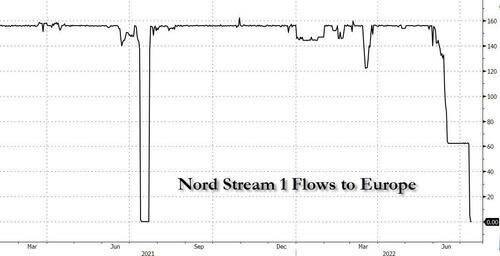
The country’s top buyer of Russian gas started withdrawing fuel from storage sites to supply its customers, the company said in a statement to Bloomberg on Friday. The drawdowns, which began on Monday, will also help the company to save some cash as it has been forced to pay up for gas in the spot market. Meanwhile, flows through the Nord Stream 1 pipeline remain shut for maintenance.

Harald Seegatz, deputy chairman of the supervisory board, said that Uniper needs urgent help, risking insolvency within days.

“We are currently reducing our own gas volumes in our storage facilities in order to supply our customers with gas and to secure Uniper’s liquidity,” the company said. And judging by the flatlining of German gas storage in inventory, Uniper is not alone in draining reserves.

According to Bloomberg, citing data from Gas Infrastructure Europe, Uniper’s storage sites in Germany are now about 58% full, down from about 60% reached on Sunday. Drawdowns were also made from the company’s storage in Austria, but overall storage levels in Germany’s Alpine neighbor are still showing marginal increases.

As we reported previously, Uniper is majority owned by Finland’s Fortum Oyj, has already said it needs to be rescued by the German government, and it’s negotiating a possible stake and a cash boost. But talks have been difficult, with Berlin and Helsinki yet to agree on who to best rescue the company key for energy security.

Last month, Russia significantly cut gas flows to Europe via its biggest pipeline, a move that forced Uniper and other European energy companies to buy gas at much higher prices in the open market. Faced with a shortage of cash, Uniper has been tapping gas in inventories since the start of the week, according to Gas Infrastructure Europe.

“It is clear that Uniper cannot wait weeks, but needs help in a few days,” said Seegatz, adding that insolvency can happen “within days.”

“We cannot wait for weeks to do something,” Seegatz told Bloomberg in a phone interview. “That would have a huge impact on the company and also on the employees. The government said it wants to avoid this situation, but the fact is that we cannot lose time.”

In other words, Germany is facing a total industrial collapse; meanwhile, the media continues to repeat the increasingly more laughable propaganda that Putin is losing the war.

[…]

Via https://www.zerohedge.com/markets/german-energy-giant-starts-draining-gas-storage-it-warns-insolvency-within-days

“Swamp Coolers” – DIY Simple Evaporator Air Coolers You Can Make at Home if You Don’t Have Air Conditioning

by Brian Shilhavy
Editor, Health Impact News

As much of the nation is experiencing very hot temperatures here in the middle of July, there are reports that many people cannot use or do not have air conditioning, sometimes because there is a shortage of technicians and parts to fix HVAC units.

Extreme heat across the US has strained air conditioners. HVAC technicians report repairs are delayed because of a nationwide part and labor shortage.

Steve Stewart, the owner of Southern Comfort Mechanical Heating and A/C Specialists in Dallas County, Texas, told NBC 5 Dallas-Fort Worth that the entire HVAC industry is dealing with a shortage of all sorts of parts for HVAC systems due to lockdowns in China and bottlenecks at ports. (Full article.)

There are simple and cost effective ways to cool the air around you, however, and they are usually called “swamp coolers” or “evaporated air coolers.”

There are many videos that show one how to make these, and I have included one here that highlights 8 different types.

You do still need some power, so backup power is a very high priority when electricity is not available from the grid. At the very least, you should have some backup rechargeable batteries and some kind of solar charger that can provide at least a couple hundred watts of energy that will power a fan and other small appliances.

12 volt fans and appliances can also come in handy, as then they can be powered from your vehicle. Just make sure you have electrical cords long enough to get inside your dwelling to the place you need to cool down.

These DIY coolers also require water, so make sure you have a backup plan that includes some kind of reservoir of water.


The Media Don’t Want You To Know About The Massive Protests Going On Around The Globe

Posted BY: Billy | NwoReport

If you skim the front pages of major corporate news outlets, you’ll find no mention of the economic protests raging in Spain, Morocco, Greece, and the United Kingdom.

On The Washington Post homepage these days, you’ll find headlines such as, “How To Deal With A Chatty Coworker Who Won’t Get Out Of Your Office,” but you won’t find mention of the more than 100,000 people protesting in Madrid.

You’ll find the story of a gay union entitled, “What’s Two ‘Yentas’ Plus One Senator? A Lifetime Together” at The New York Times, but you won’t see a single heading on the more than 10,000 protesters in Athens.

Corporate media has largely glossed over the tens of thousands of farmers in the Netherlands who clogged up roadways and distributions centers by holding Canadian-trucker-convoy-style demonstrations to protest radical climate policies.

[…]

Via https://nworeport.me/2022/07/16/heres-why-the-media-dont-want-you-to-know-about-the-massive-protests-going-on-around-the-globe/

Gasoline Consumption Drops to July 1999 Level


By Wolf Richter for WOLF STREET.

Some demand destruction is behavioral and may bounce back; some is structural, growing, and long term: The decline of an industry.

The spike in gasoline prices motivated Americans to go on buyers’ strike. The phenomenon of a price shock reducing demand for that product is called “demand destruction” in economics. It can reverse when the price falls to such a low level that demand returns. Demand destruction has now turned into a crescendo during peak driving season, including the 4th of July holiday weekend.

In the week through July 8, gasoline consumption plunged by 9.7% to 8.73 million barrels per day, on a four-week moving average, according to EIA data. The EIA measures gasoline consumption in terms of barrels supplied to the market by refiners, blenders, etc., and not by retail sales at gas stations. This was the steepest decline yet so far this year.

Consumption, compared to three years earlier, started dropping in January. At the time, the price was in the $3.30 range:

Demand destruction weighs on price.

The average price of gasoline, all grades combined, after spiking by 63% year-over-year to $5.00 a gallon on June 13, has now dipped for the fourth week in a row, to $4.65 as of Monday, according to EIA data. Between 2015 and 2021, the price ranged between $2 and $3 mostly. It was a shock to suddenly see $5. In lots of places, folks saw over $6 for regular.

Summer driving season in the US means gasoline consumption surges, hitting high points around the 4th of July week and then again around Labor Day. In the 2022 driving season too, gasoline consumption had been rising through mid-June (four-week moving average), but less than three years earlier, and in mid-June it plateaued instead of surging, and now consumption has plunged to the lowest level since mid-April.

The red line in the chart below spans July 2021 through early July 2022. The gray line spans the same weeks in 2018 and 2019.

In the week ended July 8, consumption of 8.73 million barrels per day (four-week moving average) was down by 9.7% from the same period in 2019. But in 2021, June through December 2021, consumption tracked fairly closely the consumption in the same period three years earlier, in 2018:

This demand destruction of gasoline is happening on a global scale – and it doesn’t even figure in yet a recession, but just price resistance, as buyers go on strike wherever they can.

But in the US, people drive a lot more – whether to commute every day or to go shopping or to go on vacation – and they drive bigger vehicles than in most other countries, and they consume a lot of gasoline, and a spike like this in the price is particularly, let’s say, revolting – and finally motivating.

[…]

Via https://wolfstreet.com/2022/07/14/large-scale-gasoline-demand-destruction-hits-sky-high-prices-in-peak-driving-season-gasoline-consumption-drops-to-july-1999-level/

Hidden History: How British Bankers Shaped America’s 20th Century

Clash of the Two Americas Volume 2 ...

Clash of the Two Americas Volume 2: Open vs Closed Systems Collide

By Matthew Ehret (2021)a

Purchase link: https://canadianpatriot.org/untold-history-of-canada-books/

Book Review

In Volume 2,  Ehret’s narrative about the political clash between America’s Anglophile pro-colonization elite and pro-international cooperation forces who opposed them continues into the 20th century.

The second volume begins with a brief discussion of Gilpin’s Landbridge, proposed by Lincoln advisor William Gilpin (who Lincoln appointed as Colorado’s first governor in 1861). In 1890 Gilipin published Cosmopolitan Railway: Compacting and Fusing Together All the World’s Continents, calling for a Tunnel to be built between Alaska and Siberia connecting Russia’s Trans-Siberian Railroad [1] with a North American transcontinental rail network. This proposal arose in part out of a strategy first put forward by Lincoln’s Secretary of State William Seward, General (and later president) Ulysses Grant and Senator Charles Sumner. The surprise purchase of Alaska from the Russians in 1867 was the first step in this venture. 

According to Ehret, most of British foreign policy in the early 20th century was aimed at disrupting the strong US-Russia-German alliance supported by Lincoln, Seward, Grant, Gilpin and Sumner.

For example

  • The 1902 Anglo-Japanese treaty which resulted in the disastrous Japan-Russian war (in which Anglophile US banker Jacob Schiff financed the Japanese), which substantially weakened Russia’s pro-US Romanov rulers.
  • According to Ehert, Britain’ primary purpose in instigating World War I was to break up the continuing US-German-Russian-Ottoman alliance committed to international rail development (a major threat to Britain’s monopoly on maritime trade).
  • The substantial support the British/Wall Street banking establishment provided Russia’s two revolutions in 1905 and 1917. According to Schiff’s grandson, Schiff funded the Bolsheviki revolution to the tune of $20 million. Prominent member of Lloyd George’s war cabinet Lord Alfred Milner also contributed 21 million rubles to the Bolshevik cause.
  •  The collaboration of British banks and Wall Street banks and corporates to finance the rise of Hitler.[2] Prescott Bush (grandfather of George W) bailed out the German Nazi party when it went bankrupt and collapsed in 1932.[3] J P Morgan and Henry Luce, founder and owner of Time Magazine, also helped fund both Hitler and Mussolini, while the Rockefeller and Carnegie foundations funded the Nazis eugenics program, including the experiments Dr Mengele conducted on concentration camp victims.

The book includes some fascinating details about Franklin D Roosevelt’s presidency that are rarely covered in high school history classes. Immediately on taking office, anti-colonist FDR immediately declared war on Wall Street, with his Pecora Commission sending dozens of bankers to prison. He only agreed to support Europe during World War II on condition the European powers surrender their colonies at war’s end. However he ran into major resistance from Churchill 1) when he and Eisenhower tried to open a second front in Western France after Hitler invaded Russia in June 1941 and when 2) FDR (seeking to prevent a dangerous nuclear arms race)  tried to bring the Soviets into the secret US-British project to develop an atomic bomb.

Ehert also devotes a chapter to President John F Kennedy, an anti-colonist like Franklin, Lincoln and Roosevelt, and to the role of Anglophile CIA elements (and even British intelligence agents in Montreal) in his assassination.

My favorite part of the book concerns extensive evidence Ehert has compiled revealing the alleged 1989 Tienanmen Square massacre was actually a color revolution funded by George Soros and the CIA-sponsored National Endowment for Democracy.[4] Both Soros and color revolution guru Gene Sharp were in Beijing on June 4, 1989. See George Soros, Gene Sharp and the 1989 Failed Color Revolution in Tiananmen Square and The CIA and Nonviolence

I feel some chapters towards the end of Volume 2 are somewhat one-sided in terms of Ehert’s unconditional embrace of new technological development. At times new technologies can be extremely hazardous to human health, eg our 70-year-old toxic chemical technology which has left us with a global epidemic of chronic diseases.

I’m also skeptical of his high praise of China’s embrace of unrestrained fossil fuel use and nuclear energy. Serious problems with particulate pollution pose (from coal burning a vehicle exhaust) are responsible for serious health problems (in some cases life threatening) for residents of all China’s major cities. Likewise, I don’t believe there is sufficient evidence to conclude China has “solved” the nuclear waste problem by vitrifying it.[5] While transforming nuclear waste to a solid makes it easier to store, the waste still remains radioactive for thousands of years. You also have to wonder whether the massive temperatures (1000° C) required for vitrification lowers the Energy Returned for Energy Invested below the break even point to justify the major investment required.

Finally I’m confused when he writes in one section about global warming being a myth and about the Polar Silk Road made possible by Arctic ice melting.


[1] Which was built with generous US engineering support.

[2] According to Ehret increasing calls by residents of British Columbia for the province to be annexed to the United States (to facilitate the construction of the transcontinental railroad between Oregon and Alaska) put the UK under pressure to unite Canada’s provinces as a dominion under the British king on July 1st 1867.

[3] First documented by journalist George Seldes in Facts and Fascism in 1943.

[4] It’s also significant that Bush was an insider of the US/British banking conspiracy that created the $5.7 billion Wall Street bubble (via an astronomical level of broker loans) and then deliberately crashed the economy by suddenly calling them due. Bush, like others involved the conspiracy, made his fortune by selling his holdings prior to the crash. In 1942, he was found guilt of under the Trading with the Enemy Act and the federal government all the capital assets of his bank, Union Banking.

[5] In vitrification of nuclear waste, the fission products are made solid by being incorporated into molten glass.

[6] See USA: Exportng Democracy Since 1948

US judge blocks Air Force from kicking out thousands of unvaccinated troops

https://americanmilitarynews.com/wp-content/uploads/Screenshot-2021-12-14-8.26.55-AM.png.webp

US Military Newes

On Thursday, a federal judge in Ohio put a temporary stop to the U.S. Air Force kicking out thousands of service members who remain unvaccinated against COVID-19.

Judge Matthew W. McFarland, of Ohio’s Southern District, granted a temporary restraining order in the case of Hunter Doster, et al. v. Hon Frank Kendall, et al., in which Doster and other service members sued the Air Force Secretary to grant religious exemptions to the service’s COVID-19 vaccine mandate.

McFarland’s ruling grants class status in a class action lawsuit to Airmen, Space Force Guardians, Air National Guardsmen and Air Force Academy and Air Force Reserve Officer Training Corps (AFROTC) cadets who submitted a religious accommodation request for the vaccine mandate from Sept. 1, 2021, to the present, and who were confirmed by an Air Force Chaplain as having had a sincerely held religious belief, and who either had their requests denied or still-pending accommodations.

McFarland also granted a temporary restraining order, thus preventing the Air Force from enforcing its vaccine mandate, which can entail punishments and involuntary separations from the service, against the lawsuit class.

“They face separation from the Air Force and other disciplinary measures. A single injunction would provide relief to the entire class,” McFarland wrote. “Indeed, the main purpose of a [lawsuit class] is to provide relief through a single injunction or declaratory judgment. Because Defendants have uniformly maintained a policy of overriding Airmen’s religious objections to the COVID-19 vaccine, they have acted ‘on grounds that apply generally to the class.’ Moreover, the class definition requires that a Chaplain certify that the airman’s religious beliefs are sincerely held. Finally, a single injunction would provide the proposed class with the relief they seek from the harm they stand to suffer.”

As of the Air Force’s latest vaccination statistics posted Tuesday, 6,803 members were denied religious accommodation requests, while 2,847 requests remain pending, and only 104 were approved. Approximately 2.9% of the Air Force’s entire ranks remain unvaccinated. The service has already kicked out 834 members.

McFarland has ordered the Air Force to provide a response by July 21 as to why he should not extend the temporary restraining order into a preliminary injunction that would apply over the course of the lawsuit. The plaintiffs in the case will then have a chance to respond to the Air Force in no more than 10 pages by July 25.

[…]

Via https://americanmilitarynews.com/2022/07/us-judge-blocks-air-force-from-kicking-out-punishing-thousands-of-unvaccinated-troops/


Amazon Eyes Vaccine Market

By  Megan Redshaw

A new filing with the National Institutes of Health reveals Amazon is collaborating with Fred Hutchinson to develop a vaccine for skin cancer and certain breast cancers, as it sets its sights on a piece of a multi-billion-dollar industry.

According to a filing with the National Institutes of Health, Fred Hutch is testing a “personalized” vaccine for patients with late-stage melanoma skin cancer and certain breast cancers that have metastasized or are unresponsive to other treatments.

The Fred Hutchinson Center based in Seattle sponsors and leads the study, while Amazon, a partner of the World Economic Forum, is listed as its sole collaborator.

Amazon and Fred Hutch are looking to recruit 20 participants over the age of 18 for the early stage, or phase 1 trial, with the goal of developing “personalized vaccines” that can treat breast cancer and melanoma, CNBC reported.

The vaccine is personalized with a combination of each patient’s own tumor antigens, with the goal of inducing T cell activity against the tumors expressing those antigens.

The trial involves a 25-week regimen of the vaccines — absent any complications — and offers follow-ups over the subsequent 12 months.

​​The study was first posted on ClinicalTrials.gov in October 2021 and began on June 9. The clinical trial is expected to be completed by Nov. 1, 2023.

According to Allied Analytics LLP, the cancer vaccine global market was valued at $4.18 billion in 2019 and is projected to reach $7.30 billion by 2027.

Amazon is providing “scientific and machine learning expertise” to the latest Fred Hutch endeavor, a company spokesperson told The Hill. The vaccine is in the early stages, and “it’s unclear whether it will be successful.”

The project will take several years to complete. “Should it progress, we would be open to working with other organizations in health care and life sciences that might also be interested in similar efforts,” the spokesperson said.

A representative of Fred Hutch confirmed the collaboration with Amazon and said in an emailed statement:

“Fred Hutch is working with Amazon to explore the development of a personalized treatment for certain forms of cancer. Fred Hutch recently received permission from the U.S. Food and Drug Administration to proceed with a Phase I clinical trial, which is now underway. It’s very early in a long, multi-year process, and success is by no means guaranteed. The program is an important example of how Fred Hutch works with collaborators to develop new therapies.”

Fred Hutch previously collaborated with Merck to develop its controversial human papillomavirus (HPV) vaccine and COVID-19 drug, molnupiravir (MOV).

As The Defender reported in March, Attorneys from Baum Hedlund Aristei & Goldman and Robert F. Kennedy, Jr., chairman of Children’s Health Defense, filed their 14th lawsuit against Merck alleging the drugmaker knowingly concealed adverse events associated with its Gardasil HPV vaccine.

“I question the integrity of a vaccine involving the Fred Hutch group after litigating devastating injuries related to the Gardasil vaccine, which they helped pioneer,” attorney Michael Baum told The Defender in an email.

“Gardasil was rushed through approval without proper safety oversight and shoddy clinical trials, according to the evidence and allegations my firm is litigating against Merck right now.”

[…]

Via https://childrenshealthdefense.org/defender/amazon-fred-hutchinson-skin-breast-cancer-vaccine/

Monkeypox Update – fear porn kicks up a notch as WHO meeting looms


Kit Knightly

Offguardian

We’re only three days removed from our last monkeypox article – We’re “losing the fight against monkeypox”…apparently – and already it’s time for an update.

It’s been a busy two days for the monkeypox madness.

First, the World Health Organization announced their plans to hold a second “emergency meeting” on the monkeypox outbreak, to discuss if it merits being declared a “global emergency”.

As if trying to supply fuel for the WHO’s meeting next week, countries all around the world are reporting up ticks in cases.

Yesterday Global News reported that Canada’s monkeypox cases had “risen by 59% in just 9 days” (from 300 to 477 if you’re one of those people who likes hard figures in place of scary-sounding percentages).

According to the Associated Press, the UK’s “cases” have risen to 1735. One nursery school even shut down for the summer two weeks early…just because one their pupils may have come into contact with monkeypox.

Elsewhere in the UK press, one “expert” was “warning” that Monkeypox will become “endemic” if we don’t “take action”.

The “expert” also suggests that it would be wrong to “sit back and watch” monkeypox become endemic in “men who have sex with men”. Perhaps revealing the point of that part of the narrative – that if you reject monkeypox as anything to be worried about at all, you’re just being homophobic or speaking with “straight privilege”.

A similar angle is taken in this NPR piece, which claims that “the warning signs were there” with monkeypox for over a decade, and the only reason we never did anything about it is that it only affected poor African nations. Ergo, if you don’t care about monkeypox you’re a racist.

New York is apparently experiencing “urgent” vaccine shortages amid “rising cases”…rising from 223 to 267.

The US generally has seen cases increase from 700 to over a thousand since Monday. Monday was also the day they started allowing private labs to begin running tests. It’s baffling, isn’t it?

Australia has had the “killer virus spread to another state”. (To be clear, there are currently 28 reported cases of monkeypox on Australia, including “probable cases”, and not one of them is alleged to have died)

It’s not just the West either – India reported their first case in the last hour.

Argentina reports cases surging up to twelve whole people, while Bosnia & Herzogovina reported their first.

Meanwhile, on the other side of Iron Curtain 2.0, Russia reported their first monkeypox case on Tuesday. A handy reminder of their current position on the great reset agenda.

So, given all this, will the WHO declare monkeypox a “public health emergency of international concern”?

The smart money is very much on “yes”.

But there’s good news too…for biotech shareholders. China’s ZJ Biotech has seen its share prices increase by over 10% in just a day after the WHO announced a supply deal with the tech firm to manufacture Monkeypox test kits.

They still haven’t told us what they’re changing the name to, though. Maybe they can discuss that at the emergency meeting too.

Via https://off-guardian.org/2022/07/14/monkeypox-update-fear-porn-kicks-up-a-notch-as-who-meeting-looms/