
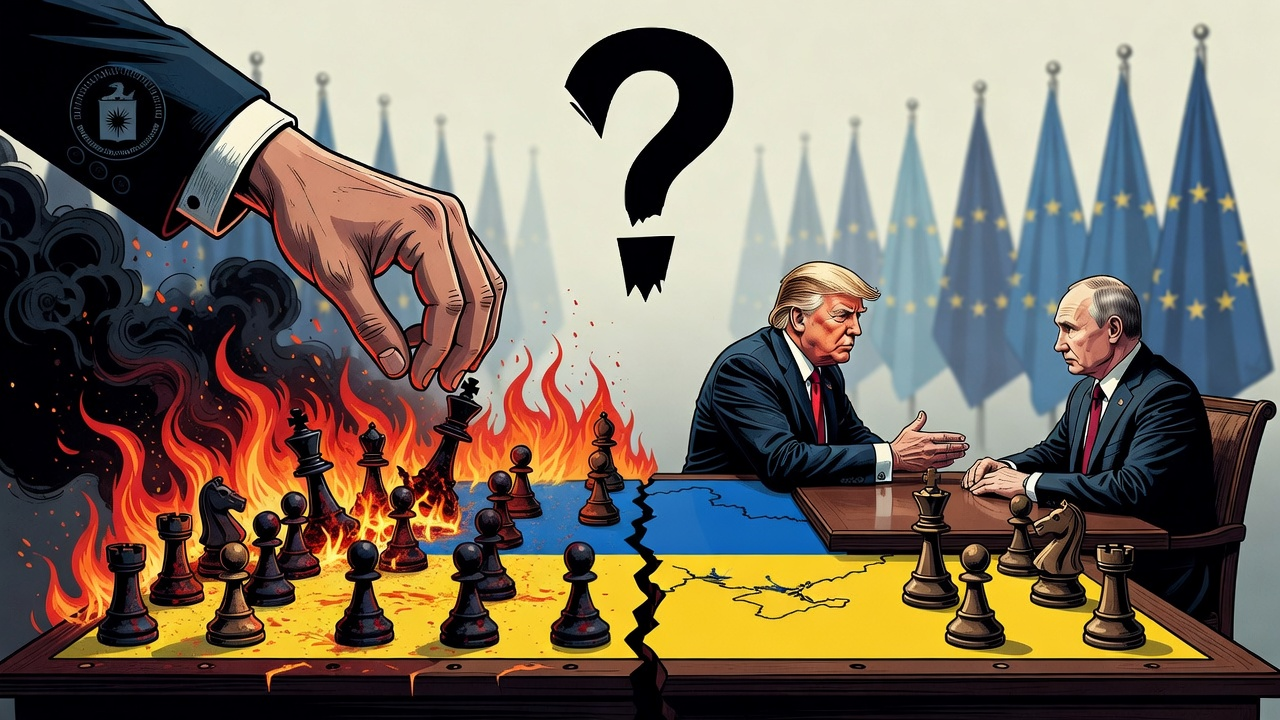
History shows that wars launched in expectation of quick capitulation often end in disaster — and the Ukraine conflict, driven by CIA operations and Western strategic miscalculation, is approaching that reckoning.
Ukraine as CIA Project
As battlefield realities shift and diplomatic negotiations expose growing divisions in Washington and Europe, the Ukraine conflict is approaching a strategic reckoning. Trump talks peace, Moscow holds its ground, Kyiv faces mounting manpower and political pressures, and the U.S. intelligence establishment appears to be pursuing a far more confrontational agenda.
I think it’s no secret the Ukraine war is a CIA war. I doubt Trump can do anything himself anyway. I’ve wondered for a while if the anti-Russia pro-war EU isn’t also being manipulated by the CIA. When they run out of Ukrainians, they need another source of cannon fodder.
All the while Trump talks peace as the CIA fuels the war in Ukraine, as the title of a recent commentary explains so well. The central problem is not Trump or Putin. It is an intelligence apparatus that appears to have an agenda of its own. The war continues not simply because of political disagreements between Washington and Moscow, but because elements of the U.S. national security establishment have institutional interests that run counter to ending it.
While Trump calls Zelensky “more difficult to deal with” than Putin and urges Ukrainians to elect new leadership, his CIA is reportedly pursuing operations against Russia more aggressively than under Biden. The contradiction is striking: the CIA is helping Ukraine target Russian oil refineries even as Trump pursues deals to sell Russian diesel.
Meanwhile, his intelligence chief travels to Moscow to tell the Russians they cannot win, while reports suggest intelligence analysts are reluctant to tell the president what they actually think. This is not a coherent peace strategy. It is a government sending contradictory signals, with an intelligence agency seemingly operating according to its own rules and priorities.
Lack of Good Intentions
In reviewing the Ukraine playbook, whereby the Minsk accords were never intended to be honored by the west or their Ukrainian proxies, but were merely, in the words of the former German chancellor, Angela Merkel, to buy time for Ukraine to rearm and retake the Donbas by force. The rest is history that CIA concocted plan was destroyed by the Russian SMO starting in February 2022.
But still most of Europe, NATO, who were center stage to the mayhem that followed. They were like Hitler’s Willing Executors in having planned such a course of action. But now they cannot face facts, i.e., the situation on the ground, now that Russia is nearing a final push in reaching it strategic objectives. Turning away from Russia to the EU and US ruin has been brought upon Ukraine, and like a desperate gambler, Zelensky may now be betting the whole house in trying to recoup his losses and survive politically and physically.
It Is Time to End the War.
Even now, some of the more liberal news publications, including The Nation, are calling for an end to the war. Yet even in doing so, they wrap their arguments in a thick layer of political subterfuge. Rather than confront the underlying failures of Western policy toward Russia and Ukraine, they continue trying to shift responsibility onto Trump and Putin, portraying them as though they were somehow on the same team.
The article goes on to explain the failure of the proposed peace initiative largely through the prism of American domestic politics, while recycling the familiar and increasingly questionable narrative that Putin is somehow on his last legs. This is a convenient political storyline, but it is not a substitute for an honest assessment of the military balance, Russia’s strategic position, or the realities unfolding on the battlefield.
The central question is no longer who can win the propaganda war or which political faction can claim the moral high ground. It is how many more lives must be sacrificed before Washington and its European partners acknowledge that prolonging this conflict is not the same thing as winning it.
What Comes Next?
We shall have to wait and see what will happen—if anything. It is ironic that the pundits of war and peace are in denial in tandem with Ukrainian denials, one only has to check out the site of the Institute for the Study of War, which as of October 31, 2026 gives a narrow perspective of Russian offensives alongside claimed Ukrainian counterattacks and some localized advances.
History may ultimately judge the Ukraine conflict not simply by who prevailed on the battlefield, but by whether the governments that helped shape the confrontation ever seriously considered the political, economic and human fallout of a shooting war that diplomacy should have prevented—if that had been the desire.
Ukraine may now be confronting its own version of that historical reckoning.
The Minsk revelations, particularly Merkel’s acknowledgment that the agreements gave Ukraine time to strengthen its military, raise a fundamental question: was diplomacy ever intended to produce a lasting political settlement, or had it become an instrument of strategic postponement? If the CIA and other Western intelligence and security institutions were instrumental in shaping a longer-term strategy to weaken Russia through Ukraine, the battlefield has exposed the extraordinary risks of that calculation.
The extent of direct CIA operational control remains a question that will merit academic research as history is written. It is clear that Washington’s extensive intelligence sharing, military and its financial support prolonged the fighting Ukraine far beyond the point of diminishing returns.
And what of Europe?
Having committed its political credibility, economic resources and security architecture to this confrontation, European leaders now face an uncomfortable dilemma. How does one acknowledge strategic failure without admitting that years of policy, enormous financial commitments and Ukrainian lives may have been sacrificed to assumptions that proved disastrously wrong?
There is an even more disturbing question: if Ukraine can no longer sustain the human cost of the conflict, will European governments seek to expand their own military commitments rather than reconsider the strategy that brought them here?
Meanwhile, Zelensky faces a particularly consequential choice. Continuing the war carries mounting military, demographic and economic costs; negotiating carries enormous political risks. Yet prolonging a conflict simply to avoid confronting an unfavourable negotiating position could leave Ukraine with even less leverage and fewer options.
A government cannot indefinitely gamble the future of its country in the hope that the next Western weapons package, intelligence assessment or political promise will reverse the strategic and tactical reality on the ground.
And perhaps this is the most uncomfortable question of all: when the supply of Ukrainian soldiers, public patience and Western political goodwill begins to run out, who will be expected to pay the next instalment of this war?
If this conflict began as an attempt to contain Russia, it has become a test of the strategic judgment of the very governments that embraced that objective. The ultimate irony may be that, in seeking to weaken Moscow, the West has helped produce a militarized, devastated Ukraine, a more dangerous European security environment and a confrontation that has exposed the limits of Western power.
Who Decides the Endgame?
The endgame may not be determined by Washington’s rhetoric or Brussels’ declarations, but by what is happening on the ground—and what Russia is prepared to accept at the negotiating table.
The historical verdict will not be determined by press conferences in Washington, Brussels or Kyiv. It will be written by the territorial realities and the people left to live with the consequences.
A proxy war can be prolonged by outside powers, financed by taxpayers and fought by another country’s population. But it cannot be made winnable simply by refusing to acknowledge that the original strategy has failed.
Via https://journal-neo.su/2026/11/07/the-endgame-when-the-cia-proxy-war-runs-out-of-ukrainians/

