Unknown's avatar

About stuartbramhall

Retired child and adolescent psychiatrist and American expatriate in New Zealand. In 2002, I made the difficult decision to close my 25-year Seattle practice after 15 years of covert FBI harassment. I describe the unrelenting phone harassment, illegal break-ins and six attempts on my life in my 2010 book The Most Revolutionary Act: Memoir of an American Refugee.

US must cut military, intelligence assistance to Israel to protect Iran deal

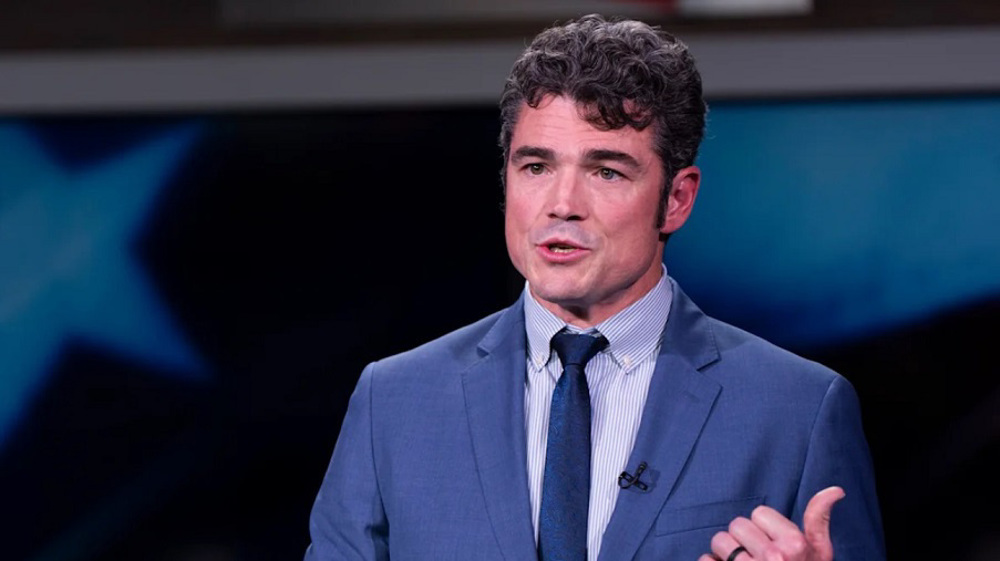
Joe Kent, former official in US President Donald Trump’s administration

Press TV

A former official in US President Donald Trump’s administration says cutting US assistance to Israel could help strengthen the agreement between Tehran and Washington, amid the Tel Aviv regime’s continuous attempts to sabotage regional peace.

Joe Kent, who left the administration after disagreements over the United States’ joint unprovoked aggression against Iran alongside the regime, made the remarks in a post on X on Monday.

He welcomed the prospect of the conclusion of a memorandum of understanding between Tehran and Washington that could be followed by an agreement.

Kent said the durability of any agreement with Iran could be improved if the United States reconsidered its military and intelligence support for the regime, saying that Israeli officials have opposed efforts to achieve a diplomatic settlement.

The former Trump administration official said Washington should seek to eliminate factors that could prompt the US to resume the aggression “on Israel’s terms.”

A day earlier, Iran’s Foreign Ministry had announced that the MoU had been finalized and would be officially signed in Switzerland on Friday.

On April 7, Trump announced a ceasefire in the aggression, which had begun targeting the Islamic Republic on February 28 amid widely-reported Israeli instigation.

The announcement came amid decisive and successful Iranian retaliation and after the Islamic Republic announced closure of the Strait of Hormuz to enemies and their allies.

Following the announcement, though, the Israeli regime would keep violating another ceasefire in Lebanon, despite Tehran’s insistence that cessation of aggression should encompass all fronts.

Kent also advocated reducing the US military footprint at bases in the Persian Gulf’s littoral states.

“We should also quietly get our troops out of the bases in the [Persian] Gulf that can be reached by Iran,” he wrote.

Iran’s retaliation featured strikes on American outposts in the Persian Gulf’s coastal states that had allowed their territories to be used as launchpads for attacks on the Islamic Republic.

[…]

Israel Fails to Sabotage Islamabad Accord… At Least for Now

This is as Close as the US and Iran Will Get to Signing an MOU

Well, when news broke that Israel had bombed the southern suburb of Beirut on Sunday afternoon, the Iranians started gearing up for promised retaliation only to be dissuaded by a Donald Trump bribe. Iran and the US reportedly were closing in on an agreement based on Iran’s 14-point plan when the Israeli strike in Lebanon threw everything into chaos. Iran quickly started ramping up for a renewed missile strike on Israel, but Donald Trump rump reportedly offered Iran financial incentives to not attack Israel.

Iranian media outlet Mehr reported that a 14-point memorandum of understanding between the US and Iran calls for the release of $24 billion in frozen Iranian assets during a 60-day negotiation period, with half of that — $12 billion — required to be made available to Iran before negotiations even begin. The MOU also reportedly includes immediate and permanent cessation of war on all fronts including Lebanon, a US commitment not to interfere in Iran’s internal affairs, lifting of the naval blockade within 30 days, and reopening of the Strait of Hormuz under Iranian arrangements.

Trump essentially offer Iran a bribe to not attack Israel. Hedeclared on Truth Social that the US deal with Iran was “now complete,” authorizing the toll-free reopening of the Strait of Hormuz and the immediate removal of the US.naval blockade, instead of waiting 30 days. He also agreed that Iran could receive the $12 billion as soon as the ceasefire agreement was signed on Friday.

With that change, the Supreme National Security Council of Iran confirmed the achievement of an agreement between the United States and Iran:

“The Islamic Republic of Iran, under the leadership of its martyred leader, has completed its success over the American-Zionist enemy and, under the guidance of the Supreme Leader of the system (may God protect him), with the support of the entire nation and the diligent efforts of Islam’s warriors, after a difficult and intensive several months of negotiations and based on the resolution of the Supreme National Security Council, finalized the text of the Memorandum of Understanding regarding negotiations to end the war (negotiations in Islamabad) between Iran and the United States on the evening of June 14.

According to the agreements reached, the war and military operations on all fronts, including Lebanon, will end immediately and forever from tonight, and the naval blockade against Iran will be immediately and fully lifted. The signing of this Memorandum of Understanding will be officially carried out on Friday, June 19. Negotiations for the final agreement will be postponed until the other party fulfills its obligations in accordance with the Memorandum of Understanding. The Islamic Republic of Iran highly values the efforts of the Islamic Republic of Pakistan and the government of Qatar.”

But before you start popping champagne corks you must understand that Trump administration officials — mostly unnamed — are painting a different picture of the agreement. For example, a senior U.S. official rejected Iran’s claim that it would receive $12 billion in frozen assets unconditionally before the start of the 60-day negotiations, describing the assertion as “a spin,” Axios reports:

This is completely not true. This is a pay-for-performance deal, and no frozen funds will be released without the Iranians implementing their commitments,” the official said.

The point is simple… Major differences remain between the US and Iran regarding the details of the proposed MOU. Even if those details are eventually ironed out and a letter signed on Friday with both sides confirming their mutual agreement to the 14 prinicipals spelled out in the final MOU, this will mark the start of a negotiations process that will last at least two months, if not longer. And, at any time in the succeeding days, a US or Israeli violation of the MOU will likely lead Iran to renew its attacks on Israeli and/or US military targets.

[…]

Via https://sonar21.com/israel-fails-to-sabotage-islamabad-accord-at-least-for-now/

A Nation of Suspects

Some of the recent legal challenges to the use of surveillance by the Department of Homeland Security upon Americans have resulted in the revelation of truly terrifying behavior by the government, in direct defiance of the Fourth Amendment to the Constitution. We now know that the federal government spies on innocent Americans without suspicion and without warrants.

The spying seems to fall into several categories. The National Security Agency, which is in the Department of Defense, employs about 60,000 domestic spies. These are the folks who want us to believe that they go through the trouble of making applications to the Foreign Intelligence Surveillance Court for warrants to spy on foreigners.


Actually, from time to time they do go to this court, but their travels there — where judges are frisked upon entering and leaving the courthouse by the NSA agents who appear before them — serve as fig leaves for their massive warrantless spying on Americans. The FISA Court is unconstitutional because it issues warrants based on probable cause of communicating with a foreign person, rather than on probable cause of crime as the Fourth Amendment requires.

The courts have ruled consistently since the 1960s that spying — surveillance, as the feds call it — is a search, and the capture of data from a surveillance is a seizure.

The Fourth Amendment protects all persons in America — not just Americans — from warrantless searches and seizures of their “persons, houses, papers, and effects.” There are some well-recognized exceptions to this constitutional baseline, such as evidence that will quickly vanish or be seriously degraded, but those exceptions do not apply here as the NSA captures in real time all keystrokes on all digital devices and all fiber optic data transmitted into, out of and within the United States.

The judges of the FISA Court surely know that the Department of Justice lawyers and NSA agents who appear before them are going through a charade, and the court has been made a part of it. The charade is the pretense that all spying is done pursuant to the warrants that FISA Court judges issue. Former NSA agents have revealed publicly that this is hardly the case.

Nevertheless, the lowered standard from probable cause of crime to probable cause of communicating to a foreign person was crafted by Congress — in another of its many moments heedless of the Constitution. After a few years of this, the FISA Court began to issue warrants for spying on the Americans who communicate with foreigners, out to the sixth degree. A sixth grader can do the math, as this leads to hundreds of millions of Americans whose communications are captured.

A second category of spying is employed by the DHS. The DHS — now a 250,000-person strong federal police department nowhere countenanced by the Constitution — has sophisticated software that can read fingerprints at 15 feet and irises at 15 inches. So, if you wave goodbye or good riddance to an ICE agent, and he holds up his mobile phone, and you are in the federal system for any benign reason, he has captured your bank, health, legal and commercial records on the spot. If he talks to you in your car and is within 15 inches of your face, he can capture the same data.

As if all this were not enough, the feds and local police use a device called a Stingray, which mimics the signal sent to all mobile devices as if the device were being used to communicate. But the communication is just one way, as the Stingray will tell the government where the person possessing the mobile device is at any given moment. This, too, is a seizure of private personal information — the contents of the computer chip in your mobile device — which the Fourth Amendment characterizes as an “effect.”

And then there is the FBI, which now uses zero-click software. This permits agents without warrants or even approval of their superiors to engage in computer hacking without having to trick the hacked victim into clicking on a link. Computer hacking is a felony.

All of this surveillance is unconstitutional, dangerous and commonplace. It consists in the use of surveillance and law enforcement tools without articulable suspicion.

For 600 years, articulable suspicion — the lowest evidentiary standard we have — has been the baseline for all government behavior that targets an individual. Articulable suspicion is the fact-based ability to state why a person — not a group — should be targeted and for what crime. This is the same standard that must be met when police stop someone in public.

Anything less than articulable suspicion is a fishing expedition; stated differently, a general warrant. General warrants — which were used by British agents on American colonists — permitted the agents to stop anyone, to search anywhere and to seize anything without articulable suspicion. The Fourth Amendment outlawed them.

How did we get from a Constitution that assumes that the individual is sovereign, our rights are natural and inalienable, and the government may only legally do what the governed have affirmatively authorized it to do to where we are today? The answer is fear. Fear is the great tool for authoritarians — fear of foreigners, fear of war, fear of crime, fear of drugs, fear of terror. When people are afraid, they will allow the government to take liberty in return for a promise of safety.

Of course, liberty once surrendered is never returned. But liberty is individual, not collective. You can surrender your liberty and your neighbors can surrender theirs, but none of you can surrender mine. These values are what animated Thomas Jefferson in the Declaration and James Madison in the Bill of Rights. Those animations seem like ancient history today. On the eve of America’s 250th anniversary, the Founders would not recognize this country of no values where everyone is a suspect.

[…]

Via https://www.activistpost.com/a-nation-of-suspects/

Geopolitical fatigue

Unfolding Direct Effects of Geopolitical Shifts Upon Enterprise ...

Dmitry Orlov

June 14, 2026

Are you tired of geopolitics? I know I am! More and more, it seems like a ploy for keeping pundits and analysts and internet talking heads talking and to keep you looking at online advertising. And so, for a change, I’d like to write about something else. But first, let me briefly describe the geopolitical landscape I wish to leave behind.

First, we have the United States. It is figureheaded by a man who is dawdling toward senescence but still manages to draw a lot of attention to himself. He keeps everyone in thrall by saying one thing in the morning and another in the evening. There is no rational explanation for his behavior except that it is driven by a desire to further enrich himself and his family through insider trading, as follows, explained in the simplest terms possible, using a bit of pseudocode.

Step 1. Trump clan sells stocks, buys oil futures. Trump announces: “I will destroy Iran!” Stocks tank, oil rallies.

Step 2. Trump clan buys stocks, sells oil futures. Trump announces: “I make deal with Iran!” Stocks rally, oil tanks.

Step 3. Go to step 1.

It is something that’s known as an “infinite loop” but in real life nothing lasts forever and at some point the oil futures and equities traders start discounting his pronouncements. The more intelligent ones probably already have but the robots which do most of the trading these days still haven’t and they are yet to be reprogrammed to ignore Trump. Once they are, Trump’s scheme will stop working. It remains to be seen whether or not he is capable of noticing such a fact. But it is notable that everyone else seems to be ignoring Trump’s geopolitically themed insider trading. The reason for this is that money is more important than self-preservation.

Ignoring its self-serving figurehead, we are waiting for the United States to make a very important financial decision: will it choose endless horror (runaway debt, hyperinflation, social explosion and political collapse) or a horrible end (national default and bankruptcy, economic shutdown, social explosion and political collapse). A little of both is also not out of the question. The new Federal Reserve chairman is quite forthright about the choices: they are all bad.

Moving on to Europe, there is nobody in charge in Europe who is even remotely capable of speaking intelligently on the topic of geopolitics. The main political tactic for the last decade or so has been to mask economic and social decline using Russophobia: Russia bad; hence all the problems. But they seem to have gotten carried away with threatening Russia to a point where Russia is not even threatening them but grinding a very big axe with which to chop them into tiny, insignificant bits. Some of the Europeans have noticed and are trying to pick someone who is capable of walking in and speaking to the Russians. It can’t be someone whom the Europeans regard as pro-Russian and it can’t be a Russophobe with whom the Russians will refuse to talk. These two sets appear to be to be disjoint (A∩B=∅).

Hence, Europe is at an impasse diplomatically. Meanwhile, the Europeans can’t stop themselves from giving drones and rockets to the Ukrainian. This further irritates Russia and causes it to accelerate the axe-sharpening. That is because there is money in drones and rockets and money is more important than self-preservation.

This is something of a refrain. Such behavior is certainly foolish, and this bring to mind an old saying: “A fool and his money are soon parted.”

Outside of the United States and Europe lies a geopolitical terra incognita — the vast domain of other civilizations (Persian, Chinese, Russian, Indian, etc.). They are older than the West and different from it and therefore far too complex for a short online article or an hour-long online interview, remaining inscrutable. Any attempt to comprehend these other civilizations from the Western point of view turns, at best, into a futile quest to weigh objects using a ruler or to bail water with a sieve or, at worst, into an exercise of projecting the shadow (“…a Jungian psychological defense mechanism where an individual unconsciously attributes his own disowned thoughts, impulses, or unacceptable character traits to someone else.”) Someone should write a succession of weighty tomes on this subject. But then, would anyone bother to read them when everybody is too busy watching online videos?

[…]

Via https://boosty.to/cluborlov/posts/7e5414dc-f03d-4e95-a956-e4beeea719aa

Ebola: Public Health Crisis or Criminal Enterprise?

Ebola FI

Photo Credit – © Canva Pro Content License

By NZDSOS Media Team

Hot on the tail of hantavirus histrionics, the World Health Organization (WHO) declared on 17 May 2026 that an epidemic of Ebola disease caused by Bundibugyo virus in the Democratic Republic of the Congo and Uganda is a public health emergency of international concern (aka a PHEIC). As the 79th session of the World Health Assembly wrapped up last week, it is easy to see the priorities of WHO in these four brief headlines from the front page of their website. Without frightening diseases, how will the pandemic agreement be reached, or the global health architecture be built?

What is Ebola?

Ebolavirus belongs to the Filovirus family, named for their thread-like appearance under electron microscopy (‘filum‘ is Latin for ‘thread‘). There are six known subtypes, four of which are associated with human disease. It is claimed that wild animals are the source of initial infection, followed by human-to-human transmission via direct contact with the blood and body fluids of an infected person.

Ebolavirus disease (EVD) presents initially as an influenza-like illness, followed by vomiting, diarrhoea, skin rash, impaired kidney and liver function and impaired neurological status with confusion, irritability and aggression. Internal and external bleeding from any organs can occur, but is less frequent than the aforementioned symptoms.

Ebola History and Epidemiology

According to Laurie Garret in The Coming Plague (1994), the first case of EVD was detected in August 1976 in a school teacher from Yambuku in Northern Zaire (now the Democratic Republic of Congo or DRC), near the Ebola river. The subsequent outbreak in this region occurred simultaneously to an outbreak in Southern Sudan. A public health investigation dispatched virologists and epidemiologists from their laboratories in Europe and North America, into the deep heart of the African continent.

Tissue specimens were sent to laboratories in Europe and the USA to determine a causative agent. On 10 October 1976 scientists at the Centers for Disease Control maximum security laboratory in Atlanta officially informed the World Health Organization that the causative agent was “a virus that resembles Marburg“.

Serial passage experimentation began almost immediately, “passing Ebola samples from one guinea pig to another to see if the virulence of the virus was diminished as it went through successive generations of animals“. A contamination incident in a UK laboratory resulted in at least one researcher becoming unwell and being successfully treated with plasma from a recovered African patient.

Since that time, there have been more than 25 EVD outbreaks involving the loss of 15,000 lives across a fifty year timespan. Seventeen of these outbreaks have occurred in the DRC, also currently affected, which was also ground zero for MPox in 2022. Most outbreaks have been confined to rural areas in five of Africa’s 54 countries: Sudan, DRC, Gabon, Republic of Congo and Uganda.

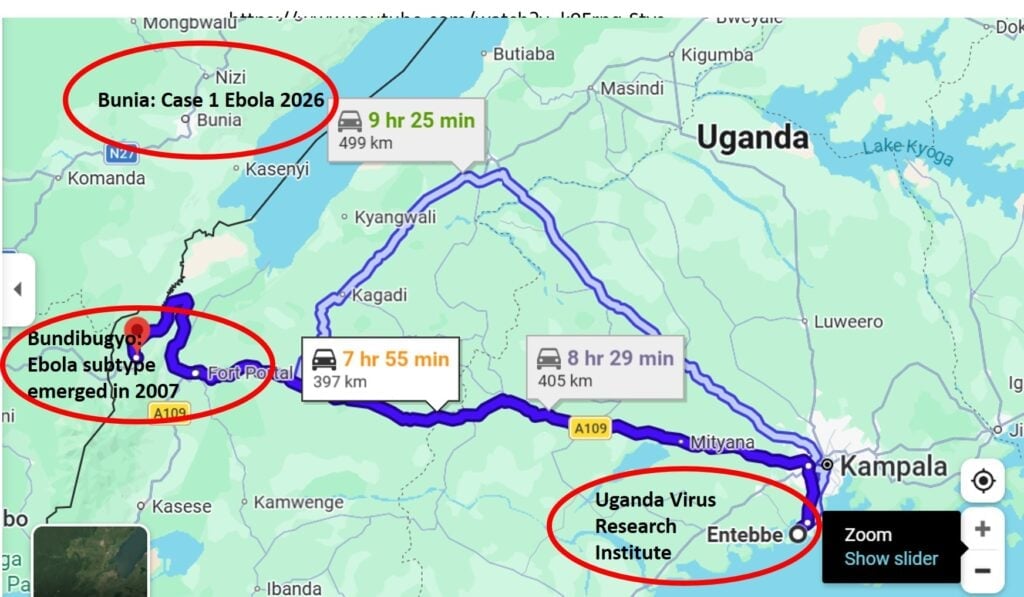
The Bundibugyo subtype, responsible for the current public health emergency of international concern (PHEIC), was first identified in the Bundibugyo region of Uganda during an outbreak in 2007. A second Bundibugyo outbreak followed in the DRC in 2012, and today’s outbreak is the third involving this subtype.

For context, in the year 2024 alone, tuberculosis killed 1.23 million people; and malaria killed 610,000 people. The African continent bears the highest burden of these diseases.

How is Ebolavirus Disease Diagnosed?

Clinical symptoms of EVD are difficult to distinguish from other infectious diseases such as malaria, typhoid fever and meningitis which are endemic to the geographic region where EVD outbreaks sporadically occur. A range of diagnostic tests have been developed to confirm presence of Ebolavirus.

World Health Organization recommend nucleic acid amplification testing (NAAT), of which PCR is a frequently used technique, with genome sequencing to categorise the subtype. As at 22 May 2026, Africa Centres for Disease Control and Prevention recommend PCR testing as below.

It is important to always remember the flaws and potential corruptibility in using PCR to diagnose disease, especially when symptoms may be caused by other, more common endemic diseases. Pseudoepidemics can occur in world class facilities. A much higher risk exists in locations with limited resources and an abundance of sickness and premature death, especially if panic and fear have been galvanised, as we are witnessing today.

How is Ebolavirus Treated?

Early treatment ensures the best possible outcomes, as with any disease. Hydration management via oral or intravenous fluids is important. Monoclonal antibodies may be useful, depending on the subtype. There has been no research into the benefits of repurposed drugs in Ebola treatment but it seems likely that ivermectin and hydroxychloroquine, effective in other RNA virus infections, may be useful. Instead, the World Health Organization and their sponsors are focused on finding new countermeasures (vaccines and therapeutics) to patent and sell at profit.

What Causes an Ebola Outbreak?

According to the World Health Organization, Ebolavirus is “transmitted to people from wild animals (such as fruit bats, porcupines and non-human primates).” Contact with the blood or body fluids of an infected person can then result in human-to-human transmission.

What this assertion ignores however, is the Ebolavirus gain of function research occurring in laboratories across the globe, including across the region where these sporadic outbreaks occur. Such research is always claimed to be for reasons that are in the public’s best interest, for example developing countermeasures such as vaccines and therapeutics. Yet the work is shrouded in secrecy.

In a 2015 report on Ebola research at the Commonwealth Scientific and Industrial Research Organisation (CSIRO) in Geelong in Victoria, SBS held firmly to the claim that Ebola outbreaks are due to crossover from wild animals. Nevertheless, the same report stated that:

“If any of these viruses were to make it out of the lab, it could have deadly consequences“.

In the USA, Rocky Mountain Laboratories in Montana is known to be infecting animals with a range of pandemic-potential viruses including Ebola. The research involves torturing animals known as maximum-pain virus experiments.

The White Coat Waste Project has exposed a number of biosafety breaches in these laboratories which pose a threat to public health, setting aside the welfare of the animals for a moment.

Late last year during experimentation with Crimean-Congo Haemorrhagic Fever, a staffer was “bitten by an infected monkey (macaque) that was being tortured (infected and sickened with no pain mitigation).” Earlier this year Vincent Munster, a virologist at the Rocky Mountain Laboratories, was caught smuggling dangerous pathogens including Clade 1B MPox, from the DRC into the USA.

The US Army Medical Research Institute of Infectious Diseases (USAMRIID) at Fort Detrick, 50 miles from Washington DC, employs 900 researchers to experiment with “biological threats” including Ebola. USAMRIID developed Ervebo, the first Ebola vaccine, licenced in 2019.

On the African continent, where regulation has even less oversight, a number of laboratories are likely to be involved in gain of function research. The proximity of these laboratories to the “ground zero” of outbreaks gives pause for thought to even the least conspiracy-minded amongst us.

In our August 2024 MPox article, we raised suspicions about the Rodolphe Mérieux Foundation’s high security facility in Goma, DRC.  Situated in North Kivu Province, eastern DRC, Goma lies on the border with South Kivu Province, around 500km from Kamituga, where Clade IB of MPox was first detected. That alone is a coincidence deserving of raised eyebrows. Even more suspicious, is the fact that ground zero of the current Ebola outbreak lies a very similar distance from Goma, in the opposite direction.

The first case of Nipah virus, in a much-publicised outbreak earlier this year, was detected in Kolkata, the provincial capital of West Bengal in India. This is approximately 500km from another Rodolphe Mérieux Laboratory at the Bangladesh Institute of Tropical and Infectious Diseases in Chattogram (Chittagong).

Mérieux Laboratories are partnered with local reference laboratories, academic, university and hospital research institutes across low income nations in what they named the GABRIEL Network – an acronym for “global approach to biology research, infectious diseases and epidemics in low-income countries.” The stated aim is “to build capacity and improve laboratory-based surveillance of diseases with a major impact on public health in developing countries.” Sponsors include the Bill & Melinda Gates Foundation, among others.

Could this potentially be a front for more nefarious activities? As we documented in March 2026, the Coalition for Epidemic Preparedness Innovations (CEPI) was established in 2017 at the World Economic Forum in Davos and received a significant amount of early funding from the Bill and Melinda Gates Foundation. It is a direct institutional descendant of the pandemic preparedness funding architecture documented in the Epstein files.

In January 2026 CEPI paid $26.7 million to Moderna and the University of Oxford to develop mRNA and viral vector injections that target the Bundibugyo strain. This business decision came just four months before the outbreak began. What are the chances that this timing was coincidental?

One of the many projects listed at the Uganda Virus Research Institute in Entebbe, receiving philanthropic donations from Wellcome Trust and the Bill & Melinda Gates Foundation, is CEPI: Advancing Global Vaccine Preparedness. The project claims to conduct “rigorous, standardized testing of vaccine candidates for priority diseases, including Ebola, Marburg, Lassa, Nipah, Rift Valley Fever, SARS-CoV-2, Mpox, and unidentified emerging threats“, and to develop and optimise “critical assays for the detection of immune responses against Ebola and Marburg viruses.”

Is it possible that this laboratory is working with live Ebolaviruses? Could that explain the laboratory’s uncanny distance from Bundibugyo, a town and district in western Uganda where the current outbreak strain was first identified in 2007? Bundibugyo and Bunia are about 270km apart and recent reports claim that the outbreak is spreading in Uganda. Do the Rodolphe Merieux Laboratory in Goma and the Uganda Virus Research Institute in Entebbe have anything to do with these outbreaks that are being blamed on spread following contact with wild animals?

Ebola Uganda Virus Research Institute
Image captured for criticism/review and reporting current events under Fair Dealing – The Copyright Act 1994

Pandemics Profit Pandemic Prophets

University of North Carolina Chapel Hill virologist Ralph Baric, considered a pioneer of gain of function research, recently had his research grants stopped and was placed on leave by UNC Chapel Hill. This seems to be due to implications of his coronavirus research at the Wuhan Institute of Virology.

In 2018 Baric gave a 40 minute presentation, available on YouTube, in which he prophesied that a pandemic was looming. Many of the individuals who profit from claims of a pandemic have made similar prophesies. In the below clip Baric boasted to the audience about the profits that can come from a pandemic. These are consistent with similar boasting from Belgium’s 2009 Swine Flu commissioner at Chatham House in 2019.

In the current Ebola outbreak, public funds have been committed so far to the tune of US$645 million. With a grand total of 101 confirmed cases, this amounts to $6.3m per confirmed case. In a nation where the average annual income is US$670, this is obscene and irrelevant to the health or any other needs of the population.

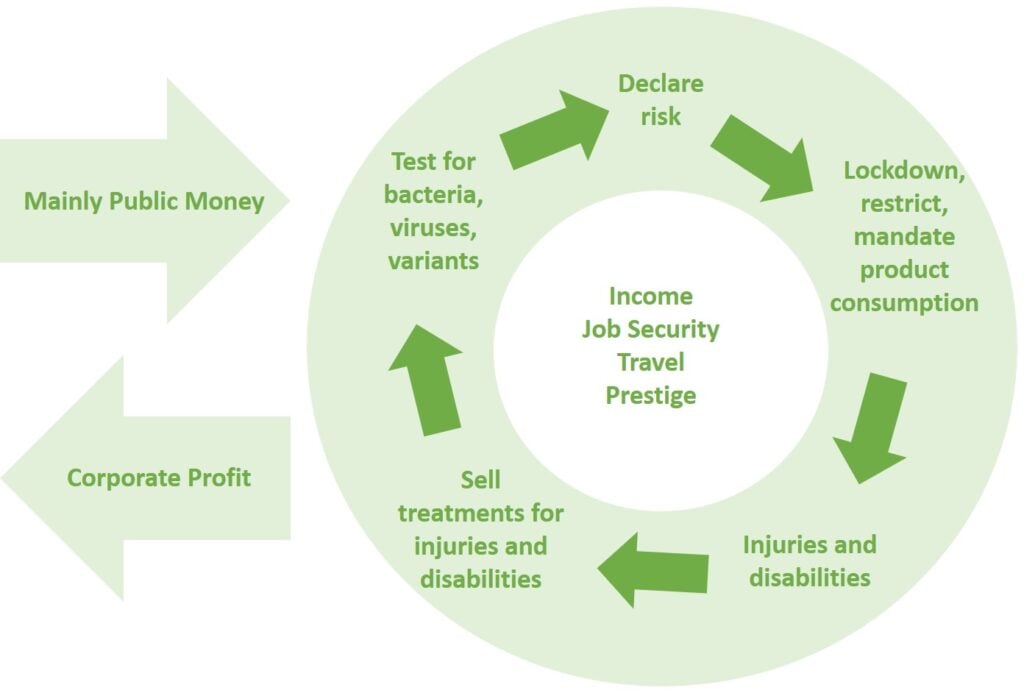
On 24 May 2026 Tedros Ghebreyesus released a video clip on social media announcing the activation of complex networks focused on developing and trialing countermeasures, therapeutics and candidate vaccines. We have written about this ponzi scheme previously, in which taxpayers cover all risk, the industry receive all benefits, and population health remains a very firm loser. The model is explained in this one easy infographic from Dr David Bell.

Ebola Pandemic Business Model
Image captured for criticism/review and reporting current events under Fair Dealing – The Copyright Act 1994

Conclusion

A number of viral haemorrhagic fevers are touted as candidates for the repeatedly-foretold “next pandemic“. None evoke more fear than Ebola. This makes it highly marketable despite the fact that it does not transmit easily and outbreaks always ultimately abate naturally.

[…]

Via https://nzdsos.com/2026/05/29/ebola-public-health-or-criminal/

Buried Before Ivermectin: Meet Chlorine Dioxide

Buried Before Ivermectin: Meet Chlorine Dioxide

Filipe Rafaeli June 11, 2026

What Was Covid-19?

I’ll give you a simple summary. And I know this summary will make a lot of people stop reading right here. If that’s you, I’ll say it upfront: I can explain why you feel that way.

The pandemic in a nutshell: Covid-19 always had very effective and inexpensive treatments, right from the start. Millions were left to die because it was, of all things, profitable.

The lockdowns, when the world stopped as it never had before in history, was never necessary beyond two weeks, because with the disease properly treated, fewer people would have died than in a common flu season.

Yes, that’s exactly what I said: millions dead for profit. For money. Does that shock you?

I know it’s a hard story to believe. I understand. Because to believe it, given that it involves an enormous number of people, institutions, medical societies, scientific bodies, regulatory agencies, all in sync to cover up and steer people away from valid treatments, you have to believe something else: that humanity, at its core, doesn’t care. It’s a blow to your faith in human goodness. That’s not easy to let go of.

Let’s Get Straight to the Biggest Contrast of Covid-19

Six years after the pandemic, some striking contrasts remain. Let’s look at the most remarkable one: the hydroxychloroquine saga.

[…]

In the US, newspapers treated the subject as a “conspiracy theory.” In Brazil, a physician named Luana Araújo appeared before Congress during a parliamentary investigation and stated that “Discussing chloroquine is choosing which edge of the flat Earth we’re going to jump off.”

[…]

And yet, despite all the clarification across every major newspaper that HCQ was “conclusively proven ineffective” against Covid, as the mainstream media put it, some physicians, clearly delusional, kept insisting that there was, in fact, evidence. Many of them were fired, faced investigations, and even lost their medical licenses. After all, only someone as deluded as a flat-earther could promote such dangerous nonsense and put society at risk.

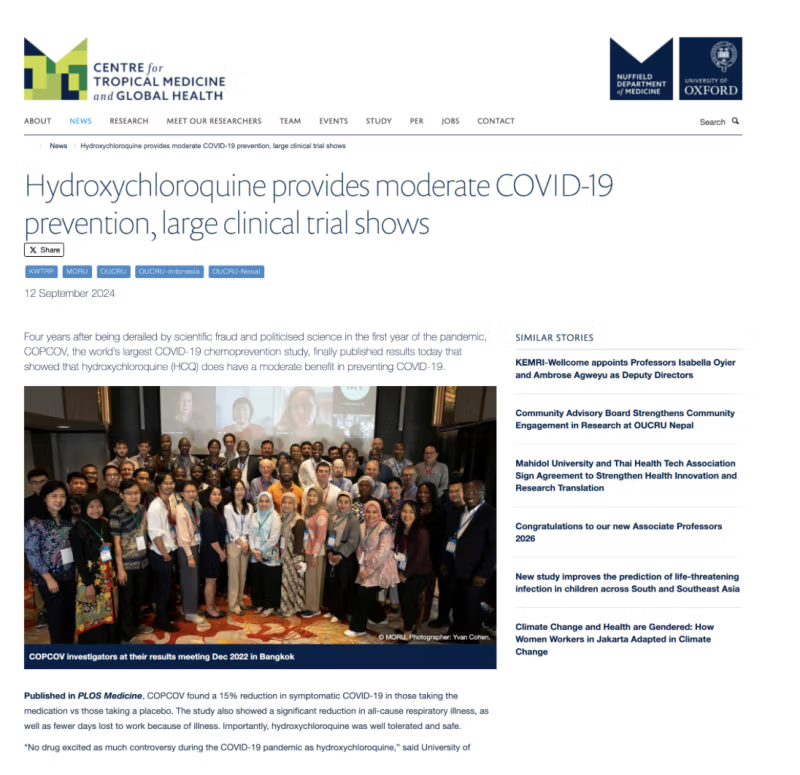
Now let’s get to the contrast. Open a link with me. It’s a news article. Let’s open it, check the website address, verify the source carefully: “Hydroxychloroquine provides moderate COVID-19 prevention, large clinical trial shows.”

No, this is not some obscure corner of the internet. It’s right there, on the University of Oxford’s website: chloroquine is effective against Covid-19. Worth remembering that Oxford consistently ranks among the three most prestigious universities in the world by any measure, competing directly with MIT, Harvard, and Stanford. With nearly a millennium of history, the University of Oxford was a cornerstone of the Enlightenment, playing a crucial role in humanity’s transition from the darkness of the Middle Ages into the age of reason and the scientific method.

Quite a contrast, isn’t it?

Things Worth Noticing About the Oxford Study

Oxford only delivered its verdict because this was a meta-analysis of randomized trials – the highest possible level of evidence a medication can reach. For reference: according to a study published in JAMA in 2019, only 8.5% of recommendations in the major American cardiology guidelines meet that standard (multiple randomized controlled trials). To flip the numbers: 91.5% of the guidelines cardiologists follow are based on weaker evidence than what Oxford presented for HCQ.

HCQ against Covid-19, then, belongs to a select group of the most thoroughly proven treatments in existence. That’s exactly why Oxford didn’t use the cautious language typical of scientific studies – none of the usual “may be effective,” followed by “further studies are needed.” They brought the hammer down: it works. Full stop.

[…]

And there’s more: the news article includes a photo of the research team. Over 70 people signed the study, not much room for argument, outrage, or grandstanding. Because outrage and personal wishes count for nothing in science. Among the signatories is Sir Nicholas John White, a scientist with an H-index above 200, the world’s foremost expert on tropical diseases. Is there anyone left foolish enough to call Oxford a “flat-earther?”

Necessary Questions About Oxford

I’d like to now move on to chlorine dioxide and say more about (Pierre) Kory’s book, but I can’t yet. I need to go a little deeper into the HCQ story first. Either way, it’s important for you to understand a bit more about how this field works. Think of it as the warmup before the main event.

The first question: why did Oxford take more than 800 days to publish the study’s results? Can you think of any reason why findings would sit in a drawer for more than two years?

Oxford conducted its gold-standard clinical trial on pre-exposure prophylaxis (that is, taking the medication before any contact with the virus, with the goal of preventing infection). In Oxford’s trial, the use of chloroquine and hydroxychloroquine showed a 57% reduction in PCR-confirmed Covid-19 cases. Then, within the same study, they conducted a meta-analysis, pooling their trial with similar pre-exposure prophylaxis studies. Every previous study also showed positive results.

The second question: why did they change the outcome measure to seroconversion midway through the study? Vaccine trials didn’t use that metric. They all used PCR testing. Seroconversion only measures whether the body produced antibodies, not whether the person actually got sick. Could changing the outcome be what made the result, as the headline put it, merely “moderate?”

A note to close this topic: this Oxford meta-analysis covers pre-exposure prophylaxis, taking hydroxychloroquine before infection to prevent it. For that use, it reached the highest possible level of evidence. But HCQ is also highly effective for early treatment, taking it in the first days after infection to prevent the disease from worsening. The evidence there is solid, though not at the same peak level. It’s also effective for post-exposure prophylaxis, taking it after contact with an infected person to prevent catching the disease. Again, good evidence, but not at the maximum tier. (Side note: it is not effective in intubated patients, in extremis, or in overdose conditions. And yes, studies conducted under overdose conditions made the front pages of the world’s most important newspapers.)

Second note: the evidence for ivermectin in Covid is also overwhelming, but I didn’t use it as my example here because I don’t have a contrast as sharp as a study from an Oxford-caliber institution. The Oxford contrast is simply devastating.

I watched all of this unfold in real time, right in front of me. And it led me to an inevitable question: what else was buried before this, throughout the history of medicine?

Chlorine Dioxide

“The Medicine That Could End Medicine;” that’s the subtitle Dr. Pierre Kory and Jenna McCarthy, journalist and co-author, chose for the book. At the very least, it’s intriguing, isn’t it? End it all. Remake everything.

They use that phrase because they believe that chlorine dioxide (ClO₂) poses an existential threat to the business model of the modern pharmaceutical industry, just as hydroxychloroquine threatened Big Pharma’s grip during Covid-19.

Chlorine dioxide is a cheap, non-patentable molecule that people can prepare at home, with reported efficacy against a wide range of infectious and chronic diseases. It could replace or eliminate the need for countless expensive, cartel-controlled medical treatments. Does that unsettle you?

But the book isn’t only about scientific evidence. It tells the story of the molecule itself, and of the people who, throughout history, tried to bring it into wider use. The result? Three suspected murders, including that of Dr. Eugene Blass, who was beaten to death in front of his own laboratory. Another survived multiple poisoning attempts. And there was even a man whose legs were blown off by a bomb planted in his hotel room. Dangerous business, messing with this topic.

Then there are the people who were imprisoned. One case involves a professor and researcher who conducted and published a highly positive study of 500 malaria patients treated with chlorine dioxide in Cameroon, Africa. He traveled to a meeting, and on his way back, someone asked him to carry a package. It contained cocaine. He was arrested for drug trafficking. And the study he had already published? Retracted from the scientific literature. The book reads more like a Hollywood spy thriller than a medical text. It’s a page-turner.

Pierre and Jenna also surface some remarkable details, like the fact that in 1987, NASA called chlorine dioxide a “universal antidote” due to its efficacy against 42 known pathogens.

One of the book’s most brilliant moments is the “Kory Scale.” It’s a satirical but grounded metric he developed to assess the likely efficacy of “unproven” therapies. The premise is simple: the effectiveness of a treatment is directly proportional to the brutality of the attacks it suffers from the medical establishment: the FDA, the media, health agencies. On the scale, media attacks are worth 4 points, imprisonments 10, and murders 50.

The hydroxychloroquine story I told above never reached the level of assassinations. There were intimidating police raids, professionals losing their jobs, others losing their medical licenses, and a staggering volume of media attacks, but on the Kory Scale, that scores relatively few points.

The book has many other striking passages, like the researcher who installed a water treatment system that eradicated malaria in an entire city. Consider the stakes: 600,000 people die of malaria every year.

But one thing needs to be said clearly. For hydroxychloroquine against Covid, we now have the highest possible level of scientific evidence, produced by one of the most important universities in the world. For chlorine dioxide, we don’t have that. But this reminds me of 2020. Early in the pandemic, the first evidence for HCQ in prophylaxis began emerging from observational studies, low on the evidentiary ladder. Yet there were many of them, from many different places, and all positive. Some scientists argued at the time that it was enough, that prophylaxis should begin immediately and the pandemic could be brought to an end. The picture, taken as a whole, was clear. Instead, everyone dragged their feet, held back, buried results in drawers, delayed studies. There was even outright fraud to derail or interrupt ongoing research, with the Surgisphere case being the most glaring example. “Monumental fraud,” said Richard Horton, editor-in-chief of the Lancet.

The book presents striking accounts of a vast range of conditions that reportedly responded to chlorine dioxide: acute infections such as malaria, HIV/AIDS, hepatitis, influenza, and multidrug-resistant tuberculosis; chronic and inflammatory conditions including autism, diabetes, Lyme disease, and hard-to-heal wounds, among them severe cases of gangrene and diabetic foot that avoided imminent amputation.

There are even case series documenting stable remissions in patients with metastatic cancer, pancreatic, prostate, and renal, who had exhausted all conventional options. Dr. Kory acknowledges that formal trials are still needed to determine the precise magnitude of the effect at scale. But the clinical impact of watching diseases labeled “incurable” simply recede is something that both astonishes and challenges the business model of conventional medicine.

Reading the book, I feel the way I did at the start of the pandemic. The evidence for chlorine dioxide, as it stands, shows a great deal. But given the violence of what surrounds this topic, I doubt anyone will ever manage to conduct large, randomized, gold-standard trials on it. One researcher who tried ended up in prison as an international drug trafficker, arrested on his way back from a meeting where he had been seeking funding for another study.

Who This Book Is Not for

If you don’t find the Oxford hydroxychloroquine story important, if it didn’t leave you shaken, this book is not for you.

Think carefully about what happened: with the efficacy Oxford confirmed for prophylaxis, the pandemic could have been over in 2020. One month of lockdowns at most, not a year and a half. Lockdowns that permanently shuttered small businesses, that generated the largest transfer of wealth from the poor to the rich in human history, that destroyed the livelihoods of millions of families, that left lasting illness and psychiatric damage in its wake. If all of that seems reasonable to you, this book is not for you.

[…]

Via https://brownstone.org/articles/buried-before-ivermectin-meet-chlorine-dioxide/

Ukraine as a laboratory of technofascism

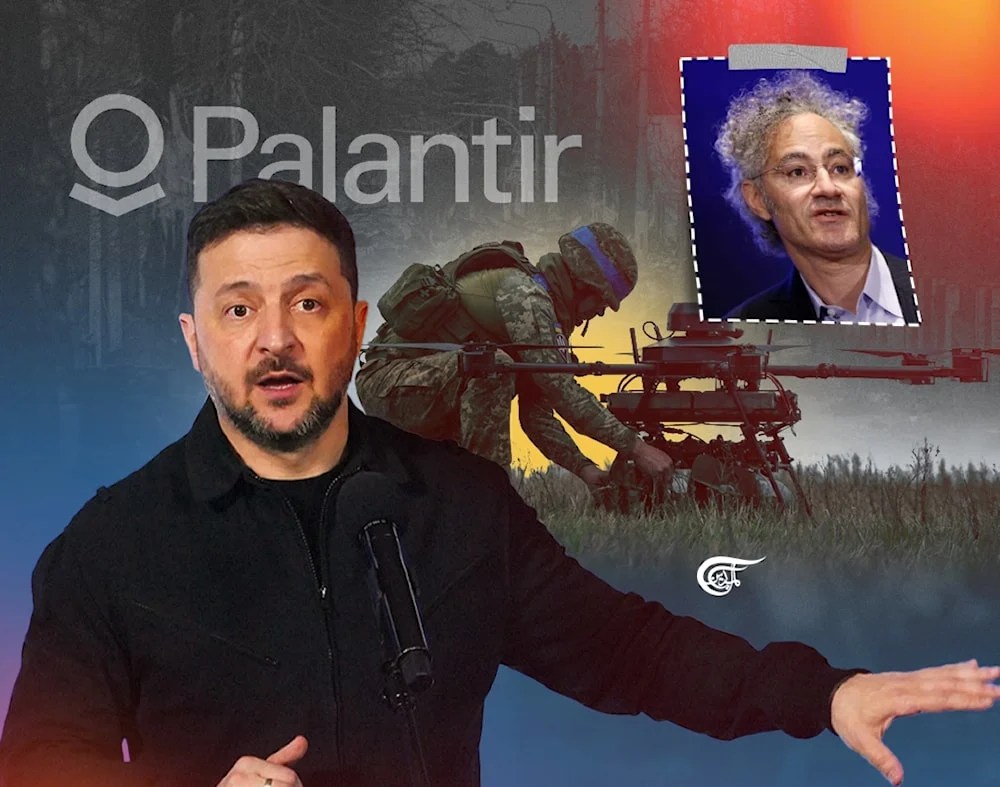
The goal of Zelensky and his lobbyists in the West is to main their own survival even while living in bunkers (Al Mayadeen English, illustrated by Ali al-Hadi Shmeiss

Al Mayadeen English

June 14, 2026

Ukraine has become a testing ground for Western military technologies, AI-driven warfare, and defense industry interests, with the conflict increasingly serving geopolitical and corporate objectives beyond Ukraine itself.

For its part, the government in Kiev, whose mandate has expired, is focusing on drone strikes against oil refineries and shipping terminals in Russia. This fits into the overall strategy of the Western, NATO powers to deprive their economic competitors of oil supply in the struggle to maintain global hegemony. This can also be seen further in the continued, debilitating attacks and sanctions aimed against the peoples of Iran, the Middle East as a whole, and Venezuela and Cuba.

In late May, Ukrainian President Volodomyr Zelenskyy issued a five-page, open letter to US President Donald Trump dated May 26, requesting that more missiles be supplied as soon as possible. As noted by the Ukrainian analytical Telegram channel Rubicon on May 30, “While arms deliveries were previously discussed rather privately, now everything is taking the form of public appeals of ‘Donald, help us, and fast!’.

Rubicon writes, “The goal of this move by Zelensky is not only to needle Trump’s pride but also to elegantly shift blame onto the White House for recent missile and drone strikes by Russia on military sites in and around the Ukrainian capital. Washington has been slow to condemn these attacks and slow to continue its supply of missiles to Ukraine’s armed forces.”

A former lawmaker from Zelensky’s party-machine, Alexander Dubinsky, wrote on Telegram May 31 that overall, Zelensky’s letter amounts to an ode to himself, as in: ‘I allow you to touch my greatness and become part of it by allocating more money and missiles.’

The US government did not respond publicly to Zelensky’s letter. The Ukrainian opposition Telegram channel Kartel comments on May 31, referencing the high-profile corruption scandal involving Zelensky’s friend who has since fled to “Israel”: “Let us recall that Zelenskyy’s friend Timur Mindich stole over $1 billion allocated for weapons production, as uncovered by NABU [National Anticorruption Bureau] investigations. So it’s no surprise that after exposures of such corruption, the Americans would choose to ignore Zelensky’s outburst.”

Zelensky’s letter also demands that the US grant licenses for the production of Patriot missiles in Ukraine. But the US military has been proven unwilling to share production of its known and tested military technologies. It has shown willingness to share new weapons systems, evidently as part of ‘testing’ programs.

The letter by Zelensky criticizes the slow pace of Patriot missile production in the US itself, adding that this could lead to crises in various other parts of the world. According to the letter, Ukraine-produced weaponry could help protect US allies in the Middle East. In other words, the man is proposing that the US also continue selling or supplying missiles and other weapons to “Israel” and the United Arab Emirates for use against Iran.

Despite Trump’s various, so-called peace initiatives to end the war in Ukraine, voiced for several years now, Victoria Fedosova, deputy director of the Institute for Strategic Studies and Forecasting at the Peoples’ Friendship University of Russia, believes that Trump is merely proposing a high-profile display of negotiations between Moscow and Kiev that would lead nowhere. In the meantime, Washington continues to supply Kiev with weapons and intelligence, some of which are being used against the civilian population of Russia. During the night of May 23 (Ukraine time), US-made Hornet drones struck a teacher college dormitory for women and girls in the town of Starobelsk in the Lugansk People’s Republic, which was annexed by Russia, killing 21 and wounding dozens more.

Despite all of Trump’s ostentatious rhetoric, there is no sign he intends to pressure Zelenskyy to end the proxy war against Russia. Moreover, Chinese media reported on June 2 that he has also asked Chinese leader Xi Jinping to pressure the Russian president to end the war; that is, end Russia’s responses to the NATO proxy war on the West’s terms.

Pete Hegseth, the US Secretary of War, has also stated that Washington will continue to find a way to help Ukraine ‘defend itself’ (code language for waging NATO’s proxy war). He made this remark at a meeting on Asian security issues in Singapore, according to Clash Report on Telegram on May 30. (Clash Report is an online news platform aligned with the views of the Turkish government.)

Hegseth also noted that the US continues to study and learn from Ukraine’s experience with the use of drones on the battlefield. He says it is vastly increasing its investments in this area. In other words, the continuation of the conflict in Ukraine benefits the US by serving as a laboratory to test new types of weapons and study the reactions by the Russian army, even though these often pose a threat to Ukrainians themselves.

As the Ukrainian Institute of Politics notes in this regard, Pete Hegset’s statements are particularly telling when viewed against the backdrop of earlier remarks by Donald Trump. In March of this year, following the escalation of the conflicts in West Asia, Trump claimed that the US had no need for Ukrainian expertise in the field of drones. However, “Judging by the current rhetoric of the U.S. Secretary of War, the situation has changed: Washington effectively recognizes the value of Ukrainian experience and is ready to scale it up in its own defense policy.

“This US approach fits directly into Trump’s business logic—war as a market where Washington ramps up production, sells weapons, and simultaneously strengthens its own technologies. In this model, Ukraine is already an asset that generates knowledge, tests technologies, and creates demand for the American defense industry,” writes the Ukrainian institute.

Iran warns ‘no point’ in deal with US if Israel remains unrestrained

(Photo credit: Majid Asgaripour/WANA via Reuters)

The Crade

June 14, 2026

Another top Iranian official said Washington’s ‘rabid dog’ must be ‘controlled’ following Israel’s latest strike on Beirut

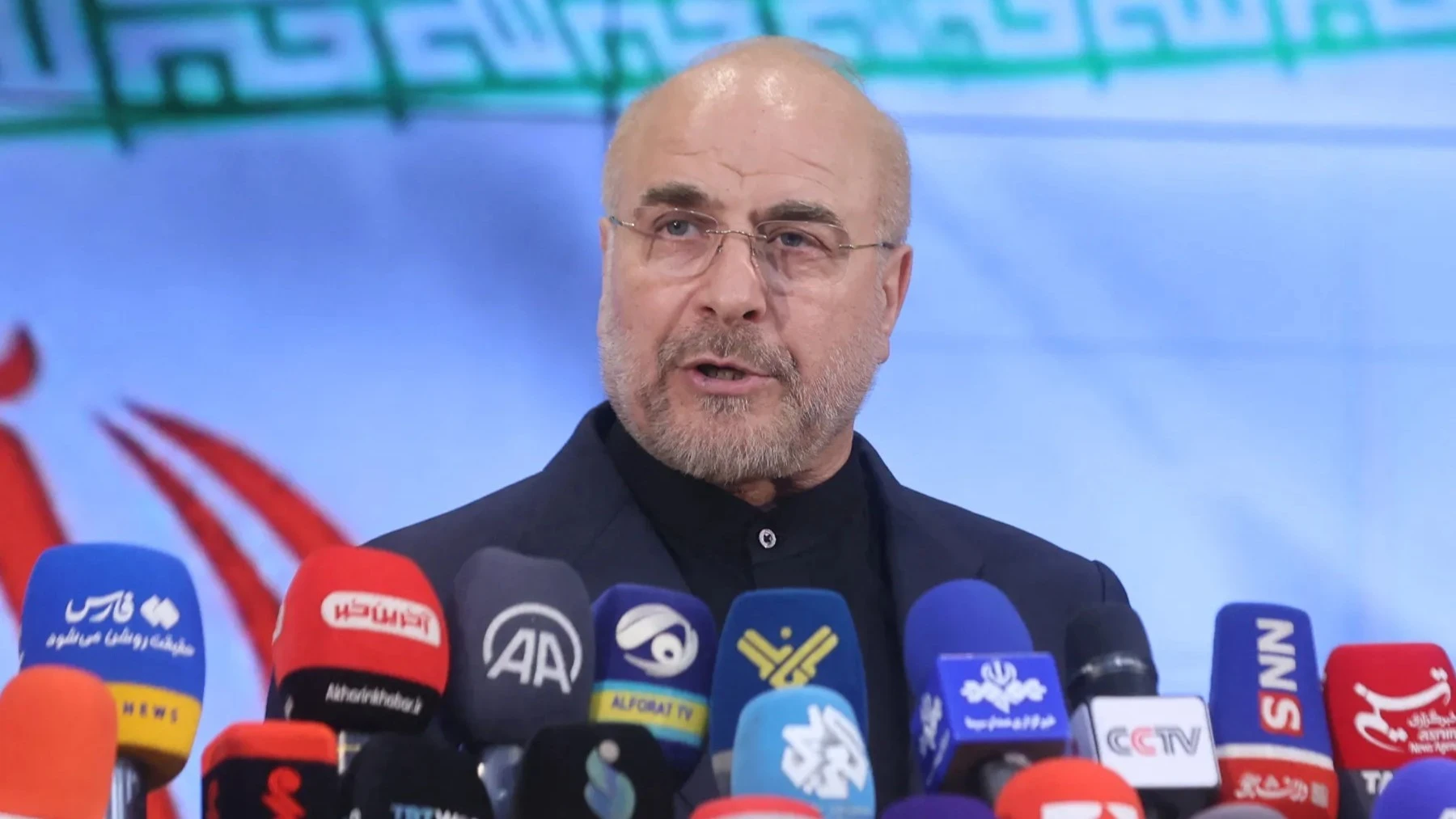
Iran’s Parliament Speaker Mohammad Bagher Ghalibaf warned in a statement on 14 June that there is “no point” in continuing efforts to reach a deal with Washington if Tel Aviv remains unrestrained, a few hours after a new Israeli attack on Lebanon’s capital.

“The Zionists’ aggression against the southern suburb [of Beirut] once again demonstrated that the US either lacks the will to uphold its commitments or lacks the ability to do so,” Ghalibaf said.

“You cannot gain concessions by giving the [Israeli] regime a green light. The ‘good cop, bad cop’ game has grown old. If you lack the will and the ability to fulfill your commitments, then there is no point in speaking about continuing down this path,” the parliament speaker added.

Meanwhile, Brigadier General Mohammad Jafar Asadi, deputy commander and deputy inspector of the Iranian military’s Khatam al-Anbiya Central Headquarters, said Israel’s attack on Beirut’s southern suburb will not go unanswered.

“If you seek an agreement or understanding, you must discipline the Zionist regime. If this rabid dog is not controlled, it will bite your leg before the ink is dry on the agreement,” said Ebrahim Rezaei, spokesperson for the Iranian parliament’s Foreign Policy and National Security Committee.

The latest Israeli airstrike on the Lebanese capital took place earlier on Sunday afternoon. The attack hit a building in the southern suburb’s Ghobeiry area.

According to the Lebanese Civil Defense, three people were killed and six others injured.

The Israeli army claimed it bombed a “command center belonging to the Hezbollah terrorist organization in Beirut.”

“The targeted command center was being used by Hezbollah operatives to advance terrorist plans against the citizens of the State of Israel,” the Israeli military added, calling its deadly attack on Beirut a “precise strike.”

The new attack on Beirut coincides with intensive Pakistani mediation to secure a Memorandum of Understanding (MoU) between the US and Iran.

Among Tehran’s terms is a full ceasefire in Lebanon and an end to Israel’s wars, attacks, and occupation across the region.

Following an Israeli attack on Beirut earlier this month, Iran carried out a ballistic missile attack on an Israeli air base and vowed harsher retaliation in response to any new attacks on the Lebanese capital.

[…]

Via https://thecradle.co/articles/iran-warns-no-point-in-deal-with-us-if-israel-remains-unrestrained

It’s a most confusing time to be in the US Military

Pentagon Says Military Is Overweight - Business Insider

by | Jun 14, 2026

Who knows why we fight?

It’s a most confusing time to be in the U.S. military. Who knows why we fight?

At the top, there’s a lack of principles, a lack of clarity, a lack of care.

There’s no accountability for losses and bad decisions.

The government keeps the people isolated from war’s true costs. There’s no call for sacrifice. No war bonds, no draft, no increase in taxes. Costs are largely kicked into the future as the national debt soars ever higher.

An all-volunteer military is essentially told to follow orders. Never mind about the morality or legality of the same.

The people are encouraged to cheer on or otherwise to support their warriors and warfighters. Basically, to wave the flag but otherwise to go about their business.

A divided Congress has essentially rendered itself powerless over war-making. Meanwhile, Members of Congress fight for their share of an expanding Pentagon pie of money (or pork) for their districts.

The Secretary of State says we went to war with Iran because Israel forced the U.S. government’s hand. So apparently in this case the U.S. military fights for Israel.

So far, the main beneficiaries of the war appear to be defense contractors, fossil fuel companies and banks, so apparently the U.S. military is fighting for them as well.

Clearly, with Iran the U.S. military is not fighting to defend the American people or to support and defend the U.S. Constitution.

Again, who knows why we fight?

It’s always useful to ask Cui bono? while following the money. I asked my AI friends who’s benefiting from this war, and this was the answer the HAL 9000 spit out:

The primary beneficiaries of the Iran war are Western defense contractors, major oil and gas corporations, and geopolitical rivals like Russia and China. The conflict has resulted in billions of dollars in windfalls for arms manufacturers and energy producers, while simultaneously shifting regional power balances. [1, 2, 3, 4, 5]

Defense Contractors

  • Stock Surges: Arms manufacturers like Lockheed Martin and Northrop Grumman have seen multi-billion dollar gains.
  • Missile & Defense Demand: High demand for THAAD interceptors and other Raytheon systems drives excess revenue. [1, 2]

Oil & Gas Majors

  • Record Profits: Surging crude prices have boosted revenues for producers like ExxonMobil and Chevron.
  • Energy Traders: European giants like Shell and BP capitalized on market chaos and sharp price movements. [1, 2, 3, 4]

Geopolitical Rivals

  • Russia: The conflict acts as a fiscal rescue by diverting Western attention and skyrocketing global energy prices.
  • China: China’s regional strategic influence is strengthened as the US is forced to divert military resources to the Middle East. [1]

Regional Powers

  • Israel: The war has neutralized immediate adversaries and solidified the country’s military posture in the region.

Certainly, it’s indisputable how much the weapons makers and fossil fuel companies are profiting here.

Famously, Marine Corps Major General Smedley Butler confessed in the 1930s he’d served as a gangster for capitalism with Standard Oil being one of his biggest clients. The Iran War seems to have benefited Israel, oil and gas interests, and military contractors the most, even as the average American has been hurt by inflation with much higher prices for gas, oil, groceries, and the like.

Interestingly, my AI friend didn’t list Iran as a major beneficiary of the war, but many have argued persuasively that Iran will emerge stronger from this conflict.

Again, it’s a most confusing time to be in the U.S. military.

PS: I thought I’d add this response I made to TomR’s comment below:

In 1985, when I pinned on those 2LT bars, I thought I had some clarity. America, though hardly perfect, was better than the model offered by the Soviet Union. Then the USSR collapsed in 1991, and the government went looking for new dragons to slay. And we found them and we keep finding them because we keep sowing the dragon’s teeth.

So the U.S. military has become a perpetual fighting machine, never mind the Constitution, never mind democracy, never mind morality or legality. If we don’t have enemies, we’ll create them.

[…]

Via https://www.antiwar.com/blog/2026/06/14/its-a-most-confusing-time-to-be-in-the-us-military/

The strategic arsenal US lost in war against Iran – and why replenishment will take years

By Mohammad Molaei

The sheer scale of munitions consumed during the Third Imposed War is without modern precedent in American warfare. As reported by The New York Times, within just the first two days of the military aggression that began on February 28, an estimated $5.6 billion worth of precision-guided munitions were expended, a sum that exceeds the annual military budgets of most countries in the world.

Over the full 40-day war leading up to the fragile ceasefire in early April, US forces struck more than 13,000 targets, many of which required multiple munitions each. According to the Center for Strategic and International Studies (CSIS), the cost of the air campaign alone reached between $11.3 billion in its first six days and $16.5 billion by day twelve.

The total cost over 40 days of full-scale military aggression, followed by subsequent hostilities in the Persian Gulf region, amounts to a far greater sum. While the Pentagon has estimated the figure at around $25 billion, independent assessments place the cost closer to $100 billion.

These figures do not reflect a campaign defined by restraint or resource discipline. Rather, they reveal a military establishment that bet its most advanced precision arsenal on a war it expected to win quickly – only to find itself mired in a quagmire of its own making.

JASSM-ER: Draining the Pacific’s first line of strike

No single weapons system reveals the strategic recklessness of so-called “Operation Epic Fury” more precisely than the AGM-158B Joint Air-to-Surface Standoff Missile Extended Range, known in Pentagon parlance as the JASSM-ER.

This is not a conventional cruise missile. It is a stealthy, air-launched precision strike weapon with a range exceeding 600 miles, purpose-built to penetrate the most sophisticated integrated air defense systems in the world.

Its operational logic is explicitly tied to high-end war scenarios – specifically, a potential confrontation with China in the Western Pacific, where the People’s Liberation Army has constructed the most elaborate anti-access/area-denial architecture in history. The JASSM-ER is the weapon Washington designed for its most serious adversary. And it is largely gone.

At the outset of the war of aggression launched on February 28, the United States held a JASSM-ER inventory of approximately 2,300 missiles. According to Bloomberg, citing a source with direct knowledge of the matter, US forces consumed more than 1,000 JASSM-ERs in the first four weeks of the campaign alone.

The New York Times, drawing on Department of War sources, placed total JASSM-ER expenditure over the full campaign at approximately 1,100 missiles. An additional 47 were fired in a separate operation to abduct Venezuelan President Nicolás Maduro.

The order to drain Pacific stockpiles for the Iran campaign, stripping missiles from US facilities across the continental US and repositioning them to CENTCOM bases and RAF Fairford in the United Kingdom, was issued at the end of March, according to Bloomberg.

The arithmetic is unambiguous and brutal. Of a prewar JASSM-ER inventory of 2,300, approximately 425 remain available for the rest of the world, roughly 18 percent of the prewar total. In the shorter-range baseline JASSM variant, approximately two-thirds of total stocks across both versions were committed to the Iran campaign, according to Bloomberg.

CSIS calculates that around 25 percent of the total combined JASSM inventory was expended in just 40 days of combat.

The unit cost of the JASSM-ER is $1.1 million per missile. The JASSM baseline variant costs $2.6 million per unit at current procurement figures. The roughly 1,100 JASSM-ERs fired in the recent war, therefore, represent approximately $1.2 billion in precision strike munitions, consumed in a campaign that failed to destroy Iran’s ballistic missile infrastructure, did not fracture its command structure, and did not alter the strategic balance in West Asia.

Replenishment will not be swift, as per experts. The US Air Force has procured JASSM variants at an average rate of nearly 500 per year over the past decade, and existing orders in the pipeline mean that JASSM inventories will recover more quickly than other systems; CSIS estimates “several months to a year” for baseline replacement.

However, this timeline assumes no new wars, no additional campaign consumption, and full US Congressional funding of the FY 2027 military procurement request, which has not yet been appropriated.

Tomahawk: A thousand missiles in the 40-day war

The BGM-109 Tomahawk Land Attack Missile (TLAM) is the oldest and most combat-proven precision strike weapon in the US Navy’s inventory, having been used in every major American military operation since Operation Desert Storm in 1991.

Its versatility, fired from surface ships and submarines, capable of loitering and retargeting in flight, with a range of approximately 1,000 miles, makes it the Navy’s primary instrument of long-range power projection.

The war against Iran consumed it on a historically unprecedented scale.

The Washington Post reported that US naval assets fired more than 850 Tomahawks in the first month of the third imposed war. The Wall Street Journal subsequently updated that figure to more than 1,000 over the full pre-ceasefire campaign period.

CSIS’s analysis of the first six days alone identified 319 TLAMs expended, representing approximately 10 percent of the prewar inventory in less than a week.

The prewar Tomahawk inventory stood at approximately 3,200 missiles. The expenditure of over 1,000, therefore, represents roughly 31 percent of the prewar total consumed in 40 days, more than ten times the annual procurement rate.

The Pentagon ordered just 190 new Tomahawks in 2026, a figure barely more than half the number fired in the first six days of the war. The US Navy has requested 785 Tomahawks in the FY 2027 budget, a substantial increase from prior years, but CSIS projects these will not begin arriving in US inventories until March 2030, after 34 months of production lead time.

US Tomahawk inventories will not return to prewar levels until late 2030 at the earliest.

The cost consequences compound the strategic ones. Each Tomahawk Block V costs approximately $1.87 million. The 1,000-plus Tomahawks fired in the recent war, therefore, represent approximately $1.9 billion in naval strike capability, consumed against a country that, at the ceasefire, retained its ballistic missile launch capacity, its underground missile production infrastructure, and its ability to control shipping through the Strait of Hormuz.

The allied dimension of the Tomahawk shortage adds a further layer of strategic damage. Japan, which recently completed modifications on a destroyer to fire TLAMs and had purchased 400 missiles as part of its historic shift toward a more robust conventional deterrent posture against Chinese pressure, has reportedly been told that its deliveries may be delayed indefinitely because the United States must prioritize refilling its own depleted stockpiles.

Australia has also purchased more than 200 Tomahawks, and the Netherlands has purchased 175. All of these allied orders now sit in a queue behind American replenishment needs, weakening the combined deterrent posture of the US alliance network in the Western Pacific at precisely the moment that network is under the greatest pressure.

The defensive arsenal: Patriot, THAAD, and interceptor crisis

While the consumption of offensive strike missiles has drawn significant analytical attention, the depletion of America’s missile defense interceptor inventory may carry even more severe long-term strategic consequences.

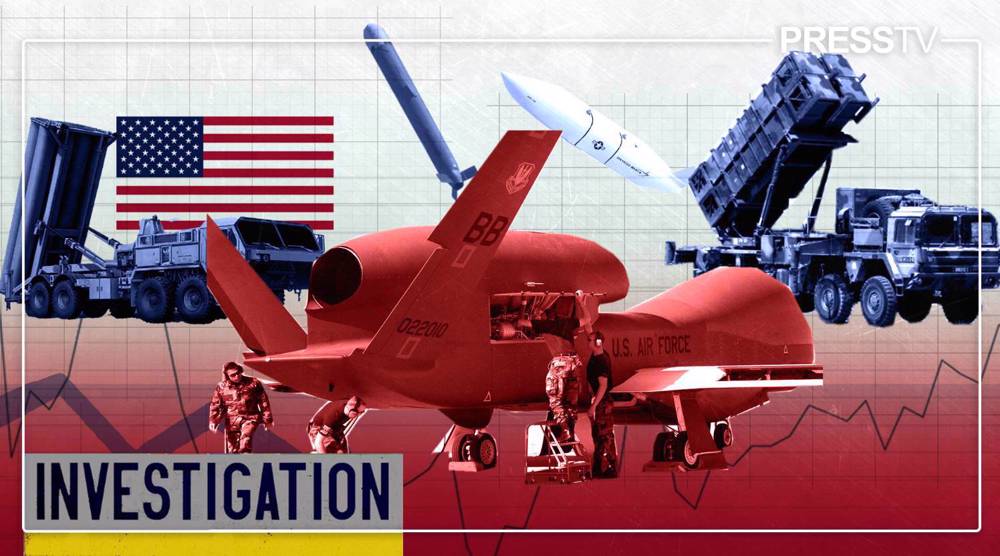
These systems, including the much-hyped Patriot PAC-3 MSE, the Terminal High Altitude Area Defense (THAAD), and the Standard Missiles SM-3 and SM-6, are not interchangeable with cheaper alternatives. They are the irreplaceable components of layered missile defense architecture, designed to defeat the ballistic and cruise missile threats posed by peer and near-peer adversaries.

In the Pacific scenario, they are the systems that would need to protect US forward bases, carrier strike groups, and allied territory from Chinese ballistic missile salvos in the opening hours of any war. Instead, they are being consumed in the Persian Gulf.

The Patriot PAC-3 MSE interceptor, at approximately $4 million per unit, was among the most heavily used anti-missile systems in the recent war imposed on Iran.

The New York Times reported that over 1,200 Patriot interceptors were fired during the aggression. CSIS estimates that Patriot usage, combined with the ongoing supply of interceptors to Ukraine, has left prewar PAC-3 inventory at critically reduced levels.

The Army’s FY 2027 budget requests 3,203 Patriot missiles, a procurement figure that reflects the scale of the shortfall, but CSIS projects these will not begin delivery until May 2029, with full replenishment of prewar levels taking three or more years from the present.

Current Patriot production stands at approximately 650 interceptors per year, with roughly half going to allied orders. Lockheed Martin intends to surge production to 2,000 per year, but achieving this capacity requires years of facility and tooling expansion.

In the interim, the United States faces a set of allocation decisions with no good options: prioritize replenishment of its own depleted stocks, continue supplying Ukraine, or fulfill the orders of the 17 other countries that operate the Patriot system and are now watching their own deliveries pushed back indefinitely.

Swiss authorities have already threatened to cancel their Patriot purchase and seek an alternative supplier after being informed of delivery delays. The bilateral friction this production shortfall is generating with allied governments has been explicitly acknowledged by CSIS and represents a tangible erosion of alliance cohesion at a moment of acute strategic uncertainty.

The THAAD situation is, by CSIS’s assessment, the most critical of all. THAAD is the upper-tier component of the US missile defense architecture, designed to intercept ballistic missiles at higher altitudes and longer ranges than Patriot.

Its interceptors are expensive, scarce, and – as of the ongoing fragile ceasefire – severely depleted. CSIS estimates that between 52 and 81 percent of the prewar THAAD interceptor inventory was expended in the recent war and related offensives, building on roughly 150 THAAD interceptors already consumed during the 12-day war in June 2025.

There have been no new deliveries of THAAD interceptors since August 2023. Deliveries are not scheduled to resume until April 2027 at the earliest. The US Army’s FY 2027 budget requests 857 THAAD interceptors, which CSIS projects will not complete the replacement of the usage during the recent war against Iran until the end of calendar year 2029.

Compounding the interceptor shortage is the damage or possible destruction of multiple AN/TPY-2 radar systems – the targeting backbone of THAAD batteries – during Iranian retaliatory strikes on US facilities in the region.

Only 13 AN/TPY-2 radars have been delivered to the United States in total. The loss or degradation of even two or three of these systems represents a qualitative capability gap that cannot be papered over by procurement requests. The US has also maintained only eight THAAD batteries in total, a number that was considered inadequate for simultaneous deployment in multiple theaters even before the war on Iran consumed the interceptors from those batteries at a rate far exceeding production capacity to replace them.

The ship-launched Standard Missiles present a somewhat less acute but still serious picture. CSIS estimates that SM-3 expenditure in the recent war ranged from 31 to 60 percent of prewar inventory, while SM-6 consumption ran between 16 and 32 percent.

[…]

The cost ledger: What was spent and what was not gained

[…]

The principal expenditures, based on CSIS data and DOD reporting, break down as follows. Over 1,100 JASSM-ER missiles at $1.1 million each account for approximately $1.21 billion. More than 1,000 Tomahawk missiles at $1.87 million each represent approximately $1.87 billion. Over 1,200 Patriot PAC-3 MSE interceptors at $4 million each amount to approximately $4.8 billion. More than 1,000 Precision Strike Missiles and ATACMS, at between $500,000 and $1.5 million each, add a further $500 million to $1.5 billion.

[…]

The combined picture across all seven critical munitions categories is that the US will not return to prewar inventory levels for any of its most critical systems before 2028 at the earliest, with Tomahawk, THAAD, and Patriot taking three or more years from the present.

[…]

The production constraint: Why money cannot buy time

[…]

The Trump administration has responded to the munitions crisis with a series of framework agreements with major contractors – Lockheed Martin, Raytheon, Boeing – committing to expand production capacity across the full range of critical munitions.

[…]

Manufacturing lead time for advanced missile systems – the period between contract award and first delivery – runs between 34 and 39 months for the most critical systems. Building new production facilities, qualifying new supply chains, training additional skilled labor, and resolving bottlenecks in specialized components such as guidance systems and rocket motors are processes measured in years, not quarters.

[…]

Via https://www.presstv.ir/Detail/2026/06/13/770362/strategic-arsenal-us-lost-war-against-iran-why-replenishment-will-take-years