The Most Revolutionary Act

Uncensored updates on world events, economics, the environment and medicine

The Most Revolutionary Act
Unknown's avatar

About stuartbramhall

Retired child and adolescent psychiatrist and American expatriate in New Zealand. In 2002, I made the difficult decision to close my 25-year Seattle practice after 15 years of covert FBI harassment. I describe the unrelenting phone harassment, illegal break-ins and six attempts on my life in my 2010 book The Most Revolutionary Act: Memoir of an American Refugee.

Untold Story of George Soros’ Worldwide Soft Power Empire

Soros Fund Management Chairman George Soros testifies on Capitol Hill in Washington (File) - Sputnik International, 1920, 24.08.2023

Ilya Tsukanov

Sputnik Inernational

Elon Musk has confirmed X’s plans to sue NGOs funded by US financier George Soros over their alleged attempt to crack down on free speech. What’s the lawsuit about? Who is Mr. Soros? And how has his name come to feature so prominently in many of the most politically disruptive events of the first decades of the 21st century? Sputnik explains.

X CEO Elon Musk dropped a bombshell late Wednesday after confirming that his social media empire would “be filing legal action” to “stop” an attempted crackdown on free speech by politicians and George Soros-funded NGOs justified using trumped-up data on the number of “hate incidents” in the British Isles. “Can’t wait for discovery to start!” Musk wrote.

Musk’s message was a response to a report by an independent Irish journalist accusing authorities in Ireland and Scotland of inflating statistics about “hate-based offenses” to pass a new “hate speech” law which would make it a criminal offense to possess “hateful material” on your person or in your home – including up to a year in prison and a 5,000 euro fine for those refusing to hand over their digital device passwords to the authorities.

The crackdown is reportedly being backed by George Soros-funded non-government organizations (NGOs) accused of supporting a hardline censorship agenda, including by supporting police intervention and the seizure of personal phones and computers, as well as raids on the homes of the accused.

What is Soft Power?

Soros-backed NGOs’ alleged attempts to influence Irish and Scottish government policy are a prime example of soft power.

Soft power, or the use of ideological, cultural, or economic influence rather than force to achieve one’s policy objectives, has been a primary tool of US and European foreign policy from at least the mid-1980s onward. After 1991, Western countries working to build the post-Cold War unipolar world order used soft power tools to spread visions of liberal democracy, free market economics, and “open societies” as “universal values” applicable to all nations. Countries refusing to adhere to these concepts have faced invasions, crushing sanctions, and coup d’états (among them Yugoslavia, Afghanistan, Iraq, Libya, and Ukraine, just to name a few).

George Soros, 93, has been a staple of Western soft power campaigns for well over 40 years, and is perhaps the single most visible face of such efforts (although certainly not the first or only one). His Open Society Foundations spends around $1.5 billion a year from the financier’s vast hedge fund empire to fund “civil society” groups around the globe.

How Do Soros’ NGOs Work With Soft Power, and What Ideology Do They Spread?

While conservatives often characterize Soros as a “leftist,” “communist,” or even “neo-Marxist,” his actions in Eastern Europe in the late 1980s and early 1990s reveal that he can best described as a standard social and economic liberal, promoting a vision of the world which both social conservatives and traditional leftists abhor – that is, the spread of a neoliberal political, social, and economic order perhaps best exemplified by academic Francis Fukuyama in his famous 1989 essay “The End of History?”

The Hungarian-born hedge fund manager and financier got his start in soft power “philanthropy” in the 1980s, providing funding for groups promoting radical political, economic, and institutional reforms in the communist nations of Eastern Europe and the USSR. He quickly ramped up the scale and scope of his activities in the region after the collapse of the Eastern Bloc in 1989 and the end of the Soviet Union in 1991.

Soros’ Open Society Foundations and other major Western political philanthropic institutions like them succeeded in creating an entire generation of new political and social leaders in over 60 countries, not just in Eastern Europe and the Global South, but many Western countries as well, including the United States.

OSF’s initiatives include a mind-numbing array of the types of support it provides, from generous grants to political parties pushing liberal, pro-Western politics, to money for media, think tanks, academia, and publishing houses (including those pushing textbooks for children), as well as modern art.
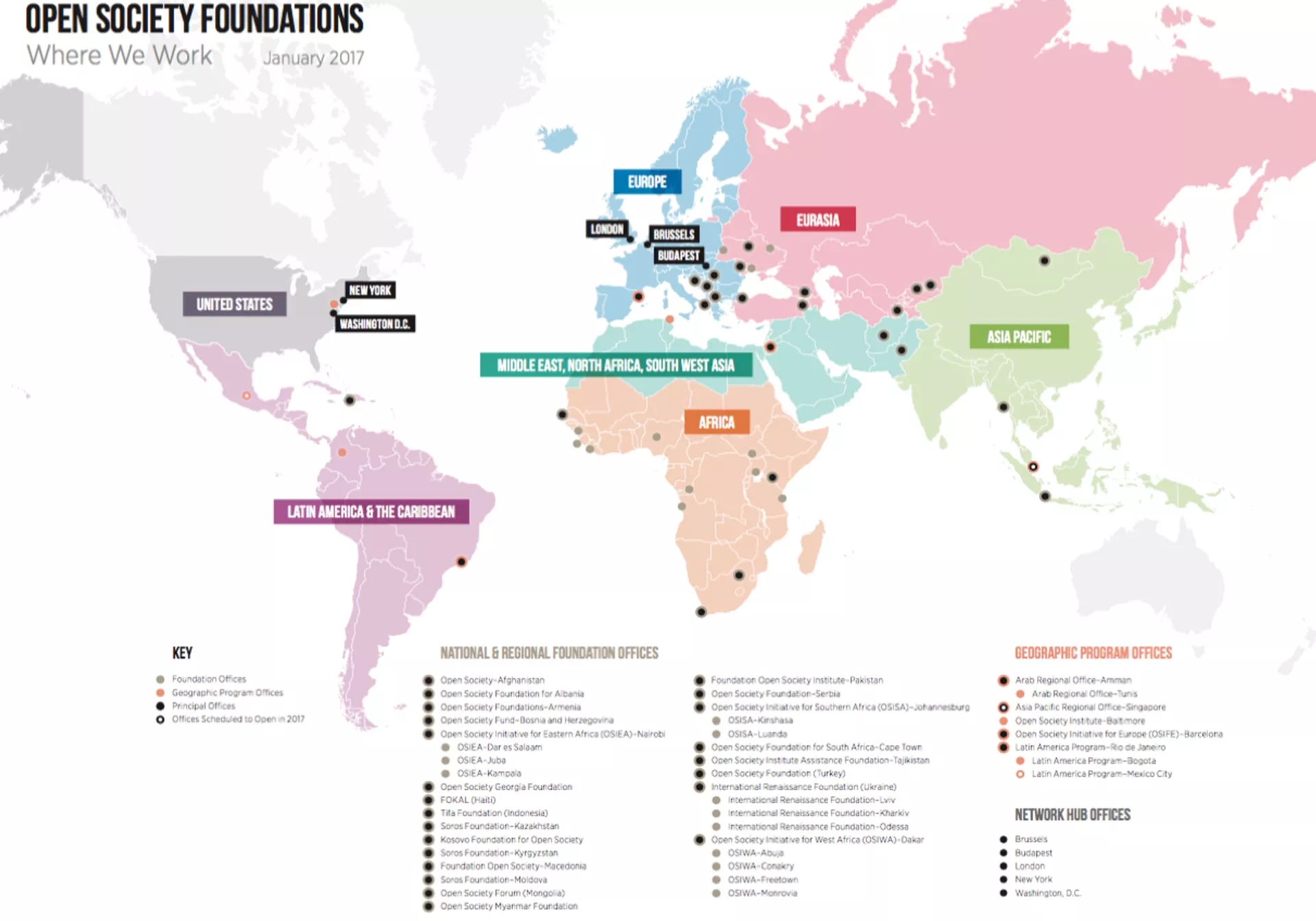
Screenshot of OSF presentation from 2017 showing countries where George Soros' Open Society Foundations operate. - Sputnik International, 1920, 24.08.2023

Soros in Ukraine

Setting up shop in Ukraine immediately after independence in 1992, Soros’ foundations played an intimate role in the formation of the country’s post-Soviet elites, especially its liberal, pro-Western faction.

Both during the Orange Revolution of 2004 and the Euromaidan coup in 2014, the OSF had a critical job to play in financing and otherwise supporting the “revolutionaries,” from lobbying efforts targeting US allies to “legalize” the coup, to meeting with the country’s new authorities to advise them on policy, to spending vast sums of money on an array of domestic “civil society” initiatives (including over $181 million by late 2015 alone).

Ukraine, perhaps more than any other case study to date, demonstrates the effective synergy between private “soft power” wielded by billionaires like Soros combined with institutions like USAID and the US State Department, showing the effective role soft power in creating a crisis from scratch, and then attempting to use it to achieve a geopolitical objective.<

Americans Get a Taste of Soros

Before the political rise of Donald Trump, Soros-linked organizations played a mostly low-key role in American politics, with the OSF’s initiatives and allies not really popping up on the radars of ordinary Americans before the rise of Black Lives Matter (which, it turns out, began receiving generous funding from Soros-linked groups from 2016 onwards).

Since then, the OSF has been thoroughly linked to financing of the election campaigns of judges (including some of those now looking to prosecute former President Donald Trump), and the bankrolling of major candidates for high political office. In 2022, a series of memos from an influential, but highly secretive Soros-linked Washington, DC-based nonprofit revealed that the billionaire had helped to formulate the then-incoming Biden administration’s policies across nearly two dozen policy areas, including the environment, education, healthcare, housing, and labor.

Where Have Soros and His OSF Been Banned

Russia was the first country to move to stamp out Soros’ activities, banning the OSF and its affiliates in 2015.* The Pakistani government issued a similar order against the OSF in late 2017, although the organization’s activities have since been reapproved. Turkiye banned the OSF in late 2018, citing the NGO’s meddling in domestic politics. The same year, the Hungarian parliament issued a series of measures aimed at forcing the OSF to close down its operations in Soros’ native Hungary. Poland’s nationalist authorities similarly called for a “de-Sorosization” of society in the late 2010s.

What is OSF’s Future?

Soros’ 37-year-old son Alexander took the reins of his father’s $25 billion business and soft power philanthropy empire in June, having replaced him as the OSF’s chairman in late 2022.

Last week, the OSF announced a “radical shift of strategic direction” for grantees, moving to end much of its operations across the European Union as part of a “global review of how we work to support democracy, human rights and climate justice.”

It’s not clear how much of an impact the shift in strategy will have on other countries where Soros-linked NGOs operate. However, if the billionaire’s comments about Trump being a “danger to the world” and the “threat” Russia and China supposedly pose to “open societies” are anything to go by, the OSF will likely ramp up its activities to prevent the former president’s reelection, and do what whatever is in its power to prevent the emergence of a genuine multipolar world order.


*Canadian historian Matthew Ehret disputes this. He asserts China was was the first country to ban Soros and his cronies following the 1989 Tienanmen Square color revolution. See  https://gt.linkedin.com/posts/mattehret_how-china-banned-soros-in-1989-a-canadian-activity-7033463355696631808-npDj

[…]
Via https://sputnikglobe.com/20230824/untold-story-of-george-soros-worldwide-soft-power-empire-1112859657.html


Reuters Admits the Blood Clots Are Real

By

AstraZeneca facing two London lawsuits over COVID-19 vaccines

LONDON, Aug 23 (Reuters) – AstraZeneca (AZN.L) is facing two London lawsuits, including one from the husband of a woman who died after receiving the Anglo-Swedish drugmaker’s COVID-19 vaccine, in the first of potentially dozens of cases brought in England.

Britain was the first country to roll out the at-cost AstraZeneca COVID-19 vaccine in early 2021, although it later restricted the use of it among under 40s due to the small risk of blood clots.

Anish Tailor, whose wife Alpa died in March 2021 after receiving her first dose of the vaccine, filed a product liability claim against AstraZeneca at London’s High Court on Aug. 4, according to court records.

His lawyer Peter Todd, from the law firm Scott-Moncrieff & Associates, told Reuters that he has nearly 50 other clients who will formally sue AstraZeneca in the coming months.

AstraZeneca declined to comment on active legal cases. A spokesperson said in a statement: “Patient safety is our highest priority and regulatory authorities have clear and stringent standards to ensure the safe use of all medicines, including vaccines.

“Our sympathy goes out to anyone who has lost loved ones or reported health problems.”

AstraZeneca is facing a similar lawsuit from Jamie Scott, who was diagnosed with vaccine-induced thrombotic thrombocytopenia, which can cause fatal blood clotting, after receiving the AstraZeneca vaccine.

Scott filed a product liability lawsuit against AstraZeneca on Monday, according to court records. No filings or further details about the case were immediately available.

Hausfeld, the law firm representing Scott, said it represents around 40 other individuals or bereaved families.

Sarah Moore, a lawyer at Hausfeld, said in a statement that Scott had “suffered life-changing injuries which have severely impacted not only him, but those close to him”.

She said Scott will argue AstraZeneca is “liable to compensate him for what he has suffered so that he can rebuild his life as far as possible and ensure the security of his family”.

The two cases are the first lawsuits brought in England and Wales over an adverse reaction to a COVID-19 vaccine, according to publicly-available court records.

[…]

Via https://www.reuters.com/legal/astrazeneca-facing-two-london-lawsuits-over-covid-19-vaccines-2023-08-23/

India After Independence

Episode 34 India Under Nehru

A History of India

Michael Fisher (2016)

Film Review

Jawahadal Nehru, who died in 1964, was the country’s longest serving prime minister. Gandhi who disagreed with Nehru’s vision of a strong central government, refused to accept any post under his administration. Both favored a secular government for India with separate civil codes (related to marriage, divorce, etc) for different religions.

One of Nehru’s main problems in 1947 was the hundreds of princely states who refused to join either India or Pakistan.  Nehru persuaded most within India’s boundaries to cede sovereignty by allowing them to keep their palaces and some local revenues for themselves. The Indian army had to formally annex the largest, Ayderabad (with a Muslim leader ruling a Hindu minority), at a cost of 30,000 lives.

Sovereignty over Kashmir, administered by India, Pakistan and China, has never been resolved. In 1948 after Pakistan invaded western Kashmir, India airlifted troops into eastern Kashmir, establishing a Line of Control between Pakistani-controlled Azad Kashmir and India-controlled Jammu, Kashmir and Ladakh.  China controls Aksai Chin and the Trans-Karakoram Tract) in Northeastern Kashmir. A popular referendum India promised the majority Muslim Kashmiris never happened.

India’s constitution, approved in 1950. It establishes India as a republic.* It also abolishes Untouchability and establishes compensatory discrimination (creating special seats and quotas for “scheduled” castes and tribes), as well welfare provisions for the poor, elderly and disabled. Two hundred fifty million people voted in India’s first election 1951-52.

India has a bicameral legislature, with the lower house elected by direct popular vote and the upper house selected indirectly by state legislatures. India’s president is also elected indirectly.** The prime minister, elected by the lower house, has direct governing authority but can be dismissed if he loses a parliamentary vote.

With 18 years in office, Nehru was India’s longest serving prime minister, and his daughter Indira Gandhi the second longest (15 years).

Under Nehru (a democratic socialist), India established a mixed economy, with the government owning heavy industry railroads and energy production. One of his first acts one to create a planning commission to established five year plans to establish economic goals. The first five- year plan (1951-56) focused mainly on making India agriculturally self-sufficient. The second focused mainly on making heavy industry more efficient. From the outset Nehru set high tariffs on imported goods to prevent Western countries from crushing the country’s burgeoning industry with cheap imports.

Another major hurdle he faced was establishing a natural language, as the vast majority of the country couldn’t speak Hindu. A compromise he reached with state legislatures was initial constitutional recognition of 14 languages, with a 15-year transition to Hindi and English as the two official languages.

In 1955, Nehru became a leader in the international Non-Aligned Movement,** along with Indonesian president Sukarno, Yugoslavian president Tito and Egyptian president Nassar.

In 1961 he forcibly annexed Goa and other Portuguese enclaves, as well as forcing the French to withdraw from Pondicherry.


*Although India is still in the British Commonwealth of Nations, they no longer recognize the British monarch as head of state and no longer have a governor general (as do Canada, Australia and New Zealand).

**India’s president is elected by the members of an electoral college, consisting of the elected members of both the houses of parliament the legislative assemblies of states and the Union Territories of Delhi and Pondicherry.

***The Non-Aligned Movement (NAM) is an international organization dedicated to representing the interests and aspirations of developing countries

Film can be viewed free with a library card on Kanopy.

https://www.kanopy.com/en/pukeariki/watch/video/366254/366239

Politics – Not Science or Health – Behind Return of Masks

By  Michael Nevradakis, Ph.D.

A growing number of universities, businesses and hospitals in recent weeks have reinstituted mask mandates and social distancing requirements, and a new report warned that broader mandates may be coming this fall.

At the same time, the Biden administration is pushing for the public to get COVID-19 booster shots for the fall and winter seasons — even though President Joe Biden ended the COVID-19 public health and national emergencies in May, as did the World Health Organization (WHO), citing an overall low level of COVID-19 infections and hospitalizations.

Meanwhile, recently released documents from the National Institutes of Health (NIH) reveal that public health officials privately questioned the effectiveness of masks and the guidance issued by the Centers for Disease Control and Prevention (CDC) promoting their use.

While some experts have openly called for the widespread use of masks to return, experts who spoke with The Defender questioned the need for mandates and the effectiveness of masks in preventing the spread of COVID-19 and other respiratory viruses.

“Masks are not effective against the spread of viruses like COVID-19,” said Brian Hooker, Ph.D., senior director of science and research for Children’s Health Defense (CHD). “The virus is much too small to be blocked by a cloth/paper mask and even N95 masks have very limited effectiveness in reducing transmission.”

Dr. Meryl Nass, an internist and member of CHD’s scientific advisory committee, told The Defender that while medical professionals may “benefit from short periods” of mask-wearing before disposing of them, “Regular people who use these masks and are not trained in their use probably get no benefit and may well be at greater risk.”

Is threat of new mandates being used to push COVID boosters?

CBS News reported that several new COVID-19 variants have surfaced in recent weeks and are spreading across the U.S. These include the EG.5 variant, “estimated to be the ‘dominant’ strain in the U.S.,” FL.1.5.1 and a “highly mutated” strain, BA.2.86.

These strains have caught the attention of public health authorities and the WHO, which on Aug. 9 declared EG.5 (“Eris”) a “variant of interest,” even though the WHO acknowledged there’s no evidence the strain leads to more severe disease than its predecessors.

According to CNN, the CDC no longer reports aggregate COVID-19 case counts, but still urges people to “wear a mask with the best fit, protection, and comfort for you.”

Yet, CNN also reported there were “four new hospital admissions for every 100,000 people” in the U.S. for the week ending Aug. 12, “which is considered low.”

The CDC continues to recommend universal masking in areas where 20 or more people per 100,000 are hospitalized with COVID-19, and masking for “high-risk” individuals where between 10-19.9 people per 100,000 are hospitalized with COVID-19.

CNN cited a “growing number of hospitalizations” and increased virus levels in wastewater as “an early indication of a COVID spike.”

Universities, hospitals push mask mandates citing reports of ‘positive cases’

Morris Brown College in Atlanta, Georgia, announced Sunday it is reinstating a mask mandate, social distancing and bans on large gatherings as a precaution and for a two-week period, citing “reports of positive cases among students at the Atlanta University Center” — but not the university’s main campus.

Rutgers University, which also requires indoor masking, announced it is maintaining its COVID-19 vaccine requirement for the new academic year, and that students granted a medical or religious exemption may still be barred from campus attendance.

Rutgers previously announced that, as of Aug. 15, it would begin disenrolling students who had not complied with its vaccine requirement. In June, a federal appeals court heard arguments in an ongoing lawsuit supported by CHD challenging Rutgers’ policy.

According to No College Mandates, 90 U.S. universities require COVID-19 vaccines.

In California, Kaiser Permanente on Tuesday announced the reinstatement of a mask mandate for its Santa Rosa facilities.

Also in California, Hollywood studio Lionsgate reinstated mask mandates on Monday, until further notice, for employees on the third and fifth floors of its five-story headquarters in Santa Monica, affecting nearly half the company’s employees. The policy change came in response to several positive COVID-19 cases among its employees.

According to Deadline.com, all Lionsgate employees are required to perform a daily self-screening before coming to the office and must stay home if they exhibit any symptoms or have traveled internationally in the last 10 days.

And in an Instagram post Tuesday, actor Jamie Lee Curtis posted a photo of herself wearing a cloth mask, accompanied by a message reading “COVID is on the rise. SO MANY friends now are really sick. BE MINDFUL. WEAR A MASK if required or even if you feel unwell and are out in public spaces,” and suggesting masking will “be back.”

Some medical experts also recently spoke in favor of masks. A Royal Society report published Thursday found “clear evidence … that stringent implementation of packages of NPIs [non-pharmaceutical interventions] was effective in some countries in reducing transmission of SARS-CoV-2.”

NPIs include masks, social distancing, lockdowns and travel restrictions.

In an editorial published Tuesday in the Annals of Internal Medicine, a group of Washington doctors called for mask mandates to return to healthcare settings.

Cardiologist Dr. Jonathan Reiner told CNN members of “high-risk” groups should “take some precautions and wear a mask in crowds,” while Dr. Trish Greenhalgh, a primary healthcare expert at the University of Oxford, tweeted on Aug. 15 that “it looks like it’s once again time to MASK UP.”

[…]

Previous transportation mask mandate struck down, but decision vacated

A federal judge in Florida, in April 2022, struck down the Biden administration’s previous transportation mask mandate, following a lawsuit filed by the Health Freedom Defense Fund. CHD supported the suit.

The U.S. Department of Justice appealed the ruling in June 2022, but in June 2023, the 11th Circuit U.S. Court of Appeals vacated the decision and dismissed the case as moot.

[…]

CHD Senior Counsel Ray Flores told The Defender that while the federal government traditionally exerts its authority only over federal employees, “the transportation case was different.”

[…]

Masks ‘do not prevent the spread of respiratory viruses’

Recently released documents show that some key public health experts expressed reservations about the effectiveness of masks.

A November 2021 letter obtained by The Functional Government Initiative following a Freedom of Information Act request revealed that Michael Osterholm, Ph.D., MPH, director of the University of Minnesota’s Center for Infectious Disease Research and Policy, argued the CDC was promoting flawed mask data and excluded data which did not fit its narrative.

Osterholm, along with seven colleagues who co-signed the letter, asked the CDC to reconsider its claims regarding the “efficacy of masks and face coverings for preventing transmission of SARS-CoV-2,” adding that “the information and recommendations as provided may actually put an individual at increased risk of becoming infected.”

A meta-analysis published in Cochrane in January found masks were largely ineffective in reducing the spread of COVID-19. Cochrane has been described as “the gold standard” and “major source of high-quality, reputable meta-analyses.”

The study was authored by Oxford University senior associate tutor in epidemiology Dr. Tom Jefferson and 11 other researchers, who identified “78 relevant studies” conducted “in low-, middle-, and high-income countries” during health emergencies, and assessed the effects of different types of masks, including surgical masks and N95/P2 respirators.

The researchers found surgical masks “may make little to no difference in how many people caught a flu-like illness/COVID-like illness,” while N95/P2 respirators “probably [made] little to no difference in how many people have confirmed flu … and may make little to no difference in how many people catch a flu-like illness … or respiratory illness.”

A 2022 study published in Cureus by Beny Spira, Ph.D., coordinator of the Bacterial Genetics Laboratory at Brazil’s University of São Paulo, analyzed mortality and morbidity rates in Europe during the winter of 2020-2021, finding that “countries with high levels of mask compliance did not perform better than those with low mask usage.”

Spira told The Defender “If you compare the Nordics with southern Europe … the difference in mask wearing was gigantic,” he said. Sweden, which did not mandate masks, had lower levels of excess deaths compared to countries with mask mandates.

Notably, in 2020, Swedish state epidemiologist Anders Tegnell said, “We see no point in wearing a face mask in Sweden, not even on public transport,” adding there were “at least three heavyweight reports … which all state that the scientific evidence is weak.”

As of April 2022, Sweden had recorded fewer COVID-19-related deaths per million people than the U.S. — and 53 other countries. A Swedish government commission that investigated the country’s COVID-19 response found the no-lockdown strategy was “fundamentally correct,” and that, at most, masks should have been “recommended.”

Spira said masks “certainly will not help, because the best available studies … randomly controlled trials, have time after time shown that masks do not work. They do not prevent the spread of respiratory viruses.”

Spira has completed an updated study confirming his initial findings, but “most journals don’t accept this material,” he said.

Mask mandates pose ‘particular risk to children’

A September 2022 study published in Environmental Research concluded that “Wearing of [surgical masks] raises CO2 content in inhaled air quickly to a very high level in healthy children … that might be hazardous to children’s health.”

The study’s lead author, Harald Walach, Ph.D., founder of the Change Health Science Institute in Germany and professional research fellow at Kazimieras Simonavicius University in Lithuania, told The Defender “We have been highly critical of mask mandates, and our study vindicated our original skepticism.”

“Masks do not appear to have changed the infection dynamics,” Walach said. “A lot of the problems are really home-made, as the vaccination campaigns might have led both to the emergence of more dangerous strains of the virus and immunologically compromised individuals that are much more susceptible.”

“For instance, if one looks at deaths and mortality data during 2020, with no vaccines present, one sees that the mortality rates were much lower — at least in Germany,” Walach said. “After the vaccination campaign started, death tolls rose. At the very least, this shows that the vaccination campaign did not do what it was meant to do: to prevent excess mortality. It rather exacerbated mortality.”

Harvey Risch, M.D., Ph.D., professor emeritus and senior research scientist in epidemiology (chronic diseases) at the Yale School of Public Health, told The Defender: “There is no evidence that wearing masks contributes appreciably to source control of respiratory virus infections. This has been shown in all of the studies of source control.”

Cardiologist Dr. Peter McCullough told The Defender that while the Cochrane analysis “found that masks are ineffective … 17 studies, including three large randomized trials, have demonstrated that viricidal nasal sprays and gargles (iodine, xylitol) are very effective in reducing the spread of the virus,” suggesting their use be encouraged.

For Dr. David Bell, a public health physician, biotech consultant and former director of Global Health Technologies at Intellectual Ventures Global Good Fund, mask mandates pose a particular risk to children.

[…]

Via https://childrenshealthdefense.org/defender/politics-mask-mandates-return/

50% of trans-identifying biological males in Wisconsin prisons convicted of sex crimes

50% of trans-identifying biological males in Wisconsin prisons convicted of sex crimes: report

It has been revealed that half of the trans-identifying biological males currently serving out sentences in Wisconsin prisons have been convicted of at least one sex crime.

The statistic was uncovered by the Heritage Foundation’s Oversight Project during its analysis of Wisconsin Department of Corrections data obtained via an April 2022 public records request.

According to the report, of the 161 trans-identifying biological males in prisons across the state, 81 have sex crimes on their record.

The report did not divulge exactly which crimes the 81 inmates had been convicted of, though details of certain cases have been previously reported on.

One such case is that of Mark Campbell, who was allowed to stay in a women’s prison while awaiting his taxpayer-funded gender transition surgery in 2020. Campbell was arrested in 2007 after allegedly sexually assaulting and abusing his 10-year-old daughter.

Six years into his 34-year sentence, he began identifying as a woman and changed his name to Nicole, and in 2020 US District Judge James Peterson ruled that receiving surgery fell under his constitutional rights, arguing that “an inmate’s criminal history is irrelevant to whether she has a right to necessary medical treatment.” The women at the prison he ended up in were not consulted prior to his arrival.

[…]

Via https://thepostmillennial.com/50-of-trans-identifying-biological-males-in-wisconsin-prisons-convicted-of-sex-crimes-report

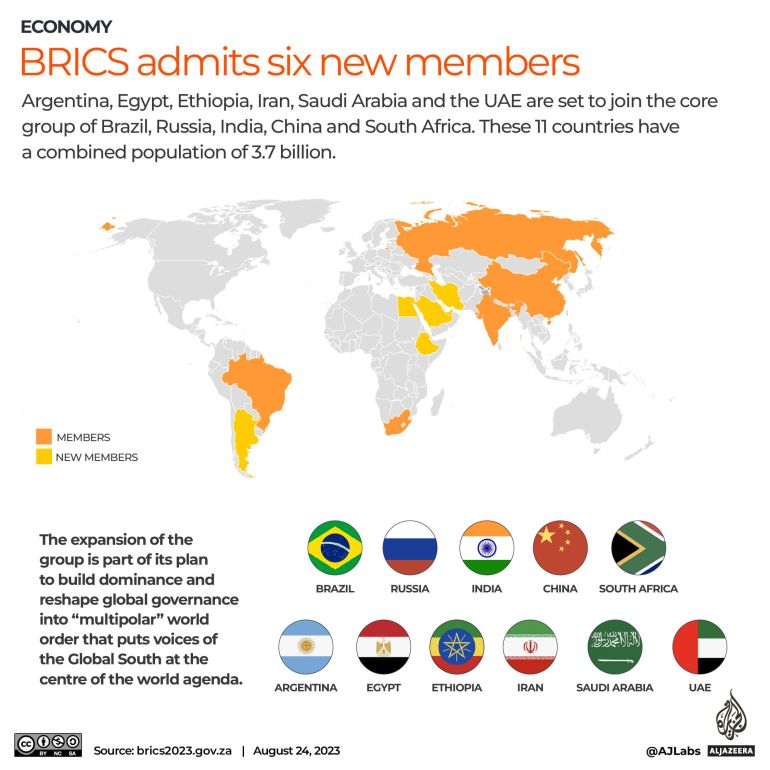
Saudi Arabia and Iran Among Six New BRICS Nations

Al Jazeera

Johannesburg, South Africa – Saudi Arabia and Iran are among six countries invited to join BRICS as new members next year, South African President Cyril Ramaphosa has announced on the final day of a summit of the group that considers itself a counterweight to Western powers.

The group encompassing five major emerging economies – China, Brazil, South Africa, Russia and India – which makes decisions by consensus, agreed on “the guiding principles, standards, criteria and procedures of the BRICS expansion process”, during the three-day annual summit held in Johannesburg this week, Ramaphosa said on Thursday.

Argentina, Egypt, Ethiopia, Iran, Saudi Arabia and the United Arab Emirates have been invited to join as full members from January 1 next year.

“This membership expansion is historic,” said Chinese President Xi Jinping.

“The expansion is also a new starting point for BRICS cooperation. It will bring new vigour to the BRICS cooperation mechanism and further strengthen the force for world peace and development.”

A senior adviser to Iran’s president on Thursday welcomed the country’s admission to the grouping.

“Permanent membership in the group of global emerging economies is considered a historic development and a strategic success for the foreign policy of the Islamic republic,” Mohammad Jamshidi wrote on X, which was previously known as Twitter.

Ethiopian Prime Minister Abiy Ahmed hailed what he called “a great moment” for his country.

“Ethiopia stands ready to cooperate with all for an inclusive and prosperous global order,” Abiy said on Twitter.

“We look forward to develop this cooperation to create new developmental and economic opportunities and elevate our relationship to the aspired level,” Prince Faisal bin Farhan, Saudi Arabia’s foreign minister said at the summit on Thursday.

Later, he told Saudi channel Al Arabiya that the kingdom welcomed the invitation and would review the details in order to make an “appropriate decision” ahead of the proposed joining date.

The core group of five BRICS countries has been discussing the issue of expansion for more than a year, Ramaphosa said, and the new members were invited this week after an agreement was reached at the summit.

The expansion of the group is part of its plan to build dominance and reshape global governance into a “multipolar” world order that puts voices of the Global South at the centre of the world agenda.

The inclusion of Saudi Arabia, the UAE, Iran and Egypt marks the first MENA representation in the group, and the inclusion of Argentina was championed by member Brazil.

Expansion was pushed heavily by Russia and China, analysts said, as they are facing pushback from Western nations in the form of sanctions.

Other BRICS countries were initially more ambivalent, but leaders came out in vocal support of the plan this week.

The grouping of emerging economies has been in formal existence for 15 years. Some experts told Al Jazeera that it has not achieved much and the diffuse nature of their political and social interests means BRICS leaders do not always agree on issues. Some say that has prevented them from becoming a more powerful or effective entity.

“What [BRICS is] trying to achieve in a way is being opened up for more discussion,” Danny Bradlow, a professor with the Centre for the Advancement of Scholarship at the University of Pretoria, told Al Jazeera ahead of the summit. “As long as it was just the five countries, they were talking about the reform of global economic governance or global governance generally … But they haven’t done very much about that.

“Getting agreements among the five has not been all that easy,” he said. “If they expand membership, that makes it even more complicated. But it also depends on who they take on as the new members.”

More than 40 countries had expressed interest in joining BRICS, and 23 formally applied to join the club, which already represented a quarter of the global economy and 40 percent of the world’s population.

Some 50 other heads of state and leaders are attending the summit in South Africa, which concludes on Thursday.

[…]

Via https://www.aljazeera.com/economy/2023/8/24/saudi-arabia-iran-to-join-brics-as-grouping-admits-six-new-members

Global Campaign Against Ocean Dumping of Nuclear Wastewater Worldwide Urgent Actions against Japan’s ocean dumping of nuclear wastewater on Aug 24th.

Antinuclear

1. The USA

  • Los Angeles, Aug 23rd, 12 – 1 PM @ Japanese Consulate
  • New York, Aug 23rd, 12 – 1 PM @ Japanese Consulate  (E 49th St & Park Ave.)
  • Washington DC, Aug 25th, 11am @ Japanese Embassy
  • Seattle, Washington, Aug 26th, 2pm @ Seattle Downtown  ‘West Lake Park’

Organized by Global Candlelight Action

2. UK

  • North Wales, Aug 25th, 5pm @ Bangor pier

Organized by PAWB ( People Against Wylfa B) and CADNO

3. Germany

  • Berlin, Aug25th, 5 pm @ Brandenburg Gate
  • Frankfurt, Aug 26th, 3 pm @ Rathenauplatz (Goetheplatz)
  • Hamburk, September 9th

Organized by Global Candlelight Action

4. Fiji

  • Suva, Aug 25th, 10am @ Japanese Embassy

Organized by PANG, Alliance for Future Generations, Pacific Conference of Churches; FWRM, DIVA for Equality and others joining the March including the largest Indigenous women’s network.

5. Japan

  • Tokyo, Aug 22nd @ Japanese PM house
  • Tokyo, Aug 23rd @ TEPCO
  • Fukushima Iwaki, Aug 27th

Organized by Japanese CSOs alliances

6. Switzerland

  • Zurich, September 16th

Organized by Global Candlelight Action

7. Canada

  • Civil Zoom rally, on August 24, 5 pm

Organized by  civil society in Canada

  • Melbourne, Aug 26th (Sat), 5 pm @ Korea Society of Victoria

Organized by Global Candlelight Action

9. Korea

  • Seoul, Aug 23rd, 7pm @ Japanese Embassy
  • Seoul, Aug 24th, 7pm @ Japanese Embassy
  • Seoul, Aug 26th, 6pm @ Korea Press Center
  • 17 local cities nationwide in Korea hold a press conference and rallies from Aug 22nd~31st

Organized by Korean civil society alliances / Korean Peoples’ Action to Stop Dumping of Fukushima Daiichi Radioactive Water(KPA-SDFDRW)

Via https://antinuclear.net/2023/08/24/global-campaign-against-ocean-dumping-of-nuclear-wastewater-worldwide-urgent-actions-against-japans-ocean-dumping-of-nuclear-wastewater-on-aug-24th/

Helicopter Pilot Forced to Get COVID Vaccine Grounded After Experiencing Rare Strokes

Tim McAdams, a 59-year-old pilot and health enthusiast loved his work teaching pilots to fly Airbus Helicopters — until Airbus required him to get the COVID-19 vaccine. Three weeks after he got his second Pfizer shot, Tim had two cerebellar strokes — a rare stroke in the cerebellum that accounts for only 1-4% of total strokes.

Tim McAdams, a 59-year-old pilot, health enthusiast, husband and father was content with his job training pilots for Airbus Helicopters — a job he held for over a decade — until Airbus mandated the COVID-19 vaccine for its employees.

Up to that point, Tim and his wife Beth McAdams had approached the vaccine as a question of “risk management,” they told The Defender in an interview. Because Tim was fit, healthy and had no family history of illness, they didn’t think he needed to get the shot, despite repeated urging by Airbus.

“But when my employer mandated it, I thought, ‘Well now all of our retirement plans, everything could be in jeopardy if I have to try to find another job,’” Tim said.

He didn’t qualify for a medical exemption and had no religious beliefs that would exempt him, so they felt he had no choice.

Tim got his first Pfizer shot on Oct. 17, 2021, and the second on Nov. 7, 2021. Three weeks later he had two cerebellar strokes, a rare stroke in the cerebellum that accounts for only 1-4% of total strokes.

“I woke up in the middle of the night, dizzy, throwing up and with difficulty moving my legs. My wife took me to an urgent care facility and they diagnosed me with vertigo,” Tim said.

The hospital sent him home with drugs for nausea. The next night, he said, it happened again. They returned to urgent care.

Although the doctors still thought he was suffering from vertigo, they wanted to observe him overnight in the hospital. But, Tim said, “They only wanted to send me to a hospital within their hospital [system], which was a two-hour ambulance ride away,” even though there were approximately 15 hospitals closer to them in the Dallas-Fort Worth, Texas, metroplex.

“Patient care was not the priority,” Beth said.

Beth and Tim returned home instead. But the next morning when the symptoms returned, they went by ambulance to the nearest hospital. Doctors there told Tim he had suffered two strokes, one on each side of his brain.

“Cerebellar strokes, in themselves, are very rare to begin with,” Beth said. “And then to have them bilaterally was very very strange. We were just shocked. I mean shocked is all I can remember,” because Tim was such a healthy person and had never had any health issues at all.

‘You’ll never ever get a doctor in this facility to admit the vaccine had anything to do with it’

In the hospital, the McAdams asked the doctors repeatedly what could have caused this rare event, but “they always shrugged.”

It didn’t dawn on them that the vaccine could have caused the strokes until Tim’s doctors began questioning them about recent events. They asked whether Tim had fallen, suffered any injuries or done anything at all they could possibly think of that was outside the norm in the previous three months.

“And I told the doctor, ‘Well, the only thing is three weeks prior I got the second shot of the vaccine,’” Tim said. The doctor responded, “‘No, that had nothing to do with it.’ And he walked out.”

“The thing that got me,” Tim said, “is they were telling me they had no idea why it happened, but they were really quick to eliminate only one possible cause, the one change that had happened.”

After the doctor left, a nurse who had been in the room spoke up. “For political reasons, you’ll never ever get a doctor in this facility to admit that the vaccine has anything to do with it,” the nurse said. “But I think it does, and I encourage you to research that and contact VAERS (Vaccine Adverse Event Reporting System).”

Another nurse told Beth that she worked all over the metroplex and had seen countless vaccine injuries. The nurse told them vaccine injuries were “definitely prevalent and needed to be investigated,” but the doctors were “not willing to have a conversation about it, not even willing to say, ‘Well, we’re not sure.’”

That nurse also encouraged them to report Tim’s injury to VAERS.

After that, things took a turn for the worse. While showering in the hospital, Tim started to feel his legs shake and give out. He lurched for the door, seeking help.

Beth said, “I heard this clunk where he opened the hand lever of the bathroom door, opened it a little bit and let out the most horrific moaning scream I’ve ever heard.”

Tim was rapidly becoming paralyzed on his left side as the nurses dragged him to his hospital bed.

“I’m looking at him. Tim can’t talk, he can’t even raise his hand, barely. He’s trying to grab three of his fingers to tell me that he thinks it’s the third stroke,” Beth said.

But it wasn’t another stroke. Tim was suffering from brain swelling, which they treated with drugs and Tim soon returned to normal.

But a few days later, the swelling returned. Beth was awakened in the night by a call informing her Tim was being rushed into surgery for an emergency craniotomy.

After the surgery, he remained in the acute-care hospital. “It was such a wild 80-some days in the hospital because along the way he developed double pneumonia and lung failure,” Beth said.

Tim was intubated a number of times and eventually given a tracheotomy and a feeding tube. His vocal cords were damaged in the process.

Eventually, Tim began to recover.

Getting the story out to warn others

After the ordeal, Tim had to learn to do everything from scratch — to breathe on his own, walk and talk. He was in a rehab hospital for 30 days regaining those basic functions. “​​They got me out of the bed into a chair and into a wheelchair and a walker,” Tim said.

Outpatient rehab followed. Tim was able to return to a greater degree of physical normalcy, and he continues to improve. But he still struggles with fine motor skills, loss of balance and dizziness multiple times a day.

“Fortunately, cognitively, he is 100% there, thank God,” Beth said. “It’s the coordination and putting things together. The thoughts are there, but he can’t speak them as fast, so it’s speech coordination and mobility, which is typical for this type of stroke.”

Tim was able to return to work. He couldn’t fly but could teach in a flight simulator. On the job, he began suffering headaches and high blood pressure and had to make the decision to stop working.

“That’s very disappointing to me because it means that at least for a few years, I can’t go back to work because I can’t risk my health. And of course, I spent 40 years in this career and I love flying.”

This was difficult to come to terms with, Tim said. He was anxious at first to get recertified to fly. But his doctor pointed out that “in my business, I don’t have the luxury of having a second pilot — it’s what we call ‘single pilot.’”

The doctor told Tim, “If this had happened when you were flying, you would be dead. And so would everybody that was with you.”

“So with that thought in mind,” Tim said, “I’m thinking, well, maybe I’m better off not flying. I don’t want to put myself or anyone else in jeopardy.”

“At this point, Tim wouldn’t be physically able to fly anyway,” Beth said. “Life is different today in many ways,” Beth said.

Tim is on disability, which has hurt their finances. They downsized, sold their home and moved out to the country where things are less expensive.

[…]

Tim’s primary care physician for more than 15 years, and who helped him recuperate and make decisions about work, blamed Tim’s stroke on the Pfizer COVID-19 vaccine.

Tim said the doctor himself got a blood clot in his leg after being vaccinated, lost one patient and had two patients — Tim and another person — who had strokes, all in a very small family practice in Colleyville, Texas.

As they settle into their new home and new normal, the McAdams are starting to connect to others and share their story.

COVID jabs linked to 2,500% increased risk of early onset dementia

Image

Executive summary

No doubt about it: the COVID vaccines are causing a very significant increase in the likelihood of people developing sudden dementia.

I just got off the phone with a charge nurse at a rehab/long term elderly care facility. She’s been a nurse for 32 years and has never seen anything like this in her history.

She told me that they would rarely see anyone suddenly exhibit dementia behaviors like sudden onset hallucinations for no reason (nothing showing in the labs); maybe around 2 a year.

Now, just in the last 12 months, she’s seen this happen nearly 50 times, which is a 25X fold increase in the dementia rate.

By the way, she also told me that their local funeral home that picks up bodies from her facility mentioned to her that they had 150 deaths last month, but in a normal July they would get 7 deaths. [ I have a call into this funeral home; no call back ].

It’s very noticeable by people who work at nursing homes, but most are not able to talk about it without losing their jobs. I finally found someone who will talk on video. Stay tuned.

The medical literature shows that COVID virus can also increase the risk of dementia, but the COVID vaccine is far more efficient, doing it at a rate that appears to be at least 25X that of the virus (this nurse had never seen any of these 50 cases post-COVID). This is why the nursing homes are all noticing this post-vaccine, rather than post-virus.

A VAERS search shows that COVID vaccine is causing dementia reports to be filed in people as young as 18 years old. No other vaccine in the 33 history of VAERS is doing anything close to this kind of damage. I’ll show you the chart.

Introduction

I did a survey recently on death rates in elderly care facilities and geriatric practices.

In the survey, I was interested only in the number of deaths each year to see if the vaccine rollout changed anything.

I got plenty of deaths… the responses were that the deaths more than doubled each year in 2021, 2022, 2023 vs. the pre-COVID baseline with 2023 looking like the highest death rate on record. I didn’t find this surprising. The COVID vaccines have been a huge contributor to this as I wrote about earlier.

But I left a “Notes” field in the survey for people to mention anything else they wanted me to be aware of.

I read through the comments just now and noticed that 20% of the people who commented spontaneously noted a huge increase in dementia in their facility after the jabs rolled out.

In particular, the new cases were high but also the onset age was much lower than normal.

Because these reports were completely unprompted (there was no mention of dementia anywhere in the survey), I suspect this is happening in every nursing facility and people are just assuming “that’s odd” and thinking it is just a coincidence and not giving it a second thought.

Nope. No coincidence.

The COVID vaccines are basically destroying the minds of the elderly.

This is so tragic that we are doing this to our elderly.

Even more tragic is that:

  • the elderly care facilities will never public acknowledge or report this (not surprising since sudden dementia is not a reportable event),
  • the mainstream medical community will deny it is happening (otherwise, they’d look if they admitted it),
  • and the mainstream media will never write a story about it (because they were the ones pushing the narrative).

But you can verify for yourself it is happening in every nursing home if you can befriend a resident or employee at your local facility.

Or you can just read what they are saying here in the Notes field.

Here are the unprompted comments regarding dementia cases received on my survey

These are the comments; I added the bold emphasis.

And keep in mind when you read these reports that this is all unprompted recall. The survey didn’t mention dementia at all!

At first I thought it was odd, but after seeing this being noted in nearly 20% of the responses, it’s crystal clear that these were not “coincidences.”

  1. I am a nurse at this convent. All except 1 of these deaths were nuns who were vaccinated and boosted per CDC recommendation. I’ve also witnessed a huge uptick in dementia.
  2. There are 5 residents in our facility. The other 2 residents that had the 2 shots each have had strokes and are not well. They can’t walk nor feed themselves. They both have advanced Dementia now.
  3. My mother is in a memory care unit at vista springs Northview in Grand Rapids Michigan. Covid boosters were administered (the second round) in or around October/December 2022. Within a couple months the facility which houses 30-35 residents 10 plus died within a three week period. All in their sleep. Jan, feb of march 2023. I am just a family member but I’m noticing these things. Many aides who are not vaccinated realize what’s going on, but they are too scared to say anything. Most of the residents (from what aides said) were all double vaxxed and boosted. My mom got the first booster against my wishes. She did not receive the second booster. She did get the first two shots. Also- I am noticing very young residents in the memory care unit. 60s and 70s. Dementia. It seems very strange to me that this age group would all have dementia. Many of the younger dementia patients were teachers. I don’t know if there is any correlation. just seems very odd. I have no hard data. Just observation. Thank you for all you are doing.
  4. I am a daughter of a resident. This facility is Assisted Living on one side and memory care on the other. I could probably get you the death rates per year possibly… but My mother is in this facility. I lived in California. I come to visit twice a year and now I have moved back to Michigan to care for my mom. Most people who lived in this facility were pretty healthy and could for the most part care for themselves. After the vaccines seemingly very together and healthy people died every time I came a couple of them were gone. My mother started falling and other people she knew took falls. One man who she was really good friends with started having neurological problems and then he and his wife died one day apart from each other. My mom is now in memory care. She is unable to do most things. She can barely feed herself at this point. Her motor skills are affected. Many people I knew who were quite normal in Assisted Living were also moved to memory care… however some seem to be hallucinating and creating havoc and fighting… The first time I came and saw my mother in Memory care.. I felt like I was in One Flew Over The Cuckoo’s nest. One man was bent over touching the floor in his wheelchair doing a wheelie – but he was so drugged out it was like they were all on Thorazine. People in wheelchairs leaning over the sides of the sleeping. A woman stole the pizza I brought for my mother and told me her family owned the place and how dare I bring food in there and stole my pizza. I knew her before and she was a lovely lady… but now she hallucinates about men with hair coming out of their mouth and other orifices… there is always someone after her and hitting her. It makes me cry to see my mother in a place like this… but I believe they all have prions disease. This all happened after the shot and more and more from the regular assisted living are coming into the memory care with dementia. People who did not have dementia the last couple years all the sudden, they all have it.

[…]

It’s not just dementia that is up. Deaths are way way up in 2023. From 7 a year in a normal year to 50 so far in 2023.

There was a second entry from that same reporter:

I wanted to add to the survey I filled out yesterday. I just lost a 61 yo patient last night, due to respiratory failure. When the mortuary arrived to pick up the deceased, I struck up a chat with them. They (2 men) informed me that in July, they picked up over 150 bodies- the most ever, and I don’t reside in a large county..!

This nurse said prior to the COVID vaccine, they would see 7 deaths a year in their 99 person facility. This year, they’ve seen over 50 deaths so far, suggesting they will have 75 deaths for the entire year, a 10X increase in death rate from the pre-COVID baseline. This is statistically impossible if there isn’t something causing these deaths (it’s on the order of 1e-50 of an increase like this happening by chance).

[…]

Via https://kirschsubstack.com/p/breaking-early-onset-dementia-is

China bans seafood from Japan after Tokyo begins releasing treated radioactive water

The treated radioactive wastewater will be highly diluted and released slowly over decades, said Japanese authorities.


By , and and CNN’s Beijing bureau

CNN

The company said it expects to discharge only around 200 or 210 cubic meters of treated wastewater. From Friday, it plans to then continuously release 456 cubic meters of treated wastewater over a 24-hour period and a total of 7,800 cubic meters over a 17-day period.

TEPCO said that the operation would be suspended immediately and an investigation conducted if any abnormalities are detected in the discharge equipment or the dilution levels of the treated wastewater.

It will send a boat later Thursday into the harbor to collect samples to monitor and ensure the discharged treated wastewater meets international safety standards.

Japan’s devastating 2011 earthquake and tsunami caused water within the Fukushima nuclear plant to be contaminated with highly radioactive material. Since then, new water has been pumped in to cool fuel debris in the reactors, while ground and rainwater have leaked in, creating more radioactive wastewater.

The plan to release the water has been in the works for years, with authorities warning in 2019 that space was running out to store the material and they had “no other options” but to release it in a treated and highly diluted form.

A controversial decision

While some governments have expressed support for Japan, others have strongly opposed the wastewater release, with many consumers in Asia hoarding salt and seafood amid fears of future contamination.

The US has backed Japan, and Taiwan has agreed that the amount of tritium being released should have “minimal” impact.

However, China and the Pacific Islands have been vocal in their opposition, arguing the release could have broad regional and international impact, and potentially threaten human health and the marine environment.

Before China announced the seafood ban on Thursday, its foreign affairs ministry said the wastewater release would “pass on the risks to the whole world and extend the pain to future generations of humankind.”

Chinese social media was also awash in anger and dismay on Thursday, with a hashtag about the release gaining more than 800 million views on Weibo in just a few hours.

Many users supported the seafood ban, while others called on authorities to take it a step further. “We should ban all Japanese products,” read one top comment.

Many people in China continue to hold ambivalent feelings toward Japan. Despite the popularity of Japanese products and culture in China, calls to boycott all things Japanese are not uncommon whenever old grievances, triggered by current bilateral disputes, re-emerge.

In 2012, a series of anti-Japanese protests in cities across China turned violent after Japan decided to nationalize a group of islands in the East China Sea claimed by both Tokyo and Beijing.

The total ban on Japanese aquatic products and seafood expands on previous regulations that had already halted imports from Fukushima and nine other regions of Japan. Earlier this week, Hong Kong announced a similar ban on food imported from parts of Japan.

Both places – mainland China and Hong Kong – represent Japan’s top two biggest export markets for seafood, according to Japanese custom data, spelling potential trouble for the Japanese fishing industry.

Despite the backlash, Japanese authorities and their international supporters, including the United Nations’ nuclear watchdog, argue the release is safe.

Over the years, the wastewater has been continually treated to filter out all the removable harmful elements, then stored in tanks. Much of the water is treated a second time, according to TEPCO.

When the wastewater is finally released, it will be heavily diluted with clean water so it has only very low concentrations of radioactive material. It will travel through an undersea tunnel about 1 kilometer (0.62 miles) off the coast, into the Pacific Ocean.

Third parties will monitor the discharge during and after its release – including the UN’s International Atomic Energy Agency (IAEA).

The IAEA has staff stationed in a newly-opened Fukushima office and will monitor the situation for years to come, it said.

[…]

Via https://edition.cnn.com/2023/08/23/asia/japan-fukushima-water-release-thursday-intl-hnk/index.html