Retired child and adolescent psychiatrist and American expatriate in New Zealand. In 2002, I made the difficult decision to close my 25-year Seattle practice after 15 years of covert FBI harassment. I describe the unrelenting phone harassment, illegal break-ins and six attempts on my life in my 2010 book The Most Revolutionary Act: Memoir of an American Refugee.
Yesterday, the US House of Representatives quietly passed a bundle of “digital protections” collectively labelled the Kids Internet and Digital Safety Act (KIDS Act).
You might not have heard, because the US news was focused on other things, like the Supreme Court refusing to review the civil verdict that Donald Trump sexually assaulted E Jean Carroll, or that they would continue to count mail-in ballots that arrive after election day.
As is usually the case, the truly important news found itself buried behind things that never happened and things that don’t matter.
So what’s in the USA’s online safety act?
The same things that are in everyone else’s, obviously.
Digital ID this, age verification that.
The act is effectively a package of clauses and sections from other acts, including:
Kids Online Safety Act (KOSA),
Children and Teens’ Online Privacy Protection Act (COPPA 2.0)
Shielding Children’s Retinas from Egregious Exposure on the Net (SCREEN) Act
Safeguarding Adolescents from Exploitative (SAFE) Bots Act
Safer Guarding of Adolescents from Malicious Interactions on Network Games (GAMING) Act.
[Side note – I HATE US legislation naming conventions and the need to force cringey acronyms.]
If you want to go into the details, there’s a good write-up here.
The unfortunate truth is the details don’t really matter. As we’ve seen already with Spain, the UK, Australia, Canada et al. the actual measures and rules may have cosmetic differences, but in the end they share one important similarity: The only way to enforce them is age verification.
This is true of social media bans, or screen time limits, or algorithm exemptions or disabling infinite scrolling or nudity filters or…any of them.
Whatever is or isn’t in the KIDS Act, it will need you to verify your age by biometrics or digital ID to work.
Just like everywhere else.
It passed the House with bipartisan support. It will probably pass the Senate too; if it doesn’t, it will be branded as a “victory for small government”…and the individual states will just pass their own legislation. As many already have.
And just like that, Trump’s MAGA US will be just like the “liberal” countries he despises and who claim to despise him.
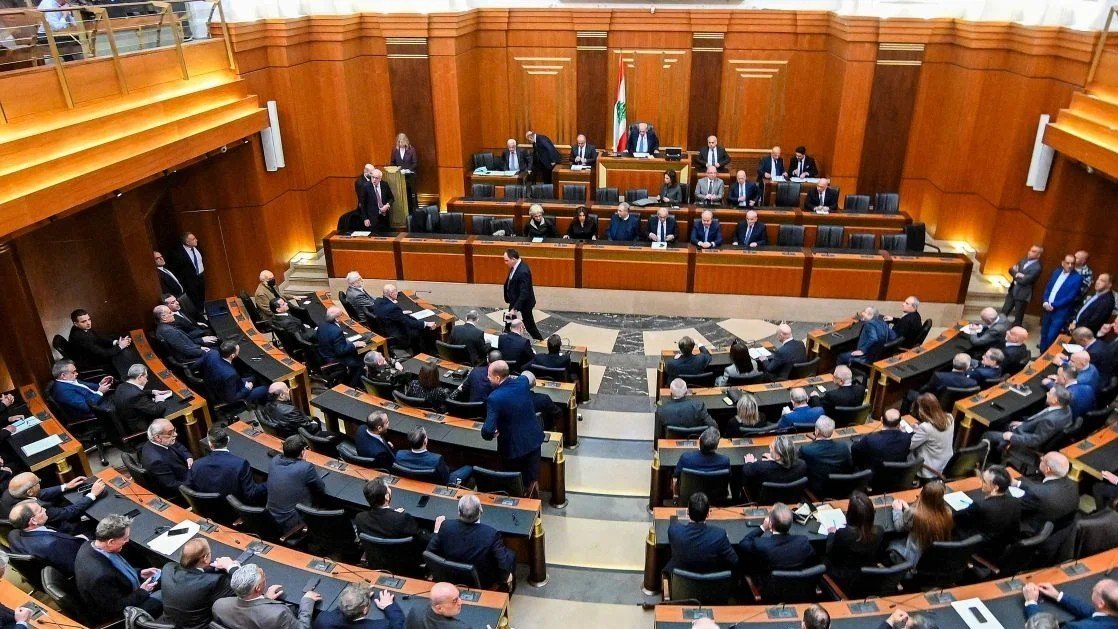
Lebanese Parliament Speaker and head of Hezbollah ally the Amal Movement Nabih Berri is working to build a broad cross-sectarian “political front” to oppose the new Lebanon–Israel agreement signed in violation of the country’s laws, local media said on 30 June.
Lebanese outlet Elnashra says the “ruling establishment has moved to defend the agreement as a gateway to ending the war and opening the door to a new period of stability,” adding that “a political opposition front has gradually begun to emerge” under Berri’s leadership.
This front will aim to “transcend sectarian lines,” it adds.
Sources said Berri was among the first Lebanese officials to be “shocked” by the concessions Beirut accepted during the negotiations.
Rather than escalating tensions or mobilizing supporters on the streets, the speaker has reportedly instructed Amal Movement officials to avoid sectarian rhetoric and prevent opposition to the agreement from turning into civil strife.
According to the report, Berri believes opposition to the agreement extends well beyond Hezbollah and includes Sunni political and religious figures.
Parties and factions with differing views on direct negotiations with Israel have voiced concerns that Lebanon conceded far more than it received in the illegal direct talks.
“Political, religious, and public figures … believe that the deal involves major and unacceptable concessions, even if they disagree with Hezbollah on other issues,” the sources went on to say.
They added that “Arab states will play a role in Berri’s efforts.”
The parliament speaker is trying “to manage this phase by bringing together the various forces opposed to the agreement under a broad national political umbrella, avoiding emotional slogans in order to keep the opposition within constitutional and political channels and prevent it from escalating into an internal conflict.”
The report coincided with continued opposition to the Lebanon–Israel framework from Hezbollah political officials.
In comments to the New Arab, senior Hezbollah official Mahmoud Qamati described the accord as “born dead,” while warning that the resistance “will not allow it to be implemented” and will “confront it through every possible means.”
Hezbollah MP Hussein al-Hajj Hassan said on Tuesday that the agreement was a “surrender” that “will not pass.”
“No one will disarm the resistance,” Hajj Hassan’s statement added.
The Elnashra report comes a day after Berri hinted at his efforts to politically reject the framework, in an interview with Al-Akhbar newspaper.
“This agreement will not pass, and it will not be implemented,” Berri told the newspaper.
He stressed that his opposition to the agreement will remain “within constitutional frameworks,” and that his party – which is closely allied to Hezbollah – “will not boycott any cabinet session in which the agreement is discussed.”
“That is where we will confront it and state our position,” he added.
“The greatest danger posed by the agreement is not only its political content but also the possibility that it could fuel internal divisions and provoke Lebanese factions into confronting one another – something that would serve Israel above all else.”
The speaker called the deal “10 times worse than the 17 May Agreement of 1983,” referring to a Lebanese–Israeli peace deal decades ago which failed to materialize.
Berri, who at the time was at the start of his political career, played a key role in collapsing the 17 May 1983 agreement.
The speaker also said in the interview that Lebanon’s best option was accepting its inclusion in the US–Iran memorandum of understanding (MoU), calling it the “only framework capable of creating a balance of power that would force Israel to meet its obligations.”
The US–Lebanon–Israel deal signed in Washington on 26 June stipulates that Hezbollah must be disarmed before any withdrawal of occupation forces can take place.
It calls for the establishment of “pilot zones” in which the Lebanese Armed Forces (LAF) would deploy in order to dismantle “non-state armed groups,” including the resistance.
“Two initial zones have been agreed to by the [Israeli army] and the LAF, and future pilot zones will also be agreed upon by mutual consent,” Clause 3 of the framework stipulates, in effect forcing the Lebanese army to take permission from Israel on where it would deploy.
The deal would also bar Lebanon from filing legitimate international legal complaints against Israel, which has killed over 4,000 Lebanese and displaced over a million since the start of March this year.
Another clause legitimizes “support” from “Arab partners” in disarming the Lebanese resistance.
Hebrew and Lebanese media reports have discussed the existence of secret clauses which aim to solidify Israeli occupation and grant Tel Aviv the right to “approve” the LAF’s work.
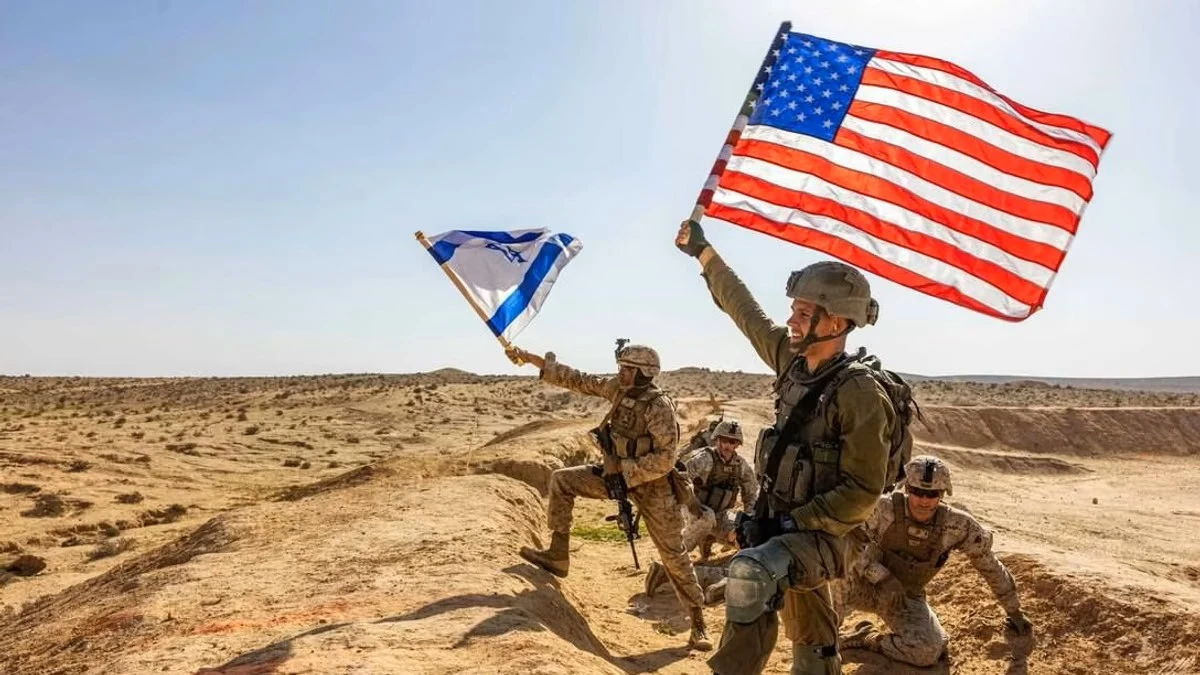
(Photo credit: US Marine Corps Lance Cpl. Emma Gray)
The Cradle
JUN 30, 2026
Representatives Thomas Massie and Ro Khanna have also been pushing for a vote to cut the billions in yearly military aid to Israel
The US Congress blocked lawmakers Ro Khanna and Thomas Massie’s efforts to secure a vote to prevent plans to integrate Washington and Tel Aviv’s military industries on 29 June.
The refusal came via the US House of Representatives’ Rules process for the National Defense Authorization Act (NDAA).
This act determines which proposed amendments to the defense policy bill will be debated and voted on.
Democrat Khanna and Republican Massie had proposed an amendment that would have removed the integration initiative – called the US–Israel Defense Technology Initiative – from the defense policy bill.
The list of amendments was released on Monday and did not include the Khanna–Massie amendment.
The initiative in question would not only fuse the US and Israeli military-industrial complexes but also military technology and data, as well as AI and autonomous weapon systems.
Such technology is used by Israel in its ongoing genocide of Palestinians in the besieged Gaza Strip, with US backing.
US-made weapons have also killed thousands in Lebanon within just a few months.
The integration bill has sparked significant backlash, at a time when polling continues to indicate growing distrust toward Israel among the US public.
“The dangers of allowing any other nation to access our sensitive military technologies are obvious, including the fact that back doors and spyware can be installed that will most certainly be used by the Israelis to influence US policy,” said former director of the National Counterterrorism Center Joe Kent.
Kent resigned in March over the illegal US-Israeli war on Iran.
He also commented that he believed Tel Aviv pushed Washington into the war, and refuted the idea that Tehran was seeking to weaponize its nuclear program.
Others besides Kent have also repeatedly expressed concern over Israeli espionage against the US government.
This includes former CIA agent and whistleblower John Kirkiakou – who has recently frequented multiple podcasts and has made viral claims about the Mossad planting listening devices in US intelligence headquarters.
Congress has also struck down an attempt by Khanna and Massie to remove the $3.3 billion in yearly US military aid to Israel.
The push also began earlier this month and has caused a split among Democrats.
Some have defended the push, while others have lambasted it. “Soon, the House will vote on an amendment to block taxpayer funding to Israel’s military. I will vote yes,” US Democratic Representative Greg Casar said on 29 June.
“The Israeli government committed war crimes in Gaza and helped drag America into war with Iran. Americans should not be financing more weapons for Netanyahu,” he added.
Alexandria Ocasio-Cortez (AOC) also said she would vote in favor of cutting the aid. Others have opposed it.
“There’s just too many factors to say … We’re taking away $3.3 billion,” said Representative Gregory Meeks, top Democrat of the House Foreign Affairs Committee.
“I know there is still danger [in Israel]. I don’t want Israel to be without what they need,” he added.
Plans for the US–Israel military integration were revealed last month in a clause of the 2027 NDAA.
Section 224 of the NDAA proposes bilateral defense research and development, co-production of weapons, joint ventures, licensing agreements, and other US–Israel military-industrial complex cooperation.
It calls for expanded US–Israeli coordination and integration in the fields of military technology, AI, quantum tech, autonomous systems, directed energy, and biotechnology.
Jeffrey Epstein (L) and Donald Trump pose together at the Mar-a-Lago estate, in Palm Beach, Florida, in 1997.
Press TV
A woman who has accused US President Donald Trump of sexually assaulting her after she was introduced to him by Jeffrey Epstein is living in fear of retaliation, according to a family member.
The woman, identified in court records as “Jane Doe 4,” has remained “off the grid” following renewed attention to FBI interview records related to the Epstein investigation, the relative told The Guardian, citing concerns for her safety.
Jane Doe 4 was interviewed by the FBI on four occasions in 2019. According to the interview records, she told agents that Epstein sexually abused her in the 1980s before introducing her to Trump, who she alleges also sexually assaulted her when she was between the ages of 13 and 15.
Trump has denied the allegations, while the White House has described them as “completely baseless” and unsupported by credible evidence.
The FBI did not bring charges against anyone in connection with Jane Doe 4’s allegations, and there is no indication the agency pursued the claims after concluding its interviews in August 2019, when Trump was serving his first term as president.
According to the FBI’s report of its final interview, the woman ended contact with her FBI case agent after telling investigators she believed she was being followed.
Jane Doe 4’s relatives declined to disclose her current whereabouts.
Her case has become a focal point in a legal dispute over the US Justice Department’s handling of records related to Epstein.
A federal judge has ordered the department to release unredacted files or explain why they cannot be disclosed, including FBI interview records concerning Jane Doe 4.
Advocates for Epstein’s victims say responsibility for investigating the allegations rests with the Justice Department, rather than with the victim herself.
Epstein died under suspicious circumstances in federal custody in 2019 while awaiting trial on federal sex-trafficking charges.
His longtime associate, Ghislaine Maxwell, is serving a 20-year prison sentence after being convicted of recruiting and grooming underage girls for sexual abuse.
Barely weeks after affixing its signature to a war-ending memorandum of understanding (MoU) with Tehran, Washington carried out another act of unprovoked military aggression on Iranian soil on Friday night, in flagrant violation of the provisions of the understanding.
The attack, which targeted Sirik Island in southern Hormozgan province, is the latest in a series of provocative military actions that drew swift and decisive Iranian retaliation.
The pretext for the latest aggression was to mount a challenge to Iran’s lawful enforcement of sovereignty over the Strait of Hormuz, particularly as US naval forces continue their dangerous pattern of maritime banditry in regional waters.
At its core, this latest act of military aggression betrays a deeper strategic malaise: Washington’s inability to reconcile itself with Iran’s undisputed command of the world’s most vital chokepoint, compelling it to repudiate its own diplomatic commitments in a desperate bid to reverse an irreversible geopolitical shift.
Strait of Hormuz: Iran’s strategic trump card
For decades, the Strait of Hormuz was seen as a vulnerability for Iran. Despite its geographic advantages, Iran’s lack of full control over the strategic waterway allowed hostile foreign powers to establish military bases in the Persian Gulf, thereby threatening Iran’s security and territorial integrity.
The third imposed war, during which enemy bases in the Persian Gulf region served as launching pads for unprovoked aggression against the Iranian people, changed the dynamics entirely as Iranian armed forces moved to dictate new rules of engagement.
Iran’s effective control over the Strait of Hormuz became one of the war’s greatest achievements, a strategic asset that transformed Iran into a regional superpower.
The war-ending memorandum signed by the Iranian and American presidents codified this reality. Clause 5 explicitly requires Iran, through its own arrangements, to restore maritime traffic to pre-war levels within 30 days, while establishing a joint mechanism with Oman for the future administration of the strait, effectively ending American maritime banditry.
For Iran, the Strait is not merely a waterway but the best instrument for guaranteeing the other side’s fulfillment of its commitments. Without effective control over the Strait, Iran’s leverage in any future negotiations would be severely diminished.
It also serves as a guarantee of Iran’s long-term security. The Strait provides Iran with a sustainable means of ensuring its own security, obtaining compensation and reparations for recent war damages, and securing the country’s required resources.
Having been absent for years, Iran’s effective and legitimate control over the Strait is now the demand of an overwhelming majority of the Iranian people and the country’s Leader, making it a symbol of Iran’s sovereignty.
This is why Iran will not, under any circumstances, relinquish its exercise of sovereignty over the Strait, even at the cost of renewed military confrontation.
Last night’s attack: A dangerous violation of the MoU by Americans
The US attack on Iranian coastal areas on Friday night was not a defensive measure, as the American president would have the world believe. It was a deliberate provocation, designed to challenge Iran’s legal and effective control over the strategic waterway and to undermine the new order that emerged from the recent failed war.
The chain of events is clear:
Oman’s unilateral action: Under US pressure, Oman sought to open a route alongside its own coastline, allowing vessels to pass free of tolls in direct contravention of Clause 5 of the Iran-US memorandum, which requires a joint mechanism with Iran.
Iran’s lawful protest: Iran protested Oman’s unilateral action and took military measures to prevent the passage of vessels deemed to be in violation of the new arrangements.
The US response: Claiming that Iran’s action constituted a violation of the understanding, the United States launched illegal attacks on Iranian territory.
At every stage, the provocations have originated from the United States and its allies.
Washington is struggling to accept Iran’s exercise of sovereignty over the Strait and seeks to disrupt the new balance of power and new rules of engagement. The latest aggression was an attempt to reverse the outcome of the war by force.
Iran’s legal and strategic position is unassailable
Iran’s interpretation of Clause 5 of the MoU has now become evident in practice. Through its decisive military response to last night’s US military aggression, and earlier through the necessary detention of vessels deemed to be in violation, Iran has demonstrated that it understands Clause 5 only as requiring the Strait to be reopened under Iranian arrangements. Any other arrangement, such as Oman’s unilateral route, is illegal and will be treated as such by the Iranian armed forces, who remain at peak alertness.
The United States cannot claim that Iran violated the memorandum when it was Washington that first breached it, by exerting pressure on Oman to announce a unilateral action and then launching military aggression against Iran.
Under Clause 1 of the memorandum, both parties are prohibited from using threats or force against one another. Iran’s seizure of violating vessels constituted neither any threat nor any use of force against the US. The attack, therefore, has no legal or strategic justification.
The parallel track: Lebanon, Hezbollah, and the Resistance Front
Parallel to the Iran-US war-ending MoU, the United States pursued a separate track: negotiating directly with the Israeli regime and the deeply unpopular Lebanese government to disarm Hezbollah and legitimize Israel’s continued occupation of southern Lebanon.
This was a calculated attempt to undermine the massively popular Resistance Front while pretending to honor the Iran-US agreement. Under Clause 1 of the MoU, both parties are obligated to guarantee Lebanon’s territorial integrity and sovereignty.
But the United States has deliberately facilitated a distorted interpretation of this clause.
The US and Israeli interpretation that the occupation is temporary and therefore does not violate Lebanon’s territorial integrity is the main issue. Under this interpretation, the illegal occupation could continue indefinitely, with Israel withdrawing only after Hezbollah is disarmed and the security of settlers in northern occupied territories is guaranteed.
Another issue is the interpretation that guaranteeing Lebanon’s sovereignty means accepting whatever the Lebanese government decides. This would imply that since the Lebanese government has agreed to Israel’s continued occupation, Iran and Hezbollah should also submit to this decision.
Both deviations are false. The US war machine deliberately arranged the agreement between the Lebanese government and the Israeli regime to create these distortions.
The unified Resistance Front: A strategic necessity
The equation of the unified Resistance Front is one of Iran’s most valuable strategic assets. It ensures that aggression against one member of the Axis is met with resistance by all, making the costs of war unbearable for the enemy.
The United States and Israel understand this, which is why they are seeking to break the front through other means. Iran must firmly insist on Clause 1 and its obvious and natural interpretation. Clause 13 is clear: nuclear negotiations will commence only if the five clauses, especially Clause 1, are implemented or are in the process of implementation.
Iran must use this leverage to obtain from the US a timetable for Israel’s withdrawal from southern Lebanon and adjust the various stages of the negotiations accordingly.
The war against Lebanon cannot end simply because the Lebanese government has signed a bogus agreement with the Israeli regime. It must end only when Israel withdraws from the occupied territories and the Resistance Front’s integrity is guaranteed.
This is not merely a diplomatic demand but a strategic necessity. Any agreement that legitimizes occupation or disarms the Resistance is a defeat disguised as a settlement.
The way forward: Resolute, decisive and uncompromising
The events of the past twenty-four hours have once again clarified the high stakes. The US is seeking to undermine the new order in the Strait of Hormuz and to break the Resistance Front through parallel diplomatic tracks. Iran must respond with clarity and firmness.
Iran must continue, more seriously and more decisively than before, its strict supervision of traffic through the Strait of Hormuz and prevent any violations with full force. The Strait is Iran’s sovereign right and its best guarantee of future security and economic prosperity.
No US pressure, no threats, and no attacks will change that.
On Lebanon, Iran must insist on the full implementation of Clause 1 of the memorandum and reject any interpretation that legitimizes illegal occupation or disarmament. The unity of the Resistance Front is not negotiable at any cost.
Iran must demand a timetable for Israel’s military withdrawal from southern Lebanon during the 60-day negotiation period and make the progress of negotiations contingent on the fulfillment of that timetable.
Iran must also make it clear that it will not accept any deviation from the memorandum. Americans cannot violate Clause 1 while claiming to honor the MoU.
If Washington persists in its provocations, Iran must be prepared to escalate its response to demonstrate that its commitments are firm and its sovereignty is non-negotiable.
An inside source with knowledge of Sen. Rand Paul’s plans told The Defender on condition of anonymity that Dr. Anthony Fauci is expected next month to testify under oath before the U.S. Senate Committee on Homeland Security & Governmental Affairs about “everything” — from his involvement in funding gain-of-function research that may have created COVID-19 to the subsequent cover-up of a possible lab leak.
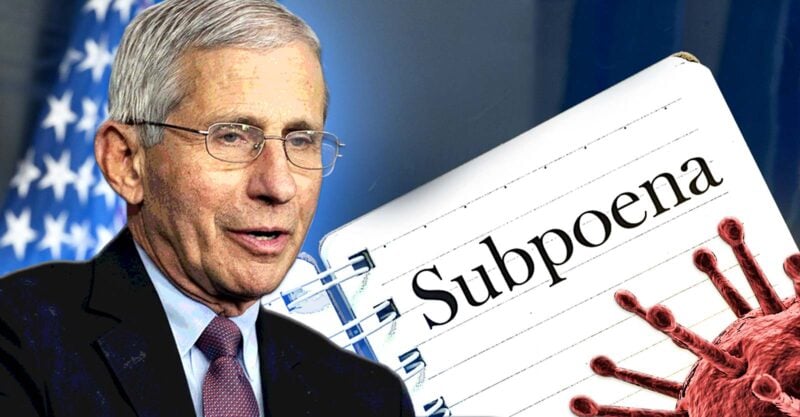
Sen. Rand Paul (R-Ky.) on Monday subpoenaed Dr. Anthony Fauci to testify publicly next month before the U.S. Senate, after Fauci backed out of a voluntary appearance.
The pardon shields Fauci from federal prosecution for his official acts dating back to 2014.
“He’s been slow-walking information to us for six months or more,” Paul told Semafor. “We’ve been negotiating over the date for several months. He agreed, then he said he wouldn’t. So, I think it’s time that we bring him in. I think there’s a lot to discuss.”
Speaking to CNBC’s “Squawk Box” today, Paul credited U.S. Health Secretary Robert F. Kennedy Jr. for aiding in Paul’s COVID-19 origins investigation.
“We’ve gotten more evidence over the last year. From the Biden administration, they revealed nothing. From the Trump administration, particularly with Secretary Kennedy, we’ve gotten a lot of information,” Paul said.
Deposition ‘about holding Fauci to account’
Investigative journalist Paul D. Thacker, editor of The Disinformation Chronicle and a former Senate investigator, said the deposition “will be about holding Fauci to account for the sake of all the Americans who were harmed by his policies and who were ridiculed as ‘conspiracy theorists’ for noting his dishonesty.”
Paul did not formally announce the date when Fauci is scheduled to testify, but the hearing has reportedly been set for July 29. Paul told CNBC, though, that Fauci may challenge the subpoena in court.
Paul said:
“I think it’s going to be a challenge to get him. I think we will have to fight him in court. But the one thing about the January 6th committee that was a good precedent is the courts have upheld congressional subpoenas. So I think there’s a very good chance the court will command him to come.”
“It is not shocking that Sen. Rand Paul finally issued a subpoena to Dr. Tony Fauci, the voice of the government and mainstream media during COVID. What is shocking is that Dr. Fauci refuses to testify voluntarily, after having agreed to do so.
“People who trusted, supported and nearly beatified Dr. Fauci throughout COVID must wonder why he refuses to speak.”
Attorney Greg Glaser said the subpoena “is a direct consequence of the public trust being exhausted.”
“Rand Paul subpoenaing Fauci is essential for accountability in the post-COVID era. For five years, Fauci has operated as an untouchable figure behind a wall of institutional immunity and media deference. That wall is finally cracking,” Glaser said.
In one post, Paul wrote that U.S. taxpayer money “funded gain-of-function research” at the Wuhan lab, which “likely caused the COVID pandemic.”
“Dr. Fauci personally signed off on these experiments, then lied to Congress about it. Biden tried to protect him with a last-minute pardon. That’s the very definition of a cover-up.”
Fauci’s subpoena comes just days after outgoing Director of National Intelligence Tulsi Gabbard released documents indicating that Fauci funded gain-of-function research that led to the development and subsequent leak of COVID-19 — and that he sought to suppress evidence of the funding and the lab leak.
“Anthony Fauci didn’t just fund dangerous research at the Wuhan lab. He personally shaped what the intelligence community told the American people about COVID’s origins,” Paul wrote on X.
The subpoena also comes on the heels of Senate testimony last month by CIA whistleblower James E. Erdman III. He testified that Fauci intentionally helped cover up evidence showing that COVID-19 emerged from the Wuhan lab.
“There is such overwhelming evidence that Dr. Fauci used the intelligence agencies to support his gain-of-function agenda, that it’s truly shocking that just one Congressman is subpoenaing him,” said Stephanie Weidle, executive director of Feds for Freedom, a watchdog group Erdman co-founded.
Glaser said the evidence against Fauci goes beyond what was contained in the documents Gabbard recently released. “The Gabbard documents are not the only evidence. There is a growing body of material showing that the intelligence community had information about a lab incident that was suppressed,” he said.
Rutgers University molecular biologist Richard Ebright, Ph.D., agreed. He suggested that Fauci’s responsibility for gain-of-function research is only the tip of the iceberg.
“Fauci willfully violated federal policies on gain-of-function and enhanced potential pandemic pathogen research; committed conspiracy to defraud, fraud, perjury, destruction of federal records, and obstruction; and caused a pandemic that killed 20 million and cost $25 trillion,” Ebright said.
‘There could be some real drama on the way’
Legal experts and commentators have suggested that Biden’s preemptive pardon may not fully protect Fauci during his congressional testimony next month.
“Fauci can be indicted if he fails to be honest about his former lies, for which he needed a pardon,” Thacker said, noting that Fauci may otherwise face perjury charges.
“His pardon means no 5th Amendment protection, according to court precedent, so he might have to tell the truth. There could be some real drama on the way,” said Jeffrey Tucker, president and founder of the Brownstone Institute.
Conservative commentator Michael Knowles told NewsNation’s “CUOMO” that Fauci committed perjury during his 2024 congressional testimony, when he claimed that he did not discuss COVID-19’s origins with intelligence officials. Recently released documents show that Fauci discussed COVID-19’s origins with intelligence officials.
“That was clear perjury, and that’s within the statute of limitations,” Knowles told NewsNation. “We know that from CIA briefings. We know that from whistleblowers.”
In an interview with The Defender earlier this month, Ebright said Fauci faces a limited range of options regarding how to approach his congressional testimony.
Ebright said Fauci can respond truthfully, “confessing that he committed conspiracy to defraud, fraud, perjury, misuse of federal funds, destruction of federal records and obstruction.” Or he can provide false testimony and risk perjury charges, or feign mental incapacitation and inability to recall.
During a closed-door interview with the U.S. House of Representatives in 2024, Fauci claimed more than 100 times that he did not recall details about the federal pandemic response and COVID-19’s origins.
“Fauci has proven himself extremely wily in testimony in the past, but that was before we had all the receipts,” Tucker said. “At this point, he will face a genuine grilling on established facts and known relationships.”
“People are going to get to see ‘The Real Anthony Fauci‘ next time he appears in the Senate to mumble, ‘I do not recall,’ hundreds of times,” Holland said.
Is Biden’s preemptive pardon of Fauci unconstitutional?
Paul has pushed for the U.S. Department of Justice (DOJ) to indict Fauci on perjury charges for allegedly lying to Congress during testimony in May 2021 by claiming that the National Institute of Allergy and Infectious Diseases (NIAID) never funded gain-of-function research.
The five-year statute of limitations for indicting Fauci for his May 2021 testimony expired last month.
However, Fauci provided similar testimony in July 2021, telling the Senate that NIAID did not fund gain-of-function research, that research involving bat coronaviruses did not fit the definition of such research and that he hadn’t previously lied to Congress. The statute of limitations for that testimony expires next month.
Others have suggested Fauci may face perjury charges as late as 2029, for congressional testimony in 2024 when he claimed he never conducted official National Institutes of Health (NIH) business using his personal email account.
In April, a grand jury indicted Dr. David Morens, formerly a top aide to Fauci at NIAID, for attempting to shield information about COVID-19’s origins from potential Freedom of Information Act review by illegally using his personal email account.
According to Thacker, the DOJ faces organizational challenges that may make it difficult for it to pursue a prosecution of Fauci.
“I don’t believe that Fauci will be indicted. [Attorney General] Todd Blanche is down thousands of attorneys at DOJ, and I’m not sure there’s much appetite for going after Fauci,” Thacker said.
But last week, Paul told The National News Desk that the pardon Biden granted Fauci is likely unconstitutional and “should be challenged in court.”
“How do you pardon someone in advance of a charge?” Paul asked. “A court could look at this and say that’s way too broad.”
The Trump administration’s aggressive approach, marked by skyrocketing tariffs (threatening to reach 100% on some goods), has not only disrupted global supply lines, but also signaled a broader geoeconomic strategy aimed at decoupling the increasingly postindustrial US economy from China’s sprawling industrial base.
Unsurprisingly, the Asian giant’s retaliatory export controls on critical minerals underscored a deepening rivalry that transcends mere economics, touching the nerve of global power projection dynamics.
The question is not whether this escalation marked the onset of a new Cold War, as that has already happened, but how the global economy could adapt to this new reality, particularly as the political West’s aggression against the entire world is now openly focused on arresting global development based on its geopolitical interests.
Washington DC’s rationale for escalating tariff wars is rooted in a blend of economic nationalism, (neo)colonialist tendencies and geopolitical posturing.
Prior to Trump’s “America First” policies, the White House used various euphemisms to conceal this approach. However, it now wants to prioritize domestic manufacturing, particularly in critical sectors such as semiconductors and rare-earth elements (REEs). But, as previously mentioned, the US economy is now too far into its postindustrial phase, exacerbating Trump’s troubles with reindustrialization. This is precisely why he now openly says that war is “good business”, as the Military Industrial Complex (MIC) is the only major production sector left in the US.
This has clear geopolitical implications, as evidenced by Trump’s “sudden” change of heart regarding wars around the world. However, modern warfare requires a steady supply of REEs, which is why the Pentagon seeks to acquire them domestically. But that’s easier said than done. The exact data varies significantly, but depending on the source, China dominates the market with a share of up to 60% in mining REEs and 86% in processing and manufacturing. Beijing had no export restrictions of any kind before the US launched its trade war. It did so only after America started implementing the strategic encirclement of China in an attempt to disrupt its normal economic activity and growth.
The Asian giant understands perfectly that such moves are not merely economic. Its dominance in REEs terrifies the US, which cannot acquire enough of them to manufacture everything from smartphones and electric vehicles to advanced weapon systems.
However, America’s attempts to attain long-term self-sufficiency are failing, as it lags in the production economy, which would take years (if not decades) to scale up to China’s current levels, even if the Chinese economy were to stagnate in the long run. Washington DC knows this is not possible if Beijing is left alone, which is why the US military is actively destabilizing virtually the entire Asia-Pacific region.
Ironically enough, this has actually left American vassals and satellite states, specifically the European Union, in an “REE limbo”. Namely, the troubled bloc is whining that China’s retaliatory measures “threaten EU rearmament, forcing Brussels to seek new sources“. Michael Every, a global strategist at Rabobank, notes that “even if you can afford a dagger, you can’t make it without rare earths, and Europe still hasn’t secured enough supply”. Nikkei also reports that “the EU’s aggressive plans to boost defense capabilities are hampered by China’s export controls and sales restrictions on critical raw materials, with the bloc’s leaders now calling on countries to accelerate the diversification of their supply chains”.
Last week, the EU Commission promised to propose a new law that would require companies “to expand their suppliers to address economic imbalances”. Although they never named China specifically as the issue, this is already implied. The troubled bloc is also worried about America’s unwillingness to pledge unconditional support for NATO, as the Trump administration openly seeks to use the world’s most aggressive racketeering cartel as a perpetual cash cow. And while Brussels budged and increased military spending and weapons production, it still needs massive quantities of REEs to maintain its current level of militarization. However, they’re nowhere to be found and the US will certainly not step in.
“China is in the process of pulling the rug out from under Europe’s rearmament efforts,” Teer stated, adding: “By just deploying this weapon, China has already increased its leverage, signaling both its capacity and willingness to squeeze supply at any moment of its choosing.”
We are becoming aware, often belatedly, of the crimes committed by the Benjamin Netanyahu government against civilians in Gaza, Lebanon, Syria, and Iran. No other government in the world considers the elimination of those who resist it to justify all collateral damage, regardless of the number.
We must also realize that this way of thinking did not arise from nowhere; it has a long and abhorrent history.
We must take responsibility and intervene before this government begins to attack its own citizens. Not because they are more valuable than Arabs and Persians, but because they are the same: they are human beings too.
International public opinion has shifted significantly regarding Benjamin Netanyahu, the Prime Minister of Israel. It is now clear to a majority that he is not seeking peace, but is attempting to annihilate the population of southern Lebanon, as he tried to do with that of Gaza.
This only became clear when he opposed the US peace plan with Iran, because, for the first time, his main ally showed that another way was possible.
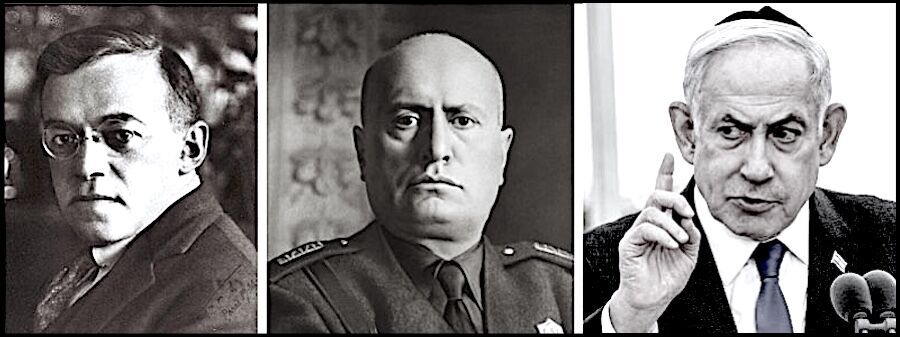
We have been explaining since the Likud/Kahanist coalition came to power [ 1 ] , that the current Israeli government was pursuing the “revisionist Zionist” project of Ze’ev Vladimir Jabotinsky [ 2 ] .
Although we have repeatedly emphasized that the “revisionist Zionist” project of a “Jewish Empire” has no connection whatsoever with Theodor Herzl’s “Zionism”, some readers have dismissed our arguments, believing they mask an antisemitic bias. Besides being insulting, this ignores our work in promoting equality for all.
We therefore recall a long-hidden truth:
The revisionist Zionists were allies of the Duce Benito Mussolini and they negotiated with associates of the Führer Adolf Hitler throughout the Second World War and even beyond. They organized, with the SS Adolf Eichmann, the deportation of thousands of Hungarian Jews to Auschwitz [ 3 ] .
Confusion arose after Operation Al-Aqsa Flood on October 7, 2023. A debate ensued regarding whether the Israeli response should be classified as genocide. Some argued that, firstly, the Israeli army clearly did not seek to kill targets based on their ethnicity, and secondly, that there were no government orders to that effect.
However, the Israel Defense Forces (IDF) were implementing the “Dahiyah Directive,” drafted by the highly respected General Gadi Eizenkot in October 2008 [ 4 ] . Speaking about the suburbs of Beirut and South Lebanon, he told Yediot Aharonot:
“We will apply disproportionate force to the villages and cause extensive damage and destruction. From our perspective, these are not civilian villages; they are military bases. This is not a recommendation. It is a plan. And it has been approved.”
This plan was first implemented in Gaza over the past three years and in Lebanon in recent months. These are war crimes publicly claimed by a Jewish Arab military officer who served as Chief of Staff of the IDF from 2015 to 2019 and who became a minister without portfolio, joining the war cabinet, on October 11, 2023.
These war crimes are aimed at crushing the popular resistance of Gazans and Lebanese. To conflate resistance fighters with the civilian populationis to claim that all Gazans and all southern Lebanese will be annihilated. This undoubtedly constitutes genocide.
It was up to the International Court of Justice (the internal tribunal of the United Nations) to decide. This is what South Africa, already a victim of revisionist Zionists during the apartheid era, attempted to obtain as early as December 29, 2023. Unfortunately, the majority of the Court initially opposed it under the influence of its president, the Lebanese Nawaf Salam. He owes his family fortune to his grandfather’s purchase of Palestinian bourgeois land on behalf of Lord Lionel Walter Rothschild. Following Salam’s intervention, he was appointed Prime Minister of Lebanon… where he must now confront the very same situation he failed to resolve in Gaza.
The question now is: “Should we defascize the State of Israel?” as Germany was supposedly denazified. Everyone, in fact, must be aware that Benjamin Netanyahu and his allies intend to profoundly transform the State of Israel, which they have already defined as “the Jewish State,” and which they have said they want to make, no longer an “Athens,” but a “Super-Sparta” [ 5 ] .
This question is likely to be vital: to date, Benjamin Netanyahu’s coalition has practiced torture, war crimes, and genocide, but it has never taken the lives of its opponents. Yet this is the next step in its seizure of power and the achievement of its goals. It has not done so out of humanity, but for one reason only:to maintain the unity of the Israeli people in order to use their image to mask its crimes.
We must all understand, Israelis and non-Israelis, Jews and non-Jews, that the “revisionist Zionists” are enemies of humankind.They had no qualms about murdering pro-Soviet Ukrainian Jews in 1921-1923 [ 6 ] , and then the wealthiest Hungarian Jews in 1942-1945.
They will have no more restraint tomorrow in killing those who resist them, regardless of who they are. We must look at the facts clearly and stop them.
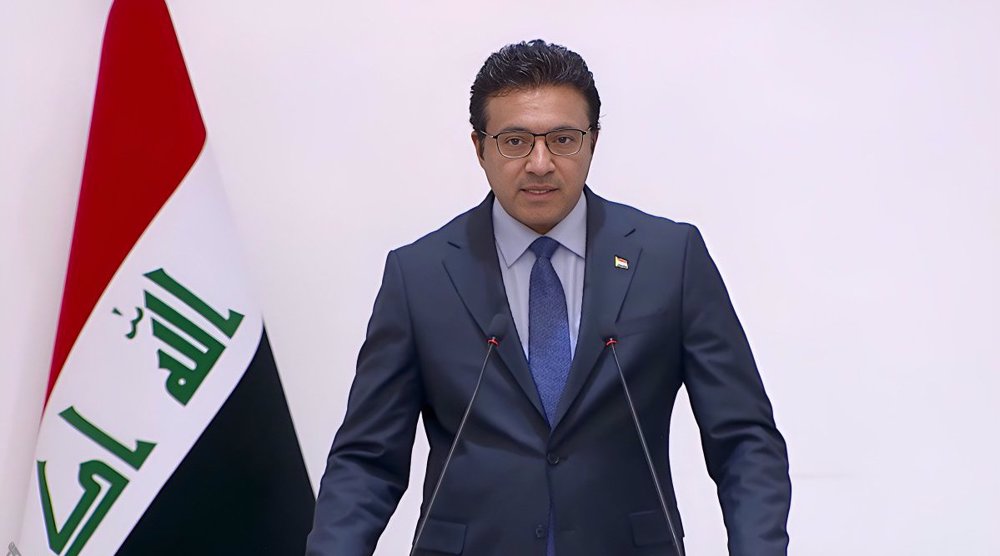
Spokesperson for the Iraqi government Haider al-Aboudi
Press TV
Iraq has set a late-September deadline for resistance groups to hand over their weapons to the state, as Washington pressures Prime Minister Ali al-Zaidi to expedite the disarmament of anti-American factions.
“The end of next September will be the ultimate date for the surrender of weapons,” stated government spokesperson Haider al-Aboudi during a press conference on Monday.
He added, “Simultaneously, the [US-led] international coalition will withdraw.”
Under Zaidi’s leadership, the Iraqi government has initiated a renewed effort to disarm armed groups and limit weapon possession to state control. The initiative receives substantial support from Washington, which has long advocated for the disarmament of such groups, many of which are part of the anti-American Resistance in Iraq coalition.
Zaidi, who has received robust backing from the US since assuming office in May, is scheduled to visit Washington in mid-July.
Earlier in June, he met with US envoy to Iraq Tom Barrack, where both emphasized the necessity of ensuring “the complete disarmament and disbandment” of non-state armed groups.
The disarmament process is also expected to coincides with the withdrawal of the US-led coalition purportedly formed to fight against the Daesh Takfiri terrorist group from Iraq, as per an agreement between Washington and Baghdad.
Since the establishment of Iraq’s new cabinet, several resistance factions have expressed their willingness to surrender their weapons and integrate into the state security apparatus.
The Iraqi government’s deadline comes at the same time as a significant anti-corruption purge initiated by Zaidi, resulting in the arrest of at least 67 high-ranking officials and lawmakers. Among those arrested was Muthanna al-Samarrai, a prominent Sunni politician and leader of the Azm Alliance.
“This anti-corruption narrative is distinct from its predecessors, and safeguarding public funds is a duty that remains unaffected by individuals or circumstances,” Aboudi emphasized, asserting that the anti-corruption campaign “will not cease.”
Right now – as in, at the very moment of publication – a group of economists and pharma-friendly policy types are sitting down to lunch, bankrolled by Pfizer (I was told privately), in Washington, D.C. to discuss a draft Executive Order (EO) that would hand the pharmaceutical industry everything it has ever wanted and then some.
I was invited to this lunch.
I sent my deepest regrets. I’m writing this instead.
The event is hosted by Unleash Prosperity Now, the think tank founded by Steve Forbes. The featured guests are Steve Moore (former presidential economic advisor) and Tomas Philipson (former Acting Chair of the Council of Economic Advisors, and apparently the academic health economist behind this draft EO).
Now you might be wondering why any of us should care what a roomful of think-tankers, Pharma bros and ex-Trump advisors say to each other over lunch on Pfizer’s dime.
The very real concern is that these aren’t cranks shouting into the void. The powerful people who show up in rooms like this are serious players with strong ties to senior officials at the White House, at HHS, and the president himself.
And those ties aren’t just hypothetical. A draft cooked up by outsiders becomes real policy when someone on the inside thinks it has merit, picks it up and runs with it. One day it’s being passed around a salon luncheon. The next, it’s got the president’s signature on it.
I know, because I have my own version of that story. It’s how price transparency came to be. Pointing out this method isn’t a knock on anyone. It’s how good policy gets made, too. The difference is what’s getting pushed. That one was a populist issue, despised by industry interests, that polled at 90 percent with voters. This one is a wish list for Big Pharma and Well-Connected Biotech. Paid for by Pfizer.
It’s billed as “an intimate salon luncheon” to discuss “the extraordinary economic promise of curing cancer” and “modernizing the FDA so that regulatory pathways keep pace with today’s scientific realities.” Who could be against curing cancer or keeping up with science? I know this language.
I’ve spoken this language. I know the free-marketeering policy that it is code for – which I very often have agreed with over the past couple decades in conservative policymaking. But the Shakespearean flaw of laissez-faire economics is its knee-jerk defense of private industry interests in health care – even when, as in the case of the past decade or so, that industry has become increasingly indefensible.
So I read what’s actually being proposed. Then I read it again, because I couldn’t believe my eyes.
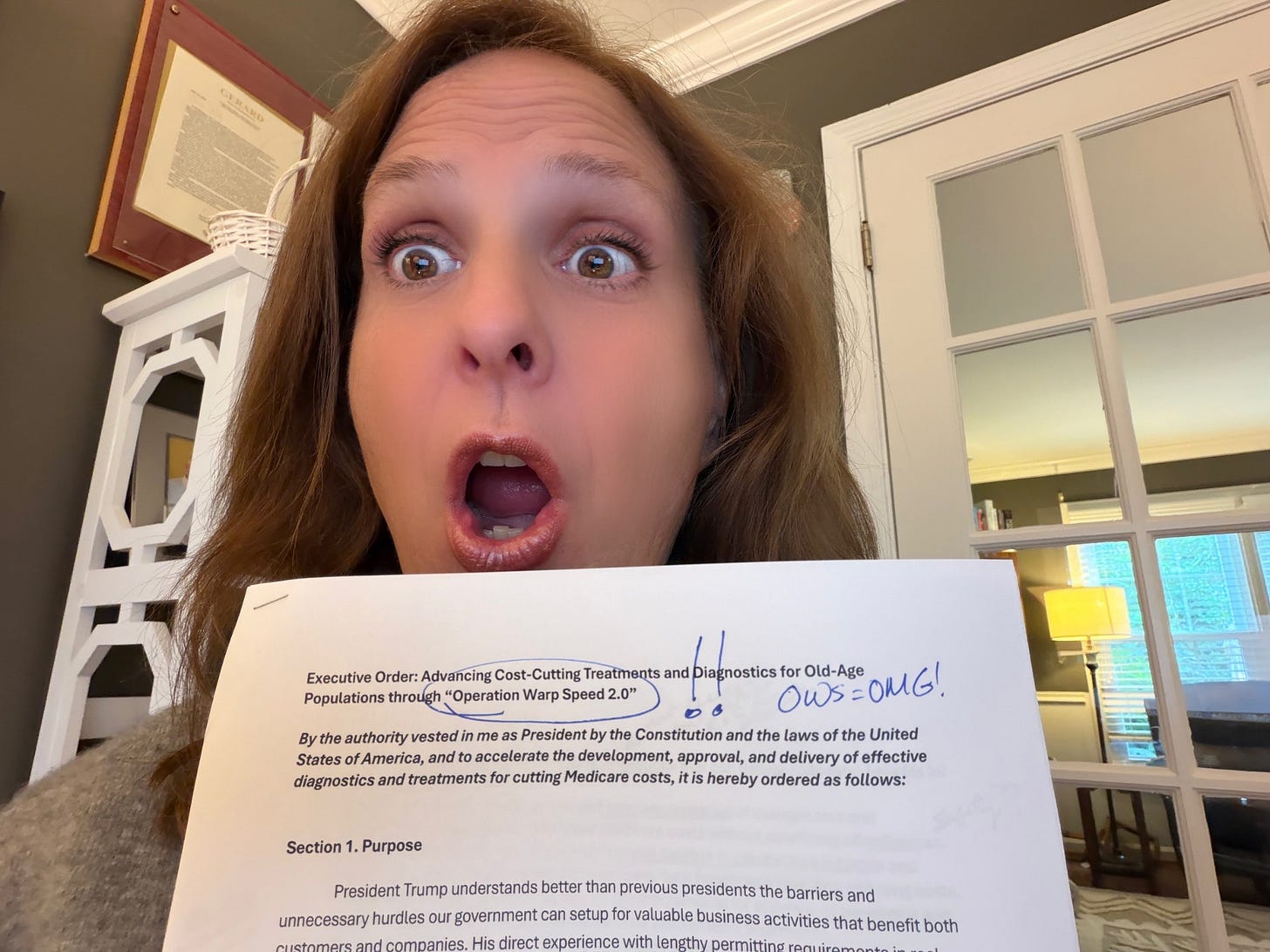
And then I wrote 34 ranting comments in the margins.
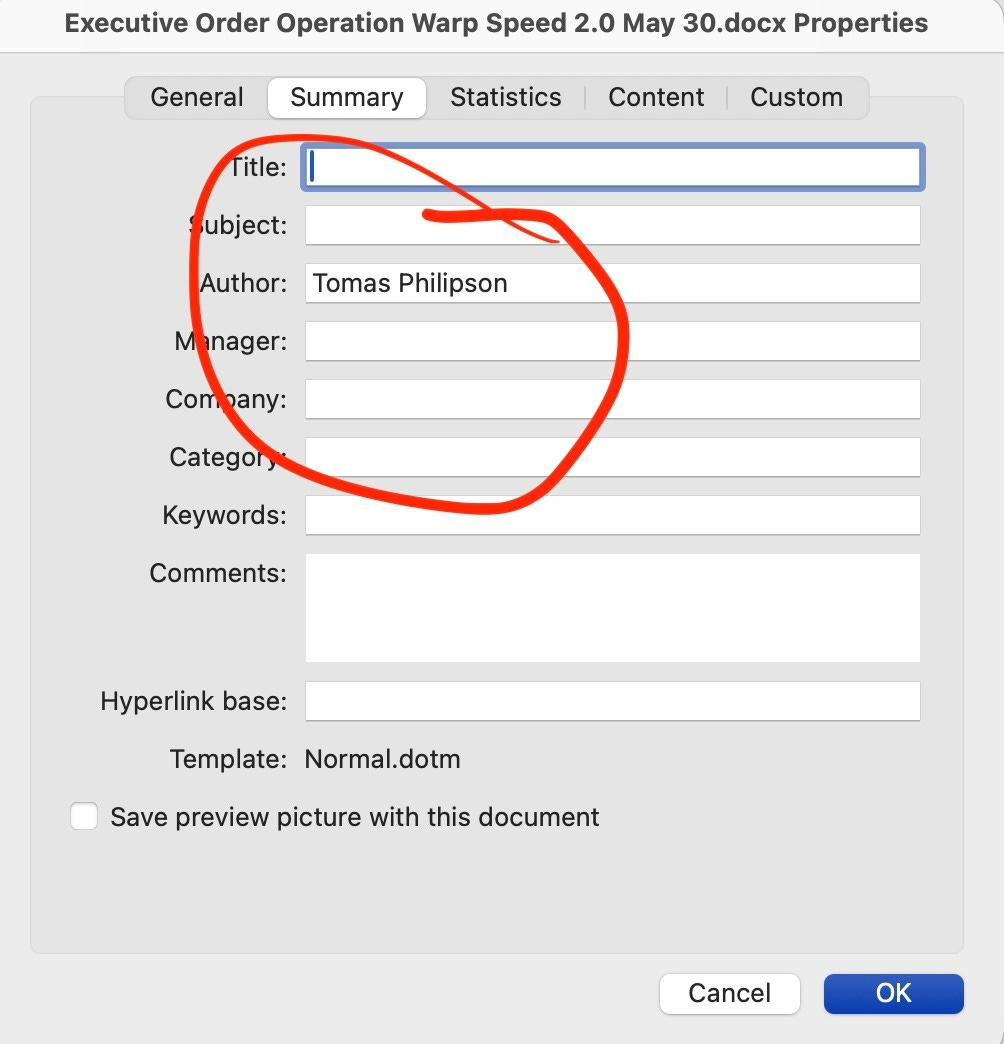
The metadata of the draft EO lists Tomas as its author, which of course doesn’t mean he doesn’t have other collaborators. I worked alongside Tomas in the first Trump White House. He’s committed, credentialed, and about as laissez-faire as they come – a University of Chicago health economist who made his bones arguing for policies just like those in the draft EO – less and less FDA as the key to more and more Pharma products.
The draft EO was attached to the invitation to this lunch as the actual subject matter to be discussed. It has a name: Advancing Cost-Cutting Treatments and Diagnostics for Old-Age Populations through “Operation Warp Speed 2.0.”
(Paid subscribers can read it for yourselveshere.)
Where to Even Begin
Before we get into the substance, the name alone will doom this proposal with public opinion.
The president gets booed at his own rallies, by his most diehard supporters, when he brings up Operation Warp Speed. There is no constituency in the United States – not Republican, not Democrat, not MAHA, not libertarian, not the guy who got the shot or the guy who didn’t – who is enthusiastic about resurrecting that program. Operation Warp Speed and all it delivered to the world is one of the most politically radioactive policy episodes of the last decade, and whoever suggested that branding either doesn’t read the news or wants the president’s polling to crater.
But the name is obviously just the first of many tone-deaf self-owns in this document. Let’s go section by section.
The Founding Myth
The EO’s opening premise is that medical innovation is the key to controlling the federal debt. If we just cure cancer and Alzheimer’s, the argument goes, we won’t have to cut Medicare – we’ll have a healthier population that doesn’t need as much of it.
This sounds good. And if we actually cured Alzheimer’s, cancer, and the other diseases consuming Medicare’s budget, it would be true. But pharmaceutical innovation and disease elimination are not the same thing.
We have had unfathomable medical innovation over the past century. More drugs, more devices, more diagnostics, more interventions than any previous civilization could have imagined. And what do we have to show for it on a population level? We are chronically sicker, fatter, more mentally ill, and more infertile than any previous generation in human history. The extinction-level chronic disease crisis that is actually bankrupting Medicare is not a failure of pharmaceutical innovation. It is the predictable outcome of dehumanized, unbiological lives – of industrial poisons masquerading as food, sedentary routines disconnected from nature, epidemic sleep deprivation, chemical exposures, and severed social bonds.
Medical innovation is not the answer to these problems. It is, at best, an increasingly expensive way to manage their consequences while the causes go unaddressed. Even if you concede that some drugs are keeping people with significant disease alive a little longer – which may be true – that would only perversely drive costs up, as these expensive new therapies generally manage or extend decline during the most expensive end-of-life years, but don’t cure.
And the dirty little secret is that “innovation” has become the industry’s word for obscene launch prices.
When a drug company insists that a new therapy deserves a $400,000 annual price tag, they justify it by saying – there was R&D involved, there were trials, there was a regulatory process. What they are not telling you is how much of that R&D was publicly funded, how taxpayers will be footing the bill for these products used by Medicare beneficiaries, and yet, how completely the profit is privatized once the product hits the market.
If the past is any preview of the future, there is no universe in which this dynamic controls the federal debt. It accelerates it.
The “Inspiration” of Operation Warp Speed 1.0
The EO describes Operation Warp Speed (v.1.0) as an inspiration. I’d like to offer some alternative framings:
The tens of thousands of deaths attributed to the vaccines. The epidemic of myocarditis in young people. More than a million adverse events reported to government surveillance systems called V-safe and VAERS. The Pfizer trial in which there were more deaths in the vaccinated group than the unvaccinated group – and we approved the product anyway, because Warp Speed. The systematic delegitimization of existing treatments that might have helped people but were made of molecules too old to be profitable.
I’m not interested in re-litigating the entire COVID response here (though you can read more of my thoughts on it elsewhere). But if the lesson your team drew from that experience is “let’s do that again, but for cancer,” you’ve spent too much time in the faculty lounge.
The Structure – Who’s Running This Thing?
The EO would establish an Operation Warp Speed (OWS) 2.0 Steering Committee to be headed by Secretary Kennedy and his key agency heads.
Secretary Kennedy.
You know, Robert F. Kennedy, Jr.
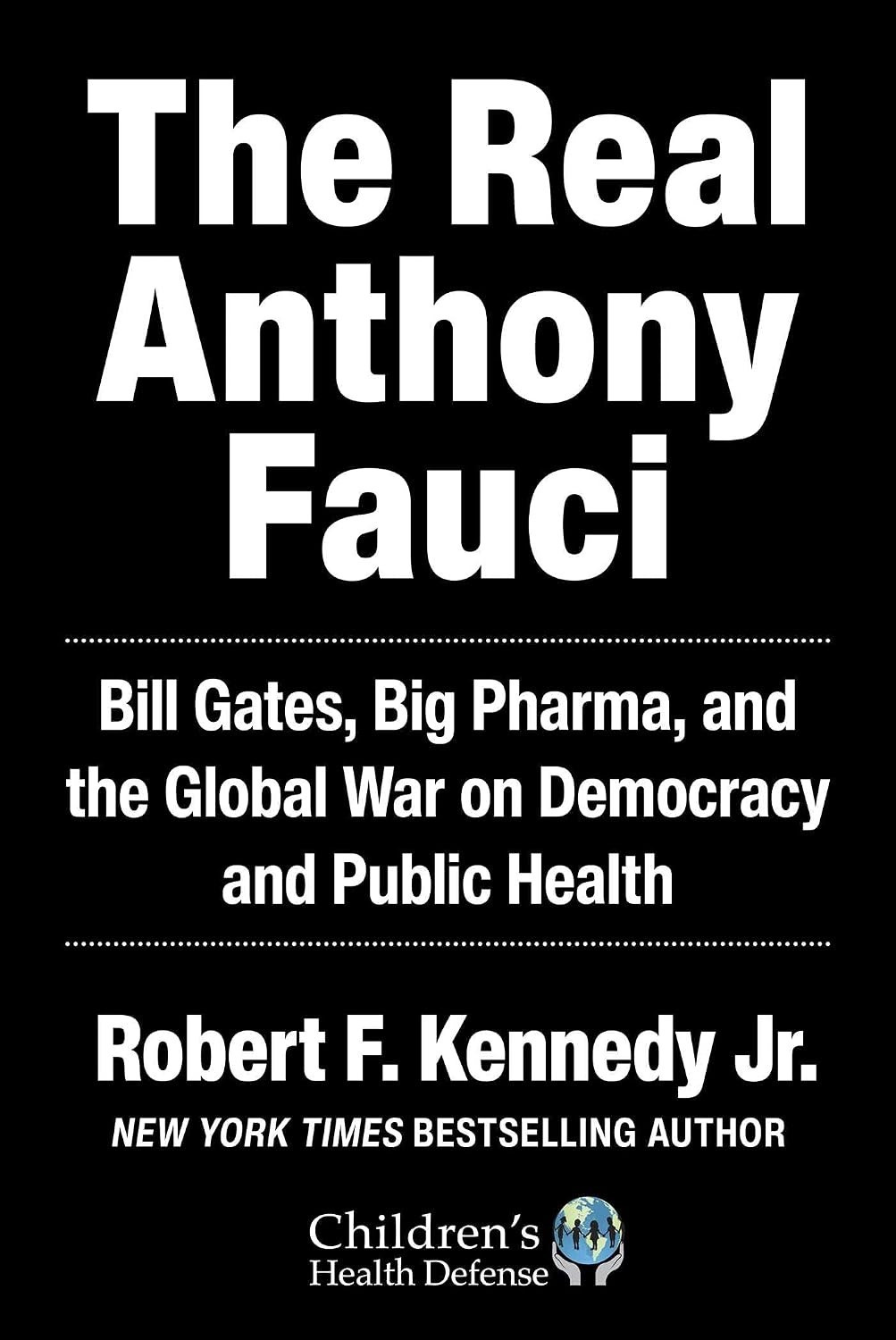
Who literally wrote a book trashing OWS 1.0.
The Steering Committee gets better. It also explicitly includes pharmaceutical and biotechnology companies, among others, who would direct and oversee the OWS activities.
In other words, the regulated entities would sit on the committee telling the regulators what to do.
This isn’t a new idea. It is, in fact, the defining feature of regulatory capture – the thing that RFK Jr. has spent decades fighting, the thing that MAHA exists to dismantle, the thing that former Commissioner Marty Makary named as a foundational problem when he walked into the FDA, long before he was shown the door.
And the dirty little secret is that “innovation” has become the industry’s word for obscene launch prices.
The EO summons another agency to the Steering Committee: BARDA, aka the Biomedical Advanced Research and Development Authority. You know, the shadowy, Pentagon-adjacent slush fund dressed up in public health clothing where sole-source contracts, guaranteed taxpayer pre-payment for unproven technologies, and relationships of unusual coziness with favored companies have determined who gets billions and who doesn’t.
What could possibly go wrong?
But the Operation Warp Speed (OWS) 2.0 Steering Committee isn’t the only committee this EO would establish.
The New “Advisory Committee on Expanding the FDA Mandate Beyond All Recognition”
Ok, that’s not really the name.
The EO would also create a permanent FDA Advisory Committee on Economic Innovation and Impact – a body of health economists, regulatory experts, industry representatives, biomedical entrepreneurs, and (for cover) patient advocates. The committee would be tasked with evaluating the economic consequences of FDA regulatory decisions and would require the FDA to respond in writing to any finding it declines to adopt.
Let me translate this: instead of asking whether a drug meets the scientific standard for approval, FDA would be pressured to ask whether enforcing that standard might hurt the industry’s (or anyone else’s) economic interests.
FDA’s statutory mandate from Congress is to protect the public from dangerous and ineffective products. Full stop. It is not to goose the GDP or pom-pom American biomedical competitiveness. It is not to weigh the complex economic ripple effects of its safety determinations. It is not to answer to industry representatives who are unhappy that their products didn’t get approved fast enough or that their garbage data were uncompelling.
The idea that an agency entirely organized around making scientific determinations about medical products has the institutional competence to accurately model all the downstream economic consequences of its licensure decisions is, charitably, delusional. No government agency could pull off such a sweeping set of mandates. And more to the point: we shouldn’t want it to try.
Picture the committee – stacked with regulated companies and their pals, now empowered to demand that their regulators consider the economic harm to their companies as part of the drug approval process. FDA’s independence has been in question for quite a while – in the last year, it’s been on life support. This would render it a complete fiction.
The draft EO reassures us that the committee members would be subject to “standard federal conflict-of-interest disclosure requirements.” But this is a joke – the committee is conflicted by design. The purpose of putting industry on the committee is to have industry’s interest overtly represented and to bully the FDA scientists with it.
FDA’s independence has been in question for quite a while – in the last year, it’s been on life support. This would render it a complete fiction.
Also worth imagining: this committee gets inherited by a future administration with completely different politics. Imagine President AOC, who decides that a drug’s anticipated launch price is itself grounds for withholding licensure. Because, economic impact. You’ve just built them the playbook – congratulations.
The Regulatory “Modernization” (Read: Weak-sauce Safety Trials)
Under the advice and oversight of all these committees, the draft EO would require:
Creating fast-track pathways that cut development and approval costs by at least 50% while “maintaining standards of safety and efficacy.” You can’t cut the cost and time of safety evaluation by half and then claim you haven’t touched the standards. Sufficient follow-up time to detect safety signals IS the standard.


 (Photo credit: Fadel Itani/AFP)