Unknown's avatar

About stuartbramhall

Retired child and adolescent psychiatrist and American expatriate in New Zealand. In 2002, I made the difficult decision to close my 25-year Seattle practice after 15 years of covert FBI harassment. I describe the unrelenting phone harassment, illegal break-ins and six attempts on my life in my 2010 book The Most Revolutionary Act: Memoir of an American Refugee.

Melania Trump Reveals She Was Debanked and Banned From Business Email Provider

Melania Trump wearing a gray plaid blazer, sitting indoors.

In a Sunday interview with Fox News’ Maria Bartiromo, former First Lady Melania Trump revealed the challenges she faced post-White House, highlighting how her political affiliations led to punitive measures from various service providers, including her bank and an email service provider. This issue casts a light on the increasing trend of “debanking” and “deplatforming”—a form of censorship that has seen individuals and entities cut off from essential financial and communication services for non-criminal reasons.

“You know, this pushback from so many areas of your life that you never saw before, but suddenly the powers that be wanted to cancel you,” stated Bartiromo, probing into the unexpected hurdles encountered by Trump.

Melania Trump detailed several instances of this cancellation, noting, “the bank suddenly informed me they will not be able to do business with me anymore.” Moreover, she described how an “email distribution service provider just rapidly terminated my agreement.” These cancellations, according to Trump, were due to her political beliefs and affiliations, revealing a troubling trend of service denial as a political weapon.

This has not only affected Trump but also extended its impact to philanthropic efforts. She recounted an incident involving a university that initially accepted her donations for foster students’ scholarships but later reneged upon realizing her involvement. “They didn’t want to do business with me because of political affiliation, my political beliefs,” Trump said, pointing out the real victims of this decision—”children from the foster community.”

The phenomenon of debanking is increasingly recognized as a tool of exclusion and censorship, impacting individuals and organizations worldwide. While traditionally associated with financial crimes or risk management, it is now frequently weaponized against those a provider believes have controversial or unpopular political views. This growing form of censorship raises significant concerns about the neutrality of service providers and the broader implications for free speech and political engagement in a highly polarized era.

Despite facing significant setbacks, Trump remains optimistic about changing attitudes towards this suppressive trend. “I think some people got the courage and they said, like, they see it, what’s going on. They are not afraid to speak, but it’s still going on,” she acknowledged, showing a mix of resistance and ongoing challenges.

[…]

Via https://reclaimthenet.org/melania-trump-reveals-she-was-debanked-and-banned-from-her-business-email-provider

Homeschooling Numbers Continue To Climb After COVID-19 Pandemic

Zero Hedge

New data from the Johns Hopkins Institute for Education Policy’s homeschool research lab show that 90 percent of states reporting data saw an increase in homeschooling in the 2023–2024 school year.

The report examined data from 21 out of 30 states that collect or report homeschool participation information. The other nine states are expected to report data in the coming months.

The 19 states that experienced growth were Arkansas, Colorado, Delaware, Georgia, Louisiana, Maine, Massachusetts, Minnesota, New Mexico, North Carolina, North Dakota, Rhode Island, South Carolina, South Dakota, Virginia, Washington, West Virginia, Wisconsin, and Wyoming.

Only Vermont and New Hampshire showed a decline from the previous school year in the total number of homeschooled students.

The report identified two primary trends: sustained growth and rebounding growth. The three states with sustained growth, meaning they experienced no post-COVID-19 pandemic decline, were Louisiana, South Carolina, and South Dakota.

The other 16 states exhibited a rebounding trend, meaning they saw a post-COVID-19 pandemic decline, followed by an increase in 2023–2024.

“While homeschooling grew rapidly during the pandemic, most people thought that students would return to more traditional schools when the pandemic disruptions abated,” the report states.

“Some states did show a decline, but few have returned to normal, even four years after the onset of the pandemic.”

During the 2023–2024 school year, the number of homeschoolers in North Dakota reached an all-time high, reflecting a 24 percent increase from the previous year. Similarly, Rhode Island saw a 67 percent increase in the number of homeschoolers from the previous year. Wyoming also hit an all-time high with an 8 percent increase over the previous year.

“The big takeaway is that this is new homeschool growth that we see in last year’s state reports,” report author Angela Watson said in an emailed statement to The Epoch Times.

“The rebound effect is really interesting and we aren’t sure of the reason—but we know it’s not because of a global pandemic.”

Tracking accurate data on homeschoolers is challenging due to varying legislation and reporting requirements. States have different policies regarding homeschoolers; some classify them as private school students, while others do not.

“The fact that so many states are reporting highest-ever numbers seems like a big finding as well,” Watson said,

“and that these counts are going up while overall school enrollment and population is declining.”

Some states, such as Texas, do not report homeschool statistics. However, other data indicate an increase in homeschool participation in the Lone Star state.

The Texas Homeschool Coalition examined data from the U.S. Census Bureau that showed that homeschooling in Texas nearly tripled between the spring and fall of 2020, rising from 4.5 percent to 12.3 percent.

The coalition also cited information gathered from the Texas Education Agency and statewide school districts indicating that more than 50,000 students migrated from public schools to homeschooling in 2022 and 2023.

[…]

Via https://www.zerohedge.com/political/homeschooling-numbers-continue-climb-after-covid-19-pandemic-report

FEMA Abandons Devastated North Carolina Town Due to ‘Road Closed’ Sign

Kamala Harris at a FEMA meeting.

By Jack Morphet and Chris Nesi

FEMA abandons devastated NC town residents because it can’t drive around ‘Road Closed’ sign: ‘Nobody’s been bringing in supplies except civilians’

BAT CAVE, North Carolina — Residents of a tiny North Carolina town that was almost totally destroyed by Hurricane Helene have been fending for themselves after FEMA told them that a “Road Closed” sign is an insurmountable obstacle for the agency to navigate.

“FEMA called me and told me they wanted to inspect my house, then called me back to say they couldn’t drive around the ‘Road Closed’ sign. They weren’t allowed,” local Chelsea Atkins, 38, told The Post.

“You can drive it by car for sure, it’s not that bad, you just have to drive around the ‘Road Closed’ sign. I explained that to them. They said they couldn’t,” she said, recounting her maddening exchange with the embattled federal agency.

Left to fend for themselves, Bat Cave residents banded together — opening the roads and starting the arduous work of cleanup and recovery. Residents told The Post that they don’t need FEMA now — and at this point, they don’t even want the disaster relief agency to come.

While the sick and elderly residents of Bat Cave were airlifted to safety a week ago, those left behind have seen virtually no sign of government agencies, save for a handful of Louisiana state troopers “keeping an eye on everything,” who locals say haven’t done much of anything.

The intermittent whir of military Chinook helicopters buzzing over the town serves as a reminder that people in the devastated west of the state are getting help — just not in Bat Cave.

Here, apple orchard workers armed with chainsaws worked with a local grading contractor to clear the roads well before the Department of Transportation arrived to help, although they were grateful for the assist when it finally showed up.

Helene’s path of destruction

  • Helene slammed into Florida’s Big Bend coastline Thursday night as a Category 4 hurricane, pounding the state with 155-mph gusts and killing at least 13.
  • Helene moved northeast into Georgia, where it was downgraded to a tropical storm by Friday morning, but winds and floods left 25 dead in the state.
  • By Friday afternoon, Helene had moved over parts of Tennessee, Virginia, North Carolina and South Carolina, where at least 29 died.
  • Relentless rain drenched Appalachia Friday night, sending floodwaters and mudslides crashing through mountain towns.
  • In North Carolina, at least 35 people died in the Asheville area, and a tornado injured 15 in Rocky Mount.
  • Over the weekend, rescuers struggled to clear roads and recover bodies. The death toll is 192 and counting.

The few remaining locals have scavenged building supplies to shore up homes teetering on the edge of the Broad River, which is now 10 times wider than it was before Helene carved its path of destruction.

Atkins, a health researcher, originally from Buffalo, NY, said she thought she was going to die when the storm hit Bat Cave. She and her husband, Andy Wells, 40, sought shelter Friday morning in the foyer of a small white brick post office across Highway 64 with neighbors Kendall and her fiancée, Curtis McCart, 58.

“It was wild,” Atkins said.

When floodwaters started to deluge their makeshift refuge, the displaced locals made their way to empty houses on higher ground, trudging up the side of a mountain in a desperate attempt to reach safety. The first home they tried had a gas leak, and the ground beneath the porch of a second slipped out from under them.

“At first we thought we’d be fine waiting out the storm in the post office for a couple of hours and then walk back home. With every minute that went by, the situation got more and more dire,” she said.

“The post office flooded and that’s when we realized the s—t was really hitting the fan.”

Atkins says she’s not usually frightened by weather, but admits that at that point, she genuinely feared for her life.

“I’m not very ruffled by nature, I can really handle a lot, but I looked at my neighbor and asked, ‘Are we going to die?,’ like real talk ‘Are we going to die?’”

The next cabin the group tried had a screened-in porch and provided them with the shelter they had sought.

Atkins said FEMA called her to arrange an inspection of her house on the Broad River that was rendered uninhabitable by the storm, but that the agency never showed up because the road was closed — the very same road The Post traversed on its way into Bat Cave.

The road is treacherous but navigable. It’s littered with downed power lines, and whole sections have collapsed. One portion of Highway 9 is entirely washed away, forcing traffic to navigate a huge chasm through someone’s front yard.

“FEMA hasn’t been here,” Atkins said.

“The DOT’s been here, and random fire departments, like Kannapolis. They were great. But nobody’s been bringing in supplies except civilians,” she shared.

At this late stage in the recovery effort, Atkins said, there are concerns that FEMA showing up at this point could do more harm than good.

“It’s been a civilian-run operation since day one. You can’t ask the authorities for help — they’ll say you need to leave,” she said, calling Bat Cave a “country boy can survive” kind of place.

“We’re handling it. Leave it to us and we’ll get it covered.”

Her neighbor McCart, a retired Los Angeles fire captain and paramedic, estimates a dozen houses along his stretch of the winding Highway 64 were washed away in the storm.

The town itself has been ripped in half — a 15-foot segment of bridge connecting the two halves of the town was destroyed. Though the gap is now spanned with pieces of sheet metal, they can’t support a car’s weight, forcing residents to traverse the span only on foot.

The Broad River was only 10 yards wide in front of McCart’s home before the hurricane. Now it’s a 100-yard-wide morass strewn with trees, concrete slabs, twisted tin and powerlines with their transformers still connected.

“We had huge, 60-feet-tall sycamores in front of the house, which must have been 100-and-something years old, that are all gone. Because of their age, they must have been here in the 1916 flood, which I heard was 27 to 30 feet. This flood must have been worse, I heard this flood was 40 feet,” he said.

McCart hasn’t seen anyone in Bat Cave wearing a FEMA uniform, and like Atkins, he worries about what will happen if the agency shows up as he works to buttress the third floor of his home to stop the attic roof from toppling.

“At this point, I don’t care if FEMA comes by. I don’t want somebody to pull me out of here, saying I’m working in an unsafe spot,” he said. “I’m wondering if Big Brother is going to allow us to rebuild.”

The unincorporated community — with a population of just 180 residents — is about 30 miles southeast of Asheville.

At least 232 people in the Southeast have lost their lives in Hurricane Helene so far, with hundreds still reported missing.

The Category 4 storm was the deadliest mainland US hurricane since Katrina rocked the Gulf Coast in 2005.

[…]

Via https://nypost.com/2024/10/06/us-news/fema-abandons-residents-of-devastated-nc-town-because-of-road-closed-sign/

US Military Facing Critical Drone Shortage Owing to Chinese Import Ban

Clipart - Predator Drone 2

Components such as motors, speed controllers, antennas, and other electronics, previously plentiful from Chinese suppliers, are now in critical short supply.

As the conflict between Russia and Ukraine has escalated, the significance of drone warfare has increased, leading to substantial investments in unmanned aerial vehicles (UAVs) by militaries worldwide.

The US military is also enhancing its inventory of high-tech drones to counter China in potential conflicts.

However, the service is facing a drone shortage due to the US ban on drone spare parts made in China.

Ban on Chinese drones

A bill titled “Countering CCP Drones Act” passed by the US House of Representatives in mid-June stated that all Chinese-made drones, especially those made by DJI, are considered a “national security threat” and should, therefore, be banned.

The Pentagon’s decision to prohibit Chinese components is based on valid security concerns regarding espionage and cyber vulnerabilities.

However, this ban has profound unintended consequences for the US military.

US manufacturers are struggling to keep up with the increasing demand for essential components needed for drone technology.

Components such as motors, speed controllers, antennas, and other electronics, previously plentiful from Chinese suppliers, are now in critical short supply.

Diminished drone production

Recent reports highlight the scale of the issue. A Pentagon briefing projects a significant increase in demand for small UAVs in response to evolving threats and operational requirements.

For example, the US Army’s 82nd Airborne Division has been forced to assemble drones from “qualified” parts, but the production volume remains alarmingly low.

As a result, many units operate with outdated equipment, which undermines the effectiveness of missions.

The significant dominance of Chinese companies in the drone component market is a cause for concern.

Firms like DJI provide advanced technology at prices that US manufacturers struggle to match.

This competitive edge has led to a dependence that creates operational risks.

[…]

Via https://interestingengineering.com/military/us-military-drone-shortage-china


One Year Later Israelis Again Bomb Northern Gaza Signaling Start of Ethnic Cleansing Plan

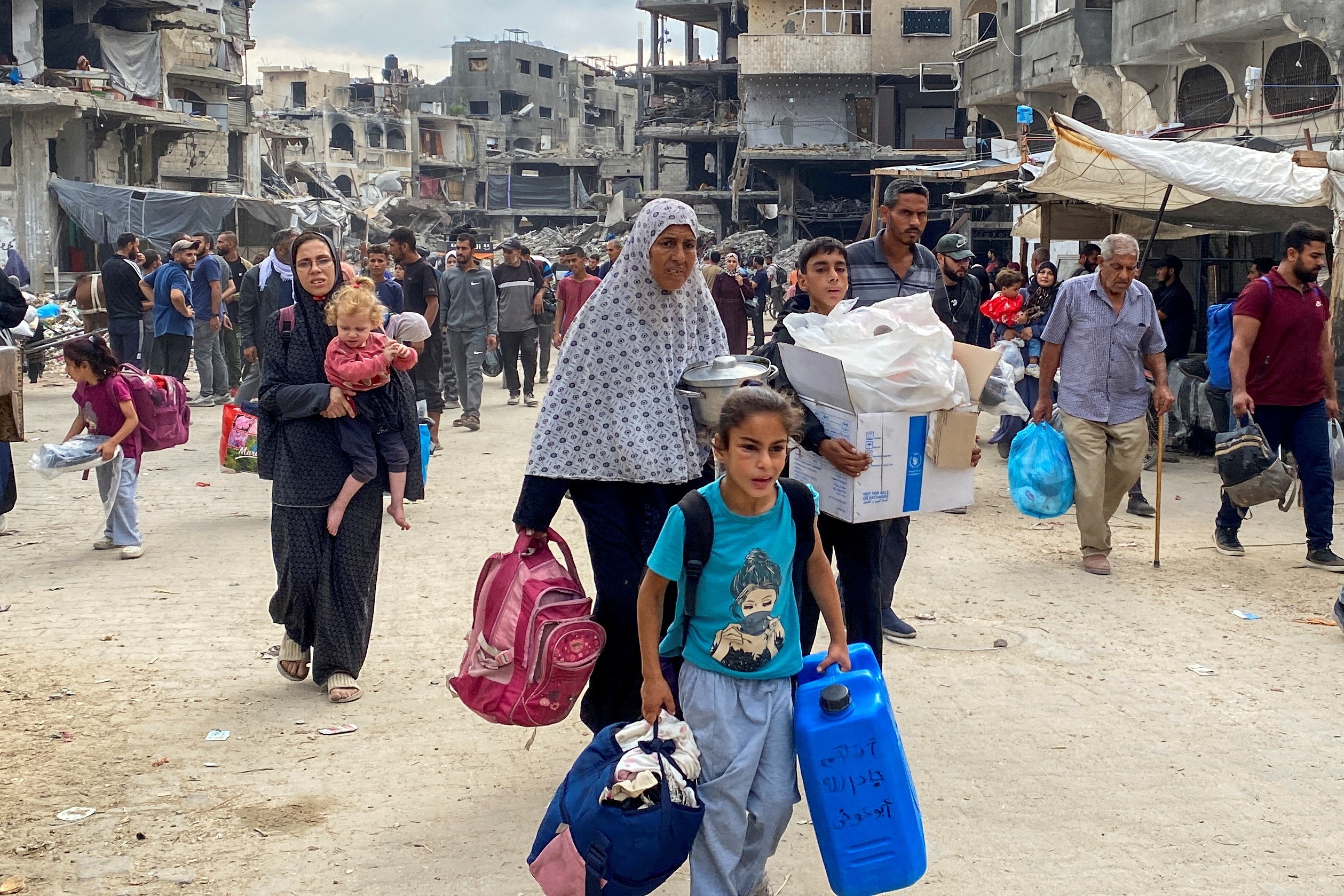
Displaced Palestinians make their way as they flee areas in northern Gaza Strip following an Israeli evacuation order, amid the Israel-Hamas conflict, in Jabalia, October 6, 2024. REUTERS/Hussam Al-Zaanin

Comments by Brian Shilhavy
Editor, Health Impact News

Returning to northern Gaza almost exactly 1 year from the start of the Hamas-Israel war on October 7, 2023, the IDF is again attacking Palestinians and forcing all the remaining Palestinians to leave northern Gaza.

Israel’s military says it has encircled Jabalya, northern Gaza and launched a new ground operation, after seeing signs of Hamas rebuilding, despite nearly a year of fighting and strikes in the territory.

Despite attention shifting to Lebanon after Israeli forces escalated their attacks on the Hezbollah militant group, Israel continues to operate across Gaza and is again focusing on an area it previously said was rid of Hamas.

Elsewhere in Gaza, at least 25 people are confirmed dead after Israeli airstrikes hit a mosque and a school in the center of the territory, hospital officials say. Israel said Hamas was embedded in both buildings. (Source.)

Dave DeCamp, writing for AntiWar.com, writes that this is part of the “general’s plan” to complete ethnic cleansing of Palestinians from areas in Gaza north of the Netzarim Corridor, paving the way for Jewish settlements in the area.

>New Israeli Assault on North Gaza Signals Start of Ethnic Cleansing Plan

Israel ordered all Palestinian civilians in northern Gaza to head south, the first step in the so-called “general’s plan” that ends with ethnic cleansing

The Israeli military has launched a fresh assault on northern Gaza and ordered all Palestinian civilians living in the north to head south, signaling Israel may be enacting an ethnic cleansing plan that has been reviewed by Prime Minister Benjamin Netanyahu.

Known as the “general’s plan” since it was drawn up by retired IDF generals, the plan would result in the complete ethnic cleansing of Palestinians from areas in Gaza north of the Netzarim Corridor, a strip of land controlled by the Israeli military that separates Gaza City and other parts of the north from the south.

The first step of the plan is to transfer the estimated 300,000 Palestinian civilians out of northern Gaza, then impose a full siege on the north to starve out remaining Hamas fighters and other Palestinians who remain. Northern Gaza would be declared a “closed military zone,” meaning anyone who remains will be targeted by the IDF.

Since Israel has bombed so-called “safe zones” throughout the war and the tent camps in the south are already extremely overcrowded, many Palestinian civilians are expected to ignore the new evacuation order. According to Al Jazeera, some Palestinians have started to head south, but Palestinian authorities are calling on civilians to ignore the Israeli evacuation order.

“Israeli claims about the presence of safe zones in southern Gaza are lies as Israel commits crimes and massacres in all areas of the enclave,” Gaza’s Interior Ministry said. “We call on citizens in northern Gaza to ignore Israeli threats.”

Israeli forces are currently focusing their renewed assault in northern Gaza on the Jabalia refugee camp and have sent tanks into the area for the first time in months.

At least 17 people, including nine children, were killed by Israeli attacks on Jabalia overnight Saturday into Sunday.

The Israeli military said it has surrounded Jabalia, while Palestinian Islamic Jihad said its fighters have targeted Israeli troops attempting to penetrate the camp.

Under the general’s plan, once Israel kills and starves the remaining Palestinians in northern Gaza, it can use the same tactics in other areas of the Strip. Israel’s assault on Lebanon and the looming Israeli attack on Iran has taken much of the world’s attention away from the genocidal war in Gaza, giving Netanyahu an opportunity to enact the ethnic cleansing plan with less global scrutiny.

The Israeli takeover of northern Gaza could pave the way for Jewish settlements in the area, an idea supported by many Israeli ministers and Knesset members. (Source.)


Chinese airlines grab market share from US and European carriers who have to fly around Russia

Inside China Business | August 15, 2024

US and European airlines are banned from Russian airspace, and so must route around the world’s largest country. This is causing much longer and costlier flights between North America and Europe, and destinations in Southeast Asia. Chinese, Korean, and Indian airlines still enjoy Russian overflight privileges, however, and can thereby offer shorter and less expensive fares. As a result, Chinese carriers are gobbling up markets and gates across international markets. Chinese airlines already operate with 30% lower costs on a passenger-mile basis compared to US- and European-flagged carriers, and their cost advantages only multiply after adjusting for the issues involving Russian airspace.

Resources and links:

Flight maps from Great Circle Maps http://www.greatcirclemap.com) and Reuters, Unfriendly skies:

How Russia’s invasion of Ukraine is redrawing air routes https://www.reuters.com/graphics/UKRA…

A year into Russian airspace ban, flight costs and lengths are rising https://globalnews.ca/news/9645165/ru…

Flight Radar, Which major airlines are still flying over Russian airspace? https://www.flightradar24.com/blog/wh…

British Airways axes one of its ‘most important’ routes amid Russian airspace ban https://www.independent.co.uk/travel/…

Reuters, British Airways to halt flights to Beijing from Oct. 26 https://www.reuters.com/business/aero…

Reuters, Foreign airlines lose interest in China as domestic carriers expand abroad https://www.reuters.com/business/aero…

Bloomberg, US Airlines Urge Officials to Block Additional China Flights https://www.bloomberg.com/news/articl…

Europe buying Russian oil via India at record rates in 2023 despite Ukraine war https://www.independent.co.uk/news/wo…

Reuters, Airbus wins reprieve from Canadian sanctions on Russian titanium https://www.reuters.com/business/aero…

[…]

Via https://alethonews.com/2024/10/06/chinese-airlines-grab-market-share-from-us-and-european-carriers-who-have-to-fly-around-russia/

Govt. Researchers: Flu Shots Not Effective in Elderly, After All

Sharyl Attkisson

An important and definitive “mainstream” government study done nearly two decades ago got little attention because the science came down on the wrong side.

It found that after decades and billions of dollars spent promoting flu shots for the elderly, the mass vaccination program did not result in saving lives. In fact, the death rate among the elderly increased substantially.

The authors of the study admitted a pro-vaccine bias going into the study. Here was the history as described to me: Public health experts long assumed flu shots were effective in the elderly. But, paradoxically, all the best studies done on the question failed to demonstrate a benefit. Instead of considering that they, the experts, could be wrong–instead of believing the scientific data–the public health experts assumed the studies were wrong. After all, flu shots have to work, right?

So the NIH launched an effort to do “the” definitive study that would actually prove, for the first time, once and for all, that flu shots were beneficial to the elderly. The government would gather some of the brightest scientific minds for the research, and adjust for all kinds of factors that could be masking that presumed benefit.

But when they finished, no matter how they crunched the numbers, the data kept telling the same story: flu shots were of no benefit to the elderly—or anyone else, it seemed. Quite the opposite. The death rate increased markedly after widespread flu vaccination among older Americans. The scientists finally had to acknowledge that decades of public health thought had been mistaken

Read on for details.

Flu shots and elderly, CBS News, Sharyl Attkisson (2006) [from original transcript]Millions of seniors swear by their annual flu shots. After all, 90% of the people killed by the flu are 65 or older. But CBS News has learned that behind the scenes, public health officials have come to a new and disturbing conclusion: mass vaccinations of the elderly haven’t done the job.Dr. Walter Orenstein was among the first to notice the problem when he headed up the Centers for Disease Control’s national immunization program. He says it’s now become a consensus among public health experts.

Dr. Orenstein: “What is absolutely clear is that there is still a substantial burden of deaths and hospitalizations out there that has not been prevented through the present strategy.”

Here’s what scientists have found. Over 20 years, the percentage of seniors getting flu shots increased sharply from 15% to 65%. It stands to reason that flu deaths among the elderly should have taken a dramatic dip making an “X” graph like this (refers to graphic). Instead, flu deaths among the elderly continued to climb.

It was hard to believe, so researchers at the National Institutes of Health set out to do a study adjusting for all kinds of factors that could be masking the true benefits of the shots. But no matter how they crunched the numbers, they got the same disappointing result: flu shots had not reduced deaths among the elderly.

In fact, the researchers said they could not correlate flu shots with reduced deaths in any age group.

It’s not what health officials hoped to find. NIH wouldn’t let us interview the study’s lead author. So we went to Boston and found the only co-author of the study not employed by NIH: Dr. Tom Reichert.

Dr. Reichert: “We realized we had incendiary material.”

Dr. Reichert said they thought their study would prove vaccinations helped.

Dr. Reichert: “We were trying to do something mainstream. That’s for sure.”

Sharyl: “Were you surprised?”

Dr. Reichert: “Astonished.”

Sharyl: “Did you check the data a couple of times to make sure?”

Dr. Reichert: “Well, even more than that. We’ve looked at other countries now and the same is true.”

That international study, soon to be published, finds the same poor results in Australia, France, Canada and the UK. And other new research stokes the idea that decades of promoting flu shots in seniors, and the billions spent, haven’t had the desired result. The current head of national immunizations confirms CDC is now looking at new strategies, but stops short of calling the present strategy a failure.

Dr. Anne Schuchat, CDC: “There’s an active dialogue about how we can do better to prevent influenza and its complications in the elderly.”

So what’s an older person to do? Oddly enough, the CDC says they should still get their flu shots. The researchers theorize it could make the flu less severe or prevent problems not reflected in the total numbers that show higher deaths as more get vaccinated.

But watch for CDC to likely shift in the near future more toward protecting the elderly in a roundabout way by pushing to vaccinate more children and others around the who could give them the flu.

(Notes: The government quickly followed this news with a recommendation to vaccinate children and infants for flu. Several years after the government study found flu shots don’t work, the vaccine industry created “high dose” flu shots that contain three to four times more antigen than the regular vaccines, as well as additional adjuvants to try to make them work better. Both of these factors may be associated with greater risk of side effects.)

[…]

Via https://sharylattkisson.substack.com/p/govt-researchers-flu-shots-not-effective

No money left to respond to hurricanes — after FEMA spends $1.4B on migrants

Hurricane Helene devastated the Southeast and killed at least 202 people.

By Steven Nelson

WASHINGTON — Homeland Security Secretary Alejandro Mayorkas set off outrage Wednesday when he told reporters that the Federal Emergency Management Agency (FEMA) “does not have the funds” to see Americans through the rest of this Atlantic hurricane season — after the agency spent more than $1.4 billion since the fall of 2022 to address the migrant crisis.

“We are meeting the immediate needs with the money that we have,” Mayorkas said during a press gaggle on Air Force One en route to tour damage from Hurricane Helene in South and North Carolina.

“We are expecting another hurricane hitting,” he added. “We do not have the funds. FEMA does not have the funds to make it through the season and what — what is imminent.”

Critics pointed out that the Department of Homeland Security (DHS) allocated $640.9 million this year in FEMA-administered funds to aid state and local governments coping with the influx of asylum seekers — though Mayorkas’ office fired back late Thursday, insisting that those funds couldn’t be used for hurricane relief because Congress authorized them specifically for the migrant crisis.

“This is easy. Mayorkas and FEMA — immediately stop spending money on illegal immigration resettlement and redirect those funds to areas hit by the hurricane. Put Americans first,” Texas Republican Gov. Greg Abbott tweeted Wednesday in response to the DHS chief.

“Yeah!” agreed Elon Musk, the billionaire owner of X and CEO of Tesla and SpaceX.

Abbott is a top critic of Mayorkas’ mass parole of asylum seekers into the US after President Biden repudiated former President Donald Trump’s “Remain in Mexico” policy — with the governor busing migrants to Democrat-led jurisdictions such as New York City, forcing local budget cuts to house them.

Over two years, more than $1.4 billion has been committed from FEMA-administered programs to support non-federal entities that are taking care of migrants.

DHS allocated $780 million for the migrant crisis last year initially through the FEMA Emergency Food and Shelter Program, which funds relief not associated with natural disasters, and then through the new FEMA Shelter and Services Program, which was authorized in late 2022 by Congress to respond to the migrant crisis.

The $640.9 million spent this year comes solely from the Shelter and Services Program.

“These claims are completely false,” DHS said in a statement Thursday to Fox News following the Republican outcry.

“As Secretary Mayorkas said, FEMA has the necessary resources to meet the immediate needs associated with Hurricane Helene and other disasters. The Shelter and Services Program (SSP) is a completely separate, appropriated grant program that was authorized and funded by Congress and is not associated in any way with FEMA’s disaster-related authorities or funding streams.”

It’s unclear if federal officials have the power to redirect migrant-focused funds to natural disaster victims.

The original program from which migrant funds flowed aimed to alleviate homelessness — with 1983 legislation setting up the Emergency Food and Shelter Program and calling for “projects and activities in civil jurisdictions with high unemployment, or in labor surplus areas, or in political units or in pockets of poverty.”

The December 2022 funding bill authorizing the split-off program for spending on migrants vaguely described the purpose as for “providing shelter and other services to families and individuals encountered by the Department of Homeland Security.”

A relatively paltry $4 million has been paid directly to families and individuals in the week since Hurricane Helene ravaged the Southeast, killing at least 202 people and causing severe flooding damage from Florida to North Carolina, White House press secretary Karine Jean-Pierre said Thursday.

Those funds are from a $10 million FEMA allocation that allows storm victims grants of $750 for groceries.

Biden said Wednesday during an operational briefing on Hurricane Helene in North Carolina that “It’s going to cost billions of dollars to deal with this storm and all the communities affected. And Congress has an obligation to ensure the states have the resources they need.”

The lack of available FEMA funds stoked outrage among congressional Republicans, who are not due back in session until after Election Day.

“The Biden-Harris administration took more than a billion tax dollars that had been allocated to FEMA for disaster relief and used it to house illegal aliens,” fumed Rep. Jim Jordan (R-Ohio). “Now, they’ve abandoned American hurricane victims in North Carolina, Georgia, Florida, South Carolina, and Tennessee.”

[…]

Via https://nypost.com/2024/10/03/us-news/feds-say-theres-no-money-left-to-respond-to-hurricanes-after-fema-used-640-9m-this-year-on-migrants/

mRNA Covid Shots May Increase Kids Risk of Asthma

mrna covid vaccine bottle and child with nebulizer

A new analysis of over 200,000 U.S. children’s health records suggests that mRNA COVID-19 vaccination increases children’s risk of asthma, Alex Berenson reported Tuesday.

Berenson, a former New York Times reporter who now reports on his Unreported Truths Substack, revealed communications with Taiwanese researchers showing they found “striking evidence” that the shots themselves may cause asthma, which leads to lung damage.

Asthma is a chronic lung disease affecting nearly 5 million U.S. children, according to the Centers for Disease Control and Prevention (CDC). While usually not fatal, severe asthma attacks can be life-threatening in children, according to the Mayo Clinic.

The Taiwanese researchers’ analysis — which the researchers are still reviewing — used electronic medical records from TriNetX, which touts itself as the “largest global source of real-world data.”

The study authors looked at TriNetX’s health data from over 200,000 U.S. kids ages 5 to 18 between Jan. 1, 2021, and Dec. 31, 2022.

According to Berenson, they found that children who received a COVID-19 mRNA shot and who had not had a natural COVID-19 infection had a 13% higher risk of receiving a new asthma diagnosis in the year after their vaccination when compared to a matched group of children who didn’t get a COVID-19 shot or infection.

“That increased risk cannot be due to Covid, since neither group was infected,” Berenson wrote.

When the researchers compared vaccinated versus unvaccinated children — all of whom also were diagnosed with a COVID-19 infection — they found an even higher risk.

Berenson reported that children who had both a COVID-19 mRNA shot and a COVID-19 infection had a 20% higher risk of a new asthma diagnosis than a similar group of unvaccinated kids who had a COVID-19 infection.

Because the study is not a randomized prospective trial it does not prove that the mRNA COVID-19 shots caused the extra asthma cases, Berenson said.

“But the researchers closely matched two very large groups,” he wrote, “and the association they found is almost certainly not due to chance.”

‘They may have some trouble getting a major or even minor journal to accept their results’

The researchers disclosed their results to Berenson in an email — which he posted on his Oct. 1 Substack post — in response to his questions about a study they published June 21 in the peer-reviewed journal Infection.

In the June study, the Taiwanese authors looked at TriNetX data records from 304,500 U.S. children and found a “strong link between COVID-19 infection and an increased risk of new-onset asthma in children.”

Though they hadn’t hypothesized that vaccination would be linked to an increase in asthma, the study authors found that the increased risk was “more marked in those vaccinated.”

Berenson wrote on Substack:

“But because the researchers had not matched the groups by vaccine status in the initial study, the vaccinated group was notably less healthy than the unvaccinated group at baseline. …So the jabbed and unjabbed cohorts could not be directly compared.”

Berenson asked the researchers in an email if they had run a parallel version of the study that directly compared outcomes by vaccination status and, if so, could they disclose the results.

“To my surprise, they responded,” Berenson told The Defender. They didn’t say when they would publish the results.

“If history is any guide,” Berenson said, “they may have some trouble getting a major or even minor journal to accept their results — journals have been very wary of publishing negative research on the mRNAs outside of myocarditis, which is an acceptable topic to discuss.”

Pediatrician: Asthma symptoms similar to anaphylaxis

Dr. Lawrence Palevsky, a pediatrician, told The Defender that many asthma symptoms are the same as those associated with anaphylaxis, a severe allergic reaction.

Coughing, wheezing, bronchospasm, shortness of breath, rapid breathing/dyspnea and hypoxia — these airway symptoms occur when the immune and nervous systems are significantly activated in response to exposure to one or more allergens the body perceives as a threat.

“If COVID injections seem to increase children’s risks of developing asthma, or anaphylaxis, this signifies there may be one or more ingredients in these injections that pose a threat to the health and safety of their immune and nervous systems,” Palevsky said. “It would make sense to avoid instigating anaphylaxis in children, no?”

Berenson criticized the CDC for continuing to recommend the COVID-19 shots for kids:

“I am stunned that the Centers for Disease Control will not admit defeat and drop its recommendation for them — though as a practical matter almost no one under 18 is getting them now.

“But in continuing to press them, the CDC is further damaging its credibility, if it has any left at this point.”

First study finds ‘strong link’ between COVID infection and asthma in kids — especially for the vaccinated

Berenson said the Taiwanese researchers’ finding about a possible link between COVID-19 vaccines and asthma was “particularly striking” because they weren’t looking for it.

They conducted the June 21 study using children’s health data from TriNetX to determine if there might be a link between COVID-19 infection and asthma.

In their report, they explained that they used a cohort-matching technique before doing their analysis to minimize the likelihood of getting biased results due to confounding factors.

Using the matching technique, they created an unvaccinated cohort and a vaccinated cohort that each had equal numbers of kids who had and hadn’t had a COVID-19 infection.

They compared the asthma diagnosis outcomes of kids who had a COVID-19 infection with the asthma diagnosis outcomes of kids who hadn’t in both the unvaccinated and vaccinated cohorts.

They found that the children infected with COVID-19 showed a significantly increased incidence of new-onset asthma during the year after the infection compared with kids who hadn’t had a COVID-19 infection — and the finding was consistent across gender, age and racial groups.

They also found that the increased risk of new-onset asthma was “more marked” in those children who had COVID-19 and also received an mRNA COVID-19 vaccine.

Berenson noted in his Oct. 2 Substack post that the Taiwanese authors’ June study has received little attention, despite the vaccine safety signals it contains.

In addition to finding that the link between COVID-19 infection and asthma was stronger in kids who got a COVID-19 shot, the study authors found that children who received a COVID-19 shot were 6 times more likely to die during the next year than kids who didn’t get a COVID-19 shot.

The most likely explanation for the difference is that the kids in the vaccinated cohort were sicker to begin with, compared to the unvaccinated. For instance, the kids in the vaccinated cohort had higher rates of diabetes and psychiatric disorders, according to Berenson who reviewed the study.

“Nonetheless,” Berenson wrote, “the gap is large enough that in any sane world researchers at the Centers for Disease Control and elsewhere would be following it up, if only to rule it out and figure out if other databases have any similar signals.”

The Taiwanese authors noted in their June study that other recent studies have also found a link between viral infections — including COVID-19 — and asthma.

However, there is still scientific debate about the degree to which that may occur in children.

A 2022 study published in BMC Infectious Diseases that analyzed roughly 70 kids hospitalized for COVID-19 reported that 41.5% had asthma-like symptoms when discharged. Less than 16% of those children had a history of asthma when admitted to the hospital. The study did not report vaccination status.

However, an April study published in Pediatrics involving almost 30,000 children concluded that testing positive for COVID-19 wasn’t associated with a new asthma diagnosis within 18 months of the infection.

[…]

Via https://childrenshealthdefense.org/defender/covid-mrna-vaccine-kids-asthma/

Medieval Tales of Heroes and Lovers

El Cid (1961) - Posters — The Movie Database (TMDB)

Episode 14 Medieval Tales of Heroes and Lovers

The Middle Ages Around the World

Dr Joyce E Salisbury

Film Review

England

Committed to writing from oral tradition in the 7th century, Beowulf is the most famous poem in Middle English. Set in pagan Scandinavia* in the 5th and 6th century, its hero Beowulf kills a man-eating monster.

France

Song of Roland – 12th century epic poem concerning one of Charlemagne’s knights who was killed in 778 while withdrawing from Spain.

12th-13th century – Era of courtly love in southern France fostered by female patrons (Eleanor of Aquitaine, Marie of Champagne), who ruled while their husbands were away at war. Hiring wandering troubadours to entertain with songs and poems of romantic love, Marie of Champagne was the patron of Chretien de Troyes. The latter wrote the first Arthurian romances about the quest for the Holy Grain (the cup Jesus drank from at the last supper).

The best known example of this tradition is Roman de la Rose  (1225) by Guillaume de Lorris. It was based on the fervent conviction that romantic love made people stronger, more noble and more successful in battle.

Spain

Song of El Cid, 12th century poem about the legendary 11th centry knight Rodrigo Diaz de Vivar who spent his life fighting Muslims.

Africa

The Grots were traveling Africans who told heroic tales. One of the most famous concerned Sundida Keita, the legendary founder of the Mali empire. Born crippled in 1215, he possessed supernatural powers and his kingship was foretold at his birth.His exploits were passed on orally until they were committed to writing in the 19th century.

Tibet

Epic of Gesar – Kingdom of Tibet origin story (which also concerns Tibet’s conversion to Buddhism) dating from the 8th century and committed to writing in the 12th century. Most scholars believe Gesar was a real person

Tang Dynasty

Song of Everlasting Regret – literary masterpiece by  famous Chinese poet Bai Juyi (772–846) about an emperor’s love affair with his concubine that interferes with his duty.

Heian Court Japan

Best known for 11th century lady-in- waiting Murasak, whose writing would inspire the Geisha tradition. Her best known work is The Tale of Gengi, concerning an emperor looking for love. During the Middle Ages, husbands and wives from the Japanese elite lived separately and took lovers.


*Both the Angles and Saxons are believed to have originated in southern Scandinavia.

Film available free with a library card from Kanopy.

https://www.kanopy.com/en/pukeariki/watch/video/13172786/13172815